BIOREMEDIATION
 Use of different biological systems to destroy or reduce
concentrations of contaminants from polluted sites.
 Manages microbes and plants to reduce, eliminate, contain
or transform contaminants present in soils, sediments, water
or air.
 Microbes and plants have a natural capability to decrease or
reduce:
 Mass
 Toxicity
 Volume
 Concentration of pollutants
without human interventions.
(Rittmann, B. E, McCarty, P. L. 2001)
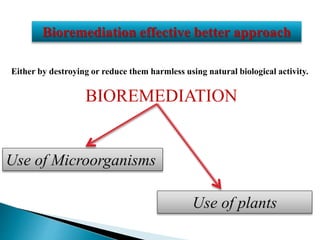
Bioremediation effective better approach
Either by destroying or reduce them harmless using natural biological activity.
Use of plants
Use of Microorganisms
BIOREMEDIATION
Outcomes of Biodegradation
1. A minor change in an organic molecule leaving the main
structure intact.
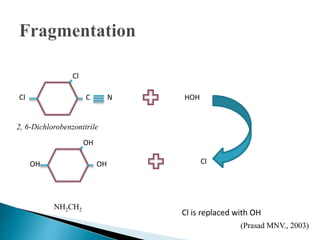
2. Fragmentation of a complex organic structure in such a way that
the fragments could be reassembled to yield the original
structure.
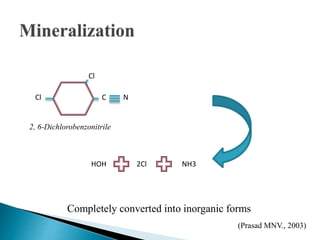
3. Complete mineralization, which in the transformation of
organic molecules to mineral forms.
One example to describe all 3 types
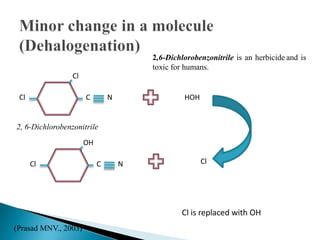
2, 6-Dichlorobenzonitrile (Marshall, F. M., 2009)
Cl
Cl C N HOH
Cl
Cl is replaced with OH
OH
Cl C N
2, 6-Dichlorobenzonitrile
(Prasad MNV., 2003)
2,6-Dichlorobenzonitrile is an herbicide and is
toxic for humans.
Cl
Cl C N HOH
Cl
Cl is replaced with OH
OH
OH OH
2, 6-Dichlorobenzonitrile
NH2CH2
(Prasad MNV., 2003)
NH32ClHOH
Completely converted into inorganic forms
Cl
Cl C N
2, 6-Dichlorobenzonitrile
(Prasad MNV., 2003)
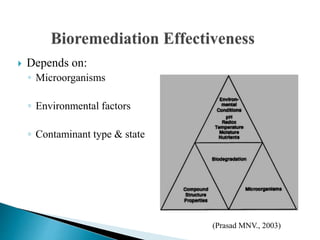
 Depends on:
◦ Microorganisms
◦ Environmental factors
◦ Contaminant type & state
(Prasad MNV., 2003)
 Aerobic bacteria:
◦ Shown to degrade pesticides and hydrocarbons; alkanes and polyaromatics.
◦ May be able to use the contaminant as sole source of carbon and energy.
 Methanotrophs:
◦ Aerobic bacteria that utilize methane for carbon and energy.
◦ Methane monooxygenase has a broad substrate range.
 active against a wide range of compounds (e.g. chlorinated aliphatics such
as trichloroethylene and 1,2-dichloroethane)
 Anaerobic bacteria:
◦ Not used as frequently as aerobic bacteria.
◦ Can often be applied to bioremediation of polychlorinated biphenyls (PCBs)
in river sediments, trichloroethylene (TCE) and chloroform.
 Fungi:
◦ Able to degrade a diverse range of persistent or toxic environmental
pollutants.
(Bodishbaugh, D.F., 2006)
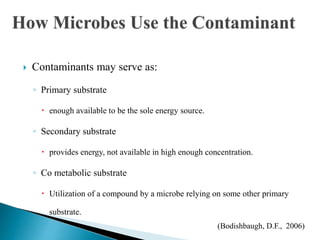
 Contaminants may serve as:
◦ Primary substrate
 enough available to be the sole energy source.
◦ Secondary substrate
 provides energy, not available in high enough concentration.
◦ Co metabolic substrate
 Utilization of a compound by a microbe relying on some other primary
substrate.
(Bodishbaugh, D.F., 2006)
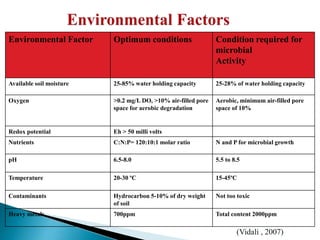
Environmental Factor Optimum conditions Condition required for
microbial
Activity
Available soil moisture 25-85% water holding capacity 25-28% of water holding capacity
Oxygen >0.2 mg/L DO, >10% air-filled pore
space for aerobic degradation
Aerobic, minimum air-filled pore
space of 10%
Redox potential Eh > 50 milli volts
Nutrients C:N:P= 120:10:1 molar ratio N and P for microbial growth
pH 6.5-8.0 5.5 to 8.5
Temperature 20-30 ºC 15-45ºC
Contaminants Hydrocarbon 5-10% of dry weight
of soil
Not too toxic
Heavy metals 700ppm Total content 2000ppm
(Vidali , 2007)
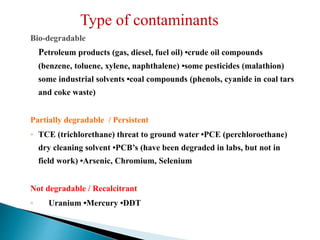
Bio-degradable
Petroleum products (gas, diesel, fuel oil) •crude oil compounds
(benzene, toluene, xylene, naphthalene) •some pesticides (malathion)
some industrial solvents •coal compounds (phenols, cyanide in coal tars
and coke waste)
Partially degradable / Persistent
◦ TCE (trichlorethane) threat to ground water •PCE (perchloroethane)
dry cleaning solvent •PCB’s (have been degraded in labs, but not in
field work) •Arsenic, Chromium, Selenium
Not degradable / Recalcitrant
◦ Uranium •Mercury •DDT
Type of contaminants
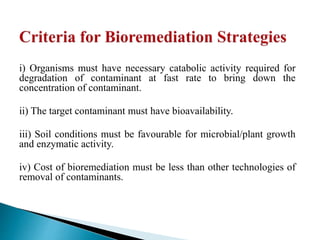
i) Organisms must have necessary catabolic activity required for
degradation of contaminant at fast rate to bring down the
concentration of contaminant.
ii) The target contaminant must have bioavailability.
iii) Soil conditions must be favourable for microbial/plant growth
and enzymatic activity.
iv) Cost of bioremediation must be less than other technologies of
removal of contaminants.
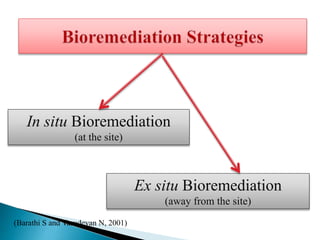
In situ Bioremediation
(at the site)
Ex situ Bioremediation
(away from the site)
(Barathi S and Vasudevan N, 2001)
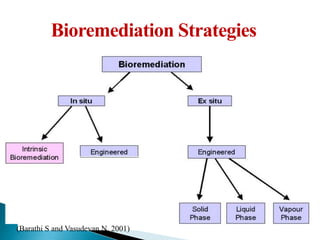
Bioremediation Strategies
(Barathi S and Vasudevan N, 2001)
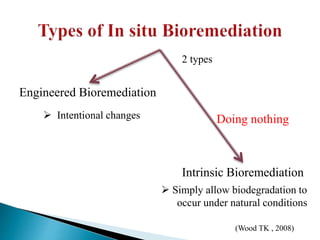
Engineered Bioremediation
Intrinsic Bioremediation
2 types
 Intentional changes
 Simply allow biodegradation to
occur under natural conditions
(Wood TK , 2008)
Doing nothing
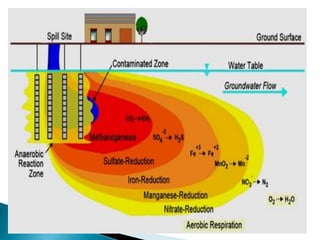
 In situ bioremediation is when the contaminated site is cleaned up
exactly where it occurred.
 There is no need to excavate or remove soils or water in order to
complete remediation.
 In situ biodegradation involves supplying oxygen and nutrients by
circulating aqueous solutions through contaminated soils to stimulate
naturally occurring bacteria to degrade organic contaminants. It can be
used for soil and groundwater.
 It is the most commonly used type of bioremediation because it is the
cheapest and most efficient, so it’s generally better to use.
(Wood TK , 2008)
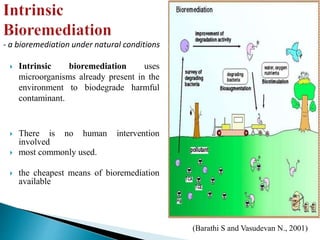
 Intrinsic bioremediation uses
microorganisms already present in the
environment to biodegrade harmful
contaminant.
 There is no human intervention
involved
 most commonly used.
 the cheapest means of bioremediation
available
(Barathi S and Vasudevan N., 2001)
- a bioremediation under natural conditions
 The second approach involves the introduction of certain
microorganisms to the site of contamination.
 Engineered in situ bioremediation accelerates the degradation
process by enhancing the physicochemical conditions to encourage
the growth of microorganisms.
 Oxygen, electron acceptors and nutrients (nitrogen and phosphorus)
promote microbial growth.
(Barathi S, Vasudevan N., 2001)
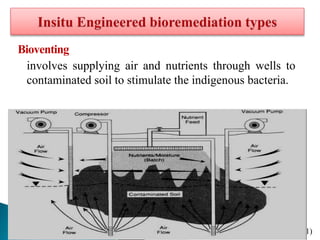
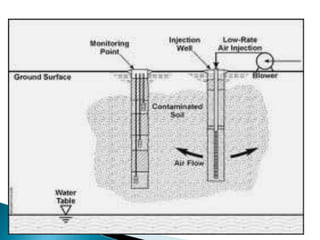
Bioventing
involves supplying air and nutrients through wells to
contaminated soil to stimulate the indigenous bacteria.
(Vidali,M., 2001)
involves the injection of air under pressure below the
water table to increase groundwater oxygen
concentrations
used to reduce concentrations of petroleum
constituents that are dissolved in
groundwater
preffered for diesel fuel, jet fuel); lighter
petroleum products (e.g., gasoline) tend to
volatilize readily and to be removed more
rapidly using air Sparging.
(Vidali,M.2001)
• Bioaugmentation
the addition of bacterial cultures required to
speed up the rate of degradation of a
contaminant
The purpose of bioaugmentation is to
supplement the existing microbial community in
order to improve its functionality
(Rittmann B.E and McCarty, P.L. 2001)
(Source: http://ndpublisher.in/ndpjournal.php?j=IJAEB)
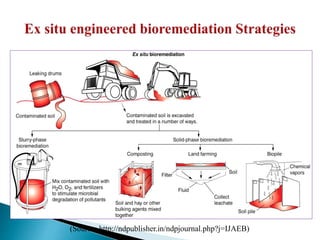
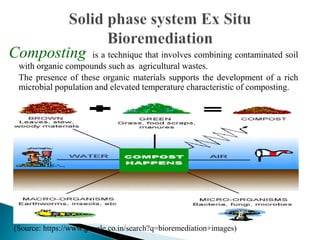
Composting is a technique that involves combining contaminated soil
with organic compounds such as agricultural wastes.
The presence of these organic materials supports the development of a rich
microbial population and elevated temperature characteristic of composting.
(Source: https://www.google.co.in/search?q=bioremediation+images)
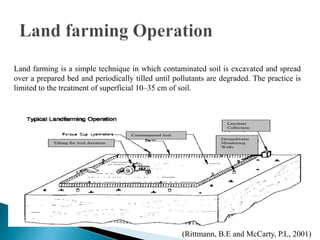
Land farming is a simple technique in which contaminated soil is excavated and spread
over a prepared bed and periodically tilled until pollutants are degraded. The practice is
limited to the treatment of superficial 10–35 cm of soil.
(Rittmann, B.E and McCarty, P.L, 2001)
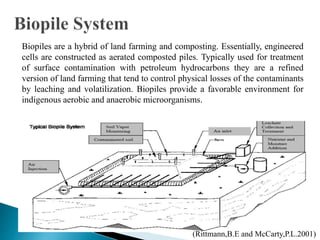
Biopiles are a hybrid of land farming and composting. Essentially, engineered
cells are constructed as aerated composted piles. Typically used for treatment
of surface contamination with petroleum hydrocarbons they are a refined
version of land farming that tend to control physical losses of the contaminants
by leaching and volatilization. Biopiles provide a favorable environment for
indigenous aerobic and anaerobic microorganisms.
(Rittmann,B.E and McCarty,P.L.2001)

Bioremediation

  • 1.
  • 2.
     Use ofdifferent biological systems to destroy or reduce concentrations of contaminants from polluted sites.  Manages microbes and plants to reduce, eliminate, contain or transform contaminants present in soils, sediments, water or air.  Microbes and plants have a natural capability to decrease or reduce:  Mass  Toxicity  Volume  Concentration of pollutants without human interventions. (Rittmann, B. E, McCarty, P. L. 2001)
  • 3.
    Bioremediation effective betterapproach Either by destroying or reduce them harmless using natural biological activity. Use of plants Use of Microorganisms BIOREMEDIATION
  • 4.
    Outcomes of Biodegradation 1.A minor change in an organic molecule leaving the main structure intact. 2. Fragmentation of a complex organic structure in such a way that the fragments could be reassembled to yield the original structure. 3. Complete mineralization, which in the transformation of organic molecules to mineral forms. One example to describe all 3 types 2, 6-Dichlorobenzonitrile (Marshall, F. M., 2009)
  • 5.
    Cl Cl C NHOH Cl Cl is replaced with OH OH Cl C N 2, 6-Dichlorobenzonitrile (Prasad MNV., 2003) 2,6-Dichlorobenzonitrile is an herbicide and is toxic for humans.
  • 6.
    Cl Cl C NHOH Cl Cl is replaced with OH OH OH OH 2, 6-Dichlorobenzonitrile NH2CH2 (Prasad MNV., 2003)
  • 7.
    NH32ClHOH Completely converted intoinorganic forms Cl Cl C N 2, 6-Dichlorobenzonitrile (Prasad MNV., 2003)
  • 8.
     Depends on: ◦Microorganisms ◦ Environmental factors ◦ Contaminant type & state (Prasad MNV., 2003)
  • 9.
     Aerobic bacteria: ◦Shown to degrade pesticides and hydrocarbons; alkanes and polyaromatics. ◦ May be able to use the contaminant as sole source of carbon and energy.  Methanotrophs: ◦ Aerobic bacteria that utilize methane for carbon and energy. ◦ Methane monooxygenase has a broad substrate range.  active against a wide range of compounds (e.g. chlorinated aliphatics such as trichloroethylene and 1,2-dichloroethane)  Anaerobic bacteria: ◦ Not used as frequently as aerobic bacteria. ◦ Can often be applied to bioremediation of polychlorinated biphenyls (PCBs) in river sediments, trichloroethylene (TCE) and chloroform.  Fungi: ◦ Able to degrade a diverse range of persistent or toxic environmental pollutants. (Bodishbaugh, D.F., 2006)
  • 10.
     Contaminants mayserve as: ◦ Primary substrate  enough available to be the sole energy source. ◦ Secondary substrate  provides energy, not available in high enough concentration. ◦ Co metabolic substrate  Utilization of a compound by a microbe relying on some other primary substrate. (Bodishbaugh, D.F., 2006)
  • 11.
    Environmental Factor Optimumconditions Condition required for microbial Activity Available soil moisture 25-85% water holding capacity 25-28% of water holding capacity Oxygen >0.2 mg/L DO, >10% air-filled pore space for aerobic degradation Aerobic, minimum air-filled pore space of 10% Redox potential Eh > 50 milli volts Nutrients C:N:P= 120:10:1 molar ratio N and P for microbial growth pH 6.5-8.0 5.5 to 8.5 Temperature 20-30 ºC 15-45ºC Contaminants Hydrocarbon 5-10% of dry weight of soil Not too toxic Heavy metals 700ppm Total content 2000ppm (Vidali , 2007)
  • 12.
    Bio-degradable Petroleum products (gas,diesel, fuel oil) •crude oil compounds (benzene, toluene, xylene, naphthalene) •some pesticides (malathion) some industrial solvents •coal compounds (phenols, cyanide in coal tars and coke waste) Partially degradable / Persistent ◦ TCE (trichlorethane) threat to ground water •PCE (perchloroethane) dry cleaning solvent •PCB’s (have been degraded in labs, but not in field work) •Arsenic, Chromium, Selenium Not degradable / Recalcitrant ◦ Uranium •Mercury •DDT Type of contaminants
  • 13.
    i) Organisms musthave necessary catabolic activity required for degradation of contaminant at fast rate to bring down the concentration of contaminant. ii) The target contaminant must have bioavailability. iii) Soil conditions must be favourable for microbial/plant growth and enzymatic activity. iv) Cost of bioremediation must be less than other technologies of removal of contaminants.
  • 14.
    In situ Bioremediation (atthe site) Ex situ Bioremediation (away from the site) (Barathi S and Vasudevan N, 2001)
  • 15.
  • 16.
    Engineered Bioremediation Intrinsic Bioremediation 2types  Intentional changes  Simply allow biodegradation to occur under natural conditions (Wood TK , 2008) Doing nothing
  • 17.
     In situbioremediation is when the contaminated site is cleaned up exactly where it occurred.  There is no need to excavate or remove soils or water in order to complete remediation.  In situ biodegradation involves supplying oxygen and nutrients by circulating aqueous solutions through contaminated soils to stimulate naturally occurring bacteria to degrade organic contaminants. It can be used for soil and groundwater.  It is the most commonly used type of bioremediation because it is the cheapest and most efficient, so it’s generally better to use. (Wood TK , 2008)
  • 18.
     Intrinsic bioremediationuses microorganisms already present in the environment to biodegrade harmful contaminant.  There is no human intervention involved  most commonly used.  the cheapest means of bioremediation available (Barathi S and Vasudevan N., 2001) - a bioremediation under natural conditions
  • 19.
     The secondapproach involves the introduction of certain microorganisms to the site of contamination.  Engineered in situ bioremediation accelerates the degradation process by enhancing the physicochemical conditions to encourage the growth of microorganisms.  Oxygen, electron acceptors and nutrients (nitrogen and phosphorus) promote microbial growth. (Barathi S, Vasudevan N., 2001)
  • 20.
    Bioventing involves supplying airand nutrients through wells to contaminated soil to stimulate the indigenous bacteria. (Vidali,M., 2001)
  • 21.
    involves the injectionof air under pressure below the water table to increase groundwater oxygen concentrations used to reduce concentrations of petroleum constituents that are dissolved in groundwater preffered for diesel fuel, jet fuel); lighter petroleum products (e.g., gasoline) tend to volatilize readily and to be removed more rapidly using air Sparging. (Vidali,M.2001)
  • 23.
    • Bioaugmentation the additionof bacterial cultures required to speed up the rate of degradation of a contaminant The purpose of bioaugmentation is to supplement the existing microbial community in order to improve its functionality (Rittmann B.E and McCarty, P.L. 2001)
  • 25.
  • 26.
    Composting is atechnique that involves combining contaminated soil with organic compounds such as agricultural wastes. The presence of these organic materials supports the development of a rich microbial population and elevated temperature characteristic of composting. (Source: https://www.google.co.in/search?q=bioremediation+images)
  • 27.
    Land farming isa simple technique in which contaminated soil is excavated and spread over a prepared bed and periodically tilled until pollutants are degraded. The practice is limited to the treatment of superficial 10–35 cm of soil. (Rittmann, B.E and McCarty, P.L, 2001)
  • 28.
    Biopiles are ahybrid of land farming and composting. Essentially, engineered cells are constructed as aerated composted piles. Typically used for treatment of surface contamination with petroleum hydrocarbons they are a refined version of land farming that tend to control physical losses of the contaminants by leaching and volatilization. Biopiles provide a favorable environment for indigenous aerobic and anaerobic microorganisms. (Rittmann,B.E and McCarty,P.L.2001)