Bioremediation
Presented By,
Ananya Azad Hrisha
Objectives
• Bioremediation
• How it works?
• Essential Factors for microbial Bioremediation
• Bioremediation Methods & Types
• Microbes involved in Bioremediation
• Advantages & Disadvantages of Bioremediation
• Application of Bioremediation
• Some Bioremediation related technologies.
What is Bioremediation?
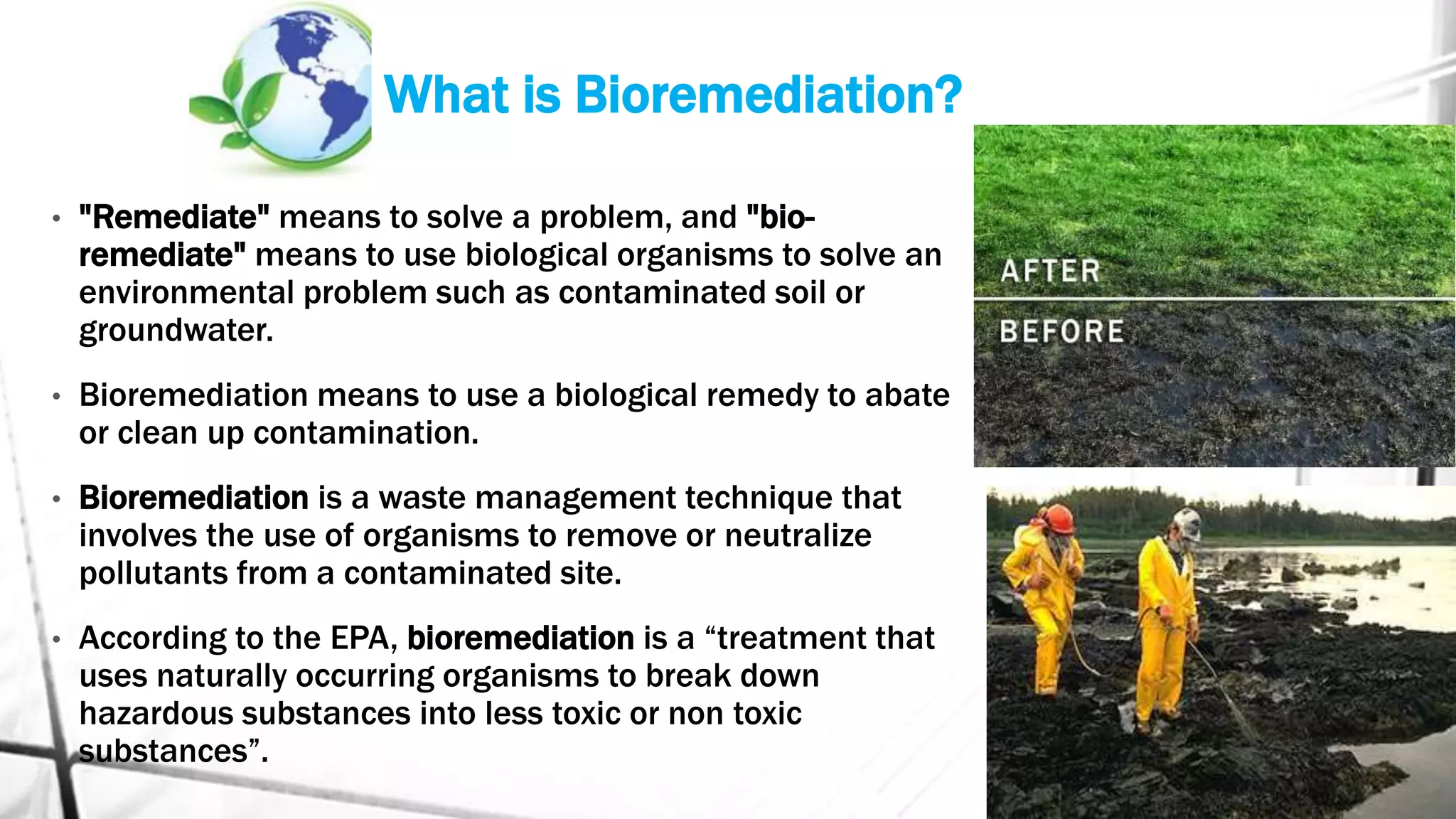
• "Remediate" means to solve a problem, and "bio-
remediate" means to use biological organisms to solve an
environmental problem such as contaminated soil or
groundwater.
• Bioremediation means to use a biological remedy to abate
or clean up contamination.
• Bioremediation is a waste management technique that
involves the use of organisms to remove or neutralize
pollutants from a contaminated site.
• According to the EPA, bioremediation is a “treatment that
uses naturally occurring organisms to break down
hazardous substances into less toxic or non toxic
substances”.
What is Bioremediation?
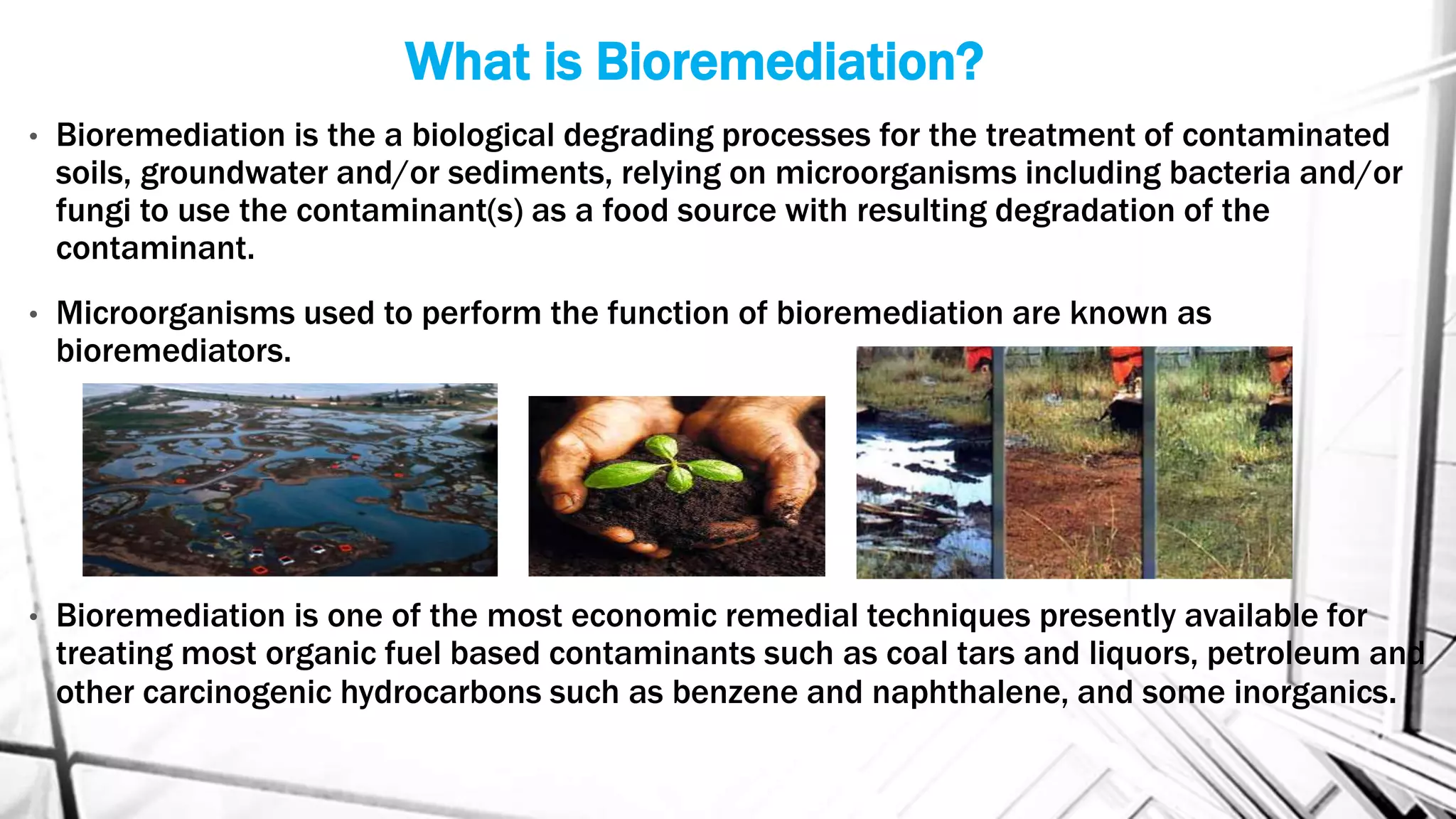
• Bioremediation is the a biological degrading processes for the treatment of contaminated
soils, groundwater and/or sediments, relying on microorganisms including bacteria and/or
fungi to use the contaminant(s) as a food source with resulting degradation of the
contaminant.
• Microorganisms used to perform the function of bioremediation are known as
bioremediators.
• Bioremediation is one of the most economic remedial techniques presently available for
treating most organic fuel based contaminants such as coal tars and liquors, petroleum and
other carcinogenic hydrocarbons such as benzene and naphthalene, and some inorganics.
Organisms
Pollutants
Environments
Inorganic Organic
Solid
Liquid
Gas
Soil
Water
Air
Microorganisms
Plants
Enzymes
How Does It Work?
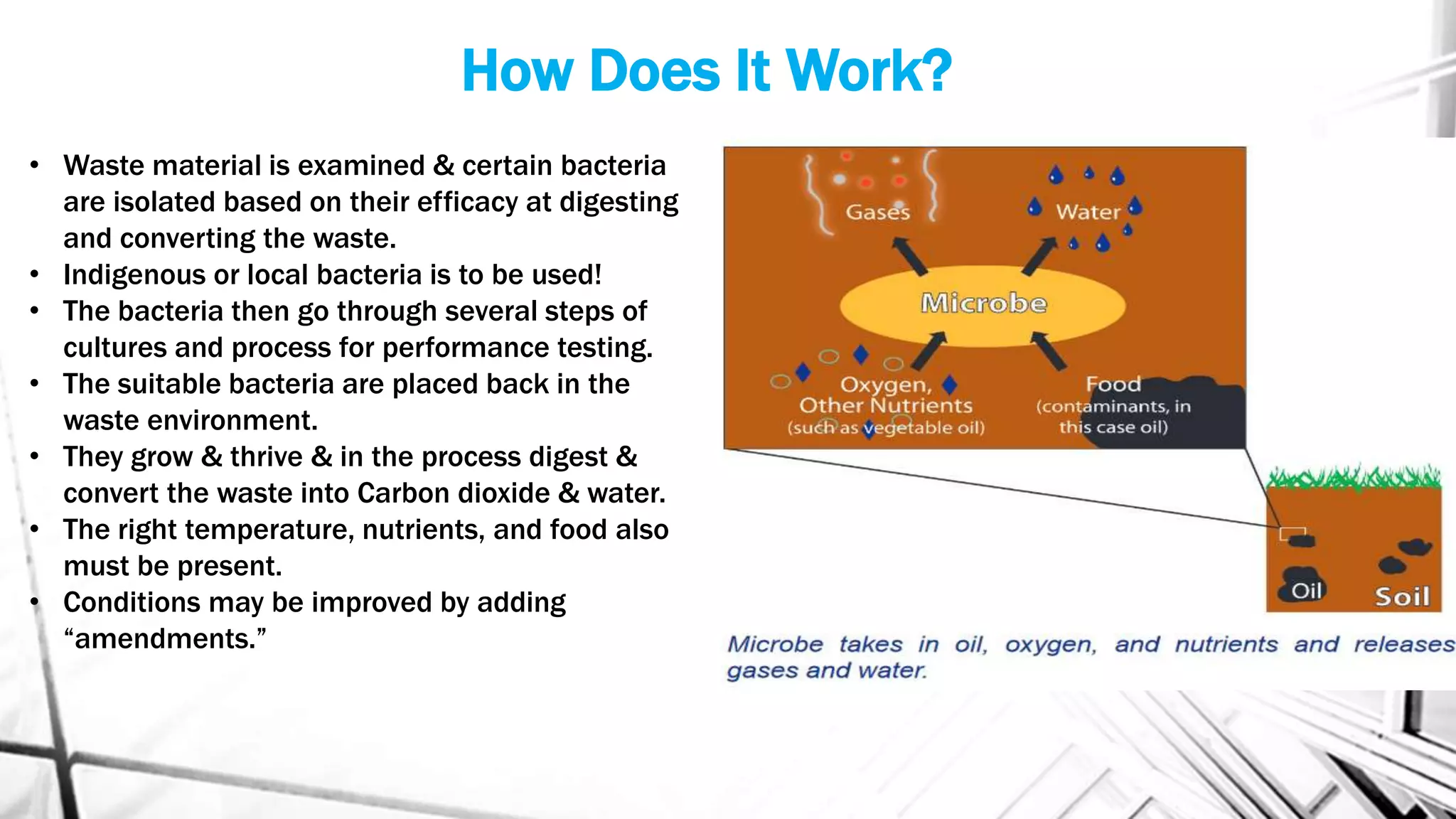
• Waste material is examined & certain bacteria
are isolated based on their efficacy at digesting
and converting the waste.
• Indigenous or local bacteria is to be used!
• The bacteria then go through several steps of
cultures and process for performance testing.
• The suitable bacteria are placed back in the
waste environment.
• They grow & thrive & in the process digest &
convert the waste into Carbon dioxide & water.
• The right temperature, nutrients, and food also
must be present.
• Conditions may be improved by adding
“amendments.”
ESSENTIAL FACTORS FOR MICROBIAL
BIOREMEDIATION
Factor Desired Conditions
Microbial population
Suitable kinds of organisms that can
biodegrade all of the contaminants
Oxygen
Enough to support aerobic biodegradation
(about 2% oxygen in the gas phase or 0.4
mg/liter in the soil water)
Water
Soil moisture should be from 50–70% of the
water holding capacity of the soil
Nutrients
Nitrogen, phosphorus, sulfur, and other
nutrients to support good microbial growth
Temperature
Appropriate temperatures for microbial
growth (0–40˚C)
pH Best range is from 6.5 to 7.5
Bioremediation
In situ
- At the site
-treatment of contaminated material
in place
- Ex – Benzene, Toluene, TNT, 2,4-D
- only certain types of soils can be
bioremediated in-situ
- complete degradation is often difficult to
achieve
- Away from site
- Techniques involve physical removal of
the contaminated material for treatment
process
- Ex- Bio-piles, soil treatment unit,
Compost pile , Windrows etc. &
-use of bioreactors to process the material
in a highly controlled environment.
Ex Situ
TYPES OF BIOREMEDIATION :
1. Biostimulation 2. Bioaugmentation 3. Intrinsic Bioremediation
• The method in which bacteria are
motivated to start the process of
bioremediation.
• In this method, first the experts
release nutrients and other
important substances in the soil
where there is need or removing the
contaminants.
• These are in the form of gas or
liquid. It increases the growth of
microbes in that area.
• As a result bacteria and other
microorganisms remove the
contaminants quickly and efficiently.
• Microorganisms that can clean up
a particular contaminant are
added to the contaminated soil
and water.
• Bioaugmentation is more
commonly and successfully used
on contaminants removed from
the original site, such as
municipal waste water treatment
facilities.
• Process takes place in soil and water
because these two places are always
full of contaminants and toxins.
• This process is also called as natural
attenuation.
• Also means use of the
microorganisms to remove the
harmful substances from soil and
water.
• Especially those sites are treated with
this method, which are underground,
for example underground petroleum
tanks.
Bioremediation by Bacteria
 Genetically engineered bacteria (Pseudomonas)
with plasmid producing enzymes to degrade octane
and many different organic compounds from crude
oil.
• A selected list of genetically engineered
microorganisms.
 Candida can degrade formaldehyde.
 Gibeberella can degrade cyanide.
 White rot fungi can degrade organic
pollutants in soil and effluent and decolorize
kraft black liquor, e.g. Phanerochaete
chrysosporium can produce aromatic
mixtures with its lignolytic system.
 Pentachlorophenol,dichlorodiphenyltrichloro
ethane (e.g. DDT), even TNT (trinitrotoluene)
can be degraded by white rot fungi.
Bioremediation by Fungi
 METABOLIC EFFECT OF MO’S ON
XENOBIOTICS:
¤ Detoxification ¤ Activation
¤ Degradation ¤ Conjugation
Advantages:
• Low cost.
• Minimal site disruption.
• Simultaneous treatment of contaminated water
and soil.
• Minimal exposure of public & site personnel.
• Useful for the complete destruction of a wide
variety of contaminants.
• Can often be carried out on site, often without
causing a major disruption of normal activities
• Can prove less expensive than other
technologies that are used for cleanup of
hazardous waste.
Disadvantages:
• Time consuming.
• Seasonal variation.
• Problematic addition of additives.
• Limited to those compounds that are
biodegradable.
• Not all compounds are susceptible to rapid
and complete degradation.
• There are some concerns that the products
of biodegradation may be more persistent or
toxic than the parent compound.
• difficult to extrapolate (deduce) from bench
and pilot-scale studies to fullscale field
operations.
• Biological processes are often highly specific.
microbial populations, suitable
environmental growth conditions, and
appropriate levels of nutrients and
contaminants.
Applications of Bioremediation
 Bioremediation is used in following ways:
 Bioremediation of contaminated soil
 Bioremediation of aquifer
 Bioremediation of marine oil
pollutants
 Bioremediation of industrial waste
 Slurry-phase bioremediation is useful too
but only for small amounts of
contaminated soil.
 Composting can be used to degrade
household wastes.
Environmental
cleanup
Joint action of
Govt.(various
ministries and
their
departments)
Novel lab level
research
Pilot Scale
experiments
Bioremediation of Contaminated Soil
In-situ bioremediation of soil:
• Allows treatment of a large volume of soil
at once.
• Mostly effective at sites with sandy soils.
• Can vary depending on the method of
supplying oxygen or electron donors to the
organisms that degrade the contaminants.
• Three commonly used in-situ methods
include:
 Bioventing
 Injection of hydrogen peroxide or oxygen
releasing compound (ORC) for aerobic treatment
 Injection of HRC for anaerobic treatment
Ex-situ Bioremediation of soil:
• Involves excavation of the
contaminated soil and treating in a
treatment plant located on the site or
away from the site.
• This approach can be faster, easier to
control, and used to treat a wider range
of contaminants and soil types than in-
situ approach.
• Ex-situ bioremediation can be
implemented as:
 Slurry-phase bioremediation, or
 Solid-phase bioremediation
Contained Solid
Phase
Compost
ing
Land
farming
• In slurry-phase bioremediation - the contaminated soil is mixed with water to create a
slurry. The slurry is aerated, and the contaminants are aerobically biodegraded. The
treatment can take place on-site, or the soils can be removed and transported to a
remote location for treatment. The process generally takes place in a tank or vessel (a
"bioreactor"), but can also take place in a lagoon.
• In solid-phase bioremediation - soil is treated above ground treatment areas equipped
with collection systems to prevent any contaminant from escaping the treatment.
Moisture, heat, nutrients, or oxygen are controlled to enhance bioremediation for the
application of this treatment.
• Solid-phase systems are relatively simple to operate and maintain, require large amount
of space, and cleanups require more time to complete than slurry-phase processes.
Bioremediation of Contaminated Soil
Bioremediation of Aquifer
• In situ bioremediation (ISB) of groundwater involves the encouragement of indigenous
bacterial populations to metabolize target contaminants through the addition of various
amendments (biostimulation) to the subsurface environment.
• In addition to amendments, select strains of bacteria may be added to the subsurface to
help treat some sites (bioaugmentation).
• Bacteria perform coupled oxidation/reduction (redox) reactions to live, and bioremediation
exploits these reactions to remove contaminants from contaminated media (groundwater).
• Bacteria can use different electron acceptors (oxidized compounds) and donors (reduced compounds) in the
three major oxidation pathways —
• Aerobic respiration,
• Anaerobic respiration, and
• Fermentation.
• ISB can use all of these pathways, and contaminant degradation may occur through
• Direct metabolism,
• Cometabolism, or
• Abiotic transformations that may result from biological activities.
Bioremediation of Aquifer
Bioremediation of Marine Oil Spills
• Useful process for removing marine oil pollutants.
• The application of oleophilic fertilizer is a useful bioremediation strategy.
• Marine oil spills are very catastrophic events which pose a great threat on the affected
environment.
• Marine oil spills are mainly oils, petroleum, fuel etc. composed of complex hydrocarbons.
• Addition of microbial seeding or inoculum that are capable of degrading hydrocarbons.
• Most microorganisms considered for seeding are obtained from enriched cultures (from a
previously contaminated site).
• After inoculum addition, fertilizer is added, then environmental modification is done ,
adequate aeration, nutrient source is a prerequisite.
• Bioremediation for marine oil spills can be approached in two different ways depending on
the case at hand. This includes bioaugmentation which involves introducing oil degrading
microorganisms to the affected site, and also biostimulation which involves adding
supplemental nutrients to the affected site to aid the existing oil degrading microorganisms.
Bioremediation of Marine Oil Spills
Bioremediation of Air Pollutants
• Microorganisms are used for air emission control in 3 types of devices:
a. Biofilter
b. Bioscrubbers
c. Trickling Filter
a c
b
Bioremediation related technologies
• Phytoremediation - bioremediation through the use of plants that mitigate the environmental problem
without the need to excavate the contaminant material and dispose of it elsewhere.
• Bioventing - an in situ remediation technology that uses microorganisms to biodegrade organic
constituents in the groundwater system.
• Bioleaching - the extraction of metals from their ores through the use of living organisms.
• Landfarming - an ex-situ waste treatment process that is performed in the upper soil zone or in
biotreatment cells.
• Bioreactor - any manufactured or engineered device or system that supports a biologically active
environment.
• Vermicomposting - using various worms, usually red wigglers, white worms, and other earthworms to
create a heterogeneous mixture of decomposing vegetable or food waste, bedding materials, and
vermicast.
• Rhizofiltration - is a form of phytoremediation that involves filtering water through a mass of roots to
remove toxic substances or excess nutrients.
References
• Microbial Ecology by Atlas & Bartha
• Various Webpages including:
• Wikipedia
• http://ei.cornell.edu/biodeg/bioremed/
• http://www.pollutionissues.com/A-Bo/Bioremediation.html
• http://www.soilutions.co.uk/services/soil-remediation/bioremediation/
• http://www.slideplayer.com/slide/1523117/#
• http://krockne.people.uic.edu/proceeding9.pdf
• https://clu-
in.org/download/remed/introductiontoinsitubioremediationofgroundwater_dec2013.
pdf
• http://home.engineering.iastate.edu/~tge/ce421-521/matt-r.pdf
• A Citizen’s Guide To Bioremediation
Bioremediation

Bioremediation

  • 1.
  • 2.
    Objectives • Bioremediation • Howit works? • Essential Factors for microbial Bioremediation • Bioremediation Methods & Types • Microbes involved in Bioremediation • Advantages & Disadvantages of Bioremediation • Application of Bioremediation • Some Bioremediation related technologies.
  • 3.
    What is Bioremediation? •"Remediate" means to solve a problem, and "bio- remediate" means to use biological organisms to solve an environmental problem such as contaminated soil or groundwater. • Bioremediation means to use a biological remedy to abate or clean up contamination. • Bioremediation is a waste management technique that involves the use of organisms to remove or neutralize pollutants from a contaminated site. • According to the EPA, bioremediation is a “treatment that uses naturally occurring organisms to break down hazardous substances into less toxic or non toxic substances”.
  • 4.
    What is Bioremediation? •Bioremediation is the a biological degrading processes for the treatment of contaminated soils, groundwater and/or sediments, relying on microorganisms including bacteria and/or fungi to use the contaminant(s) as a food source with resulting degradation of the contaminant. • Microorganisms used to perform the function of bioremediation are known as bioremediators. • Bioremediation is one of the most economic remedial techniques presently available for treating most organic fuel based contaminants such as coal tars and liquors, petroleum and other carcinogenic hydrocarbons such as benzene and naphthalene, and some inorganics.
  • 5.
  • 6.
    How Does ItWork? • Waste material is examined & certain bacteria are isolated based on their efficacy at digesting and converting the waste. • Indigenous or local bacteria is to be used! • The bacteria then go through several steps of cultures and process for performance testing. • The suitable bacteria are placed back in the waste environment. • They grow & thrive & in the process digest & convert the waste into Carbon dioxide & water. • The right temperature, nutrients, and food also must be present. • Conditions may be improved by adding “amendments.”
  • 7.
    ESSENTIAL FACTORS FORMICROBIAL BIOREMEDIATION Factor Desired Conditions Microbial population Suitable kinds of organisms that can biodegrade all of the contaminants Oxygen Enough to support aerobic biodegradation (about 2% oxygen in the gas phase or 0.4 mg/liter in the soil water) Water Soil moisture should be from 50–70% of the water holding capacity of the soil Nutrients Nitrogen, phosphorus, sulfur, and other nutrients to support good microbial growth Temperature Appropriate temperatures for microbial growth (0–40˚C) pH Best range is from 6.5 to 7.5
  • 8.
    Bioremediation In situ - Atthe site -treatment of contaminated material in place - Ex – Benzene, Toluene, TNT, 2,4-D - only certain types of soils can be bioremediated in-situ - complete degradation is often difficult to achieve - Away from site - Techniques involve physical removal of the contaminated material for treatment process - Ex- Bio-piles, soil treatment unit, Compost pile , Windrows etc. & -use of bioreactors to process the material in a highly controlled environment. Ex Situ
  • 9.
    TYPES OF BIOREMEDIATION: 1. Biostimulation 2. Bioaugmentation 3. Intrinsic Bioremediation • The method in which bacteria are motivated to start the process of bioremediation. • In this method, first the experts release nutrients and other important substances in the soil where there is need or removing the contaminants. • These are in the form of gas or liquid. It increases the growth of microbes in that area. • As a result bacteria and other microorganisms remove the contaminants quickly and efficiently. • Microorganisms that can clean up a particular contaminant are added to the contaminated soil and water. • Bioaugmentation is more commonly and successfully used on contaminants removed from the original site, such as municipal waste water treatment facilities. • Process takes place in soil and water because these two places are always full of contaminants and toxins. • This process is also called as natural attenuation. • Also means use of the microorganisms to remove the harmful substances from soil and water. • Especially those sites are treated with this method, which are underground, for example underground petroleum tanks.
  • 10.
    Bioremediation by Bacteria Genetically engineered bacteria (Pseudomonas) with plasmid producing enzymes to degrade octane and many different organic compounds from crude oil. • A selected list of genetically engineered microorganisms.  Candida can degrade formaldehyde.  Gibeberella can degrade cyanide.  White rot fungi can degrade organic pollutants in soil and effluent and decolorize kraft black liquor, e.g. Phanerochaete chrysosporium can produce aromatic mixtures with its lignolytic system.  Pentachlorophenol,dichlorodiphenyltrichloro ethane (e.g. DDT), even TNT (trinitrotoluene) can be degraded by white rot fungi. Bioremediation by Fungi  METABOLIC EFFECT OF MO’S ON XENOBIOTICS: ¤ Detoxification ¤ Activation ¤ Degradation ¤ Conjugation
  • 11.
    Advantages: • Low cost. •Minimal site disruption. • Simultaneous treatment of contaminated water and soil. • Minimal exposure of public & site personnel. • Useful for the complete destruction of a wide variety of contaminants. • Can often be carried out on site, often without causing a major disruption of normal activities • Can prove less expensive than other technologies that are used for cleanup of hazardous waste. Disadvantages: • Time consuming. • Seasonal variation. • Problematic addition of additives. • Limited to those compounds that are biodegradable. • Not all compounds are susceptible to rapid and complete degradation. • There are some concerns that the products of biodegradation may be more persistent or toxic than the parent compound. • difficult to extrapolate (deduce) from bench and pilot-scale studies to fullscale field operations. • Biological processes are often highly specific. microbial populations, suitable environmental growth conditions, and appropriate levels of nutrients and contaminants.
  • 15.
    Applications of Bioremediation Bioremediation is used in following ways:  Bioremediation of contaminated soil  Bioremediation of aquifer  Bioremediation of marine oil pollutants  Bioremediation of industrial waste  Slurry-phase bioremediation is useful too but only for small amounts of contaminated soil.  Composting can be used to degrade household wastes. Environmental cleanup Joint action of Govt.(various ministries and their departments) Novel lab level research Pilot Scale experiments
  • 16.
    Bioremediation of ContaminatedSoil In-situ bioremediation of soil: • Allows treatment of a large volume of soil at once. • Mostly effective at sites with sandy soils. • Can vary depending on the method of supplying oxygen or electron donors to the organisms that degrade the contaminants. • Three commonly used in-situ methods include:  Bioventing  Injection of hydrogen peroxide or oxygen releasing compound (ORC) for aerobic treatment  Injection of HRC for anaerobic treatment Ex-situ Bioremediation of soil: • Involves excavation of the contaminated soil and treating in a treatment plant located on the site or away from the site. • This approach can be faster, easier to control, and used to treat a wider range of contaminants and soil types than in- situ approach. • Ex-situ bioremediation can be implemented as:  Slurry-phase bioremediation, or  Solid-phase bioremediation Contained Solid Phase Compost ing Land farming
  • 17.
    • In slurry-phasebioremediation - the contaminated soil is mixed with water to create a slurry. The slurry is aerated, and the contaminants are aerobically biodegraded. The treatment can take place on-site, or the soils can be removed and transported to a remote location for treatment. The process generally takes place in a tank or vessel (a "bioreactor"), but can also take place in a lagoon. • In solid-phase bioremediation - soil is treated above ground treatment areas equipped with collection systems to prevent any contaminant from escaping the treatment. Moisture, heat, nutrients, or oxygen are controlled to enhance bioremediation for the application of this treatment. • Solid-phase systems are relatively simple to operate and maintain, require large amount of space, and cleanups require more time to complete than slurry-phase processes. Bioremediation of Contaminated Soil
  • 18.
  • 19.
    Bioremediation of Aquifer •In situ bioremediation (ISB) of groundwater involves the encouragement of indigenous bacterial populations to metabolize target contaminants through the addition of various amendments (biostimulation) to the subsurface environment. • In addition to amendments, select strains of bacteria may be added to the subsurface to help treat some sites (bioaugmentation). • Bacteria perform coupled oxidation/reduction (redox) reactions to live, and bioremediation exploits these reactions to remove contaminants from contaminated media (groundwater). • Bacteria can use different electron acceptors (oxidized compounds) and donors (reduced compounds) in the three major oxidation pathways — • Aerobic respiration, • Anaerobic respiration, and • Fermentation. • ISB can use all of these pathways, and contaminant degradation may occur through • Direct metabolism, • Cometabolism, or • Abiotic transformations that may result from biological activities.
  • 20.
  • 21.
  • 22.
    Bioremediation of MarineOil Spills • Useful process for removing marine oil pollutants. • The application of oleophilic fertilizer is a useful bioremediation strategy. • Marine oil spills are very catastrophic events which pose a great threat on the affected environment. • Marine oil spills are mainly oils, petroleum, fuel etc. composed of complex hydrocarbons. • Addition of microbial seeding or inoculum that are capable of degrading hydrocarbons. • Most microorganisms considered for seeding are obtained from enriched cultures (from a previously contaminated site). • After inoculum addition, fertilizer is added, then environmental modification is done , adequate aeration, nutrient source is a prerequisite. • Bioremediation for marine oil spills can be approached in two different ways depending on the case at hand. This includes bioaugmentation which involves introducing oil degrading microorganisms to the affected site, and also biostimulation which involves adding supplemental nutrients to the affected site to aid the existing oil degrading microorganisms.
  • 23.
  • 24.
  • 25.
  • 26.
    Bioremediation of AirPollutants • Microorganisms are used for air emission control in 3 types of devices: a. Biofilter b. Bioscrubbers c. Trickling Filter a c b
  • 27.
    Bioremediation related technologies •Phytoremediation - bioremediation through the use of plants that mitigate the environmental problem without the need to excavate the contaminant material and dispose of it elsewhere. • Bioventing - an in situ remediation technology that uses microorganisms to biodegrade organic constituents in the groundwater system. • Bioleaching - the extraction of metals from their ores through the use of living organisms. • Landfarming - an ex-situ waste treatment process that is performed in the upper soil zone or in biotreatment cells. • Bioreactor - any manufactured or engineered device or system that supports a biologically active environment. • Vermicomposting - using various worms, usually red wigglers, white worms, and other earthworms to create a heterogeneous mixture of decomposing vegetable or food waste, bedding materials, and vermicast. • Rhizofiltration - is a form of phytoremediation that involves filtering water through a mass of roots to remove toxic substances or excess nutrients.
  • 28.
    References • Microbial Ecologyby Atlas & Bartha • Various Webpages including: • Wikipedia • http://ei.cornell.edu/biodeg/bioremed/ • http://www.pollutionissues.com/A-Bo/Bioremediation.html • http://www.soilutions.co.uk/services/soil-remediation/bioremediation/ • http://www.slideplayer.com/slide/1523117/# • http://krockne.people.uic.edu/proceeding9.pdf • https://clu- in.org/download/remed/introductiontoinsitubioremediationofgroundwater_dec2013. pdf • http://home.engineering.iastate.edu/~tge/ce421-521/matt-r.pdf • A Citizen’s Guide To Bioremediation