BIOREMEDIATION
BIOREMEDIATION is the process of using
microorganisms to remove the environmental
pollutants i.e. toxic wastes(XENOBIOTICS)
found in soil, water, air, land etc. The microbes
serve as scavengers in bioremediation . The
removal of organic wastes by microbes for
environmental clean-up is the essence of
bioremediation. The other names used (by some
authors) are BIOTREATMENT
BIORECLAMATION and BIORESTORATION.
TYPES OF
BIOREMEDIATION
 IN- SITU BIOREMEDIATION
 Involves a direct approach for the microbial
degradation of Xenobiotic at the site of
pollution (soil, ground water)
 Addition of adequate quantities of nutrients at
the site promotes microbial growth. When
these microorganisms are exposed to
pollutants, they develop metabolic ability to
degrade them.
 The growth of microorganisms and there
ability to bring out bioremediation depends on
supply of essential nutrients( Nitrogen,
Phosphorus ) etc.
 Successfully applied for clean up of oil
spillages , beaches.
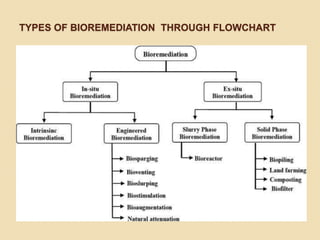
TYPES OF BIOREMEDIATION THROUGH FLOWCHART
TYPES OF IN-SITU
BIOREMEDIATION
 INTRINSIC
 It is the natural or
inherent metabolic
activity of
microorganisms to
degrade certain
pollutants .
 Process is based on
both microbial Aerobic
and Anaerobic
Reactions to
biodegrade polluting
constituents.
 Due to the absence of
external force this
technique is less
expensive than any
 ENGINEERED
 It involves the
introduction of certain
genetically engineered
microorganisms at the
site .
 By using suitable
physico-chemical
means (good nutrient,
O₂ supply , addition of e-
acceptor, optimal
temperature can enhance
bioremediation.
TYPES OF ENGINEERED
BIOREMEDIATION
 BIOSPARGING - Air is injected to soil
subsurface to improve microbial
activities which stimulate pollutant
removal.
 BIOVENTING – Air is injected in
saturated zone, which can help in
upward movement of volatile organic
compounds to unsaturated zone to
stimulate biodegradation process.
 BIOSLURPING – It combines Vacuum-
enhanced pumping, Soil Vapor
 BIOSTIMULATION – Involves the
stimulation of microorganisms present in
the soil by various means (addition of N
and P , adding co-substrates like
methane to degrade trichloroethylene,
addition of surfactant to expose
hydrophobic molecules).
 BIOAUGMENTATION – Addition of
specific microorganism or CONSORTIUM
OF MICROORGANISMS to degrade complex
pollutants like Polychlorobiphenyls
(PCBs), Trinitrotoluene (TNT),
Polyaromatic Hydrocarbons(PAHs) and
pesticides which cannot be degraded by
natural or single microorganism .
ADVANTAGES OF IN-SITU
BIOREMEDIATION
 Cost Effective, with minimal exposure to public
or site personnel.
 Sites remain minimally disrupted, time required
to treat sub surface pollution is faster than pump
and treat processes.
DISADVANTAGES OF IN-SITU
BIOREMEDIATION
 Very time consuming process, heavy metals and
organic compounds might not be degraded
successfully
 Sites are directly exposed to environmental
factors, microbial degrading ability varies
seasonally.
EX-SITU BIOREMEDIATION
 This technique involves digging
pollutants from polluted site and
successively transporting it to another
site for treatment.
 This technique is considered based on
the depth of pollution, type of
pollutant, degree of pollution, cost of
treatment and geographical location of
the polluted site.
TYPES OF EX-SITU
BIOREMEDIATION
 SLURRY PHASE
 Contaminated soil is combined
with water, nutrient and oxygen in
the bioreactor to create the
optimum environment for the
microorganisms to degrade the
contaminants which are present
in soil.
 This processing involves the
separation of stones and rubbles
from the contaminated soil.
 The added water concentration
depends on the concentration of
pollutants, the biodegradation
process rate and the
physicochemical properties of the
soil.
 After completion of this process
the soil is removed and dried up
by using vacuum filters, pressure
 SOLID PHASE
 An ex-situ technology in
which the contaminated soil
is excavated and placed into
piles.
 It also includes organic waste
like leaves, animal manures
and agriculture wastes,
domestic, industrial wastes
and municipal wastes.
 Bacterial growth is moved
through pipes that are
distributed throughout the
piles.
 Air pulling through the pipes
is necessary for ventilation
and microbial respiration .
 Solid-phase treatment
processes include biopiles ,
windrows, land farming,
TYPES OF SOLID PHASE
BIOREMEDIATION
 BIOPILE – It includes above-ground piling of
dug polluted soil, followed by aeration and
nutrient amendment to improve bioremediation
by microbial metabolic activities. This
technique comprises aeration, irrigation,
nutrients, leachate collection and treatment
bed systems.
 LAND FARMING - In land farming, polluted
soils are regularly excavated and tilled and site
of treatment speciously regulates the type of
bioremediation. When excavated polluted soil
is treated on-site, it is ex-situ as it has more in
common than other ex-situ bioremediation
techniques.
ADVANTAGES OF EX-SITU BIOREMEDIATIO
 Better controlled and more efficient processes ,
can be improved by enrichment with desired
microorganisms.
 Time required is short, suitable for wide range of
contaminants, environment is controllable and
manageable.
DISADVANTAGES OF EX-SITU
BIOREMEDIATION
 Very costly processes, sites of pollution are
highly disturbed.
 There may be disposal problems after the
process is complete, the contaminant can be
stripped off via soil washing or physical
extraction.
MICROORGANISMS USED IN
BIOREMEDIATION
 Bioremediation involves the removal of the
contaminated materials with the help of
bacteria, fungi, algae and yeast. Microbes
can grow at below zero temperature as well
as extreme heat in the presence of hazardous
compounds or any waste stream. The two
characters of microbes are adaptability and
biological system made them suitable for
remediation process.
 These microorganisms
comprise Achromobacter, Arthrobacter, Alca
ligenes, Bacillus, Corynebacterium, Pseudom
onas,
Flavobacterium, Mycobacterium, Nitrosomon
There are groups of microbes
which are used in bioremediation
such as:
 Aerobic: aerobic bacteria have degradative
capacities to degrade the complex compounds
such as Pseudomonas, Acinetobacter,
Sphingomonas, Nocardia, Flavobacterium,
Rhodococcus, and Mycobacterium. These
microbes have been reported to degrade
pesticides, hydrocarbons, alkanes, and
polyaromatic compounds. Many of these bacteria
use the contaminants as carbon and energy
source.
 Anaerobic: anaerobic bacteria are not as
regularly used as aerobic bacteria. There is an
increasing interest in aerobic bacteria used for
bioremediation of chlorinated aromatic
compounds, polychlorinated biphenyls, and
dechlorination of the solvent trichloroethylene and
LIMITATIONS:
 Specificity
 Biological processes are highly specific. Important site factors
mandatory for success include the presence of metabolically
capable microbial populations, suitable environmental growth
conditions, and appropriate levels of nutrients and
contaminants.
 Scale up limitation
 It is difficult to scale up bioremediation process from batch and
pilot scale studies applicable to large scale field operations.
 Technological advancement
 More research is required to develop modern engineer
bioremediation technologies that are suitable for sites with
composite combinations of contaminants that are not equally
distributed in the environment. It may be present as solids,
liquids and gases forms.
 Time taking process
 Bioremediation takes longer time compare to other treatment
options, such as excavation and removal of soil from
contaminated site.
CONCLUSION:
 Biodegradation is very fruitful and attractive
option to remediating, cleaning, managing and
recovering technique for solving polluted
environment through microbial activity. The
speed of undesirable waste substances
degradation is determined in competition with in
biological agents like fungi, bacteria, algae
inadequate supply with essential nutrient,
uncomfortable external abiotic conditions
(aeration, moisture, pH, temperature), and low
bioavailability. Bioremediation depending on
several factors, which include but not limited to
cost, site characteristics, type and concentration
of pollutants. The leading step to a successful
bioremediation is site description, which helps
create the most suitable and promising
THANK YOU

BIOREMEDIATION.pptx

  • 1.
    BIOREMEDIATION BIOREMEDIATION is theprocess of using microorganisms to remove the environmental pollutants i.e. toxic wastes(XENOBIOTICS) found in soil, water, air, land etc. The microbes serve as scavengers in bioremediation . The removal of organic wastes by microbes for environmental clean-up is the essence of bioremediation. The other names used (by some authors) are BIOTREATMENT BIORECLAMATION and BIORESTORATION.
  • 2.
    TYPES OF BIOREMEDIATION  IN-SITU BIOREMEDIATION  Involves a direct approach for the microbial degradation of Xenobiotic at the site of pollution (soil, ground water)  Addition of adequate quantities of nutrients at the site promotes microbial growth. When these microorganisms are exposed to pollutants, they develop metabolic ability to degrade them.  The growth of microorganisms and there ability to bring out bioremediation depends on supply of essential nutrients( Nitrogen, Phosphorus ) etc.  Successfully applied for clean up of oil spillages , beaches.
  • 3.
    TYPES OF BIOREMEDIATIONTHROUGH FLOWCHART
  • 4.
    TYPES OF IN-SITU BIOREMEDIATION INTRINSIC  It is the natural or inherent metabolic activity of microorganisms to degrade certain pollutants .  Process is based on both microbial Aerobic and Anaerobic Reactions to biodegrade polluting constituents.  Due to the absence of external force this technique is less expensive than any  ENGINEERED  It involves the introduction of certain genetically engineered microorganisms at the site .  By using suitable physico-chemical means (good nutrient, O₂ supply , addition of e- acceptor, optimal temperature can enhance bioremediation.
  • 5.
    TYPES OF ENGINEERED BIOREMEDIATION BIOSPARGING - Air is injected to soil subsurface to improve microbial activities which stimulate pollutant removal.  BIOVENTING – Air is injected in saturated zone, which can help in upward movement of volatile organic compounds to unsaturated zone to stimulate biodegradation process.  BIOSLURPING – It combines Vacuum- enhanced pumping, Soil Vapor
  • 6.
     BIOSTIMULATION –Involves the stimulation of microorganisms present in the soil by various means (addition of N and P , adding co-substrates like methane to degrade trichloroethylene, addition of surfactant to expose hydrophobic molecules).  BIOAUGMENTATION – Addition of specific microorganism or CONSORTIUM OF MICROORGANISMS to degrade complex pollutants like Polychlorobiphenyls (PCBs), Trinitrotoluene (TNT), Polyaromatic Hydrocarbons(PAHs) and pesticides which cannot be degraded by natural or single microorganism .
  • 7.
    ADVANTAGES OF IN-SITU BIOREMEDIATION Cost Effective, with minimal exposure to public or site personnel.  Sites remain minimally disrupted, time required to treat sub surface pollution is faster than pump and treat processes. DISADVANTAGES OF IN-SITU BIOREMEDIATION  Very time consuming process, heavy metals and organic compounds might not be degraded successfully  Sites are directly exposed to environmental factors, microbial degrading ability varies seasonally.
  • 8.
    EX-SITU BIOREMEDIATION  Thistechnique involves digging pollutants from polluted site and successively transporting it to another site for treatment.  This technique is considered based on the depth of pollution, type of pollutant, degree of pollution, cost of treatment and geographical location of the polluted site.
  • 9.
    TYPES OF EX-SITU BIOREMEDIATION SLURRY PHASE  Contaminated soil is combined with water, nutrient and oxygen in the bioreactor to create the optimum environment for the microorganisms to degrade the contaminants which are present in soil.  This processing involves the separation of stones and rubbles from the contaminated soil.  The added water concentration depends on the concentration of pollutants, the biodegradation process rate and the physicochemical properties of the soil.  After completion of this process the soil is removed and dried up by using vacuum filters, pressure  SOLID PHASE  An ex-situ technology in which the contaminated soil is excavated and placed into piles.  It also includes organic waste like leaves, animal manures and agriculture wastes, domestic, industrial wastes and municipal wastes.  Bacterial growth is moved through pipes that are distributed throughout the piles.  Air pulling through the pipes is necessary for ventilation and microbial respiration .  Solid-phase treatment processes include biopiles , windrows, land farming,
  • 10.
    TYPES OF SOLIDPHASE BIOREMEDIATION  BIOPILE – It includes above-ground piling of dug polluted soil, followed by aeration and nutrient amendment to improve bioremediation by microbial metabolic activities. This technique comprises aeration, irrigation, nutrients, leachate collection and treatment bed systems.  LAND FARMING - In land farming, polluted soils are regularly excavated and tilled and site of treatment speciously regulates the type of bioremediation. When excavated polluted soil is treated on-site, it is ex-situ as it has more in common than other ex-situ bioremediation techniques.
  • 11.
    ADVANTAGES OF EX-SITUBIOREMEDIATIO  Better controlled and more efficient processes , can be improved by enrichment with desired microorganisms.  Time required is short, suitable for wide range of contaminants, environment is controllable and manageable. DISADVANTAGES OF EX-SITU BIOREMEDIATION  Very costly processes, sites of pollution are highly disturbed.  There may be disposal problems after the process is complete, the contaminant can be stripped off via soil washing or physical extraction.
  • 12.
    MICROORGANISMS USED IN BIOREMEDIATION Bioremediation involves the removal of the contaminated materials with the help of bacteria, fungi, algae and yeast. Microbes can grow at below zero temperature as well as extreme heat in the presence of hazardous compounds or any waste stream. The two characters of microbes are adaptability and biological system made them suitable for remediation process.  These microorganisms comprise Achromobacter, Arthrobacter, Alca ligenes, Bacillus, Corynebacterium, Pseudom onas, Flavobacterium, Mycobacterium, Nitrosomon
  • 13.
    There are groupsof microbes which are used in bioremediation such as:  Aerobic: aerobic bacteria have degradative capacities to degrade the complex compounds such as Pseudomonas, Acinetobacter, Sphingomonas, Nocardia, Flavobacterium, Rhodococcus, and Mycobacterium. These microbes have been reported to degrade pesticides, hydrocarbons, alkanes, and polyaromatic compounds. Many of these bacteria use the contaminants as carbon and energy source.  Anaerobic: anaerobic bacteria are not as regularly used as aerobic bacteria. There is an increasing interest in aerobic bacteria used for bioremediation of chlorinated aromatic compounds, polychlorinated biphenyls, and dechlorination of the solvent trichloroethylene and
  • 14.
    LIMITATIONS:  Specificity  Biologicalprocesses are highly specific. Important site factors mandatory for success include the presence of metabolically capable microbial populations, suitable environmental growth conditions, and appropriate levels of nutrients and contaminants.  Scale up limitation  It is difficult to scale up bioremediation process from batch and pilot scale studies applicable to large scale field operations.  Technological advancement  More research is required to develop modern engineer bioremediation technologies that are suitable for sites with composite combinations of contaminants that are not equally distributed in the environment. It may be present as solids, liquids and gases forms.  Time taking process  Bioremediation takes longer time compare to other treatment options, such as excavation and removal of soil from contaminated site.
  • 15.
    CONCLUSION:  Biodegradation isvery fruitful and attractive option to remediating, cleaning, managing and recovering technique for solving polluted environment through microbial activity. The speed of undesirable waste substances degradation is determined in competition with in biological agents like fungi, bacteria, algae inadequate supply with essential nutrient, uncomfortable external abiotic conditions (aeration, moisture, pH, temperature), and low bioavailability. Bioremediation depending on several factors, which include but not limited to cost, site characteristics, type and concentration of pollutants. The leading step to a successful bioremediation is site description, which helps create the most suitable and promising
  • 16.