WELCOME
5-Dec-19 Dept. of civil engineering 1
BIOAUGMENTATION AS
REMEDIATION TECHNOLOGY
5-Dec-19 Dept. of civil engineering 2
INTRODUCTION
 Increase in pollution.
 Remove pollution.
 Physical and chemical methods are not used
 Bioremediation.
 When Bioaugmentation
 What is Bioaugmentation
5-Dec-19 Dept. of civil engineering 3
SCOPE
 To convert the toxic compounds to nontoxic
end products using natural microbial strains or
genetically engineered variants.
 Reduced health and ecological risks.
 To perform the treatment with a very low disturbance of
native ecosystems.
5-Dec-19 Dept. of civil engineering 4
FACTORS AFFECTING
BIOAUGUMENTATION
 Microorganisms
 Compound characteristics
 Physical & chemical environmental
characteristics
 Niche adjustment
 Microbial ecology
 Engineering process design
5-Dec-19 Dept. of civil engineering 5
DIFFERENT TECHNOLOGIES OF
BIOAUGMENTATION
 Cell bioaugmentation
 Gene bioaugmentation
 Rhizosphere bioaugmentation
 Phytoaugmentation
5-Dec-19 Dept. of civil engineering 6
CELL BIOAUGMENTATION
 A carrier and encapsulation technology for inoculant
delivery is known as cell bioaugmentaion.
 Cell bioaugmentation done by mainly three methods.
Use of Carrier Materials for Bioaugmentation
Bioaugmentation with Encapsulated Microorganisms
Activated soil bioaugmentation
5-Dec-19 Dept. of civil engineering 7
CELL BIOAUGMENTATION Contd…
Use of Carrier Materials for Bioaugmentation
 Microbial inoculant have been applied to the soil as live
microorganisms in a liquid culture or attached to a carrier
material.
 When applying the inoculant to a harsh environment like
soil, it may be desirable to use a carrier material.
 Since it can provide a protective niche and even
temporary nutrition for the introduced microorganisms.
5-Dec-19 Dept. of civil engineering 8
CELL BIOAUGMENTATION Contd…
 Numerous different carrier materials have been used
including bio solids, charcoal amended soil, clay,
lignite and manure.
 For example Pseudomonas fluorescens strain can be
added to soil either as a liquid culture, or in a soil
carrier.
5-Dec-19 Dept. of civil engineering 9
CELL BIOAUGMENTATION Contd…
The ideal characteristics for a carrier material include:
 Providing an adequate environment for cell survival and
growth.
 Resulting in a long life and enhanced activity when added
to the environment.
 Being nontoxic to the inoculant microorganisms and the
environment.
 Allowing target for the introduction of cells and also
means to contain the introduced microorganisms when
control is necessary.
5-Dec-19 Dept. of civil engineering 10
CELL BIOAUGMENTATION Contd…
Bioaugmentation with Encapsulated Microorganisms
 Materials allows the microorganisms to be contained in a
relatively nontoxic through which gases and liquids can
diffuse.
 Encapsulation technology create micro sites with a unique
microbial community that works interactively to remediate
a given compound.
5-Dec-19 Dept. of civil engineering 11
CELL BIOAUGMENTATION Contd…
Activated soil bioaugmentation
 Activated soil can use directly as both the inoculants and
carrier without extracting degraders from the soil.
 Activated soil is the soil that exposed to the contaminant
and contains a developed degrader population that can
eliminate the contaminant.
5-Dec-19 Dept. of civil engineering 12
GENE BIOAUGMENTATION
 Since introduced microorganisms often do not survive
following bioaugmentation.
 Naturally occurring horizontal gene transfer processes
has been used for the introduction of remediation genes
into a contaminated site.
5-Dec-19 Dept. of civil engineering 13
GENE BIOAUGMENTATION Contd…
Horizontal gene transfer may occur via:
 Transformation
 Transduction
 Conjugation
5-Dec-19 Dept. of civil engineering 14
GENE BIOAUGMENTATION Contd…
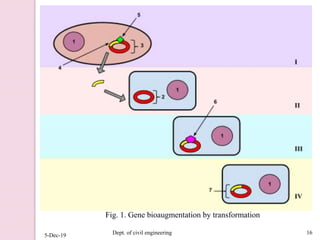
 Transformation is the genetic alteration of
a cell resulting from the direct uptake and incorporation
of exogenous genetic material (exogenous DNA)from
its surroundings and taken up through the cell
membrane.
5-Dec-19 Dept. of civil engineering 15
5-Dec-19 Dept. of civil engineering 16
Fig. 1. Gene bioaugmentation by transformation
GENE BIOAUGMENTATION Contd…
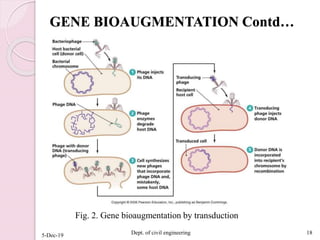
 Transduction is the process by which DNA is
transferred from one bacterium to another by virus.
 It also refers to the process whereby foreign DNA is
introduced into another cell via a viral vector.
5-Dec-19 Dept. of civil engineering 17
GENE BIOAUGMENTATION Contd…
5-Dec-19 Dept. of civil engineering 18
Fig. 2. Gene bioaugmentation by transduction
GENE BIOAUGMENTATION Contd…
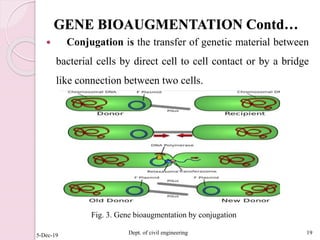
 Conjugation is the transfer of genetic material between
bacterial cells by direct cell to cell contact or by a bridge
like connection between two cells.
5-Dec-19 Dept. of civil engineering 19
Fig. 3. Gene bioaugmentation by conjugation
RHIZOSPHERE BIOAUGMENTATION
 Microbial inoculants are added to the soil along with a
plant that supports the inoculants growth.
 Additionally, these processes can be mediated by plants
or plant associated microorganisms.
 By using the plant microorganism combination, the
microorganism is added to soil along with a niche, the
plant root, supporting its growth.
5-Dec-19 Dept. of civil engineering 20
RHIZOSPHERE BIOAUGMENTATION Contd..
 Different plants used for rhizosphere bioaugmentation
are:
umbrella sludge
flower umbrella plant
tall fringe rush
hoorah grass
 It is a low-cost technique
5-Dec-19 Dept. of civil engineering 21
PHYTOAUGMENTATION
 Phytoaugmentation means the microorganisms are
introduced in the field by plant that contains the microbial
genes.
 By incorporation of these genes into plants. It is also
easier to control the persistence and spread of genes
introduced into the environment than via a genetically
engineered microorganism.
5-Dec-19 Dept. of civil engineering 22
5-Dec-19 Dept. of civil engineering 23
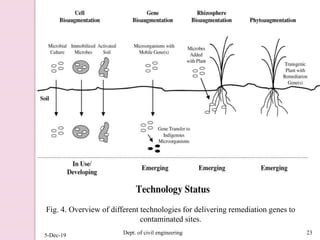
Fig. 4. Overview of different technologies for delivering remediation genes to
contaminated sites.
BIOAUGMENTATION IN WATER - A
CASE STUDY
Coke plant wastewater in China
 Coal in China is used as a main energy source.
 The contaminated water has many harmful toxic
contaminants like ammonia, thiocyanate, phenolics etc.
 When the advanced microorganisms were added, they
formed a new microbial community.
5-Dec-19 Dept. of civil engineering 24
BIOAUGMENTATION IN WATER - A
CASE STUDY Contd…
 where indigenous microorganisms could break down the
contaminants in the coke plant wastewater.
 When the indigenous heterotropic microorganisms were
added, they converted many large molecular compounds
into smaller and simpler compounds.
5-Dec-19 Dept. of civil engineering 25
BIOAUGMENTATION IN WATER - A
CASE STUDY Contd…
Petroleum industry
 There is a large problem with how the oilfield drilling pit
is disposed.
 When the environmental conditions are correct, microbes
are placed in the oil pit to break down hydrocarbons and
alongside are other nutrients.
 The microbes that break up hydrogen are placed in
because this is the contaminant that is most prominent in
the oil pit.
5-Dec-19 Dept. of civil engineering 26
BIOAUGMENTATION IN WATER - A
CASE STUDY Contd…
 Before using these microbes there was a total petroleum
hydrocarbon level of 44,880 PPM.
 After the method was taken upon in just 47 days the total
petroleum hydrocarbon lowered to a level of 10,000
PPM to 6,486 PPM.
5-Dec-19 Dept. of civil engineering 27
BENEFITS OF BIOAUGMENTATION
 Bioaugmentation Enhances the Microbial Community
 Bioaugmentation is Cost Effective
 Bioaugmentation Improves Plant Efficiency
5-Dec-19 Dept. of civil engineering 28
PROBLEMS ASSOCIATED WITH
BIOAUGMENTATION
 There are abiotic and biotic stresses causing the death of
introduced organisms.
 In addition the added microorganisms almost
always face competition from indigenous organisms for
limited nutrients
 It can be difficult to deliver the inoculant to the desired
location
5-Dec-19 Dept. of civil engineering 29
CONSLUSIONS
 Bioaugmentation is the process of adding actively
growing, specialized microbial strains into a microbial
community.
 This is done to enhance the ability of the microbial
community to degrade certain compounds, resulting in
improved treatment.
 Cell bioaugmentation remains the most commonly used
technique because of its simplicity in use.
5-Dec-19 Dept. of civil engineering 30
CONSLUSIONS Contd…
 Alternative methods such as the use of immobilized
microorganisms or activated soil may increase the success
rate of this approach.
 Additionally, several other bioaugmentaion approaches
including gene bioaumentation, rhizosphere
bioaugmentation and phytoaugmentation are currently in
the developmental stages.
5-Dec-19 Dept. of civil engineering 31
REFERENCES
5-Dec-19 Dept. of civil engineering 32
1. Mrozika, A and Segetb, Z.P. (2010) “Bioaugmentation as
a strategy for cleaning up of soils contaminated with
aromatic compounds”, Microbiological Research 165,
363-375
2. Agarry, S and Latinwo,G.K. (2015) “Biodegradation Of
Diesel Oil In Soil And Its Enhancement By Application
Of Bioventing And Amendment With Brewery Waste
Effluents As Biostimulation-Bioaugmentation Agents”,
Journal of Ecological Engineering,2(16),82-91
3. Koul, S and Gauba, p. (2014) “Bioaugmentation-a
strategy for cleaning up soil”, Journal of Civil
Engineering and Environmental Technology, 5(1), 72-74
5-Dec-19 Dept. of civil engineering 33
REFERENCES Contd…
4. Nzila, A., Razzak, S.A., and Zhu,j. (2016)
“Bioaugmentation: An emergency strategy for industrial
waste water treatment for reuse and discharge”,
environmental research and public health, 846(13), 1-20
5.Head, M.A., and Oleszkiewicz, J.A., (2005)
“Bioaugmentation with Nitrifying Bacteria Acclimated to
Different Temperatures”, Journal of Environmental
Engineering (ASCE), 7(131), 1046-1051
6.http://civilenggseminar.blogspot.in/2014/11/bioaugume
ntation-as-remediation.hmtl
5-Dec-19 Dept. of civil engineering 34

bioaugmentation as remediation technology

  • 1.
    WELCOME 5-Dec-19 Dept. ofcivil engineering 1
  • 2.
  • 3.
    INTRODUCTION  Increase inpollution.  Remove pollution.  Physical and chemical methods are not used  Bioremediation.  When Bioaugmentation  What is Bioaugmentation 5-Dec-19 Dept. of civil engineering 3
  • 4.
    SCOPE  To convertthe toxic compounds to nontoxic end products using natural microbial strains or genetically engineered variants.  Reduced health and ecological risks.  To perform the treatment with a very low disturbance of native ecosystems. 5-Dec-19 Dept. of civil engineering 4
  • 5.
    FACTORS AFFECTING BIOAUGUMENTATION  Microorganisms Compound characteristics  Physical & chemical environmental characteristics  Niche adjustment  Microbial ecology  Engineering process design 5-Dec-19 Dept. of civil engineering 5
  • 6.
    DIFFERENT TECHNOLOGIES OF BIOAUGMENTATION Cell bioaugmentation  Gene bioaugmentation  Rhizosphere bioaugmentation  Phytoaugmentation 5-Dec-19 Dept. of civil engineering 6
  • 7.
    CELL BIOAUGMENTATION  Acarrier and encapsulation technology for inoculant delivery is known as cell bioaugmentaion.  Cell bioaugmentation done by mainly three methods. Use of Carrier Materials for Bioaugmentation Bioaugmentation with Encapsulated Microorganisms Activated soil bioaugmentation 5-Dec-19 Dept. of civil engineering 7
  • 8.
    CELL BIOAUGMENTATION Contd… Useof Carrier Materials for Bioaugmentation  Microbial inoculant have been applied to the soil as live microorganisms in a liquid culture or attached to a carrier material.  When applying the inoculant to a harsh environment like soil, it may be desirable to use a carrier material.  Since it can provide a protective niche and even temporary nutrition for the introduced microorganisms. 5-Dec-19 Dept. of civil engineering 8
  • 9.
    CELL BIOAUGMENTATION Contd… Numerous different carrier materials have been used including bio solids, charcoal amended soil, clay, lignite and manure.  For example Pseudomonas fluorescens strain can be added to soil either as a liquid culture, or in a soil carrier. 5-Dec-19 Dept. of civil engineering 9
  • 10.
    CELL BIOAUGMENTATION Contd… Theideal characteristics for a carrier material include:  Providing an adequate environment for cell survival and growth.  Resulting in a long life and enhanced activity when added to the environment.  Being nontoxic to the inoculant microorganisms and the environment.  Allowing target for the introduction of cells and also means to contain the introduced microorganisms when control is necessary. 5-Dec-19 Dept. of civil engineering 10
  • 11.
    CELL BIOAUGMENTATION Contd… Bioaugmentationwith Encapsulated Microorganisms  Materials allows the microorganisms to be contained in a relatively nontoxic through which gases and liquids can diffuse.  Encapsulation technology create micro sites with a unique microbial community that works interactively to remediate a given compound. 5-Dec-19 Dept. of civil engineering 11
  • 12.
    CELL BIOAUGMENTATION Contd… Activatedsoil bioaugmentation  Activated soil can use directly as both the inoculants and carrier without extracting degraders from the soil.  Activated soil is the soil that exposed to the contaminant and contains a developed degrader population that can eliminate the contaminant. 5-Dec-19 Dept. of civil engineering 12
  • 13.
    GENE BIOAUGMENTATION  Sinceintroduced microorganisms often do not survive following bioaugmentation.  Naturally occurring horizontal gene transfer processes has been used for the introduction of remediation genes into a contaminated site. 5-Dec-19 Dept. of civil engineering 13
  • 14.
    GENE BIOAUGMENTATION Contd… Horizontalgene transfer may occur via:  Transformation  Transduction  Conjugation 5-Dec-19 Dept. of civil engineering 14
  • 15.
    GENE BIOAUGMENTATION Contd… Transformation is the genetic alteration of a cell resulting from the direct uptake and incorporation of exogenous genetic material (exogenous DNA)from its surroundings and taken up through the cell membrane. 5-Dec-19 Dept. of civil engineering 15
  • 16.
    5-Dec-19 Dept. ofcivil engineering 16 Fig. 1. Gene bioaugmentation by transformation
  • 17.
    GENE BIOAUGMENTATION Contd… Transduction is the process by which DNA is transferred from one bacterium to another by virus.  It also refers to the process whereby foreign DNA is introduced into another cell via a viral vector. 5-Dec-19 Dept. of civil engineering 17
  • 18.
    GENE BIOAUGMENTATION Contd… 5-Dec-19Dept. of civil engineering 18 Fig. 2. Gene bioaugmentation by transduction
  • 19.
    GENE BIOAUGMENTATION Contd… Conjugation is the transfer of genetic material between bacterial cells by direct cell to cell contact or by a bridge like connection between two cells. 5-Dec-19 Dept. of civil engineering 19 Fig. 3. Gene bioaugmentation by conjugation
  • 20.
    RHIZOSPHERE BIOAUGMENTATION  Microbialinoculants are added to the soil along with a plant that supports the inoculants growth.  Additionally, these processes can be mediated by plants or plant associated microorganisms.  By using the plant microorganism combination, the microorganism is added to soil along with a niche, the plant root, supporting its growth. 5-Dec-19 Dept. of civil engineering 20
  • 21.
    RHIZOSPHERE BIOAUGMENTATION Contd.. Different plants used for rhizosphere bioaugmentation are: umbrella sludge flower umbrella plant tall fringe rush hoorah grass  It is a low-cost technique 5-Dec-19 Dept. of civil engineering 21
  • 22.
    PHYTOAUGMENTATION  Phytoaugmentation meansthe microorganisms are introduced in the field by plant that contains the microbial genes.  By incorporation of these genes into plants. It is also easier to control the persistence and spread of genes introduced into the environment than via a genetically engineered microorganism. 5-Dec-19 Dept. of civil engineering 22
  • 23.
    5-Dec-19 Dept. ofcivil engineering 23 Fig. 4. Overview of different technologies for delivering remediation genes to contaminated sites.
  • 24.
    BIOAUGMENTATION IN WATER- A CASE STUDY Coke plant wastewater in China  Coal in China is used as a main energy source.  The contaminated water has many harmful toxic contaminants like ammonia, thiocyanate, phenolics etc.  When the advanced microorganisms were added, they formed a new microbial community. 5-Dec-19 Dept. of civil engineering 24
  • 25.
    BIOAUGMENTATION IN WATER- A CASE STUDY Contd…  where indigenous microorganisms could break down the contaminants in the coke plant wastewater.  When the indigenous heterotropic microorganisms were added, they converted many large molecular compounds into smaller and simpler compounds. 5-Dec-19 Dept. of civil engineering 25
  • 26.
    BIOAUGMENTATION IN WATER- A CASE STUDY Contd… Petroleum industry  There is a large problem with how the oilfield drilling pit is disposed.  When the environmental conditions are correct, microbes are placed in the oil pit to break down hydrocarbons and alongside are other nutrients.  The microbes that break up hydrogen are placed in because this is the contaminant that is most prominent in the oil pit. 5-Dec-19 Dept. of civil engineering 26
  • 27.
    BIOAUGMENTATION IN WATER- A CASE STUDY Contd…  Before using these microbes there was a total petroleum hydrocarbon level of 44,880 PPM.  After the method was taken upon in just 47 days the total petroleum hydrocarbon lowered to a level of 10,000 PPM to 6,486 PPM. 5-Dec-19 Dept. of civil engineering 27
  • 28.
    BENEFITS OF BIOAUGMENTATION Bioaugmentation Enhances the Microbial Community  Bioaugmentation is Cost Effective  Bioaugmentation Improves Plant Efficiency 5-Dec-19 Dept. of civil engineering 28
  • 29.
    PROBLEMS ASSOCIATED WITH BIOAUGMENTATION There are abiotic and biotic stresses causing the death of introduced organisms.  In addition the added microorganisms almost always face competition from indigenous organisms for limited nutrients  It can be difficult to deliver the inoculant to the desired location 5-Dec-19 Dept. of civil engineering 29
  • 30.
    CONSLUSIONS  Bioaugmentation isthe process of adding actively growing, specialized microbial strains into a microbial community.  This is done to enhance the ability of the microbial community to degrade certain compounds, resulting in improved treatment.  Cell bioaugmentation remains the most commonly used technique because of its simplicity in use. 5-Dec-19 Dept. of civil engineering 30
  • 31.
    CONSLUSIONS Contd…  Alternativemethods such as the use of immobilized microorganisms or activated soil may increase the success rate of this approach.  Additionally, several other bioaugmentaion approaches including gene bioaumentation, rhizosphere bioaugmentation and phytoaugmentation are currently in the developmental stages. 5-Dec-19 Dept. of civil engineering 31
  • 32.
    REFERENCES 5-Dec-19 Dept. ofcivil engineering 32 1. Mrozika, A and Segetb, Z.P. (2010) “Bioaugmentation as a strategy for cleaning up of soils contaminated with aromatic compounds”, Microbiological Research 165, 363-375 2. Agarry, S and Latinwo,G.K. (2015) “Biodegradation Of Diesel Oil In Soil And Its Enhancement By Application Of Bioventing And Amendment With Brewery Waste Effluents As Biostimulation-Bioaugmentation Agents”, Journal of Ecological Engineering,2(16),82-91 3. Koul, S and Gauba, p. (2014) “Bioaugmentation-a strategy for cleaning up soil”, Journal of Civil Engineering and Environmental Technology, 5(1), 72-74
  • 33.
    5-Dec-19 Dept. ofcivil engineering 33 REFERENCES Contd… 4. Nzila, A., Razzak, S.A., and Zhu,j. (2016) “Bioaugmentation: An emergency strategy for industrial waste water treatment for reuse and discharge”, environmental research and public health, 846(13), 1-20 5.Head, M.A., and Oleszkiewicz, J.A., (2005) “Bioaugmentation with Nitrifying Bacteria Acclimated to Different Temperatures”, Journal of Environmental Engineering (ASCE), 7(131), 1046-1051 6.http://civilenggseminar.blogspot.in/2014/11/bioaugume ntation-as-remediation.hmtl
  • 34.
    5-Dec-19 Dept. ofcivil engineering 34