PRESENTED BY
Sushma P. R
M.Sc Biotech 2nd sem
Dept. of Biotechnology
PRESENTED TO
Dr. Jayamangalaswamy
Dept. of Biotechnology
Brindavan college

 Man made chemical compounds.
 Not commonly produced by nature.
 Non degradable xenobiotic compounds –
recalcitrant.
XENOBIOTIC COMPOUNDS

 Halocarbons
 Polychlorinated biphenyls (PCB)
 Synthetic polymers
 Alkyl benzyl sulphonate
 Oil mixture
 Others
TYPES OF RECALCITRANT XENOBIOTIC
COMPOUNDS

 A waste management technique.
 The process uses naturally occurring organisms to
breakdown hazardous substances into less toxic or
not toxic substances.
 It uses organisms like bacteria, fungi or plants for
carrying out the process.
BIOREMEDIATION

 Two types :
1. In – situ bioremediation
Cleaning up of contamination at the site where
it occurred.
2. Ex – situ bioremediation
Cleaning up of contamination out of site.
TYPES OF BIOREMEDIATION
IN – SITU BIOREMEDIATION
 There are two main types of in situ bioremediation:
intrinsic bioremediation and accelerated
bioremediation.
 Intrinsic bioremediation uses microorganisms already
present in the environment to biodegrade harmful
contaminant.
 In accelerated bioremediation, either substrate or
nutrients are added to the environment to help break
down the toxic spill by making the microorganisms
grow more rapidly.

 BIOSPARGING :
Biosparging involves the injection of air under
pressure below the water table to increase groundwater
oxygen concentrations and enhance the rate of
biological degradation of contaminants by naturally
occurring bacteria.
Methods involved in In – situ bioremediation
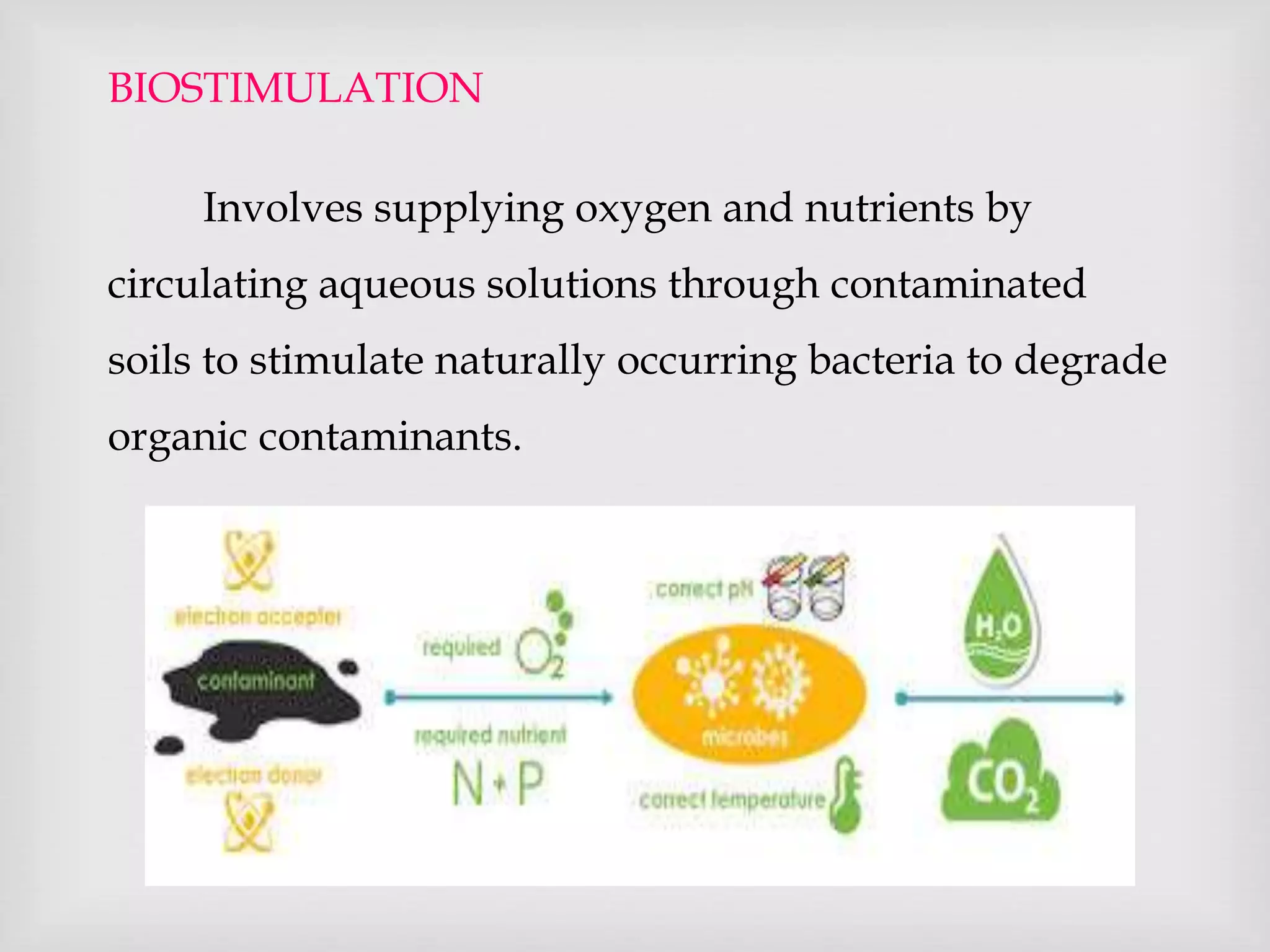
BIOSTIMULATION
Involves supplying oxygen and nutrients by
circulating aqueous solutions through contaminated
soils to stimulate naturally occurring bacteria to degrade
organic contaminants.
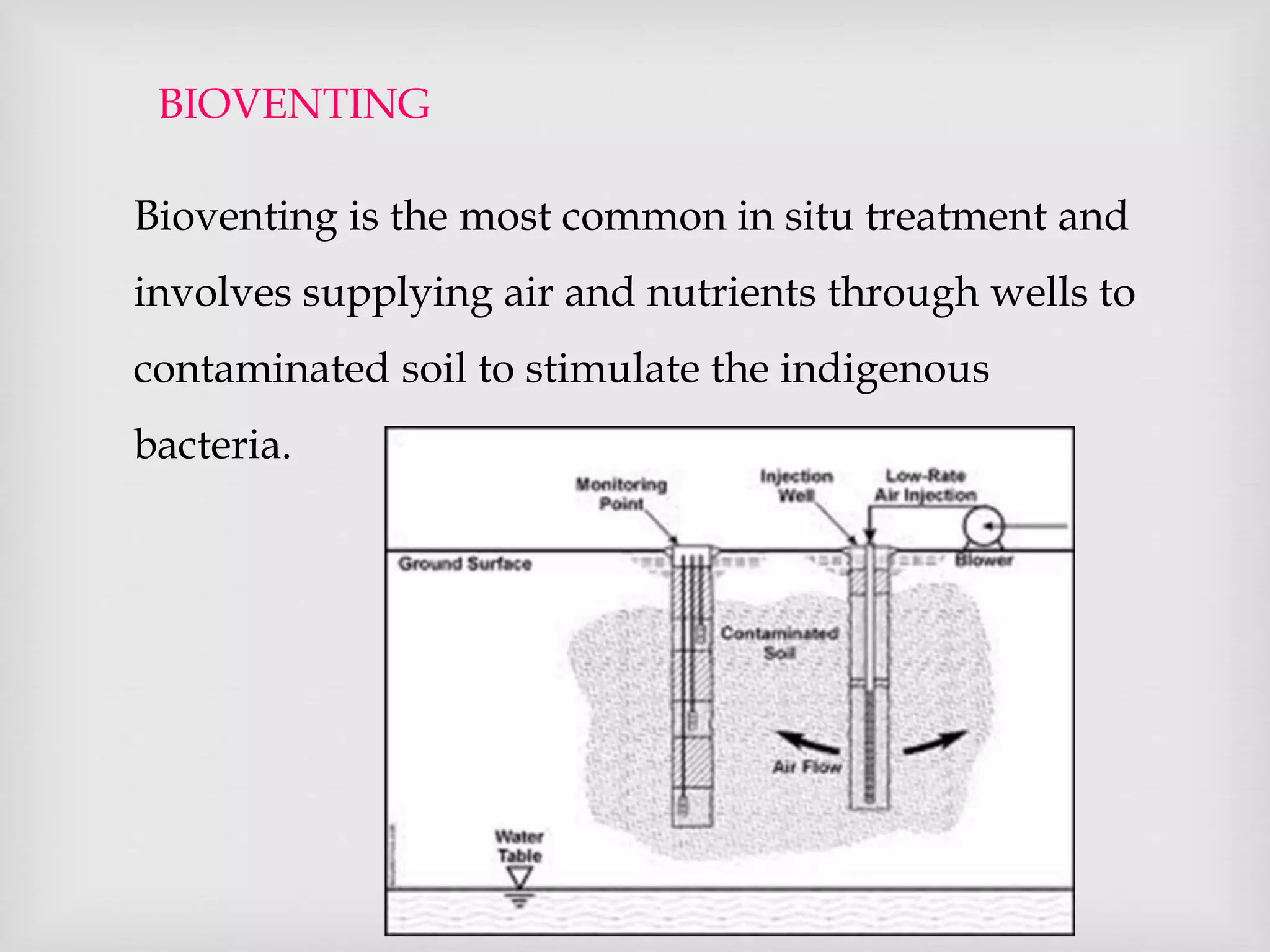
Bioventing is the most common in situ treatment and
involves supplying air and nutrients through wells to
contaminated soil to stimulate the indigenous
bacteria.
BIOVENTING
Bioaugmentation is another Bioremediation method
which frequently involves the addition of
microorganisms indigenous or exogenous to the
contaminated sites.
BIOAUGMENTATION
EX – SITU BIOREMEDIATION
Ex situ bioremediation is only used when necessary
because it’s expensive and damaging to the area, since
the contaminated land is physically removed.
LANDFARMING
 Landfarming is a
simple technique in
which
contaminated soil
is excavated and
spread over a
prepared bed and
periodically tilled
until pollutants are
degraded.
METHODS INVOLVED IN EX – SITU
BIOREMEDIATION
COMPOSTING
Composting is a technique that involves combining
contaminated soil with non-hazardous organic
compounds such as agricultural wastes.
The presence of these organic materials supports the
development of a rich microbial population and elevated
temperature characteristic of composting.

 Involves different methods
1. Biodegradation
2. Biotransformation
3. Co – metabolism
4. Bio sorption
BIOREMEDIATION OF XENOBIOTICS

 Heavy metals cannot be destroyed by microbes.
 But can be transformed from one oxidation or
organic state to another.
 This may result in either of the following result
(i) more water soluble ,
(ii) inherently less toxic,
(iii) less water soluble , or
(iv) volatilized
BIOREMEDIATION OF HEAVY METALS
 BIOLEACHING :
 Some micro organisms can produce metal leaching
organic acids.
E.g. : Thiobacillus sp. are capable of producing sulphuric
acid which can form metal chelates.
 Many microorganisms produce siderophores, iron
complexing molecules, some of which have high affinity
for heavy metals and form metal chelates.
e.g. : Pseudomonas aeruginosa for Cu and Zn
 BIOSORPTION :
 Metabolism – independent sorption of heavy metals to
biomass.
 Can use low cost waste biomass sources such as spent
brewery yeast.
 Some bacteria ( e.g. : Alcaligenes eutrophus ) can also
adsorb metals like Cd and Zn.
 BIOIMMOBILIZATION :
 Immobilize metals by precipitation.
 Microbes precipitate heavy metals by changing their
valence.
 The process is called Enzyme - Catalyzed
Transformation.
 E.g. : U (VI) is highly soluble. But U (IV) formed through
enzymatic reduction is highly insoluble.
 Also include formation of insoluble metal phosphates
and sulphates (biomineralization).

 Pesticides are Persistent Organic Pollutants (POPs).
 Several methods are employed in bioremediation of
pesticides
BIOREMEDIATION OF PESTICIDES
 DEGRADATION BY MICROBES :
 Some pesticides are readily degraded by microbes.
 They use the organic chemicals in pesticides for growth
and reproduction.
 E.g. : genera of Flavobacterium, Pseudomonas, Rhodococcus
 BIOTANSFORMATION
 Oxidation or reduction, hydrolysis etc. of pesticide by
enzymes present in different bacteria, fungi, plants can
transform it into less or non – toxic compounds.
 LEACHING
 Since many of the pesticides can be solubilised are
soluble , they can be removed via leaching.
 PHYTOACCUMULATION AND PHYTOEXTRACTION
 Crop plants like Brinjal, spinach, radish , rice can bio
accumulate pesticides like DDT and benzene
hexachloride.

 Oil spills threaten public health and safety by
contaminating drinking water, causing fire and
explosion hazards, diminishing air and water
quality, wasting nonrenewable resources.
BIOREMEDIATION OF OIL SPILLS
Methods involved in bioremediation of oil spills are
 SEEDING WITH NATURALLY OCCURRING MICROBES
 Many microbial genera like Nocardia, Bacillus, Streptomyces,
Corynforms and 70 others are known to contain species that
can degrade petroleum components.
 ENVIRONMENTAL MODIFICATIONS :
 Factors like oxygen supply , nutrient concentration,
temperature, pH, pressure, salinity etc. of the
contaminated area is modified in favor to the activity of
degrading microbes.

 DEGRADATION USING ENDOPHYTES:
 Several plastics contain the same chemical bond that are found
in natural plant polymers.
 Endophytes , organisms that symbiotically grows inside plants,
can degrade these similar bonds in plastics.
 e.g. : Endophytic fungus Pestalotiopsis microspore can degrade
plastic polyester polyurethane.
 DEGRADATION BY MICROBES :
 Many microbes can degrade plastics and use it as energy or
carbon source.
BIOREMEDIATION OF PLASTICS

 Since bioremediation is a natural process, it is positively
perceived by public.
 Low cost technologies and that also cost effective
increases its favorability.
 Complete breakdown of toxic compounds is possible.
 Method to be used can be selected according to
conditions.
CONCLUSION

 www.wikipedia.com
 www.intechifo.com
 www.researchgate.com
 www.govinfo.unt.edu
 www.intechopen.com
REFERENCES
THANK YOU

Bioremediation

  • 1.
    PRESENTED BY Sushma P.R M.Sc Biotech 2nd sem Dept. of Biotechnology PRESENTED TO Dr. Jayamangalaswamy Dept. of Biotechnology Brindavan college
  • 2.
      Man madechemical compounds.  Not commonly produced by nature.  Non degradable xenobiotic compounds – recalcitrant. XENOBIOTIC COMPOUNDS
  • 3.
      Halocarbons  Polychlorinatedbiphenyls (PCB)  Synthetic polymers  Alkyl benzyl sulphonate  Oil mixture  Others TYPES OF RECALCITRANT XENOBIOTIC COMPOUNDS
  • 4.
      A wastemanagement technique.  The process uses naturally occurring organisms to breakdown hazardous substances into less toxic or not toxic substances.  It uses organisms like bacteria, fungi or plants for carrying out the process. BIOREMEDIATION
  • 5.
      Two types: 1. In – situ bioremediation Cleaning up of contamination at the site where it occurred. 2. Ex – situ bioremediation Cleaning up of contamination out of site. TYPES OF BIOREMEDIATION
  • 6.
    IN – SITUBIOREMEDIATION  There are two main types of in situ bioremediation: intrinsic bioremediation and accelerated bioremediation.  Intrinsic bioremediation uses microorganisms already present in the environment to biodegrade harmful contaminant.  In accelerated bioremediation, either substrate or nutrients are added to the environment to help break down the toxic spill by making the microorganisms grow more rapidly.
  • 7.
      BIOSPARGING : Biosparginginvolves the injection of air under pressure below the water table to increase groundwater oxygen concentrations and enhance the rate of biological degradation of contaminants by naturally occurring bacteria. Methods involved in In – situ bioremediation
  • 9.
    BIOSTIMULATION Involves supplying oxygenand nutrients by circulating aqueous solutions through contaminated soils to stimulate naturally occurring bacteria to degrade organic contaminants.
  • 10.
    Bioventing is themost common in situ treatment and involves supplying air and nutrients through wells to contaminated soil to stimulate the indigenous bacteria. BIOVENTING
  • 11.
    Bioaugmentation is anotherBioremediation method which frequently involves the addition of microorganisms indigenous or exogenous to the contaminated sites. BIOAUGMENTATION
  • 12.
    EX – SITUBIOREMEDIATION Ex situ bioremediation is only used when necessary because it’s expensive and damaging to the area, since the contaminated land is physically removed.
  • 13.
    LANDFARMING  Landfarming isa simple technique in which contaminated soil is excavated and spread over a prepared bed and periodically tilled until pollutants are degraded. METHODS INVOLVED IN EX – SITU BIOREMEDIATION
  • 14.
    COMPOSTING Composting is atechnique that involves combining contaminated soil with non-hazardous organic compounds such as agricultural wastes. The presence of these organic materials supports the development of a rich microbial population and elevated temperature characteristic of composting.
  • 15.
      Involves differentmethods 1. Biodegradation 2. Biotransformation 3. Co – metabolism 4. Bio sorption BIOREMEDIATION OF XENOBIOTICS
  • 16.
      Heavy metalscannot be destroyed by microbes.  But can be transformed from one oxidation or organic state to another.  This may result in either of the following result (i) more water soluble , (ii) inherently less toxic, (iii) less water soluble , or (iv) volatilized BIOREMEDIATION OF HEAVY METALS
  • 17.
     BIOLEACHING : Some micro organisms can produce metal leaching organic acids. E.g. : Thiobacillus sp. are capable of producing sulphuric acid which can form metal chelates.  Many microorganisms produce siderophores, iron complexing molecules, some of which have high affinity for heavy metals and form metal chelates. e.g. : Pseudomonas aeruginosa for Cu and Zn
  • 18.
     BIOSORPTION : Metabolism – independent sorption of heavy metals to biomass.  Can use low cost waste biomass sources such as spent brewery yeast.  Some bacteria ( e.g. : Alcaligenes eutrophus ) can also adsorb metals like Cd and Zn.
  • 19.
     BIOIMMOBILIZATION : Immobilize metals by precipitation.  Microbes precipitate heavy metals by changing their valence.  The process is called Enzyme - Catalyzed Transformation.  E.g. : U (VI) is highly soluble. But U (IV) formed through enzymatic reduction is highly insoluble.  Also include formation of insoluble metal phosphates and sulphates (biomineralization).
  • 21.
      Pesticides arePersistent Organic Pollutants (POPs).  Several methods are employed in bioremediation of pesticides BIOREMEDIATION OF PESTICIDES
  • 22.
     DEGRADATION BYMICROBES :  Some pesticides are readily degraded by microbes.  They use the organic chemicals in pesticides for growth and reproduction.  E.g. : genera of Flavobacterium, Pseudomonas, Rhodococcus  BIOTANSFORMATION  Oxidation or reduction, hydrolysis etc. of pesticide by enzymes present in different bacteria, fungi, plants can transform it into less or non – toxic compounds.
  • 23.
     LEACHING  Sincemany of the pesticides can be solubilised are soluble , they can be removed via leaching.  PHYTOACCUMULATION AND PHYTOEXTRACTION  Crop plants like Brinjal, spinach, radish , rice can bio accumulate pesticides like DDT and benzene hexachloride.
  • 25.
      Oil spillsthreaten public health and safety by contaminating drinking water, causing fire and explosion hazards, diminishing air and water quality, wasting nonrenewable resources. BIOREMEDIATION OF OIL SPILLS
  • 26.
    Methods involved inbioremediation of oil spills are  SEEDING WITH NATURALLY OCCURRING MICROBES  Many microbial genera like Nocardia, Bacillus, Streptomyces, Corynforms and 70 others are known to contain species that can degrade petroleum components.  ENVIRONMENTAL MODIFICATIONS :  Factors like oxygen supply , nutrient concentration, temperature, pH, pressure, salinity etc. of the contaminated area is modified in favor to the activity of degrading microbes.
  • 27.
      DEGRADATION USINGENDOPHYTES:  Several plastics contain the same chemical bond that are found in natural plant polymers.  Endophytes , organisms that symbiotically grows inside plants, can degrade these similar bonds in plastics.  e.g. : Endophytic fungus Pestalotiopsis microspore can degrade plastic polyester polyurethane.  DEGRADATION BY MICROBES :  Many microbes can degrade plastics and use it as energy or carbon source. BIOREMEDIATION OF PLASTICS
  • 28.
      Since bioremediationis a natural process, it is positively perceived by public.  Low cost technologies and that also cost effective increases its favorability.  Complete breakdown of toxic compounds is possible.  Method to be used can be selected according to conditions. CONCLUSION
  • 29.
      www.wikipedia.com  www.intechifo.com www.researchgate.com  www.govinfo.unt.edu  www.intechopen.com REFERENCES
  • 30.