BIOREMEDIAION AND ANAEROBIC
TREATMENT OF FISH PROCESSING
WASTE
Submitted by
Pooja Saklani
INTRODUCTION-
 Environmental pollution has been on the rise in the past few
decades owing to increased human activities on energy
reservoirs, unsafe agricultural practices and rapid
industrialization.
 Amongst the pollutants that are of environmental and public
health concerns due to their toxicities are: heavy metals,
nuclear wastes, pesticides, green house gases, and
hydrocarbons. Remediation of polluted sites using microbial
process (bioremediation) has proven effective and reliable
due to its eco-friendly features.
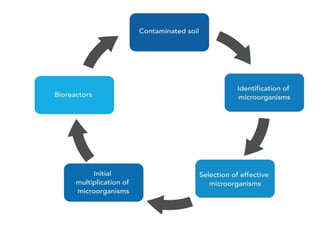
 Bioremediation is the naturally occurring process by which
microorganisms either immobilize or transform environmental
contaminants to innocuous end products.
 Bioremediation is an important soil and groundwater remediation
strategy because it:
 Harnesses naturally occurring biogeological processes;
 Destroys or immobilizes contaminants rather than transfers them
from one environmental medium to another; and
 Conserves financial resources due to shortened cleanup times
and/or lower capital expenditures to many other remediation
technologies (GZA Geo Environmental, 1998).
Characteristics of Fish Processing Waste
 The commercial fish-processing industry generates large
quantities of solid waste and wastewater.
 Solid waste includes whole waste fish, offal containing viscera
and fish scrap, which are residues from filleting (Hwang and
Hansen, 1998).
 Wastewater comes mainly from factory cleaning operations
and washing of raw materials and contains organic
contaminants in soluble, colloidal and particulate form
(Chowdhury et al., 2010).
 This wastewater has to be treated properly before discharge
(Chowdhury et al., 2010)
 In recent years, there has been a constant increase in the
exploitation of fish resources and the estimated quantity used
for human consumption (105.6 million tons) is globally 75 %
of the worldwide fish production. The remaining 25 % of the
catch (34.8 million tons) are considered as wastes (FAO 2007).
 Furthermore, the commercial fish processing industry
generates large quantities of solid waste and wastewater.
Solid waste which represents 20–60 % of the initial raw
material contains various kinds of residues (whole waste fish,
fish head, viscera, skin, bones, blood, frame liver, gonads,
guts, some muscle tissue, etc.) (Awarenet 2004).
 In some countries, these discards are not utilized, but
incinerated or dumped at sea causing environmental
problems (Bozzano and Sarda 2002).
 Recently, environmental regulations are becoming stricter,
requiring new disposal methods based on the fact that fish
wastes (solid waste and wastewater) may considered as an
important source of protein, lipids and minerals with high
biological value (Toppe et al. 2007; Kacem et al. 2011).
 The wastewater from seafood processing plants
contains large amounts of organic matter, small
particles of flesh, breading, soluble proteins, and
carbohydrates.
 The more important concern is that the untreated
waste input high amounts of nutrients, such as
nitrogen and phosphorus, which contribute to the
eutrophication of coastal waters.
 Other main pollutants in fisheries industry
wastewater include particulate and dissolved organic
matter, and Fat, oil and grease(FOG) residues etc.
Types of Bioremediation: a Closer Look
 Bioremediation technology has made it possible to
decontaminate soil and groundwater and has helped us clean
up our oceans after oil spills and other environmental
disasters.
1) Microbial bioremediation- uses microorganisms to break
down contaminants by using them as a food source.
2) Phytoremediation- uses plants to bind, extract, and clean up
pollutants such as pesticides, petroleum hydrocarbons,
metals, and chlorinated solvents.
3) Mycoremediation- uses fungi’s digestive enzymes to break
down contaminants such as, hydrocarbons, and heavy
metals.
Ex situ Bioremediation Techniques-
 These techniques involve excavating pollutants from polluted
sites and subsequently transporting them to another site for
treatment.
 Ex situ bioremediation techniques are usually considered
based on: the cost of treatment, depth of pollution, type of
pollutant, degree of pollution, geographical location and
geology of the polluted site. Performance criteria, which also
determine the choice of ex situ bioremediation techniques,
have been described (Philpand Atlas 2005).
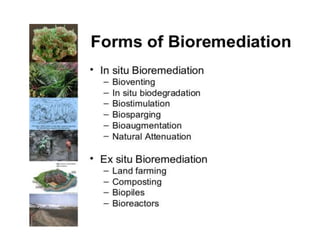
In Situ Bioremediation techniques-
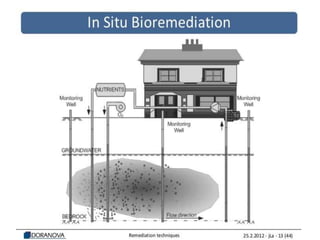
 These techniques involve treating polluted substances at the site of
pollution.
 It does not require any excavation; therefore, it is accompanied by
little or no disturbance to soil structure.
 Ideally, these techniques ought to be less expensive compared to
ex situ bioremediation techniques, due to no extra cost required for
excavation processes; nonetheless, cost of design and on-site
installation of some sophisticated equipment to improve microbial
activities during bioremediation is of major concern.
 Some in situ bioremediation techniques might be enhanced
(bioventing,biosparging and phytoremediation), while
others might proceed without any form of enhancement
(intrinsic bioremediation or natural attenuation).
 In situ bioremediation techniques have been successfully
used to treat chlorinated solvents, dyes, heavy metals, and
hydrocarbons polluted sites (Folch et al. 2013; Kim et al.
2014; Frascariet al. 2015; Roy et al. 2015).
 There are two main types of in situ bioremediation:
intrinsic bioremediation and accelerated
bioremediation.
Intrinsic Bioremediation.
 Intrinsic bioremediation uses microorganisms already present
in the environment to biodegrade harmful contaminant.
 There is no human intervention involved in this type of
bioremediation, and since it is the cheapest means of
bioremediation available, it is the most commonly used.
 When intrinsic bioremediation isn’t feasible, scientists turn
next to accelerated bioremediation
Accelerated Bioremediation
 In accelerated bioremediation, either substrate or nutrients
are added to the environment to help break down the toxic
spill by making the microorganisms grow more rapidly.
 Usually the microorganisms are indigenous, but occasionally
microorganisms that are very efficient at degrading a certain
contaminant are additionally added.
 Sometimes genetically engineered microbes are used. The
goal of in situ treatment is to manage and manipulate the
subsurface environment to optimize microbial degradation.
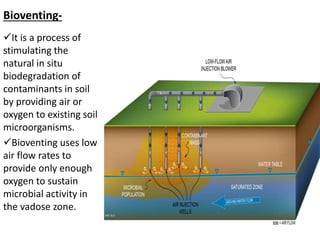
Bioventing-
It is a process of
stimulating the
natural in situ
biodegradation of
contaminants in soil
by providing air or
oxygen to existing soil
microorganisms.
Bioventing uses low
air flow rates to
provide only enough
oxygen to sustain
microbial activity in
the vadose zone.
 Biostimulation -involves the modification of the environment to
stimulate existing bacteria capable of bioremediation. This can be
done by addition of various forms of rate limiting nutrients and
electron acceptors, such as phosphorus, nitrogen, oxygen, or
carbon (e.g. in the form of molasses) .
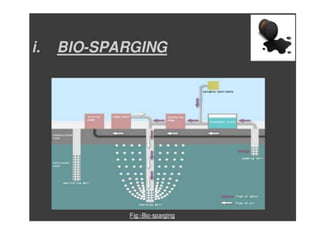
 Biosparging is an in-situ remediation technology that uses
indigenous microorganisms to biodegrade organic constituents in
the saturated zone.
 In biosparging, air (or oxygen) and nutrients (if needed) are
injected into the saturated zone to increase the biological activity of
the indigenous microorganisms.
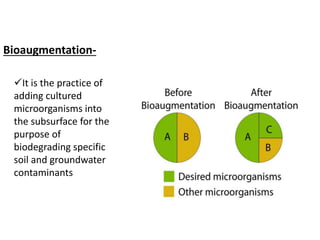
Bioaugmentation-
It is the practice of
adding cultured
microorganisms into
the subsurface for the
purpose of
biodegrading specific
soil and groundwater
contaminants
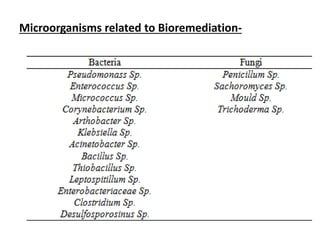
Microorganisms related to Bioremediation-
ESSENTIAL FACTORS FOR MICROBIAL BIOREMEDIATION
 Microbial population- Suitable kinds of organisms that can
biodegrade all of the contains
 Oxygen- Enough to support aerobic biodegradation (about 2%
oxygen in the gas phase or 0.4 mg/liter in the soil water)
 Water -Soil moisture should be from 50–70% of the water holding
capacity of the soil
 Nutrients- Nitrogen, phosphorus, sulfur, and other nutrients to
support good microbial growth
 Temperature -Appropriate temperatures for microbial growth (0–
40˚C)
 pH- Best range is from 6.5 to 7.5
 These factors greatly enhance the potential range of
bioremediation. For example, bacterial enzymes engineered
into plants can speed up the breakdown of TNT
(Trinitrotoluene ) and other explosives.
 With transgenic poplar trees carrying a bacterial gene, methyl
mercury may be converted to elemental mercury, which is
released to the atmosphere at extreme dilution.
 However, concern about release of such organisms into the
environment has limited actual field applications.
Aerobic and Anaerobic biodegredation
 Aerobic and anaerobic refers to the presence or absence of
oxygen during the chemical breakdown process. An
aerobic organism functions in the presence of oxygen. An
anaerobic organism functions without the use of oxygen.
 One particularly useful area of aerobic bioremediation is
the clean up of spilled oil in ocean water. One of the worst
aspects environmentally of spilled oil are polycyclic
aromatic hydrocarbons (PAH's). These have notoriously
long lifetimes and tend to bio-accumulate (in other words,
build up over time in an exposed organism's tissues). A
new strain of the bacteria Pseudomonas aeruginosa (called
NY3) helps to break down these PAH's in oil spills by
oxidizing the carbon into harmless byproducts. This is an
example of aerobic bioremediation.
 An example of anaerobic bioremediation is
Dechloromonas aromatica. This is a microbe that can break
down benzene in an anaerobic environment through a
mechanism that has not even been fully elucidated
yet. Benzene is a very stable known carcinogen than is present
in oil/petroleum products and is a byproduct of some industrial
processes.
 Some chemical pollutants that need to be cleaned up include
oil/petroleum that spills both on land and water. Also, excessive
nitrogen and phosphates from fertilizer and agricultural use also
tend to accumulate and can be treated with bacteria to break
them down. Manure and livestock waste can contaminate
waterways if allowed to runoff from pastures. Bacterial
treatment can break down this waste before it can become a
danger to humans through drinking water.
Advantages of bioremediation-
 Bioremediation is a natural process and is therefore perceived
by the public.
 Bioremediation is useful for the complete destruction of a
wide variety of contaminants.
 Instead of transferring contaminants from one environmental
medium to another, for example, from coastal water to shore
or air, the complete destruction of target pollutants is possible.
Disadvantages of bioremediation-
 Bioremediation is limited to those compounds that are
biodegradable. Not all compounds are susceptible to rapid
and complete degradation.
 There are some concerns that the products of biodegradation
may be more persistent or toxic than the parent compound.
 Biological processes are often highly specific. microbial
populations, suitable environmental growth conditions, and
appropriate levels of nutrients and contaminants
 Bioremediation often takes longer than other treatment
options.
Conclusion-
 Of all the different processes available for clean-up of
sites, Bioremediation is the best and most cost effective
method for remediation, with respect to environmental
liability.
 The nature and location of the contamination, the type of
soils and geological conditions, determine which method
of remediation is best for each individual clean-up site.
References-
1) Bioremediation of Seafood Processing Plant Effluents Using
Indigenous Bacterial Isolates M. Divya1 , S.Aanand1 ,
A.Srinivasan1 , B.Ahilan2 and A.Uma3
2) Bioremediation techniques-classification based on site of
application: principles, advantages, limitations and prospects
1-Christopher Chibueze Azubuike 2 Chioma Chikere.
3) Bioremediation: a novel approach to food waste
management P.K. Thassitou and I.S. Arvanitoyanni
THANK YOU

Bioremediaion

  • 1.
    BIOREMEDIAION AND ANAEROBIC TREATMENTOF FISH PROCESSING WASTE Submitted by Pooja Saklani
  • 2.
    INTRODUCTION-  Environmental pollutionhas been on the rise in the past few decades owing to increased human activities on energy reservoirs, unsafe agricultural practices and rapid industrialization.  Amongst the pollutants that are of environmental and public health concerns due to their toxicities are: heavy metals, nuclear wastes, pesticides, green house gases, and hydrocarbons. Remediation of polluted sites using microbial process (bioremediation) has proven effective and reliable due to its eco-friendly features.
  • 3.
     Bioremediation isthe naturally occurring process by which microorganisms either immobilize or transform environmental contaminants to innocuous end products.  Bioremediation is an important soil and groundwater remediation strategy because it:  Harnesses naturally occurring biogeological processes;  Destroys or immobilizes contaminants rather than transfers them from one environmental medium to another; and  Conserves financial resources due to shortened cleanup times and/or lower capital expenditures to many other remediation technologies (GZA Geo Environmental, 1998).
  • 5.
    Characteristics of FishProcessing Waste  The commercial fish-processing industry generates large quantities of solid waste and wastewater.  Solid waste includes whole waste fish, offal containing viscera and fish scrap, which are residues from filleting (Hwang and Hansen, 1998).  Wastewater comes mainly from factory cleaning operations and washing of raw materials and contains organic contaminants in soluble, colloidal and particulate form (Chowdhury et al., 2010).  This wastewater has to be treated properly before discharge (Chowdhury et al., 2010)
  • 6.
     In recentyears, there has been a constant increase in the exploitation of fish resources and the estimated quantity used for human consumption (105.6 million tons) is globally 75 % of the worldwide fish production. The remaining 25 % of the catch (34.8 million tons) are considered as wastes (FAO 2007).  Furthermore, the commercial fish processing industry generates large quantities of solid waste and wastewater. Solid waste which represents 20–60 % of the initial raw material contains various kinds of residues (whole waste fish, fish head, viscera, skin, bones, blood, frame liver, gonads, guts, some muscle tissue, etc.) (Awarenet 2004).
  • 7.
     In somecountries, these discards are not utilized, but incinerated or dumped at sea causing environmental problems (Bozzano and Sarda 2002).  Recently, environmental regulations are becoming stricter, requiring new disposal methods based on the fact that fish wastes (solid waste and wastewater) may considered as an important source of protein, lipids and minerals with high biological value (Toppe et al. 2007; Kacem et al. 2011).
  • 8.
     The wastewaterfrom seafood processing plants contains large amounts of organic matter, small particles of flesh, breading, soluble proteins, and carbohydrates.  The more important concern is that the untreated waste input high amounts of nutrients, such as nitrogen and phosphorus, which contribute to the eutrophication of coastal waters.  Other main pollutants in fisheries industry wastewater include particulate and dissolved organic matter, and Fat, oil and grease(FOG) residues etc.
  • 9.
    Types of Bioremediation:a Closer Look  Bioremediation technology has made it possible to decontaminate soil and groundwater and has helped us clean up our oceans after oil spills and other environmental disasters. 1) Microbial bioremediation- uses microorganisms to break down contaminants by using them as a food source. 2) Phytoremediation- uses plants to bind, extract, and clean up pollutants such as pesticides, petroleum hydrocarbons, metals, and chlorinated solvents. 3) Mycoremediation- uses fungi’s digestive enzymes to break down contaminants such as, hydrocarbons, and heavy metals.
  • 10.
    Ex situ BioremediationTechniques-  These techniques involve excavating pollutants from polluted sites and subsequently transporting them to another site for treatment.  Ex situ bioremediation techniques are usually considered based on: the cost of treatment, depth of pollution, type of pollutant, degree of pollution, geographical location and geology of the polluted site. Performance criteria, which also determine the choice of ex situ bioremediation techniques, have been described (Philpand Atlas 2005).
  • 11.
    In Situ Bioremediationtechniques-  These techniques involve treating polluted substances at the site of pollution.  It does not require any excavation; therefore, it is accompanied by little or no disturbance to soil structure.  Ideally, these techniques ought to be less expensive compared to ex situ bioremediation techniques, due to no extra cost required for excavation processes; nonetheless, cost of design and on-site installation of some sophisticated equipment to improve microbial activities during bioremediation is of major concern.
  • 13.
     Some insitu bioremediation techniques might be enhanced (bioventing,biosparging and phytoremediation), while others might proceed without any form of enhancement (intrinsic bioremediation or natural attenuation).  In situ bioremediation techniques have been successfully used to treat chlorinated solvents, dyes, heavy metals, and hydrocarbons polluted sites (Folch et al. 2013; Kim et al. 2014; Frascariet al. 2015; Roy et al. 2015).  There are two main types of in situ bioremediation: intrinsic bioremediation and accelerated bioremediation.
  • 14.
    Intrinsic Bioremediation.  Intrinsicbioremediation uses microorganisms already present in the environment to biodegrade harmful contaminant.  There is no human intervention involved in this type of bioremediation, and since it is the cheapest means of bioremediation available, it is the most commonly used.  When intrinsic bioremediation isn’t feasible, scientists turn next to accelerated bioremediation
  • 15.
    Accelerated Bioremediation  Inaccelerated bioremediation, either substrate or nutrients are added to the environment to help break down the toxic spill by making the microorganisms grow more rapidly.  Usually the microorganisms are indigenous, but occasionally microorganisms that are very efficient at degrading a certain contaminant are additionally added.  Sometimes genetically engineered microbes are used. The goal of in situ treatment is to manage and manipulate the subsurface environment to optimize microbial degradation.
  • 17.
    Bioventing- It is aprocess of stimulating the natural in situ biodegradation of contaminants in soil by providing air or oxygen to existing soil microorganisms. Bioventing uses low air flow rates to provide only enough oxygen to sustain microbial activity in the vadose zone.
  • 18.
     Biostimulation -involvesthe modification of the environment to stimulate existing bacteria capable of bioremediation. This can be done by addition of various forms of rate limiting nutrients and electron acceptors, such as phosphorus, nitrogen, oxygen, or carbon (e.g. in the form of molasses) .  Biosparging is an in-situ remediation technology that uses indigenous microorganisms to biodegrade organic constituents in the saturated zone.  In biosparging, air (or oxygen) and nutrients (if needed) are injected into the saturated zone to increase the biological activity of the indigenous microorganisms.
  • 20.
    Bioaugmentation- It is thepractice of adding cultured microorganisms into the subsurface for the purpose of biodegrading specific soil and groundwater contaminants
  • 21.
  • 22.
    ESSENTIAL FACTORS FORMICROBIAL BIOREMEDIATION  Microbial population- Suitable kinds of organisms that can biodegrade all of the contains  Oxygen- Enough to support aerobic biodegradation (about 2% oxygen in the gas phase or 0.4 mg/liter in the soil water)  Water -Soil moisture should be from 50–70% of the water holding capacity of the soil  Nutrients- Nitrogen, phosphorus, sulfur, and other nutrients to support good microbial growth  Temperature -Appropriate temperatures for microbial growth (0– 40˚C)  pH- Best range is from 6.5 to 7.5
  • 23.
     These factorsgreatly enhance the potential range of bioremediation. For example, bacterial enzymes engineered into plants can speed up the breakdown of TNT (Trinitrotoluene ) and other explosives.  With transgenic poplar trees carrying a bacterial gene, methyl mercury may be converted to elemental mercury, which is released to the atmosphere at extreme dilution.  However, concern about release of such organisms into the environment has limited actual field applications.
  • 24.
    Aerobic and Anaerobicbiodegredation  Aerobic and anaerobic refers to the presence or absence of oxygen during the chemical breakdown process. An aerobic organism functions in the presence of oxygen. An anaerobic organism functions without the use of oxygen.  One particularly useful area of aerobic bioremediation is the clean up of spilled oil in ocean water. One of the worst aspects environmentally of spilled oil are polycyclic aromatic hydrocarbons (PAH's). These have notoriously long lifetimes and tend to bio-accumulate (in other words, build up over time in an exposed organism's tissues). A new strain of the bacteria Pseudomonas aeruginosa (called NY3) helps to break down these PAH's in oil spills by oxidizing the carbon into harmless byproducts. This is an example of aerobic bioremediation.
  • 25.
     An exampleof anaerobic bioremediation is Dechloromonas aromatica. This is a microbe that can break down benzene in an anaerobic environment through a mechanism that has not even been fully elucidated yet. Benzene is a very stable known carcinogen than is present in oil/petroleum products and is a byproduct of some industrial processes.  Some chemical pollutants that need to be cleaned up include oil/petroleum that spills both on land and water. Also, excessive nitrogen and phosphates from fertilizer and agricultural use also tend to accumulate and can be treated with bacteria to break them down. Manure and livestock waste can contaminate waterways if allowed to runoff from pastures. Bacterial treatment can break down this waste before it can become a danger to humans through drinking water.
  • 26.
    Advantages of bioremediation- Bioremediation is a natural process and is therefore perceived by the public.  Bioremediation is useful for the complete destruction of a wide variety of contaminants.  Instead of transferring contaminants from one environmental medium to another, for example, from coastal water to shore or air, the complete destruction of target pollutants is possible.
  • 27.
    Disadvantages of bioremediation- Bioremediation is limited to those compounds that are biodegradable. Not all compounds are susceptible to rapid and complete degradation.  There are some concerns that the products of biodegradation may be more persistent or toxic than the parent compound.  Biological processes are often highly specific. microbial populations, suitable environmental growth conditions, and appropriate levels of nutrients and contaminants  Bioremediation often takes longer than other treatment options.
  • 28.
    Conclusion-  Of allthe different processes available for clean-up of sites, Bioremediation is the best and most cost effective method for remediation, with respect to environmental liability.  The nature and location of the contamination, the type of soils and geological conditions, determine which method of remediation is best for each individual clean-up site.
  • 29.
    References- 1) Bioremediation ofSeafood Processing Plant Effluents Using Indigenous Bacterial Isolates M. Divya1 , S.Aanand1 , A.Srinivasan1 , B.Ahilan2 and A.Uma3 2) Bioremediation techniques-classification based on site of application: principles, advantages, limitations and prospects 1-Christopher Chibueze Azubuike 2 Chioma Chikere. 3) Bioremediation: a novel approach to food waste management P.K. Thassitou and I.S. Arvanitoyanni
  • 30.