What is Biosafety?
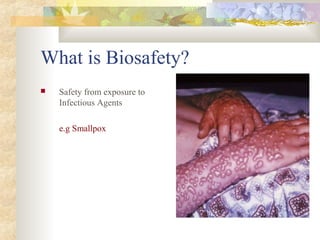
 Safety from exposure to
Infectious Agents
e.g Smallpox
What is Biosafety?
Sunday, Sep. 20, 2009
Did the Plague Kill Illinois Scientist?
By AP
(AP / CHICAGO) — The University of Chicago Medical Center says the infection that killed a
scientist may be connected to bacteria he researched that causes the plague.
The university said Saturday that its researcher studied the genetics of harmful bacteria including
Yersinia pestis, which causes the illness. He died Sept. 13. His name and age haven't been
released
The medical center says the bacteria he worked with was a weakened strain that isn't known to cause
illness in healthy adults. The strain was approved by the Centers for Disease Control and
Prevention for laboratory studies.
An autopsy found no obvious cause of death but did find the presence of the bacteria. More tests are
planned. No other illnesses have been reported.
Biosafety in Various Disciplines
Biosafety is related to several fields
 AGRICULTURE: reducing the
risk of food bacterial
contamination
 MEDICINE: referring to
organs or tissues from biological
origin, or genetic therapy
products, virus; levels of lab
containment protocols BSL-1, 2,
3, 4 in rising order of danger
 CHEMISTRY: i.e., nitrates in
water, PCB levels affecting
fertility
 EXOBIOLOGY: i.e., NASA's
policy for containing alien
microbes that may exist on space
samples - sometimes called
"biosafety level 5"
Biosafety in Academic Research
 Research Universities:
Promoting safe laboratory
practices, and procedures;
proper use of containment
equipment and facilities;
provides advice on
laboratory design and risk
assesment of experiments
involving infectious agents,
rDNA in-vitro and in-vivo.
Bottom Line: Risk & Containment
Biosafety Issues
 Laboratory Safety
 Bloodborne pathogens (BBP)
 Recombinant DNA (rDNA)
 Biological waste disposal
 Infectious substance and
diagnostic specimen shipping
Biosafety Issues (con’t.)
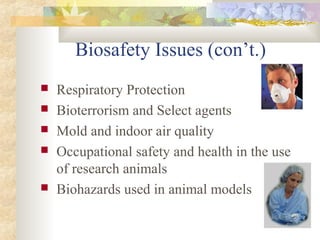
 Respiratory Protection
 Bioterrorism and Select agents
 Mold and indoor air quality
 Occupational safety and health in the use
of research animals
 Biohazards used in animal models
Biohazardous Materials
 Viruses
 Bacteria
 Fungi
 Chlamydiae/Rickettsiae
 Prions
 Recombinant DNA
Biohazardous materials
 Transgenic Plants, Animals and Insects
Biohazardous Materials
 Human Cells, Tissues, and Body Fluids
 Brain Tissue from Demented Patients
 Viral Vectors
The New BMBL
 Early print
edition….
 Emphasis on “Risk
& Containment”
Biosafety Concepts from
the BMBL
Principles of Biosafety
 Practice and Procedures
 Standard Practices
 Special Practices & Considerations
 Safety Equipment
 Facility Design and Construction
 Increasing levels of protection
Principles of Biosafety
Biosafety Levels 1-4 (BSL)
 Increasing levels of employee and environmental protection
 Guidelines for working safely in research & medical
laboratory facilities
Animal Biosafety Levels 1- 4
(ABSL)
 Laboratory animal facilities
 Animal models that support research
 Guidelines for working safely in animal research facilities
Biosafety Concepts
The BMBL
(1) Standard Microbiological Practices
 Most important concept / Strict adherence
 Aware of potential hazard
 Trained & proficient in techniques
 Supervisors responsible for:
 Appropriate Laboratory facilities
 Personnel & Training
 Special practices & precautions
 Occupational Health Programs
Biosafety Issues
The BMBL
(2) Safety Equipment
 Primary Containment Barrier
 Minimize exposure to hazard
 Prevent contact / Contain aerosols
 Engineering controls/ equipment
 Personal Protective Equipment (PPE)
 Gloves, gowns, Respirator, Face shield, Booties
 Biological Safety Cabinets
 Covered or ventilated animal cage systems
Biosafety Concepts
The BMBL
(3) Facility Design and
Construction
 Secondary Barrier/ Engineering
controls
 Contributes to worker protection
 Protects outside the laboratory
 Environment & Neighborhood
 Ex. Building & Lab design,
Ventilation, Autoclaves, Cage wash
facilities, etc.
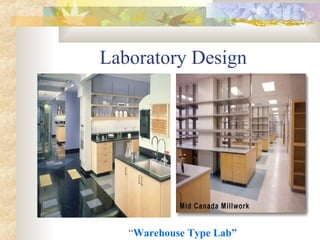
Laboratory Design
“Warehouse Type Lab”
Discussion
 What are some of the
negatives and
positives of this open
lab concept?
Biosafety Level-1
Concepts of Biosafety
Biosafety Level-1 (BSL-1 or ABSL-1)
 Well characterized agents
 Agents not known to cause disease (in healthy human
adults; now healthy immunocompetent adults)
 Prophylactic treatment available
 Open bench procedures
 Animals in open cage system or open environment
(outdoors)
 Good laboratory practices
Risk Group 1 Agents
 E.coli K-12
 Transgenic Plants
 Plasmids
 Fungi
 Mold
 Yeast
BSL-1 Practices
 Bench-top work allowed
 Daily Decontamination
 Manual pipetting
 Required Handwashing
 Red bag waste
 Bio cabinet not required
(unless creating aerosols)
 2˚ containment
Risk Group 2 Agents
 Human or Primate
Cells
 Herpes Simplex Virus
 Replication
Incompetent
Attenuated Human
Immunodeficiency
Virus
 Patient specimens
BSL-2 Practices
Concepts of Biosafety
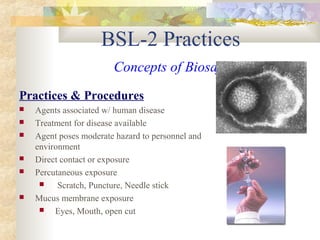
Practices & Procedures
 Agents associated w/ human disease
 Treatment for disease available
 Agent poses moderate hazard to personnel and
environment
 Direct contact or exposure
 Percutaneous exposure
 Scratch, Puncture, Needle stick
 Mucus membrane exposure
 Eyes, Mouth, open cut
BSL-2 Practices
 Limited access to lab
when work in progress
 Daily decontamination
 Mechanical pipetting
 Labcoat, safety glasses
and gloves required
 Red bag & sharps
containers required
BSL-2 Practices (con’t)
 Biohaz. Sign posted at
entrance to lab
 Label all equipment
(incubators, freezers, etc.)
 TC room – negative air flow
 Documented training
 Baseline serology or pre-
vaccination may be required
Risk Group 3 Agents
 Human
Immunodeficiency
Virus
 Mycobacterium
tuberculosis
 Coxiella burnetii
Biosafety Level 3
Working in High Containment
Biosafety Level-3 (BSL-3 or
ABSL-3)
 Indigenous or exotic agents
 Aerosol transmission
 Serious health effects
 Treatment may or may not exist
BSL-3 Practices
 Public access NOT permitted
 Daily decontamination after spill and
upon completion of experiment
 Autoclave required and waste is
disposed at the end of day
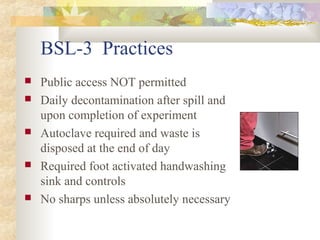
 Required foot activated handwashing
sink and controls
 No sharps unless absolutely necessary
BSL-3 Practices (con’t)
 Aerosol minimization procedures required
 Wrap around disposable clothing is
required. Specialized equipment may be
required depending upon procedures
 Biohaz. Signs and labels posted
 Air flow from low hazard to high hazard
“Pressure Mapping”
BSL-3 Practices (con’t)
 Bench top work not permitted
 Documented training and personnel competency
certification (for BSL-3 procedures)
 Baseline serology
 Spills – report immediately and treat accordingly
 Vaccinations/post exposure protocols and SOP’s,
Biosafety Manual, Biosafety Officer
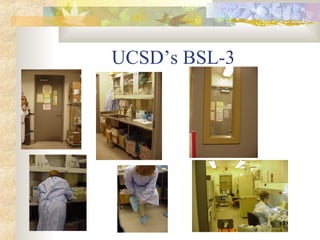
UCSD’s BSL-3
Biosafety Level-4
Working in High Containment
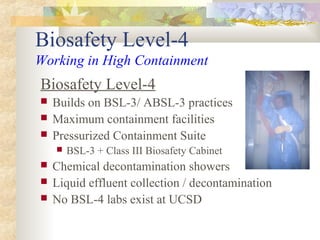
Biosafety Level-4
 Builds on BSL-3/ ABSL-3 practices
 Maximum containment facilities
 Pressurized Containment Suite
 BSL-3 + Class III Biosafety Cabinet
 Chemical decontamination showers
 Liquid effluent collection / decontamination
 No BSL-4 labs exist at UCSD
Biosafety Level 4
 Lassa Fever Virus
 Ebola Hemmorrhagic
Fever Virus
 Marburg Virus
 Herpes B Virus
Biosafety Concepts
Working in High Containment
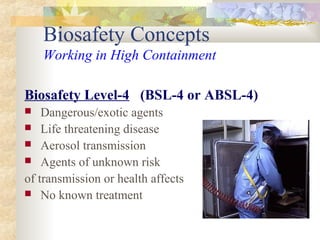
Biosafety Level-4 (BSL-4 or ABSL-4)
 Dangerous/exotic agents
 Life threatening disease
 Aerosol transmission
 Agents of unknown risk
of transmission or health affects
 No known treatment
Animal Biosafety Level-4
Working in High Containment
General Good Lab Technique
 Hygienic Practices
 No Smoking, Eating, Applying cosmetics, lip
balm, contacts
 Wash hands after procedures
 Decontaminate lab bench before and after
work
General Operational Practices
 Proper attire
 Minimum – lab coat, safety glasses, gloves
 Plan your work
 Know in advance what you are working with
 Read available resources (MSDS)
Risk Assessment
In-Vitro In-Vivo Human Clinical
Trial
Addressing Risk Assessments
 What is the organism?
 Is it Wild-type, attenuated, irradiated, or
chemically treated? Look at kill data or kill
curves.
 What is the max. concentration, volume,
infectious dose?
 What is the work space like?
 Aerosolizing procedures? How do they contain
their aerosols?
Risk Assessment, con’t
 Are personnel trained? Do
personnel understand the
organism, infectious dose and
symptoms?
 What are their experimental
procedures?
 Will they be transporting the
material? Shipping intra, inter-
state or international?
 Are they doing tissue culture?
 Do they have adequate
containment equipment?
Tom Pugh
Risk Assessment, Con’t
 Are they doing this
work in-vivo? Have
you consulted and
discussed this with
the Vets and IACUC
to determine special
needs and housing?
 Waste issues
addressed?
 Pregnancy issues with
the organisms?
Risk Assessment, con’t
 Do they share their
Tissue Culture room?
 Do they have more than
1 Biosafety Cabinet?
 Occupational Health
informed and set up to
receive patient or offer
counseling?
Accidental Spills
 Evacuate area, alert personnel and
cordon off so that aerosols may settle
 Don PPE; Cover with paper towels and
apply bleach (1 part bleach : 9 parts water
 Allow 15 – 20 min contact time
 Wipe up working towards center
 Use tongs if broken glass is involved
Is Recombinant DNA involved?
First Aid Measures
 Splash to Eye or Needlestick Injury
 Rinse thoroughly for 15 minutes at the eyewash or
sink
 Call Occupational Medicine  619 471-9210
 Call EH&S to report exposure – 858 534-5366
What Helps?
Resources
 UCSD Biosafety: http://blink.ucsd.edu/safety/research-
lab/biosafety/
 Biological Safety MSDS: http://www.phac-
aspc.gc.ca/msds-ftss/index-eng.php
 NIH BMBL:
http://www.cdc.gov/od/ohs/biosfty/bmbl5/bmbl5toc.htm
 See Handout for additional resources..
Thanks
 Any questions

Biosafety

  • 1.
    What is Biosafety? Safety from exposure to Infectious Agents e.g Smallpox
  • 2.
    What is Biosafety? Sunday,Sep. 20, 2009 Did the Plague Kill Illinois Scientist? By AP (AP / CHICAGO) — The University of Chicago Medical Center says the infection that killed a scientist may be connected to bacteria he researched that causes the plague. The university said Saturday that its researcher studied the genetics of harmful bacteria including Yersinia pestis, which causes the illness. He died Sept. 13. His name and age haven't been released The medical center says the bacteria he worked with was a weakened strain that isn't known to cause illness in healthy adults. The strain was approved by the Centers for Disease Control and Prevention for laboratory studies. An autopsy found no obvious cause of death but did find the presence of the bacteria. More tests are planned. No other illnesses have been reported.
  • 3.
    Biosafety in VariousDisciplines Biosafety is related to several fields  AGRICULTURE: reducing the risk of food bacterial contamination  MEDICINE: referring to organs or tissues from biological origin, or genetic therapy products, virus; levels of lab containment protocols BSL-1, 2, 3, 4 in rising order of danger  CHEMISTRY: i.e., nitrates in water, PCB levels affecting fertility  EXOBIOLOGY: i.e., NASA's policy for containing alien microbes that may exist on space samples - sometimes called "biosafety level 5"
  • 4.
    Biosafety in AcademicResearch  Research Universities: Promoting safe laboratory practices, and procedures; proper use of containment equipment and facilities; provides advice on laboratory design and risk assesment of experiments involving infectious agents, rDNA in-vitro and in-vivo. Bottom Line: Risk & Containment
  • 5.
    Biosafety Issues  LaboratorySafety  Bloodborne pathogens (BBP)  Recombinant DNA (rDNA)  Biological waste disposal  Infectious substance and diagnostic specimen shipping
  • 6.
    Biosafety Issues (con’t.) Respiratory Protection  Bioterrorism and Select agents  Mold and indoor air quality  Occupational safety and health in the use of research animals  Biohazards used in animal models
  • 7.
    Biohazardous Materials  Viruses Bacteria  Fungi  Chlamydiae/Rickettsiae  Prions  Recombinant DNA
  • 8.
    Biohazardous materials  TransgenicPlants, Animals and Insects
  • 9.
    Biohazardous Materials  HumanCells, Tissues, and Body Fluids  Brain Tissue from Demented Patients  Viral Vectors
  • 10.
    The New BMBL Early print edition….  Emphasis on “Risk & Containment”
  • 11.
    Biosafety Concepts from theBMBL Principles of Biosafety  Practice and Procedures  Standard Practices  Special Practices & Considerations  Safety Equipment  Facility Design and Construction  Increasing levels of protection
  • 12.
    Principles of Biosafety BiosafetyLevels 1-4 (BSL)  Increasing levels of employee and environmental protection  Guidelines for working safely in research & medical laboratory facilities Animal Biosafety Levels 1- 4 (ABSL)  Laboratory animal facilities  Animal models that support research  Guidelines for working safely in animal research facilities
  • 13.
    Biosafety Concepts The BMBL (1)Standard Microbiological Practices  Most important concept / Strict adherence  Aware of potential hazard  Trained & proficient in techniques  Supervisors responsible for:  Appropriate Laboratory facilities  Personnel & Training  Special practices & precautions  Occupational Health Programs
  • 14.
    Biosafety Issues The BMBL (2)Safety Equipment  Primary Containment Barrier  Minimize exposure to hazard  Prevent contact / Contain aerosols  Engineering controls/ equipment  Personal Protective Equipment (PPE)  Gloves, gowns, Respirator, Face shield, Booties  Biological Safety Cabinets  Covered or ventilated animal cage systems
  • 15.
    Biosafety Concepts The BMBL (3)Facility Design and Construction  Secondary Barrier/ Engineering controls  Contributes to worker protection  Protects outside the laboratory  Environment & Neighborhood  Ex. Building & Lab design, Ventilation, Autoclaves, Cage wash facilities, etc.
  • 16.
  • 17.
    Discussion  What aresome of the negatives and positives of this open lab concept?
  • 18.
    Biosafety Level-1 Concepts ofBiosafety Biosafety Level-1 (BSL-1 or ABSL-1)  Well characterized agents  Agents not known to cause disease (in healthy human adults; now healthy immunocompetent adults)  Prophylactic treatment available  Open bench procedures  Animals in open cage system or open environment (outdoors)  Good laboratory practices
  • 19.
    Risk Group 1Agents  E.coli K-12  Transgenic Plants  Plasmids  Fungi  Mold  Yeast
  • 20.
    BSL-1 Practices  Bench-topwork allowed  Daily Decontamination  Manual pipetting  Required Handwashing  Red bag waste  Bio cabinet not required (unless creating aerosols)  2˚ containment
  • 21.
    Risk Group 2Agents  Human or Primate Cells  Herpes Simplex Virus  Replication Incompetent Attenuated Human Immunodeficiency Virus  Patient specimens
  • 22.
    BSL-2 Practices Concepts ofBiosafety Practices & Procedures  Agents associated w/ human disease  Treatment for disease available  Agent poses moderate hazard to personnel and environment  Direct contact or exposure  Percutaneous exposure  Scratch, Puncture, Needle stick  Mucus membrane exposure  Eyes, Mouth, open cut
  • 23.
    BSL-2 Practices  Limitedaccess to lab when work in progress  Daily decontamination  Mechanical pipetting  Labcoat, safety glasses and gloves required  Red bag & sharps containers required
  • 24.
    BSL-2 Practices (con’t) Biohaz. Sign posted at entrance to lab  Label all equipment (incubators, freezers, etc.)  TC room – negative air flow  Documented training  Baseline serology or pre- vaccination may be required
  • 25.
    Risk Group 3Agents  Human Immunodeficiency Virus  Mycobacterium tuberculosis  Coxiella burnetii
  • 26.
    Biosafety Level 3 Workingin High Containment Biosafety Level-3 (BSL-3 or ABSL-3)  Indigenous or exotic agents  Aerosol transmission  Serious health effects  Treatment may or may not exist
  • 27.
    BSL-3 Practices  Publicaccess NOT permitted  Daily decontamination after spill and upon completion of experiment  Autoclave required and waste is disposed at the end of day  Required foot activated handwashing sink and controls  No sharps unless absolutely necessary
  • 28.
    BSL-3 Practices (con’t) Aerosol minimization procedures required  Wrap around disposable clothing is required. Specialized equipment may be required depending upon procedures  Biohaz. Signs and labels posted  Air flow from low hazard to high hazard “Pressure Mapping”
  • 29.
    BSL-3 Practices (con’t) Bench top work not permitted  Documented training and personnel competency certification (for BSL-3 procedures)  Baseline serology  Spills – report immediately and treat accordingly  Vaccinations/post exposure protocols and SOP’s, Biosafety Manual, Biosafety Officer
  • 30.
  • 31.
    Biosafety Level-4 Working inHigh Containment Biosafety Level-4  Builds on BSL-3/ ABSL-3 practices  Maximum containment facilities  Pressurized Containment Suite  BSL-3 + Class III Biosafety Cabinet  Chemical decontamination showers  Liquid effluent collection / decontamination  No BSL-4 labs exist at UCSD
  • 32.
    Biosafety Level 4 Lassa Fever Virus  Ebola Hemmorrhagic Fever Virus  Marburg Virus  Herpes B Virus
  • 33.
    Biosafety Concepts Working inHigh Containment Biosafety Level-4 (BSL-4 or ABSL-4)  Dangerous/exotic agents  Life threatening disease  Aerosol transmission  Agents of unknown risk of transmission or health affects  No known treatment
  • 34.
  • 35.
    General Good LabTechnique  Hygienic Practices  No Smoking, Eating, Applying cosmetics, lip balm, contacts  Wash hands after procedures  Decontaminate lab bench before and after work
  • 36.
    General Operational Practices Proper attire  Minimum – lab coat, safety glasses, gloves  Plan your work  Know in advance what you are working with  Read available resources (MSDS)
  • 38.
  • 39.
    Addressing Risk Assessments What is the organism?  Is it Wild-type, attenuated, irradiated, or chemically treated? Look at kill data or kill curves.  What is the max. concentration, volume, infectious dose?  What is the work space like?  Aerosolizing procedures? How do they contain their aerosols?
  • 40.
    Risk Assessment, con’t Are personnel trained? Do personnel understand the organism, infectious dose and symptoms?  What are their experimental procedures?  Will they be transporting the material? Shipping intra, inter- state or international?  Are they doing tissue culture?  Do they have adequate containment equipment? Tom Pugh
  • 41.
    Risk Assessment, Con’t Are they doing this work in-vivo? Have you consulted and discussed this with the Vets and IACUC to determine special needs and housing?  Waste issues addressed?  Pregnancy issues with the organisms?
  • 42.
    Risk Assessment, con’t Do they share their Tissue Culture room?  Do they have more than 1 Biosafety Cabinet?  Occupational Health informed and set up to receive patient or offer counseling?
  • 43.
    Accidental Spills  Evacuatearea, alert personnel and cordon off so that aerosols may settle  Don PPE; Cover with paper towels and apply bleach (1 part bleach : 9 parts water  Allow 15 – 20 min contact time  Wipe up working towards center  Use tongs if broken glass is involved Is Recombinant DNA involved?
  • 44.
    First Aid Measures Splash to Eye or Needlestick Injury  Rinse thoroughly for 15 minutes at the eyewash or sink  Call Occupational Medicine  619 471-9210  Call EH&S to report exposure – 858 534-5366
  • 45.
  • 46.
    Resources  UCSD Biosafety:http://blink.ucsd.edu/safety/research- lab/biosafety/  Biological Safety MSDS: http://www.phac- aspc.gc.ca/msds-ftss/index-eng.php  NIH BMBL: http://www.cdc.gov/od/ohs/biosfty/bmbl5/bmbl5toc.htm  See Handout for additional resources..
  • 47.