PPT By :- Mohan Kumar M P
BRANCH : Biotechnology .
engineering
Topic ON:
MICROBES IN
BIOREMEDIATION
MICROBES IN BIOREMEDIATION
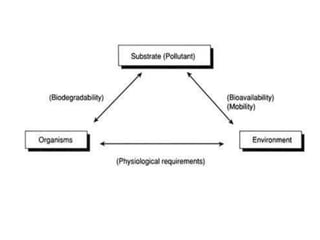
BIOREMEDIATION
• BIO- LIFE
• REMEDIATION- TO SOLVE
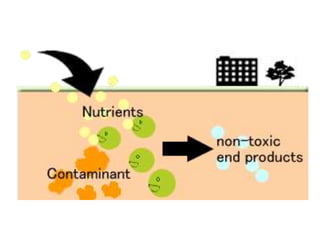
• Solving environmental problems using
biological organisms
• Use of living organisms to reduce or eliminate
the environmental hazards
Bacterial Bioremediation
• 1) In-situ-ON site Bioremediation
a) Intrinsic
b) Engineered
• 2) Ex-situ-OFF site bioremediation
a) Slurry-Phase
b) Solid-Phase
IN-SITU
• Contaminated site is treated at the Point of
Origin .
• Prevents the spread of contamination during
the Displacement and transport of
contaminated material
• Eg : Soil Bioremediation at the site of
occurrence
INTRINSIC BIOREMEDIATION
• Conversion of environmental pollution into
harmless substances naturally.
• Depends on the inherent capacity of the
microbes that are already present.
• Utilizes the natural existing micro flora for
nutrients & Ventilation .
ENGINEERED
• Engineered system applied when the the
intrinsic system is not suitable .
• Better form of bioremediation .
• Site is provided with the required Nutrients ,
air , microbes & other required additives to
enhance the bioremediation.
EX-situ
• It is an off-site bioremediation process
• Takes place above the ground level .
• Contaminated compound are transferred from
the origin site to separately for
bioremediation .
• It includes
• Solid phase treatment
• Slurry phase treatment
SLURRY-PHASE SYSTEM
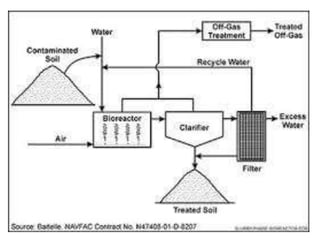
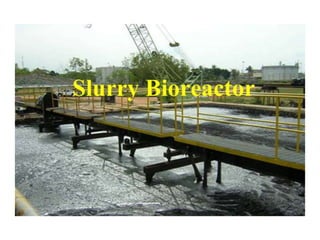
• Occurs in the Bioreactor .
• Contaminated soil + water + nutrients +
oxygen + other additives
• After bioremediation
• water is removed off
• solid waste disposed off
• treated soil is tested & replaced into the
surrounding.
SOLID-PHASE TREATMENT
• Remediation above the ground.
• Takes place under the controlled temperature,
moisture, heat , nutrient .
• Easy to operate but requires large space .
• Suitable for organic wastes , domestic
industrial waste , municipal solid waste.
ENGINEERED TECHNIQUES(IN-SITU)
• BIOVENTING
• BIOSPARGING
• BIOAGUMENTATION
• BIOSTIMULATION
1.BIOVENTING
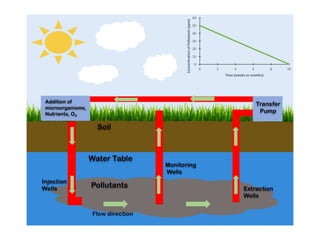
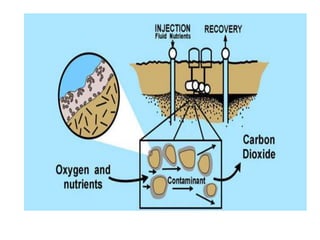
• Process of supplying Oxygen+Nutrient to the
contaminated site.
• Oxygen stimulate the indigenous microbes.
• A blower or compressor is connected to the
air supplying well
• H2O2, O2, He , is blow into the well.
2.BIOSPARGING
• Injection of Air to enhance the biological role
of indigenous microbes.
• Suitable for Benzene, toluene , volatile organic
compound , chlorinated ethane , petroleum
hydrocorbons , vinyl chloride .
• Best result seen within 6-months to 2-years.
• Low air injection rate is enough.
• Bio-venting is more effective than biosparging.
3.BIOAGUMENTATION
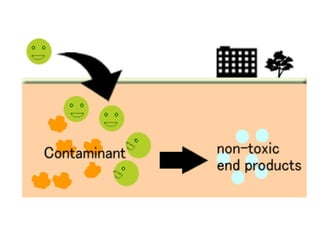
• Addition of exogenous microbes to enhance
the degradation process.
• Improvement in the efficiency & in the speed
of the process .
• Mainly used for treatment of contaminated
water .
• LIMT: First identification of existing microbial
communities , contaminants and its amount .
Case study
• China-coal waste water plant
• Waste water contains harmful :- thiocyanate ,
phenols, ammonia & sulfur containing poly-
nuclear aromatic hydrocarbons.
• Treated with Pseudomonas stutzeri
showed best result .
Petroleum cleanup
• Petroleum leakage cause the oil-pit .
• Total petroleum hydrocarbons = 44,880ppm
• Performed Bioagumentation with advance
strain for 47 days .
• Level lowered to 6,486ppm.
4.BIOSTIMULATION
• Addition of In-organic nutrient to the
contaminated sites.
• Perform to enhance the indigenous microbes.
• Phosphorus, nitrogen , glutamate , sulfur ,
Acetate.
• More effective when combined with
Bioagumentation .
Solid phase treatment process include:
• Composting ,
• Landforming &
• Biopiles
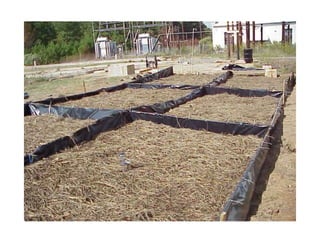
1.Composting
• Used to convert biodegradable hazardous
waste to harmless products .
• Performed using Bulking agent
• Bulking agents are straw , manure ,
agricultural waste , wood waste .
• Best result can be seen nearly in 20 days.
• Contaminated soil + Bulking agents at 45°C -
65°C
• Performed well mixing of the contaminant
and agents nearly for 40 days
• Increased in temperature denote the
occurrence bioremediation process .
• Temperature rises is due to the heat produced
by the microbes during degradation .
2.LAND FORMING
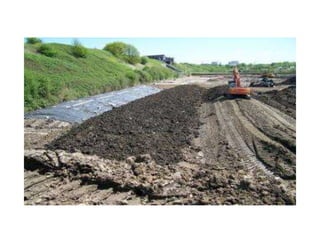
• Contaminated soil is excavated and spread
over the land .
• Periodically titled to improve the aeration .
• Degradation by the indigenous microbe .
• Performs volatilization than degradation .
• Mainly lighter hydrocarbons are easily
volatilised .
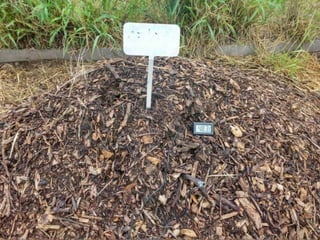
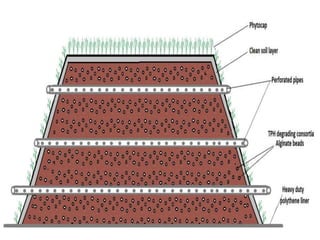
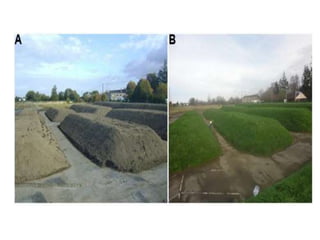
3.BIOPILING
• Hybrid of land forming and composting .
• Set up is similar to land forming but compost
is added along with the contaminated soil .
• Provides favourable environment for
Indigenous aerobic and anaerobic microbes .
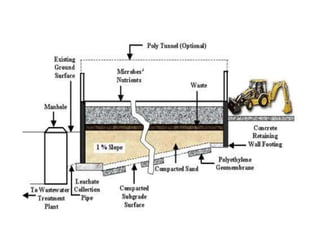
• First nutrient then contaminated soil is spread
up for 20 feet height .
• Aeration is provided through perforated pipes.
• Set up is covered with plastic sheet .
• Microbes + nutrients + aeration – undergoes
the Volatilization of the contaminant .
• Recovered in collection tank .
MYCOREMEDIATION
• Bioremediation using Fungi .
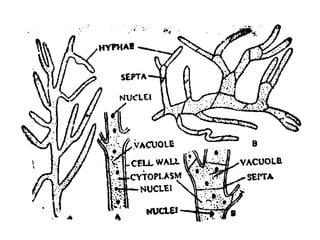
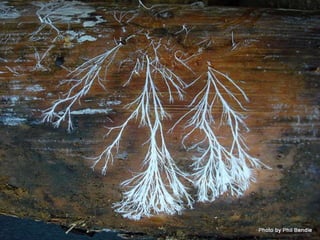
• Mycelium(vegetative part of fungus : thread
like hyphae in the colony) contains
extracellular enzymes(function outside of the
cell) & acids for remediation .
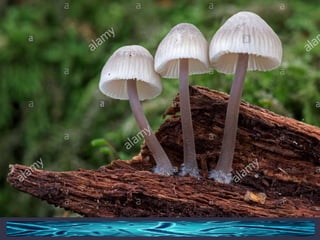
• Fungi is the only organism that can degrade
wood .
• White rot fungi and Brown rot fungi .
Some important topics in
Mycoremediation
• Fungal enzymes play a very major role in
Bioremediation .
• Fungal bioremediation of municipal solid
waste .
• Bioremediation potential of fungi .
• Fungal as agent as Bioremediation .
• Technical advance in fungi bioremediation .
Case study
• Diesel contaminated soil
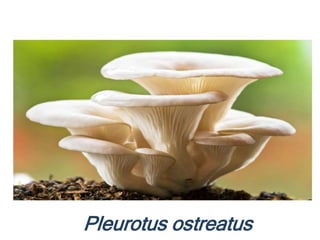
• Inoculation of mycelium from oyster
mushroom[Pleurotus ostreatus ].
• After 5 weeks nearly 95% of poly
hydrocarbons are turned into non-toxic .
Pleurotus ostreatus
Archaea Bioremediation
• The role of archaea in bioremediation has not
been studied as commonly as that of bacteria.
Numbers of researchers have shown their
ability to degrade various pollutants.
• Extreme halophilic archaea has potential to
biodegrade pollutants in hypersaline
environment, in which bacteria typically used
in bioremediation cannot survive or function
properly.
THANK
YOU
THANK YOU

Microbes in bioremediation
  • 1.
    PPT By :-Mohan Kumar M P BRANCH : Biotechnology . engineering Topic ON: MICROBES IN BIOREMEDIATION
  • 2.
  • 3.
    BIOREMEDIATION • BIO- LIFE •REMEDIATION- TO SOLVE • Solving environmental problems using biological organisms • Use of living organisms to reduce or eliminate the environmental hazards
  • 5.
    Bacterial Bioremediation • 1)In-situ-ON site Bioremediation a) Intrinsic b) Engineered • 2) Ex-situ-OFF site bioremediation a) Slurry-Phase b) Solid-Phase
  • 6.
    IN-SITU • Contaminated siteis treated at the Point of Origin . • Prevents the spread of contamination during the Displacement and transport of contaminated material • Eg : Soil Bioremediation at the site of occurrence
  • 7.
    INTRINSIC BIOREMEDIATION • Conversionof environmental pollution into harmless substances naturally. • Depends on the inherent capacity of the microbes that are already present. • Utilizes the natural existing micro flora for nutrients & Ventilation .
  • 8.
    ENGINEERED • Engineered systemapplied when the the intrinsic system is not suitable . • Better form of bioremediation . • Site is provided with the required Nutrients , air , microbes & other required additives to enhance the bioremediation.
  • 9.
    EX-situ • It isan off-site bioremediation process • Takes place above the ground level . • Contaminated compound are transferred from the origin site to separately for bioremediation . • It includes • Solid phase treatment • Slurry phase treatment
  • 10.
    SLURRY-PHASE SYSTEM • Occursin the Bioreactor . • Contaminated soil + water + nutrients + oxygen + other additives • After bioremediation • water is removed off • solid waste disposed off • treated soil is tested & replaced into the surrounding.
  • 13.
    SOLID-PHASE TREATMENT • Remediationabove the ground. • Takes place under the controlled temperature, moisture, heat , nutrient . • Easy to operate but requires large space . • Suitable for organic wastes , domestic industrial waste , municipal solid waste.
  • 14.
    ENGINEERED TECHNIQUES(IN-SITU) • BIOVENTING •BIOSPARGING • BIOAGUMENTATION • BIOSTIMULATION
  • 15.
    1.BIOVENTING • Process ofsupplying Oxygen+Nutrient to the contaminated site. • Oxygen stimulate the indigenous microbes. • A blower or compressor is connected to the air supplying well • H2O2, O2, He , is blow into the well.
  • 18.
    2.BIOSPARGING • Injection ofAir to enhance the biological role of indigenous microbes. • Suitable for Benzene, toluene , volatile organic compound , chlorinated ethane , petroleum hydrocorbons , vinyl chloride . • Best result seen within 6-months to 2-years. • Low air injection rate is enough. • Bio-venting is more effective than biosparging.
  • 20.
    3.BIOAGUMENTATION • Addition ofexogenous microbes to enhance the degradation process. • Improvement in the efficiency & in the speed of the process . • Mainly used for treatment of contaminated water . • LIMT: First identification of existing microbial communities , contaminants and its amount .
  • 21.
    Case study • China-coalwaste water plant • Waste water contains harmful :- thiocyanate , phenols, ammonia & sulfur containing poly- nuclear aromatic hydrocarbons. • Treated with Pseudomonas stutzeri showed best result .
  • 22.
    Petroleum cleanup • Petroleumleakage cause the oil-pit . • Total petroleum hydrocarbons = 44,880ppm • Performed Bioagumentation with advance strain for 47 days . • Level lowered to 6,486ppm.
  • 24.
    4.BIOSTIMULATION • Addition ofIn-organic nutrient to the contaminated sites. • Perform to enhance the indigenous microbes. • Phosphorus, nitrogen , glutamate , sulfur , Acetate. • More effective when combined with Bioagumentation .
  • 25.
    Solid phase treatmentprocess include: • Composting , • Landforming & • Biopiles
  • 26.
    1.Composting • Used toconvert biodegradable hazardous waste to harmless products . • Performed using Bulking agent • Bulking agents are straw , manure , agricultural waste , wood waste . • Best result can be seen nearly in 20 days. • Contaminated soil + Bulking agents at 45°C - 65°C
  • 27.
    • Performed wellmixing of the contaminant and agents nearly for 40 days • Increased in temperature denote the occurrence bioremediation process . • Temperature rises is due to the heat produced by the microbes during degradation .
  • 30.
    2.LAND FORMING • Contaminatedsoil is excavated and spread over the land . • Periodically titled to improve the aeration . • Degradation by the indigenous microbe . • Performs volatilization than degradation . • Mainly lighter hydrocarbons are easily volatilised .
  • 33.
    3.BIOPILING • Hybrid ofland forming and composting . • Set up is similar to land forming but compost is added along with the contaminated soil . • Provides favourable environment for Indigenous aerobic and anaerobic microbes . • First nutrient then contaminated soil is spread up for 20 feet height . • Aeration is provided through perforated pipes.
  • 34.
    • Set upis covered with plastic sheet . • Microbes + nutrients + aeration – undergoes the Volatilization of the contaminant . • Recovered in collection tank .
  • 37.
    MYCOREMEDIATION • Bioremediation usingFungi . • Mycelium(vegetative part of fungus : thread like hyphae in the colony) contains extracellular enzymes(function outside of the cell) & acids for remediation . • Fungi is the only organism that can degrade wood . • White rot fungi and Brown rot fungi .
  • 38.
    Some important topicsin Mycoremediation • Fungal enzymes play a very major role in Bioremediation . • Fungal bioremediation of municipal solid waste . • Bioremediation potential of fungi . • Fungal as agent as Bioremediation . • Technical advance in fungi bioremediation .
  • 42.
    Case study • Dieselcontaminated soil • Inoculation of mycelium from oyster mushroom[Pleurotus ostreatus ]. • After 5 weeks nearly 95% of poly hydrocarbons are turned into non-toxic .
  • 43.
  • 44.
    Archaea Bioremediation • Therole of archaea in bioremediation has not been studied as commonly as that of bacteria. Numbers of researchers have shown their ability to degrade various pollutants. • Extreme halophilic archaea has potential to biodegrade pollutants in hypersaline environment, in which bacteria typically used in bioremediation cannot survive or function properly.
  • 46.

Editor's Notes

  • #3 MICROBES IN BIOREMEDIATION