Rice Blast
Magnaporthe grisea
Pathogen
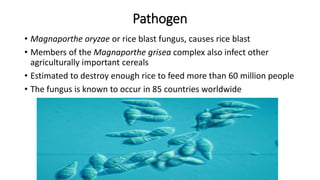
• Magnaporthe oryzae or rice blast fungus, causes rice blast
• Members of the Magnaporthe grisea complex also infect other
agriculturally important cereals
• Estimated to destroy enough rice to feed more than 60 million people
• The fungus is known to occur in 85 countries worldwide
Symptoms and Signs
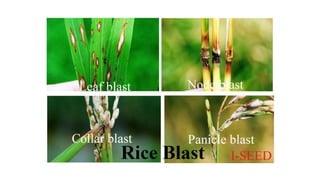
• Symptoms can occur on different parts of the plant
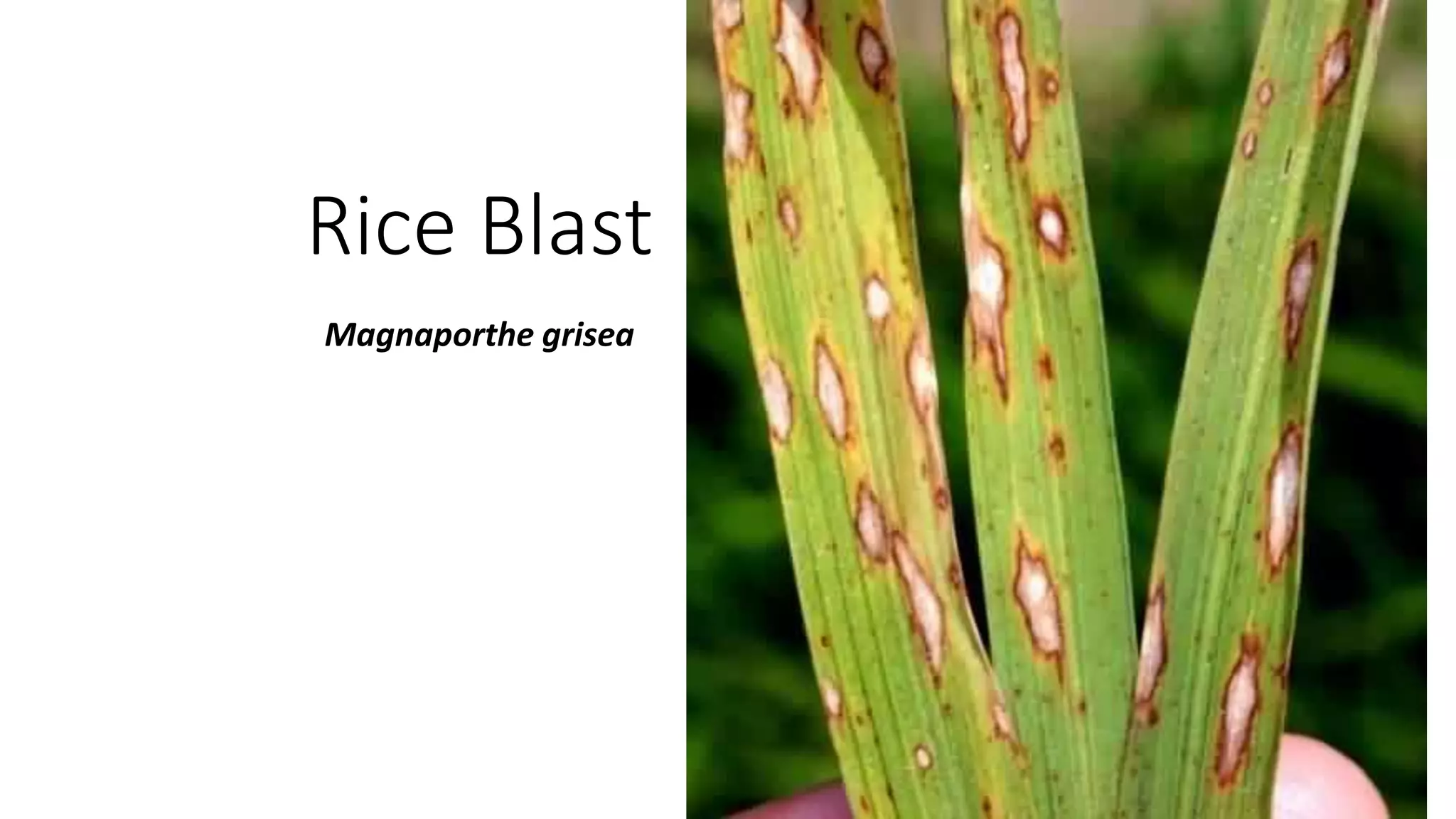
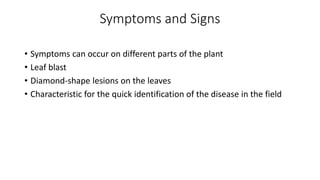
• Leaf blast
• Diamond-shape lesions on the leaves
• Characteristic for the quick identification of the disease in the field
Cont.
• Collar rot
• Infection on the plant’s neck causes rot
• Can result in a lack of seed filling or collapse of the entire panicle
• The pedicels are infected, seeds may not be produced at all
Ecology and
Spread
Infected grasses
Crop residues
Infected seed can be
a source of inoculum
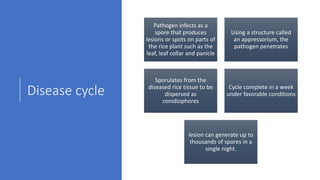
Disease cycle
Pathogen infects as a
spore that produces
lesions or spots on parts of
the rice plant such as the
leaf, leaf collar and panicle
Using a structure called
an appressorium, the
pathogen penetrates
Sporulates from the
diseased rice tissue to be
dispersed as
conidiophores
Cycle complete in a week
under favorable conditions
lesion can generate up to
thousands of spores in a
single night.
Environment
Long periods of free
moisture where leaf
wetness is required
for infection
High humidity is
high
High relative
humidity and at 77-
82 F
Excessive amount
of nitrogen
fertilization
Drought stress
increase rice
susceptibility to the
pathogen
Extended drain
periods also favor
infection
BioControl
• Aspergillus niger (Fungus)
• Trichoderma harzianum (Fungus)
• Streptomyces
Streptomyces
• S. vinaceusdrappus
• Inhibited the mycelial growth of M. oryzae by 53.5%
• Streptomyces philanthi
• In Southern Thailand exhibited significant antifungal activity
against M. oryzae (88.73% inhibition of mycelial growth)
Boukaew and Prasertsan (2014)
Aspergillus niger
• In the dual culture, 81.32% inhibition percentage of M. oryzae
• pH at level 5.0 and temperature between 21℃ to 29℃ is the optimum
condition for A. niger to produce efficient antifungal metabolites
• Antifungal Metabolites
Oleic Acid, n-Hexadecanoic acid, Hexose, Glycerol, Stearic acid,
Tetradecanoic acid, Dodecanoic acid
(Idan, A. , Sijam, K. , Kadir, J. , Rashid, T. , Awla, H. and Alsultan, W. (2017)
Trichoderma
harzianum
Treatment of cultivar with Trichoderma harzianum
Treated seed of rice showed range of mean performance
of seed germination from 86.67 to 96.67%
Trichoderma have positive response on the seed
germination
Reduce the intensity of blast disease of rice
It can be used as effective bio-control measure for rice
blast besides increasing the yield of rice crop
Mathivanan et. al.2006.
Management
• Certified seed
• pre-treat seed with hot water or fungicides
• Use of resistant varieties
• Susceptible variety once
Cont.
• Proper sanitation measures to reduce inoculum
• Carry out crop rotation, intercropping
• Modify plant density to avoid close spacing
• Provide a balanced nutrition to the rice crop
• Maintain proper flood level for rice to grow

Rice blast

  • 1.
  • 2.
    Pathogen • Magnaporthe oryzaeor rice blast fungus, causes rice blast • Members of the Magnaporthe grisea complex also infect other agriculturally important cereals • Estimated to destroy enough rice to feed more than 60 million people • The fungus is known to occur in 85 countries worldwide
  • 3.
    Symptoms and Signs •Symptoms can occur on different parts of the plant • Leaf blast • Diamond-shape lesions on the leaves • Characteristic for the quick identification of the disease in the field
  • 5.
    Cont. • Collar rot •Infection on the plant’s neck causes rot • Can result in a lack of seed filling or collapse of the entire panicle • The pedicels are infected, seeds may not be produced at all
  • 6.
    Ecology and Spread Infected grasses Cropresidues Infected seed can be a source of inoculum
  • 7.
    Disease cycle Pathogen infectsas a spore that produces lesions or spots on parts of the rice plant such as the leaf, leaf collar and panicle Using a structure called an appressorium, the pathogen penetrates Sporulates from the diseased rice tissue to be dispersed as conidiophores Cycle complete in a week under favorable conditions lesion can generate up to thousands of spores in a single night.
  • 8.
    Environment Long periods offree moisture where leaf wetness is required for infection High humidity is high High relative humidity and at 77- 82 F Excessive amount of nitrogen fertilization Drought stress increase rice susceptibility to the pathogen Extended drain periods also favor infection
  • 9.
    BioControl • Aspergillus niger(Fungus) • Trichoderma harzianum (Fungus) • Streptomyces
  • 10.
    Streptomyces • S. vinaceusdrappus •Inhibited the mycelial growth of M. oryzae by 53.5% • Streptomyces philanthi • In Southern Thailand exhibited significant antifungal activity against M. oryzae (88.73% inhibition of mycelial growth) Boukaew and Prasertsan (2014)
  • 11.
    Aspergillus niger • Inthe dual culture, 81.32% inhibition percentage of M. oryzae • pH at level 5.0 and temperature between 21℃ to 29℃ is the optimum condition for A. niger to produce efficient antifungal metabolites • Antifungal Metabolites Oleic Acid, n-Hexadecanoic acid, Hexose, Glycerol, Stearic acid, Tetradecanoic acid, Dodecanoic acid (Idan, A. , Sijam, K. , Kadir, J. , Rashid, T. , Awla, H. and Alsultan, W. (2017)
  • 12.
    Trichoderma harzianum Treatment of cultivarwith Trichoderma harzianum Treated seed of rice showed range of mean performance of seed germination from 86.67 to 96.67% Trichoderma have positive response on the seed germination Reduce the intensity of blast disease of rice It can be used as effective bio-control measure for rice blast besides increasing the yield of rice crop Mathivanan et. al.2006.
  • 13.
    Management • Certified seed •pre-treat seed with hot water or fungicides • Use of resistant varieties • Susceptible variety once
  • 14.
    Cont. • Proper sanitationmeasures to reduce inoculum • Carry out crop rotation, intercropping • Modify plant density to avoid close spacing • Provide a balanced nutrition to the rice crop • Maintain proper flood level for rice to grow