
DNA
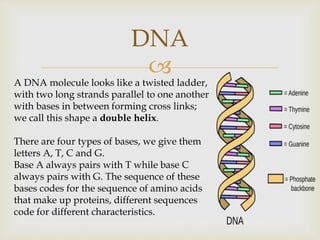
A DNA molecule looks like a twisted ladder,
with two long strands parallel to one another
with bases in between forming cross links;
we call this shape a double helix.
There are four types of bases, we give them
letters A, T, C and G.
Base A always pairs with T while base C
always pairs with G. The sequence of these
bases codes for the sequence of amino acids
that make up proteins, different sequences
code for different characteristics.
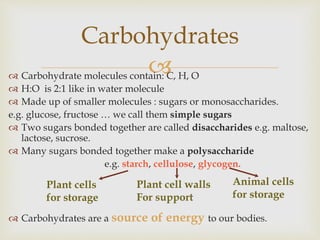
 Carbohydrate molecules contain: C, H, O
 H:O is 2:1 like in water molecule
 Made up of smaller molecules : sugars or monosaccharides.
e.g. glucose, fructose … we call them simple sugars
 Two sugars bonded together are called disaccharides e.g. maltose,
lactose, sucrose.
 Many sugars bonded together make a polysaccharide
e.g. starch, cellulose, glycogen.
 Carbohydrates are a source of energy to our bodies.
Carbohydrates
Plant cells
for storage
Plant cell walls
For support
Animal cells
for storage

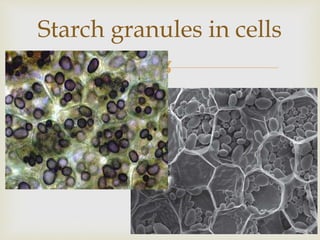
Starch granules in cells

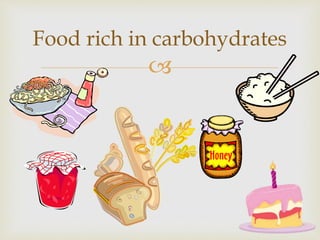
Food rich in carbohydrates

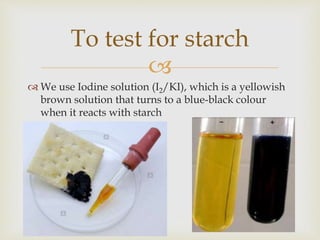
 We use Iodine solution (I2/KI), which is a yellowish
brown solution that turns to a blue-black colour
when it reacts with starch
To test for starch

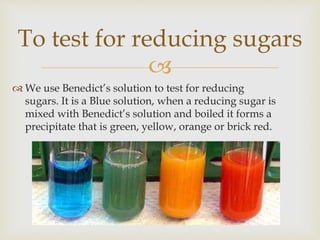
 We use Benedict’s solution to test for reducing
sugars. It is a Blue solution, when a reducing sugar is
mixed with Benedict’s solution and boiled it forms a
precipitate that is green, yellow, orange or brick red.
To test for reducing sugars
 Protein molecules contain elements: C,H,O,N (S,P)
 Proteins are made of smaller molecules called amino acids.
 Two amino acids bonded together are called dipeptides.
 Many amino acids bonded together make a polypeptide.
 Proteins are needed to make:
1. Enzymes
2. Haemoglobin
3. Muscles fibers
4. Hair and nails (Keratin)
5. Cell membranes of cells
6. As a source of energy during starvation.
Proteins

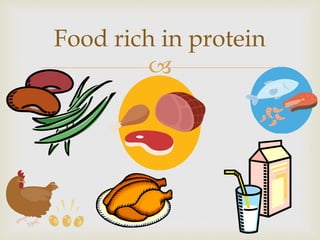
Food rich in protein

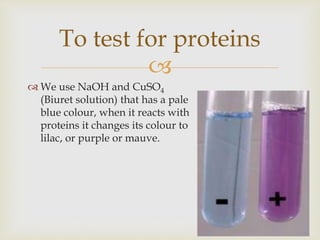
 We use NaOH and CuSO4
(Biuret solution) that has a pale
blue colour, when it reacts with
proteins it changes its colour to
lilac, or purple or mauve.
To test for proteins

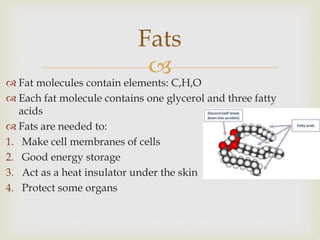
 Fat molecules contain elements: C,H,O
 Each fat molecule contains one glycerol and three fatty
acids
 Fats are needed to:
1. Make cell membranes of cells
2. Good energy storage
3. Act as a heat insulator under the skin
4. Protect some organs
Fats

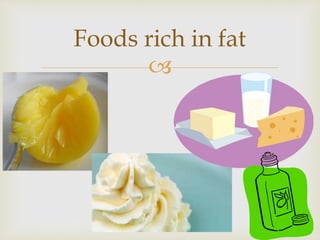
Foods rich in fat

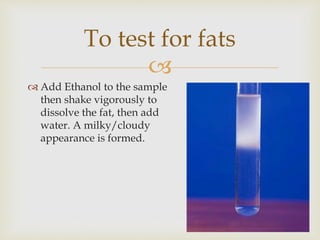
 Add Ethanol to the sample
then shake vigorously to
dissolve the fat, then add
water. A milky/cloudy
appearance is formed.
To test for fats
 There are many vitamins known to us by now, we will
study vitamin C and vitamin D as examples.
 Vitamin C, the first discovered vitamin, is needed by
the body to make an important protein called collagen
that toughens the skin, walls of blood vessels and
bones.
 Lack of vitamin C causes inability to form collagen
fibres which gives strength to blood vessels and skin.
 Deficiency symptoms: bleeding gums, skin ulcers.
 Deficiency disease: scurvy
Vitamins

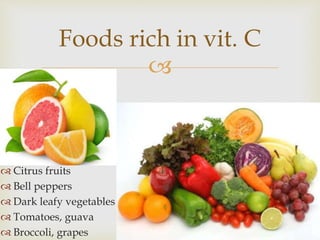
 Citrus fruits
 Bell peppers
 Dark leafy vegetables
 Tomatoes, guava
 Broccoli, grapes
Foods rich in vit. C

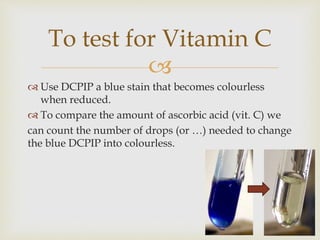
 Use DCPIP a blue stain that becomes colourless
when reduced.
 To compare the amount of ascorbic acid (vit. C) we
can count the number of drops (or …) needed to change
the blue DCPIP into colourless.
To test for Vitamin C
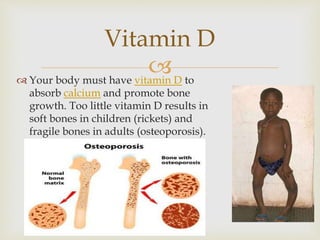
 Your body must have vitamin D to
absorb calcium and promote bone
growth. Too little vitamin D results in
soft bones in children (rickets) and
fragile bones in adults (osteoporosis).
Vitamin D

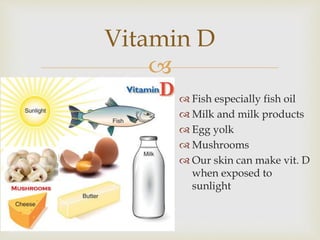
 Fish especially fish oil
 Milk and milk products
 Egg yolk
 Mushrooms
 Our skin can make vit. D
when exposed to
sunlight
Vitamin D

Biological molecules 2018

  • 2.
     DNA A DNA moleculelooks like a twisted ladder, with two long strands parallel to one another with bases in between forming cross links; we call this shape a double helix. There are four types of bases, we give them letters A, T, C and G. Base A always pairs with T while base C always pairs with G. The sequence of these bases codes for the sequence of amino acids that make up proteins, different sequences code for different characteristics.
  • 3.
     Carbohydrate moleculescontain: C, H, O  H:O is 2:1 like in water molecule  Made up of smaller molecules : sugars or monosaccharides. e.g. glucose, fructose … we call them simple sugars  Two sugars bonded together are called disaccharides e.g. maltose, lactose, sucrose.  Many sugars bonded together make a polysaccharide e.g. starch, cellulose, glycogen.  Carbohydrates are a source of energy to our bodies. Carbohydrates Plant cells for storage Plant cell walls For support Animal cells for storage
  • 4.
  • 5.
     Food rich incarbohydrates
  • 6.
      We useIodine solution (I2/KI), which is a yellowish brown solution that turns to a blue-black colour when it reacts with starch To test for starch
  • 7.
      We useBenedict’s solution to test for reducing sugars. It is a Blue solution, when a reducing sugar is mixed with Benedict’s solution and boiled it forms a precipitate that is green, yellow, orange or brick red. To test for reducing sugars
  • 8.
     Protein moleculescontain elements: C,H,O,N (S,P)  Proteins are made of smaller molecules called amino acids.  Two amino acids bonded together are called dipeptides.  Many amino acids bonded together make a polypeptide.  Proteins are needed to make: 1. Enzymes 2. Haemoglobin 3. Muscles fibers 4. Hair and nails (Keratin) 5. Cell membranes of cells 6. As a source of energy during starvation. Proteins
  • 9.
  • 10.
      We useNaOH and CuSO4 (Biuret solution) that has a pale blue colour, when it reacts with proteins it changes its colour to lilac, or purple or mauve. To test for proteins
  • 11.
      Fat moleculescontain elements: C,H,O  Each fat molecule contains one glycerol and three fatty acids  Fats are needed to: 1. Make cell membranes of cells 2. Good energy storage 3. Act as a heat insulator under the skin 4. Protect some organs Fats
  • 12.
  • 13.
      Add Ethanolto the sample then shake vigorously to dissolve the fat, then add water. A milky/cloudy appearance is formed. To test for fats
  • 14.
     There aremany vitamins known to us by now, we will study vitamin C and vitamin D as examples.  Vitamin C, the first discovered vitamin, is needed by the body to make an important protein called collagen that toughens the skin, walls of blood vessels and bones.  Lack of vitamin C causes inability to form collagen fibres which gives strength to blood vessels and skin.  Deficiency symptoms: bleeding gums, skin ulcers.  Deficiency disease: scurvy Vitamins
  • 15.
      Citrus fruits Bell peppers  Dark leafy vegetables  Tomatoes, guava  Broccoli, grapes Foods rich in vit. C
  • 16.
      Use DCPIPa blue stain that becomes colourless when reduced.  To compare the amount of ascorbic acid (vit. C) we can count the number of drops (or …) needed to change the blue DCPIP into colourless. To test for Vitamin C
  • 17.
     Your bodymust have vitamin D to absorb calcium and promote bone growth. Too little vitamin D results in soft bones in children (rickets) and fragile bones in adults (osteoporosis). Vitamin D
  • 18.
      Fish especiallyfish oil  Milk and milk products  Egg yolk  Mushrooms  Our skin can make vit. D when exposed to sunlight Vitamin D