Expii
C, H, O
BIOLOGICAL
MOLECULES
Carbohydrates
Proteins
Lipids
Nucleic acids
SPECIFICATION
(c) Biological molecules
Students should:
 2.7 identify the chemical elements present in carbohydrates, proteins
and lipids (fats and oils)
 2.8 describe the structure of carbohydrates, proteins and lipids as
large molecules made up from smaller basic units: starch and
glycogen from simple sugars, protein from amino acids, and lipid
from fatty acids and glycerol
 2.9 practical: investigate food samples for the presence of glucose,
starch, protein and fat
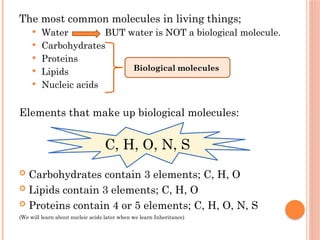
The most common molecules in living things;
 Water BUT water is NOT a biological molecule.
 Carbohydrates
 Proteins
 Lipids
 Nucleic acids
Elements that make up biological molecules:
 Carbohydrates contain 3 elements; C, H, O
 Lipids contain 3 elements; C, H, O
 Proteins contain 4 or 5 elements; C, H, O, N, S
(We will learn about nucleic acids later when we learn Inheritance)
Biological molecules
C, H, O, N, S
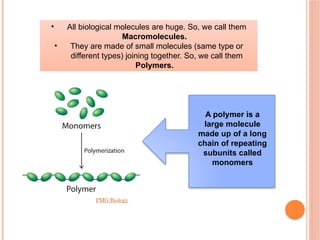
• All biological molecules are huge. So, we call them
Macromolecules.
• They are made of small molecules (same type or
different types) joining together. So, we call them
Polymers.
A polymer is a
large molecule
made up of a long
chain of repeating
subunits called
monomers
PMG Biology
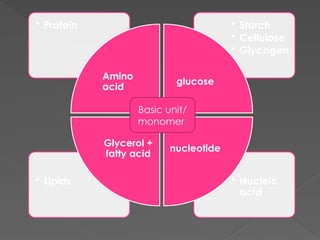
• Nucleic
acid
• Lipids
• Starch
• Cellulose
• Glycogen
• Protein
Amino
acid
glucose
nucleotide
Glycerol +
fatty acid
Basic unit/
monomer
Carbohydrates
STRUCTURE OF
CARBOHYDRATES
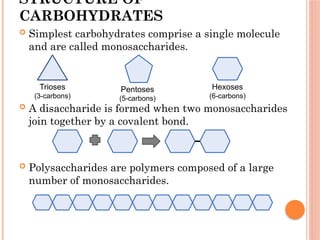
 Simplest carbohydrates comprise a single molecule
and are called monosaccharides.
 A disaccharide is formed when two monosaccharides
join together by a covalent bond.
 Polysaccharides are polymers composed of a large
number of monosaccharides.
Trioses
(3-carbons)
Pentoses
(5-carbons)
Hexoses
(6-carbons)
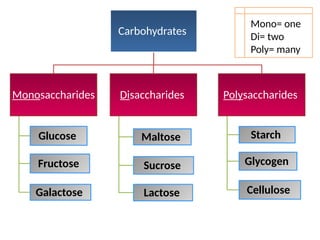
Carbohydrates
Monosaccharides
Glucose
Fructose
Galactose
Disaccharides
Maltose
Sucrose
Lactose
Polysaccharides
Starch
Glycogen
Cellulose
Mono= one
Di= two
Poly= many
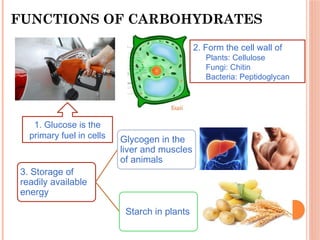
1. Glucose is the
primary fuel in cells
FUNCTIONS OF CARBOHYDRATES
A2B
Car
Rental Expii
2. Form the cell wall of
Plants: Cellulose
Fungi: Chitin
Bacteria: Peptidoglycan
3. Storage of
readily available
energy
Glycogen in the
liver and muscles
of animals
Starch in plants
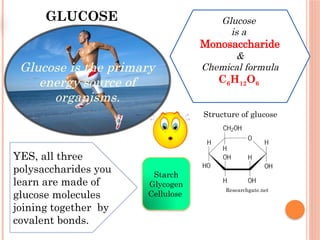
GLUCOSE
Glucose is the primary
energy source of
organisms.
Glucose
is a
Monosaccharide
&
Chemical formula
C6H12O6
Structure of glucose
Researchgate.net
YES, all three
polysaccharides you
learn are made of
glucose molecules
joining together by
covalent bonds.
Starch
Glycogen
Cellulose
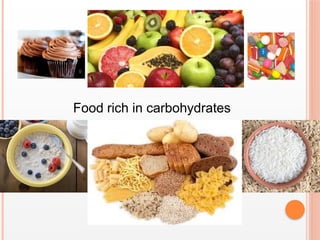
Food rich in carbohydrates
Protei
n
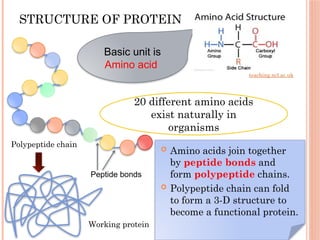
STRUCTURE OF PROTEIN
 Amino acids join together
by peptide bonds and
form polypeptide chains.
 Polypeptide chain can fold
to form a 3-D structure to
become a functional protein.
Basic unit is
Amino acid
teaching.ncl.ac.uk
20 different amino acids
exist naturally in
organisms
Peptide bonds
Working protein
Polypeptide chain
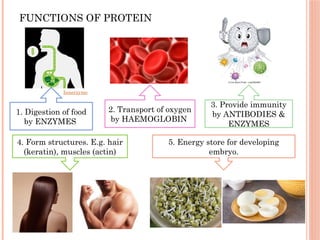
FUNCTIONS OF PROTEIN
1. Digestion of food
by ENZYMES
2. Transport of oxygen
by HAEMOGLOBIN
3. Provide immunity
by ANTIBODIES &
ENZYMES
Innerzyme
4. Form structures. E.g. hair
(keratin), muscles (actin)
5. Energy store for developing
embryo.
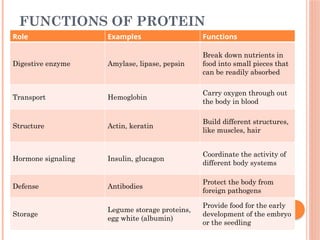
FUNCTIONS OF PROTEIN
Role Examples Functions
Digestive enzyme Amylase, lipase, pepsin
Break down nutrients in
food into small pieces that
can be readily absorbed
Transport Hemoglobin
Carry oxygen through out
the body in blood
Structure Actin, keratin
Build different structures,
like muscles, hair
Hormone signaling Insulin, glucagon
Coordinate the activity of
different body systems
Defense Antibodies
Protect the body from
foreign pathogens
Storage
Legume storage proteins,
egg white (albumin)
Provide food for the early
development of the embryo
or the seedling
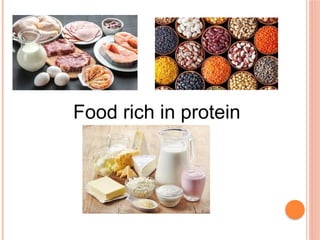
Food rich in protein
Lipid
s
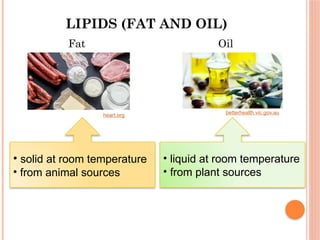
LIPIDS (FAT AND OIL)
heart.org
• solid at room temperature
• from animal sources
Fat
betterhealth.vic.gov.au
• liquid at room temperature
• from plant sources
Oil
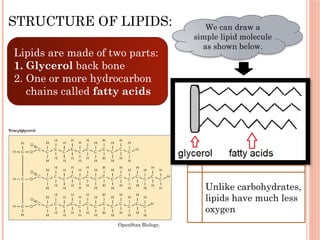
STRUCTURE OF LIPIDS: We can draw a
simple lipid molecule
as shown below.
Lipids are made of two parts:
1. Glycerol back bone
2. One or more hydrocarbon
chains called fatty acids
OpenStax Biology.
Unlike carbohydrates,
lipids have much less
oxygen
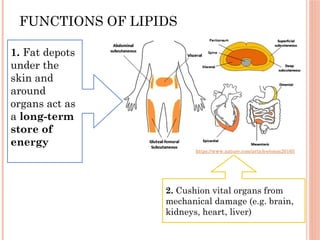
FUNCTIONS OF LIPIDS
2. Cushion vital organs from
mechanical damage (e.g. brain,
kidneys, heart, liver)
https://www.nature.com/articles/emm20165
1. Fat depots
under the
skin and
around
organs act as
a long-term
store of
energy
FUNCTIONS OF LIPIDS
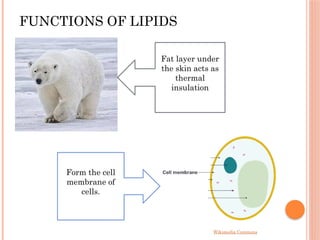
Wikimedia Commons
Fat layer under
the skin acts as
thermal
insulation
Form the cell
membrane of
cells.
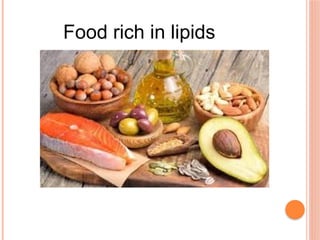
Food rich in lipids
Tests to identify
biological molecules
(Food tests)
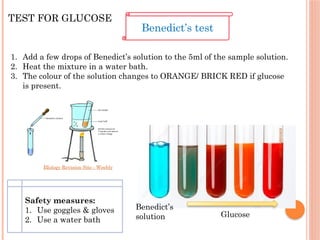
TEST FOR GLUCOSE
sciencephoto.com
1. Add a few drops of Benedict’s solution to the 5ml of the sample solution.
2. Heat the mixture in a water bath.
3. The colour of the solution changes to ORANGE/ BRICK RED if glucose
is present.
Benedict’s test
Benedict’s
solution Glucose
Safety measures:
1. Use goggles & gloves
2. Use a water bath
BIology Revision Site - Weebly
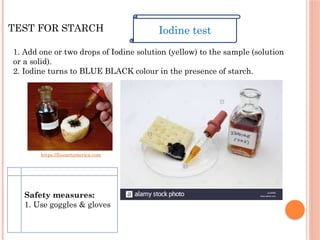
TEST FOR STARCH
1. Add one or two drops of Iodine solution (yellow) to the sample (solution
or a solid).
2. Iodine turns to BLUE BLACK colour in the presence of starch.
Iodine test
https://fineartamerica.com
Safety measures:
1. Use goggles & gloves
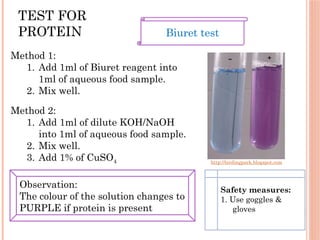
TEST FOR
PROTEIN
http://birdingpark.blogspot.com
Biuret test
Method 1:
1. Add 1ml of Biuret reagent into
1ml of aqueous food sample.
2. Mix well.
Method 2:
1. Add 1ml of dilute KOH/NaOH
into 1ml of aqueous food sample.
2. Mix well.
3. Add 1% of CuSO4
Observation:
The colour of the solution changes to
PURPLE if protein is present
Safety measures:
1. Use goggles &
gloves
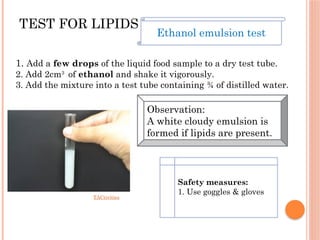
TEST FOR LIPIDS
TACtivities
1. Add a few drops of the liquid food sample to a dry test tube.
2. Add 2cm3
of ethanol and shake it vigorously.
3. Add the mixture into a test tube containing ¾ of distilled water.
Ethanol emulsion test
Observation:
A white cloudy emulsion is
formed if lipids are present.
Safety measures:
1. Use goggles & gloves
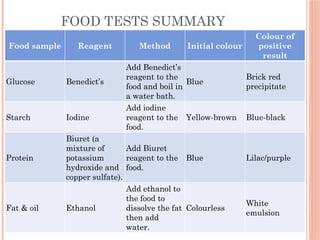
FOOD TESTS SUMMARY
Food sample Reagent Method Initial colour
Colour of
positive
result
Glucose Benedict’s
Add Benedict’s
reagent to the
food and boil in
a water bath.
Blue
Brick red
precipitate
Starch Iodine
Add iodine
reagent to the
food.
Yellow-brown Blue-black
Protein
Biuret (a
mixture of
potassium
hydroxide and
copper sulfate).
Add Biuret
reagent to the
food.
Blue Lilac/purple
Fat & oil Ethanol
Add ethanol to
the food to
dissolve the fat
then add
water.
Colourless
White
emulsion
Thank you

Biological-molecules, Proteins others pptx

  • 1.
  • 2.
    SPECIFICATION (c) Biological molecules Studentsshould:  2.7 identify the chemical elements present in carbohydrates, proteins and lipids (fats and oils)  2.8 describe the structure of carbohydrates, proteins and lipids as large molecules made up from smaller basic units: starch and glycogen from simple sugars, protein from amino acids, and lipid from fatty acids and glycerol  2.9 practical: investigate food samples for the presence of glucose, starch, protein and fat
  • 3.
    The most commonmolecules in living things;  Water BUT water is NOT a biological molecule.  Carbohydrates  Proteins  Lipids  Nucleic acids Elements that make up biological molecules:  Carbohydrates contain 3 elements; C, H, O  Lipids contain 3 elements; C, H, O  Proteins contain 4 or 5 elements; C, H, O, N, S (We will learn about nucleic acids later when we learn Inheritance) Biological molecules C, H, O, N, S
  • 4.
    • All biologicalmolecules are huge. So, we call them Macromolecules. • They are made of small molecules (same type or different types) joining together. So, we call them Polymers. A polymer is a large molecule made up of a long chain of repeating subunits called monomers PMG Biology
  • 5.
    • Nucleic acid • Lipids •Starch • Cellulose • Glycogen • Protein Amino acid glucose nucleotide Glycerol + fatty acid Basic unit/ monomer
  • 6.
  • 7.
    STRUCTURE OF CARBOHYDRATES  Simplestcarbohydrates comprise a single molecule and are called monosaccharides.  A disaccharide is formed when two monosaccharides join together by a covalent bond.  Polysaccharides are polymers composed of a large number of monosaccharides. Trioses (3-carbons) Pentoses (5-carbons) Hexoses (6-carbons)
  • 8.
  • 9.
    1. Glucose isthe primary fuel in cells FUNCTIONS OF CARBOHYDRATES A2B Car Rental Expii 2. Form the cell wall of Plants: Cellulose Fungi: Chitin Bacteria: Peptidoglycan 3. Storage of readily available energy Glycogen in the liver and muscles of animals Starch in plants
  • 10.
    GLUCOSE Glucose is theprimary energy source of organisms. Glucose is a Monosaccharide & Chemical formula C6H12O6 Structure of glucose Researchgate.net YES, all three polysaccharides you learn are made of glucose molecules joining together by covalent bonds. Starch Glycogen Cellulose
  • 11.
    Food rich incarbohydrates
  • 12.
  • 13.
    STRUCTURE OF PROTEIN Amino acids join together by peptide bonds and form polypeptide chains.  Polypeptide chain can fold to form a 3-D structure to become a functional protein. Basic unit is Amino acid teaching.ncl.ac.uk 20 different amino acids exist naturally in organisms Peptide bonds Working protein Polypeptide chain
  • 14.
    FUNCTIONS OF PROTEIN 1.Digestion of food by ENZYMES 2. Transport of oxygen by HAEMOGLOBIN 3. Provide immunity by ANTIBODIES & ENZYMES Innerzyme 4. Form structures. E.g. hair (keratin), muscles (actin) 5. Energy store for developing embryo.
  • 15.
    FUNCTIONS OF PROTEIN RoleExamples Functions Digestive enzyme Amylase, lipase, pepsin Break down nutrients in food into small pieces that can be readily absorbed Transport Hemoglobin Carry oxygen through out the body in blood Structure Actin, keratin Build different structures, like muscles, hair Hormone signaling Insulin, glucagon Coordinate the activity of different body systems Defense Antibodies Protect the body from foreign pathogens Storage Legume storage proteins, egg white (albumin) Provide food for the early development of the embryo or the seedling
  • 16.
    Food rich inprotein
  • 17.
  • 18.
    LIPIDS (FAT ANDOIL) heart.org • solid at room temperature • from animal sources Fat betterhealth.vic.gov.au • liquid at room temperature • from plant sources Oil
  • 19.
    STRUCTURE OF LIPIDS:We can draw a simple lipid molecule as shown below. Lipids are made of two parts: 1. Glycerol back bone 2. One or more hydrocarbon chains called fatty acids OpenStax Biology. Unlike carbohydrates, lipids have much less oxygen
  • 20.
    FUNCTIONS OF LIPIDS 2.Cushion vital organs from mechanical damage (e.g. brain, kidneys, heart, liver) https://www.nature.com/articles/emm20165 1. Fat depots under the skin and around organs act as a long-term store of energy
  • 21.
    FUNCTIONS OF LIPIDS WikimediaCommons Fat layer under the skin acts as thermal insulation Form the cell membrane of cells.
  • 22.
  • 23.
    Tests to identify biologicalmolecules (Food tests)
  • 24.
    TEST FOR GLUCOSE sciencephoto.com 1.Add a few drops of Benedict’s solution to the 5ml of the sample solution. 2. Heat the mixture in a water bath. 3. The colour of the solution changes to ORANGE/ BRICK RED if glucose is present. Benedict’s test Benedict’s solution Glucose Safety measures: 1. Use goggles & gloves 2. Use a water bath BIology Revision Site - Weebly
  • 25.
    TEST FOR STARCH 1.Add one or two drops of Iodine solution (yellow) to the sample (solution or a solid). 2. Iodine turns to BLUE BLACK colour in the presence of starch. Iodine test https://fineartamerica.com Safety measures: 1. Use goggles & gloves
  • 26.
    TEST FOR PROTEIN http://birdingpark.blogspot.com Biuret test Method1: 1. Add 1ml of Biuret reagent into 1ml of aqueous food sample. 2. Mix well. Method 2: 1. Add 1ml of dilute KOH/NaOH into 1ml of aqueous food sample. 2. Mix well. 3. Add 1% of CuSO4 Observation: The colour of the solution changes to PURPLE if protein is present Safety measures: 1. Use goggles & gloves
  • 27.
    TEST FOR LIPIDS TACtivities 1.Add a few drops of the liquid food sample to a dry test tube. 2. Add 2cm3 of ethanol and shake it vigorously. 3. Add the mixture into a test tube containing ¾ of distilled water. Ethanol emulsion test Observation: A white cloudy emulsion is formed if lipids are present. Safety measures: 1. Use goggles & gloves
  • 28.
    FOOD TESTS SUMMARY Foodsample Reagent Method Initial colour Colour of positive result Glucose Benedict’s Add Benedict’s reagent to the food and boil in a water bath. Blue Brick red precipitate Starch Iodine Add iodine reagent to the food. Yellow-brown Blue-black Protein Biuret (a mixture of potassium hydroxide and copper sulfate). Add Biuret reagent to the food. Blue Lilac/purple Fat & oil Ethanol Add ethanol to the food to dissolve the fat then add water. Colourless White emulsion
  • 29.