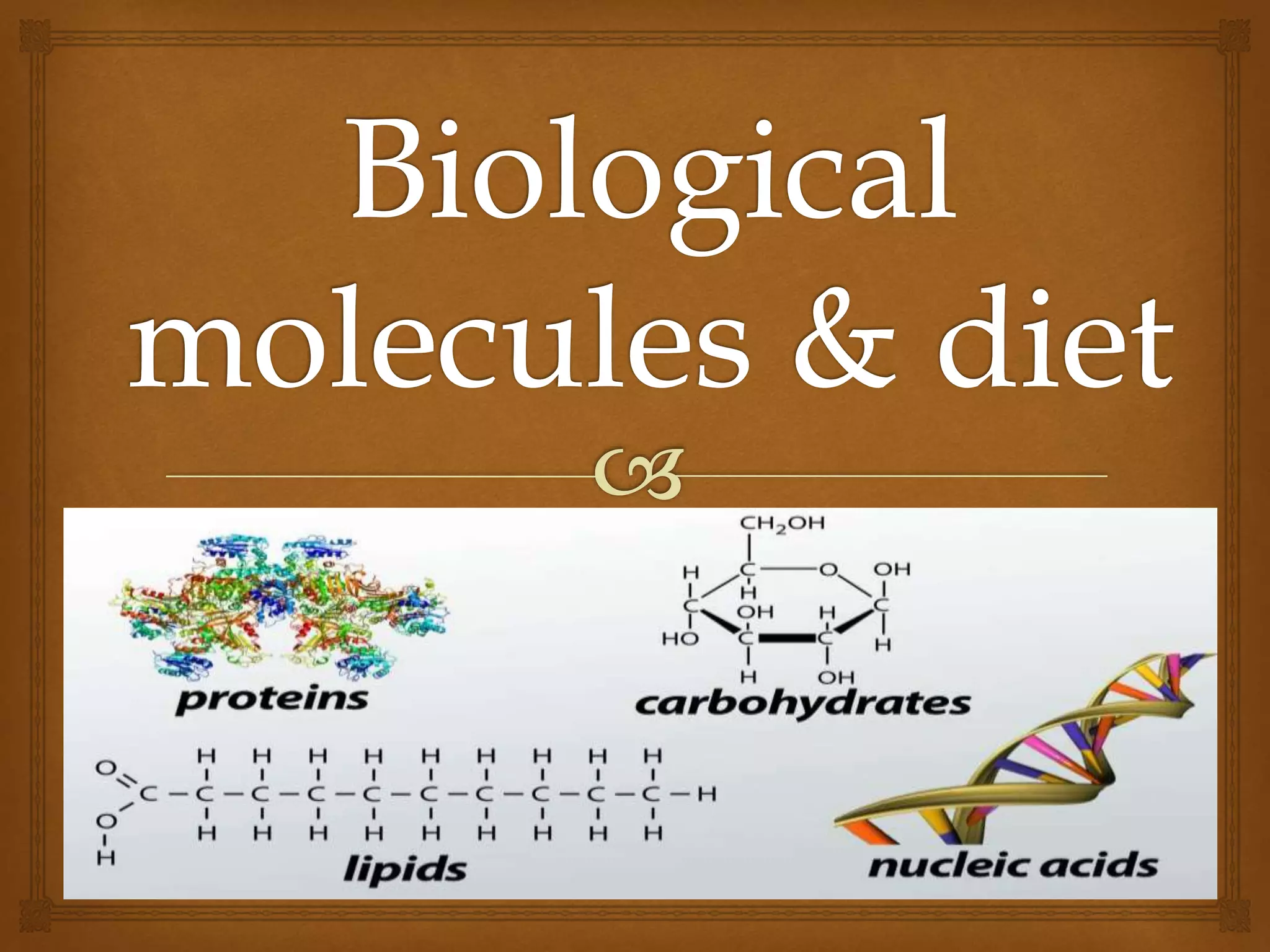
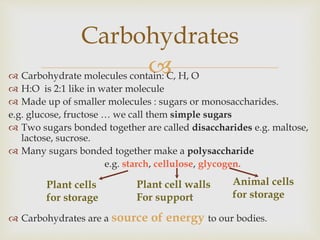
 Carbohydrate molecules contain: C, H, O
 H:O is 2:1 like in water molecule
 Made up of smaller molecules : sugars or monosaccharides.
e.g. glucose, fructose … we call them simple sugars
 Two sugars bonded together are called disaccharides e.g. maltose,
lactose, sucrose.
 Many sugars bonded together make a polysaccharide
e.g. starch, cellulose, glycogen.
 Carbohydrates are a source of energy to our bodies.
Carbohydrates
Plant cells
for storage
Plant cell walls
For support
Animal cells
for storage

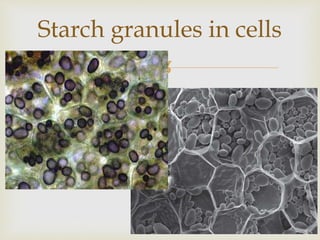
Starch granules in cells

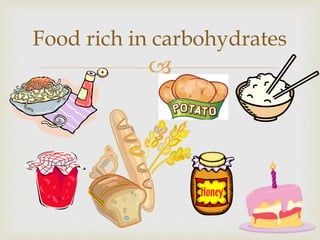
Food rich in carbohydrates

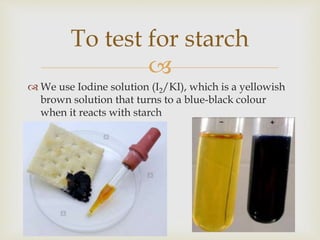
 We use Iodine solution (I2/KI), which is a yellowish
brown solution that turns to a blue-black colour
when it reacts with starch
To test for starch
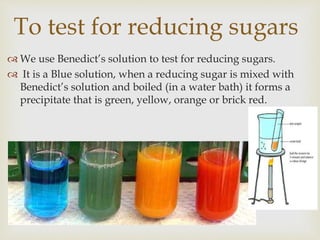
 We use Benedict’s solution to test for reducing sugars.
 It is a Blue solution, when a reducing sugar is mixed with
Benedict’s solution and boiled (in a water bath) it forms a
precipitate that is green, yellow, orange or brick red.
To test for reducing sugars
 Protein molecules contain elements: C,H,O,N (S,P)
 Proteins are made of smaller molecules called amino acids.
 Two amino acids bonded together are called dipeptides.
 Many amino acids bonded together make a polypeptide.
 Proteins are needed to make:
1. Enzymes
2. Haemoglobin
3. Muscles fibers
4. Hair and nails (Keratin)
5. Cell membranes of cells
6. As a source of energy during starvation.
Proteins

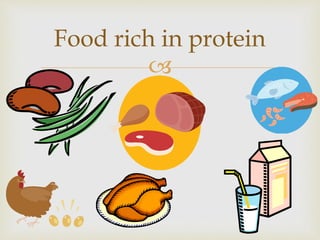
Food rich in protein

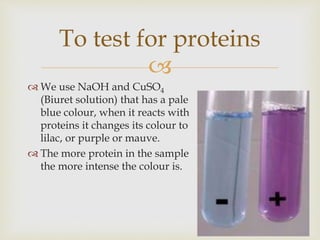
 We use NaOH and CuSO4
(Biuret solution) that has a pale
blue colour, when it reacts with
proteins it changes its colour to
lilac, or purple or mauve.
 The more protein in the sample
the more intense the colour is.
To test for proteins

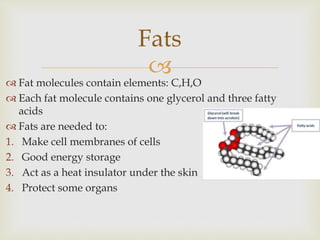
 Fat molecules contain elements: C,H,O
 Each fat molecule contains one glycerol and three fatty
acids
 Fats are needed to:
1. Make cell membranes of cells
2. Good energy storage
3. Act as a heat insulator under the skin
4. Protect some organs
Fats

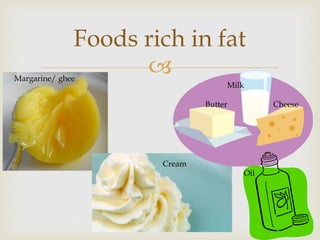
Foods rich in fat
Margarine/ ghee
Milk
Butter Cheese
Cream
Oil

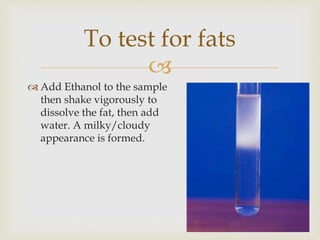
 Add Ethanol to the sample
then shake vigorously to
dissolve the fat, then add
water. A milky/cloudy
appearance is formed.
To test for fats

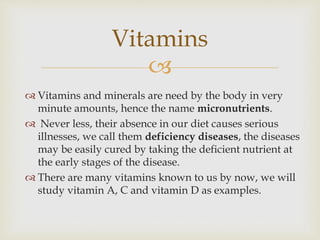
 Vitamins and minerals are need by the body in very
minute amounts, hence the name micronutrients.
 Never less, their absence in our diet causes serious
illnesses, we call them deficiency diseases, the diseases
may be easily cured by taking the deficient nutrient at
the early stages of the disease.
 There are many vitamins known to us by now, we will
study vitamin A, C and vitamin D as examples.
Vitamins

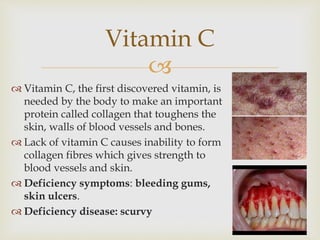
 Vitamin C, the first discovered vitamin, is
needed by the body to make an important
protein called collagen that toughens the
skin, walls of blood vessels and bones.
 Lack of vitamin C causes inability to form
collagen fibres which gives strength to
blood vessels and skin.
 Deficiency symptoms: bleeding gums,
skin ulcers.
 Deficiency disease: scurvy
Vitamin C

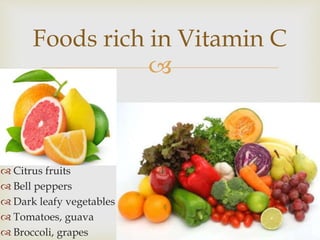
 Citrus fruits
 Bell peppers
 Dark leafy vegetables
 Tomatoes, guava
 Broccoli, grapes
Foods rich in Vitamin C

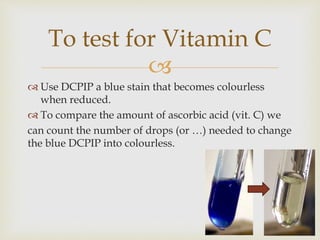
 Use DCPIP a blue stain that becomes colourless
when reduced.
 To compare the amount of ascorbic acid (vit. C) we
can count the number of drops (or …) needed to change
the blue DCPIP into colourless.
To test for Vitamin C
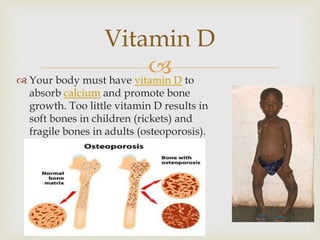
 Your body must have vitamin D to
absorb calcium and promote bone
growth. Too little vitamin D results in
soft bones in children (rickets) and
fragile bones in adults (osteoporosis).
Vitamin D

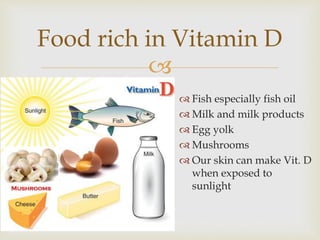
 Fish especially fish oil
 Milk and milk products
 Egg yolk
 Mushrooms
 Our skin can make Vit. D
when exposed to
sunlight
Food rich in Vitamin D
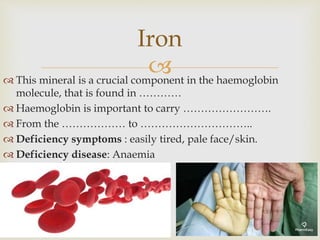
 This mineral is a crucial component in the haemoglobin
molecule, that is found in …………
 Haemoglobin is important to carry …………………….
 From the ……………… to …………………………..
 Deficiency symptoms : easily tired, pale face/skin.
 Deficiency disease: Anaemia
Iron

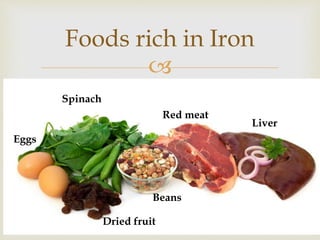
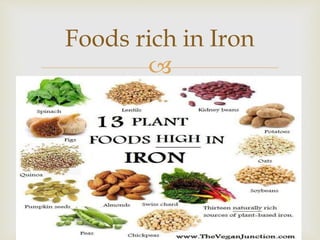
Foods rich in Iron
Spinach
Red meat
Beans
Liver
Dried fruit
Eggs

Foods rich in Iron

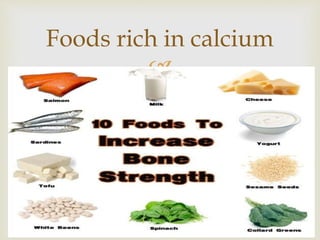
Foods rich in calcium
Micro-organisms in
food production
Yeast is a fungus
used in bread
making.
Micro-organisms in
food production
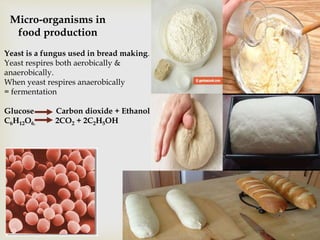
Yeast is a fungus used in bread making.
Yeast respires both aerobically &
anaerobically.
When yeast respires anaerobically
= fermentation
Glucose Carbon dioxide + Ethanol
C6H12O6. 2CO2 + 2C2H5OH
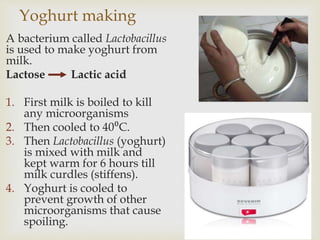
Yoghurt making
A bacterium called Lactobacillus
is used to make yoghurt from
milk.
Lactose Lactic acid
1. First milk is boiled to kill
any microorganisms
2. Then cooled to 40⁰C.
3. Then Lactobacillus (yoghurt)
is mixed with milk and
kept warm for 6 hours till
milk curdles (stiffens).
4. Yoghurt is cooled to
prevent growth of other
microorganisms that cause
spoiling.
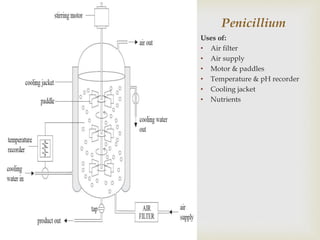
Penicillium
Uses of:
• Air filter
• Air supply
• Motor & paddles
• Temperature & pH recorder
• Cooling jacket
• Nutrients

5 biological molecules y9 2019

  • 2.
     Carbohydrate moleculescontain: C, H, O  H:O is 2:1 like in water molecule  Made up of smaller molecules : sugars or monosaccharides. e.g. glucose, fructose … we call them simple sugars  Two sugars bonded together are called disaccharides e.g. maltose, lactose, sucrose.  Many sugars bonded together make a polysaccharide e.g. starch, cellulose, glycogen.  Carbohydrates are a source of energy to our bodies. Carbohydrates Plant cells for storage Plant cell walls For support Animal cells for storage
  • 3.
  • 4.
     Food rich incarbohydrates
  • 5.
      We useIodine solution (I2/KI), which is a yellowish brown solution that turns to a blue-black colour when it reacts with starch To test for starch
  • 6.
     We useBenedict’s solution to test for reducing sugars.  It is a Blue solution, when a reducing sugar is mixed with Benedict’s solution and boiled (in a water bath) it forms a precipitate that is green, yellow, orange or brick red. To test for reducing sugars
  • 7.
     Protein moleculescontain elements: C,H,O,N (S,P)  Proteins are made of smaller molecules called amino acids.  Two amino acids bonded together are called dipeptides.  Many amino acids bonded together make a polypeptide.  Proteins are needed to make: 1. Enzymes 2. Haemoglobin 3. Muscles fibers 4. Hair and nails (Keratin) 5. Cell membranes of cells 6. As a source of energy during starvation. Proteins
  • 8.
  • 9.
      We useNaOH and CuSO4 (Biuret solution) that has a pale blue colour, when it reacts with proteins it changes its colour to lilac, or purple or mauve.  The more protein in the sample the more intense the colour is. To test for proteins
  • 10.
      Fat moleculescontain elements: C,H,O  Each fat molecule contains one glycerol and three fatty acids  Fats are needed to: 1. Make cell membranes of cells 2. Good energy storage 3. Act as a heat insulator under the skin 4. Protect some organs Fats
  • 11.
     Foods rich infat Margarine/ ghee Milk Butter Cheese Cream Oil
  • 12.
      Add Ethanolto the sample then shake vigorously to dissolve the fat, then add water. A milky/cloudy appearance is formed. To test for fats
  • 13.
      Vitamins andminerals are need by the body in very minute amounts, hence the name micronutrients.  Never less, their absence in our diet causes serious illnesses, we call them deficiency diseases, the diseases may be easily cured by taking the deficient nutrient at the early stages of the disease.  There are many vitamins known to us by now, we will study vitamin A, C and vitamin D as examples. Vitamins
  • 14.
      Vitamin C,the first discovered vitamin, is needed by the body to make an important protein called collagen that toughens the skin, walls of blood vessels and bones.  Lack of vitamin C causes inability to form collagen fibres which gives strength to blood vessels and skin.  Deficiency symptoms: bleeding gums, skin ulcers.  Deficiency disease: scurvy Vitamin C
  • 15.
      Citrus fruits Bell peppers  Dark leafy vegetables  Tomatoes, guava  Broccoli, grapes Foods rich in Vitamin C
  • 16.
      Use DCPIPa blue stain that becomes colourless when reduced.  To compare the amount of ascorbic acid (vit. C) we can count the number of drops (or …) needed to change the blue DCPIP into colourless. To test for Vitamin C
  • 17.
     Your bodymust have vitamin D to absorb calcium and promote bone growth. Too little vitamin D results in soft bones in children (rickets) and fragile bones in adults (osteoporosis). Vitamin D
  • 18.
      Fish especiallyfish oil  Milk and milk products  Egg yolk  Mushrooms  Our skin can make Vit. D when exposed to sunlight Food rich in Vitamin D
  • 19.
     This mineralis a crucial component in the haemoglobin molecule, that is found in …………  Haemoglobin is important to carry …………………….  From the ……………… to …………………………..  Deficiency symptoms : easily tired, pale face/skin.  Deficiency disease: Anaemia Iron
  • 20.
     Foods rich inIron Spinach Red meat Beans Liver Dried fruit Eggs
  • 21.
  • 22.
  • 23.
    Micro-organisms in food production Yeastis a fungus used in bread making. Micro-organisms in food production Yeast is a fungus used in bread making. Yeast respires both aerobically & anaerobically. When yeast respires anaerobically = fermentation Glucose Carbon dioxide + Ethanol C6H12O6. 2CO2 + 2C2H5OH
  • 24.
    Yoghurt making A bacteriumcalled Lactobacillus is used to make yoghurt from milk. Lactose Lactic acid 1. First milk is boiled to kill any microorganisms 2. Then cooled to 40⁰C. 3. Then Lactobacillus (yoghurt) is mixed with milk and kept warm for 6 hours till milk curdles (stiffens). 4. Yoghurt is cooled to prevent growth of other microorganisms that cause spoiling.
  • 25.
    Penicillium Uses of: • Airfilter • Air supply • Motor & paddles • Temperature & pH recorder • Cooling jacket • Nutrients