Biological Molecules Biology Department
Introduction For each of the following you should be able to: Describe the properties Know the general formulae & structure Understand the role in animals & plants Carbohydrates Lipids Proteins Nucleic acids
Carbohydrates Contain the elements Carbon Hydrogen & Oxygen There are 3 types: Monosaccharides Disaccharides Polysaccharides
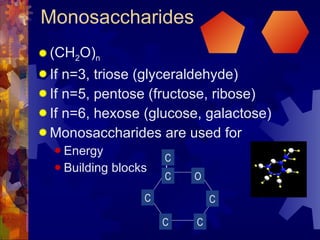
Monosaccharides (CH 2 O) n If n=3, triose (glyceraldehyde) If n=5, pentose (fructose, ribose) If n=6, hexose (glucose, galactose) Monosaccharides are used for Energy Building blocks O C C C C C C
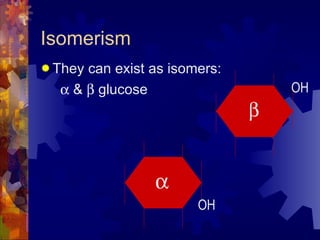
Isomerism They can exist as isomers:   &    glucose OH OH  
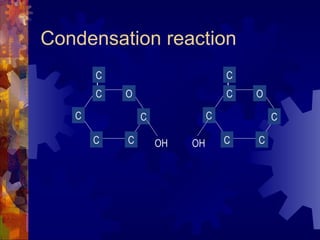
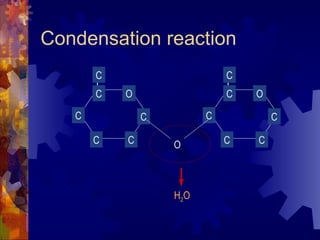
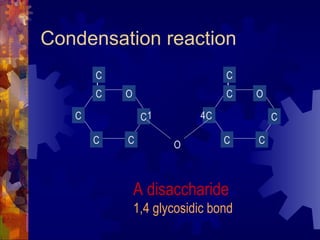
Disaccharides Formed from two monosaccharides Joined by a glycosidic bond A condensation reaction: glucose + glucose     maltose glucose + galactose     lactose glucose + fructose     sucrose
Condensation reaction OH OH O C C C C C C O C C C C C C
Condensation reaction O H OH O C C C C C C O C C C C C C
Condensation reaction O H 2 O O C C C C C C O C C C C C C
Condensation reaction O A disaccharide 1,4 glycosidic bond 4 1 O C C C C C C O C C C C C C
Polysaccharides Polymers formed from many monosaccharides Three important examples: Starch Glycogen Cellulose
Starch  Insoluble store of glucose in plants formed from two glucose polymers: Amylose  -glucose 1,4 glycosidic bonds Spiral structure Amylopectin  -glucose 1,4 and some 1,6 glycosidic bonds Branched structure
Glycogen Insoluble compact store of glucose in animals  -glucose units 1,4 and 1,6 glycosidic bonds Branched structure
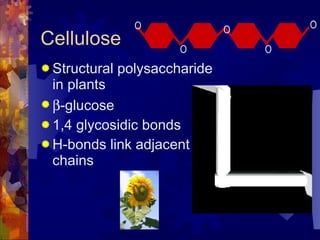
Cellulose Structural polysaccharide in plants  -glucose 1,4 glycosidic bonds H-bonds link adjacent chains O O O O O
Lipids Made up of C, H and O Can exist as fats, oils and waxes They are insoluble in water They are a good source of energy (38kJ/g) They are poor conductors of heat Most fats & oils are triglycerides
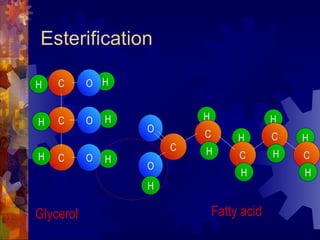
Triglycerides Formed by esterification… …a condensation reaction between 3 fatty acids and glycerol: Glycerol H C H C C H H H H O O O
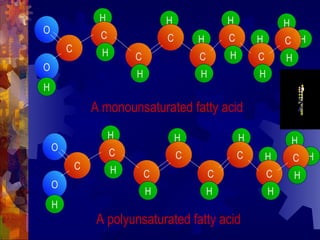
Fatty acids Carboxyl group (-COOH)  attached to a long non-polar hydrocarbon chain (hydrophobic): H A saturated fatty acid (no double bonds) H C H H C H H C H C O O H C H H C H H C H H C H H
H H C O O H C C C C H A polyunsaturated fatty acid C O O H C H H C H A monounsaturated fatty acid H H H C H H C H H C H H C H H C H H C H H C H H C H
Esterification Glycerol Fatty acid H C H C C H H H H O O O C O O H C H H C H H C H H C H H
Esterification H C H C C H H H H O O O C O O H Glycerol Fatty acid H C H H C H H C H H C H
Esterification H C H C C H H H H O O O C O O H Ester bond water H C H H C H H C H H C H
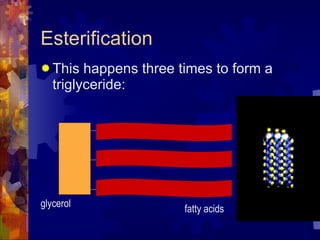
Esterification This happens three times to form a triglyceride: glycerol fatty acids
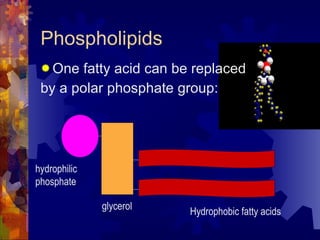
Phospholipids One fatty acid can be replaced  by a polar phosphate group: glycerol Hydrophobic fatty acids hydrophilic phosphate
Functions of lipids Protection of vital organs To prevent evaporation in plants & animals To insulate the body They form the myelin sheath around some neurones As a water source (respiration of lipids) As a component of cell membranes
Proteins Made from C H O N & sometimes S Long chains of amino acids Properties determined by the aa sequence Amino acids ~20 aa Glycine R=H Alanine R=CH 3 amine carboxyl H C H N C H H O O R
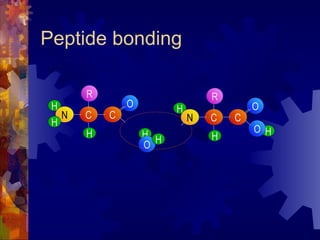
Peptide bonding H C H N C H H O O R H C H N C H H O O R
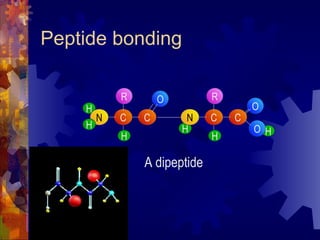
Peptide bonding C H N C H H O R H C H N C H O O R water Peptide bond A condensation reaction H O H
Peptide bonding H C H N C H O O R A dipeptide C H N C H H O R
Primary structure The sequence of aa is know as the primary structure The aa chain is a polypeptide Secondary structure H-bonding forms between the –COOH and the -NH 2  of adjacent aa This results in the chains folding:
Secondary structure  -helix  -pleated sheet
Tertiary structure Bonding between R-groups gives rise to a 3D shape H-bonds  =O  HN- Ionic bonds –NH 3 - COO- Disulphide bridge   --CH 2 S - SCH 2 - affected by temp & pH affected by pH affected by reducing agents
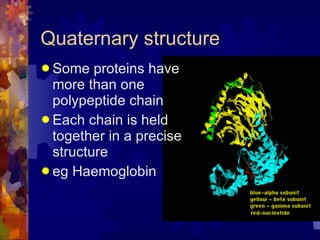
Quaternary structure Some proteins have more than one polypeptide chain Each chain is held together in a precise structure eg Haemoglobin
Types of proteins Fibrous proteins e.g. collagen Insoluble structural Globular proteins e.g.enzymes Soluble  3D shape
Functions of proteins Enzymes –  Transport –  Movement –  Cell recognition – Channels – Structure – Hormones –  Protection – Amylase Haemoglobin Actin & myosin Antigens Membrane proteins Collagen & keratin Insulin Antibodies
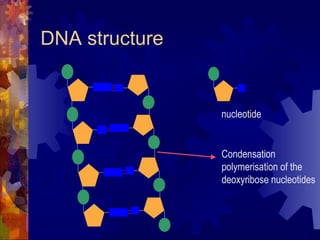
Nucleic acids DNA & RNA Made up of nucleotides: phosphate pentose sugar base
Nucleotides 2 types of base: Pyrimidines  - Cytosine  C Thymine  T Purines Adenine  A Guanine  G
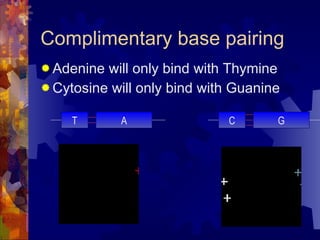
Complimentary base pairing Adenine will only bind with Thymine Cytosine will only bind with Guanine T C G A
DNA structure nucleotide Condensation  polymerisation of the  deoxyribose nucleotides
Replication During cell division the DNA must replicate The DNA double helix unwinds The exposed bases bind to free floating nucleotides in the nucleoplasm DNA polymerase binds the complimentary nucleotides Replication is  semiconservative
The genetic code The sequence of nucleotide bases forms a code Each ‘code word’ has three letter – a triplet code Each codon codes for a specific amino acid e.g: GGG = proline CGG = glycine ATG = tyrosine ACT = stop (no amino acid)
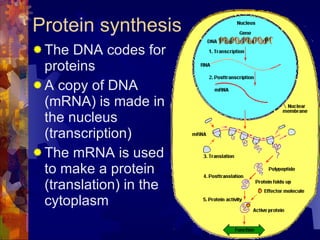
Protein synthesis The DNA codes for proteins A copy of DNA (mRNA) is made in the nucleus (transcription) The mRNA is used to make a protein (translation) in the cytoplasm
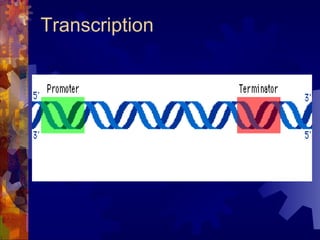
Transcription The DNA polymerase unwinds the DNA Free nucleotides join onto complimentary bases RNA polymerase links adjacent nucleotides The completed mRNA moves out of the nucleus
Transcription
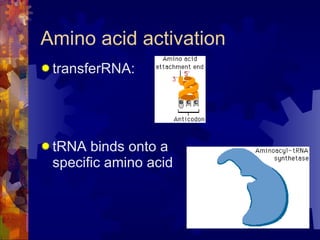
Amino acid activation transferRNA: tRNA binds onto a specific amino acid
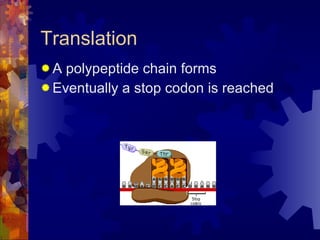
Translation mRNA binds to a ribosome tRNA carries an amino acid to the ribosome
Translation A second tRNA brings another aa The two aa’s bind The process repeats
Translation A polypeptide chain forms Eventually a stop codon is reached
The Human Genome Project A multinational project aimed at sequencing the entire human genome Visit the Human Genome Web site: www.ornl.gov/hgmis/project/about.html www.sanger.ac.uk
Quiz 1. The general formula for a monosaccharide is: (CH 2 O) n   (CHO) n C(H 2 O) n C n H 2 O n
Quiz 2. Sucrose is made up of glucose + fructose   glucose +  galactose glucose + glucose galactose  + fructose
Quiz 3. Amylopectin is made up of:  - 1,4  glycosidic  bonds  - 1,4 &   -1,4  glycosidic  bonds  - 1,4 & 1,6  glycosidic  bonds  - 1,4 & 1,6  glycosidic  bonds
Quiz 4. Formation of a triglyceride does NOT involve: A condensation reaction   Esterification Polymerisation A reaction between 3 fatty acids & glycerol
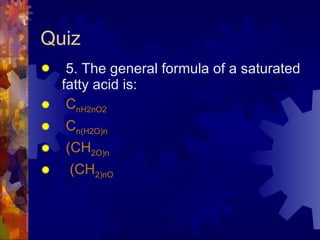
Quiz 5. The general formula of a saturated fatty acid is: C n H 2n O 2  C n (H 2 O) n (CH 2 O) n (CH 2 ) n O
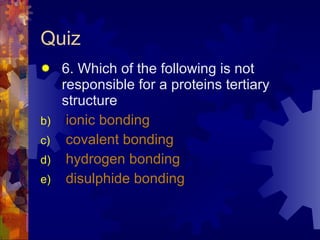
Quiz 6. Which of the following is not responsible for a proteins tertiary structure ionic bonding covalent bonding hydrogen bonding disulphide bonding
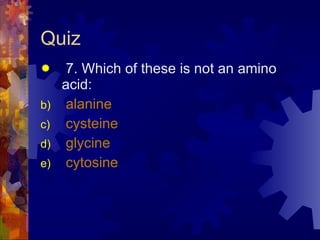
Quiz 7. Which of these is not an amino acid: alanine cysteine glycine cytosine
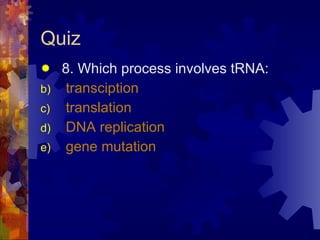
Quiz 8. Which process involves tRNA: transciption translation DNA replication gene mutation
Quiz 9. The formation of RNA does not involve: ribose sugar thymine removal of water phosphate
Answers Sorry, that is not the correct answer Click here to go back
Answers That’s right Click here to go to the next question
Answers That’s right, cytosine is an organic base Click here to go to the next question
Answers That’s right Click here to go to the next question
Answers That’s right, in RNA thymine is replaced with uracil Click here to go back to the start Press escape to exit

Biological molecules

  • 1.
  • 2.
    Introduction For eachof the following you should be able to: Describe the properties Know the general formulae & structure Understand the role in animals & plants Carbohydrates Lipids Proteins Nucleic acids
  • 3.
    Carbohydrates Contain theelements Carbon Hydrogen & Oxygen There are 3 types: Monosaccharides Disaccharides Polysaccharides
  • 4.
    Monosaccharides (CH 2O) n If n=3, triose (glyceraldehyde) If n=5, pentose (fructose, ribose) If n=6, hexose (glucose, galactose) Monosaccharides are used for Energy Building blocks O C C C C C C
  • 5.
    Isomerism They canexist as isomers:  &  glucose OH OH  
  • 6.
    Disaccharides Formed fromtwo monosaccharides Joined by a glycosidic bond A condensation reaction: glucose + glucose  maltose glucose + galactose  lactose glucose + fructose  sucrose
  • 7.
    Condensation reaction OHOH O C C C C C C O C C C C C C
  • 8.
    Condensation reaction OH OH O C C C C C C O C C C C C C
  • 9.
    Condensation reaction OH 2 O O C C C C C C O C C C C C C
  • 10.
    Condensation reaction OA disaccharide 1,4 glycosidic bond 4 1 O C C C C C C O C C C C C C
  • 11.
    Polysaccharides Polymers formedfrom many monosaccharides Three important examples: Starch Glycogen Cellulose
  • 12.
    Starch Insolublestore of glucose in plants formed from two glucose polymers: Amylose  -glucose 1,4 glycosidic bonds Spiral structure Amylopectin  -glucose 1,4 and some 1,6 glycosidic bonds Branched structure
  • 13.
    Glycogen Insoluble compactstore of glucose in animals  -glucose units 1,4 and 1,6 glycosidic bonds Branched structure
  • 14.
    Cellulose Structural polysaccharidein plants  -glucose 1,4 glycosidic bonds H-bonds link adjacent chains O O O O O
  • 15.
    Lipids Made upof C, H and O Can exist as fats, oils and waxes They are insoluble in water They are a good source of energy (38kJ/g) They are poor conductors of heat Most fats & oils are triglycerides
  • 16.
    Triglycerides Formed byesterification… …a condensation reaction between 3 fatty acids and glycerol: Glycerol H C H C C H H H H O O O
  • 17.
    Fatty acids Carboxylgroup (-COOH) attached to a long non-polar hydrocarbon chain (hydrophobic): H A saturated fatty acid (no double bonds) H C H H C H H C H C O O H C H H C H H C H H C H H
  • 18.
    H H CO O H C C C C H A polyunsaturated fatty acid C O O H C H H C H A monounsaturated fatty acid H H H C H H C H H C H H C H H C H H C H H C H H C H
  • 19.
    Esterification Glycerol Fattyacid H C H C C H H H H O O O C O O H C H H C H H C H H C H H
  • 20.
    Esterification Glycerol Fattyacid H C H C C H H H H O O O C O O H C H H C H H C H H C H H
  • 21.
    Esterification H CH C C H H H H O O O C O O H Glycerol Fatty acid H C H H C H H C H H C H
  • 22.
    Esterification H CH C C H H H H O O O C O O H Ester bond water H C H H C H H C H H C H
  • 23.
    Esterification This happensthree times to form a triglyceride: glycerol fatty acids
  • 24.
    Phospholipids One fattyacid can be replaced by a polar phosphate group: glycerol Hydrophobic fatty acids hydrophilic phosphate
  • 25.
    Functions of lipidsProtection of vital organs To prevent evaporation in plants & animals To insulate the body They form the myelin sheath around some neurones As a water source (respiration of lipids) As a component of cell membranes
  • 26.
    Proteins Made fromC H O N & sometimes S Long chains of amino acids Properties determined by the aa sequence Amino acids ~20 aa Glycine R=H Alanine R=CH 3 amine carboxyl H C H N C H H O O R
  • 27.
    Peptide bonding HC H N C H H O O R H C H N C H H O O R
  • 28.
    Peptide bonding HC H N C H H O O R H C H N C H H O O R
  • 29.
    Peptide bonding HC H N C H H O O R H C H N C H H O O R
  • 30.
    Peptide bonding CH N C H H O R H C H N C H O O R water Peptide bond A condensation reaction H O H
  • 31.
    Peptide bonding HC H N C H O O R A dipeptide C H N C H H O R
  • 32.
    Primary structure Thesequence of aa is know as the primary structure The aa chain is a polypeptide Secondary structure H-bonding forms between the –COOH and the -NH 2 of adjacent aa This results in the chains folding:
  • 33.
    Secondary structure -helix  -pleated sheet
  • 34.
    Tertiary structure Bondingbetween R-groups gives rise to a 3D shape H-bonds =O HN- Ionic bonds –NH 3 - COO- Disulphide bridge --CH 2 S - SCH 2 - affected by temp & pH affected by pH affected by reducing agents
  • 35.
    Quaternary structure Someproteins have more than one polypeptide chain Each chain is held together in a precise structure eg Haemoglobin
  • 36.
    Types of proteinsFibrous proteins e.g. collagen Insoluble structural Globular proteins e.g.enzymes Soluble 3D shape
  • 37.
    Functions of proteinsEnzymes – Transport – Movement – Cell recognition – Channels – Structure – Hormones – Protection – Amylase Haemoglobin Actin & myosin Antigens Membrane proteins Collagen & keratin Insulin Antibodies
  • 38.
    Nucleic acids DNA& RNA Made up of nucleotides: phosphate pentose sugar base
  • 39.
    Nucleotides 2 typesof base: Pyrimidines - Cytosine C Thymine T Purines Adenine A Guanine G
  • 40.
    Complimentary base pairingAdenine will only bind with Thymine Cytosine will only bind with Guanine T C G A
  • 41.
    DNA structure nucleotideCondensation polymerisation of the deoxyribose nucleotides
  • 42.
    Replication During celldivision the DNA must replicate The DNA double helix unwinds The exposed bases bind to free floating nucleotides in the nucleoplasm DNA polymerase binds the complimentary nucleotides Replication is semiconservative
  • 43.
    The genetic codeThe sequence of nucleotide bases forms a code Each ‘code word’ has three letter – a triplet code Each codon codes for a specific amino acid e.g: GGG = proline CGG = glycine ATG = tyrosine ACT = stop (no amino acid)
  • 44.
    Protein synthesis TheDNA codes for proteins A copy of DNA (mRNA) is made in the nucleus (transcription) The mRNA is used to make a protein (translation) in the cytoplasm
  • 45.
    Transcription The DNApolymerase unwinds the DNA Free nucleotides join onto complimentary bases RNA polymerase links adjacent nucleotides The completed mRNA moves out of the nucleus
  • 46.
  • 47.
    Amino acid activationtransferRNA: tRNA binds onto a specific amino acid
  • 48.
    Translation mRNA bindsto a ribosome tRNA carries an amino acid to the ribosome
  • 49.
    Translation A secondtRNA brings another aa The two aa’s bind The process repeats
  • 50.
    Translation A polypeptidechain forms Eventually a stop codon is reached
  • 51.
    The Human GenomeProject A multinational project aimed at sequencing the entire human genome Visit the Human Genome Web site: www.ornl.gov/hgmis/project/about.html www.sanger.ac.uk
  • 52.
    Quiz 1. Thegeneral formula for a monosaccharide is: (CH 2 O) n (CHO) n C(H 2 O) n C n H 2 O n
  • 53.
    Quiz 2. Sucroseis made up of glucose + fructose glucose + galactose glucose + glucose galactose + fructose
  • 54.
    Quiz 3. Amylopectinis made up of:  - 1,4 glycosidic bonds  - 1,4 &  -1,4 glycosidic bonds  - 1,4 & 1,6 glycosidic bonds  - 1,4 & 1,6 glycosidic bonds
  • 55.
    Quiz 4. Formationof a triglyceride does NOT involve: A condensation reaction Esterification Polymerisation A reaction between 3 fatty acids & glycerol
  • 56.
    Quiz 5. Thegeneral formula of a saturated fatty acid is: C n H 2n O 2 C n (H 2 O) n (CH 2 O) n (CH 2 ) n O
  • 57.
    Quiz 6. Whichof the following is not responsible for a proteins tertiary structure ionic bonding covalent bonding hydrogen bonding disulphide bonding
  • 58.
    Quiz 7. Whichof these is not an amino acid: alanine cysteine glycine cytosine
  • 59.
    Quiz 8. Whichprocess involves tRNA: transciption translation DNA replication gene mutation
  • 60.
    Quiz 9. Theformation of RNA does not involve: ribose sugar thymine removal of water phosphate
  • 61.
    Answers Sorry, thatis not the correct answer Click here to go back
  • 62.
    Answers Sorry, thatis not the correct answer Click here to go back
  • 63.
    Answers Sorry, thatis not the correct answer Click here to go back
  • 64.
    Answers Sorry, thatis not the correct answer Click here to go back
  • 65.
    Answers Sorry, thatis not the correct answer Click here to go back
  • 66.
    Answers Sorry, thatis not the correct answer Click here to go back
  • 67.
    Answers Sorry, thatis not the correct answer Click here to go back
  • 68.
    Answers Sorry, thatis not the correct answer Click here to go back
  • 69.
    Answers Sorry, thatis not the correct answer Click here to go back
  • 70.
    Answers That’s rightClick here to go to the next question
  • 71.
    Answers That’s rightClick here to go to the next question
  • 72.
    Answers That’s rightClick here to go to the next question
  • 73.
    Answers That’s rightClick here to go to the next question
  • 74.
    Answers That’s rightClick here to go to the next question
  • 75.
    Answers That’s rightClick here to go to the next question
  • 76.
    Answers That’s right,cytosine is an organic base Click here to go to the next question
  • 77.
    Answers That’s rightClick here to go to the next question
  • 78.
    Answers That’s right,in RNA thymine is replaced with uracil Click here to go back to the start Press escape to exit