Earth & beyond
WHAT IS OUT THERE?
We need to revise:
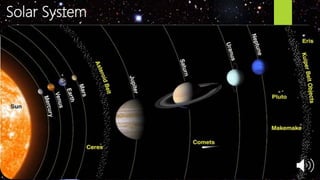
Solar system
Planets & moons
Orbit/Revolution
Rotation
Day/ night & seasons
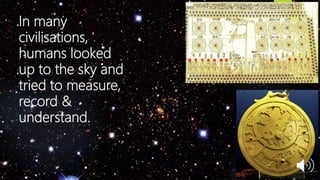
In many
civilisations,
humans looked
up to the sky and
tried to measure,
record &
understand.
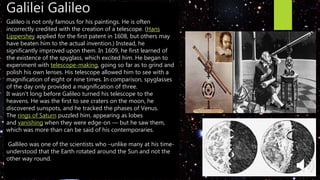
Galilei Galileo
Galileo is not only famous for his paintings. He is often
incorrectly credited with the creation of a telescope. (Hans
Lippershey applied for the first patent in 1608, but others may
have beaten him to the actual invention.) Instead, he
significantly improved upon them. In 1609, he first learned of
the existence of the spyglass, which excited him. He began to
experiment with telescope-making, going so far as to grind and
polish his own lenses. His telescope allowed him to see with a
magnification of eight or nine times. In comparison, spyglasses
of the day only provided a magnification of three.
It wasn't long before Galileo turned his telescope to the
heavens. He was the first to see craters on the moon, he
discovered sunspots, and he tracked the phases of Venus.
The rings of Saturn puzzled him, appearing as lobes
and vanishing when they were edge-on — but he saw them,
which was more than can be said of his contemporaries.
Gallileo was one of the scientists who –unlike many at his time-
understood that the Earth rotated around the Sun and not the
other way round.
Solar System
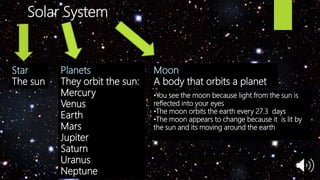
Solar System
•You see the moon because light from the sun is
reflected into your eyes
•The moon orbits the earth every 27.3 days
•The moon appears to change because it is lit by
the sun and its moving around the earth
Star
The sun
Planets
They orbit the sun:
Mercury
Venus
Earth
Mars
Jupiter
Saturn
Uranus
Neptune
Moon
A body that orbits a planet
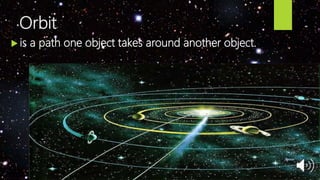
Orbit
 is a path one object takes around another object.
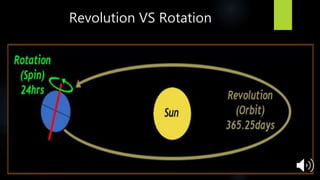
Revolution VS Rotation
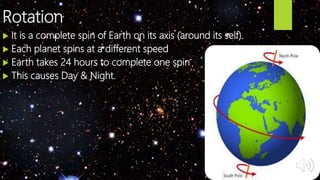
Rotation
 It is a complete spin of Earth on its axis (around its self).
 Each planet spins at a different speed
 Earth takes 24 hours to complete one spin
 This causes Day & Night.
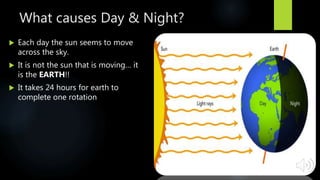
What causes Day & Night?
 Each day the sun seems to move
across the sky.
 It is not the sun that is moving… it
is the EARTH!!
 It takes 24 hours for earth to
complete one rotation
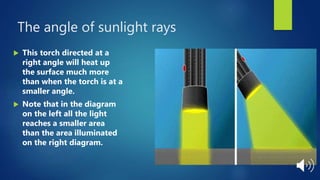
The angle of sunlight rays
 This torch directed at a
right angle will heat up
the surface much more
than when the torch is at a
smaller angle.
 Note that in the diagram
on the left all the light
reaches a smaller area
than the area illuminated
on the right diagram.
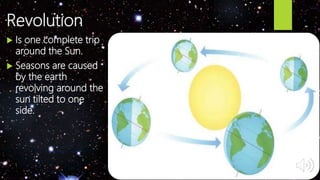
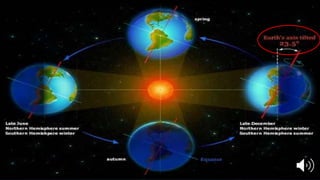
Revolution
 Is one complete trip
around the Sun.
 Seasons are caused
by the earth
revolving around the
sun tilted to one
side.
Earth and beyond gr.6  2020

Earth and beyond gr.6 2020

  • 1.
    Earth & beyond WHATIS OUT THERE?
  • 2.
    We need torevise: Solar system Planets & moons Orbit/Revolution Rotation Day/ night & seasons
  • 3.
    In many civilisations, humans looked upto the sky and tried to measure, record & understand.
  • 4.
    Galilei Galileo Galileo isnot only famous for his paintings. He is often incorrectly credited with the creation of a telescope. (Hans Lippershey applied for the first patent in 1608, but others may have beaten him to the actual invention.) Instead, he significantly improved upon them. In 1609, he first learned of the existence of the spyglass, which excited him. He began to experiment with telescope-making, going so far as to grind and polish his own lenses. His telescope allowed him to see with a magnification of eight or nine times. In comparison, spyglasses of the day only provided a magnification of three. It wasn't long before Galileo turned his telescope to the heavens. He was the first to see craters on the moon, he discovered sunspots, and he tracked the phases of Venus. The rings of Saturn puzzled him, appearing as lobes and vanishing when they were edge-on — but he saw them, which was more than can be said of his contemporaries. Gallileo was one of the scientists who –unlike many at his time- understood that the Earth rotated around the Sun and not the other way round.
  • 5.
  • 6.
    Solar System •You seethe moon because light from the sun is reflected into your eyes •The moon orbits the earth every 27.3 days •The moon appears to change because it is lit by the sun and its moving around the earth Star The sun Planets They orbit the sun: Mercury Venus Earth Mars Jupiter Saturn Uranus Neptune Moon A body that orbits a planet
  • 7.
    Orbit  is apath one object takes around another object.
  • 8.
  • 9.
    Rotation  It isa complete spin of Earth on its axis (around its self).  Each planet spins at a different speed  Earth takes 24 hours to complete one spin  This causes Day & Night.
  • 10.
    What causes Day& Night?  Each day the sun seems to move across the sky.  It is not the sun that is moving… it is the EARTH!!  It takes 24 hours for earth to complete one rotation
  • 11.
    The angle ofsunlight rays  This torch directed at a right angle will heat up the surface much more than when the torch is at a smaller angle.  Note that in the diagram on the left all the light reaches a smaller area than the area illuminated on the right diagram.
  • 12.
    Revolution  Is onecomplete trip around the Sun.  Seasons are caused by the earth revolving around the sun tilted to one side.