IGCSE Biology – 4BI0
MAKING SENSE OF
Copyright©2015HenryExham
Icons CC – The Pink Group
Copyright©2017HenryExham
Icons CC – The Pink Group
Copyright © 2015 Henry Exham
• Can you explain the role of enzymes as
biological catalysts and how they are used in
metabolic reactions?
• How can enzyme function be affected by
temperature?
• Can you describe a simple controlled
experiment to show how enzyme activity is
affected by temperature?
• How are enzymes affected by pH? (Separate science only)
1.1 Life Processes - Enzymes
Objectives
2
Copyright © 2015 Henry Exham
• All chemical reactions that happen in a cell are
controlled by enzymes.
• Enzymes are biological catalysts.
• This means they speed up the reaction and do
not get used up in the reaction.
• They are all proteins which are coded for by
genes.
• The function of enzymes is to catalyse
metabolic reactions.
3
1.1 Life Processes - Enzymes
What are enzymes?
Copyright © 2015 Henry Exham
4
1.1 Life Processes - Enzymes
What are enzymes?
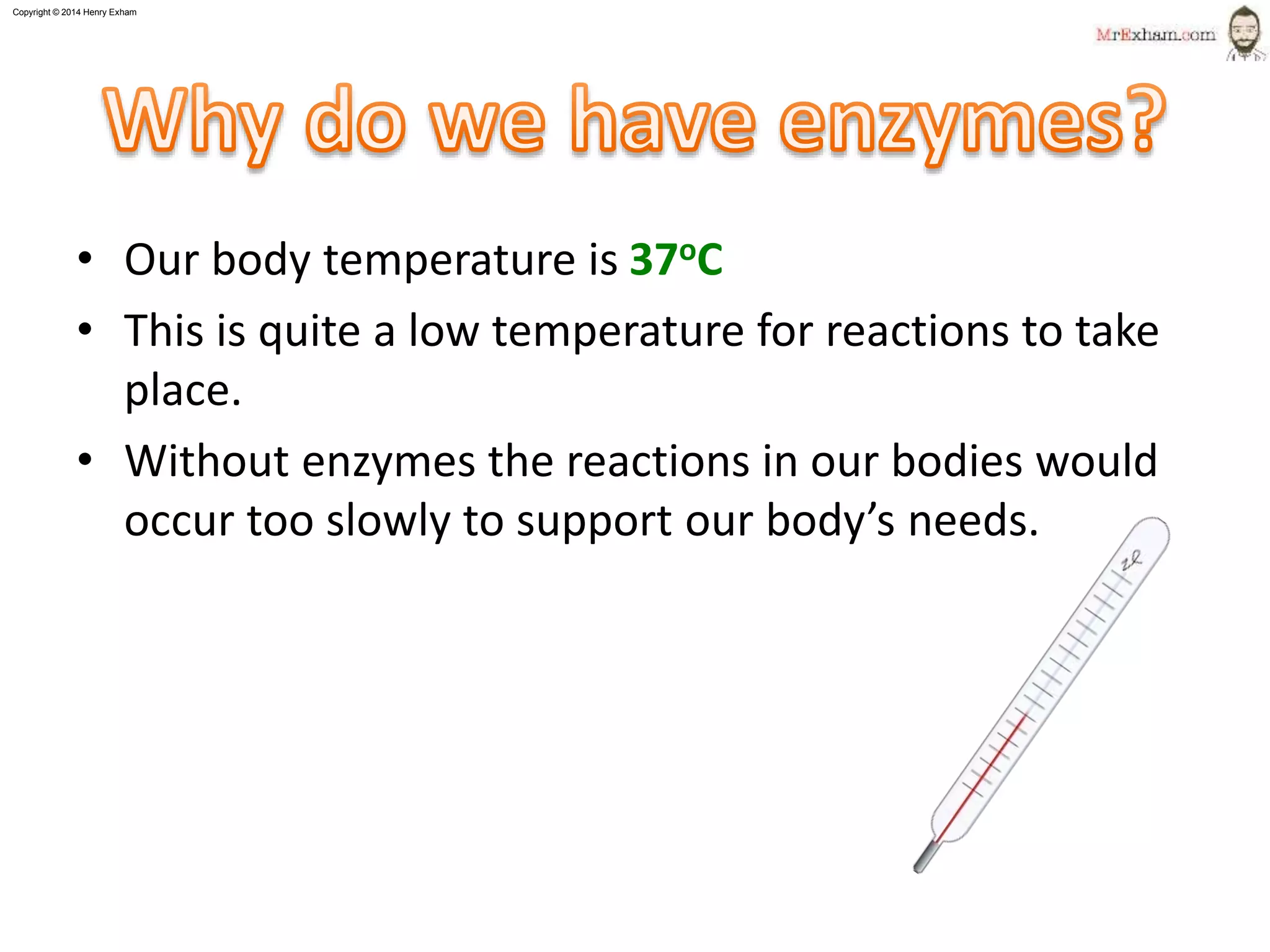
• Our body temperature is 37oC
• This is quite a low temperature for reactions
to take place.
• Without enzymes the reactions in our bodies
would occur too slowly to support our body’s
needs.
Copyright © 2015 Henry Exham
5
1.1 Life Processes - Enzymes
How do enzymes work?
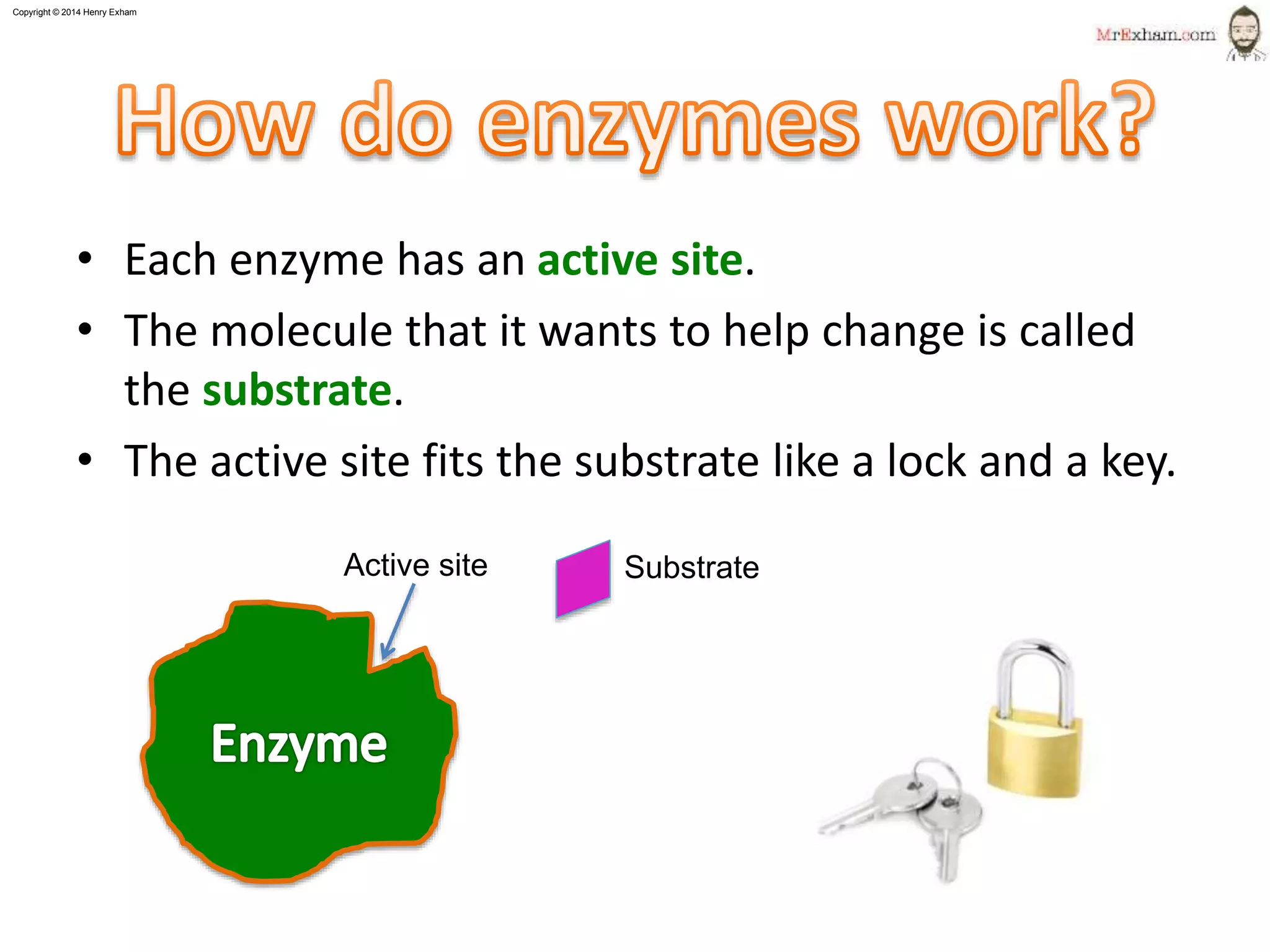
• Each enzyme has an active site.
• The molecule that it wants to help change is called
the substrate.
• The active site fits the substrate like a lock and a key.
SubstrateActive site
Copyright © 2015 Henry Exham
6
1.1 Life Processes - Enzymes
How do enzymes work?
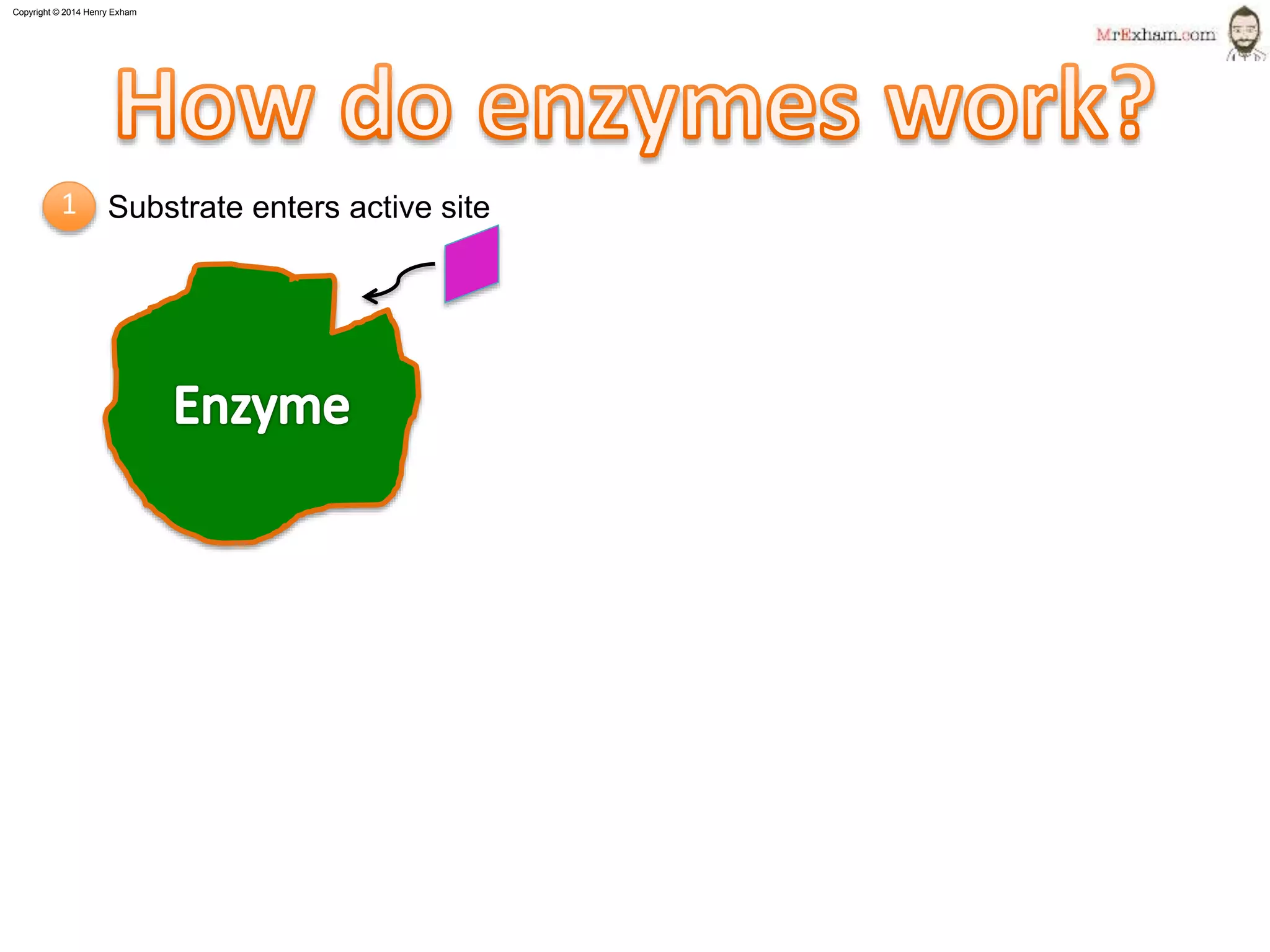
Substrate enters active site1
Copyright © 2015 Henry Exham
7
1.1 Life Processes - Enzymes
How do enzymes work?
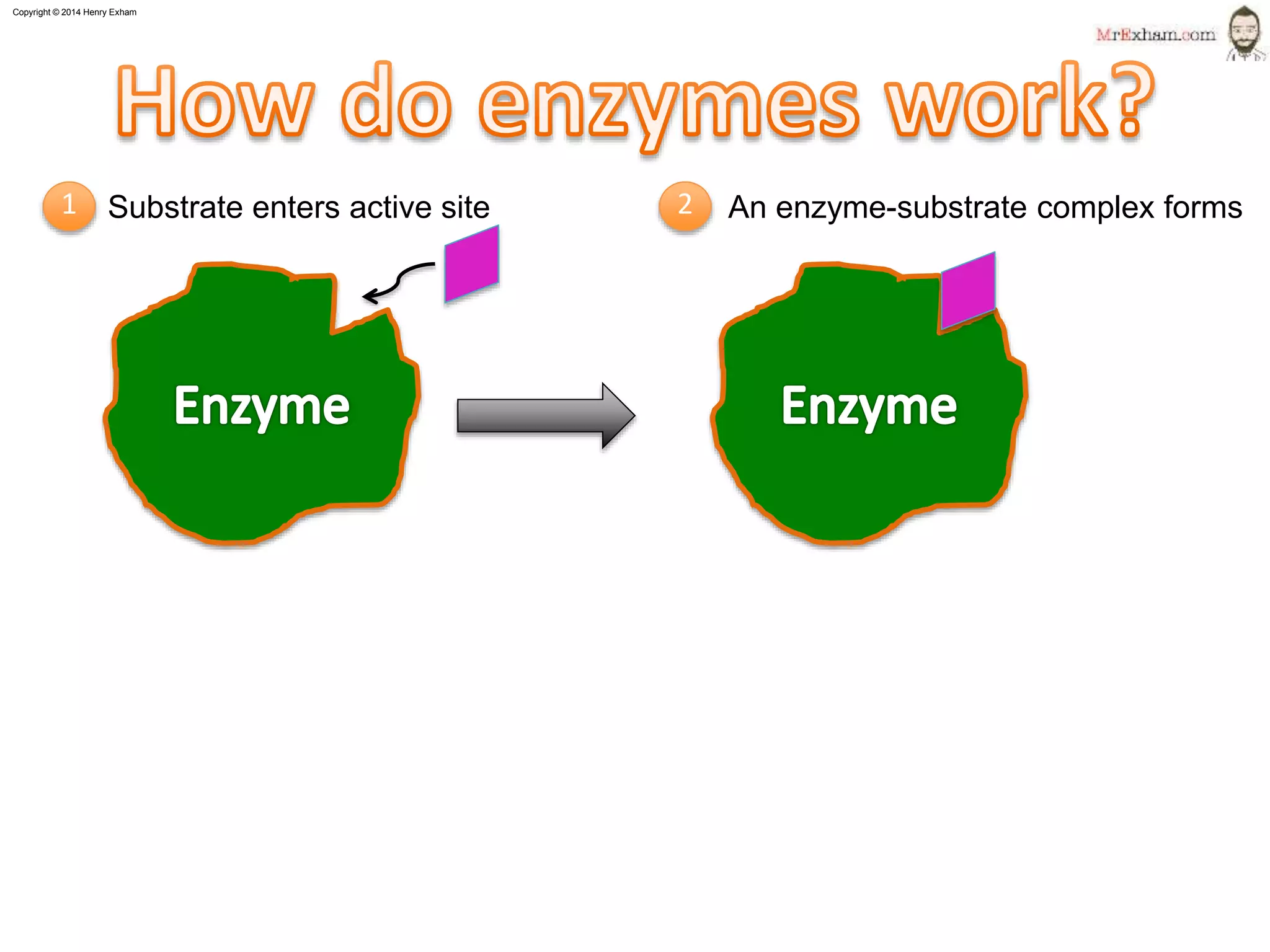
Substrate enters active site An enzyme-substrate complex forms1 2
Copyright © 2015 Henry Exham
8
1.1 Life Processes - Enzymes
How do enzymes work?
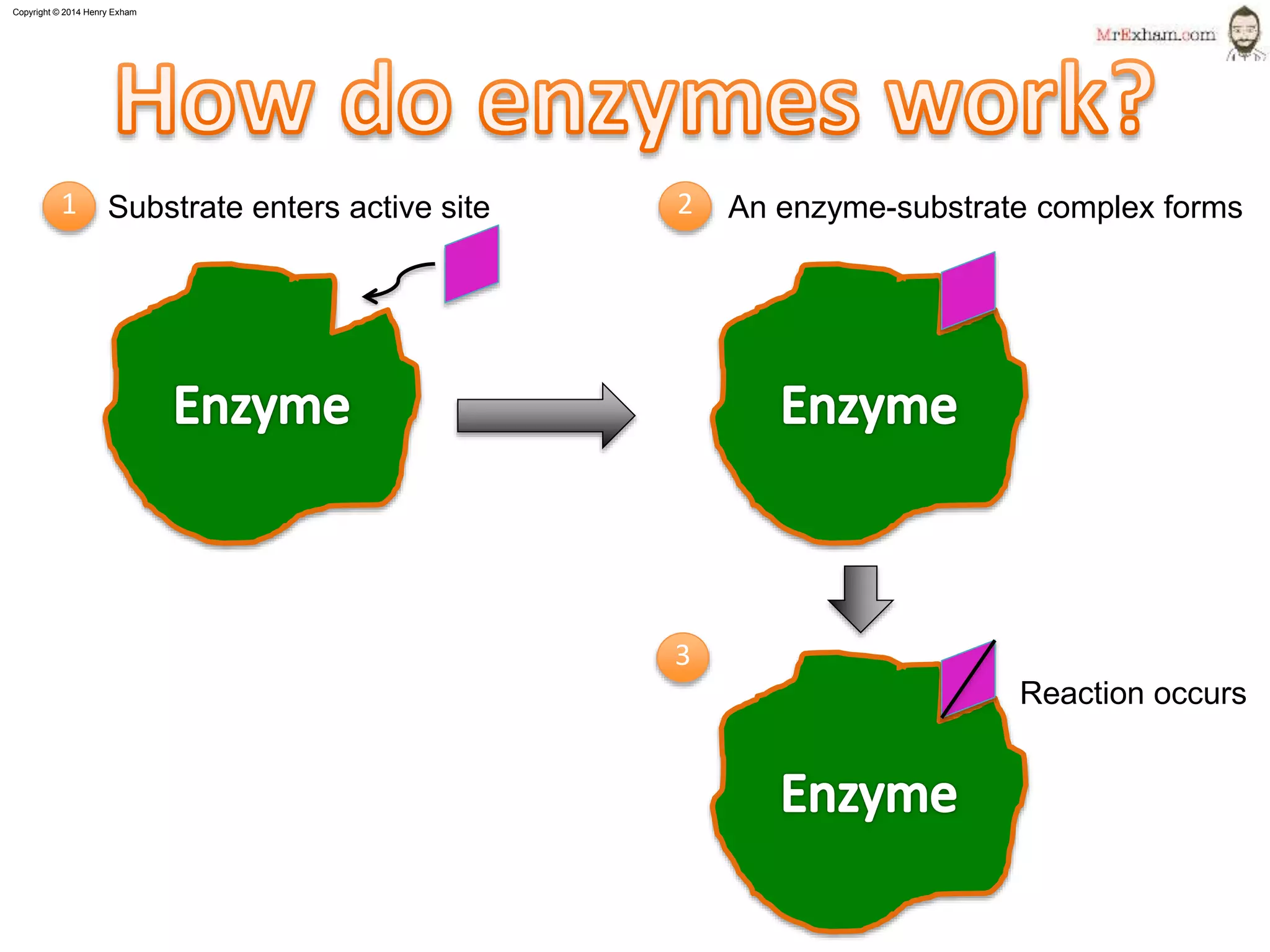
Substrate enters active site1 2
3
Copyright © 2015 Henry Exham
9
1.1 Life Processes - Enzymes
How do enzymes work?
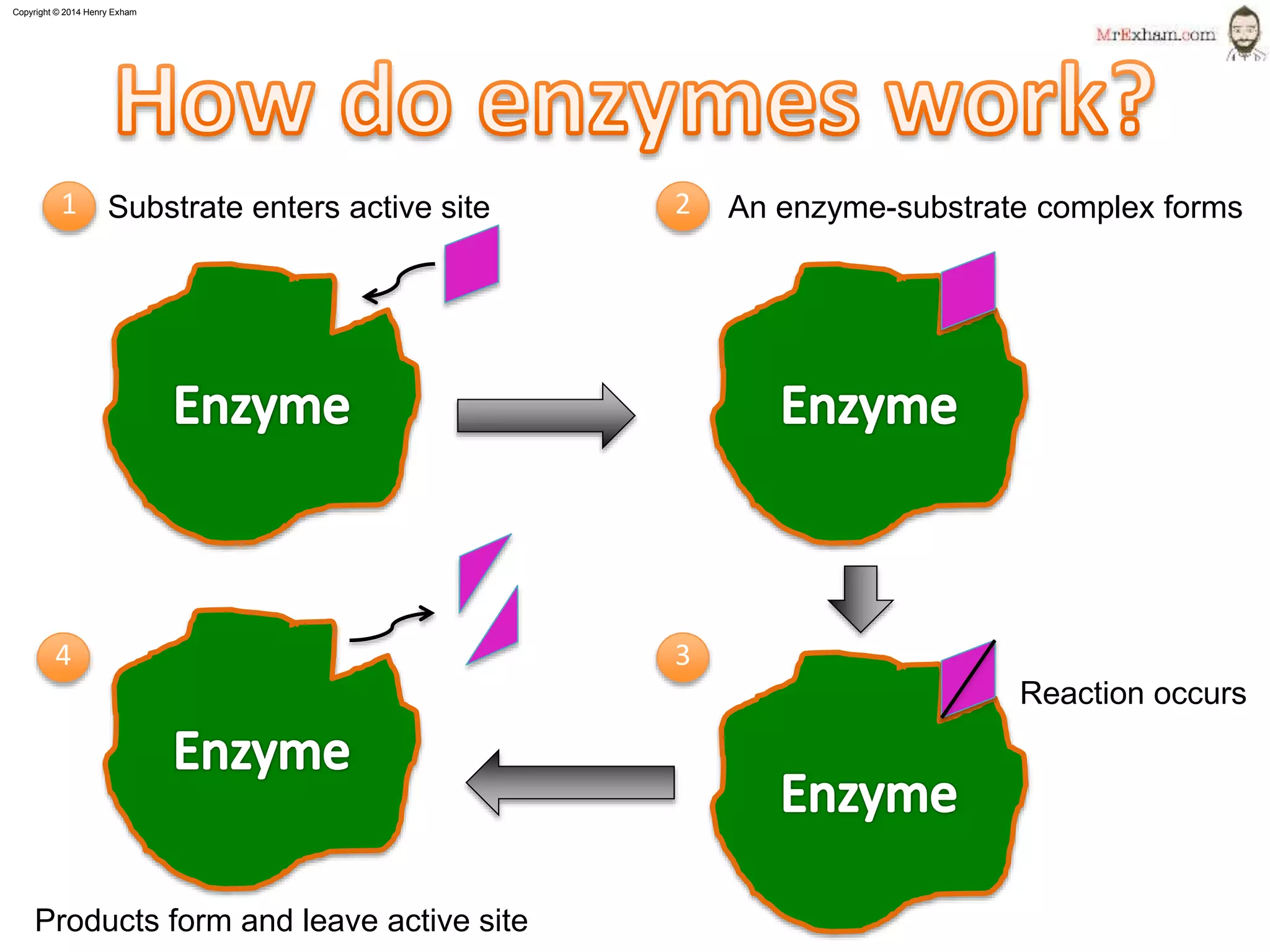
Products form and leave active site
Reaction occurs
Substrate enters active site An enzyme-substrate complex forms1 2
34
Copyright © 2015 Henry Exham
10
1.1 Life Processes - Enzymes
Factors affecting enzymes
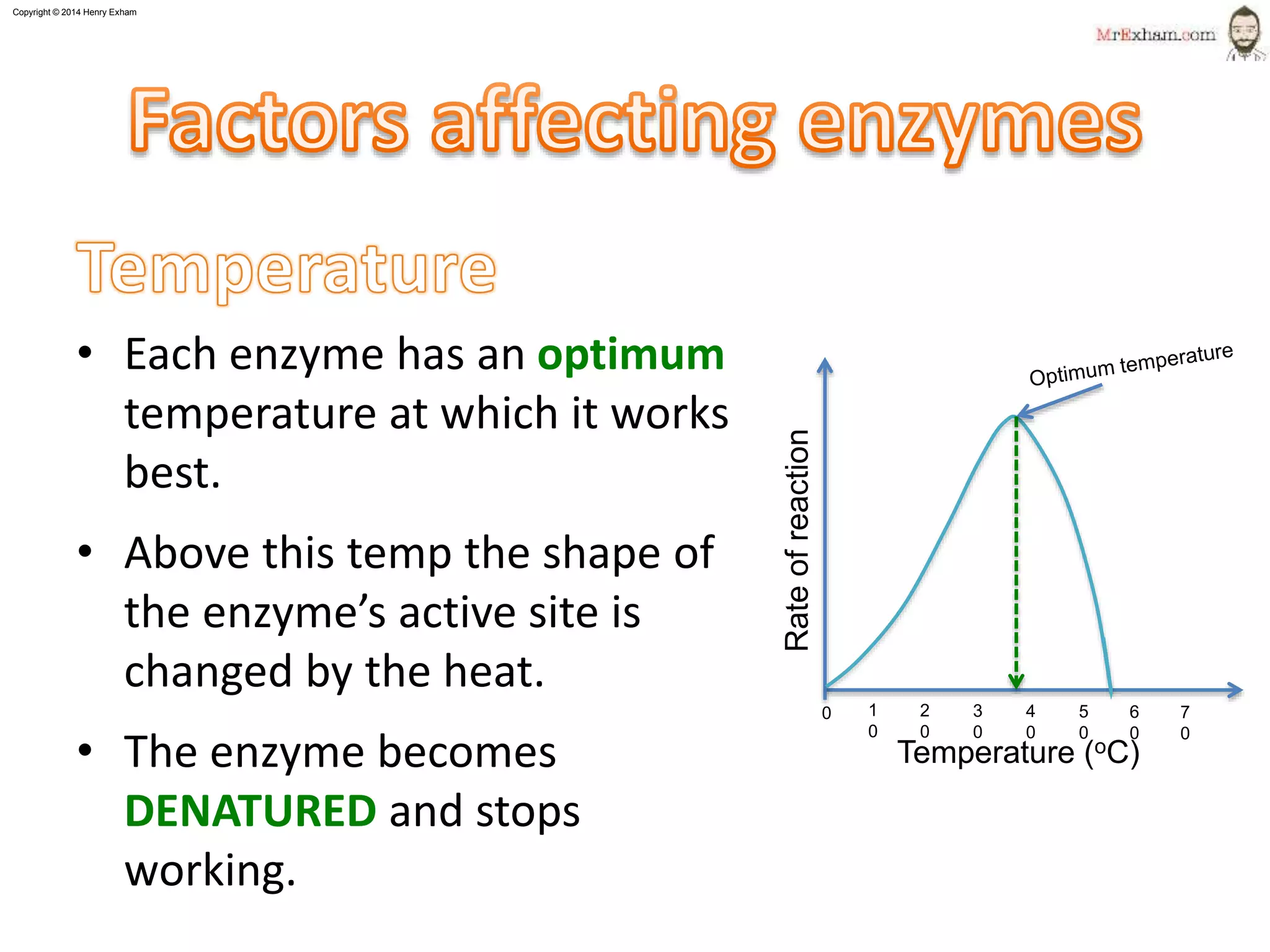
• Each enzyme has an optimum
temperature at which it works
best.
• Above this temp the shape of the
enzyme’s active site is changed
by the heat.
• The enzyme becomes
DENATURED and stops working.
0 1
0
2
0
3
0
4
0
5
0
6
0
7
0
Temperature (oC)
Rateofreaction
Copyright © 2015 Henry Exham
11
1.1 Life Processes - Enzymes
Factors affecting enzymes
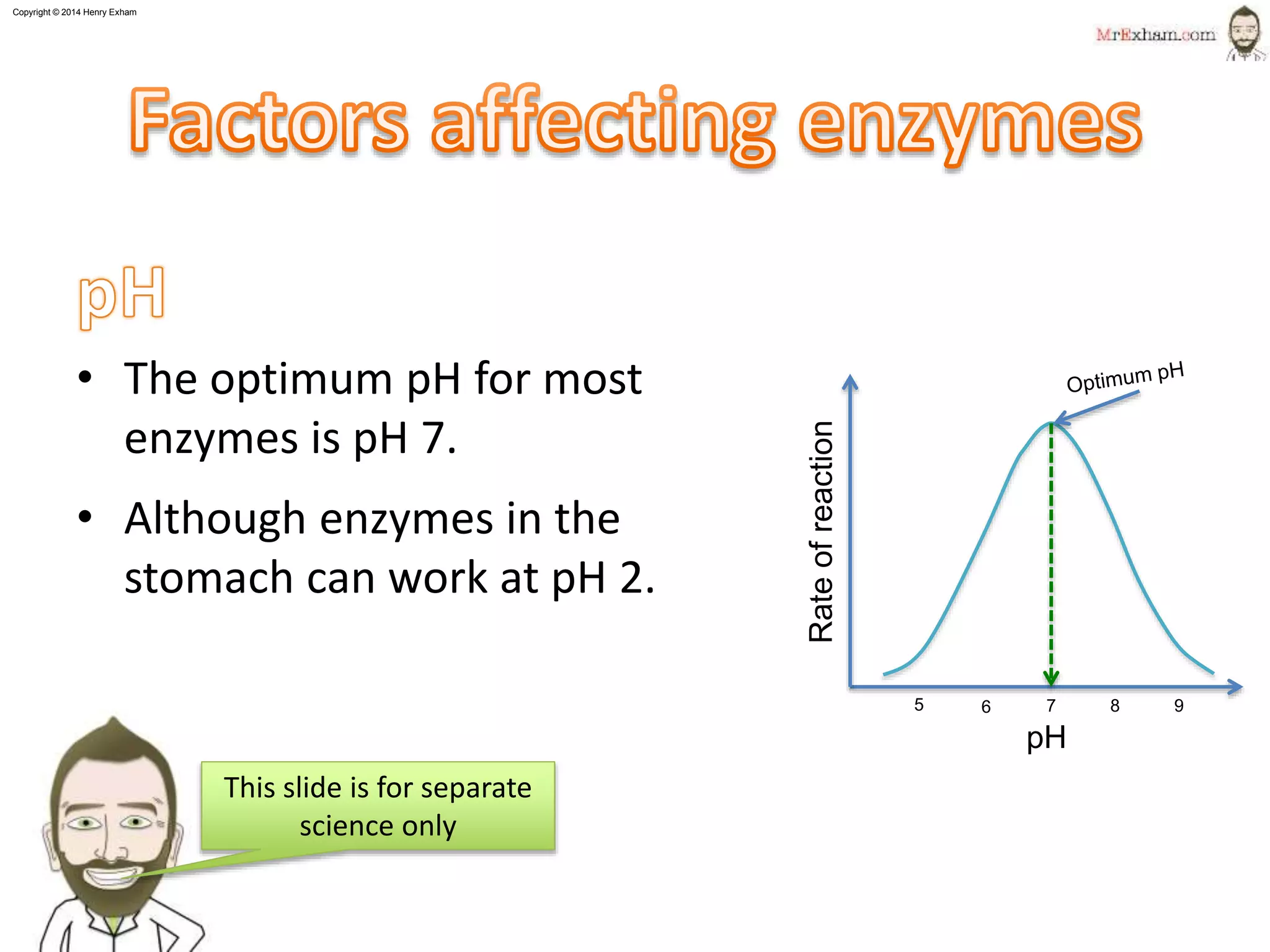
• The optimum pH for most
enzymes is pH 7.
• Although enzymes in the
stomach can work at pH 2.
pH
5 6 7 8 9
Rateofreaction
This slide is for separate
science only
Copyright © 2015 Henry Exham
12
1.1 Life Processes - Enzymes
Factors affecting enzymes
Can you describe a simple controlled experiment to
show how enzyme activity is affected by
temperature?
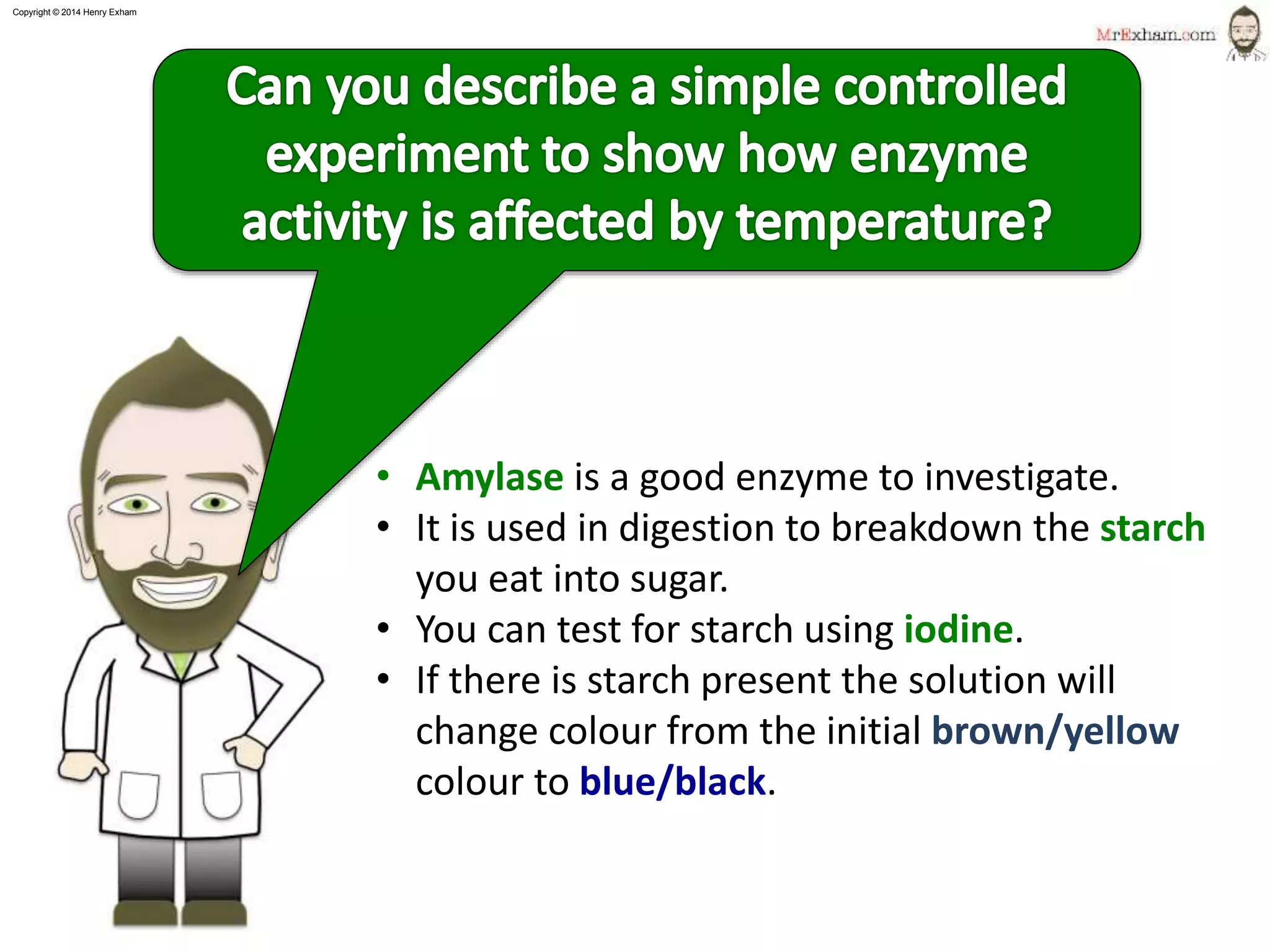
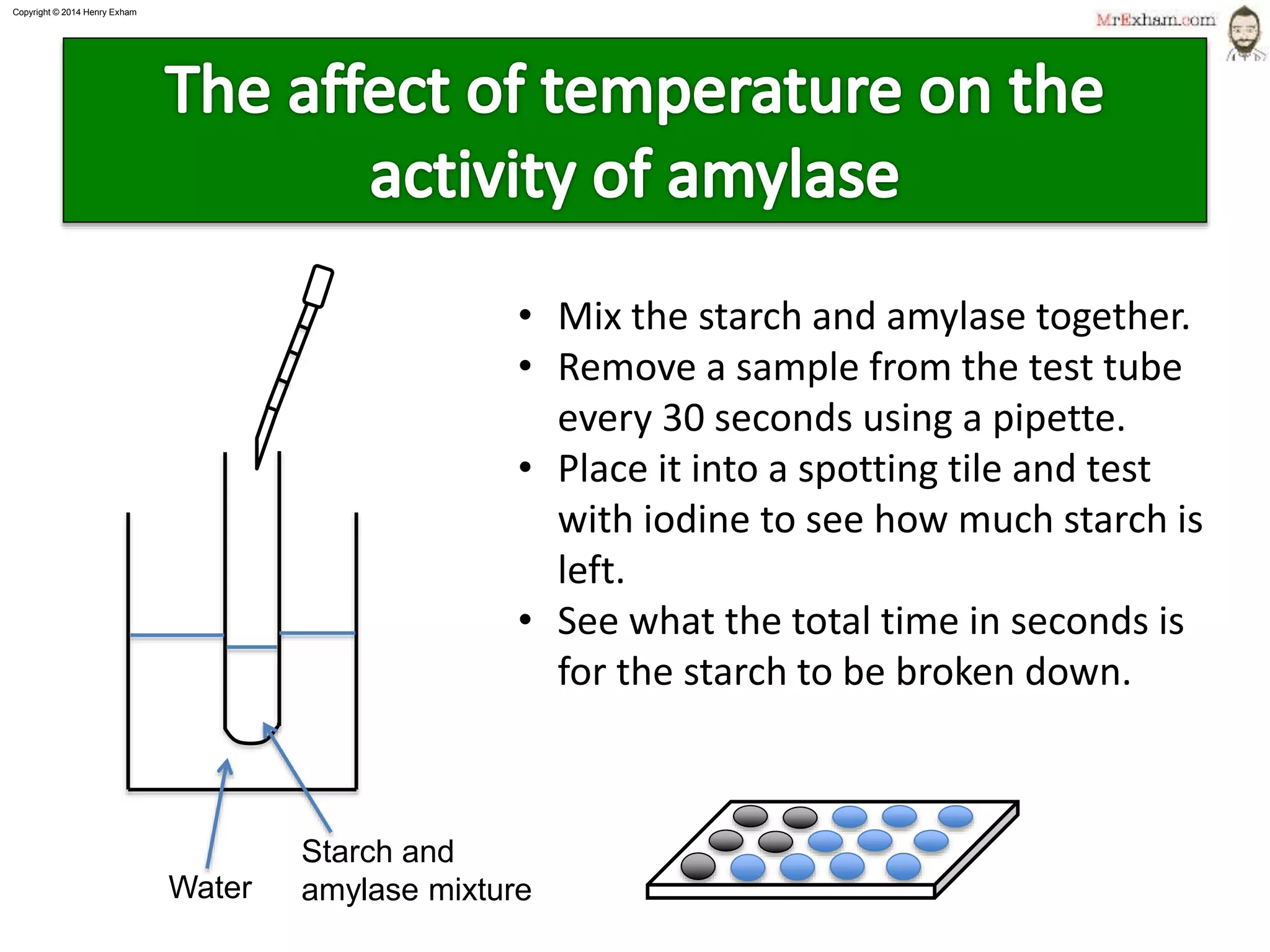
• Amylase is a good enzyme to investigate.
• It is used in digestion to breakdown the starch
you eat into sugar.
• You can test for starch using iodine.
• If there is starch present the solution will
change colour from the initial brown/yellow
colour to blue/black.
Copyright © 2015 Henry Exham
13
1.1 Life Processes - Enzymes
Factors affecting enzymes
Copyright © 2015 Henry Exham
14
1.1 Life Processes - Enzymes
Factors affecting enzymes
Copyright © 2015 Henry Exham
15
1.1 Life Processes - Enzymes
Factors affecting enzymes
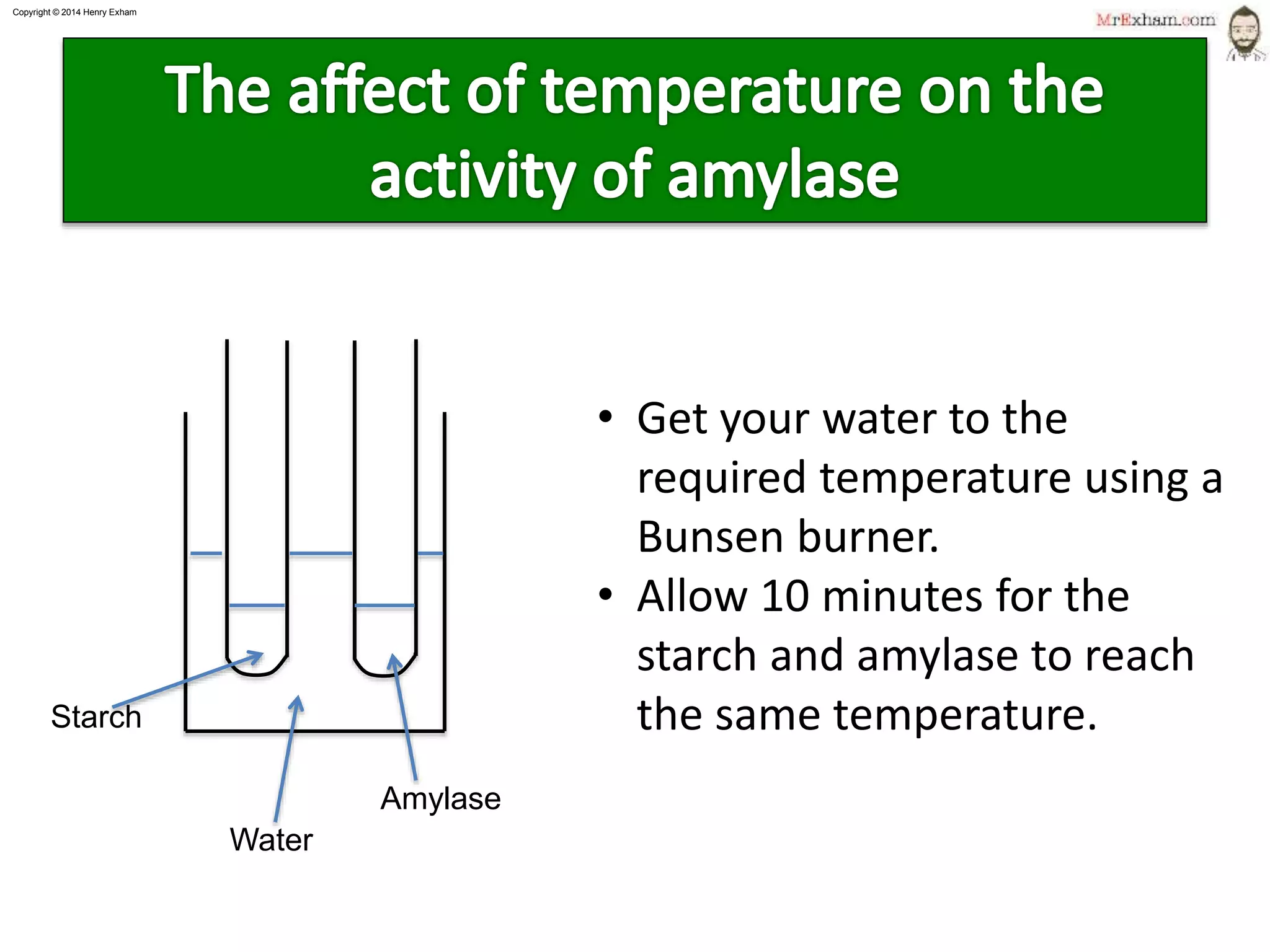
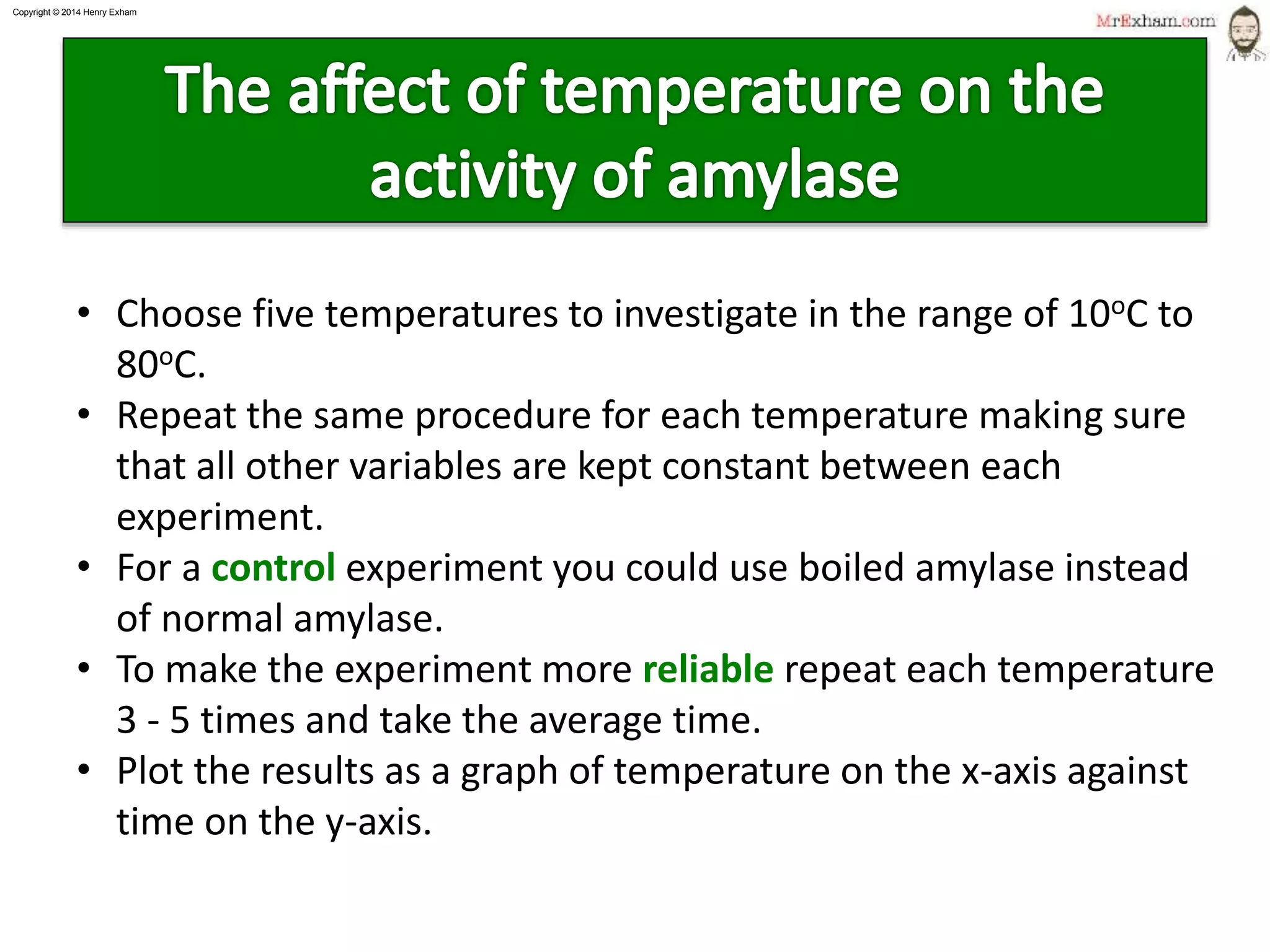
• Choose five temperatures to investigate in the range of 10oC to
80oC.
• Repeat the same procedure for each temperature making sure
that all other variables are kept constant between each
experiment.
• For a control experiment you could use boiled amylase instead
of normal amylase.
• To make the experiment more reliable repeat each temperature
3 - 5 times and take the average time.
• Plot the results as a graph of temperature on the x-axis against
time on the y-axis.
This PowerPoint is protected under copyright.
It is designed for educational use. Either personal study or to be
presented to a class. It may be edited or duplicated for these
purposes only.
It must not be shared or distributed online in any format.
Some images used are under a separate creative commons license,
these are clearly marked.
Copyright © 2017 Henry Exham
Brought to you by MrExham.com
TERMS AND CONDITIONS
16

Mr Exham IGCSE Biology - Enzymes

  • 1.
    IGCSE Biology –4BI0 MAKING SENSE OF Copyright©2015HenryExham Icons CC – The Pink Group Copyright©2017HenryExham Icons CC – The Pink Group
  • 2.
    Copyright © 2015Henry Exham • Can you explain the role of enzymes as biological catalysts and how they are used in metabolic reactions? • How can enzyme function be affected by temperature? • Can you describe a simple controlled experiment to show how enzyme activity is affected by temperature? • How are enzymes affected by pH? (Separate science only) 1.1 Life Processes - Enzymes Objectives 2
  • 3.
    Copyright © 2015Henry Exham • All chemical reactions that happen in a cell are controlled by enzymes. • Enzymes are biological catalysts. • This means they speed up the reaction and do not get used up in the reaction. • They are all proteins which are coded for by genes. • The function of enzymes is to catalyse metabolic reactions. 3 1.1 Life Processes - Enzymes What are enzymes?
  • 4.
    Copyright © 2015Henry Exham 4 1.1 Life Processes - Enzymes What are enzymes? • Our body temperature is 37oC • This is quite a low temperature for reactions to take place. • Without enzymes the reactions in our bodies would occur too slowly to support our body’s needs.
  • 5.
    Copyright © 2015Henry Exham 5 1.1 Life Processes - Enzymes How do enzymes work? • Each enzyme has an active site. • The molecule that it wants to help change is called the substrate. • The active site fits the substrate like a lock and a key. SubstrateActive site
  • 6.
    Copyright © 2015Henry Exham 6 1.1 Life Processes - Enzymes How do enzymes work? Substrate enters active site1
  • 7.
    Copyright © 2015Henry Exham 7 1.1 Life Processes - Enzymes How do enzymes work? Substrate enters active site An enzyme-substrate complex forms1 2
  • 8.
    Copyright © 2015Henry Exham 8 1.1 Life Processes - Enzymes How do enzymes work? Substrate enters active site1 2 3
  • 9.
    Copyright © 2015Henry Exham 9 1.1 Life Processes - Enzymes How do enzymes work? Products form and leave active site Reaction occurs Substrate enters active site An enzyme-substrate complex forms1 2 34
  • 10.
    Copyright © 2015Henry Exham 10 1.1 Life Processes - Enzymes Factors affecting enzymes • Each enzyme has an optimum temperature at which it works best. • Above this temp the shape of the enzyme’s active site is changed by the heat. • The enzyme becomes DENATURED and stops working. 0 1 0 2 0 3 0 4 0 5 0 6 0 7 0 Temperature (oC) Rateofreaction
  • 11.
    Copyright © 2015Henry Exham 11 1.1 Life Processes - Enzymes Factors affecting enzymes • The optimum pH for most enzymes is pH 7. • Although enzymes in the stomach can work at pH 2. pH 5 6 7 8 9 Rateofreaction This slide is for separate science only
  • 12.
    Copyright © 2015Henry Exham 12 1.1 Life Processes - Enzymes Factors affecting enzymes Can you describe a simple controlled experiment to show how enzyme activity is affected by temperature? • Amylase is a good enzyme to investigate. • It is used in digestion to breakdown the starch you eat into sugar. • You can test for starch using iodine. • If there is starch present the solution will change colour from the initial brown/yellow colour to blue/black.
  • 13.
    Copyright © 2015Henry Exham 13 1.1 Life Processes - Enzymes Factors affecting enzymes
  • 14.
    Copyright © 2015Henry Exham 14 1.1 Life Processes - Enzymes Factors affecting enzymes
  • 15.
    Copyright © 2015Henry Exham 15 1.1 Life Processes - Enzymes Factors affecting enzymes • Choose five temperatures to investigate in the range of 10oC to 80oC. • Repeat the same procedure for each temperature making sure that all other variables are kept constant between each experiment. • For a control experiment you could use boiled amylase instead of normal amylase. • To make the experiment more reliable repeat each temperature 3 - 5 times and take the average time. • Plot the results as a graph of temperature on the x-axis against time on the y-axis.
  • 16.
    This PowerPoint isprotected under copyright. It is designed for educational use. Either personal study or to be presented to a class. It may be edited or duplicated for these purposes only. It must not be shared or distributed online in any format. Some images used are under a separate creative commons license, these are clearly marked. Copyright © 2017 Henry Exham Brought to you by MrExham.com TERMS AND CONDITIONS 16