IT’S ALIVE !!!! 
1.1 Understand that living organisms share the following characteristics: they require nutrition; they respire; they excrete their waste; they respond to their 
surroundings; they move; they control their internal conditions; they reproduce; they grow and develop. 
M Movement All living things move, even plants 
R Respiration Getting energy from food 
S Sensitivity Detecting changes in the surroundings 
G Growth All living things grow and develop 
R Reproduction Making more living things of the same 
type (species). 
E Excretion Getting rid of waste 
N Nutrition Taking in and using food and other 
nutrients 
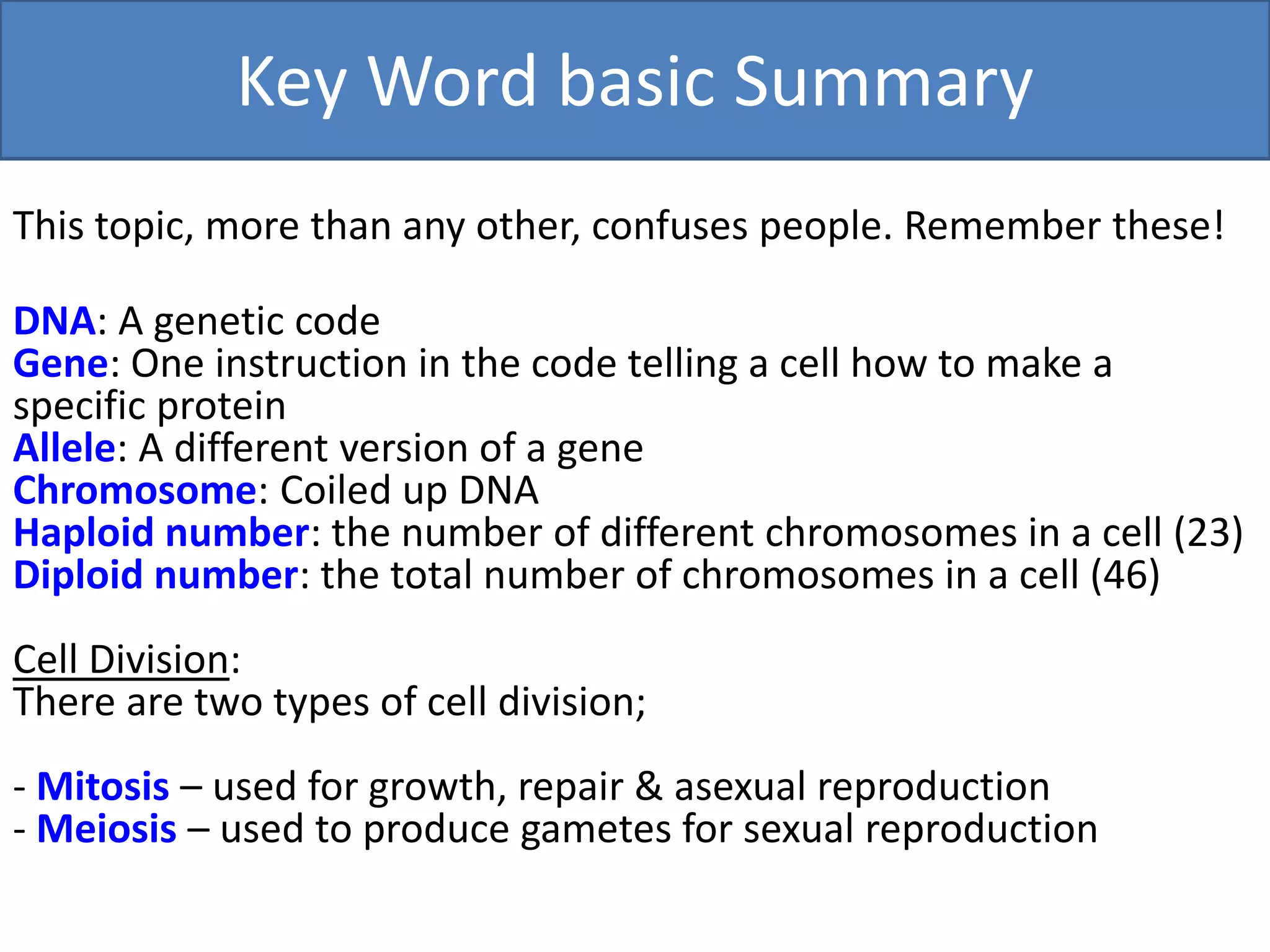
In addition, all living organisms contain nucleic acids (DNA/RNA) and 
have the ability to control their internal conditions (homeostasis). 
Finally, all living organisms can die.
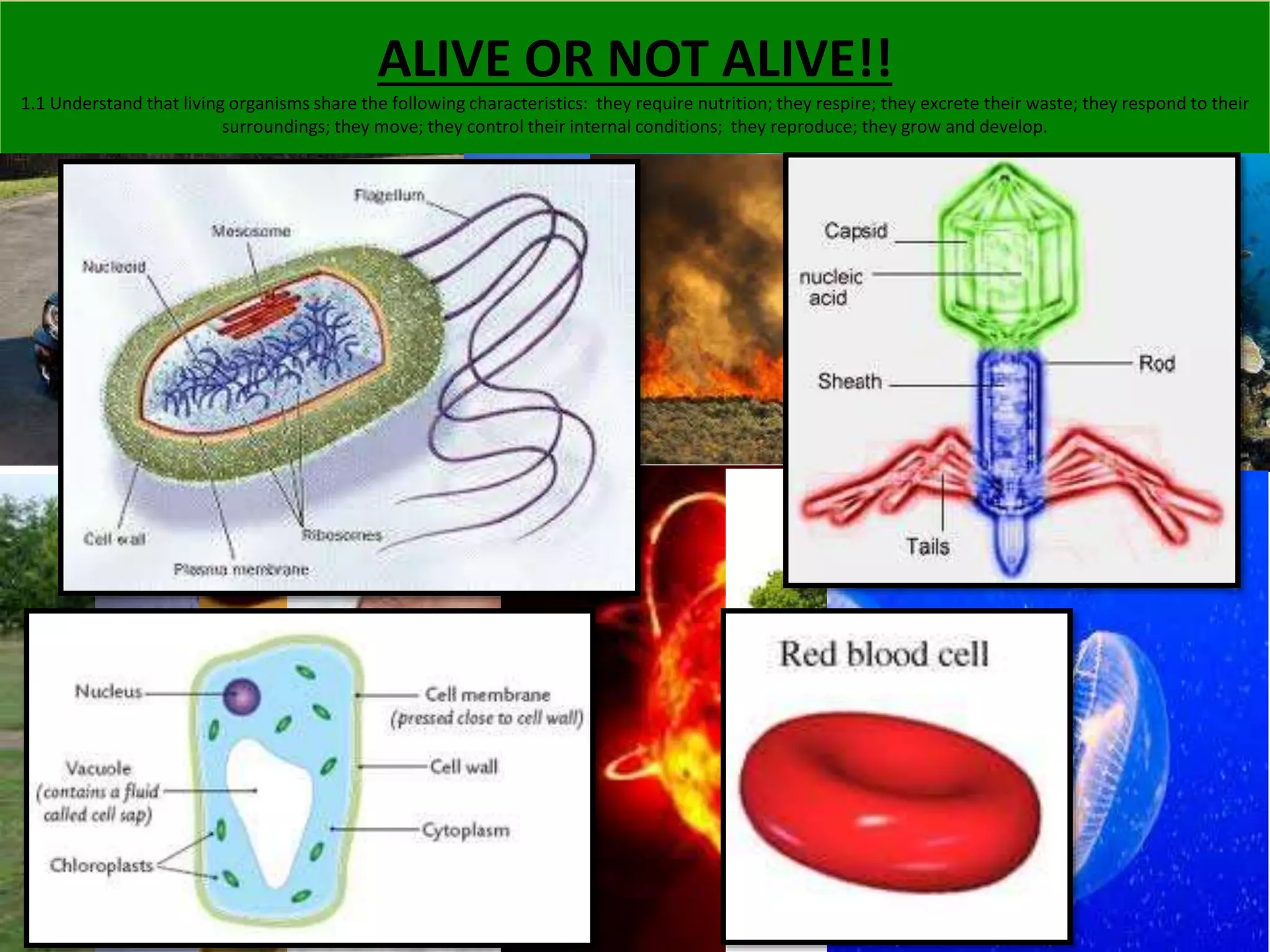
ALIVE OR NOT ALIVE!! 
ALIVE OR NOT ALIVE 
1.1 Understand that living organisms share the following characteristics: they require nutrition; they respire; they excrete their waste; they respond to their 
surroundings; they move; they control their internal conditions; they reproduce; they grow and develop.
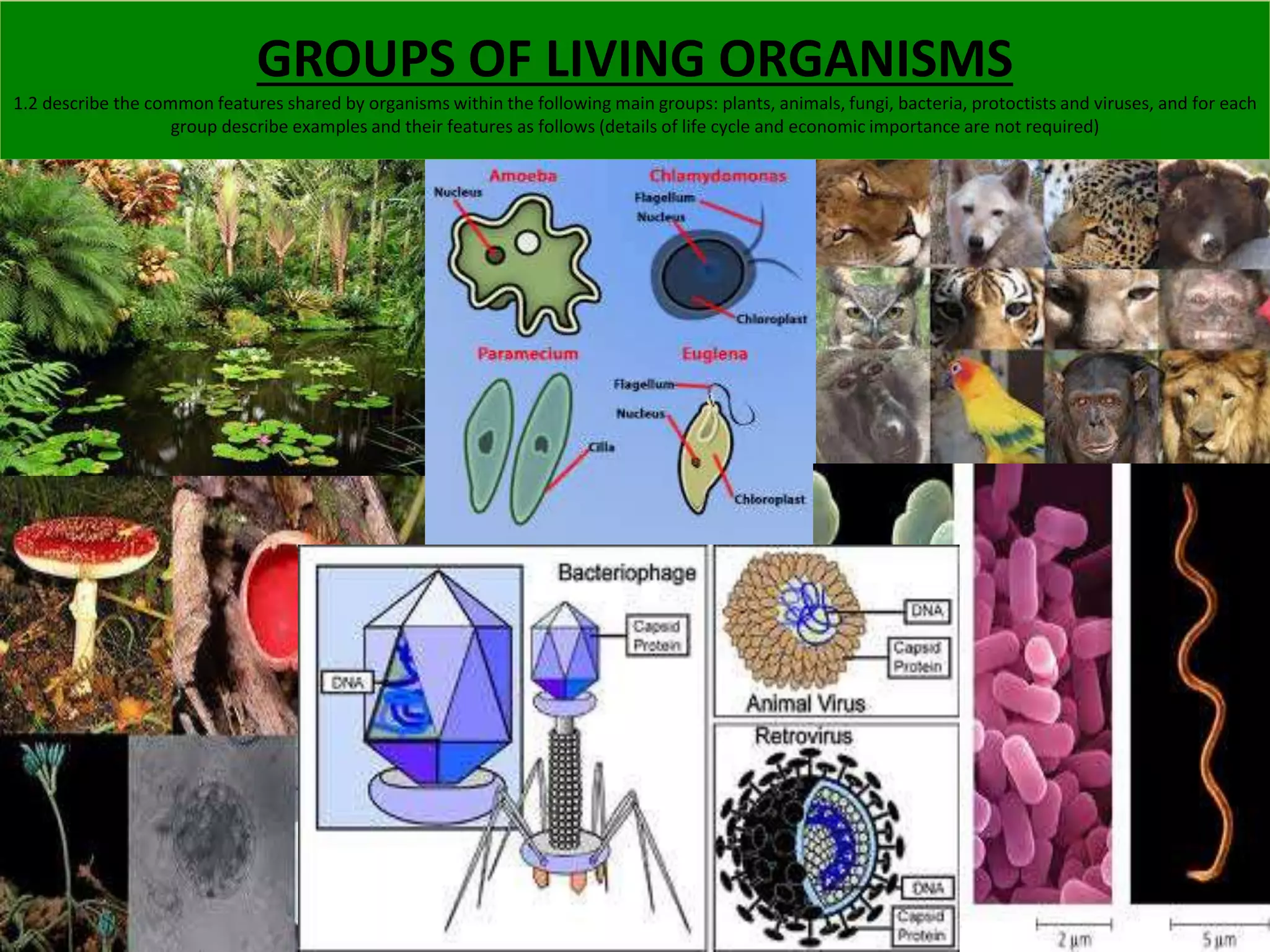
GROUPS OF LIVING ORGANISMS 
1.2 describe the common features shared by organisms within the following main groups: plants, animals, fungi, bacteria, protoctists and viruses, and for each 
group describe examples and their features as follows (details of life cycle and economic importance are not required)
PLANTS 
Plants: These are multicellular organisms; their cells contain chloroplasts and are able to carry out photosynthesis; their cells have cellulose cell walls; they 
store carbohydrates as starch or sucrose 
Plants all have the following in common: 
1) Multicellular organisms (made of lots of cells) 
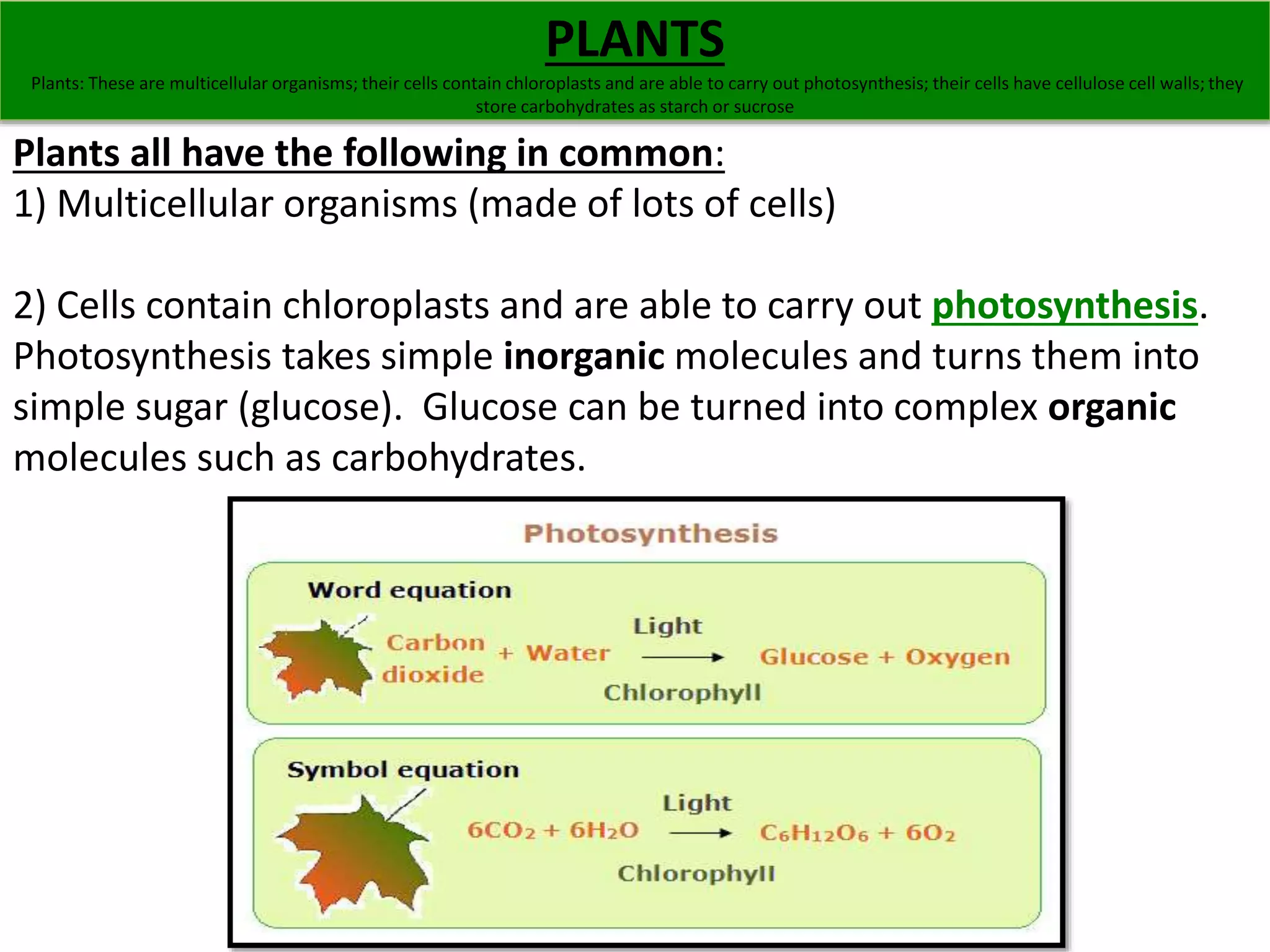
2) Cells contain chloroplasts and are able to carry out photosynthesis. 
Photosynthesis takes simple inorganic molecules and turns them into 
simple sugar (glucose). Glucose can be turned into complex organic 
molecules such as carbohydrates.
PLANTS 
Plants: These are multicellular organisms; their cells contain chloroplasts and are able to carry out photosynthesis; their cells have cellulose cell walls; they 
store carbohydrates as starch or sucrose 
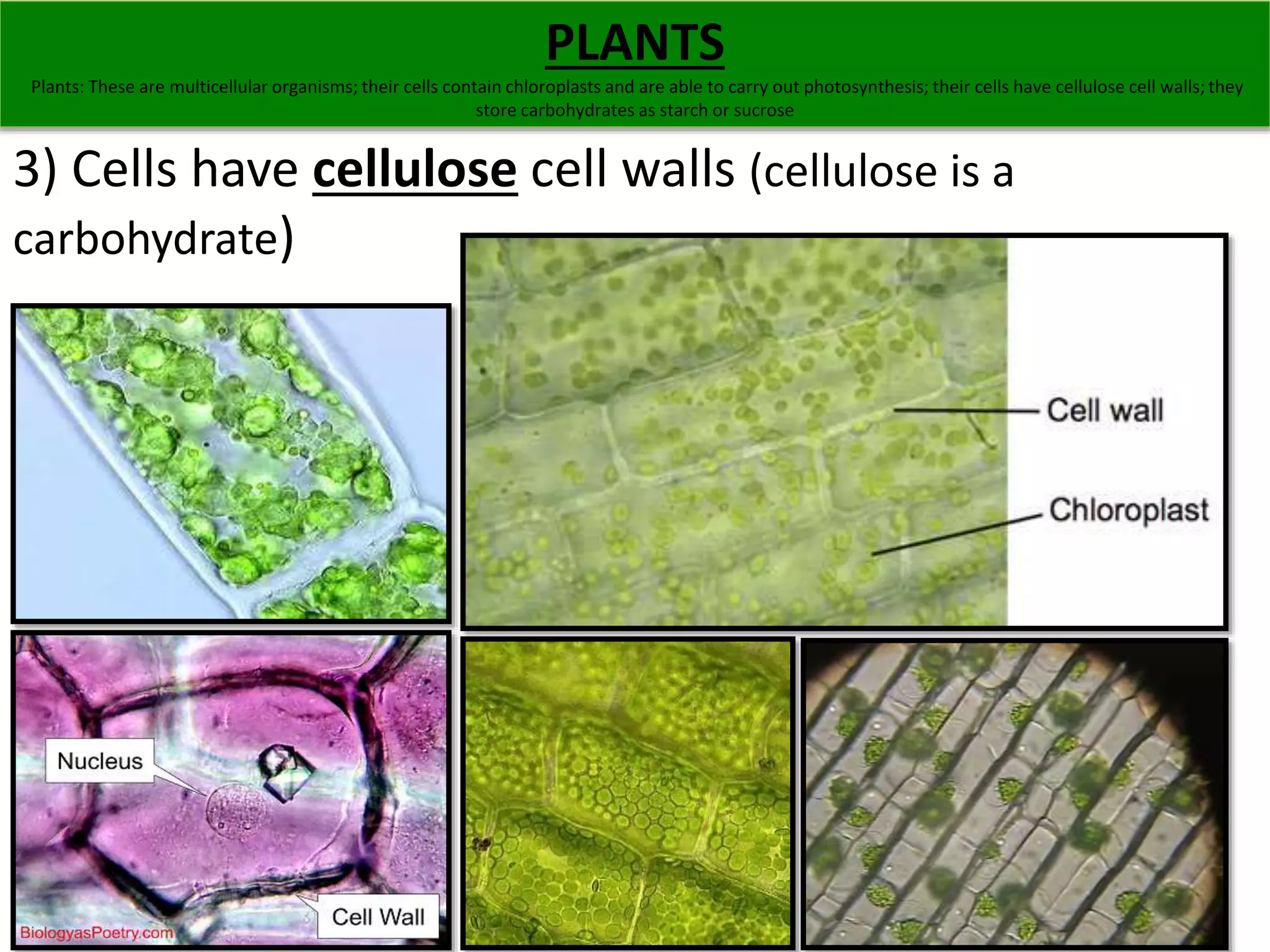
3) Cells have cellulose cell walls (cellulose is a 
carbohydrate)
PLANTS 
Plants: These are multicellular organisms; their cells contain chloroplasts and are able to carry out photosynthesis; their cells have cellulose cell walls; they 
store carbohydrates as starch or sucrose 
4) They store carbohydrates as starch. 
Carbohydrates are polysaccharides (many sugars/glucose linked 
together) 
or sucrose. 
Sucrose is a disaccharide (two sugars linked together).
Examples you need to know: 
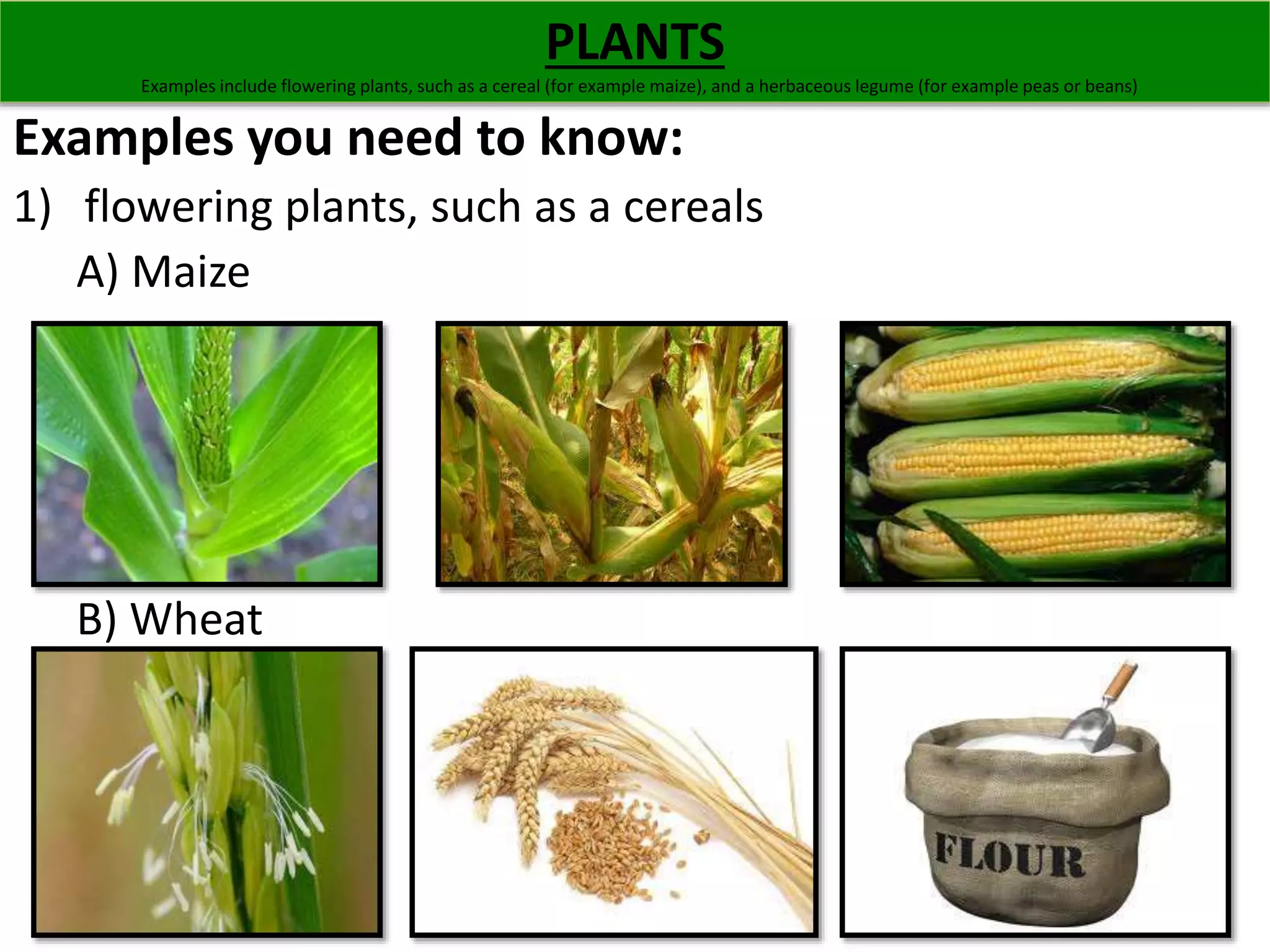
1) flowering plants, such as a cereals 
A) Maize 
PLANTS 
Examples include flowering plants, such as a cereal (for example maize), and a herbaceous legume (for example peas or beans) 
B) Wheat
PLANTS 
Examples include flowering plants, such as a cereal (for example maize), and a herbaceous legume (for example peas or beans) 
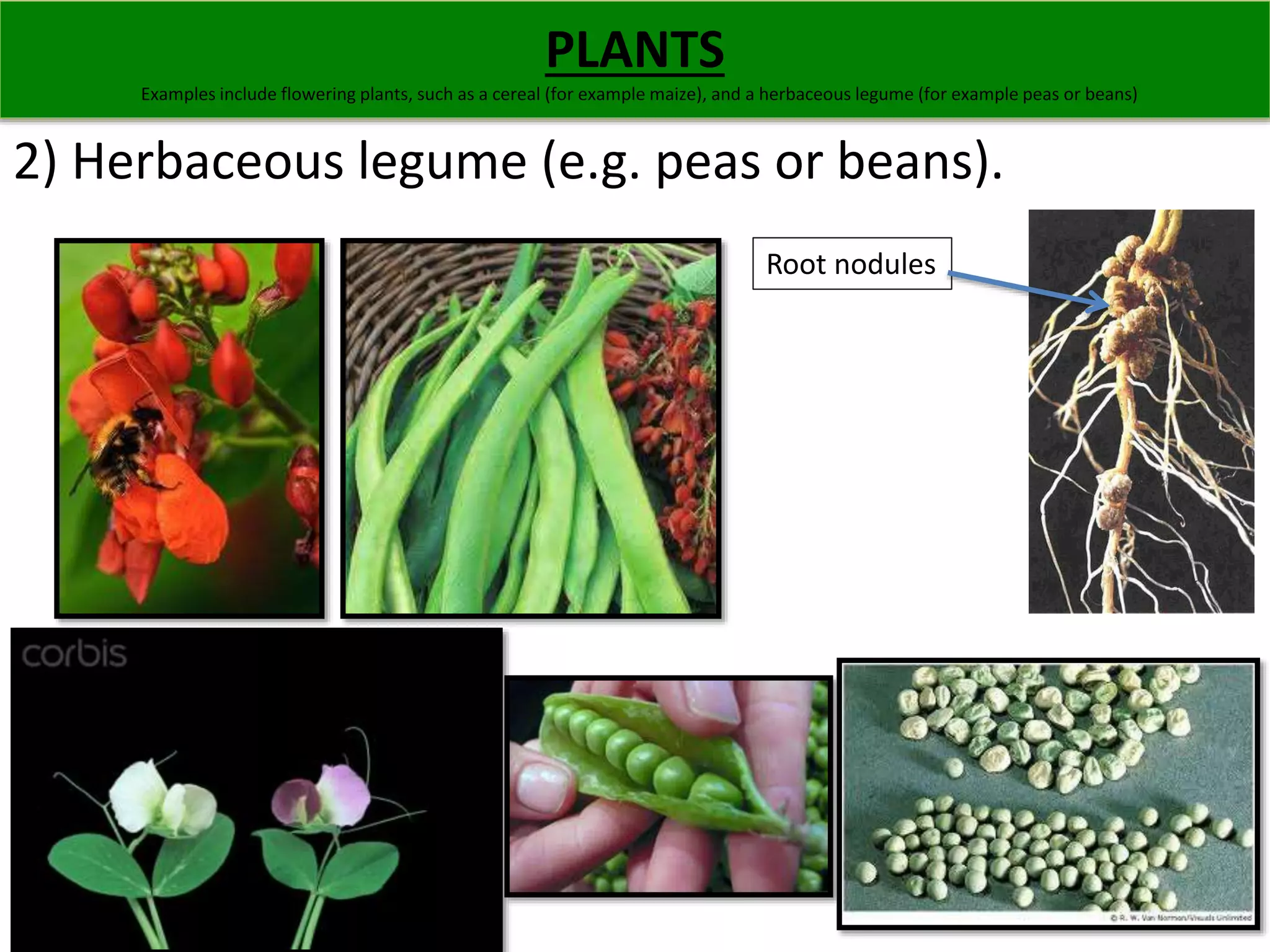
2) Herbaceous legume (e.g. peas or beans). 
Root nodules
ANIMALS 
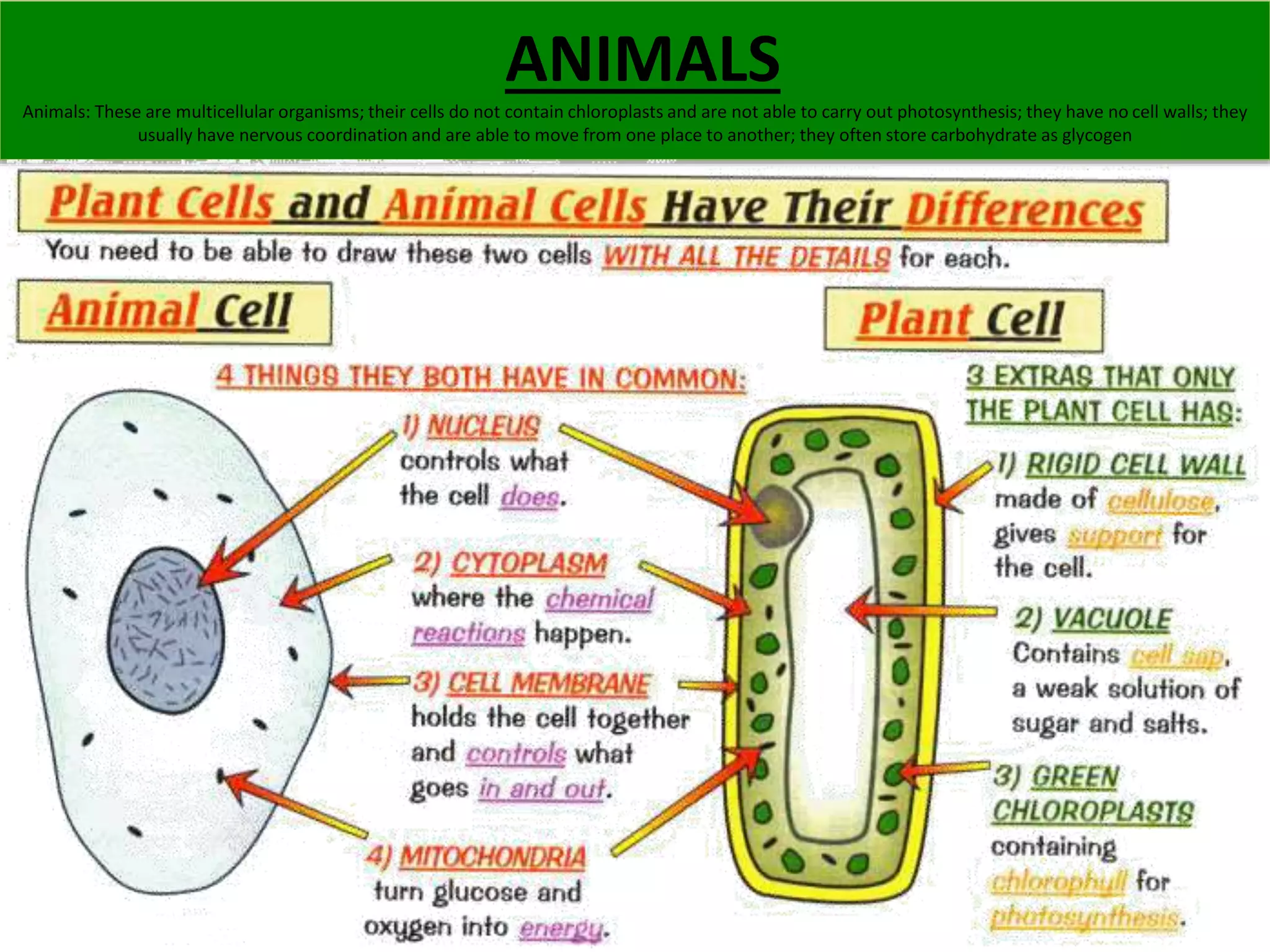
Animals: These are multicellular organisms; their cells do not contain chloroplasts and are not able to carry out photosynthesis; they have no cell walls; they 
usually have nervous coordination and are able to move from one place to another; they often store carbohydrate as glycogen 
1) Animals include: 
sponges, molluscs, worms, starfish, insects, crustaceans, 
fish, amphibians, reptiles, birds, mammals 
Animals without a backbone (vertebral column) are invertebrates. 
Animals with a vertebral column are called vertebrates. 
2) Animals are Multicellular organisms
ANIMALS 
Animals: These are multicellular organisms; their cells do not contain chloroplasts and are not able to carry out photosynthesis; they have no cell walls; they 
usually have nervous coordination and are able to move from one place to another; they often store carbohydrate as glycogen 
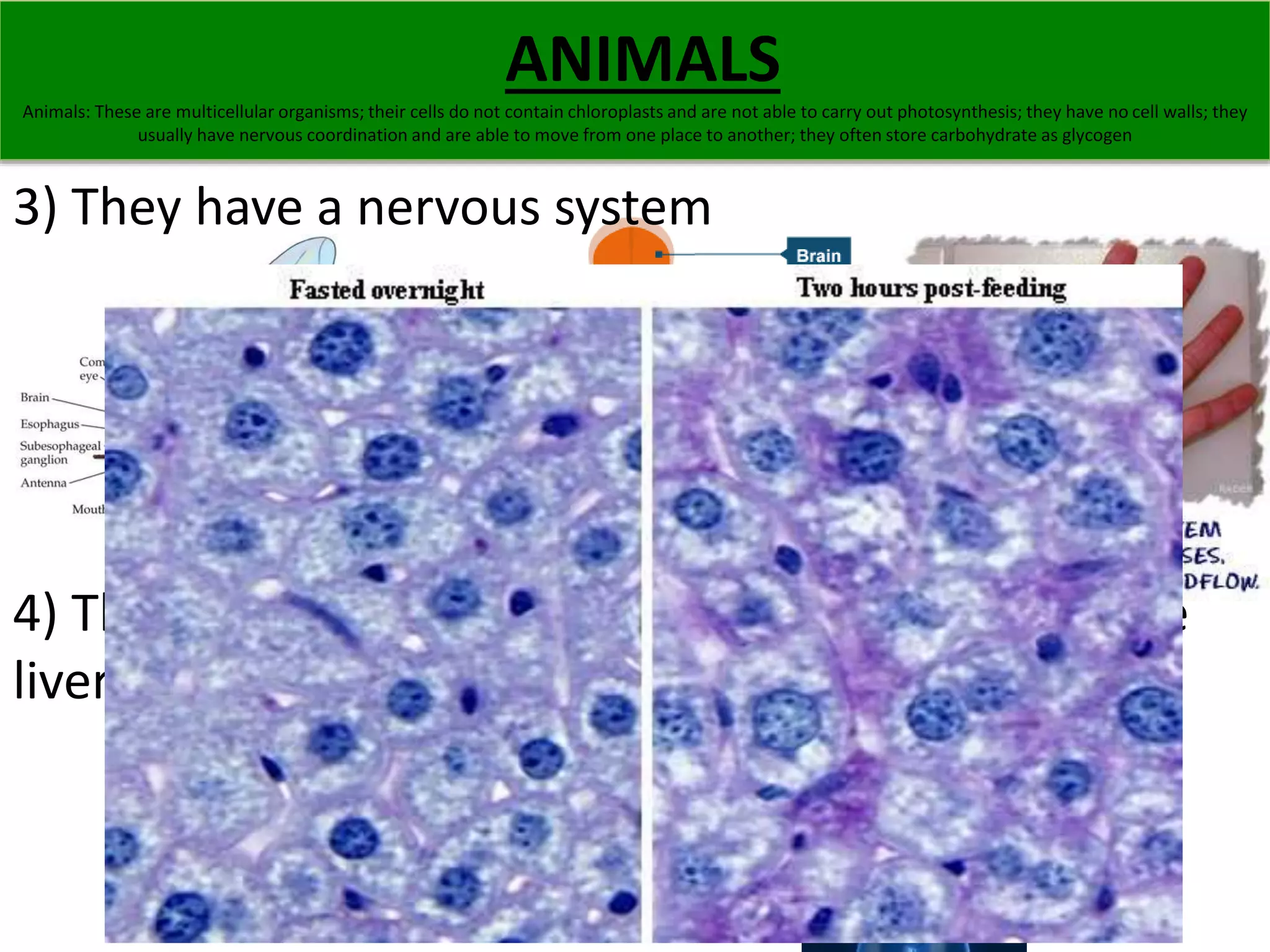
3) They have a nervous system 
4) They often store carbohydrate as glycogen in the 
liver and muscles.
ANIMALS 
Animals: These are multicellular organisms; their cells do not contain chloroplasts and are not able to carry out photosynthesis; they have no cell walls; they 
usually have nervous coordination and are able to move from one place to another; they often store carbohydrate as glycogen 
5) Animal cells do not contain chloroplasts and are 
not able to carry out photosynthesis 
6) Animal cells have no cell walls
ANIMALS 
Animals: These are multicellular organisms; their cells do not contain chloroplasts and are not able to carry out photosynthesis; they have no cell walls; they 
usually have nervous coordination and are able to move from one place to another; they often store carbohydrate as glycogen
ANIMALS 
Examples include mammals (for example humans) and insects (for example housefly and mosquito) 
Examples you need to know: 
1) Human (mammal)
2) Insects 
Examples include mammals (for example humans) and insects (for example housefly and mosquito) 
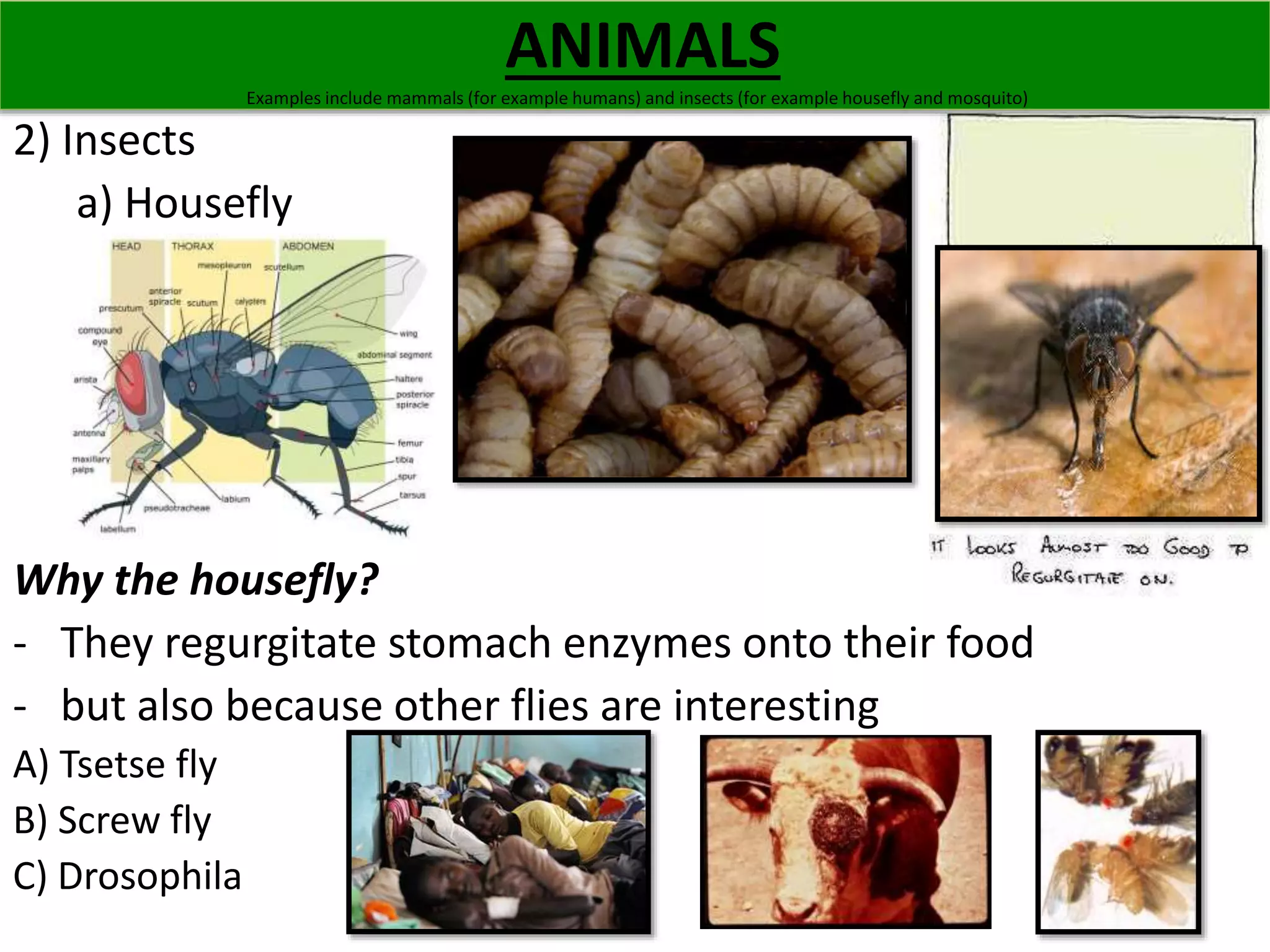
a) Housefly 
ANIMALS 
Why the housefly? 
- They regurgitate stomach enzymes onto their food 
- but also because other flies are interesting 
A) Tsetse fly 
B) Screw fly 
C) Drosophila
ANIMALS 
Examples include mammals (for example humans) and insects (for example housefly and mosquito) 
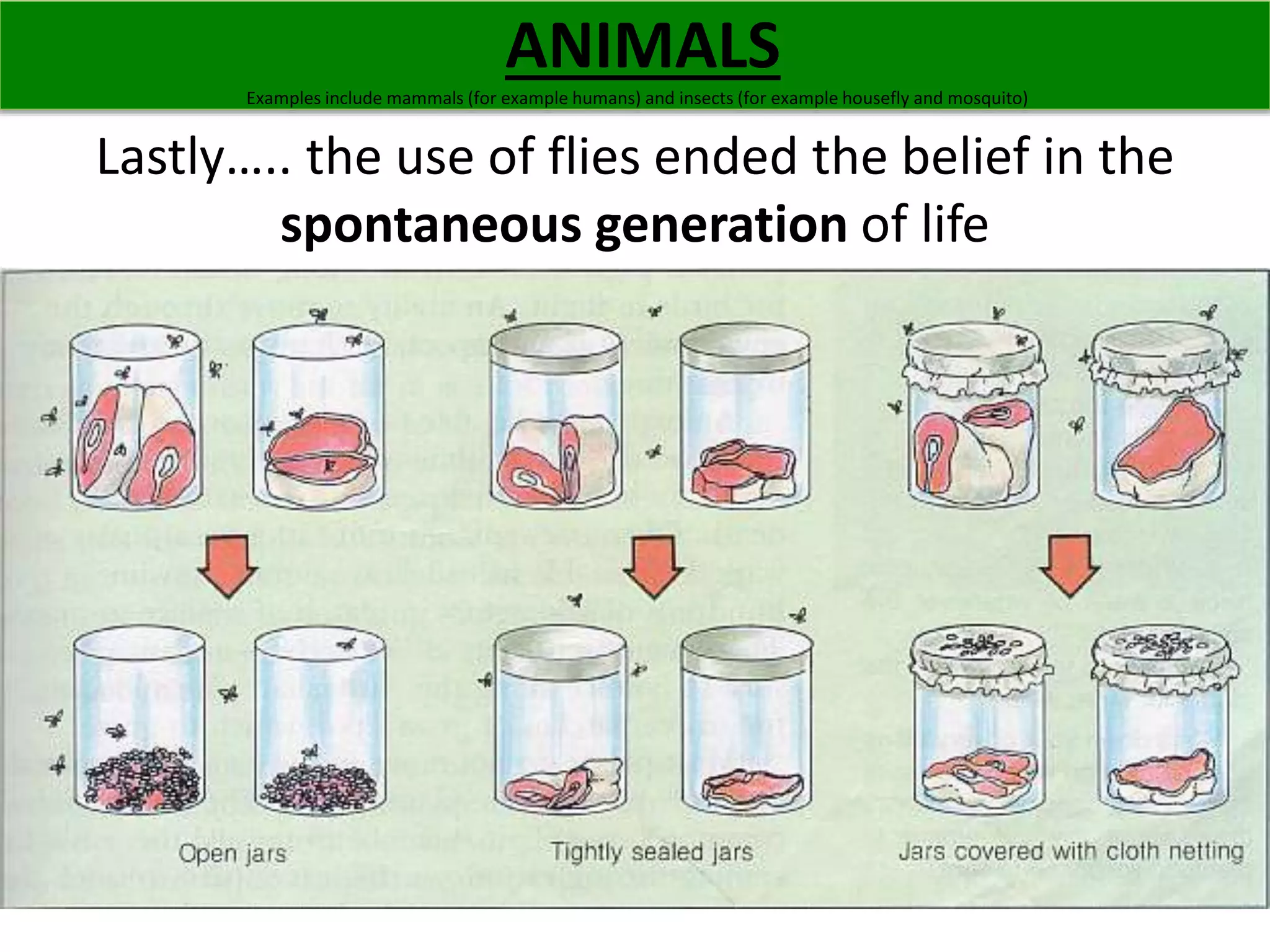
Lastly….. the use of flies ended the belief in the 
spontaneous generation of life
Examples include mammals (for example humans) and insects (for example housefly and mosquito) 
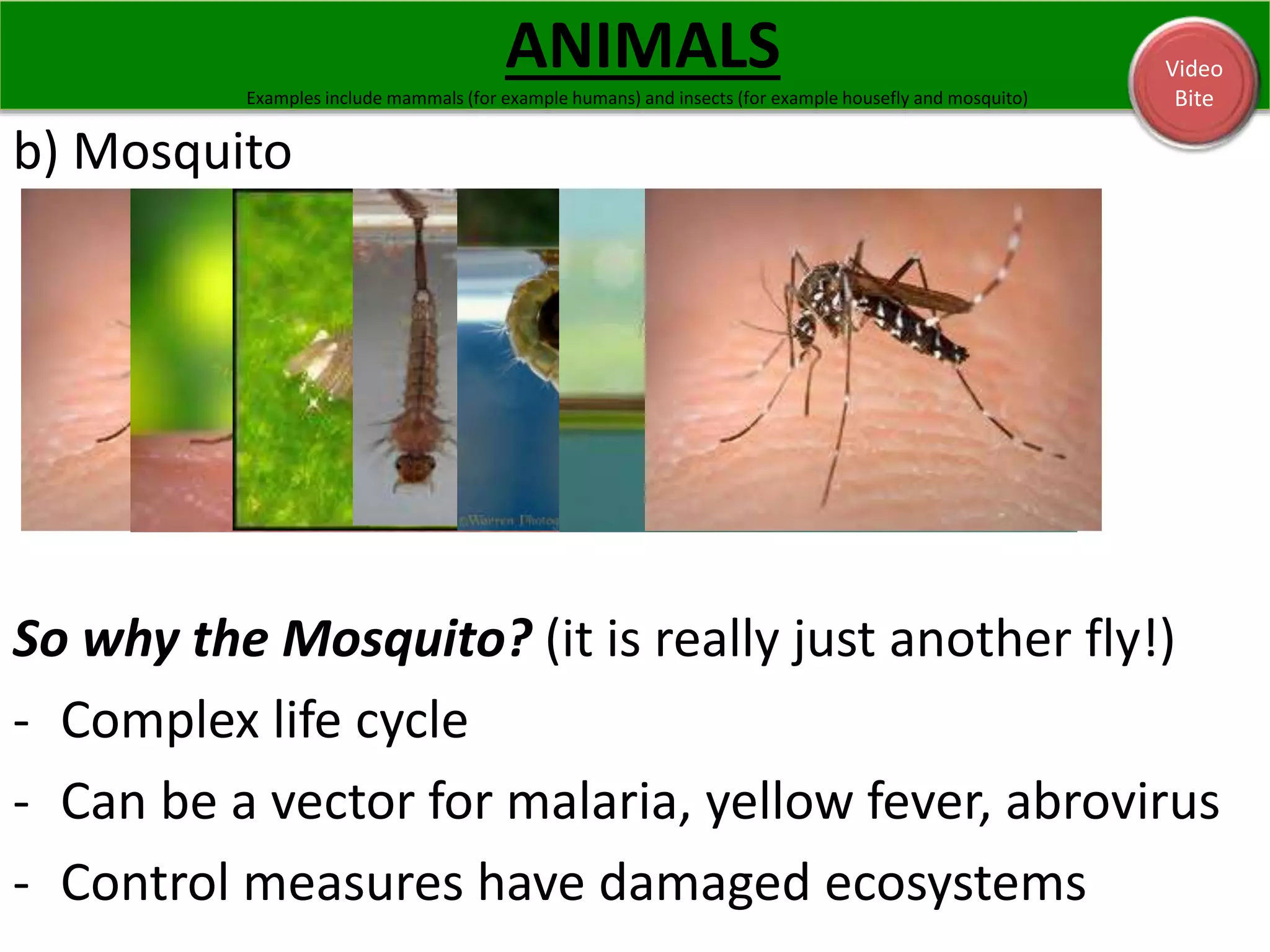
b) Mosquito 
ANIMALS 
Video 
Bite 
So why the Mosquito? (it is really just another fly!) 
- Complex life cycle 
- Can be a vector for malaria, yellow fever, abrovirus 
- Control measures have damaged ecosystems
FUNGI 
Fungi: These are organisms that are not able to carry out photosynthesis; their body is usually organised into a mycelium made from thread-like structures 
called hyphae, which contain many nuclei; some examples are single-celled; their cells have walls made of chitin; they feed by extracellular secretion of 
digestive enzymes onto food material and absorption of the organic products; this is known as saprotrophic nutrition; they may store 
carbohydrate as glycogen 
Characteristics of Fungi: 
1) They feed by saprophytic nutrition (feeds on dead 
organic material & digestion takes place outside the 
organism. 
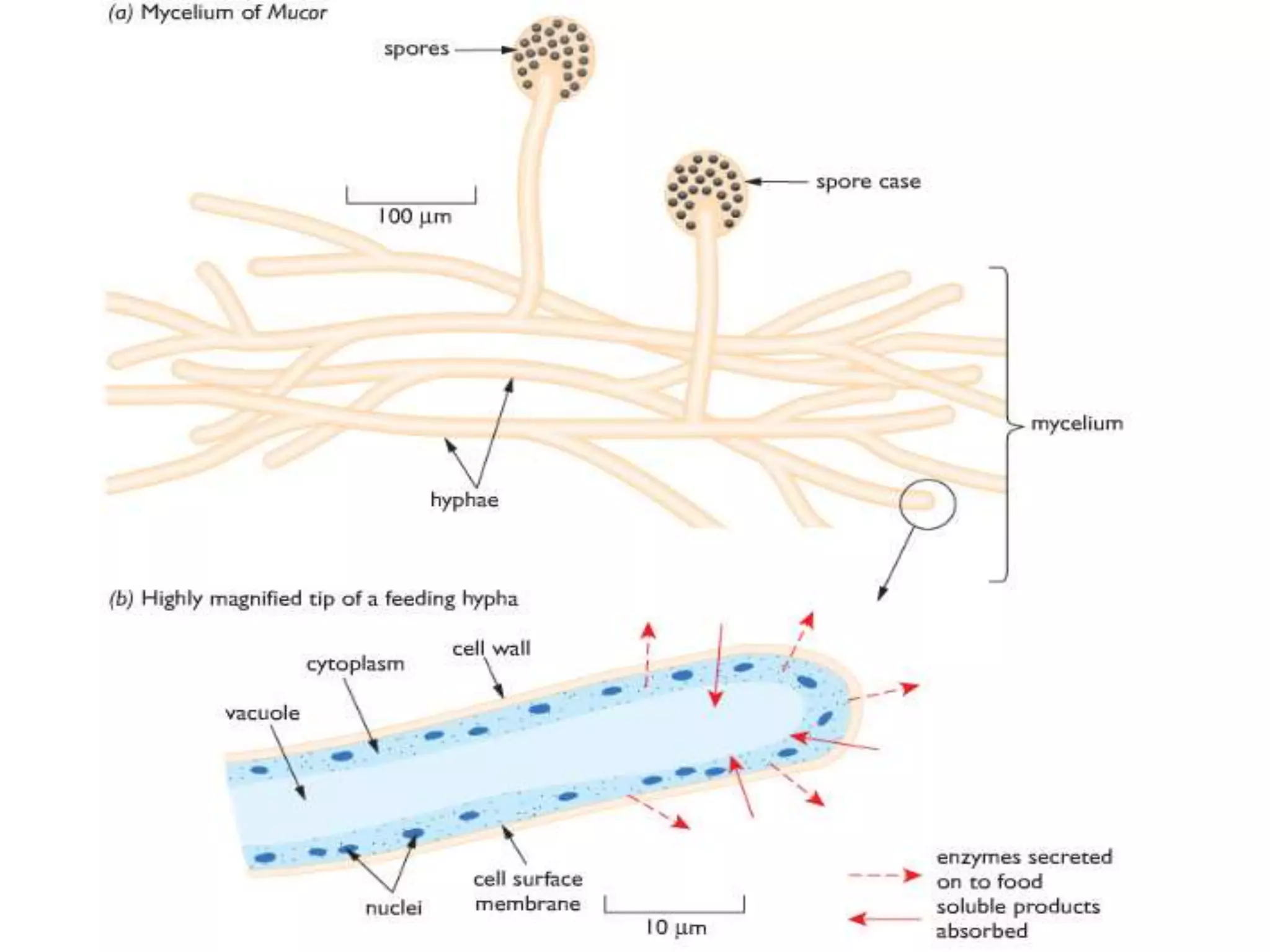
2) Fungi feed by excreting extracellular secretions of 
digestive enzymes onto food and absorbing the digested 
products. 
3) Cells are joined together to form threads, called hyphae. 
Hyphae contain many nuclei, because they are made 
from many cells. 
4) Hyphae join together to make a network of threads called 
mycelium
FUNGI ARE NOT PLANTS 
5) Cells do not contain chloroplasts and are not able 
to carry out photosynthesis 
6) Cell walls are made from a protein called chitin 
(not cellulose) 
7) They store carbohydrates as glycogen 
(not starch) 
FUNGI 
Fungi: These are organisms that are not able to carry out photosynthesis; their body is usually organised into a mycelium made from thread-like structures 
called hyphae, which contain many nuclei; some examples are single-celled; their cells have walls made of chitin; they feed by extracellular secretion of 
digestive enzymes onto food material and absorption of the organic products; this is known as saprotrophic nutrition; they may store 
carbohydrate as glycogen
FUNGI 
Fungi Examples include Mucor , which has the typical fungal hyphal structure, and yeast, which is single-celled 
Examples you must know: 
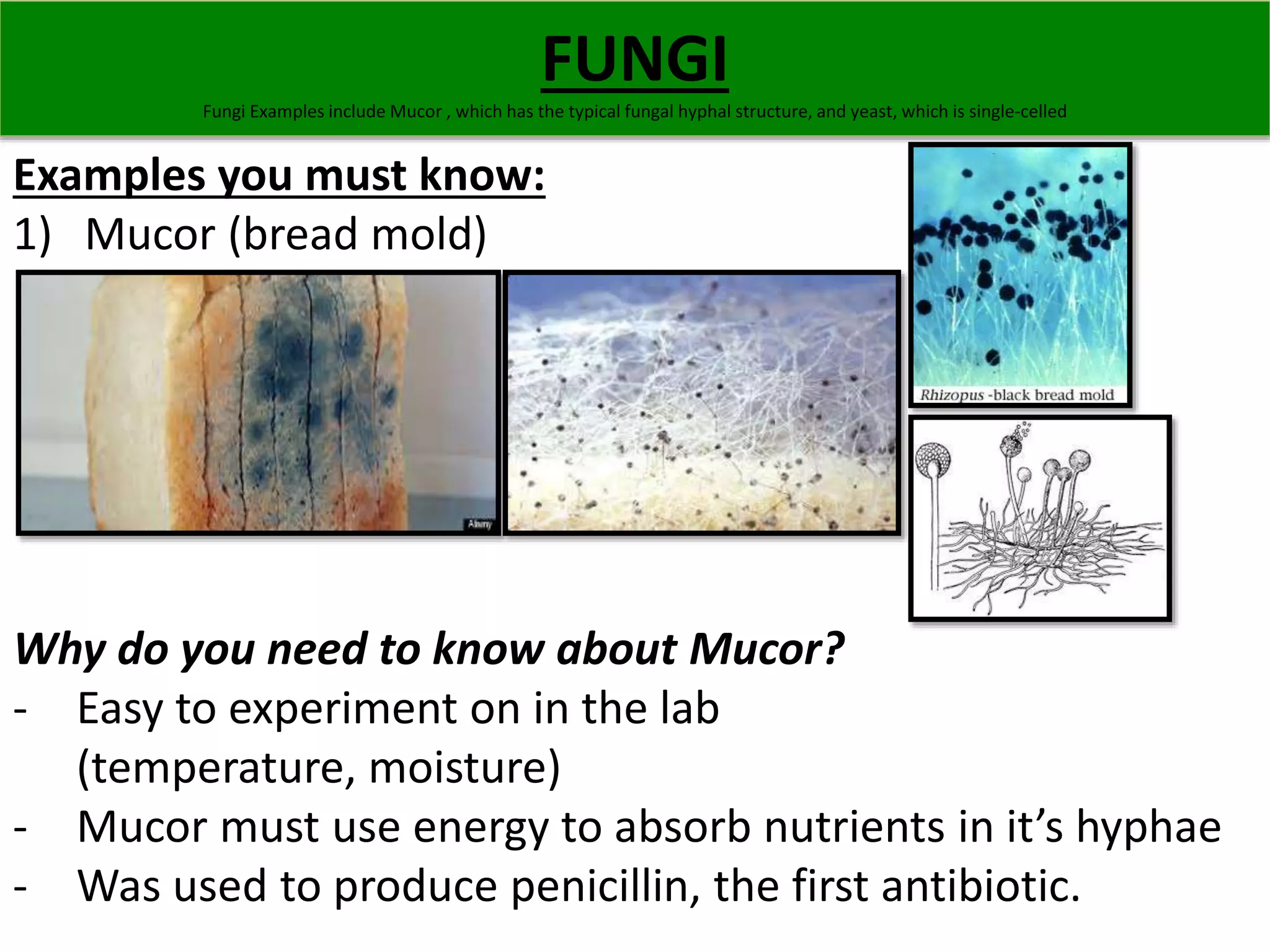
1) Mucor (bread mold) 
Why do you need to know about Mucor? 
- Easy to experiment on in the lab 
(temperature, moisture) 
- Mucor must use energy to absorb nutrients in it’s hyphae 
- Was used to produce penicillin, the first antibiotic.
FUNGI 
Fungi Examples include Mucor , which has the typical fungal hyphal structure, and yeast, which is single-celled 
2) Yeast (single celled fungi) 
Why do you need to know about Yeast? 
- Easy to experiment on in the lab 
(temperature & sugar concentration) 
- Yeast is used in the production of beer & bread
BACTERIA 
Bacteria: These are microscopic single-celled organisms; they have a cell wall, cell membrane, cytoplasm and plasmids; they lack a nucleus but contain a 
circular chromosome of DNA; some bacteria can carry out photosynthesis but most feed off other living or dead organisms 
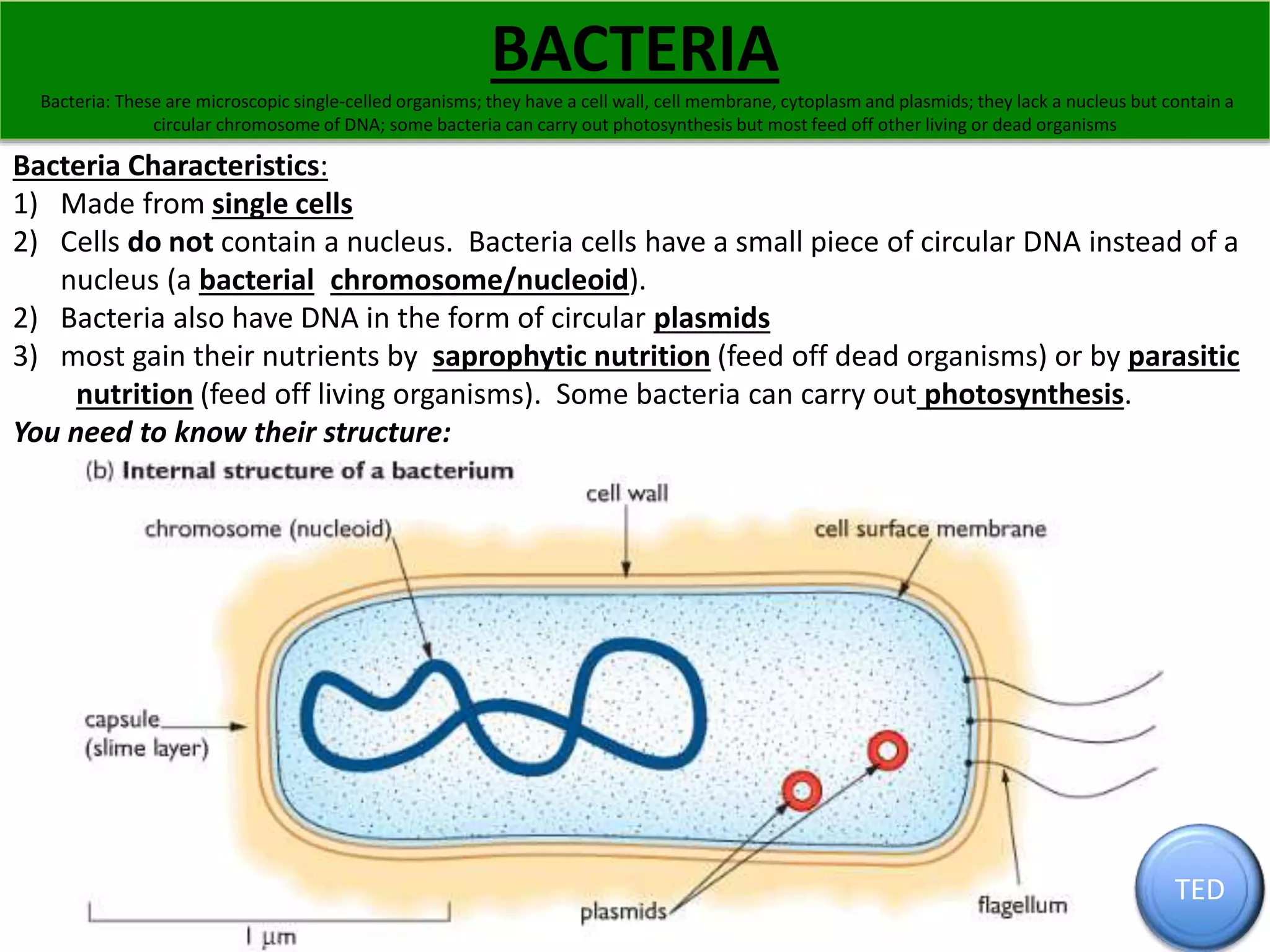
Bacteria Characteristics: 
1) Made from single cells 
2) Cells do not contain a nucleus. Bacteria cells have a small piece of circular DNA instead of a 
nucleus (a bacterial chromosome/nucleoid). 
2) Bacteria also have DNA in the form of circular plasmids 
3) most gain their nutrients by saprophytic nutrition (feed off dead organisms) or by parasitic 
nutrition (feed off living organisms). Some bacteria can carry out photosynthesis. 
You need to know their structure: 
TED
BACTERIA 
Bacteria: These are microscopic single-celled organisms; they have a cell wall, cell membrane, cytoplasm and plasmids; they lack a nucleus but contain a 
circular chromosome of DNA; some bacteria can carry out photosynthesis but most feed off other living or dead organisms 
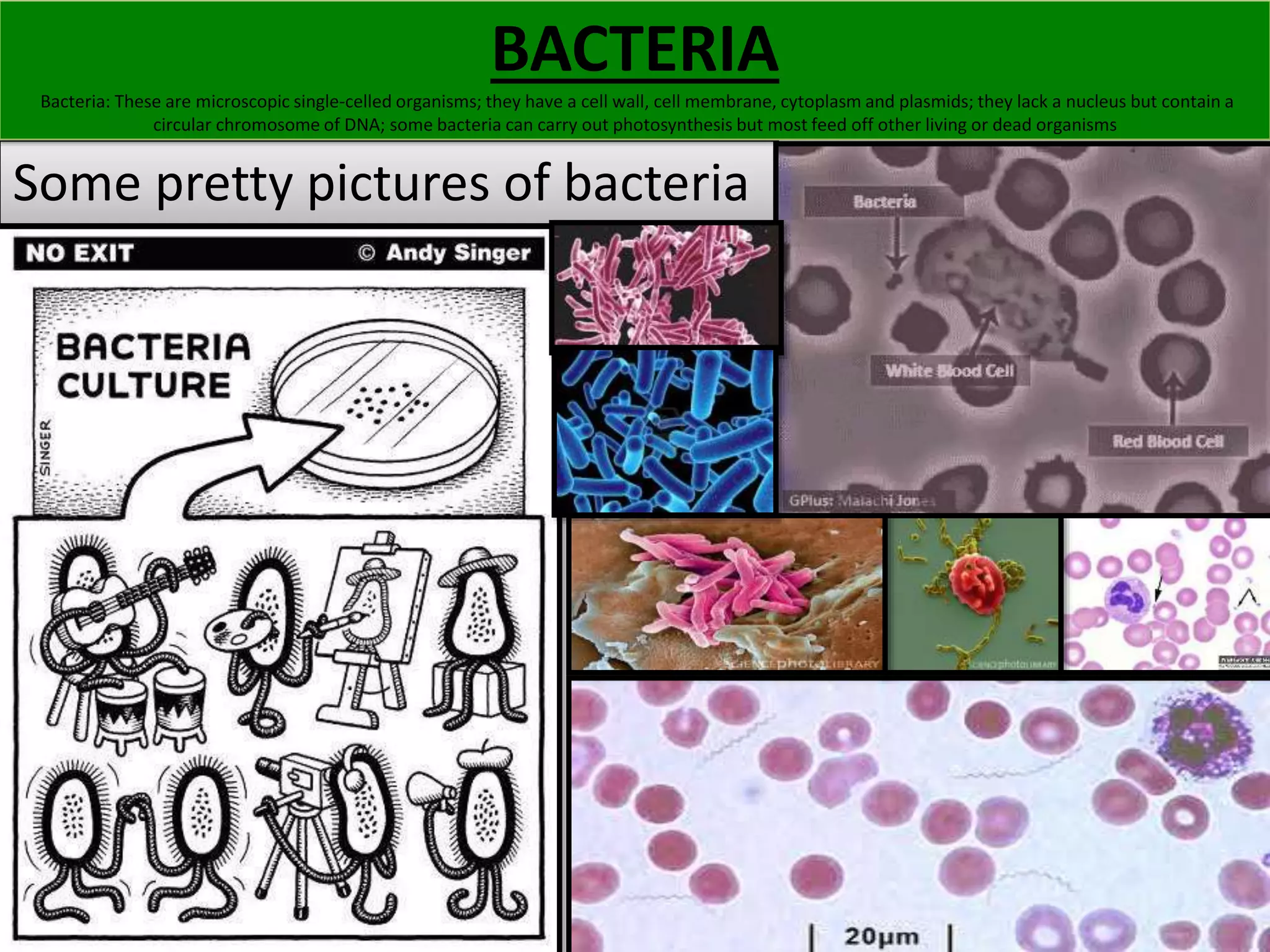
Some pretty pictures of bacteria
BACTERIA 
Examples include Lactobacillus bulgaricus , a rod-shaped bacterium used in the production of yoghurt from milk, and Pneumococcus , a spherical bacterium 
that acts as the pathogen causing pneumonia 
Example you need to know: 
1) Lactobacillus bulgaricus 
- Used to make yogurt 
- Produces lactic acid (excretes) 
- Rod shaped 
- Not dangerous to humans 
Why Lactobacillus bulgaricus? 
- It is used in how human food production 
- lowers the pH of milk to inhibit harmful 
to human bacterial growth
Examples include Lactobacillus bulgaricus , a rod-shaped bacterium used in the production of yoghurt from milk, and Pneumococcus , a spherical bacterium 
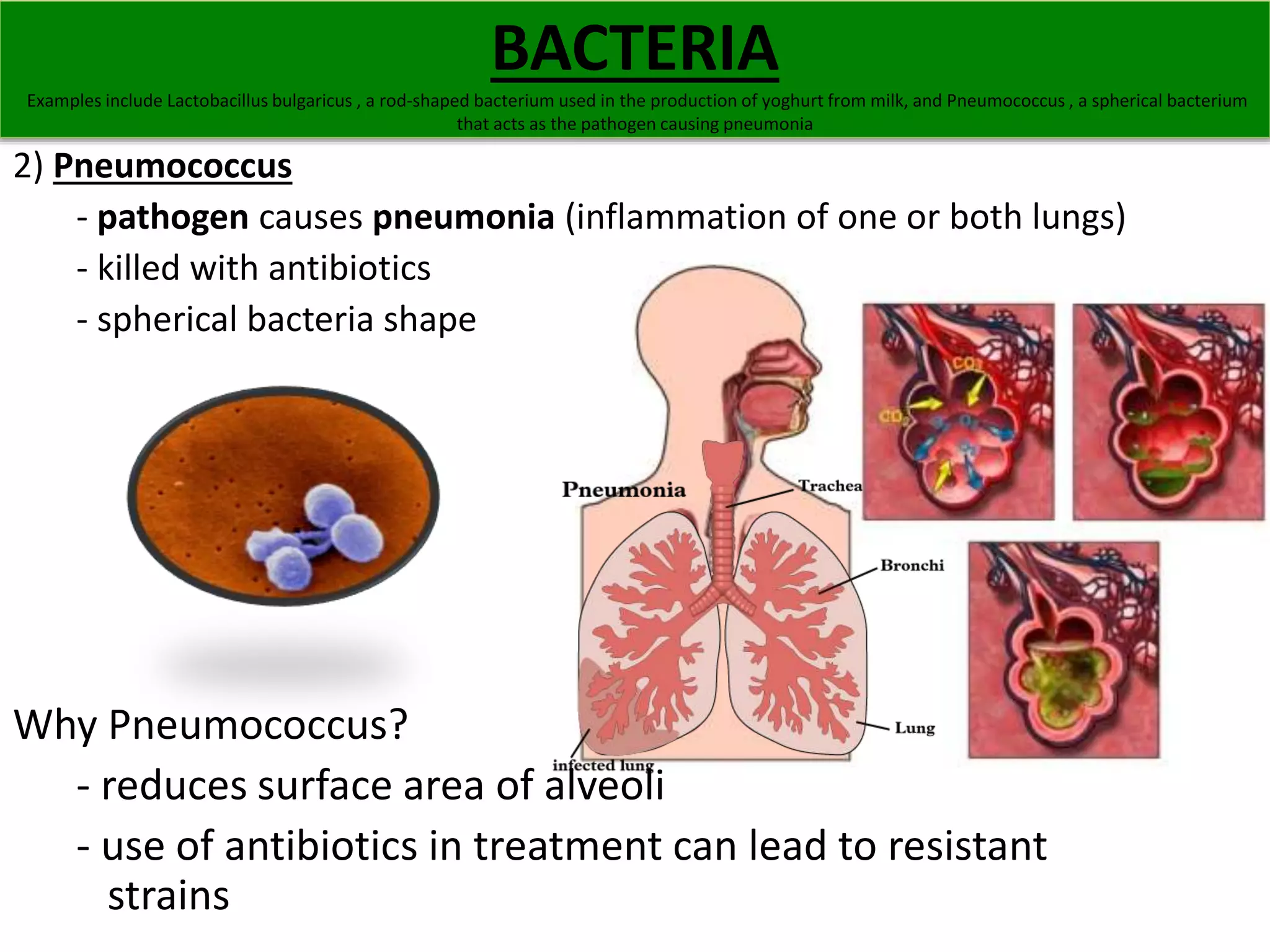
2) Pneumococcus 
BACTERIA 
that acts as the pathogen causing pneumonia 
- pathogen causes pneumonia (inflammation of one or both lungs) 
- killed with antibiotics 
- spherical bacteria shape 
Why Pneumococcus? 
- reduces surface area of alveoli 
- use of antibiotics in treatment can lead to resistant 
strains
PROTOCTISTS 
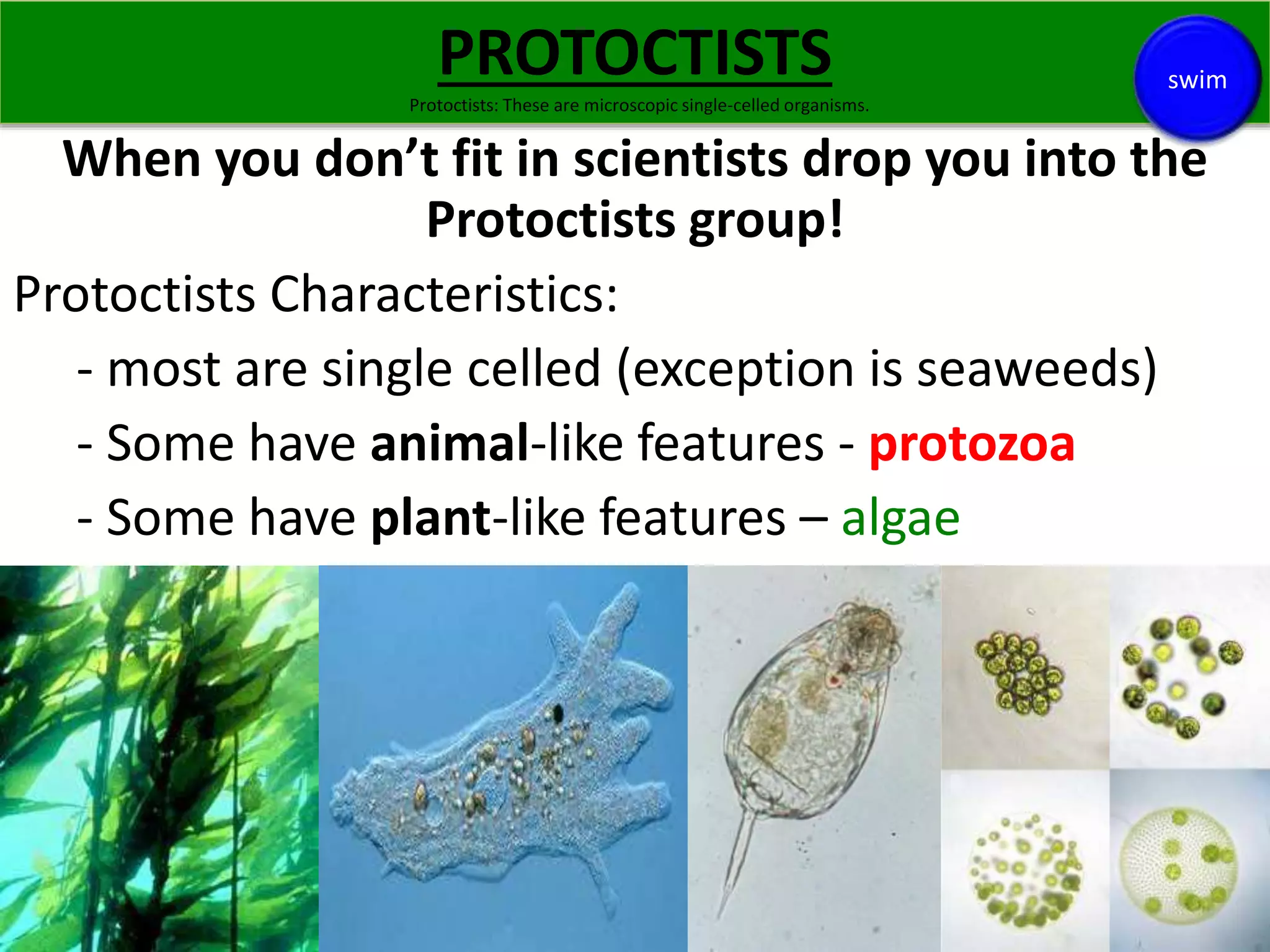
Protoctists: These are microscopic single-celled organisms. 
When you don’t fit in scientists drop you into the 
Protoctists group! 
Protoctists Characteristics: 
- most are single celled (exception is seaweeds) 
- Some have animal-like features - protozoa 
- Some have plant-like features – algae 
swim
PROTOCTISTS 
Some, like Amoeba, that live in pond water, have features like an animal cell, while others, like Chlorella, have chloroplasts and are more like plants. A 
pathogenic example is Plasmodium , responsible for causing malaria 
Examples you need to know: 
1) Amoeba 
- protozoa 
- live in pond water 
- Pathogen amoeba can cause Amoebic dysentery 
(kills 70,000 people every year) 
Why Amoeba? 
- Highlights the need for clean drinking water supplies 
- Uses amoebiasis to feed (similair to phagocytosis) 
eating
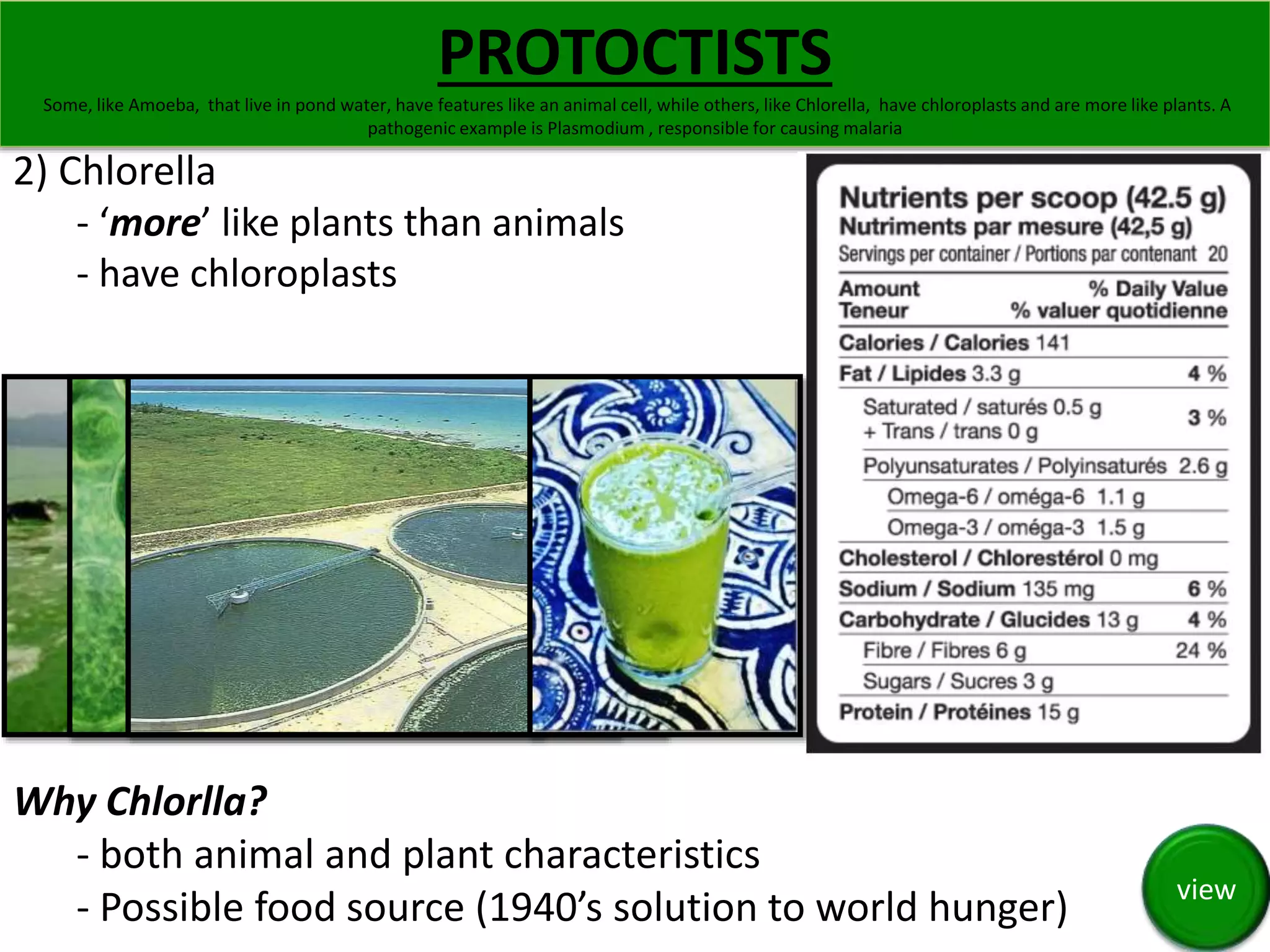
Some, like Amoeba, that live in pond water, have features like an animal cell, while others, like Chlorella, have chloroplasts and are more like plants. A 
2) Chlorella 
PROTOCTISTS 
pathogenic example is Plasmodium , responsible for causing malaria 
- ‘more’ like plants than animals 
- have chloroplasts 
Why Chlorlla? 
- both animal and plant characteristics 
- Possible food source (1940’s solution to world hunger) 
view
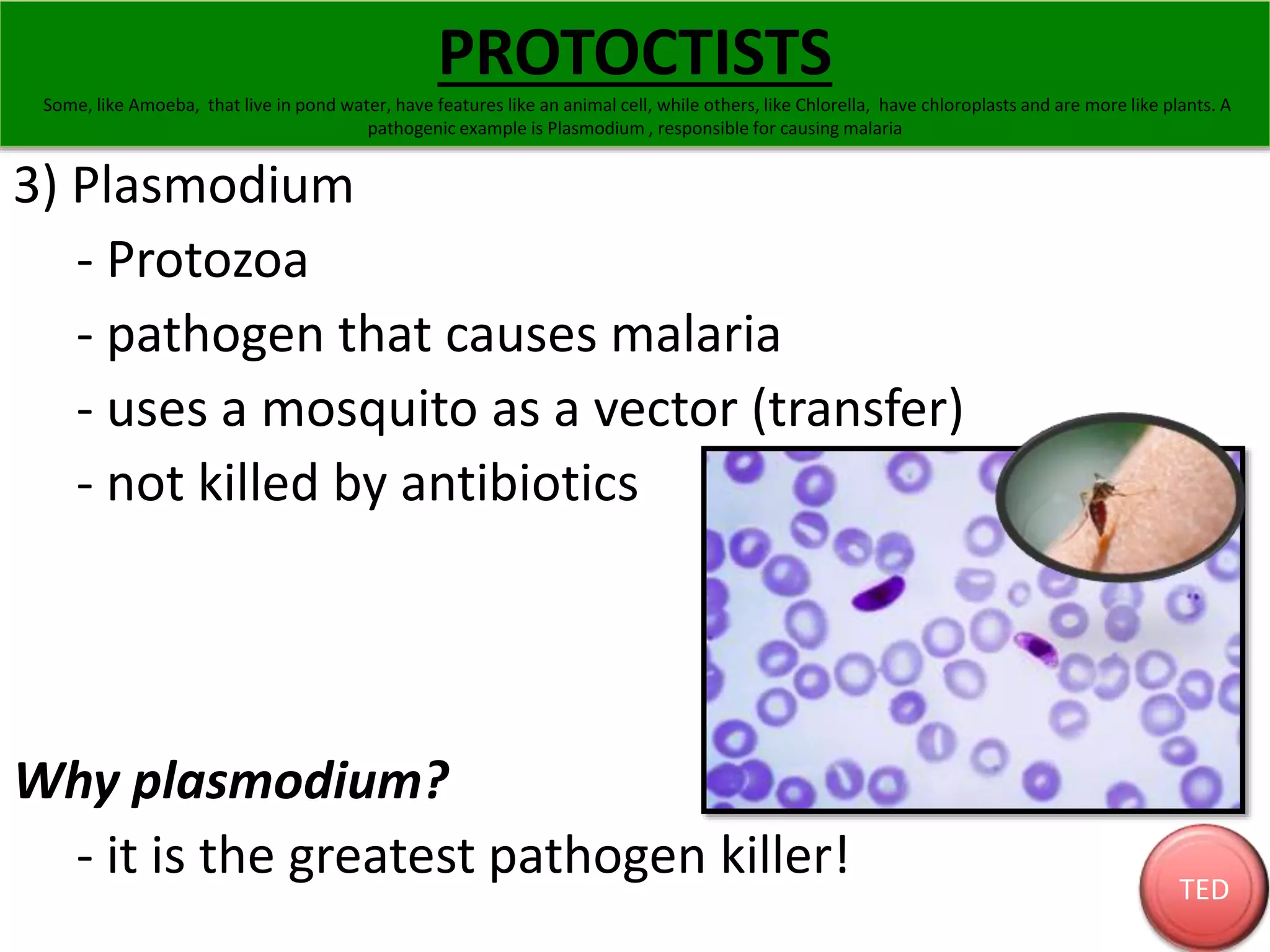
3) Plasmodium 
- Protozoa 
- pathogen that causes malaria 
- uses a mosquito as a vector (transfer) 
- not killed by antibiotics 
Why plasmodium? 
- it is the greatest pathogen killer! 
TED 
PROTOCTISTS 
Some, like Amoeba, that live in pond water, have features like an animal cell, while others, like Chlorella, have chloroplasts and are more like plants. A 
pathogenic example is Plasmodium , responsible for causing malaria
VIRUS 
Viruses: These are small particles, smaller than bacteria; they are parasitic and can reproduce only inside living cells; they infect every type of living 
organism. They have a wide variety of shapes and sizes; they have no cellular structure but have a protein coat and contain one type of nucleic acid, either 
DNA or RNA 
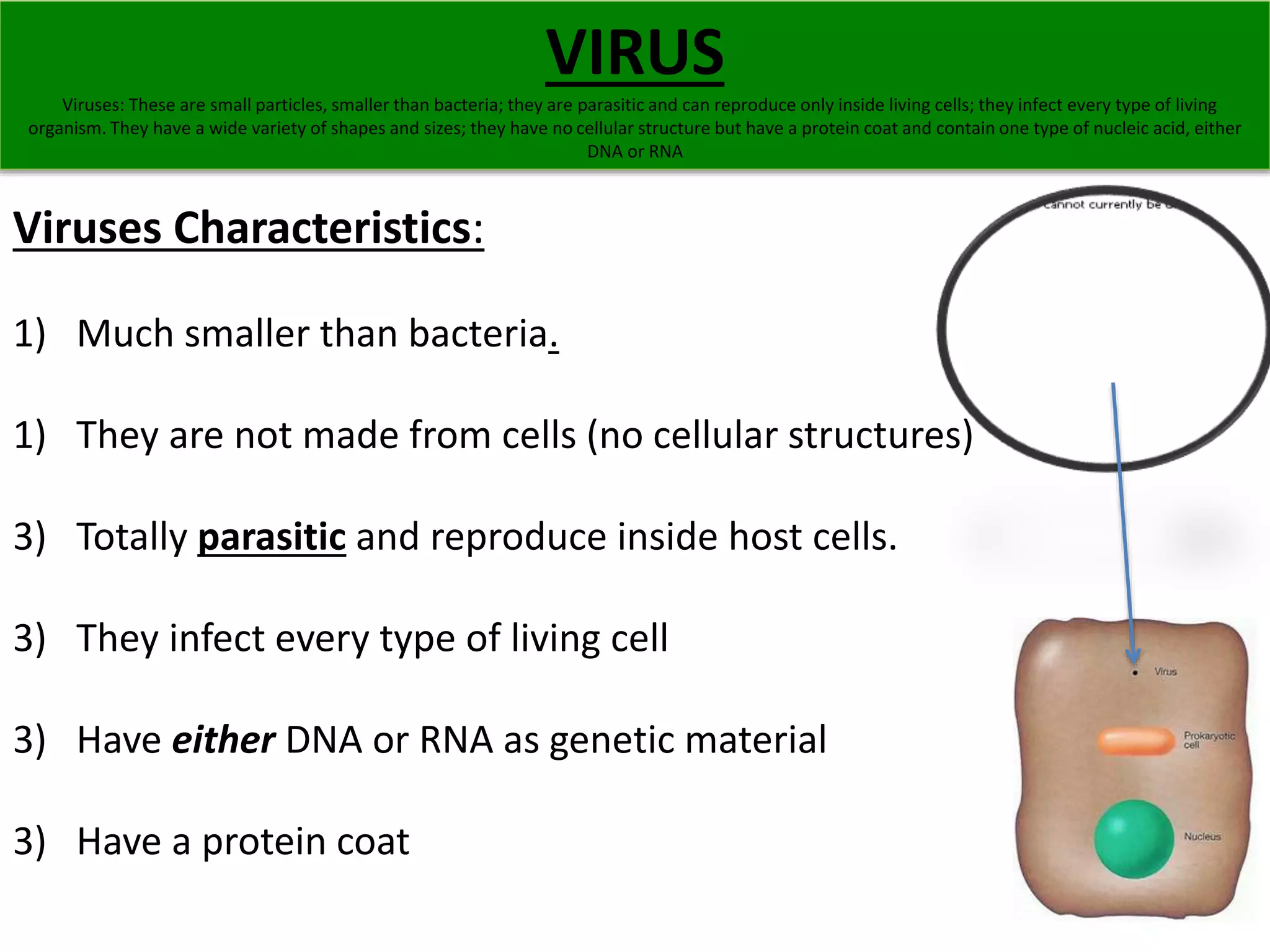
Viruses Characteristics: 
1) Much smaller than bacteria. 
1) They are not made from cells (no cellular structures) 
3) Totally parasitic and reproduce inside host cells. 
3) They infect every type of living cell 
3) Have either DNA or RNA as genetic material 
3) Have a protein coat
VIRUS 
Viruses: These are small particles, smaller than bacteria; they are parasitic and can reproduce only inside living cells; they infect every type of living 
organism. They have a wide variety of shapes and sizes; they have no cellular structure but have a protein coat and contain one type of nucleic acid, either 
DNA or RNA 
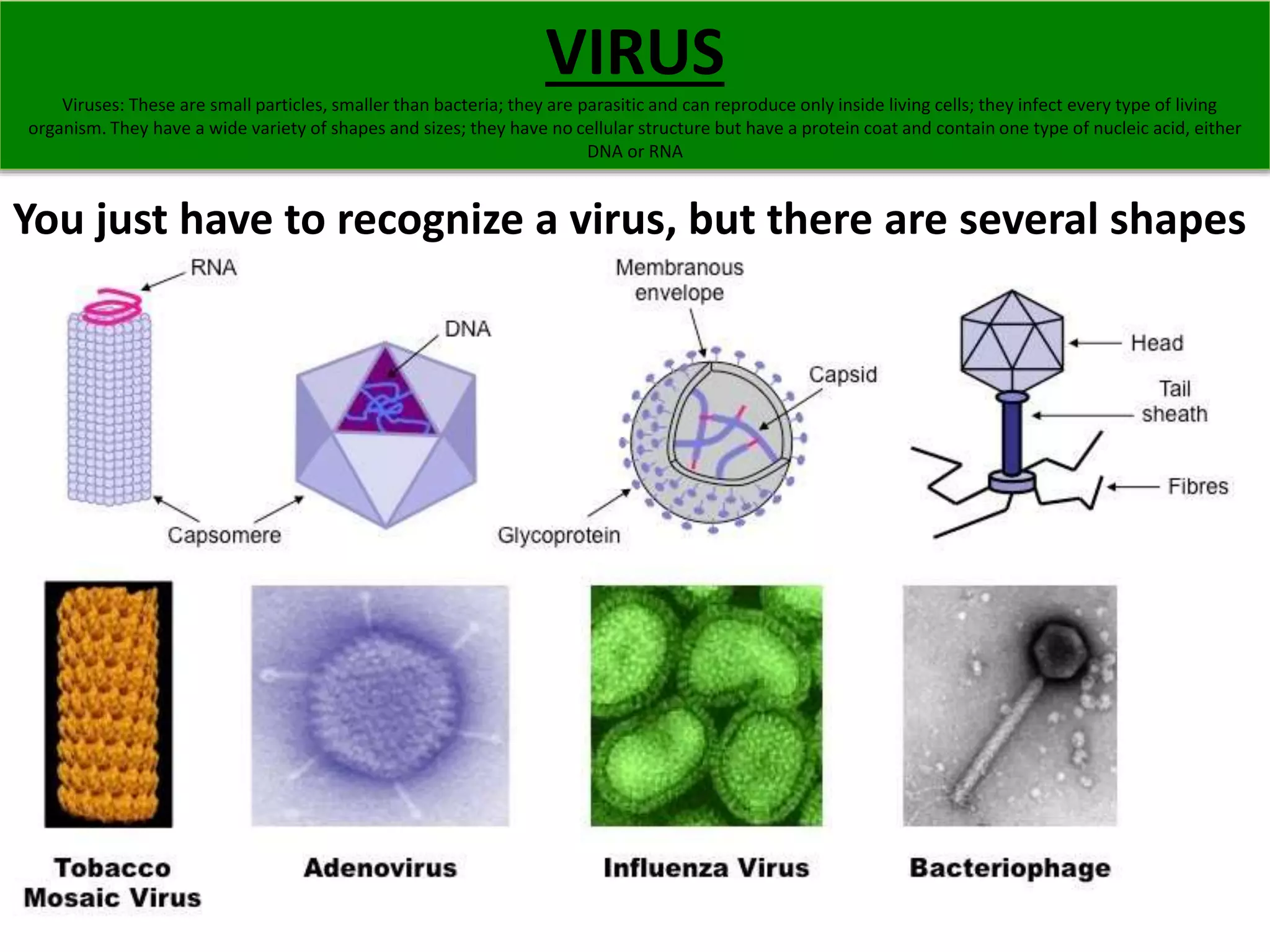
You just have to recognize a virus, but there are several shapes
VIRUS 
Viruses: These are small particles, smaller than bacteria; they are parasitic and can reproduce only inside living cells; they infect every type of living 
organism. They have a wide variety of shapes and sizes; they have no cellular structure but have a protein coat and contain one type of nucleic acid, either 
DNA or RNA 
REVIEW FROM YEAR 8
VIRUS 
Examples include the tobacco mosaic virus that causes discolouring of the leaves of tobacco plants by preventing the formation of chloroplasts, the influenza 
virus that causes gfluc and the HIV virus that causes AIDS 
Examples you need to know: 
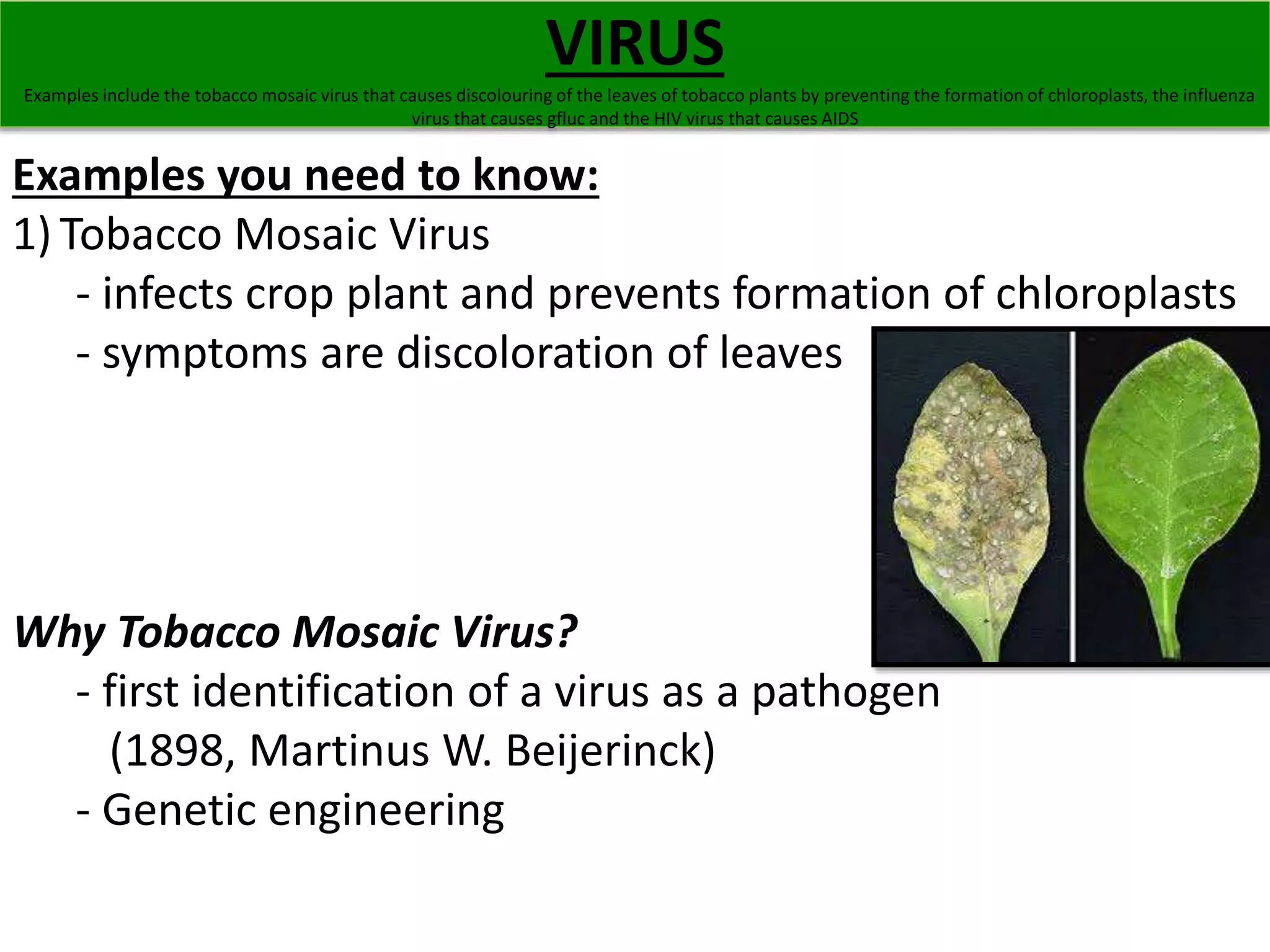
1) Tobacco Mosaic Virus 
- infects crop plant and prevents formation of chloroplasts 
- symptoms are discoloration of leaves 
Why Tobacco Mosaic Virus? 
- first identification of a virus as a pathogen 
(1898, Martinus W. Beijerinck) 
- Genetic engineering
VIRUS 
Examples include the tobacco mosaic virus that causes discolouring of the leaves of tobacco plants by preventing the formation of chloroplasts, the influenza 
virus that causes gfluc and the HIV virus that causes AIDS 
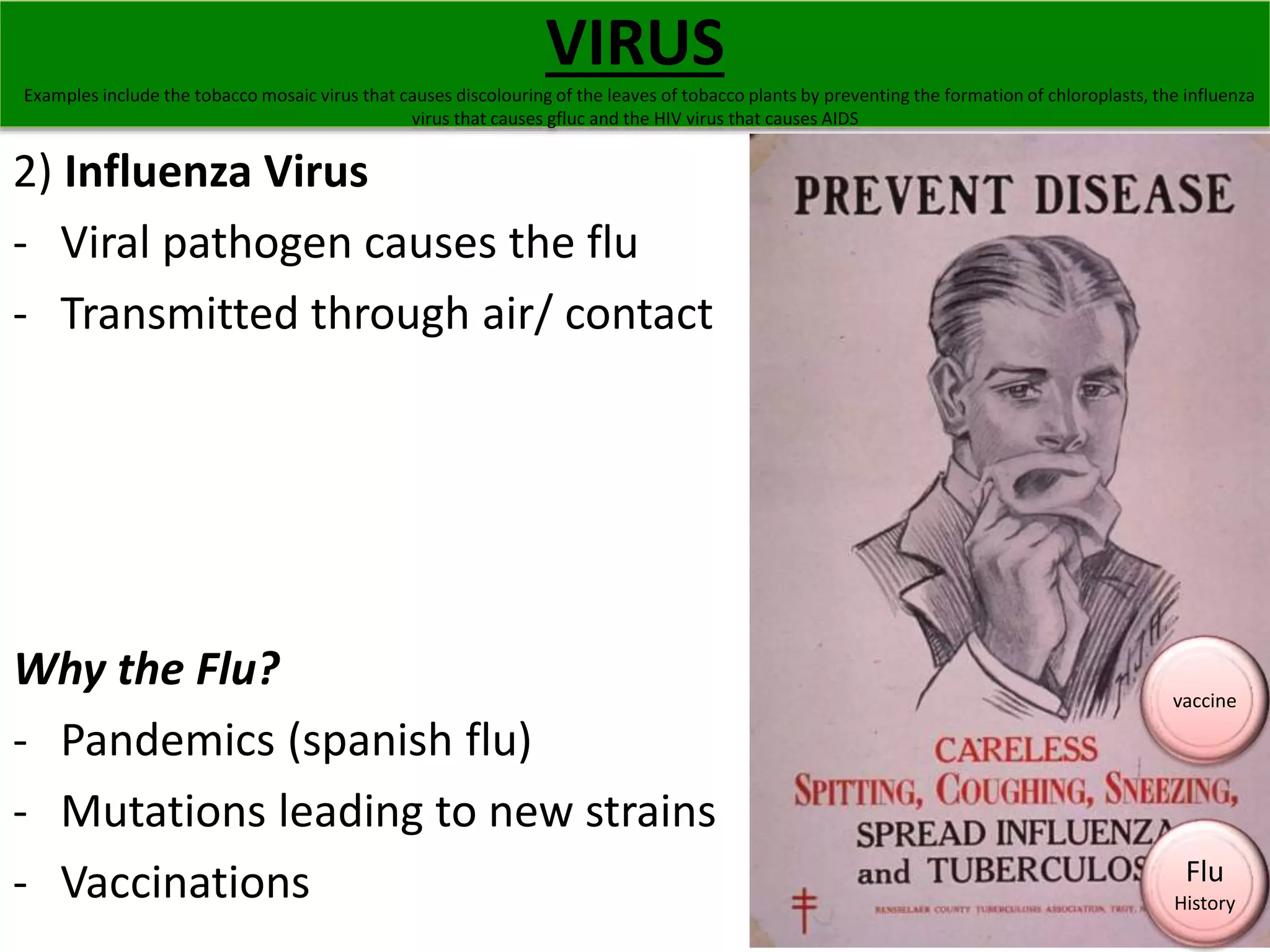
2) Influenza Virus 
- Viral pathogen causes the flu 
- Transmitted through air/ contact 
Why the Flu? 
- Pandemics (spanish flu) 
- Mutations leading to new strains 
- Vaccinations 
vaccine 
Flu 
History
Just thought you would like to know.
3) HIV (human immunodeficiency virus) 
- Pathogen causes AIDS (acquired immunodeficiency syndrome) 
- Virus attacks white blood cells (immune system) 
- Host killed by secondary disease 
- Transmitted by blood to blood contact 
Why HIV? 
- Immune system 
- Mutations 
VIRUS 
Examples include the tobacco mosaic virus that causes discolouring of the leaves of tobacco plants by preventing the formation of chloroplasts, the influenza 
virus that causes gfluc and the HIV virus that causes AIDS
PATHOGEN 
1.3 recall the term gpathogenc and know that pathogens may be fungi, bacteria, protoctists or viruses. 
Pathogen: 
An agent that causes infection or disease, especially a 
microorganism, such as a bacterium or protozoan, or 
a virus.
LEVELS OF ORGANIZATION 
2.1 describe the levels of organisation within organisms: organelles, cells, tissues, organs and systems. 
Organisms are made from organizations of smaller structures. You 
need to know the following hierarchy of structures. 
Organelles - intracellular structures that carry out specific functions within a cell 
Nucleus Chloroplast Mitochondria Ribosome Vacuole 
Cells - the basic structural and functional unit from which all biological organisms are made 
Neurone Skin cell Muscle 
cell 
Tissues - a group of specialized cells, which are adapted to carry out a specific function 
Organs - a collection of two or more tissues, which carries out a specific function or functions 
Organ Systems - a group of two or more organs 
Phagocyte Red Blood Cell 
Muscle Nerves Blood Bone Adipose (Fat) 
Heart Skin Brain Artery Kidney 
Pulmonary Cardiac Nervous Endocrine Skeletal
LEVELS OF ORGANIZATION 
2.1 describe the levels of organisation within organisms: organelles, cells, tissues, organs and systems.
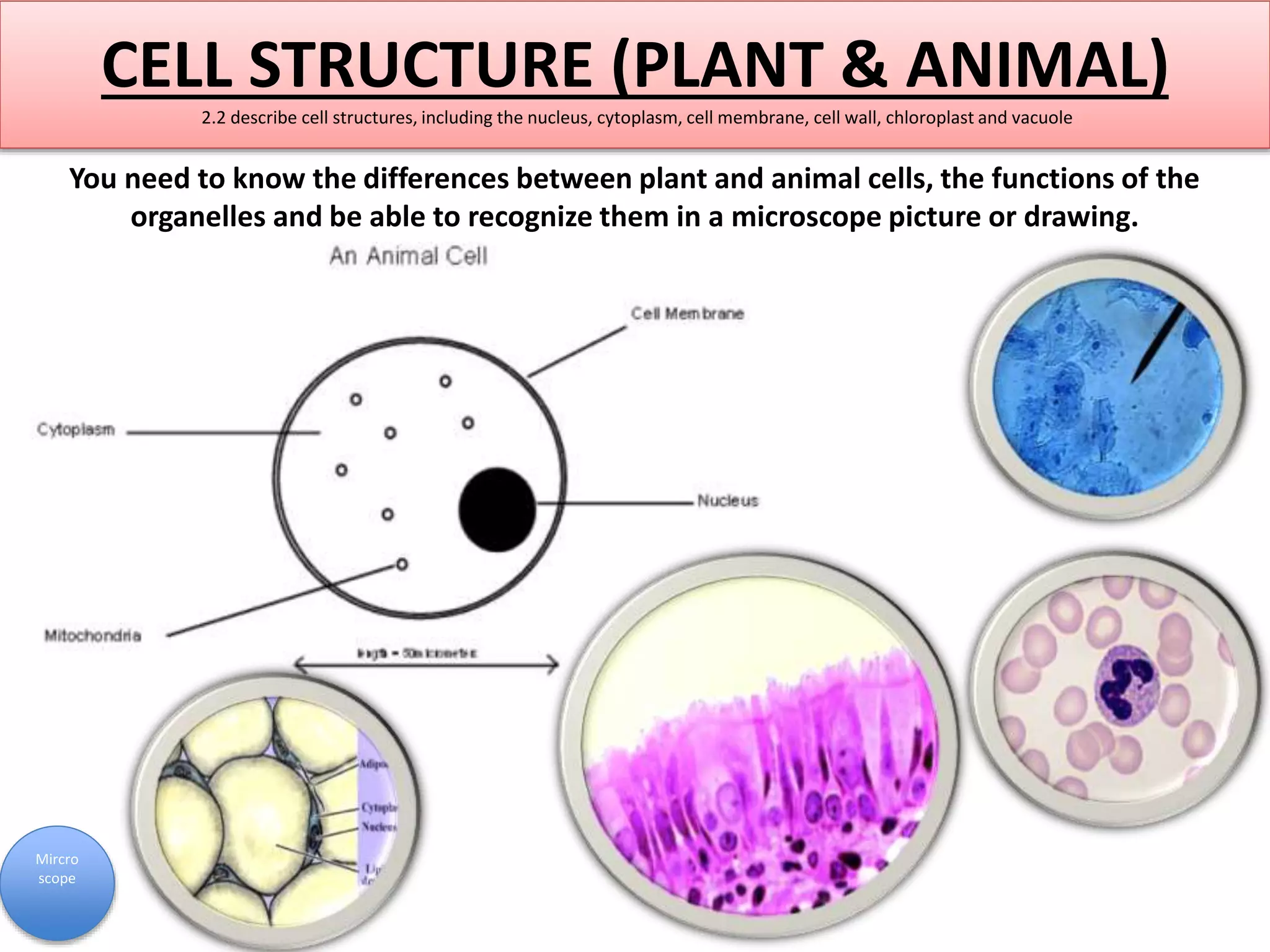
CELL STRUCTURE (PLANT & ANIMAL) 
2.2 describe cell structures, including the nucleus, cytoplasm, cell membrane, cell wall, chloroplast and vacuole 
You need to know the differences between plant and animal cells, the functions of the 
organelles and be able to recognize them in a microscope picture or drawing. 
Mircro 
scope
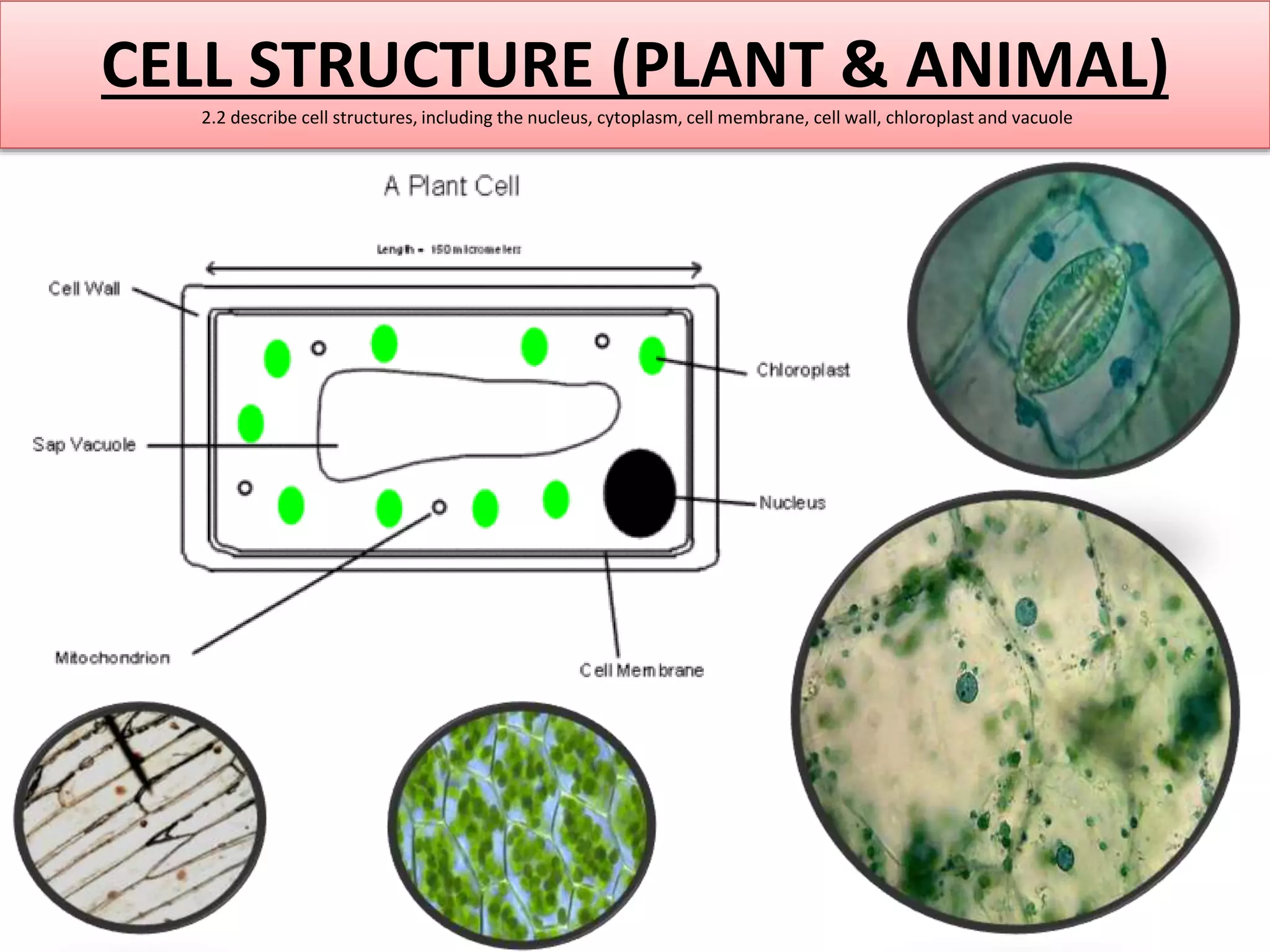
CELL STRUCTURE (PLANT & ANIMAL) 
2.2 describe cell structures, including the nucleus, cytoplasm, cell membrane, cell wall, chloroplast and vacuole
CELL STRUCTURE (PLANT & ANIMAL) 
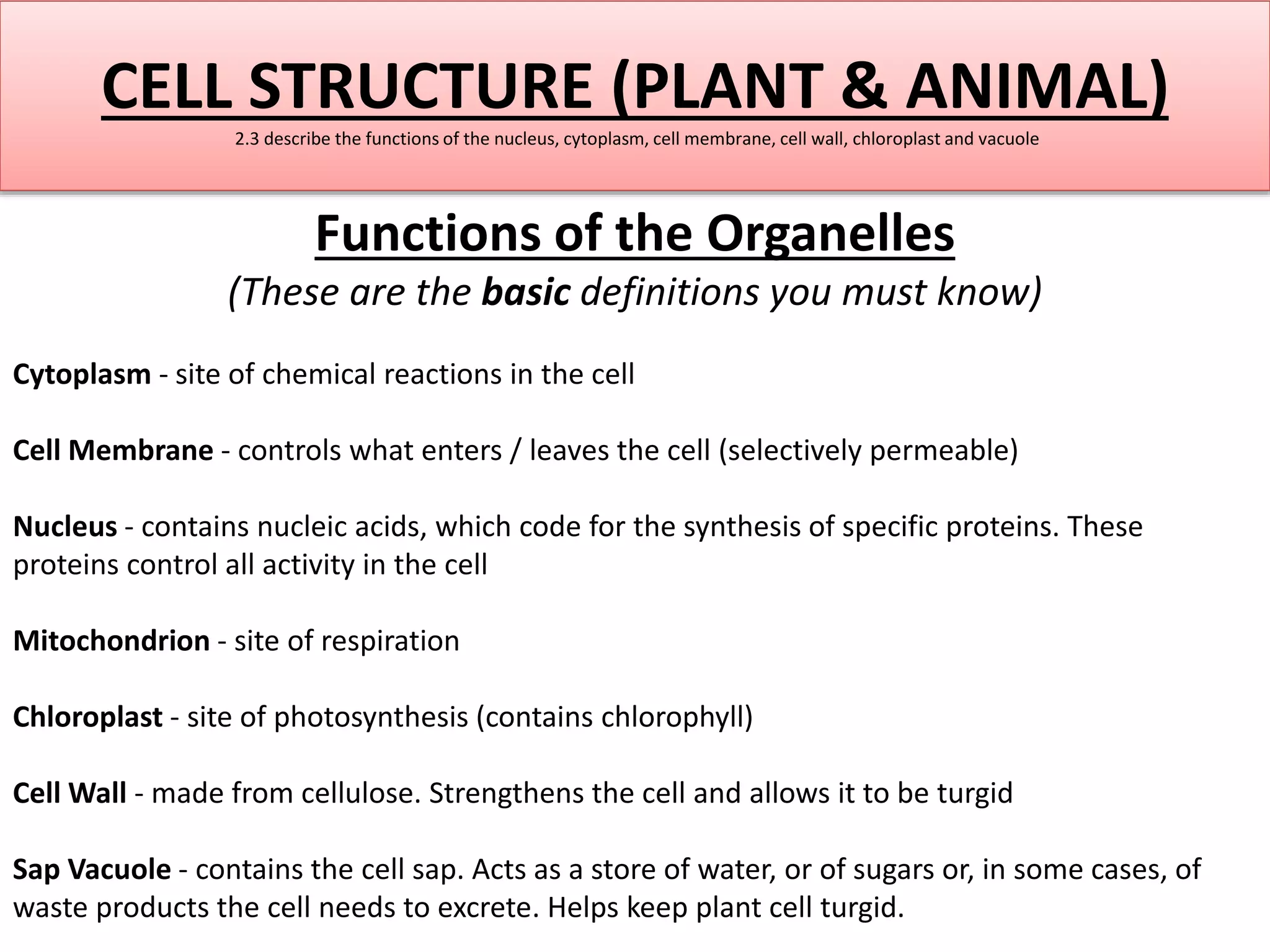
2.3 describe the functions of the nucleus, cytoplasm, cell membrane, cell wall, chloroplast and vacuole 
Functions of the Organelles 
(These are the basic definitions you must know) 
Cytoplasm - site of chemical reactions in the cell 
Cell Membrane - controls what enters / leaves the cell (selectively permeable) 
Nucleus - contains nucleic acids, which code for the synthesis of specific proteins. These 
proteins control all activity in the cell 
Mitochondrion - site of respiration 
Chloroplast - site of photosynthesis (contains chlorophyll) 
Cell Wall - made from cellulose. Strengthens the cell and allows it to be turgid 
Sap Vacuole - contains the cell sap. Acts as a store of water, or of sugars or, in some cases, of 
waste products the cell needs to excrete. Helps keep plant cell turgid.
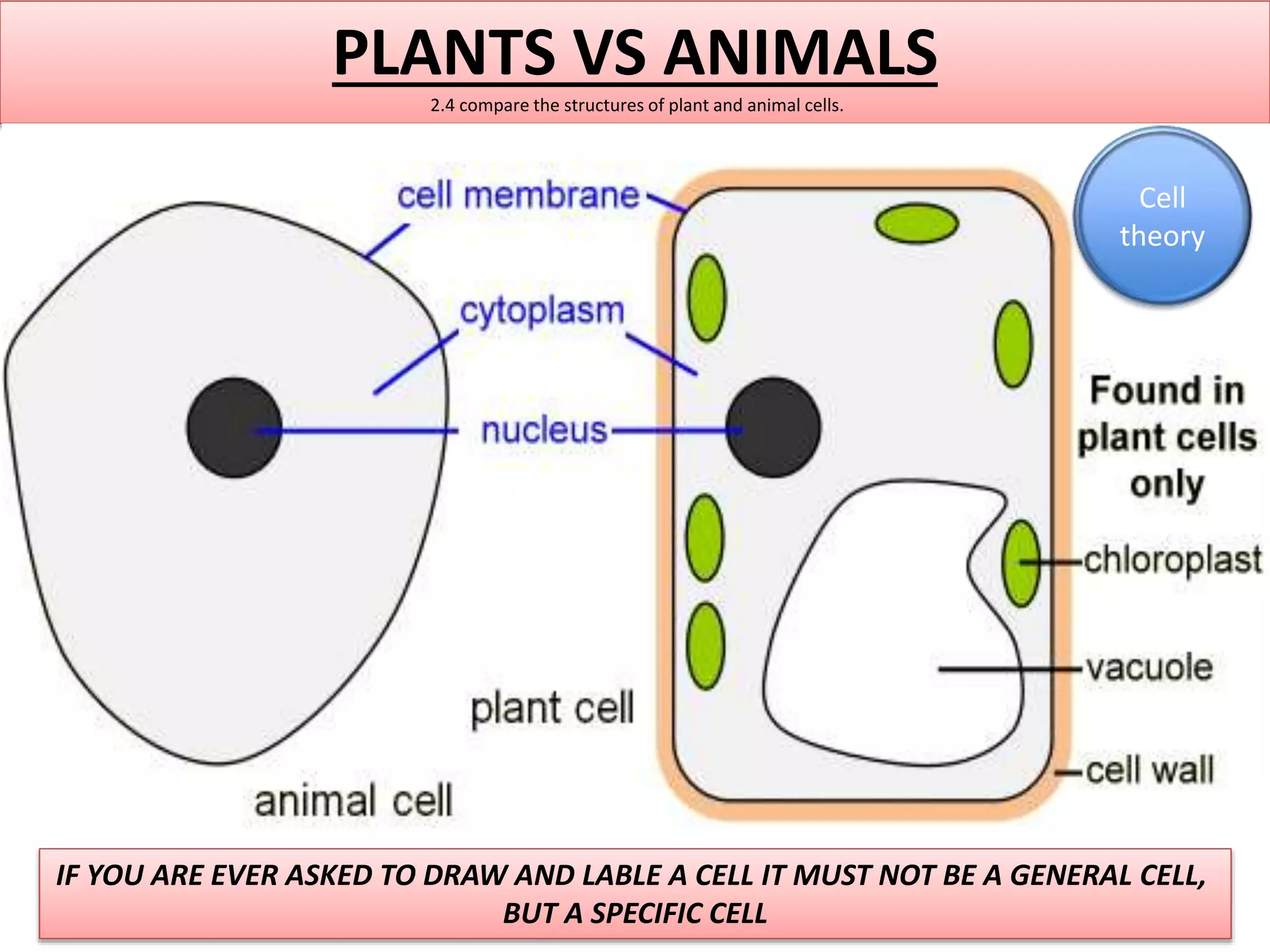
PLANTS VS ANIMALS 
2.4 compare the structures of plant and animal cells. 
IF YOU ARE EVER ASKED TO DRAW AND LABLE A CELL IT MUST NOT BE A GENERAL CELL, 
BUT A SPECIFIC CELL 
Cell 
theory
CELL STRUCTURE (PLANT & ANIMAL) 
2.2 describe cell structures, including the nucleus, cytoplasm, cell membrane, cell wall, chloroplast and vacuole 
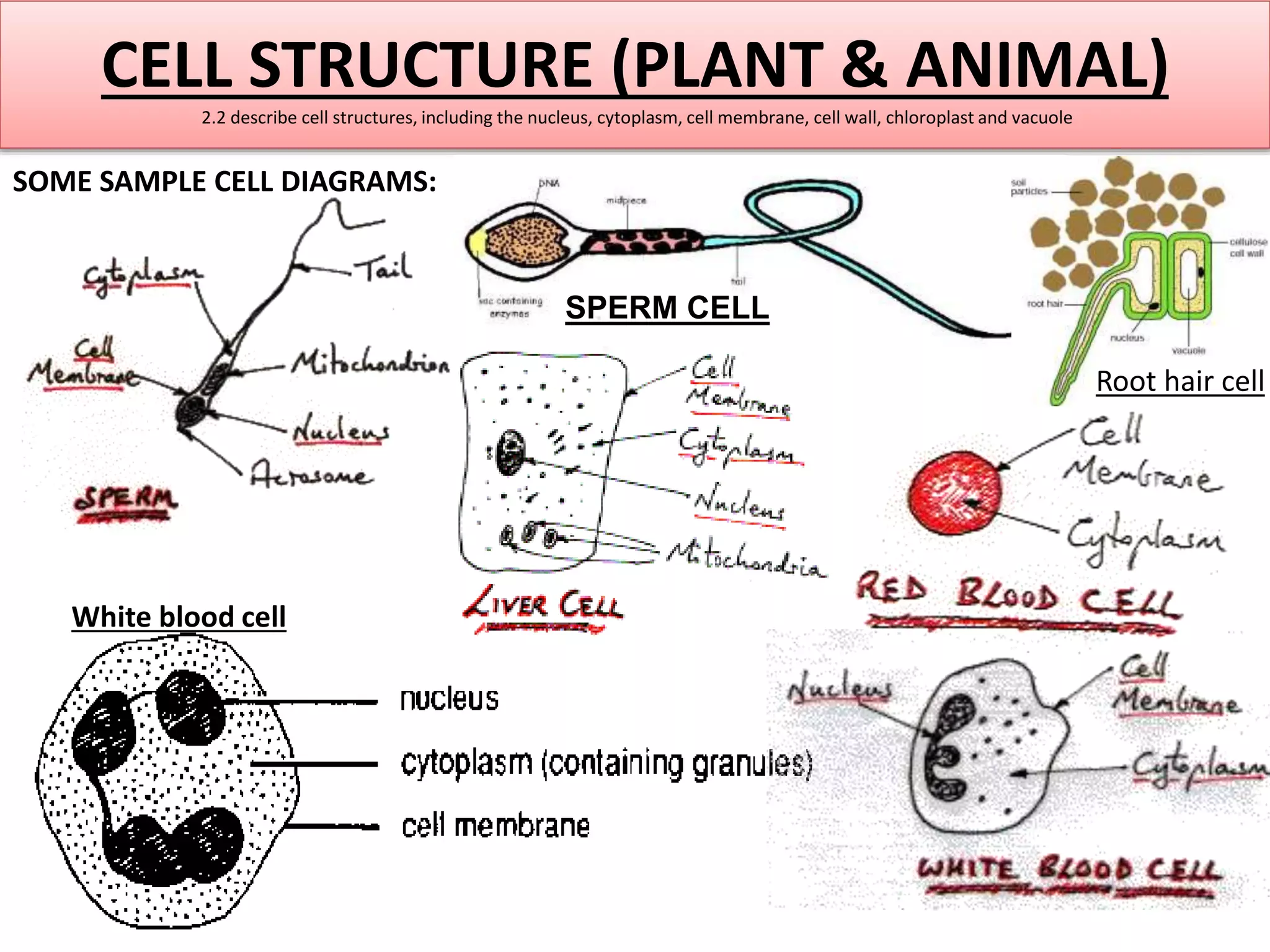
SOME SAMPLE CELL DIAGRAMS: 
White blood cell 
SPERM CELL 
Root hair cell
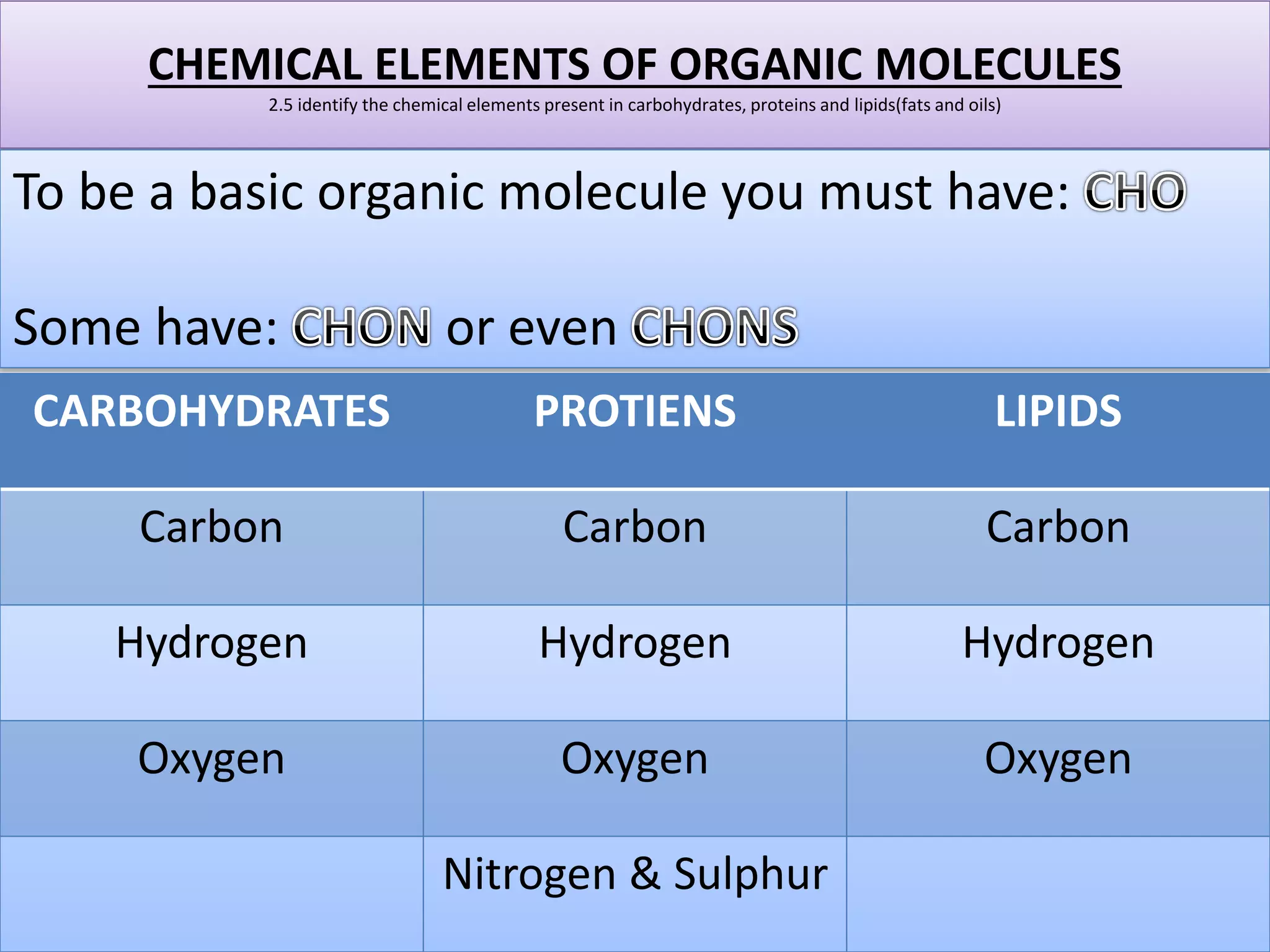
CHEMICAL ELEMENTS OF ORGANIC MOLECULES 
2.5 identify the chemical elements present in carbohydrates, proteins and lipids(fats and oils) 
To be a basic organic molecule you must have: 
Some have: or even 
CARBOHYDRATES PROTIENS LIPIDS 
Carbon Carbon Carbon 
Hydrogen Hydrogen Hydrogen 
Oxygen Oxygen Oxygen 
Nitrogen & Sulphur
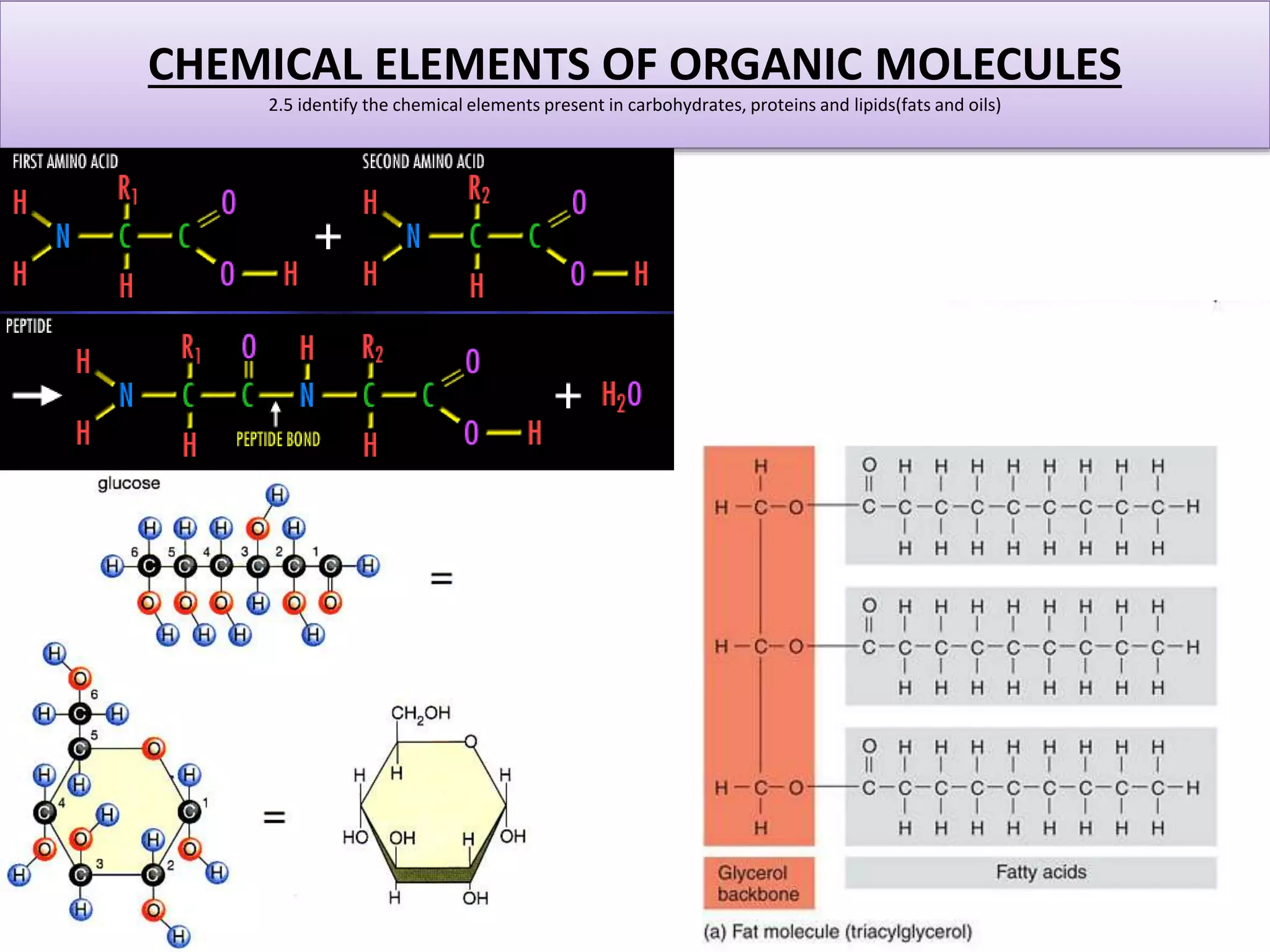
CHEMICAL ELEMENTS OF ORGANIC MOLECULES 
2.5 identify the chemical elements present in carbohydrates, proteins and lipids(fats and oils)
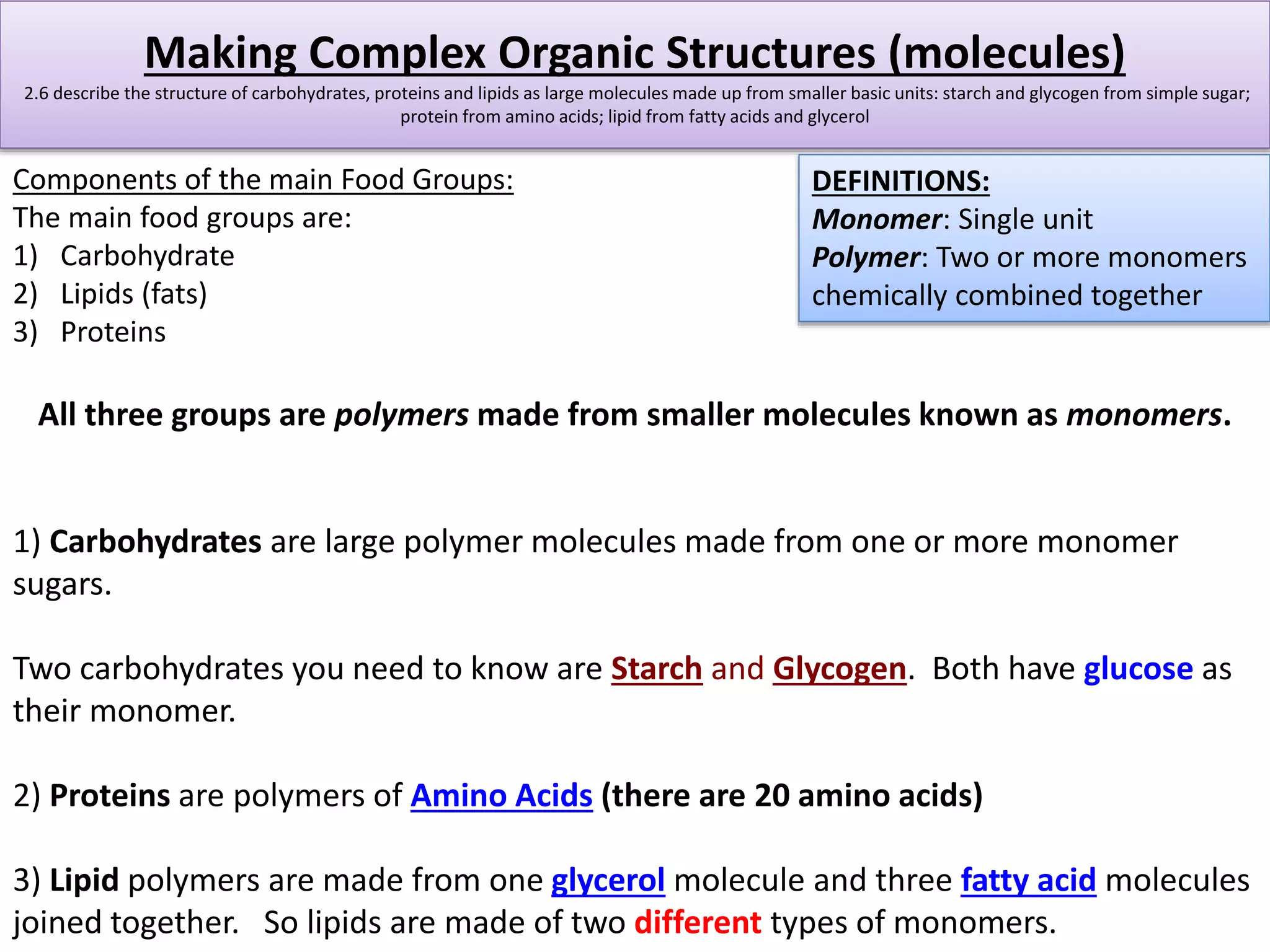
Making Complex Organic Structures (molecules) 
2.6 describe the structure of carbohydrates, proteins and lipids as large molecules made up from smaller basic units: starch and glycogen from simple sugar; 
protein from amino acids; lipid from fatty acids and glycerol 
Components of the main Food Groups: 
The main food groups are: 
1) Carbohydrate 
2) Lipids (fats) 
3) Proteins 
DEFINITIONS: 
Monomer: Single unit 
Polymer: Two or more monomers 
chemically combined together 
All three groups are polymers made from smaller molecules known as monomers. 
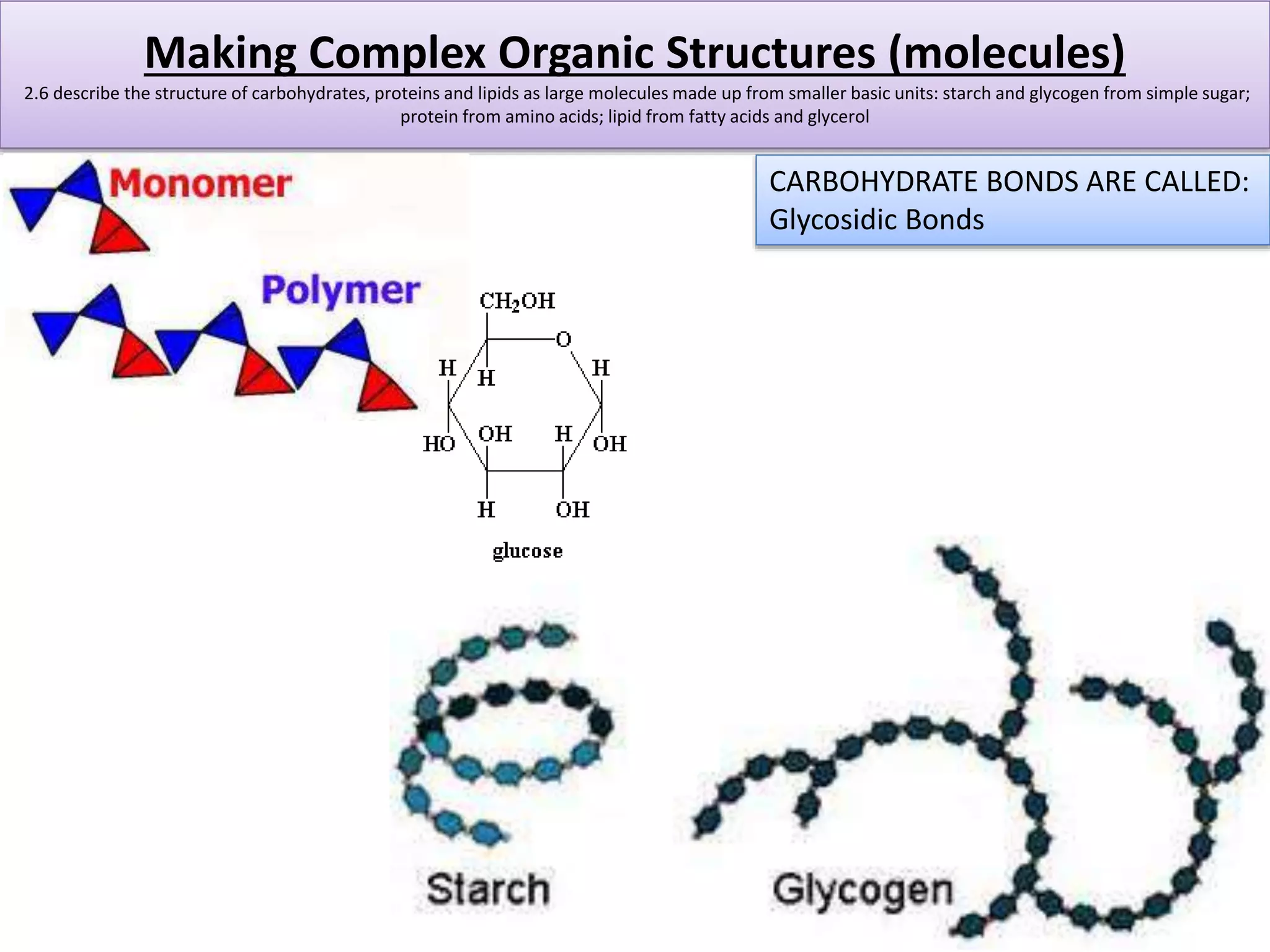
1) Carbohydrates are large polymer molecules made from one or more monomer 
sugars. 
Two carbohydrates you need to know are Starch and Glycogen. Both have glucose as 
their monomer. 
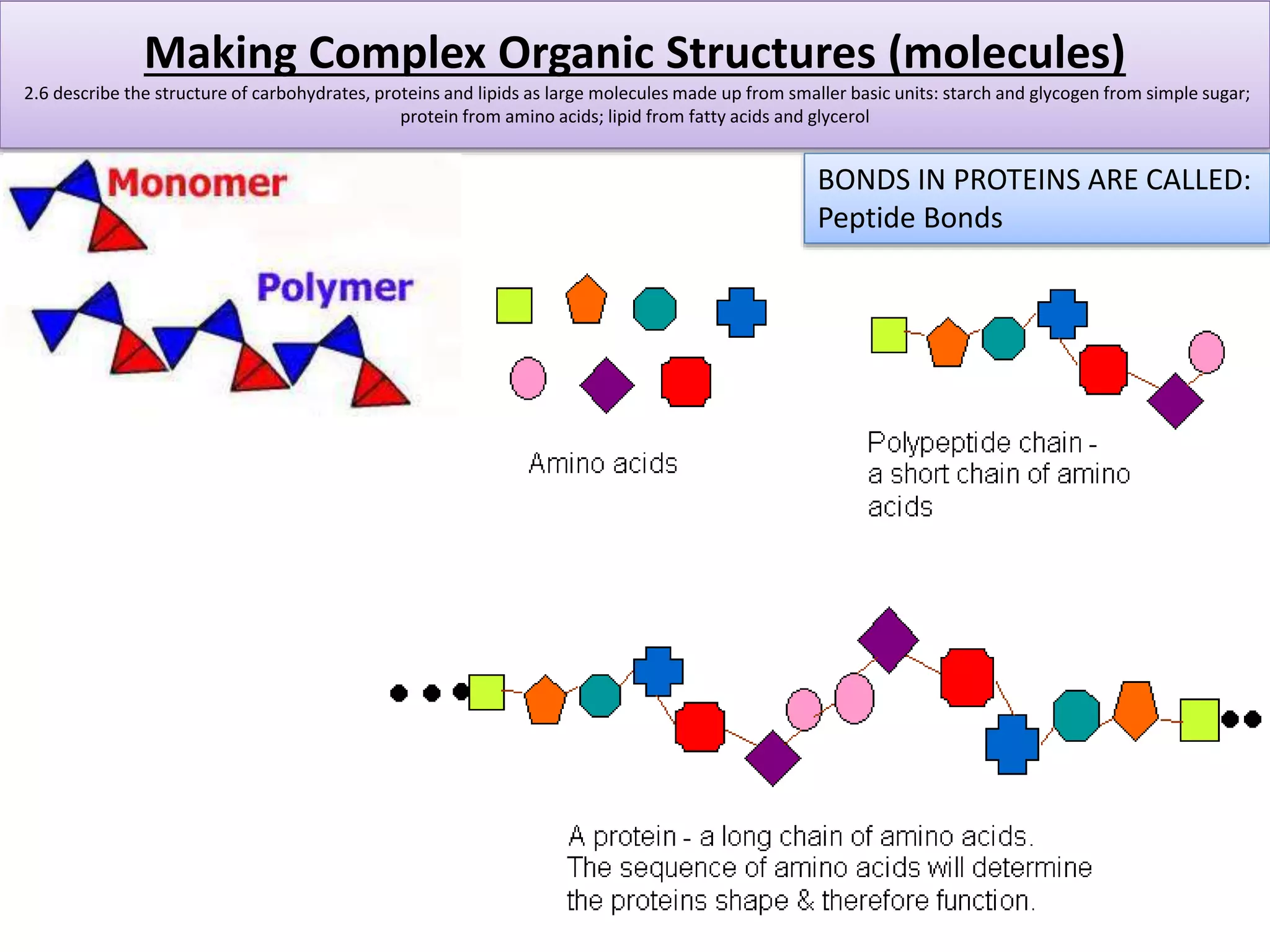
2) Proteins are polymers of Amino Acids (there are 20 amino acids) 
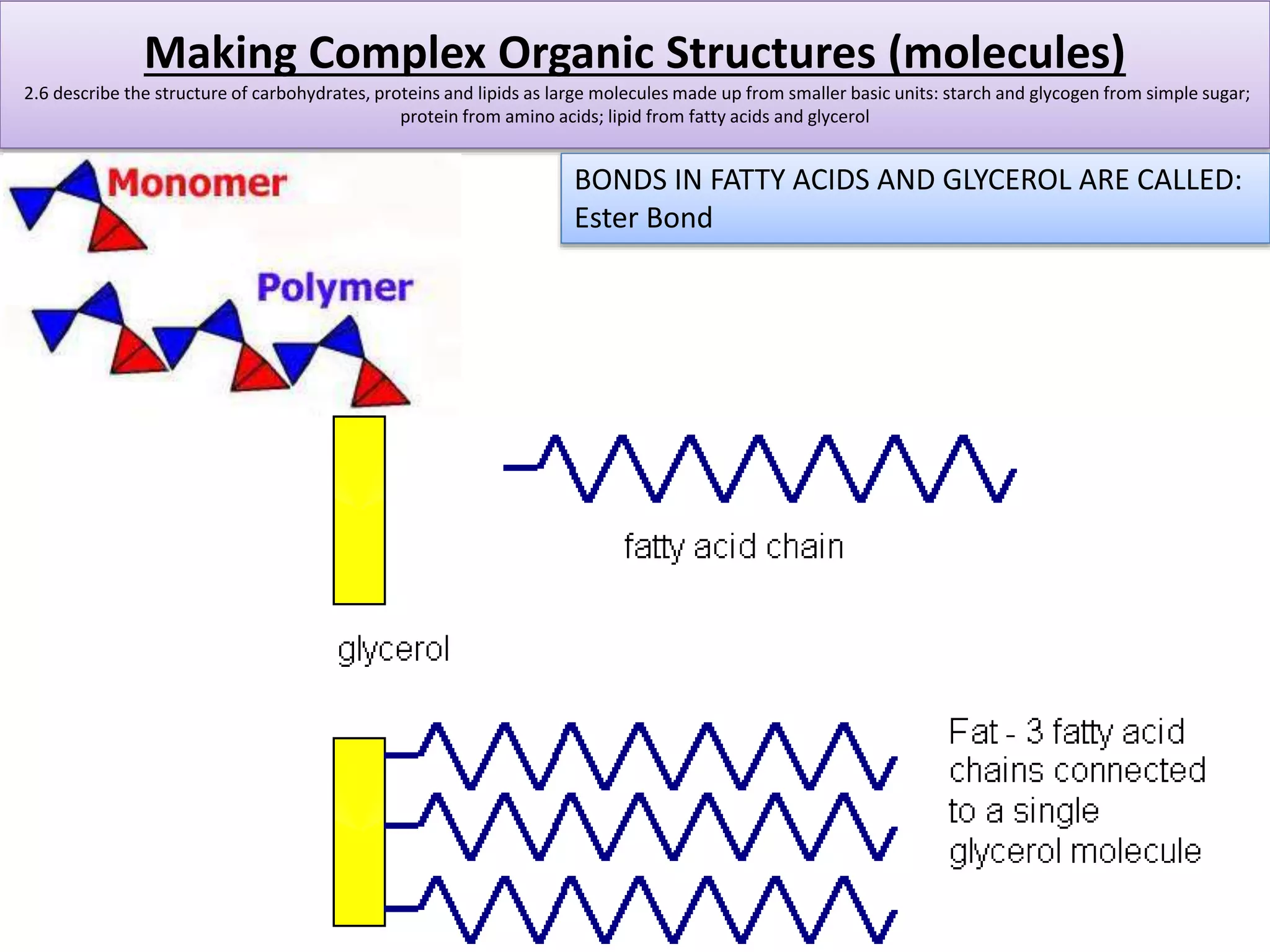
3) Lipid polymers are made from one glycerol molecule and three fatty acid molecules 
joined together. So lipids are made of two different types of monomers.
Making Complex Organic Structures (molecules) 
2.6 describe the structure of carbohydrates, proteins and lipids as large molecules made up from smaller basic units: starch and glycogen from simple sugar; 
protein from amino acids; lipid from fatty acids and glycerol 
CARBOHYDRATE BONDS ARE CALLED: 
Glycosidic Bonds
Making Complex Organic Structures (molecules) 
2.6 describe the structure of carbohydrates, proteins and lipids as large molecules made up from smaller basic units: starch and glycogen from simple sugar; 
protein from amino acids; lipid from fatty acids and glycerol 
BONDS IN PROTEINS ARE CALLED: 
Peptide Bonds
Making Complex Organic Structures (molecules) 
2.6 describe the structure of carbohydrates, proteins and lipids as large molecules made up from smaller basic units: starch and glycogen from simple sugar; 
protein from amino acids; lipid from fatty acids and glycerol 
BONDS IN FATTY ACIDS AND GLYCEROL ARE CALLED: 
Ester Bond
REVIEW: Glucose is a Monomer of several 
Polymers 
2.6 describe the structure of carbohydrates, proteins and lipids as largemolecules made up from smaller basic units: starch and glycogen from simple sugar; protein from 
amino acids; lipid from fatty acids and glycerol 
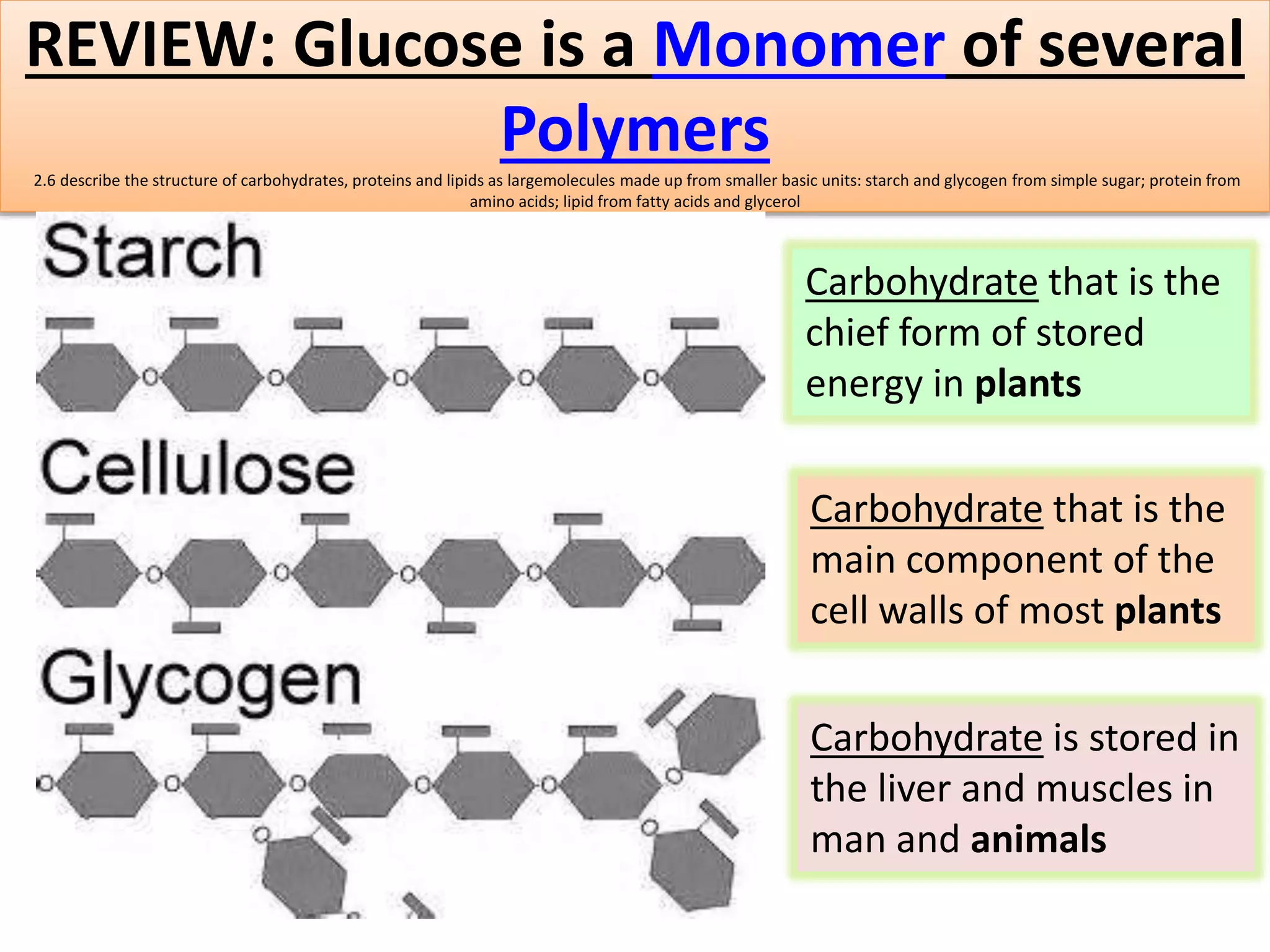
Carbohydrate that is the 
chief form of stored 
energy in plants 
Carbohydrate that is the 
main component of the 
cell walls of most plants 
Carbohydrate is stored in 
the liver and muscles in 
man and animals
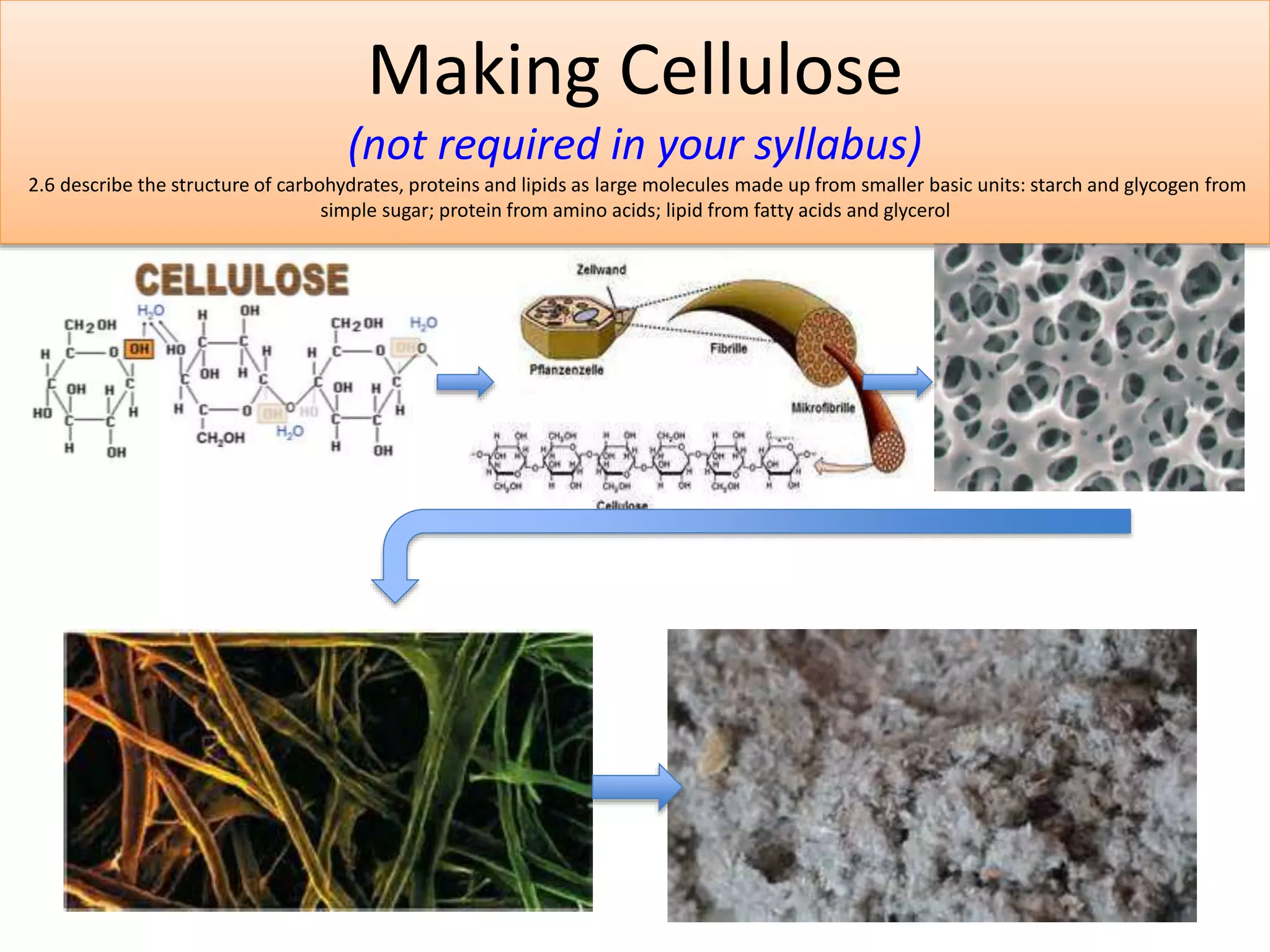
Making Cellulose 
(not required in your syllabus) 
2.6 describe the structure of carbohydrates, proteins and lipids as large molecules made up from smaller basic units: starch and glycogen from 
simple sugar; protein from amino acids; lipid from fatty acids and glycerol
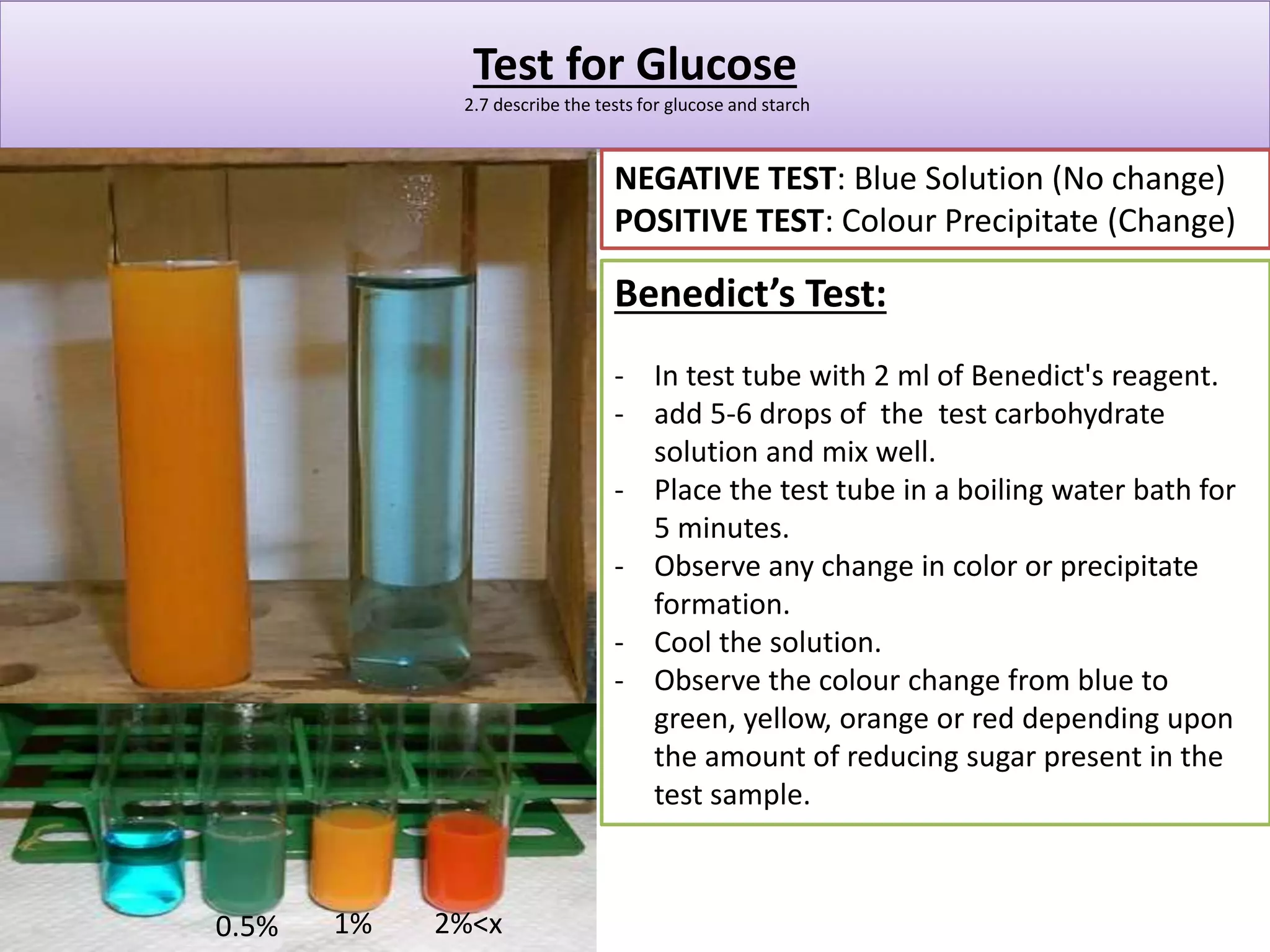
Test for Glucose 
2.7 describe the tests for glucose and starch 
NEGATIVE TEST: Blue Solution (No change) 
POSITIVE TEST: Colour Precipitate (Change) 
Benedict’s Test: 
- In test tube with 2 ml of Benedict's reagent. 
- add 5-6 drops of the test carbohydrate 
solution and mix well. 
- Place the test tube in a boiling water bath for 
5 minutes. 
- Observe any change in color or precipitate 
formation. 
- Cool the solution. 
- Observe the colour change from blue to 
green, yellow, orange or red depending upon 
the amount of reducing sugar present in the 
test sample. 
0.5% 1% 2%<x
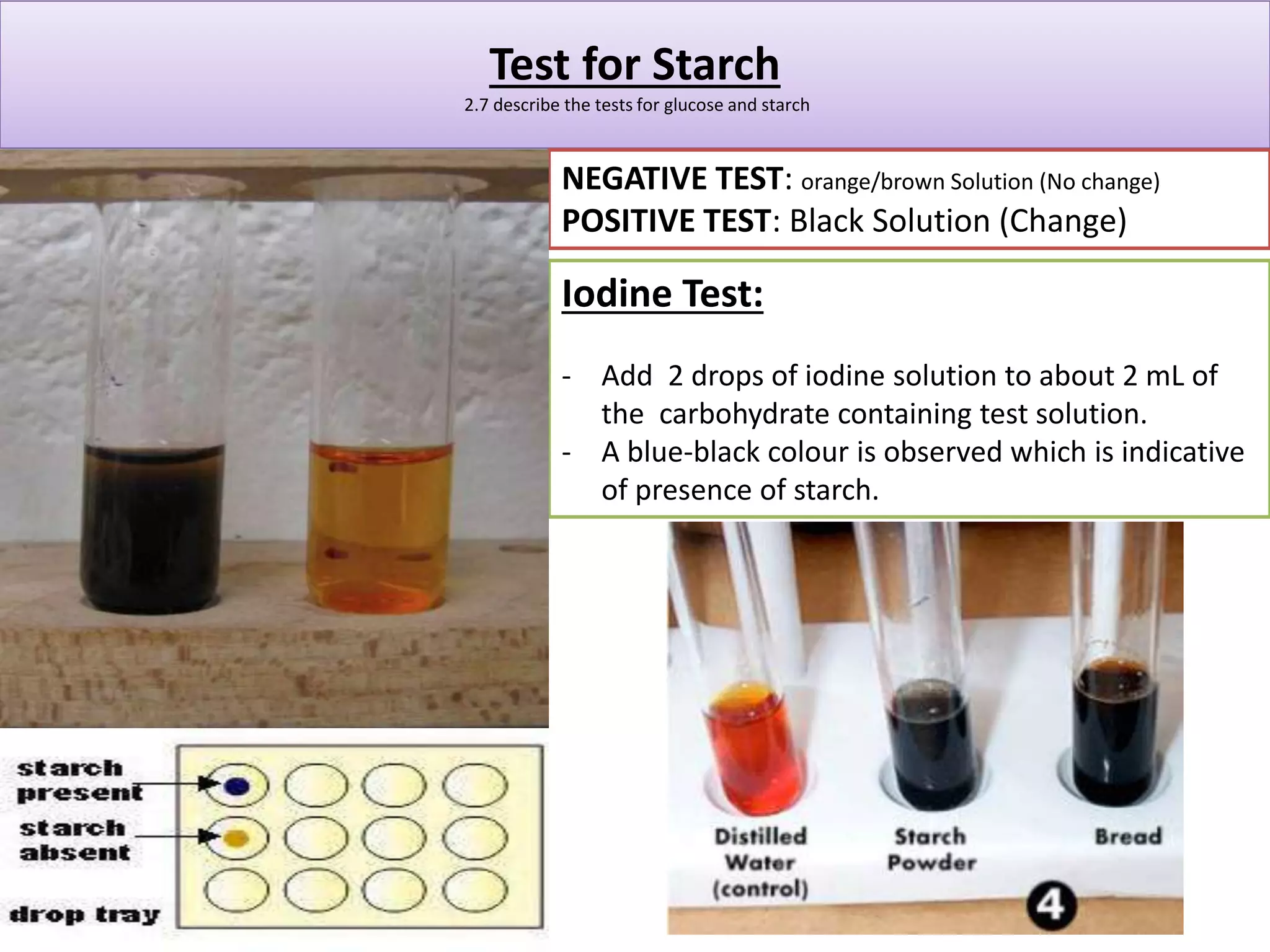
Test for Starch 
2.7 describe the tests for glucose and starch 
NEGATIVE TEST: orange/brown Solution (No change) 
POSITIVE TEST: Black Solution (Change) 
Iodine Test: 
- Add 2 drops of iodine solution to about 2 mL of 
the carbohydrate containing test solution. 
- A blue-black colour is observed which is indicative 
of presence of starch.
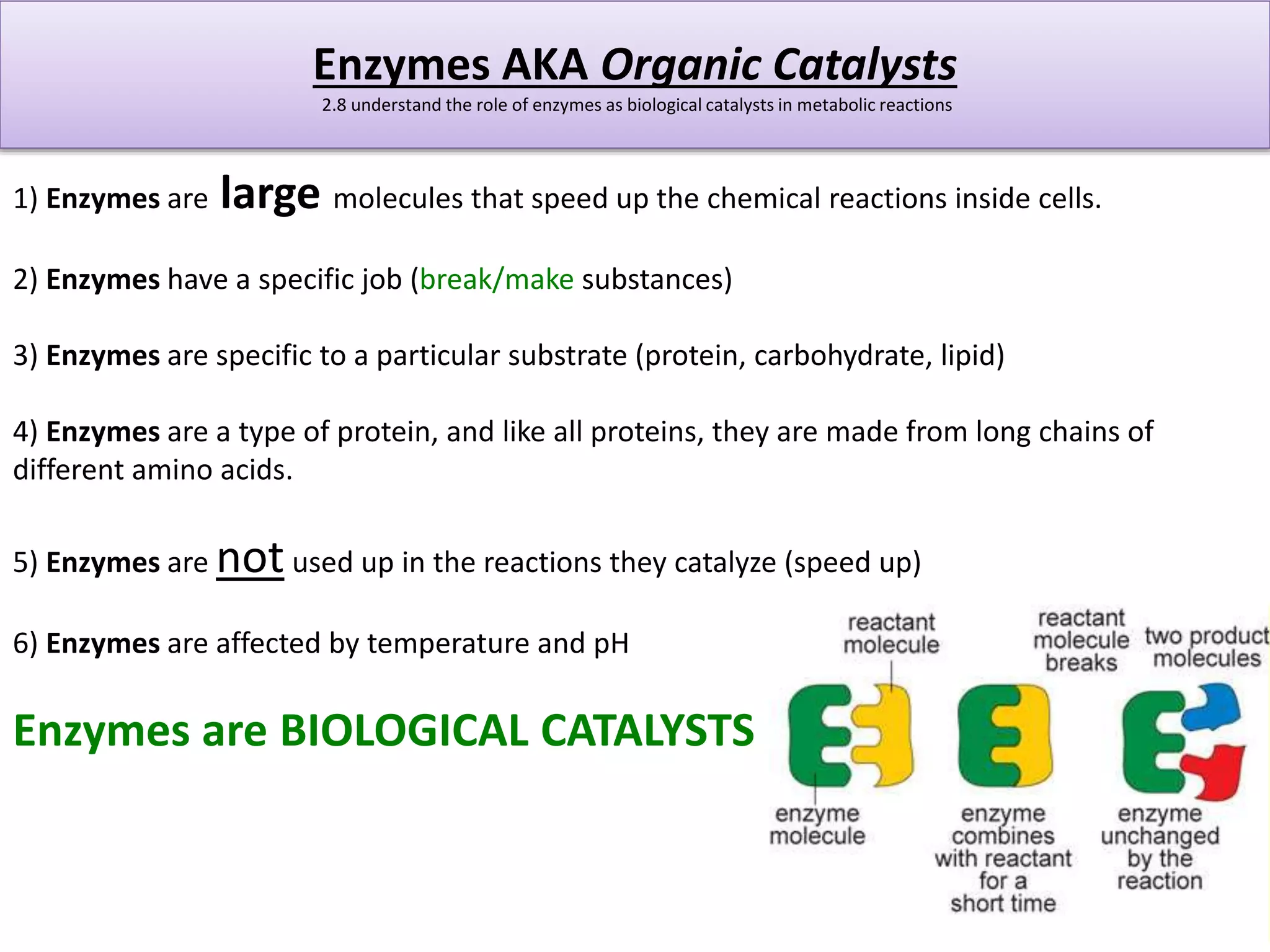
Enzymes AKA Organic Catalysts 
2.8 understand the role of enzymes as biological catalysts in metabolic reactions 
1) Enzymes are large molecules that speed up the chemical reactions inside cells. 
2) Enzymes have a specific job (break/make substances) 
3) Enzymes are specific to a particular substrate (protein, carbohydrate, lipid) 
4) Enzymes are a type of protein, and like all proteins, they are made from long chains of 
different amino acids. 
5) Enzymes are not used up in the reactions they catalyze (speed up) 
6) Enzymes are affected by temperature and pH 
Enzymes are BIOLOGICAL CATALYSTS
So What is an difference between an Inorganic Catalyst and 
an Enzyme 
2.8 understand the role of enzymes as biological catalysts in metabolic reactions 
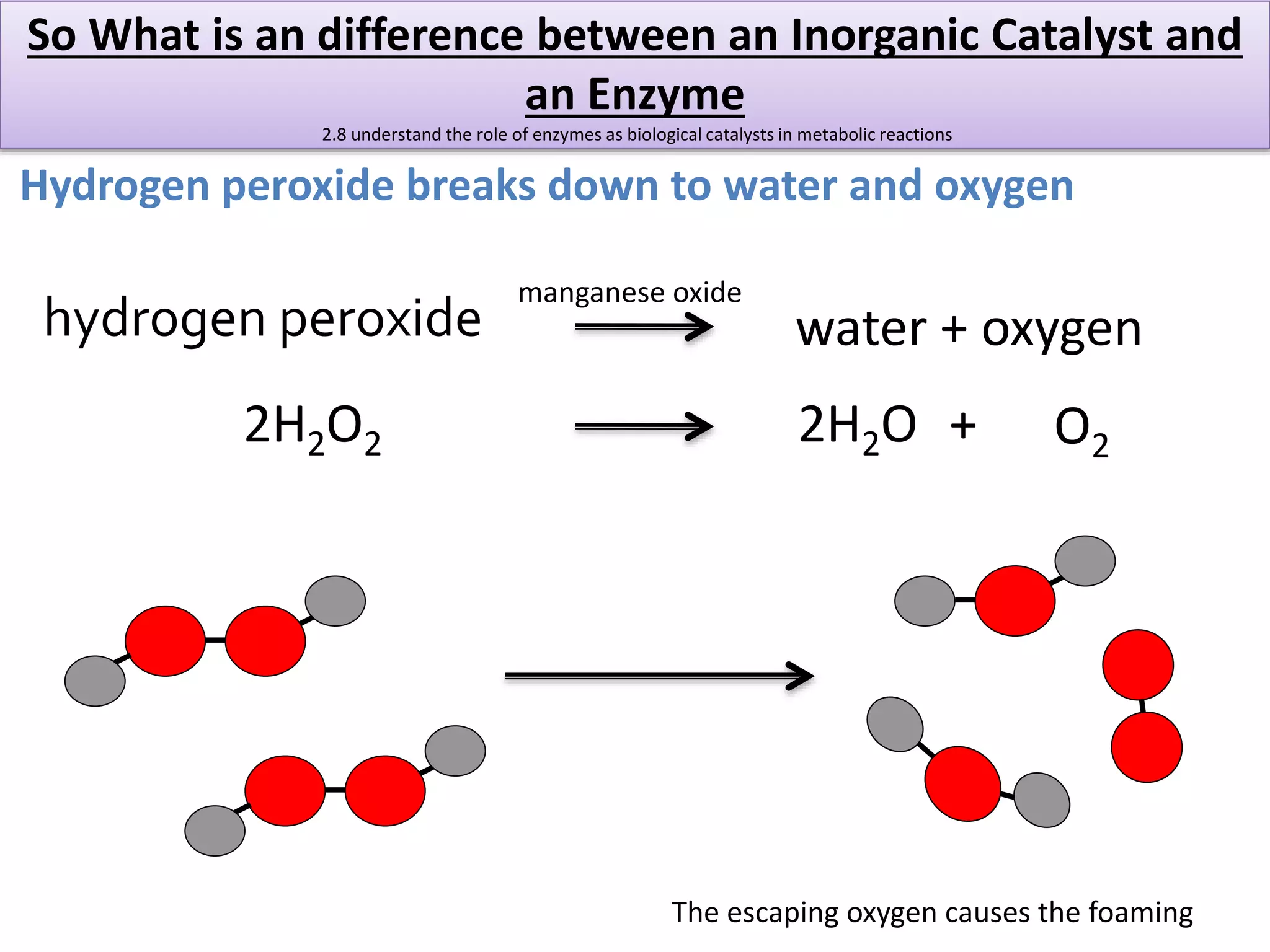
Hydrogen peroxide breaks down to water and oxygen 
hydrogen peroxide 
water + oxygen 
manganese oxide 
2H2O2 2H2O O2 + 
The escaping oxygen causes the foaming
So What is an difference between an Inorganic Catalyst and 
an Enzyme 
2.8 understand the role of enzymes as biological catalysts in metabolic reactions 
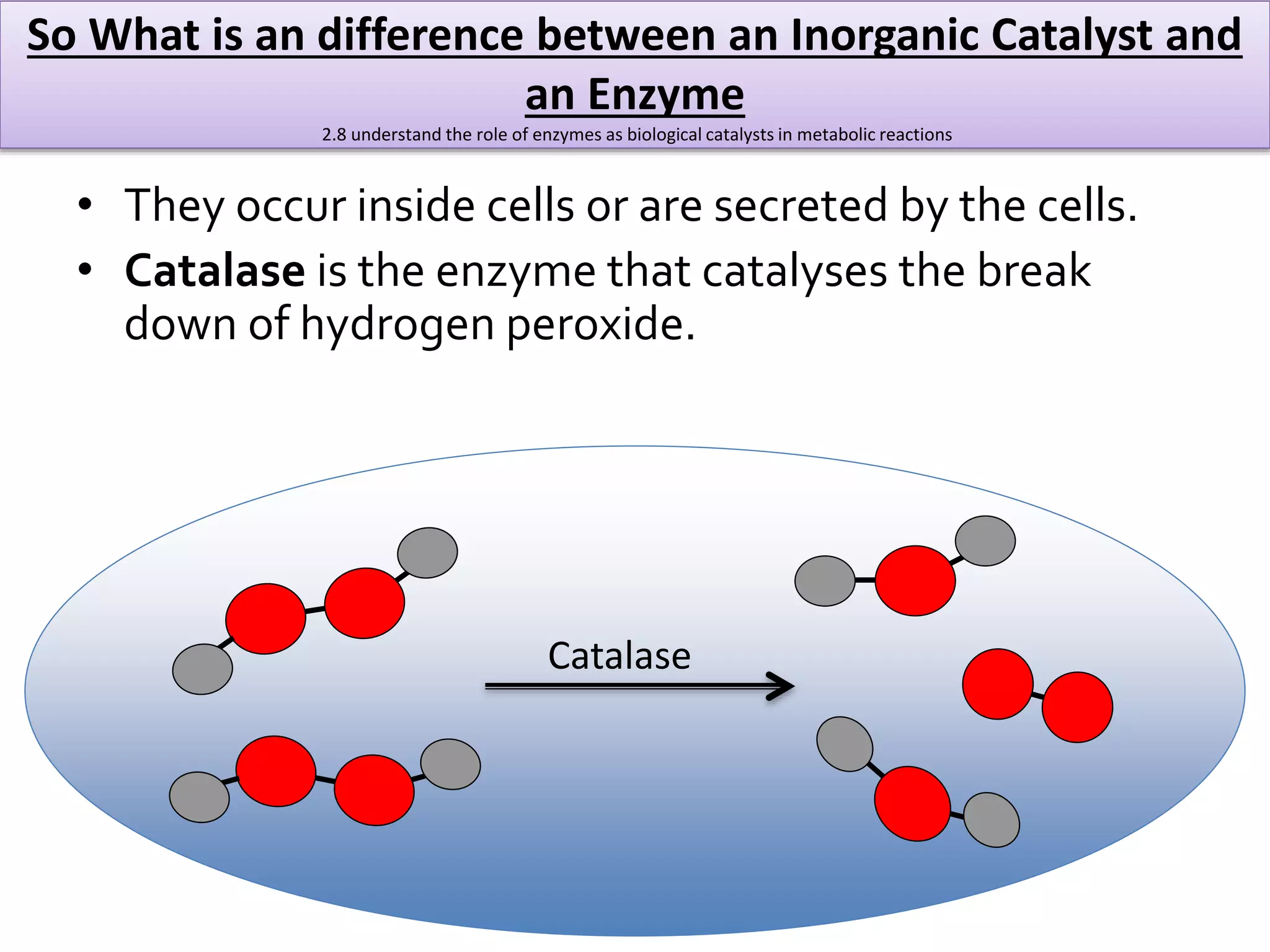
• They occur inside cells or are secreted by the cells. 
• Catalase is the enzyme that catalyses the break 
down of hydrogen peroxide. 
Catalase
Naming Enzymes 
2.8 understand the role of enzymes as biological catalysts in metabolic reactions 
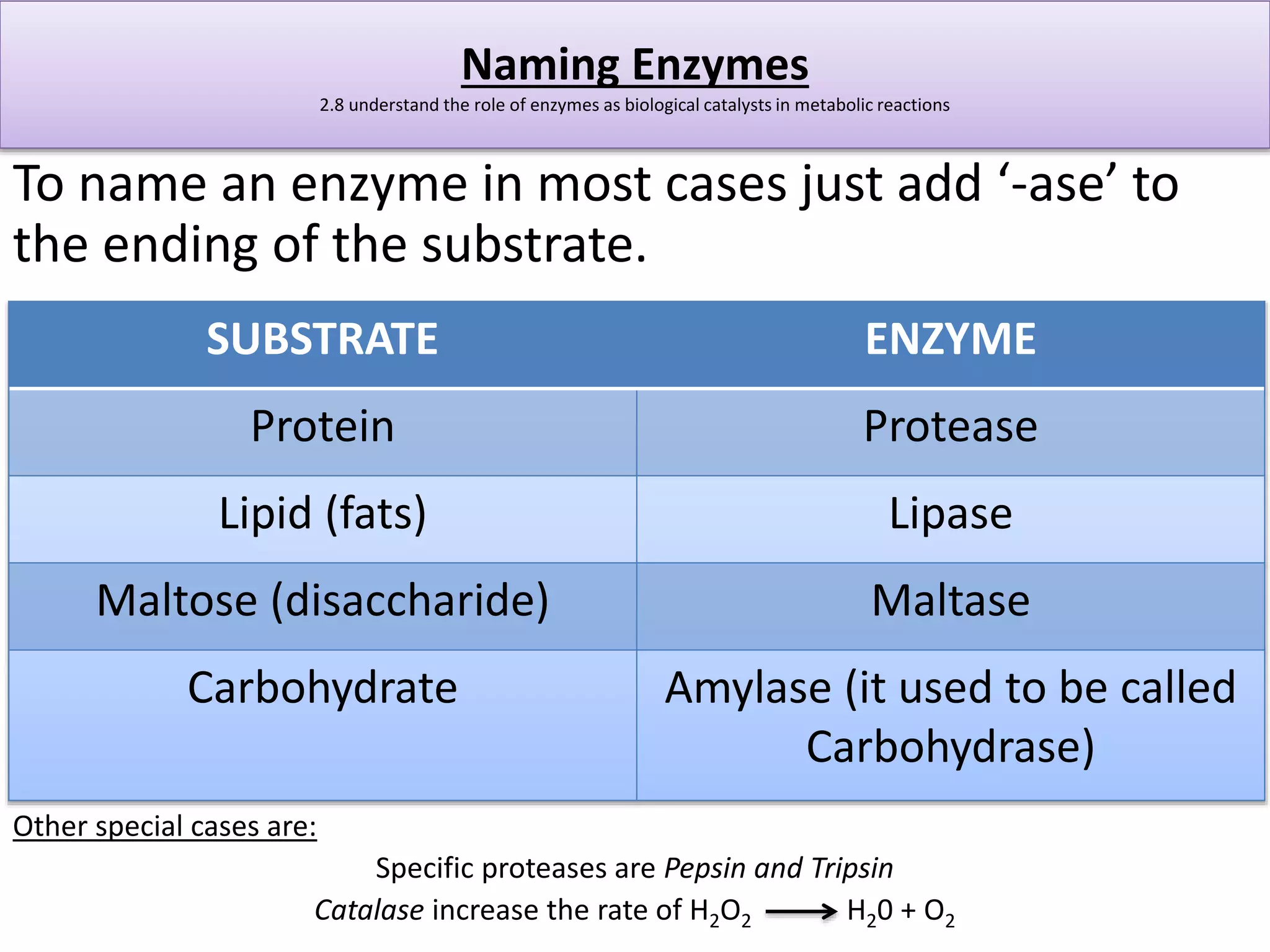
To name an enzyme in most cases just add ‘-ase’ to 
the ending of the substrate. 
SUBSTRATE ENZYME 
Protein Protease 
Lipid (fats) Lipase 
Maltose (disaccharide) Maltase 
Carbohydrate Amylase (it used to be called 
Other special cases are: 
Carbohydrase) 
Specific proteases are Pepsin and Tripsin 
Catalase increase the rate of H2O2 H20 + O2
Enzymes AKA Organic Catalysts 
2.8 understand the role of enzymes as biological catalysts in metabolic reactions 
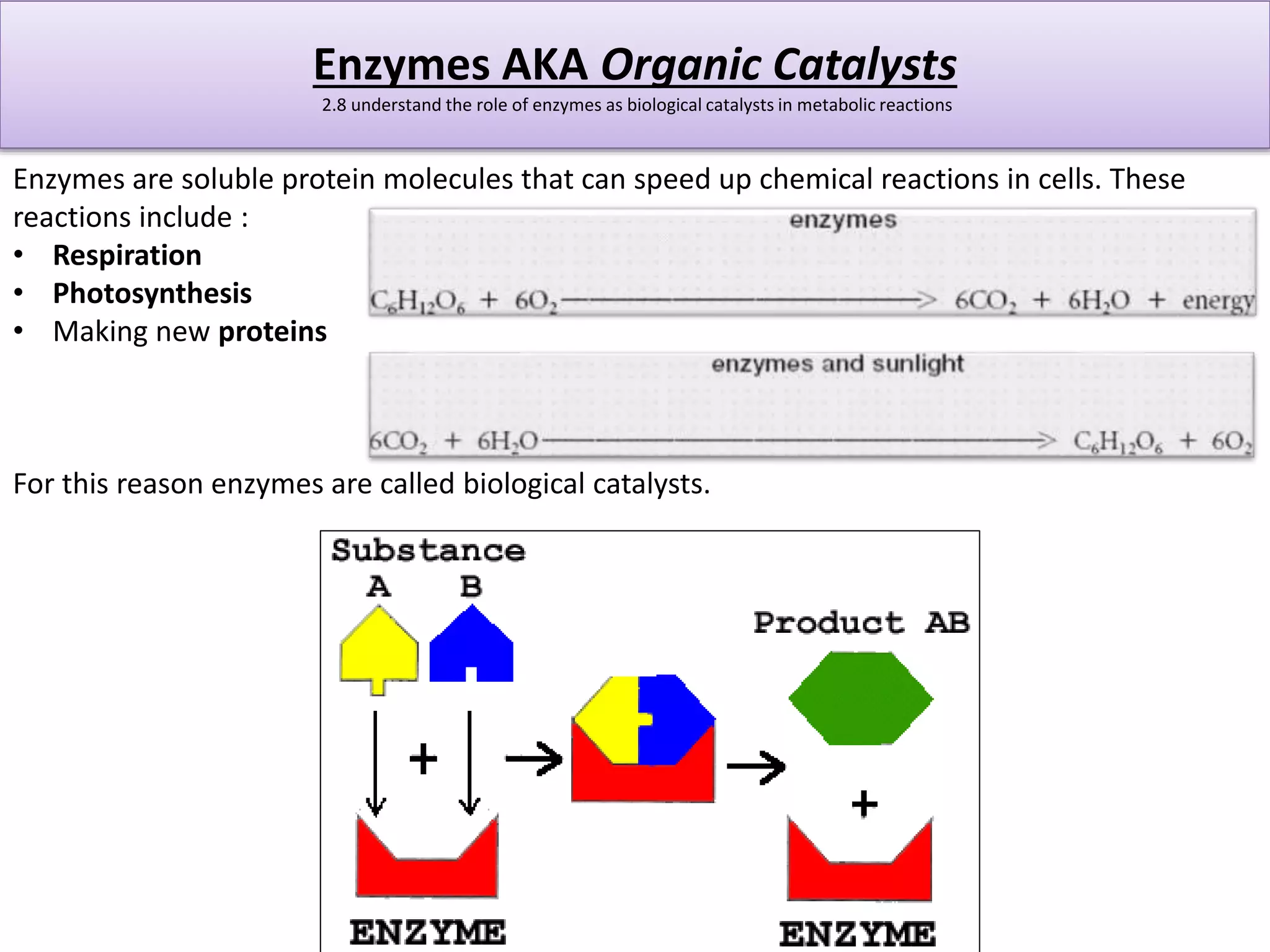
Enzymes are soluble protein molecules that can speed up chemical reactions in cells. These 
reactions include : 
• Respiration 
• Photosynthesis 
• Making new proteins 
For this reason enzymes are called biological catalysts.
Enzymes AKA Organic Catalysts 
2.8 understand the role of enzymes as biological catalysts in metabolic reactions 
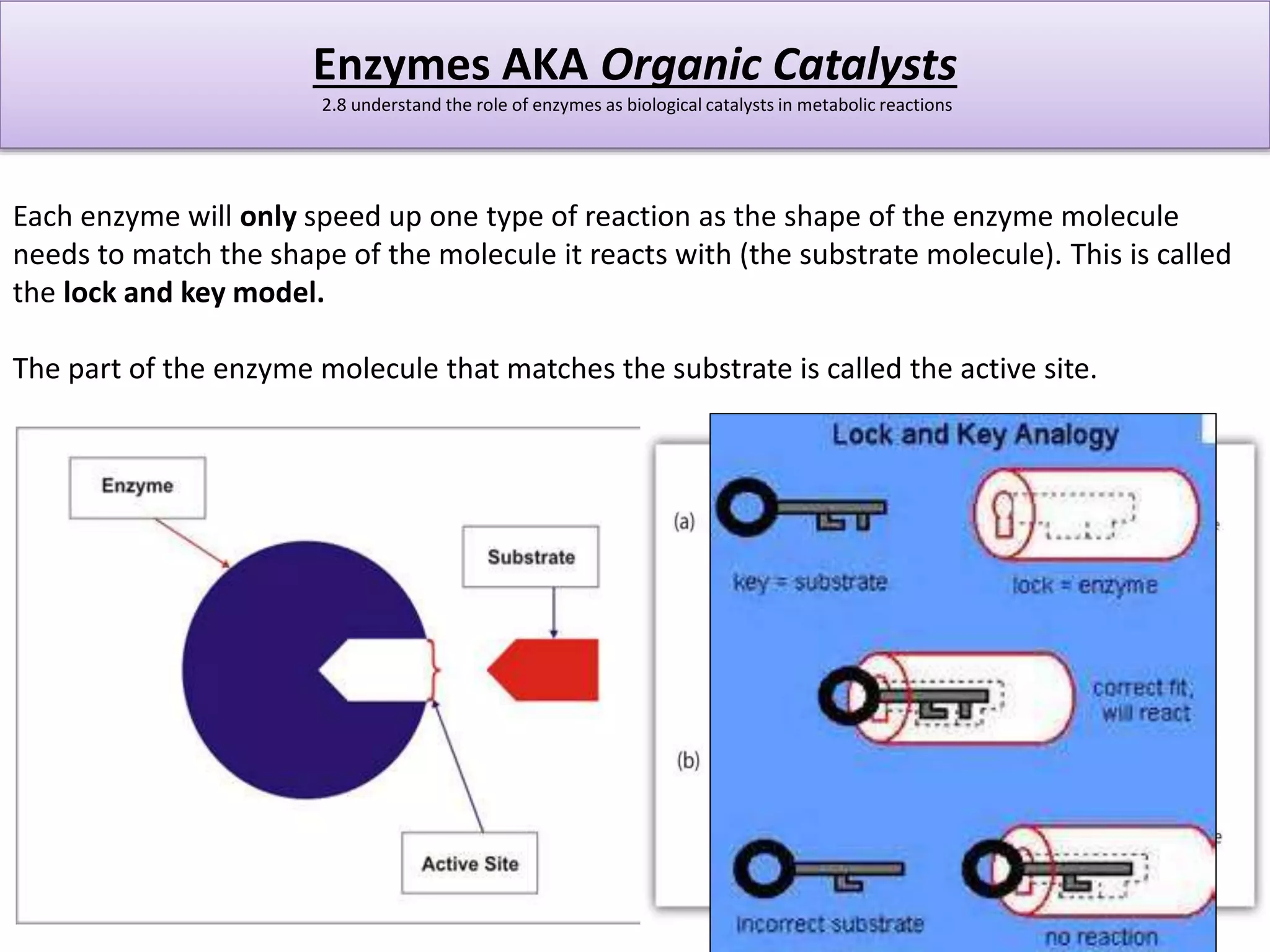
Each enzyme will only speed up one type of reaction as the shape of the enzyme molecule 
needs to match the shape of the molecule it reacts with (the substrate molecule). This is called 
the lock and key model. 
The part of the enzyme molecule that matches the substrate is called the active site.
Rates of enzyme reactions can be measured by recording the time for a 
substrate to disappear or a product to appear. 
trypsin 
Rates of Enzymes 
2.8 understand the role of enzymes as biological catalysts in metabolic reactions 
protein polypeptides 
white clear 
Controlled variables: 
•Volume and concentration of substrate (milk) 
•Volume and concentration of enzyme (trypsin) 
•pH (controlled by buffers) 
•Temperature 
WHAT KIND OF UNITS 
WILL RATES OF 
REACTION HAVE?
Temperature’s effect on Enzyme activity 
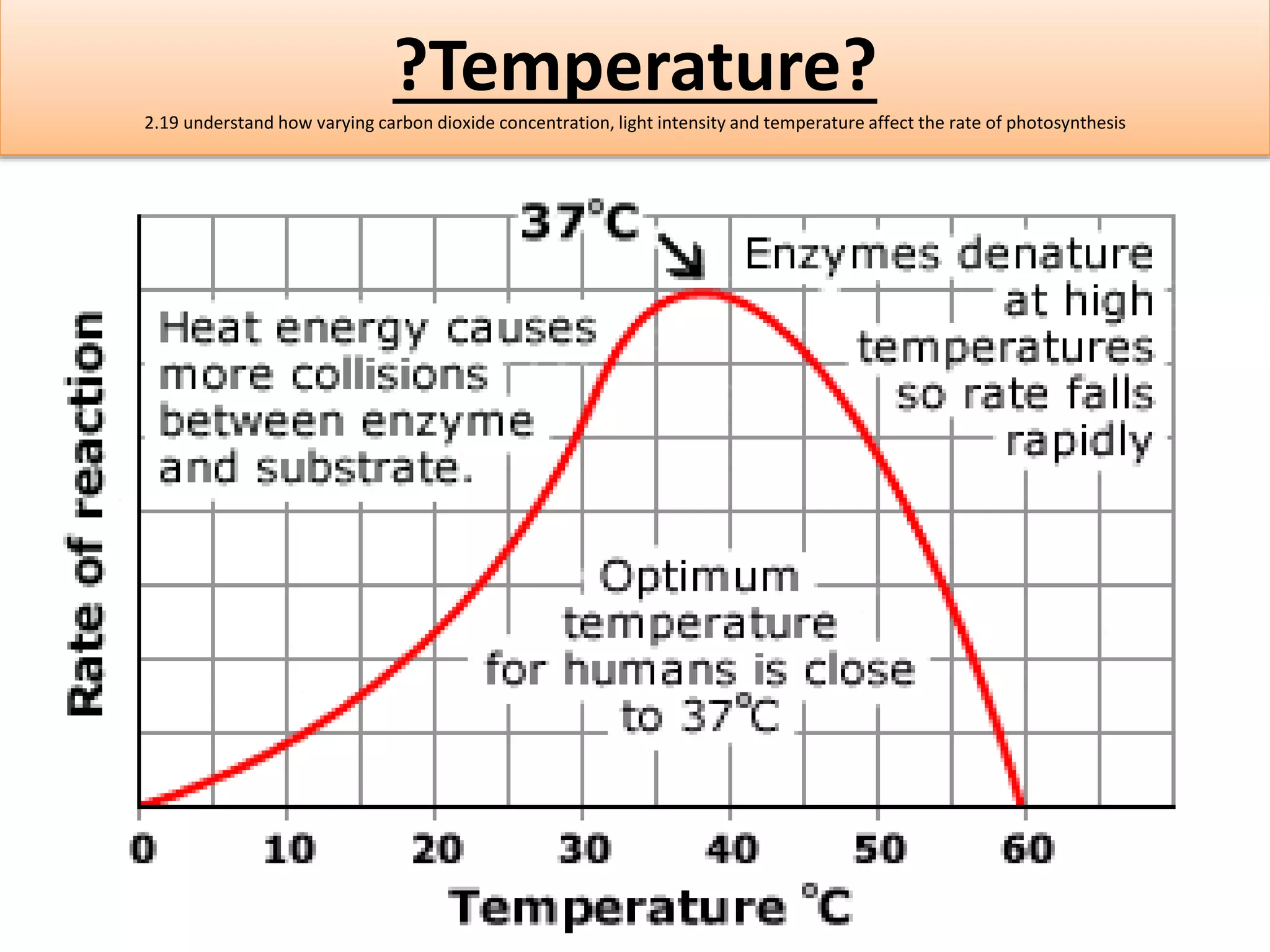
2.9 understand how the functioning of enzymes can be affected by changes in temperature, including changes due to change in active site 
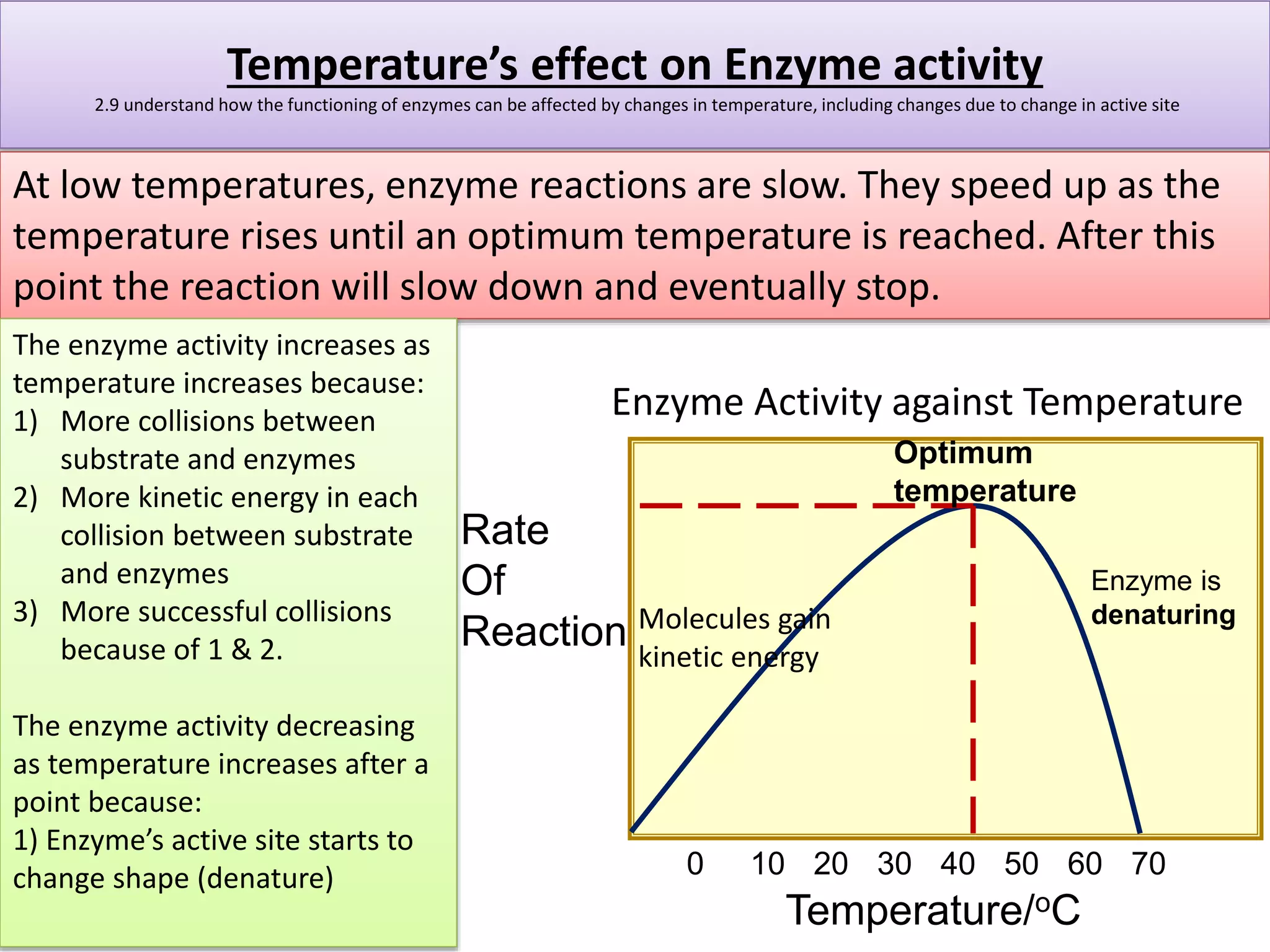
At low temperatures, enzyme reactions are slow. They speed up as the 
temperature rises until an optimum temperature is reached. After this 
point the reaction will slow down and eventually stop. 
The enzyme activity increases as 
temperature increases because: 
1) More collisions between 
substrate and enzymes 
2) More kinetic energy in each 
collision between substrate 
and enzymes 
3) More successful collisions 
because of 1 & 2. 
The enzyme activity decreasing 
as temperature increases after a 
point because: 
1) Enzyme’s active site starts to 
change shape (denature) 
Enzyme Activity against Temperature 
Rate 
Of 
Reaction 
Optimum 
temperature 
0 10 20 30 40 50 60 70 
Temperature/oC 
Enzyme is 
Molecules gain denaturing 
kinetic energy
Temperature’s effect on Enzyme activity 
2.9 understand how the functioning of enzymes can be affected by changes in temperature, including changes due to change in active site 
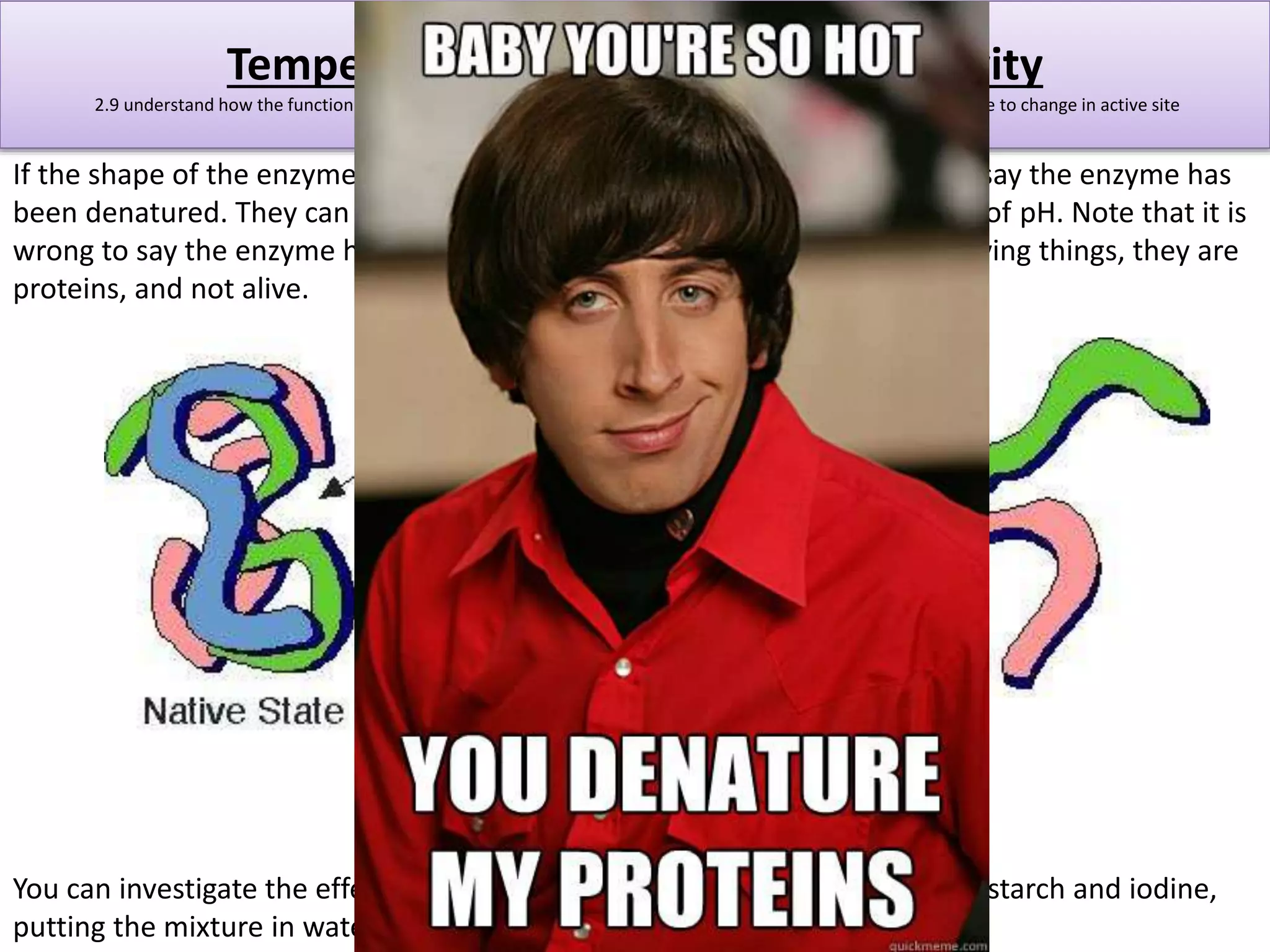
If the shape of the enzyme changes, its active site may no longer work. We say the enzyme has 
been denatured. They can be denatured by high temperatures or extremes of pH. Note that it is 
wrong to say the enzyme has been killed. Although enzymes are made by living things, they are 
proteins, and not alive. 
You can investigate the effect of temperature on the enzyme amylase using starch and iodine, 
putting the mixture in water baths at different temperatures.
pH’s effect on Enzyme activity 
2.10 understand how the functioning of enzymes can be affected by changes in active site caused by changes in pH (TA) 
Enzymes and pH 
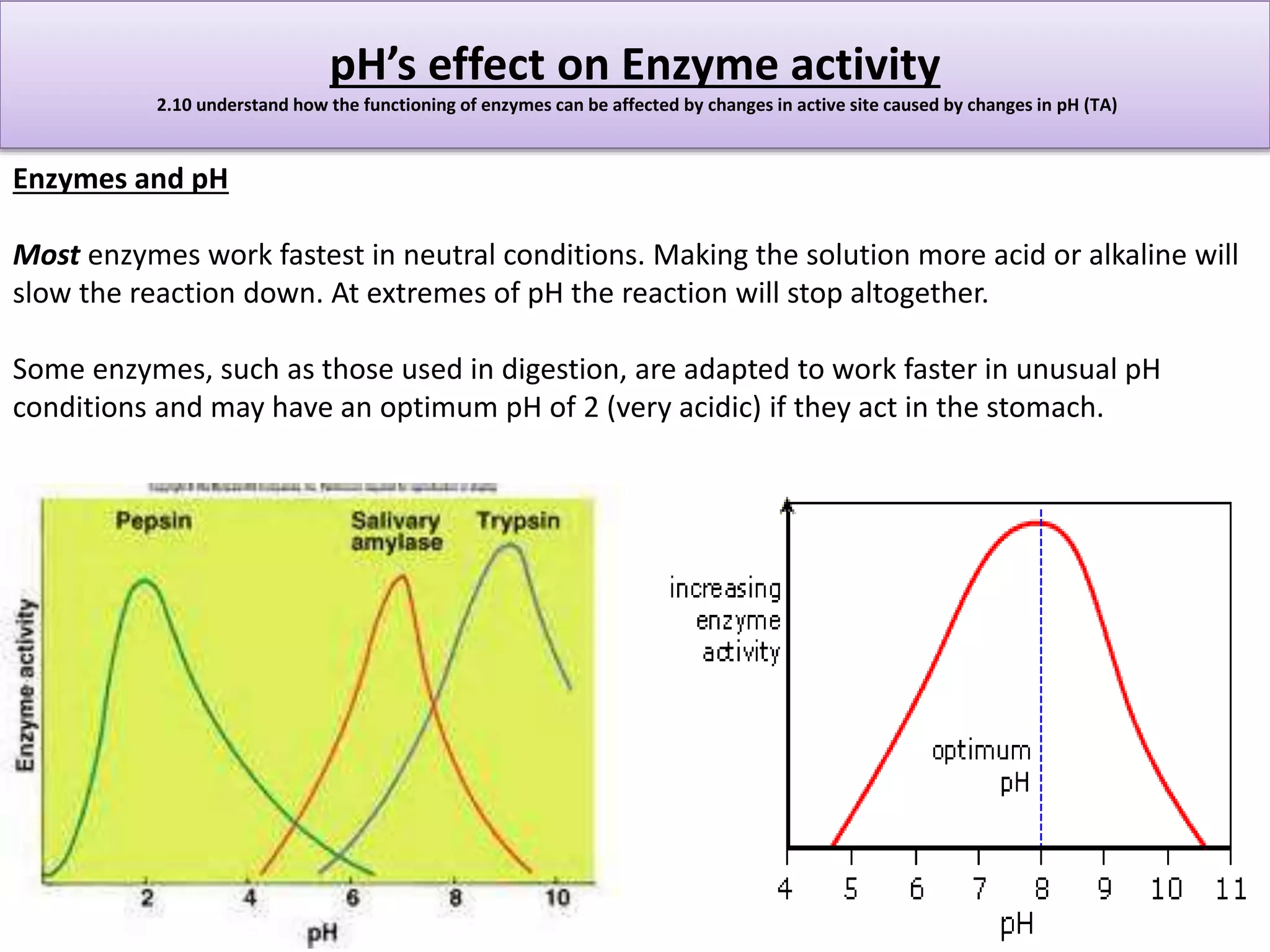
Most enzymes work fastest in neutral conditions. Making the solution more acid or alkaline will 
slow the reaction down. At extremes of pH the reaction will stop altogether. 
Some enzymes, such as those used in digestion, are adapted to work faster in unusual pH 
conditions and may have an optimum pH of 2 (very acidic) if they act in the stomach.
pH’s effect on Enzyme activity 
2.10 understand how the functioning of enzymes can be affected by changes in active site caused by changes in pH (TA) 
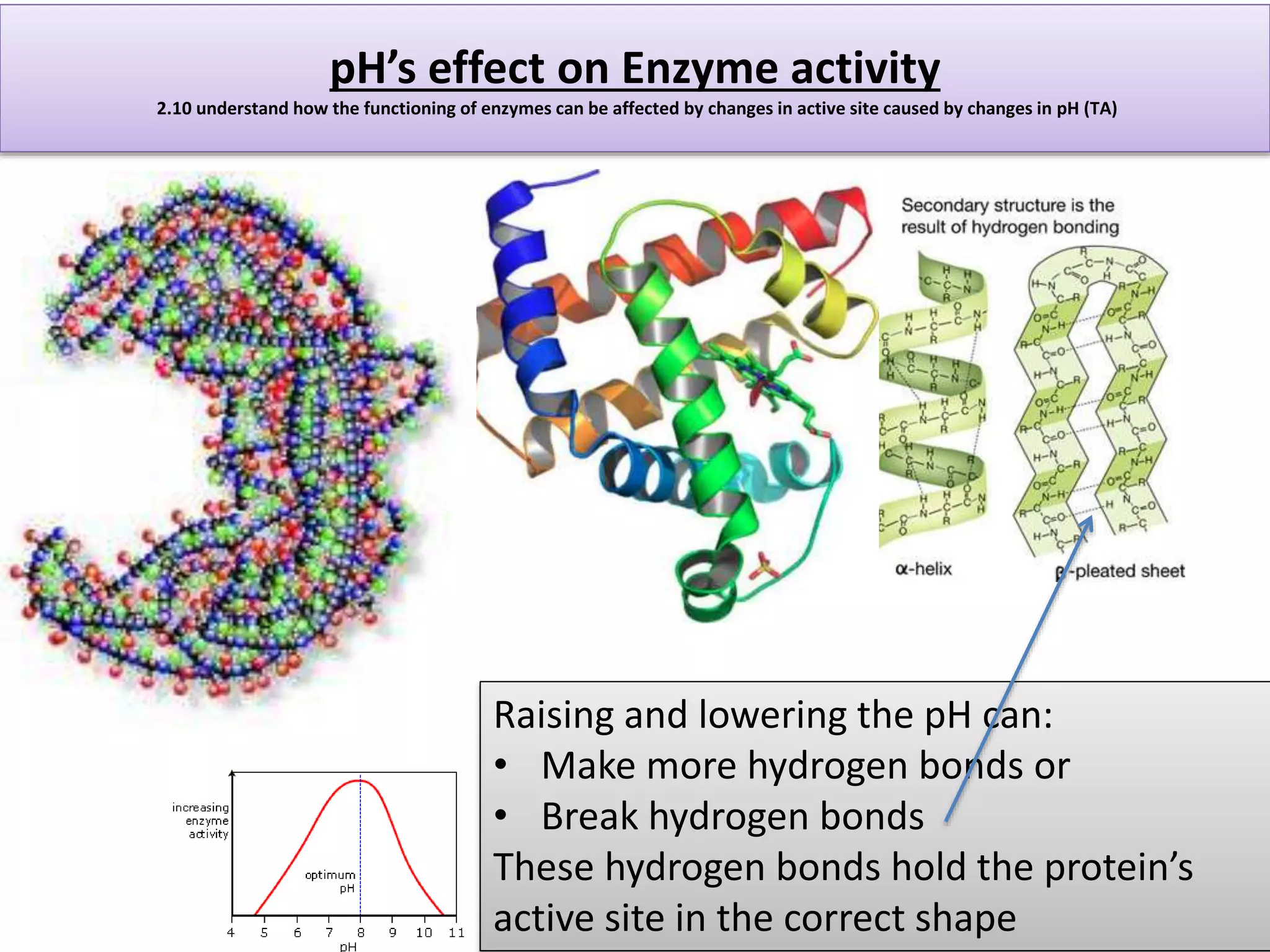
Raising and lowering the pH can: 
• Make more hydrogen bonds or 
• Break hydrogen bonds 
These hydrogen bonds hold the protein’s 
active site in the correct shape
Experiments on Enzymes: TEMPERATURE 
2.11 describe experiments to investigate how enzyme activity can be affected by changes in temperature. 
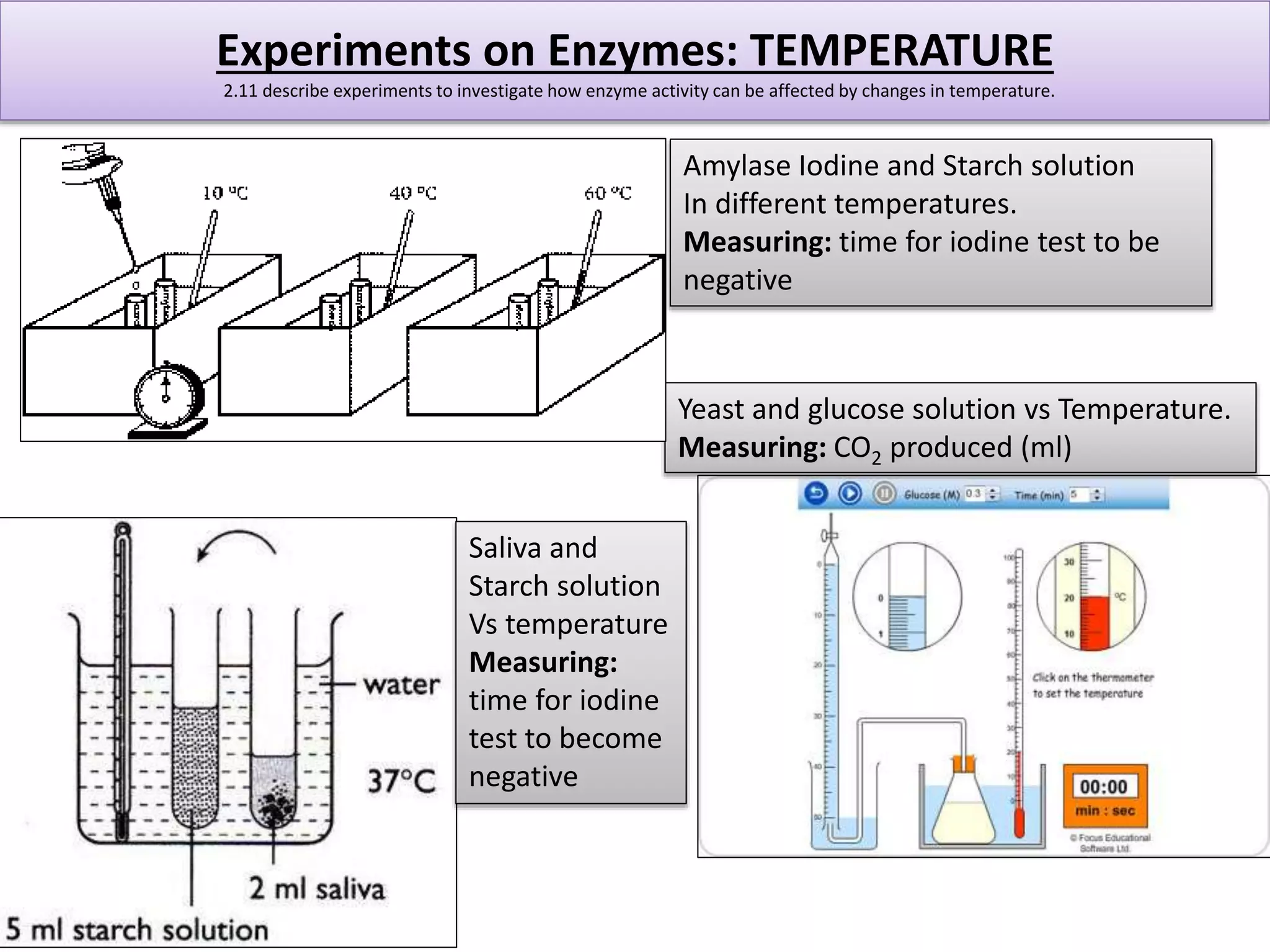
Amylase Iodine and Starch solution 
In different temperatures. 
Measuring: time for iodine test to be 
negative 
Yeast and glucose solution vs Temperature. 
Measuring: CO2 produced (ml) 
Saliva and 
Starch solution 
Vs temperature 
Measuring: 
time for iodine 
test to become 
negative
POSSIBLE CORMMS QUESTIONS TOPICS 
2.11 describe experiments to investigate how enzyme activity can be affected by changes in temperature. 
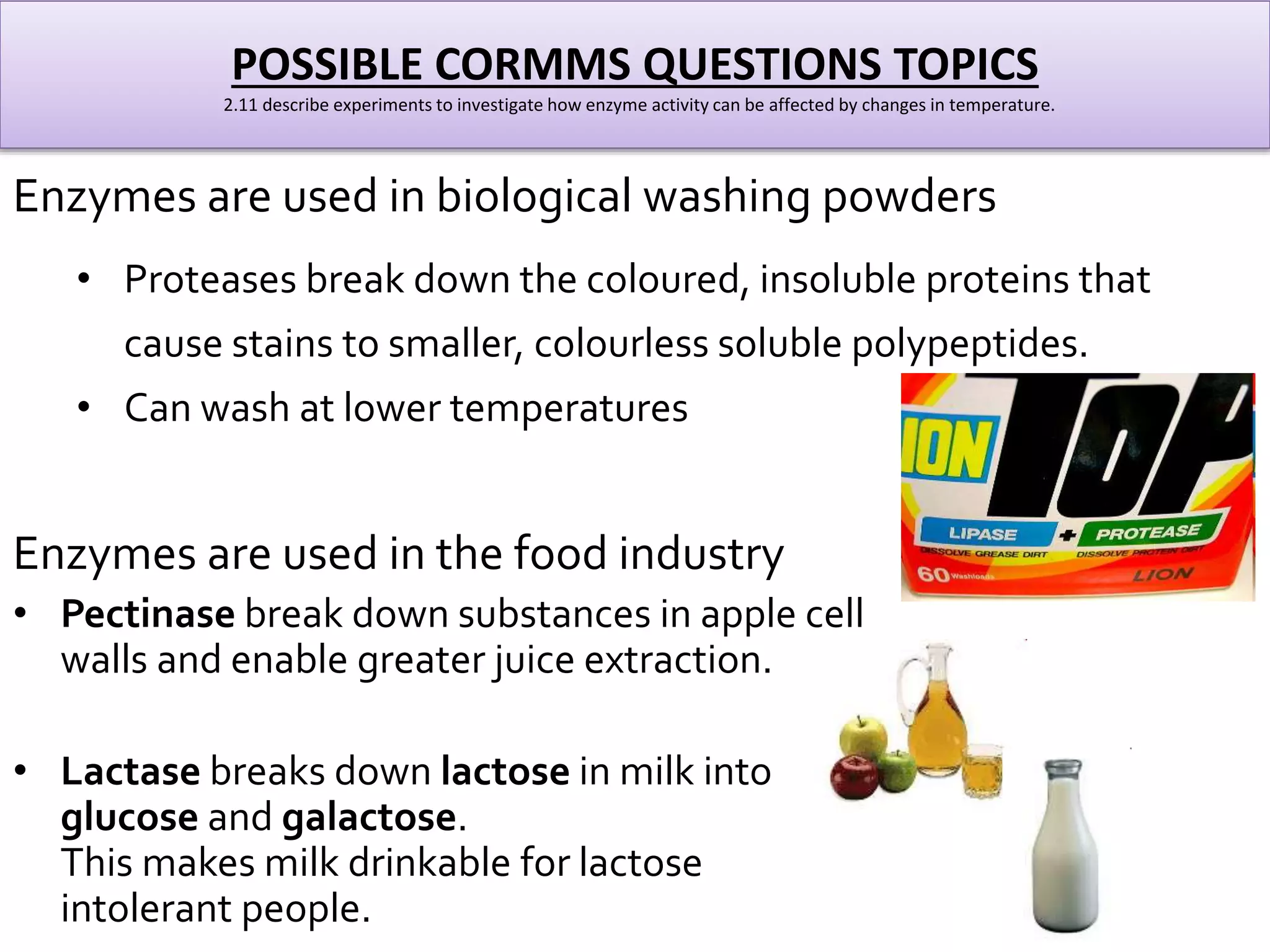
Enzymes are used in biological washing powders 
• Proteases break down the coloured, insoluble proteins that 
cause stains to smaller, colourless soluble polypeptides. 
• Can wash at lower temperatures 
Enzymes are used in the food industry 
• Pectinase break down substances in apple cell 
walls and enable greater juice extraction. 
• Lactase breaks down lactose in milk into 
glucose and galactose. 
This makes milk drinkable for lactose 
intolerant people.
POSSIBLE CORMMS QUESTIONS TOPICS 
2.11 describe experiments to investigate how enzyme activity can be affected by changes in temperature. 
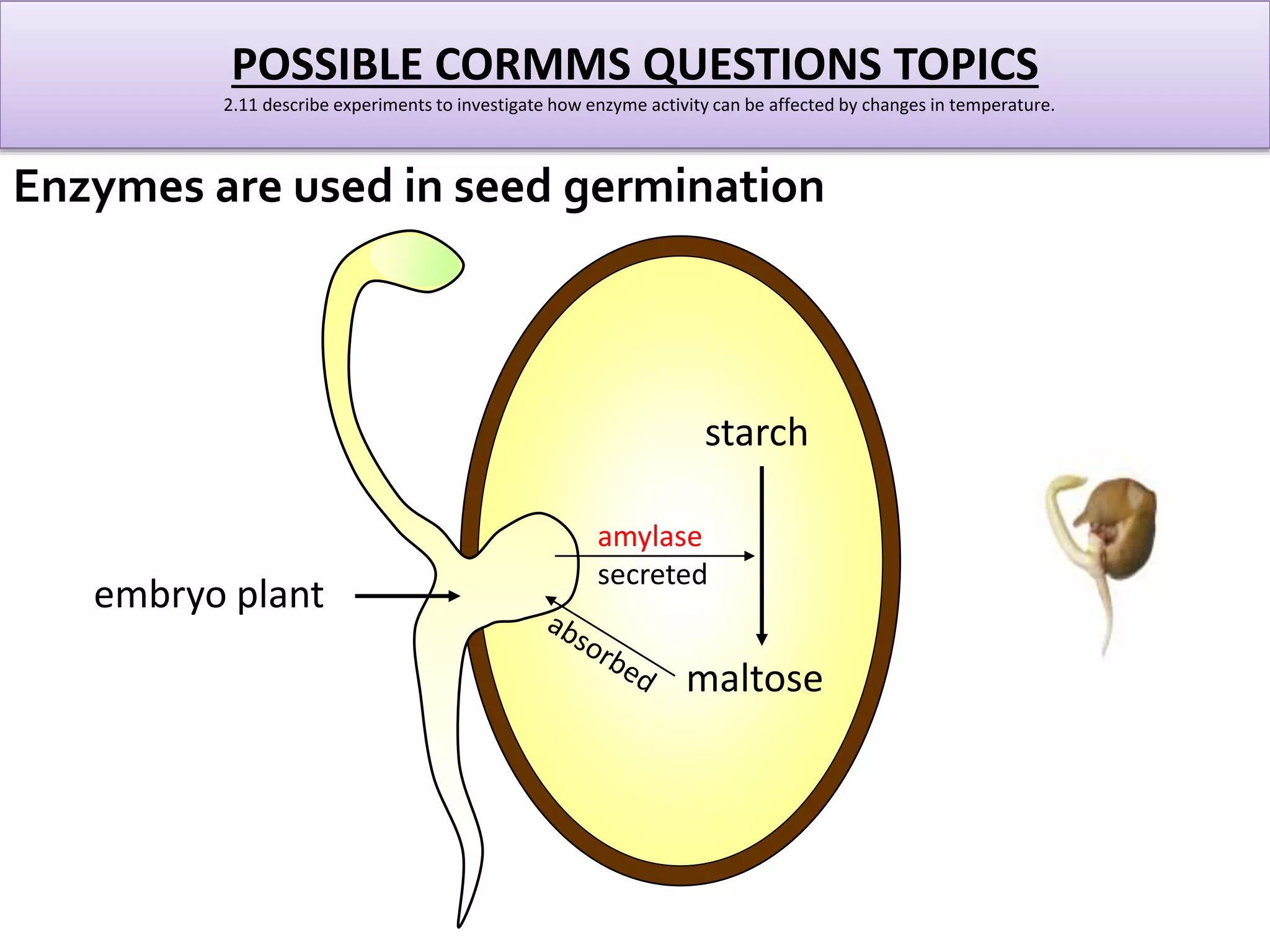
Enzymes are used in seed germination 
starch 
embryo plant 
amylase 
secreted 
maltose
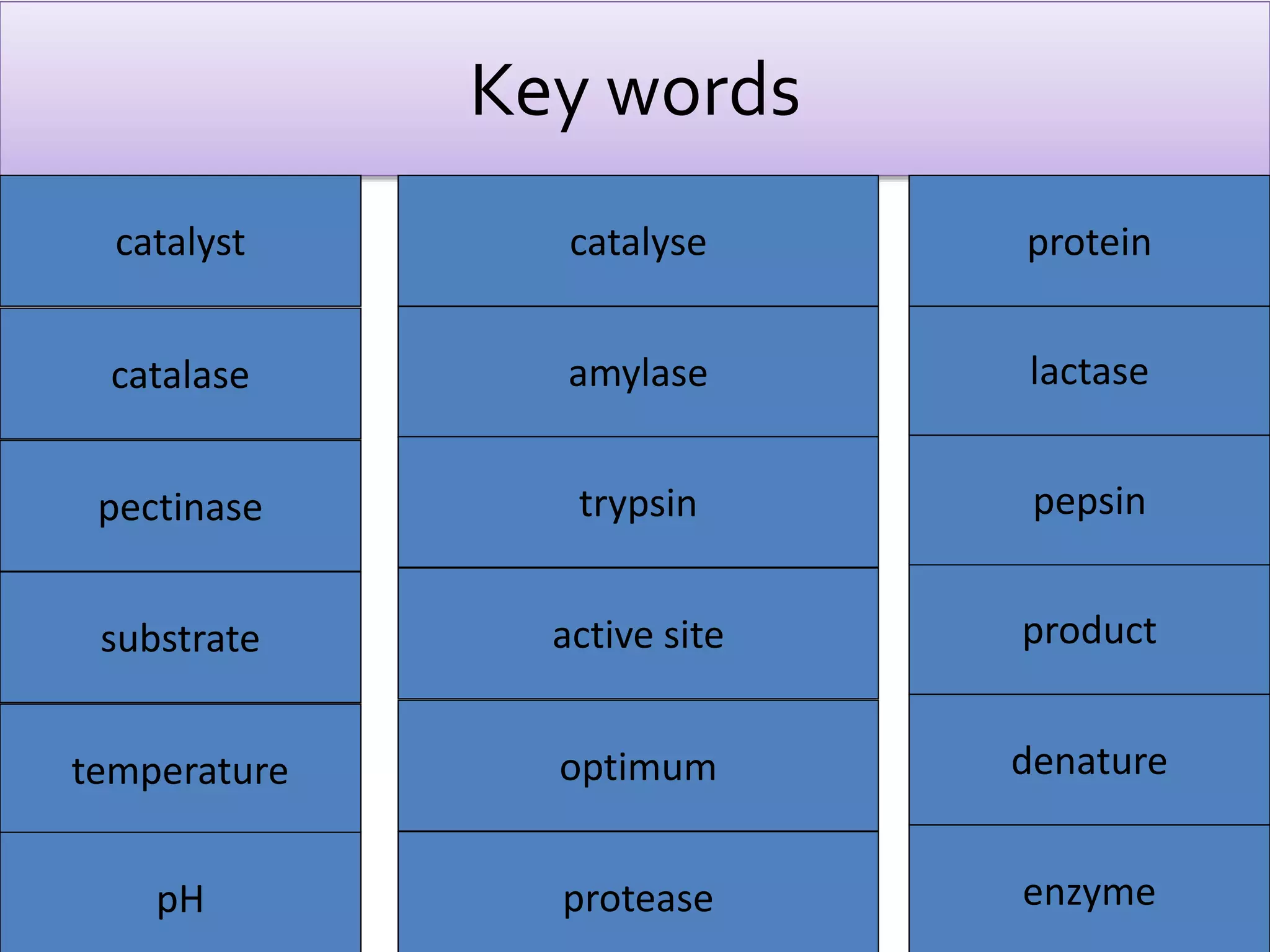
Key words 
catalyst catalyse protein 
catalase amylase 
pectinase trypsin pepsin 
substrate active site product 
temperature denature 
enzyme 
pH 
optimum 
lactase 
protease
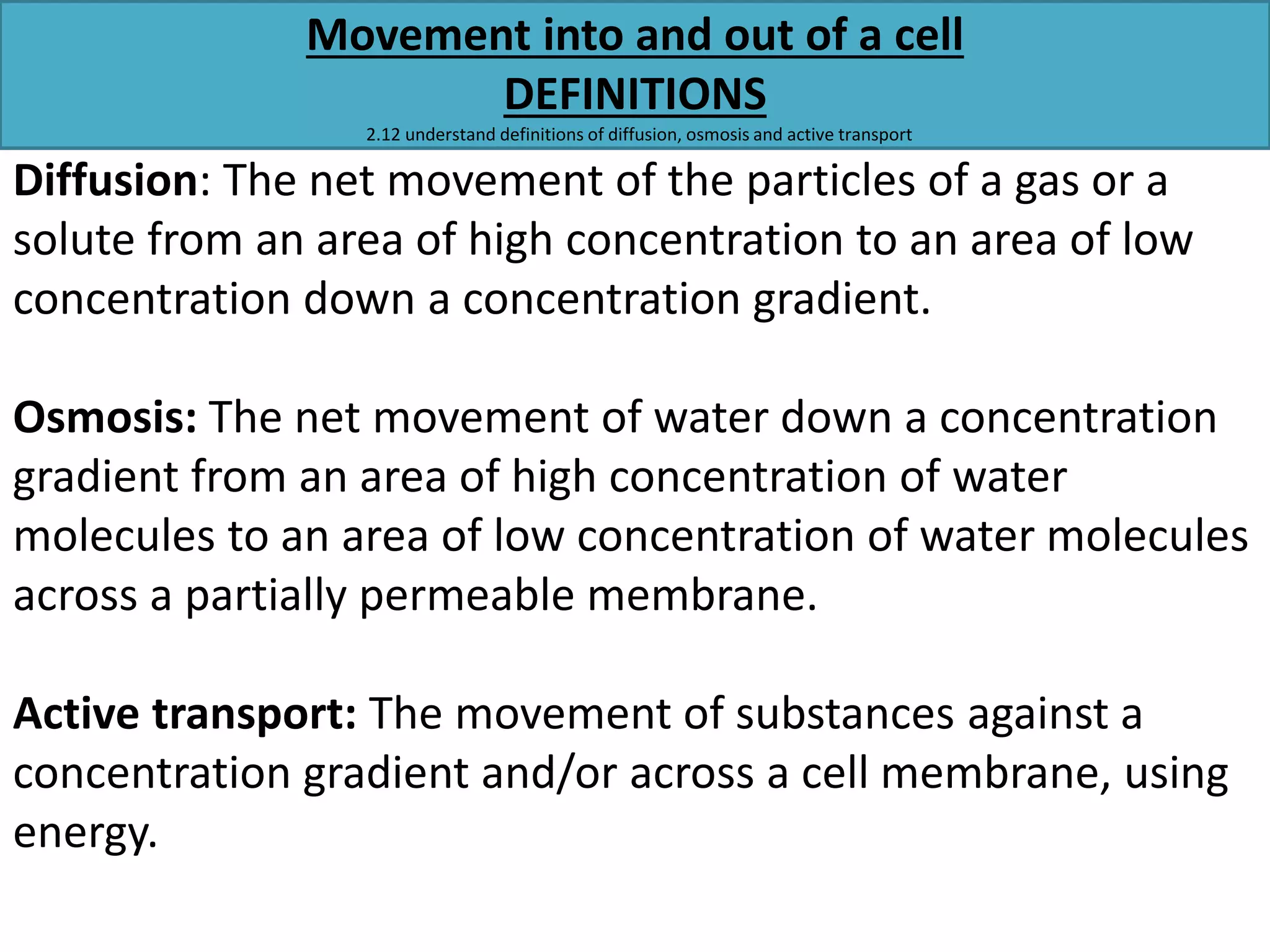
Movement into and out of a cell 
DEFINITIONS 
2.12 understand definitions of diffusion, osmosis and active transport 
Diffusion: The net movement of the particles of a gas or a 
solute from an area of high concentration to an area of low 
concentration down a concentration gradient. 
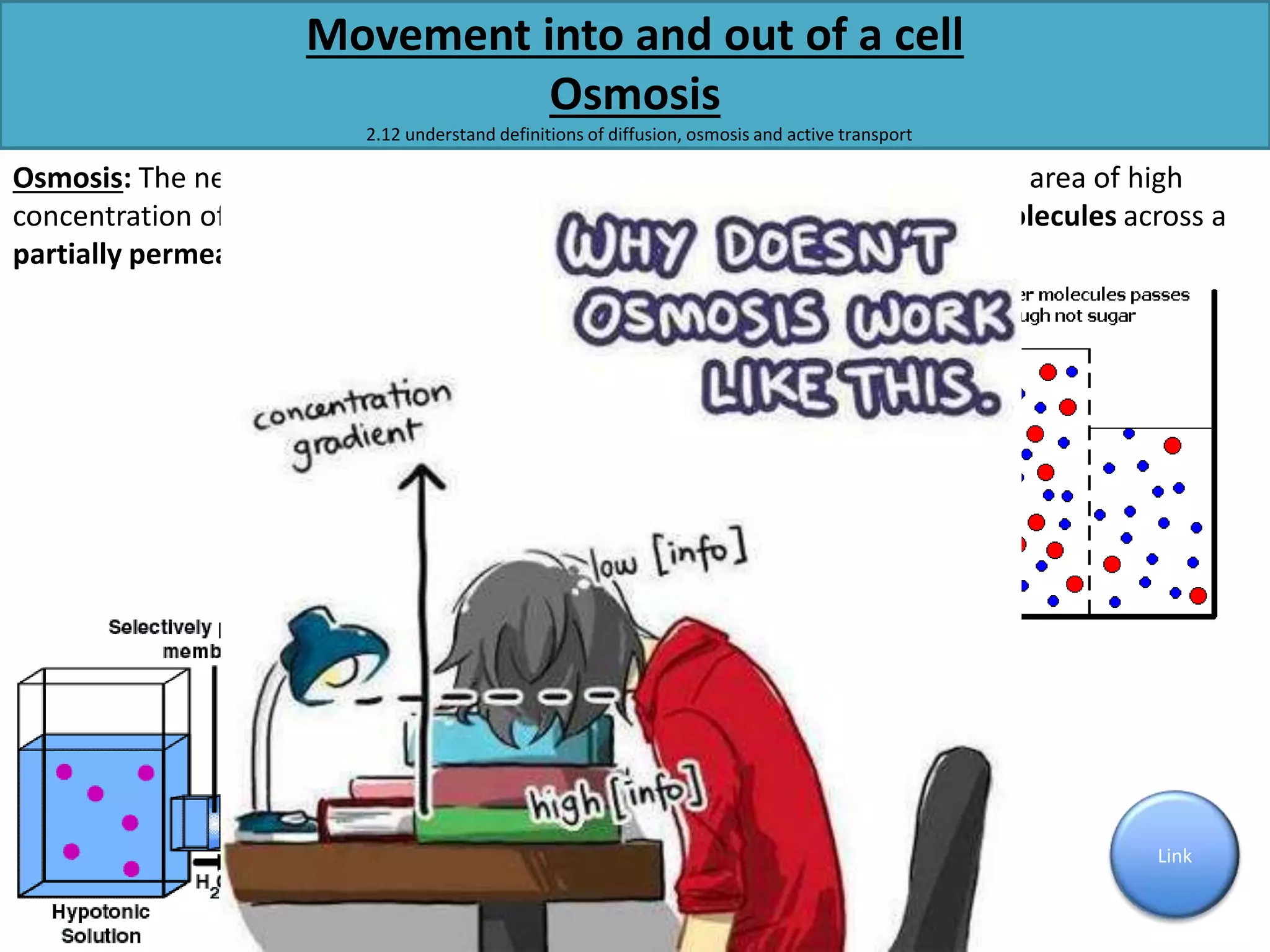
Osmosis: The net movement of water down a concentration 
gradient from an area of high concentration of water 
molecules to an area of low concentration of water molecules 
across a partially permeable membrane. 
Active transport: The movement of substances against a 
concentration gradient and/or across a cell membrane, using 
energy.
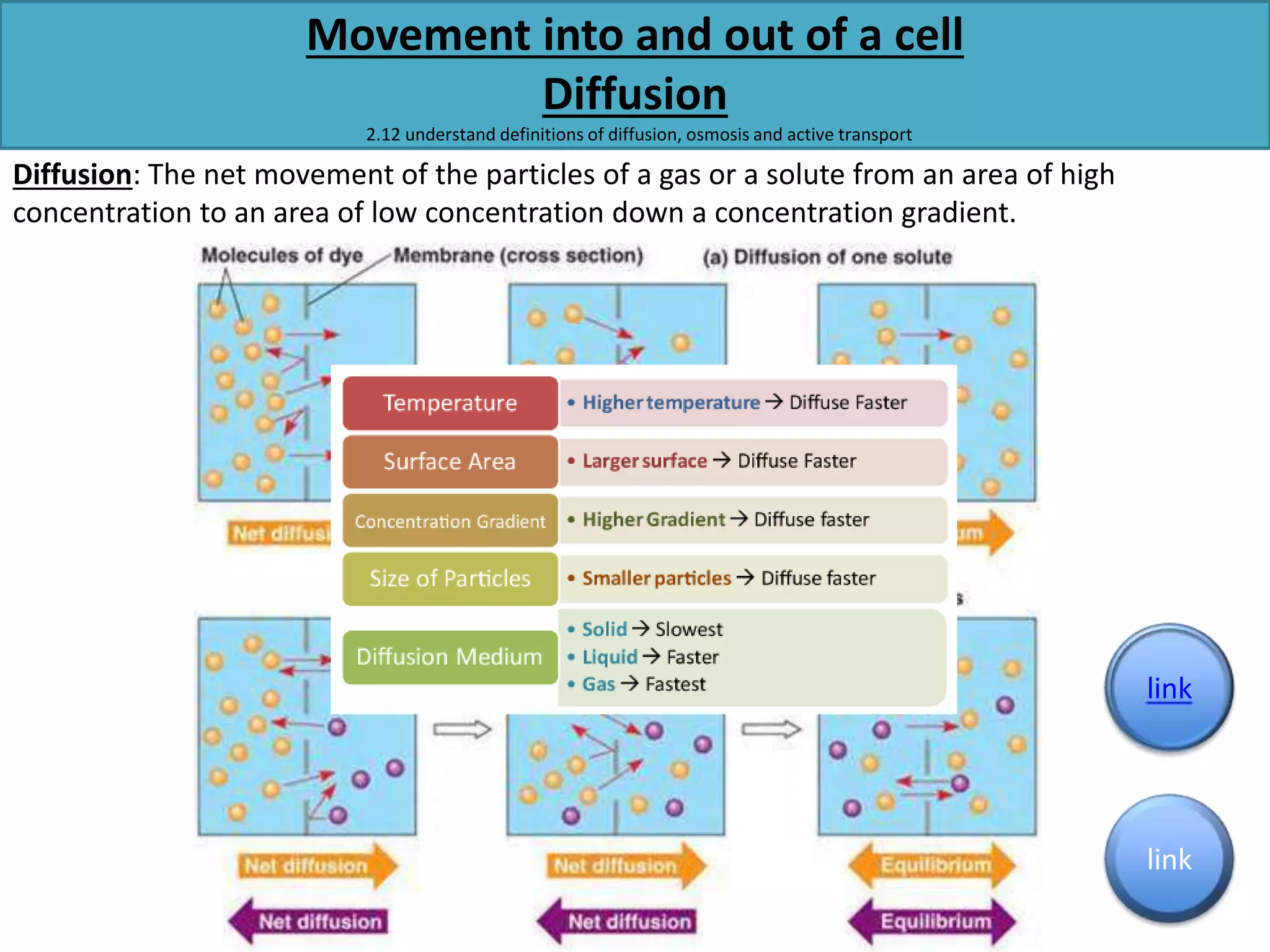
Movement into and out of a cell 
Diffusion 
2.12 understand definitions of diffusion, osmosis and active transport 
Diffusion: The net movement of the particles of a gas or a solute from an area of high 
concentration to an area of low concentration down a concentration gradient. 
link 
link
Movement into and out of a cell 
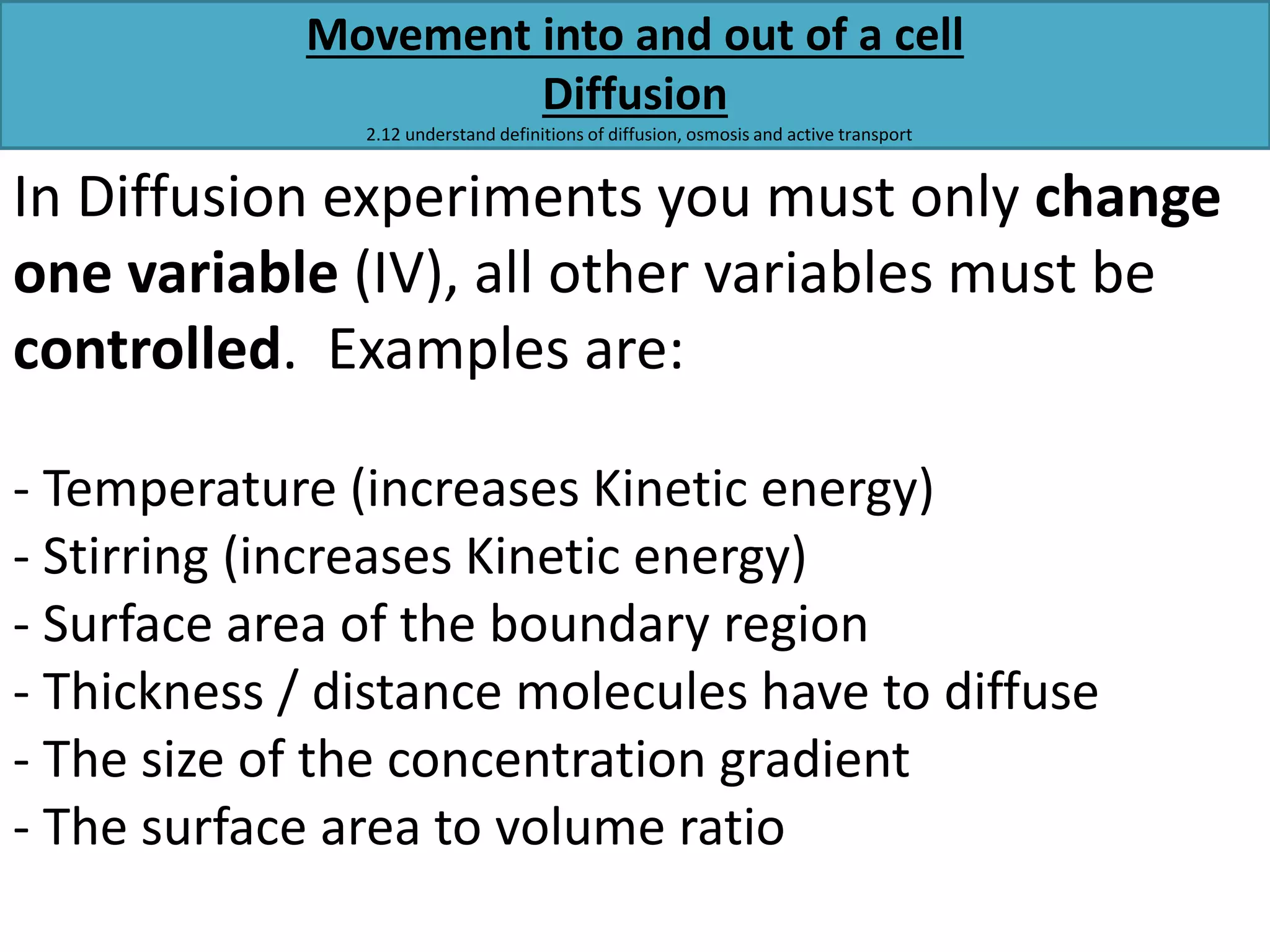
Diffusion 
2.12 understand definitions of diffusion, osmosis and active transport 
In Diffusion experiments you must only change 
one variable (IV), all other variables must be 
controlled. Examples are: 
- Temperature (increases Kinetic energy) 
- Stirring (increases Kinetic energy) 
- Surface area of the boundary region 
- Thickness / distance molecules have to diffuse 
- The size of the concentration gradient 
- The surface area to volume ratio
Movement into and out of a cell 
Osmosis 
2.12 understand definitions of diffusion, osmosis and active transport 
Osmosis: The net movement of water down a concentration gradient from an area of high 
concentration of water molecules to an area of low concentration of water molecules across a 
partially permeable membrane. 
Link
Movement into and out of a cell 
Active Transport 
2.12 understand definitions of diffusion, osmosis and active transport 
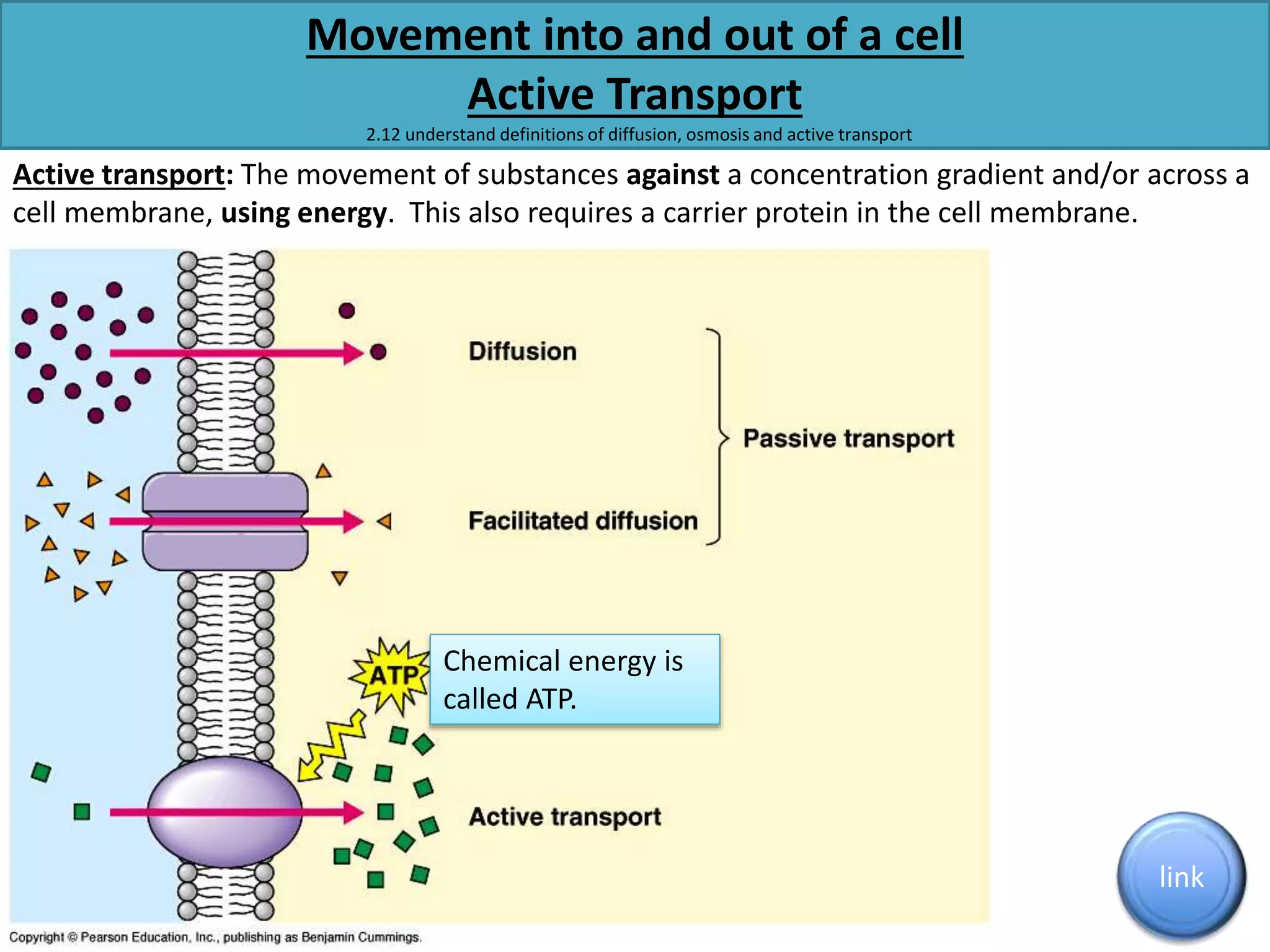
Active transport: The movement of substances against a concentration gradient and/or across a 
cell membrane, using energy. This also requires a carrier protein in the cell membrane. 
link 
Chemical energy is 
called ATP.
Movement into and out of a cell 
Review 
2.13 understand that movement of substances into and out of cells can be by diffusion, osmosis and active transport 
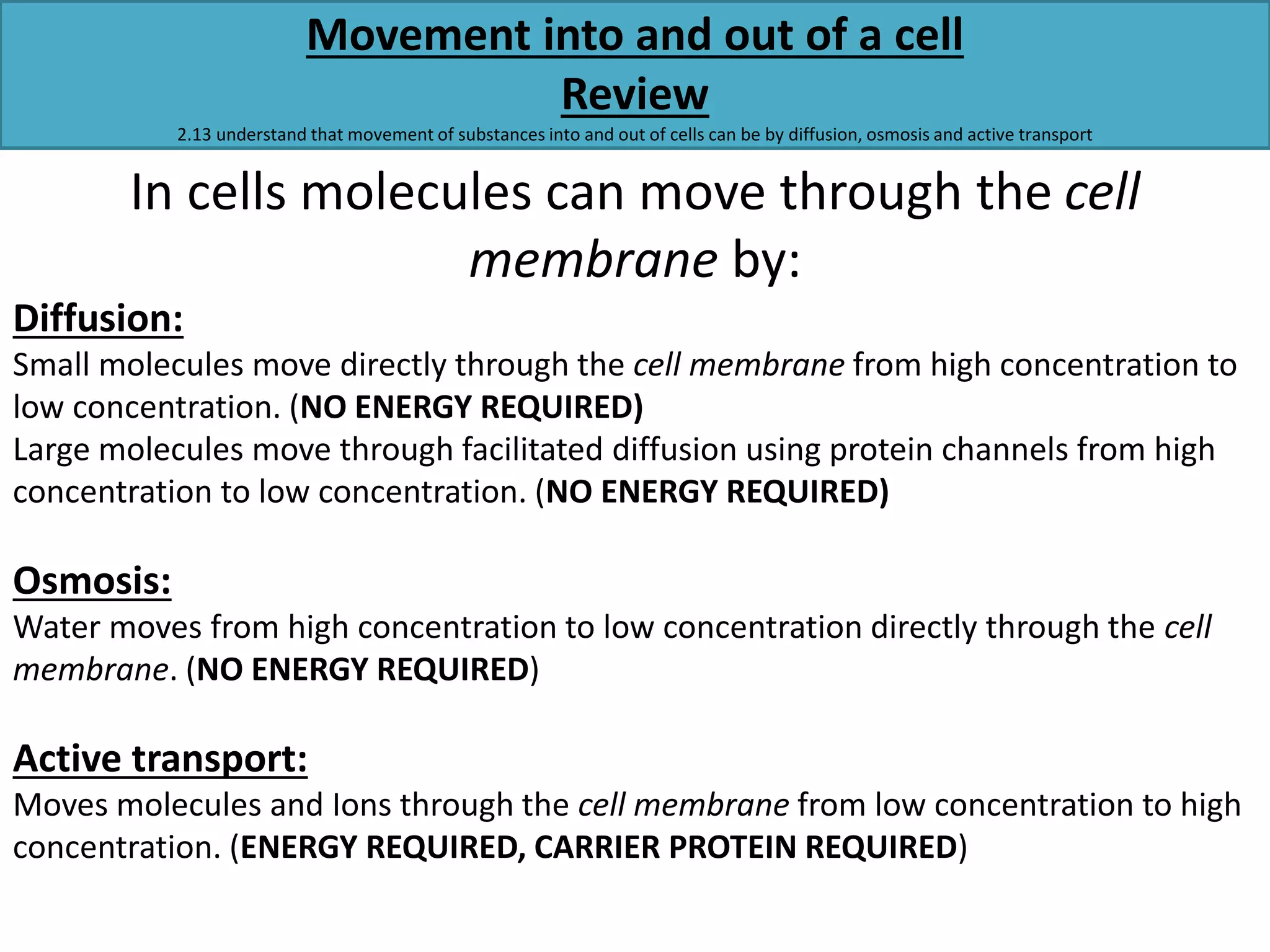
In cells molecules can move through the cell 
membrane by: 
Diffusion: 
Small molecules move directly through the cell membrane from high concentration to 
low concentration. (NO ENERGY REQUIRED) 
Large molecules move through facilitated diffusion using protein channels from high 
concentration to low concentration. (NO ENERGY REQUIRED) 
Osmosis: 
Water moves from high concentration to low concentration directly through the cell 
membrane. (NO ENERGY REQUIRED) 
Active transport: 
Moves molecules and Ions through the cell membrane from low concentration to high 
concentration. (ENERGY REQUIRED, CARRIER PROTEIN REQUIRED)
TURGID CELLS 
2.14 understand the importance in plants of turgid cells as a means of support (TA) 
EXAMINATION POINTS (step by step) 
(4 Mark Question) 
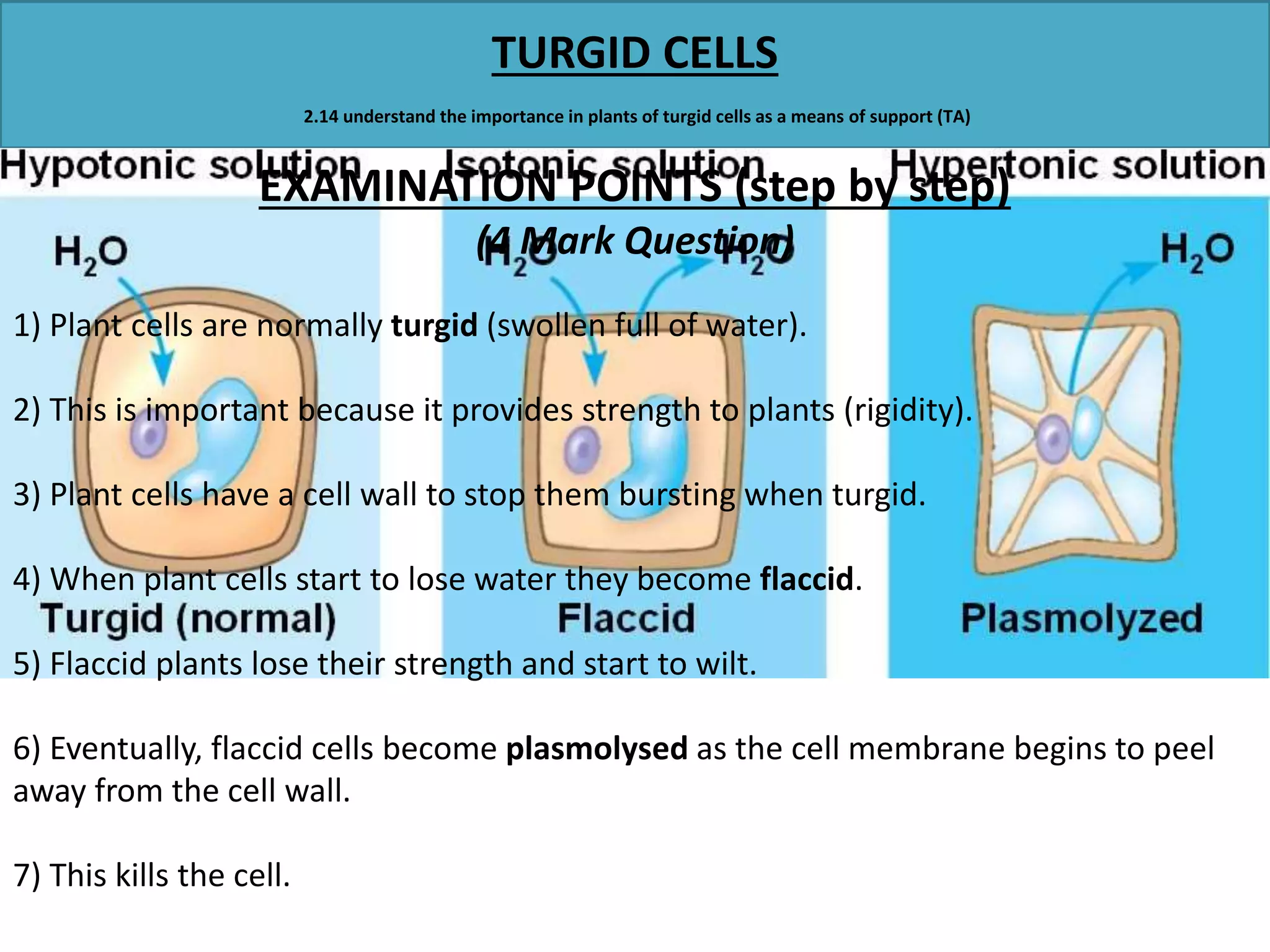
1) Plant cells are normally turgid (swollen full of water). 
2) This is important because it provides strength to plants (rigidity). 
3) Plant cells have a cell wall to stop them bursting when turgid. 
4) When plant cells start to lose water they become flaccid. 
5) Flaccid plants lose their strength and start to wilt. 
6) Eventually, flaccid cells become plasmolysed as the cell membrane begins to peel 
away from the cell wall. 
7) This kills the cell.
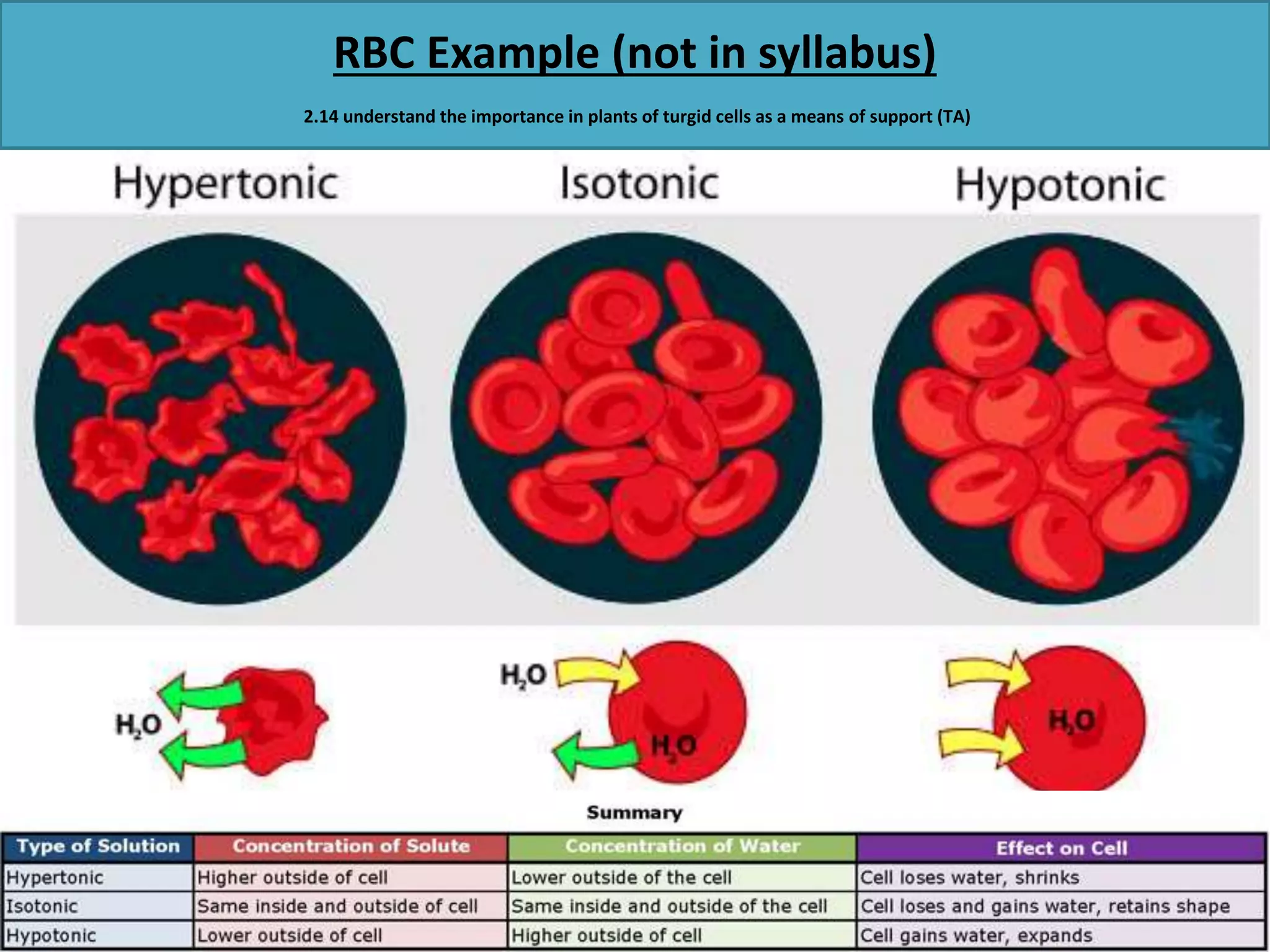
RBC Example (not in syllabus) 
2.14 understand the importance in plants of turgid cells as a means of support (TA)
Variables affecting movement into and out of cells 
2.15 understand the factors that affect the rate of movement of substances into and out of cells, to include the effects of surface area to volume ratio, 
temperature and concentration gradient 
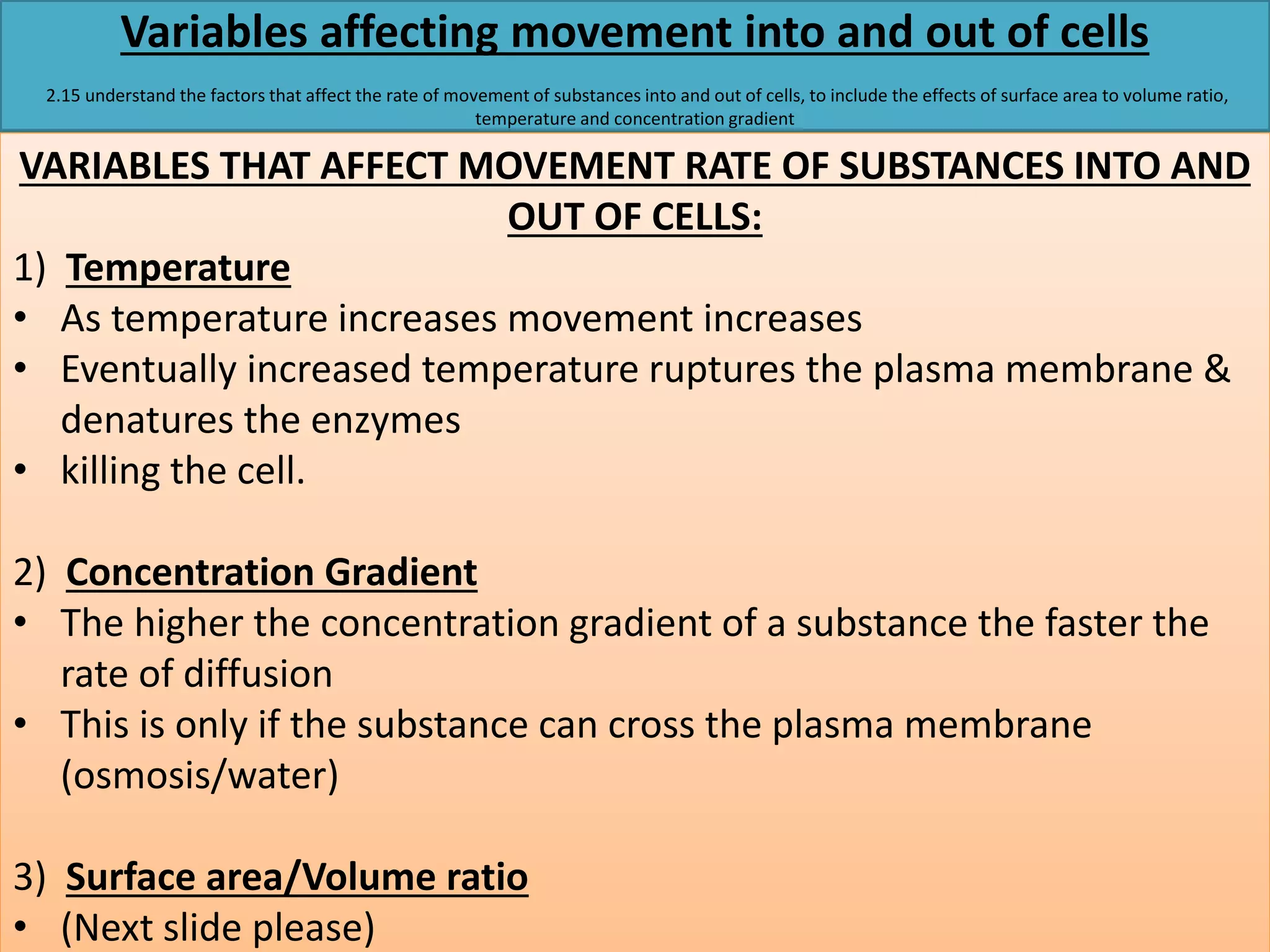
VARIABLES THAT AFFECT MOVEMENT RATE OF SUBSTANCES INTO AND 
OUT OF CELLS: 
1) Temperature 
• As temperature increases movement increases 
• Eventually increased temperature ruptures the plasma membrane & 
denatures the enzymes 
• killing the cell. 
2) Concentration Gradient 
• The higher the concentration gradient of a substance the faster the 
rate of diffusion 
• This is only if the substance can cross the plasma membrane 
(osmosis/water) 
3) Surface area/Volume ratio 
• (Next slide please)
Variables affecting movement into and out of cells 
2.15 understand the factors that affect the rate of movement of substances into and out of cells, to include the effects of surface area to volume ratio, 
temperature and concentration gradient 
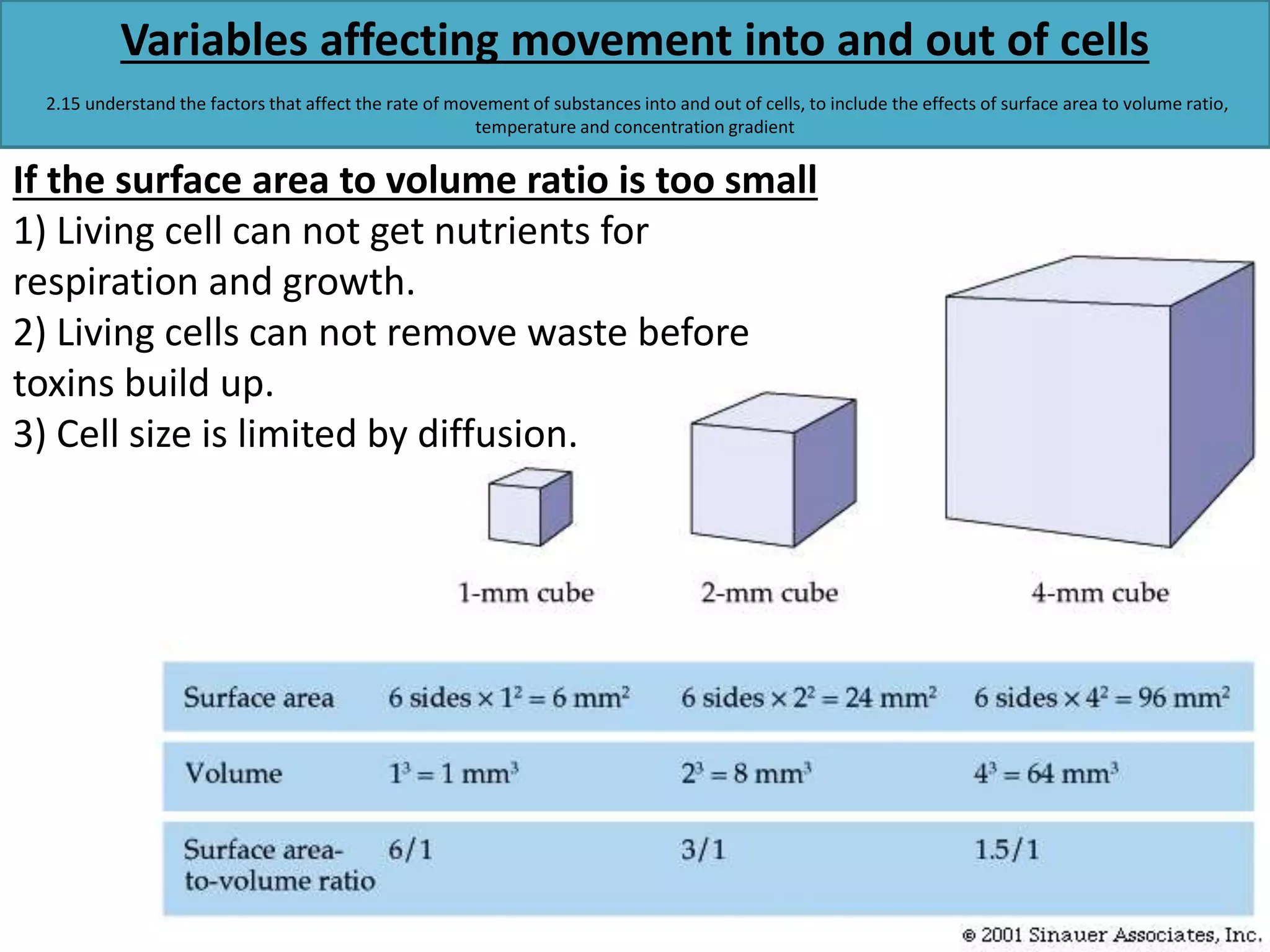
If the surface area to volume ratio is too small 
1) Living cell can not get nutrients for 
respiration and growth. 
2) Living cells can not remove waste before 
toxins build up. 
3) Cell size is limited by diffusion.
Variables affecting movement into and out of cells 
2.15 understand the factors that affect the rate of movement of substances into and out of cells, to include the effects of surface area to volume ratio, 
temperature and concentration gradient 
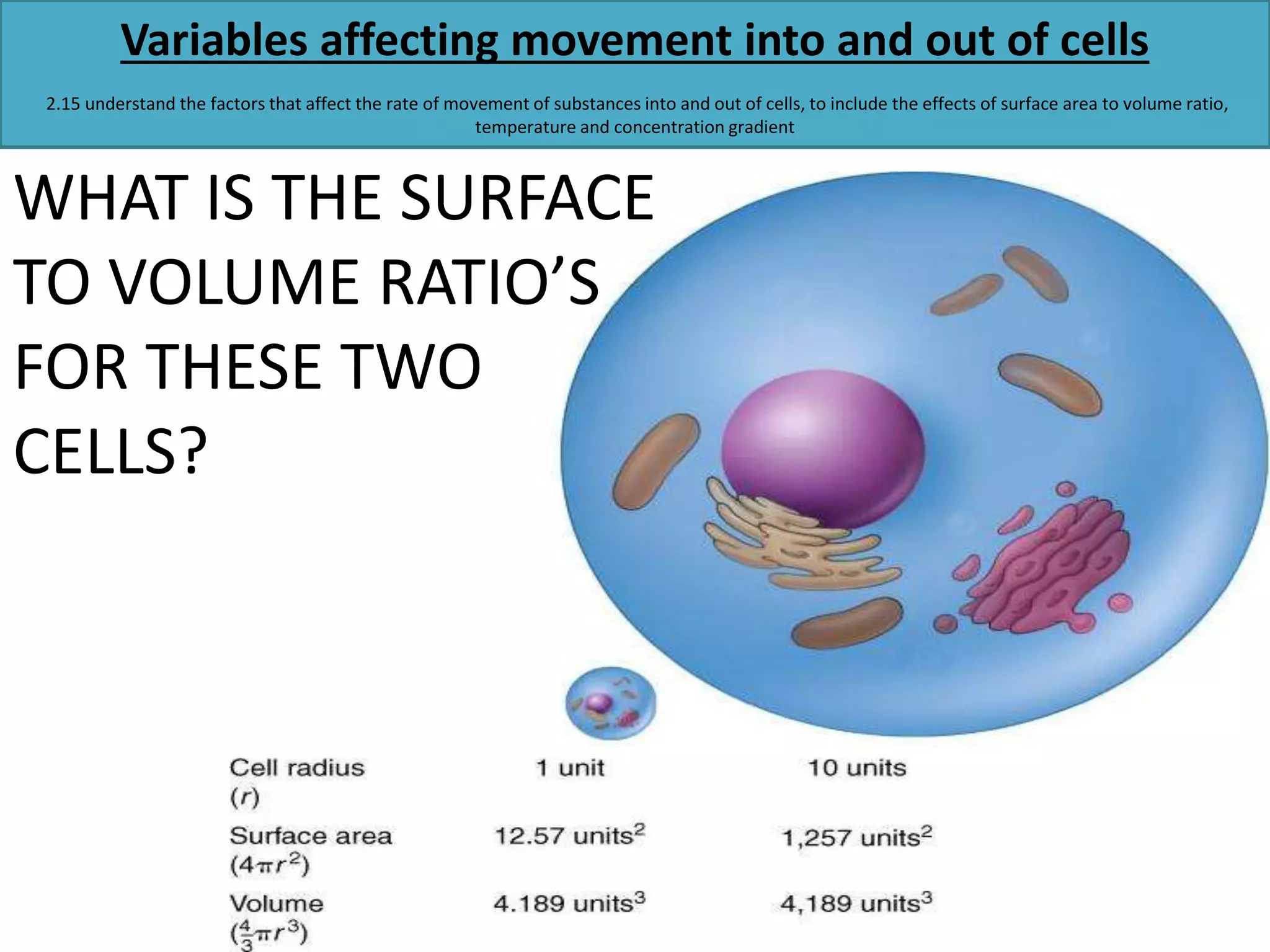
WHAT IS THE SURFACE 
TO VOLUME RATIO’S 
FOR THESE TWO 
CELLS?
Variables affecting movement into and out of cells 
2.15 understand the factors that affect the rate of movement of substances into and out of cells, to include the effects of surface area to volume ratio, 
temperature and concentration gradient 
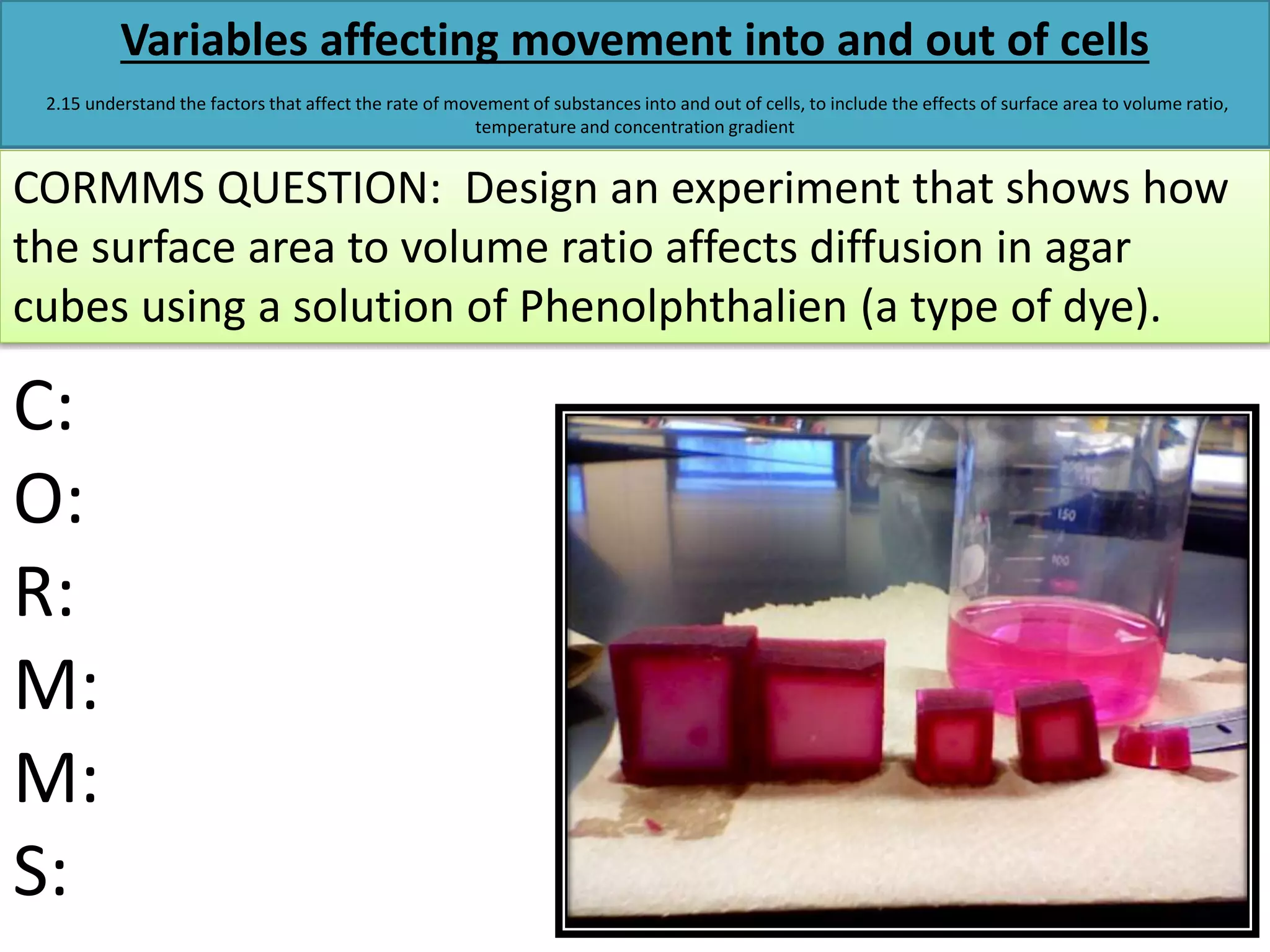
CORMMS QUESTION: Design an experiment that shows how 
the surface area to volume ratio affects diffusion in agar 
cubes using a solution of Phenolphthalien (a type of dye). 
C: 
O: 
R: 
M: 
M: 
S:
Experiments on Diffusion and Osmosis 
2.16 describe experiments to investigate diffusion and osmosis using living and non-living systems. 
Good examples of diffusion are: 
- Ink chromatography 
- The diffusion of KMnO4 crystals (purple) into water 
- Diffusion of gases in the lung 
- Diffusion of gases in the leaf 
- Gas diffusion of Bromine gas 
Osmosis can be shown by: 
- Artificially using visking tubing 
- Potato chips in salt solutions of different concentrations.
NUTRITION 
(Yum Yum Yum)
PLANT NUTRTITION 
2.17 describe the process of photosynthesis and understand its importance in the 
conversion of light energy to chemical energy 
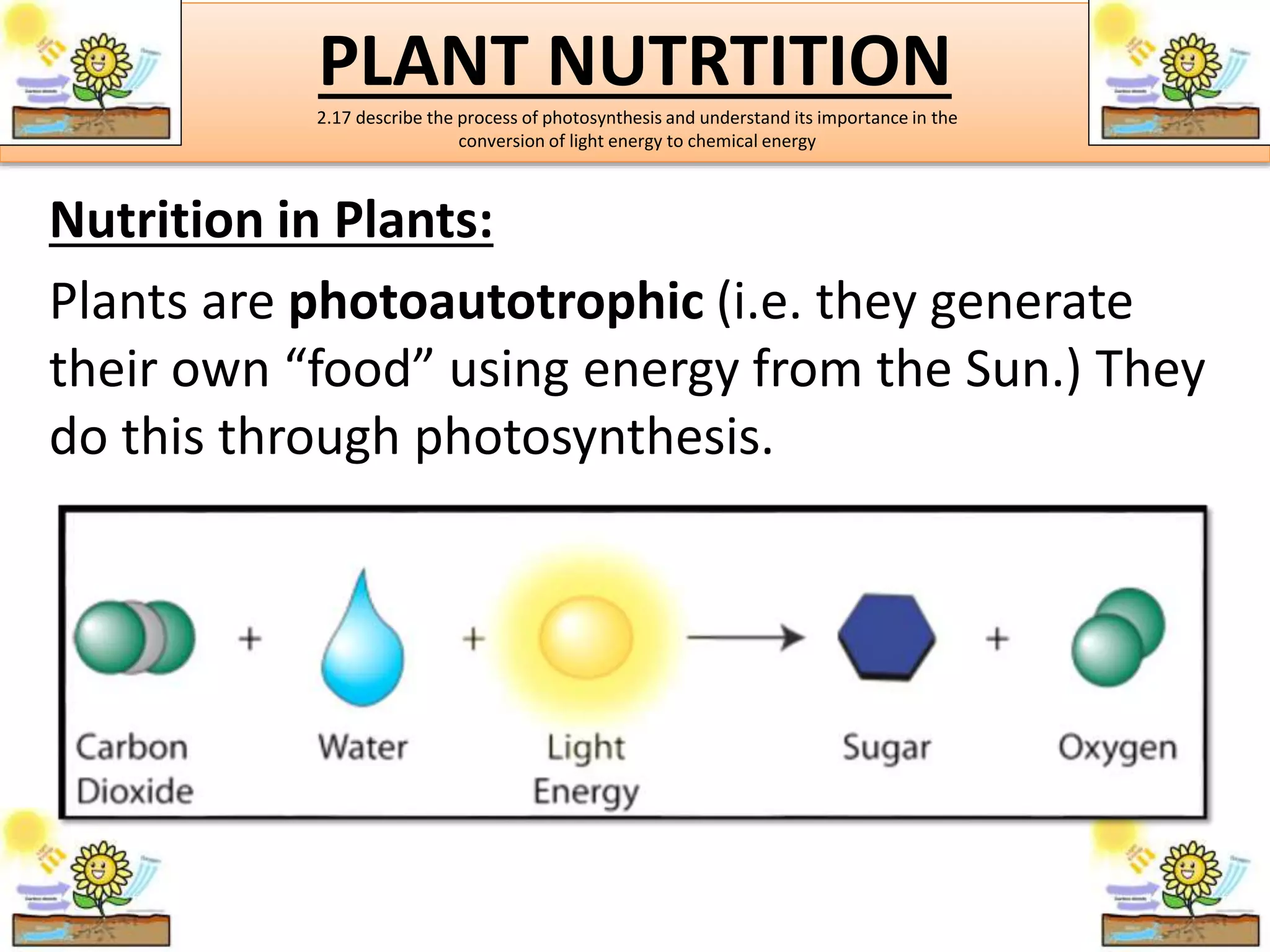
Nutrition in Plants: 
Plants are photoautotrophic (i.e. they generate 
their own “food” using energy from the Sun.) They 
do this through photosynthesis.
Photosynthesis Equation 
2.18 write the word equation and the balanced chemical symbol equation for photosynthesis 
Nutrition in Flowering Plants: 
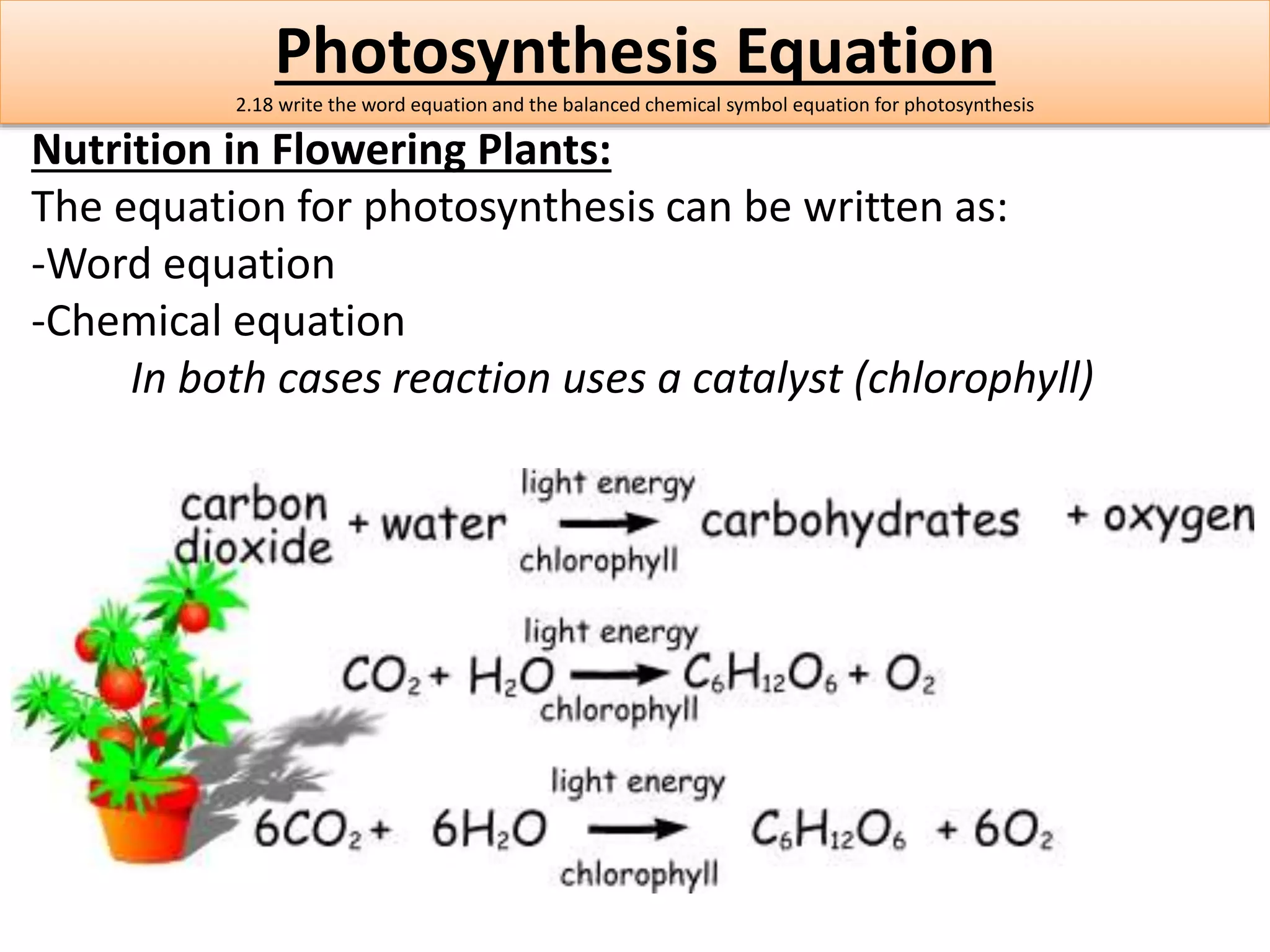
The equation for photosynthesis can be written as: 
-Word equation 
-Chemical equation 
In both cases reaction uses a catalyst (chlorophyll)
Light ….. Glucose….. ? 
2.18 write the word equation and the balanced chemical symbol equation for photosynthesis 
Through photosynthesis light energy is converted 
into chemical energy in the bonds in glucose. Plants 
use glucose for the following; 
1) Respiration 
2) Stored as Starch 
3) Turned into Cellulose (cellulose is a 
polymer of glucose) 
4) Used to make fats and oils
Photosynthesis Rate 
2.19 understand how varying carbon dioxide concentration, light intensity and temperature affect the rate of photosynthesis 
At any point the rate of photosynthesis can be 
increased by adding: 
1) More CO2 
2) More light 
WAIT!!!! 
3) Heating towards optimum temperature 
This (photosynthesis is not is catalyzed the by whole 
enzymes). 
story
Limiting Factors 
2.19 understand how varying carbon dioxide concentration, light intensity and temperature affect the rate of photosynthesis 
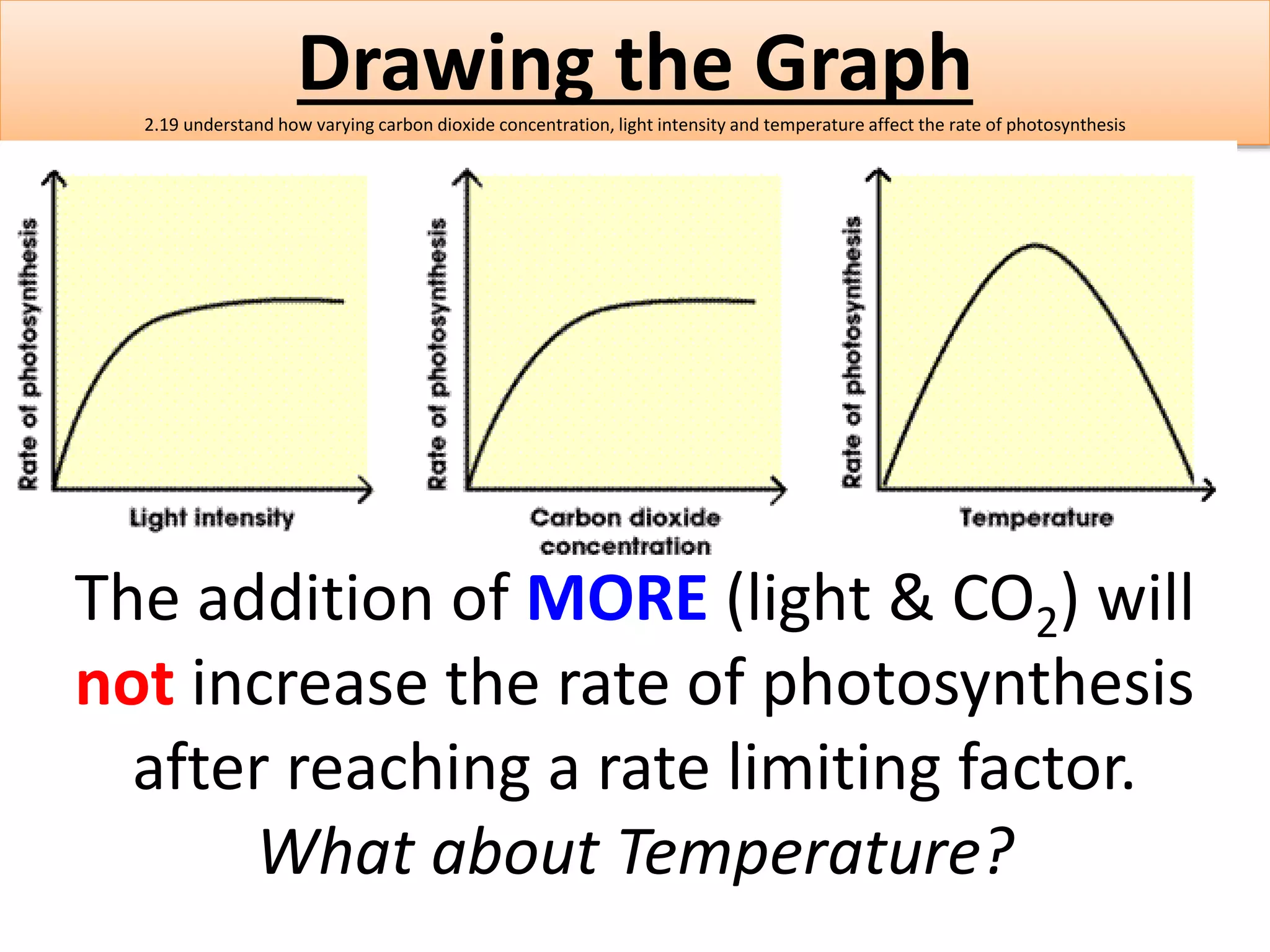
a)At a certain point the addition of MORE 
(light & CO2) will not increase the rate of 
photosynthesis any further. 
b)This is because a second factor is limiting 
the rate of photosynthesis. 
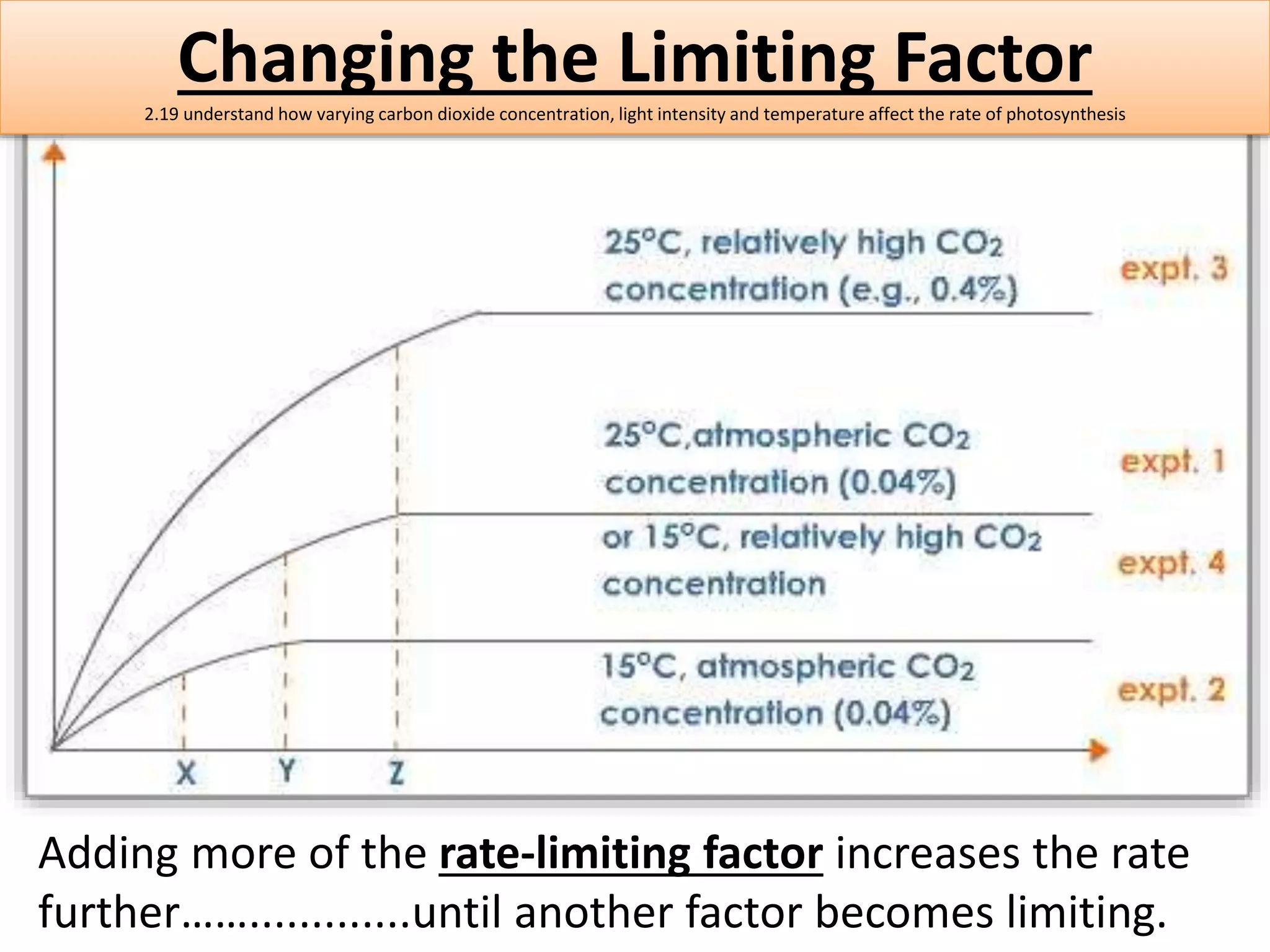
c)Adding more of the rate-limiting factor 
will increase the rate further until another 
factor becomes limiting.
Drawing the Graph 
2.19 understand how varying carbon dioxide concentration, light intensity and temperature affect the rate of photosynthesis 
The addition of MORE (light & CO2) will 
not increase the rate of photosynthesis 
after reaching a rate limiting factor. 
What about Temperature?
?Temperature? 
2.19 understand how varying carbon dioxide concentration, light intensity and temperature affect the rate of photosynthesis
?Temperature? 
2.19 understand how varying carbon dioxide concentration, light intensity and temperature affect the rate of photosynthesis 
Without enough light, a plant cannot 
photosynthesize very quickly, even if there is 
plenty of water and carbon dioxide. 
1) Increasing the temperature will boost the 
speed (rate) of photosynthesis. 
2) Increasing the intensity will boost the 
speed (rate) of photosynthesis.
Changing the Limiting Factor 
2.19 understand how varying carbon dioxide concentration, light intensity and temperature affect the rate of photosynthesis 
Adding more of the rate-limiting factor increases the rate 
further…….............until another factor becomes limiting.
What about Water? 
2.19 understand how varying carbon dioxide concentration, light intensity and temperature affect the rate of photosynthesis 
Water is not seen as a limiting factor. 
Plants have enough water in their tissues for 
photosynthesis. 
If they do not have enough water the plant will wilt 
and die anyway. 
Very sad, but very true.
Leaf Structure 
2.20 describe the structure of the leaf and explain how it is adapted for photosynthesis 
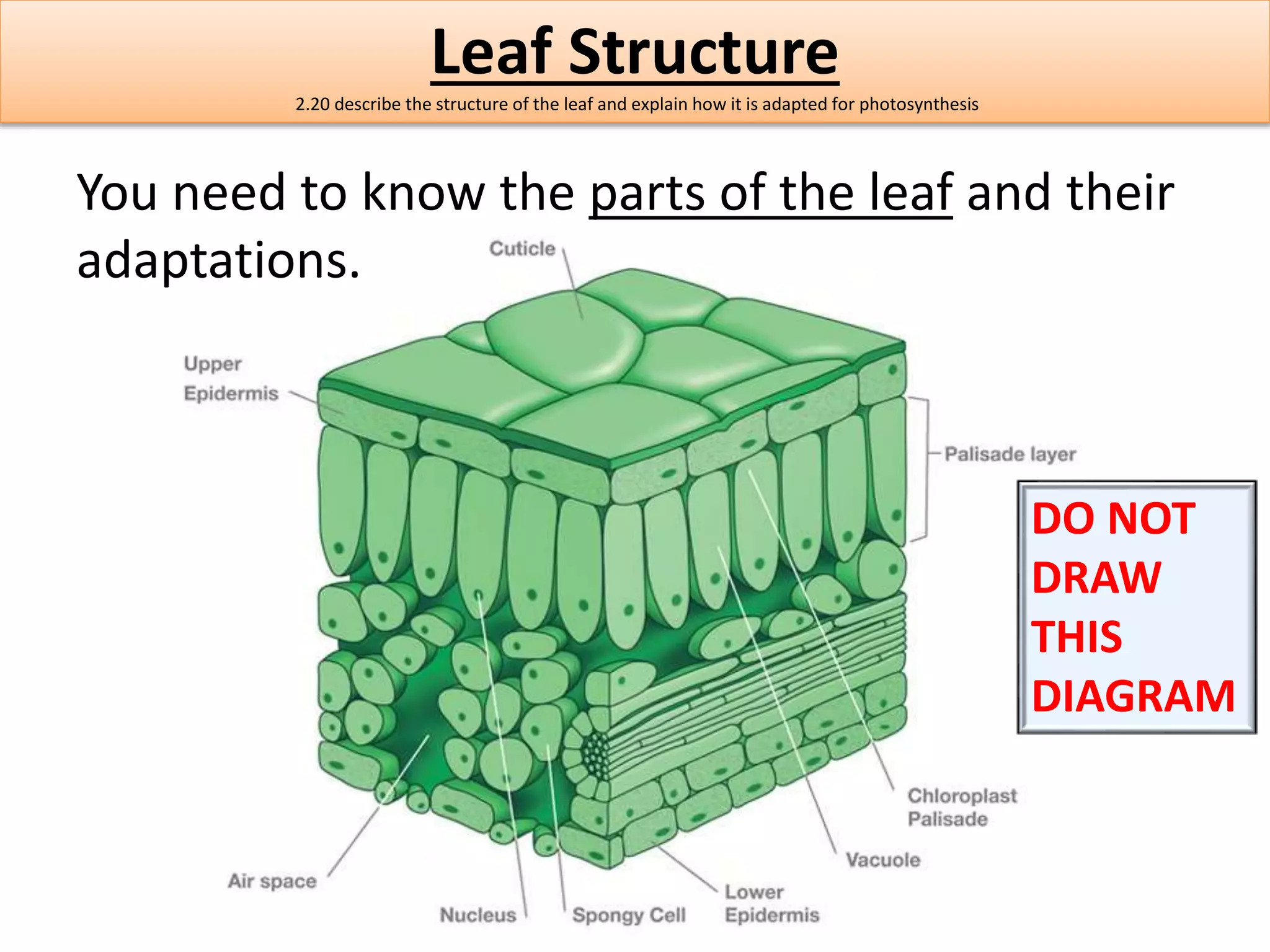
You need to know the parts of the leaf and their 
adaptations. 
DO NOT 
DRAW 
THIS 
DIAGRAM
SIMPLE CROSS SECTIONAL LEAF DIAGRAM 
2.20 describe the structure of the leaf and explain how it is adapted for photosynthesis
More Complicated Cross Section 
2.20 describe the structure of the leaf and explain how it is adapted for photosynthesis
In Real Life 
2.20 describe the structure of the leaf and explain how it is adapted for photosynthesis
LABEL 
2.20 describe the structure of the leaf and explain how it is adapted for photosynthesis
Adaptation 
2.20 describe the structure of the leaf and explain how it is adapted for photosynthesis
Which Tissues Are Missing? 
2.20 describe the structure of the leaf and explain how it is adapted for photosynthesis 
Please add into your notes any tissue missing 
and write in their functions: 
1) Xylem 
2) Phloem 
3) Vascular Bundle 
4) Spongy Mesophyll
Minerals for Nutrition 
2.21 understand that plants require mineral ions for growth and that magnesium ions are needed for chlorophyll and nitrate ions are needed for 
amino acids 
In addition to water and CO2 plants also need specific 
minerals; 
• Nitrate – used to make amino acids for use in plant 
proteins Magnesium – forms part of the chlorophyll 
molecule 
• Potassium - essential for cell membranes 
• Phosphate - essential part of DNA and cell 
membranes
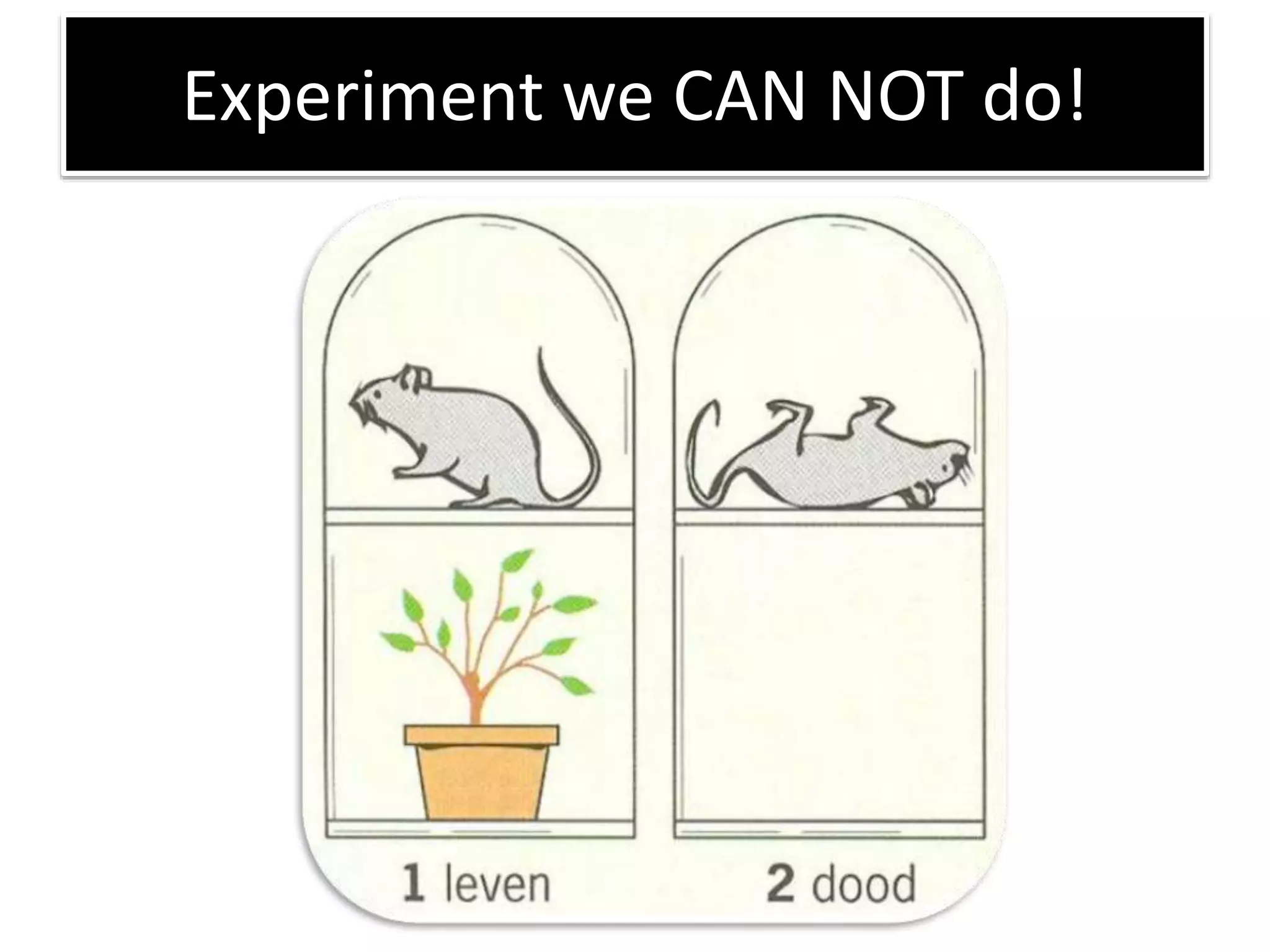
Experiment we CAN NOT do!
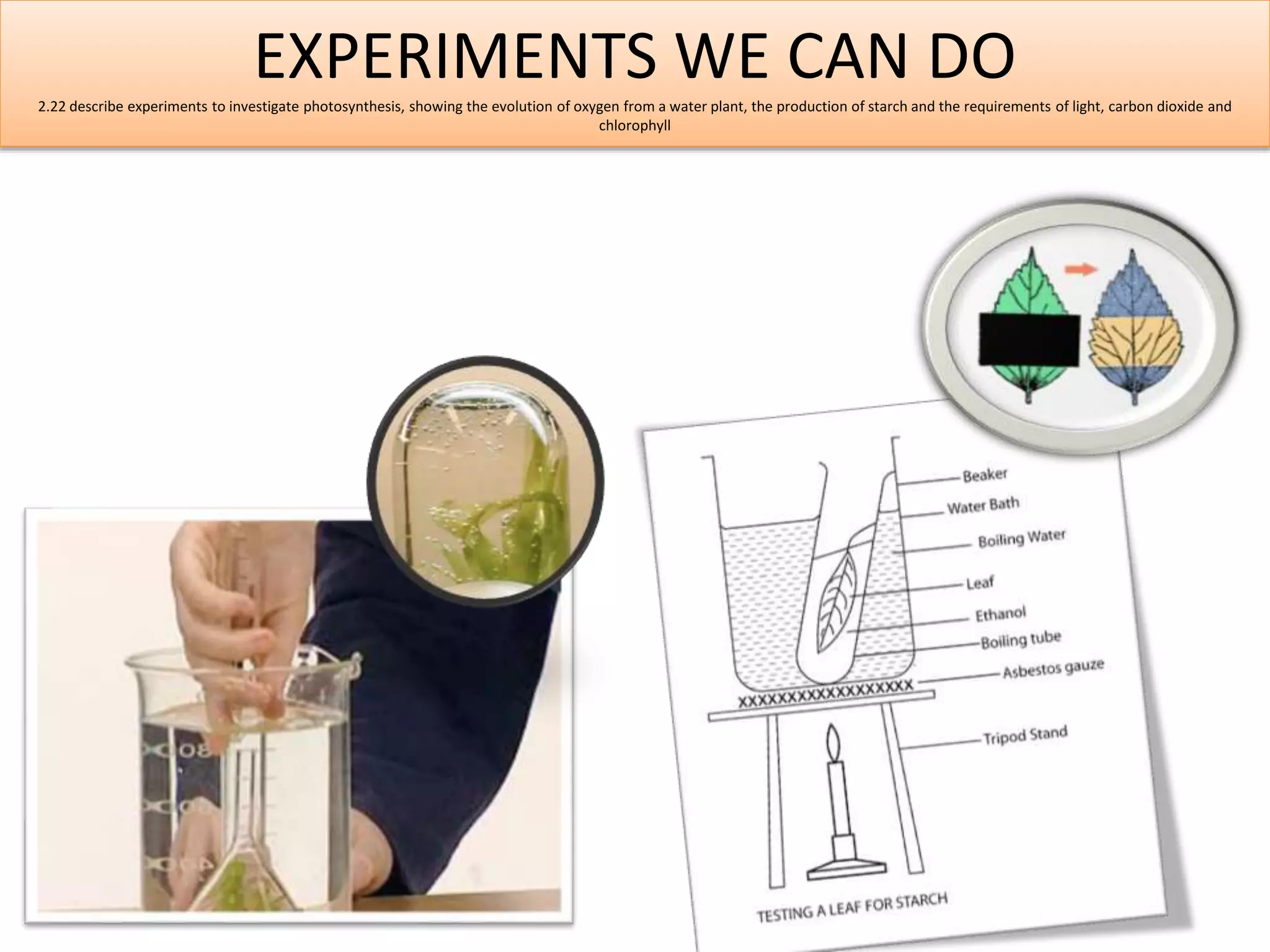
EXPERIMENTS WE CAN DO 
2.22 describe experiments to investigate photosynthesis, showing the evolution of oxygen from a water plant, the production of starch and the requirements of light, carbon dioxide and 
chlorophyll
Using Pond Weed 
2.22 describe experiments to investigate photosynthesis, showing the evolution of oxygen from a water plant, the production of starch and the 
requirements of light, carbon dioxide and chlorophyll 
You must know an experiment that shows how the rate of 
photosynthesis is affected by rate-limiting factors. 
Example: Use pond weed (Elodea) which produces bubbles of O2 as it 
photosynthesizes. 
1) The rate of bubble production is proportional to the rate of 
photosynthesis. 
2) When you add light or give it more CO2, the rate of bubble 
production increases. 
Watch out: 
 Cut Elodea underwater or air bubbles will form in xylem 
 Make sure the O2 is a result of light and not temperature 
 The examiner may ask for a better way to measure O2 production
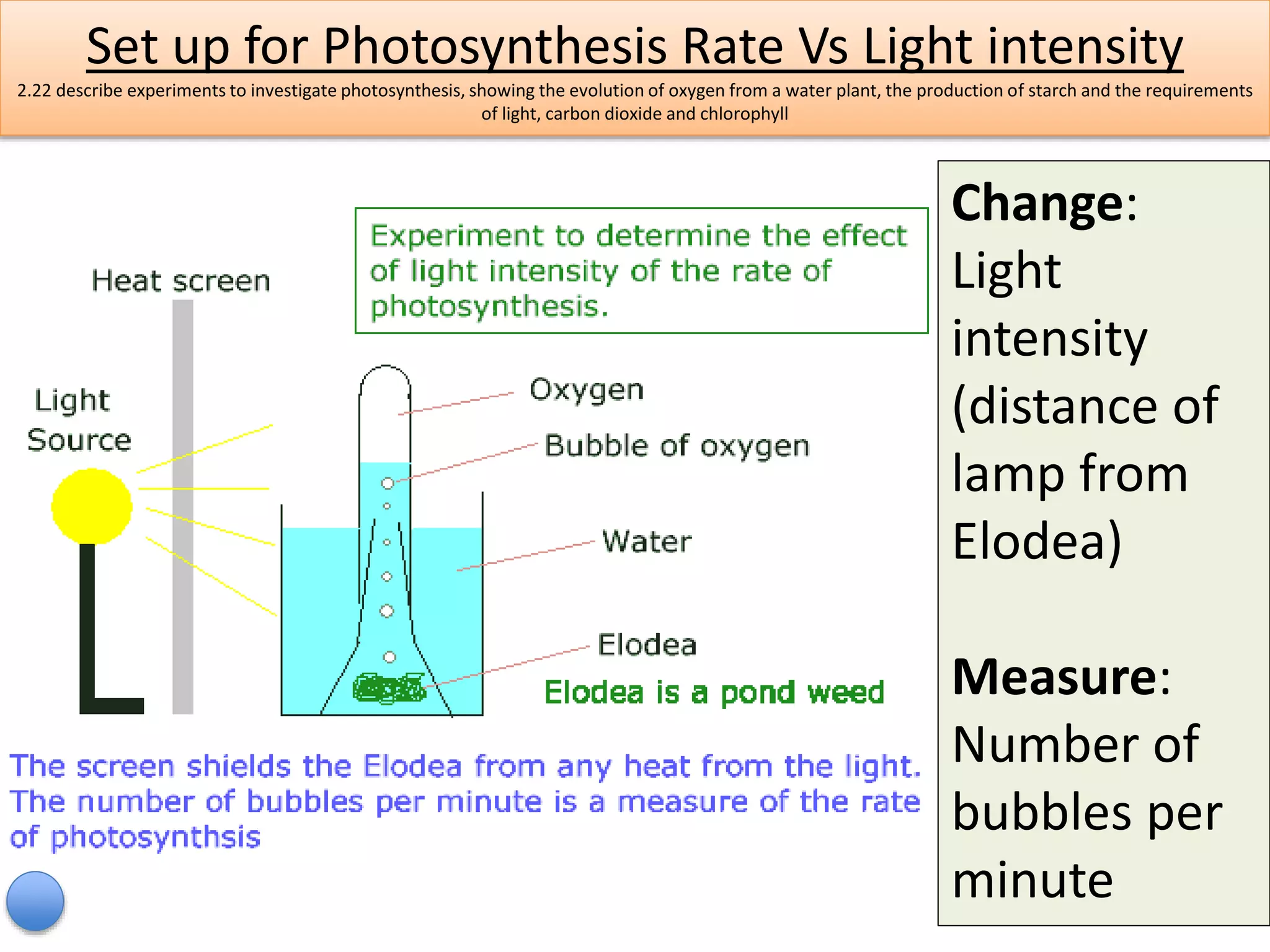
Set up for Photosynthesis Rate Vs Light intensity 
2.22 describe experiments to investigate photosynthesis, showing the evolution of oxygen from a water plant, the production of starch and the requirements 
of light, carbon dioxide and chlorophyll 
Change: 
Light 
intensity 
(distance of 
lamp from 
Elodea) 
Measure: 
Number of 
bubbles per 
minute
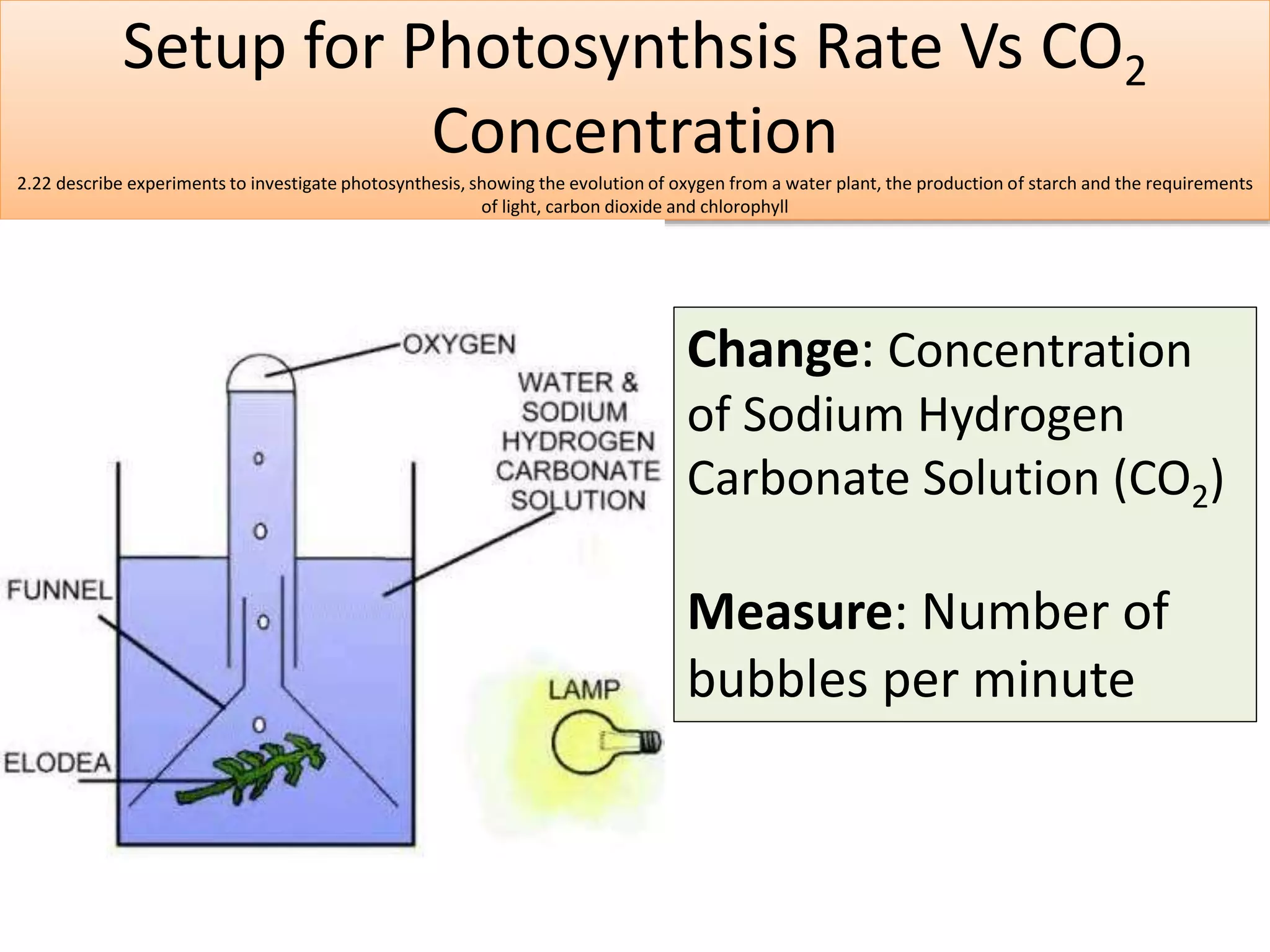
Setup for Photosynthsis Rate Vs CO2 
Concentration 
2.22 describe experiments to investigate photosynthesis, showing the evolution of oxygen from a water plant, the production of starch and the requirements 
of light, carbon dioxide and chlorophyll 
Change: Concentration 
of Sodium Hydrogen 
Carbonate Solution (CO2) 
Measure: Number of 
bubbles per minute
Testing Photosynthesis by Starch 
2.22 describe experiments to investigate photosynthesis, showing the evolution of oxygen from a water plant, the production of starch and the requirements 
of light, carbon dioxide and chlorophyll 
You need to know an experiment that proves that 
light and CO2 are essential for the production of 
starch. 
A good example is the Geranium plant. It’s leaves 
normally turn blue-black in the presence of iodine 
solution showing starch is present 
(you have to boil it in ethanol first to remove the 
chlorophyll to show the colour).
Testing Photosynthesis by Starch 
2.22 describe experiments to investigate photosynthesis, showing the evolution of oxygen from a water plant, the production of starch and the requirements 
of light, carbon dioxide and chlorophyll 
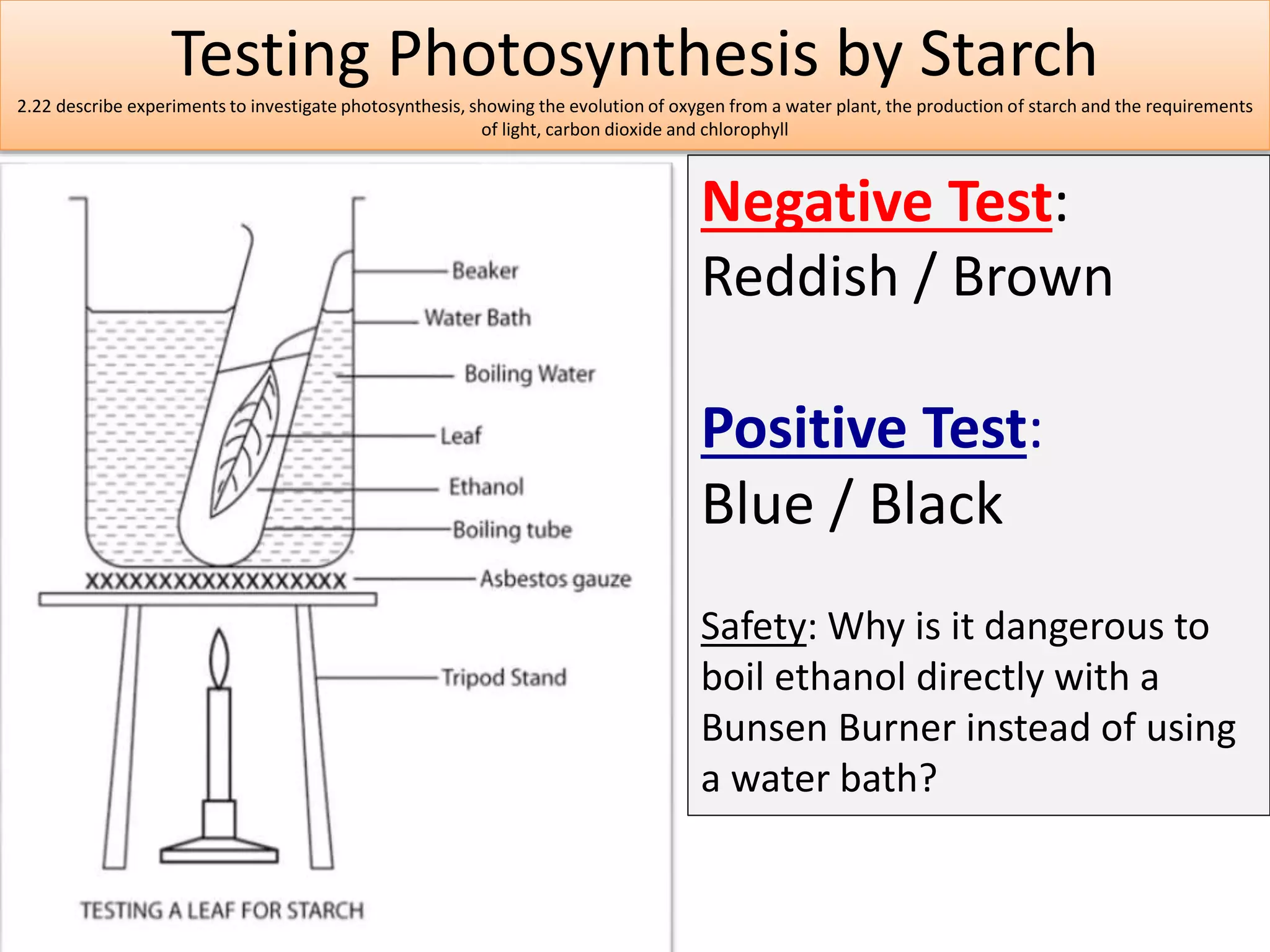
Negative Test: 
Reddish / Brown 
Positive Test: 
Blue / Black 
Safety: Why is it dangerous to 
boil ethanol directly with a 
Bunsen Burner instead of using 
a water bath?
Destarching 
2.22 describe experiments to investigate photosynthesis, showing the evolution of oxygen from a water plant, the production of starch and the requirements of light, carbon 
dioxide and chlorophyll 
You will want to destarch a leaf for this experiment. 
To remove the starch (destarch) 
1) put the poor plant in a dark room for 24 hours. 
2) No light means no photosynthesis, no 
photosynthesis means no glucose produced, no 
glucose produced means no starch stored in the leaf. 
Sadly the leaf still needs to respire so it will break all 
the previously stored starch back into glucose to use 
in respiration. No more starch, poor leaf…
Destarching 
2.22 describe experiments to investigate photosynthesis, showing the evolution of oxygen from a water plant, the production of starch and the requirements of light, carbon 
dioxide and chlorophyll 
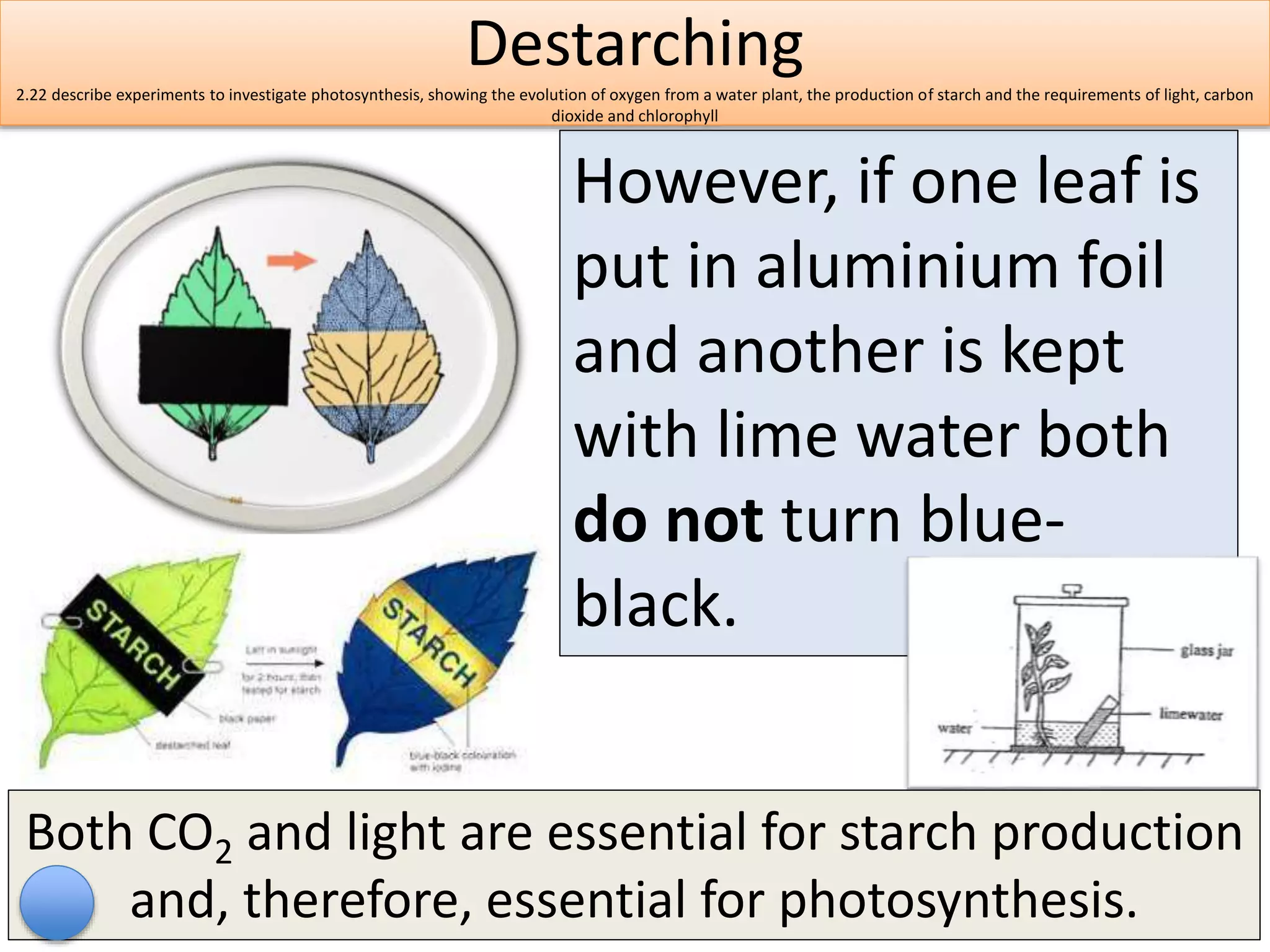
However, if one leaf is 
put in aluminium foil 
and another is kept 
with lime water both 
do not turn blue-black. 
Both CO2 and light are essential for starch production 
and, therefore, essential for photosynthesis.
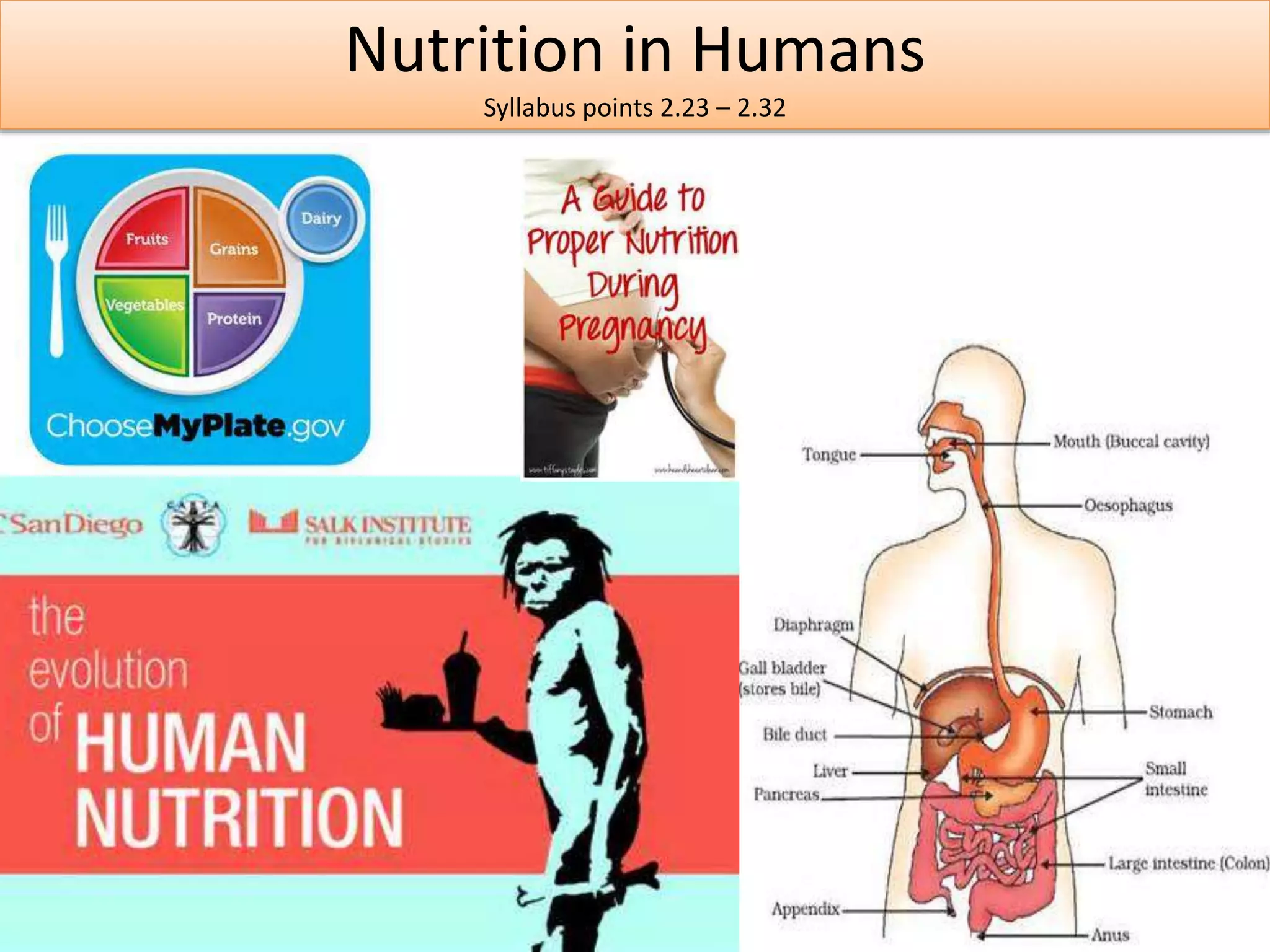
Nutrition in Humans 
Syllabus points 2.23 – 2.32
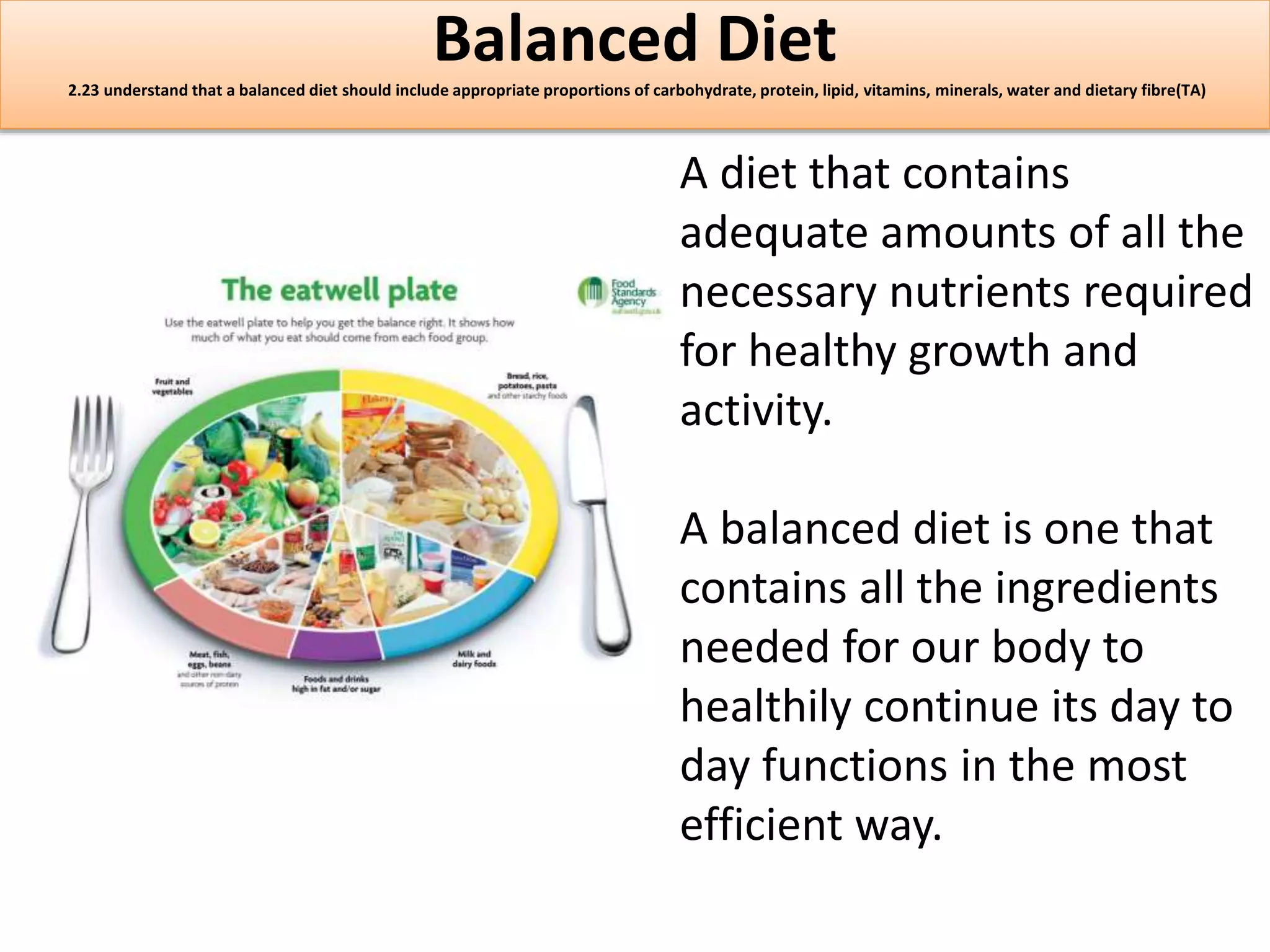
Balanced Diet 
2.23 understand that a balanced diet should include appropriate proportions of carbohydrate, protein, lipid, vitamins, minerals, water and dietary fibre(TA) 
A diet that contains 
adequate amounts of all the 
necessary nutrients required 
for healthy growth and 
activity. 
A balanced diet is one that 
contains all the ingredients 
needed for our body to 
healthily continue its day to 
day functions in the most 
efficient way.
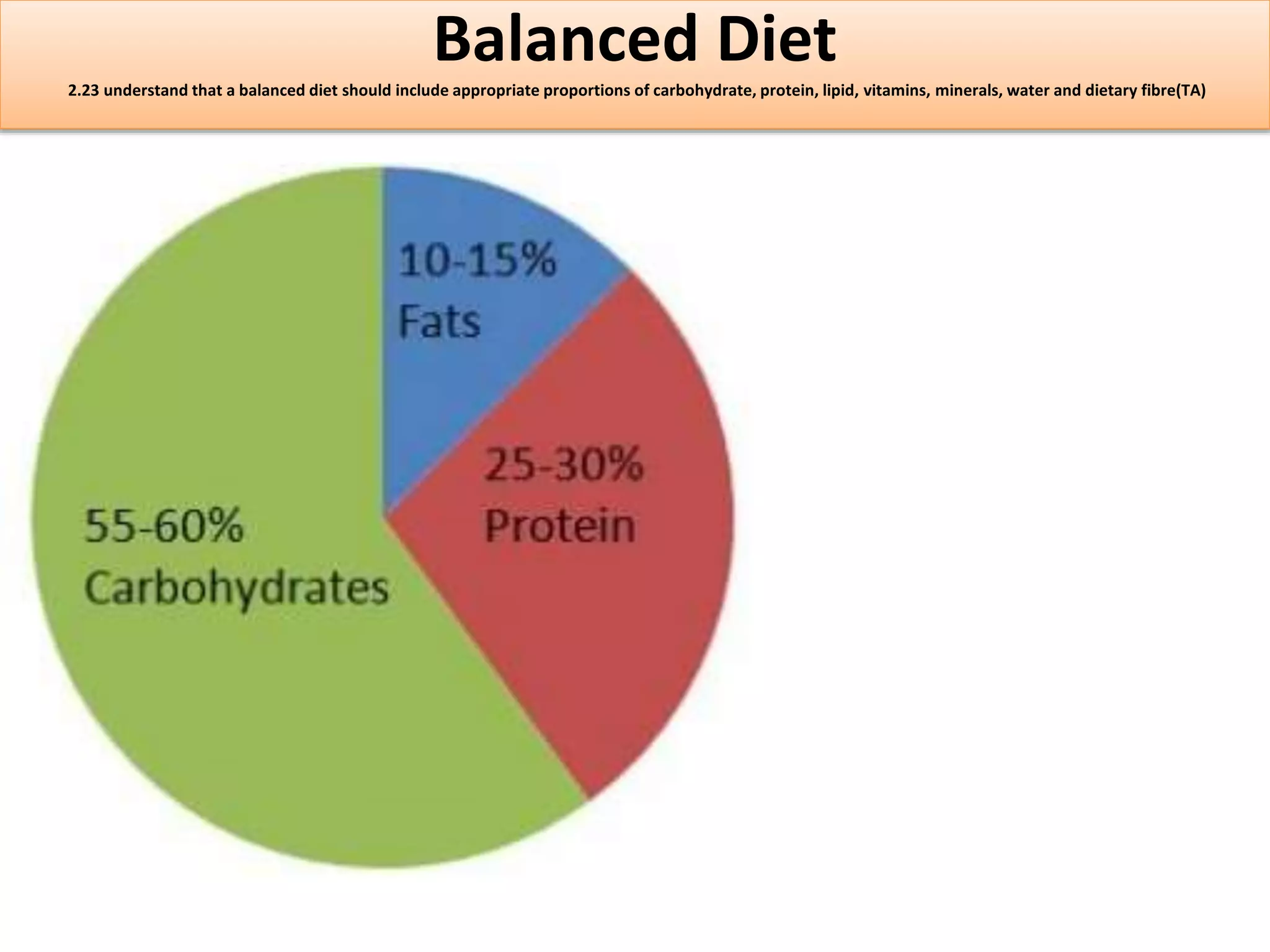
Balanced Diet 
2.23 understand that a balanced diet should include appropriate proportions of carbohydrate, protein, lipid, vitamins, minerals, water and dietary fibre(TA)
Balanced Diet 
2.23 understand that a balanced diet should include appropriate proportions of carbohydrate, protein, lipid, vitamins, minerals, water and dietary fibre(TA) 
72% of our body is WATER. 
We contain so much water because water: 
-Distributes essential nutrients to cells, 
such as minerals, vitamins and glucose as 
part of the plasma in our blood 
-Is an integral part of urine and faeces, 
which removes waste from our body 
-Is needed for sweat (sweat is essential in 
controlling our internal body 
temperature)
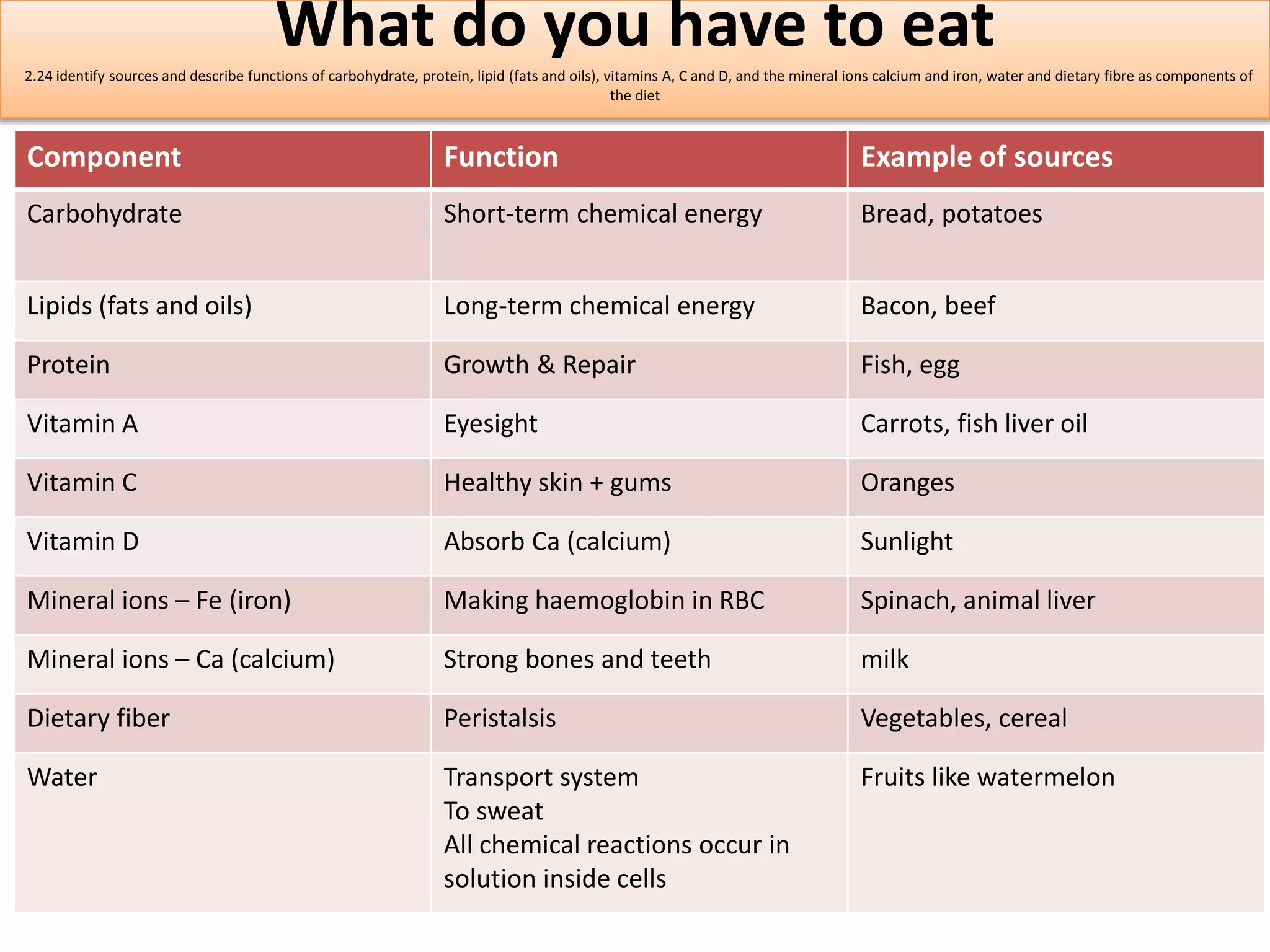
What do you have to eat 
2.24 identify sources and describe functions of carbohydrate, protein, lipid (fats and oils), vitamins A, C and D, and the mineral ions calcium and iron, water and dietary fibre as components of 
the diet 
Component Function Example of sources 
Carbohydrate Short-term chemical energy Bread, potatoes 
Lipids (fats and oils) Long-term chemical energy Bacon, beef 
Protein Growth & Repair Fish, egg 
Vitamin A Eyesight Carrots, fish liver oil 
Vitamin C Healthy skin + gums Oranges 
Vitamin D Absorb Ca (calcium) Sunlight 
Mineral ions – Fe (iron) Making haemoglobin in RBC Spinach, animal liver 
Mineral ions – Ca (calcium) Strong bones and teeth milk 
Dietary fiber Peristalsis Vegetables, cereal 
Water Transport system 
To sweat 
All chemical reactions occur in 
solution inside cells 
Fruits like watermelon
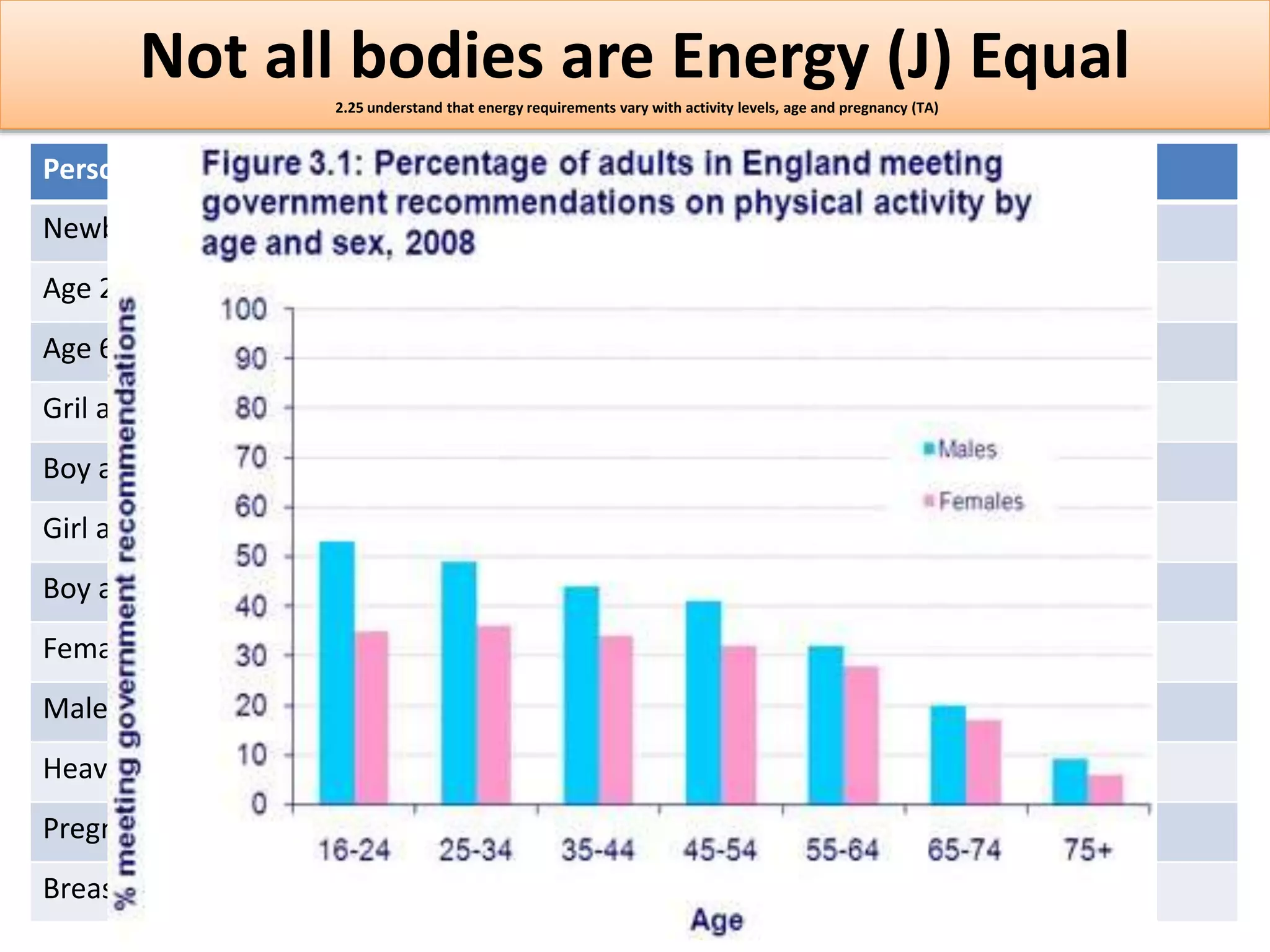
Not all bodies are Energy (J) Equal 
2.25 understand that energy requirements vary with activity levels, age and pregnancy (TA) 
Person Energy needed per day (kJ) 
Newborn baby 2000 
Age 2 5000 
Age 6 7500 
Gril age 12-14 9000 
Boy age 12-14 11000 
Girl age 15-17 9000 
Boy age 15-17 12000 
Female office worker 9500 
Male office worker 10500 
Heavy manual worker 15000 
Pregnant woman 10000 
Breast-feeding woman 11300
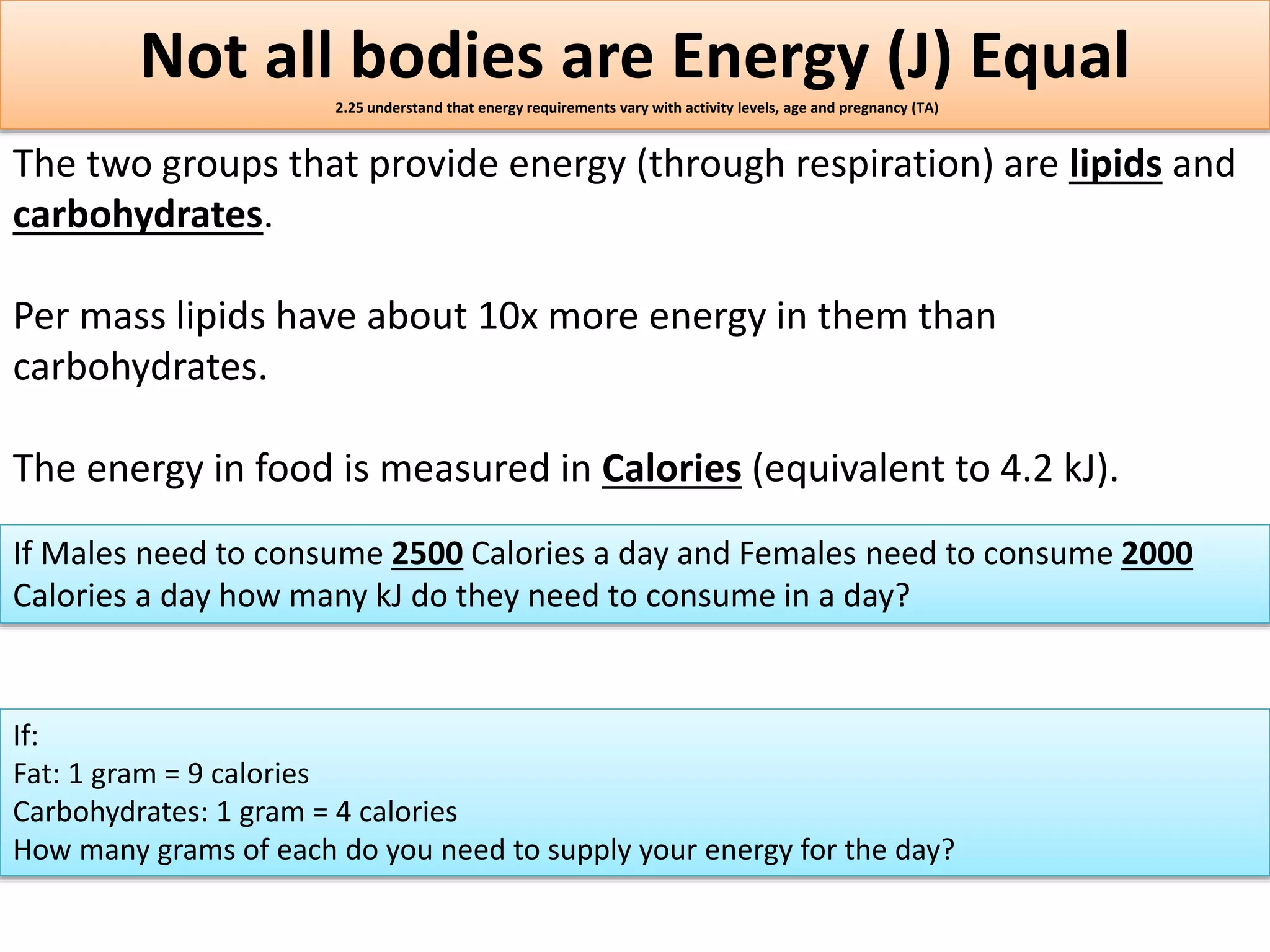
Not all bodies are Energy (J) Equal 
2.25 understand that energy requirements vary with activity levels, age and pregnancy (TA) 
The two groups that provide energy (through respiration) are lipids and 
carbohydrates. 
Per mass lipids have about 10x more energy in them than 
carbohydrates. 
The energy in food is measured in Calories (equivalent to 4.2 kJ). 
If Males need to consume 2500 Calories a day and Females need to consume 2000 
Calories a day how many kJ do they need to consume in a day? 
If: 
Fat: 1 gram = 9 calories 
Carbohydrates: 1 gram = 4 calories 
How many grams of each do you need to supply your energy for the day?
Not all bodies are Energy (J) Equal 
2.25 understand that energy requirements vary with activity levels, age and pregnancy (TA) 
Energy requirements vary according to several factors: 
• Age: growing people require more energy than others. 
• Gender: on average, males require more energy than 
females. 
• Pregnancy: pregnant women require more energy to 
nourish themselves and the baby. 
• Activity levels: more active people require more energy 
as they use up more energy throughout the day.
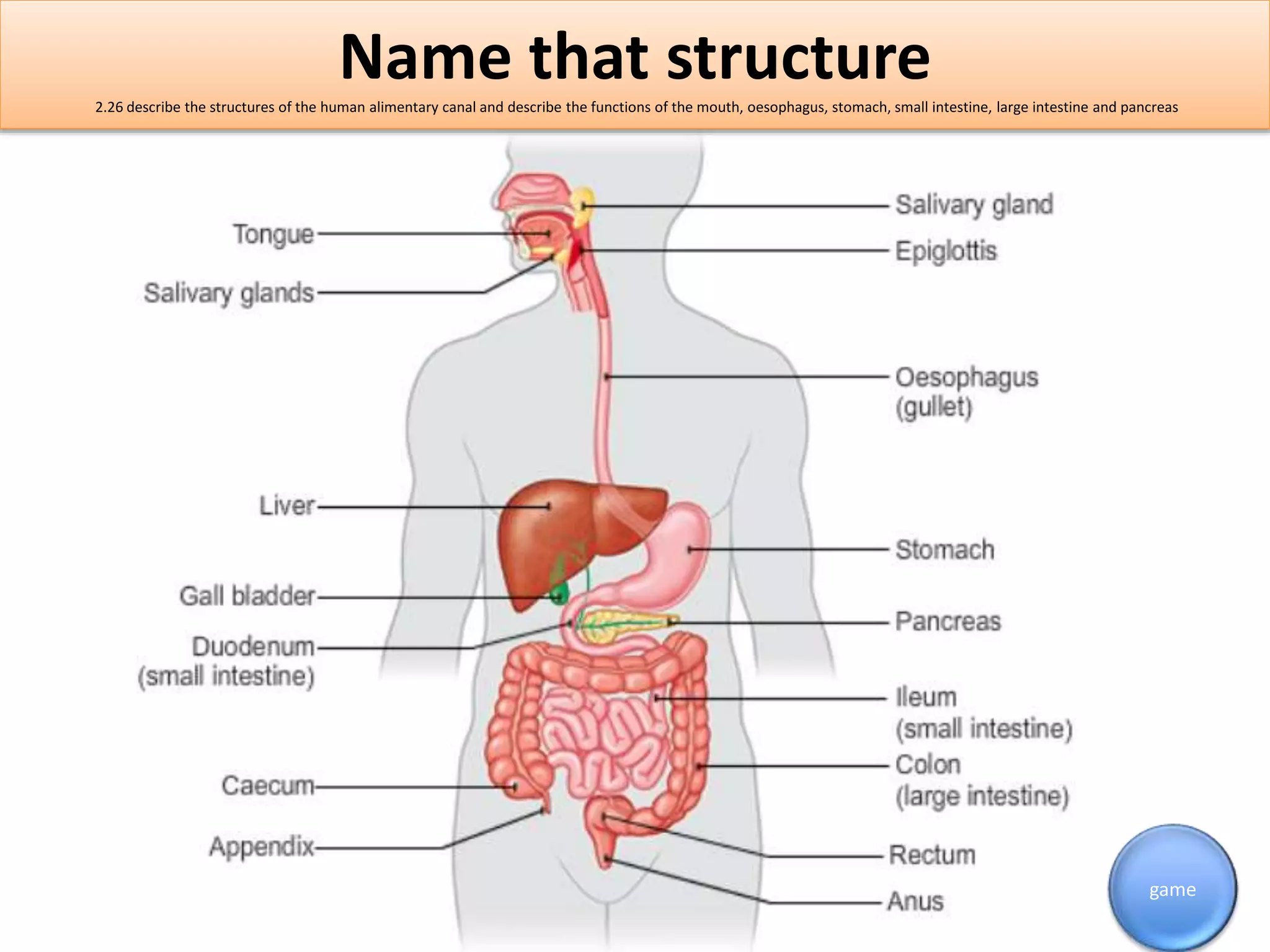
Name that structure 
2.26 describe the structures of the human alimentary canal and describe the functions of the mouth, oesophagus, stomach, small intestine, large intestine and pancreas 
game
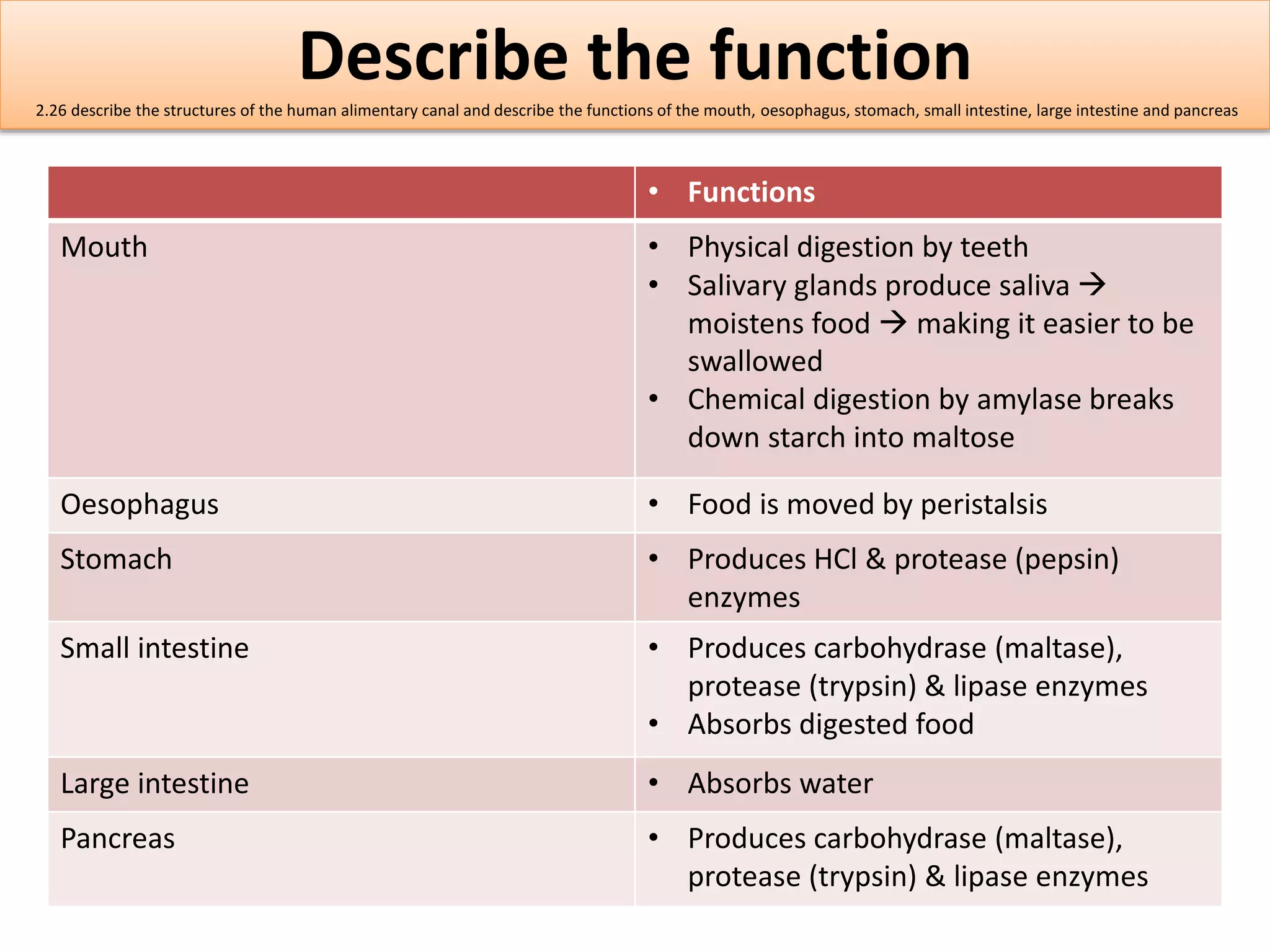
Describe the function 
2.26 describe the structures of the human alimentary canal and describe the functions of the mouth, oesophagus, stomach, small intestine, large intestine and pancreas 
• Functions 
Mouth • Physical digestion by teeth 
• Salivary glands produce saliva  
moistens food  making it easier to be 
swallowed 
• Chemical digestion by amylase breaks 
down starch into maltose 
Oesophagus • Food is moved by peristalsis 
Stomach • Produces HCl & protease (pepsin) 
enzymes 
Small intestine • Produces carbohydrase (maltase), 
protease (trypsin) & lipase enzymes 
• Absorbs digested food 
Large intestine • Absorbs water 
Pancreas • Produces carbohydrase (maltase), 
protease (trypsin) & lipase enzymes
Flow Chart the Process 
2.27 understand the processes of ingestion, digestion, absorption, assimilation and egestion 
Ingestion 
• Taking food into 
the body 
Digestion 
• The breakdown of large 
insoluble molecules into 
small soluble molecules 
so they can be absorbed 
into the blood 
Absorption 
• The process of 
absorbing nutrients 
into the body after 
digestion 
Assimilation 
• Using food 
molecules to build 
new molecules 
Egestion 
• Getting rid of 
undigested/unwan 
ted food
Flow Chart the Process 
2.27 understand the processes of ingestion, digestion, absorption, assimilation and egestion 
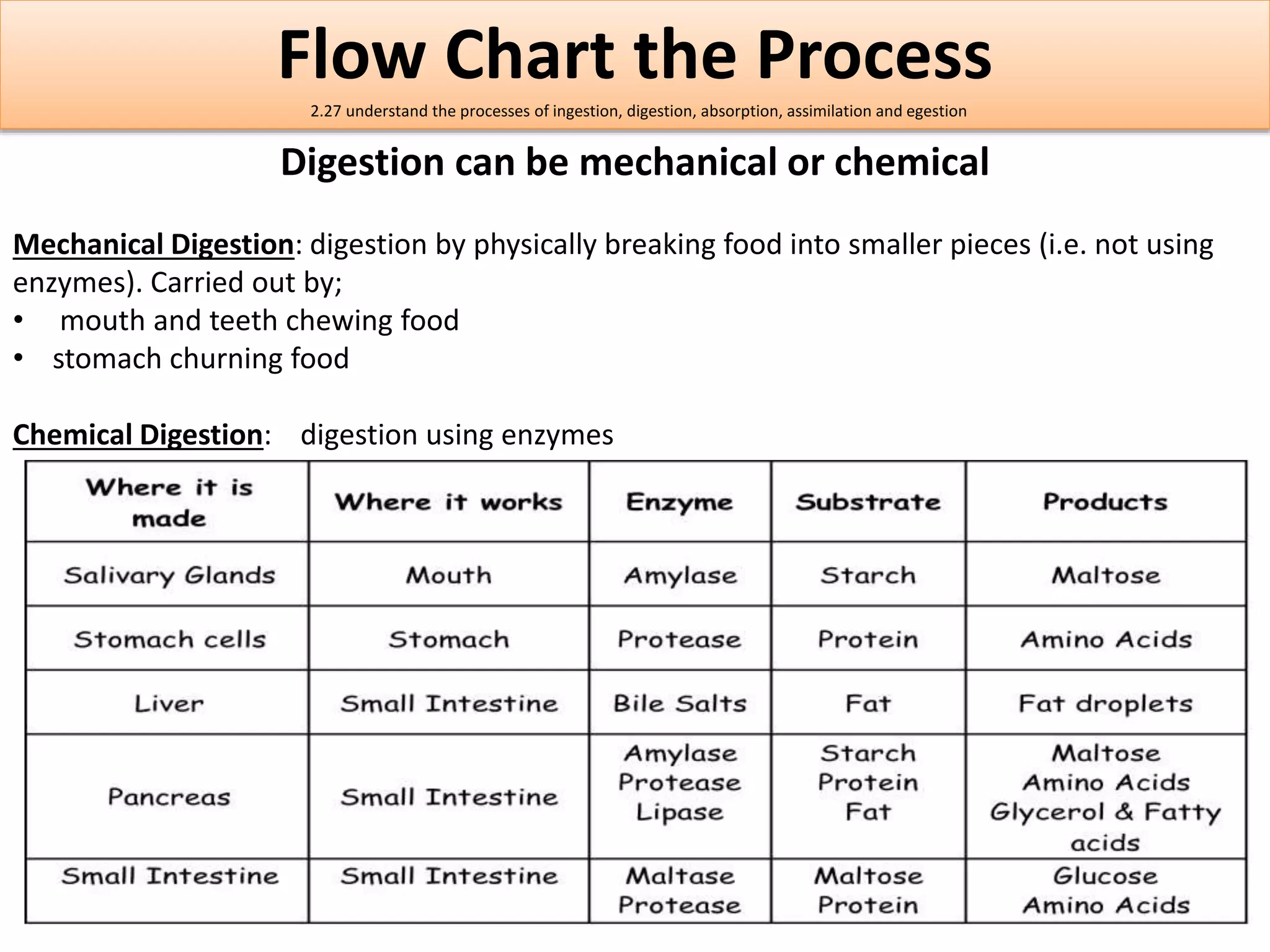
Digestion can be mechanical or chemical 
Mechanical Digestion: digestion by physically breaking food into smaller pieces (i.e. not using 
enzymes). Carried out by; 
• mouth and teeth chewing food 
• stomach churning food 
Chemical Digestion: digestion using enzymes
Peristalsis 
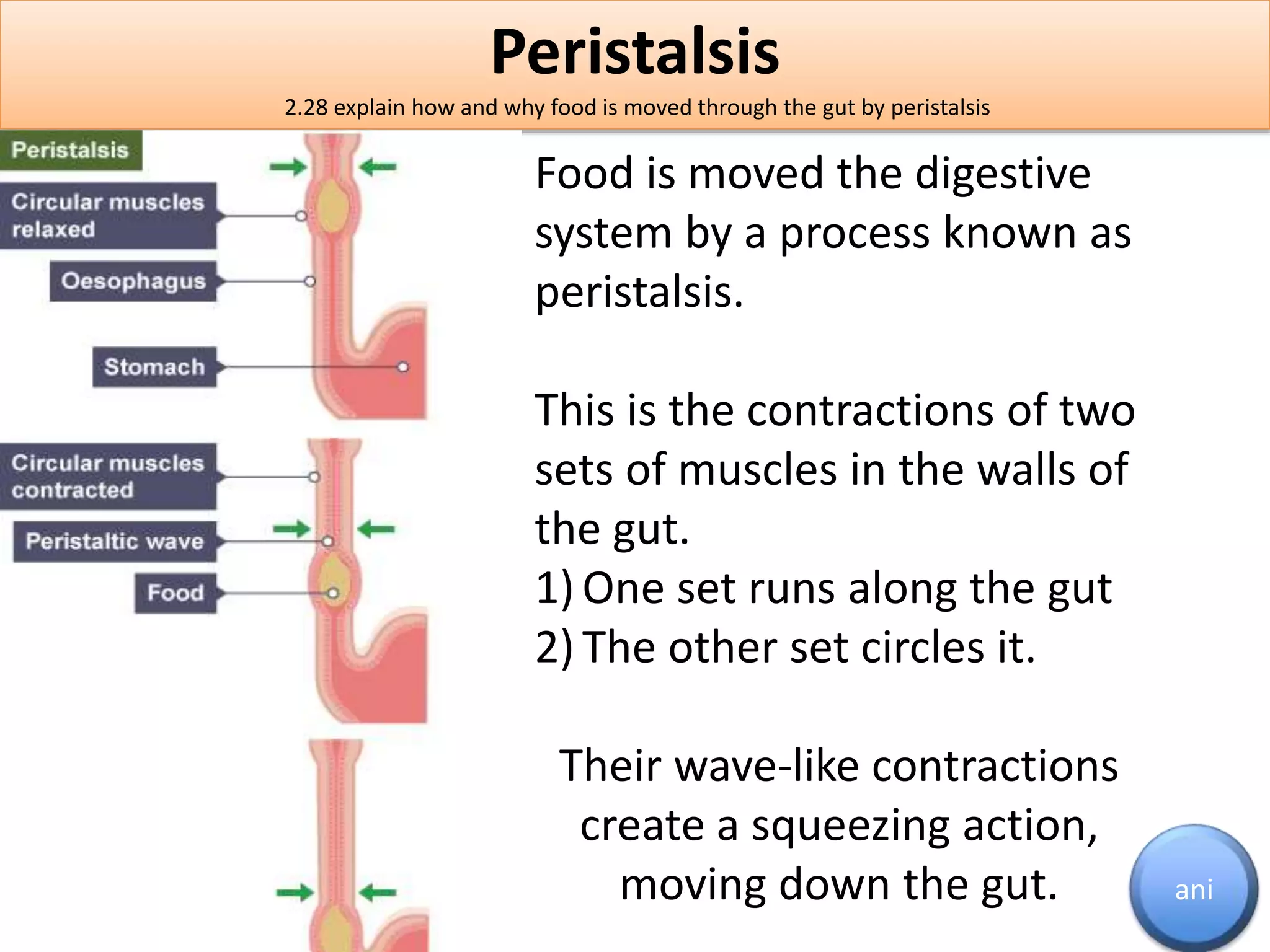
2.28 explain how and why food is moved through the gut by peristalsis 
Food is moved the digestive 
system by a process known as 
peristalsis. 
This is the contractions of two 
sets of muscles in the walls of 
the gut. 
1) One set runs along the gut 
2) The other set circles it. 
Their wave-like contractions 
create a squeezing action, 
moving down the gut. ani
Digestive Enzymes 
2.29 understand the role of digestive enzymes, to include the digestion of starch to glucose by amylase and maltase, the digestion of proteins to amino acids by proteases and the digestion of lipids to fatty acids and 
glycerol by lipases 
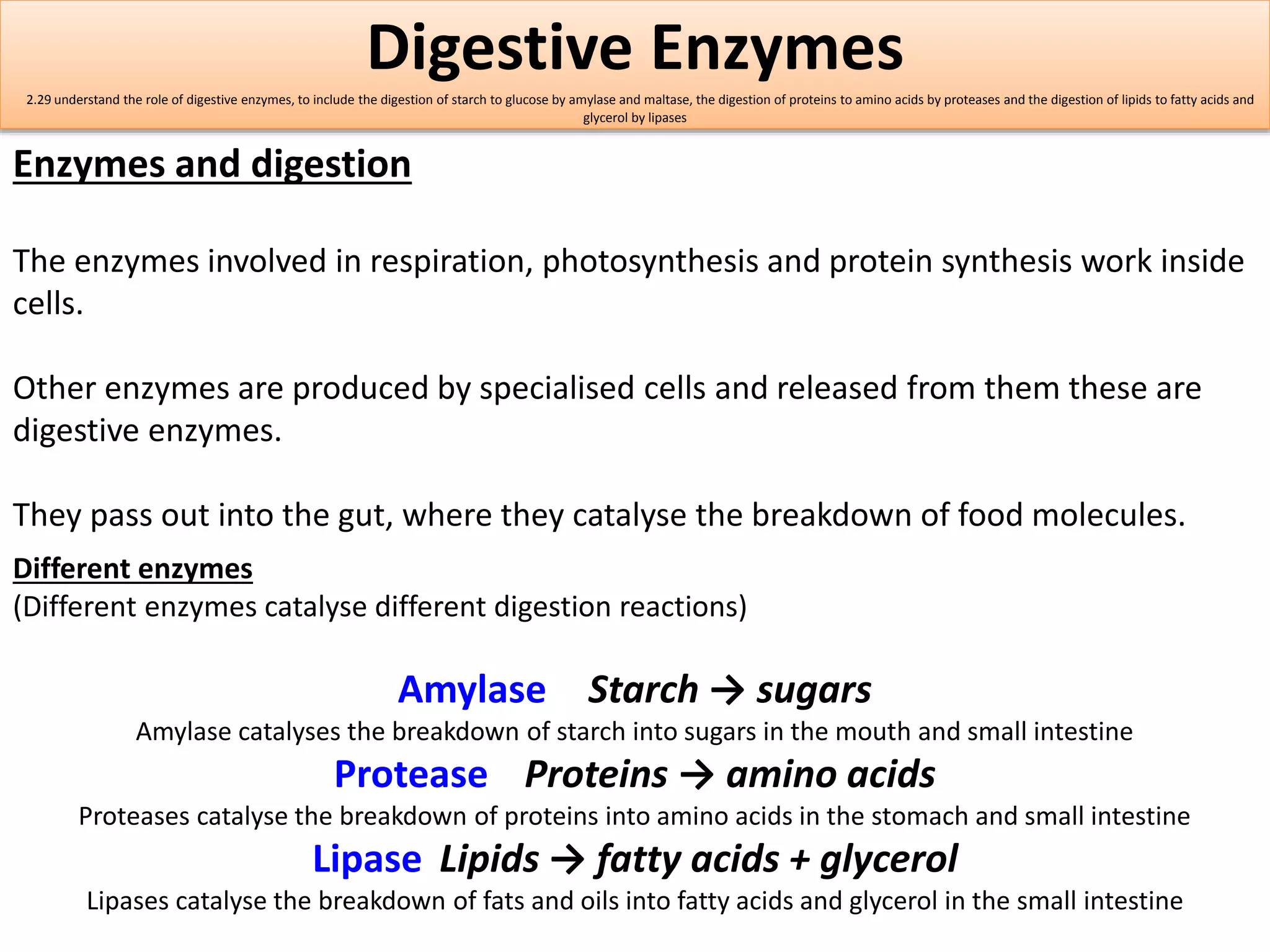
Enzymes and digestion 
The enzymes involved in respiration, photosynthesis and protein synthesis work inside 
cells. 
Other enzymes are produced by specialised cells and released from them these are 
digestive enzymes. 
They pass out into the gut, where they catalyse the breakdown of food molecules. 
Different enzymes 
(Different enzymes catalyse different digestion reactions) 
Amylase Starch → sugars 
Amylase catalyses the breakdown of starch into sugars in the mouth and small intestine 
Protease Proteins → amino acids 
Proteases catalyse the breakdown of proteins into amino acids in the stomach and small intestine 
Lipase Lipids → fatty acids + glycerol 
Lipases catalyse the breakdown of fats and oils into fatty acids and glycerol in the small intestine
Bile is not so Vile 
2.30 understand that bile is produced by the liver and stored in the gall bladder, and understand the role of bile in neutralising stomach acid and emulsifying lipids 
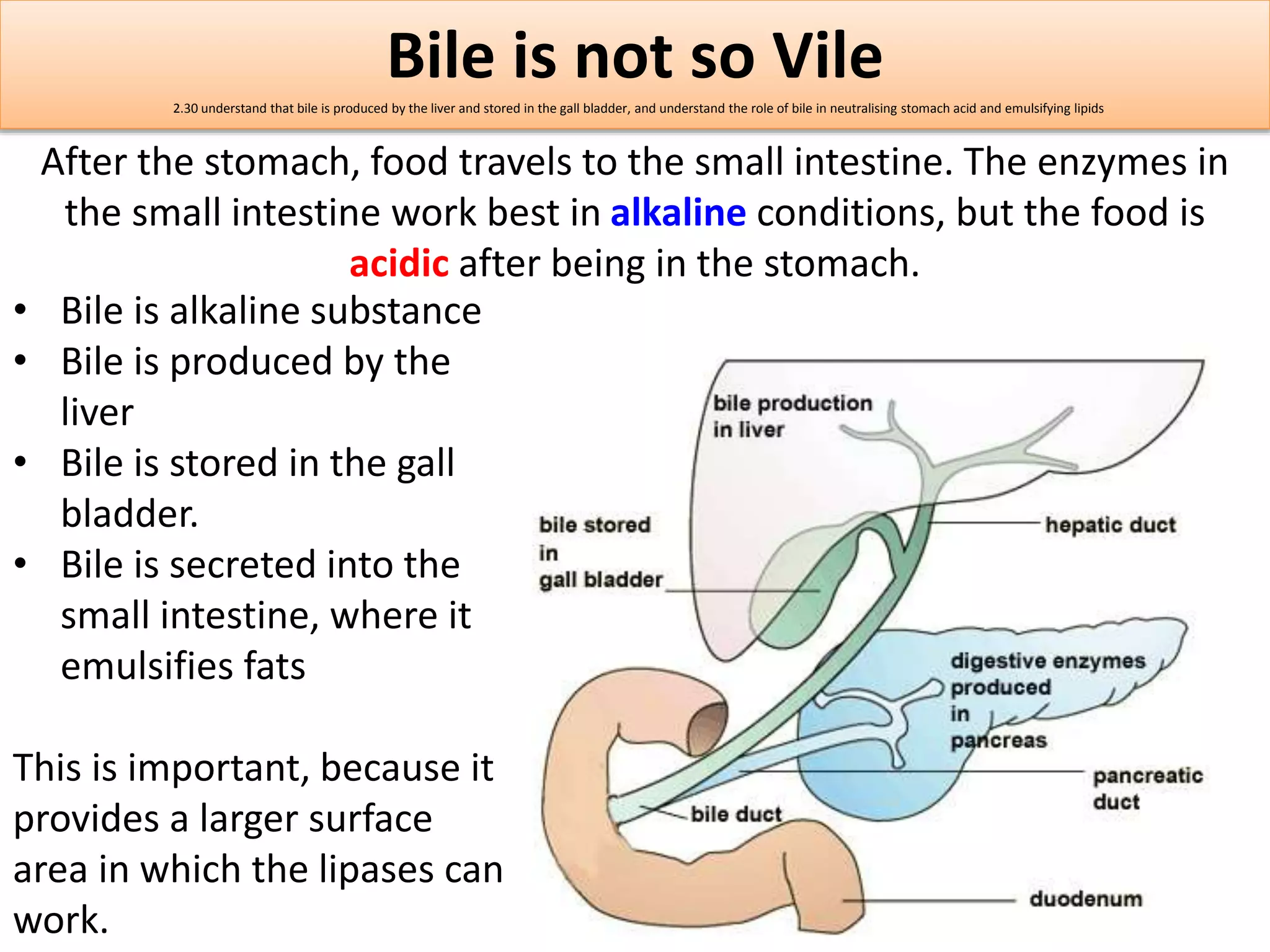
After the stomach, food travels to the small intestine. The enzymes in 
the small intestine work best in alkaline conditions, but the food is 
acidic after being in the stomach. 
• Bile is alkaline substance 
• Bile is produced by the 
liver 
• Bile is stored in the gall 
bladder. 
• Bile is secreted into the 
small intestine, where it 
emulsifies fats 
This is important, because it 
provides a larger surface 
area in which the lipases can 
work.
Silli Villi 
2.31 describe the structure of a villus and explain how this helps absorption of the products of digestion in the small intestine 
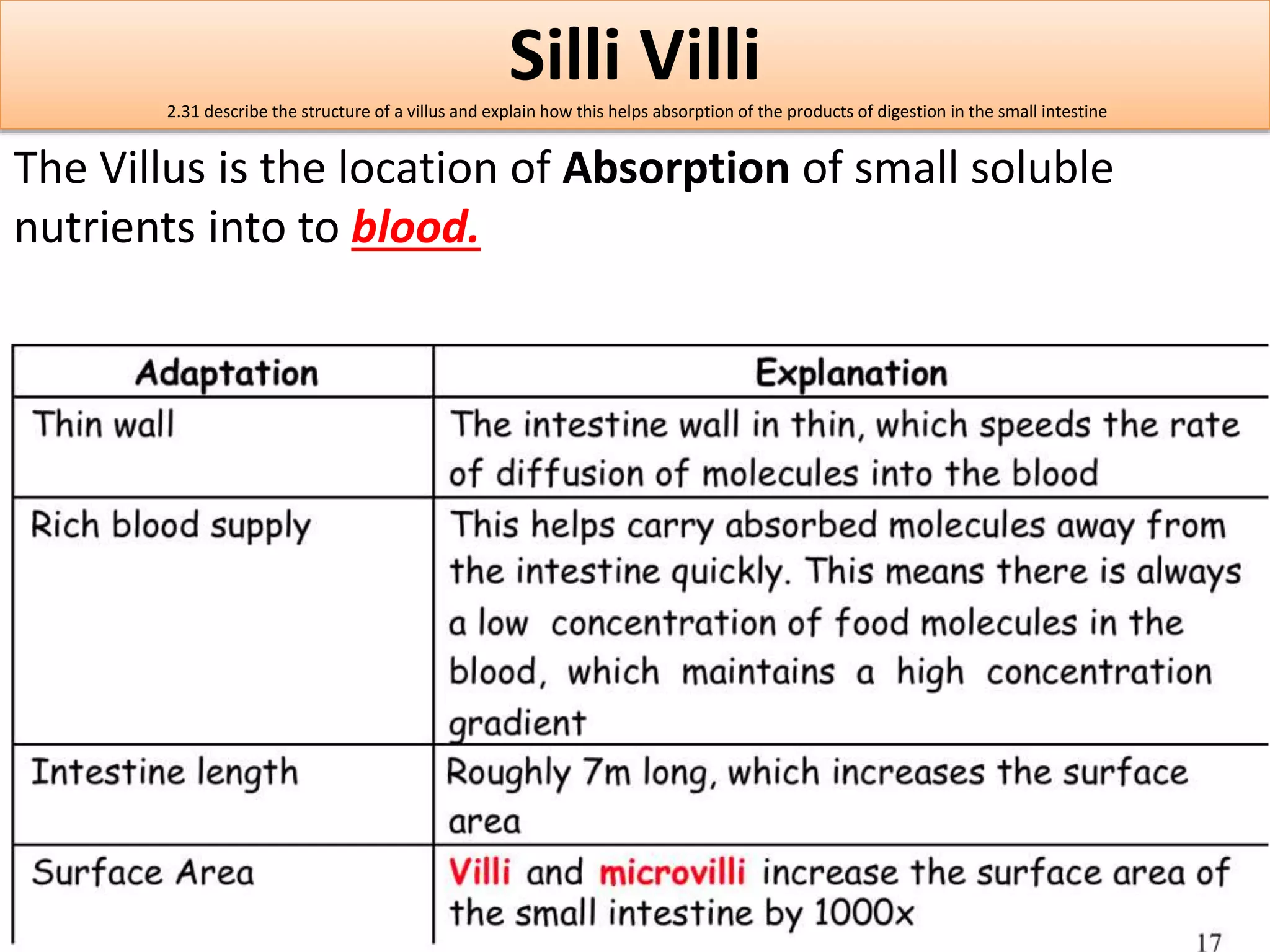
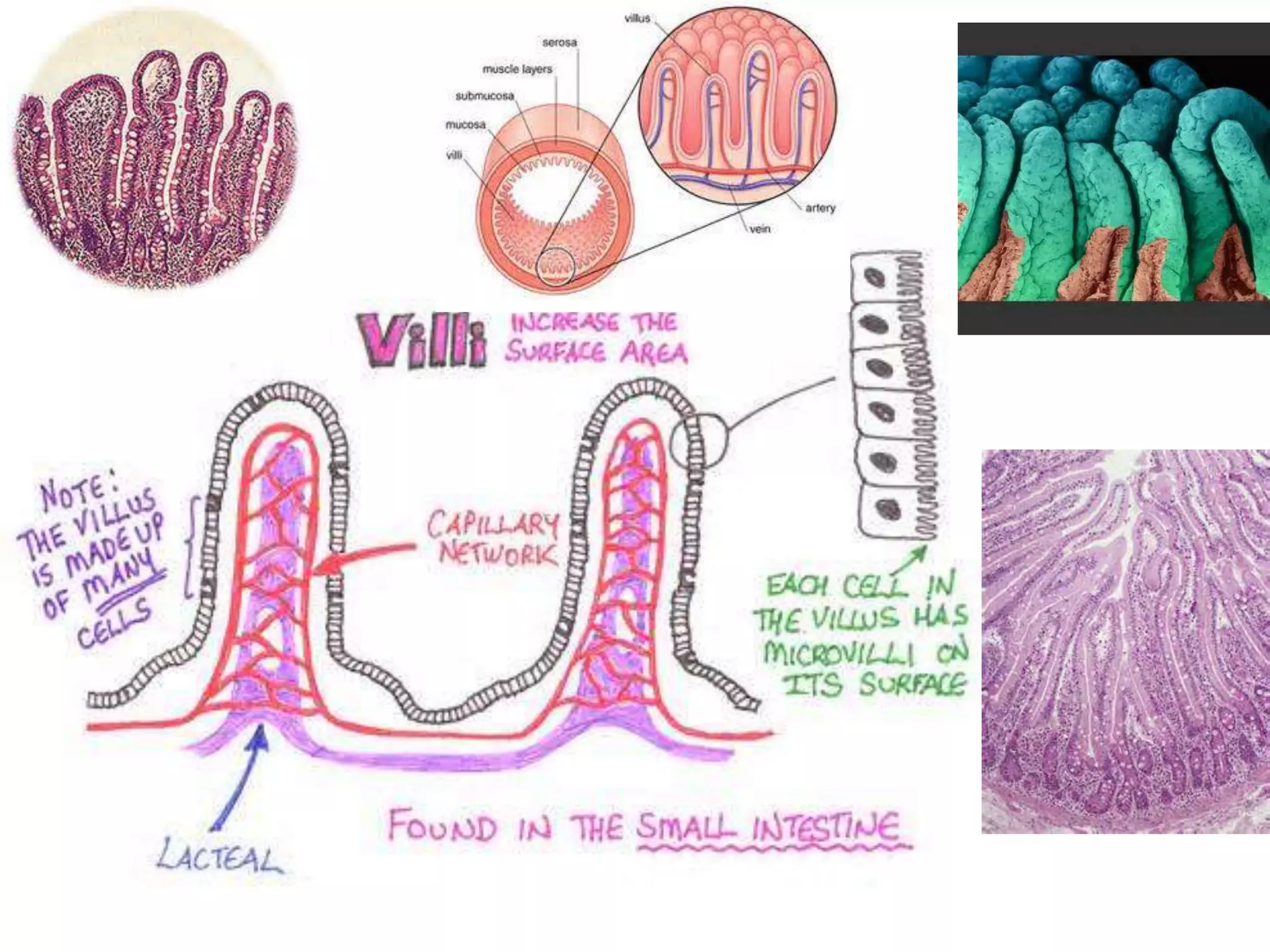
The Villus is the location of Absorption of small soluble 
nutrients into to blood.
How much energy is in that crisp? 
2.32 describe an experiment to investigate the energy content in a food sample.(TA) 
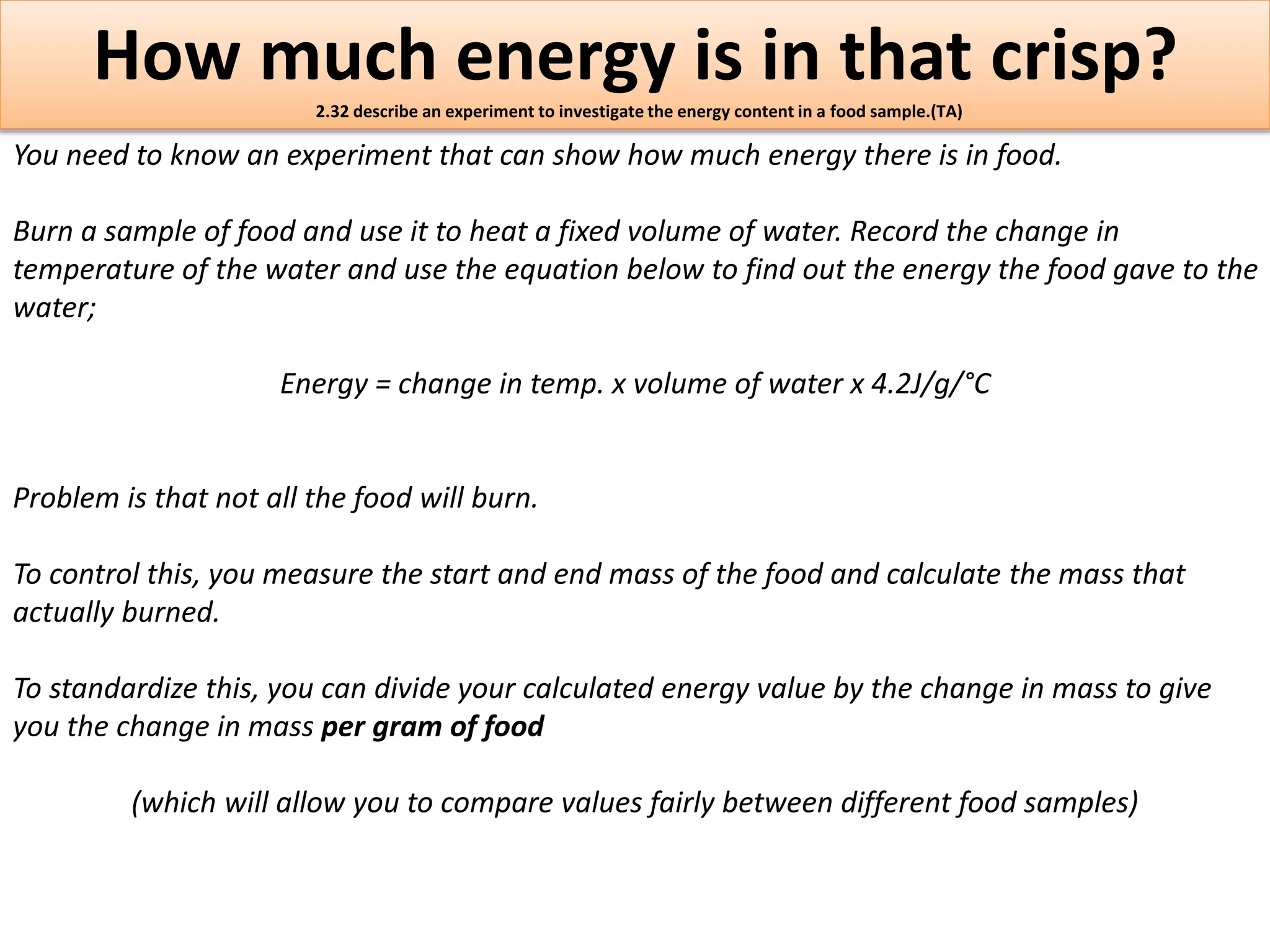
You need to know an experiment that can show how much energy there is in food. 
Burn a sample of food and use it to heat a fixed volume of water. Record the change in 
temperature of the water and use the equation below to find out the energy the food gave to the 
water; 
Energy = change in temp. x volume of water x 4.2J/g/°C 
Problem is that not all the food will burn. 
To control this, you measure the start and end mass of the food and calculate the mass that 
actually burned. 
To standardize this, you can divide your calculated energy value by the change in mass to give 
you the change in mass per gram of food 
(which will allow you to compare values fairly between different food samples)
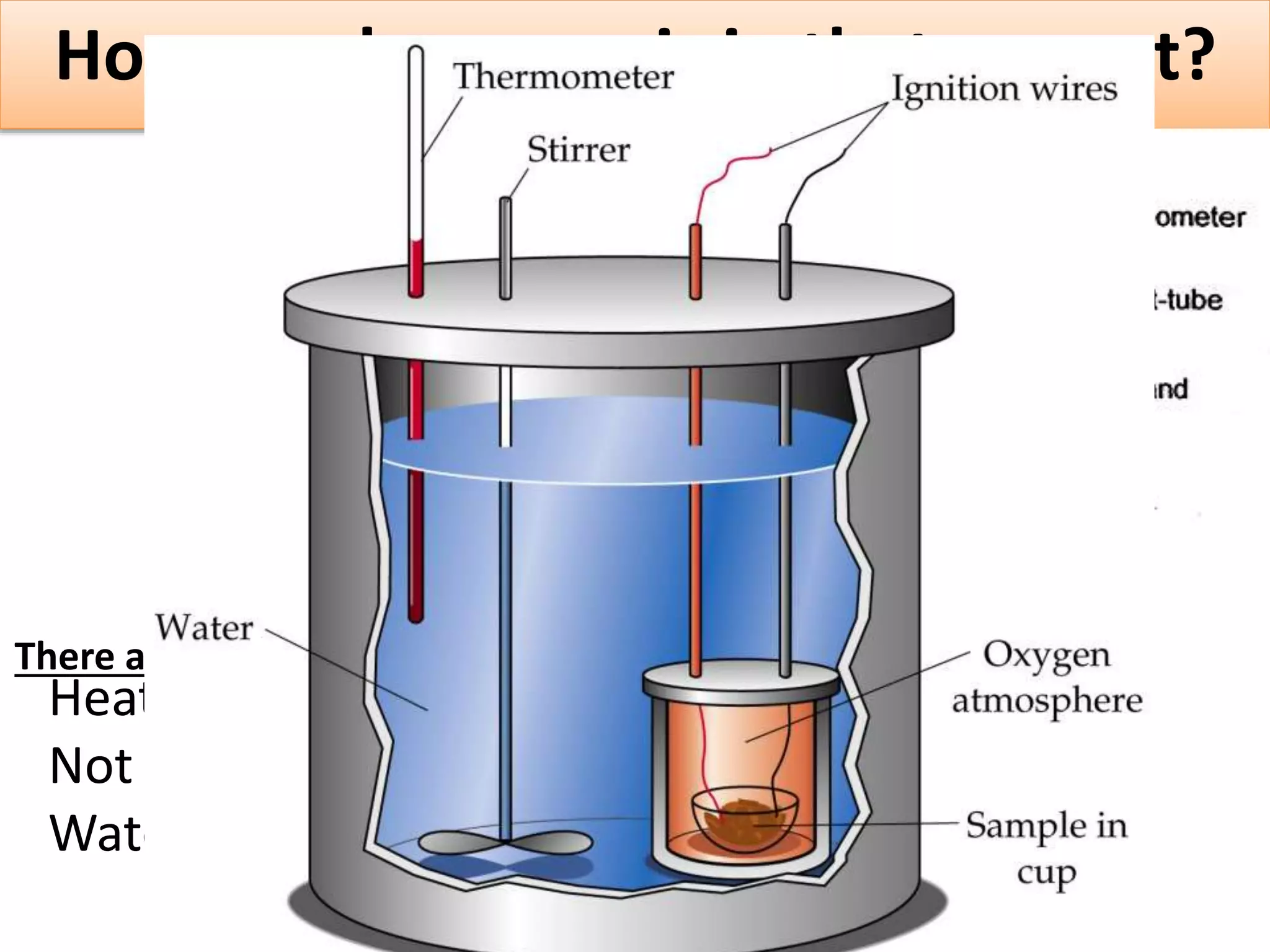
How much energy is in that peanut? 
2.32 describe an experiment to investigate the energy content in a food sample.(TA) 
There are problems with using this system: 
Heat from food item does not heat water 
Not all the food burns 
Water looses heat to environment 
So what is the solution?
Respiration releases ENERGY 
2.33 understand that the process of respiration releases energy in living organisms
Aerobic and Anerobic 
2.34 describe the differences between aerobic and anaerobic respiration
Word and Chemical Equation 
2.35 write the word equation and the balanced chemical symbol equation for aerobic respiration in living organisms
Anaerobic Repiration Word Equation 
2.36 write the word equation for anaerobic respiration in plants and in animals
Experiment for Respiration 
2.37 describe experiments to investigate the evolution of carbon dioxide and heat from respiring seeds or other suitable living organisms.
Gas Exchange 
2.38 understand the role of diffusion in gas exchange
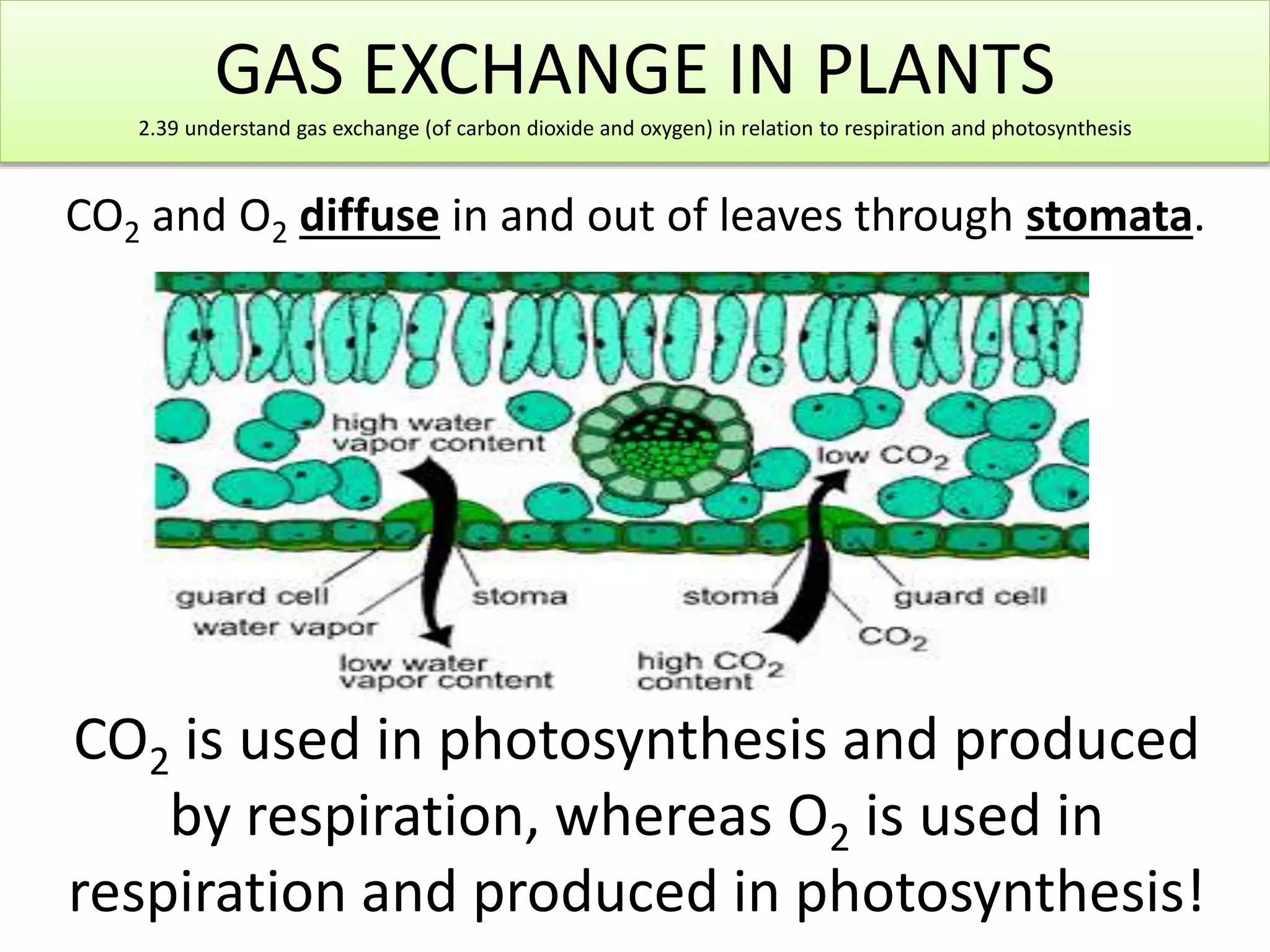
GAS EXCHANGE IN PLANTS 
2.39 understand gas exchange (of carbon dioxide and oxygen) in relation to respiration and photosynthesis 
CO2 and O2 diffuse in and out of leaves through stomata. 
CO2 is used in photosynthesis and produced 
by respiration, whereas O2 is used in 
respiration and produced in photosynthesis!
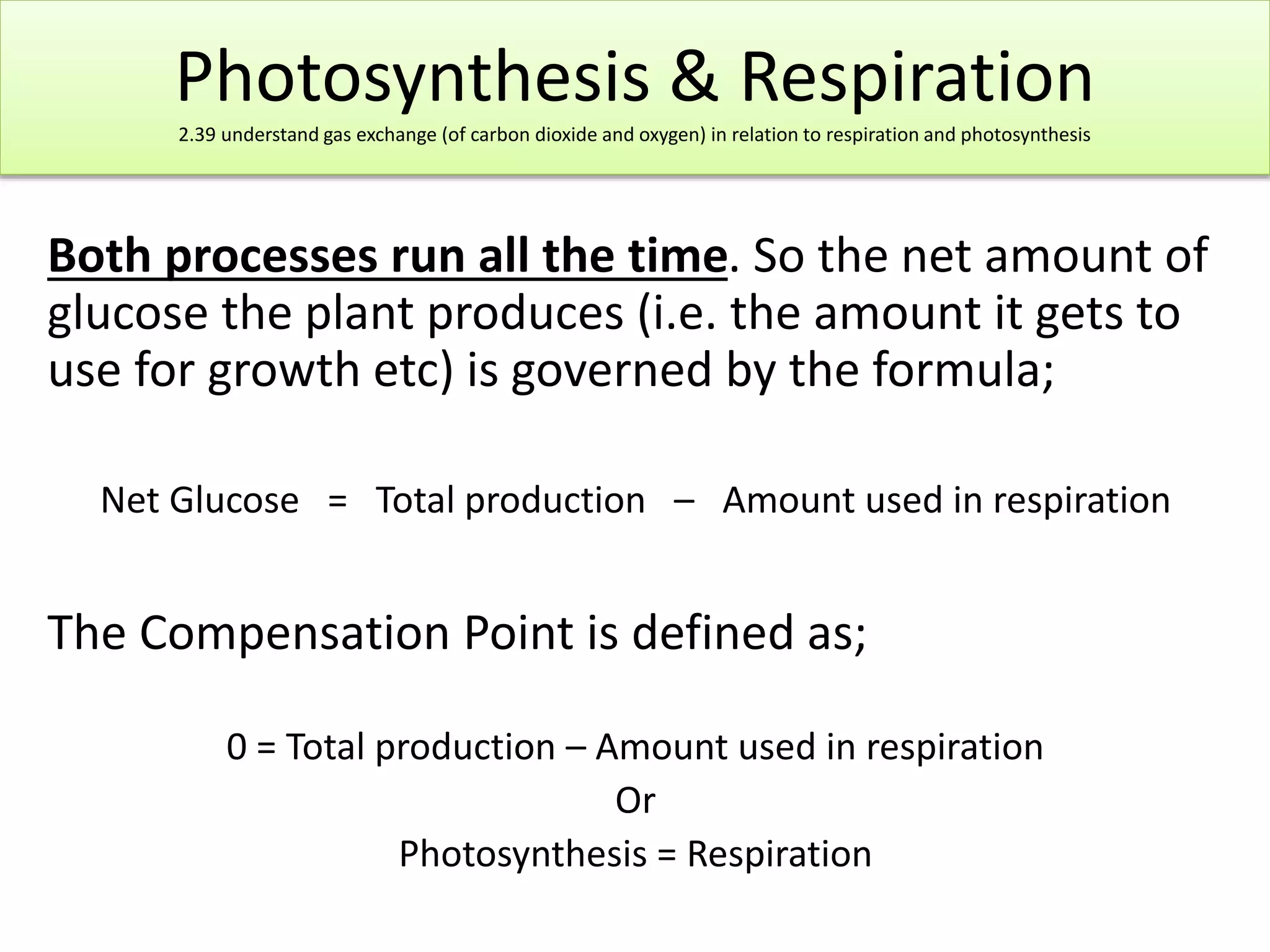
Photosynthesis & Respiration 
2.39 understand gas exchange (of carbon dioxide and oxygen) in relation to respiration and photosynthesis 
Both processes run all the time. So the net amount of 
glucose the plant produces (i.e. the amount it gets to 
use for growth etc) is governed by the formula; 
Net Glucose = Total production – Amount used in respiration 
The Compensation Point is defined as; 
0 = Total production – Amount used in respiration 
Or 
Photosynthesis = Respiration
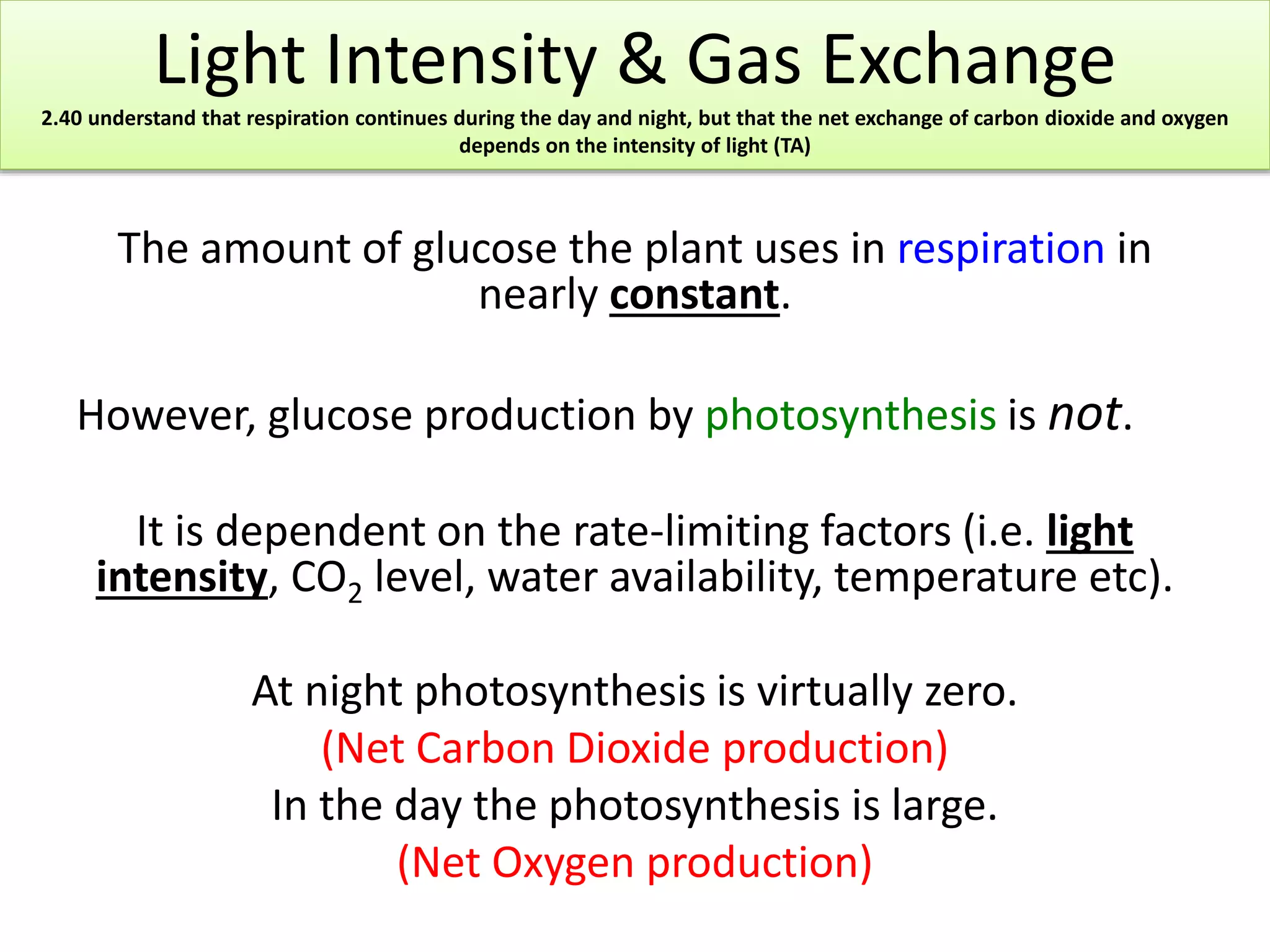
Light Intensity & Gas Exchange 
2.40 understand that respiration continues during the day and night, but that the net exchange of carbon dioxide and oxygen 
depends on the intensity of light (TA) 
The amount of glucose the plant uses in respiration in 
nearly constant. 
However, glucose production by photosynthesis is not. 
It is dependent on the rate-limiting factors (i.e. light 
intensity, CO2 level, water availability, temperature etc). 
At night photosynthesis is virtually zero. 
(Net Carbon Dioxide production) 
In the day the photosynthesis is large. 
(Net Oxygen production)
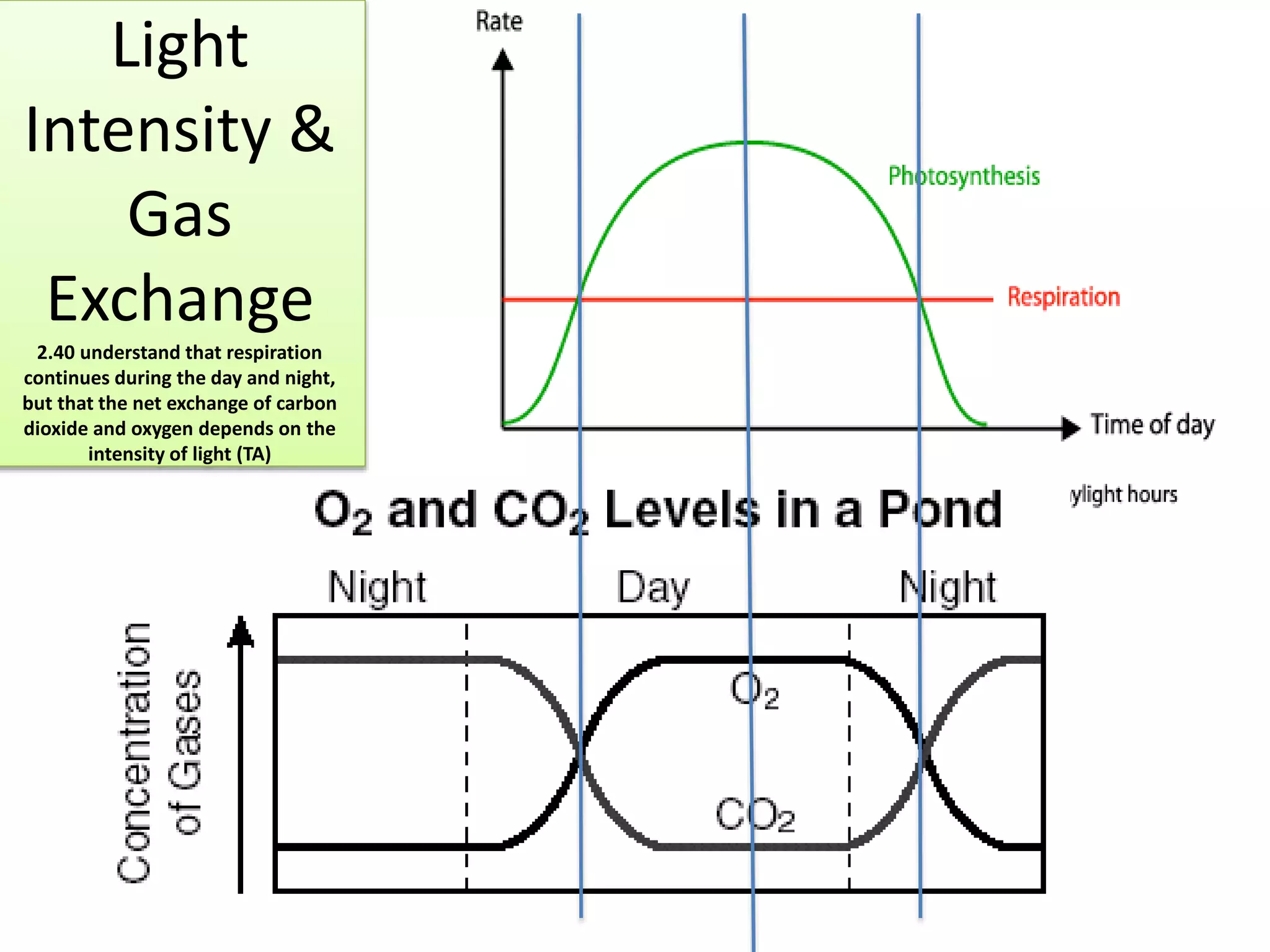
Light 
Intensity & 
Gas 
Exchange 
2.40 understand that respiration 
continues during the day and night, 
but that the net exchange of carbon 
dioxide and oxygen depends on the 
intensity of light (TA)
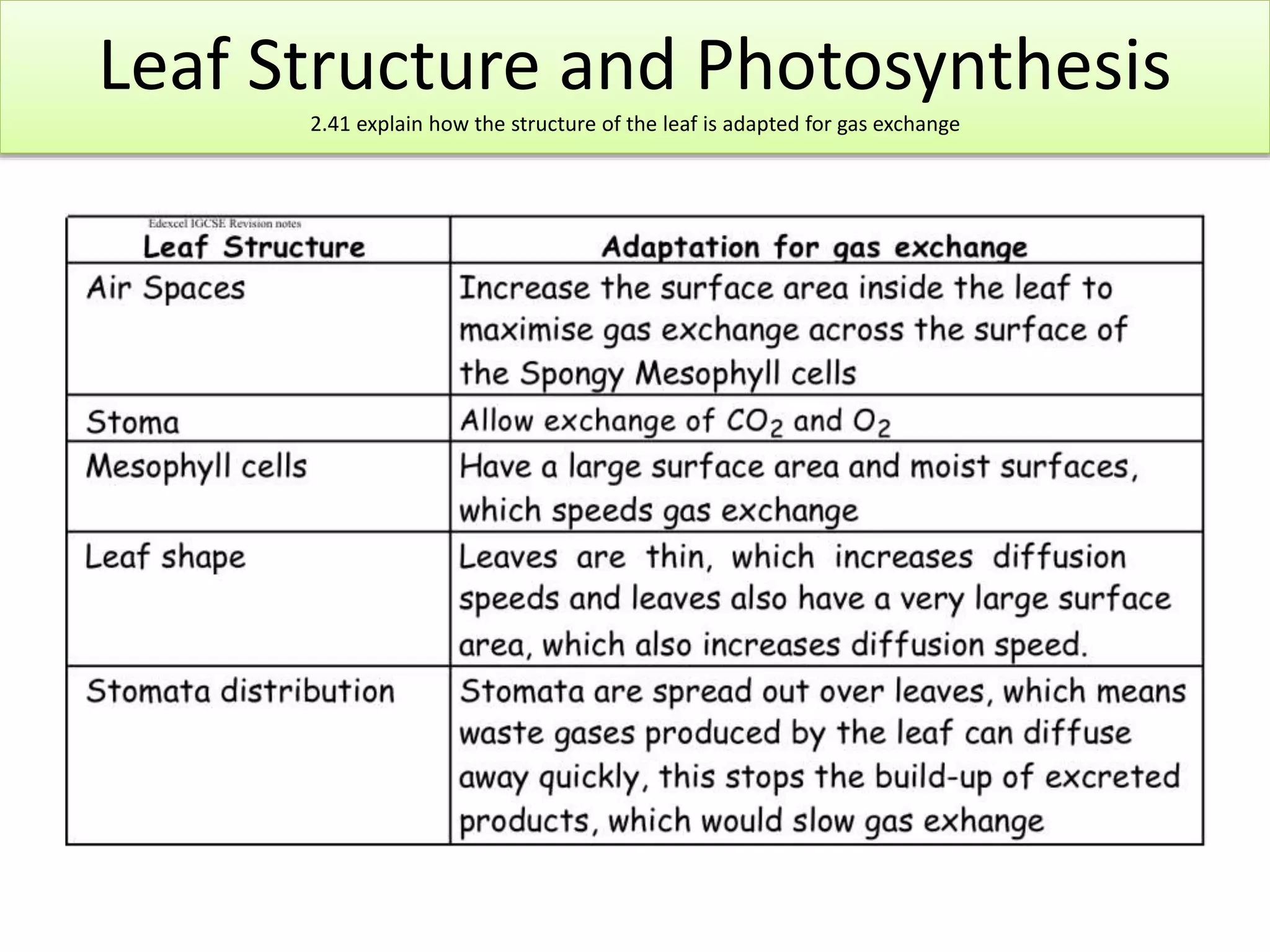
Leaf Structure and Photosynthesis 
2.41 explain how the structure of the leaf is adapted for gas exchange
Stomata and Gas Exchange 
2.42 describe the role of stomata in gas exchange 
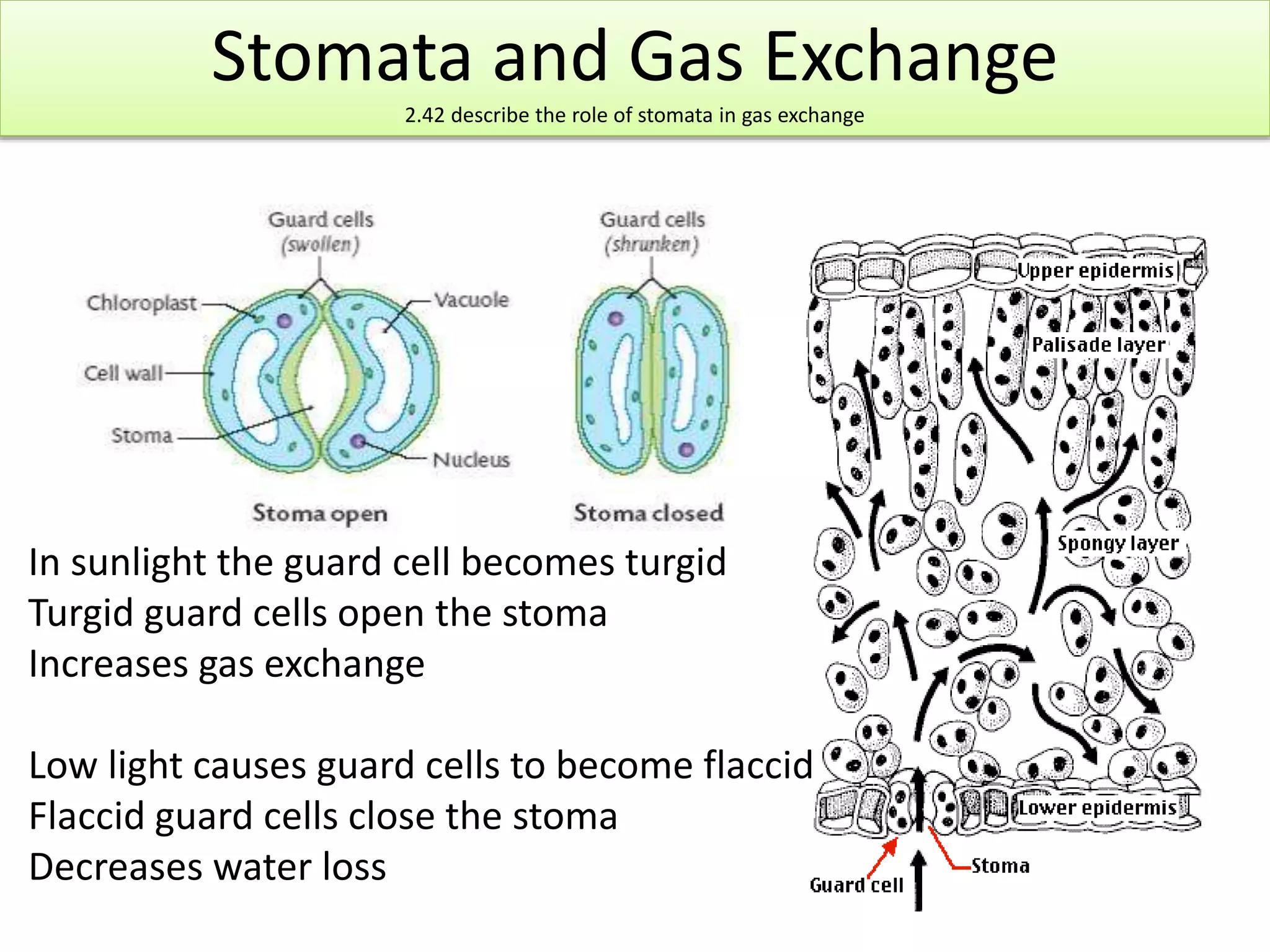
In sunlight the guard cell becomes turgid 
Turgid guard cells open the stoma 
Increases gas exchange 
Low light causes guard cells to become flaccid 
Flaccid guard cells close the stoma 
Decreases water loss
Stomata and Gas Exchange 
2.42 describe the role of stomata in gas exchange 
Exp 
1 
Exp 
2
Stomata and Gas Exchange 
2.42 describe the role of stomata in gas exchange 
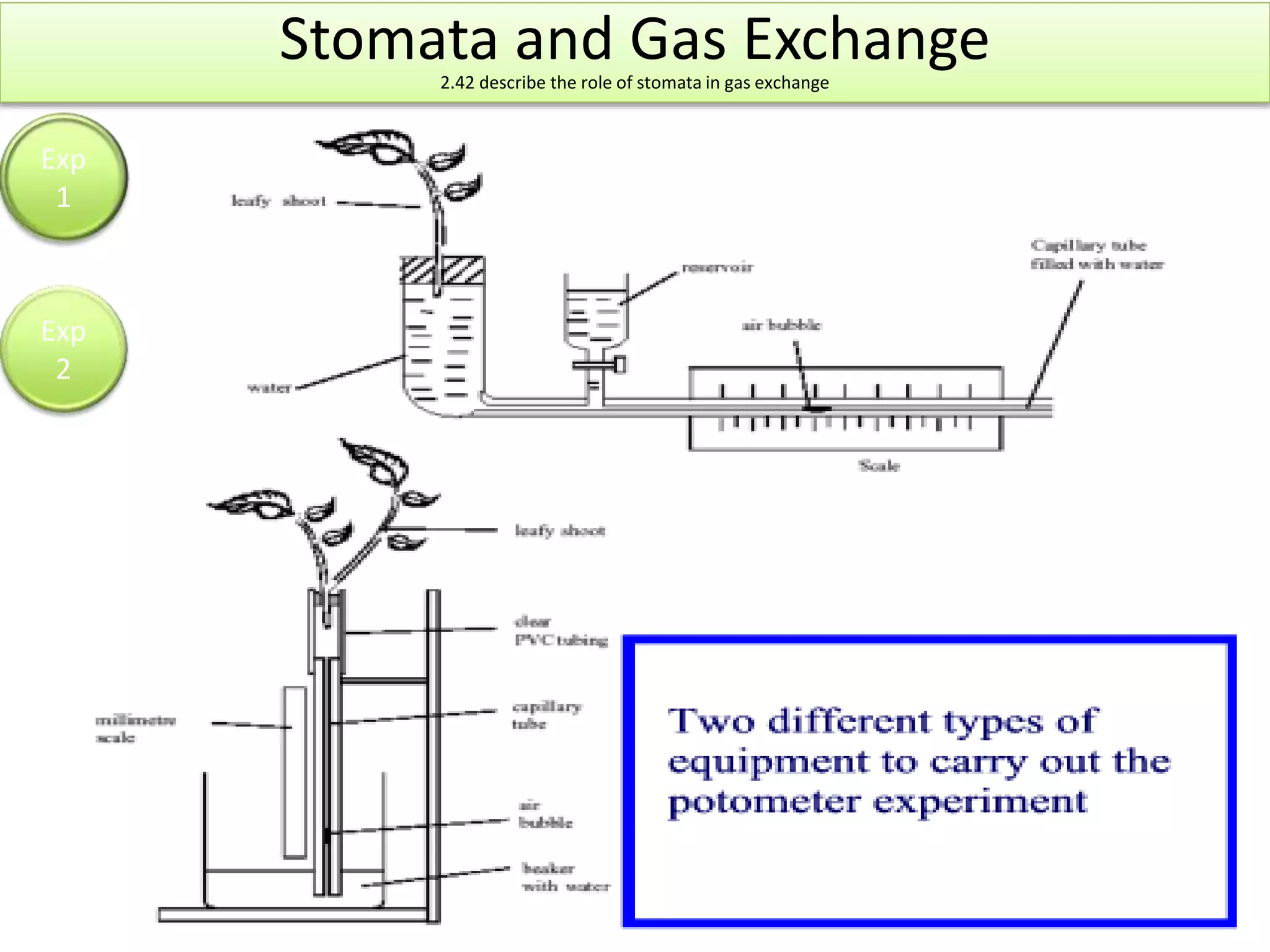
Potometer 
1) You must cut the shoots under water and you must 
assemble the potometer under water. If air gets into the 
xylem vessels of the plant, it can form air locks which will 
prevent the plant taking up water and so prevent steady 
transpiration. 
1) Check all seals are airtight – coat seals with Vaseline jelly 
3) The potometers should be left for the leaves to dry. 
Alternatively dry the leaves gently with a paper towel. The 
potometer will not work properly until any excess water 
on the leaves has evaporated or been removed. 
2) Adding food colouring to the water makes it easier to see 
the air bubble in the capillary tube.
Stomata and Gas Exchange 
2.42 describe the role of stomata in gas exchange
Experiment to Know 
2.43 describe experiments to investigate the effect of light on net gas exchange from a leaf, using hydrogen-carbonate indicator (TA) 
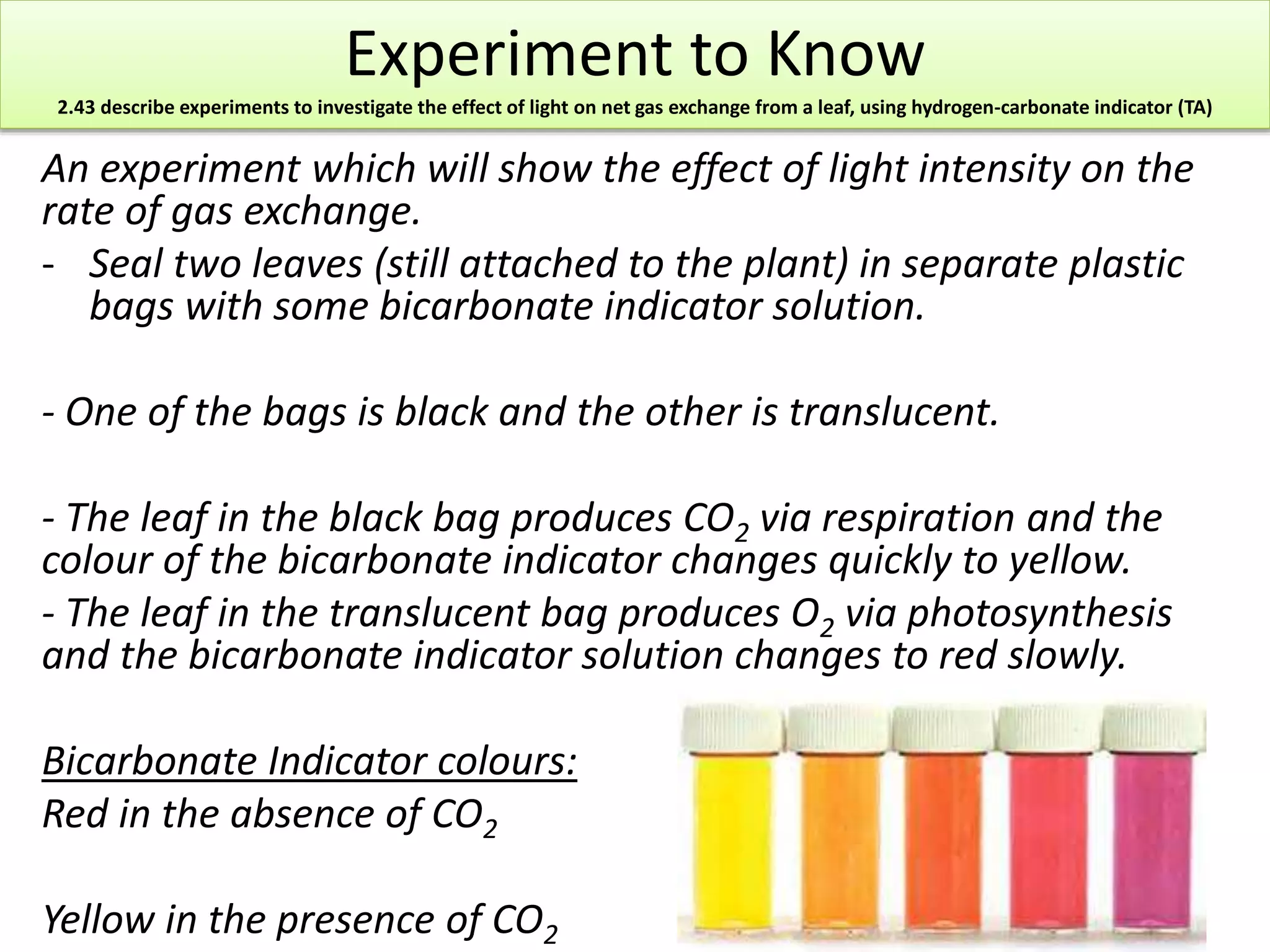
An experiment which will show the effect of light intensity on the 
rate of gas exchange. 
- Seal two leaves (still attached to the plant) in separate plastic 
bags with some bicarbonate indicator solution. 
- One of the bags is black and the other is translucent. 
- The leaf in the black bag produces CO2 via respiration and the 
colour of the bicarbonate indicator changes quickly to yellow. 
- The leaf in the translucent bag produces O2 via photosynthesis 
and the bicarbonate indicator solution changes to red slowly. 
Bicarbonate Indicator colours: 
Red in the absence of CO2 
Yellow in the presence of CO2
Gas Exchange in Humans 
Syllabus points 2.44 – 2.48
Gas Exchange in Humans 
Syllabus points 2.44 – 2.48
Gas Exchange in Humans 
Syllabus points 2.44 – 2.48
Gas Exchange in Humans 
Syllabus points 2.44 – 2.48
Transport 
syllabus points 2.49 – 2.50
Transport 
syllabus points 2.49 – 2.50
Plant Transport (2.51 – 2.56) 
2.51 describe the role of phloem in transporting sucrose and amino acids between the leaves and other parts of the plant
Plant Transport (2.51 – 2.56) 
2.51 describe the role of phloem in transporting sucrose and amino acids between the leaves and other parts of the plant
Plant Transport (2.51 – 2.56) 
2.51 describe the role of phloem in transporting sucrose and amino acids between the leaves and other parts of the plant
Plant Transport (2.51 – 2.56) 
2.51 describe the role of phloem in transporting sucrose and amino acids between the leaves and other parts of the plant
Plant Transport (2.51 – 2.56) 
2.51 describe the role of phloem in transporting sucrose and amino acids between the leaves and other parts of the plant
Transport in Humans (2.57 – 2.66)
Excretion in Plants 
2.67 understand the origin of carbon dioxide and oxygen as waste products of metabolism and their loss from the stomata of a leaf
Excretion in Humans (2.68 – 2.76) 
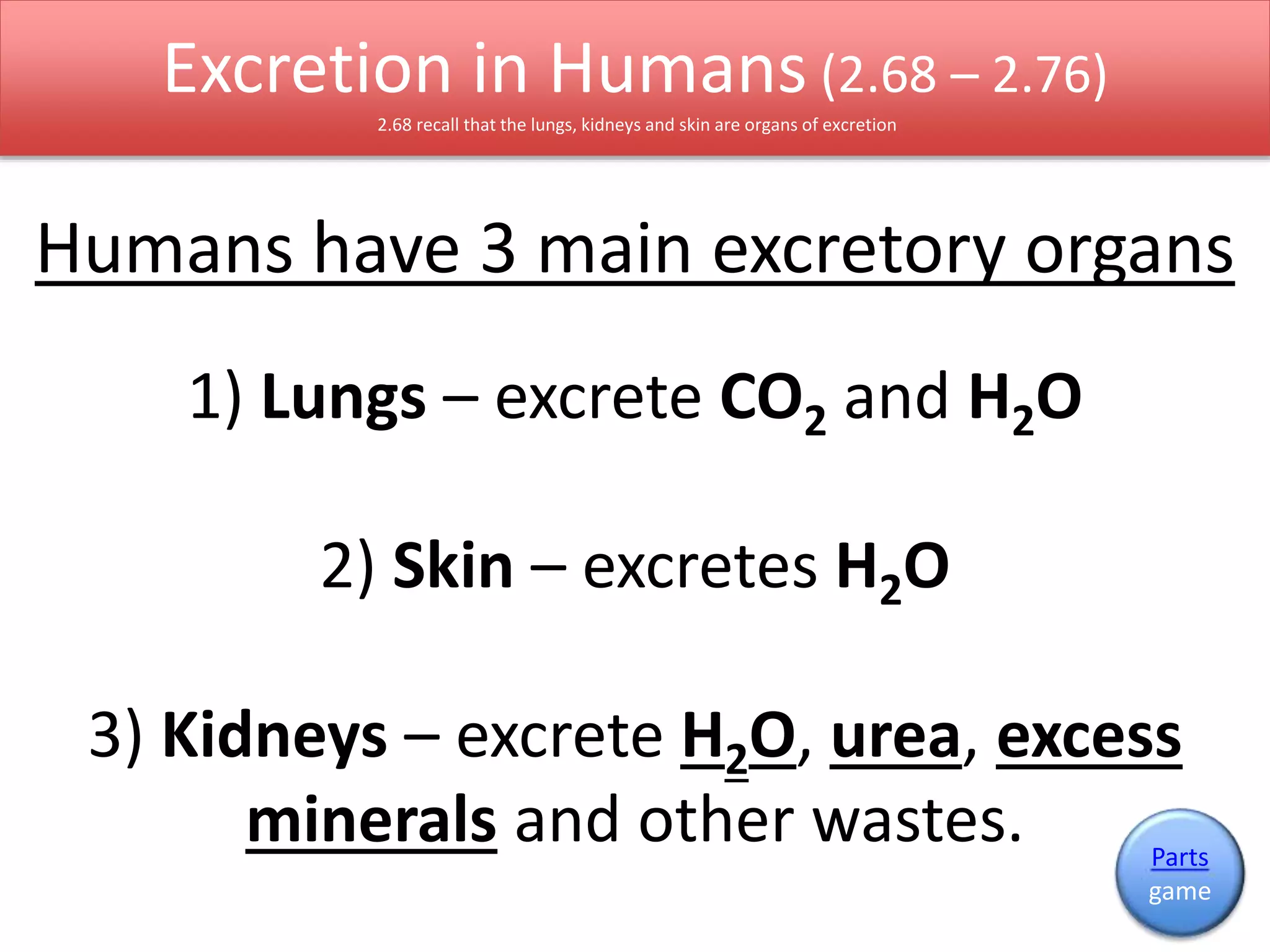
2.68 recall that the lungs, kidneys and skin are organs of excretion 
Humans have 3 main excretory organs 
1) Lungs – excrete CO2 and H2O 
2) Skin – excretes H2O 
3) Kidneys – excrete H2O, urea, excess 
minerals and other wastes. Parts 
game
UREA 
2.68 recall that the lungs, kidneys and skin are organs of excretion 
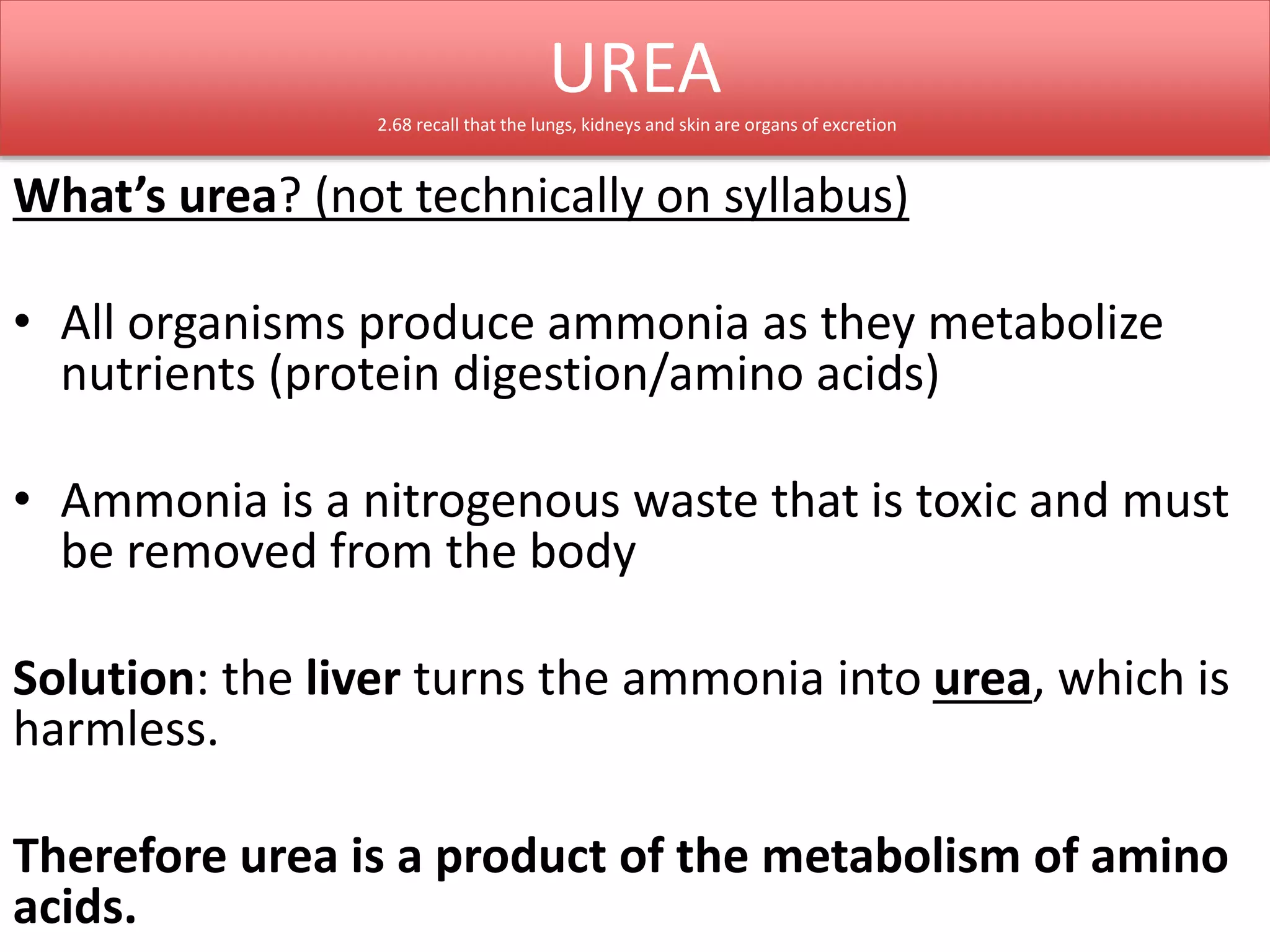
What’s urea? (not technically on syllabus) 
• All organisms produce ammonia as they metabolize 
nutrients (protein digestion/amino acids) 
• Ammonia is a nitrogenous waste that is toxic and must 
be removed from the body 
Solution: the liver turns the ammonia into urea, which is 
harmless. 
Therefore urea is a product of the metabolism of amino 
acids.
UREA 
2.68 recall that the lungs, kidneys and skin are organs of excretion 
Many land animals and some bony fish (amphibians, 
mammals) dilute the toxic ammonia with water. 
This substance is called Urea & is filtered out by the 
kidneys. 
- The problem is they do lose water in the process 
- Requires Energy
Excretion & Osmoregulation 
2.69 understand how the kidney carries out its roles of excretion and osmoregulation 
The Kidney: 
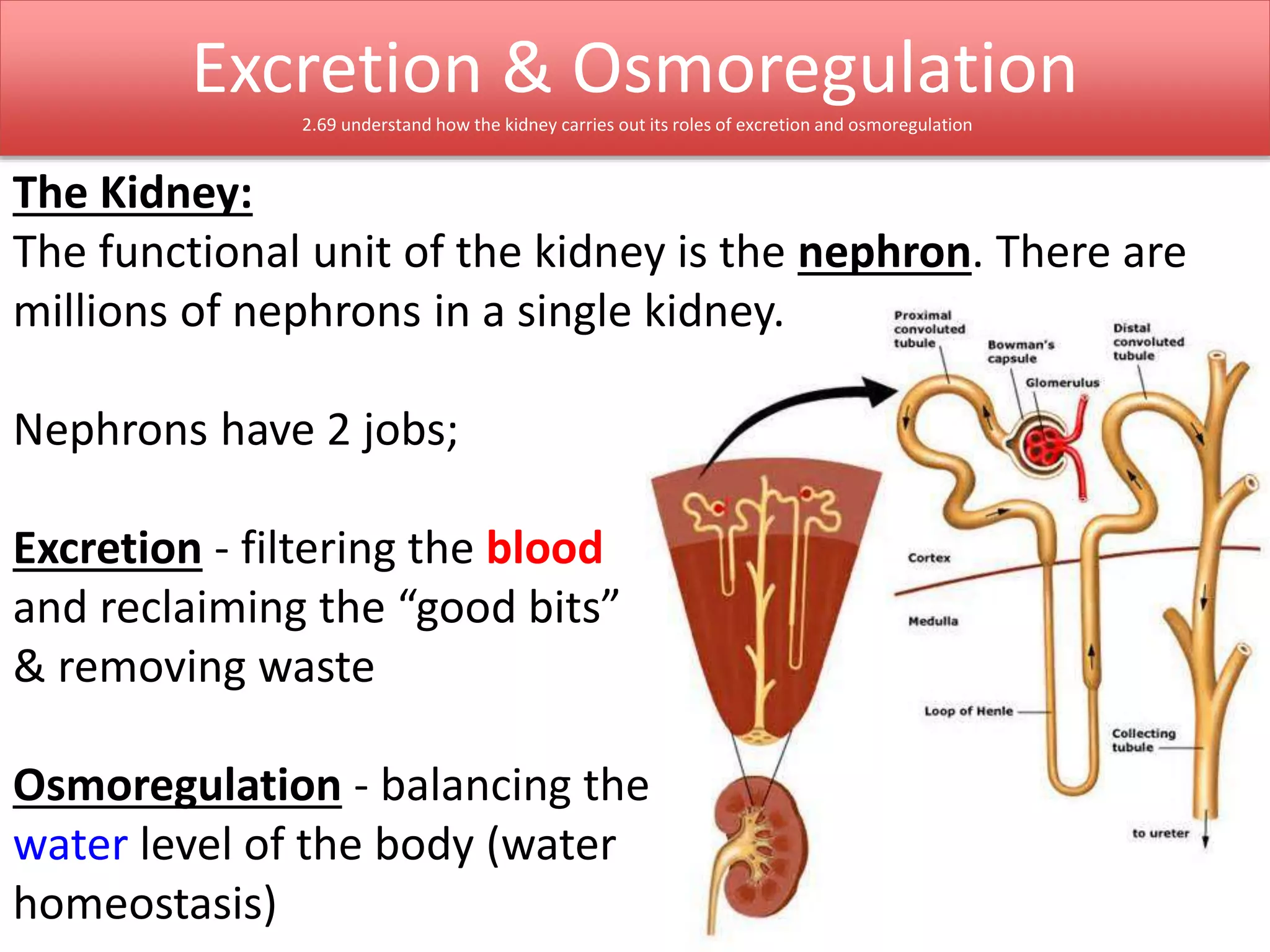
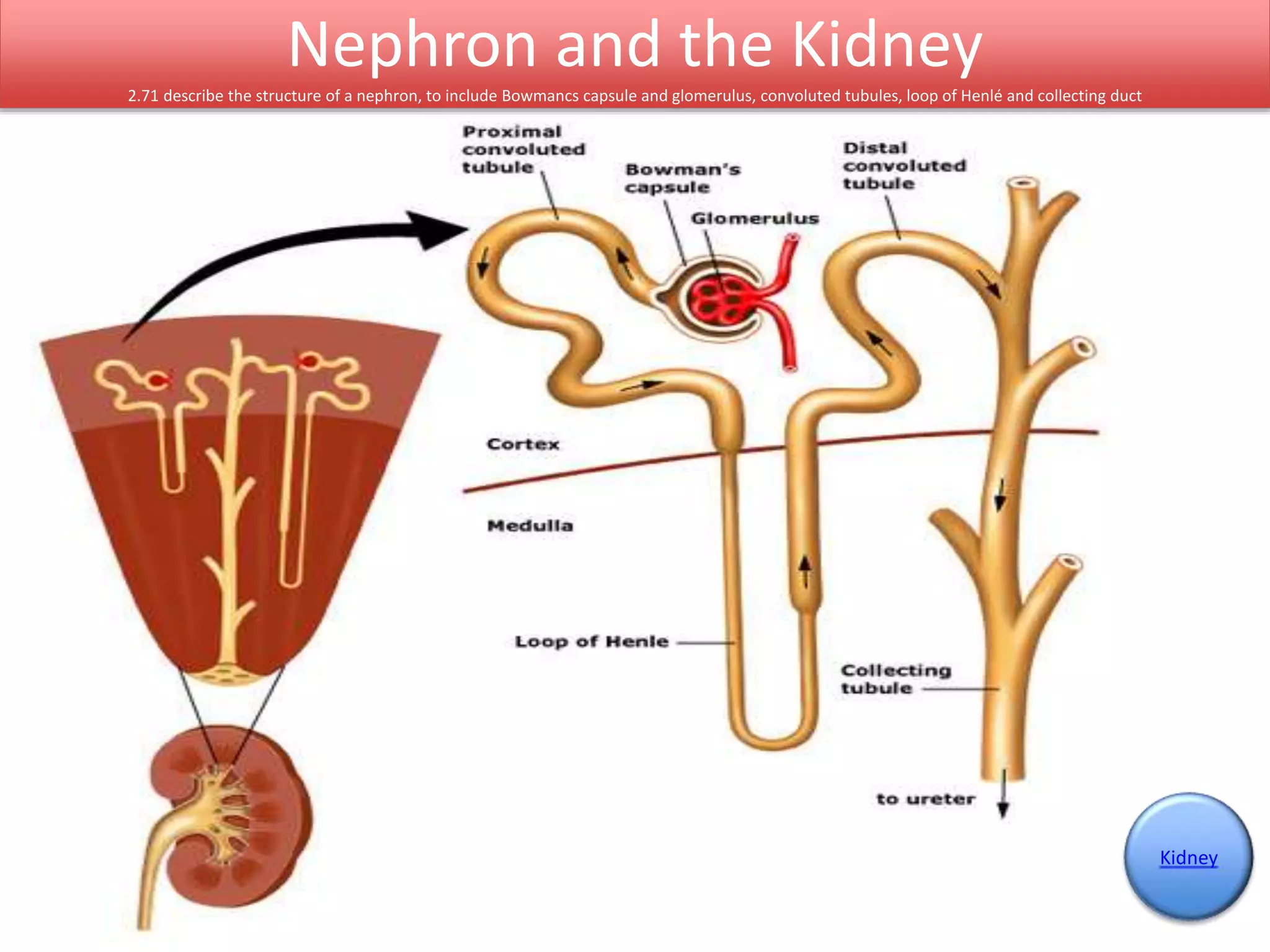
The functional unit of the kidney is the nephron. There are 
millions of nephrons in a single kidney. 
Nephrons have 2 jobs; 
Excretion - filtering the blood 
and reclaiming the “good bits” 
& removing waste 
Osmoregulation - balancing the 
water level of the body (water 
homeostasis)
Excretion System 
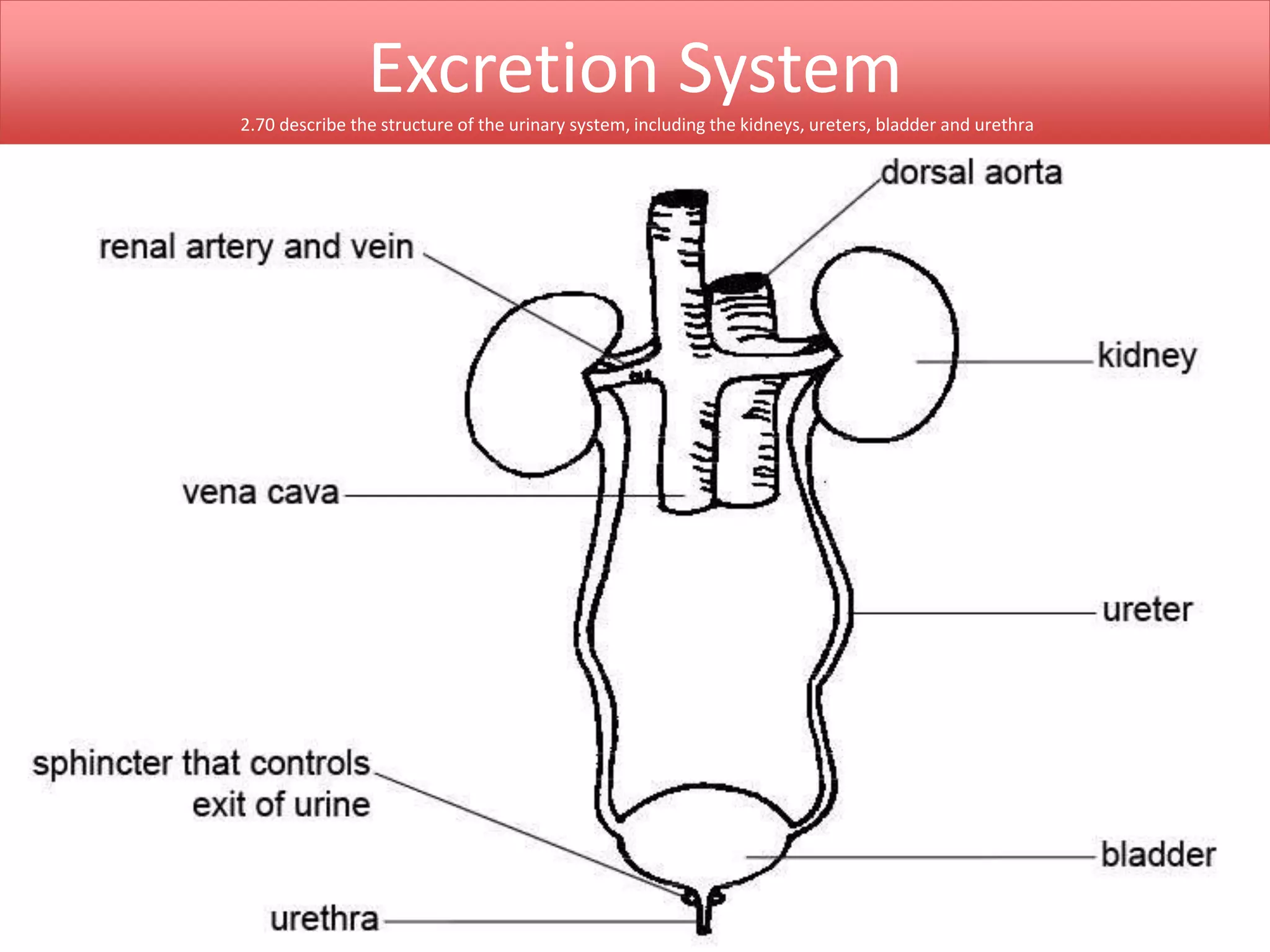
2.70 describe the structure of the urinary system, including the kidneys, ureters, bladder and urethra
Excretion System 
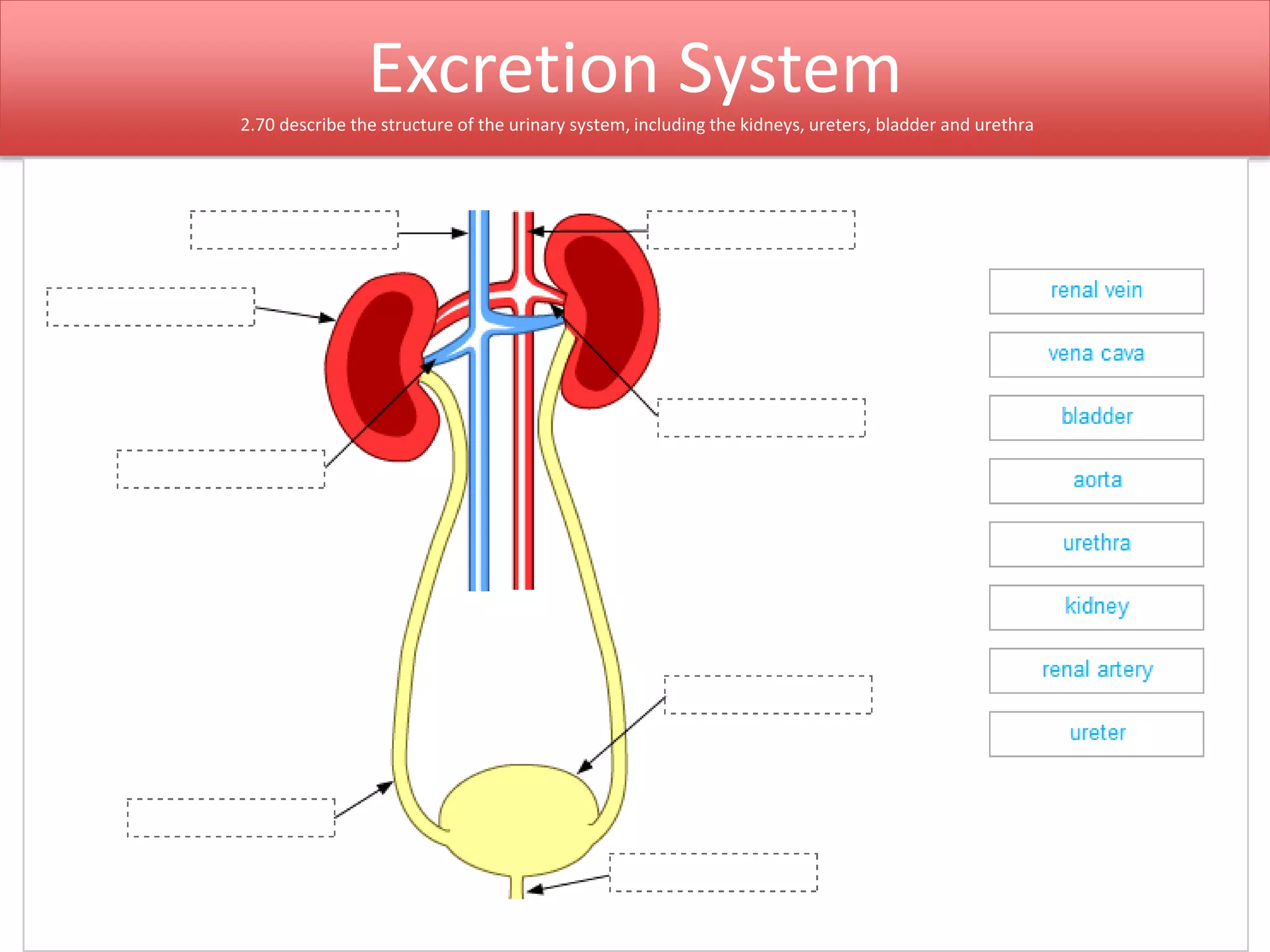
2.70 describe the structure of the urinary system, including the kidneys, ureters, bladder and urethra
Kidney 
Nephron and the Kidney 
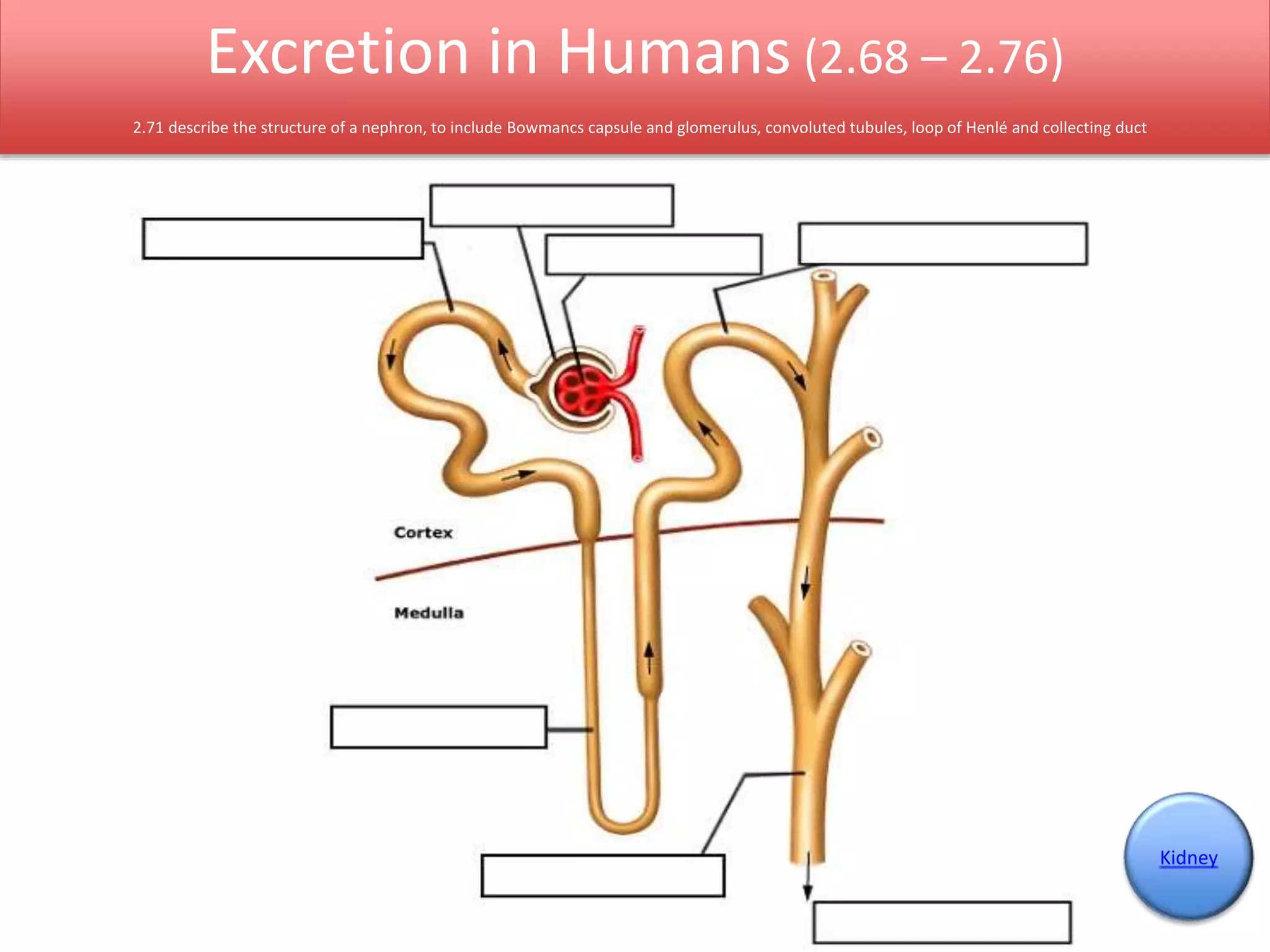
2.71 describe the structure of a nephron, to include Bowmancs capsule and glomerulus, convoluted tubules, loop of Henlé and collecting duct
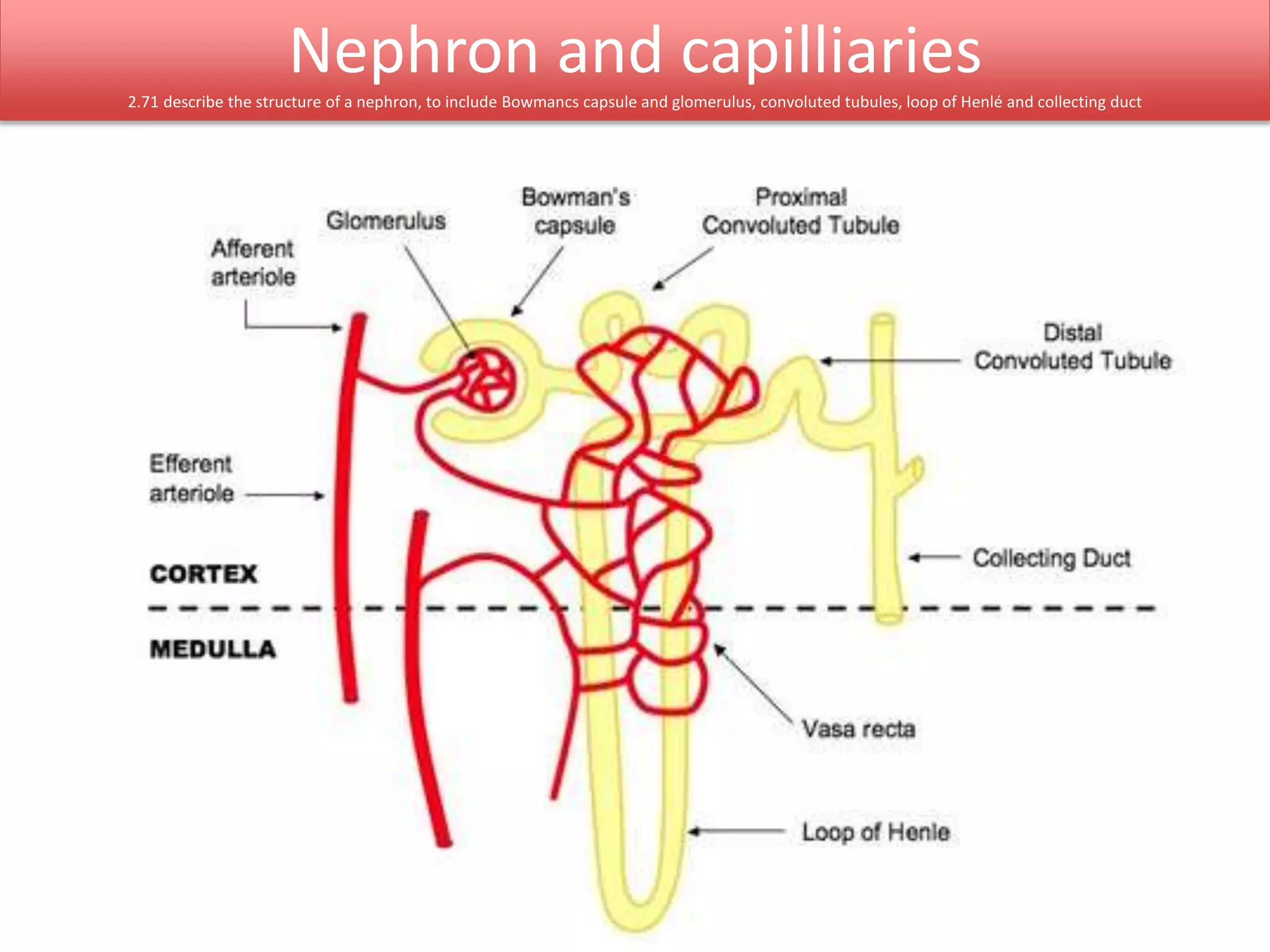
Nephron and capilliaries 
2.71 describe the structure of a nephron, to include Bowmancs capsule and glomerulus, convoluted tubules, loop of Henlé and collecting duct
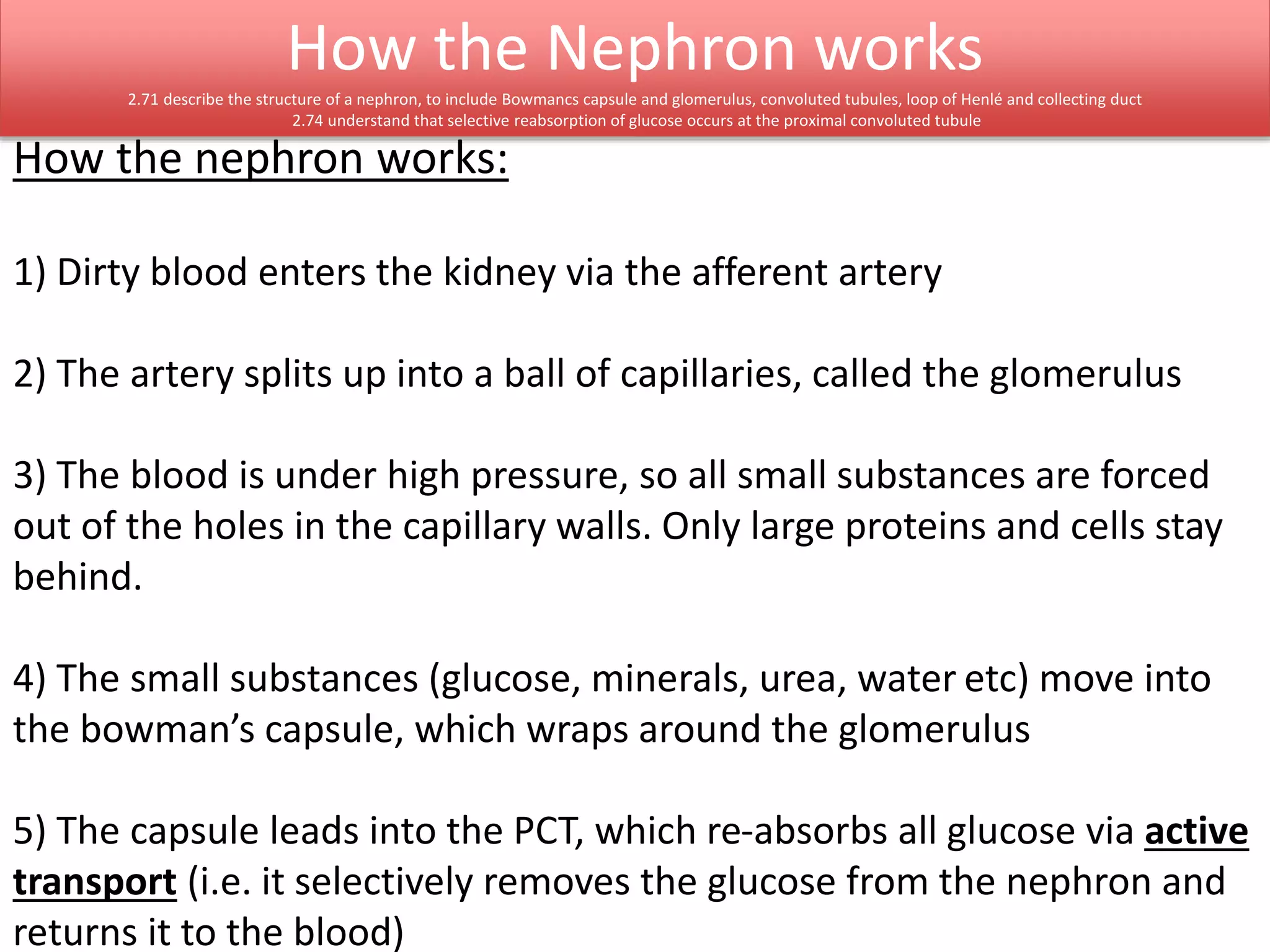
How the Nephron works 
2.71 describe the structure of a nephron, to include Bowmancs capsule and glomerulus, convoluted tubules, loop of Henlé and collecting duct 
2.74 understand that selective reabsorption of glucose occurs at the proximal convoluted tubule 
How the nephron works: 
1) Dirty blood enters the kidney via the afferent artery 
2) The artery splits up into a ball of capillaries, called the glomerulus 
3) The blood is under high pressure, so all small substances are forced 
out of the holes in the capillary walls. Only large proteins and cells stay 
behind. 
4) The small substances (glucose, minerals, urea, water etc) move into 
the bowman’s capsule, which wraps around the glomerulus 
5) The capsule leads into the PCT, which re-absorbs all glucose via active 
transport (i.e. it selectively removes the glucose from the nephron and 
returns it to the blood)
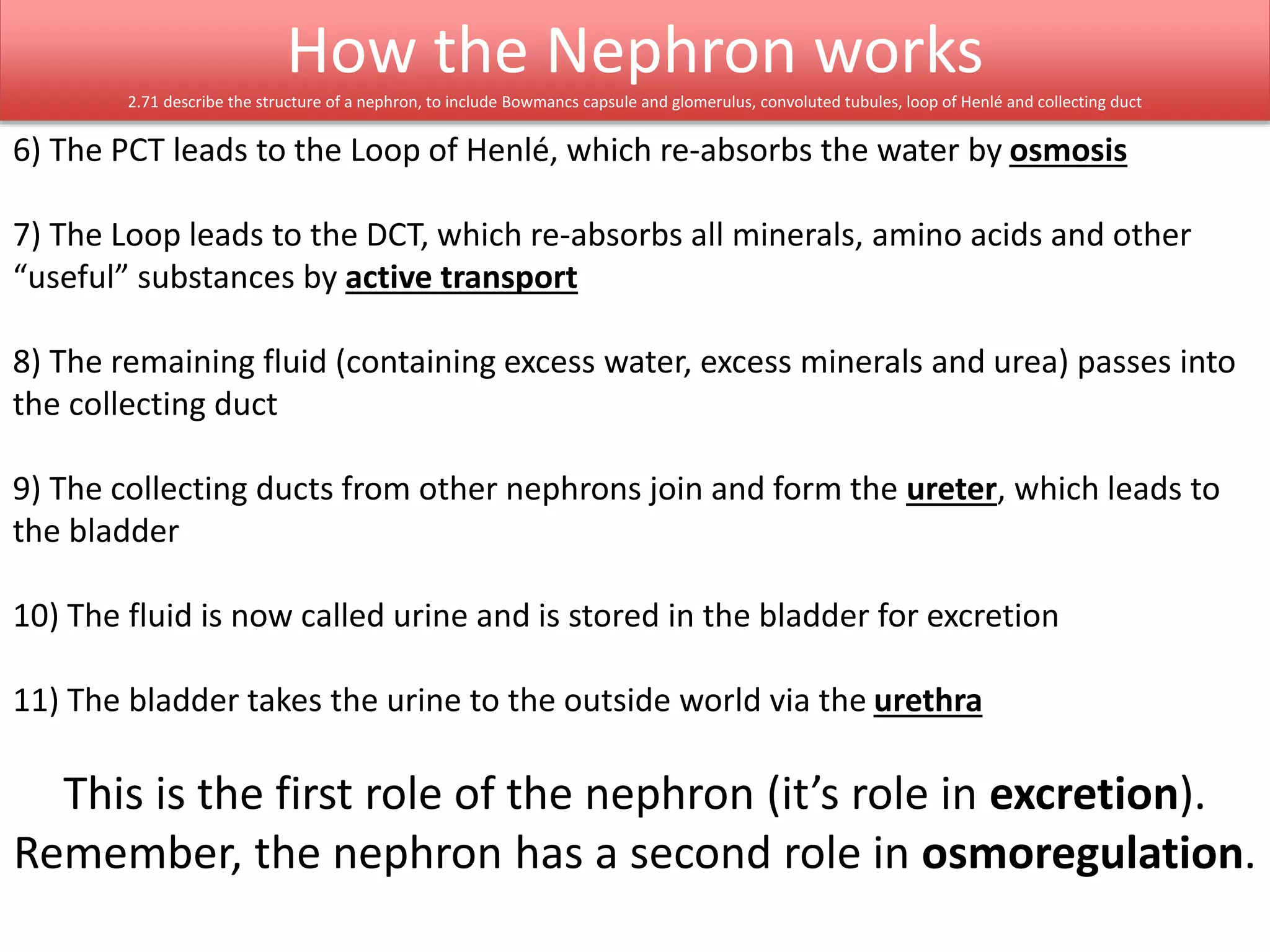
How the Nephron works 
2.71 describe the structure of a nephron, to include Bowmancs capsule and glomerulus, convoluted tubules, loop of Henlé and collecting duct 
6) The PCT leads to the Loop of Henlé, which re-absorbs the water by osmosis 
7) The Loop leads to the DCT, which re-absorbs all minerals, amino acids and other 
“useful” substances by active transport 
8) The remaining fluid (containing excess water, excess minerals and urea) passes into 
the collecting duct 
9) The collecting ducts from other nephrons join and form the ureter, which leads to 
the bladder 
10) The fluid is now called urine and is stored in the bladder for excretion 
11) The bladder takes the urine to the outside world via the urethra 
This is the first role of the nephron (it’s role in excretion). 
Remember, the nephron has a second role in osmoregulation.
Excretion in Humans (2.68 – 2.76) 
2.71 describe the structure of a nephron, to include Bowmancs capsule and glomerulus, convoluted tubules, loop of Henlé and collecting duct 
Kidney
Excretion in Humans (2.68 – 2.76) 
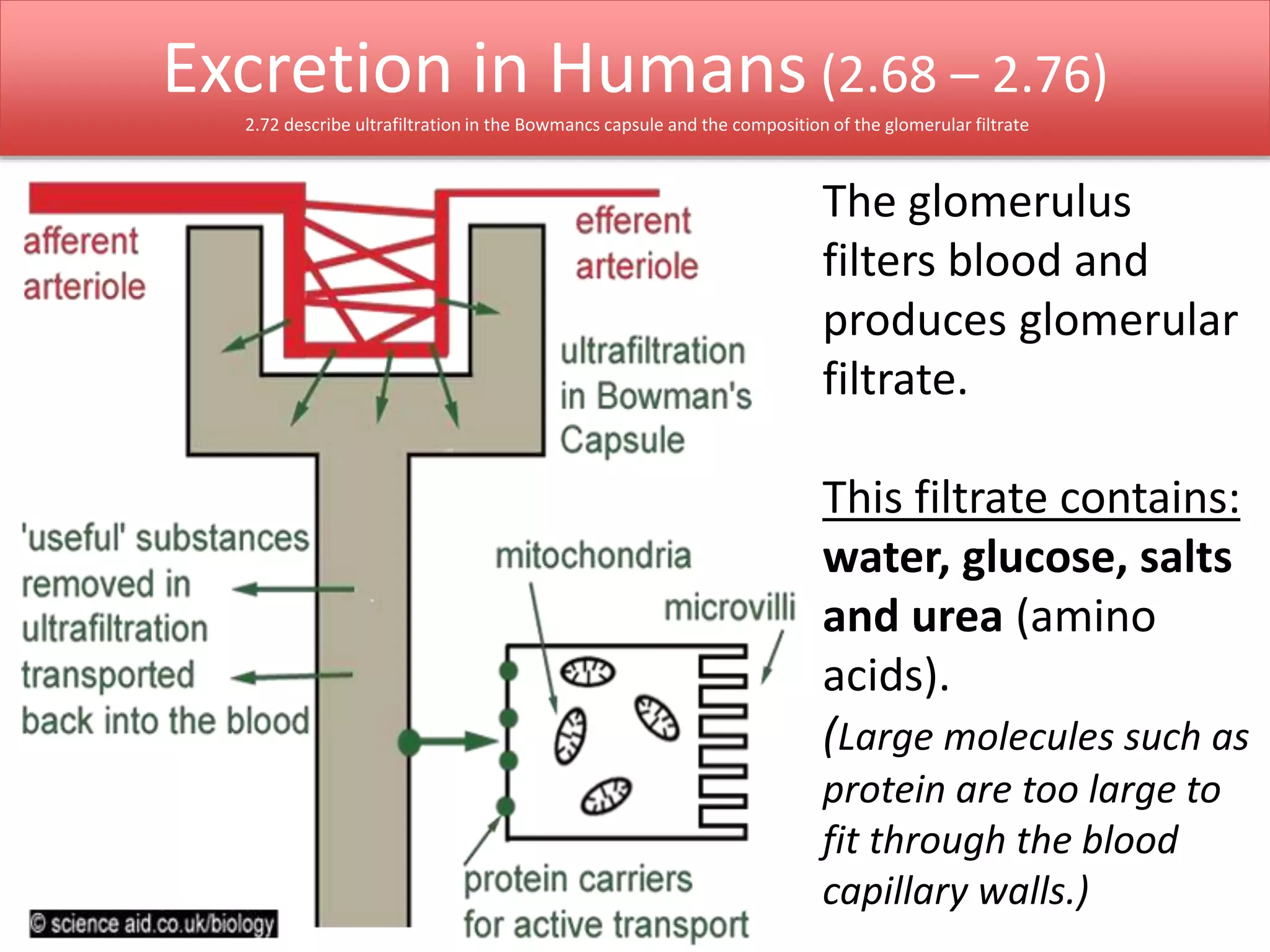
2.72 describe ultrafiltration in the Bowmancs capsule and the composition of the glomerular filtrate 
The glomerulus 
filters blood and 
produces glomerular 
filtrate. 
This filtrate contains: 
water, glucose, salts 
and urea (amino 
acids). 
(Large molecules such as 
protein are too large to 
fit through the blood 
capillary walls.)
Excretion in Humans (2.68 – 2.76) 
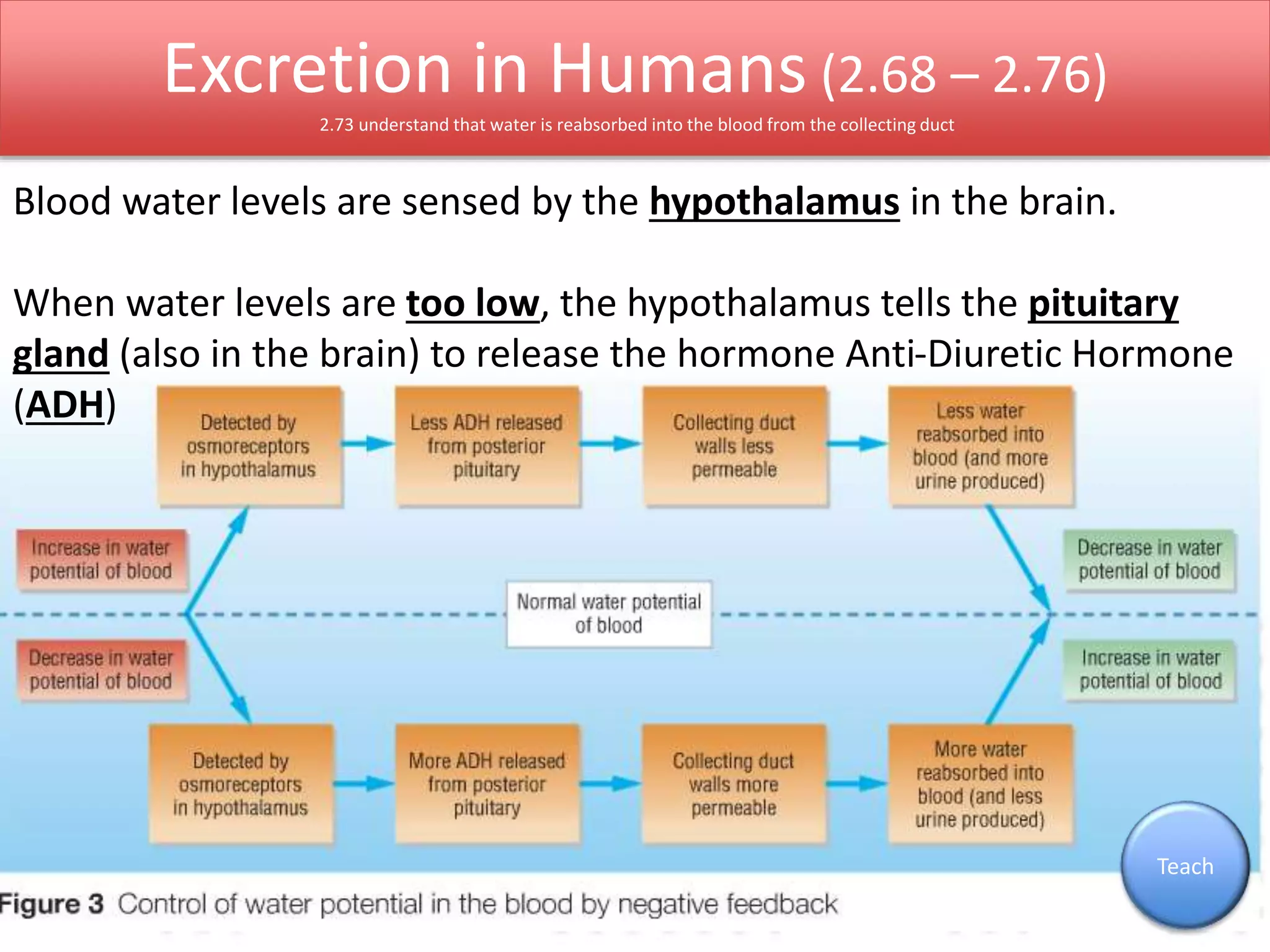
2.73 understand that water is reabsorbed into the blood from the collecting duct 
Teach 
Blood water levels are sensed by the hypothalamus in the brain. 
When water levels are too low, the hypothalamus tells the pituitary 
gland (also in the brain) to release the hormone Anti-Diuretic Hormone 
(ADH)
Excretion in Humans (2.68 – 2.76) 
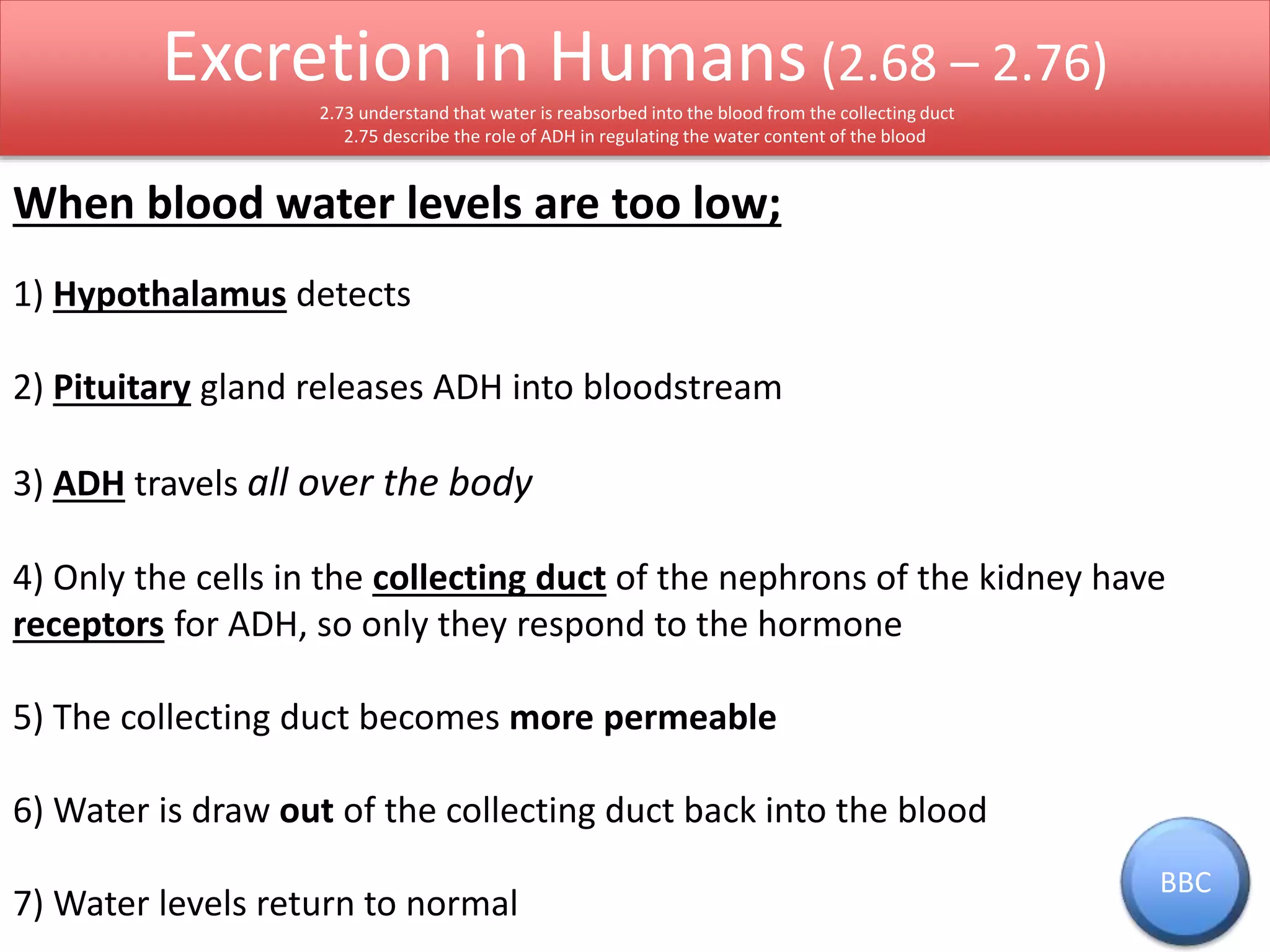
2.73 understand that water is reabsorbed into the blood from the collecting duct 
2.75 describe the role of ADH in regulating the water content of the blood 
When blood water levels are too low; 
1) Hypothalamus detects 
2) Pituitary gland releases ADH into bloodstream 
3) ADH travels all over the body 
4) Only the cells in the collecting duct of the nephrons of the kidney have 
receptors for ADH, so only they respond to the hormone 
5) The collecting duct becomes more permeable 
6) Water is draw out of the collecting duct back into the blood 
7) Water levels return to normal 
BBC
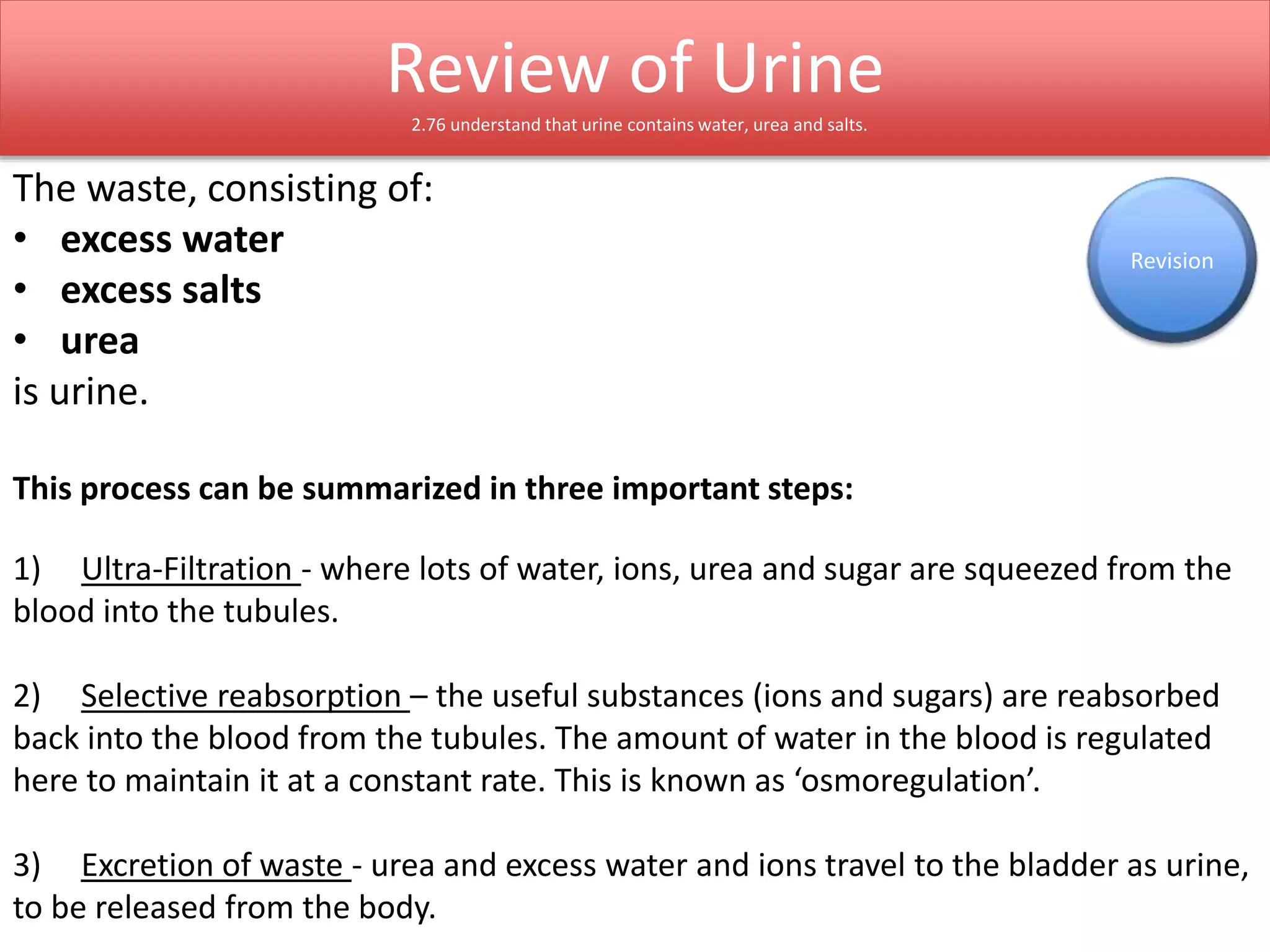
Review of Urine 
2.76 understand that urine contains water, urea and salts. 
The waste, consisting of: 
• excess water 
• excess salts 
• urea 
is urine. 
This process can be summarized in three important steps: 
Revision 
1) Ultra-Filtration - where lots of water, ions, urea and sugar are squeezed from the 
blood into the tubules. 
2) Selective reabsorption – the useful substances (ions and sugars) are reabsorbed 
back into the blood from the tubules. The amount of water in the blood is regulated 
here to maintain it at a constant rate. This is known as ‘osmoregulation’. 
3) Excretion of waste - urea and excess water and ions travel to the bladder as urine, 
to be released from the body.
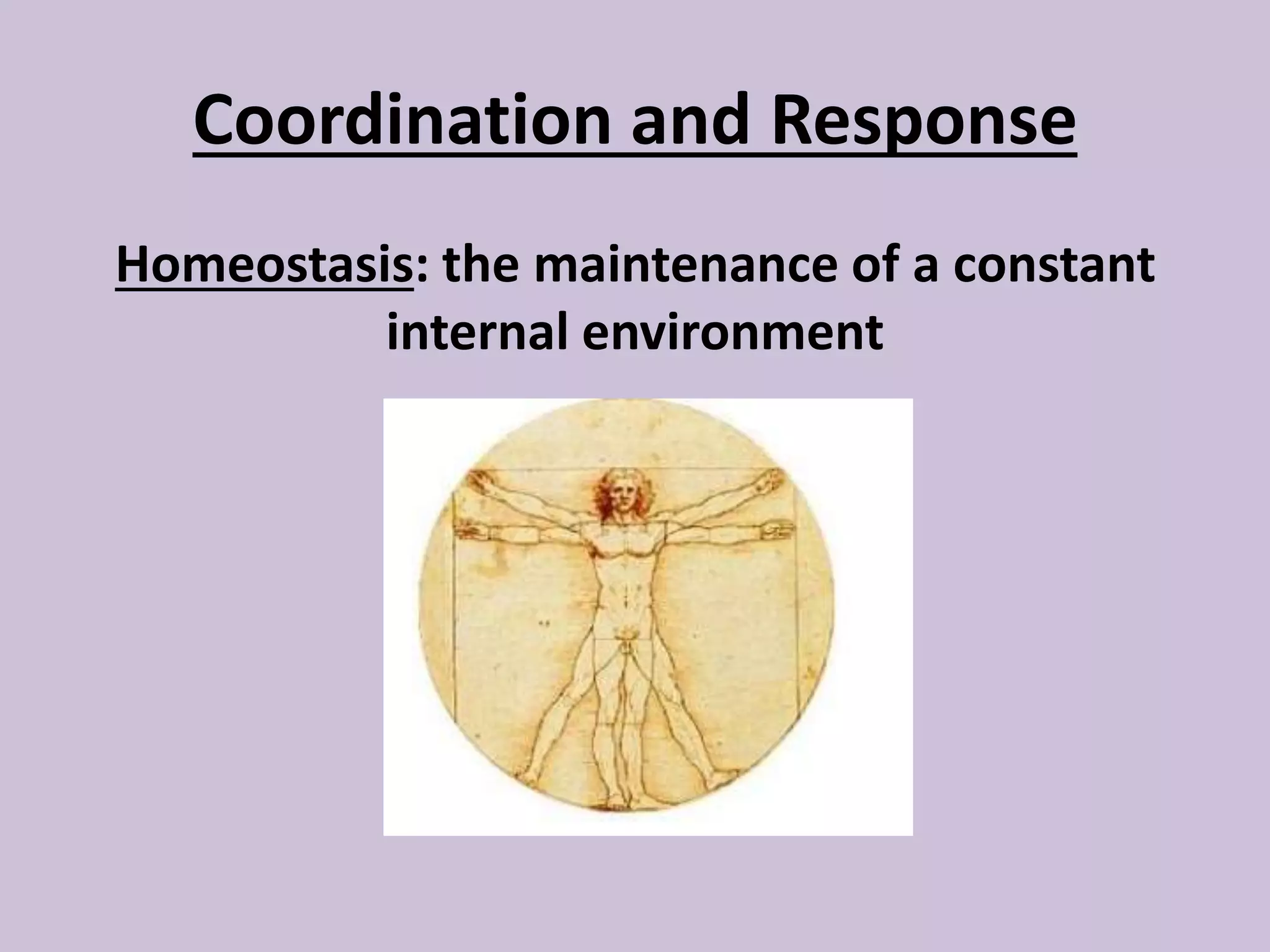
Coordination and Response 
Homeostasis: the maintenance of a constant 
internal environment
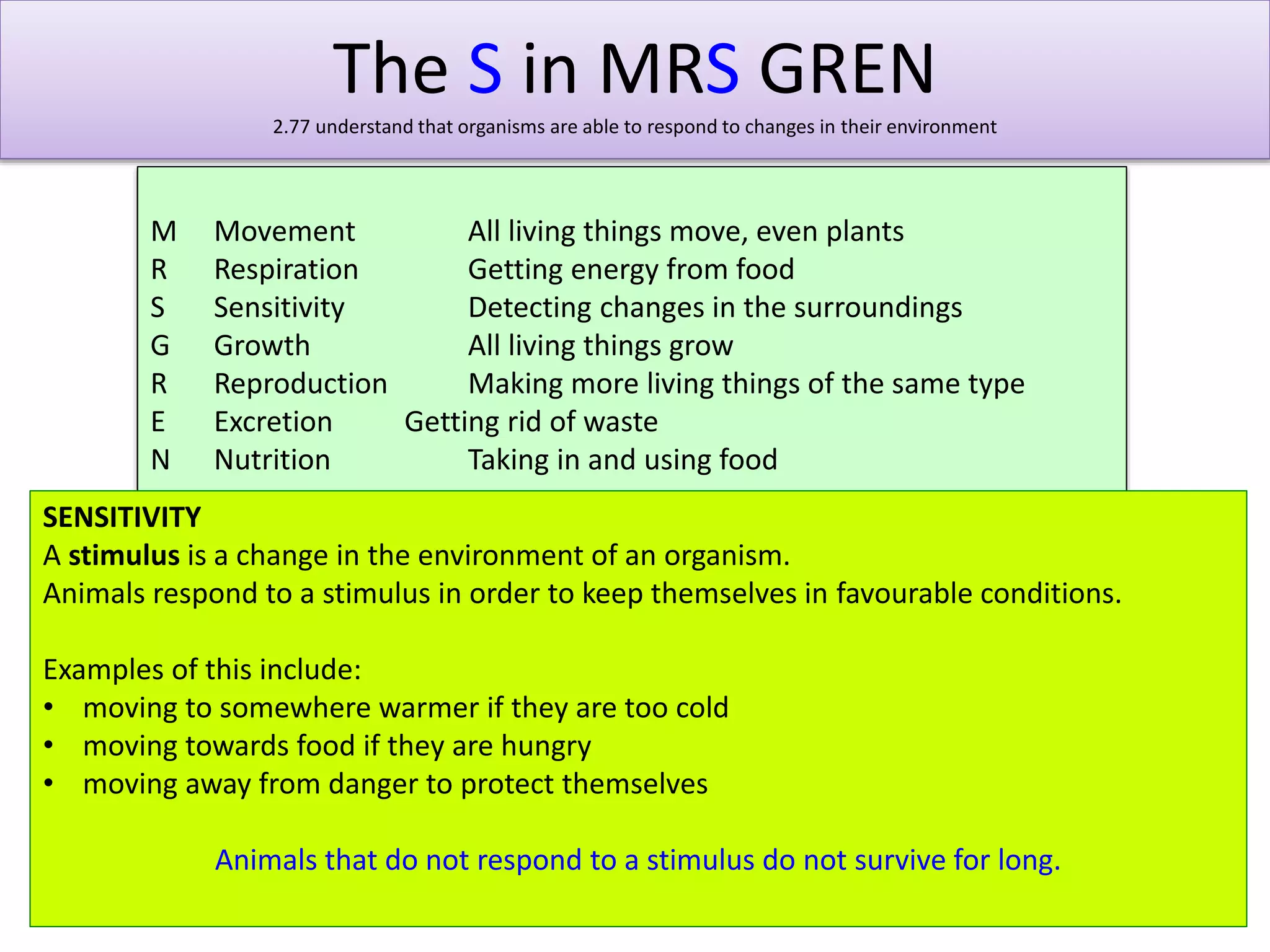
The S in MRS GREN 
2.77 understand that organisms are able to respond to changes in their environment 
M Movement All living things move, even plants 
R Respiration Getting energy from food 
S Sensitivity Detecting changes in the surroundings 
G Growth All living things grow 
R Reproduction Making more living things of the same type 
E Excretion Getting rid of waste 
N Nutrition Taking in and using food 
SENSITIVITY 
A stimulus is a change in the environment of an organism. 
Animals respond to a stimulus in order to keep themselves in favourable conditions. 
Examples of this include: 
• moving to somewhere warmer if they are too cold 
• moving towards food if they are hungry 
• moving away from danger to protect themselves 
Animals that do not respond to a stimulus do not survive for long.
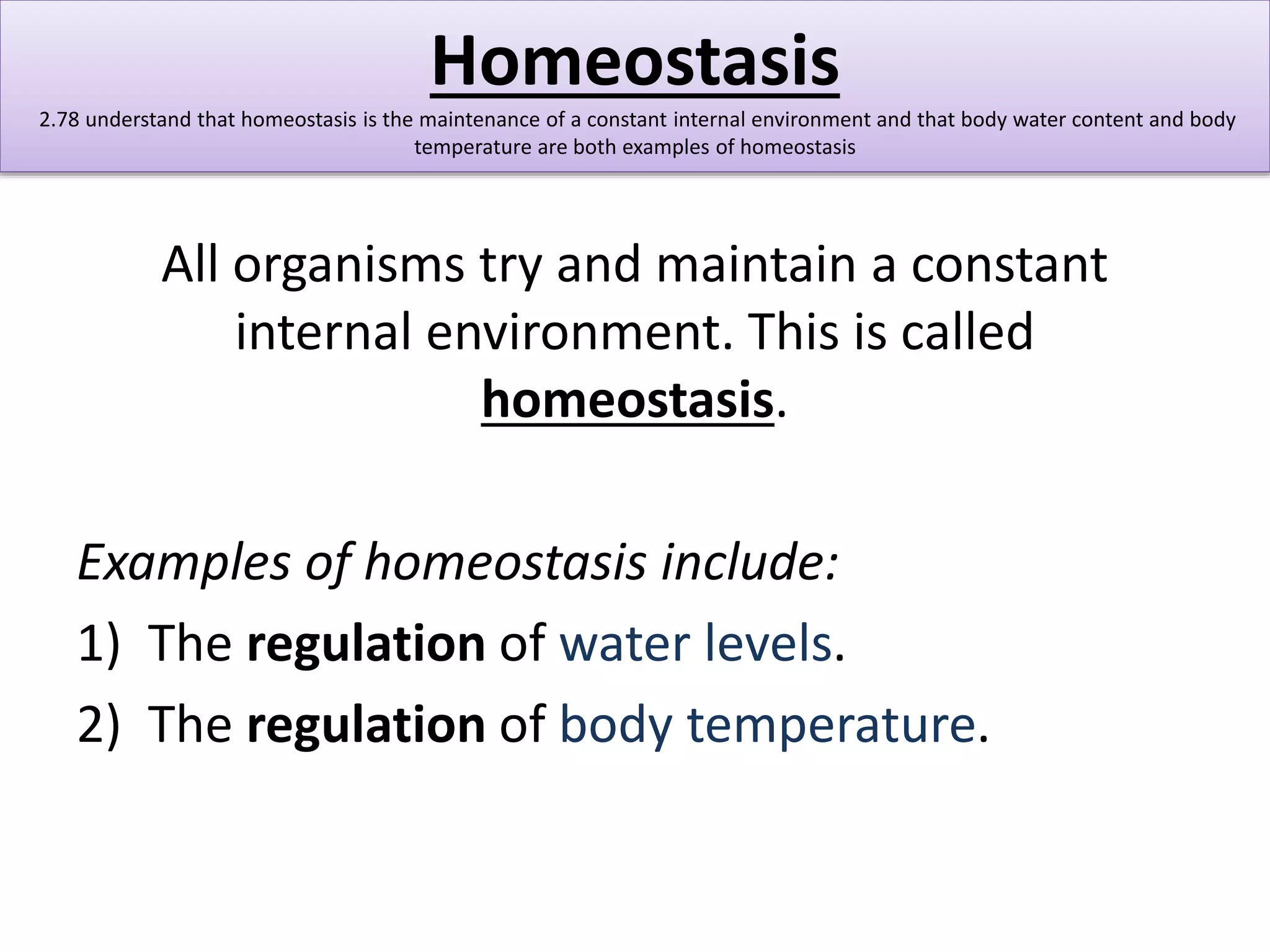
Homeostasis 
2.78 understand that homeostasis is the maintenance of a constant internal environment and that body water content and body 
temperature are both examples of homeostasis 
All organisms try and maintain a constant 
internal environment. This is called 
homeostasis. 
Examples of homeostasis include: 
1) The regulation of water levels. 
2) The regulation of body temperature.
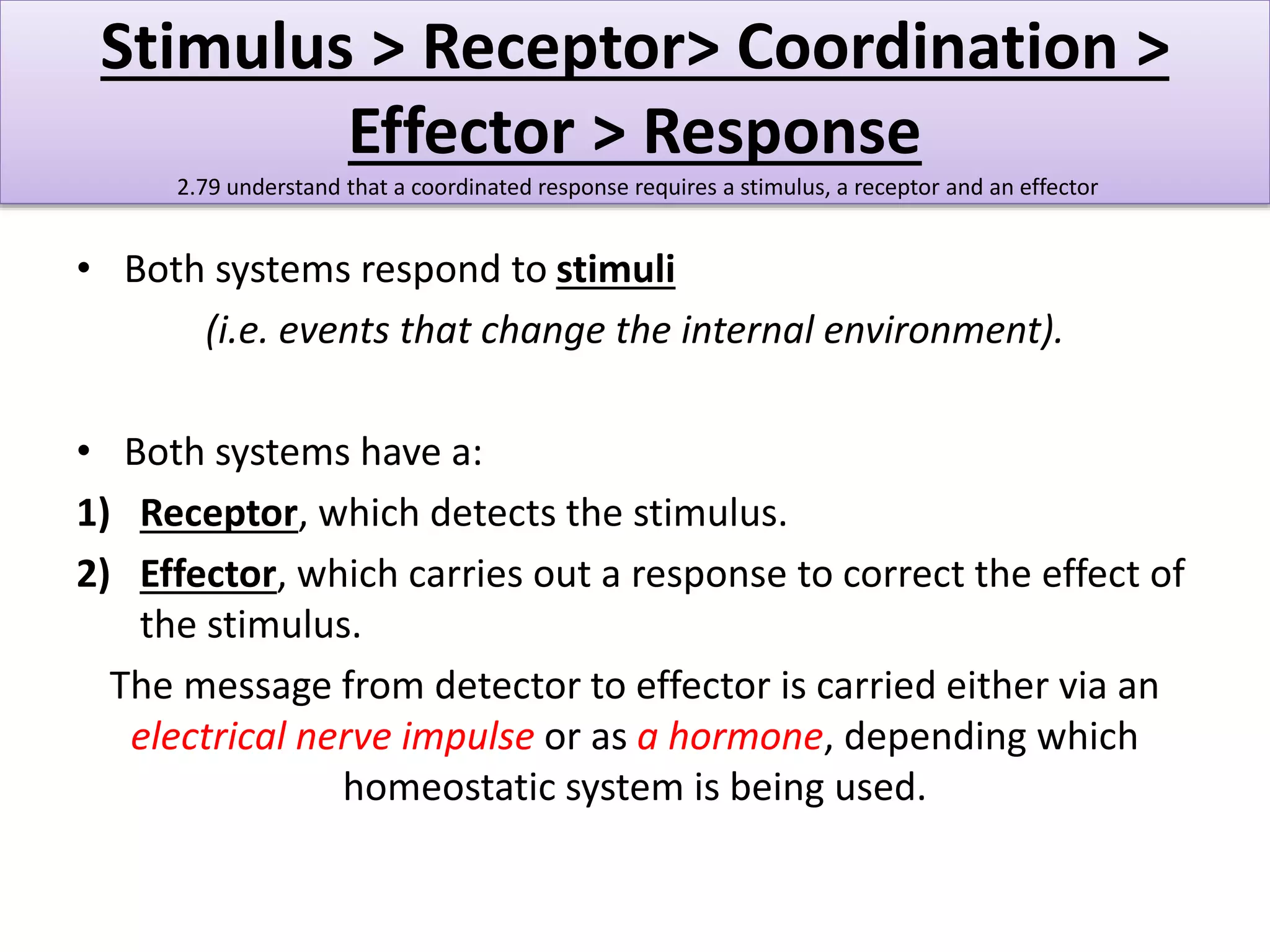
Stimulus > Receptor> Coordination > 
Effector > Response 
2.79 understand that a coordinated response requires a stimulus, a receptor and an effector 
• Both systems respond to stimuli 
(i.e. events that change the internal environment). 
• Both systems have a: 
1) Receptor, which detects the stimulus. 
2) Effector, which carries out a response to correct the effect of 
the stimulus. 
The message from detector to effector is carried either via an 
electrical nerve impulse or as a hormone, depending which 
homeostatic system is being used.
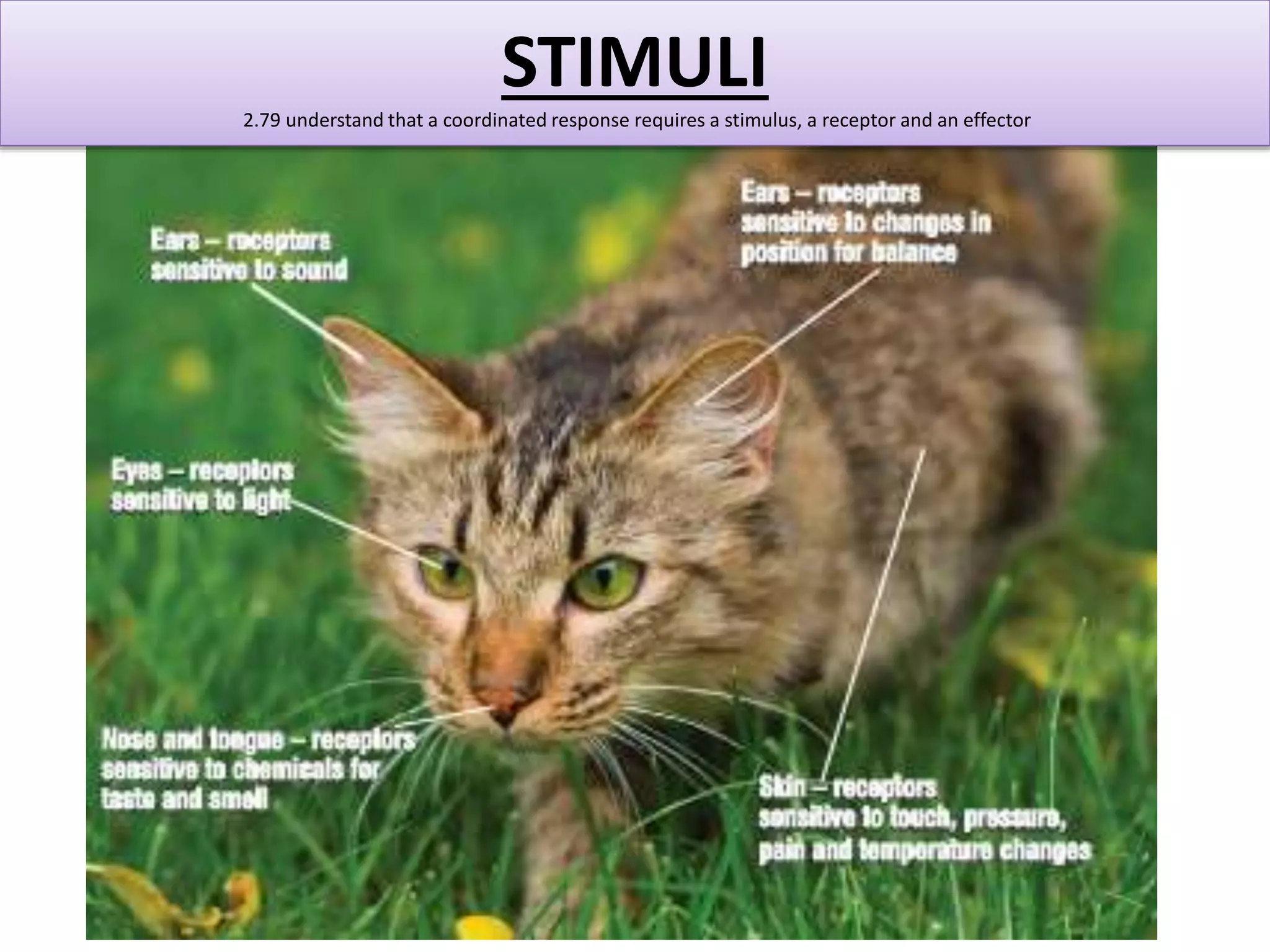
STIMULI 
2.79 understand that a coordinated response requires a stimulus, a receptor and an effector
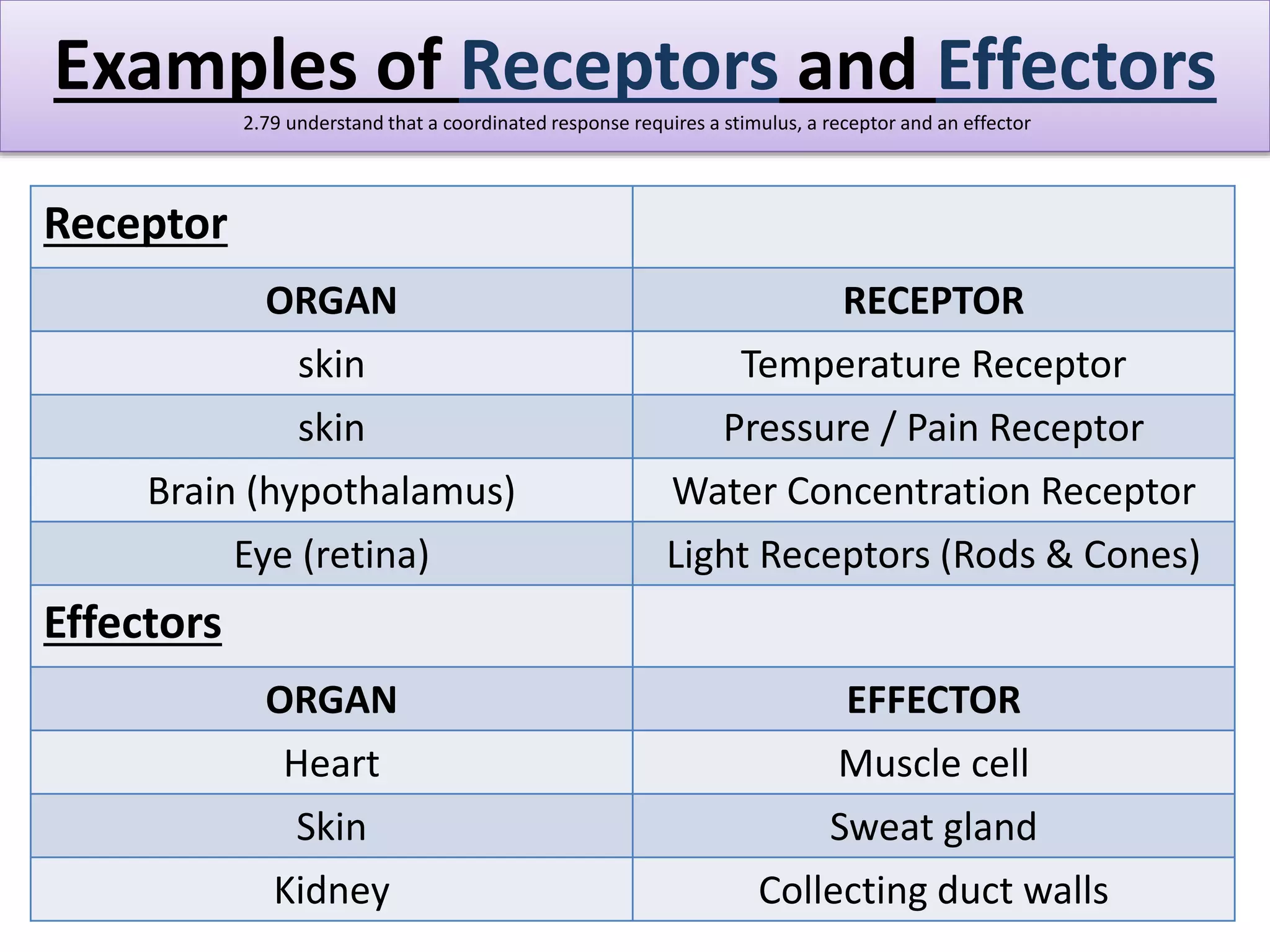
Examples of Receptors and Effectors 
2.79 understand that a coordinated response requires a stimulus, a receptor and an effector 
Receptor 
ORGAN RECEPTOR 
skin Temperature Receptor 
skin Pressure / Pain Receptor 
Brain (hypothalamus) Water Concentration Receptor 
Eye (retina) Light Receptors (Rods & Cones) 
Effectors 
ORGAN EFFECTOR 
Heart Muscle cell 
Skin Sweat gland 
Kidney Collecting duct walls
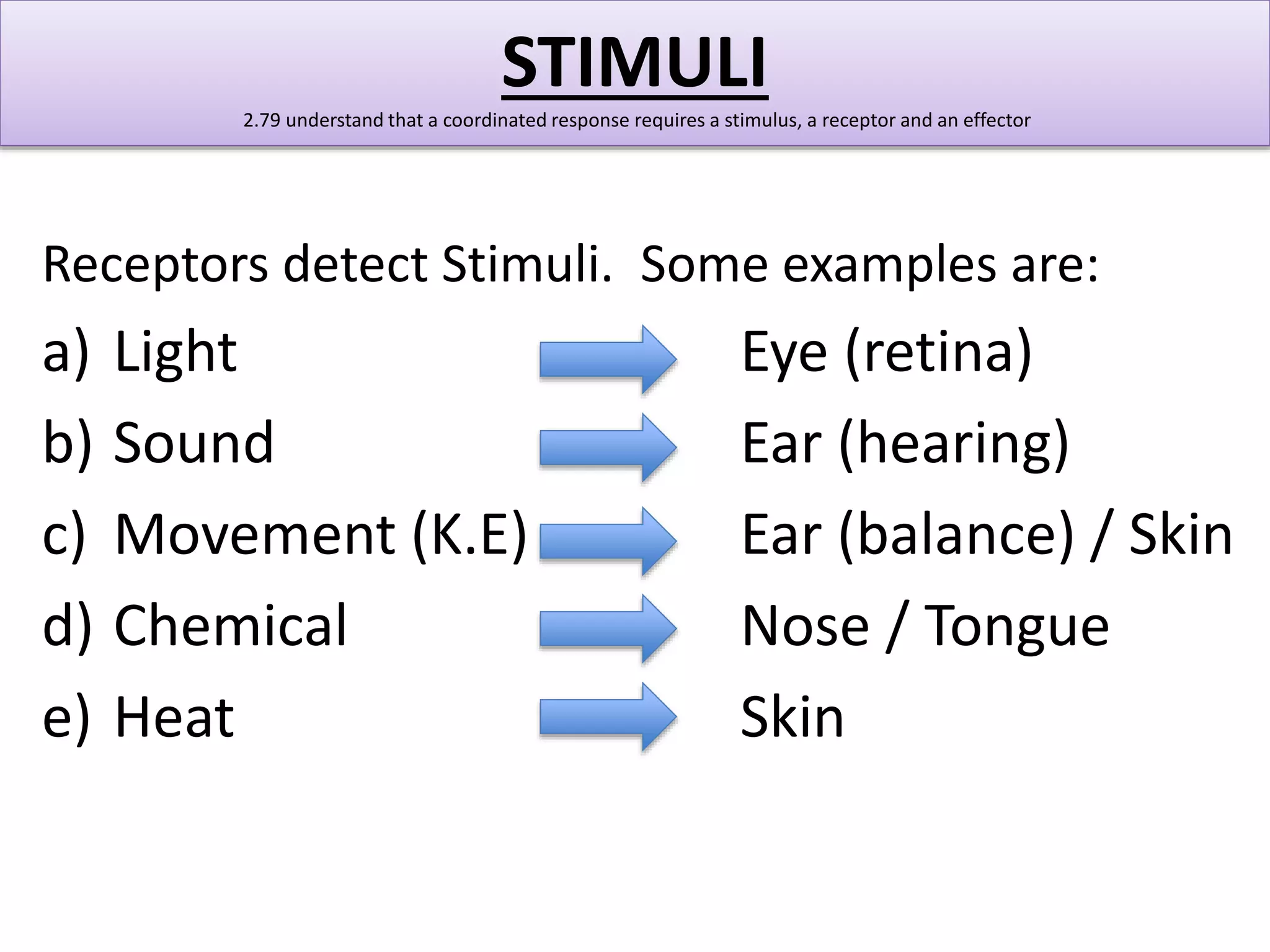
STIMULI 
2.79 understand that a coordinated response requires a stimulus, a receptor and an effector 
Receptors detect Stimuli. Some examples are: 
a) Light Eye (retina) 
b) Sound Ear (hearing) 
c) Movement (K.E) Ear (balance) / Skin 
d) Chemical Nose / Tongue 
e) Heat Skin
Response in Plants 
2.80 understand that plants respond to stimuli 
Plants also respond to stimuli. As plants don’t have 
nerves their responses are limited to hormones only. 
Plants respond to the following stimuli: 
• Gravity: Roots grow towards gravitational pull and 
stems grow away. This is Geotropism. 
• Water: Roots grow towards water. This is 
Hydrotropism. 
• Light: Shoots grow towards light. This is Phototropism.
GEOTROPISM 
2.81 describe the geotropic responses of roots and stems 
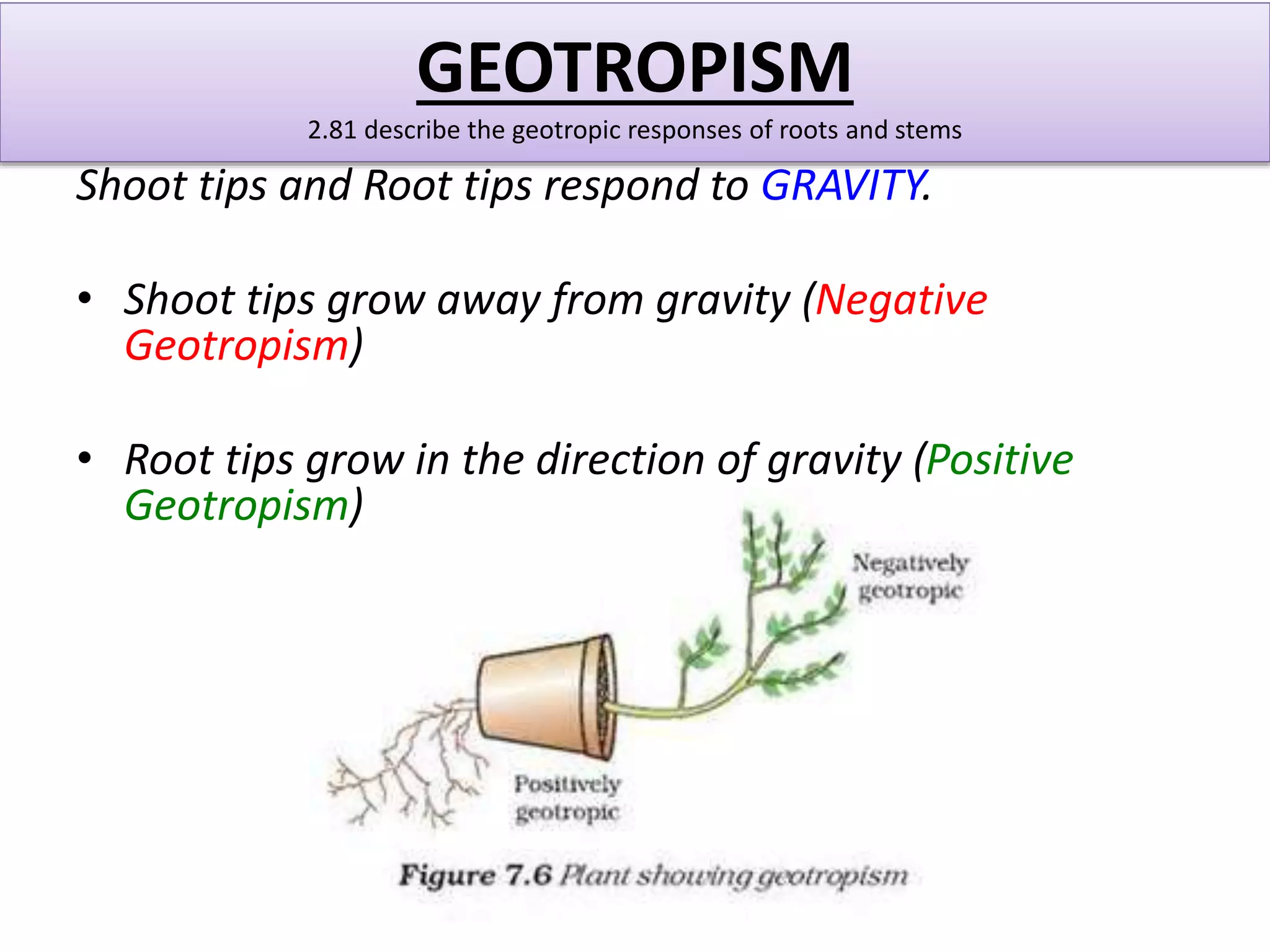
Shoot tips and Root tips respond to GRAVITY. 
• Shoot tips grow away from gravity (Negative 
Geotropism) 
• Root tips grow in the direction of gravity (Positive 
Geotropism)
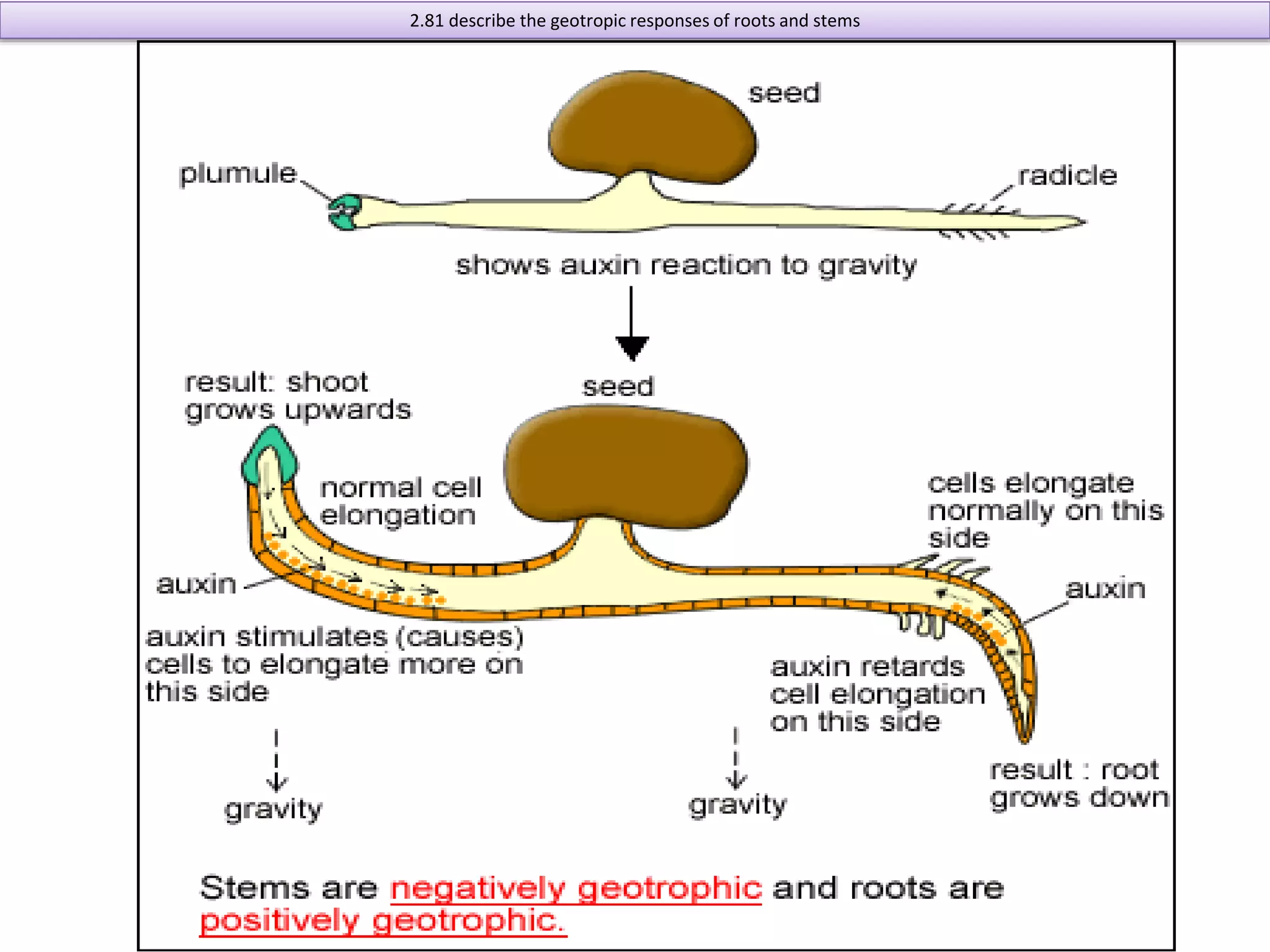
WHY 
You only need to know that plants respond to a 
chemical hormone called 
AUXIN 
BUT if you want more……… 
2.81 describe the geotropic responses of roots and stems
2.81 describe the geotropic responses of roots and stems 
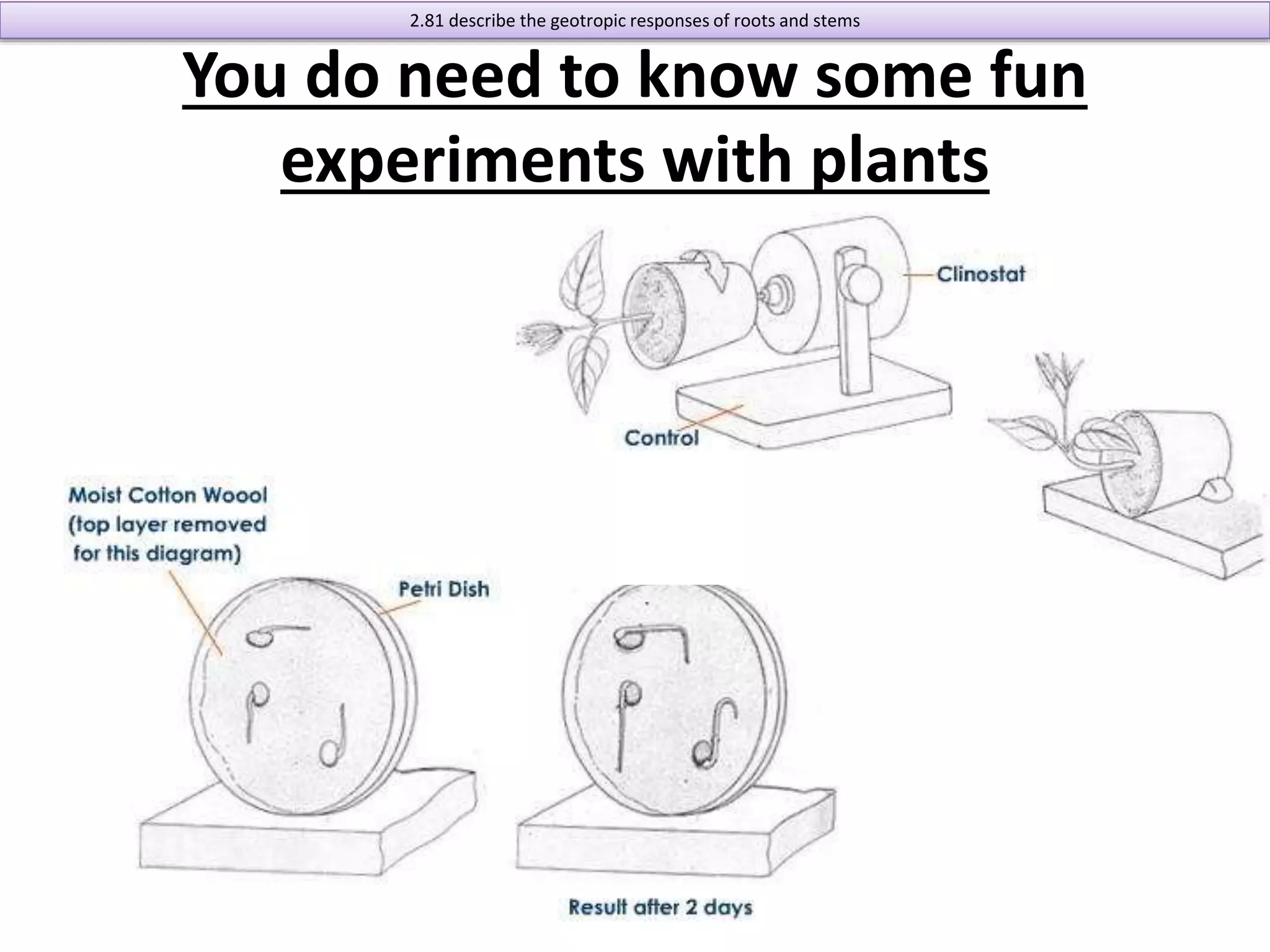
You do need to know some fun 
experiments with plants
2.81 describe the geotropic responses of roots and stems 
What happens when you grow a plant 
in space?
Positive Phototropism 
2.82 describe positive phototropism of stems 
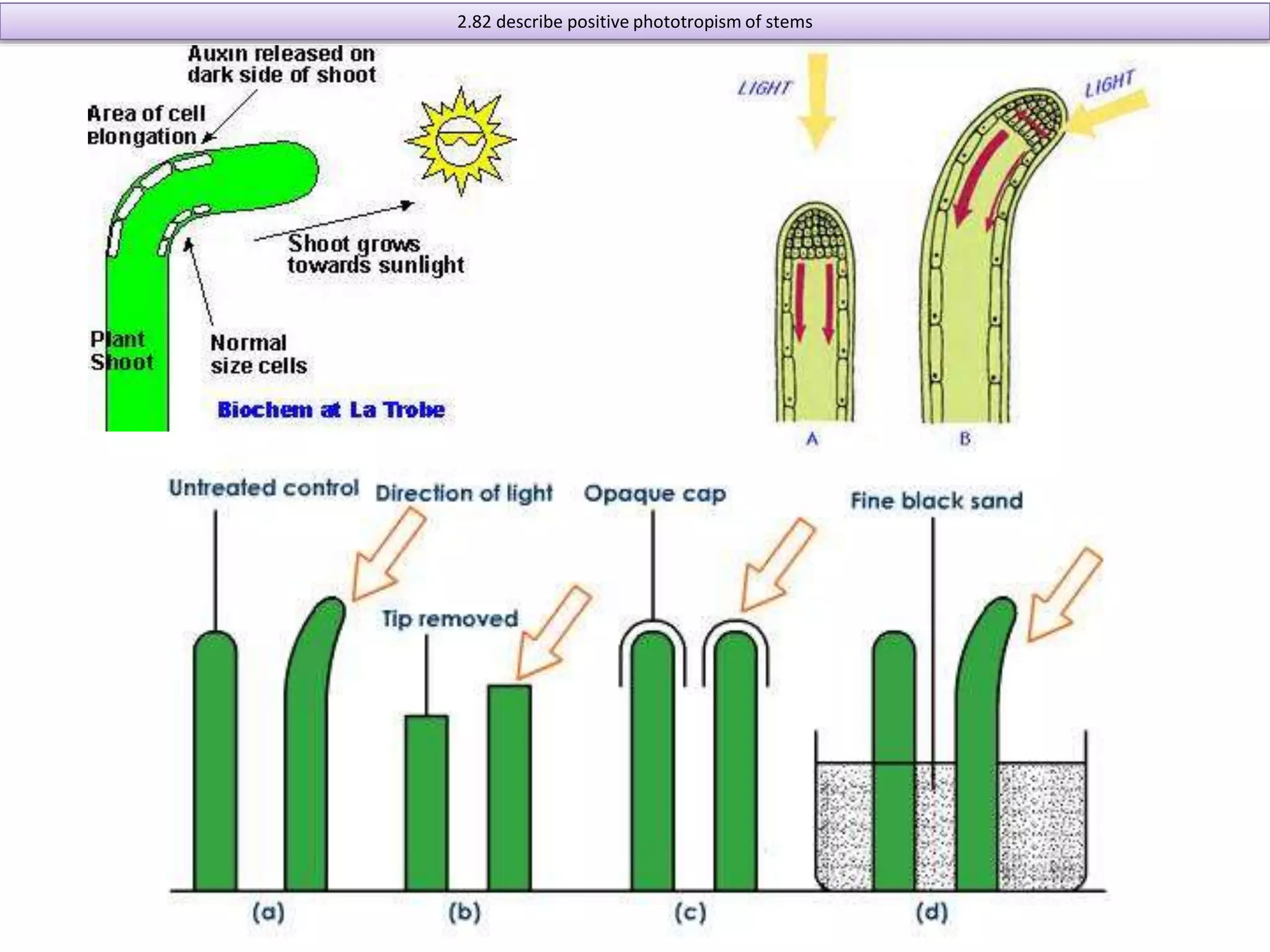
Positive Phototropism is controlled by hormones 
released by the growing tip of the shoot. 
(Only the tip makes the hormone) 
If you remove the tip, the shoot stops growing. 
The hormone made by the tip is called 
Auxin 
(which part of the plant would be controlled by 
Negative Phototropism?)
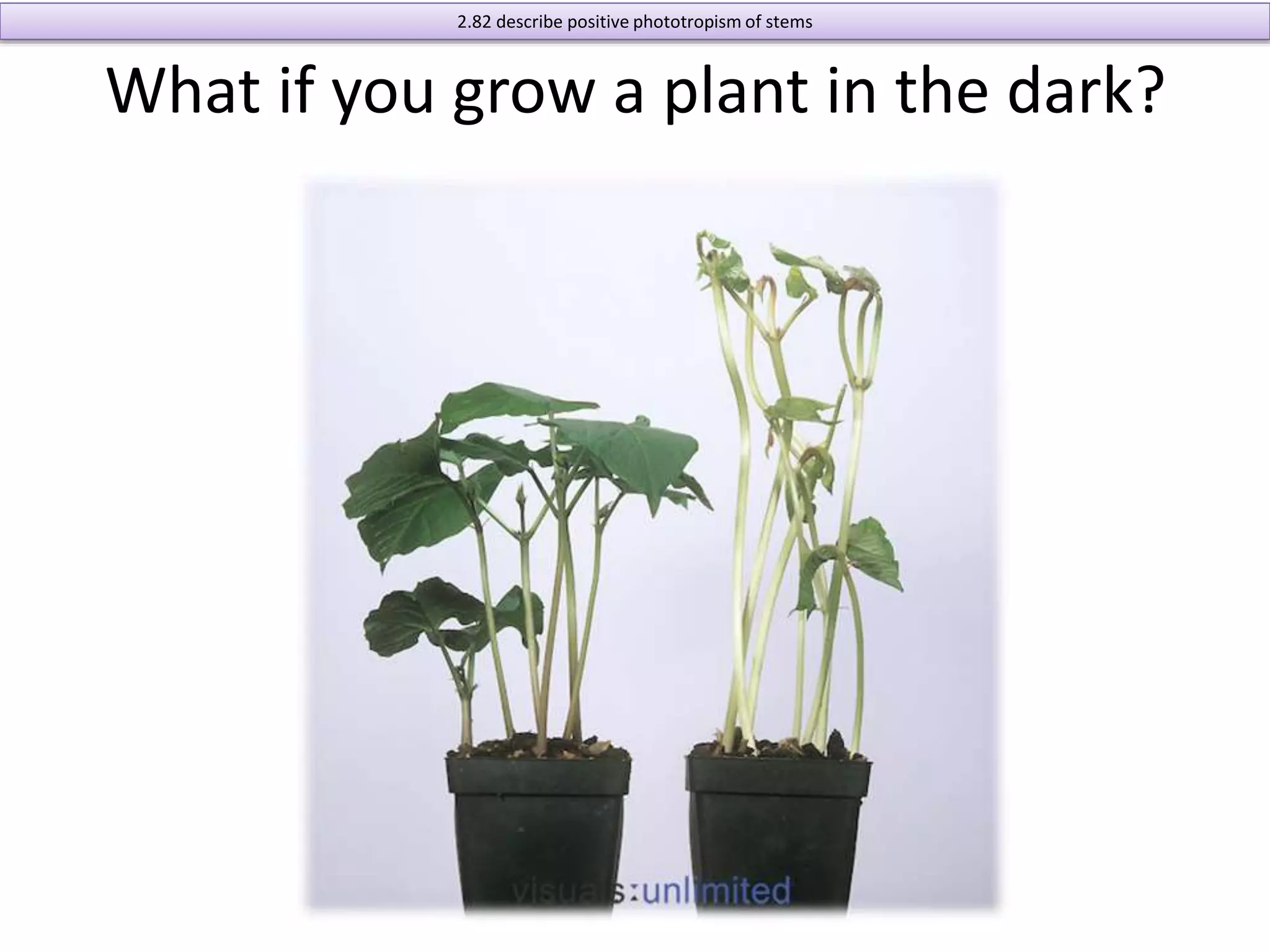
2.82 describe positive phototropism of stems
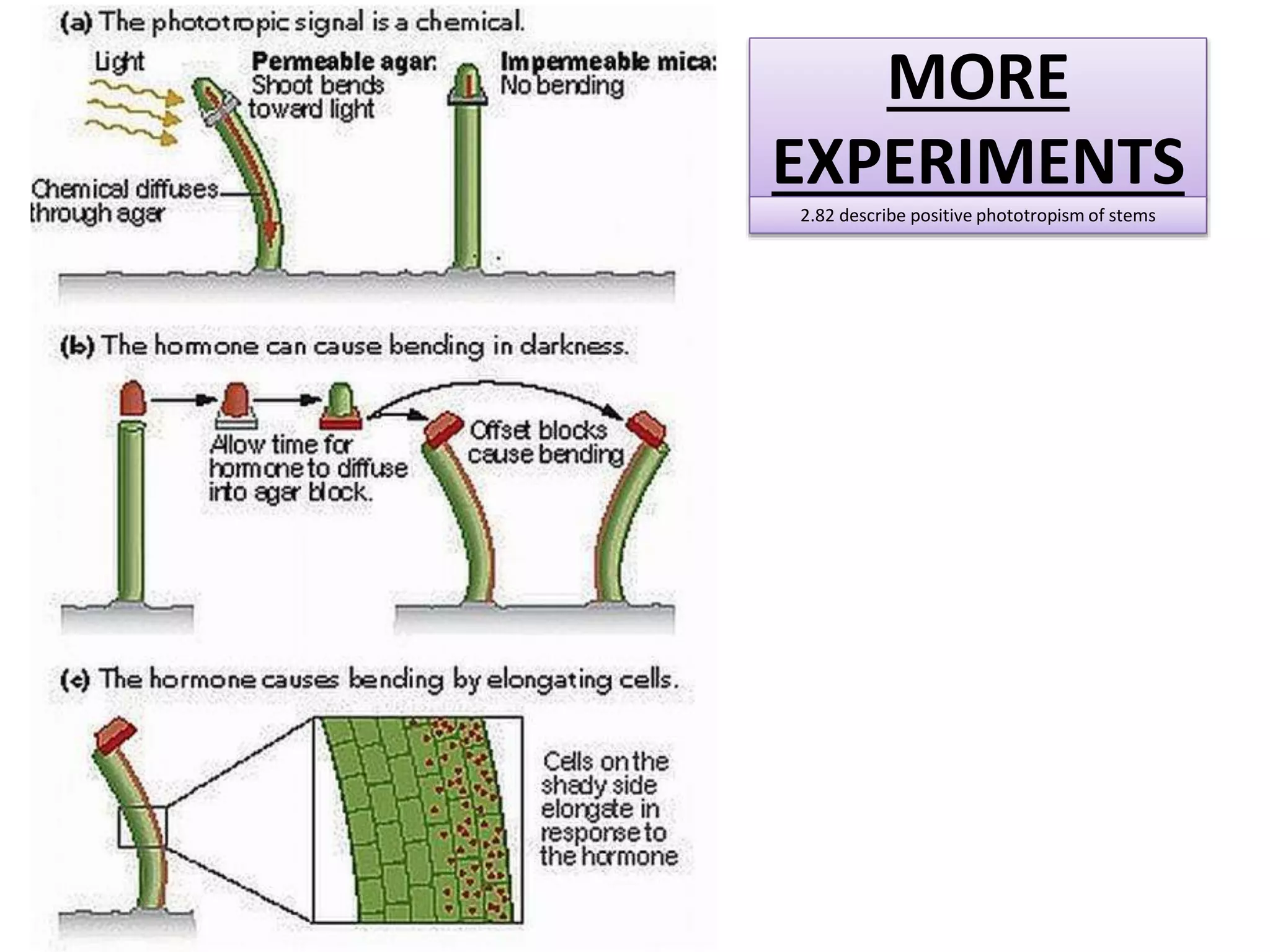
MORE 
EXPERIMENTS 
2.82 describe positive phototropism of stems
2.82 describe positive phototropism of stems 
What if you grow a plant in the dark?
Response Systems 
2.83 describe how responses can be controlled by nervous or by hormonal communication and understand the differences 
between the two systems 
Humans have two systems which carry out 
detection and response: 
• Nervous System – Chemical electrical system 
using Neurons 
Example: Iris dilation, movement, ventilation 
• Endocrine System –Chemical system using 
proteins called hormones in the blood. 
Example: Osmoregulation, Fight or Flight, 
Menstruation.
Differences 
2.83 describe how responses can be controlled by nervous or by hormonal communication and understand the differences 
between the two systems 
Nervous System Endocrine System 
Works by nerve impulses 
(has chemicals in synapses though) 
Works by hormones transmitted 
in blood stream 
Travel fast and usually have 
‘instant’ effect 
Travel slowly and may take longer 
to ask 
Response is short lived Response is usually longer lasting 
Impulse act on individual cells 
(localised effect) 
Widespread effects on different 
organs (still only work on 
cells/organs with correct 
receptors)
Nervous System 
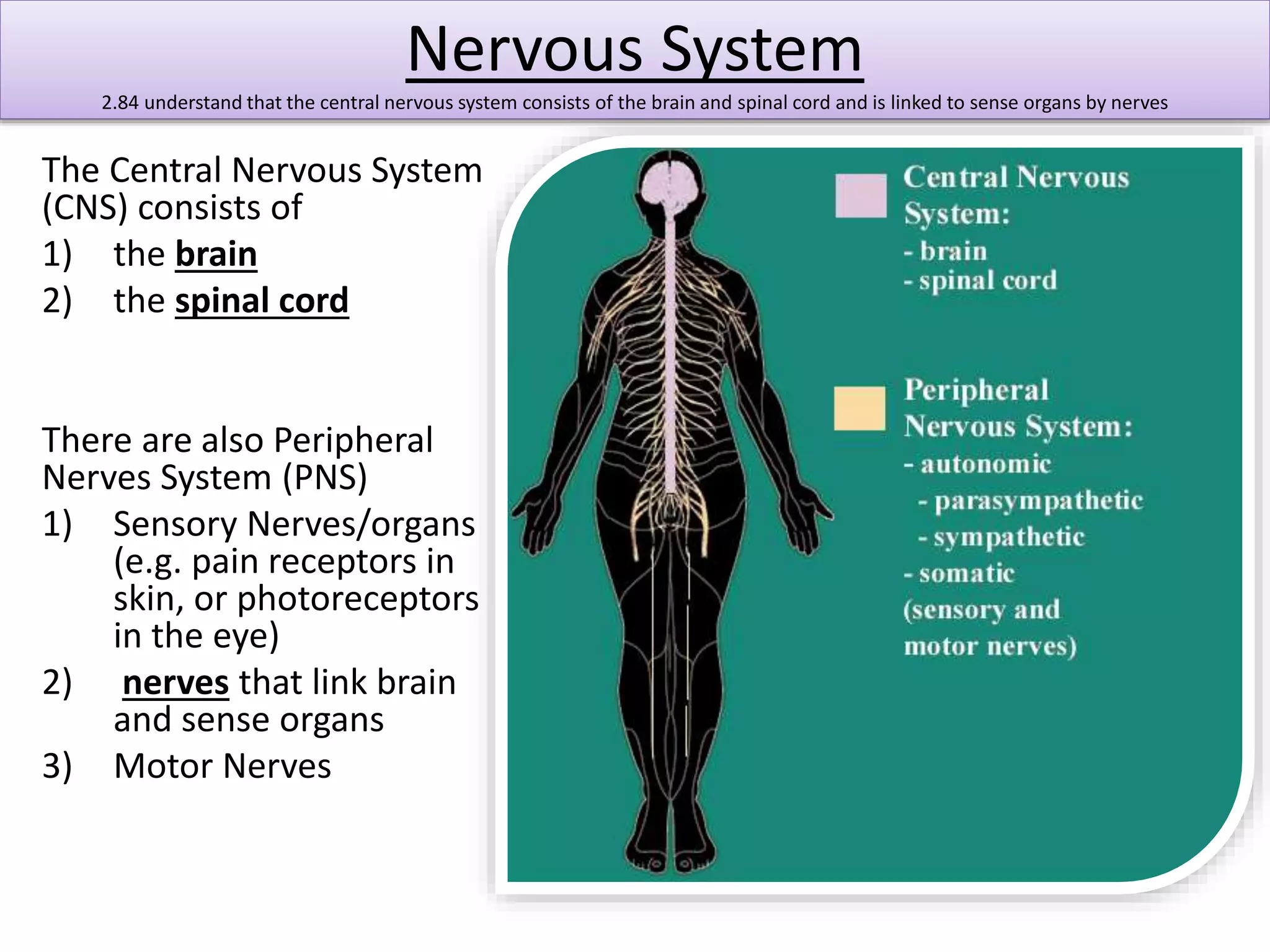
2.84 understand that the central nervous system consists of the brain and spinal cord and is linked to sense organs by nerves 
The Central Nervous System 
(CNS) consists of 
1) the brain 
2) the spinal cord 
There are also Peripheral 
Nerves System (PNS) 
1) Sensory Nerves/organs 
(e.g. pain receptors in 
skin, or photoreceptors 
in the eye) 
2) nerves that link brain 
and sense organs 
3) Motor Nerves
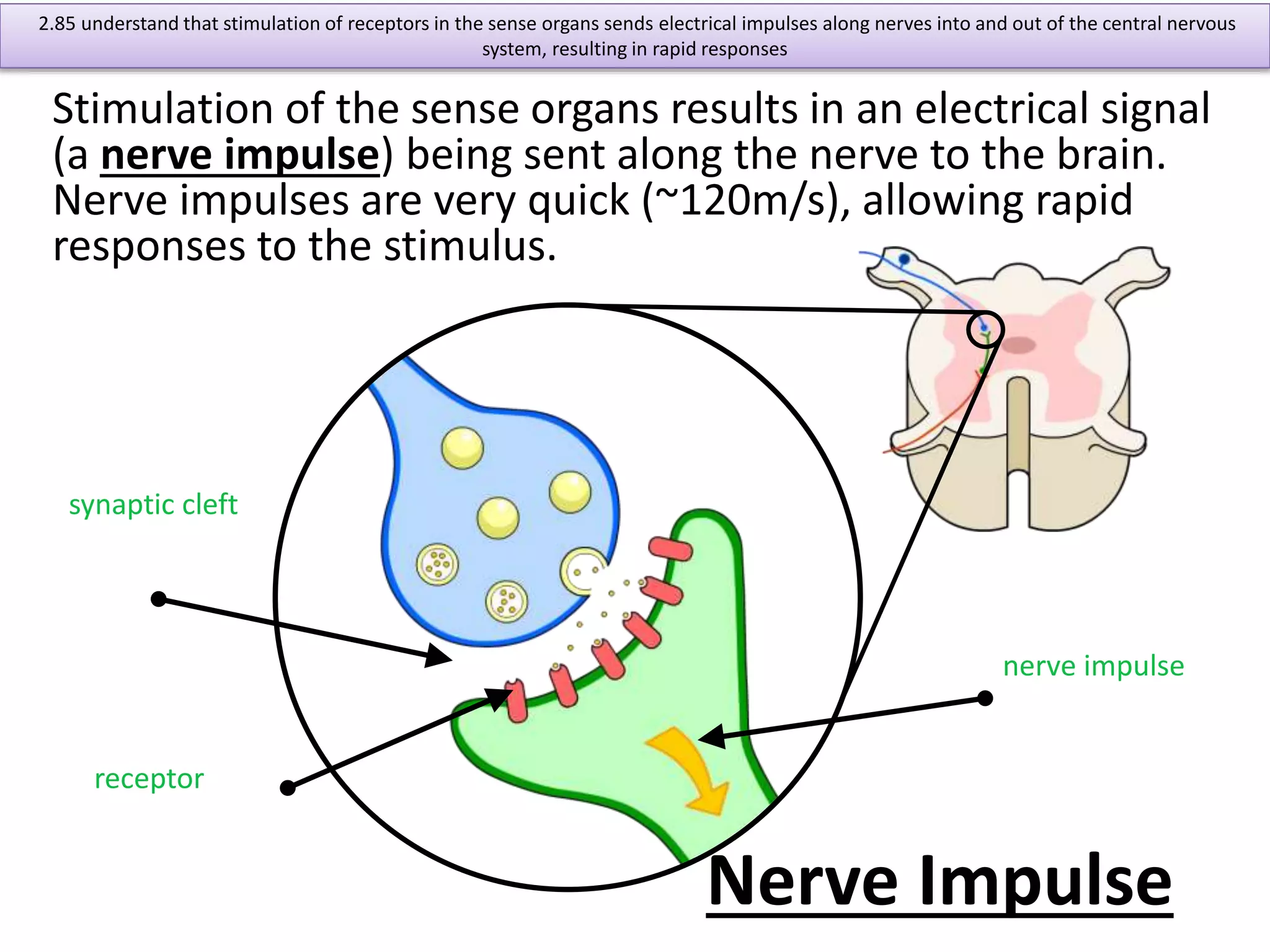
2.85 understand that stimulation of receptors in the sense organs sends electrical impulses along nerves into and out of the central nervous 
Stimulation of the sense organs results in an electrical signal 
(a nerve impulse) being sent along the nerve to the brain. 
Nerve impulses are very quick (~120m/s), allowing rapid 
responses to the stimulus. 
nerve impulse 
Nerve Impulse 
synaptic cleft 
receptor 
system, resulting in rapid responses
DIFFUSION AGAIN?? 
2.85 understand that stimulation of receptors in the sense organs sends electrical impulses along nerves into and out of the central nervous system, resulting in rapid responses 
(You do not have to know the terms just the ideas) 
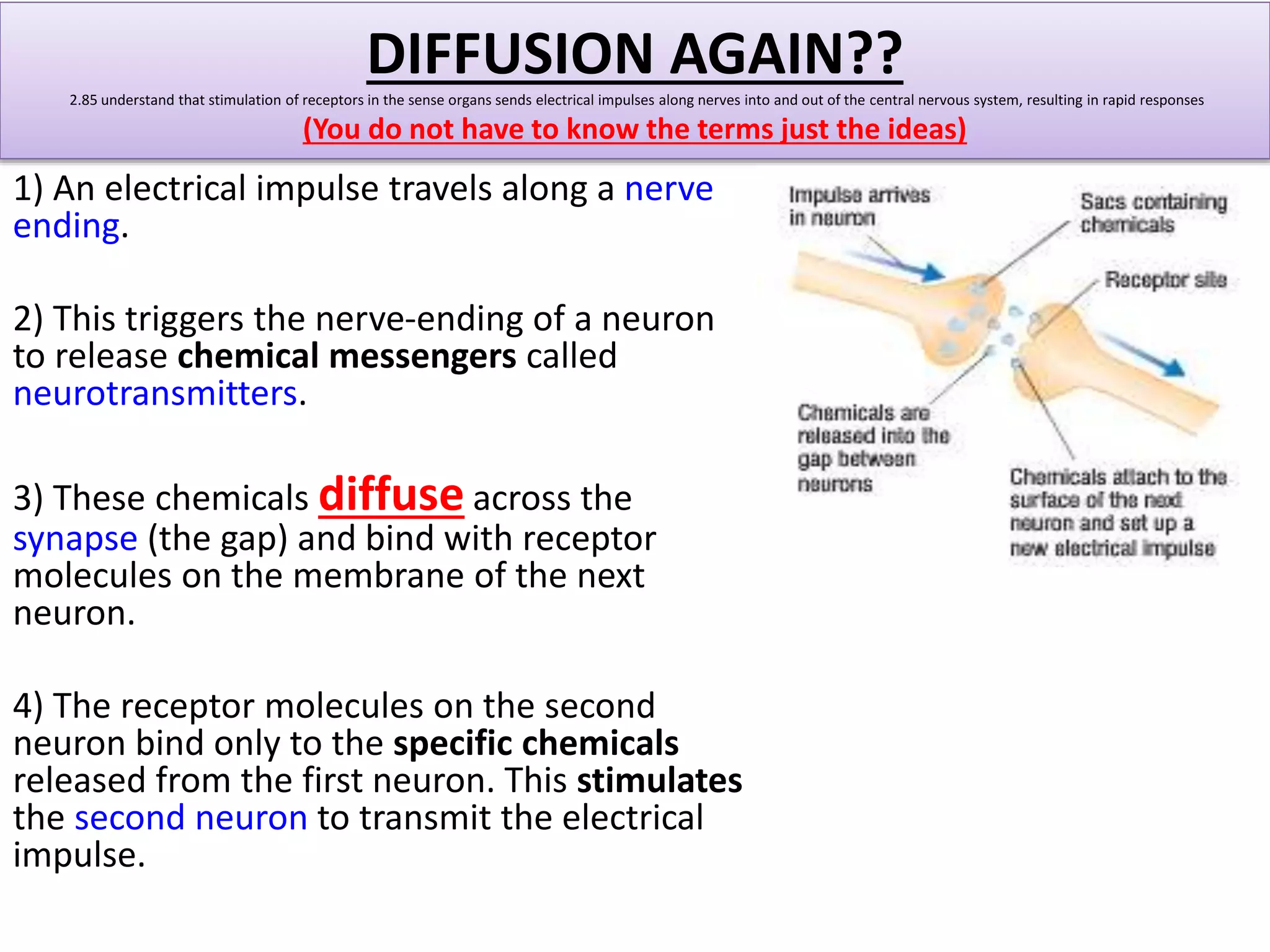
1) An electrical impulse travels along a nerve 
ending. 
2) This triggers the nerve-ending of a neuron 
to release chemical messengers called 
neurotransmitters. 
3) These chemicals diffuse across the 
synapse (the gap) and bind with receptor 
molecules on the membrane of the next 
neuron. 
4) The receptor molecules on the second 
neuron bind only to the specific chemicals 
released from the first neuron. This stimulates 
the second neuron to transmit the electrical 
impulse.
REFLEXS 
2.86 describe the structure and functioning of a simple reflex arc illustrated by the withdrawal of a finger from a hot object 
Some sense organs are not connected directly to 
the brain. 
This is a defence mechanism allowing almost 
instant responses to threatening or dangerous 
stimuli (e.g. pain/hot object). 
These instant responses are controlled by nerves 
in the spine, rather than the brain and are called 
reflexes
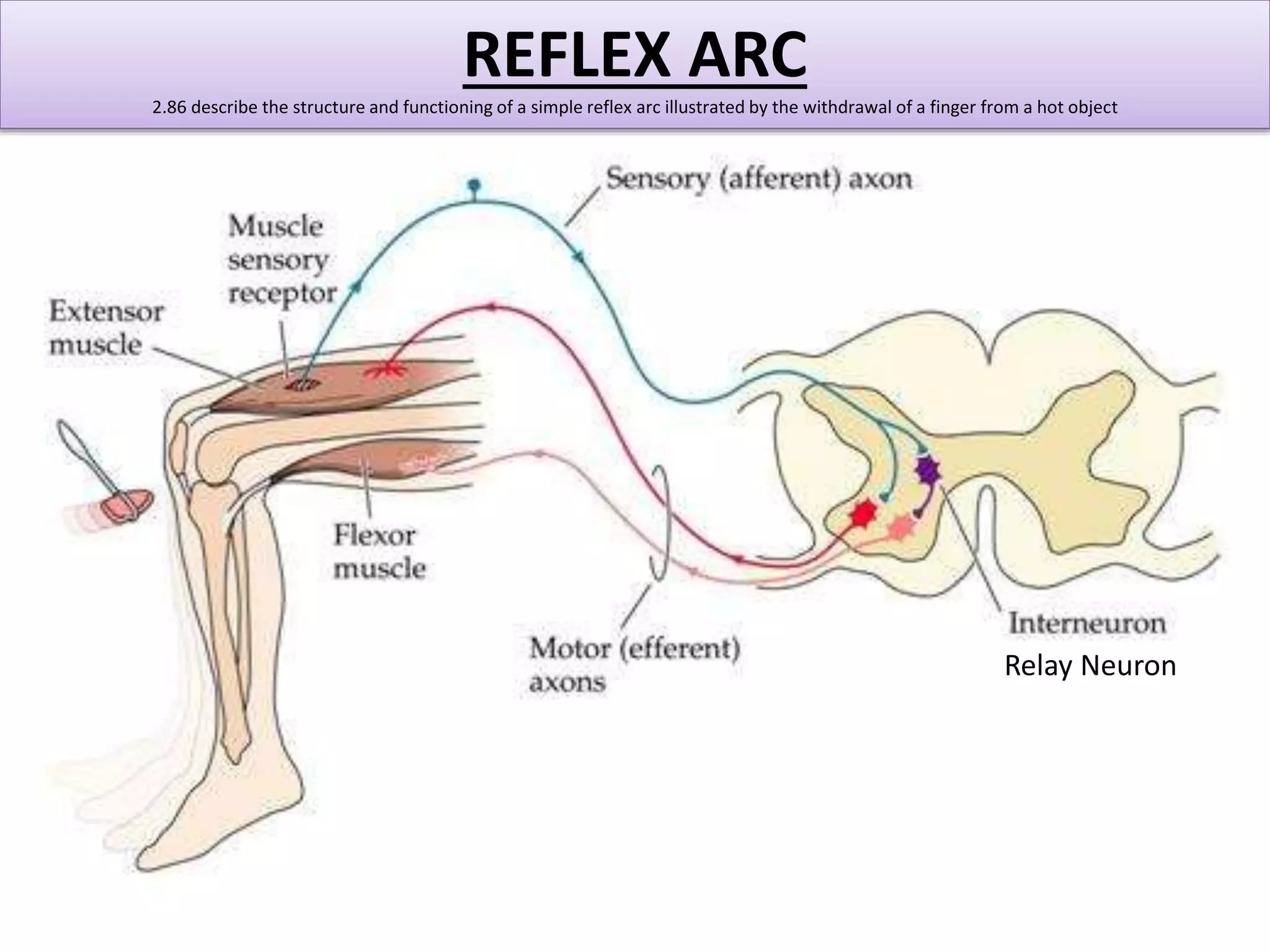
REFLEX ARC 
2.86 describe the structure and functioning of a simple reflex arc illustrated by the withdrawal of a finger from a hot object 
Relay Neuron
STEP BY STEP REFLEX ARC 
2.86 describe the structure and functioning of a simple reflex arc illustrated by the withdrawal of a finger from a hot object 
1) A stimulus is detected by a receptor 
2) The receptor initiates a nerve impulse in the sensory 
nerve 
3) The sensory nerve (which runs from the receptor to the 
spine) passes the message/impulse onto an 
interneuron/Relay Neuron in the spine 
4) The interneuron/relay neuron passes the message on the 
a motor nerve 
5) The motor nerve (which runs from the spine to a muscle 
in the same limb as the receptor) passes the message 
onto the effector muscle 
6) The effector muscle carries out the response (muscle 
contraction).
Reflex Arc Timing 
2.86 describe the structure and functioning of a simple reflex arc illustrated by the withdrawal of a finger from a hot object 
The entire process (stimulus to response) 
happens in less than a second and does not 
involve the brain. 
The purpose of the interneuron is also to inform 
the brain of what has happened. 
Reflex Summary 
1) Immediate response to stimulus 
2) Automatic reactions 
3) Limits damage to organism
THE EYE
EyE WebSites 
2.87 describe the structure and function of the eye as a receptor 
a) Label the eye 
http://www.kscience.co.uk/animations/eye_drag.htm 
b) Function of the eye 
http://www.kscience.co.uk/animations/eye_function_drag.htm 
c) Label the eye 
http://www.freezeray.com/flashFiles/eye.htm 
d) Light and the eye 
http://www.kscience.co.uk/animations/eye.htm 
e) Fun with your blind spot 
http://www.med.yale.edu/neurobio/mccormick/fill_in_seminar/figure1.htm
EYE DIAGRAM 
2.87 describe the structure and function of the eye as a receptor 
Conjunctiva
Define these Terms 
2.87 describe the structure and function of the eye as a receptor 
• Ciliary Body (muscle) 
• Iris 
• Pupil 
• Cornea 
• Lens 
• Suspensory Ligament 
• Sclera 
• Choroid 
• Retina 
• Fovea 
• Optic Disk (blind spot) 
• Optic Nerve 
• Conjunctiva 
Contracts to Relaxes to change shape of lens 
Coloured muscular part of eye that controls pupils size 
Opening in the iris that lets light through to the retina 
Transparent front part of the eye that refracts light 
Transparent part of the eye that bends light (refracts) 
Ligament that controls the shape of the lens 
Dense white covering of the eye 
Vascular membrane of the eyeball between the sclera and the retina 
& stops light reflecting around in the eye 
Light sensitive membrane that converts light to electrical signals to the brain 
Part of the retina with a high density of cones for very sharp vision 
Area of retina that is insensitive to light 
Where electrical impulses from retina travel to brain 
helps lubricate the eye by producing mucus and tears
RODS & CONES 
2.87 describe the structure and function of the eye as a receptor 
Light is detected by photoreceptors in the eye. 
These receptors form the retina (the inner lining of 
the eye). 
There are two types of photoreceptor 
Rods, which see only in & 
& 
Cones, which see in either red, blue or green 
(3 types of cones) 
Hint: Cone and Colour both start with ‘C’
Automatic Reflexs 
2.88 understand the function of the eye in focusing near and distant objects, and in responding to changes in light intensity (TA) 
There are two types of reflex you need to know 
about in the eye 
1) Responding to different light levels 
2) Focusing the eye
Responding to Light Levels 
(Antagonistic Muscle Pairs at Work) 
2.88 understand the function of the eye in focusing near and distant objects, and in responding to changes in light intensity (TA) 
Condition (Stimulus) Bright light Dim light 
Receptors More photoreceptors stimulated Less photoreceptors stimulated 
Impulses More impulses sent to the brain via 
optic nerve 
Fewer impulses sent to the brain 
via optic nerve 
Effectors Radial muscles of the iris relax Radial muscles of the iris contract 
Circular muscles of the iris contract Circular muscles of the iris relax 
Gross Effect Pupil constricts (becomes smaller) Pupil dilates (becomes larger) 
Less light enters the eye More light enters the eye
FOCUSING THE EYE 
2.88 understand the function of the eye in focusing near and distant objects, and in responding to changes in light intensity (TA) 
Cilary Muscle & Suspensory Ligaments 
Ciliary fibers are also 
know as 
Suspensory ligaments 
Cilary Muscle Contracted 
& Suspensory Ligament 
Relaxed 
Cilary Muscle Relaxed 
& Suspensory Ligament 
Contracted
2.88 understand the function of the eye in focusing near and distant objects, and in responding to changes in light intensity (TA) 
Distant Focus 
Cilary Muscle relax 
ACCOMODATION 
(Focusing) 
Suspensory Ligaments contract 
Lens is pulled 
Lens is thin 
Light rays bent slightly 
Light rays focus on retina 
Close Focus 
Cilary Muscle contract 
Suspensory Ligaments relax 
Lens is not pulled 
Lens is fat 
Light rays are bent strongly 
Light rays focus on retina
Controlling Skin Temperature 
2.89 describe the role of the skin in temperature regulation, with reference to sweating, vasoconstriction and 
vasodilation (TA) 
Too HOT Too COLD 
When you are HOT the following 
happens (controlled by reflexes) 
When you are cold the following 
happens (controlled by reflexes) 
1) Hairs on skin lie flat (less 
insulating air trapped) 
1) Hairs on skin stand up (more 
insulating air trapped) 
2) Sweating starts 2) Sweating stops 
3) Blood is diverted close to the 
surface of the skin (more heat 
radiation) 
3) Shivering starts, so muscles 
respire more, producing more 
heat. 
4) Blood is diverted away from the 
surface of the skin (less heat 
radiation)
2.89 describe the role of the skin in temperature regulation, with reference to sweating, vasoconstriction and vasodilation (TA)
Blood is diverted 
2.89 describe the role of the skin in temperature regulation, with reference to sweating, vasoconstriction and vasodilation (TA) 
Arterioles in the skin can open and close in 
response to nerve messages. 
Vasoconstriction – arteriole closes 
Vasodilation – arteriole opens
Hormones involved in Coordination 
2.90 understand the sources, roles and effects of the following hormones: ADH, adrenaline, insulin, testosterone, 
progesterone and oestrogen. 
Hormone Source Effect 
ADH Pituitary Regulated blood osmoregulation 
Adrenaline Adrenal glands Increases heart rate and breathing rate 
during exercise (more O2 for respiration) 
Insulin Pancreas 
Decreases blood glucose level after a meal. 
Glucose converted to Glycogen and stored in 
liver. 
Testosterone Testes 
Triggers puberty in boys (secondary sexual 
characteristics) 
Progesterone Ovaries Maintains uterus lining and (indirectly) 
causes menstruation 
Oestrogen Ovaries Triggers puberty in girls. 
Stimulates growth of uterus lining each 
month and (indirectly) causes ovulation
REPRODUCTION 
3.1 understand the differences between sexual and asexual reproduction 
There are two types of reproduction; 
• Sexual: reproduction in which two gametes (sex 
cells) fuse to create a new offspring that is 
genetically different to the parents. Two parents 
are involved. 
• Asexual: reproduction without fusion of gametes. It 
involves one parent only and produces offspring 
that are genetically identical to the parent (clones).
Fertilization 
3.2 understand that fertilisation involves the fusion of a male and female gamete to produce a zygote that 
undergoes cell division and develops into an embryo 
Definitions 
• Fertilization: 
• Zygote: 
• Embryo: 
A male and a female gamete fuse 
to form a zygote 
a cell that is the result of 
fertilization. It will divide by mitosis 
to form an embryo 
An organism in its early stages of 
development, especially before it 
has reached a distinctively 
recognizable form.
Reproduction in Plants 
(3.3 - 3.7)
Reproduction in Plants 
(3.3 - 3.7)
Reproduction in Plants 
(3.3 - 3.7)
Reproduction in Plants 
(3.3 - 3.7)
Structure and Function of Reproductive systems 
3.8 describe the structure and explain the function of the male and female reproductive systems
Structure and Function of Reproductive systems 
3.8 describe the structure and explain the function of the male and female reproductive systems
Structure and Function of Reproductive systems 
3.8 describe the structure and explain the function of the male and female reproductive systems 
DRAW IN YOUR OWN DIAGRAM 
LABLE
MENSTRUAL CYCLE 
3.9 understand the roles of oestrogen and progesterone in the menstrual cycle 
The menstrual cycle in women is a recurring process, taking around 28 days. 
During the process, the lining of the uterus - womb - is prepared for pregnancy. 
If pregnancy does not happen, the lining is then shed at menstruation. 
Several hormones control this cycle. 
Oestrogen 
The hormone oestrogen is secreted by the ovaries. 
Oestrogen makes two things happen: 
it stops more ovum being matured 
it causes the thinkening of the uterus lining 
Progesterone 
Progesterone is a hormone secreted by ovaries. 
It maintains the lining of the uterus during the middle part of the menstrual cycle and during 
pregnancy.
MENSTRUAL CYCLE 
3.9 understand the roles of oestrogen and progesterone in the menstrual cycle
MENSTRUAL CYCLE 
3.9 understand the roles of oestrogen and progesterone in the menstrual cycle
PLACENTA 
3.10 describe the role of the placenta in the nutrition of the developing embryo (TA) 
Diffuse from 
foetus to mother: 
1) CO2 
2) water, 
3) Urea 
Diffuse from 
mother to foetus: 
1) O2 
2) glucose, 
3) amino acids, 
4) minerals
PLACENTA 
3.10 describe the role of the placenta in the nutrition of the developing embryo (TA) 
The placenta is 
adapted for diffusion 
in much the same 
way as other 
exchange organs: 
1. Huge surface area (it 
has lots of villi-like 
projections) 
2. Only a few cells thick 
3. Blood supplies keep 
the concentration 
gradients high 
4. Counter-current 
system
AMNIOTIC FLUID 
3.11 understand how the developing embryo is protected by amniotic fluid (TA)
SECONDARY SEXUAL CHARACTERISTICS 
3.12 understand the roles of oestrogen and testosterone in the development of secondary sexual characteristics.
INHERITANCE 
(Syllabus points 3.13 – 3.33)
REPRODUCTION (review) 
3.1 understand the differences between sexual and asexual reproduction 
There are two types of reproduction; 
• Sexual: reproduction in which two gametes 
(sex cells) fuse to create a new offspring that 
is genetically different to the parents. Two 
parents are involved. 
• Asexual: reproduction without fusion of 
gametes. It involves one parent only and 
produces offspring that are genetically 
identical to the parent (clones).
Fertilization (review) 
3.2 understand that fertilisation involves the fusion of a male and female gamete to produce a zygote that 
undergoes cell division and develops into an embryo 
Definitions 
• Fertilization: 
• Zygote: 
• Embryo: 
A male and a female gamete fuse 
to form a zygote 
a cell that is the result of 
fertilization. It will divide by mitosis 
to form an embryo 
An organism in its early stages of 
development, especially before it 
has reached a distinctively 
recognizable form.
Fertilization, Zygote, Embryo(Review) 
3.2 understand that fertilisation involves the fusion of a male and female gamete to produce a zygote that undergoes cell division and develops 
into an embryo
Genes are on Chromosomes 
3.13 understand that the nucleus of a cell contains chromosomes on which genes are located 
The nucleus of every cell 
contains DNA. 
The DNA is organized in 
genes and the genes are 
located on 
Chromosomes. 
The best way to think 
about it is like a library…. video press
3.13 understand that the nucleus of a cell contains chromosomes on which genes are located 
LIBRARY 
Books 
Chapters 
Words 
Letters 
Nucleus 
Chromosome 
(23 pairs) 
Gene 
(makes one protein) 
Group of 3 letters 
DNA letters 
(A, C, T, G)
3.13 understand that the nucleus of a cell contains chromosomes on which genes are located
Genes Make a SPECIFIC Protein 
3.14 understand that a gene is a section of a molecule of DNA and that a gene codes for a specific protein 
1) Genes are written in DNA code. 
2) The code can be translated into amino acids. 
3) Amino Acids are linked together to make 
proteins. 
ONE Gene codes for ONE specific protein
Genes Make a SPECIFIC Protein 
3.14 understand that a gene is a section of a molecule of DNA and that a gene codes for a specific protein 
A three-base sequence codes for each amino acid. 
base sequence amino acid
Genes Make a SPECIFIC Protein 
3.14 understand that a gene is a section of a molecule of DNA and that a gene codes for a specific protein 
Genes don’t actually make proteins – they just contain the instructions on how to make 
them. 
DNA stays in the nucleus but proteins are built in the cell’s cytoplasm.
3.14 understand that a gene is a section of a molecule of DNA and that a gene codes for a specific protein 
So Your Genes code for Your Proteins
WHAT IS DNA? 
3.15 describe a DNA molecule as two strands coiled to form a double helix, the strands being linked by a series of paired bases: adenine (A) with 
thymine (T), and cytosine (C) with guanine (G) 
DNA is a very long molecule. 
It is shaped like a twisted 
ladder. 
Two long strands make the 
backbones and are connected 
by rungs or links.
BASE PAIRS 
3.15 describe a DNA molecule as two strands coiled to form a double helix, the strands being linked by a series of paired bases: adenine (A) with 
thymine (T), and cytosine (C) with guanine (G) 
The Strands are 
connected by BASE 
PAIRS 
• Adenine (A) 
• Thymine (T) 
• Cytosine (C) 
• Guanine (G) 
The bases only match: 
A-T 
C-G
Genes come in Variations 
3.16 understand that genes exist in alternative forms called alleles which give rise to differences in inherited characteristics 
Sometimes more than one version of a gene occurs. 
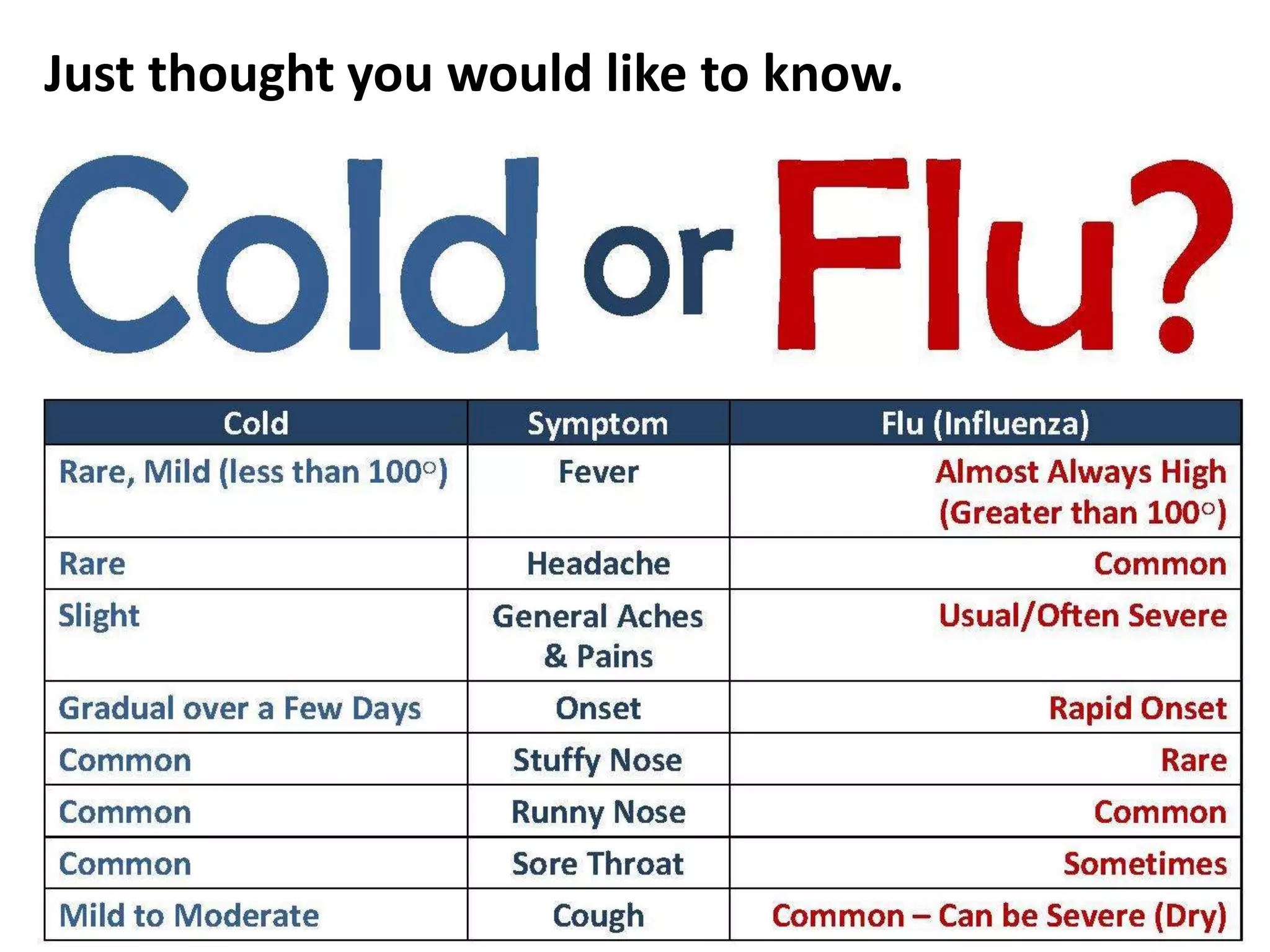
The different versions are called alleles 
(i.e. we all have the gene for iris pigment (protein), 
but there are different colours of iris pigment, same 
gene but different alleles)
Alleles give rise to Variation 
3.16 understand that genes exist in alternative forms called alleles which give rise to differences in inherited characteristics 
over 
view
Alleles give rise to Variation (2) 
3.16 understand that genes exist in alternative forms called alleles which give rise to differences in inherited characteristics 
Alleles give rise to a range of different inherited 
characteristics in a population. 
These can include in humans: 
Eye Colour 
Skin Colour 
Hitch Hikers Thumb 
Rolling of the tongue 
Earlobe shape 
Blood Type 
Many many others………..
DEFINITIONS OF INHERITANCE TERMS 
3.17 understand the meaning of the terms: dominant, recessive, homozygous, heterozygous, phenotype, genotype and co-dominance 
Dominant: 
A gene allele that ‘expresses’ over another allele in 
homozygous and heterozyogus pairs. Shown in phenotype. 
b 
B 
Recessive: 
A gene allele that only ‘expresses’ when it is matched with 
another recessive allele and never when matched with a 
dominant allele. Homozygous Recessive. Shown in phenotype 
b b
DEFINITIONS OF INHERITANCE TERMS 
3.17 understand the meaning of the terms: dominant, recessive, homozygous, heterozygous, phenotype, genotype and co-dominance 
Homozygous: having identical alleles at corresponding 
chromosome Loci (Gene Location). 
Heterozygous: having dissimilar alleles at 
corresponding chromosomal Loci. 
b B B B b b
DEFINITIONS OF INHERITANCE TERMS 
3.17 understand the meaning of the terms: dominant, recessive, homozygous, heterozygous, phenotype, genotype and co-dominance
DEFINITIONS OF INHERITANCE TERMS 
3.17 understand the meaning of the terms: dominant, recessive, homozygous, heterozygous, phenotype, genotype and co-dominance
DEFINITIONS OF INHERITANCE TERMS 
3.17 understand the meaning of the terms: dominant, recessive, homozygous, heterozygous, phenotype, genotype and co-dominance 
Phenotype: the set of observable 
characteristics Geneotype 
of an individual resulting 
from the interaction of its genotype 
with the environment 
Genotype: The genetic makeup of a cell, 
an organism, or an individual with 
reference to a specific characteristic. 
Environemnt 
Phenotype
DEFINITIONS OF INHERITANCE TERMS 
3.17 understand the meaning of the terms: dominant, recessive, homozygous, heterozygous, phenotype, genotype and co-dominance
DEFINITIONS OF INHERITANCE TERMS 
3.17 understand the meaning of the terms: dominant, recessive, homozygous, heterozygous, phenotype, genotype and co-dominance 
Codominance: A single gene has more than one dominant allele and both genes are 
expressed. 
The meaning of the prefix "co-" is "together". Cooperate = work together. Coexist = 
exist together. Cohabitat = habitat together. 
When writing alleles remember: 
All alleles are CAPITAL letters 
*I remember codominance in the form of an example like so: 
red x ---> r d & h t s o t d
CODOMINANCE
Genetic Diagrams - Generations 
3.18 describe patterns of monohybrid inheritance using a genetic diagram 
Generations 
There are the parents, then their offspring, and their offspring, etc. etc. 
Each generation has a name. 
The first plants or animals bred together are called the Parental generation, or P1 generation. 
Their offspring are called the First Filial generation, or F1 generation. 
Their offspring are called the Second Filial generation, or F2 generation. 
And so on. And so on.
Genetic Diagrams – Punnett Squares 
3.18 describe patterns of monohybrid inheritance using a genetic diagram 
SOME SIMPLE EXAMPLES OF WHAT YOU CAN USE A 
PUNNETT SQUARE FOR 
SEED COLOUR FLOWER COLOUR GENDER 
press
Genetic Diagrams – Punnett Squares 
3.18 describe patterns of monohybrid inheritance using a genetic diagram 
P1 
P1 
P1 
Genotype of F2 
press
Genetic Diagrams – Punnett Squares 
3.18 describe patterns of monohybrid inheritance using a genetic diagram 
How to diagram patterns in monohybrid inheritance: 
1) Phenotype of Parents P1 
2) Genotype of Parents 
3) Gametes Produced 
4) Genotype of F1 (you may need a Punnett square) 
5) Phenotype of F1 
6) Gametes from F1 produced 
7) Genotype of F2 (you may need a Punnett square) 
8) Phenotype of F2 
9) What are the ratios of F2 Phenotype and Genotypes
Genetic Diagrams – Crossing 
3.18 describe patterns of monohybrid inheritance using a genetic diagram 
To cross two tall plants 
1. The allele for tallness is H and is dominant to that for smallness, h. 
2. If the two plants are heterozygous, they will have a genotype, which contains the alleles Hh. 
3. Gametes of individuals contain half of the chromosomes. So only one of the alleles will be 
present in each gamete cell. 
So there will be 3 
tall plants for every 
1 small plant. Or to 
put it another way, 
there is a 75% 
chance that each F1 
(offspring) plant will 
be tall. 
press
TESTCROSS 
3.18 describe patterns of monohybrid inheritance using a genetic diagram 
Geneticists use the testcross to determine unknown Genotypes 
A testcross can reveal an unknown genotype 
1. Mate an individual of unknown genotype and a 
homozygous-recessive individual 
2. In a test cross you breed an organism showing the 
dominant features with one showing the recessive 
feature 
3. Each of the two possible genotypes (homozygous 
or heterozygous) gives a different phenotypic ratio 
in the F1 generation
TESTCROSS 
3.18 describe patterns of monohybrid inheritance using a genetic diagram
Pedigree Charts 
3.19 understand how to interpret family pedigrees 
A pedigree is a chart of the genetic history of family over several generations. 
Constructing a Pedigree 
• Female 
• Male 
Connecting Pedigree 
Symbols 
• Married 
Couple 
• Siblings 
• Fraternal 
twins 
• Identical 
twins 
• Not Affected 
• Affected 
• Deceased
Example (Dominant or Recessive) 
3.19 understand how to interpret family pedigrees 
Is the Affected allele Dominant or Recessive? 
Affected Unaffected 
aa AA 
RECESSIVE 
Aa Aa Aa 
aa aa 
aa 
Aa Aa 
aa aa 
aa
Example (Dominant or Recessive) 
3.19 understand how to interpret family pedigrees 
Is the Affected allele Dominant or Recessive? 
Affected Unaffected 
Aa aa 
Aa Aa 
DOMINANT 
aa aa 
Aa Aa Aa 
AA 
AA aa 
Aa
Interpreting a Pedigree Chart (hard) 
3.19 understand how to interpret family pedigrees 
Determine if the pedigree chart shows: 
• An autosomal disease 
-The disease Allele is not on Sex 
Chromosome (X Y) 
-The disease Allele can be dominant or 
recessive 
• X-linked disease 
-The disease Allele is found on X Sex 
Chromosome 
-( X = Normal Allele, Xr = Disease Recessive 
Allele) 
press 
If it is a 50/50 ratio between men and 
women. The disorder is autosomal. 
Most of the males in the pedigree are 
affected. The disorder is X-linked 
press
Interpreting a Pedigree Chart (additional) 
3.19 understand how to interpret family pedigrees 
Sex Linked diseases can include: 
• Hemophilia (Xr) - Recessive 
• Colour blindness (Xr) - Recessive The phenotype of a Carrier 
is “NOT DISEASED”
Example (Dominant or Recessive) 
3.19 understand how to interpret family pedigrees 
Example of Pedigree Charts 
• Is the affected trait Autosomal or X-linked? 
AUTOSOMAL 
If it is a 50/50 ratio between men and 
women. The disorder is autosomal.
Example (Dominant or Recessive) 
3.19 understand how to interpret family pedigrees 
Summary 
• Pedigrees are family trees that explain your genetic 
history. 
• Pedigrees are used to find out the probability of a 
child having a disorder in a particular family. 
• To begin to interpret a pedigree, determine if the 
disease or condition is autosomal or X-linked and 
dominant or recessive.
Monohybrid Cross Probability 
3.20 predict probabilities of outcomes from monohybrid crosses 
GIVE THE GENOTYPE RATIO: 
GIVE THE PHENOTYPE RATIO:
Male or Female 
3.21 understand that the sex of a person is controlled by one pair of chromosomes, XX in a female and XY in a male
Male or Female 
3.21 understand that the sex of a person is controlled by one pair of chromosomes, XX in a female and XY in a male 
XX = Female 
XY = Male
Determine the Sex (diagram it) 
3.22 describe the determination of the sex of offspring at fertilisation, using a genetic diagram
Diploid Cell Division 
3.23 understand that division of a diploid cell by mitosis produces two cells which contain identical sets of chromosomes
What are homologous chromosomes? 
3.23 understand that division of a diploid cell by mitosis produces two cells which contain identical sets of chromosomes 
Different organisms have different numbers of chromosomes. Humans 
have 46 chromosomes. This is the diploid number of humans. 
Chromosomes can be grouped in pairs called homologous 
chromosomes. In each pair, one chromosome has been inherited 
from the mother and the other inherited from the father. 
homologous pair 
chromosome from 
mother 
chromosome from 
father
What are homologous chromosomes? 
3.23 understand that division of a diploid cell by mitosis produces two cells which contain identical sets of chromosomes 
2n 
Body cells are: 2n - Diploid 
Sex Cells are: n - Haploid 
2n 
2n
What is Mitosis good for? 
3.24 understand that mitosis occurs during growth, repair, cloning and asexual reproduction 
MITOSIS 
GROWTH 
New cell growth 
Nerve cells 
(tissue) 
Muscle cells 
(tissue) 
Repair 
Scar tissue 
Replace old cells 
RBC 
Skin 
Cloning Dolly the sheep 
Asexual 
Reproduction 
Budding 
Bacteria & Yeast 
Cuttings, Bulbs, 
Tubers, Runners 
Willow 
Tulips 
Potatoes 
Strawberries
Meiosis Makes Gametes 
3.25 understand that division of a cell by meiosis produces four cells, each with half the number of chromosomes, and that this results in the 
formation of genetically different haploid gametes
Meiosis Makes Gametes 
3.25 understand that division of a cell by meiosis produces four cells, each with half the number of chromosomes, and that this results in the formation of 
genetically different haploid gametes 
3.27 know that in human cells the diploid number of chromosomes is 46 and the haploid number is 23 
MITOSIS MEIOSIS 
1) Produces 2 daughter cells 
2) Daughter cells are diploid 
(have 23 pairs of chromosomes) 
3) Daughter cells are genetically 
identical to each other. 
3) Gametes are different to 
each other 
4) Gametes are different to 
the parent cell (crossing over of 
genetic material) 
5) Two stage process 
6)Happens in Reproductive 
organs only 
4) Daughter cells are genetically 
identical to the parent cell (no 
genetic crossing over) 
5) One stage process 
6) Happens everywhere in the 
body 
1) Produces 4 gamete cells 
2) Daughter cells are haploid 
(Only have 23 chromosomes)
Random Fertilization and Variation 
3.26 understand that random fertilisation produces genetic variation of offspring
Key Word basic Summary 
This topic, more than any other, confuses people. Remember these! 
DNA: A genetic code 
Gene: One instruction in the code telling a cell how to make a 
specific protein 
Allele: A different version of a gene 
Chromosome: Coiled up DNA 
Haploid number: the number of different chromosomes in a cell (23) 
Diploid number: the total number of chromosomes in a cell (46) 
Cell Division: 
There are two types of cell division; 
- Mitosis – used for growth, repair & asexual reproduction 
- Meiosis – used to produce gametes for sexual reproduction
Nature Vs Nurture 
3.28 understand that variation within a species can be genetic, environmental, or a combination of both 
Variation
Mutations 
(not all x-men get superpowers) 
3.29 understand that mutation is a rare, random change in genetic material that can be inherited 
3.31 understand that many mutations are harmful but some are neutral and a few are beneficial 
Mutation - a rare, random change in the genetic code of a gene. 
The mutated gene will produce a slightly different protein to 
the original non-mutant gene. The new protein might; 
A) Work just as well as it did before (neutral mutation) 
B) Work better than before (beneficial mutation) 
C) Work worse / not at all (harmful mutation) 
Beneficial mutations give a selective advantage to the individual. 
Individuals with this kind of mutated allele are more likely to survive, 
reproduce and pass their alleles on. This is the basis of: 
Natural Selection
Evolution by Natural Selection 
3.30 describe the process of evolution by means of natural selection 
Evolution is the process by which the range of 
organisms on Earth change 
New species arise through a process known as 
NATURAL SELECTION 
1) Living organisms produce more offspring than are needed 
to replace them, not all of these off-spring grow up and 
breed themselves. These offspring have different alleles. 
2) Those organisms best suited to their local environment 
survive best and breed, passing on their genetic 
(genes/DNA) information to the next generation 
3) In this way the different forms will become more and 
more different until eventually they are a new species
WHAT IS THE SELECTION METHOD 
3.30 describe the process of evolution by means of natural selection 
HOW TO BE SUCCESSFUL IN PASSING ON YOUR 
GENES (A HOW TO 5 STEP GUIDE): 
1) BE ATTRACTIVE (physical and social traits can make you more 
successful with the opposite sex) 
2) REPRODUCE OFTEN (The more offspring you make the better) 
3) DON’T WASTE YOUR RESOURCES (Invest only the minimal 
amount of resources in offspring to see them through to 
reproduction) 
4) HAVE A ‘DEEP’ GENE POOL (The more variable your offspring 
the better chance of some of them surviving unexpected 
catastrophes. A little bit of mutation/lots of alleles is not a bad 
thing) 
5) STAY ALIVE!! (Live long enough to reproduce………....then die.)
DARWIN SAID IT BEST 
3.30 describe the process of evolution by means of natural selection 
Darwin came up with this theory 
1) Darwin’s 1st Observation: Not all 
individuals survive 
2) Darwin’s 2nd Observation: There is 
variation in a species 
3) Darwin’s Conclusion: The better 
adapted individuals survive (the 
“fittest”) and reproduce, passing their 
alleles onto the next generation. 
Over time this process leads to evolution. 
www.darwinawards.com/
THE SUPERBUGS 
3.32 understand that resistance to antibiotics can increase in bacterial populations, and appreciate how such an increase can lead to infections 
being difficult to control 
1) Bacteria reproduce very frequently so mutations (different alleles) are common. 
2) These mutations can mean that they are no longer affected/controlled by a certain 
antibiotic 
3) Surviving generations carry the mutation (allele)making it easier for them to survive. 
4) If bacteria evolve over many generations to be resistant to drugs we are treating 
them with then they are difficult to control 
5) Sometimes they can be controlled using a different antibiotic 
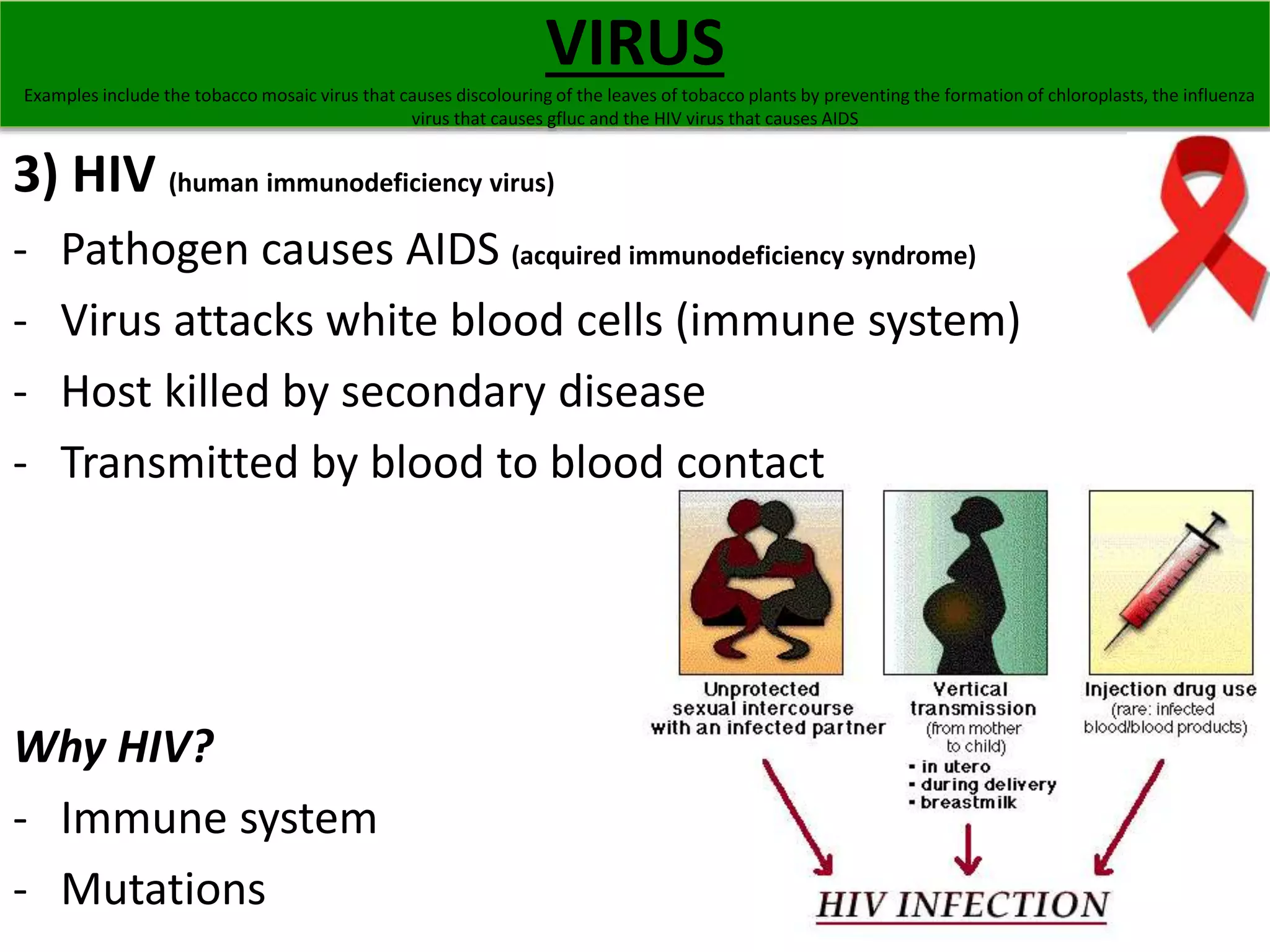
6) These bacteria in turn become resistant to new antibiotics due to the high rate or 
reproduction and random mutations 
7) Currently some are becoming resistant to all current know antibiotics. 
Methicillin-resistant Staphylococcus aureus (MRSA or golden staph), vancomycin-resistant 
Enterococcus (VRE) and multi-drug-resistant Mycobacterium tuberculosis (MDR-TB) 
✔
The Makings of a Mutant (TA) 
3.33 understand that the incidence of mutations can be increased by exposure to ionising radiation (for example gamma rays, X-rays and 
ultraviolet rays) and some chemical mutagens (for example chemicals in tobacco).(TA) 
Mutations are: a) inherited b) happen on their own 
(although this is rare). 
The frequency that mutation occurs naturally can be 
increased by exposure to radiation 
• gamma rays 
• X-rays 
• ultraviolet rays 
And 
Chemical mutagens 
• chemicals in tobacco..Not Nicotine!)
Ecology & Environment
Definitions 
4.1 understand the terms population, community, habitat and ecosystem 
• Population: all the individuals of a particular 
species within a defined area 
• Community: a group of different populations 
living in the same area 
• Habitat: the physical, chemical and biological 
environment in which an organism lives 
• Ecosystem: a community of living things and 
the environment in which they live
How to Use a Quadrat (1) 
4.2 explain how quadrats can be used to estimate the population size of an organism in two different areas 
4.3 explain how quadrats can be used to sample the distribution of organisms in their habitats. 
• A quadrat can be used to calculate 
the total population of a species 
(e.g. snails). 
• Simply count the number of 
individuals in the quadrat. 
• This technique only works for large 
organisms which can be 
distinguished as individuals and do 
not move fast (not always easy for 
plants, e.g. grass and tigers)
How to Use a Quadrat (2) 
4.2 explain how quadrats can be used to estimate the population size of an organism in two different areas 
4.3 explain how quadrats can be used to sample the distribution of organisms in their habitats. 
• A quadrat can be used to 
calculate the percentage cover 
of a species (e.g. moss). 
• The quadrat is divided into 
100 smaller squares. 
• The percentage cover of the 
quadrat is simply the number 
of squares filled with the 
species.
How to Use a Quadrat (3) 
4.2 explain how quadrats can be used to estimate the population size of an organism in two different areas 
4.3 explain how quadrats can be used to sample the distribution of organisms in their habitats. 
• A quadrat can be used to 
calculate the percentage 
frequency of a species (e.g. 
daisies in a field). 
• The quadrat is divided into 100 
smaller squares. You simply count 
a 1 for each square the species is 
in and a 0 for those where it is 
absent. 
• This gives you an indication of the 
frequency of the species, it does 
not tell you the total population.
USE of A Sample Quadrat 
4.2 explain how quadrats can be used to estimate the population size of an organism in two different areas 
4.3 explain how quadrats can be used to sample the distribution of organisms in their habitats. 
The best use of a quadrat is in obtaining a sample 
(it is not practical to count all of the species) 
e.g. one cannot count all of the grass plants in a field! 
Ecologists use quadrats to sample from a habitat.
You can use the data to: 
4.2 explain how quadrats can be used to estimate the population size of an organism in two different areas 
4.3 explain how quadrats can be used to sample the distribution of organisms in their habitats. 
Compare different species in ONE 
area 
Compare the same species in TWO 
or MORE areas
Using a Quadrat 
4.2 explain how quadrats can be used to estimate the population size of an organism in two different areas 
4.3 explain how quadrats can be used to sample the distribution of organisms in their habitats. 
Sampling: 
1) Sample has to be random (so no bias is 
introduced). 
2) Samples have to be representative, so we have to 
take a large enough sample. At least 5% of 
habitat.
Using a Quadrat 
4.2 explain how quadrats can be used to estimate the population size of an organism in two different areas 
4.3 explain how quadrats can be used to sample the distribution of organisms in their habitats. 
How to make a quadrat sample? 
• Find the boarders of your habitat (measure) 
• Divide your habitat into a grid with X and Y coordinates. 
• Randomly place your quadrat (use a random numbers for X & Y 
coordinates) 
• Count number or organism/organisms, percentage cover or 
frequency of organisms. 
• Record all data in a table. 
• Repeat until a large enough sample size is completed 
• Average all data 
• Scale up average (multiply average per quadrat by number of 
quadrats in habitat) 
• Compare: 
1. Different species in same habitat 
2. Same species from a different habitat
Review from the past 
4.4 explain the names given to different trophic levels to include producers, primary, secondary and tertiary consumers and decomposers
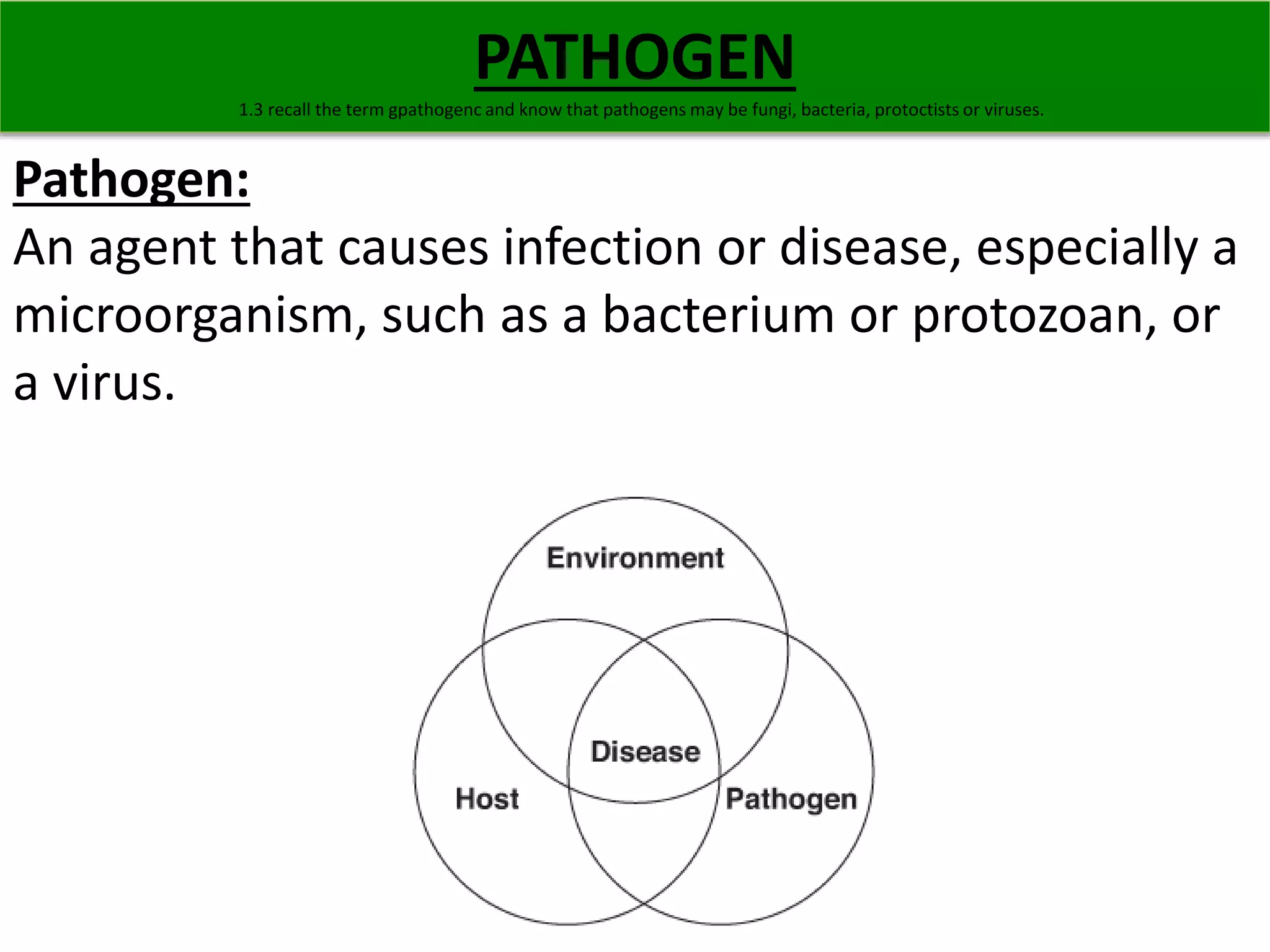
Feeding Relationships 
4.4 explain the names given to different trophic levels to include producers, primary, secondary and tertiary consumers and decomposers 
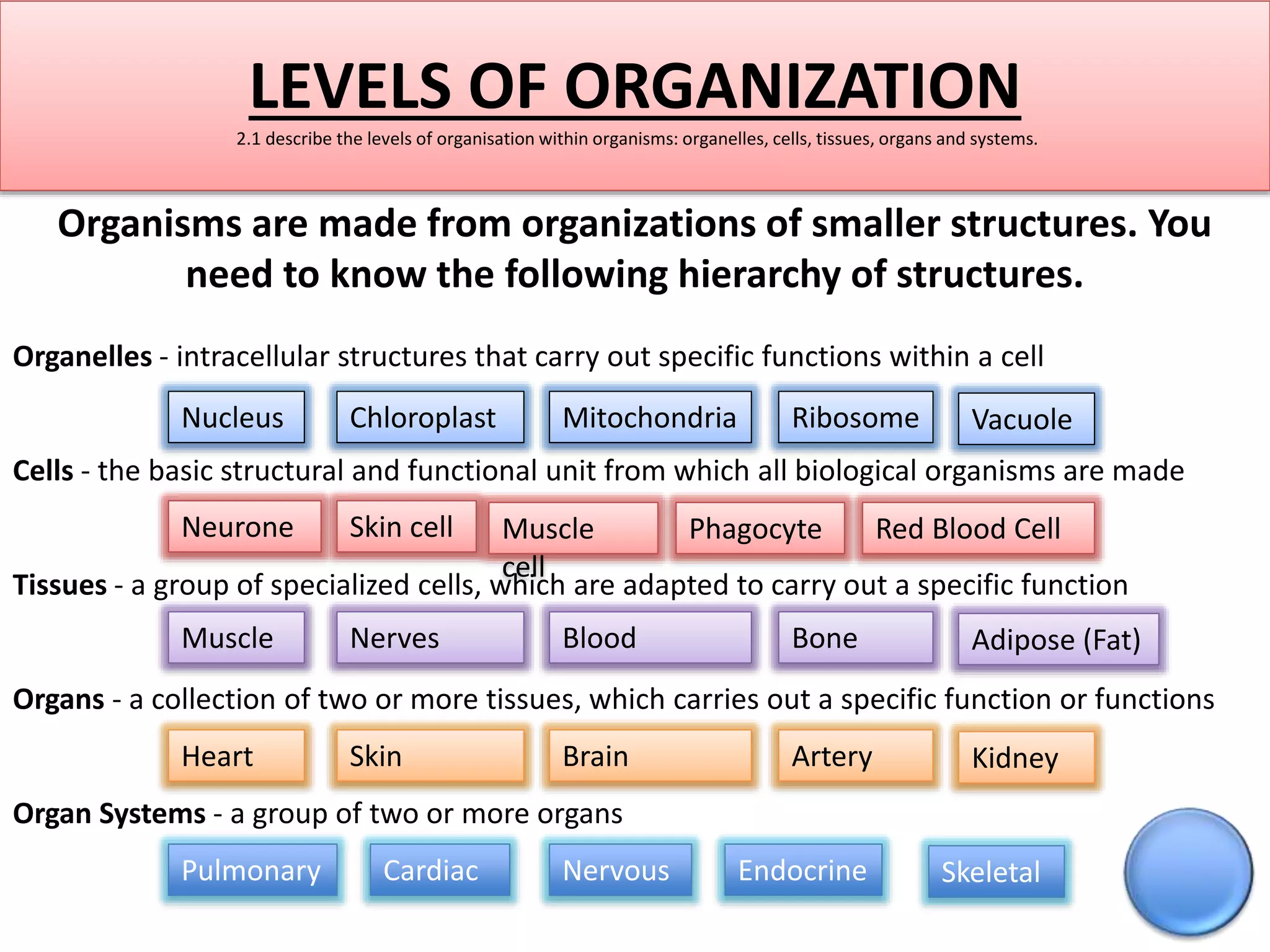
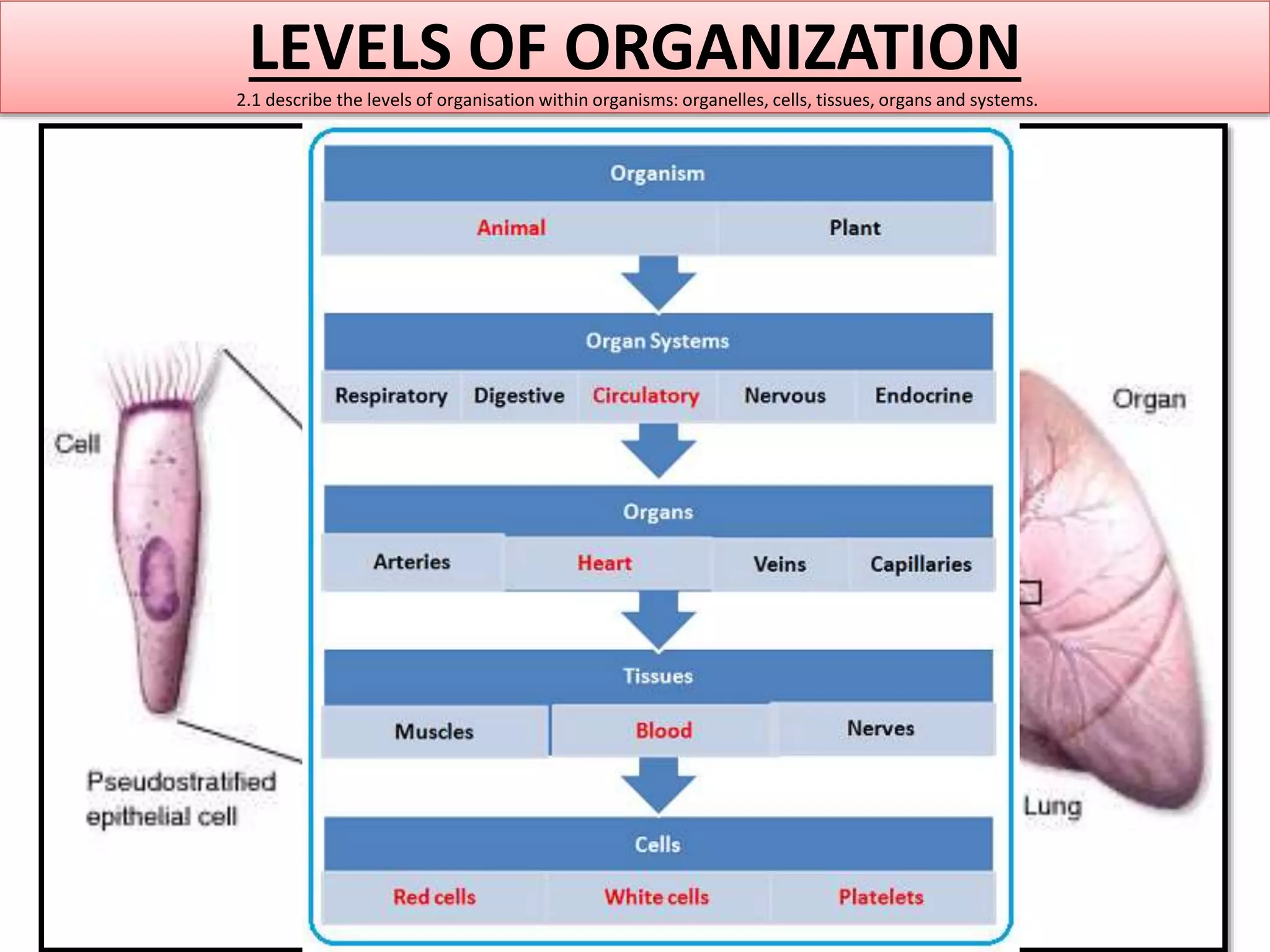
Food chains are used to show the relationships 
between species in a habitat. E.g. 
The secondary Consumer (eats the Primary 
Consumer) 
The Primary Consumer (eats the producer) 
The Primary Producer (all food chains start with this) 
FOX 
RABBIT 
GRASS 
Each level in a food chain is called a Trophic Level
Definitions of Different Trophic levels 
4.4 explain the names given to different trophic levels to include producers, primary, secondary and tertiary consumers 
and decomposers 
• Producers: 
Plants (use sunlight to obtain nutrients) 
• Primary Consumer: 
Herbivores (plant eaters) 
• Secondary Consumer: 
Carnivore (animal / herbivore eaters) 
• Tertiary Consumer: 
Carnivore (animal / carnivore eaters) 
• Decomposers: 
Usually a bacterium or fungi, that breaks down the cells of 
dead plants and animals into simpler substances.
FOOD WEBS 
4.5 understand the concepts of food chains, food webs, pyramids of number, pyramids of biomass and pyramids of energy transfer 
Food chains can be built up into complex food 
webs. The difference between food chains and 
food webs is that food webs have branches, 
chains never do.
A Pyramid of Numbers 
4.5 understand the concepts of food chains, food webs, pyramids of number, pyramids of biomass and pyramids of energy transfer 
In a pyramid of numbers, the length of each bar 
represents the number of organisms at each 
trophic level in a specified area.
Pyramid of numbers (complex) 
4.5 understand the concepts of food chains, food webs, pyramids of number, pyramids of biomass and pyramids of energy transfer
Pyramid of Biomass 
4.5 understand the concepts of food chains, food webs, pyramids of number, pyramids of biomass and pyramids of energy transfer 
In a pyramid of biomass, the length of each bar represents the 
amount of organic matter – biomass – at each trophic level in a 
specified area. 
At each trophic level, the amount of biomass and 
energy available is reduced, giving a pyramid shape.
Pyramid of Biomass 
4.5 understand the concepts of food chains, food webs, pyramids of number, pyramids of biomass and pyramids of energy transfer
Compare Numbers to Biomass 
4.5 understand the concepts of food chains, food webs, pyramids of number, pyramids of biomass and pyramids of energy 
transfer
Pyramid of Energy 
4.5 understand the concepts of food chains, food webs, pyramids of number, pyramids of biomass and pyramids of energy transfer 
• It is a graphical representation of the trophic levels, 
by which the incoming solar energy is transferred to 
the ecosystem. 
• It shows the total energy flow in the ecosystem. 
• There does not exist an inverted energy pyramid.
Pyramid of Energy 
4.5 understand the concepts of food chains, food webs, pyramids of number, pyramids of biomass and pyramids of energy transfer 
4.6 understand the transfer of substances and of energy along a food chain 
4.7 explain why only about 10% of energy is transferred from one trophic level to the next. 
Energy is never ‘lost’, it is transferred. 
Not all the energy is transferred to the next 
stage is converted into growth.
Pyramid of Numbers, Biomass & Energy 
4.5 understand the concepts of food chains, food webs, pyramids of numbers, pyramids of biomass and pyramids of energy transfer
Cycles within Ecosystems 
4.8 describe the stages in the water cycle, including evaporation, transpiration, condensation and precipitation (TA) 
transpiration
Some quick definitions 
4.8 describe the stages in the water cycle, including evaporation, transpiration, condensation and precipitation (TA) 
Evaporation: To change from a liquid or solid state 
into vapour. 
Condensation: To become liquid or solid, as a gas or 
vapour. 
Precipitation: Rain, snow, sleet, dew, etc, formed 
by condensation of water vapour in the 
atmosphere. 
Transpiration: The passage of watery vapour 
through the skin or through any membrane or pore 
in plants.
CARBON CYCLE 
4.9 describe the stages in the carbon cycle, including respiration, photosynthesis, decomposition and combustion
Some quick definitions 
4.9 describe the stages in the carbon cycle, including respiration, photosynthesis, decomposition and combustion 
• Respiration : The process in living organisms of 
taking in oxygen from the surroundings and 
giving out carbon dioxide (external respiration). 
• Photosynthesis : The synthesis of organic 
compounds from carbon dioxide and water (with 
the release of oxygen) using light energy 
absorbed by chlorophyll. 
• Decomposition : To break down (organic matter) 
physically and chemically by bacterial or fungal 
action. 
• Combustion : The process of burning
NITROGEN CYCLE 
4.10 describe the stages in the nitrogen cycle, including the roles of nitrogen fixing bacteria, decomposers, nitrifying bacteria and 
denitrifying bacteria (specific names of bacteria are not required). (TA)
NITROGEN CYCLE 
4.10 describe the stages in the nitrogen cycle, including the roles of nitrogen fixing bacteria, decomposers, nitrifying bacteria and 
denitrifying bacteria (specific names of bacteria are not required). (TA)
NITROGEN CYCLE 
4.10 describe the stages in the nitrogen cycle, including the roles of nitrogen fixing bacteria, decomposers, nitrifying bacteria and 
denitrifying bacteria (specific names of bacteria are not required). (TA)
NITROGEN CYCLE 
4.10 describe the stages in the nitrogen cycle, including the roles of nitrogen fixing bacteria, decomposers, nitrifying 
bacteria and denitrifying bacteria (specific names of bacteria are not required). (TA)
Nitrogen Cycle 
4.10 describe the stages in the nitrogen cycle, including the roles of nitrogen fixing bacteria, decomposers, nitrifying bacteria and denitrifying bacteria 
(specific names of bacteria are not required). (TA) 
This is not particularly easy to understand. You need to 
know the roles of all the different bacteria. There are 4; 
• Decomposers – turn nitrogen in protein into ammonium 
+) 
(NH4 
-) into Nitrites 
• Denitrifying Bacteria – turn Nitrates (NO3 
-) into ammonium (NH4 
(NO2 
+ ) into Nitrogen gas (N2) 
+) into nitrites 
• Nitrifying bacteria – turn ammonium (NH4 
-) and then nitrates (NO3 
(NO2 
-) 
+) 
• Nitrogen-fixing bacteria – turn N2 into ammonium (NH4
WAIT!!! 
4.10 describe the stages in the nitrogen cycle, including the roles of nitrogen fixing bacteria, decomposers, nitrifying bacteria and denitrifying bacteria (specific names of 
bacteria are not required). (TA) 
There is more that you are not expected to know from 
your syllabus, but may be included as additional 
information in your exam on the Nitrogen Cycle 
• Extension - leguminous plants 
• All of the above bacteria are naturally present in the 
soil. The only exception to this is that some Nitrogen-fixing 
bacteria (e.g. Rhizobium) live in the roots of 
some plants. These plants are called legumes (e.g. 
peas, clover etc). They have a symbiotic relationship 
with the bacteria i.e. both the bacteria and the plant 
benefit from working together.
Human influences on the environment 
4.11 understand the biological consequences of pollution of air by sulfur dioxide and by carbon monoxide 
Acid rain: 
SO2, CO2 and NOx (oxides of nitrogen) dissolve in 
rain to form Sulphuric Acid, Carbonic Acid and 
Nitric Acid. 
This falls as acid rain, which destroys soil, 
pollutes waterways and causes erosion.
BIOLOGICAL CONSEQUENCES 
4.11 understand the biological consequences of pollution of air by sulfur dioxide and by carbon monoxide 
1) Acid rain can 'burn' trees. This stops photosynthesis. 
2) Sulphuric acid causes Calcium and Magnesium to be 
leached out of the soil. Without Calcium and Magnesium 
ions in the soil plant’s leaves turn yellow/wither and the 
plant can't grow. 
3) Reduce the pH of the streams & lakes. The affect is 
that it releases aluminum ions (Al3+) which causes the 
thickening of mucus in the fishes gills. Fish have difficulty 
in obtaining oxygen. The fish numbers decrease.
CO 
4.11 understand the biological consequences of pollution of air by sulfur dioxide and by carbon monoxide 
Carbon Monoxide (CO) is a gas added to the atmosphere 
by the combustion of fossil fuels (particularly coal) 
burned with insufficient oxygen. 
• Carbon monoxide combines with our hemoglobin 
inside our blood and blocks hemoglobin from carrying 
oxygen which reduces oxygen circulation. 
• This is toxic, too much carbon monoxide can be fatal.
Greenhouse Gasses 
4.12 understand that water vapour, carbon dioxide, nitrous oxide, methane and CFCs are greenhouse gases 
4.13 understand how human activities contribute to greenhouse gases
Global Warming 
4.14 understand how an increase in greenhouse gases results in an enhanced greenhouse effect and that this may lead to 
global warming and its consequences 
Greenhouse gases trap heat around the surface 
of the Earth and are needed to keep the planet 
warm enough for life. 
1) Incoming shortwave radiation passes through the atmosphere and 
hits the Earth, where it is absorbed. (LIGHT) 
2) The Earth re-emits the radiation as longer-wavelength Infra-Red 
radiation. (HEAT) 
This is the problem. 
3) Too much IR radiation is absorbed by greenhouse gases on its way 
out of the atmosphere. This traps the too much heat in the 
atmosphere.
GREENHOUSE EFFECT 
GOOD 
4.14 understand how an increase in greenhouse gases results in an enhanced greenhouse effect and that this may lead to global warming and its consequences
GREENHOUSE EFFECT 
BAD 
4.14 understand how an increase in greenhouse gases results in an enhanced greenhouse effect and that this may lead to globalwarming and its 
consequences
GREENHOUSE EFFECT 
4.14 understand how an increase in greenhouse gases results in an enhanced greenhouse effect and that this may lead to global warming and its 
consequences 
The theory goes that the greenhouse effect is causing 
global warming, which is bad. Global warming might 
cause: 
a) Polar ice cap melting (Sea levels rising) 
b) Extinction of species living in cold climates 
c) Changes in rainfall (both droughts and flooding) 
d) Changes in species distribution (i.e. tropical species 
spreading, like mosquitoes)
Eutrophication 
4.15 understand the biological consequences of pollution of water by sewage, including increases in the number of micro-organisms 
causing depletion of oxygen (TA) 
4.16 understand that eutrophication can result from leached minerals from fertiliser 
Eutrophication is what happens when too much chemical 
fertiliser is used on crops and it washes/leaches into rivers 
and streams. 
(also nitrates can come from sewage) 
1) The nitrates in the fertilisers are essential to get crops to 
grow well and increase yields. 
NITRATES ADDED 
2) However, if too much is used, or it rains soon after it is 
added to fields, the fertiliser gets washed away. 
RUN OFF 
3) The nitrates then help plants in the rivers and streams to 
grow very quickly, especially algae. 
ALGAL BLOOM
4) But after the initial massive growth in algae 
there isn't enough light and water plants die 
MASSIVE PLANT DEATH 
5) Without sunlight and when the nitrates run 
out MOST of the algae die 
MASSIVE ALGAL DECAY 
6) All those dead plant start to decay. Respiring 
bacteria remove oxygen from the water. 
ANOXIC CONDITIONS 
7) No Oxygen kills fish and other animals. 
ANIMAL DEATH AND DECAY
8) Then even more algae and animals die. 
MORE DEATH & DECAY 
9) pH levels fall as decomposition produces acids 
pH DROPS 
10) Everything dies and waterway can no longer 
support life 
TOTAL DEATH 
So farmers have to be very careful using fertilisers 
so as not to wipe out all river and lake life.
Simply but Clearly 
4.15 understand the biological consequences of pollution of water by sewage, including increases in the number of micro-organisms causing 
depletion of oxygen (TA) 
Nitrates > 
Algae Grow > 
Algae Die > 
Algae Decay > 
No Oxygen > 
Fish & 
Animals Die
Deforestation 
4.17 understand the effects of deforestation, including leaching, soil erosion, disturbance of the water cycle and of the 
balance in atmospheric oxygen and carbon dioxide 
Cutting down trees and not replacing causes: 
• Leaching of soil minerals 
• Soil erosion / washed and blown away (no roots 
holding soil together) 
• Desertion (new deserts forming) 
• Disturbance of the water cycle (less transpiration 
can lead to flooding and / or drought) 
• Increase in CO2 levels 
Less photosynthesis 
• Decrease in O2 production 
Burning trees
Section 5 
Use of Biological Resources 
• a) Food production 
• b) Selective breeding 
• c) Genetic modification (genetic engineering) 
• d) Cloning
Food production 
CROP PLANTS 
5.1 describe how glasshouses and polythene tunnels can be used to increase the yield of certain crops 
5.2 understand the effects on crop yield of increased carbon dioxide and increased temperature in glasshouses 
Greenhouses and polythene tunnels raise the temperature, which increases 
the rate of photosynthesis, which increases crop yield. 
(Yield - The total mass of the edible part of crop.) 
1) If the level of CO2 in the greenhouse is increased  the yield will further 
increase . 
2) Heating units increase temperature and CO2. (combustion) 
(remember, CO2 is a limiting factor in photosynethsis) 
3) In winter months using artificial lights gives a ‘longer day’ for growing 
4) Transparent glass and plastic allow short wave energy in (light) and reflect 
long wave energy back (heat) to keep temperature high.
Glasshouses and Polythene tunnels 
5.1 describe how glasshouses and polythene tunnels can be used to increase the yield of certain crops 
5.2 understand the effects on crop yield of increased carbon dioxide and increased temperature in glasshouses
What is grown 
5.1 describe how glasshouses and polythene tunnels can be used to increase the yield of certain crops 
High value crops are grown in polythene tunnels and 
greenhouses. 
Some examples are: 
• Strawberries 
• Tomatoes 
• Flowers 
Only high value crops make sense to grow in this intensive 
way. 
(Value of crop must exceed cost of production)
Fertilizer and Crop Yield 
5.3 understand the use of fertiliser to increase crop yield 
If fertilizers are added (specifically those that contain 
Potasium, Nitrate and Phosphate– KNP fertilisers) then 
the yield will increase even more! 
Potassium – essential for plant membranes 
Nitrate – essential for making plant 
proteins 
Phosphate – essential for DNA and membranes
Fertilizer and Crop Yield 
5.3 understand the use of fertiliser to increase crop yield 
• Nitrogen is used to make 
protiens 
• Proteins increase biomass (more 
plant) 
• Increase in biomass increases 
marketable part of the crop 
( on a plant) 
• Increased crop increases revenue 
(the cost of fertilizer must be less 
then the increase in value of the 
crop)
Eutrophication again 
Simply but Clearly 
5.3 understand the use of fertiliser to increase crop yield 
Nitrates > 
Algae Grow > 
Algae Die > 
Algae Decay > 
No Oxygen > 
Fish & 
Animals Die
Pest Control 
5.4 understand the reasons for pest control and the advantages and disadvantages of using pesticides and biological control with 
crop plants 
Pest Control can also be used to increase Yield. This can be done 
either using pesticides or biological controls. 
• Pesticide – a chemical that kills pests (anything that eats your 
crop), but does not harm the crop plant 
• Biological control – introducing a biological organism which will 
eat the pest, but not the crop plant (e.g. birds are sometimes 
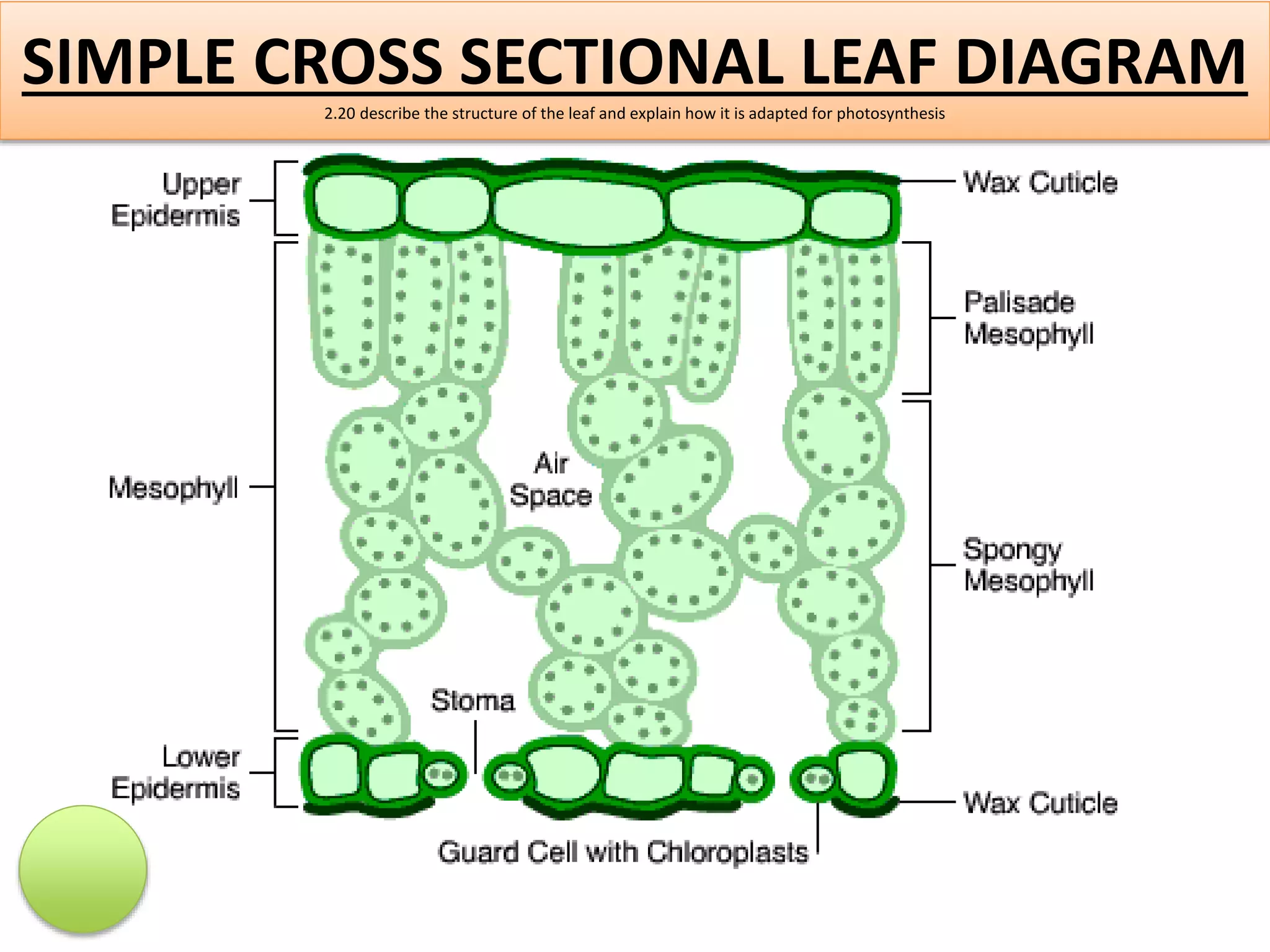
encouraged inside greenhouses because they eat caterpillars)
Name some –cides 
5.4 understand the reasons for pest control and the advantages and disadvantages of using pesticides and biological control with crop plants 
• Herbicides 
• Insecticides 
• Fungicides 
• Molluscicides 
• Fratricides 
• Suicides 
• Homicide 
• Uxoricide 
• Matricide 
• Patricide 
• Vatricide 
• Deicide 
• Tomeicide 
• Mundicide 
Plants 
Insects 
Fungi 
Shellfish 
Brother 
Self 
Person 
Wife 
Mother 
Father 
Poets 
God 
Books 
Everything
Pesticides 
5.4 understand the reasons for pest control and the advantages and disadvantages of using pesticides and biological control with crop plants 
Disadvantages of using pesticides: 
• pesticides may enter and 
accumulate in food chains 
• pesticides may harm organisms 
which are not pests 
• some pesticides are persistent. 
DDT
Biological Control 
5.4 understand the reasons for pest control and the advantages and disadvantages of using pesticides and biological control with crop plants 
Advantages and disadvantages of 
biological control, to include: 
• advantages: 
– no need for chemical pesticides 
– does not need repeated treatment 
• disadvantages: 
– predator may not eat pest 
– may eat useful species 
– may increase out of control 
– may not stay in the area where it is 
needed.
Micro Organisms 
5.5 understand the role of yeast in the production of beer 
Yeast 
Remember that yeast are capable of respiring 
1) aerobically (producing CO2 and water) 
& 
2) anaerobically (producing CO2 and ethanol). 
Yeast are therefore used in the brewing industry.
MAKING BEER 
5.5 understand the role of yeast in the production of beer 
In order to make beer: 
• barley seeds are allowed to germinate by soaking 
them in warm water (This is called malting). 
• The germinating barley seeds break down their 
carbohydrate stores, releasing sugar. 
• After a couple of days the barley seeds are gently 
roasted (which kills them). 
• The dead seeds are put into a fermenter with 
yeast. 
• The yeast use the sugar for anaerobic respiration 
and produce ethanol.
Well it’s beer
EXPERIMENT 
5.6 describe a simple experiment to investigate carbon dioxide production by yeast, in different conditions 
You need to know: 
An experiment that shows the production of CO2 by yeast, in 
different conditions: 
IV (choose one and keep the others constant): 
a) Type of sugar 
b) Concentration of sugar (mass meter/measuring cylinder - %) 
c) Temperature of solution (thermometer – 0C) 
DV (Measure one): 
a) Height of frothy bubbles (ruler - cm) 
b) Volume of CO2 produced (gas syringe - mL) 
c) Volume of CO2 from delivery tube to inverted container over 
water (graduated cylinder – mL) 
The best example is to mix a yeast suspension with sucrose 
Any CO2 produced can be collected over water or bubbled through 
lime water or hydrogen carbonate indicator
5.6 describe 
a simple 
experiment 
to investigate 
carbon 
dioxide 
production by 
yeast, in 
different 
conditions
Graphs and Limiting Factors 
5.6 describe a simple experiment to investigate carbon dioxide production by yeast, in different conditions 
The rate of CO2 production levels off in the 
experiments over time. 
Reason: 
1) Sugar (glucose/sucrose) is a limiting factor 
2) Ethanol is produced which is toxic to micro-organisms 
(yeast)
MAKING YOGHURT 
5.7 understand the role of bacteria (Lactobacillus ) in the production of yoghurt (TA) 
Lactobacillus bacterium is This bacterium is used to turn milk 
into yoghurt. 
It uses lactose sugar in the milk to produce lactic acid by 
anaerobic respiration. 
A. The lactic acid affects the milk proteins, making the 
yoghurt curdle (go solid) and giving it the characteristic 
tart taste. 
B. lowers the pH of milk to inhibit harmful to human 
bacterial growth
Industrial Fermenters 
5.8 interpret and label a diagram of an industrial fermenter and explain the need to provide suitable conditions in the fermenter, 
including aseptic precautions, nutrients, optimum temperature and pH, oxygenation and agitation, for the growth of micro-organisms 
(TA) 
Fermenters are huge containers that hold up to 200,000dm3 of liquid. 
They make it possible to control the environmental conditions such as: 
1. Temperature 
2. Oxygen 
3. Carbon Dioxide concentrations 
4. pH 
5. Nutrient levels 
This allows microorganisms can grow and respire 
without being limited and can work as efficiently as 
possible 
(High Yield)
MAKING MONEY FROM BACTERIA 
5.8 interpret and label a diagram of an industrial fermenter and explain the need to provide suitable conditions in the fermenter, including 
aseptic precautions, nutrients, optimum temperature and pH, oxygenation and agitation, for the growth of micro-organisms (TA) 
It is very important the everything in the 
fermenter is sterile, so that only the 
microorganisms that are wanted grow in the 
culture. 
Fermenters are used to produce commercially: 
• Penicillin (antibiotic) in aerobic conditions 
• Beer (ethanol) in anaerobic conditions 
• Yoghurt (lactic acid) in anaerobic conditions
FERMENTER 
5.8 interpret and label a diagram of an industrial fermenter and explain the need to provide suitable conditions in the fermenter, including aseptic 
precautions, nutrients, optimum temperature and pH, oxygenation and agitation, for the growth of micro-organisms (TA) 
Important details: 
Water Cooling jacket – keeps the microorganisms at optimum temperature. 
They will produce lots of heat through respiration, therefore need to be 
cooled! 
Paddles – keep stirring the mixture. This stops waste products from building up 
and keeps the air evenly mixed 
Nutrient medium – supplies the microorganisms with fuel for respiration 
Sterile Air supply – supplies clean O2 for respiration (note: this is not required 
in anaerobic fermentation processes) 
Data-logger – monitors temperature and pH, keeps the fermenter at optimum 
conditions
Fermenter Diagram 
5.8 interpret and label a diagram of an industrial fermenter and explain the need to provide suitable conditions in the fermenter, including aseptic 
precautions, nutrients, optimum temperature and pH, oxygenation and agitation, for the growth of micro-organisms (TA) 
You don’t need to be 
able to draw this out, 
but you could be 
asked to label a 
diagram of a 
fermenter or be 
asked to explain the 
function of the 
various parts of a 
fermenter.
STOPPING THE O2, RELEASING CO2 
5.8 interpret and label a diagram of an industrial fermenter and explain the need to provide suitable conditions in the fermenter, including 
aseptic precautions, nutrients, optimum temperature and pH, oxygenation and agitation, for the growth of micro-organisms (TA) 
The valve 
• releases CO2 under pressure 
• stops Oxygen and 
microorganisms from entering
Why Fish farming(overview) 
5.9 explain the methods which are used to farm large numbers of fish to provide a source of protein, including maintenance of water quality, control of 
intraspecific and interspecific predation, control of disease, removal of waste products, quality and frequency of feeding and the use of selective breeding. 
• Control feeding diet quality and frequency 
• Control water quality, temperature and waste removal 
• Control predation 
• Control disease and parasites 
• Select for species, size and quality 
• No boats needed and a guaranteed harvest 
• Less overfishing of natural wild fish stocks 
• No risk of catching unwanted (non-marketable species)
Fish farming 
5.9 explain the methods which are used to farm large numbers of fish to provide a source of protein, including maintenance of water quality, control of 
intraspecific and interspecific predation, control of disease, removal of waste products, quality and frequency of feeding and the use of selective breeding. 
Fish are farmed in fish farms because they are a 
good source of protein. 
1) Fish farms keep lots of fish in very small tanks to 
minimize space requirements. 
2) To stop the fish fighting with each other these 
precautions are taken;
Fish farming 
5.9 explain the methods which are used to farm large numbers of fish to provide a source of protein, including maintenance of water quality, control of 
intraspecific and interspecific predation, control of disease, removal of waste products, quality and frequency of feeding and the use of selective breeding. 
To reduce predation: 
• Nets cover tanks 
• Barriers separate tanks
Basic Points 
5.9 explain the methods which are used to farm large numbers of fish to provide a source of protein, including 
maintenance of water quality, control of intraspecific and interspecific predation, control of disease, removal of waste 
products, quality and frequency of feeding and the use of selective breeding. 
- Different fish species are kept in 
separate tanks. This stops 
competition between species of 
fish (interspecific competition) 
- Fish of different genders are kept 
separately (unless they are being 
bred) 
- Fish of different ages are kept 
separately. This stops competition 
between fish of the same species 
(intraspecific competition)
INCREASING YIELD 
5.9 explain the methods which are used to farm large numbers of fish to provide a source of protein, including maintenance of water quality, 
control of intraspecific and interspecific predation, control of disease, removal of waste products, quality and frequency of feeding and the use of 
selective breeding. 
The fish are fed often and in small amounts, or fed with 
protein-rich food 
(where does the protein come from?) 
Sometimes hormones are added to the water to speed 
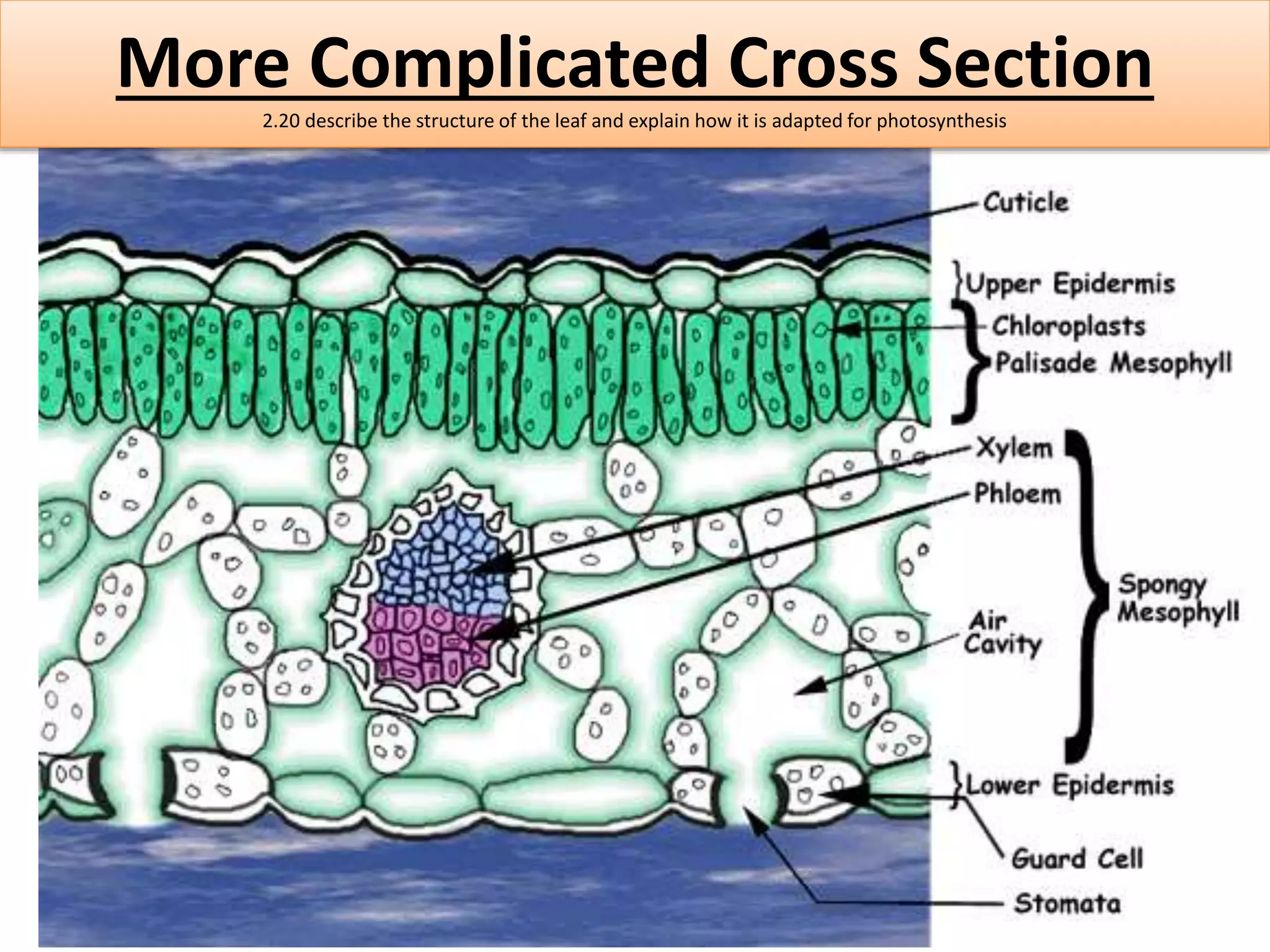
growth. 
Only the biggest and most healthy fish are allowed to 
breed. 
(The small and unhealthy fish end up as fish food.) 
This is an example of selective breeding.
INCREASING YIELD, DECREASING DISEASE, MAKING 
SUPERBUGS AND AFFECTING CONSUMERS 
5.9 explain the methods which are used to farm large numbers of fish to provide a source of protein, including maintenance of water quality, control of intraspecific and 
interspecific predation, control of disease, removal of waste products, quality and frequency of feeding and the use of selective breeding. 
The use of antibiotics will increase the rate of growth (yield) & 
decrease incidence of disease. 
Pesticides decrease the growth and spread of parasites 
Negatives: 
1. It can also selectively breed antibiotic resistant bacteria. 
2. Pesticides can kill other invertebrates 
3. Pollution from organic material leads to eutrophication 
4. Antibiotics may not degrade and can be passed on to 
consumers (humans).
DECREASING DISEASE 
5.9 explain the methods which are used to farm large numbers of fish to provide a source of protein, including maintenance of water quality, 
control of intraspecific and interspecific predation, control of disease, removal of waste products, quality and frequency of feeding and the use of 
selective breeding. 
Water is closely monitored. 
Fish are continuously supplied with fresh sterile 
water so that wastes and excess nutrients are 
washed out constantly. 
The fish are kept in sterile water to limit disease, 
which would spread very quickly in the cramped 
ponds.
DECREASING DISEASE 
5.9 explain the methods which are used to farm large numbers of fish to provide a source of protein, including maintenance of water quality, 
control of intraspecific and interspecific predation, control of disease, removal of waste products, quality and frequency of feeding and the use of 
selective breeding. 
C: 
O: 
R: 
M: 
M: 
S: 
Question 
Answer Notes Marks 
C different temperatures / eq; 
O same species / size/ age/gender/eq; 
R repeat / eq; 
M1 mass / length / number / eq; 
M2 time period stated;(one day minimum) 
S1 and S2 same food type / same food mass / 
same oxygen / tank size / 
fish density stated / eq;; 
6 
Total 6
Selective Breeding 
5.10 understand that plants with desired characteristics can be developed by selective breeding 
5.11 understand that animals with desired characteristics can be developed by selective breeding.
Definition 
5.10 understand that plants with desired characteristics can be developed by selective breeding 
5.11 understand that animals with desired characteristics can be developed by selective breeding. 
Selective Breeding: 
a. Individuals with desired characteristics are 
bred together 
b. This is to produce offspring which express 
desired characteristics. 
c. Offspring with desired characteristics are 
bred 
d. Repeat over many generations
Examples: 
Examples 
5.10 understand that plants with desired characteristics can be developed by selective breeding 
5.11 understand that animals with desired characteristics can be developed by selective breeding. 
Increased yield and reduction of stem length in wheat 
Increased yield of meat and milk in cattle.
Selective Breeding Points 
5.10 understand that plants with desired characteristics can be developed by selective breeding 
5.11 understand that animals with desired characteristics can be developed by selective breeding. 
• Process of controlled sexual reproduction 
• Potentially can take thousands of years 
• Can lead to huge variation in a species. 
Example: dog family
Selective Breeding 
(a simple how to guide…. again) 
5.10 understand that plants with desired characteristics can be developed by selective breeding 
5.11 understand that animals with desired characteristics can be developed by selective breeding. 
• Identify individual organisms that have a 
desirable trait in a population. 
• Breed these individuals together. 
• From offspring choose those with the 
desirable trait. 
• Breed these offspring together. 
• Continue for a long, long, long time
Genetic Modification 
Syllabus points 5.12 – 5.20
Genetic 
Modification 
Syllabus points 5.12 – 5.20 
Review the 
structure of DNA: 
DNA is a double-stranded molecule. The strands coil up to form a double-helix. The strands are 
linked by a series of paired bases. 
Thymine (T) pairs with Adenine (A) 
Guanine (G) pairs with Cytosine (C)
Process of Genetic Engineering 
5.14 understand that large amounts of human insulin can be manufactured from genetically modified bacteria that are grown in a fermenter 
The example you need to know is the creation of E coli 
bacteria that makes human insulin. 
However, a more fun example is Alba, the glow-in-the-dark 
bunny, and pigs that makes the protein luminol (FGP) 
(taken from a jellyfish!)
TRANSGENIC ORGANISMS 
5.12 describe the use of restriction enzymes to cut DNA at specific sites and ligase enzymes to join pieces of DNA together 
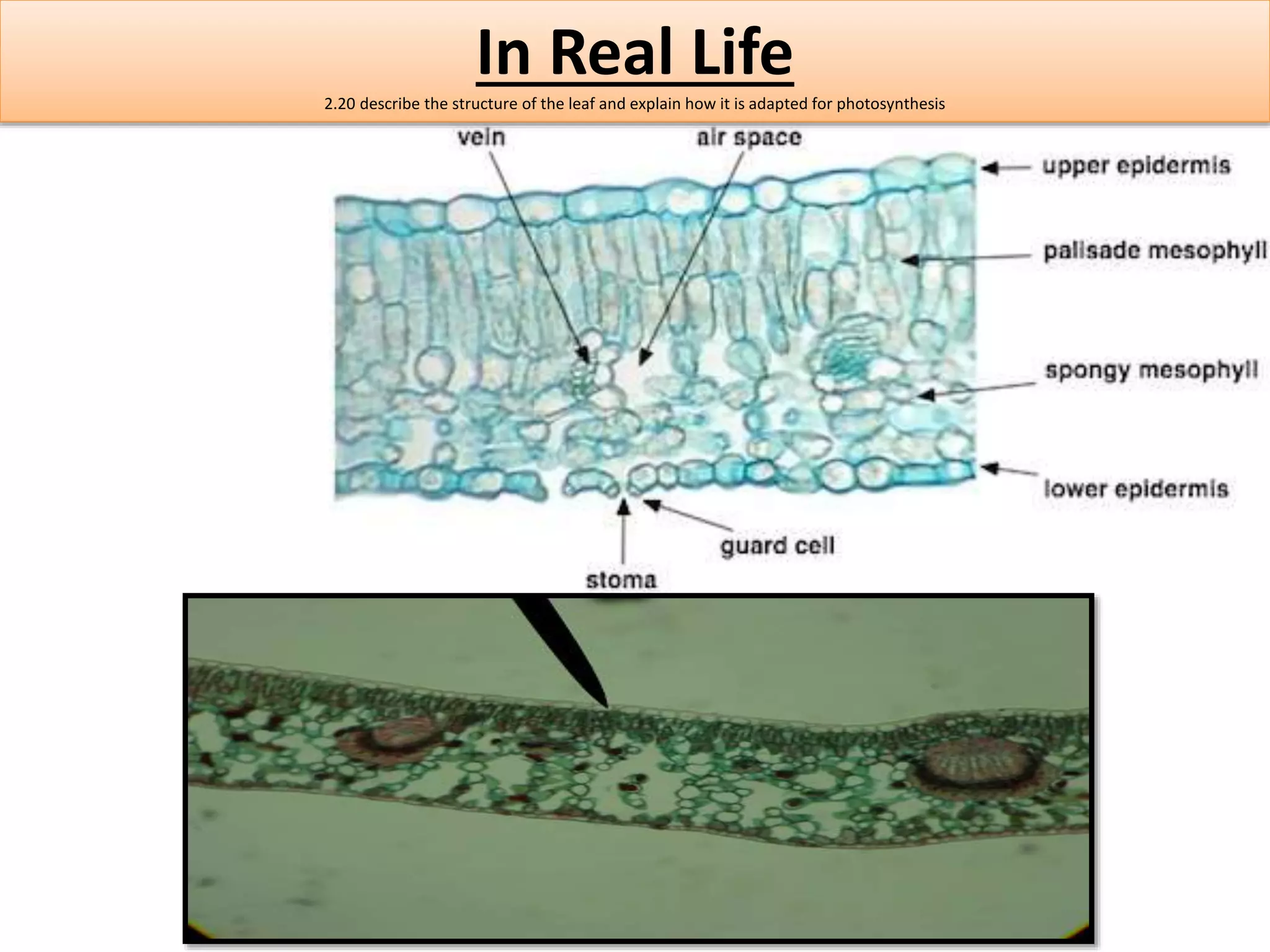
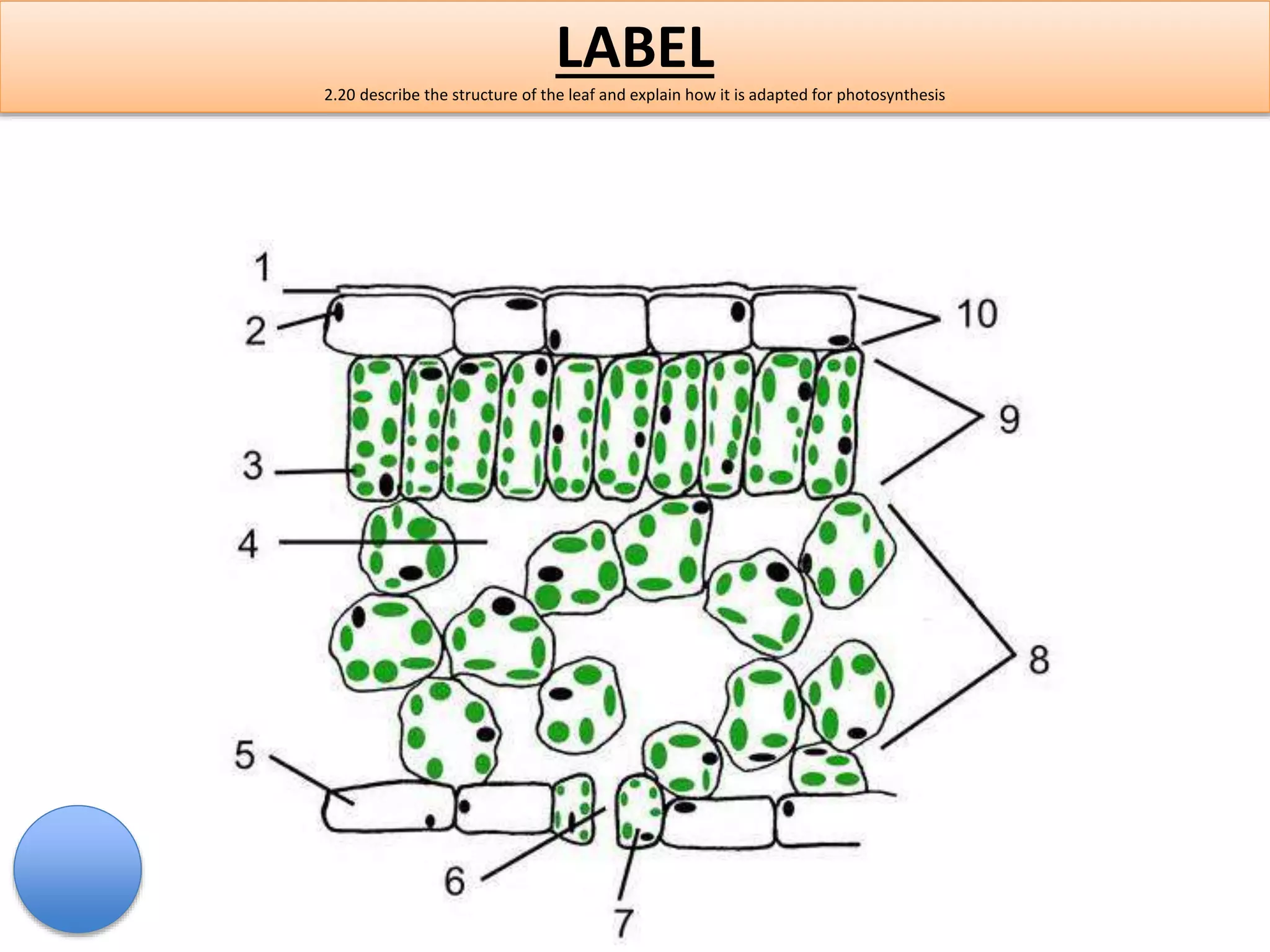
The organism that receives the new gene from a 
different species is a transgenic organism.
PROCESS 
5.12 describe the use of restriction enzymes to cut DNA at specific sites and ligase enzymes to join pieces of DNA together 
1) Plasmids are isolated from a bacterium. 
2) They are cut open with a specific restriction 
enzyme. 
3) The gene to be transferred is cut from the donor 
DNA using the same restriction enzyme, so that the 
plasmid and the gene have the same sticky ends and 
can be joined together. (ends match)
PROCESS 
5.12 describe the use of restriction enzymes to cut DNA at specific sites and ligase enzymes to join pieces of DNA together 
4) The 'opened-up' plasmids and the isolated gene are 
mixed with a DNA ligase enzyme to create 
recombinant plasmids. 
5) Bacteria are incubated 
with the recombinant DNA. 
6) Some bacteria will take up the plasmids.
PROCESS 
5.12 describe the use of restriction enzymes to cut DNA at specific sites and ligase enzymes to join pieces of DNA together 
7) The bacteria that have 
taken up the plasmid now 
contain the gene from the 
donor cell. This could be a 
gene controlling the 
production of human 
insulin. 
8) So the bacterium is 
transgenic.
Making a Transgenic Bacterium 
5.12 describe the use of restriction enzymes to cut DNA at specific sites and ligase enzymes to join pieces of DNA together 
On your diagram include the enzymes used to ‘cut’ and ‘stitch’ back to 
together the DNA. Include where the Vector would be used.
5.13 describe how plasmids and viruses can act as vectors, which take up pieces of DNA, then insert this recombinant DNA into other cells 
• Common vectors include Viruses and 
Plasmids 
• Now your transgenic bacterium is complete. 
All you need to do is grow it in a fermenter 
and it makes lots of insulin for you!
Putting it all together 
5.12 describe the use of restriction enzymes to cut DNA at specific sites and ligase enzymes to join pieces of DNA together
Transgenic Organism 
5.16 understand that the term transgenic means the transfer of genetic material from one species to a different species. (TA) 
Organism containing DNA from two or more sources 
(i.e. an organism that’s been genetically engineered to 
express a foreign gene) 
Plants are good to genetically engineer because they 
are more simple and there are fewer ethical issues.
Genetically modified (GM) crops are engineered to: 
5.15 evaluate the potential for using genetically modified plants to improve food production (illustrated by plants with improved resistance to pests) 
• Have bigger yields 
• Produce their own insecticide 
• Be frost resistant (e.g. frost resistant strawberries) 
• Have resistance to disease 
• Grow in harsher environments (e.g. drought-resistant rice) 
• Grow in harsher environments (e.g. salt resistant wheat) 
• Have a longer sell-by date (e.g. non-squash tomatoes) 
• Be a different colour / taste to normal (e.g. chocolate 
flavoured carrots) 
• Have vitamins in them that they would not normally have 
(e.g. golden rice) 
• Have stronger taste (e.g. chilli's) 
• Be easier to eat (e.g. easy-peel oranges)
CLONING 
Syllabus points 5.17 – 5.20 
Cloning is used to make many copies of a single 
individual. Usually the individual has a very desirable 
phenotype and has often been produced at the end 
of a Selective Breeding or GE programme. 
CLONES ARE: Genetically Identical Organisms 
Start 
2min
Cloning in Plants 
5.18 understand how micropropagation can be used to produce commercial quantities of identical plants (clones) with desirable characteristics 
The easiest way to clone a plant is to take a cutting or 
a graft (asexual reproduction). 
However, micro propagation (tissue culture) can be 
used in large-scale cloning programmes. 
Which desirable characteristics in cloned plants do you want 
to express (selective breeding vs GM)?
Diagram of Propagation 
5.17 describe the process of micropropagation (tissue culture) in which small pieces of plants (explants) are grown in vitro using nutrient media
Diagram of Propagation 
5.17 describe the process of micropropagation (tissue culture) in which small pieces of plants (explants) are grown in vitro using nutrient media
Micro propagation 
5.17 describe the process of micropropagation (tissue culture) in which small pieces of plants (explants) are grown in vitro using nutrient media 
1) Micro-propagation - small pieces of plants 
(explants) or tissue samples are grown in a Petri dish 
on nutrient medium (agar). 
Growing a living organism in an artificial 
environment is called In Vitro. 
2) Hormones / bleach are added to the explant so it 
will grow into a miniature plant (a plantlet). 
3) This can be done on a huge scale to produce 
1000s of plantlets from a single culture.
Diagram of Propagation 
5.17 describe the process of micropropagation (tissue culture) in which small pieces of plants (explants) are grown in vitro using nutrient media 
How do you draw it? 
Include vocabulary: 
Auxin/Bleach 
Nutrient agar 
In Vitro 
Cutting/Tissue Sample/explants 
Plantlets 
(you can include more)
Advantages and Disadvantages to clones 
5.17 describe the process of micropropagation (tissue culture) in which small pieces of plants (explants) are grown in vitro using nutrient media
Animal Cloning 
5.19 describe the stages in the production of cloned mammals involving the introduction of a diploid nucleus from a mature cell into an 
enucleated egg cell, illustrated by Dolly the sheep 
• Take an embryonic cell 
• Remove it’s nucleus (enucleate it) 
• Replace with the nucleus from an adult cell (from the 
animal you want to clone) 
• Give it an electrical shock 
• The embryonic cell grows into an embryo clone of the 
adult, from which the donor nucleus came
Animal Cloning 
5.19 describe the stages in the production of cloned mammals involving the introduction of a diploid nucleus from a mature cell into an 
enucleated egg cell, illustrated by Dolly the sheep 
This process was used to create Dolly the 
sheep
Animal Cloning 
5.19 describe the stages in the production of cloned mammals involving the introduction of a diploid nucleus from a mature cell into an 
enucleated egg cell, illustrated by Dolly the sheep
WHY CLONE? 
5.20 evaluate the potential for using cloned transgenic animals, for example to produce commercial quantities of human antibodies or organs 
for transplantation. (TA) 
Cloning can be used beneficially in agriculture to 
increase the yield of crop plants. 
Cloning genetically engineered animals organisms 
allows us to mass-produce very useful organisms 
e.g. the E. coli bacterium that makes human insulin 
has been cloned many times. 
Now all diabetics have access to human insulin.
Making Insulin 
5.20 evaluate the potential for using cloned transgenic animals, for example to produce commercial quantities of human antibodies or organs 
for transplantation. (TA)
Human antibodies 
5.20 evaluate the potential for using cloned transgenic animals, for example to produce commercial quantities of human antibodies or organs 
for transplantation. (TA) 
To make human antibodies: 
1.Create transgenic mice 
with human DNA (for 
immune system) 
2.Infect mice with disease 
3.Mice produce human 
antibodies to disease 
4.Collect mouse blood and 
remove antibodies 
5.Inject sick humans with 
antibodies 
1)Milk it or Bleed it 
2)Can give more blood
COMMERCIAL ORGANS FROM CLONES!!!! 
5.20 evaluate the potential for using cloned transgenic animals, for example to produce commercial quantities of human antibodies or organs for 
transplantation. (TA) 
The key word to this syllabus point is 
EVALUATE 
1) Morality 
2) Political 
3) Religious 
Start 
11.15
The CLONE Wars!!!! 
5.20 evaluate the potential for using cloned transgenic animals, for example to produce commercial quantities of human antibodies or organs 
for transplantation. (TA) 
Advantages 
Development of cloned animals which have been genetically engineered to 
produce valuable proteins in their milk or blood. 
Create identical organisms with exact genetic characteristics required. 
Cloning can save animals form extinction. 
Disadvantages 
Concerns about the ethics of cloning. 
Cloning limits variation. 
This can effect natural selection. 
Concerns about using the technique to clone humans in the future.
THE END

GCSE IGCSE Biology by Syllabus points

  • 1.
    IT’S ALIVE !!!! 1.1 Understand that living organisms share the following characteristics: they require nutrition; they respire; they excrete their waste; they respond to their surroundings; they move; they control their internal conditions; they reproduce; they grow and develop. M Movement All living things move, even plants R Respiration Getting energy from food S Sensitivity Detecting changes in the surroundings G Growth All living things grow and develop R Reproduction Making more living things of the same type (species). E Excretion Getting rid of waste N Nutrition Taking in and using food and other nutrients In addition, all living organisms contain nucleic acids (DNA/RNA) and have the ability to control their internal conditions (homeostasis). Finally, all living organisms can die.
  • 2.
    ALIVE OR NOTALIVE!! ALIVE OR NOT ALIVE 1.1 Understand that living organisms share the following characteristics: they require nutrition; they respire; they excrete their waste; they respond to their surroundings; they move; they control their internal conditions; they reproduce; they grow and develop.
  • 3.
    GROUPS OF LIVINGORGANISMS 1.2 describe the common features shared by organisms within the following main groups: plants, animals, fungi, bacteria, protoctists and viruses, and for each group describe examples and their features as follows (details of life cycle and economic importance are not required)
  • 4.
    PLANTS Plants: Theseare multicellular organisms; their cells contain chloroplasts and are able to carry out photosynthesis; their cells have cellulose cell walls; they store carbohydrates as starch or sucrose Plants all have the following in common: 1) Multicellular organisms (made of lots of cells) 2) Cells contain chloroplasts and are able to carry out photosynthesis. Photosynthesis takes simple inorganic molecules and turns them into simple sugar (glucose). Glucose can be turned into complex organic molecules such as carbohydrates.
  • 5.
    PLANTS Plants: Theseare multicellular organisms; their cells contain chloroplasts and are able to carry out photosynthesis; their cells have cellulose cell walls; they store carbohydrates as starch or sucrose 3) Cells have cellulose cell walls (cellulose is a carbohydrate)
  • 6.
    PLANTS Plants: Theseare multicellular organisms; their cells contain chloroplasts and are able to carry out photosynthesis; their cells have cellulose cell walls; they store carbohydrates as starch or sucrose 4) They store carbohydrates as starch. Carbohydrates are polysaccharides (many sugars/glucose linked together) or sucrose. Sucrose is a disaccharide (two sugars linked together).
  • 7.
    Examples you needto know: 1) flowering plants, such as a cereals A) Maize PLANTS Examples include flowering plants, such as a cereal (for example maize), and a herbaceous legume (for example peas or beans) B) Wheat
  • 8.
    PLANTS Examples includeflowering plants, such as a cereal (for example maize), and a herbaceous legume (for example peas or beans) 2) Herbaceous legume (e.g. peas or beans). Root nodules
  • 9.
    ANIMALS Animals: Theseare multicellular organisms; their cells do not contain chloroplasts and are not able to carry out photosynthesis; they have no cell walls; they usually have nervous coordination and are able to move from one place to another; they often store carbohydrate as glycogen 1) Animals include: sponges, molluscs, worms, starfish, insects, crustaceans, fish, amphibians, reptiles, birds, mammals Animals without a backbone (vertebral column) are invertebrates. Animals with a vertebral column are called vertebrates. 2) Animals are Multicellular organisms
  • 10.
    ANIMALS Animals: Theseare multicellular organisms; their cells do not contain chloroplasts and are not able to carry out photosynthesis; they have no cell walls; they usually have nervous coordination and are able to move from one place to another; they often store carbohydrate as glycogen 3) They have a nervous system 4) They often store carbohydrate as glycogen in the liver and muscles.
  • 11.
    ANIMALS Animals: Theseare multicellular organisms; their cells do not contain chloroplasts and are not able to carry out photosynthesis; they have no cell walls; they usually have nervous coordination and are able to move from one place to another; they often store carbohydrate as glycogen 5) Animal cells do not contain chloroplasts and are not able to carry out photosynthesis 6) Animal cells have no cell walls
  • 12.
    ANIMALS Animals: Theseare multicellular organisms; their cells do not contain chloroplasts and are not able to carry out photosynthesis; they have no cell walls; they usually have nervous coordination and are able to move from one place to another; they often store carbohydrate as glycogen
  • 13.
    ANIMALS Examples includemammals (for example humans) and insects (for example housefly and mosquito) Examples you need to know: 1) Human (mammal)
  • 14.
    2) Insects Examplesinclude mammals (for example humans) and insects (for example housefly and mosquito) a) Housefly ANIMALS Why the housefly? - They regurgitate stomach enzymes onto their food - but also because other flies are interesting A) Tsetse fly B) Screw fly C) Drosophila
  • 15.
    ANIMALS Examples includemammals (for example humans) and insects (for example housefly and mosquito) Lastly….. the use of flies ended the belief in the spontaneous generation of life
  • 16.
    Examples include mammals(for example humans) and insects (for example housefly and mosquito) b) Mosquito ANIMALS Video Bite So why the Mosquito? (it is really just another fly!) - Complex life cycle - Can be a vector for malaria, yellow fever, abrovirus - Control measures have damaged ecosystems
  • 17.
    FUNGI Fungi: Theseare organisms that are not able to carry out photosynthesis; their body is usually organised into a mycelium made from thread-like structures called hyphae, which contain many nuclei; some examples are single-celled; their cells have walls made of chitin; they feed by extracellular secretion of digestive enzymes onto food material and absorption of the organic products; this is known as saprotrophic nutrition; they may store carbohydrate as glycogen Characteristics of Fungi: 1) They feed by saprophytic nutrition (feeds on dead organic material & digestion takes place outside the organism. 2) Fungi feed by excreting extracellular secretions of digestive enzymes onto food and absorbing the digested products. 3) Cells are joined together to form threads, called hyphae. Hyphae contain many nuclei, because they are made from many cells. 4) Hyphae join together to make a network of threads called mycelium
  • 19.
    FUNGI ARE NOTPLANTS 5) Cells do not contain chloroplasts and are not able to carry out photosynthesis 6) Cell walls are made from a protein called chitin (not cellulose) 7) They store carbohydrates as glycogen (not starch) FUNGI Fungi: These are organisms that are not able to carry out photosynthesis; their body is usually organised into a mycelium made from thread-like structures called hyphae, which contain many nuclei; some examples are single-celled; their cells have walls made of chitin; they feed by extracellular secretion of digestive enzymes onto food material and absorption of the organic products; this is known as saprotrophic nutrition; they may store carbohydrate as glycogen
  • 20.
    FUNGI Fungi Examplesinclude Mucor , which has the typical fungal hyphal structure, and yeast, which is single-celled Examples you must know: 1) Mucor (bread mold) Why do you need to know about Mucor? - Easy to experiment on in the lab (temperature, moisture) - Mucor must use energy to absorb nutrients in it’s hyphae - Was used to produce penicillin, the first antibiotic.
  • 21.
    FUNGI Fungi Examplesinclude Mucor , which has the typical fungal hyphal structure, and yeast, which is single-celled 2) Yeast (single celled fungi) Why do you need to know about Yeast? - Easy to experiment on in the lab (temperature & sugar concentration) - Yeast is used in the production of beer & bread
  • 22.
    BACTERIA Bacteria: Theseare microscopic single-celled organisms; they have a cell wall, cell membrane, cytoplasm and plasmids; they lack a nucleus but contain a circular chromosome of DNA; some bacteria can carry out photosynthesis but most feed off other living or dead organisms Bacteria Characteristics: 1) Made from single cells 2) Cells do not contain a nucleus. Bacteria cells have a small piece of circular DNA instead of a nucleus (a bacterial chromosome/nucleoid). 2) Bacteria also have DNA in the form of circular plasmids 3) most gain their nutrients by saprophytic nutrition (feed off dead organisms) or by parasitic nutrition (feed off living organisms). Some bacteria can carry out photosynthesis. You need to know their structure: TED
  • 23.
    BACTERIA Bacteria: Theseare microscopic single-celled organisms; they have a cell wall, cell membrane, cytoplasm and plasmids; they lack a nucleus but contain a circular chromosome of DNA; some bacteria can carry out photosynthesis but most feed off other living or dead organisms Some pretty pictures of bacteria
  • 24.
    BACTERIA Examples includeLactobacillus bulgaricus , a rod-shaped bacterium used in the production of yoghurt from milk, and Pneumococcus , a spherical bacterium that acts as the pathogen causing pneumonia Example you need to know: 1) Lactobacillus bulgaricus - Used to make yogurt - Produces lactic acid (excretes) - Rod shaped - Not dangerous to humans Why Lactobacillus bulgaricus? - It is used in how human food production - lowers the pH of milk to inhibit harmful to human bacterial growth
  • 25.
    Examples include Lactobacillusbulgaricus , a rod-shaped bacterium used in the production of yoghurt from milk, and Pneumococcus , a spherical bacterium 2) Pneumococcus BACTERIA that acts as the pathogen causing pneumonia - pathogen causes pneumonia (inflammation of one or both lungs) - killed with antibiotics - spherical bacteria shape Why Pneumococcus? - reduces surface area of alveoli - use of antibiotics in treatment can lead to resistant strains
  • 26.
    PROTOCTISTS Protoctists: Theseare microscopic single-celled organisms. When you don’t fit in scientists drop you into the Protoctists group! Protoctists Characteristics: - most are single celled (exception is seaweeds) - Some have animal-like features - protozoa - Some have plant-like features – algae swim
  • 27.
    PROTOCTISTS Some, likeAmoeba, that live in pond water, have features like an animal cell, while others, like Chlorella, have chloroplasts and are more like plants. A pathogenic example is Plasmodium , responsible for causing malaria Examples you need to know: 1) Amoeba - protozoa - live in pond water - Pathogen amoeba can cause Amoebic dysentery (kills 70,000 people every year) Why Amoeba? - Highlights the need for clean drinking water supplies - Uses amoebiasis to feed (similair to phagocytosis) eating
  • 28.
    Some, like Amoeba,that live in pond water, have features like an animal cell, while others, like Chlorella, have chloroplasts and are more like plants. A 2) Chlorella PROTOCTISTS pathogenic example is Plasmodium , responsible for causing malaria - ‘more’ like plants than animals - have chloroplasts Why Chlorlla? - both animal and plant characteristics - Possible food source (1940’s solution to world hunger) view
  • 29.
    3) Plasmodium -Protozoa - pathogen that causes malaria - uses a mosquito as a vector (transfer) - not killed by antibiotics Why plasmodium? - it is the greatest pathogen killer! TED PROTOCTISTS Some, like Amoeba, that live in pond water, have features like an animal cell, while others, like Chlorella, have chloroplasts and are more like plants. A pathogenic example is Plasmodium , responsible for causing malaria
  • 30.
    VIRUS Viruses: Theseare small particles, smaller than bacteria; they are parasitic and can reproduce only inside living cells; they infect every type of living organism. They have a wide variety of shapes and sizes; they have no cellular structure but have a protein coat and contain one type of nucleic acid, either DNA or RNA Viruses Characteristics: 1) Much smaller than bacteria. 1) They are not made from cells (no cellular structures) 3) Totally parasitic and reproduce inside host cells. 3) They infect every type of living cell 3) Have either DNA or RNA as genetic material 3) Have a protein coat
  • 31.
    VIRUS Viruses: Theseare small particles, smaller than bacteria; they are parasitic and can reproduce only inside living cells; they infect every type of living organism. They have a wide variety of shapes and sizes; they have no cellular structure but have a protein coat and contain one type of nucleic acid, either DNA or RNA You just have to recognize a virus, but there are several shapes
  • 32.
    VIRUS Viruses: Theseare small particles, smaller than bacteria; they are parasitic and can reproduce only inside living cells; they infect every type of living organism. They have a wide variety of shapes and sizes; they have no cellular structure but have a protein coat and contain one type of nucleic acid, either DNA or RNA REVIEW FROM YEAR 8
  • 33.
    VIRUS Examples includethe tobacco mosaic virus that causes discolouring of the leaves of tobacco plants by preventing the formation of chloroplasts, the influenza virus that causes gfluc and the HIV virus that causes AIDS Examples you need to know: 1) Tobacco Mosaic Virus - infects crop plant and prevents formation of chloroplasts - symptoms are discoloration of leaves Why Tobacco Mosaic Virus? - first identification of a virus as a pathogen (1898, Martinus W. Beijerinck) - Genetic engineering
  • 34.
    VIRUS Examples includethe tobacco mosaic virus that causes discolouring of the leaves of tobacco plants by preventing the formation of chloroplasts, the influenza virus that causes gfluc and the HIV virus that causes AIDS 2) Influenza Virus - Viral pathogen causes the flu - Transmitted through air/ contact Why the Flu? - Pandemics (spanish flu) - Mutations leading to new strains - Vaccinations vaccine Flu History
  • 35.
    Just thought youwould like to know.
  • 36.
    3) HIV (humanimmunodeficiency virus) - Pathogen causes AIDS (acquired immunodeficiency syndrome) - Virus attacks white blood cells (immune system) - Host killed by secondary disease - Transmitted by blood to blood contact Why HIV? - Immune system - Mutations VIRUS Examples include the tobacco mosaic virus that causes discolouring of the leaves of tobacco plants by preventing the formation of chloroplasts, the influenza virus that causes gfluc and the HIV virus that causes AIDS
  • 37.
    PATHOGEN 1.3 recallthe term gpathogenc and know that pathogens may be fungi, bacteria, protoctists or viruses. Pathogen: An agent that causes infection or disease, especially a microorganism, such as a bacterium or protozoan, or a virus.
  • 38.
    LEVELS OF ORGANIZATION 2.1 describe the levels of organisation within organisms: organelles, cells, tissues, organs and systems. Organisms are made from organizations of smaller structures. You need to know the following hierarchy of structures. Organelles - intracellular structures that carry out specific functions within a cell Nucleus Chloroplast Mitochondria Ribosome Vacuole Cells - the basic structural and functional unit from which all biological organisms are made Neurone Skin cell Muscle cell Tissues - a group of specialized cells, which are adapted to carry out a specific function Organs - a collection of two or more tissues, which carries out a specific function or functions Organ Systems - a group of two or more organs Phagocyte Red Blood Cell Muscle Nerves Blood Bone Adipose (Fat) Heart Skin Brain Artery Kidney Pulmonary Cardiac Nervous Endocrine Skeletal
  • 39.
    LEVELS OF ORGANIZATION 2.1 describe the levels of organisation within organisms: organelles, cells, tissues, organs and systems.
  • 40.
    CELL STRUCTURE (PLANT& ANIMAL) 2.2 describe cell structures, including the nucleus, cytoplasm, cell membrane, cell wall, chloroplast and vacuole You need to know the differences between plant and animal cells, the functions of the organelles and be able to recognize them in a microscope picture or drawing. Mircro scope
  • 41.
    CELL STRUCTURE (PLANT& ANIMAL) 2.2 describe cell structures, including the nucleus, cytoplasm, cell membrane, cell wall, chloroplast and vacuole
  • 42.
    CELL STRUCTURE (PLANT& ANIMAL) 2.3 describe the functions of the nucleus, cytoplasm, cell membrane, cell wall, chloroplast and vacuole Functions of the Organelles (These are the basic definitions you must know) Cytoplasm - site of chemical reactions in the cell Cell Membrane - controls what enters / leaves the cell (selectively permeable) Nucleus - contains nucleic acids, which code for the synthesis of specific proteins. These proteins control all activity in the cell Mitochondrion - site of respiration Chloroplast - site of photosynthesis (contains chlorophyll) Cell Wall - made from cellulose. Strengthens the cell and allows it to be turgid Sap Vacuole - contains the cell sap. Acts as a store of water, or of sugars or, in some cases, of waste products the cell needs to excrete. Helps keep plant cell turgid.
  • 43.
    PLANTS VS ANIMALS 2.4 compare the structures of plant and animal cells. IF YOU ARE EVER ASKED TO DRAW AND LABLE A CELL IT MUST NOT BE A GENERAL CELL, BUT A SPECIFIC CELL Cell theory
  • 44.
    CELL STRUCTURE (PLANT& ANIMAL) 2.2 describe cell structures, including the nucleus, cytoplasm, cell membrane, cell wall, chloroplast and vacuole SOME SAMPLE CELL DIAGRAMS: White blood cell SPERM CELL Root hair cell
  • 45.
    CHEMICAL ELEMENTS OFORGANIC MOLECULES 2.5 identify the chemical elements present in carbohydrates, proteins and lipids(fats and oils) To be a basic organic molecule you must have: Some have: or even CARBOHYDRATES PROTIENS LIPIDS Carbon Carbon Carbon Hydrogen Hydrogen Hydrogen Oxygen Oxygen Oxygen Nitrogen & Sulphur
  • 46.
    CHEMICAL ELEMENTS OFORGANIC MOLECULES 2.5 identify the chemical elements present in carbohydrates, proteins and lipids(fats and oils)
  • 47.
    Making Complex OrganicStructures (molecules) 2.6 describe the structure of carbohydrates, proteins and lipids as large molecules made up from smaller basic units: starch and glycogen from simple sugar; protein from amino acids; lipid from fatty acids and glycerol Components of the main Food Groups: The main food groups are: 1) Carbohydrate 2) Lipids (fats) 3) Proteins DEFINITIONS: Monomer: Single unit Polymer: Two or more monomers chemically combined together All three groups are polymers made from smaller molecules known as monomers. 1) Carbohydrates are large polymer molecules made from one or more monomer sugars. Two carbohydrates you need to know are Starch and Glycogen. Both have glucose as their monomer. 2) Proteins are polymers of Amino Acids (there are 20 amino acids) 3) Lipid polymers are made from one glycerol molecule and three fatty acid molecules joined together. So lipids are made of two different types of monomers.
  • 48.
    Making Complex OrganicStructures (molecules) 2.6 describe the structure of carbohydrates, proteins and lipids as large molecules made up from smaller basic units: starch and glycogen from simple sugar; protein from amino acids; lipid from fatty acids and glycerol CARBOHYDRATE BONDS ARE CALLED: Glycosidic Bonds
  • 49.
    Making Complex OrganicStructures (molecules) 2.6 describe the structure of carbohydrates, proteins and lipids as large molecules made up from smaller basic units: starch and glycogen from simple sugar; protein from amino acids; lipid from fatty acids and glycerol BONDS IN PROTEINS ARE CALLED: Peptide Bonds
  • 50.
    Making Complex OrganicStructures (molecules) 2.6 describe the structure of carbohydrates, proteins and lipids as large molecules made up from smaller basic units: starch and glycogen from simple sugar; protein from amino acids; lipid from fatty acids and glycerol BONDS IN FATTY ACIDS AND GLYCEROL ARE CALLED: Ester Bond
  • 51.
    REVIEW: Glucose isa Monomer of several Polymers 2.6 describe the structure of carbohydrates, proteins and lipids as largemolecules made up from smaller basic units: starch and glycogen from simple sugar; protein from amino acids; lipid from fatty acids and glycerol Carbohydrate that is the chief form of stored energy in plants Carbohydrate that is the main component of the cell walls of most plants Carbohydrate is stored in the liver and muscles in man and animals
  • 52.
    Making Cellulose (notrequired in your syllabus) 2.6 describe the structure of carbohydrates, proteins and lipids as large molecules made up from smaller basic units: starch and glycogen from simple sugar; protein from amino acids; lipid from fatty acids and glycerol
  • 53.
    Test for Glucose 2.7 describe the tests for glucose and starch NEGATIVE TEST: Blue Solution (No change) POSITIVE TEST: Colour Precipitate (Change) Benedict’s Test: - In test tube with 2 ml of Benedict's reagent. - add 5-6 drops of the test carbohydrate solution and mix well. - Place the test tube in a boiling water bath for 5 minutes. - Observe any change in color or precipitate formation. - Cool the solution. - Observe the colour change from blue to green, yellow, orange or red depending upon the amount of reducing sugar present in the test sample. 0.5% 1% 2%<x
  • 54.
    Test for Starch 2.7 describe the tests for glucose and starch NEGATIVE TEST: orange/brown Solution (No change) POSITIVE TEST: Black Solution (Change) Iodine Test: - Add 2 drops of iodine solution to about 2 mL of the carbohydrate containing test solution. - A blue-black colour is observed which is indicative of presence of starch.
  • 55.
    Enzymes AKA OrganicCatalysts 2.8 understand the role of enzymes as biological catalysts in metabolic reactions 1) Enzymes are large molecules that speed up the chemical reactions inside cells. 2) Enzymes have a specific job (break/make substances) 3) Enzymes are specific to a particular substrate (protein, carbohydrate, lipid) 4) Enzymes are a type of protein, and like all proteins, they are made from long chains of different amino acids. 5) Enzymes are not used up in the reactions they catalyze (speed up) 6) Enzymes are affected by temperature and pH Enzymes are BIOLOGICAL CATALYSTS
  • 56.
    So What isan difference between an Inorganic Catalyst and an Enzyme 2.8 understand the role of enzymes as biological catalysts in metabolic reactions Hydrogen peroxide breaks down to water and oxygen hydrogen peroxide water + oxygen manganese oxide 2H2O2 2H2O O2 + The escaping oxygen causes the foaming
  • 57.
    So What isan difference between an Inorganic Catalyst and an Enzyme 2.8 understand the role of enzymes as biological catalysts in metabolic reactions • They occur inside cells or are secreted by the cells. • Catalase is the enzyme that catalyses the break down of hydrogen peroxide. Catalase
  • 58.
    Naming Enzymes 2.8understand the role of enzymes as biological catalysts in metabolic reactions To name an enzyme in most cases just add ‘-ase’ to the ending of the substrate. SUBSTRATE ENZYME Protein Protease Lipid (fats) Lipase Maltose (disaccharide) Maltase Carbohydrate Amylase (it used to be called Other special cases are: Carbohydrase) Specific proteases are Pepsin and Tripsin Catalase increase the rate of H2O2 H20 + O2
  • 59.
    Enzymes AKA OrganicCatalysts 2.8 understand the role of enzymes as biological catalysts in metabolic reactions Enzymes are soluble protein molecules that can speed up chemical reactions in cells. These reactions include : • Respiration • Photosynthesis • Making new proteins For this reason enzymes are called biological catalysts.
  • 60.
    Enzymes AKA OrganicCatalysts 2.8 understand the role of enzymes as biological catalysts in metabolic reactions Each enzyme will only speed up one type of reaction as the shape of the enzyme molecule needs to match the shape of the molecule it reacts with (the substrate molecule). This is called the lock and key model. The part of the enzyme molecule that matches the substrate is called the active site.
  • 61.
    Rates of enzymereactions can be measured by recording the time for a substrate to disappear or a product to appear. trypsin Rates of Enzymes 2.8 understand the role of enzymes as biological catalysts in metabolic reactions protein polypeptides white clear Controlled variables: •Volume and concentration of substrate (milk) •Volume and concentration of enzyme (trypsin) •pH (controlled by buffers) •Temperature WHAT KIND OF UNITS WILL RATES OF REACTION HAVE?
  • 62.
    Temperature’s effect onEnzyme activity 2.9 understand how the functioning of enzymes can be affected by changes in temperature, including changes due to change in active site At low temperatures, enzyme reactions are slow. They speed up as the temperature rises until an optimum temperature is reached. After this point the reaction will slow down and eventually stop. The enzyme activity increases as temperature increases because: 1) More collisions between substrate and enzymes 2) More kinetic energy in each collision between substrate and enzymes 3) More successful collisions because of 1 & 2. The enzyme activity decreasing as temperature increases after a point because: 1) Enzyme’s active site starts to change shape (denature) Enzyme Activity against Temperature Rate Of Reaction Optimum temperature 0 10 20 30 40 50 60 70 Temperature/oC Enzyme is Molecules gain denaturing kinetic energy
  • 63.
    Temperature’s effect onEnzyme activity 2.9 understand how the functioning of enzymes can be affected by changes in temperature, including changes due to change in active site If the shape of the enzyme changes, its active site may no longer work. We say the enzyme has been denatured. They can be denatured by high temperatures or extremes of pH. Note that it is wrong to say the enzyme has been killed. Although enzymes are made by living things, they are proteins, and not alive. You can investigate the effect of temperature on the enzyme amylase using starch and iodine, putting the mixture in water baths at different temperatures.
  • 64.
    pH’s effect onEnzyme activity 2.10 understand how the functioning of enzymes can be affected by changes in active site caused by changes in pH (TA) Enzymes and pH Most enzymes work fastest in neutral conditions. Making the solution more acid or alkaline will slow the reaction down. At extremes of pH the reaction will stop altogether. Some enzymes, such as those used in digestion, are adapted to work faster in unusual pH conditions and may have an optimum pH of 2 (very acidic) if they act in the stomach.
  • 65.
    pH’s effect onEnzyme activity 2.10 understand how the functioning of enzymes can be affected by changes in active site caused by changes in pH (TA) Raising and lowering the pH can: • Make more hydrogen bonds or • Break hydrogen bonds These hydrogen bonds hold the protein’s active site in the correct shape
  • 66.
    Experiments on Enzymes:TEMPERATURE 2.11 describe experiments to investigate how enzyme activity can be affected by changes in temperature. Amylase Iodine and Starch solution In different temperatures. Measuring: time for iodine test to be negative Yeast and glucose solution vs Temperature. Measuring: CO2 produced (ml) Saliva and Starch solution Vs temperature Measuring: time for iodine test to become negative
  • 67.
    POSSIBLE CORMMS QUESTIONSTOPICS 2.11 describe experiments to investigate how enzyme activity can be affected by changes in temperature. Enzymes are used in biological washing powders • Proteases break down the coloured, insoluble proteins that cause stains to smaller, colourless soluble polypeptides. • Can wash at lower temperatures Enzymes are used in the food industry • Pectinase break down substances in apple cell walls and enable greater juice extraction. • Lactase breaks down lactose in milk into glucose and galactose. This makes milk drinkable for lactose intolerant people.
  • 68.
    POSSIBLE CORMMS QUESTIONSTOPICS 2.11 describe experiments to investigate how enzyme activity can be affected by changes in temperature. Enzymes are used in seed germination starch embryo plant amylase secreted maltose
  • 69.
    Key words catalystcatalyse protein catalase amylase pectinase trypsin pepsin substrate active site product temperature denature enzyme pH optimum lactase protease
  • 70.
    Movement into andout of a cell DEFINITIONS 2.12 understand definitions of diffusion, osmosis and active transport Diffusion: The net movement of the particles of a gas or a solute from an area of high concentration to an area of low concentration down a concentration gradient. Osmosis: The net movement of water down a concentration gradient from an area of high concentration of water molecules to an area of low concentration of water molecules across a partially permeable membrane. Active transport: The movement of substances against a concentration gradient and/or across a cell membrane, using energy.
  • 71.
    Movement into andout of a cell Diffusion 2.12 understand definitions of diffusion, osmosis and active transport Diffusion: The net movement of the particles of a gas or a solute from an area of high concentration to an area of low concentration down a concentration gradient. link link
  • 72.
    Movement into andout of a cell Diffusion 2.12 understand definitions of diffusion, osmosis and active transport In Diffusion experiments you must only change one variable (IV), all other variables must be controlled. Examples are: - Temperature (increases Kinetic energy) - Stirring (increases Kinetic energy) - Surface area of the boundary region - Thickness / distance molecules have to diffuse - The size of the concentration gradient - The surface area to volume ratio
  • 73.
    Movement into andout of a cell Osmosis 2.12 understand definitions of diffusion, osmosis and active transport Osmosis: The net movement of water down a concentration gradient from an area of high concentration of water molecules to an area of low concentration of water molecules across a partially permeable membrane. Link
  • 74.
    Movement into andout of a cell Active Transport 2.12 understand definitions of diffusion, osmosis and active transport Active transport: The movement of substances against a concentration gradient and/or across a cell membrane, using energy. This also requires a carrier protein in the cell membrane. link Chemical energy is called ATP.
  • 75.
    Movement into andout of a cell Review 2.13 understand that movement of substances into and out of cells can be by diffusion, osmosis and active transport In cells molecules can move through the cell membrane by: Diffusion: Small molecules move directly through the cell membrane from high concentration to low concentration. (NO ENERGY REQUIRED) Large molecules move through facilitated diffusion using protein channels from high concentration to low concentration. (NO ENERGY REQUIRED) Osmosis: Water moves from high concentration to low concentration directly through the cell membrane. (NO ENERGY REQUIRED) Active transport: Moves molecules and Ions through the cell membrane from low concentration to high concentration. (ENERGY REQUIRED, CARRIER PROTEIN REQUIRED)
  • 76.
    TURGID CELLS 2.14understand the importance in plants of turgid cells as a means of support (TA) EXAMINATION POINTS (step by step) (4 Mark Question) 1) Plant cells are normally turgid (swollen full of water). 2) This is important because it provides strength to plants (rigidity). 3) Plant cells have a cell wall to stop them bursting when turgid. 4) When plant cells start to lose water they become flaccid. 5) Flaccid plants lose their strength and start to wilt. 6) Eventually, flaccid cells become plasmolysed as the cell membrane begins to peel away from the cell wall. 7) This kills the cell.
  • 77.
    RBC Example (notin syllabus) 2.14 understand the importance in plants of turgid cells as a means of support (TA)
  • 78.
    Variables affecting movementinto and out of cells 2.15 understand the factors that affect the rate of movement of substances into and out of cells, to include the effects of surface area to volume ratio, temperature and concentration gradient VARIABLES THAT AFFECT MOVEMENT RATE OF SUBSTANCES INTO AND OUT OF CELLS: 1) Temperature • As temperature increases movement increases • Eventually increased temperature ruptures the plasma membrane & denatures the enzymes • killing the cell. 2) Concentration Gradient • The higher the concentration gradient of a substance the faster the rate of diffusion • This is only if the substance can cross the plasma membrane (osmosis/water) 3) Surface area/Volume ratio • (Next slide please)
  • 79.
    Variables affecting movementinto and out of cells 2.15 understand the factors that affect the rate of movement of substances into and out of cells, to include the effects of surface area to volume ratio, temperature and concentration gradient If the surface area to volume ratio is too small 1) Living cell can not get nutrients for respiration and growth. 2) Living cells can not remove waste before toxins build up. 3) Cell size is limited by diffusion.
  • 80.
    Variables affecting movementinto and out of cells 2.15 understand the factors that affect the rate of movement of substances into and out of cells, to include the effects of surface area to volume ratio, temperature and concentration gradient WHAT IS THE SURFACE TO VOLUME RATIO’S FOR THESE TWO CELLS?
  • 81.
    Variables affecting movementinto and out of cells 2.15 understand the factors that affect the rate of movement of substances into and out of cells, to include the effects of surface area to volume ratio, temperature and concentration gradient CORMMS QUESTION: Design an experiment that shows how the surface area to volume ratio affects diffusion in agar cubes using a solution of Phenolphthalien (a type of dye). C: O: R: M: M: S:
  • 82.
    Experiments on Diffusionand Osmosis 2.16 describe experiments to investigate diffusion and osmosis using living and non-living systems. Good examples of diffusion are: - Ink chromatography - The diffusion of KMnO4 crystals (purple) into water - Diffusion of gases in the lung - Diffusion of gases in the leaf - Gas diffusion of Bromine gas Osmosis can be shown by: - Artificially using visking tubing - Potato chips in salt solutions of different concentrations.
  • 83.
  • 84.
    PLANT NUTRTITION 2.17describe the process of photosynthesis and understand its importance in the conversion of light energy to chemical energy Nutrition in Plants: Plants are photoautotrophic (i.e. they generate their own “food” using energy from the Sun.) They do this through photosynthesis.
  • 85.
    Photosynthesis Equation 2.18write the word equation and the balanced chemical symbol equation for photosynthesis Nutrition in Flowering Plants: The equation for photosynthesis can be written as: -Word equation -Chemical equation In both cases reaction uses a catalyst (chlorophyll)
  • 86.
    Light ….. Glucose…..? 2.18 write the word equation and the balanced chemical symbol equation for photosynthesis Through photosynthesis light energy is converted into chemical energy in the bonds in glucose. Plants use glucose for the following; 1) Respiration 2) Stored as Starch 3) Turned into Cellulose (cellulose is a polymer of glucose) 4) Used to make fats and oils
  • 87.
    Photosynthesis Rate 2.19understand how varying carbon dioxide concentration, light intensity and temperature affect the rate of photosynthesis At any point the rate of photosynthesis can be increased by adding: 1) More CO2 2) More light WAIT!!!! 3) Heating towards optimum temperature This (photosynthesis is not is catalyzed the by whole enzymes). story
  • 88.
    Limiting Factors 2.19understand how varying carbon dioxide concentration, light intensity and temperature affect the rate of photosynthesis a)At a certain point the addition of MORE (light & CO2) will not increase the rate of photosynthesis any further. b)This is because a second factor is limiting the rate of photosynthesis. c)Adding more of the rate-limiting factor will increase the rate further until another factor becomes limiting.
  • 89.
    Drawing the Graph 2.19 understand how varying carbon dioxide concentration, light intensity and temperature affect the rate of photosynthesis The addition of MORE (light & CO2) will not increase the rate of photosynthesis after reaching a rate limiting factor. What about Temperature?
  • 90.
    ?Temperature? 2.19 understandhow varying carbon dioxide concentration, light intensity and temperature affect the rate of photosynthesis
  • 91.
    ?Temperature? 2.19 understandhow varying carbon dioxide concentration, light intensity and temperature affect the rate of photosynthesis Without enough light, a plant cannot photosynthesize very quickly, even if there is plenty of water and carbon dioxide. 1) Increasing the temperature will boost the speed (rate) of photosynthesis. 2) Increasing the intensity will boost the speed (rate) of photosynthesis.
  • 92.
    Changing the LimitingFactor 2.19 understand how varying carbon dioxide concentration, light intensity and temperature affect the rate of photosynthesis Adding more of the rate-limiting factor increases the rate further…….............until another factor becomes limiting.
  • 93.
    What about Water? 2.19 understand how varying carbon dioxide concentration, light intensity and temperature affect the rate of photosynthesis Water is not seen as a limiting factor. Plants have enough water in their tissues for photosynthesis. If they do not have enough water the plant will wilt and die anyway. Very sad, but very true.
  • 94.
    Leaf Structure 2.20describe the structure of the leaf and explain how it is adapted for photosynthesis You need to know the parts of the leaf and their adaptations. DO NOT DRAW THIS DIAGRAM
  • 95.
    SIMPLE CROSS SECTIONALLEAF DIAGRAM 2.20 describe the structure of the leaf and explain how it is adapted for photosynthesis
  • 96.
    More Complicated CrossSection 2.20 describe the structure of the leaf and explain how it is adapted for photosynthesis
  • 97.
    In Real Life 2.20 describe the structure of the leaf and explain how it is adapted for photosynthesis
  • 98.
    LABEL 2.20 describethe structure of the leaf and explain how it is adapted for photosynthesis
  • 99.
    Adaptation 2.20 describethe structure of the leaf and explain how it is adapted for photosynthesis
  • 100.
    Which Tissues AreMissing? 2.20 describe the structure of the leaf and explain how it is adapted for photosynthesis Please add into your notes any tissue missing and write in their functions: 1) Xylem 2) Phloem 3) Vascular Bundle 4) Spongy Mesophyll
  • 101.
    Minerals for Nutrition 2.21 understand that plants require mineral ions for growth and that magnesium ions are needed for chlorophyll and nitrate ions are needed for amino acids In addition to water and CO2 plants also need specific minerals; • Nitrate – used to make amino acids for use in plant proteins Magnesium – forms part of the chlorophyll molecule • Potassium - essential for cell membranes • Phosphate - essential part of DNA and cell membranes
  • 102.
  • 103.
    EXPERIMENTS WE CANDO 2.22 describe experiments to investigate photosynthesis, showing the evolution of oxygen from a water plant, the production of starch and the requirements of light, carbon dioxide and chlorophyll
  • 104.
    Using Pond Weed 2.22 describe experiments to investigate photosynthesis, showing the evolution of oxygen from a water plant, the production of starch and the requirements of light, carbon dioxide and chlorophyll You must know an experiment that shows how the rate of photosynthesis is affected by rate-limiting factors. Example: Use pond weed (Elodea) which produces bubbles of O2 as it photosynthesizes. 1) The rate of bubble production is proportional to the rate of photosynthesis. 2) When you add light or give it more CO2, the rate of bubble production increases. Watch out:  Cut Elodea underwater or air bubbles will form in xylem  Make sure the O2 is a result of light and not temperature  The examiner may ask for a better way to measure O2 production
  • 105.
    Set up forPhotosynthesis Rate Vs Light intensity 2.22 describe experiments to investigate photosynthesis, showing the evolution of oxygen from a water plant, the production of starch and the requirements of light, carbon dioxide and chlorophyll Change: Light intensity (distance of lamp from Elodea) Measure: Number of bubbles per minute
  • 106.
    Setup for PhotosynthsisRate Vs CO2 Concentration 2.22 describe experiments to investigate photosynthesis, showing the evolution of oxygen from a water plant, the production of starch and the requirements of light, carbon dioxide and chlorophyll Change: Concentration of Sodium Hydrogen Carbonate Solution (CO2) Measure: Number of bubbles per minute
  • 107.
    Testing Photosynthesis byStarch 2.22 describe experiments to investigate photosynthesis, showing the evolution of oxygen from a water plant, the production of starch and the requirements of light, carbon dioxide and chlorophyll You need to know an experiment that proves that light and CO2 are essential for the production of starch. A good example is the Geranium plant. It’s leaves normally turn blue-black in the presence of iodine solution showing starch is present (you have to boil it in ethanol first to remove the chlorophyll to show the colour).
  • 108.
    Testing Photosynthesis byStarch 2.22 describe experiments to investigate photosynthesis, showing the evolution of oxygen from a water plant, the production of starch and the requirements of light, carbon dioxide and chlorophyll Negative Test: Reddish / Brown Positive Test: Blue / Black Safety: Why is it dangerous to boil ethanol directly with a Bunsen Burner instead of using a water bath?
  • 109.
    Destarching 2.22 describeexperiments to investigate photosynthesis, showing the evolution of oxygen from a water plant, the production of starch and the requirements of light, carbon dioxide and chlorophyll You will want to destarch a leaf for this experiment. To remove the starch (destarch) 1) put the poor plant in a dark room for 24 hours. 2) No light means no photosynthesis, no photosynthesis means no glucose produced, no glucose produced means no starch stored in the leaf. Sadly the leaf still needs to respire so it will break all the previously stored starch back into glucose to use in respiration. No more starch, poor leaf…
  • 110.
    Destarching 2.22 describeexperiments to investigate photosynthesis, showing the evolution of oxygen from a water plant, the production of starch and the requirements of light, carbon dioxide and chlorophyll However, if one leaf is put in aluminium foil and another is kept with lime water both do not turn blue-black. Both CO2 and light are essential for starch production and, therefore, essential for photosynthesis.
  • 111.
    Nutrition in Humans Syllabus points 2.23 – 2.32
  • 112.
    Balanced Diet 2.23understand that a balanced diet should include appropriate proportions of carbohydrate, protein, lipid, vitamins, minerals, water and dietary fibre(TA) A diet that contains adequate amounts of all the necessary nutrients required for healthy growth and activity. A balanced diet is one that contains all the ingredients needed for our body to healthily continue its day to day functions in the most efficient way.
  • 113.
    Balanced Diet 2.23understand that a balanced diet should include appropriate proportions of carbohydrate, protein, lipid, vitamins, minerals, water and dietary fibre(TA)
  • 114.
    Balanced Diet 2.23understand that a balanced diet should include appropriate proportions of carbohydrate, protein, lipid, vitamins, minerals, water and dietary fibre(TA) 72% of our body is WATER. We contain so much water because water: -Distributes essential nutrients to cells, such as minerals, vitamins and glucose as part of the plasma in our blood -Is an integral part of urine and faeces, which removes waste from our body -Is needed for sweat (sweat is essential in controlling our internal body temperature)
  • 115.
    What do youhave to eat 2.24 identify sources and describe functions of carbohydrate, protein, lipid (fats and oils), vitamins A, C and D, and the mineral ions calcium and iron, water and dietary fibre as components of the diet Component Function Example of sources Carbohydrate Short-term chemical energy Bread, potatoes Lipids (fats and oils) Long-term chemical energy Bacon, beef Protein Growth & Repair Fish, egg Vitamin A Eyesight Carrots, fish liver oil Vitamin C Healthy skin + gums Oranges Vitamin D Absorb Ca (calcium) Sunlight Mineral ions – Fe (iron) Making haemoglobin in RBC Spinach, animal liver Mineral ions – Ca (calcium) Strong bones and teeth milk Dietary fiber Peristalsis Vegetables, cereal Water Transport system To sweat All chemical reactions occur in solution inside cells Fruits like watermelon
  • 116.
    Not all bodiesare Energy (J) Equal 2.25 understand that energy requirements vary with activity levels, age and pregnancy (TA) Person Energy needed per day (kJ) Newborn baby 2000 Age 2 5000 Age 6 7500 Gril age 12-14 9000 Boy age 12-14 11000 Girl age 15-17 9000 Boy age 15-17 12000 Female office worker 9500 Male office worker 10500 Heavy manual worker 15000 Pregnant woman 10000 Breast-feeding woman 11300
  • 117.
    Not all bodiesare Energy (J) Equal 2.25 understand that energy requirements vary with activity levels, age and pregnancy (TA) The two groups that provide energy (through respiration) are lipids and carbohydrates. Per mass lipids have about 10x more energy in them than carbohydrates. The energy in food is measured in Calories (equivalent to 4.2 kJ). If Males need to consume 2500 Calories a day and Females need to consume 2000 Calories a day how many kJ do they need to consume in a day? If: Fat: 1 gram = 9 calories Carbohydrates: 1 gram = 4 calories How many grams of each do you need to supply your energy for the day?
  • 118.
    Not all bodiesare Energy (J) Equal 2.25 understand that energy requirements vary with activity levels, age and pregnancy (TA) Energy requirements vary according to several factors: • Age: growing people require more energy than others. • Gender: on average, males require more energy than females. • Pregnancy: pregnant women require more energy to nourish themselves and the baby. • Activity levels: more active people require more energy as they use up more energy throughout the day.
  • 119.
    Name that structure 2.26 describe the structures of the human alimentary canal and describe the functions of the mouth, oesophagus, stomach, small intestine, large intestine and pancreas game
  • 120.
    Describe the function 2.26 describe the structures of the human alimentary canal and describe the functions of the mouth, oesophagus, stomach, small intestine, large intestine and pancreas • Functions Mouth • Physical digestion by teeth • Salivary glands produce saliva  moistens food  making it easier to be swallowed • Chemical digestion by amylase breaks down starch into maltose Oesophagus • Food is moved by peristalsis Stomach • Produces HCl & protease (pepsin) enzymes Small intestine • Produces carbohydrase (maltase), protease (trypsin) & lipase enzymes • Absorbs digested food Large intestine • Absorbs water Pancreas • Produces carbohydrase (maltase), protease (trypsin) & lipase enzymes
  • 121.
    Flow Chart theProcess 2.27 understand the processes of ingestion, digestion, absorption, assimilation and egestion Ingestion • Taking food into the body Digestion • The breakdown of large insoluble molecules into small soluble molecules so they can be absorbed into the blood Absorption • The process of absorbing nutrients into the body after digestion Assimilation • Using food molecules to build new molecules Egestion • Getting rid of undigested/unwan ted food
  • 122.
    Flow Chart theProcess 2.27 understand the processes of ingestion, digestion, absorption, assimilation and egestion Digestion can be mechanical or chemical Mechanical Digestion: digestion by physically breaking food into smaller pieces (i.e. not using enzymes). Carried out by; • mouth and teeth chewing food • stomach churning food Chemical Digestion: digestion using enzymes
  • 123.
    Peristalsis 2.28 explainhow and why food is moved through the gut by peristalsis Food is moved the digestive system by a process known as peristalsis. This is the contractions of two sets of muscles in the walls of the gut. 1) One set runs along the gut 2) The other set circles it. Their wave-like contractions create a squeezing action, moving down the gut. ani
  • 124.
    Digestive Enzymes 2.29understand the role of digestive enzymes, to include the digestion of starch to glucose by amylase and maltase, the digestion of proteins to amino acids by proteases and the digestion of lipids to fatty acids and glycerol by lipases Enzymes and digestion The enzymes involved in respiration, photosynthesis and protein synthesis work inside cells. Other enzymes are produced by specialised cells and released from them these are digestive enzymes. They pass out into the gut, where they catalyse the breakdown of food molecules. Different enzymes (Different enzymes catalyse different digestion reactions) Amylase Starch → sugars Amylase catalyses the breakdown of starch into sugars in the mouth and small intestine Protease Proteins → amino acids Proteases catalyse the breakdown of proteins into amino acids in the stomach and small intestine Lipase Lipids → fatty acids + glycerol Lipases catalyse the breakdown of fats and oils into fatty acids and glycerol in the small intestine
  • 125.
    Bile is notso Vile 2.30 understand that bile is produced by the liver and stored in the gall bladder, and understand the role of bile in neutralising stomach acid and emulsifying lipids After the stomach, food travels to the small intestine. The enzymes in the small intestine work best in alkaline conditions, but the food is acidic after being in the stomach. • Bile is alkaline substance • Bile is produced by the liver • Bile is stored in the gall bladder. • Bile is secreted into the small intestine, where it emulsifies fats This is important, because it provides a larger surface area in which the lipases can work.
  • 126.
    Silli Villi 2.31describe the structure of a villus and explain how this helps absorption of the products of digestion in the small intestine The Villus is the location of Absorption of small soluble nutrients into to blood.
  • 128.
    How much energyis in that crisp? 2.32 describe an experiment to investigate the energy content in a food sample.(TA) You need to know an experiment that can show how much energy there is in food. Burn a sample of food and use it to heat a fixed volume of water. Record the change in temperature of the water and use the equation below to find out the energy the food gave to the water; Energy = change in temp. x volume of water x 4.2J/g/°C Problem is that not all the food will burn. To control this, you measure the start and end mass of the food and calculate the mass that actually burned. To standardize this, you can divide your calculated energy value by the change in mass to give you the change in mass per gram of food (which will allow you to compare values fairly between different food samples)
  • 129.
    How much energyis in that peanut? 2.32 describe an experiment to investigate the energy content in a food sample.(TA) There are problems with using this system: Heat from food item does not heat water Not all the food burns Water looses heat to environment So what is the solution?
  • 130.
    Respiration releases ENERGY 2.33 understand that the process of respiration releases energy in living organisms
  • 131.
    Aerobic and Anerobic 2.34 describe the differences between aerobic and anaerobic respiration
  • 132.
    Word and ChemicalEquation 2.35 write the word equation and the balanced chemical symbol equation for aerobic respiration in living organisms
  • 133.
    Anaerobic Repiration WordEquation 2.36 write the word equation for anaerobic respiration in plants and in animals
  • 134.
    Experiment for Respiration 2.37 describe experiments to investigate the evolution of carbon dioxide and heat from respiring seeds or other suitable living organisms.
  • 135.
    Gas Exchange 2.38understand the role of diffusion in gas exchange
  • 136.
    GAS EXCHANGE INPLANTS 2.39 understand gas exchange (of carbon dioxide and oxygen) in relation to respiration and photosynthesis CO2 and O2 diffuse in and out of leaves through stomata. CO2 is used in photosynthesis and produced by respiration, whereas O2 is used in respiration and produced in photosynthesis!
  • 137.
    Photosynthesis & Respiration 2.39 understand gas exchange (of carbon dioxide and oxygen) in relation to respiration and photosynthesis Both processes run all the time. So the net amount of glucose the plant produces (i.e. the amount it gets to use for growth etc) is governed by the formula; Net Glucose = Total production – Amount used in respiration The Compensation Point is defined as; 0 = Total production – Amount used in respiration Or Photosynthesis = Respiration
  • 138.
    Light Intensity &Gas Exchange 2.40 understand that respiration continues during the day and night, but that the net exchange of carbon dioxide and oxygen depends on the intensity of light (TA) The amount of glucose the plant uses in respiration in nearly constant. However, glucose production by photosynthesis is not. It is dependent on the rate-limiting factors (i.e. light intensity, CO2 level, water availability, temperature etc). At night photosynthesis is virtually zero. (Net Carbon Dioxide production) In the day the photosynthesis is large. (Net Oxygen production)
  • 139.
    Light Intensity & Gas Exchange 2.40 understand that respiration continues during the day and night, but that the net exchange of carbon dioxide and oxygen depends on the intensity of light (TA)
  • 140.
    Leaf Structure andPhotosynthesis 2.41 explain how the structure of the leaf is adapted for gas exchange
  • 141.
    Stomata and GasExchange 2.42 describe the role of stomata in gas exchange In sunlight the guard cell becomes turgid Turgid guard cells open the stoma Increases gas exchange Low light causes guard cells to become flaccid Flaccid guard cells close the stoma Decreases water loss
  • 142.
    Stomata and GasExchange 2.42 describe the role of stomata in gas exchange Exp 1 Exp 2
  • 143.
    Stomata and GasExchange 2.42 describe the role of stomata in gas exchange Potometer 1) You must cut the shoots under water and you must assemble the potometer under water. If air gets into the xylem vessels of the plant, it can form air locks which will prevent the plant taking up water and so prevent steady transpiration. 1) Check all seals are airtight – coat seals with Vaseline jelly 3) The potometers should be left for the leaves to dry. Alternatively dry the leaves gently with a paper towel. The potometer will not work properly until any excess water on the leaves has evaporated or been removed. 2) Adding food colouring to the water makes it easier to see the air bubble in the capillary tube.
  • 144.
    Stomata and GasExchange 2.42 describe the role of stomata in gas exchange
  • 145.
    Experiment to Know 2.43 describe experiments to investigate the effect of light on net gas exchange from a leaf, using hydrogen-carbonate indicator (TA) An experiment which will show the effect of light intensity on the rate of gas exchange. - Seal two leaves (still attached to the plant) in separate plastic bags with some bicarbonate indicator solution. - One of the bags is black and the other is translucent. - The leaf in the black bag produces CO2 via respiration and the colour of the bicarbonate indicator changes quickly to yellow. - The leaf in the translucent bag produces O2 via photosynthesis and the bicarbonate indicator solution changes to red slowly. Bicarbonate Indicator colours: Red in the absence of CO2 Yellow in the presence of CO2
  • 146.
    Gas Exchange inHumans Syllabus points 2.44 – 2.48
  • 147.
    Gas Exchange inHumans Syllabus points 2.44 – 2.48
  • 148.
    Gas Exchange inHumans Syllabus points 2.44 – 2.48
  • 149.
    Gas Exchange inHumans Syllabus points 2.44 – 2.48
  • 150.
  • 151.
  • 152.
    Plant Transport (2.51– 2.56) 2.51 describe the role of phloem in transporting sucrose and amino acids between the leaves and other parts of the plant
  • 153.
    Plant Transport (2.51– 2.56) 2.51 describe the role of phloem in transporting sucrose and amino acids between the leaves and other parts of the plant
  • 154.
    Plant Transport (2.51– 2.56) 2.51 describe the role of phloem in transporting sucrose and amino acids between the leaves and other parts of the plant
  • 155.
    Plant Transport (2.51– 2.56) 2.51 describe the role of phloem in transporting sucrose and amino acids between the leaves and other parts of the plant
  • 156.
    Plant Transport (2.51– 2.56) 2.51 describe the role of phloem in transporting sucrose and amino acids between the leaves and other parts of the plant
  • 157.
    Transport in Humans(2.57 – 2.66)
  • 158.
    Transport in Humans(2.57 – 2.66)
  • 159.
    Transport in Humans(2.57 – 2.66)
  • 160.
    Transport in Humans(2.57 – 2.66)
  • 161.
    Transport in Humans(2.57 – 2.66)
  • 162.
    Transport in Humans(2.57 – 2.66)
  • 163.
    Transport in Humans(2.57 – 2.66)
  • 164.
    Transport in Humans(2.57 – 2.66)
  • 165.
    Transport in Humans(2.57 – 2.66)
  • 166.
    Excretion in Plants 2.67 understand the origin of carbon dioxide and oxygen as waste products of metabolism and their loss from the stomata of a leaf
  • 167.
    Excretion in Humans(2.68 – 2.76) 2.68 recall that the lungs, kidneys and skin are organs of excretion Humans have 3 main excretory organs 1) Lungs – excrete CO2 and H2O 2) Skin – excretes H2O 3) Kidneys – excrete H2O, urea, excess minerals and other wastes. Parts game
  • 168.
    UREA 2.68 recallthat the lungs, kidneys and skin are organs of excretion What’s urea? (not technically on syllabus) • All organisms produce ammonia as they metabolize nutrients (protein digestion/amino acids) • Ammonia is a nitrogenous waste that is toxic and must be removed from the body Solution: the liver turns the ammonia into urea, which is harmless. Therefore urea is a product of the metabolism of amino acids.
  • 169.
    UREA 2.68 recallthat the lungs, kidneys and skin are organs of excretion Many land animals and some bony fish (amphibians, mammals) dilute the toxic ammonia with water. This substance is called Urea & is filtered out by the kidneys. - The problem is they do lose water in the process - Requires Energy
  • 170.
    Excretion & Osmoregulation 2.69 understand how the kidney carries out its roles of excretion and osmoregulation The Kidney: The functional unit of the kidney is the nephron. There are millions of nephrons in a single kidney. Nephrons have 2 jobs; Excretion - filtering the blood and reclaiming the “good bits” & removing waste Osmoregulation - balancing the water level of the body (water homeostasis)
  • 171.
    Excretion System 2.70describe the structure of the urinary system, including the kidneys, ureters, bladder and urethra
  • 172.
    Excretion System 2.70describe the structure of the urinary system, including the kidneys, ureters, bladder and urethra
  • 173.
    Kidney Nephron andthe Kidney 2.71 describe the structure of a nephron, to include Bowmancs capsule and glomerulus, convoluted tubules, loop of Henlé and collecting duct
  • 174.
    Nephron and capilliaries 2.71 describe the structure of a nephron, to include Bowmancs capsule and glomerulus, convoluted tubules, loop of Henlé and collecting duct
  • 175.
    How the Nephronworks 2.71 describe the structure of a nephron, to include Bowmancs capsule and glomerulus, convoluted tubules, loop of Henlé and collecting duct 2.74 understand that selective reabsorption of glucose occurs at the proximal convoluted tubule How the nephron works: 1) Dirty blood enters the kidney via the afferent artery 2) The artery splits up into a ball of capillaries, called the glomerulus 3) The blood is under high pressure, so all small substances are forced out of the holes in the capillary walls. Only large proteins and cells stay behind. 4) The small substances (glucose, minerals, urea, water etc) move into the bowman’s capsule, which wraps around the glomerulus 5) The capsule leads into the PCT, which re-absorbs all glucose via active transport (i.e. it selectively removes the glucose from the nephron and returns it to the blood)
  • 176.
    How the Nephronworks 2.71 describe the structure of a nephron, to include Bowmancs capsule and glomerulus, convoluted tubules, loop of Henlé and collecting duct 6) The PCT leads to the Loop of Henlé, which re-absorbs the water by osmosis 7) The Loop leads to the DCT, which re-absorbs all minerals, amino acids and other “useful” substances by active transport 8) The remaining fluid (containing excess water, excess minerals and urea) passes into the collecting duct 9) The collecting ducts from other nephrons join and form the ureter, which leads to the bladder 10) The fluid is now called urine and is stored in the bladder for excretion 11) The bladder takes the urine to the outside world via the urethra This is the first role of the nephron (it’s role in excretion). Remember, the nephron has a second role in osmoregulation.
  • 177.
    Excretion in Humans(2.68 – 2.76) 2.71 describe the structure of a nephron, to include Bowmancs capsule and glomerulus, convoluted tubules, loop of Henlé and collecting duct Kidney
  • 178.
    Excretion in Humans(2.68 – 2.76) 2.72 describe ultrafiltration in the Bowmancs capsule and the composition of the glomerular filtrate The glomerulus filters blood and produces glomerular filtrate. This filtrate contains: water, glucose, salts and urea (amino acids). (Large molecules such as protein are too large to fit through the blood capillary walls.)
  • 179.
    Excretion in Humans(2.68 – 2.76) 2.73 understand that water is reabsorbed into the blood from the collecting duct Teach Blood water levels are sensed by the hypothalamus in the brain. When water levels are too low, the hypothalamus tells the pituitary gland (also in the brain) to release the hormone Anti-Diuretic Hormone (ADH)
  • 180.
    Excretion in Humans(2.68 – 2.76) 2.73 understand that water is reabsorbed into the blood from the collecting duct 2.75 describe the role of ADH in regulating the water content of the blood When blood water levels are too low; 1) Hypothalamus detects 2) Pituitary gland releases ADH into bloodstream 3) ADH travels all over the body 4) Only the cells in the collecting duct of the nephrons of the kidney have receptors for ADH, so only they respond to the hormone 5) The collecting duct becomes more permeable 6) Water is draw out of the collecting duct back into the blood 7) Water levels return to normal BBC
  • 181.
    Review of Urine 2.76 understand that urine contains water, urea and salts. The waste, consisting of: • excess water • excess salts • urea is urine. This process can be summarized in three important steps: Revision 1) Ultra-Filtration - where lots of water, ions, urea and sugar are squeezed from the blood into the tubules. 2) Selective reabsorption – the useful substances (ions and sugars) are reabsorbed back into the blood from the tubules. The amount of water in the blood is regulated here to maintain it at a constant rate. This is known as ‘osmoregulation’. 3) Excretion of waste - urea and excess water and ions travel to the bladder as urine, to be released from the body.
  • 182.
    Coordination and Response Homeostasis: the maintenance of a constant internal environment
  • 183.
    The S inMRS GREN 2.77 understand that organisms are able to respond to changes in their environment M Movement All living things move, even plants R Respiration Getting energy from food S Sensitivity Detecting changes in the surroundings G Growth All living things grow R Reproduction Making more living things of the same type E Excretion Getting rid of waste N Nutrition Taking in and using food SENSITIVITY A stimulus is a change in the environment of an organism. Animals respond to a stimulus in order to keep themselves in favourable conditions. Examples of this include: • moving to somewhere warmer if they are too cold • moving towards food if they are hungry • moving away from danger to protect themselves Animals that do not respond to a stimulus do not survive for long.
  • 184.
    Homeostasis 2.78 understandthat homeostasis is the maintenance of a constant internal environment and that body water content and body temperature are both examples of homeostasis All organisms try and maintain a constant internal environment. This is called homeostasis. Examples of homeostasis include: 1) The regulation of water levels. 2) The regulation of body temperature.
  • 185.
    Stimulus > Receptor>Coordination > Effector > Response 2.79 understand that a coordinated response requires a stimulus, a receptor and an effector • Both systems respond to stimuli (i.e. events that change the internal environment). • Both systems have a: 1) Receptor, which detects the stimulus. 2) Effector, which carries out a response to correct the effect of the stimulus. The message from detector to effector is carried either via an electrical nerve impulse or as a hormone, depending which homeostatic system is being used.
  • 186.
    STIMULI 2.79 understandthat a coordinated response requires a stimulus, a receptor and an effector
  • 187.
    Examples of Receptorsand Effectors 2.79 understand that a coordinated response requires a stimulus, a receptor and an effector Receptor ORGAN RECEPTOR skin Temperature Receptor skin Pressure / Pain Receptor Brain (hypothalamus) Water Concentration Receptor Eye (retina) Light Receptors (Rods & Cones) Effectors ORGAN EFFECTOR Heart Muscle cell Skin Sweat gland Kidney Collecting duct walls
  • 188.
    STIMULI 2.79 understandthat a coordinated response requires a stimulus, a receptor and an effector Receptors detect Stimuli. Some examples are: a) Light Eye (retina) b) Sound Ear (hearing) c) Movement (K.E) Ear (balance) / Skin d) Chemical Nose / Tongue e) Heat Skin
  • 189.
    Response in Plants 2.80 understand that plants respond to stimuli Plants also respond to stimuli. As plants don’t have nerves their responses are limited to hormones only. Plants respond to the following stimuli: • Gravity: Roots grow towards gravitational pull and stems grow away. This is Geotropism. • Water: Roots grow towards water. This is Hydrotropism. • Light: Shoots grow towards light. This is Phototropism.
  • 190.
    GEOTROPISM 2.81 describethe geotropic responses of roots and stems Shoot tips and Root tips respond to GRAVITY. • Shoot tips grow away from gravity (Negative Geotropism) • Root tips grow in the direction of gravity (Positive Geotropism)
  • 191.
    WHY You onlyneed to know that plants respond to a chemical hormone called AUXIN BUT if you want more……… 2.81 describe the geotropic responses of roots and stems
  • 192.
    2.81 describe thegeotropic responses of roots and stems
  • 193.
    2.81 describe thegeotropic responses of roots and stems You do need to know some fun experiments with plants
  • 194.
    2.81 describe thegeotropic responses of roots and stems What happens when you grow a plant in space?
  • 195.
    Positive Phototropism 2.82describe positive phototropism of stems Positive Phototropism is controlled by hormones released by the growing tip of the shoot. (Only the tip makes the hormone) If you remove the tip, the shoot stops growing. The hormone made by the tip is called Auxin (which part of the plant would be controlled by Negative Phototropism?)
  • 196.
    2.82 describe positivephototropism of stems
  • 197.
    MORE EXPERIMENTS 2.82describe positive phototropism of stems
  • 198.
    2.82 describe positivephototropism of stems What if you grow a plant in the dark?
  • 199.
    Response Systems 2.83describe how responses can be controlled by nervous or by hormonal communication and understand the differences between the two systems Humans have two systems which carry out detection and response: • Nervous System – Chemical electrical system using Neurons Example: Iris dilation, movement, ventilation • Endocrine System –Chemical system using proteins called hormones in the blood. Example: Osmoregulation, Fight or Flight, Menstruation.
  • 200.
    Differences 2.83 describehow responses can be controlled by nervous or by hormonal communication and understand the differences between the two systems Nervous System Endocrine System Works by nerve impulses (has chemicals in synapses though) Works by hormones transmitted in blood stream Travel fast and usually have ‘instant’ effect Travel slowly and may take longer to ask Response is short lived Response is usually longer lasting Impulse act on individual cells (localised effect) Widespread effects on different organs (still only work on cells/organs with correct receptors)
  • 201.
    Nervous System 2.84understand that the central nervous system consists of the brain and spinal cord and is linked to sense organs by nerves The Central Nervous System (CNS) consists of 1) the brain 2) the spinal cord There are also Peripheral Nerves System (PNS) 1) Sensory Nerves/organs (e.g. pain receptors in skin, or photoreceptors in the eye) 2) nerves that link brain and sense organs 3) Motor Nerves
  • 202.
    2.85 understand thatstimulation of receptors in the sense organs sends electrical impulses along nerves into and out of the central nervous Stimulation of the sense organs results in an electrical signal (a nerve impulse) being sent along the nerve to the brain. Nerve impulses are very quick (~120m/s), allowing rapid responses to the stimulus. nerve impulse Nerve Impulse synaptic cleft receptor system, resulting in rapid responses
  • 203.
    DIFFUSION AGAIN?? 2.85understand that stimulation of receptors in the sense organs sends electrical impulses along nerves into and out of the central nervous system, resulting in rapid responses (You do not have to know the terms just the ideas) 1) An electrical impulse travels along a nerve ending. 2) This triggers the nerve-ending of a neuron to release chemical messengers called neurotransmitters. 3) These chemicals diffuse across the synapse (the gap) and bind with receptor molecules on the membrane of the next neuron. 4) The receptor molecules on the second neuron bind only to the specific chemicals released from the first neuron. This stimulates the second neuron to transmit the electrical impulse.
  • 204.
    REFLEXS 2.86 describethe structure and functioning of a simple reflex arc illustrated by the withdrawal of a finger from a hot object Some sense organs are not connected directly to the brain. This is a defence mechanism allowing almost instant responses to threatening or dangerous stimuli (e.g. pain/hot object). These instant responses are controlled by nerves in the spine, rather than the brain and are called reflexes
  • 205.
    REFLEX ARC 2.86describe the structure and functioning of a simple reflex arc illustrated by the withdrawal of a finger from a hot object Relay Neuron
  • 206.
    STEP BY STEPREFLEX ARC 2.86 describe the structure and functioning of a simple reflex arc illustrated by the withdrawal of a finger from a hot object 1) A stimulus is detected by a receptor 2) The receptor initiates a nerve impulse in the sensory nerve 3) The sensory nerve (which runs from the receptor to the spine) passes the message/impulse onto an interneuron/Relay Neuron in the spine 4) The interneuron/relay neuron passes the message on the a motor nerve 5) The motor nerve (which runs from the spine to a muscle in the same limb as the receptor) passes the message onto the effector muscle 6) The effector muscle carries out the response (muscle contraction).
  • 207.
    Reflex Arc Timing 2.86 describe the structure and functioning of a simple reflex arc illustrated by the withdrawal of a finger from a hot object The entire process (stimulus to response) happens in less than a second and does not involve the brain. The purpose of the interneuron is also to inform the brain of what has happened. Reflex Summary 1) Immediate response to stimulus 2) Automatic reactions 3) Limits damage to organism
  • 208.
  • 209.
    EyE WebSites 2.87describe the structure and function of the eye as a receptor a) Label the eye http://www.kscience.co.uk/animations/eye_drag.htm b) Function of the eye http://www.kscience.co.uk/animations/eye_function_drag.htm c) Label the eye http://www.freezeray.com/flashFiles/eye.htm d) Light and the eye http://www.kscience.co.uk/animations/eye.htm e) Fun with your blind spot http://www.med.yale.edu/neurobio/mccormick/fill_in_seminar/figure1.htm
  • 210.
    EYE DIAGRAM 2.87describe the structure and function of the eye as a receptor Conjunctiva
  • 211.
    Define these Terms 2.87 describe the structure and function of the eye as a receptor • Ciliary Body (muscle) • Iris • Pupil • Cornea • Lens • Suspensory Ligament • Sclera • Choroid • Retina • Fovea • Optic Disk (blind spot) • Optic Nerve • Conjunctiva Contracts to Relaxes to change shape of lens Coloured muscular part of eye that controls pupils size Opening in the iris that lets light through to the retina Transparent front part of the eye that refracts light Transparent part of the eye that bends light (refracts) Ligament that controls the shape of the lens Dense white covering of the eye Vascular membrane of the eyeball between the sclera and the retina & stops light reflecting around in the eye Light sensitive membrane that converts light to electrical signals to the brain Part of the retina with a high density of cones for very sharp vision Area of retina that is insensitive to light Where electrical impulses from retina travel to brain helps lubricate the eye by producing mucus and tears
  • 212.
    RODS & CONES 2.87 describe the structure and function of the eye as a receptor Light is detected by photoreceptors in the eye. These receptors form the retina (the inner lining of the eye). There are two types of photoreceptor Rods, which see only in & & Cones, which see in either red, blue or green (3 types of cones) Hint: Cone and Colour both start with ‘C’
  • 213.
    Automatic Reflexs 2.88understand the function of the eye in focusing near and distant objects, and in responding to changes in light intensity (TA) There are two types of reflex you need to know about in the eye 1) Responding to different light levels 2) Focusing the eye
  • 214.
    Responding to LightLevels (Antagonistic Muscle Pairs at Work) 2.88 understand the function of the eye in focusing near and distant objects, and in responding to changes in light intensity (TA) Condition (Stimulus) Bright light Dim light Receptors More photoreceptors stimulated Less photoreceptors stimulated Impulses More impulses sent to the brain via optic nerve Fewer impulses sent to the brain via optic nerve Effectors Radial muscles of the iris relax Radial muscles of the iris contract Circular muscles of the iris contract Circular muscles of the iris relax Gross Effect Pupil constricts (becomes smaller) Pupil dilates (becomes larger) Less light enters the eye More light enters the eye
  • 215.
    FOCUSING THE EYE 2.88 understand the function of the eye in focusing near and distant objects, and in responding to changes in light intensity (TA) Cilary Muscle & Suspensory Ligaments Ciliary fibers are also know as Suspensory ligaments Cilary Muscle Contracted & Suspensory Ligament Relaxed Cilary Muscle Relaxed & Suspensory Ligament Contracted
  • 216.
    2.88 understand thefunction of the eye in focusing near and distant objects, and in responding to changes in light intensity (TA) Distant Focus Cilary Muscle relax ACCOMODATION (Focusing) Suspensory Ligaments contract Lens is pulled Lens is thin Light rays bent slightly Light rays focus on retina Close Focus Cilary Muscle contract Suspensory Ligaments relax Lens is not pulled Lens is fat Light rays are bent strongly Light rays focus on retina
  • 217.
    Controlling Skin Temperature 2.89 describe the role of the skin in temperature regulation, with reference to sweating, vasoconstriction and vasodilation (TA) Too HOT Too COLD When you are HOT the following happens (controlled by reflexes) When you are cold the following happens (controlled by reflexes) 1) Hairs on skin lie flat (less insulating air trapped) 1) Hairs on skin stand up (more insulating air trapped) 2) Sweating starts 2) Sweating stops 3) Blood is diverted close to the surface of the skin (more heat radiation) 3) Shivering starts, so muscles respire more, producing more heat. 4) Blood is diverted away from the surface of the skin (less heat radiation)
  • 218.
    2.89 describe therole of the skin in temperature regulation, with reference to sweating, vasoconstriction and vasodilation (TA)
  • 219.
    Blood is diverted 2.89 describe the role of the skin in temperature regulation, with reference to sweating, vasoconstriction and vasodilation (TA) Arterioles in the skin can open and close in response to nerve messages. Vasoconstriction – arteriole closes Vasodilation – arteriole opens
  • 220.
    Hormones involved inCoordination 2.90 understand the sources, roles and effects of the following hormones: ADH, adrenaline, insulin, testosterone, progesterone and oestrogen. Hormone Source Effect ADH Pituitary Regulated blood osmoregulation Adrenaline Adrenal glands Increases heart rate and breathing rate during exercise (more O2 for respiration) Insulin Pancreas Decreases blood glucose level after a meal. Glucose converted to Glycogen and stored in liver. Testosterone Testes Triggers puberty in boys (secondary sexual characteristics) Progesterone Ovaries Maintains uterus lining and (indirectly) causes menstruation Oestrogen Ovaries Triggers puberty in girls. Stimulates growth of uterus lining each month and (indirectly) causes ovulation
  • 221.
    REPRODUCTION 3.1 understandthe differences between sexual and asexual reproduction There are two types of reproduction; • Sexual: reproduction in which two gametes (sex cells) fuse to create a new offspring that is genetically different to the parents. Two parents are involved. • Asexual: reproduction without fusion of gametes. It involves one parent only and produces offspring that are genetically identical to the parent (clones).
  • 222.
    Fertilization 3.2 understandthat fertilisation involves the fusion of a male and female gamete to produce a zygote that undergoes cell division and develops into an embryo Definitions • Fertilization: • Zygote: • Embryo: A male and a female gamete fuse to form a zygote a cell that is the result of fertilization. It will divide by mitosis to form an embryo An organism in its early stages of development, especially before it has reached a distinctively recognizable form.
  • 223.
  • 224.
  • 225.
  • 226.
  • 227.
    Structure and Functionof Reproductive systems 3.8 describe the structure and explain the function of the male and female reproductive systems
  • 228.
    Structure and Functionof Reproductive systems 3.8 describe the structure and explain the function of the male and female reproductive systems
  • 229.
    Structure and Functionof Reproductive systems 3.8 describe the structure and explain the function of the male and female reproductive systems DRAW IN YOUR OWN DIAGRAM LABLE
  • 230.
    MENSTRUAL CYCLE 3.9understand the roles of oestrogen and progesterone in the menstrual cycle The menstrual cycle in women is a recurring process, taking around 28 days. During the process, the lining of the uterus - womb - is prepared for pregnancy. If pregnancy does not happen, the lining is then shed at menstruation. Several hormones control this cycle. Oestrogen The hormone oestrogen is secreted by the ovaries. Oestrogen makes two things happen: it stops more ovum being matured it causes the thinkening of the uterus lining Progesterone Progesterone is a hormone secreted by ovaries. It maintains the lining of the uterus during the middle part of the menstrual cycle and during pregnancy.
  • 231.
    MENSTRUAL CYCLE 3.9understand the roles of oestrogen and progesterone in the menstrual cycle
  • 232.
    MENSTRUAL CYCLE 3.9understand the roles of oestrogen and progesterone in the menstrual cycle
  • 233.
    PLACENTA 3.10 describethe role of the placenta in the nutrition of the developing embryo (TA) Diffuse from foetus to mother: 1) CO2 2) water, 3) Urea Diffuse from mother to foetus: 1) O2 2) glucose, 3) amino acids, 4) minerals
  • 234.
    PLACENTA 3.10 describethe role of the placenta in the nutrition of the developing embryo (TA) The placenta is adapted for diffusion in much the same way as other exchange organs: 1. Huge surface area (it has lots of villi-like projections) 2. Only a few cells thick 3. Blood supplies keep the concentration gradients high 4. Counter-current system
  • 235.
    AMNIOTIC FLUID 3.11understand how the developing embryo is protected by amniotic fluid (TA)
  • 236.
    SECONDARY SEXUAL CHARACTERISTICS 3.12 understand the roles of oestrogen and testosterone in the development of secondary sexual characteristics.
  • 237.
  • 238.
    REPRODUCTION (review) 3.1understand the differences between sexual and asexual reproduction There are two types of reproduction; • Sexual: reproduction in which two gametes (sex cells) fuse to create a new offspring that is genetically different to the parents. Two parents are involved. • Asexual: reproduction without fusion of gametes. It involves one parent only and produces offspring that are genetically identical to the parent (clones).
  • 239.
    Fertilization (review) 3.2understand that fertilisation involves the fusion of a male and female gamete to produce a zygote that undergoes cell division and develops into an embryo Definitions • Fertilization: • Zygote: • Embryo: A male and a female gamete fuse to form a zygote a cell that is the result of fertilization. It will divide by mitosis to form an embryo An organism in its early stages of development, especially before it has reached a distinctively recognizable form.
  • 240.
    Fertilization, Zygote, Embryo(Review) 3.2 understand that fertilisation involves the fusion of a male and female gamete to produce a zygote that undergoes cell division and develops into an embryo
  • 241.
    Genes are onChromosomes 3.13 understand that the nucleus of a cell contains chromosomes on which genes are located The nucleus of every cell contains DNA. The DNA is organized in genes and the genes are located on Chromosomes. The best way to think about it is like a library…. video press
  • 242.
    3.13 understand thatthe nucleus of a cell contains chromosomes on which genes are located LIBRARY Books Chapters Words Letters Nucleus Chromosome (23 pairs) Gene (makes one protein) Group of 3 letters DNA letters (A, C, T, G)
  • 243.
    3.13 understand thatthe nucleus of a cell contains chromosomes on which genes are located
  • 244.
    Genes Make aSPECIFIC Protein 3.14 understand that a gene is a section of a molecule of DNA and that a gene codes for a specific protein 1) Genes are written in DNA code. 2) The code can be translated into amino acids. 3) Amino Acids are linked together to make proteins. ONE Gene codes for ONE specific protein
  • 245.
    Genes Make aSPECIFIC Protein 3.14 understand that a gene is a section of a molecule of DNA and that a gene codes for a specific protein A three-base sequence codes for each amino acid. base sequence amino acid
  • 246.
    Genes Make aSPECIFIC Protein 3.14 understand that a gene is a section of a molecule of DNA and that a gene codes for a specific protein Genes don’t actually make proteins – they just contain the instructions on how to make them. DNA stays in the nucleus but proteins are built in the cell’s cytoplasm.
  • 247.
    3.14 understand thata gene is a section of a molecule of DNA and that a gene codes for a specific protein So Your Genes code for Your Proteins
  • 248.
    WHAT IS DNA? 3.15 describe a DNA molecule as two strands coiled to form a double helix, the strands being linked by a series of paired bases: adenine (A) with thymine (T), and cytosine (C) with guanine (G) DNA is a very long molecule. It is shaped like a twisted ladder. Two long strands make the backbones and are connected by rungs or links.
  • 249.
    BASE PAIRS 3.15describe a DNA molecule as two strands coiled to form a double helix, the strands being linked by a series of paired bases: adenine (A) with thymine (T), and cytosine (C) with guanine (G) The Strands are connected by BASE PAIRS • Adenine (A) • Thymine (T) • Cytosine (C) • Guanine (G) The bases only match: A-T C-G
  • 250.
    Genes come inVariations 3.16 understand that genes exist in alternative forms called alleles which give rise to differences in inherited characteristics Sometimes more than one version of a gene occurs. The different versions are called alleles (i.e. we all have the gene for iris pigment (protein), but there are different colours of iris pigment, same gene but different alleles)
  • 251.
    Alleles give riseto Variation 3.16 understand that genes exist in alternative forms called alleles which give rise to differences in inherited characteristics over view
  • 252.
    Alleles give riseto Variation (2) 3.16 understand that genes exist in alternative forms called alleles which give rise to differences in inherited characteristics Alleles give rise to a range of different inherited characteristics in a population. These can include in humans: Eye Colour Skin Colour Hitch Hikers Thumb Rolling of the tongue Earlobe shape Blood Type Many many others………..
  • 253.
    DEFINITIONS OF INHERITANCETERMS 3.17 understand the meaning of the terms: dominant, recessive, homozygous, heterozygous, phenotype, genotype and co-dominance Dominant: A gene allele that ‘expresses’ over another allele in homozygous and heterozyogus pairs. Shown in phenotype. b B Recessive: A gene allele that only ‘expresses’ when it is matched with another recessive allele and never when matched with a dominant allele. Homozygous Recessive. Shown in phenotype b b
  • 254.
    DEFINITIONS OF INHERITANCETERMS 3.17 understand the meaning of the terms: dominant, recessive, homozygous, heterozygous, phenotype, genotype and co-dominance Homozygous: having identical alleles at corresponding chromosome Loci (Gene Location). Heterozygous: having dissimilar alleles at corresponding chromosomal Loci. b B B B b b
  • 255.
    DEFINITIONS OF INHERITANCETERMS 3.17 understand the meaning of the terms: dominant, recessive, homozygous, heterozygous, phenotype, genotype and co-dominance
  • 256.
    DEFINITIONS OF INHERITANCETERMS 3.17 understand the meaning of the terms: dominant, recessive, homozygous, heterozygous, phenotype, genotype and co-dominance
  • 257.
    DEFINITIONS OF INHERITANCETERMS 3.17 understand the meaning of the terms: dominant, recessive, homozygous, heterozygous, phenotype, genotype and co-dominance Phenotype: the set of observable characteristics Geneotype of an individual resulting from the interaction of its genotype with the environment Genotype: The genetic makeup of a cell, an organism, or an individual with reference to a specific characteristic. Environemnt Phenotype
  • 258.
    DEFINITIONS OF INHERITANCETERMS 3.17 understand the meaning of the terms: dominant, recessive, homozygous, heterozygous, phenotype, genotype and co-dominance
  • 259.
    3.17 understand themeaning of the terms: dominant, recessive, homozygous, heterozygous, phenotype, genotype and co-dominance
  • 260.
    DEFINITIONS OF INHERITANCETERMS 3.17 understand the meaning of the terms: dominant, recessive, homozygous, heterozygous, phenotype, genotype and co-dominance Codominance: A single gene has more than one dominant allele and both genes are expressed. The meaning of the prefix "co-" is "together". Cooperate = work together. Coexist = exist together. Cohabitat = habitat together. When writing alleles remember: All alleles are CAPITAL letters *I remember codominance in the form of an example like so: red x ---> r d & h t s o t d
  • 261.
  • 262.
    Genetic Diagrams -Generations 3.18 describe patterns of monohybrid inheritance using a genetic diagram Generations There are the parents, then their offspring, and their offspring, etc. etc. Each generation has a name. The first plants or animals bred together are called the Parental generation, or P1 generation. Their offspring are called the First Filial generation, or F1 generation. Their offspring are called the Second Filial generation, or F2 generation. And so on. And so on.
  • 263.
    Genetic Diagrams –Punnett Squares 3.18 describe patterns of monohybrid inheritance using a genetic diagram SOME SIMPLE EXAMPLES OF WHAT YOU CAN USE A PUNNETT SQUARE FOR SEED COLOUR FLOWER COLOUR GENDER press
  • 264.
    Genetic Diagrams –Punnett Squares 3.18 describe patterns of monohybrid inheritance using a genetic diagram P1 P1 P1 Genotype of F2 press
  • 265.
    Genetic Diagrams –Punnett Squares 3.18 describe patterns of monohybrid inheritance using a genetic diagram How to diagram patterns in monohybrid inheritance: 1) Phenotype of Parents P1 2) Genotype of Parents 3) Gametes Produced 4) Genotype of F1 (you may need a Punnett square) 5) Phenotype of F1 6) Gametes from F1 produced 7) Genotype of F2 (you may need a Punnett square) 8) Phenotype of F2 9) What are the ratios of F2 Phenotype and Genotypes
  • 266.
    Genetic Diagrams –Crossing 3.18 describe patterns of monohybrid inheritance using a genetic diagram To cross two tall plants 1. The allele for tallness is H and is dominant to that for smallness, h. 2. If the two plants are heterozygous, they will have a genotype, which contains the alleles Hh. 3. Gametes of individuals contain half of the chromosomes. So only one of the alleles will be present in each gamete cell. So there will be 3 tall plants for every 1 small plant. Or to put it another way, there is a 75% chance that each F1 (offspring) plant will be tall. press
  • 267.
    TESTCROSS 3.18 describepatterns of monohybrid inheritance using a genetic diagram Geneticists use the testcross to determine unknown Genotypes A testcross can reveal an unknown genotype 1. Mate an individual of unknown genotype and a homozygous-recessive individual 2. In a test cross you breed an organism showing the dominant features with one showing the recessive feature 3. Each of the two possible genotypes (homozygous or heterozygous) gives a different phenotypic ratio in the F1 generation
  • 268.
    TESTCROSS 3.18 describepatterns of monohybrid inheritance using a genetic diagram
  • 269.
    Pedigree Charts 3.19understand how to interpret family pedigrees A pedigree is a chart of the genetic history of family over several generations. Constructing a Pedigree • Female • Male Connecting Pedigree Symbols • Married Couple • Siblings • Fraternal twins • Identical twins • Not Affected • Affected • Deceased
  • 270.
    Example (Dominant orRecessive) 3.19 understand how to interpret family pedigrees Is the Affected allele Dominant or Recessive? Affected Unaffected aa AA RECESSIVE Aa Aa Aa aa aa aa Aa Aa aa aa aa
  • 271.
    Example (Dominant orRecessive) 3.19 understand how to interpret family pedigrees Is the Affected allele Dominant or Recessive? Affected Unaffected Aa aa Aa Aa DOMINANT aa aa Aa Aa Aa AA AA aa Aa
  • 272.
    Interpreting a PedigreeChart (hard) 3.19 understand how to interpret family pedigrees Determine if the pedigree chart shows: • An autosomal disease -The disease Allele is not on Sex Chromosome (X Y) -The disease Allele can be dominant or recessive • X-linked disease -The disease Allele is found on X Sex Chromosome -( X = Normal Allele, Xr = Disease Recessive Allele) press If it is a 50/50 ratio between men and women. The disorder is autosomal. Most of the males in the pedigree are affected. The disorder is X-linked press
  • 273.
    Interpreting a PedigreeChart (additional) 3.19 understand how to interpret family pedigrees Sex Linked diseases can include: • Hemophilia (Xr) - Recessive • Colour blindness (Xr) - Recessive The phenotype of a Carrier is “NOT DISEASED”
  • 274.
    Example (Dominant orRecessive) 3.19 understand how to interpret family pedigrees Example of Pedigree Charts • Is the affected trait Autosomal or X-linked? AUTOSOMAL If it is a 50/50 ratio between men and women. The disorder is autosomal.
  • 275.
    Example (Dominant orRecessive) 3.19 understand how to interpret family pedigrees Summary • Pedigrees are family trees that explain your genetic history. • Pedigrees are used to find out the probability of a child having a disorder in a particular family. • To begin to interpret a pedigree, determine if the disease or condition is autosomal or X-linked and dominant or recessive.
  • 276.
    Monohybrid Cross Probability 3.20 predict probabilities of outcomes from monohybrid crosses GIVE THE GENOTYPE RATIO: GIVE THE GENOTYPE RATIO: GIVE THE PHENOTYPE RATIO:
  • 277.
    Male or Female 3.21 understand that the sex of a person is controlled by one pair of chromosomes, XX in a female and XY in a male
  • 278.
    Male or Female 3.21 understand that the sex of a person is controlled by one pair of chromosomes, XX in a female and XY in a male XX = Female XY = Male
  • 279.
    Determine the Sex(diagram it) 3.22 describe the determination of the sex of offspring at fertilisation, using a genetic diagram
  • 280.
    Diploid Cell Division 3.23 understand that division of a diploid cell by mitosis produces two cells which contain identical sets of chromosomes
  • 281.
    What are homologouschromosomes? 3.23 understand that division of a diploid cell by mitosis produces two cells which contain identical sets of chromosomes Different organisms have different numbers of chromosomes. Humans have 46 chromosomes. This is the diploid number of humans. Chromosomes can be grouped in pairs called homologous chromosomes. In each pair, one chromosome has been inherited from the mother and the other inherited from the father. homologous pair chromosome from mother chromosome from father
  • 282.
    What are homologouschromosomes? 3.23 understand that division of a diploid cell by mitosis produces two cells which contain identical sets of chromosomes 2n Body cells are: 2n - Diploid Sex Cells are: n - Haploid 2n 2n
  • 283.
    What is Mitosisgood for? 3.24 understand that mitosis occurs during growth, repair, cloning and asexual reproduction MITOSIS GROWTH New cell growth Nerve cells (tissue) Muscle cells (tissue) Repair Scar tissue Replace old cells RBC Skin Cloning Dolly the sheep Asexual Reproduction Budding Bacteria & Yeast Cuttings, Bulbs, Tubers, Runners Willow Tulips Potatoes Strawberries
  • 284.
    Meiosis Makes Gametes 3.25 understand that division of a cell by meiosis produces four cells, each with half the number of chromosomes, and that this results in the formation of genetically different haploid gametes
  • 285.
    Meiosis Makes Gametes 3.25 understand that division of a cell by meiosis produces four cells, each with half the number of chromosomes, and that this results in the formation of genetically different haploid gametes 3.27 know that in human cells the diploid number of chromosomes is 46 and the haploid number is 23 MITOSIS MEIOSIS 1) Produces 2 daughter cells 2) Daughter cells are diploid (have 23 pairs of chromosomes) 3) Daughter cells are genetically identical to each other. 3) Gametes are different to each other 4) Gametes are different to the parent cell (crossing over of genetic material) 5) Two stage process 6)Happens in Reproductive organs only 4) Daughter cells are genetically identical to the parent cell (no genetic crossing over) 5) One stage process 6) Happens everywhere in the body 1) Produces 4 gamete cells 2) Daughter cells are haploid (Only have 23 chromosomes)
  • 286.
    Random Fertilization andVariation 3.26 understand that random fertilisation produces genetic variation of offspring
  • 287.
    Key Word basicSummary This topic, more than any other, confuses people. Remember these! DNA: A genetic code Gene: One instruction in the code telling a cell how to make a specific protein Allele: A different version of a gene Chromosome: Coiled up DNA Haploid number: the number of different chromosomes in a cell (23) Diploid number: the total number of chromosomes in a cell (46) Cell Division: There are two types of cell division; - Mitosis – used for growth, repair & asexual reproduction - Meiosis – used to produce gametes for sexual reproduction
  • 288.
    Nature Vs Nurture 3.28 understand that variation within a species can be genetic, environmental, or a combination of both Variation
  • 289.
    Mutations (not allx-men get superpowers) 3.29 understand that mutation is a rare, random change in genetic material that can be inherited 3.31 understand that many mutations are harmful but some are neutral and a few are beneficial Mutation - a rare, random change in the genetic code of a gene. The mutated gene will produce a slightly different protein to the original non-mutant gene. The new protein might; A) Work just as well as it did before (neutral mutation) B) Work better than before (beneficial mutation) C) Work worse / not at all (harmful mutation) Beneficial mutations give a selective advantage to the individual. Individuals with this kind of mutated allele are more likely to survive, reproduce and pass their alleles on. This is the basis of: Natural Selection
  • 290.
    Evolution by NaturalSelection 3.30 describe the process of evolution by means of natural selection Evolution is the process by which the range of organisms on Earth change New species arise through a process known as NATURAL SELECTION 1) Living organisms produce more offspring than are needed to replace them, not all of these off-spring grow up and breed themselves. These offspring have different alleles. 2) Those organisms best suited to their local environment survive best and breed, passing on their genetic (genes/DNA) information to the next generation 3) In this way the different forms will become more and more different until eventually they are a new species
  • 291.
    WHAT IS THESELECTION METHOD 3.30 describe the process of evolution by means of natural selection HOW TO BE SUCCESSFUL IN PASSING ON YOUR GENES (A HOW TO 5 STEP GUIDE): 1) BE ATTRACTIVE (physical and social traits can make you more successful with the opposite sex) 2) REPRODUCE OFTEN (The more offspring you make the better) 3) DON’T WASTE YOUR RESOURCES (Invest only the minimal amount of resources in offspring to see them through to reproduction) 4) HAVE A ‘DEEP’ GENE POOL (The more variable your offspring the better chance of some of them surviving unexpected catastrophes. A little bit of mutation/lots of alleles is not a bad thing) 5) STAY ALIVE!! (Live long enough to reproduce………....then die.)
  • 292.
    DARWIN SAID ITBEST 3.30 describe the process of evolution by means of natural selection Darwin came up with this theory 1) Darwin’s 1st Observation: Not all individuals survive 2) Darwin’s 2nd Observation: There is variation in a species 3) Darwin’s Conclusion: The better adapted individuals survive (the “fittest”) and reproduce, passing their alleles onto the next generation. Over time this process leads to evolution. www.darwinawards.com/
  • 293.
    THE SUPERBUGS 3.32understand that resistance to antibiotics can increase in bacterial populations, and appreciate how such an increase can lead to infections being difficult to control 1) Bacteria reproduce very frequently so mutations (different alleles) are common. 2) These mutations can mean that they are no longer affected/controlled by a certain antibiotic 3) Surviving generations carry the mutation (allele)making it easier for them to survive. 4) If bacteria evolve over many generations to be resistant to drugs we are treating them with then they are difficult to control 5) Sometimes they can be controlled using a different antibiotic 6) These bacteria in turn become resistant to new antibiotics due to the high rate or reproduction and random mutations 7) Currently some are becoming resistant to all current know antibiotics. Methicillin-resistant Staphylococcus aureus (MRSA or golden staph), vancomycin-resistant Enterococcus (VRE) and multi-drug-resistant Mycobacterium tuberculosis (MDR-TB) ✔
  • 294.
    The Makings ofa Mutant (TA) 3.33 understand that the incidence of mutations can be increased by exposure to ionising radiation (for example gamma rays, X-rays and ultraviolet rays) and some chemical mutagens (for example chemicals in tobacco).(TA) Mutations are: a) inherited b) happen on their own (although this is rare). The frequency that mutation occurs naturally can be increased by exposure to radiation • gamma rays • X-rays • ultraviolet rays And Chemical mutagens • chemicals in tobacco..Not Nicotine!)
  • 295.
  • 296.
    Definitions 4.1 understandthe terms population, community, habitat and ecosystem • Population: all the individuals of a particular species within a defined area • Community: a group of different populations living in the same area • Habitat: the physical, chemical and biological environment in which an organism lives • Ecosystem: a community of living things and the environment in which they live
  • 297.
    How to Usea Quadrat (1) 4.2 explain how quadrats can be used to estimate the population size of an organism in two different areas 4.3 explain how quadrats can be used to sample the distribution of organisms in their habitats. • A quadrat can be used to calculate the total population of a species (e.g. snails). • Simply count the number of individuals in the quadrat. • This technique only works for large organisms which can be distinguished as individuals and do not move fast (not always easy for plants, e.g. grass and tigers)
  • 298.
    How to Usea Quadrat (2) 4.2 explain how quadrats can be used to estimate the population size of an organism in two different areas 4.3 explain how quadrats can be used to sample the distribution of organisms in their habitats. • A quadrat can be used to calculate the percentage cover of a species (e.g. moss). • The quadrat is divided into 100 smaller squares. • The percentage cover of the quadrat is simply the number of squares filled with the species.
  • 299.
    How to Usea Quadrat (3) 4.2 explain how quadrats can be used to estimate the population size of an organism in two different areas 4.3 explain how quadrats can be used to sample the distribution of organisms in their habitats. • A quadrat can be used to calculate the percentage frequency of a species (e.g. daisies in a field). • The quadrat is divided into 100 smaller squares. You simply count a 1 for each square the species is in and a 0 for those where it is absent. • This gives you an indication of the frequency of the species, it does not tell you the total population.
  • 300.
    USE of ASample Quadrat 4.2 explain how quadrats can be used to estimate the population size of an organism in two different areas 4.3 explain how quadrats can be used to sample the distribution of organisms in their habitats. The best use of a quadrat is in obtaining a sample (it is not practical to count all of the species) e.g. one cannot count all of the grass plants in a field! Ecologists use quadrats to sample from a habitat.
  • 301.
    You can usethe data to: 4.2 explain how quadrats can be used to estimate the population size of an organism in two different areas 4.3 explain how quadrats can be used to sample the distribution of organisms in their habitats. Compare different species in ONE area Compare the same species in TWO or MORE areas
  • 302.
    Using a Quadrat 4.2 explain how quadrats can be used to estimate the population size of an organism in two different areas 4.3 explain how quadrats can be used to sample the distribution of organisms in their habitats. Sampling: 1) Sample has to be random (so no bias is introduced). 2) Samples have to be representative, so we have to take a large enough sample. At least 5% of habitat.
  • 303.
    Using a Quadrat 4.2 explain how quadrats can be used to estimate the population size of an organism in two different areas 4.3 explain how quadrats can be used to sample the distribution of organisms in their habitats. How to make a quadrat sample? • Find the boarders of your habitat (measure) • Divide your habitat into a grid with X and Y coordinates. • Randomly place your quadrat (use a random numbers for X & Y coordinates) • Count number or organism/organisms, percentage cover or frequency of organisms. • Record all data in a table. • Repeat until a large enough sample size is completed • Average all data • Scale up average (multiply average per quadrat by number of quadrats in habitat) • Compare: 1. Different species in same habitat 2. Same species from a different habitat
  • 304.
    Review from thepast 4.4 explain the names given to different trophic levels to include producers, primary, secondary and tertiary consumers and decomposers
  • 305.
    Feeding Relationships 4.4explain the names given to different trophic levels to include producers, primary, secondary and tertiary consumers and decomposers Food chains are used to show the relationships between species in a habitat. E.g. The secondary Consumer (eats the Primary Consumer) The Primary Consumer (eats the producer) The Primary Producer (all food chains start with this) FOX RABBIT GRASS Each level in a food chain is called a Trophic Level
  • 306.
    Definitions of DifferentTrophic levels 4.4 explain the names given to different trophic levels to include producers, primary, secondary and tertiary consumers and decomposers • Producers: Plants (use sunlight to obtain nutrients) • Primary Consumer: Herbivores (plant eaters) • Secondary Consumer: Carnivore (animal / herbivore eaters) • Tertiary Consumer: Carnivore (animal / carnivore eaters) • Decomposers: Usually a bacterium or fungi, that breaks down the cells of dead plants and animals into simpler substances.
  • 307.
    FOOD WEBS 4.5understand the concepts of food chains, food webs, pyramids of number, pyramids of biomass and pyramids of energy transfer Food chains can be built up into complex food webs. The difference between food chains and food webs is that food webs have branches, chains never do.
  • 308.
    A Pyramid ofNumbers 4.5 understand the concepts of food chains, food webs, pyramids of number, pyramids of biomass and pyramids of energy transfer In a pyramid of numbers, the length of each bar represents the number of organisms at each trophic level in a specified area.
  • 309.
    Pyramid of numbers(complex) 4.5 understand the concepts of food chains, food webs, pyramids of number, pyramids of biomass and pyramids of energy transfer
  • 310.
    Pyramid of Biomass 4.5 understand the concepts of food chains, food webs, pyramids of number, pyramids of biomass and pyramids of energy transfer In a pyramid of biomass, the length of each bar represents the amount of organic matter – biomass – at each trophic level in a specified area. At each trophic level, the amount of biomass and energy available is reduced, giving a pyramid shape.
  • 311.
    Pyramid of Biomass 4.5 understand the concepts of food chains, food webs, pyramids of number, pyramids of biomass and pyramids of energy transfer
  • 312.
    Compare Numbers toBiomass 4.5 understand the concepts of food chains, food webs, pyramids of number, pyramids of biomass and pyramids of energy transfer
  • 313.
    Pyramid of Energy 4.5 understand the concepts of food chains, food webs, pyramids of number, pyramids of biomass and pyramids of energy transfer • It is a graphical representation of the trophic levels, by which the incoming solar energy is transferred to the ecosystem. • It shows the total energy flow in the ecosystem. • There does not exist an inverted energy pyramid.
  • 314.
    Pyramid of Energy 4.5 understand the concepts of food chains, food webs, pyramids of number, pyramids of biomass and pyramids of energy transfer 4.6 understand the transfer of substances and of energy along a food chain 4.7 explain why only about 10% of energy is transferred from one trophic level to the next. Energy is never ‘lost’, it is transferred. Not all the energy is transferred to the next stage is converted into growth.
  • 315.
    Pyramid of Numbers,Biomass & Energy 4.5 understand the concepts of food chains, food webs, pyramids of numbers, pyramids of biomass and pyramids of energy transfer
  • 316.
    Cycles within Ecosystems 4.8 describe the stages in the water cycle, including evaporation, transpiration, condensation and precipitation (TA) transpiration
  • 317.
    Some quick definitions 4.8 describe the stages in the water cycle, including evaporation, transpiration, condensation and precipitation (TA) Evaporation: To change from a liquid or solid state into vapour. Condensation: To become liquid or solid, as a gas or vapour. Precipitation: Rain, snow, sleet, dew, etc, formed by condensation of water vapour in the atmosphere. Transpiration: The passage of watery vapour through the skin or through any membrane or pore in plants.
  • 318.
    CARBON CYCLE 4.9describe the stages in the carbon cycle, including respiration, photosynthesis, decomposition and combustion
  • 319.
    Some quick definitions 4.9 describe the stages in the carbon cycle, including respiration, photosynthesis, decomposition and combustion • Respiration : The process in living organisms of taking in oxygen from the surroundings and giving out carbon dioxide (external respiration). • Photosynthesis : The synthesis of organic compounds from carbon dioxide and water (with the release of oxygen) using light energy absorbed by chlorophyll. • Decomposition : To break down (organic matter) physically and chemically by bacterial or fungal action. • Combustion : The process of burning
  • 320.
    NITROGEN CYCLE 4.10describe the stages in the nitrogen cycle, including the roles of nitrogen fixing bacteria, decomposers, nitrifying bacteria and denitrifying bacteria (specific names of bacteria are not required). (TA)
  • 321.
    NITROGEN CYCLE 4.10describe the stages in the nitrogen cycle, including the roles of nitrogen fixing bacteria, decomposers, nitrifying bacteria and denitrifying bacteria (specific names of bacteria are not required). (TA)
  • 322.
    NITROGEN CYCLE 4.10describe the stages in the nitrogen cycle, including the roles of nitrogen fixing bacteria, decomposers, nitrifying bacteria and denitrifying bacteria (specific names of bacteria are not required). (TA)
  • 323.
    NITROGEN CYCLE 4.10describe the stages in the nitrogen cycle, including the roles of nitrogen fixing bacteria, decomposers, nitrifying bacteria and denitrifying bacteria (specific names of bacteria are not required). (TA)
  • 324.
    Nitrogen Cycle 4.10describe the stages in the nitrogen cycle, including the roles of nitrogen fixing bacteria, decomposers, nitrifying bacteria and denitrifying bacteria (specific names of bacteria are not required). (TA) This is not particularly easy to understand. You need to know the roles of all the different bacteria. There are 4; • Decomposers – turn nitrogen in protein into ammonium +) (NH4 -) into Nitrites • Denitrifying Bacteria – turn Nitrates (NO3 -) into ammonium (NH4 (NO2 + ) into Nitrogen gas (N2) +) into nitrites • Nitrifying bacteria – turn ammonium (NH4 -) and then nitrates (NO3 (NO2 -) +) • Nitrogen-fixing bacteria – turn N2 into ammonium (NH4
  • 325.
    WAIT!!! 4.10 describethe stages in the nitrogen cycle, including the roles of nitrogen fixing bacteria, decomposers, nitrifying bacteria and denitrifying bacteria (specific names of bacteria are not required). (TA) There is more that you are not expected to know from your syllabus, but may be included as additional information in your exam on the Nitrogen Cycle • Extension - leguminous plants • All of the above bacteria are naturally present in the soil. The only exception to this is that some Nitrogen-fixing bacteria (e.g. Rhizobium) live in the roots of some plants. These plants are called legumes (e.g. peas, clover etc). They have a symbiotic relationship with the bacteria i.e. both the bacteria and the plant benefit from working together.
  • 326.
    Human influences onthe environment 4.11 understand the biological consequences of pollution of air by sulfur dioxide and by carbon monoxide Acid rain: SO2, CO2 and NOx (oxides of nitrogen) dissolve in rain to form Sulphuric Acid, Carbonic Acid and Nitric Acid. This falls as acid rain, which destroys soil, pollutes waterways and causes erosion.
  • 327.
    BIOLOGICAL CONSEQUENCES 4.11understand the biological consequences of pollution of air by sulfur dioxide and by carbon monoxide 1) Acid rain can 'burn' trees. This stops photosynthesis. 2) Sulphuric acid causes Calcium and Magnesium to be leached out of the soil. Without Calcium and Magnesium ions in the soil plant’s leaves turn yellow/wither and the plant can't grow. 3) Reduce the pH of the streams & lakes. The affect is that it releases aluminum ions (Al3+) which causes the thickening of mucus in the fishes gills. Fish have difficulty in obtaining oxygen. The fish numbers decrease.
  • 328.
    CO 4.11 understandthe biological consequences of pollution of air by sulfur dioxide and by carbon monoxide Carbon Monoxide (CO) is a gas added to the atmosphere by the combustion of fossil fuels (particularly coal) burned with insufficient oxygen. • Carbon monoxide combines with our hemoglobin inside our blood and blocks hemoglobin from carrying oxygen which reduces oxygen circulation. • This is toxic, too much carbon monoxide can be fatal.
  • 329.
    Greenhouse Gasses 4.12understand that water vapour, carbon dioxide, nitrous oxide, methane and CFCs are greenhouse gases 4.13 understand how human activities contribute to greenhouse gases
  • 330.
    Global Warming 4.14understand how an increase in greenhouse gases results in an enhanced greenhouse effect and that this may lead to global warming and its consequences Greenhouse gases trap heat around the surface of the Earth and are needed to keep the planet warm enough for life. 1) Incoming shortwave radiation passes through the atmosphere and hits the Earth, where it is absorbed. (LIGHT) 2) The Earth re-emits the radiation as longer-wavelength Infra-Red radiation. (HEAT) This is the problem. 3) Too much IR radiation is absorbed by greenhouse gases on its way out of the atmosphere. This traps the too much heat in the atmosphere.
  • 331.
    GREENHOUSE EFFECT GOOD 4.14 understand how an increase in greenhouse gases results in an enhanced greenhouse effect and that this may lead to global warming and its consequences
  • 332.
    GREENHOUSE EFFECT BAD 4.14 understand how an increase in greenhouse gases results in an enhanced greenhouse effect and that this may lead to globalwarming and its consequences
  • 333.
    GREENHOUSE EFFECT 4.14understand how an increase in greenhouse gases results in an enhanced greenhouse effect and that this may lead to global warming and its consequences The theory goes that the greenhouse effect is causing global warming, which is bad. Global warming might cause: a) Polar ice cap melting (Sea levels rising) b) Extinction of species living in cold climates c) Changes in rainfall (both droughts and flooding) d) Changes in species distribution (i.e. tropical species spreading, like mosquitoes)
  • 334.
    Eutrophication 4.15 understandthe biological consequences of pollution of water by sewage, including increases in the number of micro-organisms causing depletion of oxygen (TA) 4.16 understand that eutrophication can result from leached minerals from fertiliser Eutrophication is what happens when too much chemical fertiliser is used on crops and it washes/leaches into rivers and streams. (also nitrates can come from sewage) 1) The nitrates in the fertilisers are essential to get crops to grow well and increase yields. NITRATES ADDED 2) However, if too much is used, or it rains soon after it is added to fields, the fertiliser gets washed away. RUN OFF 3) The nitrates then help plants in the rivers and streams to grow very quickly, especially algae. ALGAL BLOOM
  • 335.
    4) But afterthe initial massive growth in algae there isn't enough light and water plants die MASSIVE PLANT DEATH 5) Without sunlight and when the nitrates run out MOST of the algae die MASSIVE ALGAL DECAY 6) All those dead plant start to decay. Respiring bacteria remove oxygen from the water. ANOXIC CONDITIONS 7) No Oxygen kills fish and other animals. ANIMAL DEATH AND DECAY
  • 336.
    8) Then evenmore algae and animals die. MORE DEATH & DECAY 9) pH levels fall as decomposition produces acids pH DROPS 10) Everything dies and waterway can no longer support life TOTAL DEATH So farmers have to be very careful using fertilisers so as not to wipe out all river and lake life.
  • 337.
    Simply but Clearly 4.15 understand the biological consequences of pollution of water by sewage, including increases in the number of micro-organisms causing depletion of oxygen (TA) Nitrates > Algae Grow > Algae Die > Algae Decay > No Oxygen > Fish & Animals Die
  • 338.
    Deforestation 4.17 understandthe effects of deforestation, including leaching, soil erosion, disturbance of the water cycle and of the balance in atmospheric oxygen and carbon dioxide Cutting down trees and not replacing causes: • Leaching of soil minerals • Soil erosion / washed and blown away (no roots holding soil together) • Desertion (new deserts forming) • Disturbance of the water cycle (less transpiration can lead to flooding and / or drought) • Increase in CO2 levels Less photosynthesis • Decrease in O2 production Burning trees
  • 340.
    Section 5 Useof Biological Resources • a) Food production • b) Selective breeding • c) Genetic modification (genetic engineering) • d) Cloning
  • 341.
    Food production CROPPLANTS 5.1 describe how glasshouses and polythene tunnels can be used to increase the yield of certain crops 5.2 understand the effects on crop yield of increased carbon dioxide and increased temperature in glasshouses Greenhouses and polythene tunnels raise the temperature, which increases the rate of photosynthesis, which increases crop yield. (Yield - The total mass of the edible part of crop.) 1) If the level of CO2 in the greenhouse is increased  the yield will further increase . 2) Heating units increase temperature and CO2. (combustion) (remember, CO2 is a limiting factor in photosynethsis) 3) In winter months using artificial lights gives a ‘longer day’ for growing 4) Transparent glass and plastic allow short wave energy in (light) and reflect long wave energy back (heat) to keep temperature high.
  • 342.
    Glasshouses and Polythenetunnels 5.1 describe how glasshouses and polythene tunnels can be used to increase the yield of certain crops 5.2 understand the effects on crop yield of increased carbon dioxide and increased temperature in glasshouses
  • 343.
    What is grown 5.1 describe how glasshouses and polythene tunnels can be used to increase the yield of certain crops High value crops are grown in polythene tunnels and greenhouses. Some examples are: • Strawberries • Tomatoes • Flowers Only high value crops make sense to grow in this intensive way. (Value of crop must exceed cost of production)
  • 344.
    Fertilizer and CropYield 5.3 understand the use of fertiliser to increase crop yield If fertilizers are added (specifically those that contain Potasium, Nitrate and Phosphate– KNP fertilisers) then the yield will increase even more! Potassium – essential for plant membranes Nitrate – essential for making plant proteins Phosphate – essential for DNA and membranes
  • 345.
    Fertilizer and CropYield 5.3 understand the use of fertiliser to increase crop yield • Nitrogen is used to make protiens • Proteins increase biomass (more plant) • Increase in biomass increases marketable part of the crop ( on a plant) • Increased crop increases revenue (the cost of fertilizer must be less then the increase in value of the crop)
  • 346.
    Eutrophication again Simplybut Clearly 5.3 understand the use of fertiliser to increase crop yield Nitrates > Algae Grow > Algae Die > Algae Decay > No Oxygen > Fish & Animals Die
  • 347.
    Pest Control 5.4understand the reasons for pest control and the advantages and disadvantages of using pesticides and biological control with crop plants Pest Control can also be used to increase Yield. This can be done either using pesticides or biological controls. • Pesticide – a chemical that kills pests (anything that eats your crop), but does not harm the crop plant • Biological control – introducing a biological organism which will eat the pest, but not the crop plant (e.g. birds are sometimes encouraged inside greenhouses because they eat caterpillars)
  • 348.
    Name some –cides 5.4 understand the reasons for pest control and the advantages and disadvantages of using pesticides and biological control with crop plants • Herbicides • Insecticides • Fungicides • Molluscicides • Fratricides • Suicides • Homicide • Uxoricide • Matricide • Patricide • Vatricide • Deicide • Tomeicide • Mundicide Plants Insects Fungi Shellfish Brother Self Person Wife Mother Father Poets God Books Everything
  • 349.
    Pesticides 5.4 understandthe reasons for pest control and the advantages and disadvantages of using pesticides and biological control with crop plants Disadvantages of using pesticides: • pesticides may enter and accumulate in food chains • pesticides may harm organisms which are not pests • some pesticides are persistent. DDT
  • 350.
    Biological Control 5.4understand the reasons for pest control and the advantages and disadvantages of using pesticides and biological control with crop plants Advantages and disadvantages of biological control, to include: • advantages: – no need for chemical pesticides – does not need repeated treatment • disadvantages: – predator may not eat pest – may eat useful species – may increase out of control – may not stay in the area where it is needed.
  • 351.
    Micro Organisms 5.5understand the role of yeast in the production of beer Yeast Remember that yeast are capable of respiring 1) aerobically (producing CO2 and water) & 2) anaerobically (producing CO2 and ethanol). Yeast are therefore used in the brewing industry.
  • 352.
    MAKING BEER 5.5understand the role of yeast in the production of beer In order to make beer: • barley seeds are allowed to germinate by soaking them in warm water (This is called malting). • The germinating barley seeds break down their carbohydrate stores, releasing sugar. • After a couple of days the barley seeds are gently roasted (which kills them). • The dead seeds are put into a fermenter with yeast. • The yeast use the sugar for anaerobic respiration and produce ethanol.
  • 353.
  • 354.
    EXPERIMENT 5.6 describea simple experiment to investigate carbon dioxide production by yeast, in different conditions You need to know: An experiment that shows the production of CO2 by yeast, in different conditions: IV (choose one and keep the others constant): a) Type of sugar b) Concentration of sugar (mass meter/measuring cylinder - %) c) Temperature of solution (thermometer – 0C) DV (Measure one): a) Height of frothy bubbles (ruler - cm) b) Volume of CO2 produced (gas syringe - mL) c) Volume of CO2 from delivery tube to inverted container over water (graduated cylinder – mL) The best example is to mix a yeast suspension with sucrose Any CO2 produced can be collected over water or bubbled through lime water or hydrogen carbonate indicator
  • 355.
    5.6 describe asimple experiment to investigate carbon dioxide production by yeast, in different conditions
  • 356.
    Graphs and LimitingFactors 5.6 describe a simple experiment to investigate carbon dioxide production by yeast, in different conditions The rate of CO2 production levels off in the experiments over time. Reason: 1) Sugar (glucose/sucrose) is a limiting factor 2) Ethanol is produced which is toxic to micro-organisms (yeast)
  • 357.
    MAKING YOGHURT 5.7understand the role of bacteria (Lactobacillus ) in the production of yoghurt (TA) Lactobacillus bacterium is This bacterium is used to turn milk into yoghurt. It uses lactose sugar in the milk to produce lactic acid by anaerobic respiration. A. The lactic acid affects the milk proteins, making the yoghurt curdle (go solid) and giving it the characteristic tart taste. B. lowers the pH of milk to inhibit harmful to human bacterial growth
  • 358.
    Industrial Fermenters 5.8interpret and label a diagram of an industrial fermenter and explain the need to provide suitable conditions in the fermenter, including aseptic precautions, nutrients, optimum temperature and pH, oxygenation and agitation, for the growth of micro-organisms (TA) Fermenters are huge containers that hold up to 200,000dm3 of liquid. They make it possible to control the environmental conditions such as: 1. Temperature 2. Oxygen 3. Carbon Dioxide concentrations 4. pH 5. Nutrient levels This allows microorganisms can grow and respire without being limited and can work as efficiently as possible (High Yield)
  • 359.
    MAKING MONEY FROMBACTERIA 5.8 interpret and label a diagram of an industrial fermenter and explain the need to provide suitable conditions in the fermenter, including aseptic precautions, nutrients, optimum temperature and pH, oxygenation and agitation, for the growth of micro-organisms (TA) It is very important the everything in the fermenter is sterile, so that only the microorganisms that are wanted grow in the culture. Fermenters are used to produce commercially: • Penicillin (antibiotic) in aerobic conditions • Beer (ethanol) in anaerobic conditions • Yoghurt (lactic acid) in anaerobic conditions
  • 360.
    FERMENTER 5.8 interpretand label a diagram of an industrial fermenter and explain the need to provide suitable conditions in the fermenter, including aseptic precautions, nutrients, optimum temperature and pH, oxygenation and agitation, for the growth of micro-organisms (TA) Important details: Water Cooling jacket – keeps the microorganisms at optimum temperature. They will produce lots of heat through respiration, therefore need to be cooled! Paddles – keep stirring the mixture. This stops waste products from building up and keeps the air evenly mixed Nutrient medium – supplies the microorganisms with fuel for respiration Sterile Air supply – supplies clean O2 for respiration (note: this is not required in anaerobic fermentation processes) Data-logger – monitors temperature and pH, keeps the fermenter at optimum conditions
  • 361.
    Fermenter Diagram 5.8interpret and label a diagram of an industrial fermenter and explain the need to provide suitable conditions in the fermenter, including aseptic precautions, nutrients, optimum temperature and pH, oxygenation and agitation, for the growth of micro-organisms (TA) You don’t need to be able to draw this out, but you could be asked to label a diagram of a fermenter or be asked to explain the function of the various parts of a fermenter.
  • 362.
    STOPPING THE O2,RELEASING CO2 5.8 interpret and label a diagram of an industrial fermenter and explain the need to provide suitable conditions in the fermenter, including aseptic precautions, nutrients, optimum temperature and pH, oxygenation and agitation, for the growth of micro-organisms (TA) The valve • releases CO2 under pressure • stops Oxygen and microorganisms from entering
  • 363.
    Why Fish farming(overview) 5.9 explain the methods which are used to farm large numbers of fish to provide a source of protein, including maintenance of water quality, control of intraspecific and interspecific predation, control of disease, removal of waste products, quality and frequency of feeding and the use of selective breeding. • Control feeding diet quality and frequency • Control water quality, temperature and waste removal • Control predation • Control disease and parasites • Select for species, size and quality • No boats needed and a guaranteed harvest • Less overfishing of natural wild fish stocks • No risk of catching unwanted (non-marketable species)
  • 364.
    Fish farming 5.9explain the methods which are used to farm large numbers of fish to provide a source of protein, including maintenance of water quality, control of intraspecific and interspecific predation, control of disease, removal of waste products, quality and frequency of feeding and the use of selective breeding. Fish are farmed in fish farms because they are a good source of protein. 1) Fish farms keep lots of fish in very small tanks to minimize space requirements. 2) To stop the fish fighting with each other these precautions are taken;
  • 365.
    Fish farming 5.9explain the methods which are used to farm large numbers of fish to provide a source of protein, including maintenance of water quality, control of intraspecific and interspecific predation, control of disease, removal of waste products, quality and frequency of feeding and the use of selective breeding. To reduce predation: • Nets cover tanks • Barriers separate tanks
  • 366.
    Basic Points 5.9explain the methods which are used to farm large numbers of fish to provide a source of protein, including maintenance of water quality, control of intraspecific and interspecific predation, control of disease, removal of waste products, quality and frequency of feeding and the use of selective breeding. - Different fish species are kept in separate tanks. This stops competition between species of fish (interspecific competition) - Fish of different genders are kept separately (unless they are being bred) - Fish of different ages are kept separately. This stops competition between fish of the same species (intraspecific competition)
  • 367.
    INCREASING YIELD 5.9explain the methods which are used to farm large numbers of fish to provide a source of protein, including maintenance of water quality, control of intraspecific and interspecific predation, control of disease, removal of waste products, quality and frequency of feeding and the use of selective breeding. The fish are fed often and in small amounts, or fed with protein-rich food (where does the protein come from?) Sometimes hormones are added to the water to speed growth. Only the biggest and most healthy fish are allowed to breed. (The small and unhealthy fish end up as fish food.) This is an example of selective breeding.
  • 368.
    INCREASING YIELD, DECREASINGDISEASE, MAKING SUPERBUGS AND AFFECTING CONSUMERS 5.9 explain the methods which are used to farm large numbers of fish to provide a source of protein, including maintenance of water quality, control of intraspecific and interspecific predation, control of disease, removal of waste products, quality and frequency of feeding and the use of selective breeding. The use of antibiotics will increase the rate of growth (yield) & decrease incidence of disease. Pesticides decrease the growth and spread of parasites Negatives: 1. It can also selectively breed antibiotic resistant bacteria. 2. Pesticides can kill other invertebrates 3. Pollution from organic material leads to eutrophication 4. Antibiotics may not degrade and can be passed on to consumers (humans).
  • 369.
    DECREASING DISEASE 5.9explain the methods which are used to farm large numbers of fish to provide a source of protein, including maintenance of water quality, control of intraspecific and interspecific predation, control of disease, removal of waste products, quality and frequency of feeding and the use of selective breeding. Water is closely monitored. Fish are continuously supplied with fresh sterile water so that wastes and excess nutrients are washed out constantly. The fish are kept in sterile water to limit disease, which would spread very quickly in the cramped ponds.
  • 370.
    DECREASING DISEASE 5.9explain the methods which are used to farm large numbers of fish to provide a source of protein, including maintenance of water quality, control of intraspecific and interspecific predation, control of disease, removal of waste products, quality and frequency of feeding and the use of selective breeding. C: O: R: M: M: S: Question Answer Notes Marks C different temperatures / eq; O same species / size/ age/gender/eq; R repeat / eq; M1 mass / length / number / eq; M2 time period stated;(one day minimum) S1 and S2 same food type / same food mass / same oxygen / tank size / fish density stated / eq;; 6 Total 6
  • 371.
    Selective Breeding 5.10understand that plants with desired characteristics can be developed by selective breeding 5.11 understand that animals with desired characteristics can be developed by selective breeding.
  • 372.
    Definition 5.10 understandthat plants with desired characteristics can be developed by selective breeding 5.11 understand that animals with desired characteristics can be developed by selective breeding. Selective Breeding: a. Individuals with desired characteristics are bred together b. This is to produce offspring which express desired characteristics. c. Offspring with desired characteristics are bred d. Repeat over many generations
  • 373.
    Examples: Examples 5.10understand that plants with desired characteristics can be developed by selective breeding 5.11 understand that animals with desired characteristics can be developed by selective breeding. Increased yield and reduction of stem length in wheat Increased yield of meat and milk in cattle.
  • 374.
    Selective Breeding Points 5.10 understand that plants with desired characteristics can be developed by selective breeding 5.11 understand that animals with desired characteristics can be developed by selective breeding. • Process of controlled sexual reproduction • Potentially can take thousands of years • Can lead to huge variation in a species. Example: dog family
  • 375.
    Selective Breeding (asimple how to guide…. again) 5.10 understand that plants with desired characteristics can be developed by selective breeding 5.11 understand that animals with desired characteristics can be developed by selective breeding. • Identify individual organisms that have a desirable trait in a population. • Breed these individuals together. • From offspring choose those with the desirable trait. • Breed these offspring together. • Continue for a long, long, long time
  • 376.
    Genetic Modification Syllabuspoints 5.12 – 5.20
  • 377.
    Genetic Modification Syllabuspoints 5.12 – 5.20 Review the structure of DNA: DNA is a double-stranded molecule. The strands coil up to form a double-helix. The strands are linked by a series of paired bases. Thymine (T) pairs with Adenine (A) Guanine (G) pairs with Cytosine (C)
  • 378.
    Process of GeneticEngineering 5.14 understand that large amounts of human insulin can be manufactured from genetically modified bacteria that are grown in a fermenter The example you need to know is the creation of E coli bacteria that makes human insulin. However, a more fun example is Alba, the glow-in-the-dark bunny, and pigs that makes the protein luminol (FGP) (taken from a jellyfish!)
  • 379.
    TRANSGENIC ORGANISMS 5.12describe the use of restriction enzymes to cut DNA at specific sites and ligase enzymes to join pieces of DNA together The organism that receives the new gene from a different species is a transgenic organism.
  • 380.
    PROCESS 5.12 describethe use of restriction enzymes to cut DNA at specific sites and ligase enzymes to join pieces of DNA together 1) Plasmids are isolated from a bacterium. 2) They are cut open with a specific restriction enzyme. 3) The gene to be transferred is cut from the donor DNA using the same restriction enzyme, so that the plasmid and the gene have the same sticky ends and can be joined together. (ends match)
  • 381.
    PROCESS 5.12 describethe use of restriction enzymes to cut DNA at specific sites and ligase enzymes to join pieces of DNA together 4) The 'opened-up' plasmids and the isolated gene are mixed with a DNA ligase enzyme to create recombinant plasmids. 5) Bacteria are incubated with the recombinant DNA. 6) Some bacteria will take up the plasmids.
  • 382.
    PROCESS 5.12 describethe use of restriction enzymes to cut DNA at specific sites and ligase enzymes to join pieces of DNA together 7) The bacteria that have taken up the plasmid now contain the gene from the donor cell. This could be a gene controlling the production of human insulin. 8) So the bacterium is transgenic.
  • 383.
    Making a TransgenicBacterium 5.12 describe the use of restriction enzymes to cut DNA at specific sites and ligase enzymes to join pieces of DNA together On your diagram include the enzymes used to ‘cut’ and ‘stitch’ back to together the DNA. Include where the Vector would be used.
  • 384.
    5.13 describe howplasmids and viruses can act as vectors, which take up pieces of DNA, then insert this recombinant DNA into other cells • Common vectors include Viruses and Plasmids • Now your transgenic bacterium is complete. All you need to do is grow it in a fermenter and it makes lots of insulin for you!
  • 385.
    Putting it alltogether 5.12 describe the use of restriction enzymes to cut DNA at specific sites and ligase enzymes to join pieces of DNA together
  • 386.
    Transgenic Organism 5.16understand that the term transgenic means the transfer of genetic material from one species to a different species. (TA) Organism containing DNA from two or more sources (i.e. an organism that’s been genetically engineered to express a foreign gene) Plants are good to genetically engineer because they are more simple and there are fewer ethical issues.
  • 387.
    Genetically modified (GM)crops are engineered to: 5.15 evaluate the potential for using genetically modified plants to improve food production (illustrated by plants with improved resistance to pests) • Have bigger yields • Produce their own insecticide • Be frost resistant (e.g. frost resistant strawberries) • Have resistance to disease • Grow in harsher environments (e.g. drought-resistant rice) • Grow in harsher environments (e.g. salt resistant wheat) • Have a longer sell-by date (e.g. non-squash tomatoes) • Be a different colour / taste to normal (e.g. chocolate flavoured carrots) • Have vitamins in them that they would not normally have (e.g. golden rice) • Have stronger taste (e.g. chilli's) • Be easier to eat (e.g. easy-peel oranges)
  • 388.
    CLONING Syllabus points5.17 – 5.20 Cloning is used to make many copies of a single individual. Usually the individual has a very desirable phenotype and has often been produced at the end of a Selective Breeding or GE programme. CLONES ARE: Genetically Identical Organisms Start 2min
  • 389.
    Cloning in Plants 5.18 understand how micropropagation can be used to produce commercial quantities of identical plants (clones) with desirable characteristics The easiest way to clone a plant is to take a cutting or a graft (asexual reproduction). However, micro propagation (tissue culture) can be used in large-scale cloning programmes. Which desirable characteristics in cloned plants do you want to express (selective breeding vs GM)?
  • 390.
    Diagram of Propagation 5.17 describe the process of micropropagation (tissue culture) in which small pieces of plants (explants) are grown in vitro using nutrient media
  • 391.
    Diagram of Propagation 5.17 describe the process of micropropagation (tissue culture) in which small pieces of plants (explants) are grown in vitro using nutrient media
  • 392.
    Micro propagation 5.17describe the process of micropropagation (tissue culture) in which small pieces of plants (explants) are grown in vitro using nutrient media 1) Micro-propagation - small pieces of plants (explants) or tissue samples are grown in a Petri dish on nutrient medium (agar). Growing a living organism in an artificial environment is called In Vitro. 2) Hormones / bleach are added to the explant so it will grow into a miniature plant (a plantlet). 3) This can be done on a huge scale to produce 1000s of plantlets from a single culture.
  • 393.
    Diagram of Propagation 5.17 describe the process of micropropagation (tissue culture) in which small pieces of plants (explants) are grown in vitro using nutrient media How do you draw it? Include vocabulary: Auxin/Bleach Nutrient agar In Vitro Cutting/Tissue Sample/explants Plantlets (you can include more)
  • 394.
    Advantages and Disadvantagesto clones 5.17 describe the process of micropropagation (tissue culture) in which small pieces of plants (explants) are grown in vitro using nutrient media
  • 395.
    Animal Cloning 5.19describe the stages in the production of cloned mammals involving the introduction of a diploid nucleus from a mature cell into an enucleated egg cell, illustrated by Dolly the sheep • Take an embryonic cell • Remove it’s nucleus (enucleate it) • Replace with the nucleus from an adult cell (from the animal you want to clone) • Give it an electrical shock • The embryonic cell grows into an embryo clone of the adult, from which the donor nucleus came
  • 396.
    Animal Cloning 5.19describe the stages in the production of cloned mammals involving the introduction of a diploid nucleus from a mature cell into an enucleated egg cell, illustrated by Dolly the sheep This process was used to create Dolly the sheep
  • 397.
    Animal Cloning 5.19describe the stages in the production of cloned mammals involving the introduction of a diploid nucleus from a mature cell into an enucleated egg cell, illustrated by Dolly the sheep
  • 398.
    WHY CLONE? 5.20evaluate the potential for using cloned transgenic animals, for example to produce commercial quantities of human antibodies or organs for transplantation. (TA) Cloning can be used beneficially in agriculture to increase the yield of crop plants. Cloning genetically engineered animals organisms allows us to mass-produce very useful organisms e.g. the E. coli bacterium that makes human insulin has been cloned many times. Now all diabetics have access to human insulin.
  • 399.
    Making Insulin 5.20evaluate the potential for using cloned transgenic animals, for example to produce commercial quantities of human antibodies or organs for transplantation. (TA)
  • 400.
    Human antibodies 5.20evaluate the potential for using cloned transgenic animals, for example to produce commercial quantities of human antibodies or organs for transplantation. (TA) To make human antibodies: 1.Create transgenic mice with human DNA (for immune system) 2.Infect mice with disease 3.Mice produce human antibodies to disease 4.Collect mouse blood and remove antibodies 5.Inject sick humans with antibodies 1)Milk it or Bleed it 2)Can give more blood
  • 401.
    COMMERCIAL ORGANS FROMCLONES!!!! 5.20 evaluate the potential for using cloned transgenic animals, for example to produce commercial quantities of human antibodies or organs for transplantation. (TA) The key word to this syllabus point is EVALUATE 1) Morality 2) Political 3) Religious Start 11.15
  • 402.
    The CLONE Wars!!!! 5.20 evaluate the potential for using cloned transgenic animals, for example to produce commercial quantities of human antibodies or organs for transplantation. (TA) Advantages Development of cloned animals which have been genetically engineered to produce valuable proteins in their milk or blood. Create identical organisms with exact genetic characteristics required. Cloning can save animals form extinction. Disadvantages Concerns about the ethics of cloning. Cloning limits variation. This can effect natural selection. Concerns about using the technique to clone humans in the future.
  • 404.