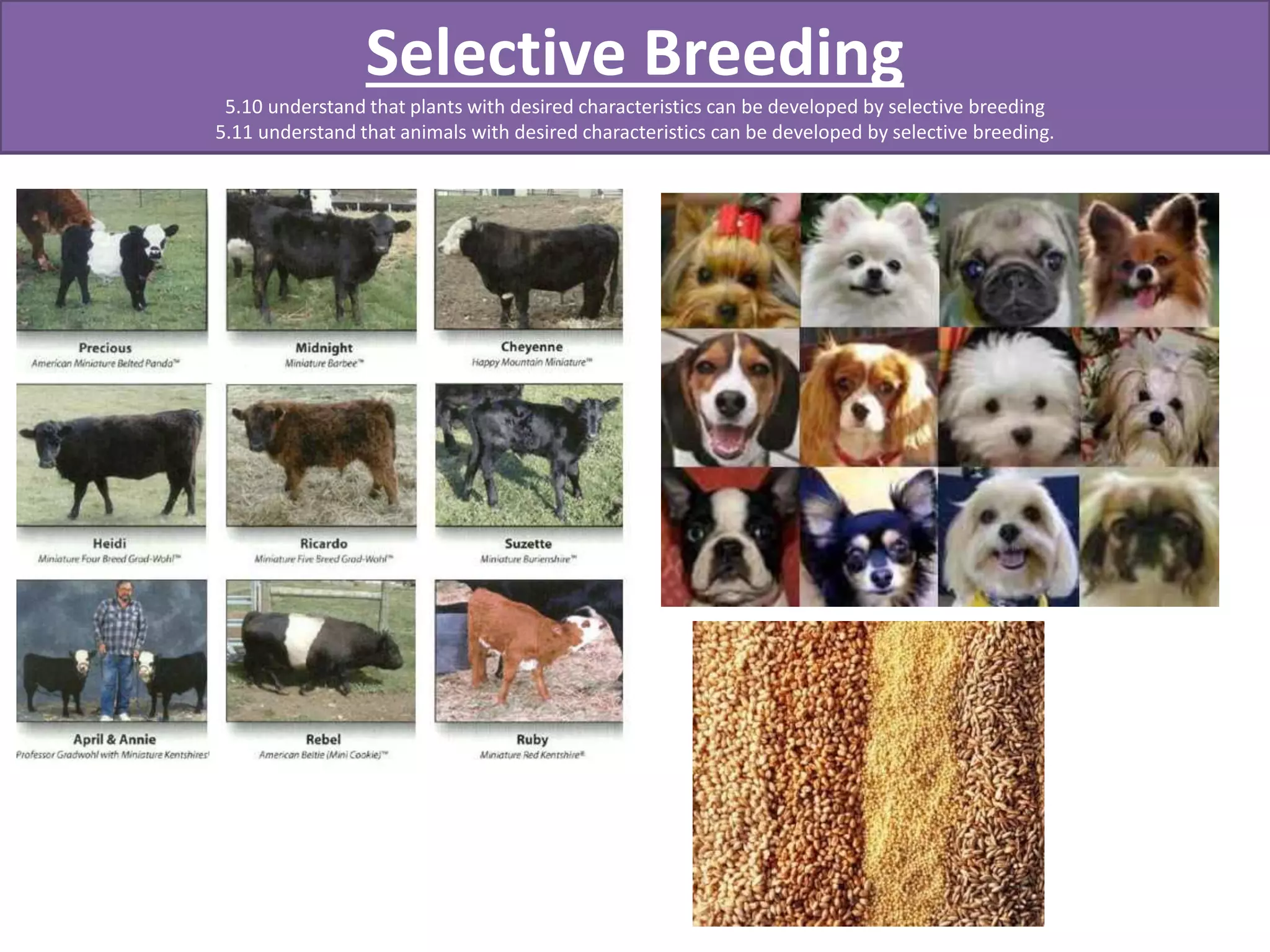
Selective Breeding 
5.10 understand that plants with desired characteristics can be developed by selective breeding 
5.11 understand that animals with desired characteristics can be developed by selective breeding.
Definition 
5.10 understand that plants with desired characteristics can be developed by selective breeding 
5.11 understand that animals with desired characteristics can be developed by selective breeding. 
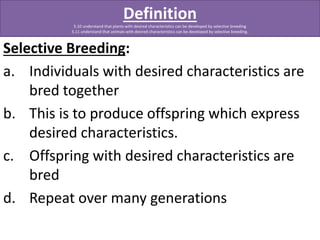
Selective Breeding: 
a. Individuals with desired characteristics are 
bred together 
b. This is to produce offspring which express 
desired characteristics. 
c. Offspring with desired characteristics are 
bred 
d. Repeat over many generations
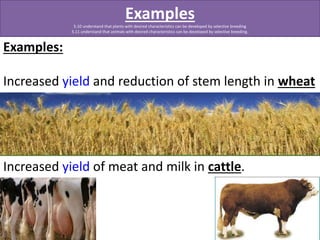
Examples: 
Examples 
5.10 understand that plants with desired characteristics can be developed by selective breeding 
5.11 understand that animals with desired characteristics can be developed by selective breeding. 
Increased yield and reduction of stem length in wheat 
Increased yield of meat and milk in cattle.
Selective Breeding Points 
5.10 understand that plants with desired characteristics can be developed by selective breeding 
5.11 understand that animals with desired characteristics can be developed by selective breeding. 
• Process of controlled sexual reproduction 
• Potentially can take thousands of years 
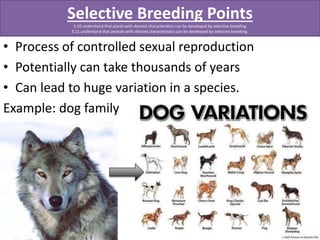
• Can lead to huge variation in a species. 
Example: dog family
Selective Breeding 
(a simple how to guide…. again) 
5.10 understand that plants with desired characteristics can be developed by selective breeding 
5.11 understand that animals with desired characteristics can be developed by selective breeding. 
• Identify individual organisms that have a 
desirable trait in a population. 
• Breed these individuals together. 
• From offspring choose those with the 
desirable trait. 
• Breed these offspring together. 
• Continue for a long, long, long time
Genetic Modification 
Syllabus points 5.12 – 5.20
Genetic 
Modification 
Syllabus points 5.12 – 5.20 
Review the 
structure of DNA: 
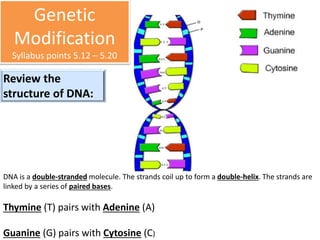
DNA is a double-stranded molecule. The strands coil up to form a double-helix. The strands are 
linked by a series of paired bases. 
Thymine (T) pairs with Adenine (A) 
Guanine (G) pairs with Cytosine (C)
Process of Genetic Engineering 
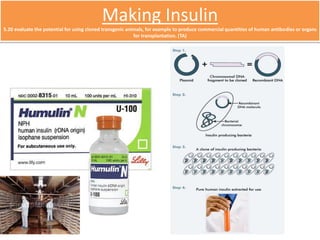
5.14 understand that large amounts of human insulin can be manufactured from genetically modified bacteria that are grown in a fermenter 
The example you need to know is the creation of E coli 
bacteria that makes human insulin. 
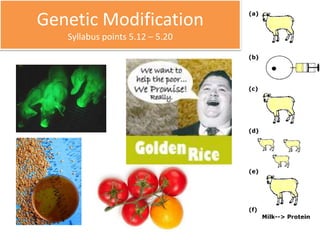
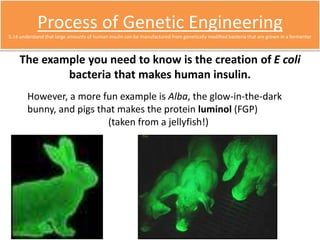
However, a more fun example is Alba, the glow-in-the-dark 
bunny, and pigs that makes the protein luminol (FGP) 
(taken from a jellyfish!)
TRANSGENIC ORGANISMS 
5.12 describe the use of restriction enzymes to cut DNA at specific sites and ligase enzymes to join pieces of DNA together 
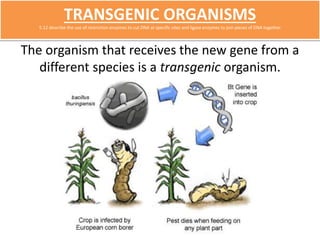
The organism that receives the new gene from a 
different species is a transgenic organism.
PROCESS 
5.12 describe the use of restriction enzymes to cut DNA at specific sites and ligase enzymes to join pieces of DNA together 
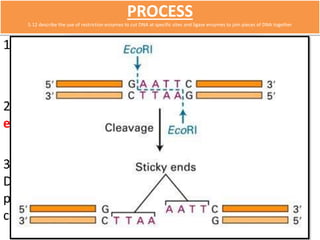
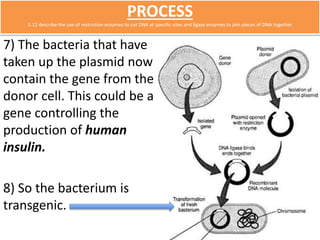
1) Plasmids are isolated from a bacterium. 
2) They are cut open with a specific restriction 
enzyme. 
3) The gene to be transferred is cut from the donor 
DNA using the same restriction enzyme, so that the 
plasmid and the gene have the same sticky ends and 
can be joined together. (ends match)
PROCESS 
5.12 describe the use of restriction enzymes to cut DNA at specific sites and ligase enzymes to join pieces of DNA together 
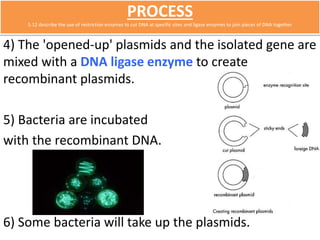
4) The 'opened-up' plasmids and the isolated gene are 
mixed with a DNA ligase enzyme to create 
recombinant plasmids. 
5) Bacteria are incubated 
with the recombinant DNA. 
6) Some bacteria will take up the plasmids.
PROCESS 
5.12 describe the use of restriction enzymes to cut DNA at specific sites and ligase enzymes to join pieces of DNA together 
7) The bacteria that have 
taken up the plasmid now 
contain the gene from the 
donor cell. This could be a 
gene controlling the 
production of human 
insulin. 
8) So the bacterium is 
transgenic.
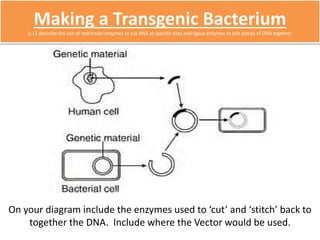
Making a Transgenic Bacterium 
5.12 describe the use of restriction enzymes to cut DNA at specific sites and ligase enzymes to join pieces of DNA together 
On your diagram include the enzymes used to ‘cut’ and ‘stitch’ back to 
together the DNA. Include where the Vector would be used.
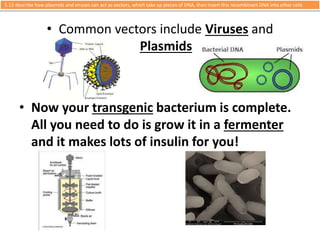
5.13 describe how plasmids and viruses can act as vectors, which take up pieces of DNA, then insert this recombinant DNA into other cells 
• Common vectors include Viruses and 
Plasmids 
• Now your transgenic bacterium is complete. 
All you need to do is grow it in a fermenter 
and it makes lots of insulin for you!
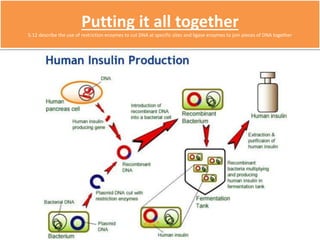
Putting it all together 
5.12 describe the use of restriction enzymes to cut DNA at specific sites and ligase enzymes to join pieces of DNA together
Transgenic Organism 
5.16 understand that the term transgenic means the transfer of genetic material from one species to a different species. (TA) 
Organism containing DNA from two or more sources 
(i.e. an organism that’s been genetically engineered to 
express a foreign gene) 
Plants are good to genetically engineer because they 
are more simple and there are fewer ethical issues.
Genetically modified (GM) crops are engineered to: 
5.15 evaluate the potential for using genetically modified plants to improve food production (illustrated by plants with improved resistance to pests) 
• Have bigger yields 
• Produce their own insecticide 
• Be frost resistant (e.g. frost resistant strawberries) 
• Have resistance to disease 
• Grow in harsher environments (e.g. drought-resistant rice) 
• Grow in harsher environments (e.g. salt resistant wheat) 
• Have a longer sell-by date (e.g. non-squash tomatoes) 
• Be a different colour / taste to normal (e.g. chocolate 
flavoured carrots) 
• Have vitamins in them that they would not normally have 
(e.g. golden rice) 
• Have stronger taste (e.g. chilli's) 
• Be easier to eat (e.g. easy-peel oranges)
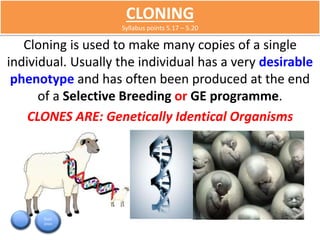
CLONING 
Syllabus points 5.17 – 5.20 
Cloning is used to make many copies of a single 
individual. Usually the individual has a very desirable 
phenotype and has often been produced at the end 
of a Selective Breeding or GE programme. 
CLONES ARE: Genetically Identical Organisms 
Start 
2min
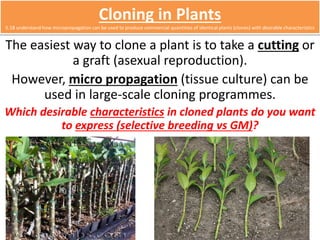
Cloning in Plants 
5.18 understand how micropropagation can be used to produce commercial quantities of identical plants (clones) with desirable characteristics 
The easiest way to clone a plant is to take a cutting or 
a graft (asexual reproduction). 
However, micro propagation (tissue culture) can be 
used in large-scale cloning programmes. 
Which desirable characteristics in cloned plants do you want 
to express (selective breeding vs GM)?
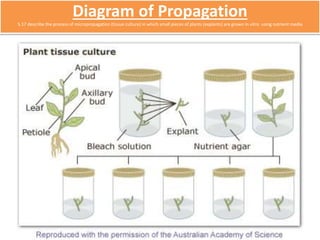
Diagram of Propagation 
5.17 describe the process of micropropagation (tissue culture) in which small pieces of plants (explants) are grown in vitro using nutrient media
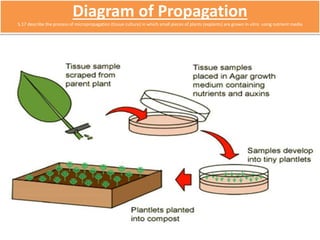
Diagram of Propagation 
5.17 describe the process of micropropagation (tissue culture) in which small pieces of plants (explants) are grown in vitro using nutrient media
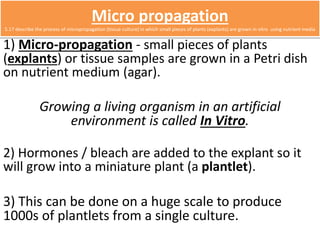
Micro propagation 
5.17 describe the process of micropropagation (tissue culture) in which small pieces of plants (explants) are grown in vitro using nutrient media 
1) Micro-propagation - small pieces of plants 
(explants) or tissue samples are grown in a Petri dish 
on nutrient medium (agar). 
Growing a living organism in an artificial 
environment is called In Vitro. 
2) Hormones / bleach are added to the explant so it 
will grow into a miniature plant (a plantlet). 
3) This can be done on a huge scale to produce 
1000s of plantlets from a single culture.
Diagram of Propagation 
5.17 describe the process of micropropagation (tissue culture) in which small pieces of plants (explants) are grown in vitro using nutrient media 
How do you draw it? 
Include vocabulary: 
Auxin/Bleach 
Nutrient agar 
In Vitro 
Cutting/Tissue Sample/explants 
Plantlets 
(you can include more)
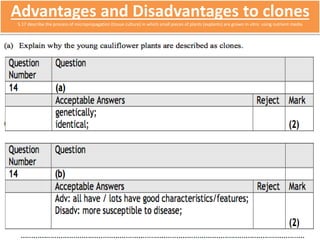
Advantages and Disadvantages to clones 
5.17 describe the process of micropropagation (tissue culture) in which small pieces of plants (explants) are grown in vitro using nutrient media
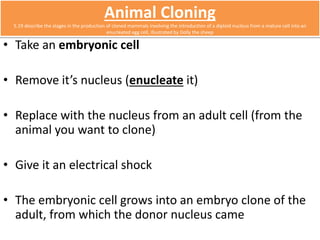
Animal Cloning 
5.19 describe the stages in the production of cloned mammals involving the introduction of a diploid nucleus from a mature cell into an 
enucleated egg cell, illustrated by Dolly the sheep 
• Take an embryonic cell 
• Remove it’s nucleus (enucleate it) 
• Replace with the nucleus from an adult cell (from the 
animal you want to clone) 
• Give it an electrical shock 
• The embryonic cell grows into an embryo clone of the 
adult, from which the donor nucleus came
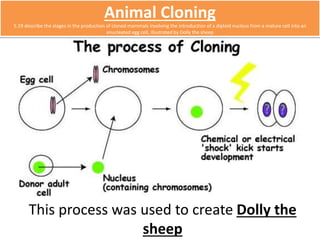
Animal Cloning 
5.19 describe the stages in the production of cloned mammals involving the introduction of a diploid nucleus from a mature cell into an 
enucleated egg cell, illustrated by Dolly the sheep 
This process was used to create Dolly the 
sheep
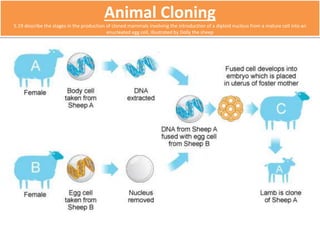
Animal Cloning 
5.19 describe the stages in the production of cloned mammals involving the introduction of a diploid nucleus from a mature cell into an 
enucleated egg cell, illustrated by Dolly the sheep
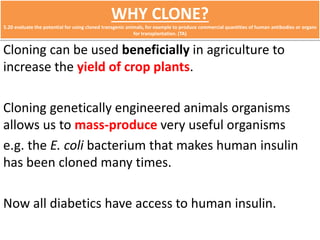
WHY CLONE? 
5.20 evaluate the potential for using cloned transgenic animals, for example to produce commercial quantities of human antibodies or organs 
for transplantation. (TA) 
Cloning can be used beneficially in agriculture to 
increase the yield of crop plants. 
Cloning genetically engineered animals organisms 
allows us to mass-produce very useful organisms 
e.g. the E. coli bacterium that makes human insulin 
has been cloned many times. 
Now all diabetics have access to human insulin.
Making Insulin 
5.20 evaluate the potential for using cloned transgenic animals, for example to produce commercial quantities of human antibodies or organs 
for transplantation. (TA)
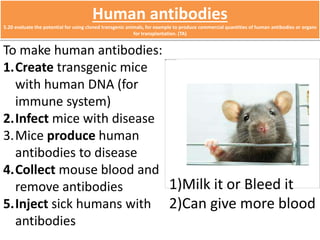
Human antibodies 
5.20 evaluate the potential for using cloned transgenic animals, for example to produce commercial quantities of human antibodies or organs 
for transplantation. (TA) 
To make human antibodies: 
1.Create transgenic mice 
with human DNA (for 
immune system) 
2.Infect mice with disease 
3.Mice produce human 
antibodies to disease 
4.Collect mouse blood and 
remove antibodies 
5.Inject sick humans with 
antibodies 
1)Milk it or Bleed it 
2)Can give more blood
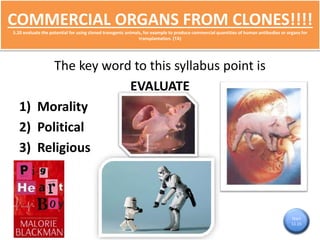
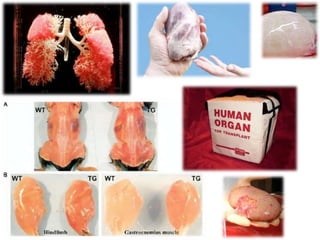
COMMERCIAL ORGANS FROM CLONES!!!! 
5.20 evaluate the potential for using cloned transgenic animals, for example to produce commercial quantities of human antibodies or organs for 
transplantation. (TA) 
The key word to this syllabus point is 
EVALUATE 
1) Morality 
2) Political 
3) Religious 
Start 
11.15
The CLONE Wars!!!! 
5.20 evaluate the potential for using cloned transgenic animals, for example to produce commercial quantities of human antibodies or organs 
for transplantation. (TA) 
Advantages 
Development of cloned animals which have been genetically engineered to 
produce valuable proteins in their milk or blood. 
Create identical organisms with exact genetic characteristics required. 
Cloning can save animals form extinction. 
Disadvantages 
Concerns about the ethics of cloning. 
Cloning limits variation. 
This can effect natural selection. 
Concerns about using the technique to clone humans in the future.
Igcse biology edexcel 5.10 5.20

Igcse biology edexcel 5.10 5.20

  • 1.
    Selective Breeding 5.10understand that plants with desired characteristics can be developed by selective breeding 5.11 understand that animals with desired characteristics can be developed by selective breeding.
  • 2.
    Definition 5.10 understandthat plants with desired characteristics can be developed by selective breeding 5.11 understand that animals with desired characteristics can be developed by selective breeding. Selective Breeding: a. Individuals with desired characteristics are bred together b. This is to produce offspring which express desired characteristics. c. Offspring with desired characteristics are bred d. Repeat over many generations
  • 3.
    Examples: Examples 5.10understand that plants with desired characteristics can be developed by selective breeding 5.11 understand that animals with desired characteristics can be developed by selective breeding. Increased yield and reduction of stem length in wheat Increased yield of meat and milk in cattle.
  • 4.
    Selective Breeding Points 5.10 understand that plants with desired characteristics can be developed by selective breeding 5.11 understand that animals with desired characteristics can be developed by selective breeding. • Process of controlled sexual reproduction • Potentially can take thousands of years • Can lead to huge variation in a species. Example: dog family
  • 5.
    Selective Breeding (asimple how to guide…. again) 5.10 understand that plants with desired characteristics can be developed by selective breeding 5.11 understand that animals with desired characteristics can be developed by selective breeding. • Identify individual organisms that have a desirable trait in a population. • Breed these individuals together. • From offspring choose those with the desirable trait. • Breed these offspring together. • Continue for a long, long, long time
  • 6.
    Genetic Modification Syllabuspoints 5.12 – 5.20
  • 7.
    Genetic Modification Syllabuspoints 5.12 – 5.20 Review the structure of DNA: DNA is a double-stranded molecule. The strands coil up to form a double-helix. The strands are linked by a series of paired bases. Thymine (T) pairs with Adenine (A) Guanine (G) pairs with Cytosine (C)
  • 8.
    Process of GeneticEngineering 5.14 understand that large amounts of human insulin can be manufactured from genetically modified bacteria that are grown in a fermenter The example you need to know is the creation of E coli bacteria that makes human insulin. However, a more fun example is Alba, the glow-in-the-dark bunny, and pigs that makes the protein luminol (FGP) (taken from a jellyfish!)
  • 9.
    TRANSGENIC ORGANISMS 5.12describe the use of restriction enzymes to cut DNA at specific sites and ligase enzymes to join pieces of DNA together The organism that receives the new gene from a different species is a transgenic organism.
  • 10.
    PROCESS 5.12 describethe use of restriction enzymes to cut DNA at specific sites and ligase enzymes to join pieces of DNA together 1) Plasmids are isolated from a bacterium. 2) They are cut open with a specific restriction enzyme. 3) The gene to be transferred is cut from the donor DNA using the same restriction enzyme, so that the plasmid and the gene have the same sticky ends and can be joined together. (ends match)
  • 11.
    PROCESS 5.12 describethe use of restriction enzymes to cut DNA at specific sites and ligase enzymes to join pieces of DNA together 4) The 'opened-up' plasmids and the isolated gene are mixed with a DNA ligase enzyme to create recombinant plasmids. 5) Bacteria are incubated with the recombinant DNA. 6) Some bacteria will take up the plasmids.
  • 12.
    PROCESS 5.12 describethe use of restriction enzymes to cut DNA at specific sites and ligase enzymes to join pieces of DNA together 7) The bacteria that have taken up the plasmid now contain the gene from the donor cell. This could be a gene controlling the production of human insulin. 8) So the bacterium is transgenic.
  • 13.
    Making a TransgenicBacterium 5.12 describe the use of restriction enzymes to cut DNA at specific sites and ligase enzymes to join pieces of DNA together On your diagram include the enzymes used to ‘cut’ and ‘stitch’ back to together the DNA. Include where the Vector would be used.
  • 14.
    5.13 describe howplasmids and viruses can act as vectors, which take up pieces of DNA, then insert this recombinant DNA into other cells • Common vectors include Viruses and Plasmids • Now your transgenic bacterium is complete. All you need to do is grow it in a fermenter and it makes lots of insulin for you!
  • 15.
    Putting it alltogether 5.12 describe the use of restriction enzymes to cut DNA at specific sites and ligase enzymes to join pieces of DNA together
  • 16.
    Transgenic Organism 5.16understand that the term transgenic means the transfer of genetic material from one species to a different species. (TA) Organism containing DNA from two or more sources (i.e. an organism that’s been genetically engineered to express a foreign gene) Plants are good to genetically engineer because they are more simple and there are fewer ethical issues.
  • 17.
    Genetically modified (GM)crops are engineered to: 5.15 evaluate the potential for using genetically modified plants to improve food production (illustrated by plants with improved resistance to pests) • Have bigger yields • Produce their own insecticide • Be frost resistant (e.g. frost resistant strawberries) • Have resistance to disease • Grow in harsher environments (e.g. drought-resistant rice) • Grow in harsher environments (e.g. salt resistant wheat) • Have a longer sell-by date (e.g. non-squash tomatoes) • Be a different colour / taste to normal (e.g. chocolate flavoured carrots) • Have vitamins in them that they would not normally have (e.g. golden rice) • Have stronger taste (e.g. chilli's) • Be easier to eat (e.g. easy-peel oranges)
  • 18.
    CLONING Syllabus points5.17 – 5.20 Cloning is used to make many copies of a single individual. Usually the individual has a very desirable phenotype and has often been produced at the end of a Selective Breeding or GE programme. CLONES ARE: Genetically Identical Organisms Start 2min
  • 19.
    Cloning in Plants 5.18 understand how micropropagation can be used to produce commercial quantities of identical plants (clones) with desirable characteristics The easiest way to clone a plant is to take a cutting or a graft (asexual reproduction). However, micro propagation (tissue culture) can be used in large-scale cloning programmes. Which desirable characteristics in cloned plants do you want to express (selective breeding vs GM)?
  • 20.
    Diagram of Propagation 5.17 describe the process of micropropagation (tissue culture) in which small pieces of plants (explants) are grown in vitro using nutrient media
  • 21.
    Diagram of Propagation 5.17 describe the process of micropropagation (tissue culture) in which small pieces of plants (explants) are grown in vitro using nutrient media
  • 22.
    Micro propagation 5.17describe the process of micropropagation (tissue culture) in which small pieces of plants (explants) are grown in vitro using nutrient media 1) Micro-propagation - small pieces of plants (explants) or tissue samples are grown in a Petri dish on nutrient medium (agar). Growing a living organism in an artificial environment is called In Vitro. 2) Hormones / bleach are added to the explant so it will grow into a miniature plant (a plantlet). 3) This can be done on a huge scale to produce 1000s of plantlets from a single culture.
  • 23.
    Diagram of Propagation 5.17 describe the process of micropropagation (tissue culture) in which small pieces of plants (explants) are grown in vitro using nutrient media How do you draw it? Include vocabulary: Auxin/Bleach Nutrient agar In Vitro Cutting/Tissue Sample/explants Plantlets (you can include more)
  • 24.
    Advantages and Disadvantagesto clones 5.17 describe the process of micropropagation (tissue culture) in which small pieces of plants (explants) are grown in vitro using nutrient media
  • 25.
    Animal Cloning 5.19describe the stages in the production of cloned mammals involving the introduction of a diploid nucleus from a mature cell into an enucleated egg cell, illustrated by Dolly the sheep • Take an embryonic cell • Remove it’s nucleus (enucleate it) • Replace with the nucleus from an adult cell (from the animal you want to clone) • Give it an electrical shock • The embryonic cell grows into an embryo clone of the adult, from which the donor nucleus came
  • 26.
    Animal Cloning 5.19describe the stages in the production of cloned mammals involving the introduction of a diploid nucleus from a mature cell into an enucleated egg cell, illustrated by Dolly the sheep This process was used to create Dolly the sheep
  • 27.
    Animal Cloning 5.19describe the stages in the production of cloned mammals involving the introduction of a diploid nucleus from a mature cell into an enucleated egg cell, illustrated by Dolly the sheep
  • 28.
    WHY CLONE? 5.20evaluate the potential for using cloned transgenic animals, for example to produce commercial quantities of human antibodies or organs for transplantation. (TA) Cloning can be used beneficially in agriculture to increase the yield of crop plants. Cloning genetically engineered animals organisms allows us to mass-produce very useful organisms e.g. the E. coli bacterium that makes human insulin has been cloned many times. Now all diabetics have access to human insulin.
  • 29.
    Making Insulin 5.20evaluate the potential for using cloned transgenic animals, for example to produce commercial quantities of human antibodies or organs for transplantation. (TA)
  • 30.
    Human antibodies 5.20evaluate the potential for using cloned transgenic animals, for example to produce commercial quantities of human antibodies or organs for transplantation. (TA) To make human antibodies: 1.Create transgenic mice with human DNA (for immune system) 2.Infect mice with disease 3.Mice produce human antibodies to disease 4.Collect mouse blood and remove antibodies 5.Inject sick humans with antibodies 1)Milk it or Bleed it 2)Can give more blood
  • 31.
    COMMERCIAL ORGANS FROMCLONES!!!! 5.20 evaluate the potential for using cloned transgenic animals, for example to produce commercial quantities of human antibodies or organs for transplantation. (TA) The key word to this syllabus point is EVALUATE 1) Morality 2) Political 3) Religious Start 11.15
  • 32.
    The CLONE Wars!!!! 5.20 evaluate the potential for using cloned transgenic animals, for example to produce commercial quantities of human antibodies or organs for transplantation. (TA) Advantages Development of cloned animals which have been genetically engineered to produce valuable proteins in their milk or blood. Create identical organisms with exact genetic characteristics required. Cloning can save animals form extinction. Disadvantages Concerns about the ethics of cloning. Cloning limits variation. This can effect natural selection. Concerns about using the technique to clone humans in the future.