BIOLOGICAL MOLECULES
As Biology – Chapter 2
Cambridge Syllabus
CARBOHYDRATES (CH20)n
 Contain C, H, and O where the ratio between H:O is 2:1.There are three
basic types of carbohydrate molecules according to their size:
 Monosaccharide: a molecule consisting of a single sugar unit, general
formula (CH2O)n.
 Disaccharide: a sugar molecule consisting of 2 monosaccharides joined
together by a glycosidic bond.
 Polysaccharide: a polymer consisting of subunits (monosaccharides)
joined together by glycosidic bonds.
 Monosaccharides and disaccharides are also known as sugars, they have
names that end in – ose.They have the general formula (CH2O)n. triose
sugars have 3 carbons, pentose sugars such as ribose and deoxyribose have
5 carbons and hexose sugars such as fructose and glucose have 6 carbons.
THE STRUCTURE OF GLUCOSE C6H12O6
 The formula for a
hexose can be written
as C6H12O6.
 This is known as the
molecular formula.
 It is also useful to show
the arrangements of
the atoms, which can
be done using a
diagram known as the
structural formula.
1
2
3
4
5
6
THE STRUCTURE OF GLUCOSE C6H12O6
 When dissolved in water
linear glucose molecules
rearrange to form a ring
structure.
1
2
3
4
5
6
THE STRUCTURE OF GLUCOSE
 Can you tell the difference
between these 2
molecules?
 The –OH group attached
to carbon 1 (C1) might be
below the ring ( -
α glucose)
or above the ring ( -
β
glucose).
 -
α glucose & -
β glucose are
called isomers; they have
exactly the same number
of atoms but have a
different 3D arrangement.
H Above
ring in -
α
glucose
H Below
ring in -
β
glucose
THE STRUCTURE OF GLUCOSE C6H12O6
 This animation model
shows the 3D ring
structure of glucose.
 What do the three colours
represent?
 Green:
 Red:
 White:
 Is this an -
α glucose or -
β
glucose molecule?
 Give a reason for your
choice.
DISACCHARIDES
 Where two monosaccharides bond
together by elimination of a water
molecule forming a glycosidic
bond.This reaction is called a
condensation reaction, which is
catalysed by an enzyme.
 Another enzyme can break this
bond by adding a water molecule to
produce two monosaccharides; this
is called a hydrolysis reaction.
 The diagram on the next slide
shows how two monosaccharides
can be joined by condensation to
produce a disaccharide.
CONDENSATION AND HYDROLYSIS REACTIONS
SOME COMMON DISACCHARIDES
POLYSACCHARIDES
Long chain molecules made
up of many monosaccharides
bonded by condensation of
(n) molecules with the
elimination of (n-1) water
molecules. Starch, glycogen
are -
α glucose polymers while
cellulose is a -
β glucose
polymer.
STARCH
 made up of many -
α glucose
molecules, with the general
formula (C6H10O5)n.
 Starch is found in plant cells
only. It is a mixture of two
polysaccharides; amylose
and amylopectin.The starch
molecule has the advantage
of being compact, un-
reactive and insoluble
which makes it ideal for
storage inside the cell.
 The table on the next page
compares both.
⍺ - 1,4 – glycosidic
bonds
COMPARING AMYLOSE AND AMYLOPECTIN
TEST FOR STARCH
 Add Iodine solution.
Iodine molecules fit
inside the spiral
amylose molecules
forming what we call :
 Iodine–starch complex
that is blue-black in
colour.
GLYCOGEN
Found in animal cells
(liver & muscles) as well
as in fungal & bacterial
cells.
 Have a similar structure to
amylopectin but with
branches every 8-10
glucose units.The
branches can be quickly
broken down
simultaneously to supply
glucose needed by
respiring cells e.g. during
exercise.
CELLULOSE
 The most abundant molecule on planet Earth!
Has a structural role in plant cell walls.
 It is a structural polysaccharide made of -
β
glucose bonded by 1,4-glycosidic linkages.
The glucose molecules are arranged so that
there is one ring is facing upward while the
other is facing downward.This arrangement
produces a straight chain and when chains are
side-by-side they would form hydrogen bonds
along their entire length. A bundle of (60 to 70)
cellulose molecules is called a microfibril, a
group of microfibrils make up a fibre.
 Cellulose fibres are arranged like threads in a
fabric, running in different directions which
give the cell walls their high tensile strength.
Other molecules form a glue-like matrix
around the fibres, further increases the
strength of the cell wall.
Animal, bacteria,
fungi
LIPIDS
 Include a wide variety of molecules that contain elements C, H & O where the C-H bonds are much
more than that found in carbohydrates.
 C-H bonds produce large amounts of energy when broken (1gm fat=38KJ).The large number of C-
H bonds makes the molecule non-polar which is why they don’t dissolve in water but rather in non-
polar (organic) solvents.
LIPIDS
 Fats and oils contain two types of
organic molecules; fatty acids
and glycerol.
 They are combined using ester
bonds in a condensation
reaction.
LIPIDS
 Fatty acids are long hydrocarbon chains with a carboxylic group (COOH) at one end. Fatty acids
may vary in two ways:
1. The length of the hydrocarbon chain (usually 15-17 carbon atoms long)
2. The fatty acid might be a saturated fatty acid or an unsaturated fatty acid.
Fatty acids with double bonds in
their structure are form
unsaturated triglycerides also
known as oils, which are liquid
at room temperature.
While fatty acids with no double
bonds form saturated
triglycerides, which are normally
solid at room temperature such
as butter, cream, margarine &
ghee.
This is due to the fact that
saturated chains are straight
which allows the triglycerides to
come closer together forming a
tight arrangement of molecules
as in solids while unsaturated
chains are askew which
prevents the molecules from
coming that close together.
TYPES OF LIPIDS
Lipids include:
1. Triglycerides(fats and oils)
2. Phospholipids (main component of plasma membrane)
3. Steroids
Triglycerides: a molecule of glycerol when bonded to three fatty acids is called a triglyceride.The
reaction is also a condensation reaction where three water molecules are removed one from each
fatty acid that bonds.The resulting bond is called an ester bond since glycerol is considered and
alcohol and fatty acids are acids!
FUNCTIONS OF TRIGLYCERIDES
 Energy source; can be broken down to release energy.
 Energy store; contain much more energy/gm due to many C-H
bonds.
 Thermal insulation; fat under skin (adipose tissue) is a poor
conductor of heat which reduces heat loss from the body.
 Electrical insulation; myelin sheath covering axons of nerve cells
act as an electrical insulator and helps nerve impulses to pass
quickly.
 Water-proofing surfaces; due to their hydrophobic nature.
 Have a low density; providing buoyancy to aquatic animals e.g.
whales
 Metabolic source of water; when oxidized in respiration TG
release many water molecules which is important for animals
living in dry habitats e.g. kangaroo rat.
PHOSPHOLIPIDS
 form the basic structure of cell membranes. In this molecule, a phosphorous group reacts
instead of one of the fatty acids.The phosphorous group ionizes to become –vely charged,
this creates a polar side along with the glycerol part of the molecule.We call this part the
head and describe it as hydrophilic “water-loving”, the rest of the molecule consists of the
long two fatty acid chains which carry no charges, they are named tails and are hydrophobic
“water-hating”.
PROTEINS
 Contain elements C, H, O, N and sometimes S and P. Proteins are polymers of many amino
acids linked together (again by condensation!) forming what we call peptide bonds.
 R= residual group which changes from one amino acid to another. If polar the amino acid is
hydrophilic (water soluble) if non-polar the amino acid is hydrophobic (water insoluble).
 In some proteins hydrophilic R-groups are arranged so that they face the outer side of the
protein, while hydrophobic R-groups face inwards, thus the protein molecule is water
soluble. R- groups are also involved in formation of cross links which gives the protein its
3D shape.
Types
of
amino
acids
Adding one more amino acid gives a tripeptide, more than three amino acids in a chain is
called a polypeptide. Proteins can contain one polypeptide chain or more.
FORMATION OF PEPTIDE BOND BETWEEN AMINO ACIDS
FUNCTIONS OF
PROTEINS:
Type Example Function Occurrence
Hormones Insulin,
Glucagon
Regulate blood
sugar level
Pancreas
Contractile
fibres
Actin, Myosin Muscle
contraction
Muscles
Storage Ferritin Stores iron Liver
Enzyme Lipase, amylase Digestion Pancreas
Structural Collagen,
Keratin
Provide strength Skin, hair, nails
Protective Antibodies Fight foreign
organism
WBCs
1. All enzymes are made of
proteins.
2. Proteins are essential
components of cell
membranes.
3. Storage products e.g.
casein in milk and
ovalbumin in egg white.
PROTEIN
STRUCTURE
 Primary structure: there are only 20 different amino acids in
our world, but the number of different proteins known to us is
increasing every day.That is because there are infinite number
of ways you could arrange the different amino acids to produce
a protein.
 The primary structure refers to the type and sequence of
amino acids in a polypeptide chain. This determines the
overall shape of the protein and thus its function.
 The 1ry structure is determined by the code on the DNA which
is translated by ribosomes that join the amino acids together
forming the protein.
Primary
Structure
PROTEIN
STRUCTURE
 Secondary structure: the polypeptide often twists into either a
spiral ( -
α helix) or a bent sheet ( -
β pleated sheet) due to hydrogen
bonds forming between –NH group of one amino acid residue and
–C=O group of another.
 The secondary structure is how the polypeptide molecules
twists forming an –
α helix or –
β pleated sheets stabilized by H-
bonds.
 -
α helix: most common type where the polypeptide is coiled into a
spiral and stabilized by H-bonds.
-
β pleated sheet: a flat structure where two or more polypeptide
chains lie side by side and the H-bonds are formed between them.
Secondary
Structure
PROTEIN
STRUCTURE
 Tertiary structure: do you
remember trying to set your
phone cord straight? The
polypeptide can coil further
like your entangled phone cord
to form a 3D shape which is
stabilized by one or more of
these different bonds between
the different R-
groups:
 Hydrogen bonds between
slightly +ve and slightly –ve R-
groups.
 Disulphide bridges (covalent
bond) between two SH-groups
in cysteine residues.
 Ionic bonds between two
oppositely charged ions in R-
groups
 Hydrophobic attractions
between non-polar R- groups.
Tertiary
Structure
PROTEIN
STRUCTURE
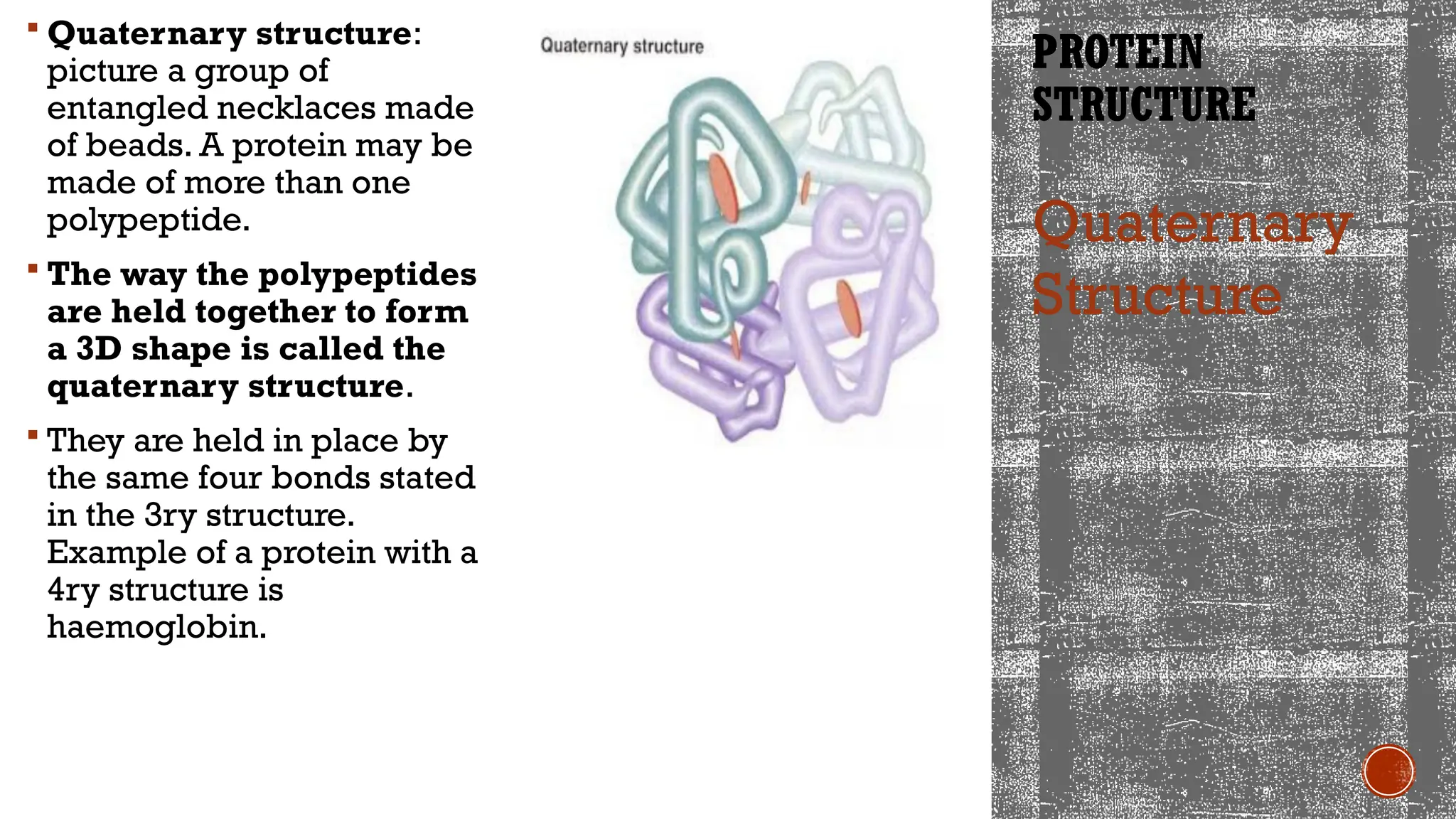
 Quaternary structure:
picture a group of
entangled necklaces made
of beads. A protein may be
made of more than one
polypeptide.
 The way the polypeptides
are held together to form
a 3D shape is called the
quaternary structure.
 They are held in place by
the same four bonds stated
in the 3ry structure.
Example of a protein with a
4ry structure is
haemoglobin.
Quaternary
Structure
GLOBULAR AND FIBROUS PROTEINS.
HAEMOGLOBIN  This protein is made up of four polypeptide
chains, two identical –
α chains and two
identical –
β chains. Each chain is folded
into a sphere and they are held together by
disulphide bonds.
 Each polypeptide holds a non-protein
prosthetic group called the haem group. It
is to the Fe+2 at the centre of the haem
group the Oxygen molecule binds.
 This makes a haemoglobin molecule
capable of carrying four O2 molecules.
COLLAGEN
 It is present in tendons, ligaments, blood vessels, bones
and skin.
 It is the most common structural protein found in
animals (up to 35% of the proteins in your body is
collagen, with a tensile strength similar to that of steel!)
 The primary structure of -glycine-X-Y-glycine-X-Y- glycine-X-
Y-(other amino acids often are proline & hydroxyproline)
allows the polypeptide molecule to have a stretched-out
helical shape (not an –
α helix).
 Its quaternary structure has three polypeptide chains, each
up to 1000 amino acids long, the three identical polypeptides
are intertwined forming a triple helix held together by a
very large number of H-bonds.The three stranded molecule
interacts with other collagen strands by covalent bonds
forming fibres that can be up to several millimetres long.
WATER
 This very important molecule has many roles:
 1. It is a major component of cells
2. Provides a habitat for aquatic animals
3. It is involved in many metabolic reactions e.g.
photosynthesis and hydrolysis
4. It helps to provide strength to plants by keeping their
cells turgid
5. It helps to cool body of living things by evaporation
6. Helps gas exchange at respiratory surfaces
7. Acts as a solvent for ionic and polar molecules which
makes it a good transport medium
 The unusual physical and chemical properties of water are
due to the small size of the water molecules & due to their
dipolar quality.
 Dipoles occur in many different molecules, particularly whenever
there is an –OH, –C=O or N-H. Hydrogen bonds can form
between these groups.These bonds are very important in the
structure and properties of carbohydrates and proteins.
Details
 H2O is dipolar: oxygen is slightly
negative while hydrogen is slightly
positive. Each pole can attract ions of
an opposite charge or other polar
molecules
Uses to living things
 Main component of the cytoplasm ,
providing a good medium for
dissolved substances to react.
 A good transport system e.g. in
blood plasma and phloem vessels.
PROPERTIES OF WATER AND ITS IMPORTANCE TO SUSTAIN LIFE
1. Solvent
Details
 Hydrogen bonds between water
molecules makes the water surface
appear as a film
Uses to living things
 Can support small animals to walk on
the surface of the water (pond skaters)
PROPERTIES OF WATER AND ITS IMPORTANCE TO SUSTAIN LIFE
2. Cohesion (surface tension)
 Forces between water molecules and
other surfaces
 Allows water to travel up capillary
tubes such as xylem vessels
Details Uses to living things
PROPERTIES OF WATER AND ITS IMPORTANCE TO SUSTAIN LIFE
3. Adhesion
Details
 Water is slow to absorb and release
heat.Water needs a relatively large
amount of energy to raise its
temperature which means that areas with
large water composition can keep a
fairly constant temperature even when
their surrounding temperatures
fluctuate.
Uses to living things
 Helps to sustain aquatic life in seas,
lakes and rivers.
 This keeps the body temperature
constant (living things are mostly
water); this helps in body
temperature regulation.
PROPERTIES OF WATER AND ITS IMPORTANCE TO SUSTAIN LIFE
4. High specific heat capacity
Details
 Hydrogen bonds between water
molecules have to be broken before
they can evaporate which requires
more heat energy.
Uses to living things
 Helps to cool down body temperature
as a small volume of water will use up a
considerable amount of body heat to
evaporate, so not much water is lost
when cooling the body.
PROPERTIES OF WATER AND ITS IMPORTANCE TO SUSTAIN LIFE
5. High latent heat of vaporisation
Details
 When solid; water molecules arrange
in a way, so they are further apart
making ice less dense than liquid
water.
Uses to living things
 Ice floats on the surface of lakes/ rivers/
sea insulating the water beneath to
support aquatic life.
 As density of water changes with
temperature, this creates water currents
that can circulate dissolved gases and
nutrients.
PROPERTIES OF WATER AND ITS IMPORTANCE TO SUSTAIN LIFE
6. Density
Details
 Viscosity is the resistance to flow.
Water has a low viscosity compared
to other liquids such as ethanol,
glycerol, oil.
Uses to living things
 Allows blood to flow easily in blood
vessels.
 Allows aquatic animals to swim easily in
water
PROPERTIES OF WATER AND ITS IMPORTANCE TO SUSTAIN LIFE
6. Low viscosity
USEFUL VIDEOS TO WATCH
 Linear and cyclical forms of glucose: https://youtu.be/-Aj5BTnz-v0
 Carohydrates: https://youtu.be/rQyWJIn1HYE
 Lipids: https://youtu.be/ebScOnAJdu0?si=cZBh7zs7VqmqTGPU
 Proteins: https://youtu.be/kMg517MHDJs?si=5CRywLXklzvchHbT

As Bio Cambridge Ch2 Biological molecules 2025.pptx

  • 1.
    BIOLOGICAL MOLECULES As Biology– Chapter 2 Cambridge Syllabus
  • 6.
    CARBOHYDRATES (CH20)n  ContainC, H, and O where the ratio between H:O is 2:1.There are three basic types of carbohydrate molecules according to their size:  Monosaccharide: a molecule consisting of a single sugar unit, general formula (CH2O)n.  Disaccharide: a sugar molecule consisting of 2 monosaccharides joined together by a glycosidic bond.  Polysaccharide: a polymer consisting of subunits (monosaccharides) joined together by glycosidic bonds.  Monosaccharides and disaccharides are also known as sugars, they have names that end in – ose.They have the general formula (CH2O)n. triose sugars have 3 carbons, pentose sugars such as ribose and deoxyribose have 5 carbons and hexose sugars such as fructose and glucose have 6 carbons.
  • 7.
    THE STRUCTURE OFGLUCOSE C6H12O6  The formula for a hexose can be written as C6H12O6.  This is known as the molecular formula.  It is also useful to show the arrangements of the atoms, which can be done using a diagram known as the structural formula. 1 2 3 4 5 6
  • 8.
    THE STRUCTURE OFGLUCOSE C6H12O6  When dissolved in water linear glucose molecules rearrange to form a ring structure. 1 2 3 4 5 6
  • 9.
    THE STRUCTURE OFGLUCOSE  Can you tell the difference between these 2 molecules?  The –OH group attached to carbon 1 (C1) might be below the ring ( - α glucose) or above the ring ( - β glucose).  - α glucose & - β glucose are called isomers; they have exactly the same number of atoms but have a different 3D arrangement. H Above ring in - α glucose H Below ring in - β glucose
  • 10.
    THE STRUCTURE OFGLUCOSE C6H12O6  This animation model shows the 3D ring structure of glucose.  What do the three colours represent?  Green:  Red:  White:  Is this an - α glucose or - β glucose molecule?  Give a reason for your choice.
  • 11.
    DISACCHARIDES  Where twomonosaccharides bond together by elimination of a water molecule forming a glycosidic bond.This reaction is called a condensation reaction, which is catalysed by an enzyme.  Another enzyme can break this bond by adding a water molecule to produce two monosaccharides; this is called a hydrolysis reaction.  The diagram on the next slide shows how two monosaccharides can be joined by condensation to produce a disaccharide.
  • 12.
  • 13.
  • 14.
    POLYSACCHARIDES Long chain moleculesmade up of many monosaccharides bonded by condensation of (n) molecules with the elimination of (n-1) water molecules. Starch, glycogen are - α glucose polymers while cellulose is a - β glucose polymer.
  • 15.
    STARCH  made upof many - α glucose molecules, with the general formula (C6H10O5)n.  Starch is found in plant cells only. It is a mixture of two polysaccharides; amylose and amylopectin.The starch molecule has the advantage of being compact, un- reactive and insoluble which makes it ideal for storage inside the cell.  The table on the next page compares both. ⍺ - 1,4 – glycosidic bonds
  • 16.
  • 18.
    TEST FOR STARCH Add Iodine solution. Iodine molecules fit inside the spiral amylose molecules forming what we call :  Iodine–starch complex that is blue-black in colour.
  • 19.
    GLYCOGEN Found in animalcells (liver & muscles) as well as in fungal & bacterial cells.  Have a similar structure to amylopectin but with branches every 8-10 glucose units.The branches can be quickly broken down simultaneously to supply glucose needed by respiring cells e.g. during exercise.
  • 20.
    CELLULOSE  The mostabundant molecule on planet Earth! Has a structural role in plant cell walls.  It is a structural polysaccharide made of - β glucose bonded by 1,4-glycosidic linkages. The glucose molecules are arranged so that there is one ring is facing upward while the other is facing downward.This arrangement produces a straight chain and when chains are side-by-side they would form hydrogen bonds along their entire length. A bundle of (60 to 70) cellulose molecules is called a microfibril, a group of microfibrils make up a fibre.  Cellulose fibres are arranged like threads in a fabric, running in different directions which give the cell walls their high tensile strength. Other molecules form a glue-like matrix around the fibres, further increases the strength of the cell wall.
  • 22.
  • 23.
    LIPIDS  Include awide variety of molecules that contain elements C, H & O where the C-H bonds are much more than that found in carbohydrates.  C-H bonds produce large amounts of energy when broken (1gm fat=38KJ).The large number of C- H bonds makes the molecule non-polar which is why they don’t dissolve in water but rather in non- polar (organic) solvents.
  • 24.
    LIPIDS  Fats andoils contain two types of organic molecules; fatty acids and glycerol.  They are combined using ester bonds in a condensation reaction.
  • 25.
    LIPIDS  Fatty acidsare long hydrocarbon chains with a carboxylic group (COOH) at one end. Fatty acids may vary in two ways: 1. The length of the hydrocarbon chain (usually 15-17 carbon atoms long) 2. The fatty acid might be a saturated fatty acid or an unsaturated fatty acid.
  • 26.
    Fatty acids withdouble bonds in their structure are form unsaturated triglycerides also known as oils, which are liquid at room temperature. While fatty acids with no double bonds form saturated triglycerides, which are normally solid at room temperature such as butter, cream, margarine & ghee. This is due to the fact that saturated chains are straight which allows the triglycerides to come closer together forming a tight arrangement of molecules as in solids while unsaturated chains are askew which prevents the molecules from coming that close together.
  • 27.
    TYPES OF LIPIDS Lipidsinclude: 1. Triglycerides(fats and oils) 2. Phospholipids (main component of plasma membrane) 3. Steroids Triglycerides: a molecule of glycerol when bonded to three fatty acids is called a triglyceride.The reaction is also a condensation reaction where three water molecules are removed one from each fatty acid that bonds.The resulting bond is called an ester bond since glycerol is considered and alcohol and fatty acids are acids!
  • 28.
    FUNCTIONS OF TRIGLYCERIDES Energy source; can be broken down to release energy.  Energy store; contain much more energy/gm due to many C-H bonds.  Thermal insulation; fat under skin (adipose tissue) is a poor conductor of heat which reduces heat loss from the body.  Electrical insulation; myelin sheath covering axons of nerve cells act as an electrical insulator and helps nerve impulses to pass quickly.  Water-proofing surfaces; due to their hydrophobic nature.  Have a low density; providing buoyancy to aquatic animals e.g. whales  Metabolic source of water; when oxidized in respiration TG release many water molecules which is important for animals living in dry habitats e.g. kangaroo rat.
  • 29.
    PHOSPHOLIPIDS  form thebasic structure of cell membranes. In this molecule, a phosphorous group reacts instead of one of the fatty acids.The phosphorous group ionizes to become –vely charged, this creates a polar side along with the glycerol part of the molecule.We call this part the head and describe it as hydrophilic “water-loving”, the rest of the molecule consists of the long two fatty acid chains which carry no charges, they are named tails and are hydrophobic “water-hating”.
  • 30.
    PROTEINS  Contain elementsC, H, O, N and sometimes S and P. Proteins are polymers of many amino acids linked together (again by condensation!) forming what we call peptide bonds.  R= residual group which changes from one amino acid to another. If polar the amino acid is hydrophilic (water soluble) if non-polar the amino acid is hydrophobic (water insoluble).  In some proteins hydrophilic R-groups are arranged so that they face the outer side of the protein, while hydrophobic R-groups face inwards, thus the protein molecule is water soluble. R- groups are also involved in formation of cross links which gives the protein its 3D shape.
  • 31.
  • 32.
    Adding one moreamino acid gives a tripeptide, more than three amino acids in a chain is called a polypeptide. Proteins can contain one polypeptide chain or more. FORMATION OF PEPTIDE BOND BETWEEN AMINO ACIDS
  • 33.
    FUNCTIONS OF PROTEINS: Type ExampleFunction Occurrence Hormones Insulin, Glucagon Regulate blood sugar level Pancreas Contractile fibres Actin, Myosin Muscle contraction Muscles Storage Ferritin Stores iron Liver Enzyme Lipase, amylase Digestion Pancreas Structural Collagen, Keratin Provide strength Skin, hair, nails Protective Antibodies Fight foreign organism WBCs 1. All enzymes are made of proteins. 2. Proteins are essential components of cell membranes. 3. Storage products e.g. casein in milk and ovalbumin in egg white.
  • 34.
    PROTEIN STRUCTURE  Primary structure:there are only 20 different amino acids in our world, but the number of different proteins known to us is increasing every day.That is because there are infinite number of ways you could arrange the different amino acids to produce a protein.  The primary structure refers to the type and sequence of amino acids in a polypeptide chain. This determines the overall shape of the protein and thus its function.  The 1ry structure is determined by the code on the DNA which is translated by ribosomes that join the amino acids together forming the protein. Primary Structure
  • 35.
    PROTEIN STRUCTURE  Secondary structure:the polypeptide often twists into either a spiral ( - α helix) or a bent sheet ( - β pleated sheet) due to hydrogen bonds forming between –NH group of one amino acid residue and –C=O group of another.  The secondary structure is how the polypeptide molecules twists forming an – α helix or – β pleated sheets stabilized by H- bonds.  - α helix: most common type where the polypeptide is coiled into a spiral and stabilized by H-bonds. - β pleated sheet: a flat structure where two or more polypeptide chains lie side by side and the H-bonds are formed between them. Secondary Structure
  • 36.
    PROTEIN STRUCTURE  Tertiary structure:do you remember trying to set your phone cord straight? The polypeptide can coil further like your entangled phone cord to form a 3D shape which is stabilized by one or more of these different bonds between the different R- groups:  Hydrogen bonds between slightly +ve and slightly –ve R- groups.  Disulphide bridges (covalent bond) between two SH-groups in cysteine residues.  Ionic bonds between two oppositely charged ions in R- groups  Hydrophobic attractions between non-polar R- groups. Tertiary Structure
  • 37.
    PROTEIN STRUCTURE  Quaternary structure: picturea group of entangled necklaces made of beads. A protein may be made of more than one polypeptide.  The way the polypeptides are held together to form a 3D shape is called the quaternary structure.  They are held in place by the same four bonds stated in the 3ry structure. Example of a protein with a 4ry structure is haemoglobin. Quaternary Structure
  • 39.
  • 40.
    HAEMOGLOBIN  Thisprotein is made up of four polypeptide chains, two identical – α chains and two identical – β chains. Each chain is folded into a sphere and they are held together by disulphide bonds.  Each polypeptide holds a non-protein prosthetic group called the haem group. It is to the Fe+2 at the centre of the haem group the Oxygen molecule binds.  This makes a haemoglobin molecule capable of carrying four O2 molecules.
  • 41.
    COLLAGEN  It ispresent in tendons, ligaments, blood vessels, bones and skin.  It is the most common structural protein found in animals (up to 35% of the proteins in your body is collagen, with a tensile strength similar to that of steel!)  The primary structure of -glycine-X-Y-glycine-X-Y- glycine-X- Y-(other amino acids often are proline & hydroxyproline) allows the polypeptide molecule to have a stretched-out helical shape (not an – α helix).  Its quaternary structure has three polypeptide chains, each up to 1000 amino acids long, the three identical polypeptides are intertwined forming a triple helix held together by a very large number of H-bonds.The three stranded molecule interacts with other collagen strands by covalent bonds forming fibres that can be up to several millimetres long.
  • 42.
    WATER  This veryimportant molecule has many roles:  1. It is a major component of cells 2. Provides a habitat for aquatic animals 3. It is involved in many metabolic reactions e.g. photosynthesis and hydrolysis 4. It helps to provide strength to plants by keeping their cells turgid 5. It helps to cool body of living things by evaporation 6. Helps gas exchange at respiratory surfaces 7. Acts as a solvent for ionic and polar molecules which makes it a good transport medium  The unusual physical and chemical properties of water are due to the small size of the water molecules & due to their dipolar quality.  Dipoles occur in many different molecules, particularly whenever there is an –OH, –C=O or N-H. Hydrogen bonds can form between these groups.These bonds are very important in the structure and properties of carbohydrates and proteins.
  • 43.
    Details  H2O isdipolar: oxygen is slightly negative while hydrogen is slightly positive. Each pole can attract ions of an opposite charge or other polar molecules Uses to living things  Main component of the cytoplasm , providing a good medium for dissolved substances to react.  A good transport system e.g. in blood plasma and phloem vessels. PROPERTIES OF WATER AND ITS IMPORTANCE TO SUSTAIN LIFE 1. Solvent
  • 44.
    Details  Hydrogen bondsbetween water molecules makes the water surface appear as a film Uses to living things  Can support small animals to walk on the surface of the water (pond skaters) PROPERTIES OF WATER AND ITS IMPORTANCE TO SUSTAIN LIFE 2. Cohesion (surface tension)
  • 45.
     Forces betweenwater molecules and other surfaces  Allows water to travel up capillary tubes such as xylem vessels Details Uses to living things PROPERTIES OF WATER AND ITS IMPORTANCE TO SUSTAIN LIFE 3. Adhesion
  • 46.
    Details  Water isslow to absorb and release heat.Water needs a relatively large amount of energy to raise its temperature which means that areas with large water composition can keep a fairly constant temperature even when their surrounding temperatures fluctuate. Uses to living things  Helps to sustain aquatic life in seas, lakes and rivers.  This keeps the body temperature constant (living things are mostly water); this helps in body temperature regulation. PROPERTIES OF WATER AND ITS IMPORTANCE TO SUSTAIN LIFE 4. High specific heat capacity
  • 47.
    Details  Hydrogen bondsbetween water molecules have to be broken before they can evaporate which requires more heat energy. Uses to living things  Helps to cool down body temperature as a small volume of water will use up a considerable amount of body heat to evaporate, so not much water is lost when cooling the body. PROPERTIES OF WATER AND ITS IMPORTANCE TO SUSTAIN LIFE 5. High latent heat of vaporisation
  • 48.
    Details  When solid;water molecules arrange in a way, so they are further apart making ice less dense than liquid water. Uses to living things  Ice floats on the surface of lakes/ rivers/ sea insulating the water beneath to support aquatic life.  As density of water changes with temperature, this creates water currents that can circulate dissolved gases and nutrients. PROPERTIES OF WATER AND ITS IMPORTANCE TO SUSTAIN LIFE 6. Density
  • 49.
    Details  Viscosity isthe resistance to flow. Water has a low viscosity compared to other liquids such as ethanol, glycerol, oil. Uses to living things  Allows blood to flow easily in blood vessels.  Allows aquatic animals to swim easily in water PROPERTIES OF WATER AND ITS IMPORTANCE TO SUSTAIN LIFE 6. Low viscosity
  • 50.
    USEFUL VIDEOS TOWATCH  Linear and cyclical forms of glucose: https://youtu.be/-Aj5BTnz-v0  Carohydrates: https://youtu.be/rQyWJIn1HYE  Lipids: https://youtu.be/ebScOnAJdu0?si=cZBh7zs7VqmqTGPU  Proteins: https://youtu.be/kMg517MHDJs?si=5CRywLXklzvchHbT