POLLUTION
Pollution is the introduction of contaminants in to the
natural environment that cause adverse change .
Pollution is the effect of undesirable changes in our
sourroundings that have harmful effects on
plant,animals,and human beings.
Pollutant is a waste material that pollutes air
,water,and soil.
Pollutants include solid ,liquid,or gaseous substances
that are produced due to human activity .
POLLUTANTS CAN BE CLASSIFIED IN TO THREE
1,Degradable pollutants
2,slowly degradable pollutants.
3,Non degradable pollutants.
• Degradable /non-persistant pollutants -
This can be rapidly broken down by natural
processes ; domestic sewage,discarded vegetables,etc
• Slowly degradable or persistant pollutants ;These
are pollutants that remain in the environment for
many years in an unchanged condition and take
decades or longer to degrade; .DDT
• Non degradable pollutants ;
These cannot be degraded by natural process .eg; toxic
elements like lead or mercury ,and nuclear wastes.
MARINE POLLUTION
• Marine pollution can be defined as the introduction
of substances to the marine environment directly
or indirectly by man resulting in adverse effects
such as hazards to human health ,obstruction of
marine activities ,and lowering the quality of sea
water .
• The causes of marine pollution is similar to water
pollution.It harmful or
• Potencially harmful ,effects result from the entry in
to the ocean of chemicals ,particles indusrial
agricultural and residential waste,noise,or the
spread of invasive organisms.
CAUSES OF MARINE POLLUTION
• The most obvious inputs of waste is through pipes
directly discharging waste in to the sea.
• Pesticides and fertilizers from agriculture,which are
washed off the land by rain ,then water reach in to
the sea.
• Petroleum and oils washed off from the roads
normally enter the sewage system but water carry
these materials in to rivers and eventually in to the
sea
• Ships carry many toxic substances such as oil
,liquified natural gas,pesticides,indusrial chemicals
that will enter in to sea water.
• Off shore oil exploration and extraction also pollute
the sea water to a large extent.
WAYS OF POLLUTANTS INPUT
There are five main types of input of pollution ;
• Direct discharge of waste in to the sea.
• Runoff in to the water due rain.
• Atmospheric pollution .
• Deep sea mining .
Direct discharge
• Pollutants enter rivers and the sea directly from urban
sewage and industrial waste discharges .Sometimes in
the form hazardous and toxic wastes .
• Inland mining for Copper ,Gold, is another source of
marine pollution.
• Most of the pollution is simply soil which ends up in
rivers flowing to the sea .
• How ever some mineral discharged in the course of
the mining can cause problems ,such as copper a
common industrial pollutant ,which can interfere with
the life history and development of coral polyps.
• Mining has a poor environmental track record ,eg ;
according to the United States Environmental
Protection agency .
• Mining has Contaminated portions of the
headwaters of over 40% of waterSheds in the
western .
• continental US much of this pollution finishes up in
the sea.
2,Surface run – off
• Surface runoff from the construction of roads
,buildings ,ports ,channels, harbours can carry soil
and particles laden with C, N ,P and minerals.
•
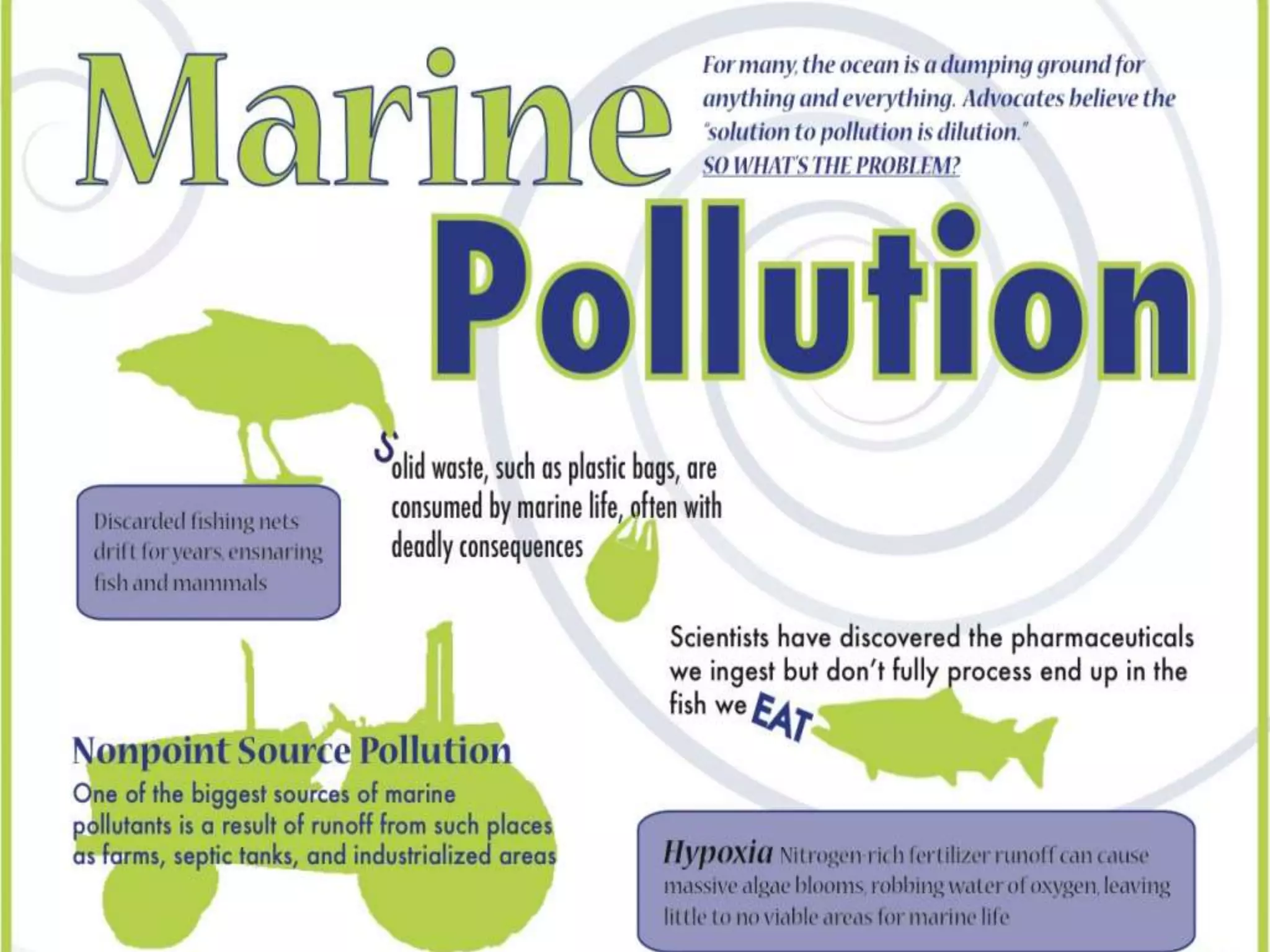
• This nutrient rich water can cause fleshy algae
,known as algal bloom , which have the potential to
create hypotoxic conditions by using all available
oxygen.
• Polluted runOff from roads and highWays can be
significant Source of water pollution in coastal.
• About 75% of the toxic chemicals that flow in to
puget sound are carried by storm water.
• that run off paved roads and drive ways ,roof
tops,yards and other developed land.
Ships pollution
• Ships can pollute water ways and oceans in many
ways ,
• OilPills can have devastating effects .while being
toxic to marine life poly cyclic aromatic
hydricarbons the components in crude oil are very
defficult to clean up and last for years in the
sediment and marine environment.
• Discharge of carge residues from bulk carriers can
pollute ports ,water ways and oceans .
• In many instances vessels intentially discharge
illegal wastes despite foreign and domestic
regulation prohibiting such actios .
• It has been estimated that container ships to lose
over 10000 containers at sea each year .
• ships also create noise pollution that disturbs
wildLife .
Atmospheric Pollution
• Wind blown dust and debris including plastic bags
.,are blown seaVwater from land fills and other
ares. Dust from the sahara moves into the
Carribean and Florida during the warm
season.climate change is raising ocean temparaturs
and raising levels of carbon dioxide in the
atmosphere.
Deep sea mining
• Ocean mining sites are usually around large areas
of poly metallic nodules or active and extinct
hydrothermal vents at about 1,400-3,700 meters
below the oceans surface
Noise pollution
• Marine life can be susceptable to noise or sound
pollution from sources such as passing ships & oil
exploration ,seismic surveys sound travels more
rapidly and over larger distances in the sea in
atmosphere.
Plastic debris
• 80% Of the marine debris is plastic. A component
that has been rapidly accumulaating ,since the end
of world war. The mass of plastic in the ocean may
be as high as 100million metric tons.
• Discarded plastic bags ,sixpack rings ,other forms of
plastic wastes which dumbed in to ocean.
• Aquatic life can be threatened through entanglement
,suffocation,and ingestion.
• Plastic dabris when bulky tangled is difficult to pass
and may become permanantly lodged in the digestive
tracts of these animals ,blocking the passage of food
and causing death through starvation / infection.
• Fishing nets made of plastic can be left or lost in the
ocean by fisherman eaten by living things in the
ocean.
IMPACTS OF MAEINE POLLUTION
• Effects impairement of marine life.
• Fixed vagetation -sea grass beds- Killed or flowering
inhibited.
• Plankton exposed to water soluble component
leaching from oil.
• Sea birds – buoyancy and thermal insalation list.
• Commercial damages
• Mortality of fish eggs and reduction.
• Loss of sensitive marine habitats loss of flura and
fauna.
SOLUTIONS FOR MARINE POLLUTION
• There are two main methods ;
• 1, CORRECTION
• 2 ,PREVENTION
• • Recycling plastics and disposing of waste
responsibly.
• • Organise a beach clean up.
• • Reduce our rubbis
CONVENTIONS
• There are no less than 6 international
cinventions,some are listed below;
•
• 1, Convention for the prevention of marine pollution by
dumbing from ships and airCraft (1972) The OSLO
CONVENTION.
• 2, Convention for the prevention of pollution from
ships (1973) ; MARPOL.
• 3, Convention for the prevention of marine pollution
from land based sourses (1974) ; PARIS CONVENTION.
OVERFISHING
OVERFISHING
• Over fishing is a form of over exploitation Where
fish stocks are reduced to below acceptable levels.
• Overfishing can occure in waterbodies of any sizes
,such as ponds,rivers,lakes,or oceans .
GLOBAL OVERFISHING
• Over fishing has greatly affects many fisheries
around the world.
• As much as 85% of the worlds fisheries may be over
exploited.,depleted,fully exploited or in recovery
from exploitation .
• Significant overfishing has been observed in
preindustrial times.
• In particular the overFishing of the western atlantic
ocean from the earliest days of european
colonisation of the Americas has been well
documented.
• Following world war to industrial fishing rapidly
expanded with rapid increases in worldWide
fishing catches.
SHOKING FACTS
• • 40tons of coral destroyed pacific ocean.
• • 30,000Propoises and dolphines are die
annually.
• • 100Millions sharks caught every year
• • Over80 % Of shark species disappear from
the oceans large fish have fishing out.
•
• Fish are renewable resources.If we catch a fish and
eat it.
• Other fish will be born to replace it .however in
many parts of the world too many fish have been
caught (OVEREXPLOITED),
• This means the numbr of fish available has
reduced(DEPLETED).
IMPACTS OF OVER FISHING
• • Reduced harvest of targested fish- Overfishing
typically laeds to a decline in the population of
productive fish .
• • Harvest of un targeted / protected/
endangered marine species.
• • Socio- Economic effects
• • It adverse effect on marine bioDiversity .
• • It completely desrupt the food chain also.
•TECHNOLOGICAL ADVANCES
• • DRIFT NETTING
• • BOTTOM TRAWLERS
•
Drift neting
• The pelagic fish , which live in the upper parts of
the water ,are caught by driftNetting where by a
net is suspended from floats and spead between
two boats to trap as many fish .
• since fish are in capable of swimming backWord.
• They get caught in the net.
Bottem trawlers
• Fish that live in deeper water are caught by trawlers
.
• where by a huge net is draged through the water
which trapes every creatures.
• The size of the net being cruicial. And important
that very small meah is bamed to share the young
fish before they have had a chance to procreation.
• TYPES OF OVERFISHING;
• GROWTH OVERFISHING
• RECRUITMENT OVERFISHING
• ECOSYSTEM OVERFISHING
CONCLUTION
• During ocean pollution ,overFishing, brings to
theSerious issues in our world.This issues may be
solved by consistant areas of the globe . Pollutions
and over fishing are effects the ecosystem also.We
also know that the problems and these will
overcomes by ourselves .also.solution for oil
pollution, to reduce heavy metal dumbing ,
liscence for fishing,that will over comes the issues
affected by nature.
THANK
YOU

WATER POLLUTION AND MARINE POLLUTION

  • 2.
    POLLUTION Pollution is theintroduction of contaminants in to the natural environment that cause adverse change . Pollution is the effect of undesirable changes in our sourroundings that have harmful effects on plant,animals,and human beings. Pollutant is a waste material that pollutes air ,water,and soil.
  • 3.
    Pollutants include solid,liquid,or gaseous substances that are produced due to human activity . POLLUTANTS CAN BE CLASSIFIED IN TO THREE 1,Degradable pollutants 2,slowly degradable pollutants. 3,Non degradable pollutants.
  • 4.
    • Degradable /non-persistantpollutants - This can be rapidly broken down by natural processes ; domestic sewage,discarded vegetables,etc • Slowly degradable or persistant pollutants ;These are pollutants that remain in the environment for many years in an unchanged condition and take decades or longer to degrade; .DDT
  • 5.
    • Non degradablepollutants ; These cannot be degraded by natural process .eg; toxic elements like lead or mercury ,and nuclear wastes.
  • 6.
    MARINE POLLUTION • Marinepollution can be defined as the introduction of substances to the marine environment directly or indirectly by man resulting in adverse effects such as hazards to human health ,obstruction of marine activities ,and lowering the quality of sea water . • The causes of marine pollution is similar to water pollution.It harmful or • Potencially harmful ,effects result from the entry in to the ocean of chemicals ,particles indusrial agricultural and residential waste,noise,or the spread of invasive organisms.
  • 9.
    CAUSES OF MARINEPOLLUTION • The most obvious inputs of waste is through pipes directly discharging waste in to the sea. • Pesticides and fertilizers from agriculture,which are washed off the land by rain ,then water reach in to the sea. • Petroleum and oils washed off from the roads normally enter the sewage system but water carry these materials in to rivers and eventually in to the sea
  • 10.
    • Ships carrymany toxic substances such as oil ,liquified natural gas,pesticides,indusrial chemicals that will enter in to sea water. • Off shore oil exploration and extraction also pollute the sea water to a large extent.
  • 11.
    WAYS OF POLLUTANTSINPUT There are five main types of input of pollution ; • Direct discharge of waste in to the sea. • Runoff in to the water due rain. • Atmospheric pollution . • Deep sea mining .
  • 13.
    Direct discharge • Pollutantsenter rivers and the sea directly from urban sewage and industrial waste discharges .Sometimes in the form hazardous and toxic wastes . • Inland mining for Copper ,Gold, is another source of marine pollution. • Most of the pollution is simply soil which ends up in rivers flowing to the sea .
  • 15.
    • How eversome mineral discharged in the course of the mining can cause problems ,such as copper a common industrial pollutant ,which can interfere with the life history and development of coral polyps. • Mining has a poor environmental track record ,eg ; according to the United States Environmental Protection agency .
  • 16.
    • Mining hasContaminated portions of the headwaters of over 40% of waterSheds in the western . • continental US much of this pollution finishes up in the sea.
  • 17.
    2,Surface run –off • Surface runoff from the construction of roads ,buildings ,ports ,channels, harbours can carry soil and particles laden with C, N ,P and minerals. • • This nutrient rich water can cause fleshy algae ,known as algal bloom , which have the potential to create hypotoxic conditions by using all available oxygen.
  • 18.
    • Polluted runOfffrom roads and highWays can be significant Source of water pollution in coastal. • About 75% of the toxic chemicals that flow in to puget sound are carried by storm water. • that run off paved roads and drive ways ,roof tops,yards and other developed land.
  • 19.
    Ships pollution • Shipscan pollute water ways and oceans in many ways , • OilPills can have devastating effects .while being toxic to marine life poly cyclic aromatic hydricarbons the components in crude oil are very defficult to clean up and last for years in the sediment and marine environment.
  • 20.
    • Discharge ofcarge residues from bulk carriers can pollute ports ,water ways and oceans . • In many instances vessels intentially discharge illegal wastes despite foreign and domestic regulation prohibiting such actios . • It has been estimated that container ships to lose over 10000 containers at sea each year . • ships also create noise pollution that disturbs wildLife .
  • 22.
    Atmospheric Pollution • Windblown dust and debris including plastic bags .,are blown seaVwater from land fills and other ares. Dust from the sahara moves into the Carribean and Florida during the warm season.climate change is raising ocean temparaturs and raising levels of carbon dioxide in the atmosphere.
  • 23.
    Deep sea mining •Ocean mining sites are usually around large areas of poly metallic nodules or active and extinct hydrothermal vents at about 1,400-3,700 meters below the oceans surface
  • 24.
    Noise pollution • Marinelife can be susceptable to noise or sound pollution from sources such as passing ships & oil exploration ,seismic surveys sound travels more rapidly and over larger distances in the sea in atmosphere.
  • 25.
    Plastic debris • 80%Of the marine debris is plastic. A component that has been rapidly accumulaating ,since the end of world war. The mass of plastic in the ocean may be as high as 100million metric tons. • Discarded plastic bags ,sixpack rings ,other forms of plastic wastes which dumbed in to ocean.
  • 27.
    • Aquatic lifecan be threatened through entanglement ,suffocation,and ingestion. • Plastic dabris when bulky tangled is difficult to pass and may become permanantly lodged in the digestive tracts of these animals ,blocking the passage of food and causing death through starvation / infection. • Fishing nets made of plastic can be left or lost in the ocean by fisherman eaten by living things in the ocean.
  • 28.
    IMPACTS OF MAEINEPOLLUTION • Effects impairement of marine life. • Fixed vagetation -sea grass beds- Killed or flowering inhibited. • Plankton exposed to water soluble component leaching from oil.
  • 29.
    • Sea birds– buoyancy and thermal insalation list. • Commercial damages • Mortality of fish eggs and reduction. • Loss of sensitive marine habitats loss of flura and fauna.
  • 30.
    SOLUTIONS FOR MARINEPOLLUTION • There are two main methods ; • 1, CORRECTION • 2 ,PREVENTION • • Recycling plastics and disposing of waste responsibly. • • Organise a beach clean up. • • Reduce our rubbis
  • 31.
    CONVENTIONS • There areno less than 6 international cinventions,some are listed below; • • 1, Convention for the prevention of marine pollution by dumbing from ships and airCraft (1972) The OSLO CONVENTION. • 2, Convention for the prevention of pollution from ships (1973) ; MARPOL. • 3, Convention for the prevention of marine pollution from land based sourses (1974) ; PARIS CONVENTION.
  • 32.
  • 33.
    OVERFISHING • Over fishingis a form of over exploitation Where fish stocks are reduced to below acceptable levels. • Overfishing can occure in waterbodies of any sizes ,such as ponds,rivers,lakes,or oceans .
  • 34.
    GLOBAL OVERFISHING • Overfishing has greatly affects many fisheries around the world. • As much as 85% of the worlds fisheries may be over exploited.,depleted,fully exploited or in recovery from exploitation . • Significant overfishing has been observed in preindustrial times.
  • 36.
    • In particularthe overFishing of the western atlantic ocean from the earliest days of european colonisation of the Americas has been well documented. • Following world war to industrial fishing rapidly expanded with rapid increases in worldWide fishing catches.
  • 37.
    SHOKING FACTS • •40tons of coral destroyed pacific ocean. • • 30,000Propoises and dolphines are die annually. • • 100Millions sharks caught every year • • Over80 % Of shark species disappear from the oceans large fish have fishing out. •
  • 38.
    • Fish arerenewable resources.If we catch a fish and eat it. • Other fish will be born to replace it .however in many parts of the world too many fish have been caught (OVEREXPLOITED), • This means the numbr of fish available has reduced(DEPLETED).
  • 39.
    IMPACTS OF OVERFISHING • • Reduced harvest of targested fish- Overfishing typically laeds to a decline in the population of productive fish . • • Harvest of un targeted / protected/ endangered marine species. • • Socio- Economic effects • • It adverse effect on marine bioDiversity . • • It completely desrupt the food chain also.
  • 40.
    •TECHNOLOGICAL ADVANCES • •DRIFT NETTING • • BOTTOM TRAWLERS •
  • 41.
    Drift neting • Thepelagic fish , which live in the upper parts of the water ,are caught by driftNetting where by a net is suspended from floats and spead between two boats to trap as many fish . • since fish are in capable of swimming backWord. • They get caught in the net.
  • 43.
    Bottem trawlers • Fishthat live in deeper water are caught by trawlers . • where by a huge net is draged through the water which trapes every creatures. • The size of the net being cruicial. And important that very small meah is bamed to share the young fish before they have had a chance to procreation.
  • 45.
    • TYPES OFOVERFISHING; • GROWTH OVERFISHING • RECRUITMENT OVERFISHING • ECOSYSTEM OVERFISHING
  • 46.
    CONCLUTION • During oceanpollution ,overFishing, brings to theSerious issues in our world.This issues may be solved by consistant areas of the globe . Pollutions and over fishing are effects the ecosystem also.We also know that the problems and these will overcomes by ourselves .also.solution for oil pollution, to reduce heavy metal dumbing , liscence for fishing,that will over comes the issues affected by nature.
  • 47.