Sustaining Terrestrial Biodiversity:  The Ecosystem Approach G. Tyler Miller’s Living in the Environment 14th Edition Chapter 11 Shohail Motahir Choudhury
Key Concepts Human land use Types and uses of US public lands Forests and forest management Implications of deforestation Management of parks Establishment and management of nature preserves Importance of ecological restoration
Human Activities and Biodiversity Biodiversity Increase Factors Middle stages of  succession Moderate environmental  disturbance Small changes in  environmental conditions Physically diverse habitat Evolution Decrease Factors Extreme environ- mental conditions Large environmental  disturbance Intense  environ- mental stress Severe shortages of  key resources Nonnative species  introduction Geographic isolation Biodiversity
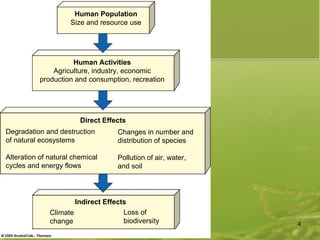
Human Population Size and resource use Human Activities Agriculture, industry, economic production and consumption, recreation Indirect Effects Direct Effects Degradation and destruction  of natural ecosystems Alteration of natural chemical cycles and energy flows Changes in number and  distribution of species Pollution of air, water,  and soil Climate  change Loss of  biodiversity
Projected Status of Biodiversity 1998–2018 Critical and endangered Threatened Stable or intact NORTH AMERICA Atlantic Ocean Natural Capital Degradation ANTARCTICA EUROPE AFRICA ASIA SOUTH AMERICA AUSTRALIA Pacific Ocean Antarctic Circle Pacific Ocean Tropic of Cancer Tropic of Capricorn Indian Ocean 150° 90° 60°E 0° 30°W 90° 120° 150° 0° 60° 30°N 30°S 60° Arctic Circle Arctic Circle
Why should we care about biodiversity?  Intrinsic value Instrumental value or  Existence value Aesthetic value Bequest value
The Species Approach The Ecosystem Approach Goal Protect species from premature extinction Strategies Identify endangered species Protect their critical habitats Tactics Legally protect endangered species Manage habitat Propagate endangered species in captivity Reintroduce species into suitable habitats Goal Protect populations of species in their natural habitats Strategy Preserve sufficient areas of habitats in different biomes and aquatic systems Tactics Protect habitat areas through private purchase or government action Eliminate or reduce populations of alien species from protected areas Manage protected areas to sustain native species Restore degraded ecosystems Solutions for Protecting Biodiversity
Management of Forests Old-growth (frontier) forests  22% Second-growth forests  63% Tree farms/plantation  5%
Managing and Sustaining Forests Ecological Importance of Forests Food webs and energy flow Protect soils from erosion Local and regional climate Numerous habitats and niches Air purification
Economic Importance of Forests Fuelwood Lumber Paper Livestock grazing Mineral extraction and recreation Managing and Sustaining Forests
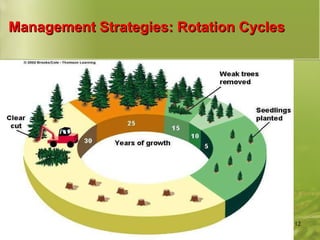
Forest Management Even-aged management Uneven-aged management Improved diversity Sustainable production Multiple-use Rotation cycle
Management Strategies: Rotation Cycles
Roads Lead to Forest Degradation Increased erosion and runoff Habitat fragmentation Pathways for exotic species Accessibility to humans
Harvesting Trees Selective cutting High-grading Shelterwood cutting Seed-tree cutting Clear-cutting  Strip cutting
Trade-Offs Clear-Cutting Forests Advantages Disadvantages Higher timber yields Maximum economic return in shortest time Can reforest with genetically  improved fast-growing trees Short time to establish new stand of trees Needs less skill and planning Best way to harvest tree plantations Good for tree species needing  full or moderate sunlight for growth Reduces biodiversity Disrupts ecosystem processes Destroys and fragments some  wildlife habitats Leaves moderate to large openings Increases soil erosion Increases sediment water pollution and flooding when done on steep slopes Eliminates most recreational value for several decades
Solutions Sustainable Forestry Grow more timber on long rotations Rely more on selective cutting and strip cutting No clear-cutting, seed-tree, or shelterwood cutting on steeply sloped land No fragmentation of remaining large blocks of forest Sharply reduce road building into uncut forest areas Leave most standing dead trees and fallen timber for  wildlife habitat and nutrient recycling Certify timber grown by sustainable methods Include ecological services of trees and forests in estimating economic value
Fire Surface fires Crown fires
Trade-Offs Advantages Disadvantages Logging in U.S. National Forests Helps meet  country’s timber  needs Cut areas grow  back Keeps lumber  and paper prices down Provides jobs in  nearby  communities Promotes  economic growth  in nearby  communities Provides only 4% of  timber needs Ample private  forest land to meet  timber needs Has little effect on  timber and paper  prices Damages nearby  rivers and fisheries Recreation in  national forests provides more local jobs and income for local  communities than logging Decreases recreational opportunities
Tropical Deforestation: Consequences Rapid and increasing  Loss of biodiversity  Loss of resources ( e.g ., medicines)  Contributes to global warming
Oil drilling Mining Flooding from dams Tree plantations Cattle ranching Cash crops Settler farming Fires Logging Roads Not valuing  ecological services Exports Government policies Poverty Population growth Secondary Causes Basic Causes Causes of tropical forest degradation
Figure 11-19 Page 213 Protect most diverse and endangered areas Educate settlers about sustainable agriculture and forestry Phase out subsidies that encourage unsustainable forest use Add subsidies that encourage sustainable forest use Protect forests with  debt-for-nature swaps,  conservation easements , and  conservation concessions Certify sustainably grown timber Reduce illegal cutting Reduce poverty Slow population growth Reforestation Rehabilitation of degraded areas Concentrate farming and ranching on already-cleared areas Restoration Prevention Solutions Sustaining Tropical Forests
Ecological Restoration Restoration  Rehabilitation  Replacement  Creating artificial ecosystems Remediation
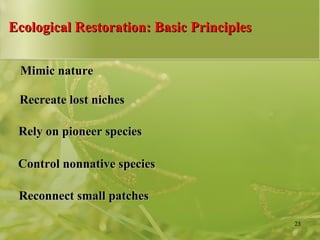
Ecological Restoration: Basic Principles Mimic nature  Recreate lost niches  Control nonnative species  Reconnect small patches Rely on pioneer species
Individuals Matter Wangari Maathai Green Belt Movement
What Can You Do? Sustaining Terrestrial Biodiversity Plant trees and take care of them. Recycle paper and buy recycled paper products. Buy wood and wood products made from trees that have been grown sustainably. Help rehabilitate or restore a degraded area of  forest or grassland near your home. When building a home, save all the trees and as much natural vegetation and soil as possible. Landscape your yard with a diversity of plants natural to the area instead of having a monoculture lawn.

Biodiversity Management

  • 1.
    Sustaining Terrestrial Biodiversity: The Ecosystem Approach G. Tyler Miller’s Living in the Environment 14th Edition Chapter 11 Shohail Motahir Choudhury
  • 2.
    Key Concepts Humanland use Types and uses of US public lands Forests and forest management Implications of deforestation Management of parks Establishment and management of nature preserves Importance of ecological restoration
  • 3.
    Human Activities andBiodiversity Biodiversity Increase Factors Middle stages of succession Moderate environmental disturbance Small changes in environmental conditions Physically diverse habitat Evolution Decrease Factors Extreme environ- mental conditions Large environmental disturbance Intense environ- mental stress Severe shortages of key resources Nonnative species introduction Geographic isolation Biodiversity
  • 4.
    Human Population Sizeand resource use Human Activities Agriculture, industry, economic production and consumption, recreation Indirect Effects Direct Effects Degradation and destruction of natural ecosystems Alteration of natural chemical cycles and energy flows Changes in number and distribution of species Pollution of air, water, and soil Climate change Loss of biodiversity
  • 5.
    Projected Status ofBiodiversity 1998–2018 Critical and endangered Threatened Stable or intact NORTH AMERICA Atlantic Ocean Natural Capital Degradation ANTARCTICA EUROPE AFRICA ASIA SOUTH AMERICA AUSTRALIA Pacific Ocean Antarctic Circle Pacific Ocean Tropic of Cancer Tropic of Capricorn Indian Ocean 150° 90° 60°E 0° 30°W 90° 120° 150° 0° 60° 30°N 30°S 60° Arctic Circle Arctic Circle
  • 6.
    Why should wecare about biodiversity? Intrinsic value Instrumental value or Existence value Aesthetic value Bequest value
  • 7.
    The Species ApproachThe Ecosystem Approach Goal Protect species from premature extinction Strategies Identify endangered species Protect their critical habitats Tactics Legally protect endangered species Manage habitat Propagate endangered species in captivity Reintroduce species into suitable habitats Goal Protect populations of species in their natural habitats Strategy Preserve sufficient areas of habitats in different biomes and aquatic systems Tactics Protect habitat areas through private purchase or government action Eliminate or reduce populations of alien species from protected areas Manage protected areas to sustain native species Restore degraded ecosystems Solutions for Protecting Biodiversity
  • 8.
    Management of ForestsOld-growth (frontier) forests 22% Second-growth forests 63% Tree farms/plantation 5%
  • 9.
    Managing and SustainingForests Ecological Importance of Forests Food webs and energy flow Protect soils from erosion Local and regional climate Numerous habitats and niches Air purification
  • 10.
    Economic Importance ofForests Fuelwood Lumber Paper Livestock grazing Mineral extraction and recreation Managing and Sustaining Forests
  • 11.
    Forest Management Even-agedmanagement Uneven-aged management Improved diversity Sustainable production Multiple-use Rotation cycle
  • 12.
  • 13.
    Roads Lead toForest Degradation Increased erosion and runoff Habitat fragmentation Pathways for exotic species Accessibility to humans
  • 14.
    Harvesting Trees Selectivecutting High-grading Shelterwood cutting Seed-tree cutting Clear-cutting Strip cutting
  • 15.
    Trade-Offs Clear-Cutting ForestsAdvantages Disadvantages Higher timber yields Maximum economic return in shortest time Can reforest with genetically improved fast-growing trees Short time to establish new stand of trees Needs less skill and planning Best way to harvest tree plantations Good for tree species needing full or moderate sunlight for growth Reduces biodiversity Disrupts ecosystem processes Destroys and fragments some wildlife habitats Leaves moderate to large openings Increases soil erosion Increases sediment water pollution and flooding when done on steep slopes Eliminates most recreational value for several decades
  • 16.
    Solutions Sustainable ForestryGrow more timber on long rotations Rely more on selective cutting and strip cutting No clear-cutting, seed-tree, or shelterwood cutting on steeply sloped land No fragmentation of remaining large blocks of forest Sharply reduce road building into uncut forest areas Leave most standing dead trees and fallen timber for wildlife habitat and nutrient recycling Certify timber grown by sustainable methods Include ecological services of trees and forests in estimating economic value
  • 17.
    Fire Surface firesCrown fires
  • 18.
    Trade-Offs Advantages DisadvantagesLogging in U.S. National Forests Helps meet country’s timber needs Cut areas grow back Keeps lumber and paper prices down Provides jobs in nearby communities Promotes economic growth in nearby communities Provides only 4% of timber needs Ample private forest land to meet timber needs Has little effect on timber and paper prices Damages nearby rivers and fisheries Recreation in national forests provides more local jobs and income for local communities than logging Decreases recreational opportunities
  • 19.
    Tropical Deforestation: ConsequencesRapid and increasing Loss of biodiversity Loss of resources ( e.g ., medicines) Contributes to global warming
  • 20.
    Oil drilling MiningFlooding from dams Tree plantations Cattle ranching Cash crops Settler farming Fires Logging Roads Not valuing ecological services Exports Government policies Poverty Population growth Secondary Causes Basic Causes Causes of tropical forest degradation
  • 21.
    Figure 11-19 Page213 Protect most diverse and endangered areas Educate settlers about sustainable agriculture and forestry Phase out subsidies that encourage unsustainable forest use Add subsidies that encourage sustainable forest use Protect forests with debt-for-nature swaps, conservation easements , and conservation concessions Certify sustainably grown timber Reduce illegal cutting Reduce poverty Slow population growth Reforestation Rehabilitation of degraded areas Concentrate farming and ranching on already-cleared areas Restoration Prevention Solutions Sustaining Tropical Forests
  • 22.
    Ecological Restoration Restoration Rehabilitation Replacement Creating artificial ecosystems Remediation
  • 23.
    Ecological Restoration: BasicPrinciples Mimic nature Recreate lost niches Control nonnative species Reconnect small patches Rely on pioneer species
  • 24.
    Individuals Matter WangariMaathai Green Belt Movement
  • 25.
    What Can YouDo? Sustaining Terrestrial Biodiversity Plant trees and take care of them. Recycle paper and buy recycled paper products. Buy wood and wood products made from trees that have been grown sustainably. Help rehabilitate or restore a degraded area of forest or grassland near your home. When building a home, save all the trees and as much natural vegetation and soil as possible. Landscape your yard with a diversity of plants natural to the area instead of having a monoculture lawn.