PRESENTATION 
BY: 
Ms.PRIYANKA WANDHE
BIODIVERSITY 
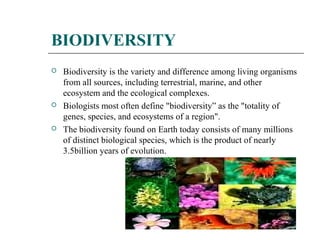
 Biodiversity is the variety and difference among living organisms 
from all sources, including terrestrial, marine, and other 
ecosystem and the ecological complexes. 
 Biologists most often define "biodiversity” as the "totality of 
genes, species, and ecosystems of a region". 
 The biodiversity found on Earth today consists of many millions 
of distinct biological species, which is the product of nearly 
3.5billion years of evolution.
LEVELS OF BIODIVERSITY 
GENETIC SPECIES ECOSYSTEM 
 It refers to the total 
number of genetic 
characteristics in the 
genetic make up of a 
species. 
 Diversity of genes 
within a species 
increases its ability to 
adapt to diseases, 
pollution and other 
environment changes. 
 Destruction in 
varieties of species, 
diminishes the genetic 
diversity. 
 It refers to the variety 
of species within a 
region. 
 Species diversity is an 
index that incorporates 
the number of species in 
an area and also the 
irrelative abundance. 
 More species diversity 
means more biological 
wealth. 
 It refers to the variety 
of ecosystems in a 
particular zone. eg-forests, 
desserts etc. 
 It has 3 perspectives: 
Alpha Diversity :Within 
community. Refers to the 
diversity of organisms 
sharing the same Habitat. 
Beta Diversity: Between 
community, organisms 
sharing two habitat. 
Gamma Diversity: 
Diversity of the habit at 
over the total 
geographical area
BIO-GEOGRAPHIC 
CLASSIFICATION OF INDIA 
 Biogeography deals with the distribution of Communities of plants 
and animals in different geographical areas of the world. Biogeography 
is divided into branches: 
 Phyto -geography deals with origin, distribution and environmental 
interrelationships of plants. 
 Zoo-geography deals with the migration and distribution of animals. 
 From the stand point of biodiversity, India is given the status of a 
“Mega-diversity” zone. CISSP There are 10 biogeographic zones witch 
are distinguished clearly in India. They are as follows— 
Trans Himalayan zone. 
Himalayan zone. 
Desert zone. 
Semiarid zone. 
Western ghat zone. 
Deccan plateau zone. 
Gangetic plain zone. 
North east zone. 
Coastal zone. 
Islands present near the shore line.
VALUE OF DIVERSITY
VALUE OF DIVERSITY 
Direct values Indirect values 
 The direct value include 
food resources like grains, 
vegetables, fruits which are 
obtained from plant resources 
and meat, fish, egg, milk and 
milk products from animal 
resources. These also include 
other values like medicine, 
fuel, timber, fiber, wool, wax, 
resin, rubber, silk and 
decorative items. 
 Biodiversity provides 
indirect benefits to human 
beings which support the 
existence of biological life 
and other benefits which are 
difficult to quantify. These 
include social and cultural 
values, ethical values, 
aesthetic values, option values 
and environment service 
values.
Direct values 
 Consumptive use value: These are the direct use values where 
the biodiversity products can be harvested and consumed directly. 
Example: Food, fuel and drugs. These goods are consumed locally 
and do no figure in national and international market. 
 Productive use values: These are the direct use values where the 
product is commercially sold in national and international market. 
Many industries are dependent upon these values. Example- 
Textile, leather, silk, paper and pulp industry etc. Although there 
is an international ban on trade of products from endangered 
species like tusks of elephants, wool from sheep, fur of many 
animals etc. These are traded in market and fetch a booming 
business.
Indirect values 
 Social and cultural value: Many plants and animals are considered 
holy and sacred in India and are worshipped like Tulsi, peepal, 
cow, snake etc. In Indian society great cultural value is given to 
forest and as such tiger, peacock and lotus are named as the 
national animal, bird and flower respectively. 
 Ethical: These values are related to conservation of biodiversity 
where ethical issue of ‘all life forms must be preserved’ is laid 
down. All species have a moral right to exist independent. 
 Aesthetic value: Natural landscapes at are a delight to watch and 
also provide opportunities for recreational activities like bird 
watching, photography etc. It promotes eco-tourism which further 
generates revenue by designing of zoological, botanical gardens, 
national parks, wild life conservation etc. 
 Environment service values: The most important benefit of 
biodiversity is maintenance of environment services which 
includes, photosynthesis, maintaining the essential nutrients like C, 
O, N, P etc, soil formation, decomposition of wastes.
INDIA-MEGADIVERSITY 
NATION 
 About 2.1 million species have been identified till date, while 
many more species are believed to exist. 
 The worlds major biodiversity is in south countries in its tropical 
forests having 50-150 trees/hectare. It consists at least half of the 
worlds living species. 
 According to UNEP (united nations environment programme) 
estimate, approximately 9.0–52 million of species exist on earth. 
 India’s position is 10th in the world & 4th in Asia in terms of Plant 
diversity.
THREATS-BIODIVERSITY LOSS 
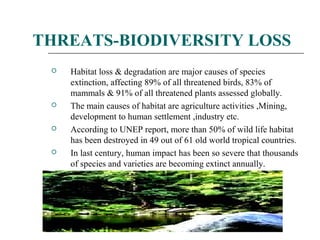
 Habitat loss & degradation are major causes of species 
extinction, affecting 89% of all threatened birds, 83% of 
mammals & 91% of all threatened plants assessed globally. 
 The main causes of habitat are agriculture activities ,Mining, 
development to human settlement ,industry etc. 
 According to UNEP report, more than 50% of wild life habitat 
has been destroyed in 49 out of 61 old world tropical countries. 
 In last century, human impact has been so severe that thousands 
of species and varieties are becoming extinct annually.
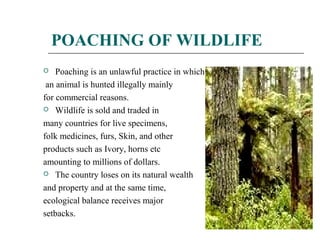
POACHING OF WILDLIFE 
 Poaching is an unlawful practice in which 
an animal is hunted illegally mainly 
for commercial reasons. 
 Wildlife is sold and traded in 
many countries for live specimens, 
folk medicines, furs, Skin, and other 
products such as Ivory, horns etc 
amounting to millions of dollars. 
 The country loses on its natural wealth 
and property and at the same time, 
ecological balance receives major 
setbacks.
HOTSPOTS OF BIODIVERSITY 
 A biodiversity hotspot is a bio geographic region with a 
significant reservoir of biodiversity that is threatened with 
destruction. 
 An area is designated as a hotspot when it contains at least 0.5% 
of plant species as endemic. 
 There are 25 such hot spots of biodiversity on a global level due 
to resource exploitation and habitat loss, out of which two are 
present in India. 
1. Indo-Burma (earlier The Eastern Himalayas) 
2. The western Ghats & SriLanka.. 
 It also include all of Cambodia,Vietnam &Laos, and nearly the 
entire areas of Thailand, Myanmar & Bhutanas part of Nepal, far 
eastern India and extreme southern China. It covers several off 
shore Islands including Island in the south China Sea and 
Andaman & Nicobar Islands in Indian Ocean..
MAN-WILDLIFE CONFLICTS 
 The conflict between man and wildlife started with the evolution of 
man, but intensity increased due to the activities of modern man. 
 Due to the lack of stable food and disruption of movement, wild 
animals came out of forest area and attack the agricultural field and 
humans and in turn got killed by the humans. 
 The instances of man-animal interface have grown in recent years in 
Orissa, in respect of wild elephants and bear. There are cases of 
human kill, human injury, cattle kill, house damage & crop damage 
by wild animals; and also retaliatory killing of wild animals. 
 During the period of ten years from 1994-95 to 2003-04, a total of 
3425 instances of depredation have been recorded (excluding the 
cases of crop damage), on the basis of compassionate payment made 
to the victims, out of which 2888 cases were due to elephants (84%), 
358 cases due to bears (10.45%), 69 cases due to tigers (2.01%), 67 
cases due to crocodiles (1.95%) & 43 cases due to leopard (1.25%).
ENDANGERED SPECIES 
 Out of about 47,000 species of plants in our country, 7000 are 
endemic 
 India contains 172 species of animals considered globally 
threatened by IUCN ,or 2.9% of the world’s total number of 
threatened species. 
 These include 53 species of mammals, 69birds, 23 reptiles and 3 
amphibians, 3000-4,000higher plants may be under high degree 
of threat in India 
 Thus Indian subcontinent has about 62% endemic flora, restricted 
mainly to Himalayas ,khasi Hills & Western Ghats. 
 Golden monkey, Niligiri Langur, Indian Wolf, Red Fox, 
Himalayan Brown Bear, Great Indian One Horned Rhinoceros, 
White Winged Wood Duck, Black Necked Crane, Indian Pea 
Fowl, Gharial, Indian egg eating Snake, Indian Salamander etc. 
are some examples of endemic animal species of India.
BIODIVERSITY CONSERVATION 
 Conservation is defined as “ the management of human use of 
the biosphere so that it may yield the greatest sustainable benefit 
to the present generation while maintaining its potential to meet 
the needs and aspirations of the future generations”. 
 The two basic approaches to wildlife conservation in protected 
habitats are: 
1) In-situ conservation 
2) Ex-situ conservation.
IN SITU EX SITU 
 Conservation of species in its 
natural ecosystem or even in man 
made ecosystems called as “protected 
areas”. 
 There are different categories of 
protected areas managed with 
different objectives. These include; 
Biosphere reserves, National parks, 
Wild Life Sanctuaries etc. 
 Presently we have 11 major 
biosphere reserves, 80 National parks, 
420 wildlife sanctuaries in our country 
covering 4% of the geographic area. 
 Egs:- Nilgiri-5,520 sq.kms, Ghana 
Bird sanctuaries, Gir National Park- 
Gujarat 
 Conservation of component of 
biological diversity (Sample of 
genetic diversity, particularly of 
endangered species) outside their 
natural habitats. 
 It maintains breeding of 
endangered plant and animal species 
under controlled conditions. E.g. 
Zoos, Botanical Gardens, Aquaria, 
Nurseries, DNA bank, Seed bank, 
Gene bank etc. 
 There are more than 1500 Botanical 
gardens in the world having more 
than 80,000 species, more than 800 
zoos having 3,000 species of 
mammals, birds, reptiles & 
amphibians, many gene banks; 
National Bureau of Plant genetic 
Resources (NBPGR), New Delhi.
THANK-YOU!!!!

Biodiversity

  • 1.
  • 2.
    BIODIVERSITY  Biodiversityis the variety and difference among living organisms from all sources, including terrestrial, marine, and other ecosystem and the ecological complexes.  Biologists most often define "biodiversity” as the "totality of genes, species, and ecosystems of a region".  The biodiversity found on Earth today consists of many millions of distinct biological species, which is the product of nearly 3.5billion years of evolution.
  • 3.
    LEVELS OF BIODIVERSITY GENETIC SPECIES ECOSYSTEM  It refers to the total number of genetic characteristics in the genetic make up of a species.  Diversity of genes within a species increases its ability to adapt to diseases, pollution and other environment changes.  Destruction in varieties of species, diminishes the genetic diversity.  It refers to the variety of species within a region.  Species diversity is an index that incorporates the number of species in an area and also the irrelative abundance.  More species diversity means more biological wealth.  It refers to the variety of ecosystems in a particular zone. eg-forests, desserts etc.  It has 3 perspectives: Alpha Diversity :Within community. Refers to the diversity of organisms sharing the same Habitat. Beta Diversity: Between community, organisms sharing two habitat. Gamma Diversity: Diversity of the habit at over the total geographical area
  • 4.
    BIO-GEOGRAPHIC CLASSIFICATION OFINDIA  Biogeography deals with the distribution of Communities of plants and animals in different geographical areas of the world. Biogeography is divided into branches:  Phyto -geography deals with origin, distribution and environmental interrelationships of plants.  Zoo-geography deals with the migration and distribution of animals.  From the stand point of biodiversity, India is given the status of a “Mega-diversity” zone. CISSP There are 10 biogeographic zones witch are distinguished clearly in India. They are as follows— Trans Himalayan zone. Himalayan zone. Desert zone. Semiarid zone. Western ghat zone. Deccan plateau zone. Gangetic plain zone. North east zone. Coastal zone. Islands present near the shore line.
  • 5.
  • 6.
    VALUE OF DIVERSITY Direct values Indirect values  The direct value include food resources like grains, vegetables, fruits which are obtained from plant resources and meat, fish, egg, milk and milk products from animal resources. These also include other values like medicine, fuel, timber, fiber, wool, wax, resin, rubber, silk and decorative items.  Biodiversity provides indirect benefits to human beings which support the existence of biological life and other benefits which are difficult to quantify. These include social and cultural values, ethical values, aesthetic values, option values and environment service values.
  • 7.
    Direct values Consumptive use value: These are the direct use values where the biodiversity products can be harvested and consumed directly. Example: Food, fuel and drugs. These goods are consumed locally and do no figure in national and international market.  Productive use values: These are the direct use values where the product is commercially sold in national and international market. Many industries are dependent upon these values. Example- Textile, leather, silk, paper and pulp industry etc. Although there is an international ban on trade of products from endangered species like tusks of elephants, wool from sheep, fur of many animals etc. These are traded in market and fetch a booming business.
  • 8.
    Indirect values Social and cultural value: Many plants and animals are considered holy and sacred in India and are worshipped like Tulsi, peepal, cow, snake etc. In Indian society great cultural value is given to forest and as such tiger, peacock and lotus are named as the national animal, bird and flower respectively.  Ethical: These values are related to conservation of biodiversity where ethical issue of ‘all life forms must be preserved’ is laid down. All species have a moral right to exist independent.  Aesthetic value: Natural landscapes at are a delight to watch and also provide opportunities for recreational activities like bird watching, photography etc. It promotes eco-tourism which further generates revenue by designing of zoological, botanical gardens, national parks, wild life conservation etc.  Environment service values: The most important benefit of biodiversity is maintenance of environment services which includes, photosynthesis, maintaining the essential nutrients like C, O, N, P etc, soil formation, decomposition of wastes.
  • 9.
    INDIA-MEGADIVERSITY NATION About 2.1 million species have been identified till date, while many more species are believed to exist.  The worlds major biodiversity is in south countries in its tropical forests having 50-150 trees/hectare. It consists at least half of the worlds living species.  According to UNEP (united nations environment programme) estimate, approximately 9.0–52 million of species exist on earth.  India’s position is 10th in the world & 4th in Asia in terms of Plant diversity.
  • 10.
    THREATS-BIODIVERSITY LOSS Habitat loss & degradation are major causes of species extinction, affecting 89% of all threatened birds, 83% of mammals & 91% of all threatened plants assessed globally.  The main causes of habitat are agriculture activities ,Mining, development to human settlement ,industry etc.  According to UNEP report, more than 50% of wild life habitat has been destroyed in 49 out of 61 old world tropical countries.  In last century, human impact has been so severe that thousands of species and varieties are becoming extinct annually.
  • 11.
    POACHING OF WILDLIFE  Poaching is an unlawful practice in which an animal is hunted illegally mainly for commercial reasons.  Wildlife is sold and traded in many countries for live specimens, folk medicines, furs, Skin, and other products such as Ivory, horns etc amounting to millions of dollars.  The country loses on its natural wealth and property and at the same time, ecological balance receives major setbacks.
  • 12.
    HOTSPOTS OF BIODIVERSITY  A biodiversity hotspot is a bio geographic region with a significant reservoir of biodiversity that is threatened with destruction.  An area is designated as a hotspot when it contains at least 0.5% of plant species as endemic.  There are 25 such hot spots of biodiversity on a global level due to resource exploitation and habitat loss, out of which two are present in India. 1. Indo-Burma (earlier The Eastern Himalayas) 2. The western Ghats & SriLanka..  It also include all of Cambodia,Vietnam &Laos, and nearly the entire areas of Thailand, Myanmar & Bhutanas part of Nepal, far eastern India and extreme southern China. It covers several off shore Islands including Island in the south China Sea and Andaman & Nicobar Islands in Indian Ocean..
  • 13.
    MAN-WILDLIFE CONFLICTS The conflict between man and wildlife started with the evolution of man, but intensity increased due to the activities of modern man.  Due to the lack of stable food and disruption of movement, wild animals came out of forest area and attack the agricultural field and humans and in turn got killed by the humans.  The instances of man-animal interface have grown in recent years in Orissa, in respect of wild elephants and bear. There are cases of human kill, human injury, cattle kill, house damage & crop damage by wild animals; and also retaliatory killing of wild animals.  During the period of ten years from 1994-95 to 2003-04, a total of 3425 instances of depredation have been recorded (excluding the cases of crop damage), on the basis of compassionate payment made to the victims, out of which 2888 cases were due to elephants (84%), 358 cases due to bears (10.45%), 69 cases due to tigers (2.01%), 67 cases due to crocodiles (1.95%) & 43 cases due to leopard (1.25%).
  • 14.
    ENDANGERED SPECIES Out of about 47,000 species of plants in our country, 7000 are endemic  India contains 172 species of animals considered globally threatened by IUCN ,or 2.9% of the world’s total number of threatened species.  These include 53 species of mammals, 69birds, 23 reptiles and 3 amphibians, 3000-4,000higher plants may be under high degree of threat in India  Thus Indian subcontinent has about 62% endemic flora, restricted mainly to Himalayas ,khasi Hills & Western Ghats.  Golden monkey, Niligiri Langur, Indian Wolf, Red Fox, Himalayan Brown Bear, Great Indian One Horned Rhinoceros, White Winged Wood Duck, Black Necked Crane, Indian Pea Fowl, Gharial, Indian egg eating Snake, Indian Salamander etc. are some examples of endemic animal species of India.
  • 15.
    BIODIVERSITY CONSERVATION Conservation is defined as “ the management of human use of the biosphere so that it may yield the greatest sustainable benefit to the present generation while maintaining its potential to meet the needs and aspirations of the future generations”.  The two basic approaches to wildlife conservation in protected habitats are: 1) In-situ conservation 2) Ex-situ conservation.
  • 16.
    IN SITU EXSITU  Conservation of species in its natural ecosystem or even in man made ecosystems called as “protected areas”.  There are different categories of protected areas managed with different objectives. These include; Biosphere reserves, National parks, Wild Life Sanctuaries etc.  Presently we have 11 major biosphere reserves, 80 National parks, 420 wildlife sanctuaries in our country covering 4% of the geographic area.  Egs:- Nilgiri-5,520 sq.kms, Ghana Bird sanctuaries, Gir National Park- Gujarat  Conservation of component of biological diversity (Sample of genetic diversity, particularly of endangered species) outside their natural habitats.  It maintains breeding of endangered plant and animal species under controlled conditions. E.g. Zoos, Botanical Gardens, Aquaria, Nurseries, DNA bank, Seed bank, Gene bank etc.  There are more than 1500 Botanical gardens in the world having more than 80,000 species, more than 800 zoos having 3,000 species of mammals, birds, reptiles & amphibians, many gene banks; National Bureau of Plant genetic Resources (NBPGR), New Delhi.
  • 17.