‫الرحيم‬ ‫الرحمن‬ ‫هللا‬ ‫بسم‬
Nel nome di Dio, il
Compassionevole, il
Misericordioso
Glasses prescription
· Mohamed Elkadim MD
· Tanta University
· mzekadem@gmail.com
Why its important ?
· Its easy job with long term patient comfort.
· Glasses became expensive $$$
· Decision for refractive surgery/
keratoconus depend on the glasses
prescription.
Commonly not done well , good
glasses became achievement
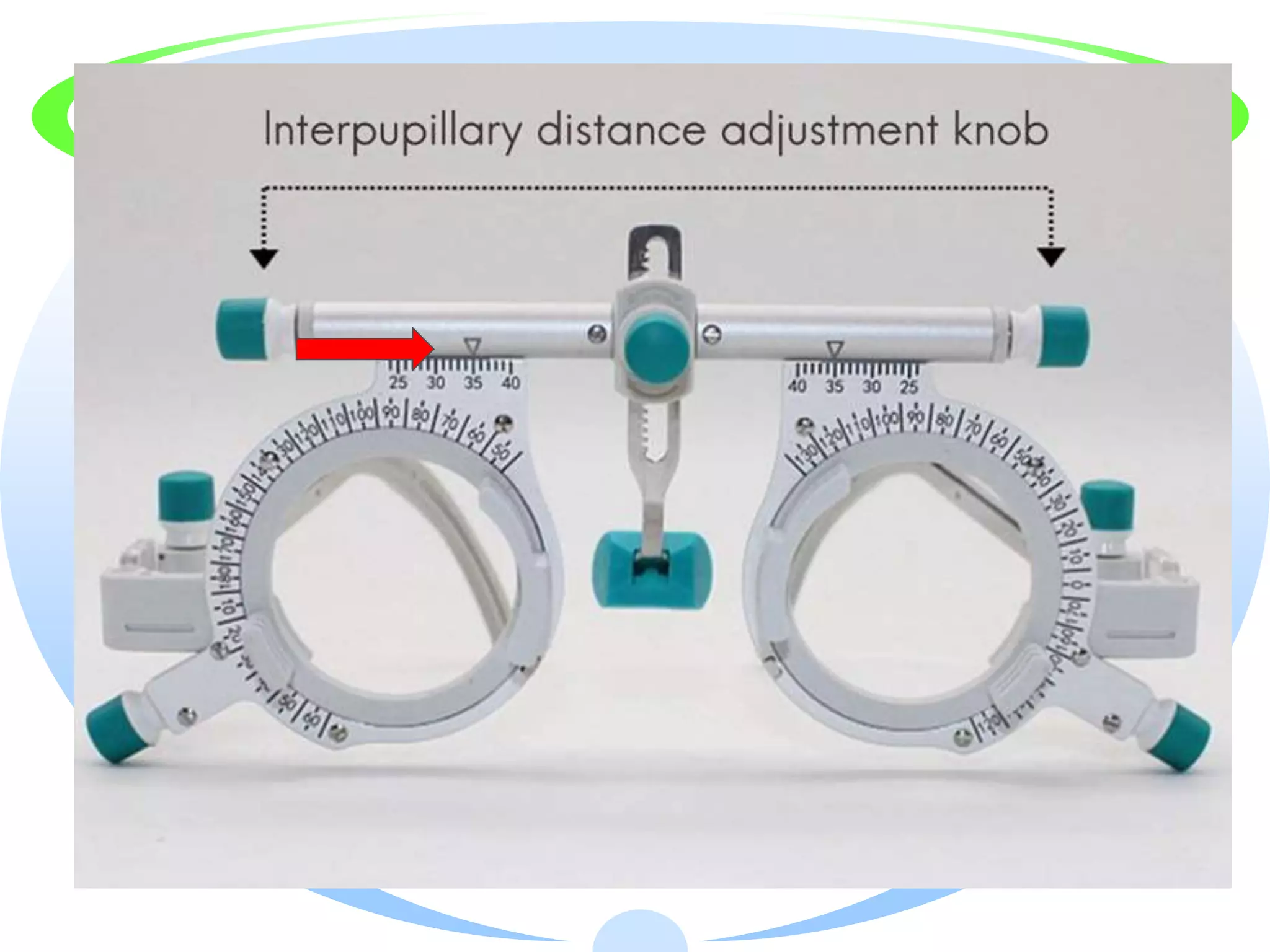
IPD
· Should be measured before trial
· * Autoref
· * Ruler
· * Frame √√
Facial asymmetry/ squint
Centralize the cross on the pupil
center of both eyes
Wrong IPD = Decentration + tilt
· Decantation = Prism
· Tilt = Cylinder
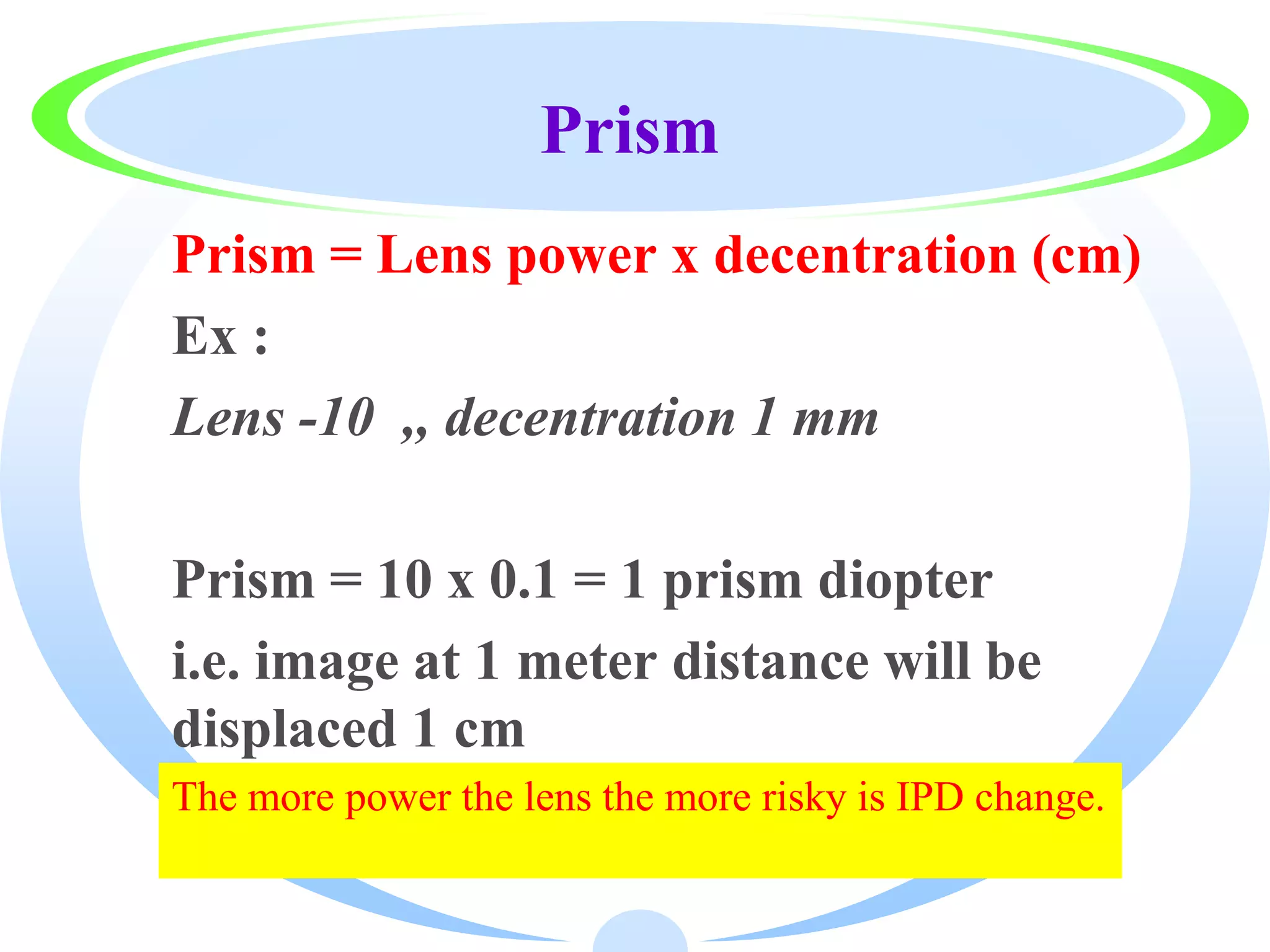
Prism
Prism = Lens power x decentration (cm)
Ex :
Lens -10 ,, decentration 1 mm
Prism = 10 x 0.1 = 1 prism diopter
i.e. image at 1 meter distance will be
displaced 1 cm
The more power the lens the more risky is IPD change.
prism
Tilt
· Induce astigmatism at axis of tilt (180)
· This astigmatism + original
astigmatism of the lens = new
astigmatism with new axis
· Patient will prefer axis 180
Tilt induced astigmatism
Astigmatism at 180 least affected by
IPD / axis 90 max effect
When we change the IPD ?
· To add low power prism e.g. CI
· * Old age (reading glasses)
· * young age (latent XT)
· + lens = - IPD
· - Lens = + IPD Provided that >> patient
is not high error or astigmatism
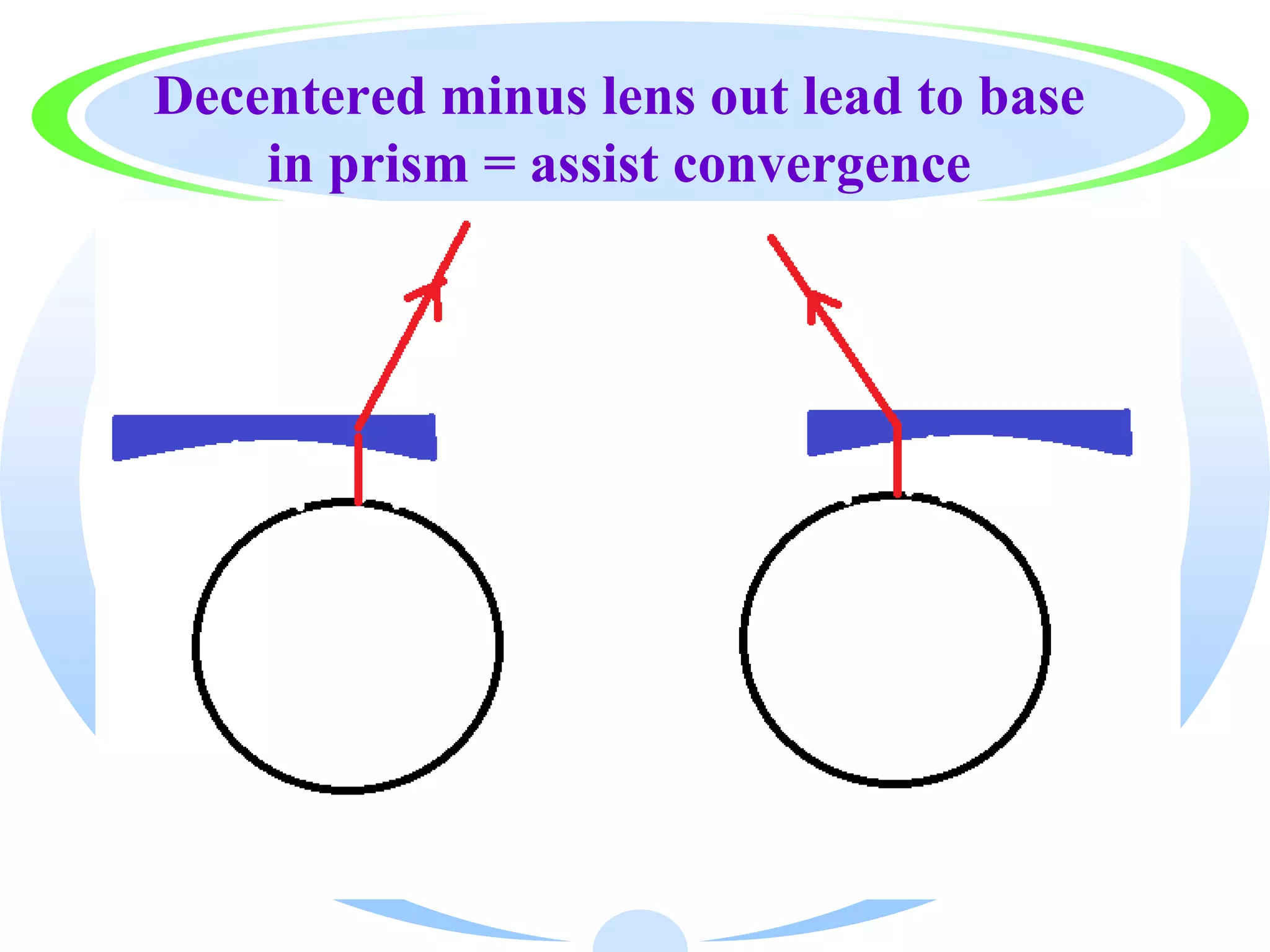
Decentered minus lens out lead to base
in prism = assist convergence
IPD in reading glasses
· IPD in reading is 2-3 mm less than far.
· In myope no need to change IPD
· Test reading in single glasses for young
Testing the reading for far glasses
is important / stress test
· Check accomodation is OK
· Convergence is OK
· IPD is OK
· Astigmatism axis is OK
· Near vision is more commonly used
these days than far
· What is better for 20 years old myope
refraction -2 OU during reading ?
· # Glasses
· # contact lens
· # Nothing
Answer : Glasses
· As base in prism will assist
convergence.
· Accommodation power required for
myope wearing glasses is less than
contact lens : confirm by ray tracing
In summary
· IPD should be accurate in high myope, high
hyperope and any astigmatism.
· Test reading function even young age
· Advice your patient (high myopia, high
hyperopia and any astigmatism) to get small
frame to minimize decentration error
NEAR ADD
Indications
· Loss of accommodation power
· To stop accommodation power
Common mistakes
1. Prescribing near glasses for a case
of only hyperopia (not presbyopia)
2. Prescribing glasses not suitable for
patient near work
3. Hyperopic Jump
Hyperopia no presbyopia
40 years male came to clinic asking for
reading glasses ,, his Autoref and trial
were +1.5 OU ,, he never used glasses ,
and had no complaint about far vision ??
Patient Job and expectation
· Test the near glasses also for far.
‫الحجة‬ ‫عليه‬ ‫اقم‬
· Ask patient about specific job.
Why phoroptor is bad ?
Hyperopic Jump (also mistake for far
glasses)
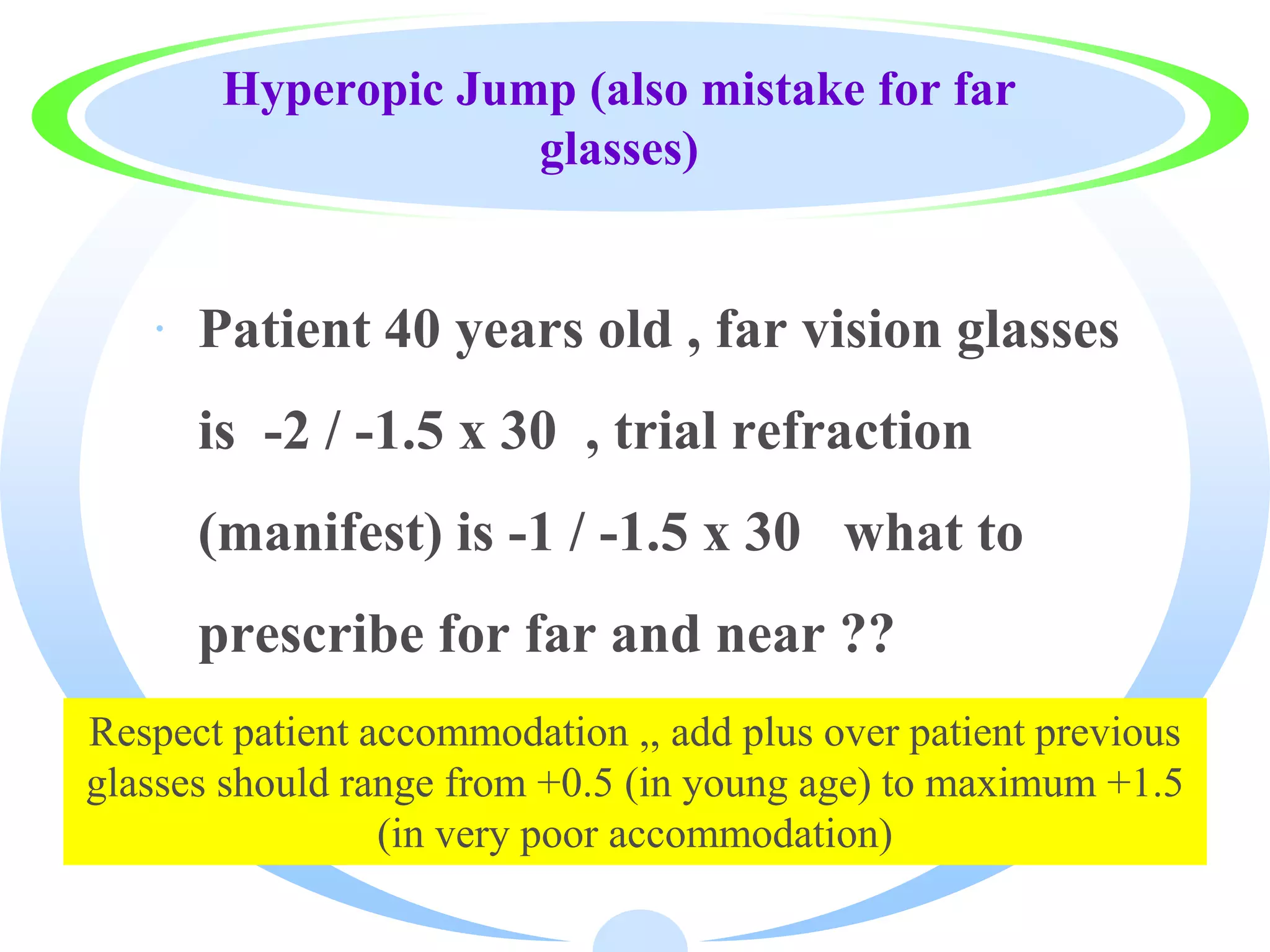
· Patient 40 years old , far vision glasses
is -2 / -1.5 x 30 , trial refraction
(manifest) is -1 / -1.5 x 30 what to
prescribe for far and near ??
Respect patient accommodation ,, add plus over patient previous
glasses should range from +0.5 (in young age) to maximum +1.5
(in very poor accommodation)
Steps for finding near ADD
· Far trial
· Find accommodation amplitude (for
each eye separately)
· Prescribe and adjust (leaving 1/3
accommodation amplitude relaxed)
Accomodation amplitude
· Pull or Push method
· Each eye separately
· Rarely both eyes have different ADD
· If patient can read well at 20 cm
· He has accommodation amplitude +5
· He mostly don’t need near ADD
· As he can read at 30 cm with 2 D relaxed
Can Add exceed +3 ?
· In low vision
· Can also differ in both eyes (e.g.
unilateral pathology or pseudophakia )
· Bifocal / Multifocal :
Don’t advise
Perfect patient : no astigmatism no
anisometrope no cataract , no squint, not
high add …
Perfect place.
· Office Glasses : Multifocal for
intermediate and near
Intermediate vision
· Important in patient with no
accommodation
· Add +0.5 to far glasses ( or +0.75 to
non dominant eye )
Sphere
Accommodation spasm
· Children
· Wrong previous glasses
· Excess near work ( usually -2.5)
· Drugs
· Astigmatism
Sources of error in sphere other
than accommodation
1. Room distance : add - 0.25 for room
distance in hyperope.
2. BVD : if error > 5 , if frame is large
under correction usually present/
phoroptor can lead to overcorrection.
3. Night myopia : if significant : give
driving glasses with add -1
َ‫ي‬َ‫ل‬ ‫وا‬ُ‫ن‬َ‫م‬‫آ‬ َ‫ين‬ِ‫ذ‬َّ‫ال‬ ‫ا‬َ‫ه‬ُّ‫ي‬َ‫أ‬ ‫ا‬َ‫ي‬
ُ َّ
‫ّللا‬ ُ‫م‬ُ‫ك‬َّ‫ن‬ َ‫و‬ُ‫ل‬ْ‫ب‬
ٍ‫ء‬ْ‫ي‬َ‫ش‬ِ‫ب‬
ِ‫د‬ْ‫ي‬َ‫أ‬ ُ‫ه‬ُ‫ل‬‫َا‬‫ن‬َ‫ت‬ ِ‫د‬ْ‫ي‬َّ‫ص‬‫ال‬ َ‫ن‬ِ‫م‬
َ‫ي‬ِ‫ل‬ ْ‫م‬ُ‫ك‬ُ‫ح‬‫ا‬َ‫م‬ ِ
‫ر‬ َ‫و‬ ْ‫م‬ُ‫ك‬‫ي‬
َ‫م‬َ‫ل‬ْ‫ع‬
ْ‫ي‬َ‫غ‬ْ‫ال‬ِ‫ب‬ ُ‫ه‬ُ‫ف‬‫َا‬‫خ‬َ‫ي‬ ْ‫ن‬َ‫م‬ ُ َّ
‫ّللا‬
َ‫ب‬ ‫ى‬َ‫د‬َ‫ت‬ْ‫ع‬‫ا‬ ِ‫ن‬َ‫م‬َ‫ف‬ ِ‫ب‬
َ‫د‬ْ‫ع‬
ٌ‫م‬‫ي‬ِ‫ل‬َ‫أ‬ ٌ‫اب‬َ‫ذ‬َ‫ع‬ ُ‫ه‬َ‫ل‬َ‫ف‬ َ‫ك‬ِ‫ل‬َ‫ذ‬
ASTIGMATISM AND MYOPIA
SHOULD BE FULLY CORRECTED
In hyperope
· Under correction is allowed
· According to patient usual
accommodation state.
Slight under correction in high myope is allowed
(In children)
· Prescribe full cyclo refraction
· Under correction could improve
peripheral vision / magnification.
In children
· The aim is (not 6/6 sharp) but to :
· * Prevent amblyopia
· * Treat symptoms
CYLINDER
Source of cylinder
· Astigmatism = Anterior cornea
· +
· others
· (posterior cornea / lens / retina )
Error in autoref
· Accomodation
· Pupil size
· Decentered patient
· Dry eye
· Faint nebula
· Cataract
· PCO or any operated eye.
May Add cylinder
that is not present
Eye lid position
· Starring in the target of Autoref
Autoref removes
cylinder that is present
Keratoconus
· Overt Kc → Autoref totally wrong
· Form fruste Kc → Autoref increases
cylinder and shift the axis to WTR
In keratoconus , start point should be
cornea not autoref
Source of error in subjective trial
Problem of Frame
How to subjectively find the
true cylinder ?
· Axis : subjective rotation of knob
· Power : adjust power of cylinder
without changing SE
· Cross cylinder
Axis
Pwr
· Trial : -1 / -3 x 90
· Try : -1.25 / -2.5 x 90
· Also : -0.75/ -3.5 x 90
If cylinder is high (2 or more)
· Re try pwr and axis in binocular
fogging // remember meridional
anisometropia
· confirm axis for near vision.
 Use ( - ) cylinder as a routine.
 Astigmatism is an indication of cyclo refraction as it
induces ciliary spasm.
 Astigmatism > 5 is usually not tolerated due to unequal
magnification in different meridians
 In near glasses , patient usually prefer less cylinder (Try
it binocular).
Cross cylinder
· The role is to find
residual / missed
cylinder e.g. mild
ptosis
· Done with binocular
fogging.
KERATOCONUS
Problems
Autoref is wrong.
Sphere is usually overminus due to
accommodation spasm.
Cylinder should be taken from
pentacam or keratoscope.
 Refine axis and power several times
Start trial by sphere or cylinder ?
What axis ? What sphere?
Axis
Cylinder
Sphere
130
- 4.00
+ 2.00
Substitute of pentacam to find
axis
BINOCULAR TRIAL
Accommodation reflex is bilateral
· The output is equal to both eyes.
(differ only in pathology)
· The input is blurred retinal image
from both eyes.
So
· The state of accommodation differ
between monocular and binocular trial
· Some times torsion also differ (Axis)
· Change of accommodation can change
the power of astigmatism also
Some myopic patients could accommodate
to see the occluder → tested eye will have
more myopia.
Binocular balancing give better binocular
vision and stereopsis and less headache.
How to test with both eyes open ?
· Fogging of one eye √√√√
· Dissociate the 2 eyes
Red – green filter √√
Polarizing filter
Prism dissociation (vertical)
Prism Duochrome test
Alternate cover 
Fogging
· Fog one eye with +1.5 and find the highest tolerable + in the
other eye ( +0.25 then +0.5 then … ) and confirm its cylinder
Importance of fogging
· Reach point where
· Add +0.25 = Worse
· Add -0.25 = not better
· Diagnose accommodation spasm
· Refine cylinder also during fogging
(power and axis)
If accommodation spasm
· Cycloplegia.
· Or
· Repeated fogging.
·
· (children , high astigmatism, excess
near work, wrong previous glasses ,
drugs)
Red green (worth 4 dot test)
ANISOMETROPIA
Problems
· Different refraction = different image =
failure to fuse images =
1- Amblyopia
2- Alternate vision
3- Anisokonia (with glasses)
4- Anisophoria (with glasses)
Amplyopia
· Glasses + full day cover (except 1 h,
follow up vision weekly)
· Improved : CL/ PRK / ICL / Glasses
with alternate cover.
OD : - 1 → 6/6
OS : +5 → 5/60
Alternate vision
Glasses :
· Diplopia : CL/ PRK / ICL / Glasses
with correct OS for near.
· No Diplopia : Worth 4 dot test
OD : 0 → 6/6
OS : - 6 → 6/9
Alternate vision
Worth 4 dot test:
· 4 dot (fusion) : Glasses with special
precautions.
· 2/3 dots (suppression) : contact lens trial
OD : 0 → 6/6
OS : - 6 → 6/9
Alternate vision
Contact lens trial :
· 4 dot (fusion) : CL/ PRK / ICL / Glasses
with correct OS for near.
· 2 dots (suppression) / 5 dots (diplopia) :
Glasses and correct OS for near
OD : 0 → 6/6
OS : - 6 → 6/9
50 years old male (work in watch repair)
· Nothing to be done
OD : -1 → 6/6
OS : - 13 → 6/9
Anisometropia glasses
· Can leave 0.5 – 1 D uncorrected myopia in
the most myopic eye.
· Decrease the back vertex distance
· Ask for low quality plastic lens (1.4) in the
low power side and high quality glass lens
(1.7) in the high power side.
Anisophoria
· Unequal prism effect in anisometropic
glasses when patient look up / down /
sides
· Solution : till the patient to move head
not eye = use small frame or till the
optician to decenter the lens 2 mm down.
· May need prism particularly for reading
glasses.
Meridional anisometropia
· Lead to Meridional Amblyopia
· Decrease the cylinder in the high
cylinder side.
OD : 0 /-1 x 90 → 6/6
OS : - 2/ -3 x 90 → 6/9
Don’t forget in cataract
· If one eye is pseudophakic
· Biometry should be adjusted so that no
anisometropia particularly at axis 90
· Expected post operative refraction:
· -1 / +2 x 90
· Pwr at axis 90 OD = +1 ; OS = - 1.5
· This lead to anisophoria in looking down
OD : cataract
K1 (90) = 46
K2 (180) = 44
Pwr = +20
OS : + 1.5/ -3 x 90 → 6/9
Solution
· Target refraction should be -1
· So post op refraction OD
· -2 / +2 x 90
· So power at 90 = zero
GLASSES AND SQUINT
Patient not happy during reading
· Monocular : error in astigmatism axis.
· Binocular problem :
· accommodation imbalance
· prism vertical effect,
· prism horizontal effect: CI/ wrong
near PD.
Other Squint-induced by glasses
· If the glasses stimulate accommodation :
· * Full correction of myopia (in high
AC/A ratio) → bifocal
· * partial correction of high hyperopia→
full correction.
PRESCRIPTION OF PRISM
· Maximum allowed 10 prism diopter in each lens
· Find correct refraction
· Patch one eye for 30 min to find the full phoria
· Trial of prism and give the patient the frame for 30
min in the clinic
· Better to divide the prism between 2 eyes.
Post traumatic
Decompensated latent XT
Retinoscopy
Why important
1. In children
2. Uncooperative adult with inaccurate
autoref.
3. Extreme error
4. Over refraction
RETINOSCOPY WITHOUT
NEUTRALIZATION
Retinoscope has 3 positions
Zero
- 2
+ 4
Eye has 3 possible far points
· When retinoscope is focused
on the far point you will see
sharp thin streak of
retinoscope on the retina
start with parallel rays
Emmetrope
Not emmetrope
Go near the patient and move
streak up
· + 4
Go back
· More and more
hyperopia > +4
Myope
Myope
sequence
This retinoscopy depend on
the ingoing rays
· Confirmation could be done with
outgoing rays ( Neutralization / null
point retinoscopy )
Stay at the far point in myope or the
far point with + lens in hyperope
· To see bright red reflex + any
movement lead to sharp rapid
moving reflex.
Glasses prescription clinical tips.pptx

Glasses prescription clinical tips.pptx

  • 1.
    ‫الرحيم‬ ‫الرحمن‬ ‫هللا‬‫بسم‬ Nel nome di Dio, il Compassionevole, il Misericordioso
  • 2.
    Glasses prescription · MohamedElkadim MD · Tanta University · mzekadem@gmail.com
  • 3.
    Why its important? · Its easy job with long term patient comfort. · Glasses became expensive $$$ · Decision for refractive surgery/ keratoconus depend on the glasses prescription.
  • 4.
    Commonly not donewell , good glasses became achievement
  • 6.
    IPD · Should bemeasured before trial · * Autoref · * Ruler · * Frame √√
  • 7.
  • 9.
    Centralize the crosson the pupil center of both eyes
  • 10.
    Wrong IPD =Decentration + tilt · Decantation = Prism · Tilt = Cylinder
  • 11.
    Prism Prism = Lenspower x decentration (cm) Ex : Lens -10 ,, decentration 1 mm Prism = 10 x 0.1 = 1 prism diopter i.e. image at 1 meter distance will be displaced 1 cm The more power the lens the more risky is IPD change.
  • 12.
  • 13.
    Tilt · Induce astigmatismat axis of tilt (180) · This astigmatism + original astigmatism of the lens = new astigmatism with new axis · Patient will prefer axis 180
  • 14.
  • 15.
    Astigmatism at 180least affected by IPD / axis 90 max effect
  • 16.
    When we changethe IPD ? · To add low power prism e.g. CI · * Old age (reading glasses) · * young age (latent XT) · + lens = - IPD · - Lens = + IPD Provided that >> patient is not high error or astigmatism
  • 17.
    Decentered minus lensout lead to base in prism = assist convergence
  • 18.
    IPD in readingglasses · IPD in reading is 2-3 mm less than far. · In myope no need to change IPD · Test reading in single glasses for young
  • 19.
    Testing the readingfor far glasses is important / stress test · Check accomodation is OK · Convergence is OK · IPD is OK · Astigmatism axis is OK · Near vision is more commonly used these days than far
  • 20.
    · What isbetter for 20 years old myope refraction -2 OU during reading ? · # Glasses · # contact lens · # Nothing
  • 21.
    Answer : Glasses ·As base in prism will assist convergence. · Accommodation power required for myope wearing glasses is less than contact lens : confirm by ray tracing
  • 22.
    In summary · IPDshould be accurate in high myope, high hyperope and any astigmatism. · Test reading function even young age · Advice your patient (high myopia, high hyperopia and any astigmatism) to get small frame to minimize decentration error
  • 23.
  • 24.
    Indications · Loss ofaccommodation power · To stop accommodation power
  • 25.
    Common mistakes 1. Prescribingnear glasses for a case of only hyperopia (not presbyopia) 2. Prescribing glasses not suitable for patient near work 3. Hyperopic Jump
  • 26.
    Hyperopia no presbyopia 40years male came to clinic asking for reading glasses ,, his Autoref and trial were +1.5 OU ,, he never used glasses , and had no complaint about far vision ??
  • 27.
    Patient Job andexpectation · Test the near glasses also for far. ‫الحجة‬ ‫عليه‬ ‫اقم‬ · Ask patient about specific job.
  • 28.
  • 29.
    Hyperopic Jump (alsomistake for far glasses) · Patient 40 years old , far vision glasses is -2 / -1.5 x 30 , trial refraction (manifest) is -1 / -1.5 x 30 what to prescribe for far and near ?? Respect patient accommodation ,, add plus over patient previous glasses should range from +0.5 (in young age) to maximum +1.5 (in very poor accommodation)
  • 30.
    Steps for findingnear ADD · Far trial · Find accommodation amplitude (for each eye separately) · Prescribe and adjust (leaving 1/3 accommodation amplitude relaxed)
  • 31.
    Accomodation amplitude · Pullor Push method · Each eye separately · Rarely both eyes have different ADD
  • 33.
    · If patientcan read well at 20 cm · He has accommodation amplitude +5 · He mostly don’t need near ADD · As he can read at 30 cm with 2 D relaxed
  • 34.
    Can Add exceed+3 ? · In low vision · Can also differ in both eyes (e.g. unilateral pathology or pseudophakia )
  • 35.
    · Bifocal /Multifocal : Don’t advise Perfect patient : no astigmatism no anisometrope no cataract , no squint, not high add … Perfect place. · Office Glasses : Multifocal for intermediate and near
  • 36.
    Intermediate vision · Importantin patient with no accommodation · Add +0.5 to far glasses ( or +0.75 to non dominant eye )
  • 37.
  • 38.
    Accommodation spasm · Children ·Wrong previous glasses · Excess near work ( usually -2.5) · Drugs · Astigmatism
  • 39.
    Sources of errorin sphere other than accommodation 1. Room distance : add - 0.25 for room distance in hyperope. 2. BVD : if error > 5 , if frame is large under correction usually present/ phoroptor can lead to overcorrection. 3. Night myopia : if significant : give driving glasses with add -1
  • 40.
    َ‫ي‬َ‫ل‬ ‫وا‬ُ‫ن‬َ‫م‬‫آ‬ َ‫ين‬ِ‫ذ‬َّ‫ال‬‫ا‬َ‫ه‬ُّ‫ي‬َ‫أ‬ ‫ا‬َ‫ي‬ ُ َّ ‫ّللا‬ ُ‫م‬ُ‫ك‬َّ‫ن‬ َ‫و‬ُ‫ل‬ْ‫ب‬ ٍ‫ء‬ْ‫ي‬َ‫ش‬ِ‫ب‬ ِ‫د‬ْ‫ي‬َ‫أ‬ ُ‫ه‬ُ‫ل‬‫َا‬‫ن‬َ‫ت‬ ِ‫د‬ْ‫ي‬َّ‫ص‬‫ال‬ َ‫ن‬ِ‫م‬ َ‫ي‬ِ‫ل‬ ْ‫م‬ُ‫ك‬ُ‫ح‬‫ا‬َ‫م‬ ِ ‫ر‬ َ‫و‬ ْ‫م‬ُ‫ك‬‫ي‬ َ‫م‬َ‫ل‬ْ‫ع‬ ْ‫ي‬َ‫غ‬ْ‫ال‬ِ‫ب‬ ُ‫ه‬ُ‫ف‬‫َا‬‫خ‬َ‫ي‬ ْ‫ن‬َ‫م‬ ُ َّ ‫ّللا‬ َ‫ب‬ ‫ى‬َ‫د‬َ‫ت‬ْ‫ع‬‫ا‬ ِ‫ن‬َ‫م‬َ‫ف‬ ِ‫ب‬ َ‫د‬ْ‫ع‬ ٌ‫م‬‫ي‬ِ‫ل‬َ‫أ‬ ٌ‫اب‬َ‫ذ‬َ‫ع‬ ُ‫ه‬َ‫ل‬َ‫ف‬ َ‫ك‬ِ‫ل‬َ‫ذ‬
  • 41.
  • 42.
    In hyperope · Undercorrection is allowed · According to patient usual accommodation state.
  • 43.
    Slight under correctionin high myope is allowed (In children) · Prescribe full cyclo refraction · Under correction could improve peripheral vision / magnification.
  • 44.
    In children · Theaim is (not 6/6 sharp) but to : · * Prevent amblyopia · * Treat symptoms
  • 45.
  • 46.
    Source of cylinder ·Astigmatism = Anterior cornea · + · others · (posterior cornea / lens / retina )
  • 47.
    Error in autoref ·Accomodation · Pupil size · Decentered patient · Dry eye · Faint nebula · Cataract · PCO or any operated eye. May Add cylinder that is not present
  • 48.
    Eye lid position ·Starring in the target of Autoref Autoref removes cylinder that is present
  • 49.
    Keratoconus · Overt Kc→ Autoref totally wrong · Form fruste Kc → Autoref increases cylinder and shift the axis to WTR
  • 50.
    In keratoconus ,start point should be cornea not autoref
  • 51.
    Source of errorin subjective trial
  • 52.
  • 53.
    How to subjectivelyfind the true cylinder ? · Axis : subjective rotation of knob · Power : adjust power of cylinder without changing SE · Cross cylinder
  • 54.
  • 55.
    Pwr · Trial :-1 / -3 x 90 · Try : -1.25 / -2.5 x 90 · Also : -0.75/ -3.5 x 90
  • 56.
    If cylinder ishigh (2 or more) · Re try pwr and axis in binocular fogging // remember meridional anisometropia · confirm axis for near vision.
  • 57.
     Use (- ) cylinder as a routine.  Astigmatism is an indication of cyclo refraction as it induces ciliary spasm.  Astigmatism > 5 is usually not tolerated due to unequal magnification in different meridians  In near glasses , patient usually prefer less cylinder (Try it binocular).
  • 58.
    Cross cylinder · Therole is to find residual / missed cylinder e.g. mild ptosis · Done with binocular fogging.
  • 59.
  • 60.
    Problems Autoref is wrong. Sphereis usually overminus due to accommodation spasm. Cylinder should be taken from pentacam or keratoscope.  Refine axis and power several times
  • 61.
    Start trial bysphere or cylinder ?
  • 64.
    What axis ?What sphere? Axis Cylinder Sphere 130 - 4.00 + 2.00
  • 67.
  • 69.
  • 70.
    Accommodation reflex isbilateral · The output is equal to both eyes. (differ only in pathology) · The input is blurred retinal image from both eyes.
  • 71.
    So · The stateof accommodation differ between monocular and binocular trial · Some times torsion also differ (Axis) · Change of accommodation can change the power of astigmatism also
  • 72.
    Some myopic patientscould accommodate to see the occluder → tested eye will have more myopia. Binocular balancing give better binocular vision and stereopsis and less headache.
  • 73.
    How to testwith both eyes open ? · Fogging of one eye √√√√ · Dissociate the 2 eyes Red – green filter √√ Polarizing filter Prism dissociation (vertical) Prism Duochrome test Alternate cover 
  • 74.
    Fogging · Fog oneeye with +1.5 and find the highest tolerable + in the other eye ( +0.25 then +0.5 then … ) and confirm its cylinder
  • 75.
    Importance of fogging ·Reach point where · Add +0.25 = Worse · Add -0.25 = not better · Diagnose accommodation spasm · Refine cylinder also during fogging (power and axis)
  • 76.
    If accommodation spasm ·Cycloplegia. · Or · Repeated fogging. · · (children , high astigmatism, excess near work, wrong previous glasses , drugs)
  • 77.
    Red green (worth4 dot test)
  • 78.
  • 79.
    Problems · Different refraction= different image = failure to fuse images = 1- Amblyopia 2- Alternate vision 3- Anisokonia (with glasses) 4- Anisophoria (with glasses)
  • 80.
    Amplyopia · Glasses +full day cover (except 1 h, follow up vision weekly) · Improved : CL/ PRK / ICL / Glasses with alternate cover. OD : - 1 → 6/6 OS : +5 → 5/60
  • 81.
    Alternate vision Glasses : ·Diplopia : CL/ PRK / ICL / Glasses with correct OS for near. · No Diplopia : Worth 4 dot test OD : 0 → 6/6 OS : - 6 → 6/9
  • 82.
    Alternate vision Worth 4dot test: · 4 dot (fusion) : Glasses with special precautions. · 2/3 dots (suppression) : contact lens trial OD : 0 → 6/6 OS : - 6 → 6/9
  • 83.
    Alternate vision Contact lenstrial : · 4 dot (fusion) : CL/ PRK / ICL / Glasses with correct OS for near. · 2 dots (suppression) / 5 dots (diplopia) : Glasses and correct OS for near OD : 0 → 6/6 OS : - 6 → 6/9
  • 85.
    50 years oldmale (work in watch repair) · Nothing to be done OD : -1 → 6/6 OS : - 13 → 6/9
  • 86.
    Anisometropia glasses · Canleave 0.5 – 1 D uncorrected myopia in the most myopic eye. · Decrease the back vertex distance · Ask for low quality plastic lens (1.4) in the low power side and high quality glass lens (1.7) in the high power side.
  • 87.
    Anisophoria · Unequal prismeffect in anisometropic glasses when patient look up / down / sides · Solution : till the patient to move head not eye = use small frame or till the optician to decenter the lens 2 mm down. · May need prism particularly for reading glasses.
  • 88.
    Meridional anisometropia · Leadto Meridional Amblyopia · Decrease the cylinder in the high cylinder side. OD : 0 /-1 x 90 → 6/6 OS : - 2/ -3 x 90 → 6/9
  • 89.
    Don’t forget incataract · If one eye is pseudophakic · Biometry should be adjusted so that no anisometropia particularly at axis 90
  • 90.
    · Expected postoperative refraction: · -1 / +2 x 90 · Pwr at axis 90 OD = +1 ; OS = - 1.5 · This lead to anisophoria in looking down OD : cataract K1 (90) = 46 K2 (180) = 44 Pwr = +20 OS : + 1.5/ -3 x 90 → 6/9
  • 91.
    Solution · Target refractionshould be -1 · So post op refraction OD · -2 / +2 x 90 · So power at 90 = zero
  • 92.
  • 93.
    Patient not happyduring reading · Monocular : error in astigmatism axis. · Binocular problem : · accommodation imbalance · prism vertical effect, · prism horizontal effect: CI/ wrong near PD.
  • 94.
    Other Squint-induced byglasses · If the glasses stimulate accommodation : · * Full correction of myopia (in high AC/A ratio) → bifocal · * partial correction of high hyperopia→ full correction.
  • 95.
  • 98.
    · Maximum allowed10 prism diopter in each lens · Find correct refraction · Patch one eye for 30 min to find the full phoria · Trial of prism and give the patient the frame for 30 min in the clinic · Better to divide the prism between 2 eyes.
  • 99.
  • 100.
  • 101.
  • 102.
    Why important 1. Inchildren 2. Uncooperative adult with inaccurate autoref. 3. Extreme error 4. Over refraction
  • 103.
  • 104.
    Retinoscope has 3positions Zero - 2 + 4
  • 105.
    Eye has 3possible far points
  • 106.
    · When retinoscopeis focused on the far point you will see sharp thin streak of retinoscope on the retina
  • 107.
    start with parallelrays Emmetrope
  • 108.
  • 109.
    Go near thepatient and move streak up · + 4
  • 110.
    Go back · Moreand more hyperopia > +4
  • 111.
  • 112.
  • 113.
  • 114.
    This retinoscopy dependon the ingoing rays · Confirmation could be done with outgoing rays ( Neutralization / null point retinoscopy )
  • 115.
    Stay at thefar point in myope or the far point with + lens in hyperope · To see bright red reflex + any movement lead to sharp rapid moving reflex.