Post refraction test
MADIHA NAZLY
OPTOMETRIST/COAVS
 By the end of subjective refraction there is a need to check the refractive
correction status whether it is over minused or over plused. This can be
done by using post refraction test i.e.
 Plus 1.0 blur test
 Duochrome test
 Pinhol test
 Jackson cross cyl
 Fan and block test
Sphere
verifica
tion
Cylind
rical
verific
ation
Plus 1.0 blur test
 The plus + 1.00 D blur check is performed towards the end of a subjective
refraction to determine if a young patient with accomodative capacity has
been over-minussed or under-plussed, ie accomodating during the course
of their refraction. The blur test is usually performed after the best vision
sphere subjective assessment.
Procedure:
 Occlude one eye.
 Place a +1.00 DS trial lens over the best vision sphere of the testing eye.
 VA should reduce with a +1.00DS from 6/5 to 6/12 or 6/18, 6/6 to 6/18 . In
a patient with normal VA (using the Snellen chart, this is typically the
bottom line of the chart).
 Visual acuity with the +1.00DS better than 6/18, say 6/9, will indicate that
the refractive correction may have been under-plussed (orover-minused)
and should be rechecked.
 As under-plussing or over-minusing a refractive correction is typically due
to insufficient relaxation of accommodation during the subjective
refraction.
Duochrome test
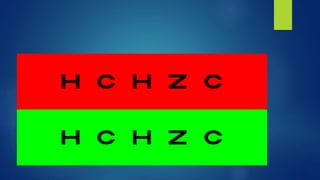
 A duochrome test is a test commonly used to refine the final sphere in
refraction, which makes use of the chromatic aberration of the eye.
Because of the chromatic aberration of the eye, the shorter wavelengths
(green) are focused in front of the longer red wavelengths.
 This test may also named as Bi chrome test. One of the colours is always
red. The other may be green or blue. Whichever colour is used the test
exploits the fact that when viewing a distant object the normal eye will
focus on the yellow part of the visible spectrum, so an eye with impaired
vision (or a miscorrected defect) may experience a form of chromatic
aberration in the same way that old telescope lenses used to... and this
may cause the patient to see more distinctly whatever lies on the green or
red section of the test.
Procedure
 After subjective refraction patient is directed to see the target against the
red background and green background simultaneously.
 If he sees target against the red background more distinctly then
 Either myopia is under-corrected or hyperopia is over-corrected.
 If he sees the target against the green background more distinctly then
either myopia is over-corrected or hyperopia is under-corrected.
 If he sees both targets with equal sharpness. Then optimal correction is
achieved.
Pinhole test
 Subjective correction may be verified using pinhole acuity test with best
correction.
 If patient reports that vision with pinhole is best then correction may need
to check with a trial + or – lens.
Binocular balancing
 The binocular balance test performed after a monocular subjective
refraction to ensure that accomodation is balanced in the two eyes.
 There is no need to perform this test if the patient is monocular, or if they
have no accomodation (i.e. patients over the age of 60 or pseudophakics).
 There are several techniques that have been described. The steps below
are for the Modified Humpriss technique, which effectively uses the
plus/minus technique of best vision sphere determination under binocular
conditions after first fogging rather than occluding the non-tested eye.
 1. Fog the left eye until the VA has been reduced to 3 or 4 lines less than
the tested eye, typically +1.0DS or +2.00DS.
 2. Repeat the best vision sphere assessment for the right eye.
 3. If significant positive power needs to be added (e.g. latent hyperopia)
this should relax accomodation in both eyes. To ensure the amount of
fogging is still effective, place additional plus power over the left eye.
 4. Remove the fog from the left eye and fog the right eye by three or four
lines and repeat the best vision sphere technique for the left eye.
ACT
 Binocular balancing may also be done using Alternate Occlusion Test as it
breaks accommodation.
 After monocular best correction test is performed with both eyes open.
 Direct the patient towards the best acuity line.
 Occlude each eye alternatively and ask
 Whether that line is equally clear with each eye or there is a difference in
clarity
 Recheck the best correction.
Vertical prism dissociation test
 With best refractive correction vertical prism test is performed to
dissociate both eyes.
 Both eyes are fogged with +1.0DS.
 A vertical prism is placed (base down)
 Then patient is directed towards the last seen line i.e. 6/12 or 6/18
 The patient will see that line placed one above the other.
 Then +0.25DS is placed in front of each eye.
 If the eyes are balanced then that line will be equally blurred.
 If seen variation then recheck refraction.
Thank You!
SOMEONE@EXAMPLE.COM

Post refraction test.pptx

  • 1.
    Post refraction test MADIHANAZLY OPTOMETRIST/COAVS
  • 2.
     By theend of subjective refraction there is a need to check the refractive correction status whether it is over minused or over plused. This can be done by using post refraction test i.e.  Plus 1.0 blur test  Duochrome test  Pinhol test  Jackson cross cyl  Fan and block test Sphere verifica tion Cylind rical verific ation
  • 3.
    Plus 1.0 blurtest  The plus + 1.00 D blur check is performed towards the end of a subjective refraction to determine if a young patient with accomodative capacity has been over-minussed or under-plussed, ie accomodating during the course of their refraction. The blur test is usually performed after the best vision sphere subjective assessment.
  • 4.
    Procedure:  Occlude oneeye.  Place a +1.00 DS trial lens over the best vision sphere of the testing eye.  VA should reduce with a +1.00DS from 6/5 to 6/12 or 6/18, 6/6 to 6/18 . In a patient with normal VA (using the Snellen chart, this is typically the bottom line of the chart).  Visual acuity with the +1.00DS better than 6/18, say 6/9, will indicate that the refractive correction may have been under-plussed (orover-minused) and should be rechecked.  As under-plussing or over-minusing a refractive correction is typically due to insufficient relaxation of accommodation during the subjective refraction.
  • 5.
    Duochrome test  Aduochrome test is a test commonly used to refine the final sphere in refraction, which makes use of the chromatic aberration of the eye. Because of the chromatic aberration of the eye, the shorter wavelengths (green) are focused in front of the longer red wavelengths.
  • 7.
     This testmay also named as Bi chrome test. One of the colours is always red. The other may be green or blue. Whichever colour is used the test exploits the fact that when viewing a distant object the normal eye will focus on the yellow part of the visible spectrum, so an eye with impaired vision (or a miscorrected defect) may experience a form of chromatic aberration in the same way that old telescope lenses used to... and this may cause the patient to see more distinctly whatever lies on the green or red section of the test.
  • 8.
    Procedure  After subjectiverefraction patient is directed to see the target against the red background and green background simultaneously.  If he sees target against the red background more distinctly then  Either myopia is under-corrected or hyperopia is over-corrected.  If he sees the target against the green background more distinctly then either myopia is over-corrected or hyperopia is under-corrected.  If he sees both targets with equal sharpness. Then optimal correction is achieved.
  • 9.
    Pinhole test  Subjectivecorrection may be verified using pinhole acuity test with best correction.  If patient reports that vision with pinhole is best then correction may need to check with a trial + or – lens.
  • 10.
    Binocular balancing  Thebinocular balance test performed after a monocular subjective refraction to ensure that accomodation is balanced in the two eyes.  There is no need to perform this test if the patient is monocular, or if they have no accomodation (i.e. patients over the age of 60 or pseudophakics).  There are several techniques that have been described. The steps below are for the Modified Humpriss technique, which effectively uses the plus/minus technique of best vision sphere determination under binocular conditions after first fogging rather than occluding the non-tested eye.
  • 11.
     1. Fogthe left eye until the VA has been reduced to 3 or 4 lines less than the tested eye, typically +1.0DS or +2.00DS.  2. Repeat the best vision sphere assessment for the right eye.  3. If significant positive power needs to be added (e.g. latent hyperopia) this should relax accomodation in both eyes. To ensure the amount of fogging is still effective, place additional plus power over the left eye.  4. Remove the fog from the left eye and fog the right eye by three or four lines and repeat the best vision sphere technique for the left eye.
  • 12.
    ACT  Binocular balancingmay also be done using Alternate Occlusion Test as it breaks accommodation.  After monocular best correction test is performed with both eyes open.  Direct the patient towards the best acuity line.  Occlude each eye alternatively and ask  Whether that line is equally clear with each eye or there is a difference in clarity  Recheck the best correction.
  • 13.
    Vertical prism dissociationtest  With best refractive correction vertical prism test is performed to dissociate both eyes.  Both eyes are fogged with +1.0DS.  A vertical prism is placed (base down)  Then patient is directed towards the last seen line i.e. 6/12 or 6/18  The patient will see that line placed one above the other.  Then +0.25DS is placed in front of each eye.  If the eyes are balanced then that line will be equally blurred.  If seen variation then recheck refraction.
  • 14.