“The refractive condition that occur when the near
point of accomodation has reached to the point that
near work is difficult or impossible without the use
of corrective lenses.”
METHODS OF
CORRECTION
1. Dynamic Retinoscopy.
2. Determining the Tentative Addition.
3. Amplitude of accomodation.
4. Age expected addition.
5. Fused cross Cylinder.
6. Near Duochrome.
7. Negative and positive relative
accomodation.
 In this procedure, the best distance correction was
placed on the trial frame and the patient was
instructed to try to keep clear a line of optotypes of
N6 presented at 40 cm or head of retinoscope
Calculation:
 W.D- neutral point= near add
40cm-1.00,
 2.50-1.00=+1.50
Subjectively the gradual increase of +0.25D
lenses after distance correction for near point,
keep increasing the power gradually untill the
targetted (N6) is clear.
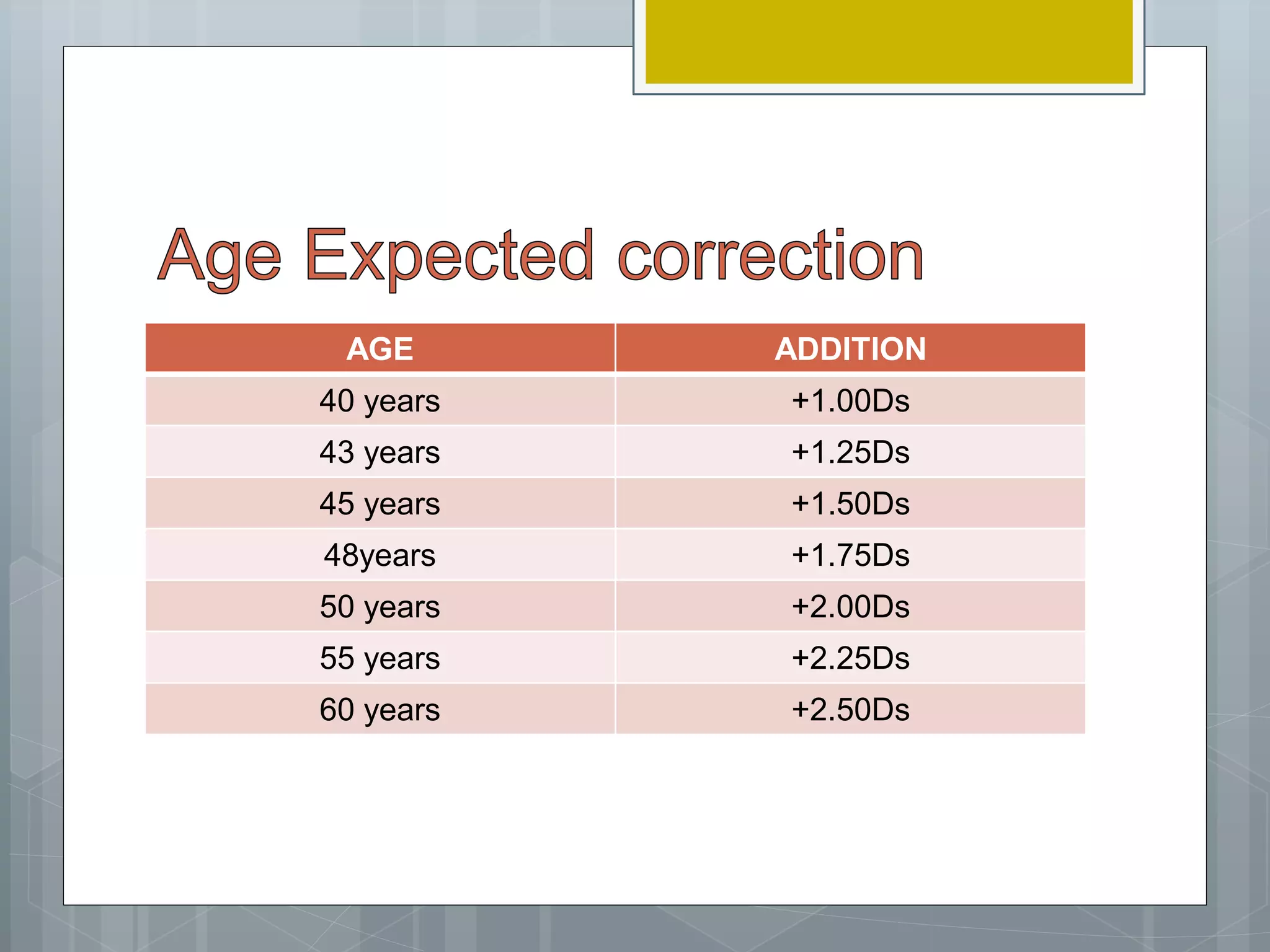
AGE ADDITION
40 years +1.00Ds
43 years +1.25Ds
45 years +1.50Ds
48years +1.75Ds
50 years +2.00Ds
55 years +2.25Ds
60 years +2.50Ds
.
Determine the amount of accomodation
required for the patient’s near-vision tasks
 For Exapmle:
Reading at 40cm would
require 2.50D of accomodation.
Calculation :
 Accomodation required 40cm is :
 D=1/f
D=100/40cm
D= 2.50D
 Keep Reserve the one-half:
 2.50-1/2(2.50)
2.50-1.25
Near addition is +1.25D
The reserve allows the movement of objects closer
and far with patients comfort.
Attention…! Real Test… 
.
 Adding plus lenses until the horizontal and vertical
lines on the cross cylinder grid subjectively appeared
equally clear.
 With the distance correction placed in the trial
frame, align the JCC on trial frame at 45 (red line
align at 90) the subject is instructed to identify which
lines appeared most sharp.
 Horizontal lines were considered to be
clearer (under correct, add plus
lenses binocularly in 0.25 D steps
until equality was reached between
the two
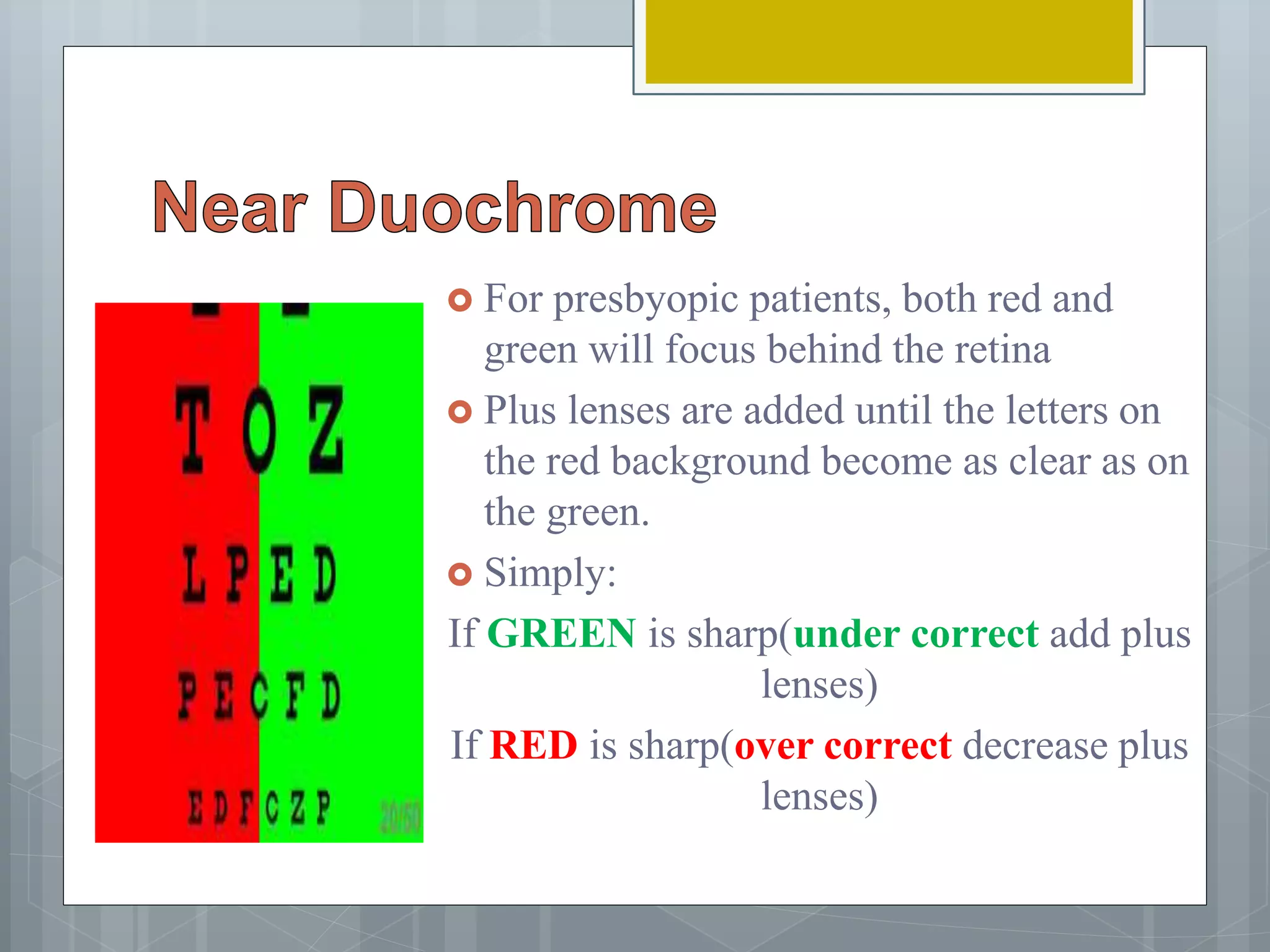
 For presbyopic patients, both red and
green will focus behind the retina
 Plus lenses are added until the letters on
the red background become as clear as on
the green.
 Simply:
If GREEN is sharp(under correct add plus
lenses)
If RED is sharp(over correct decrease plus
lenses)
Negative and Positive relative
Accomodation
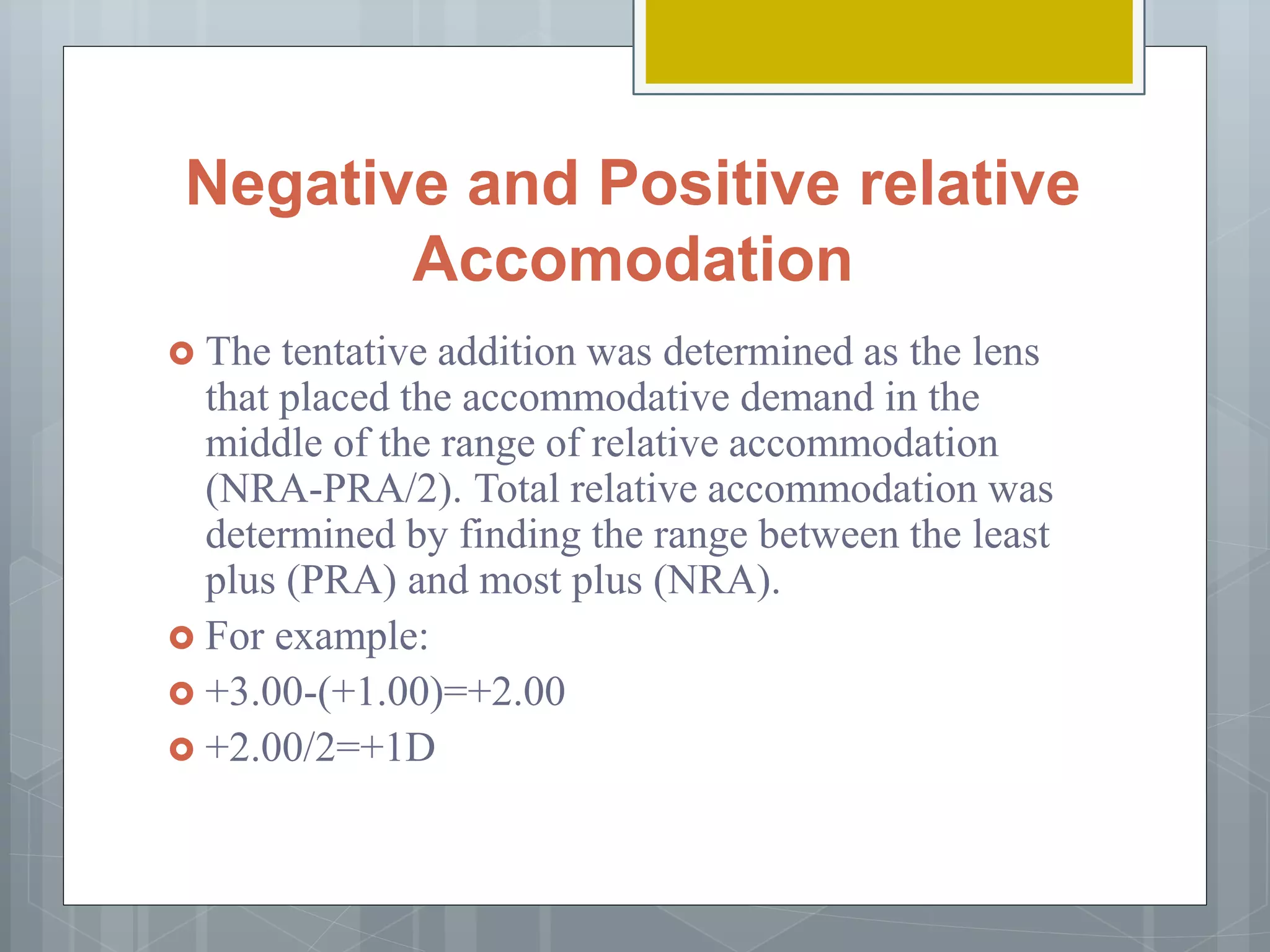
 The tentative addition was determined as the lens
that placed the accommodative demand in the
middle of the range of relative accommodation
(NRA-PRA/2). Total relative accommodation was
determined by finding the range between the least
plus (PRA) and most plus (NRA).
 For example:
 +3.00-(+1.00)=+2.00
 +2.00/2=+1D
METHODS OF PRESBYOPIC CORRECTION

METHODS OF PRESBYOPIC CORRECTION

  • 2.
    “The refractive conditionthat occur when the near point of accomodation has reached to the point that near work is difficult or impossible without the use of corrective lenses.”
  • 3.
    METHODS OF CORRECTION 1. DynamicRetinoscopy. 2. Determining the Tentative Addition. 3. Amplitude of accomodation. 4. Age expected addition. 5. Fused cross Cylinder. 6. Near Duochrome. 7. Negative and positive relative accomodation.
  • 5.
     In thisprocedure, the best distance correction was placed on the trial frame and the patient was instructed to try to keep clear a line of optotypes of N6 presented at 40 cm or head of retinoscope Calculation:  W.D- neutral point= near add 40cm-1.00,  2.50-1.00=+1.50
  • 6.
    Subjectively the gradualincrease of +0.25D lenses after distance correction for near point, keep increasing the power gradually untill the targetted (N6) is clear.
  • 7.
    AGE ADDITION 40 years+1.00Ds 43 years +1.25Ds 45 years +1.50Ds 48years +1.75Ds 50 years +2.00Ds 55 years +2.25Ds 60 years +2.50Ds
  • 8.
    . Determine the amountof accomodation required for the patient’s near-vision tasks  For Exapmle: Reading at 40cm would require 2.50D of accomodation.
  • 9.
    Calculation :  Accomodationrequired 40cm is :  D=1/f D=100/40cm D= 2.50D  Keep Reserve the one-half:  2.50-1/2(2.50) 2.50-1.25 Near addition is +1.25D The reserve allows the movement of objects closer and far with patients comfort.
  • 10.
  • 11.
    .  Adding pluslenses until the horizontal and vertical lines on the cross cylinder grid subjectively appeared equally clear.  With the distance correction placed in the trial frame, align the JCC on trial frame at 45 (red line align at 90) the subject is instructed to identify which lines appeared most sharp.  Horizontal lines were considered to be clearer (under correct, add plus lenses binocularly in 0.25 D steps until equality was reached between the two
  • 12.
     For presbyopicpatients, both red and green will focus behind the retina  Plus lenses are added until the letters on the red background become as clear as on the green.  Simply: If GREEN is sharp(under correct add plus lenses) If RED is sharp(over correct decrease plus lenses)
  • 13.
    Negative and Positiverelative Accomodation  The tentative addition was determined as the lens that placed the accommodative demand in the middle of the range of relative accommodation (NRA-PRA/2). Total relative accommodation was determined by finding the range between the least plus (PRA) and most plus (NRA).  For example:  +3.00-(+1.00)=+2.00  +2.00/2=+1D