 The full-adder forms the sum of two bits and a 
previous carry. 
 Two binary numbers of n bits each can be 
added by means of this circuit. 
 When pair of bits are added through the full-adder, 
the circuit produces a carry to be used 
with the pair of bits one higher significant 
position
 The bits are added with full-adders, starting 
from the lest significant position, to from the 
sum bit and carry bit. 
 The sum of two n-bit binary numbers A and B, 
can be generated in two ways: either in serial 
fashion or in parallel. 
 The serial addition method uses only one full-adder 
circuit and a storage device to hold the 
generated output carry and sum. 
 The parallel method uses n full-adder circuit.
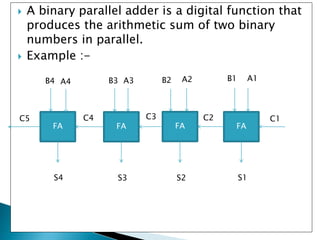
 A binary parallel adder is a digital function that 
produces the arithmetic sum of two binary 
numbers in parallel. 
 Example :- 
B4 A4 B3 A3 B2 A2 B1 A1 
C5 C4 C3 C2 C1 
FA FA FA FA 
S4 S3 S2 S1
 An n-bit parallel adder requires n full-adders 
 It can be constructed from 4-bit, 2-bit and 1- 
bit full-adders ICs by cascading several 
packages. 
 The 4-bit binary parallel adder is a typical 
example of an MSI function. 
 It can be used in many applications involving 
arithmetic operations. 
 The application of this MSI function to the 
design of a combinational circuit is 
demonstrated in the example of BCD to excess- 
1 code converter.
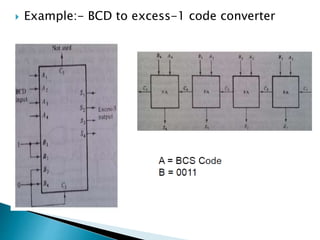
 Example:- BCD to excess-1 code converter
CARRY PROPAGATION 
 The addition of two binary numbers in parallel 
implies that all the bits of the augend and the 
addend are available for computation at the 
same time. 
 As in any combinational circuit, the signal must 
propagate through gates before the correct 
output sum is available in output terminals. 
 The total propagation time is equal to the 
propagation delay of typical gate times the 
number of gate levels in the circuit. 
 The longest propagation delay time in a parallel 
adder is the time it takes the carry to propagate 
through the full-adders
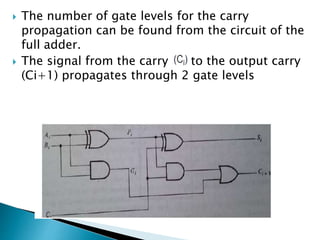
 The number of gate levels for the carry 
propagation can be found from the circuit of the 
full adder. 
 The signal from the carry to the output carry 
(Ci+1) propagates through 2 gate levels
 If there are four full-adders in the parallel adder, 
the output carry C5 would have 2*4=8 gate 
levels from C1 to C5. 
 The total propagation time in the adder would be 
the propagation time in one half adder plus eight 
gate levels. 
 For an n-bit parallel adder, there are 2n gate 
levels for the carry to propagate through. 
 The carry propagation time is a limiting factor on 
the speed with which two numbers are added in 
parallel.
 All other arithmetic operations are implemented 
by successive additions, the time consumed 
during the addition process is very critical. 
 One way to reduce the carry propagation delay 
time is to employ faster gates with reduced 
delays 
 Another solution is to increase the equipment 
complexity in such a way that the carry delay 
time is reduced. 
 The most widely used technique employs the 
principle of look-ahead carry.
 Look-ahead carry 
 If we define two variables: 
 Gi is called a carry generated and it produced an 
output carry when both Ai and Bi one. 
 Pi is called a carry propagate because it is the 
term associated with the propagation of the carry 
to 
 The output sum and carry can be expressed as:
 The boolean functions for the carry output of 
each stage are:
 Circuit diagram of a look–ahead carry generator
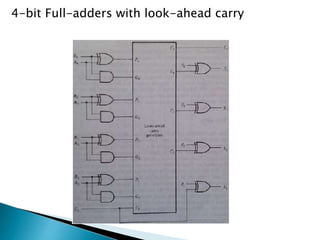
4-bit Full-adders with look-ahead carry
Binary parallel adder

Binary parallel adder

  • 2.
     The full-adderforms the sum of two bits and a previous carry.  Two binary numbers of n bits each can be added by means of this circuit.  When pair of bits are added through the full-adder, the circuit produces a carry to be used with the pair of bits one higher significant position
  • 3.
     The bitsare added with full-adders, starting from the lest significant position, to from the sum bit and carry bit.  The sum of two n-bit binary numbers A and B, can be generated in two ways: either in serial fashion or in parallel.  The serial addition method uses only one full-adder circuit and a storage device to hold the generated output carry and sum.  The parallel method uses n full-adder circuit.
  • 4.
     A binaryparallel adder is a digital function that produces the arithmetic sum of two binary numbers in parallel.  Example :- B4 A4 B3 A3 B2 A2 B1 A1 C5 C4 C3 C2 C1 FA FA FA FA S4 S3 S2 S1
  • 5.
     An n-bitparallel adder requires n full-adders  It can be constructed from 4-bit, 2-bit and 1- bit full-adders ICs by cascading several packages.  The 4-bit binary parallel adder is a typical example of an MSI function.  It can be used in many applications involving arithmetic operations.  The application of this MSI function to the design of a combinational circuit is demonstrated in the example of BCD to excess- 1 code converter.
  • 6.
     Example:- BCDto excess-1 code converter
  • 7.
    CARRY PROPAGATION The addition of two binary numbers in parallel implies that all the bits of the augend and the addend are available for computation at the same time.  As in any combinational circuit, the signal must propagate through gates before the correct output sum is available in output terminals.  The total propagation time is equal to the propagation delay of typical gate times the number of gate levels in the circuit.  The longest propagation delay time in a parallel adder is the time it takes the carry to propagate through the full-adders
  • 8.
     The numberof gate levels for the carry propagation can be found from the circuit of the full adder.  The signal from the carry to the output carry (Ci+1) propagates through 2 gate levels
  • 9.
     If thereare four full-adders in the parallel adder, the output carry C5 would have 2*4=8 gate levels from C1 to C5.  The total propagation time in the adder would be the propagation time in one half adder plus eight gate levels.  For an n-bit parallel adder, there are 2n gate levels for the carry to propagate through.  The carry propagation time is a limiting factor on the speed with which two numbers are added in parallel.
  • 10.
     All otherarithmetic operations are implemented by successive additions, the time consumed during the addition process is very critical.  One way to reduce the carry propagation delay time is to employ faster gates with reduced delays  Another solution is to increase the equipment complexity in such a way that the carry delay time is reduced.  The most widely used technique employs the principle of look-ahead carry.
  • 11.
     Look-ahead carry  If we define two variables:  Gi is called a carry generated and it produced an output carry when both Ai and Bi one.  Pi is called a carry propagate because it is the term associated with the propagation of the carry to  The output sum and carry can be expressed as:
  • 12.
     The booleanfunctions for the carry output of each stage are:
  • 13.
     Circuit diagramof a look–ahead carry generator
  • 14.
    4-bit Full-adders withlook-ahead carry