Digital Logic Circuits, Digital
Component and Data
Representation
Course: MCA-I
Subject: Computer Organization
And Architecture
Unit-1
1
Digital vs. Analog
• An analog system has continuous range of
values
 A mercury thermometer
 Vinyl records
 Human eye
• A digital system has a set of discrete values
Digital Thermometer
Compact Disc (CD)
Digital camera
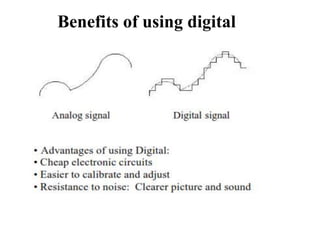
Benefits of using digital
Binary System
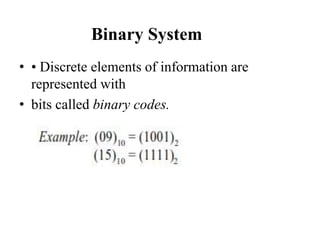
• • Discrete elements of information are
represented with
• bits called binary codes.
Decimal Code
• Review the decimal number system.
• Base (Radix) is 10 - symbols (0,1, . . 9) Digits
• For Numbers > 9, add more significant digits in
position to the left, e.g. 19>9.
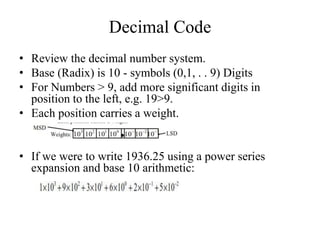
• Each position carries a weight.
• If we were to write 1936.25 using a power series
expansion and base 10 arithmetic:
Binary number system
The binary number system.
Base is 2 - symbols (0,1) - Binary Digits (Bits)
For Numbers > 1, add more significant digits in position to the
left, e.g. 10>1.
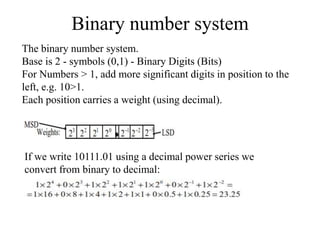
Each position carries a weight (using decimal).
If we write 10111.01 using a decimal power series we
convert from binary to decimal:
Octal/Hex number systems
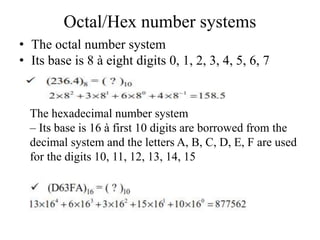
• The octal number system
• Its base is 8 à eight digits 0, 1, 2, 3, 4, 5, 6, 7
The hexadecimal number system
– Its base is 16 à first 10 digits are borrowed from the
decimal system and the letters A, B, C, D, E, F are used
for the digits 10, 11, 12, 13, 14, 15
Conversion from Decimal to Binary
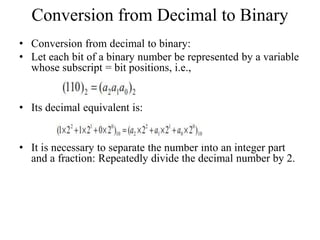
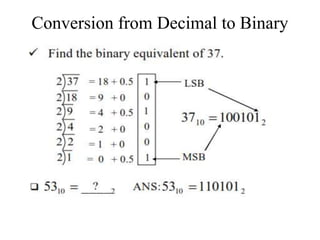
• Conversion from decimal to binary:
• Let each bit of a binary number be represented by a variable
whose subscript = bit positions, i.e.,
• Its decimal equivalent is:
• It is necessary to separate the number into an integer part
and a fraction: Repeatedly divide the decimal number by 2.
Conversion from Decimal to Binary
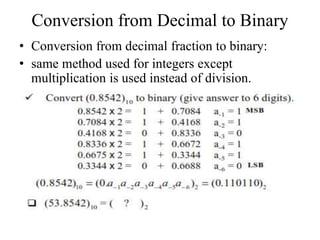
• Conversion from decimal fraction to binary:
• same method used for integers except
multiplication is used instead of division.
Conversion from Decimal to Octal
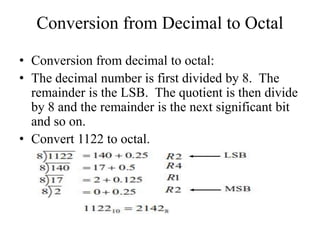
• Conversion from decimal to octal:
• The decimal number is first divided by 8. The
remainder is the LSB. The quotient is then divide
by 8 and the remainder is the next significant bit
and so on.
• Convert 1122 to octal.
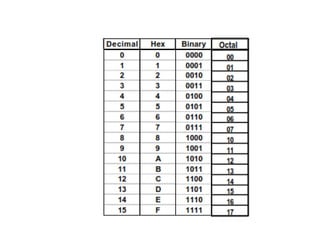
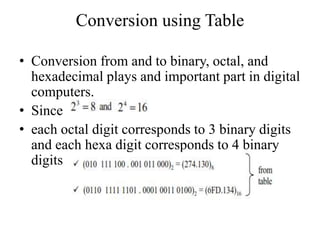
Conversion using Table
• Conversion from and to binary, octal, and
hexadecimal plays and important part in digital
computers.
• Since
• each octal digit corresponds to 3 binary digits
and each hexa digit corresponds to 4 binary
digits.
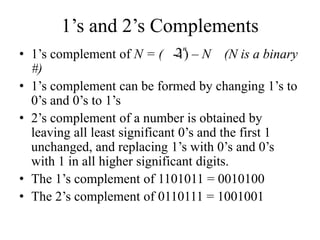
1’s and 2’s Complements
• 1’s complement of N = ( -1) – N (N is a binary
#)
• 1’s complement can be formed by changing 1’s to
0’s and 0’s to 1’s
• 2’s complement of a number is obtained by
leaving all least significant 0’s and the first 1
unchanged, and replacing 1’s with 0’s and 0’s
with 1 in all higher significant digits.
• The 1’s complement of 1101011 = 0010100
• The 2’s complement of 0110111 = 1001001
2n
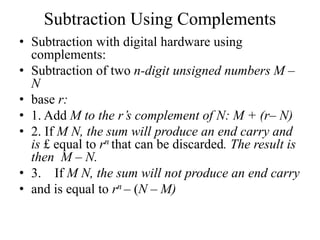
Subtraction Using Complements
• Subtraction with digital hardware using
complements:
• Subtraction of two n-digit unsigned numbers M –
N
• base r:
• 1. Add M to the r’s complement of N: M + (r– N)
• 2. If M N, the sum will produce an end carry and
is £ equal to rn that can be discarded. The result is
then M – N.
• 3. If M N, the sum will not produce an end carry
• and is equal to rn – (N – M)
Binary Subtraction using complements
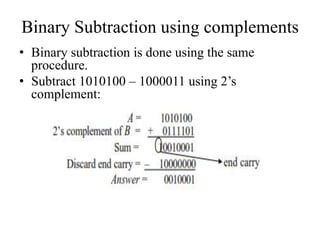
• Binary subtraction is done using the same
procedure.
• Subtract 1010100 – 1000011 using 2’s
complement:
Binary Subtraction using complements
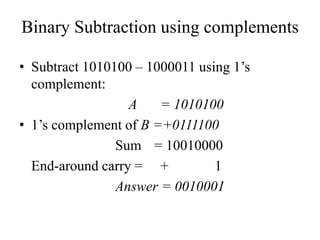
• Subtract 1010100 – 1000011 using 1’s
complement:
A = 1010100
• 1’s complement of B =+0111100
Sum = 10010000
End-around carry = + 1
Answer = 0010001
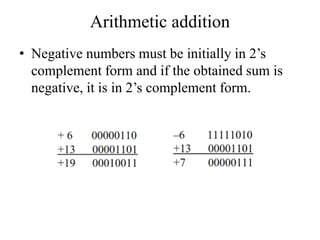
Arithmetic addition
• Negative numbers must be initially in 2’s
complement form and if the obtained sum is
negative, it is in 2’s complement form.
Reference
Reference Book
• Computer Organization & Architecture 7e By
Stallings
• Computer System Architecture By Mano
• Digital Logic & Computer Design By Mano

digital logic circuits, digital component

  • 1.
    Digital Logic Circuits,Digital Component and Data Representation Course: MCA-I Subject: Computer Organization And Architecture Unit-1 1
  • 2.
    Digital vs. Analog •An analog system has continuous range of values  A mercury thermometer  Vinyl records  Human eye • A digital system has a set of discrete values Digital Thermometer Compact Disc (CD) Digital camera
  • 3.
  • 4.
    Binary System • •Discrete elements of information are represented with • bits called binary codes.
  • 5.
    Decimal Code • Reviewthe decimal number system. • Base (Radix) is 10 - symbols (0,1, . . 9) Digits • For Numbers > 9, add more significant digits in position to the left, e.g. 19>9. • Each position carries a weight. • If we were to write 1936.25 using a power series expansion and base 10 arithmetic:
  • 6.
    Binary number system Thebinary number system. Base is 2 - symbols (0,1) - Binary Digits (Bits) For Numbers > 1, add more significant digits in position to the left, e.g. 10>1. Each position carries a weight (using decimal). If we write 10111.01 using a decimal power series we convert from binary to decimal:
  • 7.
    Octal/Hex number systems •The octal number system • Its base is 8 à eight digits 0, 1, 2, 3, 4, 5, 6, 7 The hexadecimal number system – Its base is 16 à first 10 digits are borrowed from the decimal system and the letters A, B, C, D, E, F are used for the digits 10, 11, 12, 13, 14, 15
  • 8.
    Conversion from Decimalto Binary • Conversion from decimal to binary: • Let each bit of a binary number be represented by a variable whose subscript = bit positions, i.e., • Its decimal equivalent is: • It is necessary to separate the number into an integer part and a fraction: Repeatedly divide the decimal number by 2.
  • 9.
  • 10.
    Conversion from Decimalto Binary • Conversion from decimal fraction to binary: • same method used for integers except multiplication is used instead of division.
  • 11.
    Conversion from Decimalto Octal • Conversion from decimal to octal: • The decimal number is first divided by 8. The remainder is the LSB. The quotient is then divide by 8 and the remainder is the next significant bit and so on. • Convert 1122 to octal.
  • 13.
    Conversion using Table •Conversion from and to binary, octal, and hexadecimal plays and important part in digital computers. • Since • each octal digit corresponds to 3 binary digits and each hexa digit corresponds to 4 binary digits.
  • 14.
    1’s and 2’sComplements • 1’s complement of N = ( -1) – N (N is a binary #) • 1’s complement can be formed by changing 1’s to 0’s and 0’s to 1’s • 2’s complement of a number is obtained by leaving all least significant 0’s and the first 1 unchanged, and replacing 1’s with 0’s and 0’s with 1 in all higher significant digits. • The 1’s complement of 1101011 = 0010100 • The 2’s complement of 0110111 = 1001001 2n
  • 15.
    Subtraction Using Complements •Subtraction with digital hardware using complements: • Subtraction of two n-digit unsigned numbers M – N • base r: • 1. Add M to the r’s complement of N: M + (r– N) • 2. If M N, the sum will produce an end carry and is £ equal to rn that can be discarded. The result is then M – N. • 3. If M N, the sum will not produce an end carry • and is equal to rn – (N – M)
  • 16.
    Binary Subtraction usingcomplements • Binary subtraction is done using the same procedure. • Subtract 1010100 – 1000011 using 2’s complement:
  • 17.
    Binary Subtraction usingcomplements • Subtract 1010100 – 1000011 using 1’s complement: A = 1010100 • 1’s complement of B =+0111100 Sum = 10010000 End-around carry = + 1 Answer = 0010001
  • 18.
    Arithmetic addition • Negativenumbers must be initially in 2’s complement form and if the obtained sum is negative, it is in 2’s complement form.
  • 19.
    Reference Reference Book • ComputerOrganization & Architecture 7e By Stallings • Computer System Architecture By Mano • Digital Logic & Computer Design By Mano