0
PREPARATORY CLASSES
Dr. S. RAJA KUMAR,
M.Sc(Bot)., M.Sc(Psy).,M.Ed.,M.Phil(Edn).,PGDGC.,SET(Edn).,NET(Edn)., Ph.D (Edn)
Assistant Professor,
Thiagarajar College of Preceptors (Govt. Aided), Madurai
1
2024
Teaching Aptitude 2
• Teaching: Concept, Objectives, Levels of Teaching (Memory,
Understanding and Reflective), Characteristics and Basic
Requirements.
• Learner’s Characteristics: Characteristics of adolescents and
adult learners (Academic, Social, Emotional and Cognitive),
Individual differences.
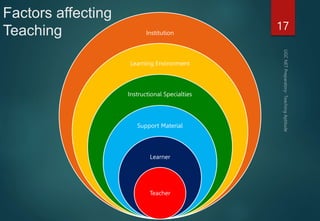
• Factors affecting Teaching related to: Teacher, Learner, Support
Material, Instructional Facilities, Learning Environment and
Institution.
• Methods of Teaching in Institutions of higher learning: Teacher
centred vs. Learner-centred methods; Off-line vs. On-line
methods (Swayam, Swayamprabha, MOOCs etc.)
• Teaching Support systems: Elements and Types of evaluation,
Evaluation in Choice Based Credit System in Higher Education,
Computer-Based Testing, Innovations in Evaluation Systems
1. Concept of teaching 3
 Teaching is the process of attending to people’s needs,
experiences and feelings, and making specific interventions
to help them learn particular things.
 Interventions commonly take the form of questioning,
listening, giving information, explaining some
phenomenon, demonstrating a skill or process, testing
understanding and capacity, and facilitating learning
activities (such as note taking, discussion, assignment
writing, simulations and practice).
2. OBJECTIVES
OF TEACHING
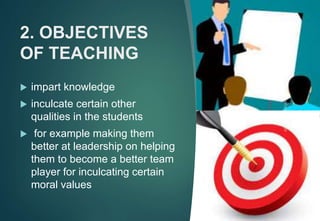
 impart knowledge
 inculcate certain other
qualities in the students
 for example making them
better at leadership on helping
them to become a better team
player for inculcating certain
moral values
4
Question
The Most Appropriate meaning of teaching
is________ (June 2019)
 1. Acquisition of skill
 2. Modification of behaviour.
 3. Personal adjustment
 4.Inculcation of knowledge
5
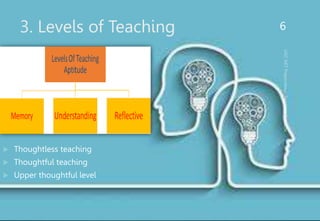
3. Levels of Teaching
 Thoughtless teaching
 Thoughtful teaching
 Upper thoughtful level
6
Questions
 Which of the following is not a prescribed
level of teaching? (December 2019)
 A) Memory
 B) Reflective
 C) Understanding
 D) Differentiation.
7
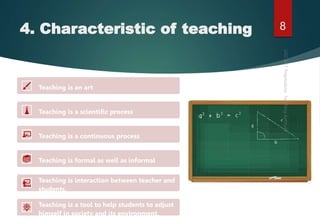
4. Characteristic of teaching 8
Teaching is an art
Teaching is a scientific process
Teaching is a continuous process
Teaching is formal as well as informal
Teaching is interaction between teacher and
students.
Teaching is a tool to help students to adjust
himself in society and its environment.
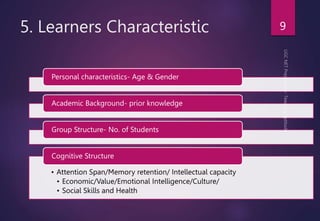
5. Learners Characteristic
Personal characteristics- Age & Gender
Academic Background- prior knowledge
Group Structure- No. of Students
• Attention Span/Memory retention/ Intellectual capacity
• Economic/Value/Emotional Intelligence/Culture/
• Social Skills and Health
Cognitive Structure
9
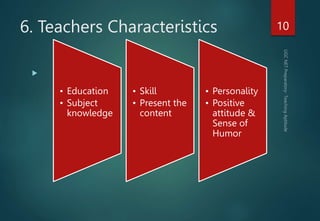
6. Teachers Characteristics

• Education
• Subject
knowledge
• Skill
• Present the
content
• Personality
• Positive
attitude &
Sense of
Humor
10
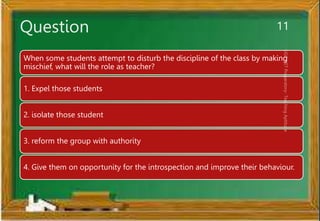
Question
When some students attempt to disturb the discipline of the class by making
mischief, what will the role as teacher?
1. Expel those students
2. isolate those student
3. reform the group with authority
4. Give them on opportunity for the introspection and improve their behaviour.
11
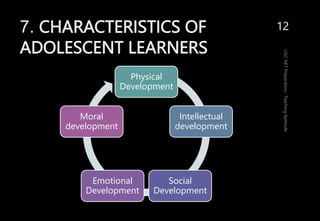
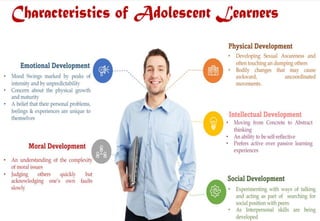
7. CHARACTERISTICS OF
ADOLESCENT LEARNERS
12
Physical
Development
Intellectual
development
Social
Development
Emotional
Development
Moral
development
13
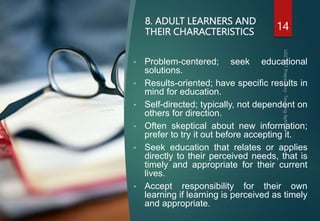
8. ADULT LEARNERS AND
THEIR CHARACTERISTICS 14
• Problem-centered; seek educational
solutions.
• Results-oriented; have specific results in
mind for education.
• Self-directed; typically, not dependent on
others for direction.
• Often skeptical about new information;
prefer to try it out before accepting it.
• Seek education that relates or applies
directly to their perceived needs, that is
timely and appropriate for their current
lives.
• Accept responsibility for their own
learning if learning is perceived as timely
and appropriate.
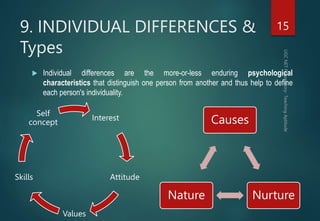
9. INDIVIDUAL DIFFERENCES &
Types
 Individual differences are the more-or-less enduring psychological
characteristics that distinguish one person from another and thus help to define
each person's individuality.
Interest
Attitude
Values
Skills
Self
concept Causes
Nurture
Nature
15
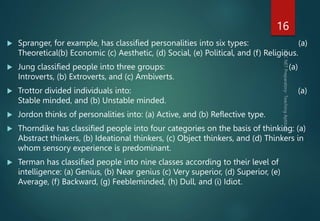
 Spranger, for example, has classified personalities into six types: (a)
Theoretical(b) Economic (c) Aesthetic, (d) Social, (e) Political, and (f) Religious.
 Jung classified people into three groups: (a)
Introverts, (b) Extroverts, and (c) Ambiverts.
 Trottor divided individuals into: (a)
Stable minded, and (b) Unstable minded.
 Jordon thinks of personalities into: (a) Active, and (b) Reflective type.
 Thorndike has classified people into four categories on the basis of thinking: (a)
Abstract thinkers, (b) Ideational thinkers, (c) Object thinkers, and (d) Thinkers in
whom sensory experience is predominant.
 Terman has classified people into nine classes according to their level of
intelligence: (a) Genius, (b) Near genius (c) Very superior, (d) Superior, (e)
Average, (f) Backward, (g) Feebleminded, (h) Dull, and (i) Idiot.
16
Institution
Learning Environment
Instructional Specialties
Support Material
Learner
Teacher
Factors affecting
Teaching 17
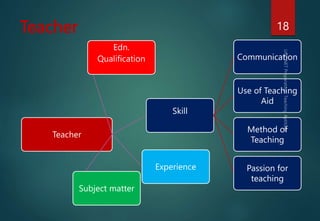
Teacher
Teacher
Edn.
Qualification
Skill
Communication
Use of Teaching
Aid
Method of
Teaching
Passion for
teaching
Experience
Subject matter
18
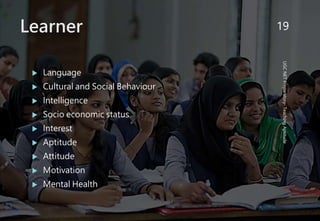
Learner 19
 Language
 Cultural and Social Behaviour
 Intelligence
 Socio economic status
 Interest
 Aptitude
 Attitude
 Motivation
 Mental Health
UGC
NET
Preparatory-
Teaching
Aptitude
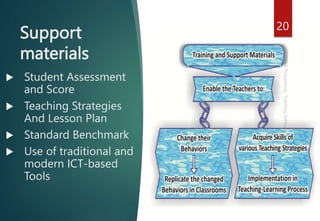
Support
materials
20
 Student Assessment
and Score
 Teaching Strategies
And Lesson Plan
 Standard Benchmark
 Use of traditional and
modern ICT-based
Tools
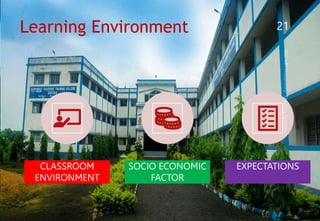
Learning Environment
CLASSROOM
ENVIRONMENT
SOCIO ECONOMIC
FACTOR
EXPECTATIONS
21
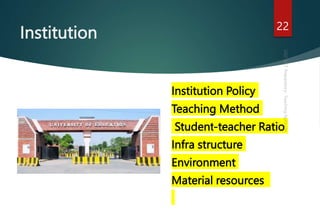
Institution 22
Institution Policy
Teaching Method
Student-teacher Ratio
Infra structure
Environment
Material resources
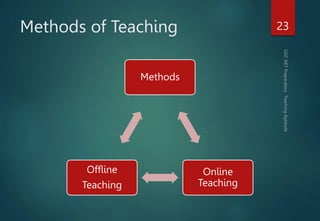
Methods of Teaching
Methods
Online
Teaching
Offline
Teaching
23
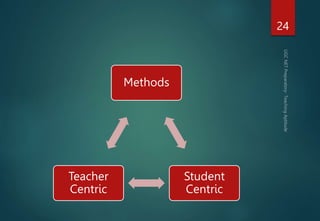
Methods
Student
Centric
Teacher
Centric
24
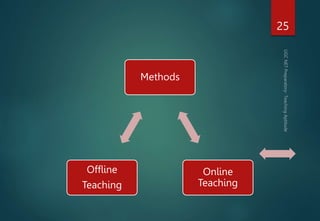
Methods
Online
Teaching
Offline
Teaching
25
E- learning Facilities
26
27
28
29
30
31
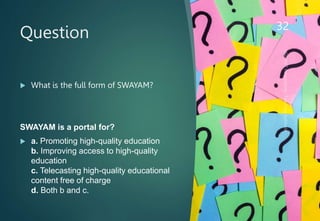
Question
 What is the full form of SWAYAM?
SWAYAM is a portal for?
 a. Promoting high-quality education
b. Improving access to high-quality
education
c. Telecasting high-quality educational
content free of charge
d. Both b and c.
32
33
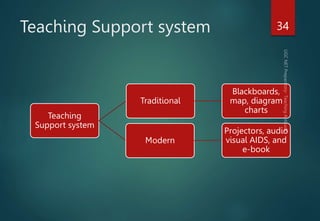
Teaching Support system
Teaching
Support system
Traditional
Blackboards,
map, diagram
charts
Modern
Projectors, audio
visual AIDS, and
e-book
34
Question 35
 Why teachers use teaching aids?
 A. to attract the students
 B. minimize the problem in the
classroom
 C.Optimizing learning outcome
 D. Effective engagement of students in
learning task.
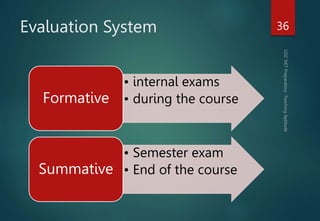
Evaluation System
• internal exams
• during the course
Formative
• Semester exam
• End of the course
Summative
36
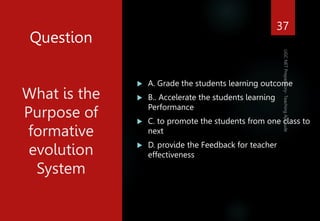
Question
What is the
Purpose of
formative
evolution
System
 A. Grade the students learning outcome
 B.. Accelerate the students learning
Performance
 C. to promote the students from one class to
next
 D. provide the Feedback for teacher
effectiveness
37
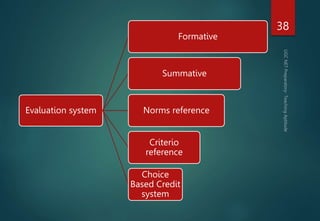
Evaluation system
Formative
Summative
Norms reference
Criterio
reference
Choice
Based Credit
system
38
39
CGPA
40
Computer Based Testing
41
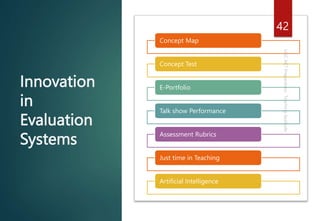
Innovation
in
Evaluation
Systems
42
Concept Map
Concept Test
E-Portfolio
Talk show Performance
Assessment Rubrics
Just time in Teaching
Artificial Intelligence
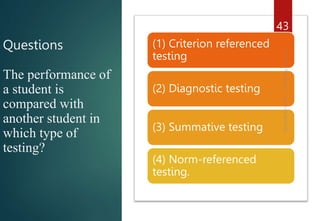
Questions
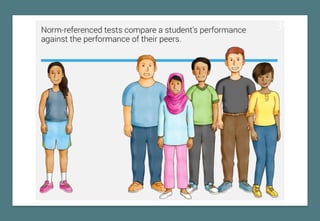
The performance of
a student is
compared with
another student in
which type of
testing?
43
(1) Criterion referenced
testing
(2) Diagnostic testing
(3) Summative testing
(4) Norm-referenced
testing.
44
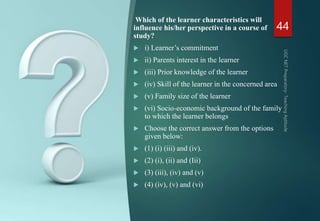
Which of the learner characteristics will
influence his/her perspective in a course of
study?
 i) Learner’s commitment
 ii) Parents interest in the learner
 (iii) Prior knowledge of the learner
 (iv) Skill of the learner in the concerned area
 (v) Family size of the learner
 (vi) Socio-economic background of the family
to which the learner belongs
 Choose the correct answer from the options
given below:
 (1) (i) (iii) and (iv).
 (2) (i), (ii) and (Iii)
 (3) (iii), (iv) and (v)
 (4) (iv), (v) and (vi)
45
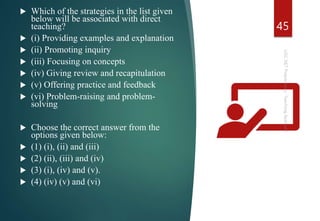
 Which of the strategies in the list given
below will be associated with direct
teaching?
 (i) Providing examples and explanation
 (ii) Promoting inquiry
 (iii) Focusing on concepts
 (iv) Giving review and recapitulation
 (v) Offering practice and feedback
 (vi) Problem-raising and problem-
solving
 Choose the correct answer from the
options given below:
 (1) (i), (ii) and (iii)
 (2) (ii), (iii) and (iv)
 (3) (i), (iv) and (v).
 (4) (iv) (v) and (vi)
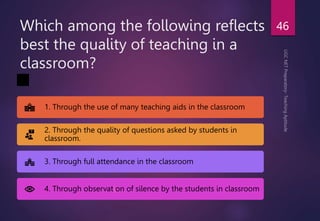
Which among the following reflects
best the quality of teaching in a
classroom?
46
1. Through the use of many teaching aids in the classroom
2. Through the quality of questions asked by students in
classroom.
3. Through full attendance in the classroom
4. Through observation of silence by the students in classroom
What is the purpose
underlying the use of
teaching aids?
 (1) To make the lessons
interesting
 2) To capture the students’
attention
 (3) To enhance access to
technological resources
 (4) To optimise learning
outcomes.
47
Democracy in the class-room is best
reflected through
(a) Allowing student’s freedom to the
observance of classroom rules and
regulations
(b) Allowing the class to decide the
auricular experiences of the classroom
(c) Allowing the maximum participation of
all the students in class-room activities.
(d) None of above
48
49
If majority of students in your class are weak you
should
(a) keep your speed of teaching fast so that
students comprehension level may increase
(b) not care about the intelligent students
(c) keep your teaching slow
(d) keep your teaching slow along with some extra
guidance to bright pupils.
Trueman’s UGC
NET/ SLET
General Paper I
M. Gagan
(Author), Sajit
Kumar
Danika Publishing
Company
Trueman’s UGC NET/ SLET General Paper I
M. Gagan (Author), Sajit
Kumar
Danika Publishing Company
50
50
UGC NET/ JRF/ SLET General Paper-1
Teaching & Research Aptitude
Arihant Express Arihant Publication
51
51
UGC NET/SET/JRF – Paper 1: Teaching and
Research Aptitude
KVS Madaan Pearson Education
52
52
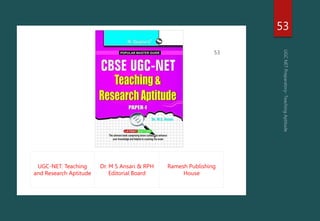
UGC-NET: Teaching
and Research Aptitude
Dr. M S Ansari & RPH
Editorial Board
Ramesh Publishing
House
53
53