BEER-LAMBERT LOW
Topics:
• Beer’s low
• Lambert’s low
• Beer-Lambert low
• Derivation of beer lambert low
• Limitations
Asif Pappu
Dept. of Applied Chemistry & Chemical Engineering
Noakhali Science & Technology University
1
BEER’S LOW
Absorbance(A) Vs. Concentration (c)
(For a dilute solution)
If a light is pass through a solution then the absorbance of light is proportional to
the concentration of the solution. Which is
Iin
Iin
Iout [2]
Iout [1]
cA 
cA  2
LAMBERT’S LOW
Absorbance(A) Vs. Path length (b)
The path distance that travels in the sample is proportional to the absorbance.
3
Iin
Iin
Iout [2]
Iout [1]
bA
Path length- the distance that light
travels in the sample
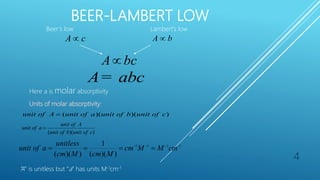
BEER-LAMBERT LOW
4
cA  bA 
A abc=
bcA
Here a is molar absorptivity
Units of molar absorptivity:
))()(( cofunitbofunitaofunitAofunit 
))(( cofunitbofunit
Aofunit
aofunit 
1111
))((
1
))((

 cmMMcm
McmMcm
unitless
aofunit
“A” is unitless but “a” has units M-1cm-1
Beer’s low Lambert’s low
DERIVATION OF BEER-LAMBERT’S LOW
Here dx is the thickness of medium and I is the intensity of light then from
lamberts low-
-dI/dx ∞ I ----------------(1) or,
-dI/dx = aI---------------(2) 5
6
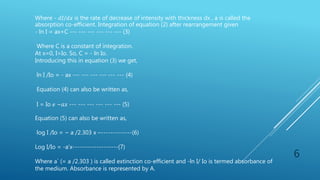
Where - 𝑑𝐼/𝑑𝑥 is the rate of decrease of intensity with thickness dx , a is called the
absorption co-efficient. Integration of equation (2) after rearrangement given
- ln I = ax+C --- --- --- --- --- --- (3)
Where C is a constant of integration.
At x=0, I=Io. So, C = - ln Io.
Introducing this in equation (3) we get,
ln I /Io = - ax --- --- --- --- --- --- (4)
Equation (4) can also be written as,
I = Io 𝑒 −𝑎𝑥 --- --- --- --- --- --- (5)
Equation (5) can also be written as,
log I /Io = − a /2.303 x –-------------(6)
Log I/Io = -a’x-------------------(7)
Where a` (= a /2.303 ) is called extinction co-efficient and -ln I/ Io is termed absorbance of
the medium. Absorbance is represented by A.
7
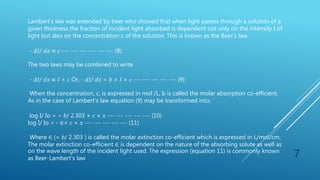
Lambert’s law was extended by beer who showed that when light passes through a solution of a
given thickness the fraction of incident light absorbed is dependent not only on the intensity I of
light but also on the concentration c of the solution. This is known as the Beer’s law.
- 𝑑𝐼/ 𝑑𝑥 ∝ 𝑐 --- --- --- --- --- --- (8)
The two laws may be combined to write
- 𝑑𝐼/ 𝑑𝑥 ∝ 𝐼 × 𝑐 Or, - 𝑑𝐼/ 𝑑𝑥 = 𝑏 × 𝐼 × 𝑐 --- --- --- --- --- (9)
When the concentration, c, is expressed in mol /L, b is called the molar absorption co-efficient.
As in the case of Lambert’s law equation (9) may be transformed into,
log I/ Io = − 𝑏/ 2.303 × 𝑐 × 𝑥 --- --- --- --- --- (10)
log I/ Io = - ∈× 𝑐 × 𝑥 --- --- --- --- --- (11)
Where ∈ (= 𝑏/ 2.303 ) is called the molar extinction co-efficient which is expressed in L/mol/cm.
The molar extinction co-efficient ∈ is dependent on the nature of the absorbing solute as well as
on the wave length of the incident light used. The expression (equation 11) is commonly known
as Beer-Lambert’s law
LIMITATIONS
• Deviations in absorptivity coefficients at high concentrations (>0.01M) due to
electrostatic interactions between molecules in close proximity.
• Scattering of light due to particulates in the sample.
• Fluoresecence or phosphorescence of the sample.
• Changes in refractive index at high analyte concentration.
• Shifts in chemical equilibria as a function of concentration.
• Non-monochromatic radiation, deviations can be minimized by using a relatively flat
part of the absorption spectrum such as the maximum of an absorption band.
• Stray light.
8
9
REFERENCE:
PRINCIPLES OF PHYSICAL CHEMISTRY.
-DR. MUHAMMAD MAHBUBUL HUQUE &
-DR. MOHAMMAD YOUSUF ALI MOLLAH.

Beer lambert low

  • 1.
    BEER-LAMBERT LOW Topics: • Beer’slow • Lambert’s low • Beer-Lambert low • Derivation of beer lambert low • Limitations Asif Pappu Dept. of Applied Chemistry & Chemical Engineering Noakhali Science & Technology University 1
  • 2.
    BEER’S LOW Absorbance(A) Vs.Concentration (c) (For a dilute solution) If a light is pass through a solution then the absorbance of light is proportional to the concentration of the solution. Which is Iin Iin Iout [2] Iout [1] cA  cA  2
  • 3.
    LAMBERT’S LOW Absorbance(A) Vs.Path length (b) The path distance that travels in the sample is proportional to the absorbance. 3 Iin Iin Iout [2] Iout [1] bA Path length- the distance that light travels in the sample
  • 4.
    BEER-LAMBERT LOW 4 cA bA  A abc= bcA Here a is molar absorptivity Units of molar absorptivity: ))()(( cofunitbofunitaofunitAofunit  ))(( cofunitbofunit Aofunit aofunit  1111 ))(( 1 ))((   cmMMcm McmMcm unitless aofunit “A” is unitless but “a” has units M-1cm-1 Beer’s low Lambert’s low
  • 5.
    DERIVATION OF BEER-LAMBERT’SLOW Here dx is the thickness of medium and I is the intensity of light then from lamberts low- -dI/dx ∞ I ----------------(1) or, -dI/dx = aI---------------(2) 5
  • 6.
    6 Where - 𝑑𝐼/𝑑𝑥is the rate of decrease of intensity with thickness dx , a is called the absorption co-efficient. Integration of equation (2) after rearrangement given - ln I = ax+C --- --- --- --- --- --- (3) Where C is a constant of integration. At x=0, I=Io. So, C = - ln Io. Introducing this in equation (3) we get, ln I /Io = - ax --- --- --- --- --- --- (4) Equation (4) can also be written as, I = Io 𝑒 −𝑎𝑥 --- --- --- --- --- --- (5) Equation (5) can also be written as, log I /Io = − a /2.303 x –-------------(6) Log I/Io = -a’x-------------------(7) Where a` (= a /2.303 ) is called extinction co-efficient and -ln I/ Io is termed absorbance of the medium. Absorbance is represented by A.
  • 7.
    7 Lambert’s law wasextended by beer who showed that when light passes through a solution of a given thickness the fraction of incident light absorbed is dependent not only on the intensity I of light but also on the concentration c of the solution. This is known as the Beer’s law. - 𝑑𝐼/ 𝑑𝑥 ∝ 𝑐 --- --- --- --- --- --- (8) The two laws may be combined to write - 𝑑𝐼/ 𝑑𝑥 ∝ 𝐼 × 𝑐 Or, - 𝑑𝐼/ 𝑑𝑥 = 𝑏 × 𝐼 × 𝑐 --- --- --- --- --- (9) When the concentration, c, is expressed in mol /L, b is called the molar absorption co-efficient. As in the case of Lambert’s law equation (9) may be transformed into, log I/ Io = − 𝑏/ 2.303 × 𝑐 × 𝑥 --- --- --- --- --- (10) log I/ Io = - ∈× 𝑐 × 𝑥 --- --- --- --- --- (11) Where ∈ (= 𝑏/ 2.303 ) is called the molar extinction co-efficient which is expressed in L/mol/cm. The molar extinction co-efficient ∈ is dependent on the nature of the absorbing solute as well as on the wave length of the incident light used. The expression (equation 11) is commonly known as Beer-Lambert’s law
  • 8.
    LIMITATIONS • Deviations inabsorptivity coefficients at high concentrations (>0.01M) due to electrostatic interactions between molecules in close proximity. • Scattering of light due to particulates in the sample. • Fluoresecence or phosphorescence of the sample. • Changes in refractive index at high analyte concentration. • Shifts in chemical equilibria as a function of concentration. • Non-monochromatic radiation, deviations can be minimized by using a relatively flat part of the absorption spectrum such as the maximum of an absorption band. • Stray light. 8
  • 9.
    9 REFERENCE: PRINCIPLES OF PHYSICALCHEMISTRY. -DR. MUHAMMAD MAHBUBUL HUQUE & -DR. MOHAMMAD YOUSUF ALI MOLLAH.