Topic-
Bed Making
Prepared by,
Teesa Baroi
RN,BSN
Definition of Bed Making:
Bed making is a technique which
provides enough area to the patient on
which he can be comfortable and
perform his activities of daily living and
also to facilitate therapeutic care.
Or,
Bed making may be defined as
preparing a bed that is comfortable
and suitable for a hospitalized patient.
Purposes of closed/Unoccupied
Bed:
1. To provide rest, comfort and safety to
the patient.
2. To maintain a clean environment and
neat appearance to the unit.
3. To reduce transmission of
microorganisms.
4. To economize time, material and effort.
5. To promote cleanliness.
6. To observe patient and to prevent
complications.
7. To provide smooth, wrinkle free bed
thus minimizing sources of skin
irritation.
Purposes of an Open/Occupied
Bed:
1. To provide comfort for patients
whose physical condition confines
them to bed and for patients on
imposed bed rest for therapeutic
reasons.
2. To help him have a good relaxed
sleep.
3. To give active and passive exercises
to the patient and promote
cleanliness.
Purposes of an Open/Occupied Bed:
5. To prevent bed sore.
6. To maintain neat appearance and
clean environment.
7. To establish a good nurse patient
relationship.
Types of Bed:
There are two main types of bed:
A. Simple bed:
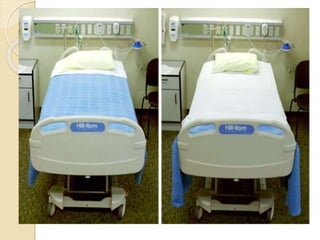
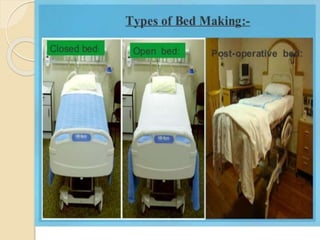
a) Closed bed or unoccupied bed-
The bed is ready for a new patient &
a bed made without the patient in the
bed.
b) Open bed or Occupied bed- A bed
made with the patient in the bed &
top linens are folded back.
B. Special bed:
a) Fowlers bed
b) Operation bed or surgical bed
c) Cardiac bed
d) Fracture bed or Amputation bed
e) Divided bed
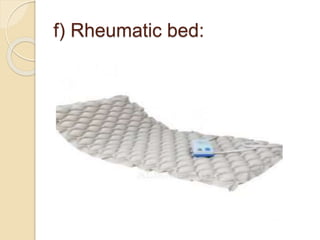
f) Rheumatic bed
g) Renal bed
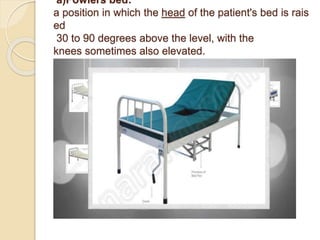
a)Fowlers bed:
a position in which the head of the patient's bed is rais
ed
30 to 90 degrees above the level, with the
knees sometimes also elevated.
b) Operation bed: It is made for the post-operative
patient after general and spinal anesthesia.
c) Cardiac bed: It is used for patients with heart
diseases to provide easy breathing for the patient
with minimum strain.
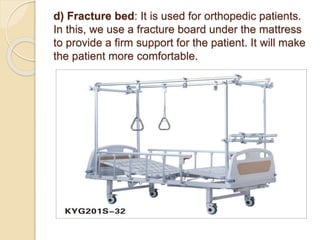
d) Fracture bed: It is used for orthopedic patients.
In this, we use a fracture board under the mattress
to provide a firm support for the patient. It will make
the patient more comfortable.
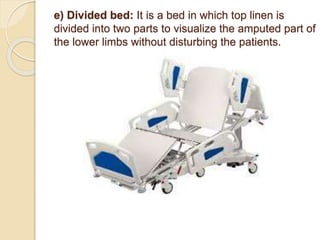
e) Divided bed: It is a bed in which top linen is
divided into two parts to visualize the amputed part of
the lower limbs without disturbing the patients.
f) Rheumatic bed:
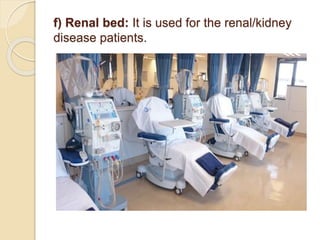
f) Renal bed: It is used for the renal/kidney
disease patients.
General/Basic principles of Bed
Making:
1. When removing sheets from the bed
lift the mattress while loosening the
bed linen, never full sheets with
force.
2. Always fold bed linen from top to
bottom.
3. Always arrange bed linen in correct
order with closed side away from you
before, making the bed. It should not
touch to the floor.
General/Basic principles of Bed
Making:
4. See there is no draught.
5. Dirty and clean linen should be kept
separate.
6.Dirty linen keep in dirty box.
7. Uniform should never touch the bed.
8. While tacking bedding under the
mattress the palm of the hands should
face down in order to protect our nails.
General/Basic principles of Bed
Making:
9. Keep the open end of the pillow away
from the entrance of the ward.
10. Soiled linen should not be thrown on
the floor, but it should be kept in dirty
linen box.
11.Soiled woolen blankets are to be
kept separately and not with the bed
linen.
12. When making an occupied bed try
not to cause discomfort by shaking the
bed or moving the patient
Procedure of Making
Unoccupied/closed Bed:
Equipment:
1. Chair/stool/trolly-hamper.
2. Duster
3. Basin with water/lotion savlon
4. Mattress with cover.
5. Long mackintosh.
6. Bed sheet-2
7. Pillow with covers-2
8. Draw sheet with mackintosh.
9. Blankets (if required)
10. Disposable Gloves (optional)
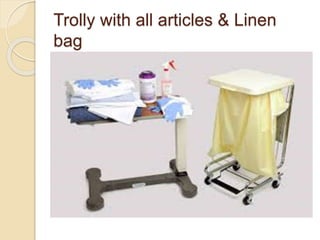
Trolly with all articles & Linen
bag
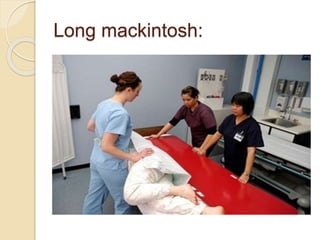
Long mackintosh:
Procedure of Making
Unoccupied/closed Bed:
1. Wash hands.
2. Wear disposable gloves.
3. Assemble and arrange equipment on
a bedside table.
4. Adjust the bed height to a
comfortable working position and
lower the side rail.
5. Loosen all linen from head to foot on
the side near to you. Move to the
other side of bed.
Procedure of Making
Unoccupied/closed Bed:
6. Discard the soiled linen into the hamper
or bucket.
7. Clean and draw the Mackintosh, roll it
and take it off.
8. Take pillows off, shake and change
covers.
9. Discard dirty linen into the hamper or
bucket.
10. Clean the long mackintosh, roll and
keep it on the chair/trolly.
11.Clean mattress with a dry duster.
Procedure of Making Unoccupied/closed
Bed:
12. Clean bed with wet duster.
13. Replace the long mackintosh on the
mattress.
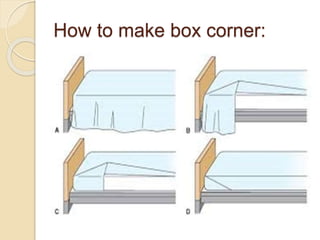
14. Spread bed sheet (bottom) and make box
corners on your side of the bed.
15. Spread and draw mackintosh, draw-sheet
and tuck them on your side.
16. Go to the other side of the bed, make box
corner of the sheet at the head-end and the
foot-end of the bed. Tuck draw-mackintosh
and draw-sheet neatly without wrinkles on
the side.
Procedure of Making Unoccupied/closed
Bed:
17.Spread top sheet to the full length of
the mattress.
18. Spread blankets over the top sheet.
19. Tuck at the foot-end by making
corners.
20 Spread bed cover to the full length
by making corners.
21. Put the pillow cover and place the
pillow at the head-end, the open end
away from the entrance.
Procedure of Making Unoccupied/closed
Bed:
22. Fanfold or pie fold top linens.
23. Rearrange furniture and place
personal items within easy reach.
24. Adjust the bed to a comfortable
height for the client.
25. Dispose off soiled linen and wash
hands.
How to make box corner:
Procedure of making An
Occupied/open bed:
Equipment:
1. Linen hamper.
2. Top sheet, draw sheet, bottom sheet.
3. Blanket.
4. Gloves.
Occupied bed: It is a bed from where
the patients cannot be moved out.
Procedure of making An
Occupied/open bed:
1. Greet the patient and explain the
procedure and identify the clients physical
ability.
2. The nurse should wash her hands & put
on gloves.
3. The nurse should collect all the needed
articles and bring them to the bed side.
4. Close door or draw bedside curtain.
5. Adjust the beds height to a comfortable
working position.
6. Place the bed in a flat position if the client
can tolerate it.
Procedure of making An
Occupied/open bed:
7. Lower the side rail on one side of bed.
8. Take off the top bed-clothes by folding
them one by one and place them an
stool/chair/trolly.
9. Keep the patient covered with one sheet or
blanket according to the weather.
10. Take off pillow from the bed and change it
cover, if necessary.
11. Bring the patient to the edge of the bed,
preferably in lateral position.
12. Roll the bottom linen towards the patient.
Procedure of making An
Occupied/open bed:
13. Dust the mattress.
14. Spread a clean bottom sheet over
the exposed mattress. Spread draw-
mackintosh at the center of the bed
and the draw-sheet, tuck and, make
corners.
15. Bring the patient onto the clean
linen and repeat the procedure on the
other side.
16. Change pillow cover and place them
in a position.
Procedure of making An
Occupied/open bed:
17. Raise side rail lower the bed height
to a comfortable position.
18. Dispose of solid linens according to
the hospital policy and wash hands.
Points to be Remembered during
bed making:
1. Assess the patients pulse, respiration and
blood pressure before ambulating.
2. Any comfort device used by the patient
should be replaced.
3. The patient should be assisted back to bed.
4. The whole unit of the patient must be made
neat and tidy.
5. Used dusters must be disinfected, washed
and dried.
6. If linen is soiled with feces, urine or any
other body fluids, segregate such linen for
laundry as per the hospital policy.
Bed  Making Basics in Nursing  Practices

Bed Making Basics in Nursing Practices

  • 1.
  • 2.
    Definition of BedMaking: Bed making is a technique which provides enough area to the patient on which he can be comfortable and perform his activities of daily living and also to facilitate therapeutic care. Or, Bed making may be defined as preparing a bed that is comfortable and suitable for a hospitalized patient.
  • 3.
    Purposes of closed/Unoccupied Bed: 1.To provide rest, comfort and safety to the patient. 2. To maintain a clean environment and neat appearance to the unit. 3. To reduce transmission of microorganisms. 4. To economize time, material and effort. 5. To promote cleanliness. 6. To observe patient and to prevent complications. 7. To provide smooth, wrinkle free bed thus minimizing sources of skin irritation.
  • 4.
    Purposes of anOpen/Occupied Bed: 1. To provide comfort for patients whose physical condition confines them to bed and for patients on imposed bed rest for therapeutic reasons. 2. To help him have a good relaxed sleep. 3. To give active and passive exercises to the patient and promote cleanliness.
  • 5.
    Purposes of anOpen/Occupied Bed: 5. To prevent bed sore. 6. To maintain neat appearance and clean environment. 7. To establish a good nurse patient relationship.
  • 6.
    Types of Bed: Thereare two main types of bed: A. Simple bed: a) Closed bed or unoccupied bed- The bed is ready for a new patient & a bed made without the patient in the bed. b) Open bed or Occupied bed- A bed made with the patient in the bed & top linens are folded back.
  • 9.
    B. Special bed: a)Fowlers bed b) Operation bed or surgical bed c) Cardiac bed d) Fracture bed or Amputation bed e) Divided bed f) Rheumatic bed g) Renal bed
  • 10.
    a)Fowlers bed: a positionin which the head of the patient's bed is rais ed 30 to 90 degrees above the level, with the knees sometimes also elevated.
  • 11.
    b) Operation bed:It is made for the post-operative patient after general and spinal anesthesia.
  • 12.
    c) Cardiac bed:It is used for patients with heart diseases to provide easy breathing for the patient with minimum strain.
  • 13.
    d) Fracture bed:It is used for orthopedic patients. In this, we use a fracture board under the mattress to provide a firm support for the patient. It will make the patient more comfortable.
  • 14.
    e) Divided bed:It is a bed in which top linen is divided into two parts to visualize the amputed part of the lower limbs without disturbing the patients.
  • 15.
  • 16.
    f) Renal bed:It is used for the renal/kidney disease patients.
  • 17.
    General/Basic principles ofBed Making: 1. When removing sheets from the bed lift the mattress while loosening the bed linen, never full sheets with force. 2. Always fold bed linen from top to bottom. 3. Always arrange bed linen in correct order with closed side away from you before, making the bed. It should not touch to the floor.
  • 18.
    General/Basic principles ofBed Making: 4. See there is no draught. 5. Dirty and clean linen should be kept separate. 6.Dirty linen keep in dirty box. 7. Uniform should never touch the bed. 8. While tacking bedding under the mattress the palm of the hands should face down in order to protect our nails.
  • 19.
    General/Basic principles ofBed Making: 9. Keep the open end of the pillow away from the entrance of the ward. 10. Soiled linen should not be thrown on the floor, but it should be kept in dirty linen box. 11.Soiled woolen blankets are to be kept separately and not with the bed linen. 12. When making an occupied bed try not to cause discomfort by shaking the bed or moving the patient
  • 20.
    Procedure of Making Unoccupied/closedBed: Equipment: 1. Chair/stool/trolly-hamper. 2. Duster 3. Basin with water/lotion savlon 4. Mattress with cover. 5. Long mackintosh. 6. Bed sheet-2 7. Pillow with covers-2 8. Draw sheet with mackintosh. 9. Blankets (if required) 10. Disposable Gloves (optional)
  • 21.
    Trolly with allarticles & Linen bag
  • 22.
  • 23.
    Procedure of Making Unoccupied/closedBed: 1. Wash hands. 2. Wear disposable gloves. 3. Assemble and arrange equipment on a bedside table. 4. Adjust the bed height to a comfortable working position and lower the side rail. 5. Loosen all linen from head to foot on the side near to you. Move to the other side of bed.
  • 24.
    Procedure of Making Unoccupied/closedBed: 6. Discard the soiled linen into the hamper or bucket. 7. Clean and draw the Mackintosh, roll it and take it off. 8. Take pillows off, shake and change covers. 9. Discard dirty linen into the hamper or bucket. 10. Clean the long mackintosh, roll and keep it on the chair/trolly. 11.Clean mattress with a dry duster.
  • 25.
    Procedure of MakingUnoccupied/closed Bed: 12. Clean bed with wet duster. 13. Replace the long mackintosh on the mattress. 14. Spread bed sheet (bottom) and make box corners on your side of the bed. 15. Spread and draw mackintosh, draw-sheet and tuck them on your side. 16. Go to the other side of the bed, make box corner of the sheet at the head-end and the foot-end of the bed. Tuck draw-mackintosh and draw-sheet neatly without wrinkles on the side.
  • 26.
    Procedure of MakingUnoccupied/closed Bed: 17.Spread top sheet to the full length of the mattress. 18. Spread blankets over the top sheet. 19. Tuck at the foot-end by making corners. 20 Spread bed cover to the full length by making corners. 21. Put the pillow cover and place the pillow at the head-end, the open end away from the entrance.
  • 27.
    Procedure of MakingUnoccupied/closed Bed: 22. Fanfold or pie fold top linens. 23. Rearrange furniture and place personal items within easy reach. 24. Adjust the bed to a comfortable height for the client. 25. Dispose off soiled linen and wash hands.
  • 28.
    How to makebox corner:
  • 29.
    Procedure of makingAn Occupied/open bed: Equipment: 1. Linen hamper. 2. Top sheet, draw sheet, bottom sheet. 3. Blanket. 4. Gloves. Occupied bed: It is a bed from where the patients cannot be moved out.
  • 30.
    Procedure of makingAn Occupied/open bed: 1. Greet the patient and explain the procedure and identify the clients physical ability. 2. The nurse should wash her hands & put on gloves. 3. The nurse should collect all the needed articles and bring them to the bed side. 4. Close door or draw bedside curtain. 5. Adjust the beds height to a comfortable working position. 6. Place the bed in a flat position if the client can tolerate it.
  • 31.
    Procedure of makingAn Occupied/open bed: 7. Lower the side rail on one side of bed. 8. Take off the top bed-clothes by folding them one by one and place them an stool/chair/trolly. 9. Keep the patient covered with one sheet or blanket according to the weather. 10. Take off pillow from the bed and change it cover, if necessary. 11. Bring the patient to the edge of the bed, preferably in lateral position. 12. Roll the bottom linen towards the patient.
  • 32.
    Procedure of makingAn Occupied/open bed: 13. Dust the mattress. 14. Spread a clean bottom sheet over the exposed mattress. Spread draw- mackintosh at the center of the bed and the draw-sheet, tuck and, make corners. 15. Bring the patient onto the clean linen and repeat the procedure on the other side. 16. Change pillow cover and place them in a position.
  • 33.
    Procedure of makingAn Occupied/open bed: 17. Raise side rail lower the bed height to a comfortable position. 18. Dispose of solid linens according to the hospital policy and wash hands.
  • 34.
    Points to beRemembered during bed making: 1. Assess the patients pulse, respiration and blood pressure before ambulating. 2. Any comfort device used by the patient should be replaced. 3. The patient should be assisted back to bed. 4. The whole unit of the patient must be made neat and tidy. 5. Used dusters must be disinfected, washed and dried. 6. If linen is soiled with feces, urine or any other body fluids, segregate such linen for laundry as per the hospital policy.