INTRODUCTION TO
NUTRITION
Prepared By : Ms. Leena Ghag Sakpal.
Nursing Tutor
FOOD
• Any substance used for energy, physical growth,
development and repair or rebuilding in the body can be
termed as food.
• It means, any such substance which after consumption,
helps in producing heat or energy, formation of new
tissues, repair of tissues and carrying the physiological
processes, can be called food.
FUNCTION OF FOOD
• Physical growth and development.
• Production of energy or power.
• Enhancement of tissues working capacity.
• Protection against diseases.
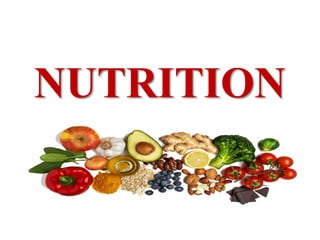
NUTRITION
INTRODUCTION
• The term “Nutrition” is derived from “Nourish” which
implies the food consumed by us and all the reactions through
which it is utilized for physical growth, energy and better
health.
• Nutrition plays an important role in healthy living and
prevention of diseases.
• Nutrition is most important indicator in determining the health
status of an individual, family and community and the nation.
DEFINITION
“Nutrition is the study of food and nourishment.”
“The scientific study of food and nourishment,
including food composition, dietary guidelines
and the roles that various nutrients have in
maintaining health.”
NUTRIENTS
• Nutrients are organic and inorganic compounds found in
diet.
• Ordinarily, we get many nutrients in food but there is no
such food item which contains all the nutrients.
• Every food item contains more than one nutrient.
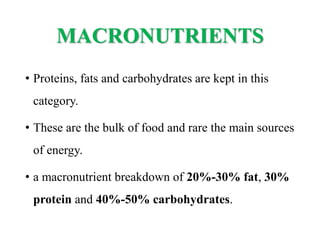
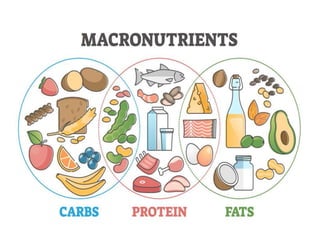
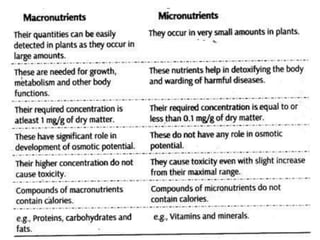
MACRONUTRIENTS
• Proteins, fats and carbohydrates are kept in this
category.
• These are the bulk of food and rare the main sources
of energy.
• a macronutrient breakdown of 20%-30% fat, 30%
protein and 40%-50% carbohydrates.
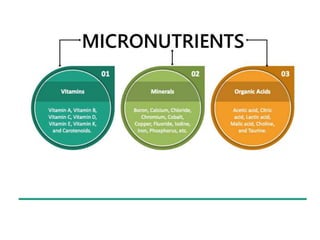
MICRONUTRIENTS
• This category includes minerals and vitamins.
• These are required in small quantities and hence,
called as micronutrients
FOOD HABITS AND
CUSTOMS
• India is a multi-customary country.
• Food customs and habits vary from religion to religion
and region to region, but irrespective of diversity, food
habits and customs are widely and respected in Indian
culture.
• Differences are present, but there are certain basic habits
and rules that are important to follow in dietary behavior.
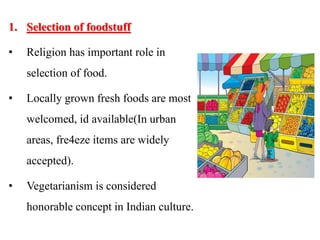
1. Selection of foodstuff
• Religion has important role in
selection of food.
• Locally grown fresh foods are most
welcomed, id available(In urban
areas, fre4eze items are widely
accepted).
• Vegetarianism is considered
honorable concept in Indian culture.
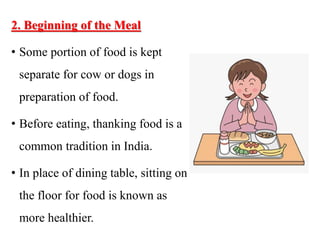
2. Beginning of the Meal
• Some portion of food is kept
separate for cow or dogs in
preparation of food.
• Before eating, thanking food is a
common tradition in India.
• In place of dining table, sitting on
the floor for food is known as
more healthier.
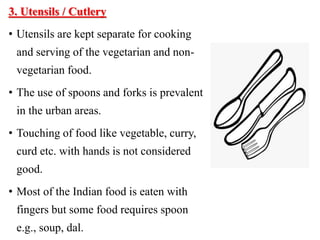
3. Utensils / Cutlery
• Utensils are kept separate for cooking
and serving of the vegetarian and non-
vegetarian food.
• The use of spoons and forks is prevalent
in the urban areas.
• Touching of food like vegetable, curry,
curd etc. with hands is not considered
good.
• Most of the Indian food is eaten with
fingers but some food requires spoon
e.g., soup, dal.
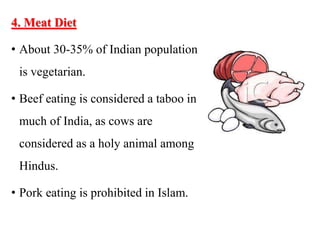
4. Meat Diet
• About 30-35% of Indian population
is vegetarian.
• Beef eating is considered a taboo in
much of India, as cows are
considered as a holy animal among
Hindus.
• Pork eating is prohibited in Islam.
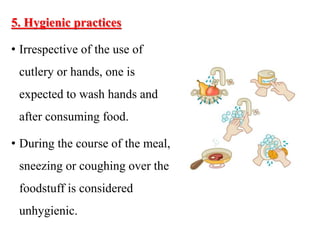
5. Hygienic practices
• Irrespective of the use of
cutlery or hands, one is
expected to wash hands and
after consuming food.
• During the course of the meal,
sneezing or coughing over the
foodstuff is considered
unhygienic.
6. Finishing the Meal
• In most parts of our country it is considered mannerly and
good etiquette to leave food place after the elders have
finished their food.
• In various communities different practices are found
which indicate the end of a meal e.g., In Rajasthan asking
papad is indication of end of a meal.
7. Other Customs / Food Habits
• Food has to be consumed by one hand only.
• It is customary that the host should take his meal at the
last.
• It is considered rudeness of the host, if he does not offer
the food to guest multiple times.
• Playing with the food is not acceptable.
• Leftover is not considered a good habit.
• It is customary to share food with anyone who wants it.
8. Food Fads
• Excessive drinking of water causes obesity.
• Consumption of fish and milk together causes
leukoderma.
• Some foods are considered "Hot" and some “Cold”. Eggs,
meat, wheat, and oil are considered as hot and the cause of
fever and boils, while fruits, vegetables and milk are
considered “Cold” which may lead to common cold,
cough, asthma and sore throat etc.
• Regarding woman as the goddess of food supply
(Annapurna) and yet not to give her sufficient nutrition
during pregnancy and lactation.
• Not to give fat rich diet to the woman after delivery.
• Feeding the infant only on breast milk and to consider
weaning as insignificant.
• Depriving the child from liquids following diarrhea with
the false notion of risk of more motions.
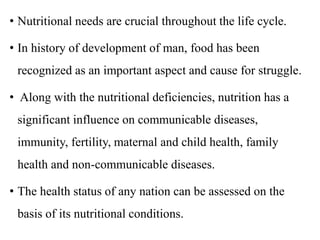
FACTORS AFFECTING
NUTRITION AND
PLANNING OF MEALS
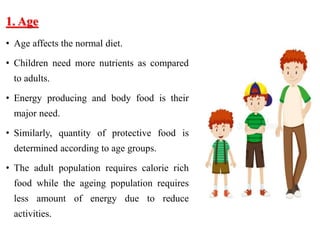
1. Age
• Age affects the normal diet.
• Children need more nutrients as compared
to adults.
• Energy producing and body food is their
major need.
• Similarly, quantity of protective food is
determined according to age groups.
• The adult population requires calorie rich
food while the ageing population requires
less amount of energy due to reduce
activities.
2. Sex
• Nutrition and balanced diet is different in
men and women.
• The nutritional requirement of males is
greater than those of females.
• Due to difference in body size and physical
activity, man needs more energy.
• During menstruation, due to loss of blood,
women need more iron. Similarly, women
need more nutritious diet during pregnancy
and lactation.
3. Income and Number of Members
• If the income of a person is higher, he
can purchase various food items in
sufficient quantities so, rich person's diet
may be more nutritious.
• Similarly, the number of members in a
family also affects the nutritional status
and choice of food.
• Even when the income is similar, the
standard of diet in small family is much
better than that of a large family.
4. Occupation
• Some occupations involve hard
physical labor while in some,
mental tension is more
common.
• A labor needs more protein and
energy as compared to an office
goer.
5. Cultural Factors
• Human life, like other factors, cannot remain Cultural
factors.
• Malnutrition or under nutrition, imbalanced or
extraordinary dietary conditions, may occur cultural
beliefs and traditions.
• Food habits, customs food fads have an important role in
meal planning and nutrition.
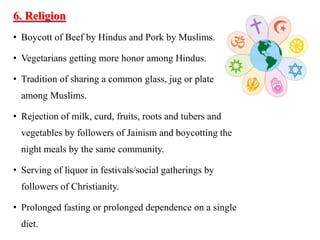
6. Religion
• Boycott of Beef by Hindus and Pork by Muslims.
• Vegetarians getting more honor among Hindus.
• Tradition of sharing a common glass, jug or plate
among Muslims.
• Rejection of milk, curd, fruits, roots and tubers and
vegetables by followers of Jainism and boycotting the
night meals by the same community.
• Serving of liquor in festivals/social gatherings by
followers of Christianity.
• Prolonged fasting or prolonged dependence on a single
diet.
7. Food Availability
• If the resources are limited, food crops are not enough or
particular agriculture crop is more or less, than nutrition
of common men is surely affected.
• Although they have the purchasing capacity, over
population is the main problem to face the under
nutrition in our country.
8. Food Laws and Food Safety
• If the public distribution system
(PDS) is working properly or food
safety laws are implemented in a
leak-proof manner, then the
nutrition status of country men can
be increased.
• Food laws have a direct impact on
nutrition.
CHANGING
CONCEPTS IN FOOD
AND NUTRITION
• Nutritional needs are crucial throughout the life cycle.
• In history of development of man, food has been
recognized as an important aspect and cause for struggle.
• Along with the nutritional deficiencies, nutrition has a
significant influence on communicable diseases,
immunity, fertility, maternal and child health, family
health and non-communicable diseases.
• The health status of any nation can be assessed on the
basis of its nutritional conditions.
• Cultural factors have a critical influence on nutritional
Pattern, as they directly affect our level of functioning.
• It should be noted that food is defined culturally.
• All the cultures of the world have a wealth of traditional
dishes that gain desirable tastes and textures by variety.
• Modern trends are reducing the use of many foods and are
thus altering the adequacy of many people's diets.
• Urbanization in many countries has affected the
availability of many traditional foods.
• Change in economic environment may alter family life and
eating habits.
• Other food habits however are dropped, modified or changed
to reflect personal and family preferences in taste and social
status.
• In our country, the nutritional concept of people is
continuously changing.
• In cities, individuals are shifting their food selection from
traditional foods to processed foods.
• In rural India also, people have started liking buffet system in
place of traditional sitting or pattal system.
• With the advent of the fast food culture, people like to eat more
packaged food and fast food; pizzas, burgers, chips and soft
drinks.
• Our food consumption habits are changing. Processed and junk
food has entered the kitchen and has become a major part of
the diet.
• The household budget has been thinned out to buy less cereals
and spend more on beverages, junk or processed food.
• This shift in food habits is clearly visible. Both urban and rural
population is spending more money on junk or fast food and
diet outing.
• More intake of these foods leads to increase in our calorie
intake which disturbs our metabolic activities.
• Sedentary lifestyle and metabolic disturbances cause obesity.
Due to obesity, occurrence of diabetes and rate of heart attack
are increasing.
• The problem is that while fast food industry is getting into our
homes, the quality of our food is declining.
• We are spending more but getting less.
• Paying Guest (PG) system, tiffin services, ready food corners
etc. are new aspects of nutrition culture. (Note : Refer changing
nutrition scenario as mentioned below).
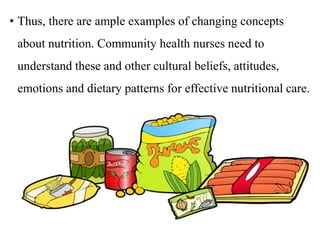
• Thus, there are ample examples of changing concepts
about nutrition. Community health nurses need to
understand these and other cultural beliefs, attitudes,
emotions and dietary patterns for effective nutritional care.
RELATIOSHIP TO
NUTRITION TO
HEATH
1. Physical and Mental Growth
• Nutrition is essential for the physical and mental development
and day to day energy requirements in the human me span from
childhood to old age.
• This requirement is greater in childhood and young age and is
reduced in the eldest people.
• In other words, maintenance of human health is no possible in
the absence of proper nutrition.
• Growth and development are directly related to diet and
nutrition.
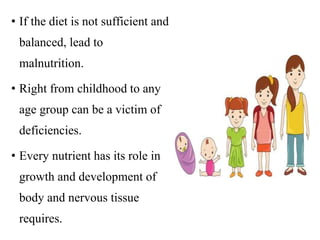
• If the diet is not sufficient and
balanced, lead to
malnutrition.
• Right from childhood to any
age group can be a victim of
deficiencies.
• Every nutrient has its role in
growth and development of
body and nervous tissue
requires.
2. Specific Nutritional Diseases
• The root cause behind the protein
calorie malnutrition, anaemia,
nutritional blindness, dysentery
etc. are different nutritional
problems.
• These health problems can be
tackled by altering or balancing
the diet.
3. Immunity
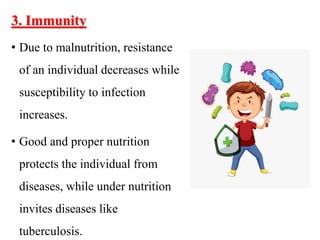
• Due to malnutrition, resistance
of an individual decreases while
susceptibility to infection
increases.
• Good and proper nutrition
protects the individual from
diseases, while under nutrition
invites diseases like
tuberculosis.
4. Maternal Child and Family Health
• The health of the vulnerable sections of the community
(expectant mothers and children under 14 years of age) is
directly and closely related to nutrition.
• Nutrition is an important factor in high maternal and infant
mortality
• Similarly, the health status of those family is higher where
nutrition is adequate and balanced.
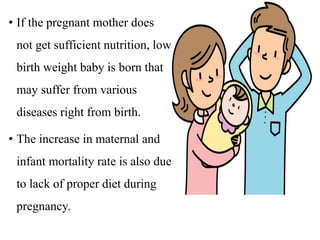
• If the pregnant mother does
not get sufficient nutrition, low
birth weight baby is born that
may suffer from various
diseases right from birth.
• The increase in maternal and
infant mortality rate is also due
to lack of proper diet during
pregnancy.
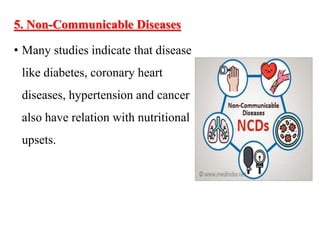
5. Non-Communicable Diseases
• Many studies indicate that disease
like diabetes, coronary heart
diseases, hypertension and cancer
also have relation with nutritional
upsets.
6. Primary Health Care
• For the achievement of “Health for all”, nutrition is one
out of the eight components of primary health care which
prove the importance of nutrition in health.
• Nutrition is an Important determinant of the national
health policy.
• In short, it can be said that health and nutrition cannot be
separated.
• In the past, nutritional diseases were held responsible for
ill health. According to the present ideology, health and
nutrition have to be studied in total, muldisciplinary and in
comprehensive manner, so that the nutritional problems
can be tackled and high standards of health can be
achieved.
FACTORS
RESPONSIBLE FOR
CHANGING
NUTRITIONAL
SCENRIO
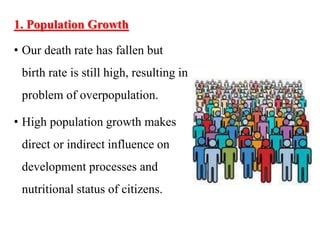
1. Population Growth
• Our death rate has fallen but
birth rate is still high, resulting in
problem of overpopulation.
• High population growth makes
direct or indirect influence on
development processes and
nutritional status of citizens.
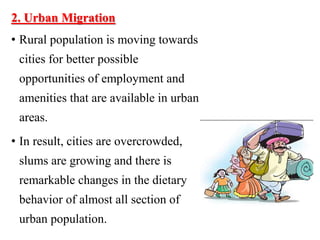
2. Urban Migration
• Rural population is moving towards
cities for better possible
opportunities of employment and
amenities that are available in urban
areas.
• In result, cities are overcrowded,
slums are growing and there is
remarkable changes in the dietary
behavior of almost all section of
urban population.
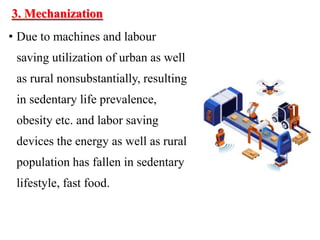
3. Mechanization
• Due to machines and labour
saving utilization of urban as well
as rural nonsubstantially, resulting
in sedentary life prevalence,
obesity etc. and labor saving
devices the energy as well as rural
population has fallen in sedentary
lifestyle, fast food.
4. Economic Development
• The per capita income of our country has
increased.
• Due to economic development, the
nutritional aspiration in the country is
also higher resulting in change of food
selection, increased demands of food; in
terms of quality and quantity and change
in pattern of food behavior.
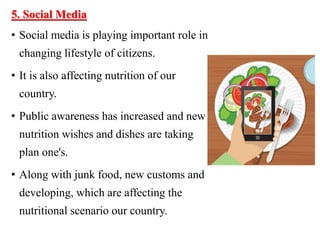
5. Social Media
• Social media is playing important role in
changing lifestyle of citizens.
• It is also affecting nutrition of our
country.
• Public awareness has increased and new
nutrition wishes and dishes are taking
plan one's.
• Along with junk food, new customs and
developing, which are affecting the
nutritional scenario our country.
IMPORTANCE
OF NUTRITION
IN NURSING
STUDIES
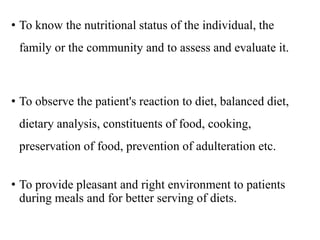
• To know the nutritional status of the individual, the
family or the community and to assess and evaluate it.
• To observe the patient's reaction to diet, balanced diet,
dietary analysis, constituents of food, cooking,
preservation of food, prevention of adulteration etc.
• To provide pleasant and right environment to patients
during meals and for better serving of diets.
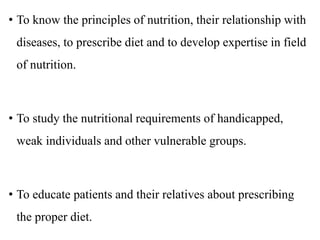
• To know the principles of nutrition, their relationship with
diseases, to prescribe diet and to develop expertise in field
of nutrition.
• To study the nutritional requirements of handicapped,
weak individuals and other vulnerable groups.
• To educate patients and their relatives about prescribing
the proper diet.
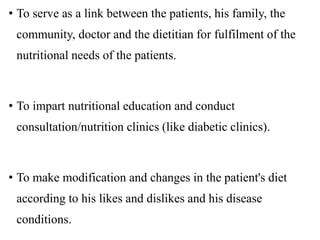
• To serve as a link between the patients, his family, the
community, doctor and the dietitian for fulfilment of the
nutritional needs of the patients.
• To impart nutritional education and conduct
consultation/nutrition clinics (like diabetic clinics).
• To make modification and changes in the patient's diet
according to his likes and dislikes and his disease
conditions.
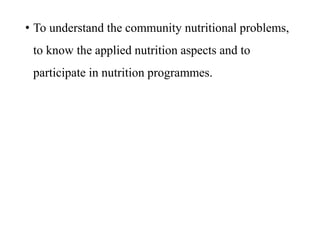
• To understand the community nutritional problems,
to know the applied nutrition aspects and to
participate in nutrition programmes.
 Introduction to Nutrition