VIDYAKIRANA COLLEGE OF NURSING BANGALORE
SUBJECT-
NUTRITION BSC
1SR YR.
TOPIC-
MOBILITY AND
IMMOBILITY
PRESENTED BY –
MRS. SULEKHA
DESHMUKH
**
• =
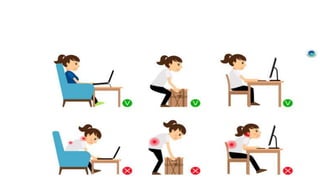
Body mechanics
Body mechanics is a term used to describe the
ways we move as we go about our daily lives. It
includes how we hold our bodies when we sit
stand, lift, carry, bend, and sleep. Poor body
mechanics are often the cause of back problems.
Purpose
•To avoid stress and strain[pressure] on the
musculoskeletal system
•It promote proper physiological function of the
body .
•It minimize the expenditure of the energy.
•it help in maintaining balance of the body
without strain.
•To prevent kyphosis, lordosis, and other
deformities.
•It contributes to one”s beauty.
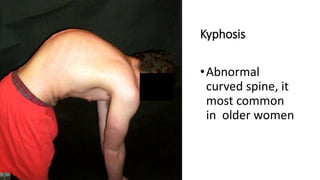
Kyphosis
•Abnormal
curved spine, it
most common
in older women
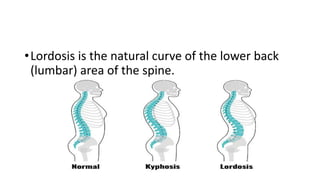
•Lordosis is the natural curve of the lower back
(lumbar) area of the spine.
Principles of body mechanics
•maintain good posture in all activity by avoiding
twisting the body ,turn your whole body ,face
the area in which you are working.
•It is easier to slide, pull or roll an object than to
lift it help to reduce the energy needed to raise
the weight .
•Movement should be smooth and co-ordinate
rather than jerky to prevent injury.
•Use strongest and longest muscles to perform
tasks which require physical effort.
•Keep the objective as close as possible to your
body when lifting ,moving, or carrying them
/
•keep the work at a comfortable height to avoid
excessive bending at the waist.
•Keep the body in good physical condition to
reduce the chance of injury.
•Get help if the object feel too heavy to lift.
•Flex the joint [ knee and hips] to come close to
the object instead of bending back
•Use the weight of the body to pull or push an
object by keeping the body above the object
GENERAL INSTRUCTION IN MOVING AND
LIFTING PATIENT
•Plan the movement of the patient ahead of time
and be sure the path is clear.
•Face the direction in which the movement will
be made to avoid twisting of the vertebral
column.
•Place the feet comfortably apart to provide a
wide base of support
•Flex the knee and hip joint but keep the trunk as
vertical [ straight 90 de.] as possible .
•Keep the patient as close to the body as
possible.
•Avoiding jerking and twisting during the lift.
•Heavy patient should be moved in bed by sliding
rather than lifting them.
•Assistance should be requested when lifting or
moving heavy patient.
•When moving a patient by more than one
person each worker assume the responsibility
for supporting one of the patients body section
the area to be supported are
•1 – head, shoulders, and chest
•2- hips
•3- thighs and ankles
•Observe the patient for symptoms of orthostatic
hypotension such as fainting,[to lose of
consciousness] dizziness, sweating
•Do not support the patient under his armpits,
since injury to major nerve and blood vessels
may occur.
•Always lock the wheels of bed and stretcher
prior to transferring a patient to increase static
friction between the wheels and the floor
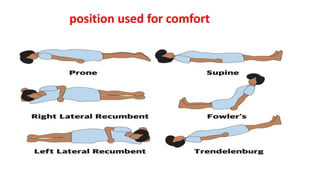
position used for comfort
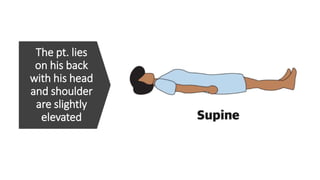
The pt. lies
on his back
with his head
and shoulder
are slightly
elevated
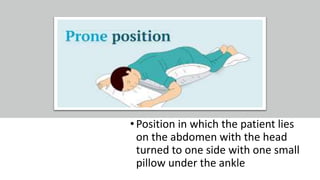
• Position in which the patient lies
on the abdomen with the head
turned to one side with one small
pillow under the ankle
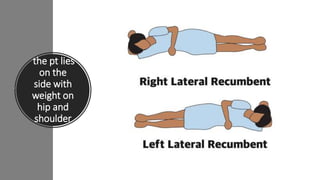
the pt lies
on the
side with
weight on
hip and
shoulder
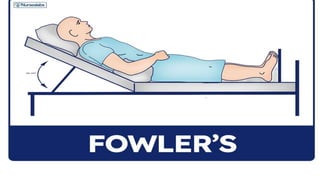
•It is the siting position in which the head is
elevated at 45 to 60 degree .
POSITION USED FOR
PHYSICAL EXAMINATION
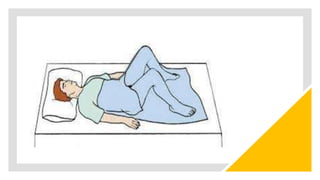
Dorsal recumbent position
•Used for vulval, vaginal and rectal examination
and for the operative procedures on the vulval
area and for such procedures as catheterization
of the bladder.
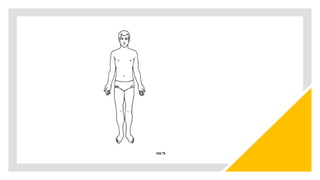
Erect position
•This is normal standing position with both feet
on the floor
•Used for orthopedic and neurological disorder
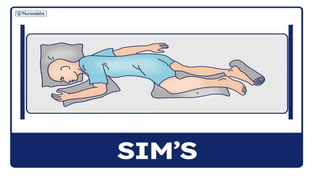
Sims lateral
•The patient lies on his left side or right side
•One pillow placed under the head, the left arm is
behind the back and right arm may be in any
position comfortable for the patient ,the right
thigh is flexed against the abdomen.
•Used mainly for the vaginal and rectal
examination
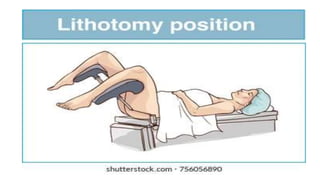
Lithotomy position
•the patient lies on his back with one pillow
under the head
•The legs are well separated and the thighs are
well fixed on the abdomen and the legs on the
thighs.
•The patient buttocks are brought to the extreme
edge of the table and legs are the supported on
the stirrups.
•used for the gynaecological examination and
treatments, surgical procedure involving the
genitourinary system.
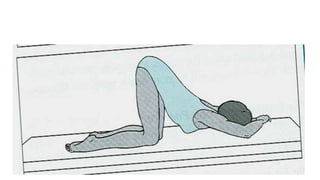
Knee chest position
•The pt. rest on the knee and the chest
•mainly used for the examination of rectum and
vagina
•Also as an exercise for the post partum patient
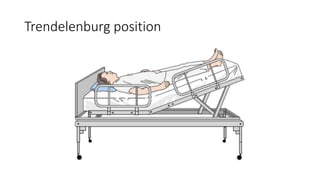
Trendelenburg position
•The patient lies on his back the foot on the bed
is elevated at a 45 degree angle.
•This position is used during the examination or
operation on the pelvic cavity into the upper
abdomen
•also used to treat shock and decreased blood
pressure.
Range of motion
•Range of motion is used when doing routine
activities such as bathing eating, dressing,
walking, sleeping, siting and standing,
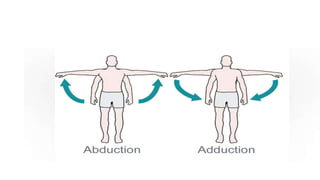
Range of motion
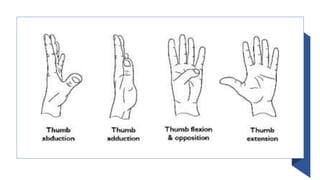
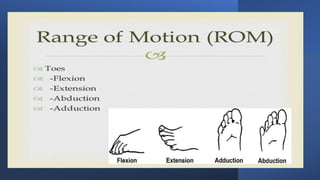
•Abduction: The movement of a limb away from
the midline of the body. The opposite of
abduction is adduction.
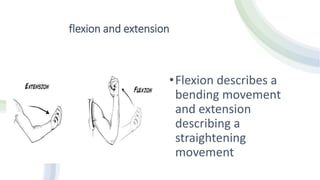
flexion and extension
•Flexion describes a
bending movement
and extension
describing a
straightening
movement
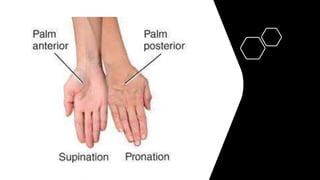
Supination and pronation
•When your palm or forearm faces up, it's
supinated. When your palm or forearm faces
down, it's pronated.
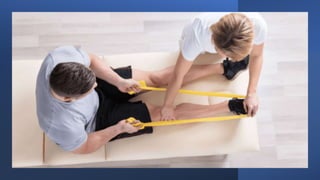
Range of motion exercise
•Range of motion exercises refers to activity
aimed at improving movement of a specific joint.
0r
Range of motion exercise are used to keep the
muscles and joint strong and flexible ,this exercise
can be done by the patient himself or with a
physical therapist.
Types
•ACTIVE RANGE OF MOTION -
Performed by the patient without help.
•PASIVE RANGE OF MOTION –
Not performed by the patient and the health care
worker moves each joint .
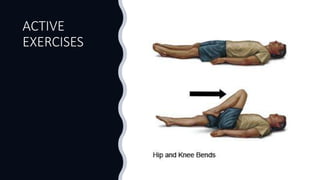
ACTIVE
EXERCISES
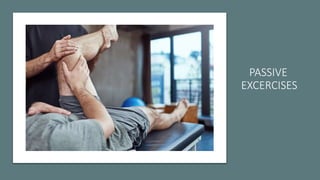
PASSIVE
EXCERCISES
•ACTIVE ASSISTIVE RANGE OF MOTION –
the patient does the exercises with some
assistance from another person or equipment
General rules for ROM
•use good body mechanics
•Expose only the body part being exercised
•Explain the patient what you are going to do .
•Support the extremity being exercised
•Move each joint slowly
•Return the joint to a natural position after the
movement
•Repeat the exercise 3-5 times
•Ideally these exercise should be done once per
day
•Expect the patient heart rate to increases during
exercise
•Some exercise may need to be delayed until the
patient condition improves.
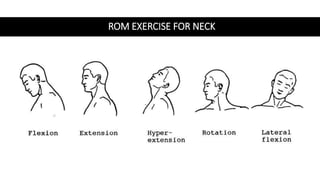
ROM EXERCISE FOR NECK
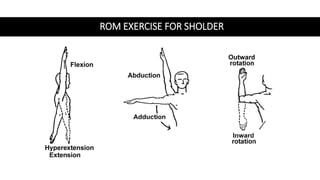
ROM EXERCISE FOR SHOLDER
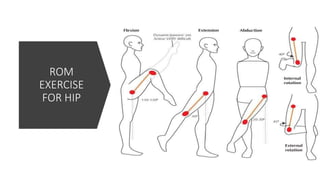
ROM
EXERCISE
FOR HIP
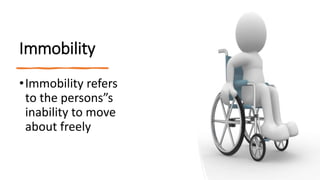
Immobility
•Immobility refers
to the persons”s
inability to move
about freely
Types of immobility
Social immobility- withdrawal from normal
pattern of social interaction .
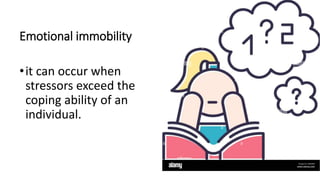
Emotional immobility
•it can occur when
stressors exceed the
coping ability of an
individual.
Intellectual immobility
•It can occur in persons who lack the ability to
acquire needed knowledge
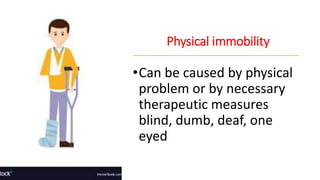
Physical immobility
•Can be caused by physical
problem or by necessary
therapeutic measures
blind, dumb, deaf, one
eyed
Effects of immobility
•Musculoskeletal system
•Prolonged bed rest and immobilization lead to
complications. Such complications are much
easier to prevent than to treat. Musculoskeletal
complications include loss of muscle strength
contractures and soft tissue changes, disuse
osteoporosis, and degenerative joint disease.-
Cardiovascular system
•Cardiovascular complications include an
increased heart rate, decreased cardiac reserve,
orthostatic hypotension, and venous
thromboembolism.[blood clots in the veins]
Respiration system
•The depth and rate of respiration and movement
of secretion in the respiration tract is decreased
when a person is immobile ,signs and system
include—
•Increased temperature
•Cough
•Increased pulse
•sharp chest pain
•Dyspnea
Nervous system
•Due to prolonged pressure and continual
stimulation of nerves, sensation in the nervous
system is altered ,the patient in the initial phase
may experience pain and then the sensation is
altered . But in cases of peripheral nerve palsy
the patient may no longer sense the pain
Gastrointestinal system
•Immobility may affect the gastrointestinal
system by slowing down the gastrointestinal
tract and decreased activity resulting in anorexia
bowel movements are also disturbed resulting in
constipation, and difficulty to evacuate feces
Integumentary system
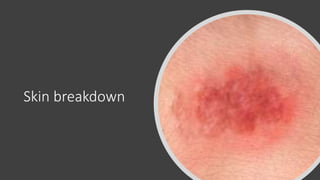
•Prolong pressure on the skin especially on bony
areas due to immobility marks, the client at
likelihood for skin breakdown[damage to the
skin surface] pressure ulcers and poor skin
turgor which leads to necrosis and ulceration of
tissues.
Urinary system
•Immobility can affect the urinary system
adversely, condition may include urinary stasis
retention, calculi, continence, urinary tract
infection.
Psychological changes
•Decreased self concept
•Altered thought process
•Coping difficulties
•Disturbed sleep pattern
care of patient with immobility
• =
•Assess the client for mobility, gait, strength, and
motor skills
•Identify complication of immobility e.g. skin
breakdown
•Perform skin assessment and implement
measures to maintain skin integrity and prevent
skin breakdown
Skin breakdown
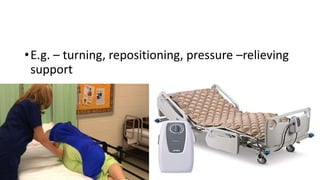
•E.g. – turning, repositioning, pressure –relieving
support
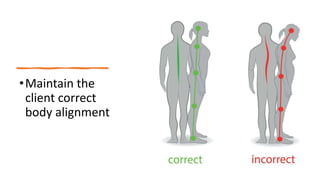
•Maintain the
client correct
body alignment
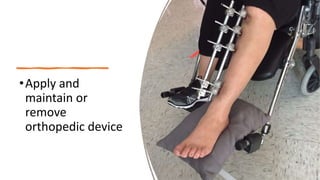
•Apply and
maintain or
remove
orthopedic device
•Apply knowledge of nursing procedures and skill
when providing care of client with immobility
•Educate the clients regarding proper methods
used when repositioning an immobilized client
•Evaluate the client”s response to intervention to
prevent complication from immobility
mobility and immobility.pptx

mobility and immobility.pptx

  • 1.
    VIDYAKIRANA COLLEGE OFNURSING BANGALORE SUBJECT- NUTRITION BSC 1SR YR. TOPIC- MOBILITY AND IMMOBILITY PRESENTED BY – MRS. SULEKHA DESHMUKH
  • 2.
  • 3.
    Body mechanics Body mechanicsis a term used to describe the ways we move as we go about our daily lives. It includes how we hold our bodies when we sit stand, lift, carry, bend, and sleep. Poor body mechanics are often the cause of back problems.
  • 5.
    Purpose •To avoid stressand strain[pressure] on the musculoskeletal system •It promote proper physiological function of the body . •It minimize the expenditure of the energy.
  • 6.
    •it help inmaintaining balance of the body without strain. •To prevent kyphosis, lordosis, and other deformities. •It contributes to one”s beauty.
  • 7.
  • 8.
    •Lordosis is thenatural curve of the lower back (lumbar) area of the spine.
  • 9.
    Principles of bodymechanics •maintain good posture in all activity by avoiding twisting the body ,turn your whole body ,face the area in which you are working. •It is easier to slide, pull or roll an object than to lift it help to reduce the energy needed to raise the weight .
  • 10.
    •Movement should besmooth and co-ordinate rather than jerky to prevent injury. •Use strongest and longest muscles to perform tasks which require physical effort. •Keep the objective as close as possible to your body when lifting ,moving, or carrying them
  • 11.
    / •keep the workat a comfortable height to avoid excessive bending at the waist. •Keep the body in good physical condition to reduce the chance of injury. •Get help if the object feel too heavy to lift. •Flex the joint [ knee and hips] to come close to the object instead of bending back
  • 12.
    •Use the weightof the body to pull or push an object by keeping the body above the object
  • 13.
    GENERAL INSTRUCTION INMOVING AND LIFTING PATIENT
  • 14.
    •Plan the movementof the patient ahead of time and be sure the path is clear. •Face the direction in which the movement will be made to avoid twisting of the vertebral column. •Place the feet comfortably apart to provide a wide base of support
  • 15.
    •Flex the kneeand hip joint but keep the trunk as vertical [ straight 90 de.] as possible . •Keep the patient as close to the body as possible. •Avoiding jerking and twisting during the lift. •Heavy patient should be moved in bed by sliding rather than lifting them.
  • 16.
    •Assistance should berequested when lifting or moving heavy patient. •When moving a patient by more than one person each worker assume the responsibility for supporting one of the patients body section the area to be supported are
  • 17.
    •1 – head,shoulders, and chest •2- hips •3- thighs and ankles •Observe the patient for symptoms of orthostatic hypotension such as fainting,[to lose of consciousness] dizziness, sweating
  • 18.
    •Do not supportthe patient under his armpits, since injury to major nerve and blood vessels may occur. •Always lock the wheels of bed and stretcher prior to transferring a patient to increase static friction between the wheels and the floor
  • 19.
  • 20.
    The pt. lies onhis back with his head and shoulder are slightly elevated
  • 21.
    • Position inwhich the patient lies on the abdomen with the head turned to one side with one small pillow under the ankle
  • 22.
    the pt lies onthe side with weight on hip and shoulder
  • 24.
    •It is thesiting position in which the head is elevated at 45 to 60 degree .
  • 25.
  • 26.
    Dorsal recumbent position •Usedfor vulval, vaginal and rectal examination and for the operative procedures on the vulval area and for such procedures as catheterization of the bladder.
  • 28.
    Erect position •This isnormal standing position with both feet on the floor •Used for orthopedic and neurological disorder
  • 30.
    Sims lateral •The patientlies on his left side or right side •One pillow placed under the head, the left arm is behind the back and right arm may be in any position comfortable for the patient ,the right thigh is flexed against the abdomen.
  • 31.
    •Used mainly forthe vaginal and rectal examination
  • 33.
    Lithotomy position •the patientlies on his back with one pillow under the head •The legs are well separated and the thighs are well fixed on the abdomen and the legs on the thighs. •The patient buttocks are brought to the extreme edge of the table and legs are the supported on the stirrups.
  • 34.
    •used for thegynaecological examination and treatments, surgical procedure involving the genitourinary system.
  • 36.
    Knee chest position •Thept. rest on the knee and the chest •mainly used for the examination of rectum and vagina •Also as an exercise for the post partum patient
  • 38.
  • 39.
    •The patient lieson his back the foot on the bed is elevated at a 45 degree angle. •This position is used during the examination or operation on the pelvic cavity into the upper abdomen
  • 40.
    •also used totreat shock and decreased blood pressure.
  • 41.
    Range of motion •Rangeof motion is used when doing routine activities such as bathing eating, dressing, walking, sleeping, siting and standing,
  • 42.
    Range of motion •Abduction:The movement of a limb away from the midline of the body. The opposite of abduction is adduction.
  • 44.
    flexion and extension •Flexiondescribes a bending movement and extension describing a straightening movement
  • 45.
    Supination and pronation •Whenyour palm or forearm faces up, it's supinated. When your palm or forearm faces down, it's pronated.
  • 47.
  • 48.
    •Range of motionexercises refers to activity aimed at improving movement of a specific joint. 0r Range of motion exercise are used to keep the muscles and joint strong and flexible ,this exercise can be done by the patient himself or with a physical therapist.
  • 49.
    Types •ACTIVE RANGE OFMOTION - Performed by the patient without help. •PASIVE RANGE OF MOTION – Not performed by the patient and the health care worker moves each joint .
  • 50.
  • 51.
  • 52.
    •ACTIVE ASSISTIVE RANGEOF MOTION – the patient does the exercises with some assistance from another person or equipment
  • 54.
    General rules forROM •use good body mechanics •Expose only the body part being exercised •Explain the patient what you are going to do . •Support the extremity being exercised •Move each joint slowly •Return the joint to a natural position after the movement
  • 55.
    •Repeat the exercise3-5 times •Ideally these exercise should be done once per day •Expect the patient heart rate to increases during exercise •Some exercise may need to be delayed until the patient condition improves.
  • 56.
  • 57.
  • 59.
  • 61.
    Immobility •Immobility refers to thepersons”s inability to move about freely
  • 62.
    Types of immobility Socialimmobility- withdrawal from normal pattern of social interaction .
  • 63.
    Emotional immobility •it canoccur when stressors exceed the coping ability of an individual.
  • 64.
    Intellectual immobility •It canoccur in persons who lack the ability to acquire needed knowledge
  • 65.
    Physical immobility •Can becaused by physical problem or by necessary therapeutic measures blind, dumb, deaf, one eyed
  • 66.
    Effects of immobility •Musculoskeletalsystem •Prolonged bed rest and immobilization lead to complications. Such complications are much easier to prevent than to treat. Musculoskeletal complications include loss of muscle strength contractures and soft tissue changes, disuse osteoporosis, and degenerative joint disease.-
  • 67.
    Cardiovascular system •Cardiovascular complicationsinclude an increased heart rate, decreased cardiac reserve, orthostatic hypotension, and venous thromboembolism.[blood clots in the veins]
  • 68.
    Respiration system •The depthand rate of respiration and movement of secretion in the respiration tract is decreased when a person is immobile ,signs and system include— •Increased temperature •Cough •Increased pulse
  • 69.
  • 70.
    Nervous system •Due toprolonged pressure and continual stimulation of nerves, sensation in the nervous system is altered ,the patient in the initial phase may experience pain and then the sensation is altered . But in cases of peripheral nerve palsy the patient may no longer sense the pain
  • 71.
    Gastrointestinal system •Immobility mayaffect the gastrointestinal system by slowing down the gastrointestinal tract and decreased activity resulting in anorexia bowel movements are also disturbed resulting in constipation, and difficulty to evacuate feces
  • 72.
    Integumentary system •Prolong pressureon the skin especially on bony areas due to immobility marks, the client at likelihood for skin breakdown[damage to the skin surface] pressure ulcers and poor skin turgor which leads to necrosis and ulceration of tissues.
  • 73.
    Urinary system •Immobility canaffect the urinary system adversely, condition may include urinary stasis retention, calculi, continence, urinary tract infection.
  • 74.
    Psychological changes •Decreased selfconcept •Altered thought process •Coping difficulties •Disturbed sleep pattern
  • 75.
    care of patientwith immobility • =
  • 76.
    •Assess the clientfor mobility, gait, strength, and motor skills •Identify complication of immobility e.g. skin breakdown •Perform skin assessment and implement measures to maintain skin integrity and prevent skin breakdown
  • 77.
  • 78.
    •E.g. – turning,repositioning, pressure –relieving support
  • 79.
  • 80.
  • 81.
    •Apply knowledge ofnursing procedures and skill when providing care of client with immobility •Educate the clients regarding proper methods used when repositioning an immobilized client •Evaluate the client”s response to intervention to prevent complication from immobility