

 To maintain joint mobility is done by putting each of the
patients joints through all possible movements.
 To increase and /or maintain movenment in each joints
 To prevent contractures
 To prevent atony (insuffiecient muscle tone)
 To prevent atrophy of muscles
 To To stimulate circulation
 To reduce edema
 To reduce workload on heart.
• To prevent thrombus and embolus formation
• To improve coordination
• To increase tolerance for more activity.
• To maintain and build muscle strength
• To prevent constipation and flatuence
• To promote urinary infection
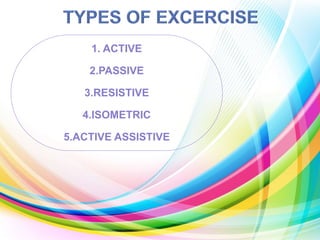
1. ACTIVE
2.PASSIVE
3.RESISTIVE
4.ISOMETRIC
5.ACTIVE ASSISTIVE
 these excercise are performed by the patient by patient,without
assistance , to increase muscle strength. some of the excercises
that can be done by the patient on the bed are”:
 deep breathing
 coughing
 range of motion
 moving in bed
 foot excercises
 abdominal and gluteal contraction excercises
 these excercise are carried out by the nurse, without assistance
from the patient.
 passive excersice will not preserve muscle mass or bone
mineralization because there is no voluntary contraction lengthening
of muscle or tension on bones.
 these are active excercise performed by the patient by pulling or
pushing against an opposing force
 these exercise are performed by the patient by contracting and
relaxing muscle while keeping the part in a fixed position. isometric
excercise are done to maintain muscle strength when a joint is
immobilized.
 full patient cooperation is required
 these excercises are performed by the patient with assistance from
the nurse. ACTIVE ASSISTIVE excercises encourage normal
muscle function while the nurse support the distal joint.
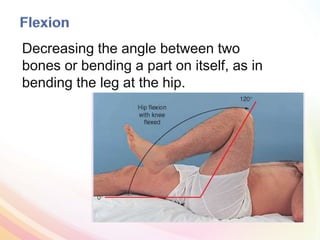
Decreasing the angle between two
bones or bending a part on itself, as in
bending the leg at the hip.
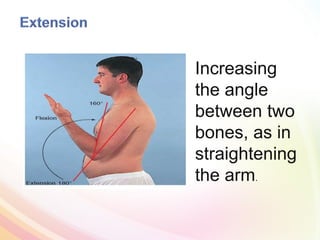
Increasing
the angle
between two
bones, as in
straightening
the arm.
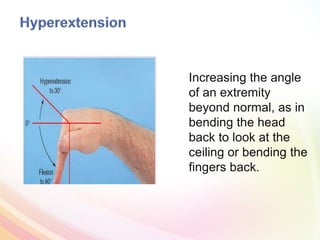
Increasing the angle
of an extremity
beyond normal, as in
bending the head
back to look at the
ceiling or bending the
fingers back.
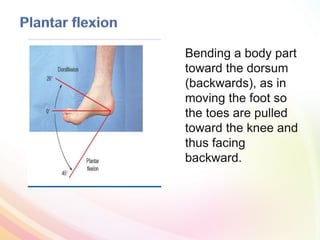
Bending a body part toward the dorsum
(backwards), as in moving the foot so the
toes are pulled toward the knee and thus
facing backward.
Bending a body part
toward the dorsum
(backwards), as in
moving the foot so
the toes are pulled
toward the knee and
thus facing
backward.
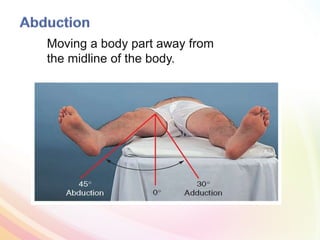
Moving a body part away from
the midline of the body.
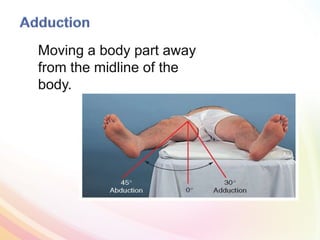
Moving a body part away
from the midline of the
body.
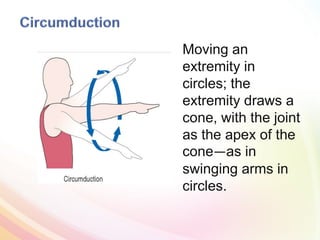
Moving an
extremity in
circles; the
extremity draws a
cone, with the joint
as the apex of the
cone—as in
swinging arms in
circles.
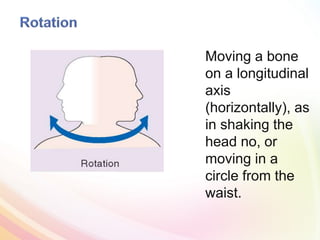
Moving a bone
on a longitudinal
axis
(horizontally), as
in shaking the
head no, or
moving in a
circle from the
waist.
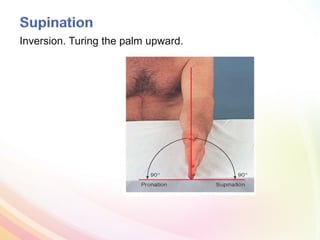
Inversion. Turing the palm upward.
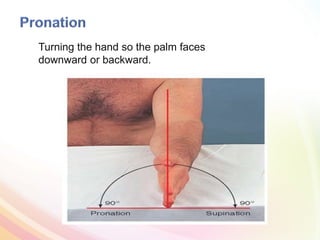
Turning the hand so the palm faces
downward or backward.
Turning a body part so that it faces
medially or inside, such as turning the
ankle so that the sole of the foot faces the
opposite foot.
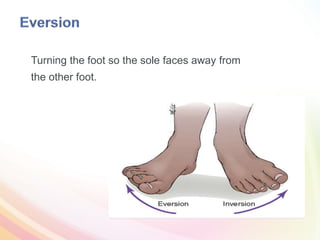
Turning the foot so the sole faces away from
the other foot.
Moving forward or
anteriorly, as in jutting
out the jaw.
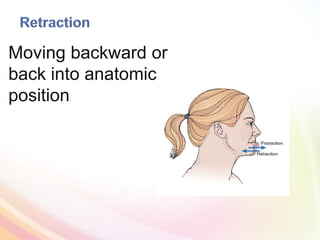
Moving backward or
back into anatomic
position.
ACTIVITY AND EXERCISE NURSING FOUNDATION OF NURSING