Bed Making
- Khyati Chaudhari
Definition
It’s process of making neat & clean bed for the client in the hospital.
Principles to keep in mind
Principle 1
Micro organisms are found everywhere on the skin, on the
articles used by the client and in the environment. The nurses
take care to prevent the transference of micro organisms from
the source to the new host by direct or indirect contact or prevent
the multiplication of the microorganisms.
• The nurse washes her hands before and after bed making to protect
the client and herself from cross infection.
Principle 1
• When changing bed linen, follow principles of medical asepsis by keeping
soiled linen away from the uniform.
• Place soiled linen in special linen bags before placing in a hamper.
• To avoid air currents that spread microorganisms, never shake the linen.
• To avoid transmitting infection, do not place soiled linen on the floor. If
clean linen touches the floor or any unclean surface, immediately place it in
the dirty linen container.
Principle 1
• Dry dusting raises dust. Damp dusting is recommended.
• The nurse keeps a reasonable distance from the client’s face to prevent
droplet infection.
• Cleaning an area where there are less number of organisms before
cleaning an area where there are numerous organisms minimizes the
spread of organism to the clean area. E.g. Clean the bed first before
cleaning the bedside locker.
Principle 1
• The linen removed from the isolation unit is disinfected first before
they are sent to laundry.
Principle 2
A safe and comfortable bed will ensure rest, sleep and prevent
several complications in bedridden patients. E.g. bedsore, foot
drop etc.
• The body exerts uneven pressure against the mattress, the pressure is
greatest over the bony prominences. Lumps and creases in the bed can
cause bedsores due to friction between the bed and mattress or
wrinkled sheets. Therefore the nurses should take care to make the bed
smooth and unwrinkled.
Principle 2
• Pull the bottom sheet tightly so that there is no wrinkles.
• Keep the linen tucked far enough under the mattress, keep it fixed,
tight and smooth.
• While tightening the sheets, do not alter the shape of the mattress.
• No wet linen should remain on the bed.
Principle 2
• A bed made for a client should allow enough freedom for moving from side
to side. The movement of the client stimulates circulation, prevent bed sores
and maintains muscle tone. Comfort devices are used to provide additional
comfort to the client.
• If the client is in bed for longer time , tight upper bedding may cause foot
drop.
• It can be prevented by making a pleat in the top sheet and blanket across
the foot of the bed.
Principle 2
• While tucking the upper bedding, ask the client to flex his knees.
• Place a pillow, foot board or cradle at the foot of the bed to take
the weight of the upper bedding.
Principle 3
 Good body mechanisms maintain the body alignment and
prevents fatigue.
• During bed making use safe patient handling procedures and proper
body mechanics .
• The stability of the body is assured by keeping its center of gravity
over its base. When the base is wide it ensures that the center of
gravity will fall through its base. In standing position the nurse can
have a wide base by separating her feet.
Principle 3
• The nearer to center of gravity a weight is held, the less is the strain
produced. E.g.. When opening the linen it should be placed on the
edge of the bed rather than holding it above the shoulder level.
• Always raise the bed to the appropriate height before changing linen so
you do not have to bend or stretch over the mattress. You move back
and forth to opposite sides of the bed while applying new linen.
Principle 3
• Body mechanics and safe handling are important when turning or
repositioning the patient in bed.
• When tucking the sheets under the mattress, flexing is done by knees
and hips. This position shifts the work to the long and strong muscles
of the thighs and keep the back in good alignment. This reduces strain
on the back.
Principle 3
• When placing the linen on the bed and tucking them under the
mattress face the direction of work and move with the work rather
than twisting the body and over reaching.
Principle 4
 Systematic ways of functioning saves time, energy and
materials.
• When patients are confined to bed, organize bed-making activities to
conserve time and energy.
• Assemble all articles and arrange them conveniently before starting the
bed making.
• Arrange the linen in the reverse order of use.
Principle 4
• Finish on one side of the bed before going to the opposite side
• When stripping the bed, remove the bed linen one by one holding the
open end towards the floor, so that the client’s possessions and the
hospital articles are not send to the laundry.
• The bed sheets are folded in such a way that it can be replaced easily.
General Principles
• The patient’s privacy, comfort, and safety are all important when
making a bed.
• Using side rails to aid positioning and turning, keeping call lights
within the patient’s reach and maintaining the proper bed position help
promote comfort and safety.
• After making a bed, return it to the lowest horizontal position and
verify that the wheels are locked to prevent accidental falls when the
patient gets in and out alone.
• When possible, make the bed while it is unoccupied . Use judgment to
determine the best time for the patient to sit up in a chair so you can
make the bed. When making an unoccupied bed, follow the same basic
principles as for occupied bed making.
Purposes of Bed-Making
• To provide a clean and comfortable bed for the patient.
• To give a neat and tidy appearance to the unit.
• To keep it ready for any emergencies.
• To receive the patient comfortably.
• To provide active and passive exercise to the patient.
• To establish interpersonal relationship.
• To economize the time, material and energy.
• To teach relatives how to take care of the patient at home.
• To prevent bed sores.
• To observe the client.
Types of Bed
1. Open bed
2. Closed bed
3. Occupied bed
4. Admission bed
5. Post operative bed
6. Cardiac bed
7. Amputation bed/divided bed
8. Fracture bed
9. Therapeutic bed (renal bed,
rheumatism bed, blanket bed)
Open Bed
• It is a bed, made when it is about to
be occupied by either a new patient
or an ambulatory patient.
Closed Bed
• It is an unoccupied or empty bed
made to receive the patient and
is fully covered with counter
pane to protect it from dust and
dirt. On admission of the
patient, the closed bed is
converted in to an open bed.
Purposes
• To keep the bed ready for occupancy.
• To provide a neat and tidy appearance to the unit.
Occupied Bed
• This bed is made with the
patient in it.
Purposes
• To make a bed with least possible discomfort to the patient.
• To handle the bed clothes skillfully while the patient is on bed, giving least
disturbance to the occupant.
• To provide a neat, clean and tidy appearance.
Admission Bed
• This is the bed prepared to receive a newly admitted patient.
 Purposes :
• To welcome the patient.
• To provide immediate care, safety and comfort.
• To protect the bed linen while giving bath on admission.
Post-operative Bed
• It is a bed prepared for a patient
who is recovering from the
effects of anesthesia following
surgery.
Purposes
• To receive the patient conveniently.
• To provide warmth and comfort.
• To prevent shock.
• To prevent injury.
• To prevent soiling of the bed.
• To meet any emergency.
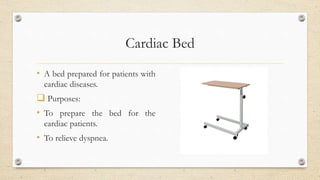
Cardiac Bed
• A bed prepared for patients with
cardiac diseases.
 Purposes:
• To prepare the bed for the
cardiac patients.
• To relieve dyspnea.
Amputation bed/divided bed
• It is a bed in which top linen is
divided into two parts to
visualize the amputed part of
the lower limbs without
disturbing the patient.
Purposes
• To watch the stump for hemorrhage and apply tourniquet instantly.
• To take the weight of the bed clothes off the patient.
• To keep the stump in position.
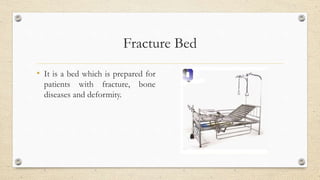
Fracture Bed
• It is a bed which is prepared for
patients with fracture, bone
diseases and deformity.
Purposes
• To prevent undue sagging of mattress.
• To immobilize the fractured part.
• To restrict sudden jerky movements.
• To keep the traction in position.
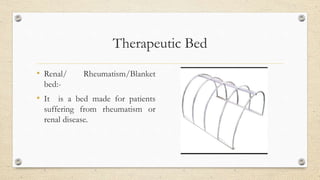
Therapeutic Bed
• Renal/ Rheumatism/Blanket
bed:-
• It is a bed made for patients
suffering from rheumatism or
renal disease.
Purposes
• To carry the weight of the bed clothes off the painful joints.
• To keep the patient warm.
• To induce sweating .
Nurses Responsibility In Bed-Making
 Preliminary Assessment :
• Check the doctor’s order for specific precautions regarding the movement
and positioning of the client.
• Assess the client’s ability for self care.
• Check the furniture and linen available in the client’s unit.
• Assess the number of clean linen needed.
• Assess the articles needed for the comfort of the client. E.g. : blankets,
backrests.
Preparation of the articles – Open Bed
• Bottom sheet
• Mackintosh
• Draw sheet
• Top sheet
• Blanket
• Pillow cover (pillow case)
• Additional articles :
• Laundry bag
• Dusters
• A bowl with antiseptic
solution (savlon 1:40)
• A kidney tray
Mackintosh & Draw sheet
Kidney Tray
Laundry bag
Preparation of the client & unit
• Explain the procedure to the client to win the co operation and
confidence of the client.
• Explain how the client can assist.
• Screen the client to provide privacy if needed.
• Move furniture away from the bed and move the bed away from the
wall.
• Lower the back rest if any.
• Place the laundry bag within the reach.
Procedure
• Keep the articles near to the unit.
• Explain the procedure. Make the patient to sit in a chair comfortably.
• Hand washing.
• Remove the pillow and place it in a side.
• Remove the old linens, if there(blanket, top sheet, draw sheet,
mackintosh, bottom sheet).
• Dust the mattress and the cot and the furnitures.
• Spread the bottom sheet, mackintosh and draw sheet.
• Tuck the near side first from top to bottom. Make metre corner.
• Go to opposite side. Tuck that side.
• Spread the top sheet ( and blanket if needed).
• Make a knee pleat. Tuck near side bottom and then the opposite side.
allow the sides to hang freely.
• Fanfold the top sheets to the bottom.
• Put the pillow cover on pillow. Place it with open end away from the
door side.
After care of client, unit & equipments
• Help the client to get in to the bed.
• Replace the comfort devises used.
• See that the whole unit is clean and tidy before you leave the unit.
• Send the laundry bag with soiled linen to laundry. If stains are present
on the linen, remove them with appropriate methods before sending
them for laundry.
• Soak the duster in antiseptic solution to disinfect it. Rinse it with clean water
and put to dry.
• Hand washing.
• Record the procedure.
bedmaking-200622082816.pdf

bedmaking-200622082816.pdf

  • 1.
  • 2.
    Definition It’s process ofmaking neat & clean bed for the client in the hospital.
  • 3.
  • 4.
    Principle 1 Micro organismsare found everywhere on the skin, on the articles used by the client and in the environment. The nurses take care to prevent the transference of micro organisms from the source to the new host by direct or indirect contact or prevent the multiplication of the microorganisms. • The nurse washes her hands before and after bed making to protect the client and herself from cross infection.
  • 5.
    Principle 1 • Whenchanging bed linen, follow principles of medical asepsis by keeping soiled linen away from the uniform. • Place soiled linen in special linen bags before placing in a hamper. • To avoid air currents that spread microorganisms, never shake the linen. • To avoid transmitting infection, do not place soiled linen on the floor. If clean linen touches the floor or any unclean surface, immediately place it in the dirty linen container.
  • 6.
    Principle 1 • Drydusting raises dust. Damp dusting is recommended. • The nurse keeps a reasonable distance from the client’s face to prevent droplet infection. • Cleaning an area where there are less number of organisms before cleaning an area where there are numerous organisms minimizes the spread of organism to the clean area. E.g. Clean the bed first before cleaning the bedside locker.
  • 7.
    Principle 1 • Thelinen removed from the isolation unit is disinfected first before they are sent to laundry.
  • 8.
    Principle 2 A safeand comfortable bed will ensure rest, sleep and prevent several complications in bedridden patients. E.g. bedsore, foot drop etc. • The body exerts uneven pressure against the mattress, the pressure is greatest over the bony prominences. Lumps and creases in the bed can cause bedsores due to friction between the bed and mattress or wrinkled sheets. Therefore the nurses should take care to make the bed smooth and unwrinkled.
  • 9.
    Principle 2 • Pullthe bottom sheet tightly so that there is no wrinkles. • Keep the linen tucked far enough under the mattress, keep it fixed, tight and smooth. • While tightening the sheets, do not alter the shape of the mattress. • No wet linen should remain on the bed.
  • 10.
    Principle 2 • Abed made for a client should allow enough freedom for moving from side to side. The movement of the client stimulates circulation, prevent bed sores and maintains muscle tone. Comfort devices are used to provide additional comfort to the client. • If the client is in bed for longer time , tight upper bedding may cause foot drop. • It can be prevented by making a pleat in the top sheet and blanket across the foot of the bed.
  • 11.
    Principle 2 • Whiletucking the upper bedding, ask the client to flex his knees. • Place a pillow, foot board or cradle at the foot of the bed to take the weight of the upper bedding.
  • 12.
    Principle 3  Goodbody mechanisms maintain the body alignment and prevents fatigue. • During bed making use safe patient handling procedures and proper body mechanics . • The stability of the body is assured by keeping its center of gravity over its base. When the base is wide it ensures that the center of gravity will fall through its base. In standing position the nurse can have a wide base by separating her feet.
  • 13.
    Principle 3 • Thenearer to center of gravity a weight is held, the less is the strain produced. E.g.. When opening the linen it should be placed on the edge of the bed rather than holding it above the shoulder level. • Always raise the bed to the appropriate height before changing linen so you do not have to bend or stretch over the mattress. You move back and forth to opposite sides of the bed while applying new linen.
  • 14.
    Principle 3 • Bodymechanics and safe handling are important when turning or repositioning the patient in bed. • When tucking the sheets under the mattress, flexing is done by knees and hips. This position shifts the work to the long and strong muscles of the thighs and keep the back in good alignment. This reduces strain on the back.
  • 15.
    Principle 3 • Whenplacing the linen on the bed and tucking them under the mattress face the direction of work and move with the work rather than twisting the body and over reaching.
  • 16.
    Principle 4  Systematicways of functioning saves time, energy and materials. • When patients are confined to bed, organize bed-making activities to conserve time and energy. • Assemble all articles and arrange them conveniently before starting the bed making. • Arrange the linen in the reverse order of use.
  • 17.
    Principle 4 • Finishon one side of the bed before going to the opposite side • When stripping the bed, remove the bed linen one by one holding the open end towards the floor, so that the client’s possessions and the hospital articles are not send to the laundry. • The bed sheets are folded in such a way that it can be replaced easily.
  • 18.
  • 19.
    • The patient’sprivacy, comfort, and safety are all important when making a bed. • Using side rails to aid positioning and turning, keeping call lights within the patient’s reach and maintaining the proper bed position help promote comfort and safety. • After making a bed, return it to the lowest horizontal position and verify that the wheels are locked to prevent accidental falls when the patient gets in and out alone.
  • 20.
    • When possible,make the bed while it is unoccupied . Use judgment to determine the best time for the patient to sit up in a chair so you can make the bed. When making an unoccupied bed, follow the same basic principles as for occupied bed making.
  • 21.
  • 22.
    • To providea clean and comfortable bed for the patient. • To give a neat and tidy appearance to the unit. • To keep it ready for any emergencies. • To receive the patient comfortably. • To provide active and passive exercise to the patient.
  • 23.
    • To establishinterpersonal relationship. • To economize the time, material and energy. • To teach relatives how to take care of the patient at home. • To prevent bed sores. • To observe the client.
  • 24.
    Types of Bed 1.Open bed 2. Closed bed 3. Occupied bed 4. Admission bed 5. Post operative bed 6. Cardiac bed 7. Amputation bed/divided bed 8. Fracture bed 9. Therapeutic bed (renal bed, rheumatism bed, blanket bed)
  • 25.
    Open Bed • Itis a bed, made when it is about to be occupied by either a new patient or an ambulatory patient.
  • 26.
    Closed Bed • Itis an unoccupied or empty bed made to receive the patient and is fully covered with counter pane to protect it from dust and dirt. On admission of the patient, the closed bed is converted in to an open bed.
  • 27.
    Purposes • To keepthe bed ready for occupancy. • To provide a neat and tidy appearance to the unit.
  • 28.
    Occupied Bed • Thisbed is made with the patient in it.
  • 29.
    Purposes • To makea bed with least possible discomfort to the patient. • To handle the bed clothes skillfully while the patient is on bed, giving least disturbance to the occupant. • To provide a neat, clean and tidy appearance.
  • 30.
    Admission Bed • Thisis the bed prepared to receive a newly admitted patient.  Purposes : • To welcome the patient. • To provide immediate care, safety and comfort. • To protect the bed linen while giving bath on admission.
  • 31.
    Post-operative Bed • Itis a bed prepared for a patient who is recovering from the effects of anesthesia following surgery.
  • 32.
    Purposes • To receivethe patient conveniently. • To provide warmth and comfort. • To prevent shock. • To prevent injury. • To prevent soiling of the bed. • To meet any emergency.
  • 33.
    Cardiac Bed • Abed prepared for patients with cardiac diseases.  Purposes: • To prepare the bed for the cardiac patients. • To relieve dyspnea.
  • 34.
    Amputation bed/divided bed •It is a bed in which top linen is divided into two parts to visualize the amputed part of the lower limbs without disturbing the patient.
  • 35.
    Purposes • To watchthe stump for hemorrhage and apply tourniquet instantly. • To take the weight of the bed clothes off the patient. • To keep the stump in position.
  • 36.
    Fracture Bed • Itis a bed which is prepared for patients with fracture, bone diseases and deformity.
  • 37.
    Purposes • To preventundue sagging of mattress. • To immobilize the fractured part. • To restrict sudden jerky movements. • To keep the traction in position.
  • 38.
    Therapeutic Bed • Renal/Rheumatism/Blanket bed:- • It is a bed made for patients suffering from rheumatism or renal disease.
  • 39.
    Purposes • To carrythe weight of the bed clothes off the painful joints. • To keep the patient warm. • To induce sweating .
  • 40.
    Nurses Responsibility InBed-Making  Preliminary Assessment : • Check the doctor’s order for specific precautions regarding the movement and positioning of the client. • Assess the client’s ability for self care. • Check the furniture and linen available in the client’s unit.
  • 41.
    • Assess thenumber of clean linen needed. • Assess the articles needed for the comfort of the client. E.g. : blankets, backrests.
  • 42.
    Preparation of thearticles – Open Bed • Bottom sheet • Mackintosh • Draw sheet • Top sheet • Blanket • Pillow cover (pillow case) • Additional articles : • Laundry bag • Dusters • A bowl with antiseptic solution (savlon 1:40) • A kidney tray
  • 43.
  • 44.
  • 45.
  • 46.
    Preparation of theclient & unit • Explain the procedure to the client to win the co operation and confidence of the client. • Explain how the client can assist. • Screen the client to provide privacy if needed. • Move furniture away from the bed and move the bed away from the wall.
  • 47.
    • Lower theback rest if any. • Place the laundry bag within the reach.
  • 48.
    Procedure • Keep thearticles near to the unit. • Explain the procedure. Make the patient to sit in a chair comfortably. • Hand washing. • Remove the pillow and place it in a side. • Remove the old linens, if there(blanket, top sheet, draw sheet, mackintosh, bottom sheet).
  • 49.
    • Dust themattress and the cot and the furnitures. • Spread the bottom sheet, mackintosh and draw sheet. • Tuck the near side first from top to bottom. Make metre corner. • Go to opposite side. Tuck that side. • Spread the top sheet ( and blanket if needed).
  • 50.
    • Make aknee pleat. Tuck near side bottom and then the opposite side. allow the sides to hang freely. • Fanfold the top sheets to the bottom. • Put the pillow cover on pillow. Place it with open end away from the door side.
  • 52.
    After care ofclient, unit & equipments • Help the client to get in to the bed. • Replace the comfort devises used. • See that the whole unit is clean and tidy before you leave the unit. • Send the laundry bag with soiled linen to laundry. If stains are present on the linen, remove them with appropriate methods before sending them for laundry.
  • 53.
    • Soak theduster in antiseptic solution to disinfect it. Rinse it with clean water and put to dry. • Hand washing. • Record the procedure.