
Project Presentation
Name of the project : BCD Counter
Group 3
 S.M Shahriar Mahmud 021 131 063
 Ahmed Amirul Arefin 021 131 088
 Tariqul Islam 021 131 085
 Israt Jahan 021131113
Content
 Introduction of BCD counter
 Background of BCD counter
 BCD counter brief discussion
 Necessary materials
 Circuit /Connection diagram
 Pin assignments of ICS
 Working Principle
 Timing diagram of a IC
 Xilinx module description
 Test bench of the Xilinx module
 Conclusion
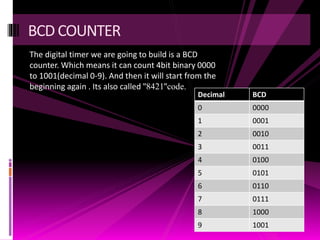
The digital timer we are going to build is a BCD
counter. Which means it can count 4bit binary 0000
to 1001(decimal 0-9). And then it will start from the
beginning again . Its also called ''8421''code.
BCDCOUNTER
Decimal BCD
0 0000
1 0001
2 0010
3 0011
4 0100
5 0101
6 0110
7 0111
8 1000
9 1001
BCD is very common in electronic systems where a numeric value is to be
displayed, especially in systems consisting solely of digital logic, and not
containing a microprocessor. By utilizing BCD, the manipulation of numerical
data for display can be greatly simplified by treating each digit as a separate
single sub-circuit. This matches much more closely the physical reality of
display hardware—a designer might choose to use a series of separate
identical seven segment displays to build a metering circuit, for example. If the
numeric quantity were stored and manipulated as pure binary, interfacing to
such a display would require complex circuitry.
Therefore, in cases where the calculations are relatively simple working
throughout with BCD can lead to a simpler overall system than converting to
binary.
Background ofBCD Counter
BCD to seven segment decoder:
A standard 7-segment LED display generally has 8 input connections, one for each
LED segment and one that acts as a common terminal or connection for all the
internal display segments. Some single displays have also have an additional input
pin to display a decimal point in their lower right or left hand corner.
In electronics there are two important types of 7-segment LED digital display.
1. The Common Cathode Display (CCD) – In the common cathode display, all the
cathode connections of the LED’s are joined together to logic “0” or ground. The
individual segments are illuminated by application of a “HIGH”, logic “1” signal to the
individual Anode terminals.
2. The Common Anode Display (CAD) – In the common anode display, all the anode
connections of the LED’s are joined together to logic “1” and the individual segments
are illuminated by connecting the individual Cathode terminals to a “LOW”, logic “0”
signal.
Proposal Brief
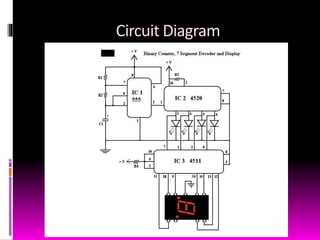
NECESSARY MATERIALS
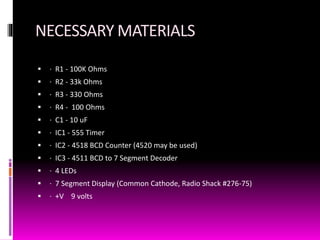
 · R1 - 100K Ohms
 · R2 - 33k Ohms
 · R3 - 330 Ohms
 · R4 - 100 Ohms
 · C1 - 10 uF
 · IC1 - 555 Timer
 · IC2 - 4518 BCD Counter (4520 may be used)
 · IC3 - 4511 BCD to 7 Segment Decoder
 · 4 LEDs
 · 7 Segment Display (Common Cathode, Radio Shack #276-75)
 · +V 9 volts
Circuit Diagram
HOW THE COUNTER WORKS
555 generates the clock pulse
4518 receives the pulse and starts counting
4511 is a decoder that collect the pulses from 4518 and sends it to the
Display.
Finally the 7 segment LED display shows the output in Decimal
[N.B. when the decimal value reaches 9(binary 1001) in the next step it resets
the clock and goes to decimal o(binary 0000) and start counting again]
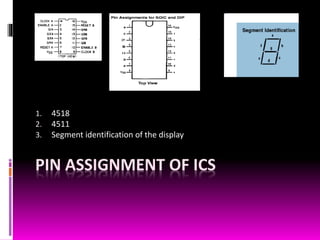
PIN ASSIGNMENT OF ICS
1. 4518
2. 4511
3. Segment identification of the display
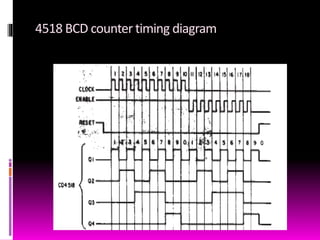
4518 BCD counter timing diagram
XILINX MODULE DESCRIPTION
`timescale 1ns / 1ps
module bcd4bit (clk,rst,count);
input clk,rst;
output reg [0:4]count;
always @(posedge clk, negedge rst)
if (rst)
count <= 0;
else
count <= count+1;
endmodule
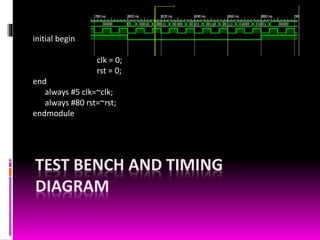
TEST BENCH AND TIMING
DIAGRAM
initial begin
clk = 0;
rst = 0;
end
always #5 clk=~clk;
always #80 rst=~rst;
endmodule
Conclusion
Many Important Applications Of BCD :
»»The Atari 8-bit family of computers used BCD to implement floating-point
algorithms. The MOS 6502 processor used has a BCD mode that affects the
addition and subtraction instructions.
»» Early models of the PlayStation 3 store the date and time in BCD. This led
to a worldwide outage of the console on 1st march 2010. The last two digits
of the year stored as BCD were misinterpreted as 16 causing a paradox in the
unit's date, rendering most functionalities inoperable

BCD Counter

  • 1.
    Project Presentation Name ofthe project : BCD Counter Group 3  S.M Shahriar Mahmud 021 131 063  Ahmed Amirul Arefin 021 131 088  Tariqul Islam 021 131 085  Israt Jahan 021131113
  • 2.
    Content  Introduction ofBCD counter  Background of BCD counter  BCD counter brief discussion  Necessary materials  Circuit /Connection diagram  Pin assignments of ICS  Working Principle  Timing diagram of a IC  Xilinx module description  Test bench of the Xilinx module  Conclusion
  • 3.
    The digital timerwe are going to build is a BCD counter. Which means it can count 4bit binary 0000 to 1001(decimal 0-9). And then it will start from the beginning again . Its also called ''8421''code. BCDCOUNTER Decimal BCD 0 0000 1 0001 2 0010 3 0011 4 0100 5 0101 6 0110 7 0111 8 1000 9 1001
  • 4.
    BCD is verycommon in electronic systems where a numeric value is to be displayed, especially in systems consisting solely of digital logic, and not containing a microprocessor. By utilizing BCD, the manipulation of numerical data for display can be greatly simplified by treating each digit as a separate single sub-circuit. This matches much more closely the physical reality of display hardware—a designer might choose to use a series of separate identical seven segment displays to build a metering circuit, for example. If the numeric quantity were stored and manipulated as pure binary, interfacing to such a display would require complex circuitry. Therefore, in cases where the calculations are relatively simple working throughout with BCD can lead to a simpler overall system than converting to binary. Background ofBCD Counter
  • 5.
    BCD to sevensegment decoder: A standard 7-segment LED display generally has 8 input connections, one for each LED segment and one that acts as a common terminal or connection for all the internal display segments. Some single displays have also have an additional input pin to display a decimal point in their lower right or left hand corner. In electronics there are two important types of 7-segment LED digital display. 1. The Common Cathode Display (CCD) – In the common cathode display, all the cathode connections of the LED’s are joined together to logic “0” or ground. The individual segments are illuminated by application of a “HIGH”, logic “1” signal to the individual Anode terminals. 2. The Common Anode Display (CAD) – In the common anode display, all the anode connections of the LED’s are joined together to logic “1” and the individual segments are illuminated by connecting the individual Cathode terminals to a “LOW”, logic “0” signal. Proposal Brief
  • 6.
    NECESSARY MATERIALS  ·R1 - 100K Ohms  · R2 - 33k Ohms  · R3 - 330 Ohms  · R4 - 100 Ohms  · C1 - 10 uF  · IC1 - 555 Timer  · IC2 - 4518 BCD Counter (4520 may be used)  · IC3 - 4511 BCD to 7 Segment Decoder  · 4 LEDs  · 7 Segment Display (Common Cathode, Radio Shack #276-75)  · +V 9 volts
  • 7.
  • 8.
    HOW THE COUNTERWORKS 555 generates the clock pulse 4518 receives the pulse and starts counting 4511 is a decoder that collect the pulses from 4518 and sends it to the Display. Finally the 7 segment LED display shows the output in Decimal [N.B. when the decimal value reaches 9(binary 1001) in the next step it resets the clock and goes to decimal o(binary 0000) and start counting again]
  • 9.
    PIN ASSIGNMENT OFICS 1. 4518 2. 4511 3. Segment identification of the display
  • 10.
    4518 BCD countertiming diagram
  • 11.
    XILINX MODULE DESCRIPTION `timescale1ns / 1ps module bcd4bit (clk,rst,count); input clk,rst; output reg [0:4]count; always @(posedge clk, negedge rst) if (rst) count <= 0; else count <= count+1; endmodule
  • 12.
    TEST BENCH ANDTIMING DIAGRAM initial begin clk = 0; rst = 0; end always #5 clk=~clk; always #80 rst=~rst; endmodule
  • 13.
    Conclusion Many Important ApplicationsOf BCD : »»The Atari 8-bit family of computers used BCD to implement floating-point algorithms. The MOS 6502 processor used has a BCD mode that affects the addition and subtraction instructions. »» Early models of the PlayStation 3 store the date and time in BCD. This led to a worldwide outage of the console on 1st march 2010. The last two digits of the year stored as BCD were misinterpreted as 16 causing a paradox in the unit's date, rendering most functionalities inoperable