
NAME: AHMED AMIRUL AREFIN
ID: 021-131-088
SEC: D
PROJECT NAME: VSAT
CONTENT
>About VSAT
>VSAT remote terminal block diagram
>Importance of VSAT network system
>Configuration of VSAT
>Uses of VSAT
>VSAT satellite network topology
>Work of VSAT Hub
>VSAT Application
>Benefit of VSAT Network
>VSAT installation
VSAT
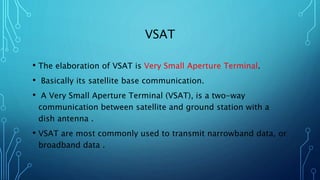
• The elaboration of VSAT is Very Small Aperture Terminal.
• Basically its satellite base communication.
• A Very Small Aperture Terminal (VSAT), is a two-way
communication between satellite and ground station with a
dish antenna .
• VSAT are most commonly used to transmit narrowband data, or
broadband data .
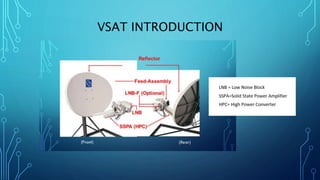
VSAT INTRODUCTION
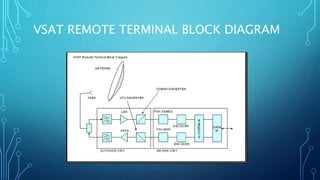
VSAT REMOTE TERMINAL BLOCK DIAGRAM
IMPORTANCE OF VSAT
• In a word when & where Radio, Fiber ,Wimax network
establish is impossible there VSAT network establish is
possible.
• A good advantage this type of networks longevity high that’s
why we like to use VSAT Network.
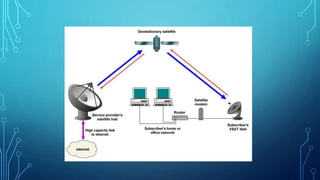
VSAT SATELLITE NETWORK TOPOLOGY
**2 Network
Topology**
• Star Network System
• Mesh Network
System
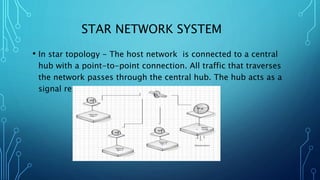
STAR NETWORK SYSTEM
• In star topology - The host network is connected to a central
hub with a point-to-point connection. All traffic that traverses
the network passes through the central hub. The hub acts as a
signal repeater.
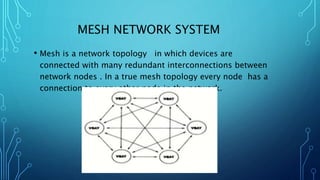
MESH NETWORK SYSTEM
• Mesh is a network topology in which devices are
connected with many redundant interconnections between
network nodes . In a true mesh topology every node has a
connection to every other node in the network.
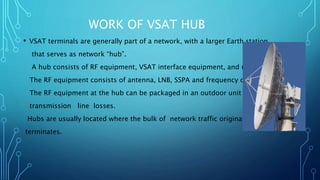
WORK OF VSAT HUB
• VSAT terminals are generally part of a network, with a larger Earth station
that serves as network “hub”.
A hub consists of RF equipment, VSAT interface equipment, and user Interfaces.
The RF equipment consists of antenna, LNB, SSPA and frequency converters.
The RF equipment at the hub can be packaged in an outdoor unit to reduce the
transmission line losses.
Hubs are usually located where the bulk of network traffic originates and/or
terminates.
VSAT APPLICATION
• VSATs are suited to many applications which broadly fall into
two categories:
• • Broadcasting or one-way applications,
• • Interactive or two-way applications
BROADCASTING OR ONE-WAY
APPLICATIONS
• Broadcasting represents one of the earliest and simplest
applications for VSATs. Voice, video, or data is transmitted from
a central station and broadcast to VSATs within the satellite
beam coverage. It might seem that the signal is subject to
access by unauthorized VSATs; however, the broadcaster can
control access to the information to allow only the desired group
of VSATs to receive the information. This access is often
implemented in software and is often called “narrow-casting”.
INTERACTIVE OR TWO-WAY APPLICATIONS
• This category consists of an application involving an inquiry from one
terminal and a subsequent response from another terminal.
Some examples are:
1.file and batch transfers for financial institutions, stock brokers, and banks
(i.e., branch offices to headquarters.
2.reservation requests and confirmations for airlines, hotels and travel
agencies.
3.Data request retrieval from remote sensing on oil drillings, pipe
4.Lines, gas, electric, and transport industries; and
5.Remote processing and LAN extension
BENEFIT OF VSAT NETWORK
From the application perspective, VSAT networks offer the following benefits:
• wide range of data, voice, and video applications;
• proven and robust technology, with high user satisfaction;
• quick network deployment;
• rapid and direct access to telecommunications;
• rapid response to market needs, because of ease of expansion.
• reliability and ease of maintenance; and
• reliable operation with around-the-clock support from the INTELSAT
Operations Centre.
VSAT INSTALLATION
Installation equipment:
• 1. 1.2m Reflector 2.iDirect (modem) 3.iDirect (modem) power 4.RG 11
Cable .5.LAN Cable 6.Laptop 7.Base pipe (5 fit) 8.OMT (Orthomode
Transducer) 9.SPC 10.Lnb (3 angle) 11.Feed horn.
Installation step:
• Step-1
• At first we have to done place with compass azimuth 141 and set up
base pipe .
• Step-2
• Adjust the reflector up and down in elevation by turning the two 12mm
nuts and omt with and spcm lmb are adjust.
• Step-3
• Spcm with opposite side indirect are connected TX and lmb are
connect RX. Then with lan cable VSAT are modem from lan side
are connected with laptop lan and switch on power.
• Step-4
• Then we have to done azimuth 141 and elevation are adjust 52.
When we get received highest signal then fixed the equipment.
THANKS

VSAT

  • 1.
    NAME: AHMED AMIRULAREFIN ID: 021-131-088 SEC: D PROJECT NAME: VSAT
  • 2.
    CONTENT >About VSAT >VSAT remoteterminal block diagram >Importance of VSAT network system >Configuration of VSAT >Uses of VSAT >VSAT satellite network topology >Work of VSAT Hub >VSAT Application >Benefit of VSAT Network >VSAT installation
  • 3.
    VSAT • The elaborationof VSAT is Very Small Aperture Terminal. • Basically its satellite base communication. • A Very Small Aperture Terminal (VSAT), is a two-way communication between satellite and ground station with a dish antenna . • VSAT are most commonly used to transmit narrowband data, or broadband data .
  • 4.
  • 5.
    VSAT REMOTE TERMINALBLOCK DIAGRAM
  • 6.
    IMPORTANCE OF VSAT •In a word when & where Radio, Fiber ,Wimax network establish is impossible there VSAT network establish is possible. • A good advantage this type of networks longevity high that’s why we like to use VSAT Network.
  • 7.
    VSAT SATELLITE NETWORKTOPOLOGY **2 Network Topology** • Star Network System • Mesh Network System
  • 8.
    STAR NETWORK SYSTEM •In star topology - The host network is connected to a central hub with a point-to-point connection. All traffic that traverses the network passes through the central hub. The hub acts as a signal repeater.
  • 9.
    MESH NETWORK SYSTEM •Mesh is a network topology in which devices are connected with many redundant interconnections between network nodes . In a true mesh topology every node has a connection to every other node in the network.
  • 10.
    WORK OF VSATHUB • VSAT terminals are generally part of a network, with a larger Earth station that serves as network “hub”. A hub consists of RF equipment, VSAT interface equipment, and user Interfaces. The RF equipment consists of antenna, LNB, SSPA and frequency converters. The RF equipment at the hub can be packaged in an outdoor unit to reduce the transmission line losses. Hubs are usually located where the bulk of network traffic originates and/or terminates.
  • 12.
    VSAT APPLICATION • VSATsare suited to many applications which broadly fall into two categories: • • Broadcasting or one-way applications, • • Interactive or two-way applications
  • 13.
    BROADCASTING OR ONE-WAY APPLICATIONS •Broadcasting represents one of the earliest and simplest applications for VSATs. Voice, video, or data is transmitted from a central station and broadcast to VSATs within the satellite beam coverage. It might seem that the signal is subject to access by unauthorized VSATs; however, the broadcaster can control access to the information to allow only the desired group of VSATs to receive the information. This access is often implemented in software and is often called “narrow-casting”.
  • 14.
    INTERACTIVE OR TWO-WAYAPPLICATIONS • This category consists of an application involving an inquiry from one terminal and a subsequent response from another terminal. Some examples are: 1.file and batch transfers for financial institutions, stock brokers, and banks (i.e., branch offices to headquarters. 2.reservation requests and confirmations for airlines, hotels and travel agencies. 3.Data request retrieval from remote sensing on oil drillings, pipe 4.Lines, gas, electric, and transport industries; and 5.Remote processing and LAN extension
  • 15.
    BENEFIT OF VSATNETWORK From the application perspective, VSAT networks offer the following benefits: • wide range of data, voice, and video applications; • proven and robust technology, with high user satisfaction; • quick network deployment; • rapid and direct access to telecommunications; • rapid response to market needs, because of ease of expansion. • reliability and ease of maintenance; and • reliable operation with around-the-clock support from the INTELSAT Operations Centre.
  • 16.
    VSAT INSTALLATION Installation equipment: •1. 1.2m Reflector 2.iDirect (modem) 3.iDirect (modem) power 4.RG 11 Cable .5.LAN Cable 6.Laptop 7.Base pipe (5 fit) 8.OMT (Orthomode Transducer) 9.SPC 10.Lnb (3 angle) 11.Feed horn. Installation step: • Step-1 • At first we have to done place with compass azimuth 141 and set up base pipe . • Step-2 • Adjust the reflector up and down in elevation by turning the two 12mm nuts and omt with and spcm lmb are adjust.
  • 17.
    • Step-3 • Spcmwith opposite side indirect are connected TX and lmb are connect RX. Then with lan cable VSAT are modem from lan side are connected with laptop lan and switch on power. • Step-4 • Then we have to done azimuth 141 and elevation are adjust 52. When we get received highest signal then fixed the equipment.
  • 18.