
Power Plant Engineering
Course Code: EEE 473
Section: A
Topic: Nuclear Power Plant
Group Members
Name ID
Md. Masum Patwary 021-131-081
Amitabh Haldar 021-131-097
Ahmed Amirul Arefin 021-131-088
Sajib Mia 021-131-086
Tariqul Islam 021-131-085
Contents
• Nuclear Fuel
• Nuclear Chain Reaction
• Nuclear Power Plant
• Site Selection of Nuclear Power Plant
• Worldwide Nuclear Scenario
• Build cost of Nuclear Power plant
• Present Nuclear Plant Scenario of Bangladesh
• Facts of Nuclear Power Plant
• Nuclears Wastes
• Nuclear Disasters
• Nuclear Fuel Cost
• Advantages
• Disadvantages
Nuclear Fuel
• Nuclear fuel is a substance that is used in nuclear power stations to produce
heat to power turbines. Heat is created when nuclear fuel
undergoes nuclear fission
• Most nuclear fuels contain heavy fissile elements that are capable of nuclear
fission, such as uranium-235.
Nuclear Chain Reaction
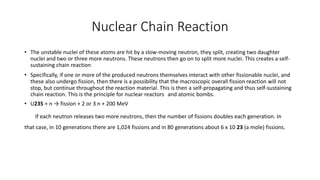
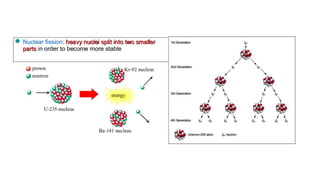
• The unstable nuclei of these atoms are hit by a slow-moving neutron, they split, creating two daughter
nuclei and two or three more neutrons. These neutrons then go on to split more nuclei. This creates a self-
sustaining chain reaction
• Specifically, if one or more of the produced neutrons themselves interact with other fissionable nuclei, and
these also undergo fission, then there is a possibility that the macroscopic overall fission reaction will not
stop, but continue throughout the reaction material. This is then a self-propagating and thus self-sustaining
chain reaction. This is the principle for nuclear reactors and atomic bombs.
• U235 + n → fission + 2 or 3 n + 200 MeV
If each neutron releases two more neutrons, then the number of fissions doubles each generation. In
that case, in 10 generations there are 1,024 fissions and in 80 generations about 6 x 10 23 (a mole) fissions.
Nuclear Power Plant
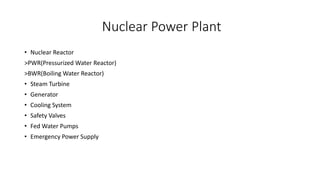
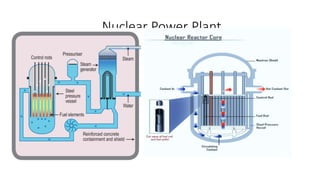
• Nuclear Reactor
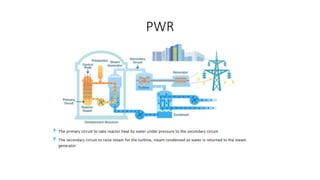
>PWR(Pressurized Water Reactor)
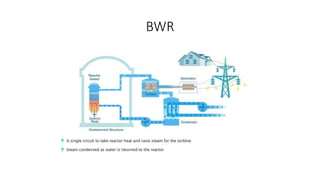
>BWR(Boiling Water Reactor)
• Steam Turbine
• Generator
• Cooling System
• Safety Valves
• Fed Water Pumps
• Emergency Power Supply
Nuclear Power Plant
PWR
BWR
Comparison Between PWR and BWR
• Radioactive contaminants to the turbine and condenser.
• Carnot efficiency
• Capital cost and complexity .
Site Selection of Nuclear Power Plant
• When we select a location for Nuclear Power plant we have to
ensure those impotant part :
1.Availability of Water
2. Disposal of Water
3. Distance from Populated Area
4.Transportation Facilities
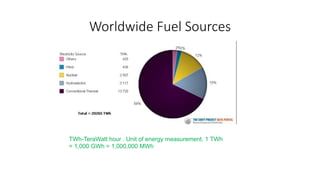
Worldwide Fuel Sources
TWh-TeraWatt hour . Unit of energy measurement. 1 TWh
= 1,000 GWh = 1,000,000 MWh
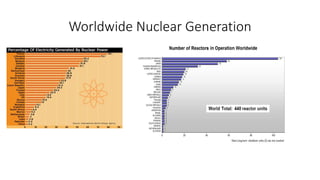
Worldwide Nuclear Generation
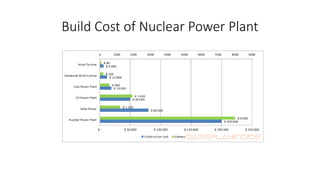
Build Cost of Nuclear Power Plant
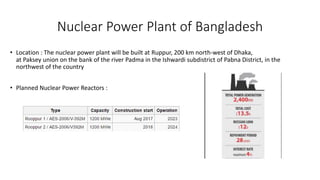
Nuclear Power Plant of Bangladesh
• Location : The nuclear power plant will be built at Ruppur, 200 km north-west of Dhaka,
at Paksey union on the bank of the river Padma in the Ishwardi subdistrict of Pabna District, in the
northwest of the country
• Planned Nuclear Power Reactors :
Facts of Nuclear Power Plant
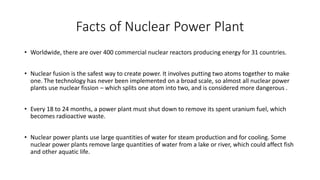
• Worldwide, there are over 400 commercial nuclear reactors producing energy for 31 countries.
• Nuclear fusion is the safest way to create power. It involves putting two atoms together to make
one. The technology has never been implemented on a broad scale, so almost all nuclear power
plants use nuclear fission – which splits one atom into two, and is considered more dangerous .
• Every 18 to 24 months, a power plant must shut down to remove its spent uranium fuel, which
becomes radioactive waste.
• Nuclear power plants use large quantities of water for steam production and for cooling. Some
nuclear power plants remove large quantities of water from a lake or river, which could affect fish
and other aquatic life.
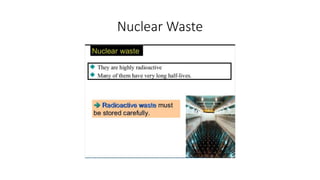
Nuclear Waste
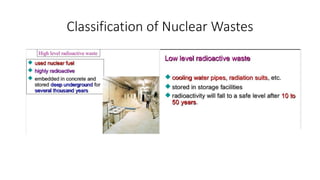
Classification of Nuclear Wastes
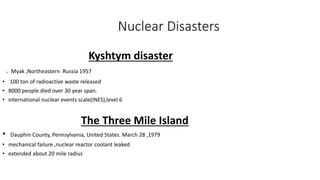
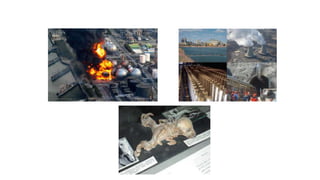
Nuclear Disasters
Kyshtym disaster
. Myak ,Northeastern Russia 1957
• 100 ton of radioactive waste released
• 8000 people died over 30 year span.
• international nuclear events scale(INES),level 6
The Three Mile Island
• Dauphin County, Pennsylvania, United States. March 28 ,1979
• mechanical failure ,nuclear reactor coolant leaked
• extended about 20 mile radius
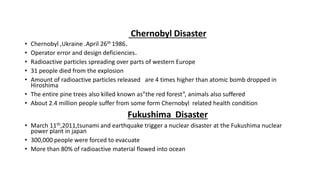
Chernobyl Disaster
• Chernobyl ,Ukraine .April 26th 1986.
• Operator error and design deficiencies.
• Radioactive particles spreading over parts of western Europe
• 31 people died from the explosion
• Amount of radioactive particles released are 4 times higher than atomic bomb dropped in
Hiroshima
• The entire pine trees also killed known as”the red forest”, animals also suffered
• About 2.4 million people suffer from some form Chernobyl related health condition
Fukushima Disaster
• March 11th,2011,tsunami and earthquake trigger a nuclear disaster at the Fukushima nuclear
power plant in japan
• 300,000 people were forced to evacuate
• More than 80% of radioactive material flowed into ocean
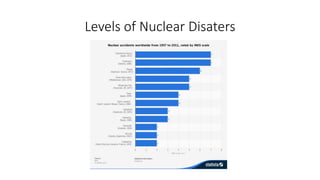
Levels of Nuclear Disaters
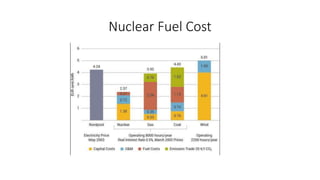
Nuclear Fuel Cost
Advantages
Nuclear power generation does emit relatively low amounts of carbon dioxide
(CO2). The emissions of green house gases and therefore the contribution of
nuclear power plants to global warming is therefore relatively little.
This technology is readily available, it does not have to be developed first.
It is possible to generate a high amount of electrical energy in one single plant
Disadvantages
The problem of radioactive waste is still an unsolved one.
High risks: It is technically impossible to build a plant with 100% security.
The energy source for nuclear energy is Uranium. Uranium is a scarce resource, its supply
is estimated to last only for the next 30 to 60 years depending on the actual demand.
Nuclear power plants as well as nuclear waste could be preferred targets for terrorist
attacks..
During the operation of nuclear power plants, radioactive waste is produced, which in
turn can be used for the production of nuclear weapons.
Reference Websites
• https://en.wikipedia.org/wiki/Nuclear_power_plant
• https://www.clpgroup.com/NuclearEnergy/Eng/power/power4_1_2.aspx
• https://www.animatedsoftware.com/environm/nukequiz/nukequiz_one/nuke_parts/reactor_parts.swf
• https://en.wikipedia.org/wiki/Economics_of_nuclear_power_plants
• https://www.iaea.org//(International Atomic Energy Agency )
• http://l.facebook.com/l.php?u=http%3A%2F%2Fhyperphysics.phy-
astr.gsu.edu%2Fhbase%2Fnucene%2Freactor.html&h=RAQG_I3Ih&s=1
• http://l.php?u=http%3A%2F%2Fen.wikipedia.org%2Fwiki%2FNuclear_and_radiation_accidents_and_incidents&h=r
AQFzV-My&s=1
• https://en.wikipedia.org/wiki/Nuclear_chain_reaction
• https://en.wikipedia.org/wiki/Ruppur_Nuclear_Power_Plant
• http://www.world-nuclear.org/information-library/country-profiles/countries-a-f/bangladesh.aspx
• https://www.google.com.bd/search?q=world+nuclear+association&rlz=1C1EJFA_enBD674BD678&oq=world+nucle
ar+&aqs=chrome.0.0l2j69i57j0l3.3965j0j4&sourceid=chrome&ie=UTF-8
• https://en.wikipedia.org/wiki/Nuclear_power
THANKS

Nuclear Power Plant

  • 1.
    Power Plant Engineering CourseCode: EEE 473 Section: A Topic: Nuclear Power Plant
  • 2.
    Group Members Name ID Md.Masum Patwary 021-131-081 Amitabh Haldar 021-131-097 Ahmed Amirul Arefin 021-131-088 Sajib Mia 021-131-086 Tariqul Islam 021-131-085
  • 3.
    Contents • Nuclear Fuel •Nuclear Chain Reaction • Nuclear Power Plant • Site Selection of Nuclear Power Plant • Worldwide Nuclear Scenario • Build cost of Nuclear Power plant • Present Nuclear Plant Scenario of Bangladesh • Facts of Nuclear Power Plant • Nuclears Wastes • Nuclear Disasters • Nuclear Fuel Cost • Advantages • Disadvantages
  • 4.
    Nuclear Fuel • Nuclearfuel is a substance that is used in nuclear power stations to produce heat to power turbines. Heat is created when nuclear fuel undergoes nuclear fission • Most nuclear fuels contain heavy fissile elements that are capable of nuclear fission, such as uranium-235.
  • 5.
    Nuclear Chain Reaction •The unstable nuclei of these atoms are hit by a slow-moving neutron, they split, creating two daughter nuclei and two or three more neutrons. These neutrons then go on to split more nuclei. This creates a self- sustaining chain reaction • Specifically, if one or more of the produced neutrons themselves interact with other fissionable nuclei, and these also undergo fission, then there is a possibility that the macroscopic overall fission reaction will not stop, but continue throughout the reaction material. This is then a self-propagating and thus self-sustaining chain reaction. This is the principle for nuclear reactors and atomic bombs. • U235 + n → fission + 2 or 3 n + 200 MeV If each neutron releases two more neutrons, then the number of fissions doubles each generation. In that case, in 10 generations there are 1,024 fissions and in 80 generations about 6 x 10 23 (a mole) fissions.
  • 7.
    Nuclear Power Plant •Nuclear Reactor >PWR(Pressurized Water Reactor) >BWR(Boiling Water Reactor) • Steam Turbine • Generator • Cooling System • Safety Valves • Fed Water Pumps • Emergency Power Supply
  • 8.
  • 9.
  • 10.
  • 11.
    Comparison Between PWRand BWR • Radioactive contaminants to the turbine and condenser. • Carnot efficiency • Capital cost and complexity .
  • 12.
    Site Selection ofNuclear Power Plant • When we select a location for Nuclear Power plant we have to ensure those impotant part : 1.Availability of Water 2. Disposal of Water 3. Distance from Populated Area 4.Transportation Facilities
  • 13.
    Worldwide Fuel Sources TWh-TeraWatthour . Unit of energy measurement. 1 TWh = 1,000 GWh = 1,000,000 MWh
  • 14.
  • 15.
    Build Cost ofNuclear Power Plant
  • 16.
    Nuclear Power Plantof Bangladesh • Location : The nuclear power plant will be built at Ruppur, 200 km north-west of Dhaka, at Paksey union on the bank of the river Padma in the Ishwardi subdistrict of Pabna District, in the northwest of the country • Planned Nuclear Power Reactors :
  • 17.
    Facts of NuclearPower Plant • Worldwide, there are over 400 commercial nuclear reactors producing energy for 31 countries. • Nuclear fusion is the safest way to create power. It involves putting two atoms together to make one. The technology has never been implemented on a broad scale, so almost all nuclear power plants use nuclear fission – which splits one atom into two, and is considered more dangerous . • Every 18 to 24 months, a power plant must shut down to remove its spent uranium fuel, which becomes radioactive waste. • Nuclear power plants use large quantities of water for steam production and for cooling. Some nuclear power plants remove large quantities of water from a lake or river, which could affect fish and other aquatic life.
  • 18.
  • 19.
  • 20.
    Nuclear Disasters Kyshtym disaster .Myak ,Northeastern Russia 1957 • 100 ton of radioactive waste released • 8000 people died over 30 year span. • international nuclear events scale(INES),level 6 The Three Mile Island • Dauphin County, Pennsylvania, United States. March 28 ,1979 • mechanical failure ,nuclear reactor coolant leaked • extended about 20 mile radius
  • 21.
    Chernobyl Disaster • Chernobyl,Ukraine .April 26th 1986. • Operator error and design deficiencies. • Radioactive particles spreading over parts of western Europe • 31 people died from the explosion • Amount of radioactive particles released are 4 times higher than atomic bomb dropped in Hiroshima • The entire pine trees also killed known as”the red forest”, animals also suffered • About 2.4 million people suffer from some form Chernobyl related health condition Fukushima Disaster • March 11th,2011,tsunami and earthquake trigger a nuclear disaster at the Fukushima nuclear power plant in japan • 300,000 people were forced to evacuate • More than 80% of radioactive material flowed into ocean
  • 22.
  • 24.
  • 25.
    Advantages Nuclear power generationdoes emit relatively low amounts of carbon dioxide (CO2). The emissions of green house gases and therefore the contribution of nuclear power plants to global warming is therefore relatively little. This technology is readily available, it does not have to be developed first. It is possible to generate a high amount of electrical energy in one single plant
  • 26.
    Disadvantages The problem ofradioactive waste is still an unsolved one. High risks: It is technically impossible to build a plant with 100% security. The energy source for nuclear energy is Uranium. Uranium is a scarce resource, its supply is estimated to last only for the next 30 to 60 years depending on the actual demand. Nuclear power plants as well as nuclear waste could be preferred targets for terrorist attacks.. During the operation of nuclear power plants, radioactive waste is produced, which in turn can be used for the production of nuclear weapons.
  • 27.
    Reference Websites • https://en.wikipedia.org/wiki/Nuclear_power_plant •https://www.clpgroup.com/NuclearEnergy/Eng/power/power4_1_2.aspx • https://www.animatedsoftware.com/environm/nukequiz/nukequiz_one/nuke_parts/reactor_parts.swf • https://en.wikipedia.org/wiki/Economics_of_nuclear_power_plants • https://www.iaea.org//(International Atomic Energy Agency ) • http://l.facebook.com/l.php?u=http%3A%2F%2Fhyperphysics.phy- astr.gsu.edu%2Fhbase%2Fnucene%2Freactor.html&h=RAQG_I3Ih&s=1 • http://l.php?u=http%3A%2F%2Fen.wikipedia.org%2Fwiki%2FNuclear_and_radiation_accidents_and_incidents&h=r AQFzV-My&s=1 • https://en.wikipedia.org/wiki/Nuclear_chain_reaction • https://en.wikipedia.org/wiki/Ruppur_Nuclear_Power_Plant • http://www.world-nuclear.org/information-library/country-profiles/countries-a-f/bangladesh.aspx • https://www.google.com.bd/search?q=world+nuclear+association&rlz=1C1EJFA_enBD674BD678&oq=world+nucle ar+&aqs=chrome.0.0l2j69i57j0l3.3965j0j4&sourceid=chrome&ie=UTF-8 • https://en.wikipedia.org/wiki/Nuclear_power
  • 28.