Miss. Sheetal Patil M. Pharm
Rani Chennamma College of Pharmacy,
Belagavi.
Definition and Scope of Anatomy
and Physiology
 Human Anatomy (ana = “up”, tome = “to cut”) is the
branch of Biomedical science dealing with normal structure
shape size and location of the various part of the body.
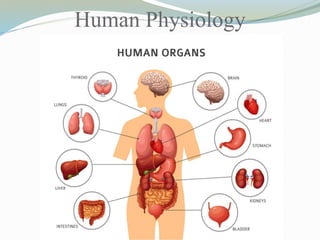
 Human Physiology (physio = nature, logy = study of) is
branch of Biomedical science dealing with normal functioning
of various organ in the body.
Human Physiology
Human Anatomy
Branches of Anatomy
1. Gross Anatomy: It is the study of body parts visible to naked
eye.
2. Microscopic anatomy: Anatomical study by means of modern
microscopes including study of cells (Cytology) and tissues
(Histology).
3. Developmental anatomy: It is the study of human growth and
development.
4. Pathological anatomy: It is the study of diseased body structure.
Branches of Physiology
1. Neurophysiology (neuro: nerve) is study of functional properties of
nerve cells.
2. Endocrinology (endo: within; crin: secretion) is study of
hormones.
3. Cardiovascular physiology (cardi: heart; vascular: blood vessels)
is study of function of heart and blood vessels.
4. Immunology (immune: not susceptible) is study of how body
defends against disease causing agents.
5. Systemic physiology it is the study of body by system (system is a
group of organs that have common function e.g. bones in skeleton
system and muscles in muscular system).
6. Respiratory physiology (respira: to breathe) is study of function
of lungs.
7. Renal physiology (ren: kidney) is study of functions of kidneys.
8. Pathophysiology (path: disease) is study of functional changes
associated with disease.
Levels of Structural Organization
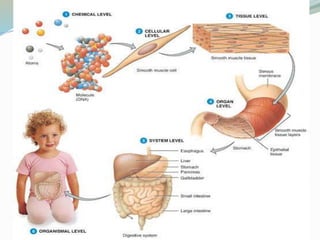
 Living things consist of several levels of structural organization that
are associated with one another in various ways.
Levels of Structural Organization
1. Chemical level
2. Cellular level
3. Tissue level
4. Organ level
5. Organ system level
6. Organismal level
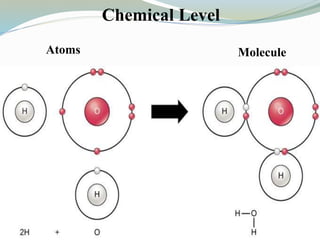
1. Chemical Level
 It is the lowest level of organization.
 It includes atoms and molecules that are essential in maintaining life.
Chemical Level
Atoms Molecule
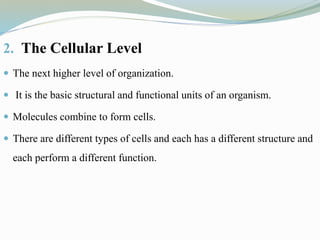
2. The Cellular Level
 The next higher level of organization.
 It is the basic structural and functional units of an organism.
 Molecules combine to form cells.
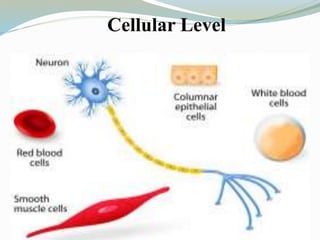
 There are different types of cells and each has a different structure and
each perform a different function.
Cellular Level
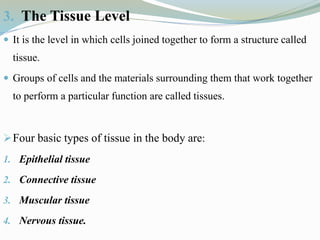
3. The Tissue Level
 It is the level in which cells joined together to form a structure called
tissue.
 Groups of cells and the materials surrounding them that work together
to perform a particular function are called tissues.
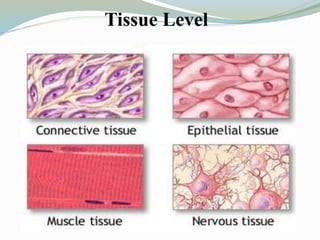
Four basic types of tissue in the body are:
1. Epithelial tissue
2. Connective tissue
3. Muscular tissue
4. Nervous tissue.
Tissue Level
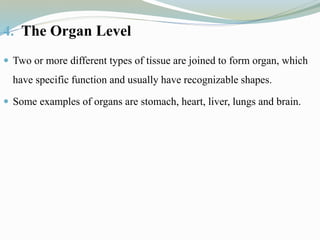
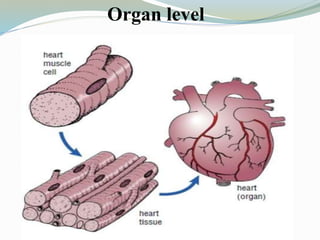
4. The Organ Level
 Two or more different types of tissue are joined to form organ, which
have specific function and usually have recognizable shapes.
 Some examples of organs are stomach, heart, liver, lungs and brain.
Organ level
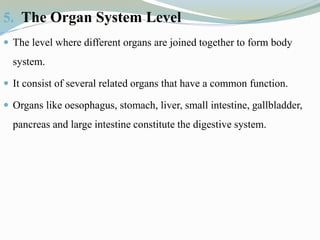
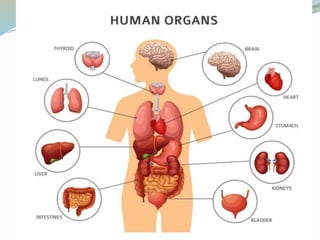
5. The Organ System Level
 The level where different organs are joined together to form body
system.
 It consist of several related organs that have a common function.
 Organs like oesophagus, stomach, liver, small intestine, gallbladder,
pancreas and large intestine constitute the digestive system.
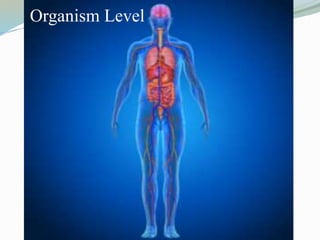
6. The Organism Level
 All the system of the body of an individual functioning together
constitute the total organism, e.g., human body.
Organism Level
Systems Of The Human Body
The human body is made of body systems that is groups of organs that
work together to produce and sustain life.
 There are eleven system of the human body:
1. Integumentary system/ Exocrine system
2. Skeletal system
3. Muscular system
4. Nervous system
5. Endocrine system
6. Cardiovascular system/circulatory system
7. Lymphatic system and immunity system
8. Respiratory system
9. Digestive system
10. Urinary system and renal system
11. Reproductive system
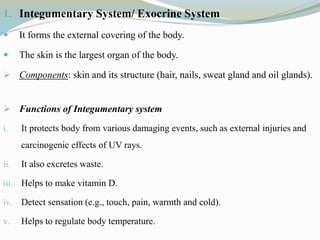
1. Integumentary System/ Exocrine System
 It forms the external covering of the body.
 The skin is the largest organ of the body.
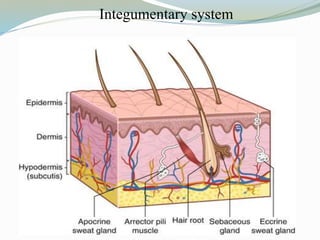
 Components: skin and its structure (hair, nails, sweat gland and oil glands).
 Functions of Integumentary system
i. It protects body from various damaging events, such as external injuries and
carcinogenic effects of UV rays.
ii. It also excretes waste.
iii. Helps to make vitamin D.
iv. Detect sensation (e.g., touch, pain, warmth and cold).
v. Helps to regulate body temperature.
Integumentary system
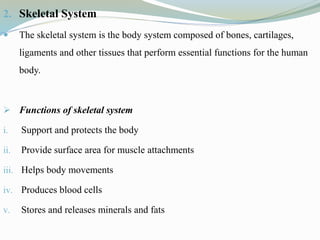
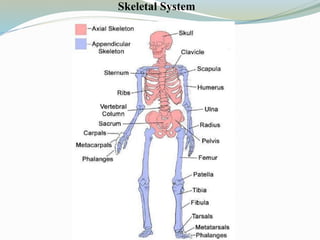
2. Skeletal System
 The skeletal system is the body system composed of bones, cartilages,
ligaments and other tissues that perform essential functions for the human
body.
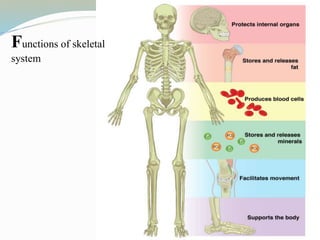
 Functions of skeletal system
i. Support and protects the body
ii. Provide surface area for muscle attachments
iii. Helps body movements
iv. Produces blood cells
v. Stores and releases minerals and fats
Functions of skeletal
system
Skeletal System
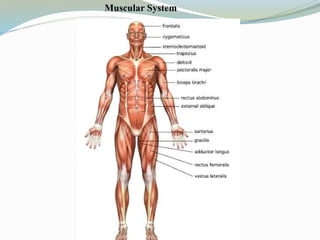
3. Muscular System
 Human muscle system, the muscles of the human body that work
the skeletal system that are under voluntary control.
 Muscles of all vertebrates is often divided into skeletal, smooth and
cardiac muscles.
 Functions of muscular system
i. Produces body movement
ii. Stabilizes body position (posture)
iii. Smooth muscle has important role in the circulation of blood around the
body.
iv. Generates heat
Muscular System
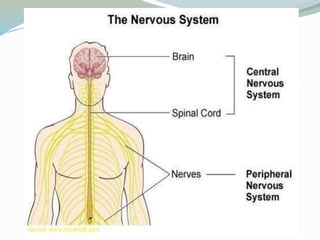
4. Nervous System
 The nervous system is a network of neurons whose main feature is to
generate, modulate and transmit information between all the different parts
of the human body.
 Components: Brain, spinal cord, nerves and special sense organ.
 Functions of nervous system
i. Generate nerve impulses to regulate body activities.
ii. Detects changes in the body’s internal and external environment.
iii. Interprets the changes and responds by causing muscular contraction and
glandular secretions.
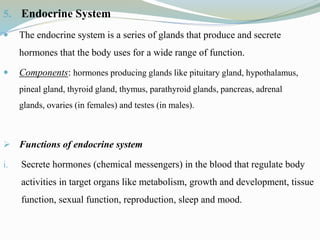
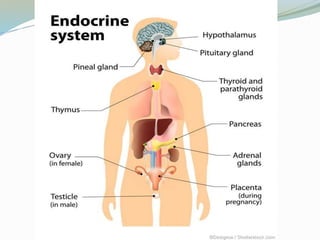
5. Endocrine System
 The endocrine system is a series of glands that produce and secrete
hormones that the body uses for a wide range of function.
 Components: hormones producing glands like pituitary gland, hypothalamus,
pineal gland, thyroid gland, thymus, parathyroid glands, pancreas, adrenal
glands, ovaries (in females) and testes (in males).
 Functions of endocrine system
i. Secrete hormones (chemical messengers) in the blood that regulate body
activities in target organs like metabolism, growth and development, tissue
function, sexual function, reproduction, sleep and mood.
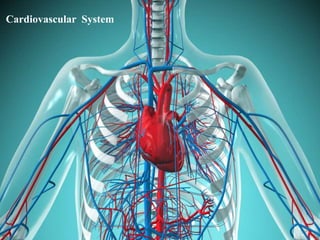
6. Cardiovascular System
 The circulatory system, also called the cardiovascular system or the
vascular system .
 Components: Blood, heart and blood vessels.
 Functions of cardiovascular system
i. Heart pumps blood through blood vessels.
ii. Blood carries oxygen and nutrients to cells and carbon dioxide and wastes away
from cells.
iii. Hearts helps to regulate temperature, acid-base balance and water content of body
fluids.
iv. Blood components helps defend against disease and repair damaged blood vessels.
Cardiovascular System
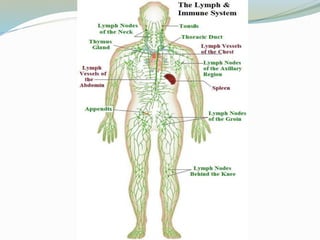
7. Lymphatic System
 The lymphatic system is a network of tissues and organs that help rid the
body of toxins, waste and other unwanted materials.
 Components: Lymphatic fluid and vessels, spleen, thymus, lymph nodes and
tonsils.
 Functions of lymphatic system
i. It maintains the balance of fluid between the blood and tissues, known as
fluid homeostasis.
ii. It forms part of the body’s immune system and helps defend against
bacteria and other intruders.
iii. It facilitates absorption of fats and fat-soluble nutrients in the digestive
system.
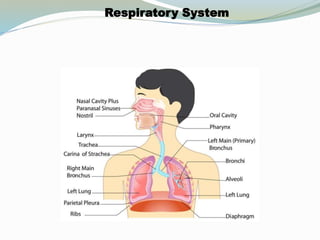
8. Respiratory System
 The respiratory system is the network of organs and tissues that help you
breathe.
 Components: Lungs, pharynx, larynx, trachea and bronchial tubes leading into
lungs.
 Functions of respiratory system
i. Transfer O2 from inhaled air to blood and CO2 from blood to exhaled air.
ii. Helps to regulate acid-base balance of body fluids.
iii. Helps to produce sound when air flows out through vocal cords.
Respiratory System
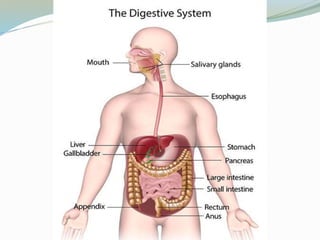
9. Digestive System
 The human digestive system is the means by which tissues and organs receive
nutrients to function. The system breaks down food, extracts nutrients from it,
and converts them into energy.
 Components: mouth, pharynx, oesophagus, stomach, small intestine, large
intestine, rectum and anus and accessary organs like salivary glands, pancreas, gall
bladder and liver.
 Functions of digestive system
i. Intake and digestion of food.
ii. Absorption of nutrients from digested food.
iii. Body uses nutrients for energy, growth and cell repair.
iv. Elimination of solid waste products.
10. Urinary System
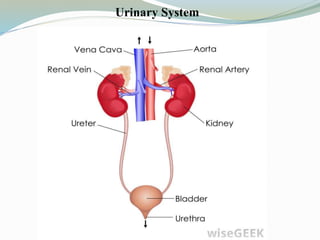
 The urinary system, also known as the renal system or urinary tract.
 Components: Kidneys, ureters, urinary bladder and urethra.
 Functions of urinary system
i. Produce, stores and eliminates urine.
ii. Eliminates wastes and regulates volume and chemical composition of blood.
iii. Helps to maintain the acid-base balance of body fluids.
iv. Maintain body’s mineral balance.
v. Helps regulate production of red blood cells.
Urinary System
11. Reproductive System
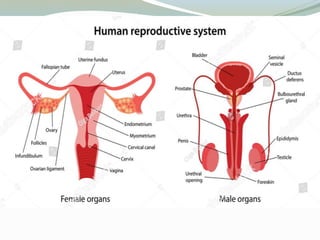
 The reproductive system of an organism, also known as the genital system,
is the biological system involved in sexual reproduction.
 Components: Gonads (testes in males and ovaries in females) and associated
organs (uterine tubes, uterus and vagina in females and epididymis, vas deferens
and penis in males).
 Functions of reproductive system
i. Gonads produce gametes (sperm or oocytes) that unite to form a new organism
ii. Gonads release hormones that regulate reproduction and other body processes
iii. Associated organs transport and store gametes
Characteristics of the living human organism
 Basic life processes
Six most important life processes of human body are:
1. Metabolism
2. Responsiveness
3. Movement
4. Growth
5. Differentiation
6. Reproduction
1. Metabolism
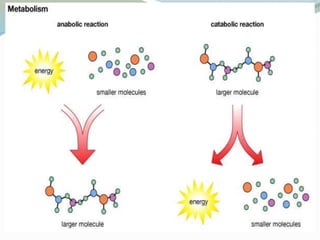
 It is the sum of all chemical processes that occur in the body and has two
types:
a. Catabolism
b. Anabolism
a. Catabolism: It is the breakdown of complex chemical substances into
simpler components, e.g., digestion of proteins into amino acids.
b. Anabolism: It is the building up of complex chemical substances from
smaller components, e.g., use of amino acids to build new proteins of the
body.
2. Responsiveness
 It is the body's ability to detect and respond to changes.
 Different cells in the body respond to environmental changes
in different ways.
Example:
a. Nerve cells: Respond by generating electric signals known as nerve
impulses/ action potentials
b. Muscle cells: Respond by contracting, which generates force to move
body parts.
3. Movements
 It includes motion of the whole body (walking), individual organs
(moving arm), single cells (movement of white blood cells) and even
tiny structures inside cells like cytoplasm.
4. Growth
 Increase in body size and weight that results from an increase in the
size of existing cells and an increase in the number of cells.
 Exapmle: In a growing bone, mineral deposits accumulate between bone
cells, causing the bone to grow in length and width.
5. Differentiation
 Development of a cell from an unspecialized to a specialized state.
 Example : Stem cells, Unspecialized precursor /ancestor cells, which can
divide and give rise to cells that undergo differentiation are known as stem
cells.
 Through differentiation , a fertilized egg/ ovum develops into an embryo,
then into a fetus, an infant, child and finally an adult.
 egg/ ovum - embryo - fetus - infant - child - adult.
6. Reproduction
It refers either to the formation of new cells or to the production of a
new individual from zygot after fertilization of an ovum by a sperm
cell.
Homeostasis
 Homeostasis is an organism’s process of maintaining a stable internal
environment suitable for sustaining life. The word homeostasis derives
from Greek, with home meaning “similar,” and stasis, meaning
“stable.”
 Homeostasis is a regulatory procedure. In the human body, homeostatic
processes regulate:
 Ratios of water and minerals
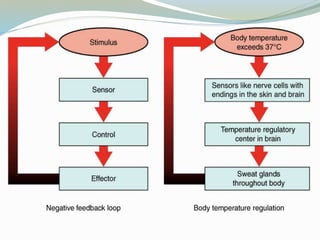
 Body temperature
 Level of glucose in blood
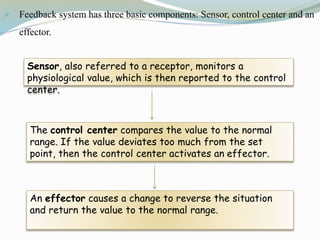
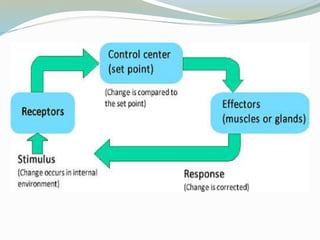
 Feedback system has three basic components: Sensor, control center and an
effector.
Sensor, also referred to a receptor, monitors a
physiological value, which is then reported to the control
center.
The control center compares the value to the normal
range. If the value deviates too much from the set
point, then the control center activates an effector.
An effector causes a change to reverse the situation
and return the value to the normal range.
Anatomical terminology
 Body positions
 The standard position in which the body is standing with feet together, arms
to the side, and head, eyes, and palms facing forward.
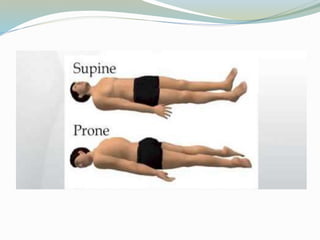
 If the body is lying face down, it is prone position.
 Lying on its back it is the supine position.
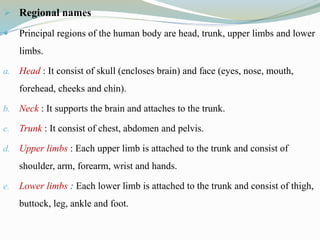
 Regional names
 Principal regions of the human body are head, trunk, upper limbs and lower
limbs.
a. Head : It consist of skull (encloses brain) and face (eyes, nose, mouth,
forehead, cheeks and chin).
b. Neck : It supports the brain and attaches to the trunk.
c. Trunk : It consist of chest, abdomen and pelvis.
d. Upper limbs : Each upper limb is attached to the trunk and consist of
shoulder, arm, forearm, wrist and hands.
e. Lower limbs : Each lower limb is attached to the trunk and consist of thigh,
buttock, leg, ankle and foot.
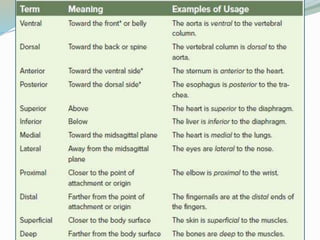
 Directional terms
 Directional terms describe the position of one body part relative to another.
Several directional terms are grouped in pairs having opposite meanings.
 Examples : Anterior (front) and posterior (back).
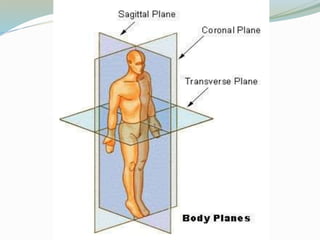
 Planes and Sections
 A plane is an imaginary, two-dimensional surface that passes through
the body. There are three planes commonly referred to in anatomy.
1. Sagittal plane
a. Midsagittal plane
b. Parasagittal plane
2. Frontal or coronal plane
3. Transverse or cross sectional or horizontal plane
1. Sagittal plane: It is a vertical plane that divides the body or an organ into
right and left sides.
a. If this vertical plane runs directly down the middle of the body, it is called
the midsagittal or median plane.
b. If it divides the body into unequal right and left sides, it is called a
parasagittal plane .
2. Frontal plane : The frontal plane divides the body or an organ into an
anterior (front) and a posterior (back) portion.
3. Transverse or horizontal plane : It divides the body or organ horizontally
into upper and lower portions. Transverse planes produce images referred
to as cross sections.
Body Cavity
 A body cavity is a fluid-filled space inside the body that holds and protects
internal organs. Human body cavities are separated by membranes and other
structures.
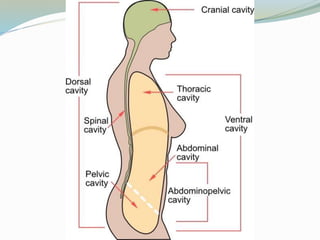
 The two largest human body cavities are the ventral cavity and the dorsal
cavity.
 These two body cavities are subdivided into smaller body cavities.
 The ventral cavity is at the anterior (front) of the trunk. It is subdivided into
the thoracic cavity and abdominopelvic cavity.
 The dorsal cavity is at the posterior (back) of the body, and includes head and
back of the trunk. It is subdivided into the cranial cavity and spinal cavity.
1. Cranial cavity : The space occupied by the brain, enclosed by the skull
bones.
2. Spinal cavity : The space occupied by the spinal cord enclosed by the
vertebrae column making up the backbone. The spinal cavity is
continuous with the cranial cavity.
3. Thoracic cavity : It is formed by ribs, muscles of chest, sternum and
thoracic portion of vertebral column.
4. Abdominopelvic cavity : It extends from diaphragm to the groin. It is
subdivided into abdominal cavity and the pelvic cavity.
a) Abdominal cavity : It contains stomach, spleen, liver, gallbladder,
small intestine and most of the large intestine.
b) Pelvic cavity : It contains urinary bladder, portions of large intestine and
internal organs of reproduction.
5. Other body cavities are oral cavity, nasal cavity, orbital cavity, middle
ear cavity and synovial cavity.
 Serous membrane
 The serous membrane, or serosal membrane, is a thin membrane that lines
the internal body cavities and organs such as the heart, lungs,
and abdominal cavity.
 Serous membranes have two layers.
1. Parietal layer of the membranes line the walls of the body cavity
(pariet- refers to a cavity wall).
2. Visceral layer which covers and adheres to the viscera within the
cavities. Serous fluid between two layers reduces friction.
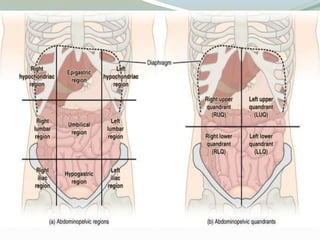
 Abdominopelvic region and quadrants
 The abdominopelvic cavity can be subdivided into four quadrants and
nine areas.
 The quadrants are labeled by location: the right upper, right lower, left upper,
and left lower quadrants.
 The nine regions are smaller than the four abdominopelvic quadrants and
include the right hypochondriac, right lumbar, right illiac, epigastric,
umbilical, hypogastric (or pubic), left hypochondriac, left lumbar, and left
illiac divisions.
Thank you

Introduction to Human Body.pptx

  • 1.
    Miss. Sheetal PatilM. Pharm Rani Chennamma College of Pharmacy, Belagavi.
  • 2.
    Definition and Scopeof Anatomy and Physiology  Human Anatomy (ana = “up”, tome = “to cut”) is the branch of Biomedical science dealing with normal structure shape size and location of the various part of the body.  Human Physiology (physio = nature, logy = study of) is branch of Biomedical science dealing with normal functioning of various organ in the body.
  • 3.
  • 4.
  • 5.
    Branches of Anatomy 1.Gross Anatomy: It is the study of body parts visible to naked eye. 2. Microscopic anatomy: Anatomical study by means of modern microscopes including study of cells (Cytology) and tissues (Histology). 3. Developmental anatomy: It is the study of human growth and development. 4. Pathological anatomy: It is the study of diseased body structure.
  • 6.
    Branches of Physiology 1.Neurophysiology (neuro: nerve) is study of functional properties of nerve cells. 2. Endocrinology (endo: within; crin: secretion) is study of hormones. 3. Cardiovascular physiology (cardi: heart; vascular: blood vessels) is study of function of heart and blood vessels. 4. Immunology (immune: not susceptible) is study of how body defends against disease causing agents.
  • 7.
    5. Systemic physiologyit is the study of body by system (system is a group of organs that have common function e.g. bones in skeleton system and muscles in muscular system). 6. Respiratory physiology (respira: to breathe) is study of function of lungs. 7. Renal physiology (ren: kidney) is study of functions of kidneys. 8. Pathophysiology (path: disease) is study of functional changes associated with disease.
  • 8.
    Levels of StructuralOrganization  Living things consist of several levels of structural organization that are associated with one another in various ways.
  • 10.
    Levels of StructuralOrganization 1. Chemical level 2. Cellular level 3. Tissue level 4. Organ level 5. Organ system level 6. Organismal level
  • 11.
    1. Chemical Level It is the lowest level of organization.  It includes atoms and molecules that are essential in maintaining life.
  • 12.
  • 13.
    2. The CellularLevel  The next higher level of organization.  It is the basic structural and functional units of an organism.  Molecules combine to form cells.  There are different types of cells and each has a different structure and each perform a different function.
  • 14.
  • 15.
    3. The TissueLevel  It is the level in which cells joined together to form a structure called tissue.  Groups of cells and the materials surrounding them that work together to perform a particular function are called tissues. Four basic types of tissue in the body are: 1. Epithelial tissue 2. Connective tissue 3. Muscular tissue 4. Nervous tissue.
  • 16.
  • 17.
    4. The OrganLevel  Two or more different types of tissue are joined to form organ, which have specific function and usually have recognizable shapes.  Some examples of organs are stomach, heart, liver, lungs and brain.
  • 18.
  • 19.
    5. The OrganSystem Level  The level where different organs are joined together to form body system.  It consist of several related organs that have a common function.  Organs like oesophagus, stomach, liver, small intestine, gallbladder, pancreas and large intestine constitute the digestive system.
  • 21.
    6. The OrganismLevel  All the system of the body of an individual functioning together constitute the total organism, e.g., human body.
  • 22.
  • 23.
    Systems Of TheHuman Body The human body is made of body systems that is groups of organs that work together to produce and sustain life.
  • 24.
     There areeleven system of the human body: 1. Integumentary system/ Exocrine system 2. Skeletal system 3. Muscular system 4. Nervous system 5. Endocrine system 6. Cardiovascular system/circulatory system 7. Lymphatic system and immunity system 8. Respiratory system 9. Digestive system 10. Urinary system and renal system 11. Reproductive system
  • 25.
    1. Integumentary System/Exocrine System  It forms the external covering of the body.  The skin is the largest organ of the body.  Components: skin and its structure (hair, nails, sweat gland and oil glands).  Functions of Integumentary system i. It protects body from various damaging events, such as external injuries and carcinogenic effects of UV rays. ii. It also excretes waste. iii. Helps to make vitamin D. iv. Detect sensation (e.g., touch, pain, warmth and cold). v. Helps to regulate body temperature.
  • 26.
  • 27.
    2. Skeletal System The skeletal system is the body system composed of bones, cartilages, ligaments and other tissues that perform essential functions for the human body.  Functions of skeletal system i. Support and protects the body ii. Provide surface area for muscle attachments iii. Helps body movements iv. Produces blood cells v. Stores and releases minerals and fats
  • 28.
  • 29.
  • 30.
    3. Muscular System Human muscle system, the muscles of the human body that work the skeletal system that are under voluntary control.  Muscles of all vertebrates is often divided into skeletal, smooth and cardiac muscles.  Functions of muscular system i. Produces body movement ii. Stabilizes body position (posture) iii. Smooth muscle has important role in the circulation of blood around the body. iv. Generates heat
  • 31.
  • 32.
    4. Nervous System The nervous system is a network of neurons whose main feature is to generate, modulate and transmit information between all the different parts of the human body.  Components: Brain, spinal cord, nerves and special sense organ.  Functions of nervous system i. Generate nerve impulses to regulate body activities. ii. Detects changes in the body’s internal and external environment. iii. Interprets the changes and responds by causing muscular contraction and glandular secretions.
  • 34.
    5. Endocrine System The endocrine system is a series of glands that produce and secrete hormones that the body uses for a wide range of function.  Components: hormones producing glands like pituitary gland, hypothalamus, pineal gland, thyroid gland, thymus, parathyroid glands, pancreas, adrenal glands, ovaries (in females) and testes (in males).  Functions of endocrine system i. Secrete hormones (chemical messengers) in the blood that regulate body activities in target organs like metabolism, growth and development, tissue function, sexual function, reproduction, sleep and mood.
  • 36.
    6. Cardiovascular System The circulatory system, also called the cardiovascular system or the vascular system .  Components: Blood, heart and blood vessels.  Functions of cardiovascular system i. Heart pumps blood through blood vessels. ii. Blood carries oxygen and nutrients to cells and carbon dioxide and wastes away from cells. iii. Hearts helps to regulate temperature, acid-base balance and water content of body fluids. iv. Blood components helps defend against disease and repair damaged blood vessels.
  • 37.
  • 38.
    7. Lymphatic System The lymphatic system is a network of tissues and organs that help rid the body of toxins, waste and other unwanted materials.  Components: Lymphatic fluid and vessels, spleen, thymus, lymph nodes and tonsils.  Functions of lymphatic system i. It maintains the balance of fluid between the blood and tissues, known as fluid homeostasis. ii. It forms part of the body’s immune system and helps defend against bacteria and other intruders. iii. It facilitates absorption of fats and fat-soluble nutrients in the digestive system.
  • 40.
    8. Respiratory System The respiratory system is the network of organs and tissues that help you breathe.  Components: Lungs, pharynx, larynx, trachea and bronchial tubes leading into lungs.  Functions of respiratory system i. Transfer O2 from inhaled air to blood and CO2 from blood to exhaled air. ii. Helps to regulate acid-base balance of body fluids. iii. Helps to produce sound when air flows out through vocal cords.
  • 41.
  • 42.
    9. Digestive System The human digestive system is the means by which tissues and organs receive nutrients to function. The system breaks down food, extracts nutrients from it, and converts them into energy.  Components: mouth, pharynx, oesophagus, stomach, small intestine, large intestine, rectum and anus and accessary organs like salivary glands, pancreas, gall bladder and liver.  Functions of digestive system i. Intake and digestion of food. ii. Absorption of nutrients from digested food. iii. Body uses nutrients for energy, growth and cell repair. iv. Elimination of solid waste products.
  • 44.
    10. Urinary System The urinary system, also known as the renal system or urinary tract.  Components: Kidneys, ureters, urinary bladder and urethra.  Functions of urinary system i. Produce, stores and eliminates urine. ii. Eliminates wastes and regulates volume and chemical composition of blood. iii. Helps to maintain the acid-base balance of body fluids. iv. Maintain body’s mineral balance. v. Helps regulate production of red blood cells.
  • 45.
  • 46.
    11. Reproductive System The reproductive system of an organism, also known as the genital system, is the biological system involved in sexual reproduction.  Components: Gonads (testes in males and ovaries in females) and associated organs (uterine tubes, uterus and vagina in females and epididymis, vas deferens and penis in males).  Functions of reproductive system i. Gonads produce gametes (sperm or oocytes) that unite to form a new organism ii. Gonads release hormones that regulate reproduction and other body processes iii. Associated organs transport and store gametes
  • 48.
    Characteristics of theliving human organism  Basic life processes Six most important life processes of human body are: 1. Metabolism 2. Responsiveness 3. Movement 4. Growth 5. Differentiation 6. Reproduction
  • 49.
    1. Metabolism  Itis the sum of all chemical processes that occur in the body and has two types: a. Catabolism b. Anabolism a. Catabolism: It is the breakdown of complex chemical substances into simpler components, e.g., digestion of proteins into amino acids. b. Anabolism: It is the building up of complex chemical substances from smaller components, e.g., use of amino acids to build new proteins of the body.
  • 51.
    2. Responsiveness  Itis the body's ability to detect and respond to changes.  Different cells in the body respond to environmental changes in different ways. Example: a. Nerve cells: Respond by generating electric signals known as nerve impulses/ action potentials b. Muscle cells: Respond by contracting, which generates force to move body parts.
  • 52.
    3. Movements  Itincludes motion of the whole body (walking), individual organs (moving arm), single cells (movement of white blood cells) and even tiny structures inside cells like cytoplasm. 4. Growth  Increase in body size and weight that results from an increase in the size of existing cells and an increase in the number of cells.  Exapmle: In a growing bone, mineral deposits accumulate between bone cells, causing the bone to grow in length and width.
  • 53.
    5. Differentiation  Developmentof a cell from an unspecialized to a specialized state.  Example : Stem cells, Unspecialized precursor /ancestor cells, which can divide and give rise to cells that undergo differentiation are known as stem cells.  Through differentiation , a fertilized egg/ ovum develops into an embryo, then into a fetus, an infant, child and finally an adult.  egg/ ovum - embryo - fetus - infant - child - adult.
  • 54.
    6. Reproduction It referseither to the formation of new cells or to the production of a new individual from zygot after fertilization of an ovum by a sperm cell.
  • 55.
    Homeostasis  Homeostasis isan organism’s process of maintaining a stable internal environment suitable for sustaining life. The word homeostasis derives from Greek, with home meaning “similar,” and stasis, meaning “stable.”  Homeostasis is a regulatory procedure. In the human body, homeostatic processes regulate:  Ratios of water and minerals  Body temperature  Level of glucose in blood
  • 56.
     Feedback systemhas three basic components: Sensor, control center and an effector. Sensor, also referred to a receptor, monitors a physiological value, which is then reported to the control center. The control center compares the value to the normal range. If the value deviates too much from the set point, then the control center activates an effector. An effector causes a change to reverse the situation and return the value to the normal range.
  • 59.
    Anatomical terminology  Bodypositions  The standard position in which the body is standing with feet together, arms to the side, and head, eyes, and palms facing forward.  If the body is lying face down, it is prone position.  Lying on its back it is the supine position.
  • 61.
     Regional names Principal regions of the human body are head, trunk, upper limbs and lower limbs. a. Head : It consist of skull (encloses brain) and face (eyes, nose, mouth, forehead, cheeks and chin). b. Neck : It supports the brain and attaches to the trunk. c. Trunk : It consist of chest, abdomen and pelvis. d. Upper limbs : Each upper limb is attached to the trunk and consist of shoulder, arm, forearm, wrist and hands. e. Lower limbs : Each lower limb is attached to the trunk and consist of thigh, buttock, leg, ankle and foot.
  • 62.
     Directional terms Directional terms describe the position of one body part relative to another. Several directional terms are grouped in pairs having opposite meanings.  Examples : Anterior (front) and posterior (back).
  • 64.
     Planes andSections  A plane is an imaginary, two-dimensional surface that passes through the body. There are three planes commonly referred to in anatomy. 1. Sagittal plane a. Midsagittal plane b. Parasagittal plane 2. Frontal or coronal plane 3. Transverse or cross sectional or horizontal plane
  • 65.
    1. Sagittal plane:It is a vertical plane that divides the body or an organ into right and left sides. a. If this vertical plane runs directly down the middle of the body, it is called the midsagittal or median plane. b. If it divides the body into unequal right and left sides, it is called a parasagittal plane . 2. Frontal plane : The frontal plane divides the body or an organ into an anterior (front) and a posterior (back) portion. 3. Transverse or horizontal plane : It divides the body or organ horizontally into upper and lower portions. Transverse planes produce images referred to as cross sections.
  • 67.
    Body Cavity  Abody cavity is a fluid-filled space inside the body that holds and protects internal organs. Human body cavities are separated by membranes and other structures.  The two largest human body cavities are the ventral cavity and the dorsal cavity.  These two body cavities are subdivided into smaller body cavities.  The ventral cavity is at the anterior (front) of the trunk. It is subdivided into the thoracic cavity and abdominopelvic cavity.  The dorsal cavity is at the posterior (back) of the body, and includes head and back of the trunk. It is subdivided into the cranial cavity and spinal cavity.
  • 68.
    1. Cranial cavity: The space occupied by the brain, enclosed by the skull bones. 2. Spinal cavity : The space occupied by the spinal cord enclosed by the vertebrae column making up the backbone. The spinal cavity is continuous with the cranial cavity. 3. Thoracic cavity : It is formed by ribs, muscles of chest, sternum and thoracic portion of vertebral column.
  • 69.
    4. Abdominopelvic cavity: It extends from diaphragm to the groin. It is subdivided into abdominal cavity and the pelvic cavity. a) Abdominal cavity : It contains stomach, spleen, liver, gallbladder, small intestine and most of the large intestine. b) Pelvic cavity : It contains urinary bladder, portions of large intestine and internal organs of reproduction. 5. Other body cavities are oral cavity, nasal cavity, orbital cavity, middle ear cavity and synovial cavity.
  • 71.
     Serous membrane The serous membrane, or serosal membrane, is a thin membrane that lines the internal body cavities and organs such as the heart, lungs, and abdominal cavity.  Serous membranes have two layers. 1. Parietal layer of the membranes line the walls of the body cavity (pariet- refers to a cavity wall). 2. Visceral layer which covers and adheres to the viscera within the cavities. Serous fluid between two layers reduces friction.
  • 72.
     Abdominopelvic regionand quadrants  The abdominopelvic cavity can be subdivided into four quadrants and nine areas.  The quadrants are labeled by location: the right upper, right lower, left upper, and left lower quadrants.  The nine regions are smaller than the four abdominopelvic quadrants and include the right hypochondriac, right lumbar, right illiac, epigastric, umbilical, hypogastric (or pubic), left hypochondriac, left lumbar, and left illiac divisions.
  • 74.