

PLANNING
Dr.Salil Choudhary
BDS,MBA
What Is Planning?
 Define planning.
 Types (Levels) of Planning
 Strategic Planning
 Intermediate Planning
 Operational Planning
 Planning Process/ Procedure
 Barriers to Effective Planning
 Planning Premises
 Forecasting
 Key to Planning
 Advantage & Disadvantage of Planning
 Planning
◦ Planning is the primary function of management.
◦ It focuses on the future course of action.
◦ A primary managerial activity that specifies the objectives to
be achieved in future and selects the alternative course of
action to reach defined objectives. Thus, it involves:
 Defining the organization’s goals
 Establishing an overall strategy for achieving those goals
 Developing plans for organizational work activities.
 “Determination of future course of actions in advance”
 It is the blue print of action and operation.
 Planning is intellectual process which is concerned with
deciding in advance what, when, why, how, and who shall do
the work.
 “Generally speaking, planning is deciding in advance what is to
be done”
-W H Newman
 “Planning is deciding in advance what to do, how to do, when to
do and who is to do it. Planning bridges a gap between from
where we are to where we want to go”
-Harold, Koontz and O’Donnel
 “Planning is that function of manner in which he decides in
advance what he will do. It is a decision making process of a
special kind, its essence is futurity.”
-Hayness and Massie
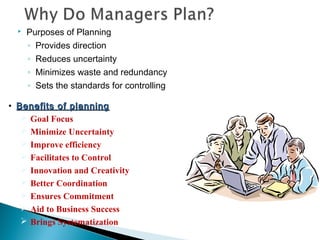
 Purposes of Planning
◦ Provides direction
◦ Reduces uncertainty
◦ Minimizes waste and redundancy
◦ Sets the standards for controlling
• Benefits of planningBenefits of planning
 Goal Focus
 Minimize Uncertainty
 Improve efficiency
 Facilitates to Control
 Innovation and Creativity
 Better Coordination
 Ensures Commitment
 Aid to Business Success
 Brings Systematization
 Elements of Planning
◦ Goals (also Objectives)
 Desired outcomes for individuals, groups, or entire
organizations
 Provide direction and evaluation performance criteria
◦ Plans
 Documents that outline how goals are to be accomplished
 Describe how resources are to be allocated and establish
activity schedules
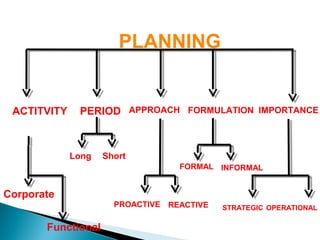
ACTITVITY
COVERED
Corporate
Functional
PERIOD
Long
term
Short
term
APPROACH
PROACTIVE REACTIVE
FORMULATION
FORMAL INFORMAL
IMPORTANCE
STRATEGIC OPERATIONAL
PLANNING
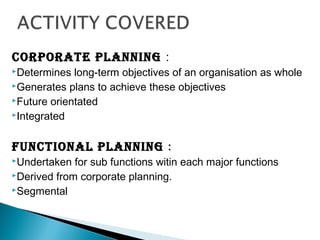
Corporate planning :
Determines long-term objectives of an organisation as whole
Generates plans to achieve these objectives
Future orientated
Integrated
FunCtional planning :
Undertaken for sub functions witin each major functions
Derived from corporate planning.
Segmental
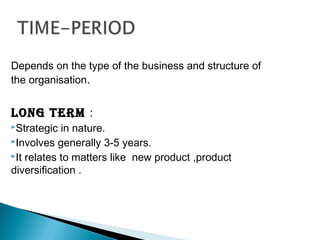
Depends on the type of the business and structure of
the organisation.
long terM :
Strategic in nature.
Involves generally 3-5 years.
It relates to matters like new product ,product
diversification .
SHort terM :
•Short term planning typically covers time frames
of less than one year in order to assist
their company in moving gradually toward its
longer term.
• Examples are the skills of the employees and
their attitudes. The condition of production
equipment or product quality problems are also
short-term concerns.
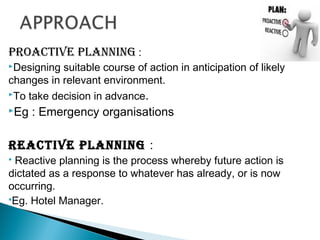
PROACTIVE PLANNING :
Designing suitable course of action in anticipation of likely
changes in relevant environment.
To take decision in advance.
Eg : Emergency organisations
REACTIVE PLANNING :
 Reactive planning is the process whereby future action is
dictated as a response to whatever has already, or is now
occurring.
Eg. Hotel Manager.
FORMAL PLANNING :
It is a structured plan.
 It has some procedure to follow.
Written record is followed in formal plan.
Eg. Five year plan of a country.
INFORMAL PLANNING
 It is unstructured plan.
It does not have any procedure to follow.
No record is maintained for future purpose.
STRATEGIC :
It sets future directions of the
organization in which it wants to proceed in future.
It involves a time horizon of more than one year and for most
of the organization it ranges between 3 and 5 years.
 Strategic plans are generally developed by top level
management.
Eg. diversification of business into new lines, planned
grown rate in sales.
 Operational plans are developed to determine
the steps necessary for achieving tactical
goals..
 They are used as a guide for day to day
operation by department managers.
 These plans may cover a time frame of few
months, weeks or even a few days.
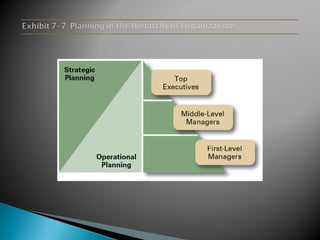
 Strategic Plans
◦ Apply to the entire organization.
◦ Establish the organization’s overall goals.
◦ Seek to position the organization in terms of its environment.
◦ Cover extended periods of time.
 Operational Plans
◦ Specify the details of how the overall goals are to be achieved.
◦ Cover short time period.
 Long-Term Plans
◦ Plans with time frames extending beyond three years
 Short-Term Plans
◦ Plans with time frames on one year or less
 Specific Plans
◦ Plans that are clearly defined and leave no room for
interpretation
 Directional Plans
◦ Flexible plans that set out general guidelines, provide
focus, yet allow discretion in implementation.
 Single-Use Plan
◦ A one-time plan specifically designed to meet the need of
a unique situation.
 Standing Plans
◦ Ongoing plans that provide guidance for activities
performed repeatedly.
 Traditional Goal Setting
◦ Broad goals are set at the top of the organization.
◦ Goals are then broken into sub-goals for each
organizational level.
◦ Assumes that top management knows best because they
can see the “big picture.”
◦ Goals are intended to direct, guide, and constrain from
above.
◦ Goals lose clarity and focus as lower-level managers
attempt to interpret and define the goals for their areas of
responsibility.
 Criticisms of Planning
◦ Planning may create rigidity.
◦ Plans cannot be developed for dynamic environments.
◦ Formal plans cannot replace intuition and creativity.
◦ Planning focuses managers’ attention on today’s
competition not tomorrow’s survival.
◦ Formal planning reinforces today’s success, which may
lead to tomorrow’s failure.
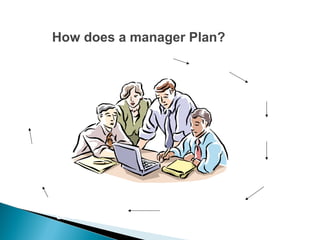
Establish objectives
Develop Strategies
Determination of
premises
Determination of
alternatives
Evaluation of
alternatives
Selecting a course
of action
Formulation of
derivative plans
Implantation of
plans
Reviewing the
planning process
How does a manager Plan?
Planning Process:
 Not a step of Planning, It is pre-step of planning.
 Essential to make a successful plan.
 SWOT analysis
Setting objectivesSetting objectives
• First and real starting point of planning.First and real starting point of planning.
• Management has to define objectives in clear manner byManagement has to define objectives in clear manner by
considering organizational resources and opportunities because aconsidering organizational resources and opportunities because a
minor mistake in setting objectives might affect in implementation ofminor mistake in setting objectives might affect in implementation of
plan.plan.
• Objectives must be specific, clear and practical.Objectives must be specific, clear and practical.
• They should be time bound and expressed in numerical terms.They should be time bound and expressed in numerical terms.
 Premises are the assumptions about the future in which the
planning is implemented.
 They provide environment and boundaries for the
implementation of plan in practical operation.
 These premises may be tangible and intangible and
external.
(a) Tangible and intangible: Tangible premises involve
capital investment, unit of production, units sold, cost per
unit, time available etc. Similarly, intangible premises involve
employees moral, goodwill, motivation, managerial attitude,
etc.
(b) Internal and external: Internal premises involve
money, materials, machines and managements. In the
similar manner, external factors involve competitors
strategy, technological change, government policy, social
and cultural beliefs etc.
 It is essential to identify all the possible hidden
alternatives. The information about alternative
courses of action may be obtained from primary
and secondary sources. There must be search for
the best alternative. The management must
develop alternatives through the support of
experienced and intellectual experts in
management sectors.
 Evaluate the alternatives from their expected cost
and benefits. This is the logical step to evaluate
each alternative from its plus and minus points.
 Each alternative is studied and evaluated in terms
of some common factors such as risk,
responsibility, planning premises, resources,
technology etc.
Selecting a course of actionSelecting a course of action
 It is essential to formulate action or derivative
plans for each step of work and to all departments
of the organization. These action plans involve
formulation of policies, rules, schedule and budget
to complete defined objectives. Thus, formulation
of derivative plans is an essential step in planning
process. It is difficult to implement main plan
without formulation of derivative plan.
 Without this step, other this procedure of plan will remain as
paper work.
 This step brings all the procedure of plan into action.
 For implementation plan, management has to take some
steps such as to communicate with subordinates who initiate
to plan into action; provide necessary instruction and
guidance; make arrangement of all resources like materials,
machines, money, equipments etc; make timely supervision
and control over subordinates.
Reviewing the planning processReviewing the planning process
 Planning facilitates management by objectives
 Planning minimizes uncertainties
 Planning facilitates co-ordination
 Planning improves employee’s moral
 Planning helps in achieving economies
 Planning facilitates controlling
 Planning provides competitive edge
 Planning encourages innovations
 Planning begins with determination of objectives.
 It highlights the purposes for which various activities are to
be undertaken.
 In fact, it makes objectives more clear and specific.
 Planning helps in focusing the attention of employees on the
objectives or goals of enterprise.
 Without planning an organization has no guide.
 Planning compels manager to prepare a Blue-print of the
courses of action to be followed for accomplishment of
objectives.
 Therefore, planning brings order and rationality into the
organization.
 Business is full of uncertainties.
 There are risks of various types due to uncertainties.
 Planning helps in reducing uncertainties of future as it
involves anticipation of future events.
 Although future cannot be predicted with cent percent
accuracy but planning helps management to anticipate
future and prepare for risks by necessary provisions to
meet unexpected turn of events.
 Therefore with the help of planning, uncertainties can be
forecasted which helps in preparing standbys as a result,
uncertainties are minimized to a great extent.
 Planning revolves around organizational goals.
 All activities are directed towards common goals.
 There is an integrated effort throughout the
enterprise in various departments and groups.
 It avoids duplication of efforts. In other words, it leads
to better co-ordination.
 It helps in finding out problems of work performance
and aims at rectifying the same.
 Planning creates an atmosphere of order and
discipline in organization.
 Employees know in advance what is expected of
them and therefore conformity can be achieved
easily.
 This encourages employees to show their best
and also earn reward for the same.
 Planning creates a healthy attitude towards work
environment which helps in boosting employees
moral and efficiency
 Effective planning secures economy since it leads to orderly
allocation of resources to various operations.
 It also facilitates optimum utilization of resources which brings
economy in operations.
 It also avoids wastage of resources by selecting most appropriate
use that will contribute to the objective of enterprise. For example,
raw materials can be purchased in bulk and transportation cost can
be minimized. At the same time it ensures regular supply for the
production department, that is, overall efficiency
 Planning facilitates existence of certain planned
goals and standard of performance.
 It provides basis of controlling.
 We cannot think of an effective system of controlling
without existence of well thought out plans.
 Planning provides pre-determined goals against
which actual performance is compared.
 In fact, planning and controlling are the two sides of
a same coin. If planning is root, controlling is the
fruit.
 Planning provides competitive edge to the enterprise over the
others which do not have effective planning. This is because of the
fact that planning may involve changing in work methods, quality,
quantity designs, extension of work, redefining of goals, etc.
 With the help of forecasting not only the enterprise secures its future
but at the same time it is able to estimate the future motives of it’s
competitor which helps in facing future challenges.
 Therefore, planning leads to best utilization of possible resources,
improves quality of production and thus the competitive strength of
the enterprise is improved
 In the process of planning, managers have the
opportunities of suggesting ways and means of
improving performance.
 Planning is basically a decision making function
which involves creative thinking and imagination
that ultimately leads to innovation of methods
and operations for growth and prosperity of the
enterprise
Limitations of
Planning
  Planning involves too much expenditure.
Money and effort both are required in planning.
 Planning includes collecting information, data
forecasting and evaluation of alternatives. It
requires salary and allowances to the experts
in the process of providing services.
    So, planning has been accepted as costly
process by small and medium size organization
 Planning is the time consuming process. It delays the
business activity to come in action.
 In the process of planning following the procedures
of planning takes a lot of time which may create
problem to the organization where immediate action
has to be made. So in such situation planning is not
suitable.
 Planning encourages false sense of
security against future risk and
uncertainty. As future is uncertain, it is
unpredictable. Therefore, planning cannot
give accurate and reliable results.
 Rapid changes in technology ,consumer tastes
and prefernces are further limitations to
planning.
 Eg.: Planning in aircraft ,chemical,electronic and
information industries is specially complicated
due to acceptionally complex and rapidly
changing production technology.
 Present is always more real than the future ,
and present problems seem to be more urgent
than the future problems.
Many of us are inclined to take care of today and
hope that tommorow will take care of itself .
This is normal human tendency but infact we
have to take take care of today as well as
tommorow.
Planning

Planning

  • 1.
  • 2.
    What Is Planning? Define planning.  Types (Levels) of Planning  Strategic Planning  Intermediate Planning  Operational Planning  Planning Process/ Procedure  Barriers to Effective Planning  Planning Premises  Forecasting  Key to Planning  Advantage & Disadvantage of Planning
  • 3.
     Planning ◦ Planningis the primary function of management. ◦ It focuses on the future course of action. ◦ A primary managerial activity that specifies the objectives to be achieved in future and selects the alternative course of action to reach defined objectives. Thus, it involves:  Defining the organization’s goals  Establishing an overall strategy for achieving those goals  Developing plans for organizational work activities.
  • 4.
     “Determination offuture course of actions in advance”  It is the blue print of action and operation.  Planning is intellectual process which is concerned with deciding in advance what, when, why, how, and who shall do the work.
  • 5.
     “Generally speaking,planning is deciding in advance what is to be done” -W H Newman  “Planning is deciding in advance what to do, how to do, when to do and who is to do it. Planning bridges a gap between from where we are to where we want to go” -Harold, Koontz and O’Donnel  “Planning is that function of manner in which he decides in advance what he will do. It is a decision making process of a special kind, its essence is futurity.” -Hayness and Massie
  • 6.
     Purposes ofPlanning ◦ Provides direction ◦ Reduces uncertainty ◦ Minimizes waste and redundancy ◦ Sets the standards for controlling • Benefits of planningBenefits of planning  Goal Focus  Minimize Uncertainty  Improve efficiency  Facilitates to Control  Innovation and Creativity  Better Coordination  Ensures Commitment  Aid to Business Success  Brings Systematization
  • 7.
     Elements ofPlanning ◦ Goals (also Objectives)  Desired outcomes for individuals, groups, or entire organizations  Provide direction and evaluation performance criteria ◦ Plans  Documents that outline how goals are to be accomplished  Describe how resources are to be allocated and establish activity schedules
  • 9.
  • 10.
    Corporate planning : Determineslong-term objectives of an organisation as whole Generates plans to achieve these objectives Future orientated Integrated FunCtional planning : Undertaken for sub functions witin each major functions Derived from corporate planning. Segmental
  • 11.
    Depends on thetype of the business and structure of the organisation. long terM : Strategic in nature. Involves generally 3-5 years. It relates to matters like new product ,product diversification .
  • 12.
    SHort terM : •Shortterm planning typically covers time frames of less than one year in order to assist their company in moving gradually toward its longer term. • Examples are the skills of the employees and their attitudes. The condition of production equipment or product quality problems are also short-term concerns.
  • 13.
    PROACTIVE PLANNING : Designingsuitable course of action in anticipation of likely changes in relevant environment. To take decision in advance. Eg : Emergency organisations REACTIVE PLANNING :  Reactive planning is the process whereby future action is dictated as a response to whatever has already, or is now occurring. Eg. Hotel Manager.
  • 14.
    FORMAL PLANNING : Itis a structured plan.  It has some procedure to follow. Written record is followed in formal plan. Eg. Five year plan of a country. INFORMAL PLANNING  It is unstructured plan. It does not have any procedure to follow. No record is maintained for future purpose.
  • 15.
    STRATEGIC : It sets future directions of the organization in which it wants to proceed infuture. It involves a time horizon of more than one year and for most of the organization it ranges between 3 and 5 years.  Strategic plans are generally developed by top level management. Eg. diversification of business into new lines, planned grown rate in sales.
  • 16.
     Operational plansare developed to determine the steps necessary for achieving tactical goals..  They are used as a guide for day to day operation by department managers.  These plans may cover a time frame of few months, weeks or even a few days.
  • 17.
     Strategic Plans ◦Apply to the entire organization. ◦ Establish the organization’s overall goals. ◦ Seek to position the organization in terms of its environment. ◦ Cover extended periods of time.  Operational Plans ◦ Specify the details of how the overall goals are to be achieved. ◦ Cover short time period.
  • 18.
     Long-Term Plans ◦Plans with time frames extending beyond three years  Short-Term Plans ◦ Plans with time frames on one year or less  Specific Plans ◦ Plans that are clearly defined and leave no room for interpretation  Directional Plans ◦ Flexible plans that set out general guidelines, provide focus, yet allow discretion in implementation.
  • 19.
     Single-Use Plan ◦A one-time plan specifically designed to meet the need of a unique situation.  Standing Plans ◦ Ongoing plans that provide guidance for activities performed repeatedly.
  • 20.
     Traditional GoalSetting ◦ Broad goals are set at the top of the organization. ◦ Goals are then broken into sub-goals for each organizational level. ◦ Assumes that top management knows best because they can see the “big picture.” ◦ Goals are intended to direct, guide, and constrain from above. ◦ Goals lose clarity and focus as lower-level managers attempt to interpret and define the goals for their areas of responsibility.
  • 22.
     Criticisms ofPlanning ◦ Planning may create rigidity. ◦ Plans cannot be developed for dynamic environments. ◦ Formal plans cannot replace intuition and creativity. ◦ Planning focuses managers’ attention on today’s competition not tomorrow’s survival. ◦ Formal planning reinforces today’s success, which may lead to tomorrow’s failure.
  • 23.
    Establish objectives Develop Strategies Determinationof premises Determination of alternatives Evaluation of alternatives Selecting a course of action Formulation of derivative plans Implantation of plans Reviewing the planning process How does a manager Plan? Planning Process:
  • 24.
     Not astep of Planning, It is pre-step of planning.  Essential to make a successful plan.  SWOT analysis Setting objectivesSetting objectives • First and real starting point of planning.First and real starting point of planning. • Management has to define objectives in clear manner byManagement has to define objectives in clear manner by considering organizational resources and opportunities because aconsidering organizational resources and opportunities because a minor mistake in setting objectives might affect in implementation ofminor mistake in setting objectives might affect in implementation of plan.plan. • Objectives must be specific, clear and practical.Objectives must be specific, clear and practical. • They should be time bound and expressed in numerical terms.They should be time bound and expressed in numerical terms.
  • 25.
     Premises arethe assumptions about the future in which the planning is implemented.  They provide environment and boundaries for the implementation of plan in practical operation.  These premises may be tangible and intangible and external. (a) Tangible and intangible: Tangible premises involve capital investment, unit of production, units sold, cost per unit, time available etc. Similarly, intangible premises involve employees moral, goodwill, motivation, managerial attitude, etc. (b) Internal and external: Internal premises involve money, materials, machines and managements. In the similar manner, external factors involve competitors strategy, technological change, government policy, social and cultural beliefs etc.
  • 26.
     It isessential to identify all the possible hidden alternatives. The information about alternative courses of action may be obtained from primary and secondary sources. There must be search for the best alternative. The management must develop alternatives through the support of experienced and intellectual experts in management sectors.
  • 27.
     Evaluate thealternatives from their expected cost and benefits. This is the logical step to evaluate each alternative from its plus and minus points.  Each alternative is studied and evaluated in terms of some common factors such as risk, responsibility, planning premises, resources, technology etc. Selecting a course of actionSelecting a course of action
  • 28.
     It isessential to formulate action or derivative plans for each step of work and to all departments of the organization. These action plans involve formulation of policies, rules, schedule and budget to complete defined objectives. Thus, formulation of derivative plans is an essential step in planning process. It is difficult to implement main plan without formulation of derivative plan.
  • 29.
     Without thisstep, other this procedure of plan will remain as paper work.  This step brings all the procedure of plan into action.  For implementation plan, management has to take some steps such as to communicate with subordinates who initiate to plan into action; provide necessary instruction and guidance; make arrangement of all resources like materials, machines, money, equipments etc; make timely supervision and control over subordinates. Reviewing the planning processReviewing the planning process
  • 30.
     Planning facilitatesmanagement by objectives  Planning minimizes uncertainties  Planning facilitates co-ordination  Planning improves employee’s moral  Planning helps in achieving economies  Planning facilitates controlling  Planning provides competitive edge  Planning encourages innovations
  • 31.
     Planning beginswith determination of objectives.  It highlights the purposes for which various activities are to be undertaken.  In fact, it makes objectives more clear and specific.  Planning helps in focusing the attention of employees on the objectives or goals of enterprise.  Without planning an organization has no guide.  Planning compels manager to prepare a Blue-print of the courses of action to be followed for accomplishment of objectives.  Therefore, planning brings order and rationality into the organization.
  • 32.
     Business isfull of uncertainties.  There are risks of various types due to uncertainties.  Planning helps in reducing uncertainties of future as it involves anticipation of future events.  Although future cannot be predicted with cent percent accuracy but planning helps management to anticipate future and prepare for risks by necessary provisions to meet unexpected turn of events.  Therefore with the help of planning, uncertainties can be forecasted which helps in preparing standbys as a result, uncertainties are minimized to a great extent.
  • 33.
     Planning revolvesaround organizational goals.  All activities are directed towards common goals.  There is an integrated effort throughout the enterprise in various departments and groups.  It avoids duplication of efforts. In other words, it leads to better co-ordination.  It helps in finding out problems of work performance and aims at rectifying the same.
  • 34.
     Planning createsan atmosphere of order and discipline in organization.  Employees know in advance what is expected of them and therefore conformity can be achieved easily.  This encourages employees to show their best and also earn reward for the same.  Planning creates a healthy attitude towards work environment which helps in boosting employees moral and efficiency
  • 35.
     Effective planningsecures economy since it leads to orderly allocation of resources to various operations.  It also facilitates optimum utilization of resources which brings economy in operations.  It also avoids wastage of resources by selecting most appropriate use that will contribute to the objective of enterprise. For example, raw materials can be purchased in bulk and transportation cost can be minimized. At the same time it ensures regular supply for the production department, that is, overall efficiency
  • 36.
     Planning facilitatesexistence of certain planned goals and standard of performance.  It provides basis of controlling.  We cannot think of an effective system of controlling without existence of well thought out plans.  Planning provides pre-determined goals against which actual performance is compared.  In fact, planning and controlling are the two sides of a same coin. If planning is root, controlling is the fruit.
  • 37.
     Planning providescompetitive edge to the enterprise over the others which do not have effective planning. This is because of the fact that planning may involve changing in work methods, quality, quantity designs, extension of work, redefining of goals, etc.  With the help of forecasting not only the enterprise secures its future but at the same time it is able to estimate the future motives of it’s competitor which helps in facing future challenges.  Therefore, planning leads to best utilization of possible resources, improves quality of production and thus the competitive strength of the enterprise is improved
  • 38.
     In theprocess of planning, managers have the opportunities of suggesting ways and means of improving performance.  Planning is basically a decision making function which involves creative thinking and imagination that ultimately leads to innovation of methods and operations for growth and prosperity of the enterprise
  • 39.
  • 40.
      Planning involvestoo much expenditure. Money and effort both are required in planning.  Planning includes collecting information, data forecasting and evaluation of alternatives. It requires salary and allowances to the experts in the process of providing services.     So, planning has been accepted as costly process by small and medium size organization
  • 41.
     Planning isthe time consuming process. It delays the business activity to come in action.  In the process of planning following the procedures of planning takes a lot of time which may create problem to the organization where immediate action has to be made. So in such situation planning is not suitable.
  • 42.
     Planning encouragesfalse sense of security against future risk and uncertainty. As future is uncertain, it is unpredictable. Therefore, planning cannot give accurate and reliable results.
  • 43.
     Rapid changesin technology ,consumer tastes and prefernces are further limitations to planning.  Eg.: Planning in aircraft ,chemical,electronic and information industries is specially complicated due to acceptionally complex and rapidly changing production technology.
  • 44.
     Present isalways more real than the future , and present problems seem to be more urgent than the future problems. Many of us are inclined to take care of today and hope that tommorow will take care of itself . This is normal human tendency but infact we have to take take care of today as well as tommorow.