HAP-I
Sem-I
Introduction To Human Anatomy & Physiology
Mrs Rishita D Patel
Assistant professor
PHARMACOLOGY DEPARTMENT
IICP
CVMU
2
Anatomy and Physiology
• Anatomy – study of structure
(Greek – “a cutting up”)
• Physiology – study of function
(Greek – “relationship to nature”)
“Structure dictates function.”
Gross anatomy (macroscopic anatomy) :Gross anatomy
considers large structures such as the brain.
- Regional anatomy
- Systemic anatomy
Microscopic anatomy: Microscopic anatomy can deal with the
same structures, though at a different scale. This is a micrograph
of nerve cells from the brain.
- Cytology
- Histology
3
Physiology
• Physiology is the study of body function.
• Function requires parts to act in a
coordinated way.
• These coordinated activities are the
processes that sustain the living state and
allow individual cells, organs, and
organisms to carry out specialized
functions.
4
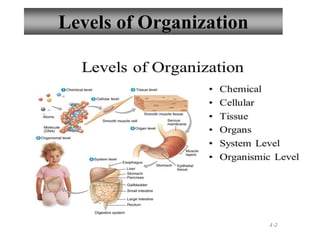
Levels of Organization
6
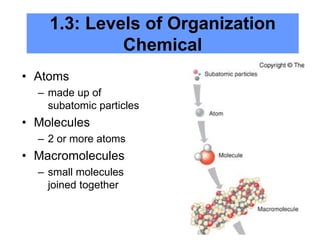
1.3: Levels of Organization
Chemical
• Atoms
– made up of
subatomic particles
• Molecules
– 2 or more atoms
• Macromolecules
– small molecules
joined together
7
1.3: Levels of Organization
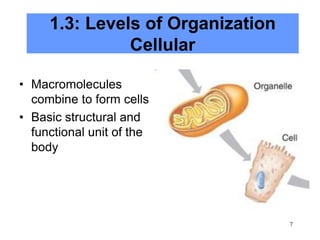
Cellular
• Macromolecules
combine to form cells
• Basic structural and
functional unit of the
body
8
1.3: Levels of Organization
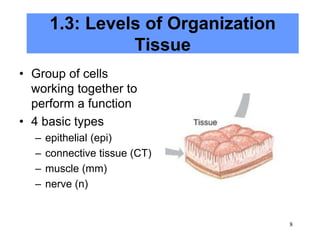
Tissue
• Group of cells
working together to
perform a function
• 4 basic types
– epithelial (epi)
– connective tissue (CT)
– muscle (mm)
– nerve (n)
9
1.3: Levels of Organization
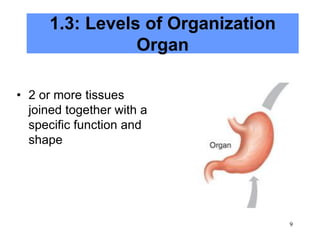
Organ
• 2 or more tissues
joined together with a
specific function and
shape
10
1.3: Levels of Organization
Systems
• Related organs with a
common function
• 11 systems
11
Organ Systems
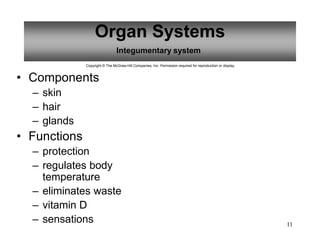
Integumentary system
Copyright © The McGraw-Hill Companies, Inc. Permission required for reproduction or display.
• Components
– skin
– hair
– glands
• Functions
– protection
– regulates body
temperature
– eliminates waste
– vitamin D
– sensations
12
Organ Systems
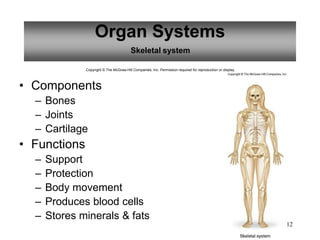
Skeletal system
Copyright © The McGraw-Hill Companies, Inc. Permission required for reproduction or display.
• Components
– Bones
– Joints
– Cartilage
• Functions
– Support
– Protection
– Body movement
– Produces blood cells
– Stores minerals & fats
13
Organ Systems
Copyright © The McGraw-Hill Companies, Inc. Permission required for reproduction or display.
Muscular system
• Components
– skeletal muscles
• Functions
– body movement
– posture
– generates heat
14
Organ Systems
Nervous system
Copyright © The McGraw-Hill Companies, Inc. Permission required for reproduction or display.
• Components
– brain
– spinal cord
– nerves
– special sense organs
• Functions
– action potentials
(nerve impulses)
– detects, interprets, and
responds to changes
in environment
15
Organ Systems
Endocrine system
Copyright © The McGraw-Hill Companies, Inc. Permission required for reproduction or display.
• Components
– hormone-producing
glands and cells
• Functions
– regulates body
activities
16
Organ Systems
Cardiovascular system
Copyright © The McGraw-Hill Companies, Inc. Permission required for reproduction or display.
• Components
– blood
– heart
– blood vessels
• Functions
– pumps blood
– carries O2 and nutrients to
cells and wastes away
– regulates temperature,
acid-base balance, and
H2O
17
Organ Systems
Copyright © The McGraw-Hill Companies, Inc. Permission required for reproduction or display.
Lymphatic system
• Components
– lymph fluid & vessels
– spleen
– thymus
– lymph nodes
– tonsils
• Functions
– transports dietary
lipids
– protection
18
Organ Systems
Respiratory system
Copyright © The McGraw-Hill Companies, Inc. Permission required for reproduction or display.
• Components
– pharynx
– larynx
– trachea
– bronchial tree
– lungs
• Functions
– exchange of gases
– acid-base balance
– sound production
19
Organ Systems
Copyright © The McGraw-Hill Companies, Inc. Permission required for reproduction or display.
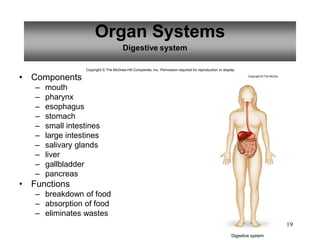
Digestive system
• Components
– mouth
– pharynx
– esophagus
– stomach
– small intestines
– large intestines
– salivary glands
– liver
– gallbladder
– pancreas
• Functions
– breakdown of food
– absorption of food
– eliminates wastes
20
Organ Systems
Copyright © The McGraw-Hill Companies, Inc. Permission required for reproduction or display.
Urinary system
• Components
– kidneys
– ureters
– urinary bladder
– urethra
• Functions
– eliminates waste
– regulates blood
composition & volume
– acid-base balance
21
Organ Systems
Reproductive system
• Components
– ovaries
– testes
– associated structures
• Functions
– produce gametes
– hormone regulation of
reproduction
22
1.4: Characteristics of Life
(basic life process)
• Movement – change in position; motion
• Responsiveness – reaction to a change
• Growth – increase in body size; no change in shape
• Respiration – obtaining oxygen; removing carbon
dioxide; releasing energy from foods
• Reproduction – production of new organisms and new cells
•Differentiation – unspecialized to specialized
23
Characteristics of Life Continued
• Absorption – passage of substances through membranes
and into body fluids
• Circulation – movement of substances in body fluids
• Assimilation – changing of absorbed substances
into chemically different forms
• Excretion – removal of wastes produced by metabolic
reactions
• Digestion – breakdown of food substances into
simpler forms
24
1.5: Maintenance of Life
• Life depends on five (5) environmental factors:
• Water
• Food
• Oxygen
• Heat
• Pressure
25
Requirements of Organisms
• Water
- most abundant substance in body
- required for metabolic processes
- required for transport of substances
- regulates body temperature
• Food
- provides necessary nutrients
- supplies energy
- supplies raw materials
26
Requirements of Organisms
• Oxygen (gas)
- one-fifth of air
- used to release energy from nutrients
• Heat
- form of energy
- partly controls rate of metabolic reactions
• Pressure
- application of force on an object
- atmospheric pressure – important for breathing
- hydrostatic pressure – keeps blood flowing
27
Homeo(Unchanged)
stasis(standing)
Maintaining of a stable internal environment
• “condition of equilibrium in body’s internal
environment”
• Dynamic condition involves maintaining the
blood volume and composition of body fluids
– intracellular (ICF) and extracellular (ECF)
– Water regulation
– Acid base regulation
– Electrolytes regulation
– Thermal regulation
Homeostatic Control Mechanisms
28
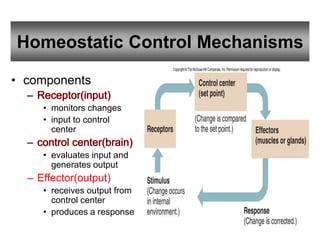
• components
• monitors changes
• input to control
center
• evaluates input and
generates output
– Effector(output)
• receives output from
control center
• produces a response
29
Homeostatic Control Mechanisms
• A group of receptors and effectors communicating with
their control centre forms a feedback system that can
regulate a controlled condition in body’s internal
environment.
• balance regulated by
– Nervous system
• Action Potentials
• Rapid
– Endocrine system
• Hormones
• Slow
30
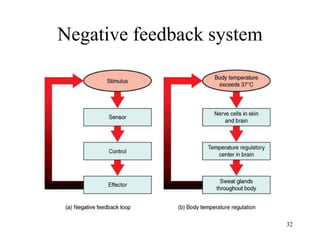
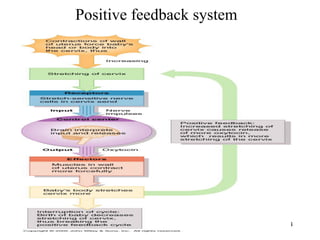
• Feedback System Can Produce Either Negative Feedback
Or Positive Feedback.
•There are two (2) types:
• Negative feedback mechanisms: If the response
reverse the original stimulus . E.g blood pressure
• Positive feedback mechanisms: if the response
enhances /intensifies the original stimulus .e.g: child birth
Homeostatic Control Mechanisms
31
Negative feedback summary:
• Prevents sudden, severe changes in the body
• Reduces the actions of the effectors and provide balanced effect
• Corrects the set point
• Causes opposite of bodily disruption to occur, i.e. the ‘negative’
• Most common type of feedback loop of body
• Examples: body temperature, blood pressure & glucose regulation
Homeostatic Control Mechanisms
Negative feedback system
32
33
Positive feedback summary:
• Increases (accelerates) the actions of the body
• Produces more instability in the body if it is not stopped.
• There are only a few types necessary for our survival
• Positive feedback mechanisms are short-lived
• Controls only infrequent events that do not require continuous
adjustments
• Considered to be the uncommon loop
• Examples: blood clotting and child birth
Homeostatic Control Mechanisms
Positive feedback system
34
1.6: Organization of the Human Body
35
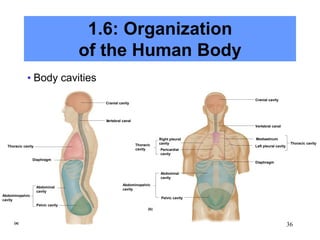
Body cavities : are space within the body that help protect
separate and support internal organs.
• bone, muscle and ligament separate various body cavities
from one another.
•Two major cavities are dorsal and ventral cavities.
•Dorsal(posterior surface): cranial and vertebral cavities.
•Ventral (anterior surface): thoracic cavity and
abdominopelvic cavity.
•Diaphragm (dome shaped muscle) seperates both thoracic
and abdominopelvic cavity.
36
1.6: Organization
of the Human Body
• Body cavities
Thoracic cavity
Abdominopelvic
cavity
Abdominal
cavity
Diaphragm
Pelvic cavity
Cranial cavity
V
ertebral canal
(a)
Thoracic cavity
Abdominopelvic
cavity
Abdominal
cavity
Pelvic cavity
Right pleural
cavity
Mediastinum
Left pleural cavity
Pericardial
cavity
Diaphragm
Vertebral canal
Cranial cavity
Thoracic
cavity
(b)
37
Thoracic & Abdominal
Serous Membranes
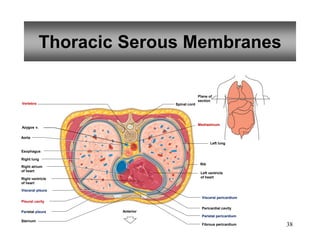
Thoracic Membranes
• Visceral pleura
• Parietal pleura
• Visceral pericardium
• Parietal pericardium
• Visceral layer – covers an organ (heart)
• Parietal layer – lines a cavity or body wall (lines the
chest wall)
Abdominopelvic Membranes
• Parietal peritoneum
• Visceral peritoneum
38
Thoracic Serous Membranes
Vertebra
Aorta
Esophagus
Right lung
Visceral pleura
Pleural cavity
Parietal pleura
Sternum
Plane of
section
Spinal cord
Mediastinum
Left lung
Rib
Left ventricle
of heart
Visceral pericardium
Pericardial cavity
Parietal pericardium
Anterior
Azygos v.
Right atrium
of heart
Right ventricle
of heart
Fibrous pericardium
39
Abdominal Serous Membranes
Vertebra
Right kidney
Pancreas
Large
intestine
Liver
Gallbladder
Duodenum
Peritoneal cavity
Parietal peritoneum
Plane of
section
Left
kidney
Spinal cord
Spleen
Rib
Small intestine
Large intestine
Stomach
Anterior
Visceral peritoneum
Costal cartilage
Aorta
Inferior
vena cava
Copyright © The McGraw-Hill Companies, Inc. Permission required for reproduction or display.
40
1.8: Anatomical Terminology
Anatomical Position –
•Describe the orientation of the body in the anatomical
position.
•It says common name to the corresponding anatomical
descriptive terms for various region of the human body.
•Define the anatomical planes and sections used to
describe the human body.
41
Anatomical Terminology:
Orientation and Directional Terms
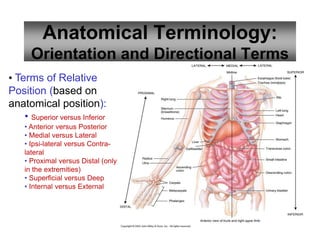
• Terms of Relative
Position (based on
anatomical position):
• Superior versus Inferior
• Anterior versus Posterior
• Medial versus Lateral
• Ipsi-lateral versus Contra-
lateral
• Proximal versus Distal (only
in the extremities)
• Superficial versus Deep
• Internal versus External
42
Body Sections or Planes (3)
• Sagittal or Median – divides body into left and right portions
• Mid-sagittal – divides body into equal left and right
portions
• Transverse or Horizontal – divides body into superior and
inferior portions
• Coronal or Frontal – divides body into anterior and posterior
portions
43
Body Sections
A section along a frontal
plane
A section along a transverse
plane
A section along the
median plane
Transverse
(horizontal)
plane
Frontal
(coronal)
plane
Parasagittal
plane
Median
(midsagittal)
plane
Copyright © The McGraw-Hill Companies, Inc. Permission required for reproduction or display.
© McGraw-Hill Higher Education, Inc./Joe De Grandis, photographer
Body Sections
44
(a) (b) (c)
Copyright © The McGraw-Hill Companies, Inc. Permission required for reproduction or display.
a: © Patrick J. Lynch/Photo Researchers, Inc.; b: © Biophoto Associates/Photo Researchers, Inc.; c: © A. Glauberman/Photo Researchers, Inc.
45
Abdominal Subdivisions (2)
• Regions (9)
• Quadrants (4)
Right
hypochondriac
region
Right
lumbar
region
Right
iliac
region
Epigastric
region
Umbilical
region
Hypogastric
region
Left
Hypochondriac region
Left
lumbar
region
Left
iliac
region
(a)
Right upper
quadrant (RUQ)
Left upper
quadrant (LUQ)
Right lower
quadrant (RLQ)
Left lower
quadrant (LLQ)
(b)

Introduction to human body_RDP.pdf

  • 1.
    HAP-I Sem-I Introduction To HumanAnatomy & Physiology Mrs Rishita D Patel Assistant professor PHARMACOLOGY DEPARTMENT IICP CVMU
  • 2.
    2 Anatomy and Physiology •Anatomy – study of structure (Greek – “a cutting up”) • Physiology – study of function (Greek – “relationship to nature”) “Structure dictates function.”
  • 3.
    Gross anatomy (macroscopicanatomy) :Gross anatomy considers large structures such as the brain. - Regional anatomy - Systemic anatomy Microscopic anatomy: Microscopic anatomy can deal with the same structures, though at a different scale. This is a micrograph of nerve cells from the brain. - Cytology - Histology 3
  • 4.
    Physiology • Physiology isthe study of body function. • Function requires parts to act in a coordinated way. • These coordinated activities are the processes that sustain the living state and allow individual cells, organs, and organisms to carry out specialized functions. 4
  • 5.
  • 6.
    6 1.3: Levels ofOrganization Chemical • Atoms – made up of subatomic particles • Molecules – 2 or more atoms • Macromolecules – small molecules joined together
  • 7.
    7 1.3: Levels ofOrganization Cellular • Macromolecules combine to form cells • Basic structural and functional unit of the body
  • 8.
    8 1.3: Levels ofOrganization Tissue • Group of cells working together to perform a function • 4 basic types – epithelial (epi) – connective tissue (CT) – muscle (mm) – nerve (n)
  • 9.
    9 1.3: Levels ofOrganization Organ • 2 or more tissues joined together with a specific function and shape
  • 10.
    10 1.3: Levels ofOrganization Systems • Related organs with a common function • 11 systems
  • 11.
    11 Organ Systems Integumentary system Copyright© The McGraw-Hill Companies, Inc. Permission required for reproduction or display. • Components – skin – hair – glands • Functions – protection – regulates body temperature – eliminates waste – vitamin D – sensations
  • 12.
    12 Organ Systems Skeletal system Copyright© The McGraw-Hill Companies, Inc. Permission required for reproduction or display. • Components – Bones – Joints – Cartilage • Functions – Support – Protection – Body movement – Produces blood cells – Stores minerals & fats
  • 13.
    13 Organ Systems Copyright ©The McGraw-Hill Companies, Inc. Permission required for reproduction or display. Muscular system • Components – skeletal muscles • Functions – body movement – posture – generates heat
  • 14.
    14 Organ Systems Nervous system Copyright© The McGraw-Hill Companies, Inc. Permission required for reproduction or display. • Components – brain – spinal cord – nerves – special sense organs • Functions – action potentials (nerve impulses) – detects, interprets, and responds to changes in environment
  • 15.
    15 Organ Systems Endocrine system Copyright© The McGraw-Hill Companies, Inc. Permission required for reproduction or display. • Components – hormone-producing glands and cells • Functions – regulates body activities
  • 16.
    16 Organ Systems Cardiovascular system Copyright© The McGraw-Hill Companies, Inc. Permission required for reproduction or display. • Components – blood – heart – blood vessels • Functions – pumps blood – carries O2 and nutrients to cells and wastes away – regulates temperature, acid-base balance, and H2O
  • 17.
    17 Organ Systems Copyright ©The McGraw-Hill Companies, Inc. Permission required for reproduction or display. Lymphatic system • Components – lymph fluid & vessels – spleen – thymus – lymph nodes – tonsils • Functions – transports dietary lipids – protection
  • 18.
    18 Organ Systems Respiratory system Copyright© The McGraw-Hill Companies, Inc. Permission required for reproduction or display. • Components – pharynx – larynx – trachea – bronchial tree – lungs • Functions – exchange of gases – acid-base balance – sound production
  • 19.
    19 Organ Systems Copyright ©The McGraw-Hill Companies, Inc. Permission required for reproduction or display. Digestive system • Components – mouth – pharynx – esophagus – stomach – small intestines – large intestines – salivary glands – liver – gallbladder – pancreas • Functions – breakdown of food – absorption of food – eliminates wastes
  • 20.
    20 Organ Systems Copyright ©The McGraw-Hill Companies, Inc. Permission required for reproduction or display. Urinary system • Components – kidneys – ureters – urinary bladder – urethra • Functions – eliminates waste – regulates blood composition & volume – acid-base balance
  • 21.
    21 Organ Systems Reproductive system •Components – ovaries – testes – associated structures • Functions – produce gametes – hormone regulation of reproduction
  • 22.
    22 1.4: Characteristics ofLife (basic life process) • Movement – change in position; motion • Responsiveness – reaction to a change • Growth – increase in body size; no change in shape • Respiration – obtaining oxygen; removing carbon dioxide; releasing energy from foods • Reproduction – production of new organisms and new cells •Differentiation – unspecialized to specialized
  • 23.
    23 Characteristics of LifeContinued • Absorption – passage of substances through membranes and into body fluids • Circulation – movement of substances in body fluids • Assimilation – changing of absorbed substances into chemically different forms • Excretion – removal of wastes produced by metabolic reactions • Digestion – breakdown of food substances into simpler forms
  • 24.
    24 1.5: Maintenance ofLife • Life depends on five (5) environmental factors: • Water • Food • Oxygen • Heat • Pressure
  • 25.
    25 Requirements of Organisms •Water - most abundant substance in body - required for metabolic processes - required for transport of substances - regulates body temperature • Food - provides necessary nutrients - supplies energy - supplies raw materials
  • 26.
    26 Requirements of Organisms •Oxygen (gas) - one-fifth of air - used to release energy from nutrients • Heat - form of energy - partly controls rate of metabolic reactions • Pressure - application of force on an object - atmospheric pressure – important for breathing - hydrostatic pressure – keeps blood flowing
  • 27.
    27 Homeo(Unchanged) stasis(standing) Maintaining of astable internal environment • “condition of equilibrium in body’s internal environment” • Dynamic condition involves maintaining the blood volume and composition of body fluids – intracellular (ICF) and extracellular (ECF) – Water regulation – Acid base regulation – Electrolytes regulation – Thermal regulation
  • 28.
    Homeostatic Control Mechanisms 28 •components • monitors changes • input to control center • evaluates input and generates output – Effector(output) • receives output from control center • produces a response
  • 29.
    29 Homeostatic Control Mechanisms •A group of receptors and effectors communicating with their control centre forms a feedback system that can regulate a controlled condition in body’s internal environment. • balance regulated by – Nervous system • Action Potentials • Rapid – Endocrine system • Hormones • Slow
  • 30.
    30 • Feedback SystemCan Produce Either Negative Feedback Or Positive Feedback. •There are two (2) types: • Negative feedback mechanisms: If the response reverse the original stimulus . E.g blood pressure • Positive feedback mechanisms: if the response enhances /intensifies the original stimulus .e.g: child birth Homeostatic Control Mechanisms
  • 31.
    31 Negative feedback summary: •Prevents sudden, severe changes in the body • Reduces the actions of the effectors and provide balanced effect • Corrects the set point • Causes opposite of bodily disruption to occur, i.e. the ‘negative’ • Most common type of feedback loop of body • Examples: body temperature, blood pressure & glucose regulation Homeostatic Control Mechanisms
  • 32.
  • 33.
    33 Positive feedback summary: •Increases (accelerates) the actions of the body • Produces more instability in the body if it is not stopped. • There are only a few types necessary for our survival • Positive feedback mechanisms are short-lived • Controls only infrequent events that do not require continuous adjustments • Considered to be the uncommon loop • Examples: blood clotting and child birth Homeostatic Control Mechanisms
  • 34.
  • 35.
    1.6: Organization ofthe Human Body 35 Body cavities : are space within the body that help protect separate and support internal organs. • bone, muscle and ligament separate various body cavities from one another. •Two major cavities are dorsal and ventral cavities. •Dorsal(posterior surface): cranial and vertebral cavities. •Ventral (anterior surface): thoracic cavity and abdominopelvic cavity. •Diaphragm (dome shaped muscle) seperates both thoracic and abdominopelvic cavity.
  • 36.
    36 1.6: Organization of theHuman Body • Body cavities Thoracic cavity Abdominopelvic cavity Abdominal cavity Diaphragm Pelvic cavity Cranial cavity V ertebral canal (a) Thoracic cavity Abdominopelvic cavity Abdominal cavity Pelvic cavity Right pleural cavity Mediastinum Left pleural cavity Pericardial cavity Diaphragm Vertebral canal Cranial cavity Thoracic cavity (b)
  • 37.
    37 Thoracic & Abdominal SerousMembranes Thoracic Membranes • Visceral pleura • Parietal pleura • Visceral pericardium • Parietal pericardium • Visceral layer – covers an organ (heart) • Parietal layer – lines a cavity or body wall (lines the chest wall) Abdominopelvic Membranes • Parietal peritoneum • Visceral peritoneum
  • 38.
    38 Thoracic Serous Membranes Vertebra Aorta Esophagus Rightlung Visceral pleura Pleural cavity Parietal pleura Sternum Plane of section Spinal cord Mediastinum Left lung Rib Left ventricle of heart Visceral pericardium Pericardial cavity Parietal pericardium Anterior Azygos v. Right atrium of heart Right ventricle of heart Fibrous pericardium
  • 39.
    39 Abdominal Serous Membranes Vertebra Rightkidney Pancreas Large intestine Liver Gallbladder Duodenum Peritoneal cavity Parietal peritoneum Plane of section Left kidney Spinal cord Spleen Rib Small intestine Large intestine Stomach Anterior Visceral peritoneum Costal cartilage Aorta Inferior vena cava Copyright © The McGraw-Hill Companies, Inc. Permission required for reproduction or display.
  • 40.
    40 1.8: Anatomical Terminology AnatomicalPosition – •Describe the orientation of the body in the anatomical position. •It says common name to the corresponding anatomical descriptive terms for various region of the human body. •Define the anatomical planes and sections used to describe the human body.
  • 41.
    41 Anatomical Terminology: Orientation andDirectional Terms • Terms of Relative Position (based on anatomical position): • Superior versus Inferior • Anterior versus Posterior • Medial versus Lateral • Ipsi-lateral versus Contra- lateral • Proximal versus Distal (only in the extremities) • Superficial versus Deep • Internal versus External
  • 42.
    42 Body Sections orPlanes (3) • Sagittal or Median – divides body into left and right portions • Mid-sagittal – divides body into equal left and right portions • Transverse or Horizontal – divides body into superior and inferior portions • Coronal or Frontal – divides body into anterior and posterior portions
  • 43.
    43 Body Sections A sectionalong a frontal plane A section along a transverse plane A section along the median plane Transverse (horizontal) plane Frontal (coronal) plane Parasagittal plane Median (midsagittal) plane Copyright © The McGraw-Hill Companies, Inc. Permission required for reproduction or display. © McGraw-Hill Higher Education, Inc./Joe De Grandis, photographer
  • 44.
    Body Sections 44 (a) (b)(c) Copyright © The McGraw-Hill Companies, Inc. Permission required for reproduction or display. a: © Patrick J. Lynch/Photo Researchers, Inc.; b: © Biophoto Associates/Photo Researchers, Inc.; c: © A. Glauberman/Photo Researchers, Inc.
  • 45.
    45 Abdominal Subdivisions (2) •Regions (9) • Quadrants (4) Right hypochondriac region Right lumbar region Right iliac region Epigastric region Umbilical region Hypogastric region Left Hypochondriac region Left lumbar region Left iliac region (a) Right upper quadrant (RUQ) Left upper quadrant (LUQ) Right lower quadrant (RLQ) Left lower quadrant (LLQ) (b)