Dr Salil Choudhary
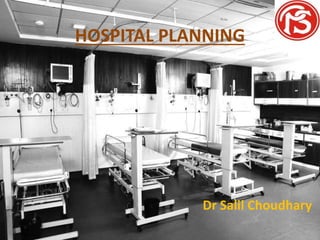
HOSPITAL PLANNING
INTRODUCTION
• The last few decades have seen a spectacular
development in the health & hospital consciousness of
the Indian public.
• Essential hospital service required for the community can
be met most economically only with adequate thought
given to planning , design,construction & operation of
health care facilities.
• A design expert says- “we’ve got to design ‘smart’
hospitals that respond to present needs while anticipating
future changes.”
PLANNING A HOSPITAL
• Planning is the forecasting and organizing the activities
required to achieve the desired goals.
• All successful hospitals,without exception,are built on a
triad of good planning,good design & construction & good
administration.
• To be successful,a hospital requires a great deal of
preliminary study and planning
• It must be designed to serve people and for promoters to
build in the first place & sustain later.
CONT..
• It must be staffed with competent and adequate
number of efficient doctors,nurses & other
professionals.
• A strong management is essential for the daily
functioning of a facility & this must be included in
the plans of a new hospitals.
CLASSIFICATION OF HOSPITALS
1. Proprietary
2. Partnership
3. Private Trust (family)
4. Charitable trust
5. Cooperative Society
6. Private Limited Company
7. Public Limited Company
STRATEGIC ESSENTIALS
• Regionalization
• Pre- planning consideration
• Need assessment
• Plot ratio
• Design for flexibility and expandability
• Fulfill the demand functions
• Emphasize on patient focused hospital
• Focus on energy conservation
• Intelligent buildings
• Create a healing architecture
• Aesthetic – an essential requisite
• Hospital architecture
• Go green
PLANNING TEAM
• Hospital administrator
• Specialists from various clinical branches
• Nursing advisor
• HR Manager
• Civil and electrical engineers
• Representative of local body
• Senior architect
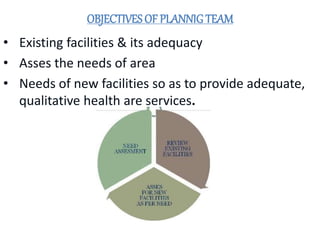
OBJECTIVES OF PLANNIGTEAM
• Existing facilities & its adequacy
• Asses the needs of area
• Needs of new facilities so as to provide adequate,
qualitative health are services.
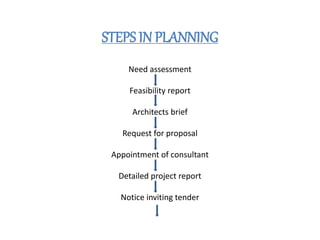
STEPS IN PLANNING
Need assessment
Feasibility report
Architects brief
Request for proposal
Appointment of consultant
Detailed project report
Notice inviting tender
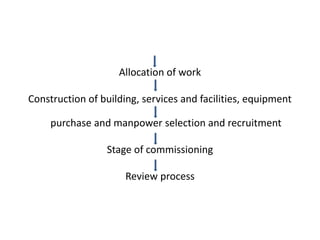
Allocation of work
Construction of building, services and facilities, equipment
purchase and manpower selection and recruitment
Stage of commissioning
Review process
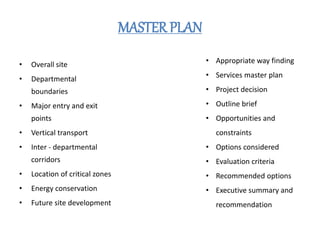
MASTER PLAN
• Overall site
• Departmental
boundaries
• Major entry and exit
points
• Vertical transport
• Inter - departmental
corridors
• Location of critical zones
• Energy conservation
• Future site development
• Appropriate way finding
• Services master plan
• Project decision
• Outline brief
• Opportunities and
constraints
• Options considered
• Evaluation criteria
• Recommended options
• Executive summary and
recommendation
MARKET SURVEY
•One the first tasks of the temporary organization is to survey the
service area of the proposed hospital.
•Following bodies helps in market survey-
1. Banks
2. CA firms
3. Financial Institutions
4. Consultant
• Since major decisions will be on the result of the survey,it must be
done in a professional manner.
•Following considerations should be taken during
survey-
Character,needs & possibilities of communities
Type & size of Hospital
Financial condition of community
Occupation
Age distribution
FINANCIAL PLANNING
• Financial planning must take precedence over every other
consideration.
• Financial planning must cover the following three areas:
1. Constructing,Equipping & Furnishing the Hospital
2. Operating Funds
3. Financial Assistance
• Financial assistance has 2 components-
1. Loan for fixed capital
2. Loan for working capital
DESIGN TEAM
• Hospital Consultant
• Architect
• Engineers
 Structural Engineers
 Electrical Engineers
 Plumbing Engineers
• Hospital Administrator
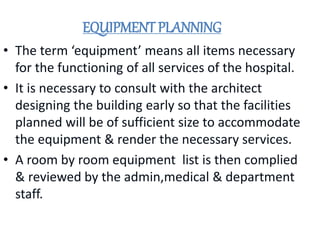
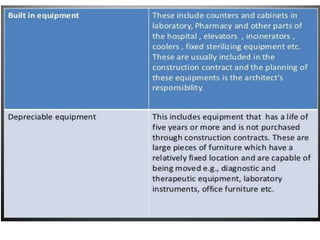
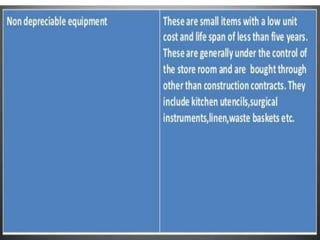
EQUIPMENT PLANNING
• The term ‘equipment’ means all items necessary
for the functioning of all services of the hospital.
• It is necessary to consult with the architect
designing the building early so that the facilities
planned will be of sufficient size to accommodate
the equipment & render the necessary services.
• A room by room equipment list is then complied
& reviewed by the admin,medical & department
staff.
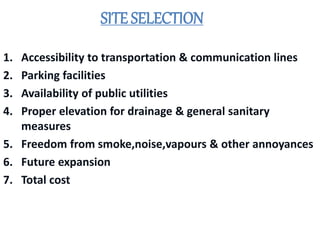
SITE SELECTION
1. Accessibility to transportation & communication lines
2. Parking facilities
3. Availability of public utilities
4. Proper elevation for drainage & general sanitary
measures
5. Freedom from smoke,noise,vapours & other annoyances
6. Future expansion
7. Total cost
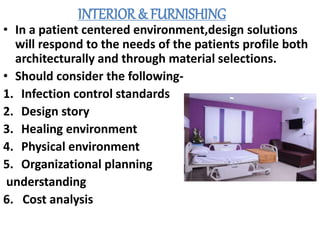
INTERIOR & FURNISHING
• In a patient centered environment,design solutions
will respond to the needs of the patients profile both
architecturally and through material selections.
• Should consider the following-
1. Infection control standards
2. Design story
3. Healing environment
4. Physical environment
5. Organizational planning
understanding
6. Cost analysis
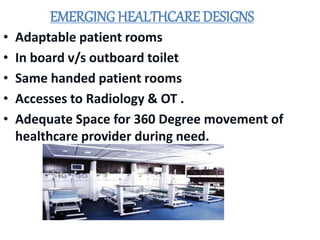
EMERGING HEALTHCARE DESIGNS
• Adaptable patient rooms
• In board v/s outboard toilet
• Same handed patient rooms
• Accesses to Radiology & OT .
• Adequate Space for 360 Degree movement of
healthcare provider during need.
HOSPITAL BUILDING
• After completing all preparations for building a
hospital the governing board issues instructions for
the development of final plans & specification.
• Principle-
# Protection
# Short traffic routes
# Separation of dissimilar activities
# Control
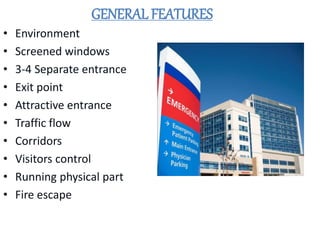
GENERAL FEATURES
• Environment
• Screened windows
• 3-4 Separate entrance
• Exit point
• Attractive entrance
• Traffic flow
• Corridors
• Visitors control
• Running physical part
• Fire escape
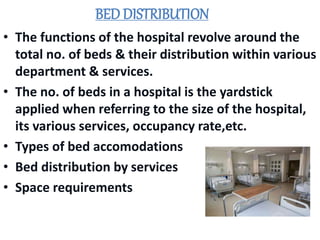
BED DISTRIBUTION
• The functions of the hospital revolve around the
total no. of beds & their distribution within various
department & services.
• The no. of beds in a hospital is the yardstick
applied when referring to the size of the hospital,
its various services, occupancy rate,etc.
• Types of bed accomodations
• Bed distribution by services
• Space requirements
Cont..
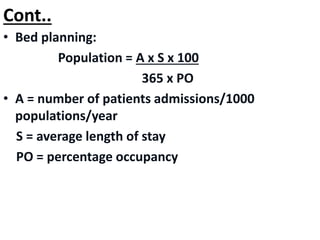
• Bed planning:
Population = A x S x 100
365 x PO
• A = number of patients admissions/1000
populations/year
S = average length of stay
PO = percentage occupancy
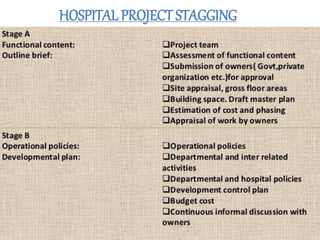
HOSPITAL PROJECT STAGGING
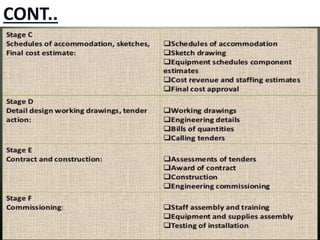
CONT..
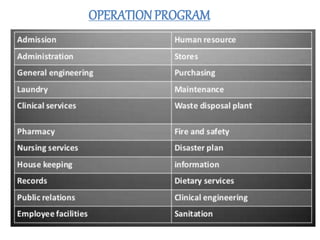
OPERATIONPROGRAM
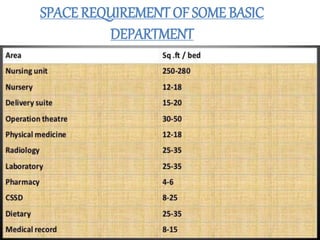
SPACE REQUIREMENT OF SOME BASIC
DEPARTMENT
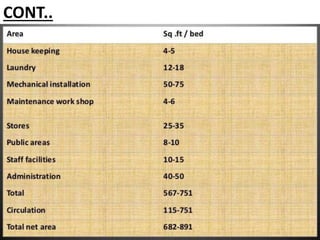
CONT..
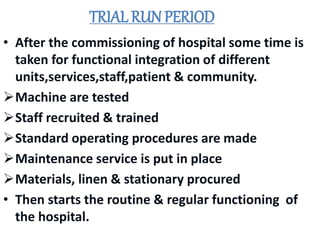
TRIAL RUN PERIOD
• After the commissioning of hospital some time is
taken for functional integration of different
units,services,staff,patient & community.
Machine are tested
Staff recruited & trained
Standard operating procedures are made
Maintenance service is put in place
Materials, linen & stationary procured
• Then starts the routine & regular functioning of
the hospital.
CONCLUSION
“A hospital is a living organism,made up of many
different parts,having different functions,but all
theses must be in due proportion & relation to
each other & to the environment to produce the
desired result”
HOSPITAL PLANNING

HOSPITAL PLANNING

  • 1.
  • 2.
    INTRODUCTION • The lastfew decades have seen a spectacular development in the health & hospital consciousness of the Indian public. • Essential hospital service required for the community can be met most economically only with adequate thought given to planning , design,construction & operation of health care facilities. • A design expert says- “we’ve got to design ‘smart’ hospitals that respond to present needs while anticipating future changes.”
  • 3.
    PLANNING A HOSPITAL •Planning is the forecasting and organizing the activities required to achieve the desired goals. • All successful hospitals,without exception,are built on a triad of good planning,good design & construction & good administration. • To be successful,a hospital requires a great deal of preliminary study and planning • It must be designed to serve people and for promoters to build in the first place & sustain later.
  • 4.
    CONT.. • It mustbe staffed with competent and adequate number of efficient doctors,nurses & other professionals. • A strong management is essential for the daily functioning of a facility & this must be included in the plans of a new hospitals.
  • 5.
    CLASSIFICATION OF HOSPITALS 1.Proprietary 2. Partnership 3. Private Trust (family) 4. Charitable trust 5. Cooperative Society 6. Private Limited Company 7. Public Limited Company
  • 6.
    STRATEGIC ESSENTIALS • Regionalization •Pre- planning consideration • Need assessment • Plot ratio • Design for flexibility and expandability • Fulfill the demand functions • Emphasize on patient focused hospital • Focus on energy conservation
  • 7.
    • Intelligent buildings •Create a healing architecture • Aesthetic – an essential requisite • Hospital architecture • Go green
  • 8.
    PLANNING TEAM • Hospitaladministrator • Specialists from various clinical branches • Nursing advisor • HR Manager • Civil and electrical engineers • Representative of local body • Senior architect
  • 9.
    OBJECTIVES OF PLANNIGTEAM •Existing facilities & its adequacy • Asses the needs of area • Needs of new facilities so as to provide adequate, qualitative health are services.
  • 10.
    STEPS IN PLANNING Needassessment Feasibility report Architects brief Request for proposal Appointment of consultant Detailed project report Notice inviting tender
  • 11.
    Allocation of work Constructionof building, services and facilities, equipment purchase and manpower selection and recruitment Stage of commissioning Review process
  • 12.
    MASTER PLAN • Overallsite • Departmental boundaries • Major entry and exit points • Vertical transport • Inter - departmental corridors • Location of critical zones • Energy conservation • Future site development • Appropriate way finding • Services master plan • Project decision • Outline brief • Opportunities and constraints • Options considered • Evaluation criteria • Recommended options • Executive summary and recommendation
  • 13.
    MARKET SURVEY •One thefirst tasks of the temporary organization is to survey the service area of the proposed hospital. •Following bodies helps in market survey- 1. Banks 2. CA firms 3. Financial Institutions 4. Consultant • Since major decisions will be on the result of the survey,it must be done in a professional manner.
  • 14.
    •Following considerations shouldbe taken during survey- Character,needs & possibilities of communities Type & size of Hospital Financial condition of community Occupation Age distribution
  • 15.
    FINANCIAL PLANNING • Financialplanning must take precedence over every other consideration. • Financial planning must cover the following three areas: 1. Constructing,Equipping & Furnishing the Hospital 2. Operating Funds 3. Financial Assistance • Financial assistance has 2 components- 1. Loan for fixed capital 2. Loan for working capital
  • 16.
    DESIGN TEAM • HospitalConsultant • Architect • Engineers  Structural Engineers  Electrical Engineers  Plumbing Engineers • Hospital Administrator
  • 17.
    EQUIPMENT PLANNING • Theterm ‘equipment’ means all items necessary for the functioning of all services of the hospital. • It is necessary to consult with the architect designing the building early so that the facilities planned will be of sufficient size to accommodate the equipment & render the necessary services. • A room by room equipment list is then complied & reviewed by the admin,medical & department staff.
  • 20.
    SITE SELECTION 1. Accessibilityto transportation & communication lines 2. Parking facilities 3. Availability of public utilities 4. Proper elevation for drainage & general sanitary measures 5. Freedom from smoke,noise,vapours & other annoyances 6. Future expansion 7. Total cost
  • 21.
    INTERIOR & FURNISHING •In a patient centered environment,design solutions will respond to the needs of the patients profile both architecturally and through material selections. • Should consider the following- 1. Infection control standards 2. Design story 3. Healing environment 4. Physical environment 5. Organizational planning understanding 6. Cost analysis
  • 22.
    EMERGING HEALTHCARE DESIGNS •Adaptable patient rooms • In board v/s outboard toilet • Same handed patient rooms • Accesses to Radiology & OT . • Adequate Space for 360 Degree movement of healthcare provider during need.
  • 23.
    HOSPITAL BUILDING • Aftercompleting all preparations for building a hospital the governing board issues instructions for the development of final plans & specification. • Principle- # Protection # Short traffic routes # Separation of dissimilar activities # Control
  • 24.
    GENERAL FEATURES • Environment •Screened windows • 3-4 Separate entrance • Exit point • Attractive entrance • Traffic flow • Corridors • Visitors control • Running physical part • Fire escape
  • 25.
    BED DISTRIBUTION • Thefunctions of the hospital revolve around the total no. of beds & their distribution within various department & services. • The no. of beds in a hospital is the yardstick applied when referring to the size of the hospital, its various services, occupancy rate,etc. • Types of bed accomodations • Bed distribution by services • Space requirements
  • 26.
    Cont.. • Bed planning: Population= A x S x 100 365 x PO • A = number of patients admissions/1000 populations/year S = average length of stay PO = percentage occupancy
  • 27.
  • 28.
  • 29.
  • 30.
    SPACE REQUIREMENT OFSOME BASIC DEPARTMENT
  • 31.
  • 32.
    TRIAL RUN PERIOD •After the commissioning of hospital some time is taken for functional integration of different units,services,staff,patient & community. Machine are tested Staff recruited & trained Standard operating procedures are made Maintenance service is put in place Materials, linen & stationary procured • Then starts the routine & regular functioning of the hospital.
  • 33.
    CONCLUSION “A hospital isa living organism,made up of many different parts,having different functions,but all theses must be in due proportion & relation to each other & to the environment to produce the desired result”