CHAPTER 1
CHAPTER 1
The Human Body :
The Human Body :
An Orientation
An Orientation
 Anatomy – the study of the s
Anatomy – the study of the structure
tructure and
and
shape
shape of the body and body parts & their
of the body and body parts & their
relationships
relationships to one another. The term
to one another. The term
anatomy comes from the Greek words
meaning to cut (tomy) apart ( ana) .
 Gross anatomy( macroscopic anatomy) –
Gross anatomy( macroscopic anatomy) –
the study of large, easily observable
structures (by naked eye), such as the
heart or bone.
heart or bone.
 Microscopic anatomy (cytology,
Microscopic anatomy (cytology,
histology) – the study of very small
structures, where a magnifying lens or
microscope is needed.
 Physiology – the study of how the body
Physiology – the study of how the body
and its parts
and its parts work or function
work or function
physio =nature , ology = the study of.
 Like anatomy , physiology has many
Like anatomy , physiology has many
subdivisions. For example,
neurophysiology explains the working
of the nervous system , and cardiac
physiology studies the function of the
heart.
heart.
Relationship between Anatomy
and Physiology
and Physiology
Anatomy and Physiology are always
related . Structure determines what
functions can take place. For example,
the lungs are not muscular chambers like
the heart and can not pump blood, but
because the walls of lungs are very thin,
they can exchange gasses and provide
oxygen to the body.
oxygen to the body.
Levels of Structural Organization
The human body exhibits
The human body exhibits 6
6 levels of structural
levels of structural
complexity :
complexity :
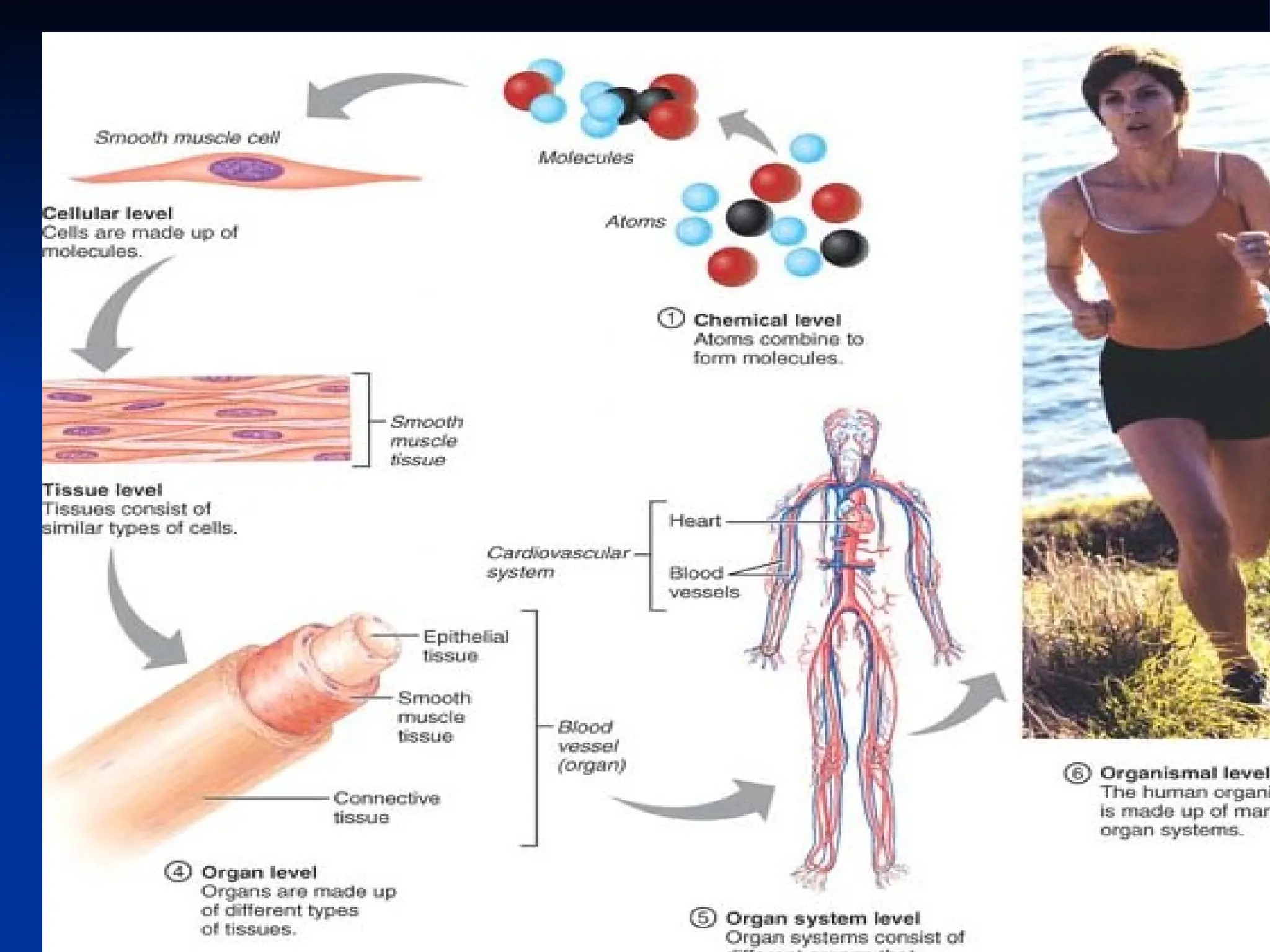
1- Chemical level , the simplest level of
structural ladder .At this level atoms
combine to form molecules such as water,
sugar, & proteins
sugar, & proteins
2- Cellular level the smallest units of living
things .
things .
3- Tissue level , groups of similar cells that
have a common function (4 basic types)
4- Organ level, an organ is a
structure composed of 2 or more
tissue types that performs a specific
function .
5- Organ System is a group of
organs that work together to
accomplish a common purpose (each
organ has its own job to do)
6- Organismal level , represents the
highest level of structural
organization( total of 11 organ
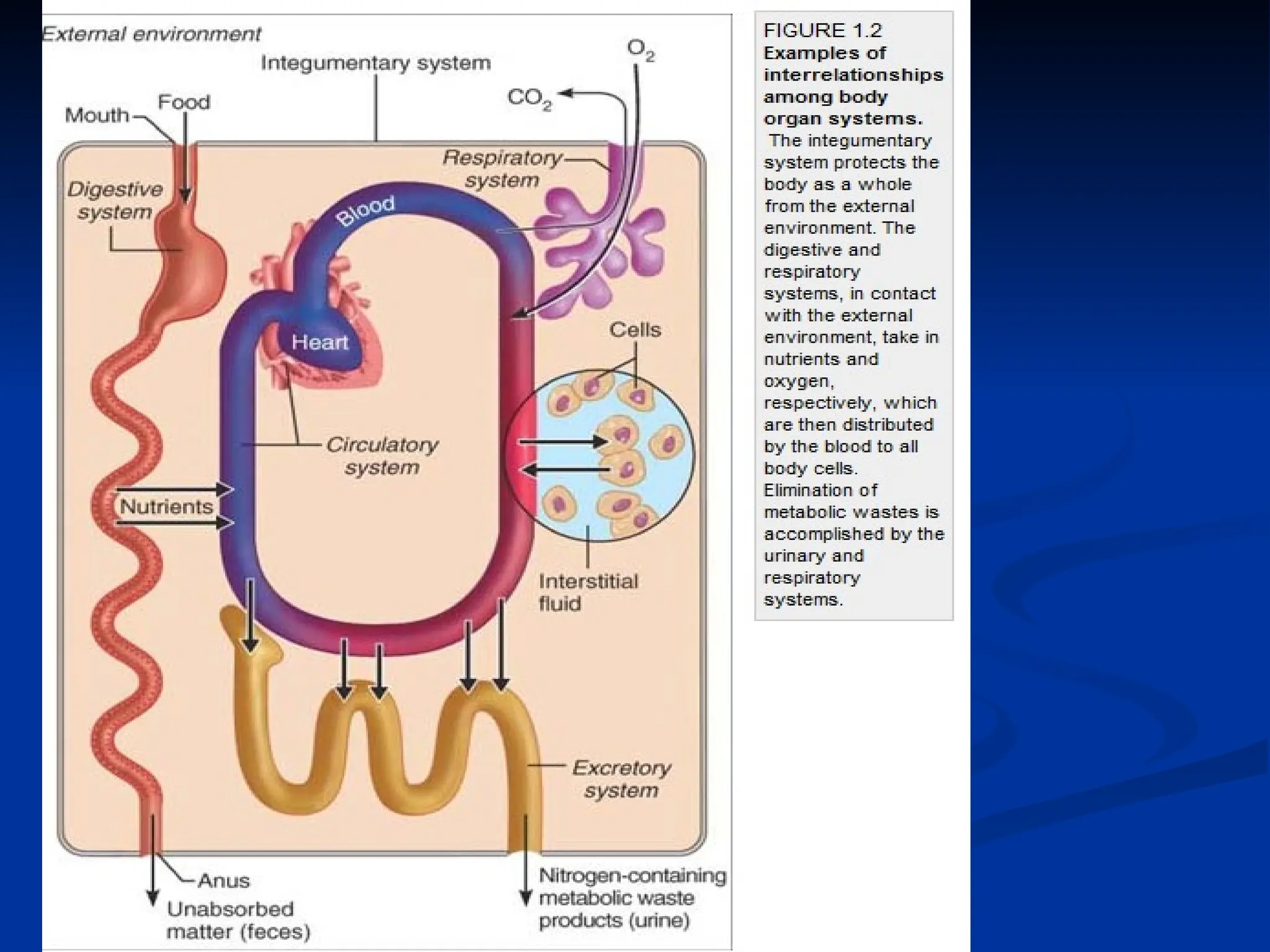
Body systems:The human body has 11
systems
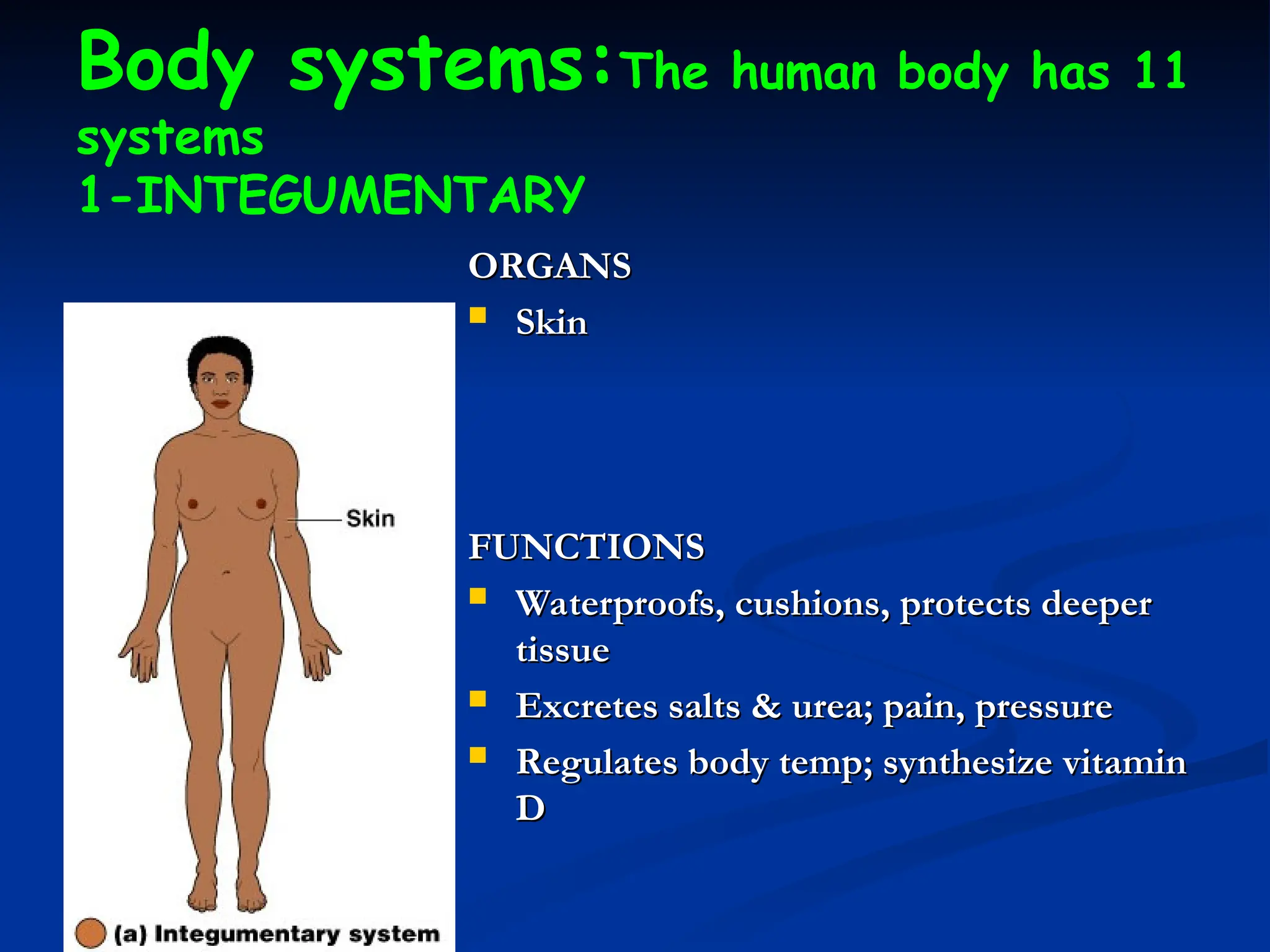
1-INTEGUMENTARY
ORGANS
ORGANS
 Skin
Skin
FUNCTIONS
FUNCTIONS
 Waterproofs, cushions, protects deeper
Waterproofs, cushions, protects deeper
tissue
tissue
 Excretes salts & urea; pain, pressure
Excretes salts & urea; pain, pressure
 Regulates body temp; synthesize vitamin
Regulates body temp; synthesize vitamin
D
D
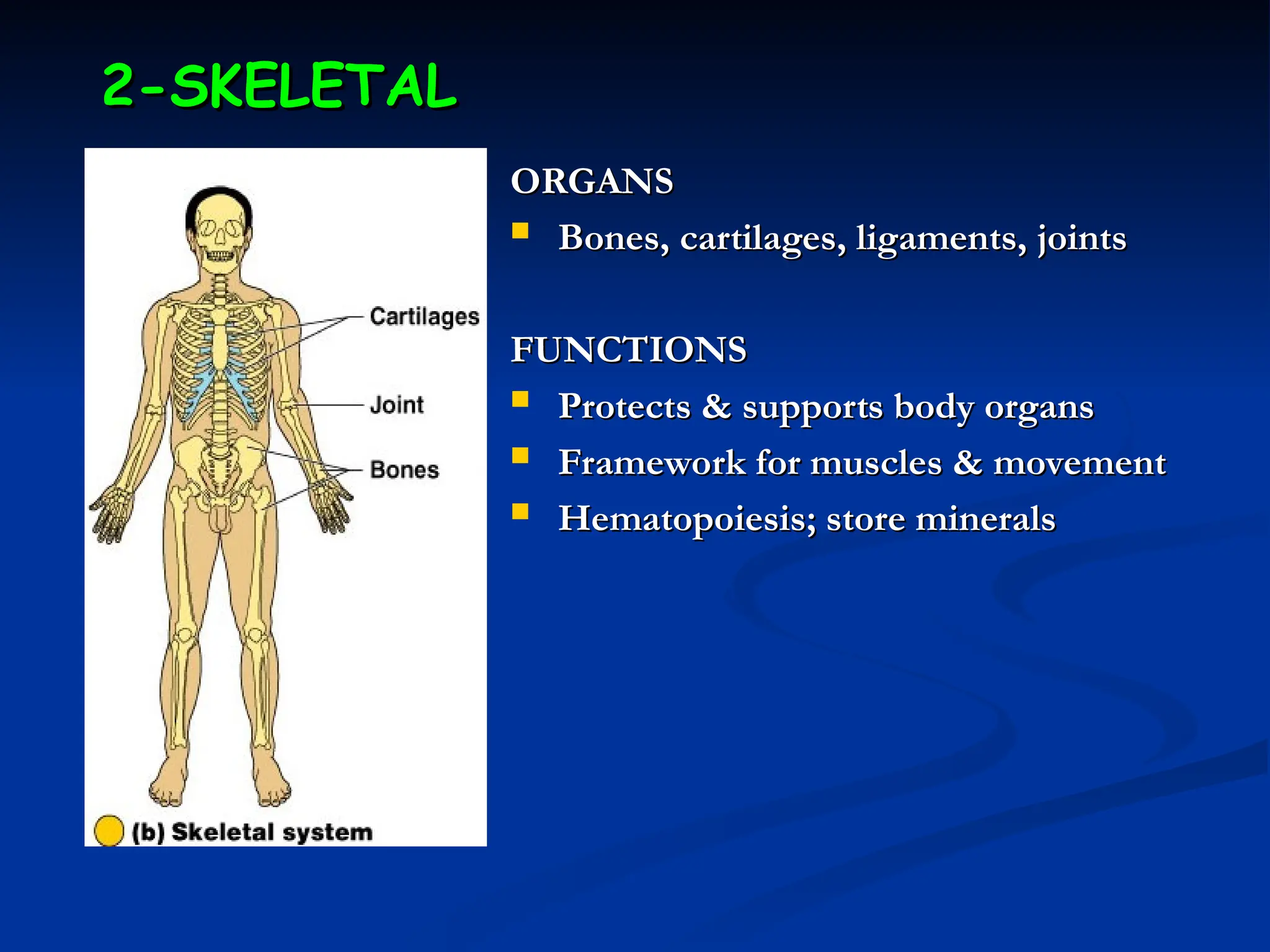
2-SKELETAL
2-SKELETAL
ORGANS
ORGANS
 Bones, cartilages, ligaments, joints
Bones, cartilages, ligaments, joints
FUNCTIONS
FUNCTIONS
 Protects & supports body organs
Protects & supports body organs
 Framework for muscles & movement
Framework for muscles & movement
 Hematopoiesis; store minerals
Hematopoiesis; store minerals
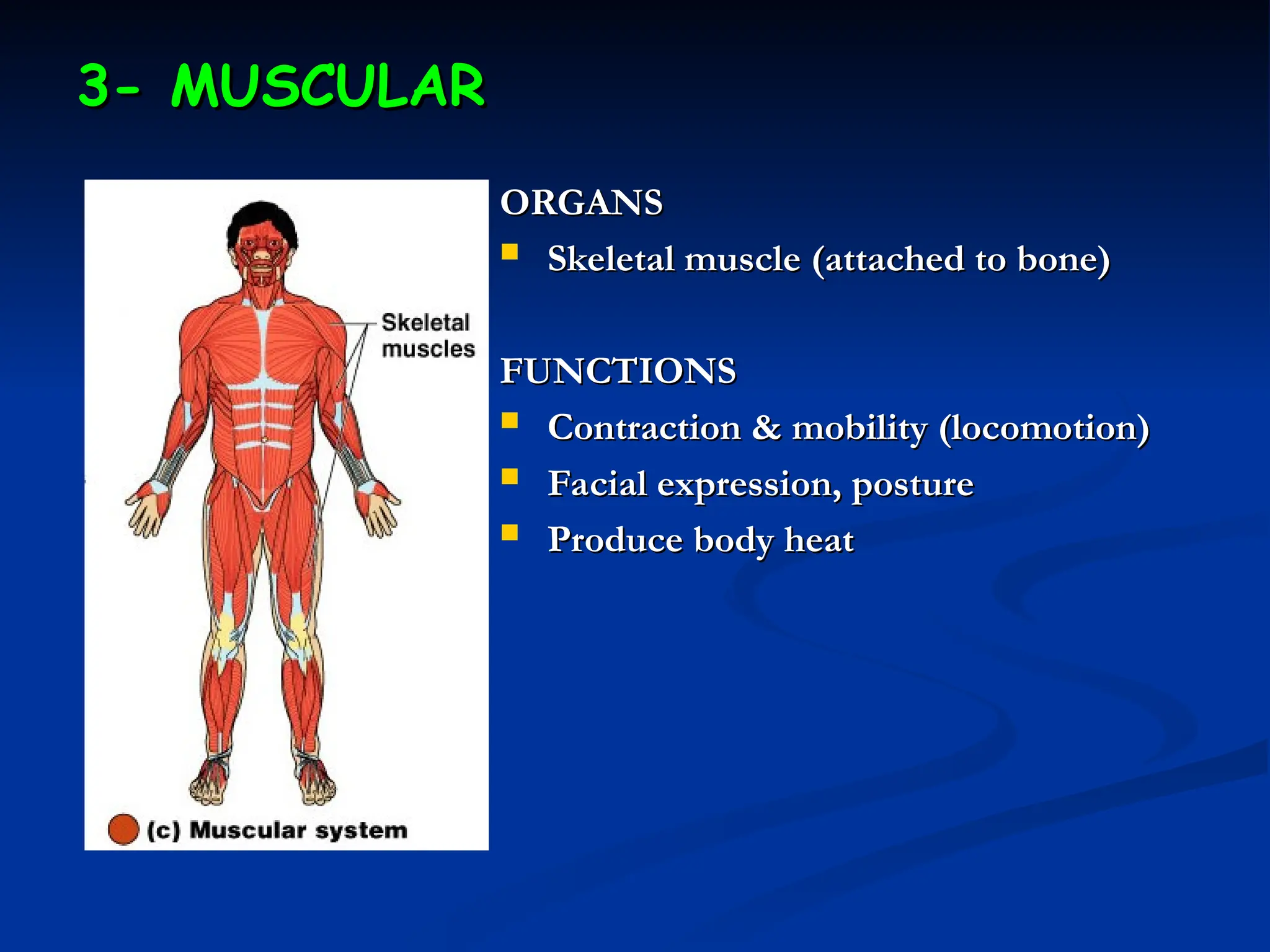
3- MUSCULAR
3- MUSCULAR
ORGANS
ORGANS
 Skeletal muscle (attached to bone)
Skeletal muscle (attached to bone)
FUNCTIONS
FUNCTIONS
 Contraction & mobility (locomotion)
Contraction & mobility (locomotion)
 Facial expression, posture
Facial expression, posture
 Produce body heat
Produce body heat
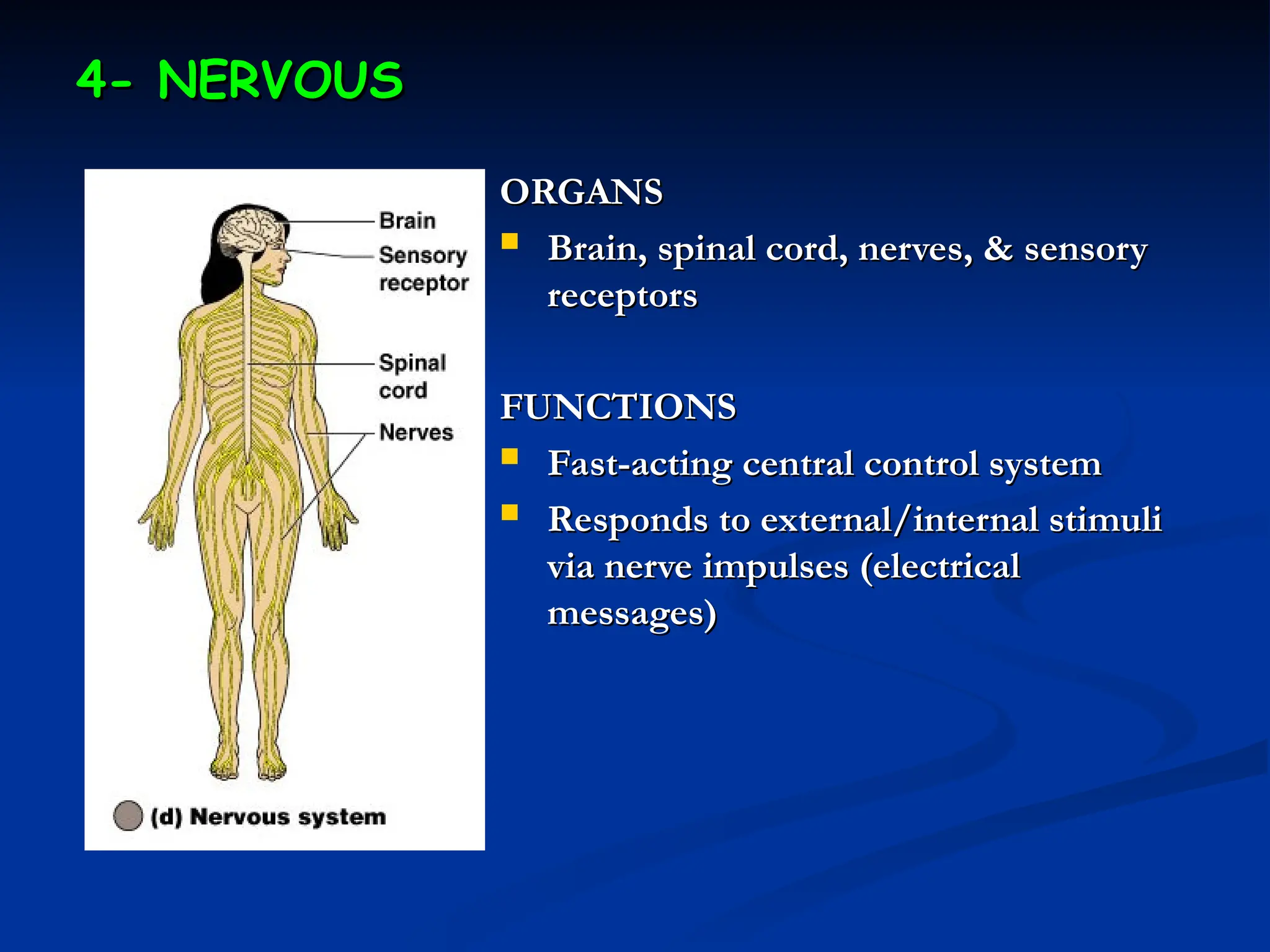
4- NERVOUS
4- NERVOUS
ORGANS
ORGANS
 Brain, spinal cord, nerves, & sensory
Brain, spinal cord, nerves, & sensory
receptors
receptors
FUNCTIONS
FUNCTIONS
 Fast-acting central control system
Fast-acting central control system
 Responds to external/internal stimuli
Responds to external/internal stimuli
via nerve impulses (electrical
messages)
messages)
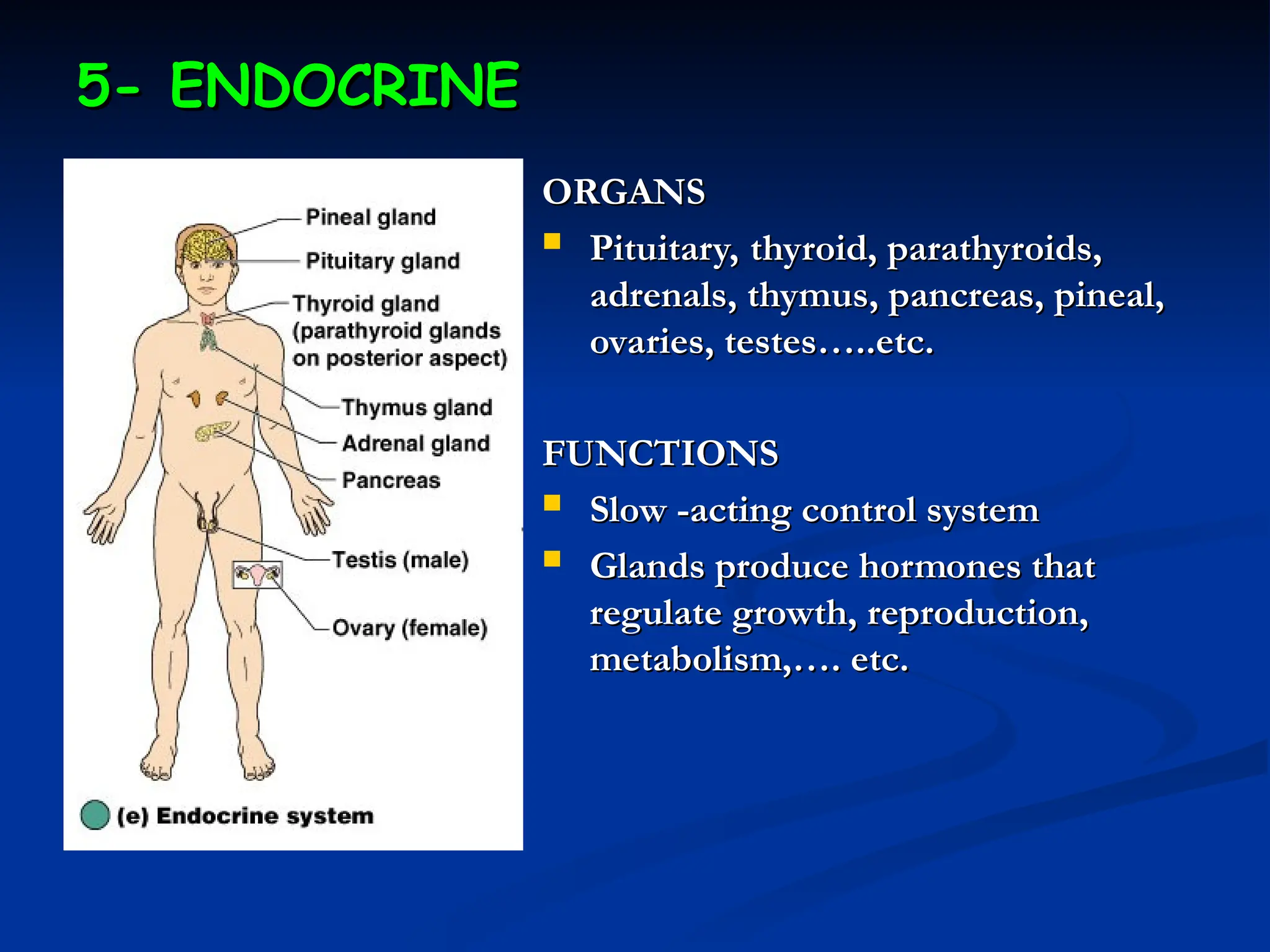
5- ENDOCRINE
5- ENDOCRINE
ORGANS
ORGANS
 Pituitary, thyroid, parathyroids,
Pituitary, thyroid, parathyroids,
adrenals, thymus, pancreas, pineal,
ovaries, testes…..etc.
FUNCTIONS
FUNCTIONS
 Slow -acting control system
Slow -acting control system
 Glands produce hormones that
Glands produce hormones that
regulate growth, reproduction,
metabolism,…. etc.
metabolism,…. etc.
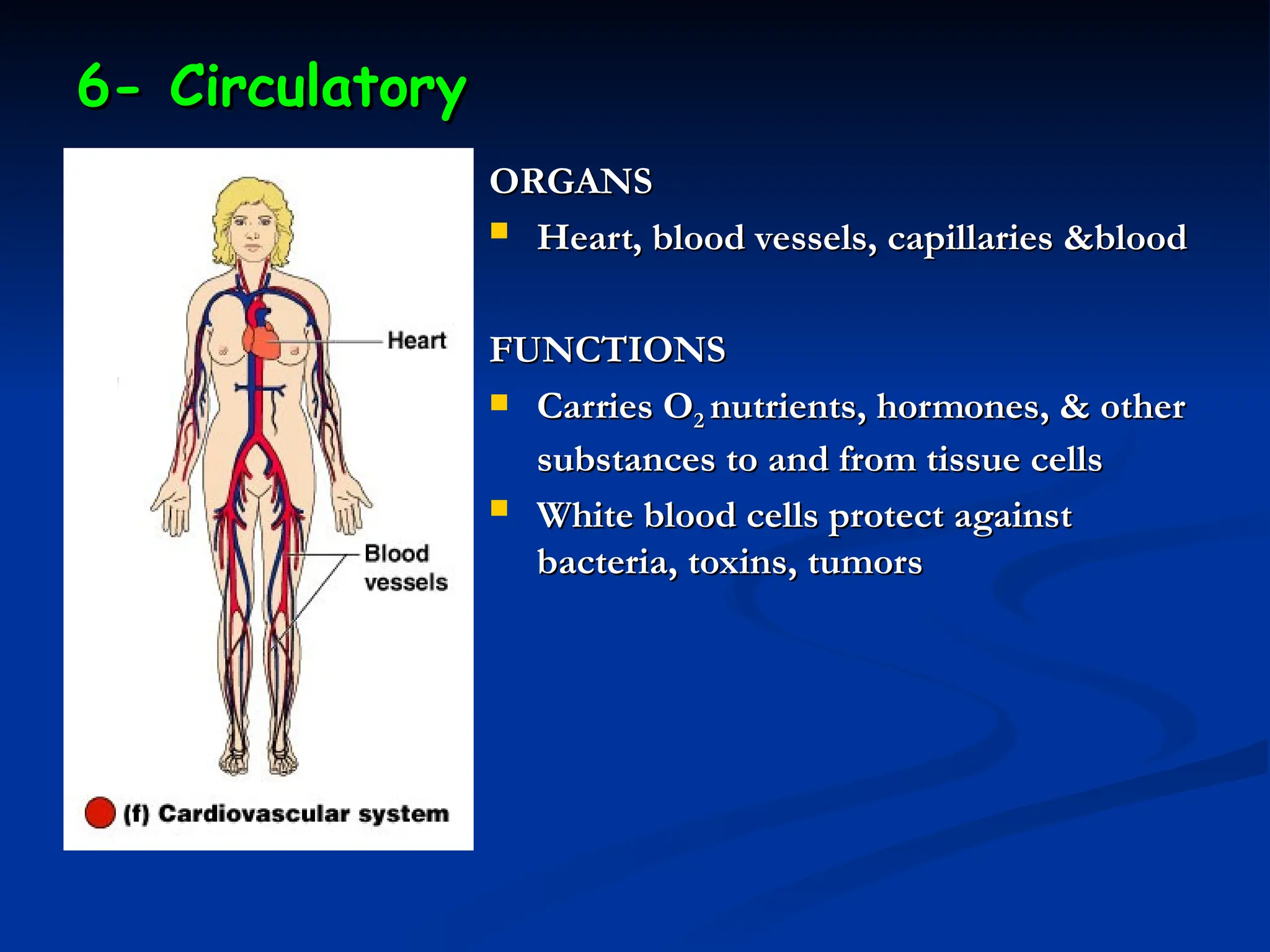
6- Circulatory
6- Circulatory
ORGANS
ORGANS
 Heart, blood vessels, capillaries &blood
Heart, blood vessels, capillaries &blood
FUNCTIONS
FUNCTIONS
 Carries O
Carries O2
2 nutrients, hormones, & other
nutrients, hormones, & other
substances to and from tissue cells
 White blood cells protect against
White blood cells protect against
bacteria, toxins, tumors
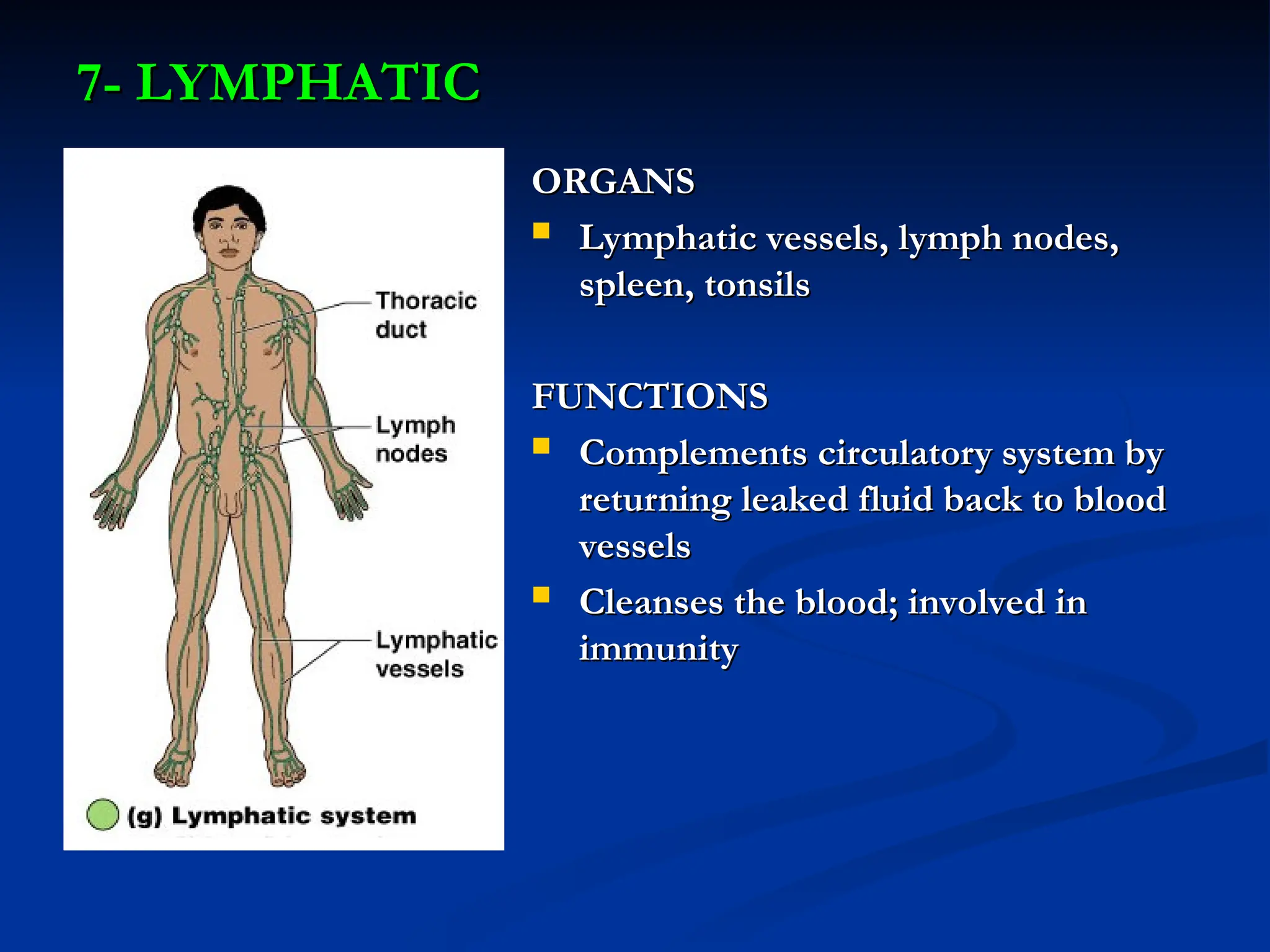
7- LYMPHATIC
7- LYMPHATIC
ORGANS
ORGANS
 Lymphatic vessels, lymph nodes,
Lymphatic vessels, lymph nodes,
spleen, tonsils
spleen, tonsils
FUNCTIONS
FUNCTIONS
 Complements circulatory system by
Complements circulatory system by
returning leaked fluid back to blood
vessels
vessels
 Cleanses the blood; involved in
Cleanses the blood; involved in
immunity
immunity
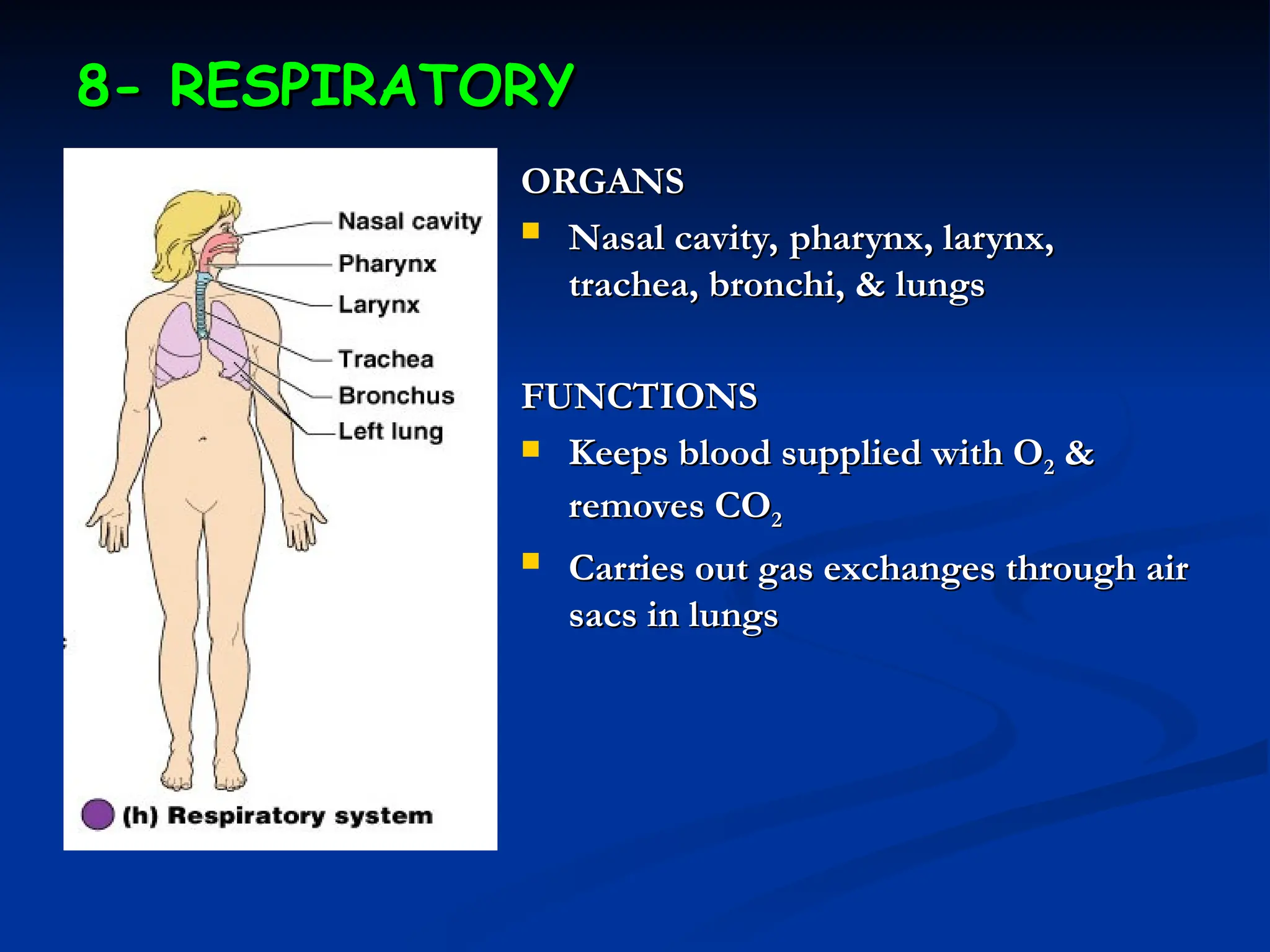
8- RESPIRATORY
8- RESPIRATORY
ORGANS
ORGANS
 Nasal cavity, pharynx, larynx,
Nasal cavity, pharynx, larynx,
trachea, bronchi, & lungs
FUNCTIONS
FUNCTIONS
 Keeps blood supplied with O
Keeps blood supplied with O2
2 &
&
removes CO
removes CO2
2
 Carries out gas exchanges through air
Carries out gas exchanges through air
sacs in lungs
sacs in lungs
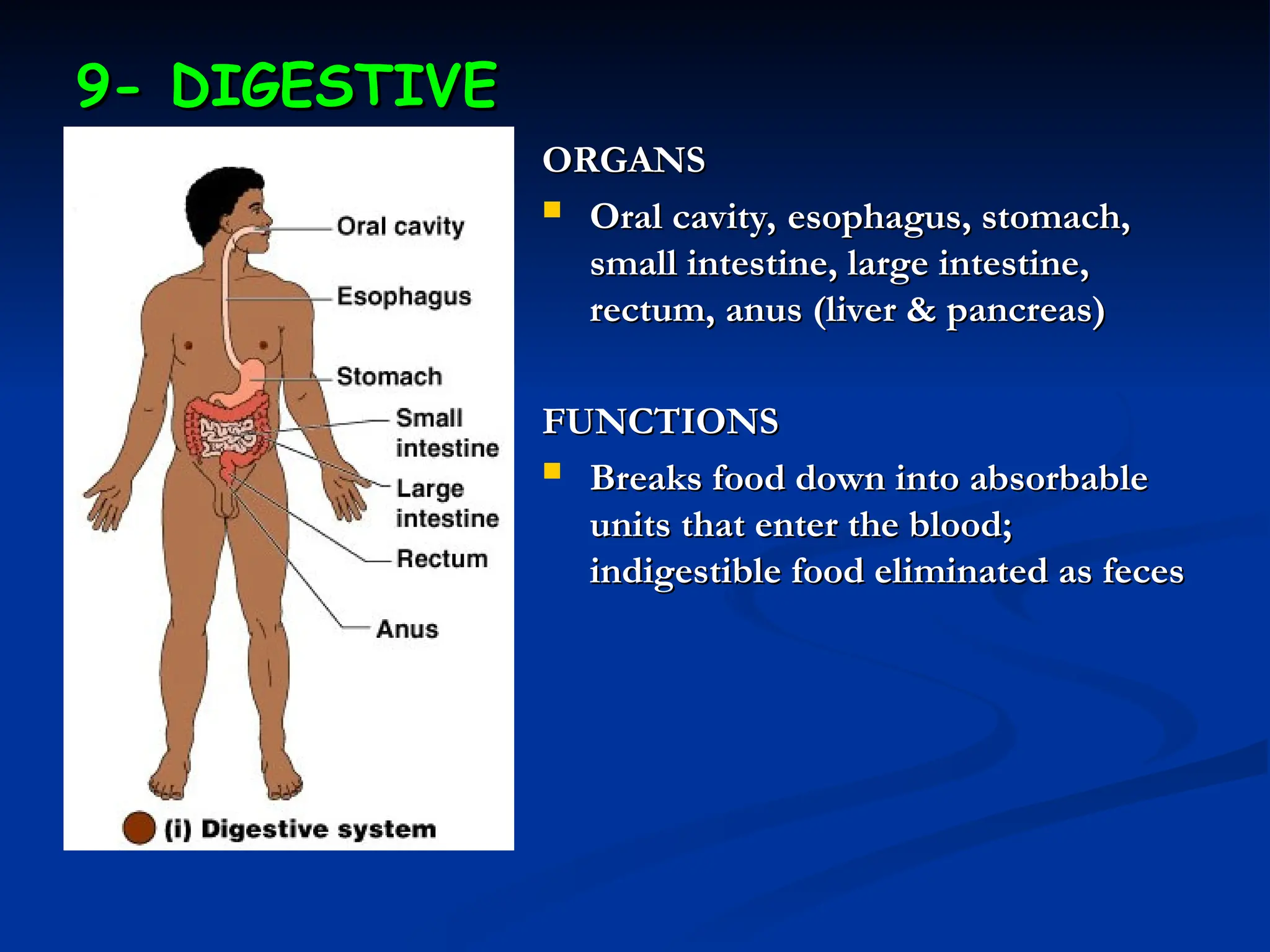
9- DIGESTIVE
9- DIGESTIVE
ORGANS
ORGANS
 Oral cavity, esophagus, stomach,
Oral cavity, esophagus, stomach,
small intestine, large intestine,
rectum, anus (liver & pancreas)
FUNCTIONS
FUNCTIONS
 Breaks food down into absorbable
Breaks food down into absorbable
units that enter the blood;
indigestible food eliminated as feces
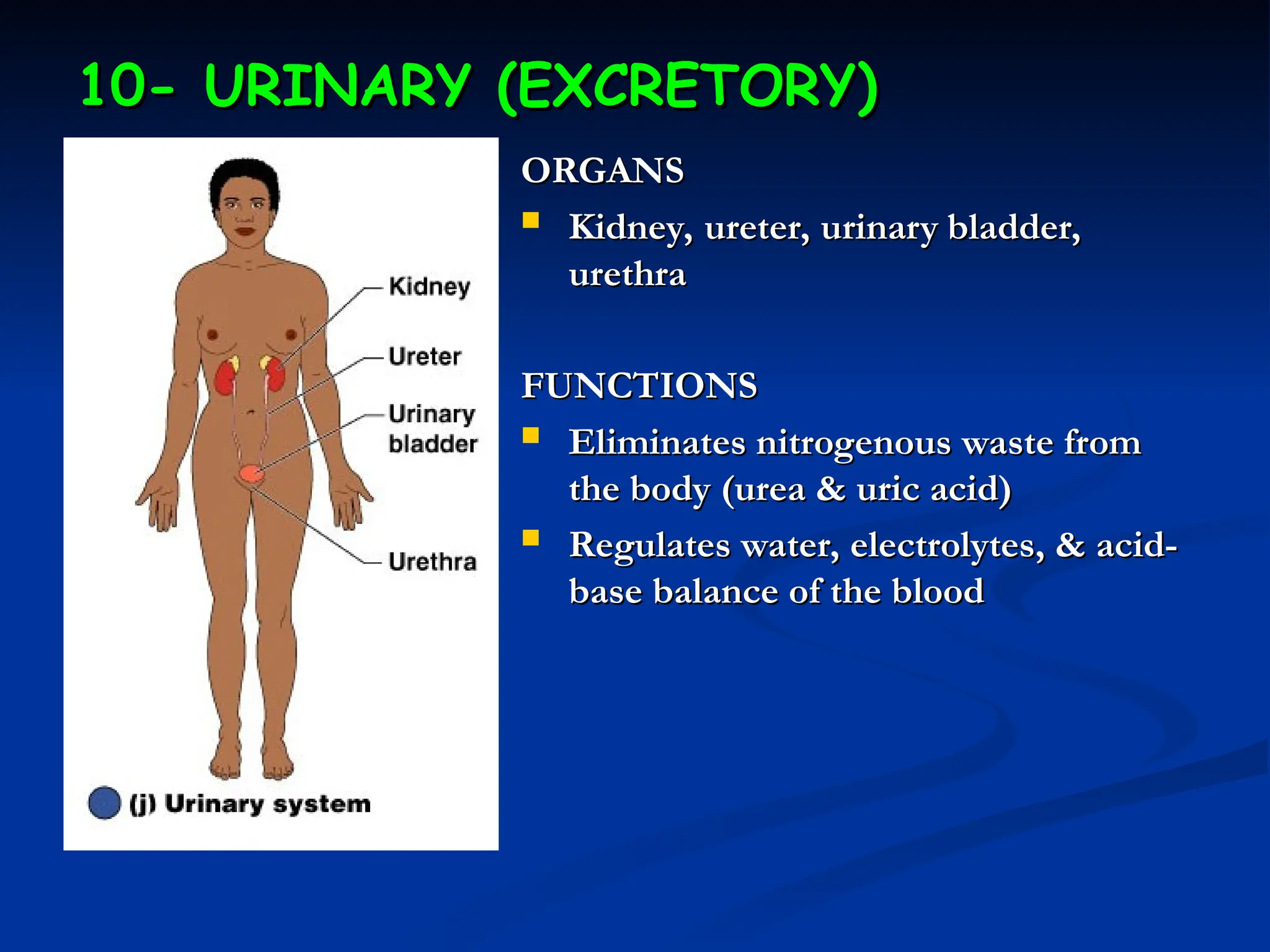
10- URINARY (EXCRETORY)
ORGANS
ORGANS
 Kidney, ureter, urinary bladder,
Kidney, ureter, urinary bladder,
urethra
urethra
FUNCTIONS
FUNCTIONS
 Eliminates nitrogenous waste from
Eliminates nitrogenous waste from
the body (urea & uric acid)
 Regulates water, electrolytes, & acid-
Regulates water, electrolytes, & acid-
base balance of the blood
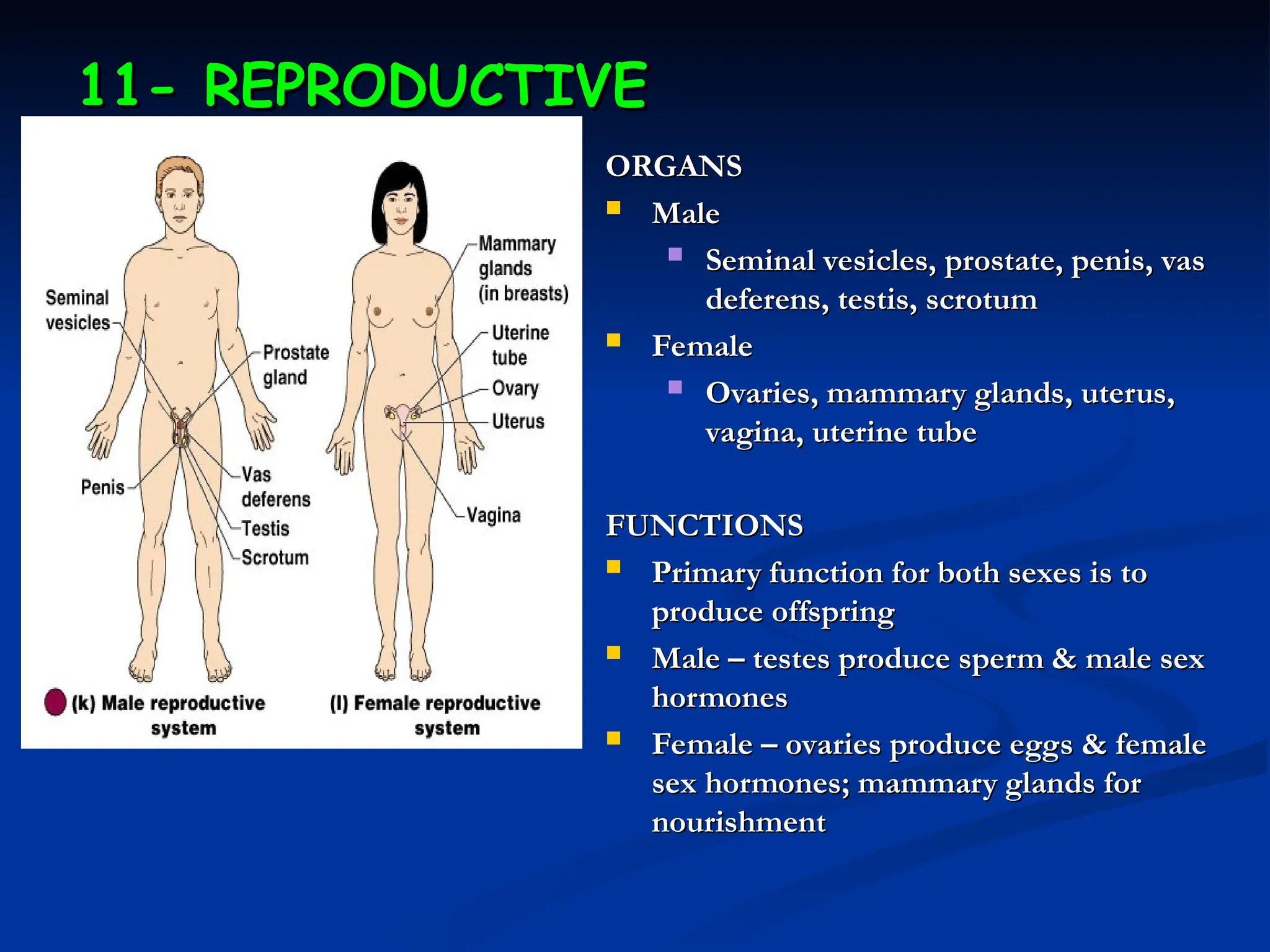
11- REPRODUCTIVE
11- REPRODUCTIVE
ORGANS
ORGANS
 Male
Male
 Seminal vesicles, prostate, penis, vas
Seminal vesicles, prostate, penis, vas
deferens, testis, scrotum
 Female
Female
 Ovaries, mammary glands, uterus,
Ovaries, mammary glands, uterus,
vagina, uterine tube
FUNCTIONS
FUNCTIONS
 Primary function for both sexes is to
Primary function for both sexes is to
produce offspring
produce offspring
 Male – testes produce sperm & male sex
Male – testes produce sperm & male sex
hormones
hormones
 Female – ovaries produce eggs & female
Female – ovaries produce eggs & female
sex hormones; mammary glands for
nourishment
nourishment
Maintaining Life
I-Necessary Life Functions : All living organisms
carry out certain vital functional activities necessary for
life, including :
1-Maintenance of boundaries: Every living organism
must maintain its inside distinct from outside.
-All the cells are surrounded by a selectively permeable
membrane.
-The body as a whole is enclosed and protected by the
integumentary system, or skin, which protects our
internal organs from drying out, bacteria, heat, sunlight,
and chemicals .
2-Movement :
-It includes the activities promoted by the
muscular system , the skeletal system provides
the bony framework that the muscles pull on as
they work.
-Movement also occurs when substances such
as blood, foodstuffs, and urine are propelled
through internal organs .
- On the cellular level, the muscle cell’s ability to
move by shortening is more precisely called
contractility.
3- Responsiveness or irritability, is the ability
to sense changes (stimuli) in the environment and
then respond to them.
-you involuntarily pull your hand away from the
painful stimulus .
-When carbon dioxide in your blood rises to
dangerously high levels, your breathing rate speeds
up.
Because nerve cells are highly irritable and
communicate rapidly with each other via electrical
impulses, the nervous system is most involved with
responsiveness. However, all body cells are irritable
to some extent.
4-Digestion :is the breaking down of ingested
foodstuffs to simple molecules that can be
absorbed into the blood. The nutrient-rich
blood is then distributed to all body cells by the
cardiovascular system.
In a simple, one-celled organism such as an
amoeba, the cell itself is the “digestion
factory,” but in the multicellular human body,
the digestive system performs this function for
the entire body.
5- Metabolism is a broad term that includes all
chemical reactions that occur within body cells. It
includes breaking down substances into their simpler
building blocks (catabolism), synthesizing more
complex cellular structures from simpler substances
(anabolism), and using nutrients and oxygen to
produce (via cellular respiration) ATP, that power
cellular activities.
Metabolism depends on the digestive and respiratory
systems to make nutrients and oxygen available to be
distributed throughout the body. Metabolism is
regulated largely by hormones secreted by endocrine
system glands.
6- Excretion is the process of removing
excreta (ek-skre′tah), or wastes, from the body.
– The digestive system rids the body of
indigestible food residues in feces.
-The urinary system disposes of nitrogen-
containing metabolic wastes, such as urea, in
urine.
- Carbon dioxide, a by-product of cellular
respiration, is carried in the blood to the lungs,
where it leaves the body in exhaled air.
7- Reproduction : is making a whole new person which
is the major task of the reproductive system.
- When a sperm unites with an egg, a fertilized egg
forms, which then develops into a baby within the
mother’s body.
- The reproductive system is regulated by hormones of
the endocrine system.
- Because males produce sperm and females produce
eggs (ova), there is a division of labor in the
reproductive process, and the reproductive organs of
males and females are different .
- The female’s reproductive structures provide the site
for fertilization of eggs by sperm, then protect and
nurture the developing fetus until birth.
8- Growth is an increase in size of a
body part or the organism. It is usually
accomplished by increasing the number
of cells. However, individual cells also
increase in size when not dividing. For
true growth to occur, constructive
activities must occur at a faster rate than
destructive ones
II.Survival Needs
Survival needs include:
1-nutrients
Nutrients, taken in via the diet, contain the chemical
substances used for energy and cell building.
-Carbohydrates are the major energy fuel for body cells.
-Proteins, and to a lesser extent fats, are essential for building
cell structures.
- Fats also provide a reserve of energy-rich fuel.
- Selected minerals and vitamins are required for the
chemical reactions that go on in cells and for oxygen transport
in the blood. The mineral calcium helps to make bones hard
and is required for blood clotting.
2- Oxygen : All the nutrients in the world are
useless unless oxygen is also available. Because
the chemical reactions that release energy from
foods are oxidative reactions that require
oxygen, human cells can survive for only a few
minutes without oxygen. Approximately 20% of
the air we breathe is oxygen. It is made available
to the blood and body cells by the cooperative
efforts of the respiratory and cardiovascular
systems.
3- Water accounts for 60–80% of body
weight and is the single most abundant
chemical substance in the body. It provides the
watery environment necessary for
chemical reactions and the fluid base for
body secretions and excretions. Water is
obtained chiefly from ingested foods or
liquids and is lost from the body by
evaporation from the lungs and skin and
in body excretions.
4- If chemical reactions are to continue at life-
sustaining rates, normal body temperature
must be maintained. As body temperature
drops below 37°C (98.6°F), metabolic
reactions become slower and slower, and
finally stop. When body temperature is too
high, body proteins lose their characteristic
shape and stop functioning. At either extreme,
death occurs. Most body heat is generated by the
activity of the muscular system.
5- Atmospheric pressure is the force that air exerts on
the surface of the body. Breathing and gas exchange in
the lungs depend on appropriate atmospheric pressure.
At high altitudes, where atmospheric pressure is lower
and the air is thin, gas exchange may be inadequate to
support cellular metabolism.
Notice :The mere presence of these survival factors is
not sufficient to sustain life. They must be present in
appropriate amounts; excesses and deficits may be equally
harmful. For example, the food we eat must be of high
quality and in proper amounts; otherwise, nutritional
disease, obesity, or starvation is likely.
Homeostasis
Homeostasis
 Describes the body’s ability to
Describes the body’s ability to
maintain relatively stable internal
conditions even though the outside
world is continuously changing
 The literal translation of homeostasis
The literal translation of homeostasis
is “unchanging,”( homeo= the same,
stasis = standing still which is not
true).
true).
The term does not really mean a
static, or unchanging, state.
Rather, it indicates a dynamic state
of equilibrium, or a balance, in
which internal conditions vary, but
always within relatively narrow
limits. In general, the body is in
homeostasis when its needs are adequately
met and it is functioning smoothly.
Homeostatic Control Mechanisms
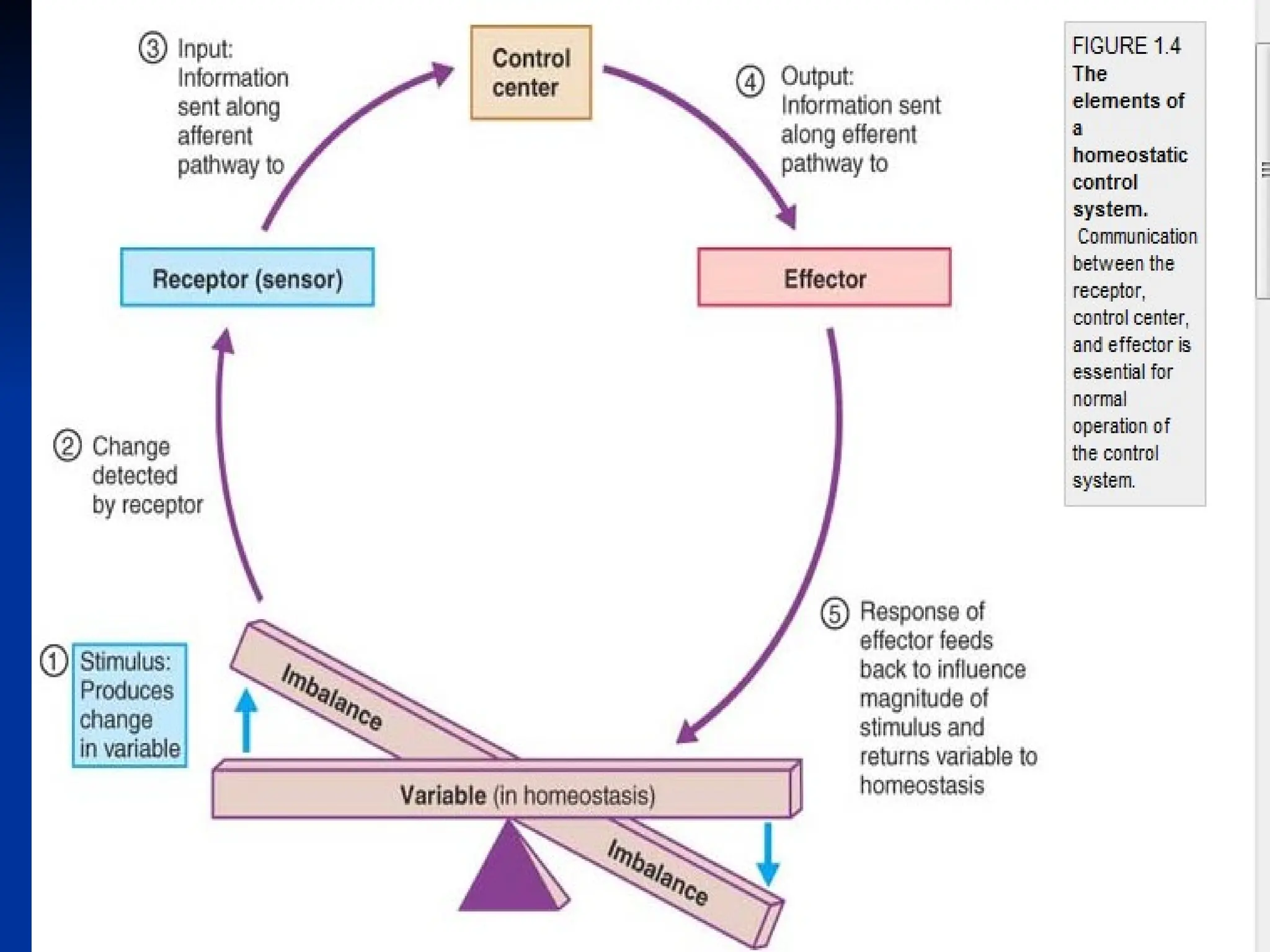
Communication within the body is essential
for homeostasis.
for homeostasis.
Communication is accomplished chiefly by
the
the nervous
nervous and
and endocrine systems
endocrine systems, which use
, which use
neural electrical impulses or blood borne
hormones, respectively, as information
carriers.
carriers.
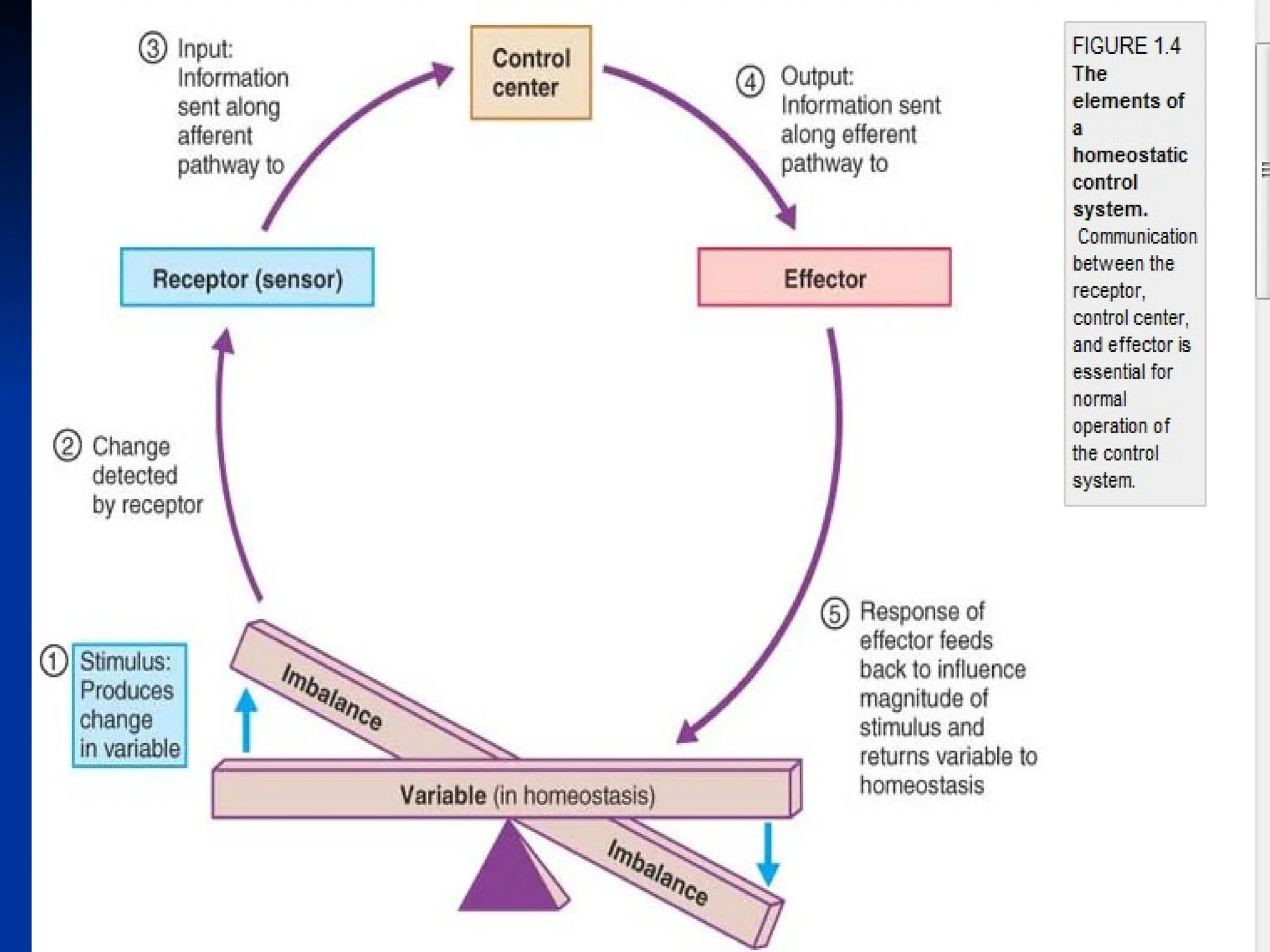
Regardless of the factor being regulated(the
variable)all homeostatic control mechanisms
have
have at least three
at least three interdependent components
interdependent components
.
.
The first component, the receptor, is some
type of sensor that monitors the
environment and responds to changes,
called stimuli, by sending information (input)
to the second component, the control
center. Input flows from the receptor to
the control center along the so-called
afferent pathway. The control center,
analyzes the input it receives and then
determines the appropriate response or
The third component, the effector,
provides the means of response (output) to
the stimulus. Information flows from the
control center to the effector along the
efferent pathway. The results of the
response then feed back to influence the
stimulus, either depressing it (negative
feedback) so that the whole control
mechanism is shut off or enhancing it
(positive feedback) so that the reaction
continues at an even faster rate.
 Homeostatic control mechanisms are
Homeostatic control mechanisms are
TWO:
TWO:
 Negative feedback mechanisms – the net
Negative feedback mechanisms – the net
effect of the response to the stimulus is
the shut off of the original stimulus or to
reduce its intensity
E.g. – body temp, blood chemical levels
E.g. – body temp, blood chemical levels
 Positive feedback mechanisms – tend to
Positive feedback mechanisms – tend to
increase the original disturbance
(stimulus) and push the variable farther
from its original value
E.g. – ovulation, blood clotting, birth
E.g. – ovulation, blood clotting, birth
Negative Feedback Mechanisms
Most homeostatic control mechanisms are
negative feedback mechanisms. In these
systems, the output shuts off the original
stimulus or reduces its intensity. These
mechanisms cause the variable to change in a
direction opposite to that of the initial change,
returning it to its “ideal” value; thus the name
“negative” feedback mechanisms.
A good example of a nonbiological negative
feedback system is a home heating system
connected to a temperature-sensing
thermostat . If the thermostat is set at 20°C
(68°F), the heating system (effector) is
triggered ON when the house temperature
drops below that setting. As the furnace
produces heat and warms the air, the
temperature rises, and when it reaches 20°C
or slightly higher, the thermostat triggers the
This process results in a cycling of
“furnace-ON” and “furnace-OFF”
so that the temperature in the house
stays very near the desired
temperature of 20°C. Your body
“thermostat,” located in a part of
your brain called the hypothalamus,
operates in a similar fashion.
Positive Feedback Mechanisms
In positive feedback mechanisms, the result
or response enhances the original stimulus
so that the activity (output) is accelerated.
This feedback mechanism is “positive”
because the change that occurs proceeds in
the same direction as the initial disturbance,
causing the variable to deviate further and
further from its original value or range.
In contrast to negative feedback controls,
which maintain many physiological
functions or keep blood chemicals within
narrow ranges, positive feedback
mechanisms usually control infrequent
events that do not require continuous
adjustments. However, TWO familiar
examples of their use as homeostatic
mechanisms are the enhancement of labor
contractions during birth and blood clotting.
The body’s ability to regulate its internal
environment is fundamental, and all
negative feedback mechanisms have the
same goal: preventing sudden severe
changes within the body. Body temperature
and blood volume are only two of the
variables that need to be regulated. There are
hundreds! Other negative feedback
mechanisms regulate heart rate, blood
pressure, the rate and depth of breathing,
and blood levels of oxygen, carbon dioxide,
and minerals.
Homeostatic Imbalance
Homeostasis is so important that most disease can be
regarded as a result of its disturbance, a condition
called homeostatic imbalance. As we age, our body’s
control systems become less efficient, and our internal
environment becomes less and less stable. These events
increase our risk for illness and produce the changes we
associate with aging.
Examples of homeostatic imbalance are provided
throughout this course to enhance understanding of
normal physiological mechanisms.
The Language of Anatomy
Anatomical Position
Anatomical Position
 Standing erect
Standing erect
 Feet parallel
Feet parallel
 Arms hanging at the sides
Arms hanging at the sides
 Palms facing forward
Palms facing forward
Anatomical position –
Anatomical position – body is erect with the
body is erect with the
feet parallel and the arms hanging at the
sides with the palms facing forward. (It’s
important to note throughout this course,
most terminology refers to this position
regardless of the position the body
happens to be in at the time)
Directional terms
Directional terms
 Superior (cranial or cephalad) –
Superior (cranial or cephalad) – toward the head
toward the head
end or upper part of a structure or body; above
 Inferior (caudal) –
Inferior (caudal) – away from the head end or
away from the head end or
toward the lower part of a structure or body; below
 Anterior (ventral) –
Anterior (ventral) – toward or at the front of the
toward or at the front of the
body; in front of
body; in front of
 Posterior (dorsal) –
Posterior (dorsal) – toward or at the backside of the
toward or at the backside of the
body; behind
body; behind
 Medial –
Medial – toward or at the midline of the body; on
toward or at the midline of the body; on
the inner side of
the inner side of
 Lateral –
Lateral – away from the midline of the body; on the
away from the midline of the body; on the
outer side of
outer side of
 Proximal –
Proximal – close to the origin of the
close to the origin of the
body part or the point of attachment of
a limb to the body trunk.
 Distal –
Distal – farther from the origin of a
farther from the origin of a
body or the point of attachment of a
limb to the body trunk.
 Superficial (external) –
Superficial (external) – toward or at the
toward or at the
body surface.
body surface.
 Deep (internal) –
Deep (internal) – away from the body
away from the body
surface; more internal.
Examples:
Examples:
 The navel is
The navel is inferior
inferior to the breastbone
to the breastbone
 The heart is
The heart is posterior
posterior to the breastbone
to the breastbone
 The arms are
The arms are lateral
lateral to the chest
to the chest
 The elbow is
The elbow is proximal
proximal to the wrist
to the wrist
 The skin is
The skin is superficial
superficial to the skeleton
to the skeleton
 The forehead is
The forehead is superior
superior to the nose
to the nose
 The breastbone is
The breastbone is anterior
anterior to the spine
to the spine
 The heart is
The heart is medial
medial to the arm
to the arm
 The armpit is
The armpit is intermediate
intermediate between the breastbone and the
between the breastbone and the
shoulder
shoulder
 The knee is
The knee is distal
distal to the thigh
to the thigh
 The lungs are
The lungs are deep
deep to the rib cage
to the rib cage
1.
1. The navel is --------------to the breastbone
The navel is --------------to the breastbone
2.
2. The heart is ------------- to the breastbone
The heart is ------------- to the breastbone
3.
3. The arms are
The arms are ------------
------------ to the chest
to the chest
4.
4. The elbow is ------------ to the wrist
The elbow is ------------ to the wrist
5.
5. The skin is ------------- to the skeleton
The skin is ------------- to the skeleton
6.
6. The forehead is ------------------ to the nose
The forehead is ------------------ to the nose
7.
7. The breastbone is------------ to the spine
The breastbone is------------ to the spine
8.
8. The heart is ------------to the arm
The heart is ------------to the arm
9.
9. The armpit is ---------between the breastbone
The armpit is ---------between the breastbone
and the shoulder
and the shoulder
10.
10. The knee is ---------to the thigh
The knee is ---------to the thigh
11.
11. The lungs are ---------to the rib cage
The lungs are ---------to the rib cage
Body planes and sections
A section is a cut made along a plane
 Sagittal –
Sagittal – cut made along the lengthwise or
cut made along the lengthwise or
longitudinal plane of the body dividing it into left
and right parts
and right parts
 Midsagittal (median) plane –
Midsagittal (median) plane – right and left parts
right and left parts
are of equal size
are of equal size
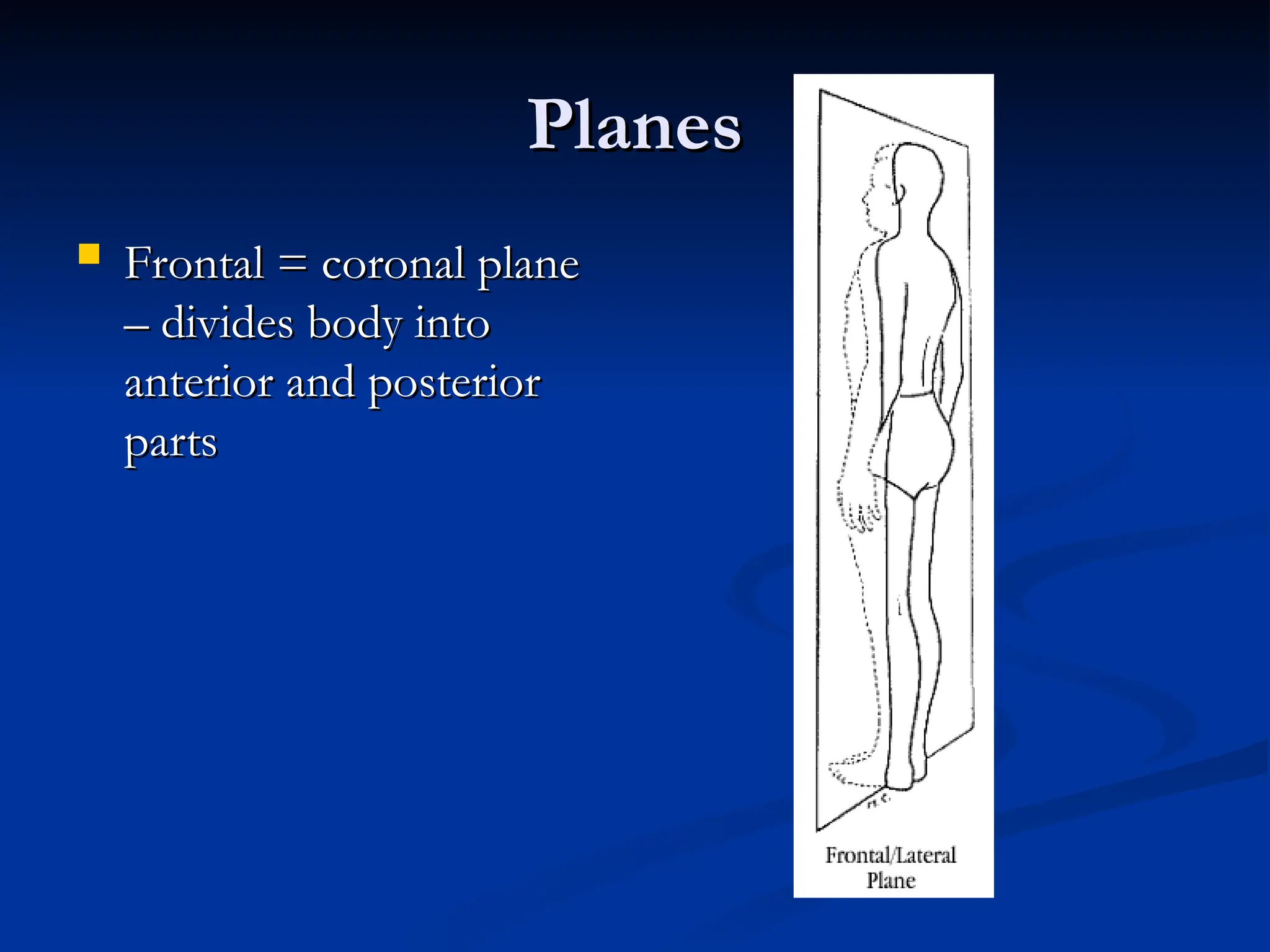
 Frontal (coronal) plane –
Frontal (coronal) plane – cut made along a
cut made along a
lengthwise plane that divides the body into
anterior and posterior parts
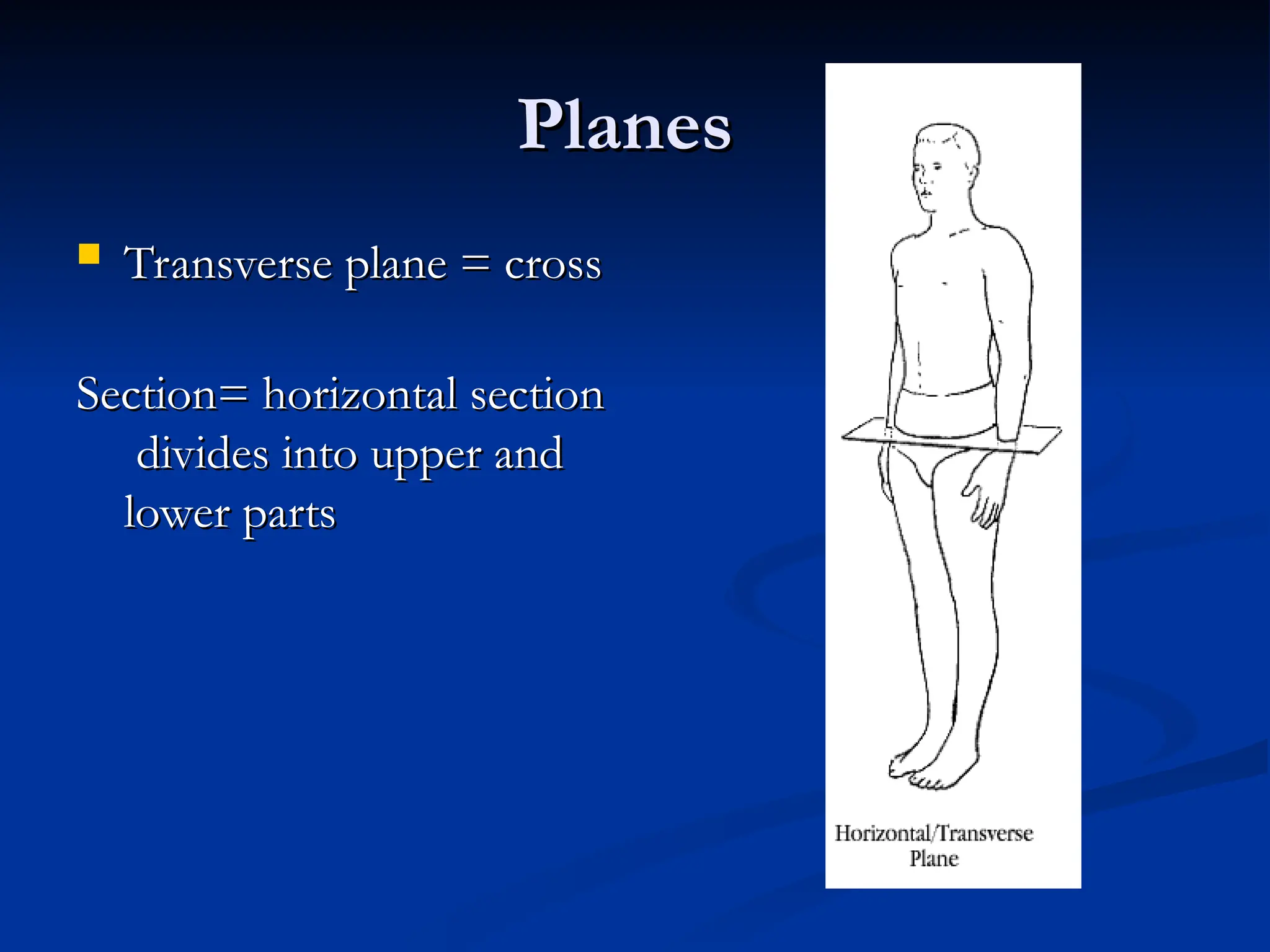
 Transverse plane (cross section) –
Transverse plane (cross section) – cut made along
cut made along
a horizontal plane dividing the body or organ into
superior and inferior parts
Planes
Planes
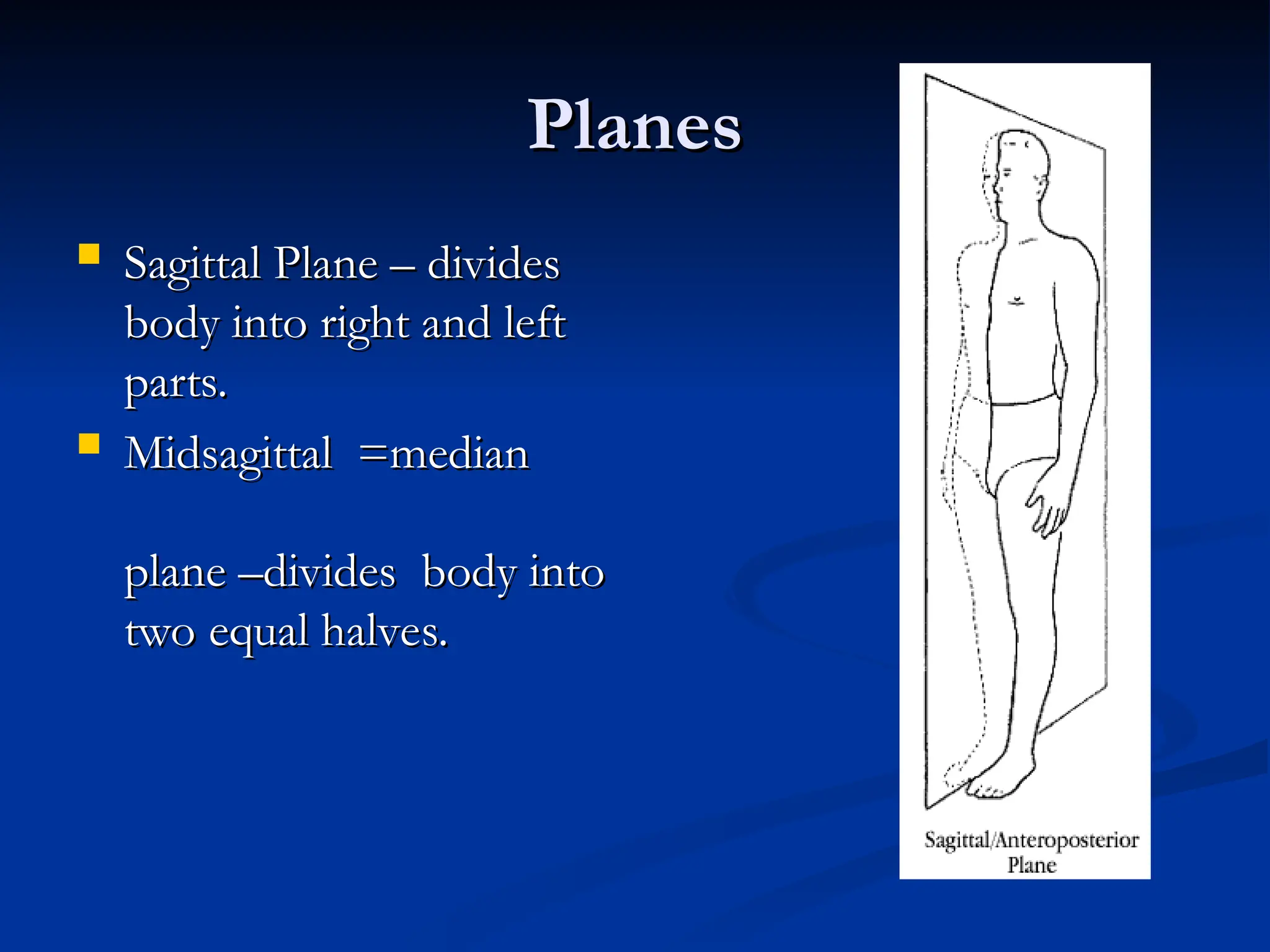
 Sagittal Plane – divides
Sagittal Plane – divides
body into right and left
parts.
parts.
 Midsagittal =median
Midsagittal =median
plane –divides body into
two equal halves.
two equal halves.
Planes
Planes
 Frontal = coronal plane
Frontal = coronal plane
– divides body into
– divides body into
anterior and posterior
parts
parts
Planes
Planes
 Transverse plane = cross
Transverse plane = cross
Section= horizontal section
divides into upper and
lower parts
lower parts
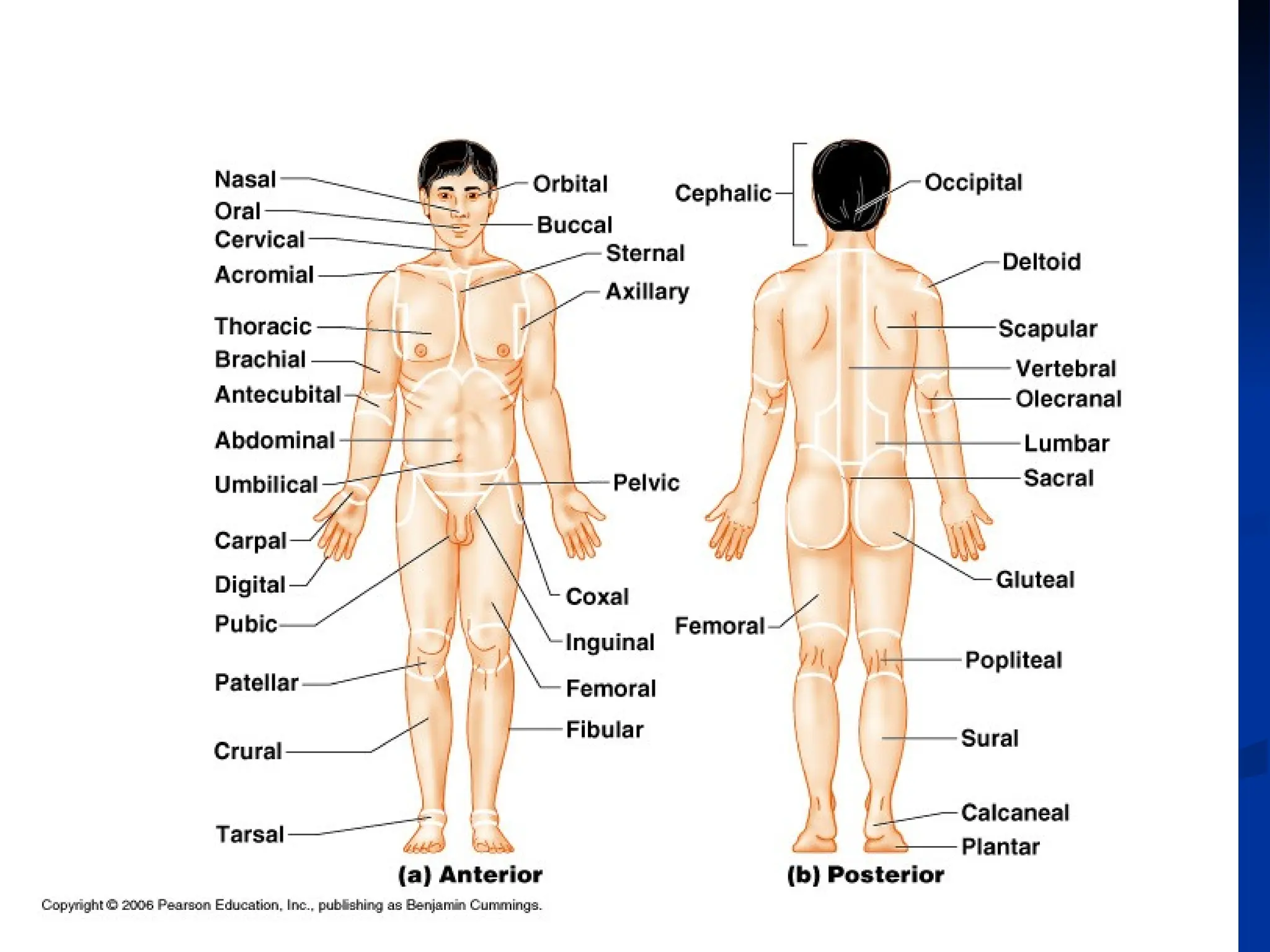
Regional terms
Regional terms
There are many visible landmarks
on the surface of the body:
- Anterior body landmarks
- Posterior body landmarks
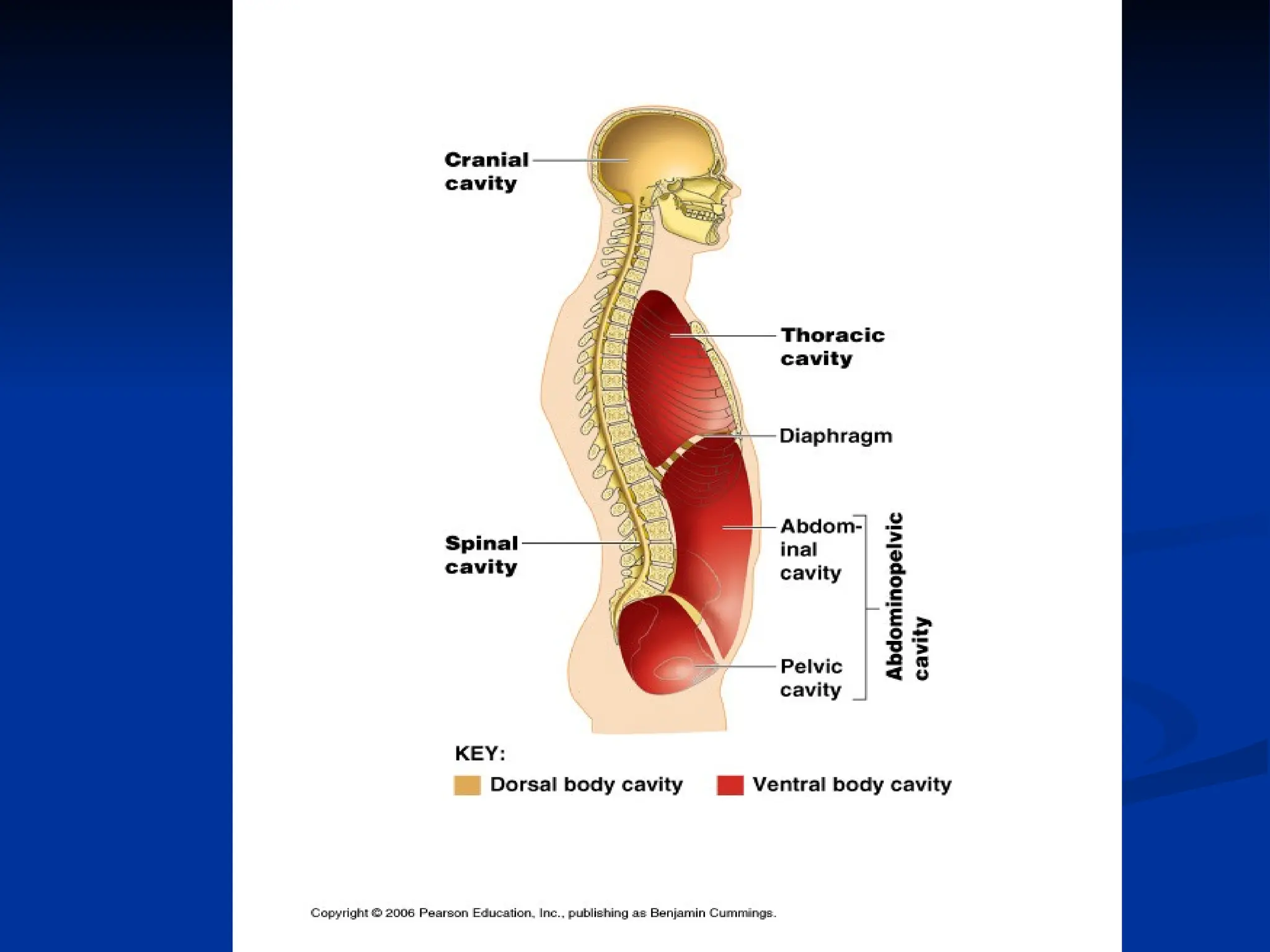
Body Cavities
There are two sets of internal body cavities called
the dorsal and ventral body cavities. These
cavities are closed to the outside.
1-Dorsal Body Cavity
Which protects the fragile nervous system organs
has two subdivisions. The cranial cavity, in the
skull, encases the brain. The vertebral, or spinal,
cavity, which runs within the bony vertebral
column, encloses the delicate spinal cord. The
cranial and spinal cavities are continuous with one
another
2- Ventral Body Cavity
The more anterior and larger of the closed body
cavities is the ventral body cavity .It has two major
subdivisions, the thoracic and the abdominopelvic
cavities. It houses internal organs collectively called the
viscera .
They are separated by the diaphragm, a dome-shaped
muscle important in breathing.
The abdominopelvic cavity, as its name suggests, has
two parts not physically separated by a muscular or
membrane wall.
The inferior part, the pelvic cavity, lies in the bony
pelvis .
HOMEOSTATIC IMBALANCE
When the body is subjected to physical
trauma (as often happens in an automobile
accident), the abdominopelvic organs are
most vulnerable. This is because the walls of
the abdominal cavity are formed only by
trunk muscles and are not reinforced by
bone. The pelvic organs receive a somewhat
greater degree of protection from the bony
pelvis
Abdominopelvic Regions and Quadrants
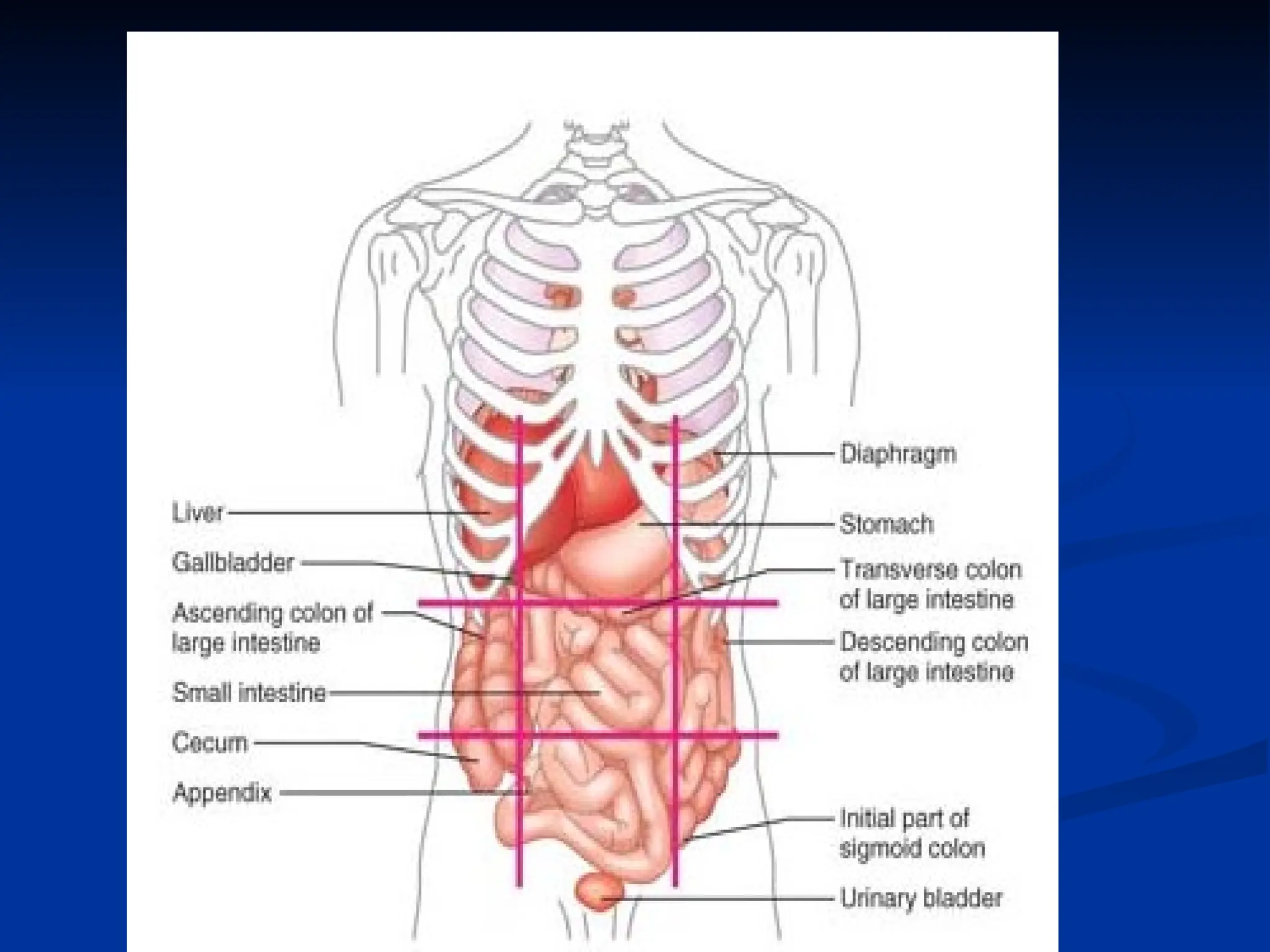
Because the abdominopelvic cavity is large and
contains several organs, it helps to divide it into smaller
areas for study.
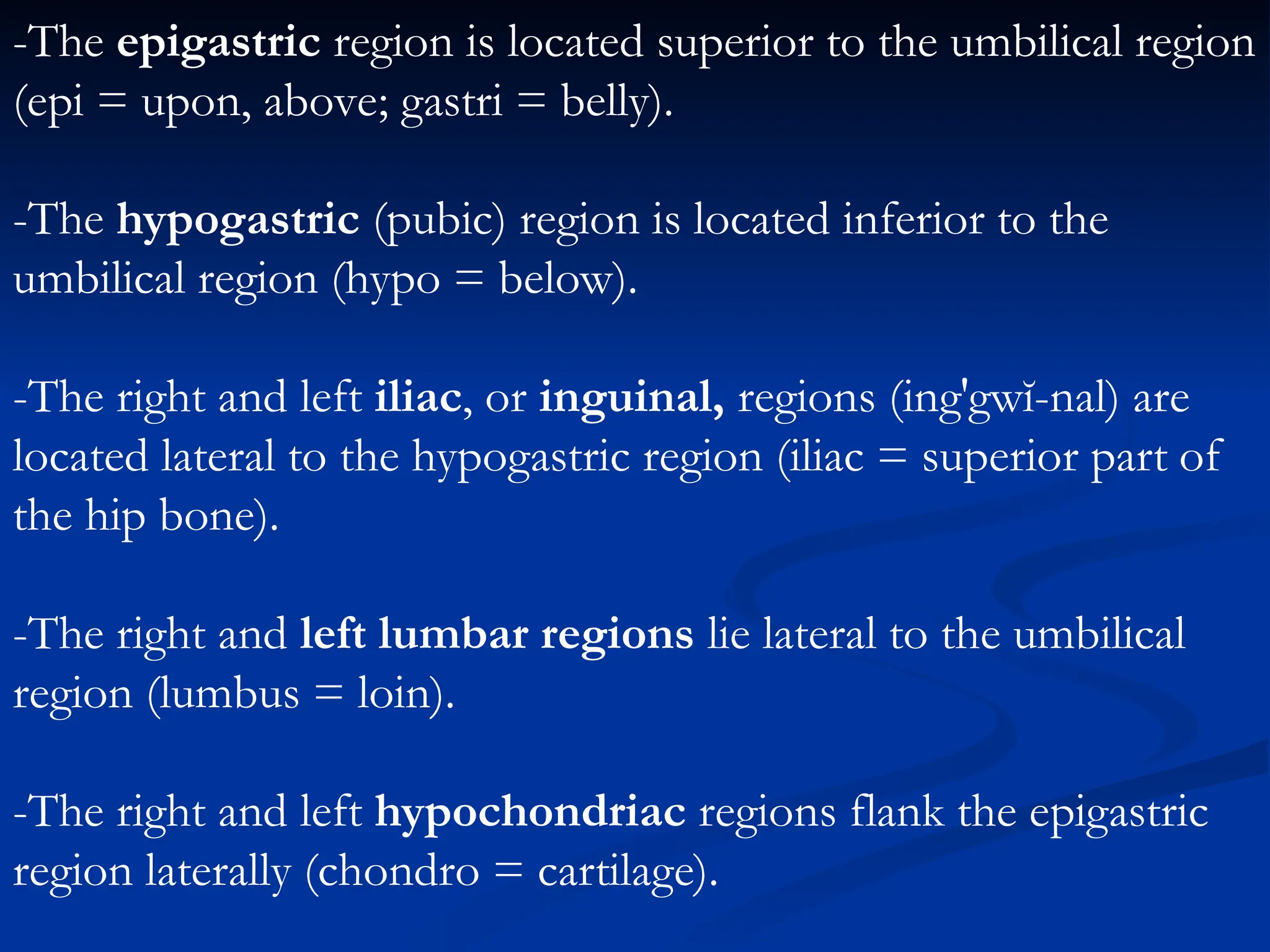
One division method, used primarily by anatomists,
uses two transverse and two parasagittal planes. These
planes, divide the cavity into nine regions :
-The umbilical region is the centermost region deep to
and surrounding the umbilicus (navel).
Abdominopelvic Regions
-The epigastric region is located superior to the umbilical region
(epi = upon, above; gastri = belly).
-The hypogastric (pubic) region is located inferior to the
umbilical region (hypo = below).
-The right and left iliac, or inguinal, regions (ing′gwĭ-nal) are
located lateral to the hypogastric region (iliac = superior part of
the hip bone).
-The right and left lumbar regions lie lateral to the umbilical
region (lumbus = loin).
-The right and left hypochondriac regions flank the epigastric
region laterally (chondro = cartilage).
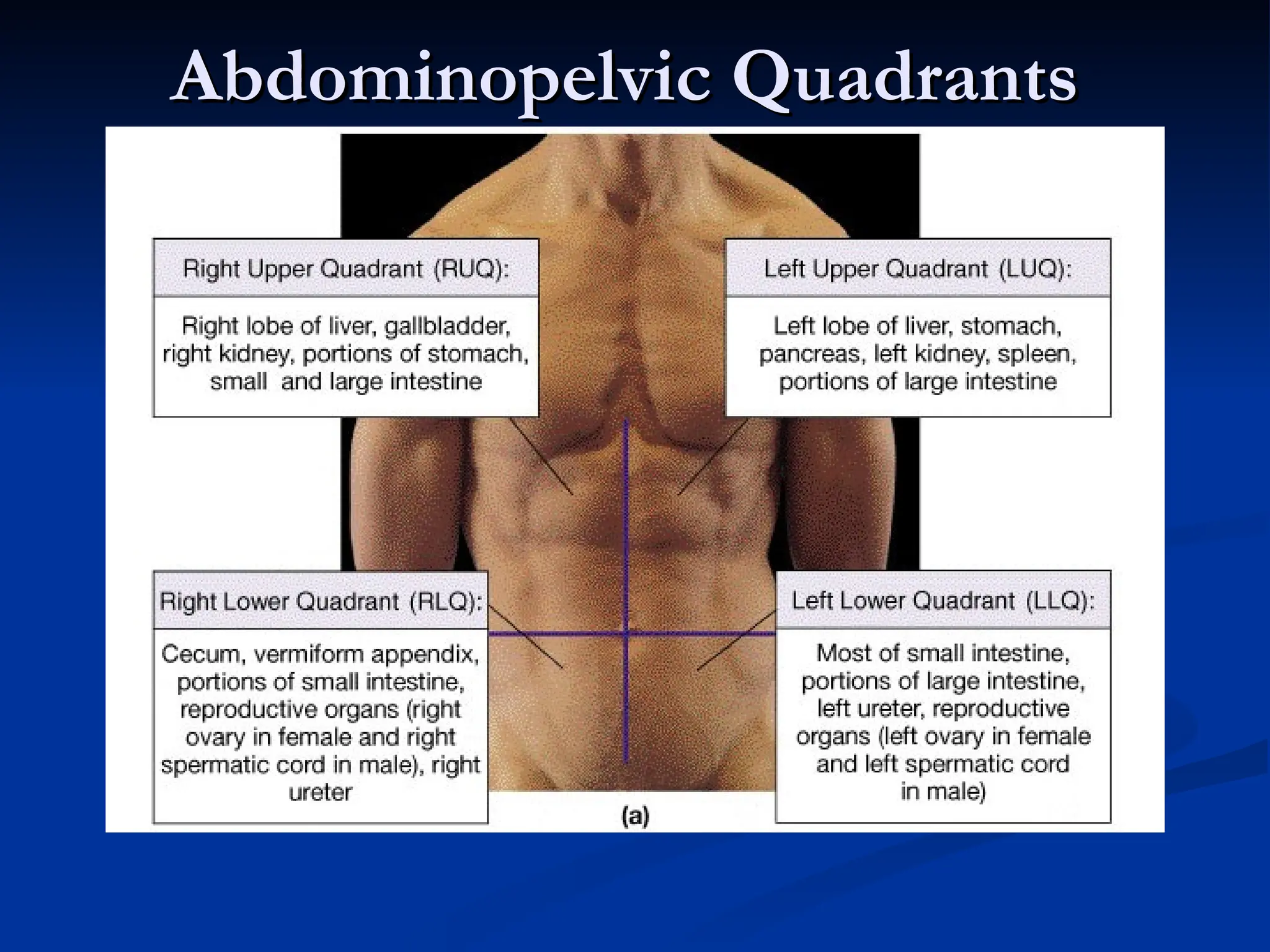
A simpler scheme to localize the
abdominopelvic cavity organs is to imagine
one transverse and one median sagittal plane
pass through the umbilicus at right angles.
The resulting quadrants are named according
to their positions from the subject’s point of
view:
right upper quadrant (RUQ), left upper
quadrant (LUQ),
right lower quadrant (RLQ), and left lower
quadrant (LLQ).
Abdominopelvic Quadrants
The Human Body : An Orientation and Introduction

The Human Body : An Orientation and Introduction

  • 1.
    CHAPTER 1 CHAPTER 1 TheHuman Body : The Human Body : An Orientation An Orientation
  • 2.
     Anatomy –the study of the s Anatomy – the study of the structure tructure and and shape shape of the body and body parts & their of the body and body parts & their relationships relationships to one another. The term to one another. The term anatomy comes from the Greek words anatomy comes from the Greek words meaning to cut (tomy) apart ( ana) . meaning to cut (tomy) apart ( ana) .  Gross anatomy( macroscopic anatomy) – Gross anatomy( macroscopic anatomy) – the study of large, easily observable the study of large, easily observable structures (by naked eye), such as the structures (by naked eye), such as the heart or bone. heart or bone.  Microscopic anatomy (cytology, Microscopic anatomy (cytology, histology) – the study of very small histology) – the study of very small structures, where a magnifying lens or structures, where a magnifying lens or microscope is needed. microscope is needed.
  • 3.
     Physiology –the study of how the body Physiology – the study of how the body and its parts and its parts work or function work or function physio =nature , ology = the study of. physio =nature , ology = the study of.  Like anatomy , physiology has many Like anatomy , physiology has many subdivisions. For example, subdivisions. For example, neurophysiology explains the working neurophysiology explains the working of the nervous system , and cardiac of the nervous system , and cardiac physiology studies the function of the physiology studies the function of the heart. heart.
  • 4.
    Relationship between Anatomy Relationshipbetween Anatomy and Physiology and Physiology Anatomy and Physiology are always Anatomy and Physiology are always related . Structure determines what related . Structure determines what functions can take place. For example, functions can take place. For example, the lungs are not muscular chambers like the lungs are not muscular chambers like the heart and can not pump blood, but the heart and can not pump blood, but because the walls of lungs are very thin, because the walls of lungs are very thin, they can exchange gasses and provide they can exchange gasses and provide oxygen to the body. oxygen to the body.
  • 5.
    Levels of StructuralOrganization Levels of Structural Organization The human body exhibits The human body exhibits 6 6 levels of structural levels of structural complexity : complexity : 1- Chemical level , the simplest level of 1- Chemical level , the simplest level of structural ladder .At this level atoms structural ladder .At this level atoms combine to form molecules such as water, combine to form molecules such as water, sugar, & proteins sugar, & proteins 2- Cellular level the smallest units of living 2- Cellular level the smallest units of living things . things . 3- Tissue level , groups of similar cells that 3- Tissue level , groups of similar cells that have a common function (4 basic types) have a common function (4 basic types)
  • 6.
    4- Organ level,an organ is a structure composed of 2 or more tissue types that performs a specific function . 5- Organ System is a group of organs that work together to accomplish a common purpose (each organ has its own job to do) 6- Organismal level , represents the highest level of structural organization( total of 11 organ
  • 8.
    Body systems:The humanbody has 11 systems 1-INTEGUMENTARY ORGANS ORGANS  Skin Skin FUNCTIONS FUNCTIONS  Waterproofs, cushions, protects deeper Waterproofs, cushions, protects deeper tissue tissue  Excretes salts & urea; pain, pressure Excretes salts & urea; pain, pressure  Regulates body temp; synthesize vitamin Regulates body temp; synthesize vitamin D D
  • 9.
    2-SKELETAL 2-SKELETAL ORGANS ORGANS  Bones, cartilages,ligaments, joints Bones, cartilages, ligaments, joints FUNCTIONS FUNCTIONS  Protects & supports body organs Protects & supports body organs  Framework for muscles & movement Framework for muscles & movement  Hematopoiesis; store minerals Hematopoiesis; store minerals
  • 10.
    3- MUSCULAR 3- MUSCULAR ORGANS ORGANS Skeletal muscle (attached to bone) Skeletal muscle (attached to bone) FUNCTIONS FUNCTIONS  Contraction & mobility (locomotion) Contraction & mobility (locomotion)  Facial expression, posture Facial expression, posture  Produce body heat Produce body heat
  • 11.
    4- NERVOUS 4- NERVOUS ORGANS ORGANS Brain, spinal cord, nerves, & sensory Brain, spinal cord, nerves, & sensory receptors receptors FUNCTIONS FUNCTIONS  Fast-acting central control system Fast-acting central control system  Responds to external/internal stimuli Responds to external/internal stimuli via nerve impulses (electrical via nerve impulses (electrical messages) messages)
  • 12.
    5- ENDOCRINE 5- ENDOCRINE ORGANS ORGANS Pituitary, thyroid, parathyroids, Pituitary, thyroid, parathyroids, adrenals, thymus, pancreas, pineal, adrenals, thymus, pancreas, pineal, ovaries, testes…..etc. ovaries, testes…..etc. FUNCTIONS FUNCTIONS  Slow -acting control system Slow -acting control system  Glands produce hormones that Glands produce hormones that regulate growth, reproduction, regulate growth, reproduction, metabolism,…. etc. metabolism,…. etc.
  • 13.
    6- Circulatory 6- Circulatory ORGANS ORGANS Heart, blood vessels, capillaries &blood Heart, blood vessels, capillaries &blood FUNCTIONS FUNCTIONS  Carries O Carries O2 2 nutrients, hormones, & other nutrients, hormones, & other substances to and from tissue cells substances to and from tissue cells  White blood cells protect against White blood cells protect against bacteria, toxins, tumors bacteria, toxins, tumors
  • 14.
    7- LYMPHATIC 7- LYMPHATIC ORGANS ORGANS Lymphatic vessels, lymph nodes, Lymphatic vessels, lymph nodes, spleen, tonsils spleen, tonsils FUNCTIONS FUNCTIONS  Complements circulatory system by Complements circulatory system by returning leaked fluid back to blood returning leaked fluid back to blood vessels vessels  Cleanses the blood; involved in Cleanses the blood; involved in immunity immunity
  • 15.
    8- RESPIRATORY 8- RESPIRATORY ORGANS ORGANS Nasal cavity, pharynx, larynx, Nasal cavity, pharynx, larynx, trachea, bronchi, & lungs trachea, bronchi, & lungs FUNCTIONS FUNCTIONS  Keeps blood supplied with O Keeps blood supplied with O2 2 & & removes CO removes CO2 2  Carries out gas exchanges through air Carries out gas exchanges through air sacs in lungs sacs in lungs
  • 16.
    9- DIGESTIVE 9- DIGESTIVE ORGANS ORGANS Oral cavity, esophagus, stomach, Oral cavity, esophagus, stomach, small intestine, large intestine, small intestine, large intestine, rectum, anus (liver & pancreas) rectum, anus (liver & pancreas) FUNCTIONS FUNCTIONS  Breaks food down into absorbable Breaks food down into absorbable units that enter the blood; units that enter the blood; indigestible food eliminated as feces indigestible food eliminated as feces
  • 17.
    10- URINARY (EXCRETORY) 10-URINARY (EXCRETORY) ORGANS ORGANS  Kidney, ureter, urinary bladder, Kidney, ureter, urinary bladder, urethra urethra FUNCTIONS FUNCTIONS  Eliminates nitrogenous waste from Eliminates nitrogenous waste from the body (urea & uric acid) the body (urea & uric acid)  Regulates water, electrolytes, & acid- Regulates water, electrolytes, & acid- base balance of the blood base balance of the blood
  • 18.
    11- REPRODUCTIVE 11- REPRODUCTIVE ORGANS ORGANS Male Male  Seminal vesicles, prostate, penis, vas Seminal vesicles, prostate, penis, vas deferens, testis, scrotum deferens, testis, scrotum  Female Female  Ovaries, mammary glands, uterus, Ovaries, mammary glands, uterus, vagina, uterine tube vagina, uterine tube FUNCTIONS FUNCTIONS  Primary function for both sexes is to Primary function for both sexes is to produce offspring produce offspring  Male – testes produce sperm & male sex Male – testes produce sperm & male sex hormones hormones  Female – ovaries produce eggs & female Female – ovaries produce eggs & female sex hormones; mammary glands for sex hormones; mammary glands for nourishment nourishment
  • 20.
    Maintaining Life I-Necessary LifeFunctions : All living organisms carry out certain vital functional activities necessary for life, including : 1-Maintenance of boundaries: Every living organism must maintain its inside distinct from outside. -All the cells are surrounded by a selectively permeable membrane. -The body as a whole is enclosed and protected by the integumentary system, or skin, which protects our internal organs from drying out, bacteria, heat, sunlight, and chemicals .
  • 21.
    2-Movement : -It includesthe activities promoted by the muscular system , the skeletal system provides the bony framework that the muscles pull on as they work. -Movement also occurs when substances such as blood, foodstuffs, and urine are propelled through internal organs . - On the cellular level, the muscle cell’s ability to move by shortening is more precisely called contractility.
  • 22.
    3- Responsiveness orirritability, is the ability to sense changes (stimuli) in the environment and then respond to them. -you involuntarily pull your hand away from the painful stimulus . -When carbon dioxide in your blood rises to dangerously high levels, your breathing rate speeds up. Because nerve cells are highly irritable and communicate rapidly with each other via electrical impulses, the nervous system is most involved with responsiveness. However, all body cells are irritable to some extent.
  • 23.
    4-Digestion :is thebreaking down of ingested foodstuffs to simple molecules that can be absorbed into the blood. The nutrient-rich blood is then distributed to all body cells by the cardiovascular system. In a simple, one-celled organism such as an amoeba, the cell itself is the “digestion factory,” but in the multicellular human body, the digestive system performs this function for the entire body.
  • 24.
    5- Metabolism isa broad term that includes all chemical reactions that occur within body cells. It includes breaking down substances into their simpler building blocks (catabolism), synthesizing more complex cellular structures from simpler substances (anabolism), and using nutrients and oxygen to produce (via cellular respiration) ATP, that power cellular activities. Metabolism depends on the digestive and respiratory systems to make nutrients and oxygen available to be distributed throughout the body. Metabolism is regulated largely by hormones secreted by endocrine system glands.
  • 25.
    6- Excretion isthe process of removing excreta (ek-skre′tah), or wastes, from the body. – The digestive system rids the body of indigestible food residues in feces. -The urinary system disposes of nitrogen- containing metabolic wastes, such as urea, in urine. - Carbon dioxide, a by-product of cellular respiration, is carried in the blood to the lungs, where it leaves the body in exhaled air.
  • 26.
    7- Reproduction :is making a whole new person which is the major task of the reproductive system. - When a sperm unites with an egg, a fertilized egg forms, which then develops into a baby within the mother’s body. - The reproductive system is regulated by hormones of the endocrine system. - Because males produce sperm and females produce eggs (ova), there is a division of labor in the reproductive process, and the reproductive organs of males and females are different . - The female’s reproductive structures provide the site for fertilization of eggs by sperm, then protect and nurture the developing fetus until birth.
  • 27.
    8- Growth isan increase in size of a body part or the organism. It is usually accomplished by increasing the number of cells. However, individual cells also increase in size when not dividing. For true growth to occur, constructive activities must occur at a faster rate than destructive ones
  • 28.
    II.Survival Needs Survival needsinclude: 1-nutrients Nutrients, taken in via the diet, contain the chemical substances used for energy and cell building. -Carbohydrates are the major energy fuel for body cells. -Proteins, and to a lesser extent fats, are essential for building cell structures. - Fats also provide a reserve of energy-rich fuel. - Selected minerals and vitamins are required for the chemical reactions that go on in cells and for oxygen transport in the blood. The mineral calcium helps to make bones hard and is required for blood clotting.
  • 29.
    2- Oxygen :All the nutrients in the world are useless unless oxygen is also available. Because the chemical reactions that release energy from foods are oxidative reactions that require oxygen, human cells can survive for only a few minutes without oxygen. Approximately 20% of the air we breathe is oxygen. It is made available to the blood and body cells by the cooperative efforts of the respiratory and cardiovascular systems.
  • 30.
    3- Water accountsfor 60–80% of body weight and is the single most abundant chemical substance in the body. It provides the watery environment necessary for chemical reactions and the fluid base for body secretions and excretions. Water is obtained chiefly from ingested foods or liquids and is lost from the body by evaporation from the lungs and skin and in body excretions.
  • 31.
    4- If chemicalreactions are to continue at life- sustaining rates, normal body temperature must be maintained. As body temperature drops below 37°C (98.6°F), metabolic reactions become slower and slower, and finally stop. When body temperature is too high, body proteins lose their characteristic shape and stop functioning. At either extreme, death occurs. Most body heat is generated by the activity of the muscular system.
  • 32.
    5- Atmospheric pressureis the force that air exerts on the surface of the body. Breathing and gas exchange in the lungs depend on appropriate atmospheric pressure. At high altitudes, where atmospheric pressure is lower and the air is thin, gas exchange may be inadequate to support cellular metabolism. Notice :The mere presence of these survival factors is not sufficient to sustain life. They must be present in appropriate amounts; excesses and deficits may be equally harmful. For example, the food we eat must be of high quality and in proper amounts; otherwise, nutritional disease, obesity, or starvation is likely.
  • 33.
    Homeostasis Homeostasis  Describes thebody’s ability to Describes the body’s ability to maintain relatively stable internal maintain relatively stable internal conditions even though the outside conditions even though the outside world is continuously changing world is continuously changing  The literal translation of homeostasis The literal translation of homeostasis is “unchanging,”( homeo= the same, is “unchanging,”( homeo= the same, stasis = standing still which is not stasis = standing still which is not true). true).
  • 34.
    The term doesnot really mean a static, or unchanging, state. Rather, it indicates a dynamic state of equilibrium, or a balance, in which internal conditions vary, but always within relatively narrow limits. In general, the body is in homeostasis when its needs are adequately met and it is functioning smoothly.
  • 35.
    Homeostatic Control Mechanisms HomeostaticControl Mechanisms Communication within the body is essential Communication within the body is essential for homeostasis. for homeostasis. Communication is accomplished chiefly by Communication is accomplished chiefly by the the nervous nervous and and endocrine systems endocrine systems, which use , which use neural electrical impulses or blood borne neural electrical impulses or blood borne hormones, respectively, as information hormones, respectively, as information carriers. carriers. Regardless of the factor being regulated(the Regardless of the factor being regulated(the variable)all homeostatic control mechanisms variable)all homeostatic control mechanisms have have at least three at least three interdependent components interdependent components . .
  • 36.
    The first component,the receptor, is some type of sensor that monitors the environment and responds to changes, called stimuli, by sending information (input) to the second component, the control center. Input flows from the receptor to the control center along the so-called afferent pathway. The control center, analyzes the input it receives and then determines the appropriate response or
  • 37.
    The third component,the effector, provides the means of response (output) to the stimulus. Information flows from the control center to the effector along the efferent pathway. The results of the response then feed back to influence the stimulus, either depressing it (negative feedback) so that the whole control mechanism is shut off or enhancing it (positive feedback) so that the reaction continues at an even faster rate.
  • 39.
     Homeostatic controlmechanisms are Homeostatic control mechanisms are TWO: TWO:  Negative feedback mechanisms – the net Negative feedback mechanisms – the net effect of the response to the stimulus is effect of the response to the stimulus is the shut off of the original stimulus or to the shut off of the original stimulus or to reduce its intensity reduce its intensity E.g. – body temp, blood chemical levels E.g. – body temp, blood chemical levels  Positive feedback mechanisms – tend to Positive feedback mechanisms – tend to increase the original disturbance increase the original disturbance (stimulus) and push the variable farther (stimulus) and push the variable farther from its original value from its original value E.g. – ovulation, blood clotting, birth E.g. – ovulation, blood clotting, birth
  • 40.
    Negative Feedback Mechanisms Mosthomeostatic control mechanisms are negative feedback mechanisms. In these systems, the output shuts off the original stimulus or reduces its intensity. These mechanisms cause the variable to change in a direction opposite to that of the initial change, returning it to its “ideal” value; thus the name “negative” feedback mechanisms.
  • 41.
    A good exampleof a nonbiological negative feedback system is a home heating system connected to a temperature-sensing thermostat . If the thermostat is set at 20°C (68°F), the heating system (effector) is triggered ON when the house temperature drops below that setting. As the furnace produces heat and warms the air, the temperature rises, and when it reaches 20°C or slightly higher, the thermostat triggers the
  • 42.
    This process resultsin a cycling of “furnace-ON” and “furnace-OFF” so that the temperature in the house stays very near the desired temperature of 20°C. Your body “thermostat,” located in a part of your brain called the hypothalamus, operates in a similar fashion.
  • 43.
    Positive Feedback Mechanisms Inpositive feedback mechanisms, the result or response enhances the original stimulus so that the activity (output) is accelerated. This feedback mechanism is “positive” because the change that occurs proceeds in the same direction as the initial disturbance, causing the variable to deviate further and further from its original value or range.
  • 44.
    In contrast tonegative feedback controls, which maintain many physiological functions or keep blood chemicals within narrow ranges, positive feedback mechanisms usually control infrequent events that do not require continuous adjustments. However, TWO familiar examples of their use as homeostatic mechanisms are the enhancement of labor contractions during birth and blood clotting.
  • 45.
    The body’s abilityto regulate its internal environment is fundamental, and all negative feedback mechanisms have the same goal: preventing sudden severe changes within the body. Body temperature and blood volume are only two of the variables that need to be regulated. There are hundreds! Other negative feedback mechanisms regulate heart rate, blood pressure, the rate and depth of breathing, and blood levels of oxygen, carbon dioxide, and minerals.
  • 46.
    Homeostatic Imbalance Homeostasis isso important that most disease can be regarded as a result of its disturbance, a condition called homeostatic imbalance. As we age, our body’s control systems become less efficient, and our internal environment becomes less and less stable. These events increase our risk for illness and produce the changes we associate with aging. Examples of homeostatic imbalance are provided throughout this course to enhance understanding of normal physiological mechanisms.
  • 48.
    The Language ofAnatomy The Language of Anatomy
  • 49.
    Anatomical Position Anatomical Position Standing erect Standing erect  Feet parallel Feet parallel  Arms hanging at the sides Arms hanging at the sides  Palms facing forward Palms facing forward Anatomical position – Anatomical position – body is erect with the body is erect with the feet parallel and the arms hanging at the feet parallel and the arms hanging at the sides with the palms facing forward. (It’s sides with the palms facing forward. (It’s important to note throughout this course, important to note throughout this course, most terminology refers to this position most terminology refers to this position regardless of the position the body regardless of the position the body happens to be in at the time) happens to be in at the time)
  • 50.
    Directional terms Directional terms Superior (cranial or cephalad) – Superior (cranial or cephalad) – toward the head toward the head end or upper part of a structure or body; above end or upper part of a structure or body; above  Inferior (caudal) – Inferior (caudal) – away from the head end or away from the head end or toward the lower part of a structure or body; below toward the lower part of a structure or body; below  Anterior (ventral) – Anterior (ventral) – toward or at the front of the toward or at the front of the body; in front of body; in front of  Posterior (dorsal) – Posterior (dorsal) – toward or at the backside of the toward or at the backside of the body; behind body; behind  Medial – Medial – toward or at the midline of the body; on toward or at the midline of the body; on the inner side of the inner side of  Lateral – Lateral – away from the midline of the body; on the away from the midline of the body; on the outer side of outer side of
  • 51.
     Proximal – Proximal– close to the origin of the close to the origin of the body part or the point of attachment of body part or the point of attachment of a limb to the body trunk. a limb to the body trunk.  Distal – Distal – farther from the origin of a farther from the origin of a body or the point of attachment of a body or the point of attachment of a limb to the body trunk. limb to the body trunk.  Superficial (external) – Superficial (external) – toward or at the toward or at the body surface. body surface.  Deep (internal) – Deep (internal) – away from the body away from the body surface; more internal. surface; more internal.
  • 52.
    Examples: Examples:  The navelis The navel is inferior inferior to the breastbone to the breastbone  The heart is The heart is posterior posterior to the breastbone to the breastbone  The arms are The arms are lateral lateral to the chest to the chest  The elbow is The elbow is proximal proximal to the wrist to the wrist  The skin is The skin is superficial superficial to the skeleton to the skeleton  The forehead is The forehead is superior superior to the nose to the nose  The breastbone is The breastbone is anterior anterior to the spine to the spine  The heart is The heart is medial medial to the arm to the arm  The armpit is The armpit is intermediate intermediate between the breastbone and the between the breastbone and the shoulder shoulder  The knee is The knee is distal distal to the thigh to the thigh  The lungs are The lungs are deep deep to the rib cage to the rib cage
  • 53.
    1. 1. The navelis --------------to the breastbone The navel is --------------to the breastbone 2. 2. The heart is ------------- to the breastbone The heart is ------------- to the breastbone 3. 3. The arms are The arms are ------------ ------------ to the chest to the chest 4. 4. The elbow is ------------ to the wrist The elbow is ------------ to the wrist 5. 5. The skin is ------------- to the skeleton The skin is ------------- to the skeleton 6. 6. The forehead is ------------------ to the nose The forehead is ------------------ to the nose 7. 7. The breastbone is------------ to the spine The breastbone is------------ to the spine 8. 8. The heart is ------------to the arm The heart is ------------to the arm 9. 9. The armpit is ---------between the breastbone The armpit is ---------between the breastbone and the shoulder and the shoulder 10. 10. The knee is ---------to the thigh The knee is ---------to the thigh 11. 11. The lungs are ---------to the rib cage The lungs are ---------to the rib cage
  • 54.
    Body planes andsections Body planes and sections A section is a cut made along a plane A section is a cut made along a plane  Sagittal – Sagittal – cut made along the lengthwise or cut made along the lengthwise or longitudinal plane of the body dividing it into left longitudinal plane of the body dividing it into left and right parts and right parts  Midsagittal (median) plane – Midsagittal (median) plane – right and left parts right and left parts are of equal size are of equal size  Frontal (coronal) plane – Frontal (coronal) plane – cut made along a cut made along a lengthwise plane that divides the body into lengthwise plane that divides the body into anterior and posterior parts anterior and posterior parts  Transverse plane (cross section) – Transverse plane (cross section) – cut made along cut made along a horizontal plane dividing the body or organ into a horizontal plane dividing the body or organ into superior and inferior parts superior and inferior parts
  • 55.
    Planes Planes  Sagittal Plane– divides Sagittal Plane – divides body into right and left body into right and left parts. parts.  Midsagittal =median Midsagittal =median plane –divides body into plane –divides body into two equal halves. two equal halves.
  • 56.
    Planes Planes  Frontal =coronal plane Frontal = coronal plane – divides body into – divides body into anterior and posterior anterior and posterior parts parts
  • 57.
    Planes Planes  Transverse plane= cross Transverse plane = cross Section= horizontal section Section= horizontal section divides into upper and divides into upper and lower parts lower parts
  • 58.
    Regional terms Regional terms Thereare many visible landmarks There are many visible landmarks on the surface of the body: on the surface of the body: - Anterior body landmarks - Anterior body landmarks - Posterior body landmarks - Posterior body landmarks
  • 60.
    Body Cavities There aretwo sets of internal body cavities called the dorsal and ventral body cavities. These cavities are closed to the outside. 1-Dorsal Body Cavity Which protects the fragile nervous system organs has two subdivisions. The cranial cavity, in the skull, encases the brain. The vertebral, or spinal, cavity, which runs within the bony vertebral column, encloses the delicate spinal cord. The cranial and spinal cavities are continuous with one another
  • 61.
    2- Ventral BodyCavity The more anterior and larger of the closed body cavities is the ventral body cavity .It has two major subdivisions, the thoracic and the abdominopelvic cavities. It houses internal organs collectively called the viscera . They are separated by the diaphragm, a dome-shaped muscle important in breathing. The abdominopelvic cavity, as its name suggests, has two parts not physically separated by a muscular or membrane wall. The inferior part, the pelvic cavity, lies in the bony pelvis .
  • 63.
    HOMEOSTATIC IMBALANCE When thebody is subjected to physical trauma (as often happens in an automobile accident), the abdominopelvic organs are most vulnerable. This is because the walls of the abdominal cavity are formed only by trunk muscles and are not reinforced by bone. The pelvic organs receive a somewhat greater degree of protection from the bony pelvis
  • 64.
    Abdominopelvic Regions andQuadrants Because the abdominopelvic cavity is large and contains several organs, it helps to divide it into smaller areas for study. One division method, used primarily by anatomists, uses two transverse and two parasagittal planes. These planes, divide the cavity into nine regions : -The umbilical region is the centermost region deep to and surrounding the umbilicus (navel).
  • 65.
  • 66.
    -The epigastric regionis located superior to the umbilical region (epi = upon, above; gastri = belly). -The hypogastric (pubic) region is located inferior to the umbilical region (hypo = below). -The right and left iliac, or inguinal, regions (ing′gwĭ-nal) are located lateral to the hypogastric region (iliac = superior part of the hip bone). -The right and left lumbar regions lie lateral to the umbilical region (lumbus = loin). -The right and left hypochondriac regions flank the epigastric region laterally (chondro = cartilage).
  • 67.
    A simpler schemeto localize the abdominopelvic cavity organs is to imagine one transverse and one median sagittal plane pass through the umbilicus at right angles. The resulting quadrants are named according to their positions from the subject’s point of view: right upper quadrant (RUQ), left upper quadrant (LUQ), right lower quadrant (RLQ), and left lower quadrant (LLQ).
  • 68.