MANAGEMENT INFORMATION
SYSTEM (MIS)
Professor, Entrepreneur & Lawyer.
Puttu Guru Prasad,
M.Com. M.B.A., L.L.B., M.Phil. PGDFTM.
AP.SET., ICFAI TMF., (PhD) at JNTUK.
Senior Faculty for Management Science,
VVIT-Nambur
My Blog: puttuguru.blogspot.in
93 94 96 98 98, 807 444 95 39,
Dipping the Achilles in STYX
Professor, Entrepreneur & Lawyer.
Puttu Guru Prasad,
M.Com. M.B.A., L.L.B., M.Phil. PGDFTM.
AP.SET., ICFAI TMF., (PhD) at JNTUK.
Senior Faculty for Management Science,
VVIT-Nambur
My Blog: puttuguru.blogspot.in
93 94 96 98 98, 807 444 95 39,
INTRODUCTION
Management Information System (MIS) provides
information for the managerial activities in an
organization.
The main purpose of MIS is, provides accurate and
timely information necessary to facilitate the
decision-making process and enable the organizations
planning, control, and operational functions to be
carried out effectively.
Management Information System (MIS) is basically
concerned with processing data into information
and is then communicated to the various
Departments in an organization for appropriate
decision-making.
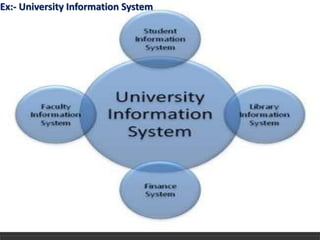
Ex:- University Information System
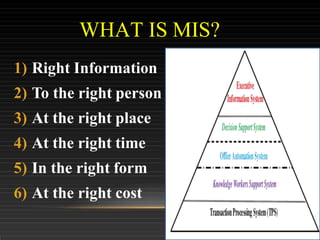
WHAT IS MIS?
1) Right Information
2) To the right person
3) At the right place
4) At the right time
5) In the right form
6) At the right cost
Characteristics of a Management
Information System
1) Provides reports with fixed and standard
formats - Hard-copy and soft-copy reports
2) Uses internal data stored in the computer
system
3) End users can develop custom reports
4) Requires formal requests from users
THE MIS DEFINITION
1) The MIS is defined as an integrated
system of man and machine for
providing the information to support the
operations, the management and the
decision making function in the
organization.
2) The MIS is defined as a system based on the
database of the organization evolved for the
purpose of providing information to the
people in the organization.
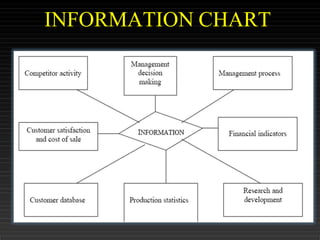
INFORMATION CHART
VARIOUS TYPES OF MIS

Transaction Processing Systems (TPS) : Management
information systems (MIS), per se, produce fixed,
regularly scheduled reports based on data extracted and
summarized from the firm’s underlying transaction
processing systems to middle and operational level
managers to identify and inform structured and semi-
structured decision problems.

Decision support systems (DSS) are computer program
applications used by middle management to compile
information from a wide range of sources to support
problem solving and decision making.
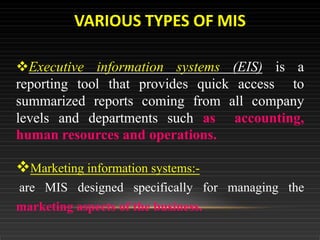
Executive information systems (EIS) is a
reporting tool that provides quick access to
summarized reports coming from all company
levels and departments such as accounting,
human resources and operations.
Marketing information systems:-
are MIS designed specifically for managing the
marketing aspects of the business.
VARIOUS TYPES OF MIS
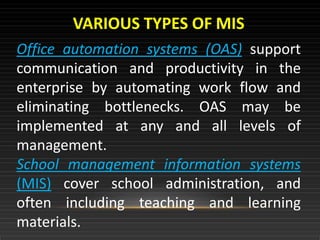
Office automation systems (OAS) support
communication and productivity in the
enterprise by automating work flow and
eliminating bottlenecks. OAS may be
implemented at any and all levels of
management.
School management information systems
(MIS) cover school administration, and
often including teaching and learning
materials.
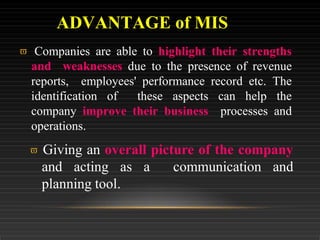
 Companies are able to highlight their strengths
and weaknesses due to the presence of revenue
reports, employees' performance record etc. The
identification of these aspects can help the
company improve their business processes and
operations.
 Giving an overall picture of the company
and acting as a communication and
planning tool.
ADVANTAGE of MIS
 The availability of the customer data and
feedback can help the company to align their
business processes according to the needs of
the customers. The effective management of
customer data can help the company to
perform direct marketing and promotion
activities.
 Information is considered to be an important
asset for any company in the modern
competitive world. The consumer buying
trends and behaviours can be predicted by
the analysis of sales and revenue reports from
each operating region of the company.
ADVANTAGE of MIS
CONCLUSION
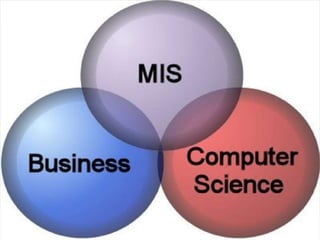
MIS differ from regular information systems
because the primary objectives of these
systems are to analyze other systems
dealing with the operational activities in the
organization. In this way, MIS is a subset of
the overall planning and control activities
covering the application of humans,
technologies, and procedures of the
organization
CONCLUSION
Within the field of scientific management, MIS is
most often tailored to the automation or support
of human decision making. As organizations
grow, MIS allows information to move between
functional areas and departments instantly,
reducing the need for face-to- face
communications among employees, thus
increasing the responsiveness of the organization.

1. management information system pgp1

  • 1.
    MANAGEMENT INFORMATION SYSTEM (MIS) Professor,Entrepreneur & Lawyer. Puttu Guru Prasad, M.Com. M.B.A., L.L.B., M.Phil. PGDFTM. AP.SET., ICFAI TMF., (PhD) at JNTUK. Senior Faculty for Management Science, VVIT-Nambur My Blog: puttuguru.blogspot.in 93 94 96 98 98, 807 444 95 39,
  • 2.
    Dipping the Achillesin STYX Professor, Entrepreneur & Lawyer. Puttu Guru Prasad, M.Com. M.B.A., L.L.B., M.Phil. PGDFTM. AP.SET., ICFAI TMF., (PhD) at JNTUK. Senior Faculty for Management Science, VVIT-Nambur My Blog: puttuguru.blogspot.in 93 94 96 98 98, 807 444 95 39,
  • 5.
    INTRODUCTION Management Information System(MIS) provides information for the managerial activities in an organization. The main purpose of MIS is, provides accurate and timely information necessary to facilitate the decision-making process and enable the organizations planning, control, and operational functions to be carried out effectively. Management Information System (MIS) is basically concerned with processing data into information and is then communicated to the various Departments in an organization for appropriate decision-making.
  • 6.
  • 7.
    WHAT IS MIS? 1)Right Information 2) To the right person 3) At the right place 4) At the right time 5) In the right form 6) At the right cost
  • 8.
    Characteristics of aManagement Information System 1) Provides reports with fixed and standard formats - Hard-copy and soft-copy reports 2) Uses internal data stored in the computer system 3) End users can develop custom reports 4) Requires formal requests from users
  • 9.
    THE MIS DEFINITION 1)The MIS is defined as an integrated system of man and machine for providing the information to support the operations, the management and the decision making function in the organization. 2) The MIS is defined as a system based on the database of the organization evolved for the purpose of providing information to the people in the organization.
  • 10.
  • 11.
    VARIOUS TYPES OFMIS  Transaction Processing Systems (TPS) : Management information systems (MIS), per se, produce fixed, regularly scheduled reports based on data extracted and summarized from the firm’s underlying transaction processing systems to middle and operational level managers to identify and inform structured and semi- structured decision problems.  Decision support systems (DSS) are computer program applications used by middle management to compile information from a wide range of sources to support problem solving and decision making.
  • 12.
    Executive information systems(EIS) is a reporting tool that provides quick access to summarized reports coming from all company levels and departments such as accounting, human resources and operations. Marketing information systems:- are MIS designed specifically for managing the marketing aspects of the business. VARIOUS TYPES OF MIS
  • 13.
    VARIOUS TYPES OFMIS Office automation systems (OAS) support communication and productivity in the enterprise by automating work flow and eliminating bottlenecks. OAS may be implemented at any and all levels of management. School management information systems (MIS) cover school administration, and often including teaching and learning materials.
  • 15.
     Companies areable to highlight their strengths and weaknesses due to the presence of revenue reports, employees' performance record etc. The identification of these aspects can help the company improve their business processes and operations.  Giving an overall picture of the company and acting as a communication and planning tool. ADVANTAGE of MIS
  • 16.
     The availabilityof the customer data and feedback can help the company to align their business processes according to the needs of the customers. The effective management of customer data can help the company to perform direct marketing and promotion activities.  Information is considered to be an important asset for any company in the modern competitive world. The consumer buying trends and behaviours can be predicted by the analysis of sales and revenue reports from each operating region of the company. ADVANTAGE of MIS
  • 18.
    CONCLUSION MIS differ fromregular information systems because the primary objectives of these systems are to analyze other systems dealing with the operational activities in the organization. In this way, MIS is a subset of the overall planning and control activities covering the application of humans, technologies, and procedures of the organization
  • 19.
    CONCLUSION Within the fieldof scientific management, MIS is most often tailored to the automation or support of human decision making. As organizations grow, MIS allows information to move between functional areas and departments instantly, reducing the need for face-to- face communications among employees, thus increasing the responsiveness of the organization.