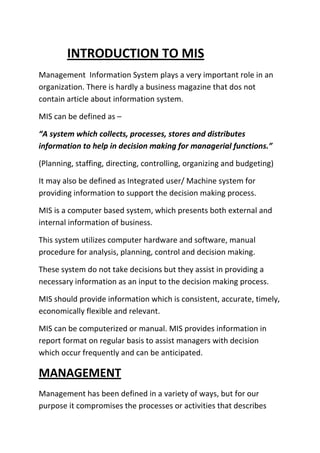
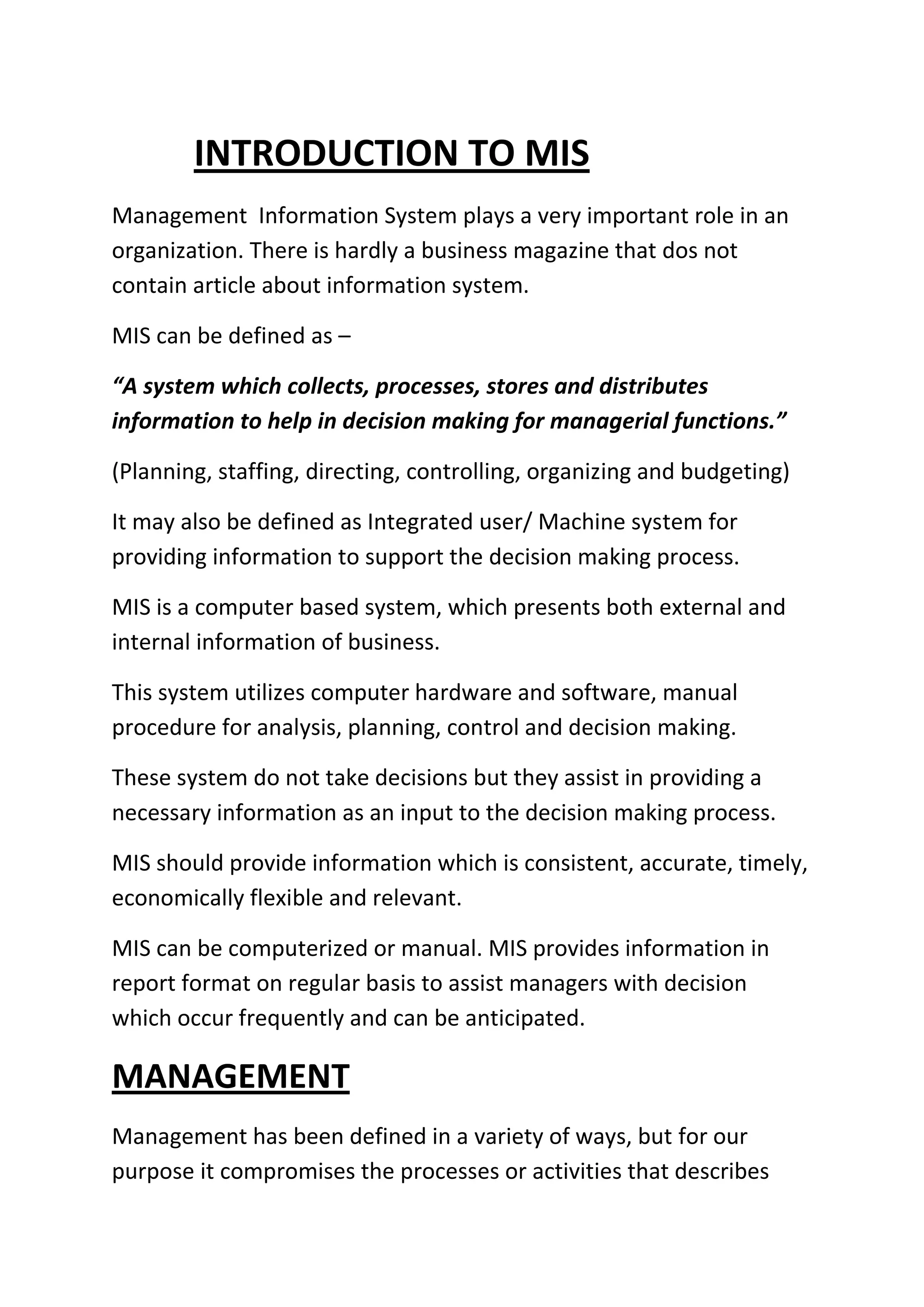
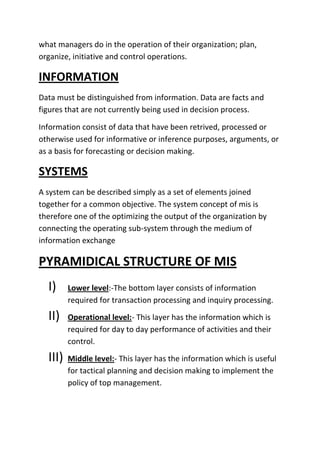
INTRODUCTION TO MIS<br />Management  Information System plays a very important role in an organization. There is hardly a business magazine that dos not contain article about information system.<br />MIS can be defined as –<br />“A system which collects, processes, stores and distributes information to help in decision making for managerial functions.”<br />(Planning, staffing, directing, controlling, organizing and budgeting)<br />It may also be defined as Integrated user/ Machine system for providing information to support the decision making process.<br />MIS is a computer based system, which presents both external and internal information of business.<br />This system utilizes computer hardware and software, manual procedure for analysis, planning, control and decision making.<br />These system do not take decisions but they assist in providing a necessary information as an input to the decision making process.<br />MIS should provide information which is consistent, accurate, timely, economically flexible and relevant.<br />MIS can be computerized or manual. MIS provides information in report format on regular basis to assist managers with decision which occur frequently and can be anticipated.<br />MANAGEMENT<br />Management has been defined in a variety of ways, but for our purpose it compromises the processes or activities that describes what managers do in the operation of their organization; plan, organize, initiative and control operations.<br />INFORMATION<br />Data must be distinguished from information. Data are facts and figures that are not currently being used in decision process.<br />Information consist of data that have been retrived, processed or otherwise used for informative or inference purposes, arguments, or as a basis for forecasting or decision making.<br />SYSTEMS<br />A system can be described simply as a set of elements joined together for a common objective. The system concept of mis is therefore one of the optimizing the output of the organization by connecting the operating sub-system through the medium of information exchange<br />PYRAMIDICAL STRUCTURE OF MIS<br />Lower level:-The bottom layer consists of information required for transaction processing and inquiry processing.
Operational level:- This layer has the information which is required for day to day performance of activities and their control.
Middle level:- This layer has the information which is useful for tactical planning and decision making to implement the policy of top management.
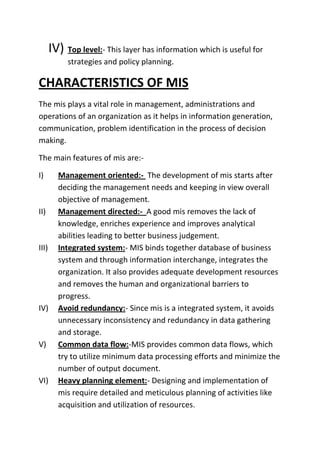
Top level:- This layer has information which is useful for strategies and policy planning.CHARACTERISTICS OF MIS<br />The mis plays a vital role in management, administrations and operations of an organization as it helps in information generation, communication, problem identification in the process of decision making.<br />The main features of mis are:-<br />Management oriented:-  The development of mis starts after deciding the management needs and keeping in view overall objective of management.
Management directed:-  A good mis removes the lack of knowledge, enriches experience and improves analytical abilities leading to better business judgement.
Integrated system:- MIS binds together database of business system and through information interchange, integrates the organization. It also provides adequate development resources and removes the human and organizational barriers to progress.
Avoid redundancy:- Since mis is a integrated system, it avoids unnecessary inconsistency and redundancy in data gathering and storage.
Common data flow:-MIS provides common data flows, which try to utilize minimum data processing efforts and minimize the number of output document.
Heavy planning element:- Designing and implementation of mis require detailed and meticulous planning of activities like acquisition and utilization of resources.
Common database:- MIS acts as a master that holds the functional sub-system together. It achieves this aim by allowing access to different master files of data to several functional sub-systems.
Flexibility:- MIS design should be flexible so as to provide alternate ways of processing data and system should be easy to operate so that not much of computers skills are required.
Computerization:- MIS can be computerized because of its nature. This provide speed, accuracy and consistency in creating and access of files.
Relevance:- MIS should deal only with operation and control of relevant information.
Support to top management:- MIS cannot be effective unless they receive the full support of top management. For this, top management should be educated about cost and benefits of mis.
Periodic evaluation:- The last feature of mis is that the system should be evaluated at periodic intervals to ensure that mis is achieving the objective of which this has been installed.COMPONENTS OF MIS<br />Management information system refers to the data, equipment and computers program that are used to develop information for managerial use. The MIS consists of following components which are as follows-<br />People:- People is only living component of mis which operates and controls the other components of mis. They enter, analyze and diagnose data, so that useful information is produced and provided to top executives for decision making.
Data process:- Data process uses different procedures, so that data can be properly analyzed and effective information is generated. Procedures explain people how to operate the computer hardware, what program to run, what data to use and what to do with the results.
Data communication:- There are different ways for communication of data. It may be informed orally or in the form of written report. Written forms are more appropriate than oral ones as it is permanent and systematic way of organizing information.
Information:- Data are facts and figures that are not currently being used in decision process. Data is process by applying different procedures to obtain information. It may be recorded into computer, storage media or manual files and is retrived whenever required.
System planning:- We have achieved a very high degree of automation and combination sub-system in scientific, mechanical and factory manufacturing operation. The system concept of mis is therefore of optimizing the output of the organization by connecting the operation sub-system, through the medium of information exchange.
Hardware and Software:- The hardware generally consists of computer equipments, on the other hand software consists of programs or instructions given to the computer such as pay roll processing, invoices etc.FUNCTIONS OF MIS<br />A MIS is used to collect data, store and process data and present information to managers.<br />Collect data:- Data can be obtained from source within and outside the organization. Internal sources such as records, reports and external sources such as publications, customers and consultancy.
Store and process data:- After creation of data, a database must be stored and processed in a form useful to managers. The data can be loaded into computers for easy access by user.
Present information to users:- After collection of data, storing and processing of data, the next step is to present the information to managers for their use.USES/BENEFITS/ROLE OF MIS<br />MIS ensures that appropriate and relevant data is collected from various sources, processed and is sent further to needy destination.
It fulfills the needs of individual, group, management.
Mis helps in strategic planning, management control, operational control and transaction processing system.
Mis plays an important role in information generation, communication, problem identification and decision making administration.
With good mis support marketing, finance, production and personnel functions increases efficiency.
Mis creates structured database and therefore saves time.
Mis brings clarity in communication and understanding, thus helps in bringing degree of professionalism.INFORMATION<br />We breathe information, eat information, drink information, wake up with information, sleep with information etc. So information is as life blood of any organization, without information survival of any organization is not possible.<br />Information means “processing of data or analyses of data in a specific context to get required information”. It is a basis of decision making. The decision taken on basis of complete and accurate information is less risky.<br />The value of perfect information is calculated by finding out the difference between the optimal policy with and without perfect information.<br />Characteristics of an information<br />Accuracy:- accuracy means that information is free from mistakes and error and it accurately and clearly reflects the meaning of data from which it is derived. It conveys the accurate picture to receiver and is free from biasness.
Timeliness :- information must be delivered at the right time and the right place to the right person otherwise information would be of little value to the organization. hence, making information available to the receiver within time is very crucial for every organization.

Mis notes

  • 1.
    INTRODUCTION TO MIS<br />Management Information System plays a very important role in an organization. There is hardly a business magazine that dos not contain article about information system.<br />MIS can be defined as –<br />“A system which collects, processes, stores and distributes information to help in decision making for managerial functions.”<br />(Planning, staffing, directing, controlling, organizing and budgeting)<br />It may also be defined as Integrated user/ Machine system for providing information to support the decision making process.<br />MIS is a computer based system, which presents both external and internal information of business.<br />This system utilizes computer hardware and software, manual procedure for analysis, planning, control and decision making.<br />These system do not take decisions but they assist in providing a necessary information as an input to the decision making process.<br />MIS should provide information which is consistent, accurate, timely, economically flexible and relevant.<br />MIS can be computerized or manual. MIS provides information in report format on regular basis to assist managers with decision which occur frequently and can be anticipated.<br />MANAGEMENT<br />Management has been defined in a variety of ways, but for our purpose it compromises the processes or activities that describes what managers do in the operation of their organization; plan, organize, initiative and control operations.<br />INFORMATION<br />Data must be distinguished from information. Data are facts and figures that are not currently being used in decision process.<br />Information consist of data that have been retrived, processed or otherwise used for informative or inference purposes, arguments, or as a basis for forecasting or decision making.<br />SYSTEMS<br />A system can be described simply as a set of elements joined together for a common objective. The system concept of mis is therefore one of the optimizing the output of the organization by connecting the operating sub-system through the medium of information exchange<br />PYRAMIDICAL STRUCTURE OF MIS<br />Lower level:-The bottom layer consists of information required for transaction processing and inquiry processing.
  • 2.
    Operational level:- Thislayer has the information which is required for day to day performance of activities and their control.
  • 3.
    Middle level:- Thislayer has the information which is useful for tactical planning and decision making to implement the policy of top management.
  • 4.
    Top level:- Thislayer has information which is useful for strategies and policy planning.CHARACTERISTICS OF MIS<br />The mis plays a vital role in management, administrations and operations of an organization as it helps in information generation, communication, problem identification in the process of decision making.<br />The main features of mis are:-<br />Management oriented:- The development of mis starts after deciding the management needs and keeping in view overall objective of management.
  • 5.
    Management directed:- A good mis removes the lack of knowledge, enriches experience and improves analytical abilities leading to better business judgement.
  • 6.
    Integrated system:- MISbinds together database of business system and through information interchange, integrates the organization. It also provides adequate development resources and removes the human and organizational barriers to progress.
  • 7.
    Avoid redundancy:- Sincemis is a integrated system, it avoids unnecessary inconsistency and redundancy in data gathering and storage.
  • 8.
    Common data flow:-MISprovides common data flows, which try to utilize minimum data processing efforts and minimize the number of output document.
  • 9.
    Heavy planning element:-Designing and implementation of mis require detailed and meticulous planning of activities like acquisition and utilization of resources.
  • 10.
    Common database:- MISacts as a master that holds the functional sub-system together. It achieves this aim by allowing access to different master files of data to several functional sub-systems.
  • 11.
    Flexibility:- MIS designshould be flexible so as to provide alternate ways of processing data and system should be easy to operate so that not much of computers skills are required.
  • 12.
    Computerization:- MIS canbe computerized because of its nature. This provide speed, accuracy and consistency in creating and access of files.
  • 13.
    Relevance:- MIS shoulddeal only with operation and control of relevant information.
  • 14.
    Support to topmanagement:- MIS cannot be effective unless they receive the full support of top management. For this, top management should be educated about cost and benefits of mis.
  • 15.
    Periodic evaluation:- Thelast feature of mis is that the system should be evaluated at periodic intervals to ensure that mis is achieving the objective of which this has been installed.COMPONENTS OF MIS<br />Management information system refers to the data, equipment and computers program that are used to develop information for managerial use. The MIS consists of following components which are as follows-<br />People:- People is only living component of mis which operates and controls the other components of mis. They enter, analyze and diagnose data, so that useful information is produced and provided to top executives for decision making.
  • 16.
    Data process:- Dataprocess uses different procedures, so that data can be properly analyzed and effective information is generated. Procedures explain people how to operate the computer hardware, what program to run, what data to use and what to do with the results.
  • 17.
    Data communication:- Thereare different ways for communication of data. It may be informed orally or in the form of written report. Written forms are more appropriate than oral ones as it is permanent and systematic way of organizing information.
  • 18.
    Information:- Data arefacts and figures that are not currently being used in decision process. Data is process by applying different procedures to obtain information. It may be recorded into computer, storage media or manual files and is retrived whenever required.
  • 19.
    System planning:- Wehave achieved a very high degree of automation and combination sub-system in scientific, mechanical and factory manufacturing operation. The system concept of mis is therefore of optimizing the output of the organization by connecting the operation sub-system, through the medium of information exchange.
  • 20.
    Hardware and Software:-The hardware generally consists of computer equipments, on the other hand software consists of programs or instructions given to the computer such as pay roll processing, invoices etc.FUNCTIONS OF MIS<br />A MIS is used to collect data, store and process data and present information to managers.<br />Collect data:- Data can be obtained from source within and outside the organization. Internal sources such as records, reports and external sources such as publications, customers and consultancy.
  • 21.
    Store and processdata:- After creation of data, a database must be stored and processed in a form useful to managers. The data can be loaded into computers for easy access by user.
  • 22.
    Present information tousers:- After collection of data, storing and processing of data, the next step is to present the information to managers for their use.USES/BENEFITS/ROLE OF MIS<br />MIS ensures that appropriate and relevant data is collected from various sources, processed and is sent further to needy destination.
  • 23.
    It fulfills theneeds of individual, group, management.
  • 24.
    Mis helps instrategic planning, management control, operational control and transaction processing system.
  • 25.
    Mis plays animportant role in information generation, communication, problem identification and decision making administration.
  • 26.
    With good missupport marketing, finance, production and personnel functions increases efficiency.
  • 27.
    Mis creates structureddatabase and therefore saves time.
  • 28.
    Mis brings clarityin communication and understanding, thus helps in bringing degree of professionalism.INFORMATION<br />We breathe information, eat information, drink information, wake up with information, sleep with information etc. So information is as life blood of any organization, without information survival of any organization is not possible.<br />Information means “processing of data or analyses of data in a specific context to get required information”. It is a basis of decision making. The decision taken on basis of complete and accurate information is less risky.<br />The value of perfect information is calculated by finding out the difference between the optimal policy with and without perfect information.<br />Characteristics of an information<br />Accuracy:- accuracy means that information is free from mistakes and error and it accurately and clearly reflects the meaning of data from which it is derived. It conveys the accurate picture to receiver and is free from biasness.
  • 29.
    Timeliness :- informationmust be delivered at the right time and the right place to the right person otherwise information would be of little value to the organization. hence, making information available to the receiver within time is very crucial for every organization.