Management  Information System  (MIS)Presented By:Pinaki BasuMIS By Pinaki Basu
What is MIS ???MIS or Management Information System would be defined as : A computer based system.
Flexible and speedy access to accurate data.
 Suited for :
Personal
Professional
Organisational
National
Global  Information SystemMIS By Pinaki Basu
Why the name MIS ?Management :	emphasizing the ultimate use of such information systems for managerial decision making rather than merely stressing on technology.Information :highlighting on processed data rather than raw data and in the context in which it is used by managers and other end user.System :		emphasizing a fair degree of integration and a holistic view.MIS By Pinaki Basu
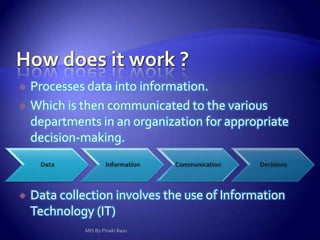
How does it work ?Processes data into information.Which is then communicated to the various departments in an organization for appropriate decision-making.Data collection involves the use of Information Technology (IT)MIS By Pinaki Basu
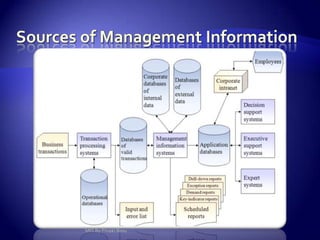
Sources of Management InformationMIS By Pinaki Basu
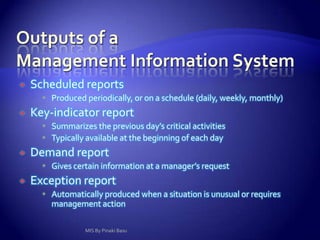
Outputs of a Management Information SystemScheduled reportsProduced periodically, or on a schedule (daily, weekly, monthly)Key-indicator reportSummarizes the previous day’s critical activitiesTypically available at the beginning of each dayDemand reportGives certain information at a manager’s requestException reportAutomatically produced when a situation is unusual or requires management actionMIS By Pinaki Basu
Characteristics of a Management Information SystemSystem  ApproachManagement  OrientedNeed  BasedException BasedMIS By Pinaki Basu
Characteristics of a Management Information SystemFuture  OrientedSub  System  ConceptCentral DatabaseLong  Term  PlanningMIS By Pinaki Basu
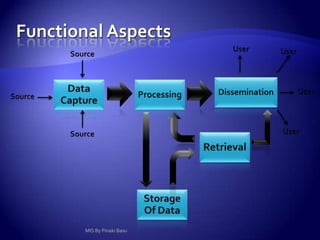
ProcessingFunctional AspectsUserUserSourceUserSourceUserSourceMIS By Pinaki Basu
AdvantageEffective and efficient coordination between departments.Quick and reliable referencing.Access to relevant data and documents.Use of less labour.MIS By Pinaki Basu
Cont...Improvement in organizational and departmental techniques.Management of day-to-day activities.Closer contact with the rest of the world.MIS By Pinaki Basu
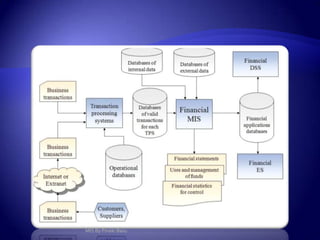
Financial MISProvides financial information to all financial managers within an organization.MIS By Pinaki Basu
MIS By Pinaki Basu
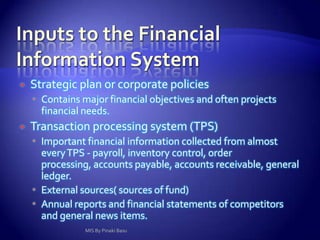
Inputs to the Financial Information SystemStrategic plan or corporate policiesContains major financial objectives and often projects financial needs.Transaction processing system (TPS)Important financial information collected from almost every TPS - payroll, inventory control, order processing, accounts payable, accounts receivable, general ledger.External sources( sources of fund)Annual reports and financial statements of competitors and general news items.MIS By Pinaki Basu
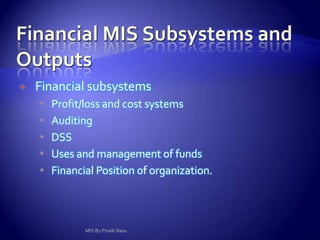
Financial MIS Subsystems and OutputsFinancial subsystemsProfit/loss and cost systemsAuditingDSSUses and management of fundsFinancial Position of organization.MIS By Pinaki Basu
Manufacturing MISConcerned with all production, manufacturing and operation related information.MIS By Pinaki Basu
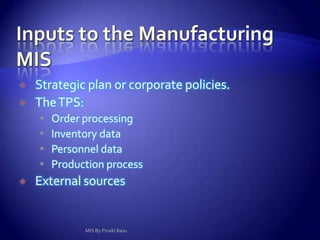
Inputs to the Manufacturing MISStrategic plan or corporate policies.The TPS:Order processingInventory dataPersonnel dataProduction processExternal sourcesMIS By Pinaki Basu
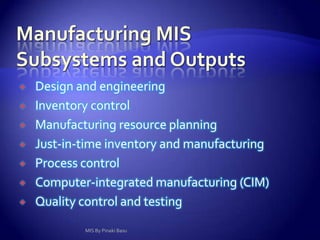
Manufacturing MIS Subsystems and OutputsDesign and engineeringInventory controlManufacturing resource planningJust-in-time inventory and manufacturingProcess controlComputer-integrated manufacturing (CIM)Quality control and testingMIS By Pinaki Basu
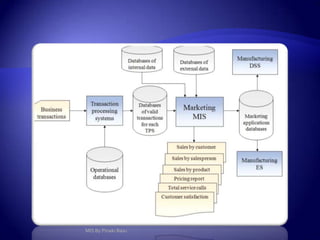
Marketing MISSupports managerial activities in product development, distribution, pricing decisions, and promotional effectivenessMIS By Pinaki Basu
MIS By Pinaki Basu
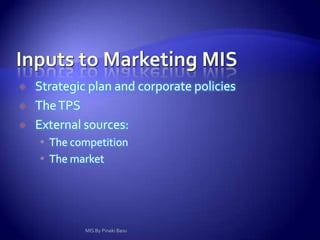
Inputs to Marketing MISStrategic plan and corporate policiesThe TPSExternal sources: The competitionThe marketMIS By Pinaki Basu
Marketing MIS Subsystems and OutputsMarketing researchProduct developmentPromotion and advertisingProduct pricingMIS By Pinaki Basu

Management Information System

  • 1.
    Management InformationSystem (MIS)Presented By:Pinaki BasuMIS By Pinaki Basu
  • 2.
    What is MIS???MIS or Management Information System would be defined as : A computer based system.
  • 3.
    Flexible and speedyaccess to accurate data.
  • 4.
  • 5.
  • 6.
  • 7.
  • 8.
  • 9.
    Global InformationSystemMIS By Pinaki Basu
  • 10.
    Why the nameMIS ?Management : emphasizing the ultimate use of such information systems for managerial decision making rather than merely stressing on technology.Information :highlighting on processed data rather than raw data and in the context in which it is used by managers and other end user.System : emphasizing a fair degree of integration and a holistic view.MIS By Pinaki Basu
  • 11.
    How does itwork ?Processes data into information.Which is then communicated to the various departments in an organization for appropriate decision-making.Data collection involves the use of Information Technology (IT)MIS By Pinaki Basu
  • 12.
    Sources of ManagementInformationMIS By Pinaki Basu
  • 13.
    Outputs of aManagement Information SystemScheduled reportsProduced periodically, or on a schedule (daily, weekly, monthly)Key-indicator reportSummarizes the previous day’s critical activitiesTypically available at the beginning of each dayDemand reportGives certain information at a manager’s requestException reportAutomatically produced when a situation is unusual or requires management actionMIS By Pinaki Basu
  • 14.
    Characteristics of aManagement Information SystemSystem ApproachManagement OrientedNeed BasedException BasedMIS By Pinaki Basu
  • 15.
    Characteristics of aManagement Information SystemFuture OrientedSub System ConceptCentral DatabaseLong Term PlanningMIS By Pinaki Basu
  • 16.
  • 17.
    AdvantageEffective and efficientcoordination between departments.Quick and reliable referencing.Access to relevant data and documents.Use of less labour.MIS By Pinaki Basu
  • 18.
    Cont...Improvement in organizationaland departmental techniques.Management of day-to-day activities.Closer contact with the rest of the world.MIS By Pinaki Basu
  • 19.
    Financial MISProvides financialinformation to all financial managers within an organization.MIS By Pinaki Basu
  • 20.
  • 21.
    Inputs to theFinancial Information SystemStrategic plan or corporate policiesContains major financial objectives and often projects financial needs.Transaction processing system (TPS)Important financial information collected from almost every TPS - payroll, inventory control, order processing, accounts payable, accounts receivable, general ledger.External sources( sources of fund)Annual reports and financial statements of competitors and general news items.MIS By Pinaki Basu
  • 22.
    Financial MIS Subsystemsand OutputsFinancial subsystemsProfit/loss and cost systemsAuditingDSSUses and management of fundsFinancial Position of organization.MIS By Pinaki Basu
  • 23.
    Manufacturing MISConcerned withall production, manufacturing and operation related information.MIS By Pinaki Basu
  • 24.
    Inputs to theManufacturing MISStrategic plan or corporate policies.The TPS:Order processingInventory dataPersonnel dataProduction processExternal sourcesMIS By Pinaki Basu
  • 25.
    Manufacturing MIS Subsystemsand OutputsDesign and engineeringInventory controlManufacturing resource planningJust-in-time inventory and manufacturingProcess controlComputer-integrated manufacturing (CIM)Quality control and testingMIS By Pinaki Basu
  • 26.
    Marketing MISSupports managerialactivities in product development, distribution, pricing decisions, and promotional effectivenessMIS By Pinaki Basu
  • 27.
  • 28.
    Inputs to MarketingMISStrategic plan and corporate policiesThe TPSExternal sources: The competitionThe marketMIS By Pinaki Basu
  • 29.
    Marketing MIS Subsystemsand OutputsMarketing researchProduct developmentPromotion and advertisingProduct pricingMIS By Pinaki Basu