STATISTICAL THINGING &
ANALYSIS
Statistical thinking will one day be as
necessary for efficient citizenship as
the ability to read and write
….. H. G. Wells
Statistical thinking can be defined as the
thought process that focuses on way
to identify, control, and reduce
variations present in all phenomenon
ORIGIN OF STATISTICS
The word „Statistics‟ seems to have
been derived from the Latin word
„STATUS‟ or the Italian word „statista‟
or the German word „statistik‟ each of
which means a „political state‟.
Sir Ronald A Fisher (1890-1962)
is Ihe father of Statistics
 “The mathematics of the collection,
organization, and interpretation of numerical
data, especially the analysis of population
characteristics by inference from sampling.”
 Statisticians collect and analyze data, then
calculate results using a specific design. They
draw conclusions and make decisions in the
face of uncertainty.
What Is Statistics?
STATISTICS
DEFINITION AND MEANING
Statistics may be defined as a science of
collection, presentation, analysis and
interpretation of numerical data.
This definition includes four terms:
1. Collection of data
2. Presentation of data
3. Analysis of data and
4. Interpretation of data
“The science of Statistics is the method of
judging collective, natural or social
phenomenon from the results obtained from
the analysis or enumeration or collection of
estimates”
…….. king
“Statistics is the science which deals
with collection, classification and
tabulation of numerical facts as the
basis for explanation, description and
comparison of phenomenon”
….. Lovitt
Types of Statistical Methods
Statistical methods, fall into the following two categories:
Descriptive statistics
Inferential statistics
Descriptive statistics
 descriptive statistics deals with collecting,
summarizing, and simplifying data, which are otherwise
quite unwieldy and voluminous. It seeks to achieve this
in a manner that meaningful conclusions can be readily
drawn from the data. Descriptive statistics may thus be
seen as comprising methods of bringing out and
highlighting the latent characteristics present in a set of
numerical data. It not only facilitates an understanding of
the data and systematic reporting thereof in a manner;
and also makes them amenable to further discussion,
analysis, and interpretations.
Inferential statistics
 Inferential statistics, also known as inductive
statistics, goes beyond describing a given problem
situation by means of collecting, summarizing, and
meaningfully presenting the related data. Instead, it
consists of methods that are used for drawing
inferences, or making broad generalizations, about a
totality of observations on the basis of knowledge about
a part of that totality. The totality of observations about
which an inference may be drawn, or a generalization
made, is called a population or a universe. The part of
totality, which is observed for data collection and
analysis to gain knowledge about the population, is
called a sample.
STATISTICS IN BUSINESS AND
MANAGEMENT
With the growing size and ever-increasing
competition, the problems of business
enterprise are becoming complex. And it
has become necessary for the executives
to rely more and more on elaborate
information system instead of their
intuition. And it is here that statistical data
and statistical methods play a very
significant role.
Some of the major areas of Business
Operations where Statistics have been
extensively and affectively used are as
follows:
 Production
 Marketing
 Purchasing
 Investment
 Banking
 Quality control
Environment
Agriculture,
Ecology, Forestry,
Animal Populations
Government
Census, Law,
National Defense
Physical
Sciences
Astronomy,
Chemistry, Physics
Areas where
STATISTICS
are used
Health &
Medicine
Genetics, Clinical Trials,
Epidemiology,
Pharmacology
Business
Economics, Engineering,
Marketing,
Computer Science
 Collecting data on subsets of the population
(samples) can give valid information about the
whole population.
 Knowing what has happened in the past can
help answer questions about the present and
future.
 Knowledge helps plan future tests,
determines resource allocation, and improves
quality.
Why Study Statistics?
 Study the safety of nuclear power plants
 Evaluate the environmental impact of pollution
 Determine the effectiveness of new drugs
 Estimate the India’s unemployment rate
 Analyze consumer demand for products
 Plan and analyze agricultural experiments
What We can do with the
help of Statistics?
 Manufacturing
 Build products and deliver
services that satisfy
consumers and increase the
corporation’s profit margin
Business and Industry
 Marketing
 Design experiments for new
products, conduct focus
groups and sample surveys,
and perform field experiments
in test markets to determine
product viability
Business and Industry
 Engineering
 Make a consistent product,
detect problems, minimize
waste, and predict product life
in electronics, chemicals,
aerospace, pollution control,
construction, and other
industries
Business and Industry
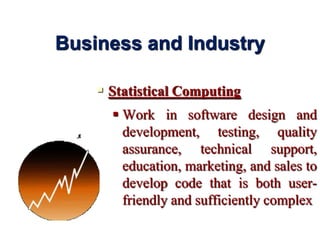
 Statistical Computing
 Work in software design and
development, testing, quality
assurance, technical support,
education, marketing, and sales to
develop code that is both user-
friendly and sufficiently complex
Business and Industry
 Epidemiology
 Work on calculating cancer
incidence rates, monitor
disease outbreaks, and
monitor changes in health-
related behaviors such as
smoking and physical activity
Health and Medicine
 Public Health
 Prevent disease, prolong life,
and promote health through
organized community efforts,
including sanitation, hygiene
education, diagnoses, and
preventative treatment
Health and Medicine
 Pharmacology
 Work in drug discovery,
development, approval, and
marketing, to ensure the
validity and accuracy of
findings at all stages of the
process
Health and Medicine
 Genetics
 Label possible indicators of
genetic abnormalities, such
as birth defects and early
aging, or breed desirable
characteristics in plant
offspring
Health and Medicine
 Education
 Teach K-12 through post-
graduate students, assess
teacher effectiveness, or
develop statistical models to
represent student learning
Learning
 Science Writing &
Journalism
 Work with mass media,
universities, and corporations to
produce news briefs, articles,
news releases, and other reports
Learning
 Government
 Work in regulations for stock
trading, pollution, and drug
approvals, or testify in court
proceedings, congressional
hearings, and lobbying
arguments
Research
 Survey Methods
 Collect data in the social
sciences, education, law,
forestry, agriculture,
biology, medicine,
business, and
e-commerce, and for the
government
Research
 Law
 Analyze data in court
cases, including DNA
evidence, salary
discrepancies, discrimination
law suits, and disease
clusters
Social Statistics
 Consulting
 Work on a temporary basis
on a variety of projects
including quality
improvement,
pharmaceuticals, ecology,
and engineering
Social Statistics
 Agriculture
 Study chemical pesticides,
hydrogeology, veterinary
sciences, genetics, and crop
management in order to
ensure optimal yield
Natural Resources
 Ecology
 Address questions about
the earth’s natural
environment, including
animal populations,
agricultural protections,
and fertilizer and pesticide
safety
Natural Resources
Skills
 Quantitative Skills
 Statistics, Mathematics, Science
 Problem Solving Skills
 Analysis, Teamwork
 Communication Skills
 Verbal, Written
 Computer Programming Languages
 Foundation in Field of Application
Opportunities
 Diversity
 Pure Research
 Interdisciplinary Teams
 Advancement
 Experience, education, and communication
skills lead to professional advancement
 Versatility
 Challenging and Exciting Fields of
Application

Basic statistics by Neeraj Bhandari ( Surkhet.Nepal )

  • 1.
    STATISTICAL THINGING & ANALYSIS Statisticalthinking will one day be as necessary for efficient citizenship as the ability to read and write ….. H. G. Wells Statistical thinking can be defined as the thought process that focuses on way to identify, control, and reduce variations present in all phenomenon
  • 2.
    ORIGIN OF STATISTICS Theword „Statistics‟ seems to have been derived from the Latin word „STATUS‟ or the Italian word „statista‟ or the German word „statistik‟ each of which means a „political state‟. Sir Ronald A Fisher (1890-1962) is Ihe father of Statistics
  • 3.
     “The mathematicsof the collection, organization, and interpretation of numerical data, especially the analysis of population characteristics by inference from sampling.”  Statisticians collect and analyze data, then calculate results using a specific design. They draw conclusions and make decisions in the face of uncertainty. What Is Statistics?
  • 4.
    STATISTICS DEFINITION AND MEANING Statisticsmay be defined as a science of collection, presentation, analysis and interpretation of numerical data. This definition includes four terms: 1. Collection of data 2. Presentation of data 3. Analysis of data and 4. Interpretation of data
  • 5.
    “The science ofStatistics is the method of judging collective, natural or social phenomenon from the results obtained from the analysis or enumeration or collection of estimates” …….. king “Statistics is the science which deals with collection, classification and tabulation of numerical facts as the basis for explanation, description and comparison of phenomenon” ….. Lovitt
  • 6.
    Types of StatisticalMethods Statistical methods, fall into the following two categories: Descriptive statistics Inferential statistics
  • 7.
    Descriptive statistics  descriptivestatistics deals with collecting, summarizing, and simplifying data, which are otherwise quite unwieldy and voluminous. It seeks to achieve this in a manner that meaningful conclusions can be readily drawn from the data. Descriptive statistics may thus be seen as comprising methods of bringing out and highlighting the latent characteristics present in a set of numerical data. It not only facilitates an understanding of the data and systematic reporting thereof in a manner; and also makes them amenable to further discussion, analysis, and interpretations.
  • 8.
    Inferential statistics  Inferentialstatistics, also known as inductive statistics, goes beyond describing a given problem situation by means of collecting, summarizing, and meaningfully presenting the related data. Instead, it consists of methods that are used for drawing inferences, or making broad generalizations, about a totality of observations on the basis of knowledge about a part of that totality. The totality of observations about which an inference may be drawn, or a generalization made, is called a population or a universe. The part of totality, which is observed for data collection and analysis to gain knowledge about the population, is called a sample.
  • 9.
    STATISTICS IN BUSINESSAND MANAGEMENT With the growing size and ever-increasing competition, the problems of business enterprise are becoming complex. And it has become necessary for the executives to rely more and more on elaborate information system instead of their intuition. And it is here that statistical data and statistical methods play a very significant role.
  • 10.
    Some of themajor areas of Business Operations where Statistics have been extensively and affectively used are as follows:  Production  Marketing  Purchasing  Investment  Banking  Quality control
  • 11.
    Environment Agriculture, Ecology, Forestry, Animal Populations Government Census,Law, National Defense Physical Sciences Astronomy, Chemistry, Physics Areas where STATISTICS are used Health & Medicine Genetics, Clinical Trials, Epidemiology, Pharmacology Business Economics, Engineering, Marketing, Computer Science
  • 12.
     Collecting dataon subsets of the population (samples) can give valid information about the whole population.  Knowing what has happened in the past can help answer questions about the present and future.  Knowledge helps plan future tests, determines resource allocation, and improves quality. Why Study Statistics?
  • 13.
     Study thesafety of nuclear power plants  Evaluate the environmental impact of pollution  Determine the effectiveness of new drugs  Estimate the India’s unemployment rate  Analyze consumer demand for products  Plan and analyze agricultural experiments What We can do with the help of Statistics?
  • 14.
     Manufacturing  Buildproducts and deliver services that satisfy consumers and increase the corporation’s profit margin Business and Industry
  • 15.
     Marketing  Designexperiments for new products, conduct focus groups and sample surveys, and perform field experiments in test markets to determine product viability Business and Industry
  • 16.
     Engineering  Makea consistent product, detect problems, minimize waste, and predict product life in electronics, chemicals, aerospace, pollution control, construction, and other industries Business and Industry
  • 17.
     Statistical Computing Work in software design and development, testing, quality assurance, technical support, education, marketing, and sales to develop code that is both user- friendly and sufficiently complex Business and Industry
  • 18.
     Epidemiology  Workon calculating cancer incidence rates, monitor disease outbreaks, and monitor changes in health- related behaviors such as smoking and physical activity Health and Medicine
  • 19.
     Public Health Prevent disease, prolong life, and promote health through organized community efforts, including sanitation, hygiene education, diagnoses, and preventative treatment Health and Medicine
  • 20.
     Pharmacology  Workin drug discovery, development, approval, and marketing, to ensure the validity and accuracy of findings at all stages of the process Health and Medicine
  • 21.
     Genetics  Labelpossible indicators of genetic abnormalities, such as birth defects and early aging, or breed desirable characteristics in plant offspring Health and Medicine
  • 22.
     Education  TeachK-12 through post- graduate students, assess teacher effectiveness, or develop statistical models to represent student learning Learning
  • 23.
     Science Writing& Journalism  Work with mass media, universities, and corporations to produce news briefs, articles, news releases, and other reports Learning
  • 24.
     Government  Workin regulations for stock trading, pollution, and drug approvals, or testify in court proceedings, congressional hearings, and lobbying arguments Research
  • 25.
     Survey Methods Collect data in the social sciences, education, law, forestry, agriculture, biology, medicine, business, and e-commerce, and for the government Research
  • 26.
     Law  Analyzedata in court cases, including DNA evidence, salary discrepancies, discrimination law suits, and disease clusters Social Statistics
  • 27.
     Consulting  Workon a temporary basis on a variety of projects including quality improvement, pharmaceuticals, ecology, and engineering Social Statistics
  • 28.
     Agriculture  Studychemical pesticides, hydrogeology, veterinary sciences, genetics, and crop management in order to ensure optimal yield Natural Resources
  • 29.
     Ecology  Addressquestions about the earth’s natural environment, including animal populations, agricultural protections, and fertilizer and pesticide safety Natural Resources
  • 30.
    Skills  Quantitative Skills Statistics, Mathematics, Science  Problem Solving Skills  Analysis, Teamwork  Communication Skills  Verbal, Written  Computer Programming Languages  Foundation in Field of Application
  • 31.
    Opportunities  Diversity  PureResearch  Interdisciplinary Teams  Advancement  Experience, education, and communication skills lead to professional advancement  Versatility  Challenging and Exciting Fields of Application