Pulmonary Tuberculosis Dave Jay S. Manriquez RN. February 1, 2009
Tuberculosis Most common infectious cause of death worldwide Latent phase of TB enabled it to spread to one third of the world population 8,000,000 new cases each year 3,000,000 infected patients die
Epidemiology Major changes in trends secondary to HIV - 1953-1985 cases decreased from 84,304 to 22,201 - during this period cases were reactivation of old infection and elderly - TB and AIDS registries suggests that HIV-infected pts account for 30-50% increase in cases of TB
Epidemiologic Pearl HIV infection is the greatest risk factor for reactivating latent tuberculosis infection In an HIV-infected tuberculin positive individual the risk of reactivating is 7-10%.
Incidence 1985-1990 TB cases increased 55% in Hispanics and 27% in African Americans Populations at risk - Foreign-born individuals - Low socioeconomic status - Cancer pts - Celiac disease - Cigarette smokers - TNF-a antagonists - Corticosteroids
Pathogenesis Inhalation and deposition of the tubercle bacillus leads to four possible outcomes: (1) Immediate clearance of the organism (2) Chronic or latent infection (3) Rapidly progressive disease (or primary disease) (4) Active disease many years after infection (reactivation disease)
Primary disease Tubercle bacilli establish infection in the lung after they are carried in droplets (5 to 10   m to reach the alveolar space Innate defense system unable to clear infection, bacilli proliferate in alveolar macrophages and kill the cells Infected macrophages produce cytokines and chemokines that attract other cells and form a tubercle Tubercle enlarges and bacilli enter lymph system
Reactivation of disease Reactivation results when persistent bacteria suddenly proliferate (unclear as to what mechanism maintain the latent state or trigger reactivation) Immunosuppressive conditions associated with reactivation of TB: - HIV/AIDS  - Lymphoma - ESRD - Corticosteroid use - DM
Pulmonary Tuberculosis Signs and Sx - fever - chest pain - pleuritic chest pain - fatigue - cough
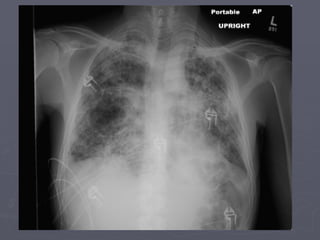
Pulmonary Tuberculosis Radiologic abnormalities - hilar adenopathy occurs in 65% of cases - can be seen 1 week to 2 months of skin test conversion
Complications  Hemoptysis - TB accounts for 5-15% of hemoptysis in US - more common in active TB cases - bleeding is usually small volume and rarely massive
Complications Bronchiectasis - may develop after primary or reactivation TB Pneumothorax - spontaneous was a dangerous complication prior to chemotherapy
Complications Extensive pulmonary destruction - rare - more typically presents in years of chronic reactivation TB in the absence of prolonged chemotherapy - symptoms include progressive dyspnea, hemoptysis and weight loss - pulmonary gangrene more acute destructive process
Treatment www.cdc.gov
TREATMENT OF TUBERCULOSIS, 2003 Division of Tuberculosis Elimination Centers for Disease Control and Prevention American Thoracic Society  Centers for Disease Control and Prevention Infectious Diseases Society of America
Isoniazid Rifampin Pyrazinamide Ethambutol Rifabutin* Rifapentine Antituberculosis Drugs Streptomycin Cycloserine p-Aminosalicylic acid Ethionamide Amikacin or kanamycin* Capreomycin Levofloxacin* Moxifloxacin* Gatifloxacin* First-Line Drugs Second-Line   Drugs * Not approved by the U.S. Food and Drug Administration for use in the treatment of TB
Role of New Drugs  Rifabutin :  For patients receiving medications having unacceptable interactions with rifampin (e.g., persons with HIV/AIDS) Rifapentine :  Used in once-weekly continuation phase for HIV-negative adults with drug-susceptible noncavitary TB and negative AFB smears at completion of initial phase of treatment
Role of New Drugs  Fluoroquinolones (Levofloxacin, Moxifloxacin, Gatifloxacin) :  Used when -first-line drugs not tolerated; -strains resistant to RIF, INH, or EMB; or -evidence of other resistance patterns with fluoroquinolone susceptibility
When to Consider Treatment Initiation  Positive AFB smear  Treatment should not be delayed because of negative AFB smears if high clinical suspicion: History of cough and weight loss Characteristic findings on chest x-ray Emmigration from a high-incidence country
Baseline Diagnostic Examinations for TB Chest x-ray Sputum specimens (= 3 obtained 8-24 hours apart) for AFB microscopy and mycobacterial cultures Routine drug-susceptibility testing for INH, RIF, and EMB on initial positive culture
Other Examinations to Conduct When TB Treatment Is Initiated  Counseling and testing for HIV infection CD4+ T-lymphocyte count for HIV-positive persons Hepatitis B and C serologic tests, if risks present
Other Examinations to Conduct When TB Treatment Is Initiated  Measurements of aspartate aminotransferase (AST), alanine aminotransferase (ALT), bilirubin, alkaline phosphatase, serum creatinine, and platelet count Visual acuity and color vision tests (when  EMB used)
Treatment Regimens  Four regimens recommended for treatment of culture-positive TB, with different options for dosing intervals in continuation phase Initial phase: standard four drug regimens (INH, RIF, PZA, EMB), for 2 months, (except one regimen that excludes PZA) Continuation phase: additional 4 months or (7 months for some patients)
Why Extend Continuation-Phase Treatment for 3 Months? Cavitary disease and positive sputum culture  at 2 months associated with increased relapse in clinical trials Extended continuation phase decreased relapses in silicotuberculosis (from 20% to 3%)
When to Extend Continuation-Phase Treatment for 3 Months?  Cavitary pulmonary disease and positive sputum cultures at completion of initial phase Initial phase excluded PZA Once-weekly INH and rifapentine started in  continuation phase and sputum specimen collected at the end of initial phase is culture positive HIV-infected with positive 2-month sputum culture
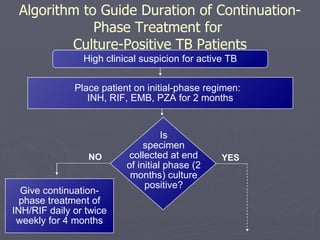
Is specimen collected at end of initial phase (2 months) culture positive? NO YES Place patient on initial-phase regimen:  INH, RIF, EMB, PZA for 2 months Give continuation-phase treatment of INH/RIF daily or twice weekly for 4 months Algorithm to Guide Duration of Continuation-Phase Treatment for  Culture-Positive TB Patients High clinical suspicion for active TB
Give continuation-phase treatment of INH/RIF daily or twice weekly for 7 months Give continuation- phase treatment of INH/RIF daily or twice weekly for  4 months  NO YES Was there cavitation on initial CXR? NO YES Is the patient HIV positive? Algorithm to Guide Duration of Continuation-Phase Treatment for Culture-Positive TB Patients  Give continuation- phase treatment of INH/RIF daily for  7 months
MDR vs. XDR TB MDR TB Multidrug-resistant TB (MDR TB) is TB that is resistant to at least two of the best anti-TB drugs, isoniazid and rifampin XDR TB Extensively drug-resistant tuberculosis (XDR TB) is a relatively rare type of multidrug-resistant tuberculosis (MDR TB). It is resistant to almost all drugs used to treat TB, including the two best first-line drugs: isoniazid and rifampin. XDR TB is also resistant to the best second-line medications: fluoroquinolones and at least one of three injectable drugs (i.e., amikacin, kanamycin, or capreomycin).
References www.uptodate.com www.cdc.gov

Pulmonary Tuberculosis

  • 1.
  • 2.
  • 3.
    Pulmonary Tuberculosis DaveJay S. Manriquez RN. February 1, 2009
  • 4.
    Tuberculosis Most commoninfectious cause of death worldwide Latent phase of TB enabled it to spread to one third of the world population 8,000,000 new cases each year 3,000,000 infected patients die
  • 5.
    Epidemiology Major changesin trends secondary to HIV - 1953-1985 cases decreased from 84,304 to 22,201 - during this period cases were reactivation of old infection and elderly - TB and AIDS registries suggests that HIV-infected pts account for 30-50% increase in cases of TB
  • 6.
    Epidemiologic Pearl HIVinfection is the greatest risk factor for reactivating latent tuberculosis infection In an HIV-infected tuberculin positive individual the risk of reactivating is 7-10%.
  • 7.
    Incidence 1985-1990 TBcases increased 55% in Hispanics and 27% in African Americans Populations at risk - Foreign-born individuals - Low socioeconomic status - Cancer pts - Celiac disease - Cigarette smokers - TNF-a antagonists - Corticosteroids
  • 8.
    Pathogenesis Inhalation anddeposition of the tubercle bacillus leads to four possible outcomes: (1) Immediate clearance of the organism (2) Chronic or latent infection (3) Rapidly progressive disease (or primary disease) (4) Active disease many years after infection (reactivation disease)
  • 9.
    Primary disease Tuberclebacilli establish infection in the lung after they are carried in droplets (5 to 10  m to reach the alveolar space Innate defense system unable to clear infection, bacilli proliferate in alveolar macrophages and kill the cells Infected macrophages produce cytokines and chemokines that attract other cells and form a tubercle Tubercle enlarges and bacilli enter lymph system
  • 10.
    Reactivation of diseaseReactivation results when persistent bacteria suddenly proliferate (unclear as to what mechanism maintain the latent state or trigger reactivation) Immunosuppressive conditions associated with reactivation of TB: - HIV/AIDS - Lymphoma - ESRD - Corticosteroid use - DM
  • 11.
    Pulmonary Tuberculosis Signsand Sx - fever - chest pain - pleuritic chest pain - fatigue - cough
  • 12.
    Pulmonary Tuberculosis Radiologicabnormalities - hilar adenopathy occurs in 65% of cases - can be seen 1 week to 2 months of skin test conversion
  • 13.
    Complications Hemoptysis- TB accounts for 5-15% of hemoptysis in US - more common in active TB cases - bleeding is usually small volume and rarely massive
  • 14.
    Complications Bronchiectasis -may develop after primary or reactivation TB Pneumothorax - spontaneous was a dangerous complication prior to chemotherapy
  • 15.
    Complications Extensive pulmonarydestruction - rare - more typically presents in years of chronic reactivation TB in the absence of prolonged chemotherapy - symptoms include progressive dyspnea, hemoptysis and weight loss - pulmonary gangrene more acute destructive process
  • 16.
  • 17.
    TREATMENT OF TUBERCULOSIS,2003 Division of Tuberculosis Elimination Centers for Disease Control and Prevention American Thoracic Society Centers for Disease Control and Prevention Infectious Diseases Society of America
  • 18.
    Isoniazid Rifampin PyrazinamideEthambutol Rifabutin* Rifapentine Antituberculosis Drugs Streptomycin Cycloserine p-Aminosalicylic acid Ethionamide Amikacin or kanamycin* Capreomycin Levofloxacin* Moxifloxacin* Gatifloxacin* First-Line Drugs Second-Line Drugs * Not approved by the U.S. Food and Drug Administration for use in the treatment of TB
  • 19.
    Role of NewDrugs Rifabutin : For patients receiving medications having unacceptable interactions with rifampin (e.g., persons with HIV/AIDS) Rifapentine : Used in once-weekly continuation phase for HIV-negative adults with drug-susceptible noncavitary TB and negative AFB smears at completion of initial phase of treatment
  • 20.
    Role of NewDrugs Fluoroquinolones (Levofloxacin, Moxifloxacin, Gatifloxacin) : Used when -first-line drugs not tolerated; -strains resistant to RIF, INH, or EMB; or -evidence of other resistance patterns with fluoroquinolone susceptibility
  • 21.
    When to ConsiderTreatment Initiation Positive AFB smear Treatment should not be delayed because of negative AFB smears if high clinical suspicion: History of cough and weight loss Characteristic findings on chest x-ray Emmigration from a high-incidence country
  • 22.
    Baseline Diagnostic Examinationsfor TB Chest x-ray Sputum specimens (= 3 obtained 8-24 hours apart) for AFB microscopy and mycobacterial cultures Routine drug-susceptibility testing for INH, RIF, and EMB on initial positive culture
  • 23.
    Other Examinations toConduct When TB Treatment Is Initiated Counseling and testing for HIV infection CD4+ T-lymphocyte count for HIV-positive persons Hepatitis B and C serologic tests, if risks present
  • 24.
    Other Examinations toConduct When TB Treatment Is Initiated Measurements of aspartate aminotransferase (AST), alanine aminotransferase (ALT), bilirubin, alkaline phosphatase, serum creatinine, and platelet count Visual acuity and color vision tests (when EMB used)
  • 25.
    Treatment Regimens Four regimens recommended for treatment of culture-positive TB, with different options for dosing intervals in continuation phase Initial phase: standard four drug regimens (INH, RIF, PZA, EMB), for 2 months, (except one regimen that excludes PZA) Continuation phase: additional 4 months or (7 months for some patients)
  • 26.
    Why Extend Continuation-PhaseTreatment for 3 Months? Cavitary disease and positive sputum culture at 2 months associated with increased relapse in clinical trials Extended continuation phase decreased relapses in silicotuberculosis (from 20% to 3%)
  • 27.
    When to ExtendContinuation-Phase Treatment for 3 Months? Cavitary pulmonary disease and positive sputum cultures at completion of initial phase Initial phase excluded PZA Once-weekly INH and rifapentine started in continuation phase and sputum specimen collected at the end of initial phase is culture positive HIV-infected with positive 2-month sputum culture
  • 28.
    Is specimen collectedat end of initial phase (2 months) culture positive? NO YES Place patient on initial-phase regimen: INH, RIF, EMB, PZA for 2 months Give continuation-phase treatment of INH/RIF daily or twice weekly for 4 months Algorithm to Guide Duration of Continuation-Phase Treatment for Culture-Positive TB Patients High clinical suspicion for active TB
  • 29.
    Give continuation-phase treatmentof INH/RIF daily or twice weekly for 7 months Give continuation- phase treatment of INH/RIF daily or twice weekly for 4 months NO YES Was there cavitation on initial CXR? NO YES Is the patient HIV positive? Algorithm to Guide Duration of Continuation-Phase Treatment for Culture-Positive TB Patients Give continuation- phase treatment of INH/RIF daily for 7 months
  • 30.
    MDR vs. XDRTB MDR TB Multidrug-resistant TB (MDR TB) is TB that is resistant to at least two of the best anti-TB drugs, isoniazid and rifampin XDR TB Extensively drug-resistant tuberculosis (XDR TB) is a relatively rare type of multidrug-resistant tuberculosis (MDR TB). It is resistant to almost all drugs used to treat TB, including the two best first-line drugs: isoniazid and rifampin. XDR TB is also resistant to the best second-line medications: fluoroquinolones and at least one of three injectable drugs (i.e., amikacin, kanamycin, or capreomycin).
  • 31.