Functional Neuroanatomy
Vivek Misra |B.Tech, M.S, MIANS
Research Fellow
The Institute of Neurological Sciences
VHS Multi-Specialty Hospital & Research Institute
Chennai. IN
vivek@ubrf.org | @iVivekMisra
http://www.ubrf.org
Overview
• A word about the funny names, and
a few definitions
• Anatomy versus Function: The
Triune Brain Hypothesis
• The Brainstem
• The Limbic System
• Cerebral Cortex
Vivek Misra
A word about the funny names…
 Early anatomists named most brain structures (in Latin,
for the most part) according to their similarity to
commonplace objects:
 amygdala = almond,
 hippocampus = sea horse,
 genu = knee,
 cortex = bark
 pons = bridge
Vivek Misra
A few definitions
Locations in the Brain
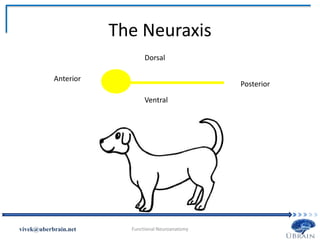
 Described relative to neuraxis - an imaginary line drawn
through the spinal cord up to the front of the brain
 The front end is anterior
 The back end is posterior
 The terms rostral (toward the head) and caudal
(toward the tail) are also used when referring to parts
of the brain
Vivek Misra
A few definitions
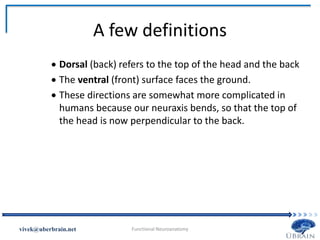
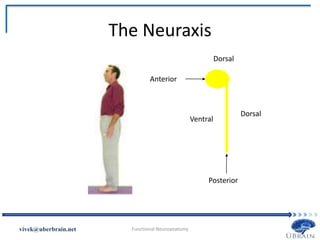
 Dorsal (back) refers to the top of the head and the back
 The ventral (front) surface faces the ground.
 These directions are somewhat more complicated in
humans because our neuraxis bends, so that the top of
the head is now perpendicular to the back.
Vivek Misra
The Neuraxis
Vivek Misra
Anterior
Posterior
Dorsal
Ventral
The Neuraxis
Vivek Misra
Anterior
Posterior
Dorsal
Dorsal
Ventral
A few definitions
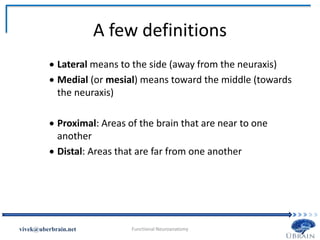
 Lateral means to the side (away from the neuraxis)
 Medial (or mesial) means toward the middle (towards
the neuraxis)
 Proximal: Areas of the brain that are near to one
another
 Distal: Areas that are far from one another
Vivek Misra
A few definitions
 Ipsilateral refers to structures on the same side of the
body
 E.g. the olfactory bulbs send ipsilateral connections to
the brain - the right bulb connects to the right
hemisphere, and the left bulb connects to the left
hemisphere
 Contralateral refers to structures on opposite sides of
the body
 E.g. the left motor strip connects to the right side of the
body
Vivek Misra
A few definitions
Slices of the brain
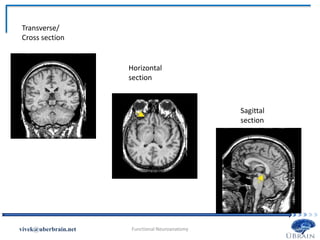
 Transversely, like a loaf of bread - also called frontal or
cross sections
 Parallel to the ground, giving us horizontal sections
 Perpendicular to the ground and parallel to the
neuraxis - sagittal section - midsagittal plane divides
the brain in half along the longitudinal fissure
 Because of our upright posture, cross sections of our
spinal cord are actually parallel to the ground
Vivek Misra
Vivek Misra
Transverse/
Cross section
Horizontal
section
Sagittal
section
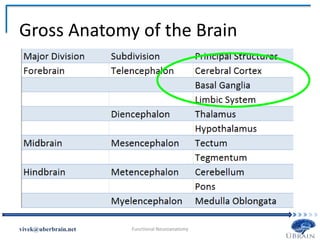
Gross Anatomy of the Brain
Vivek Misra
Gross Anatomy of the Brain
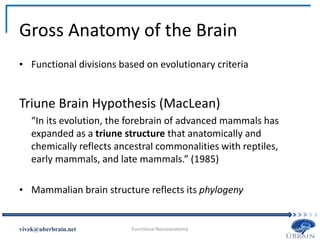
• Functional divisions based on evolutionary criteria
Triune Brain Hypothesis (MacLean)
“In its evolution, the forebrain of advanced mammals has
expanded as a triune structure that anatomically and
chemically reflects ancestral commonalities with reptiles,
early mammals, and late mammals.” (1985)
• Mammalian brain structure reflects its phylogeny
Vivek Misra
Gross Anatomy of the Brain
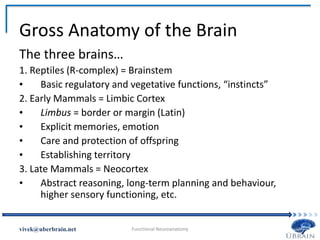
The three brains…
1. Reptiles (R-complex) = Brainstem
• Basic regulatory and vegetative functions, “instincts”
2. Early Mammals = Limbic Cortex
• Limbus = border or margin (Latin)
• Explicit memories, emotion
• Care and protection of offspring
• Establishing territory
3. Late Mammals = Neocortex
• Abstract reasoning, long-term planning and behaviour,
higher sensory functioning, etc.
Vivek Misra
Is the Triune Brain
Hypothesis Useful?
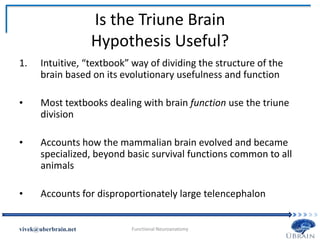
1. Intuitive, “textbook” way of dividing the structure of the
brain based on its evolutionary usefulness and function
• Most textbooks dealing with brain function use the triune
division
• Accounts how the mammalian brain evolved and became
specialized, beyond basic survival functions common to all
animals
• Accounts for disproportionately large telencephalon
Vivek Misra
Is the Triune Brain
Hypothesis Useful?
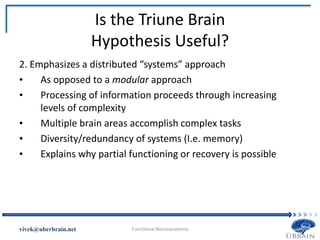
2. Emphasizes a distributed “systems” approach
• As opposed to a modular approach
• Processing of information proceeds through increasing
levels of complexity
• Multiple brain areas accomplish complex tasks
• Diversity/redundancy of systems (I.e. memory)
• Explains why partial functioning or recovery is possible
Vivek Misra
Is the Triune Brain
Hypothesis Useful?
3. Competition between different brain areas
• Conflict between different phylogenic areas of the brain--
situations where different functions come into conflict. (I.e.
smoking)
• Antagonistic or inhibitory areas exist in the brain.
• Mental disease may reflect an imbalance: over- or
underactivity of a brain area
• Role of drug or treatment is to restore balance
Vivek Misra
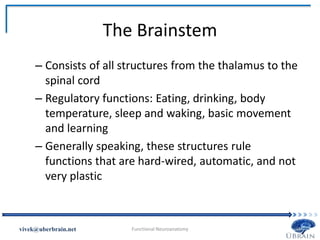
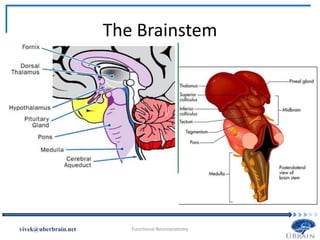
The Brainstem
– Consists of all structures from the thalamus to the
spinal cord
– Regulatory functions: Eating, drinking, body
temperature, sleep and waking, basic movement
and learning
– Generally speaking, these structures rule
functions that are hard-wired, automatic, and not
very plastic
Vivek Misra
The Brainstem
Vivek Misra
The Brainstem
• Thalamus: A relay centre for sensory information
(touch, vision, hearing); located near the middle of
the cerebral hemispheres.
– Fibres project to primary sensory areas in neocortex
– There are separate nuclei for vision, touch, hearing
– Not a “passive” structure because the majority (80%) of its
connections are not from sensory neurons, but from the
neocortex (including motor areas).
Vivek Misra
The Brainstem
• Hypothalamus: Controls all aspects of motivated
(pleasure and pain) and regulatory behaviour
– Autonomic (vegetative) system
– Superior to the pituitary gland, reciprocal connections with
it
– “Master gland”: Closely involved in the regulation and
secretion of hormones
– 0.3% of the brain’s weight
Vivek Misra
The Brainstem
• Reticular Formation: Constellation of 90+
nuclei at the base of the brainstem
– Bundles of fibres as well as projections that pass
through to the forebrain from the spinal cord
– A host of regulatory vegetative functions
– connections with cerebral cortex and thalamus
Vivek Misra
The Brainstem
• Cerebellum: conspicuous bulbous structure
protruding from the posterior brain; “little
brain”
– Distinctive narrow folds (folia), similar to sulci in
neocortex
– Involved in aspects of learning and coordination of
skilled or smooth movement
– Posture, walking, equilibrium
Vivek Misra
The Brainstem
• By and large, there is little that distinguishes
mammals from reptiles in terms of brainstem
structure and function
• An evolutionary turning point occurred with the
specialization of limbic cortex in mammals
• Functions of brainstem aren’t replaced; rather, they
are modified or enhanced by interacting with newer
phylogenic structures.
Vivek Misra
The Limbic Cortex
• Three-layer cortical structure covering the
periphery of the brainstem, on the ventral
surface of the lateral ventricles
• Primarily known for its role in emotion,
(emotional) learning and memory
• Also plays a role in spatial learning and
olfaction (memories of odour)
Vivek Misra
The Limbic Cortex
Vivek Misra
The Limbic Cortex
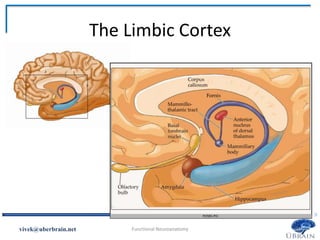
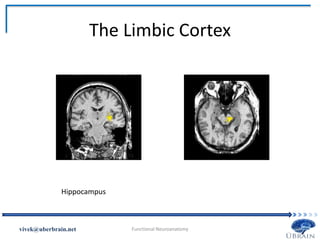
• Hippocampus: Located next to the lateral ventricle in the
temporal lobe.
• Along with the fornix, mammillary bodies, and cingulate gyrus
is involved in learning and memory.
• Amygdala: located anterior to the hippocampus
• only part of the limbic system responsible for emotional
responses
• Other areas involved with learning and memory of emotions
(recognition of emotional events)
Vivek Misra
The Limbic Cortex
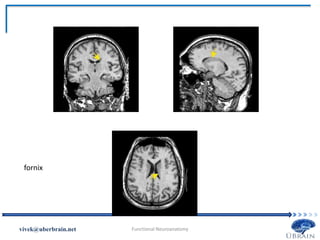
Fornix: a bundle of axons that connects
hippocampus with other regions of the brain,
including the mammillary bodies (containing some of
the hypothalamic nuclei)
Vivek Misra
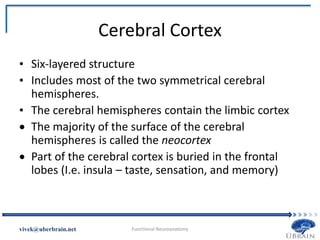
Cerebral Cortex
• Six-layered structure
• Includes most of the two symmetrical cerebral
hemispheres.
• The cerebral hemispheres contain the limbic cortex
 The majority of the surface of the cerebral
hemispheres is called the neocortex
 Part of the cerebral cortex is buried in the frontal
lobes (I.e. insula – taste, sensation, and memory)
Vivek Misra
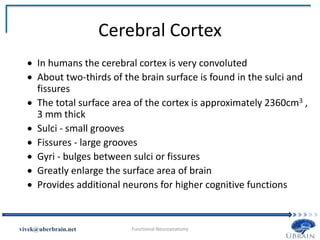
Cerebral Cortex
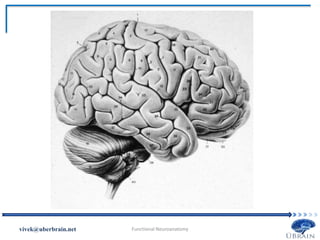
 In humans the cerebral cortex is very convoluted
 About two-thirds of the brain surface is found in the sulci and
fissures
 The total surface area of the cortex is approximately 2360cm3 ,
3 mm thick
 Sulci - small grooves
 Fissures - large grooves
 Gyri - bulges between sulci or fissures
 Greatly enlarge the surface area of brain
 Provides additional neurons for higher cognitive functions
Vivek Misra
Vivek Misra
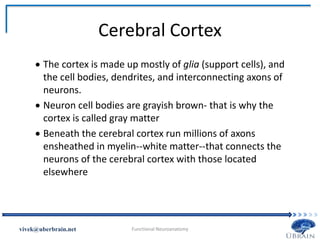
Cerebral Cortex
 The cortex is made up mostly of glia (support cells), and
the cell bodies, dendrites, and interconnecting axons of
neurons.
 Neuron cell bodies are grayish brown- that is why the
cortex is called gray matter
 Beneath the cerebral cortex run millions of axons
ensheathed in myelin--white matter--that connects the
neurons of the cerebral cortex with those located
elsewhere
Vivek Misra
Cerebral Cortex
Vivek Misra
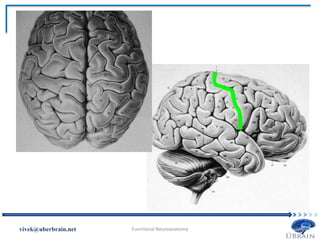
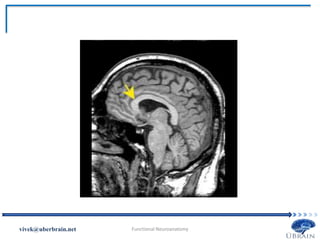
Significant individual differences in the sulci and gyri.
However, there are major landmarks common to everyone:
The longitudinal fissure divides most of the cortex into left
and right sides.
The central sulcus provides an important dividing line
between the anterior and posterior regions of the cerebral
cortex
Anterior: planning and executing movements
Posterior: sensation, perception and learning
Vivek Misra
Cerebral Cortex
– Although the two cerebral hemispheres cooperate
with each other, they do not perform identical
functions.
 Some functions are lateralized – located primarily
on one side of the brain
 The left hemisphere is involved in analysis of
information – extraction of elements that make up
a whole
 For instance the left hemisphere is good at
recognizing serial events.
Vivek Misra
Cerebral Cortex
 The right hemisphere is specialized for synthesis – putting
isolated elements together to perceive a whole.
 During normal functioning of the brain we are not aware
of lateralization
 Our perceptions and memories are unified by the corpus
callosum – a band of axons that connects the two cerebral
hemispheres
 Connects topographically – i.e. Areas of the brain that are
the same region on both sides
 The corpus callosum is the largest commissure of the brain
– cross-hemispheric connection
Vivek Misra
Vivek Misra
Cerebral Cortex
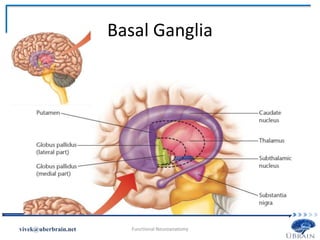
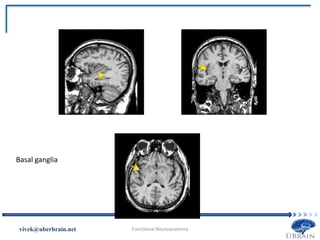
• Basal ganglia: A collection of subcortical nuclei in the
forebrain.
 Lie beneath the anterior portion of the lateral ventricles.
 The major parts: caudate nucleus, putamen, and the globus
pallidus.
 These structures are involved in the control of movement
(frontal lobe).
 Parkinson’s disease results from degeneration of the
connections between the midbrain and the caudate nucleus
and putamen.
Vivek Misra
Basal Ganglia
Vivek Misra
Cerebral Cortex
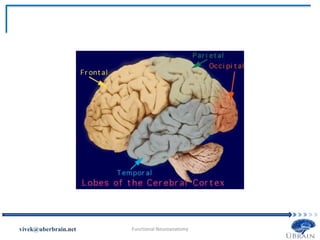
• Its divided into 4 areas, or lobes, named for the bones of the
skull that cover them
 Frontal lobes - includes everything in front of the
central fissure
 Parietal lobe - is located on the side of the cerebral
hemisphere, just behind the central sulcus and caudal
to the frontal lobe
 Temporal lobe - lateral and ventral to the frontal and
parietal lobe
 Occipital lobe - back of the brain - caudal to the parietal
and temporal lobes
Vivek Misra
Vivek Misra
Cerebral Cortex
Three areas of the cerebral cortex receive contralateral
information from the sensory organs.
 Primary visual cortex - back of the brain on the inner
surfaces of the cerebral hemispheres - upper and lower
parts of the calcarine fissure
 Primary auditory cortex is located on the upper surface
of a deep fissure in the side of the brain - lateral fissure
 Primary somatosensory cortex - vertical strip of cortex
caudal to the central sulcus - receives information from
the body senses primarily touch, pressure, pain
Vivek Misra
Vivek Misra
Cerebral Cortex
Vivek Misra
Cerebral Cortex
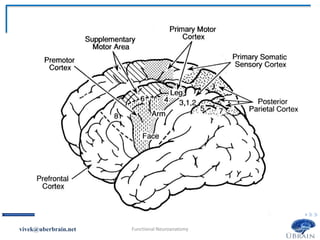
 Primary motor cortex - just anterior to the central
sulcus and the primary somatosensory cortex
 most directly involved in the control of movement
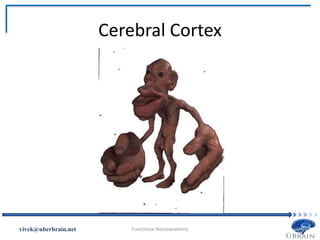
 neurons in different parts of the motor cortex are
connected to different muscles in the body
(homunculus)
 connections to muscles are contralateral
Vivek Misra
Cerebral Cortex
 The primary parts of the cortex take up a small
proportion of the cortex
 The rest of the cortex is made up of association areas.
Vivek Misra
Cerebral Cortex
• Each primary sensory area of the cerebral cortex sends
information to the adjacent regions - sensory association
cortex
 Usually posterior
 Circuits of the neurons in these areas analyze the
information received from the primary sensory cortex
 Perception takes place there and memories are stored
there
Vivek Misra
Cerebral Cortex
 The regions of the sensory association cortex located closest to
the primary cortices receive information from only one sensory
system
 E.g. region closest to primary visual cortex is involved in visual
perception and stores visual memories
 Regions further away from the primary cortices integrate
information multiple sensory systems - involved in several kinds
of perception and memories
 Combining vision and hearing to recognize a face or to
understand language
Vivek Misra
Cerebral Cortex
• The frontal association cortex is involved in the planning and
execution of movements
 The motor association cortex is located directly rostral
to the primary motor cortex
 This region controls the primary motor cortex - direct
control over behaviour
 The rest of the frontal lobe, rostral to the motor
association cortex is known as the prefrontal cortex -
formulation of plans and strategies
Vivek Misra
Summary
1. Divisions of the brain based on structure and
function may be different.
2. Normal brain functioning requires the interaction
of many (inhibitory) systems.
3. Normal brain functioning requires a balance
between all “three” brains.
4. If not, there is disease and dysfunction.
Vivek Misra
Vivek Misra
Vivek Misra
fornix
Vivek Misra
Basal ganglia
The Limbic Cortex
Vivek Misra
Hippocampus

Basics of Functional Neuroanatomy

  • 1.
    Functional Neuroanatomy Vivek Misra|B.Tech, M.S, MIANS Research Fellow The Institute of Neurological Sciences VHS Multi-Specialty Hospital & Research Institute Chennai. IN vivek@ubrf.org | @iVivekMisra http://www.ubrf.org
  • 2.
    Overview • A wordabout the funny names, and a few definitions • Anatomy versus Function: The Triune Brain Hypothesis • The Brainstem • The Limbic System • Cerebral Cortex Vivek Misra
  • 3.
    A word aboutthe funny names…  Early anatomists named most brain structures (in Latin, for the most part) according to their similarity to commonplace objects:  amygdala = almond,  hippocampus = sea horse,  genu = knee,  cortex = bark  pons = bridge Vivek Misra
  • 4.
    A few definitions Locationsin the Brain  Described relative to neuraxis - an imaginary line drawn through the spinal cord up to the front of the brain  The front end is anterior  The back end is posterior  The terms rostral (toward the head) and caudal (toward the tail) are also used when referring to parts of the brain Vivek Misra
  • 5.
    A few definitions Dorsal (back) refers to the top of the head and the back  The ventral (front) surface faces the ground.  These directions are somewhat more complicated in humans because our neuraxis bends, so that the top of the head is now perpendicular to the back. Vivek Misra
  • 6.
  • 7.
  • 8.
    A few definitions Lateral means to the side (away from the neuraxis)  Medial (or mesial) means toward the middle (towards the neuraxis)  Proximal: Areas of the brain that are near to one another  Distal: Areas that are far from one another Vivek Misra
  • 9.
    A few definitions Ipsilateral refers to structures on the same side of the body  E.g. the olfactory bulbs send ipsilateral connections to the brain - the right bulb connects to the right hemisphere, and the left bulb connects to the left hemisphere  Contralateral refers to structures on opposite sides of the body  E.g. the left motor strip connects to the right side of the body Vivek Misra
  • 10.
    A few definitions Slicesof the brain  Transversely, like a loaf of bread - also called frontal or cross sections  Parallel to the ground, giving us horizontal sections  Perpendicular to the ground and parallel to the neuraxis - sagittal section - midsagittal plane divides the brain in half along the longitudinal fissure  Because of our upright posture, cross sections of our spinal cord are actually parallel to the ground Vivek Misra
  • 11.
  • 12.
    Gross Anatomy ofthe Brain Vivek Misra
  • 13.
    Gross Anatomy ofthe Brain • Functional divisions based on evolutionary criteria Triune Brain Hypothesis (MacLean) “In its evolution, the forebrain of advanced mammals has expanded as a triune structure that anatomically and chemically reflects ancestral commonalities with reptiles, early mammals, and late mammals.” (1985) • Mammalian brain structure reflects its phylogeny Vivek Misra
  • 14.
    Gross Anatomy ofthe Brain The three brains… 1. Reptiles (R-complex) = Brainstem • Basic regulatory and vegetative functions, “instincts” 2. Early Mammals = Limbic Cortex • Limbus = border or margin (Latin) • Explicit memories, emotion • Care and protection of offspring • Establishing territory 3. Late Mammals = Neocortex • Abstract reasoning, long-term planning and behaviour, higher sensory functioning, etc. Vivek Misra
  • 15.
    Is the TriuneBrain Hypothesis Useful? 1. Intuitive, “textbook” way of dividing the structure of the brain based on its evolutionary usefulness and function • Most textbooks dealing with brain function use the triune division • Accounts how the mammalian brain evolved and became specialized, beyond basic survival functions common to all animals • Accounts for disproportionately large telencephalon Vivek Misra
  • 16.
    Is the TriuneBrain Hypothesis Useful? 2. Emphasizes a distributed “systems” approach • As opposed to a modular approach • Processing of information proceeds through increasing levels of complexity • Multiple brain areas accomplish complex tasks • Diversity/redundancy of systems (I.e. memory) • Explains why partial functioning or recovery is possible Vivek Misra
  • 17.
    Is the TriuneBrain Hypothesis Useful? 3. Competition between different brain areas • Conflict between different phylogenic areas of the brain-- situations where different functions come into conflict. (I.e. smoking) • Antagonistic or inhibitory areas exist in the brain. • Mental disease may reflect an imbalance: over- or underactivity of a brain area • Role of drug or treatment is to restore balance Vivek Misra
  • 18.
    The Brainstem – Consistsof all structures from the thalamus to the spinal cord – Regulatory functions: Eating, drinking, body temperature, sleep and waking, basic movement and learning – Generally speaking, these structures rule functions that are hard-wired, automatic, and not very plastic Vivek Misra
  • 19.
  • 20.
    The Brainstem • Thalamus:A relay centre for sensory information (touch, vision, hearing); located near the middle of the cerebral hemispheres. – Fibres project to primary sensory areas in neocortex – There are separate nuclei for vision, touch, hearing – Not a “passive” structure because the majority (80%) of its connections are not from sensory neurons, but from the neocortex (including motor areas). Vivek Misra
  • 21.
    The Brainstem • Hypothalamus:Controls all aspects of motivated (pleasure and pain) and regulatory behaviour – Autonomic (vegetative) system – Superior to the pituitary gland, reciprocal connections with it – “Master gland”: Closely involved in the regulation and secretion of hormones – 0.3% of the brain’s weight Vivek Misra
  • 22.
    The Brainstem • ReticularFormation: Constellation of 90+ nuclei at the base of the brainstem – Bundles of fibres as well as projections that pass through to the forebrain from the spinal cord – A host of regulatory vegetative functions – connections with cerebral cortex and thalamus Vivek Misra
  • 23.
    The Brainstem • Cerebellum:conspicuous bulbous structure protruding from the posterior brain; “little brain” – Distinctive narrow folds (folia), similar to sulci in neocortex – Involved in aspects of learning and coordination of skilled or smooth movement – Posture, walking, equilibrium Vivek Misra
  • 24.
    The Brainstem • Byand large, there is little that distinguishes mammals from reptiles in terms of brainstem structure and function • An evolutionary turning point occurred with the specialization of limbic cortex in mammals • Functions of brainstem aren’t replaced; rather, they are modified or enhanced by interacting with newer phylogenic structures. Vivek Misra
  • 25.
    The Limbic Cortex •Three-layer cortical structure covering the periphery of the brainstem, on the ventral surface of the lateral ventricles • Primarily known for its role in emotion, (emotional) learning and memory • Also plays a role in spatial learning and olfaction (memories of odour) Vivek Misra
  • 26.
  • 27.
    The Limbic Cortex •Hippocampus: Located next to the lateral ventricle in the temporal lobe. • Along with the fornix, mammillary bodies, and cingulate gyrus is involved in learning and memory. • Amygdala: located anterior to the hippocampus • only part of the limbic system responsible for emotional responses • Other areas involved with learning and memory of emotions (recognition of emotional events) Vivek Misra
  • 28.
    The Limbic Cortex Fornix:a bundle of axons that connects hippocampus with other regions of the brain, including the mammillary bodies (containing some of the hypothalamic nuclei) Vivek Misra
  • 29.
    Cerebral Cortex • Six-layeredstructure • Includes most of the two symmetrical cerebral hemispheres. • The cerebral hemispheres contain the limbic cortex  The majority of the surface of the cerebral hemispheres is called the neocortex  Part of the cerebral cortex is buried in the frontal lobes (I.e. insula – taste, sensation, and memory) Vivek Misra
  • 30.
    Cerebral Cortex  Inhumans the cerebral cortex is very convoluted  About two-thirds of the brain surface is found in the sulci and fissures  The total surface area of the cortex is approximately 2360cm3 , 3 mm thick  Sulci - small grooves  Fissures - large grooves  Gyri - bulges between sulci or fissures  Greatly enlarge the surface area of brain  Provides additional neurons for higher cognitive functions Vivek Misra
  • 31.
  • 32.
    Cerebral Cortex  Thecortex is made up mostly of glia (support cells), and the cell bodies, dendrites, and interconnecting axons of neurons.  Neuron cell bodies are grayish brown- that is why the cortex is called gray matter  Beneath the cerebral cortex run millions of axons ensheathed in myelin--white matter--that connects the neurons of the cerebral cortex with those located elsewhere Vivek Misra
  • 33.
    Cerebral Cortex Vivek Misra Significantindividual differences in the sulci and gyri. However, there are major landmarks common to everyone: The longitudinal fissure divides most of the cortex into left and right sides. The central sulcus provides an important dividing line between the anterior and posterior regions of the cerebral cortex Anterior: planning and executing movements Posterior: sensation, perception and learning
  • 34.
  • 35.
    Cerebral Cortex – Althoughthe two cerebral hemispheres cooperate with each other, they do not perform identical functions.  Some functions are lateralized – located primarily on one side of the brain  The left hemisphere is involved in analysis of information – extraction of elements that make up a whole  For instance the left hemisphere is good at recognizing serial events. Vivek Misra
  • 36.
    Cerebral Cortex  Theright hemisphere is specialized for synthesis – putting isolated elements together to perceive a whole.  During normal functioning of the brain we are not aware of lateralization  Our perceptions and memories are unified by the corpus callosum – a band of axons that connects the two cerebral hemispheres  Connects topographically – i.e. Areas of the brain that are the same region on both sides  The corpus callosum is the largest commissure of the brain – cross-hemispheric connection Vivek Misra
  • 37.
  • 38.
    Cerebral Cortex • Basalganglia: A collection of subcortical nuclei in the forebrain.  Lie beneath the anterior portion of the lateral ventricles.  The major parts: caudate nucleus, putamen, and the globus pallidus.  These structures are involved in the control of movement (frontal lobe).  Parkinson’s disease results from degeneration of the connections between the midbrain and the caudate nucleus and putamen. Vivek Misra
  • 39.
  • 40.
    Cerebral Cortex • Itsdivided into 4 areas, or lobes, named for the bones of the skull that cover them  Frontal lobes - includes everything in front of the central fissure  Parietal lobe - is located on the side of the cerebral hemisphere, just behind the central sulcus and caudal to the frontal lobe  Temporal lobe - lateral and ventral to the frontal and parietal lobe  Occipital lobe - back of the brain - caudal to the parietal and temporal lobes Vivek Misra
  • 41.
  • 42.
    Cerebral Cortex Three areasof the cerebral cortex receive contralateral information from the sensory organs.  Primary visual cortex - back of the brain on the inner surfaces of the cerebral hemispheres - upper and lower parts of the calcarine fissure  Primary auditory cortex is located on the upper surface of a deep fissure in the side of the brain - lateral fissure  Primary somatosensory cortex - vertical strip of cortex caudal to the central sulcus - receives information from the body senses primarily touch, pressure, pain Vivek Misra
  • 43.
  • 44.
  • 45.
    Cerebral Cortex  Primarymotor cortex - just anterior to the central sulcus and the primary somatosensory cortex  most directly involved in the control of movement  neurons in different parts of the motor cortex are connected to different muscles in the body (homunculus)  connections to muscles are contralateral Vivek Misra
  • 46.
    Cerebral Cortex  Theprimary parts of the cortex take up a small proportion of the cortex  The rest of the cortex is made up of association areas. Vivek Misra
  • 47.
    Cerebral Cortex • Eachprimary sensory area of the cerebral cortex sends information to the adjacent regions - sensory association cortex  Usually posterior  Circuits of the neurons in these areas analyze the information received from the primary sensory cortex  Perception takes place there and memories are stored there Vivek Misra
  • 48.
    Cerebral Cortex  Theregions of the sensory association cortex located closest to the primary cortices receive information from only one sensory system  E.g. region closest to primary visual cortex is involved in visual perception and stores visual memories  Regions further away from the primary cortices integrate information multiple sensory systems - involved in several kinds of perception and memories  Combining vision and hearing to recognize a face or to understand language Vivek Misra
  • 49.
    Cerebral Cortex • Thefrontal association cortex is involved in the planning and execution of movements  The motor association cortex is located directly rostral to the primary motor cortex  This region controls the primary motor cortex - direct control over behaviour  The rest of the frontal lobe, rostral to the motor association cortex is known as the prefrontal cortex - formulation of plans and strategies Vivek Misra
  • 50.
    Summary 1. Divisions ofthe brain based on structure and function may be different. 2. Normal brain functioning requires the interaction of many (inhibitory) systems. 3. Normal brain functioning requires a balance between all “three” brains. 4. If not, there is disease and dysfunction. Vivek Misra
  • 51.
  • 52.
  • 53.
  • 54.
    The Limbic Cortex VivekMisra Hippocampus