Downloaded 39 times


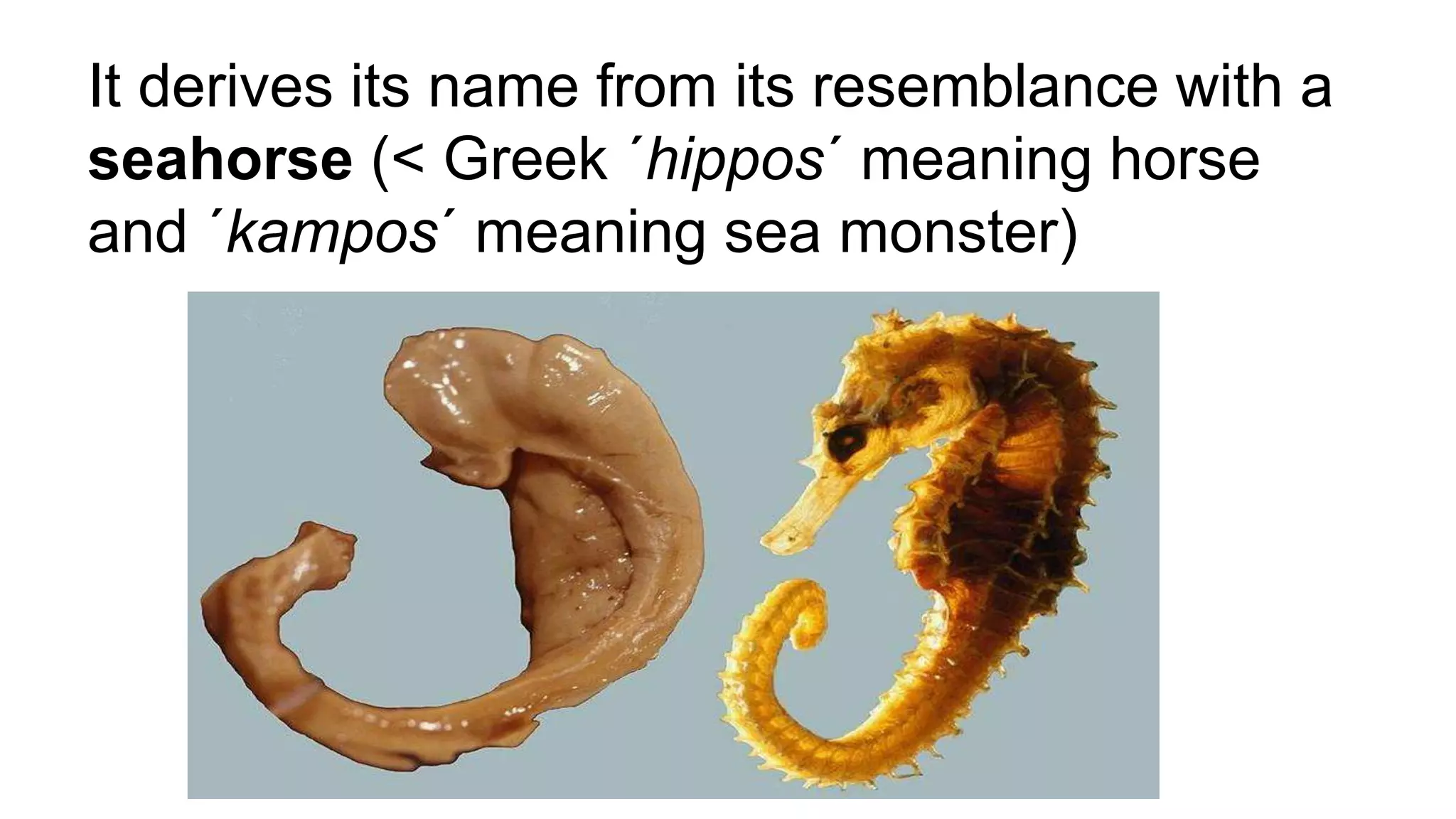
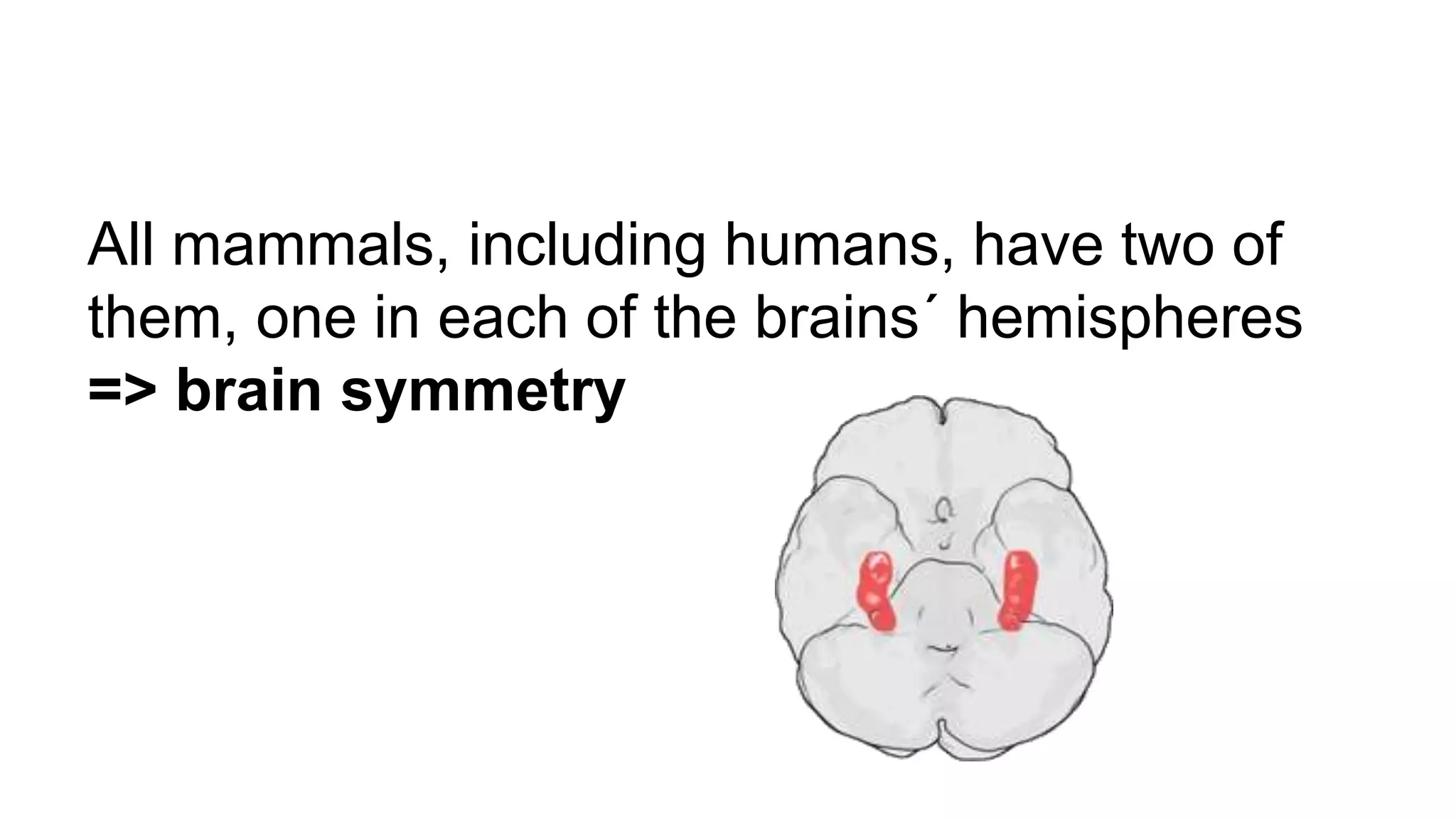


The hippocampus is a part of the brain located in the temporal lobe that plays an important role in forming, organizing, and storing memories, especially explicit memories, as well as spatial navigation. It derives its name from its resemblance to a seahorse. All mammals have two hippocampi, one in each hemisphere of the brain. Together with the hypothalamus and amygdala, the hippocampus is part of the limbic system responsible for emotional life. Damage to the hippocampus can result from factors like hypoxia, head injuries, old age, seizures, stress, or encephalitis and can cause amnesia, inability to form new explicit memories, and other symptoms.
Presentation by Adam, Thomas, Daniel, and Inchka introducing the hippocampus.
Plays crucial roles in memory formation, organization, storage, and spatial navigation.
Long-term memory has explicit (fact-based) and implicit (unconscious) components; hippocampus vital for explicit memory.
Located in the temporal lobe of the brain.
Hippocampus situated in the medial temporal lobe.
Name means 'seahorse' in Greek, reflecting its shape.
Humans have two hippocampi, one in each hemisphere, highlighting brain symmetry.
Part of the limbic system alongside hypothalamus and amygdala, crucial for emotional life.
Possible causes of damage include hypoxia, head injuries, age-related decline, and chronic stress.
Symptoms include amnesia, difficulty forming explicit memories, poor impulse control, and disorientation.


