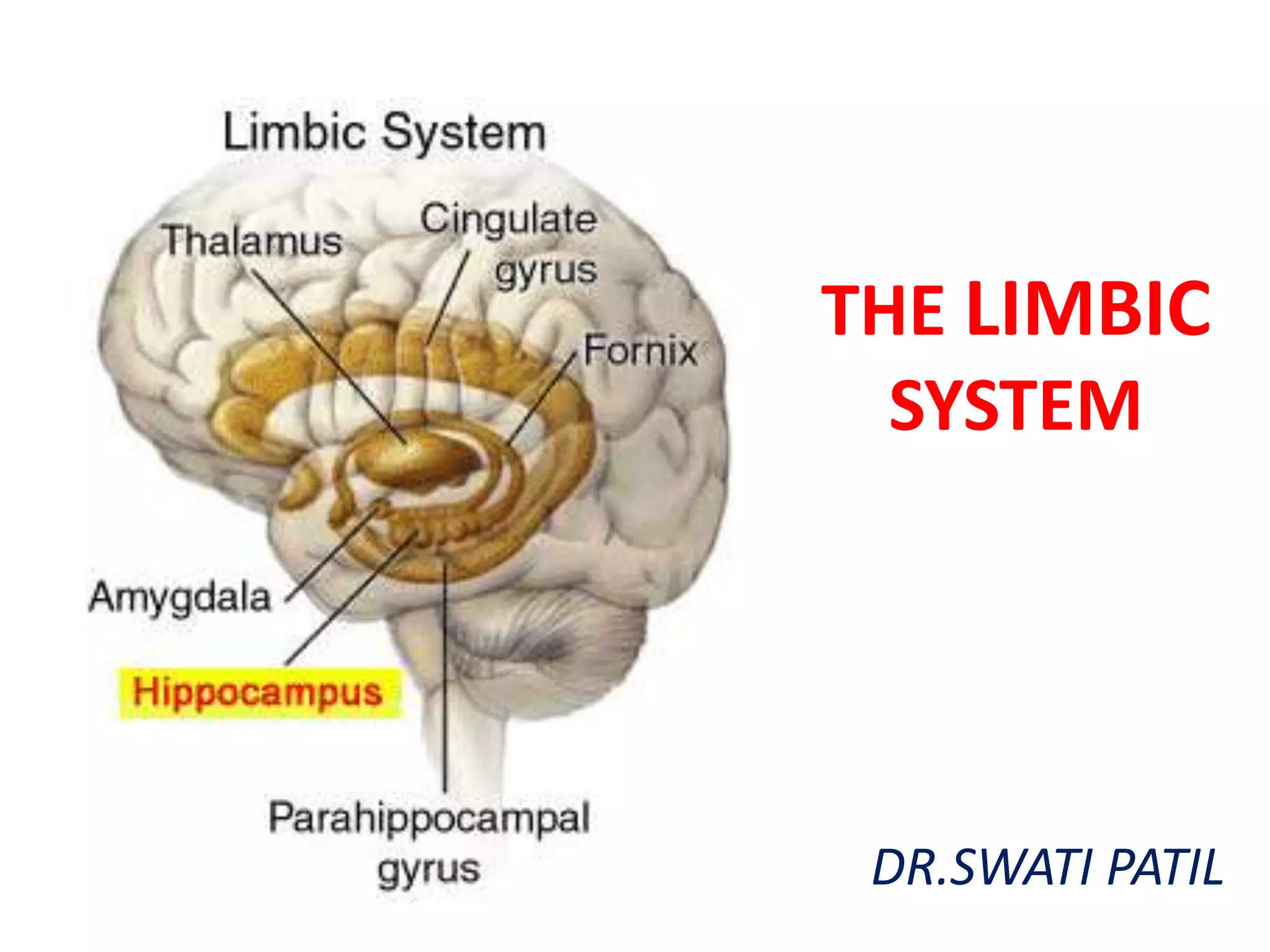
THE LIMBIC
  SYSTEM


 DR.SWATI PATIL
LIMBIC SYSTEM
•   Introduction
•   Anatomical structures
•   Connecting pathways
•   Functions
•   Applied
INTRODUCTION
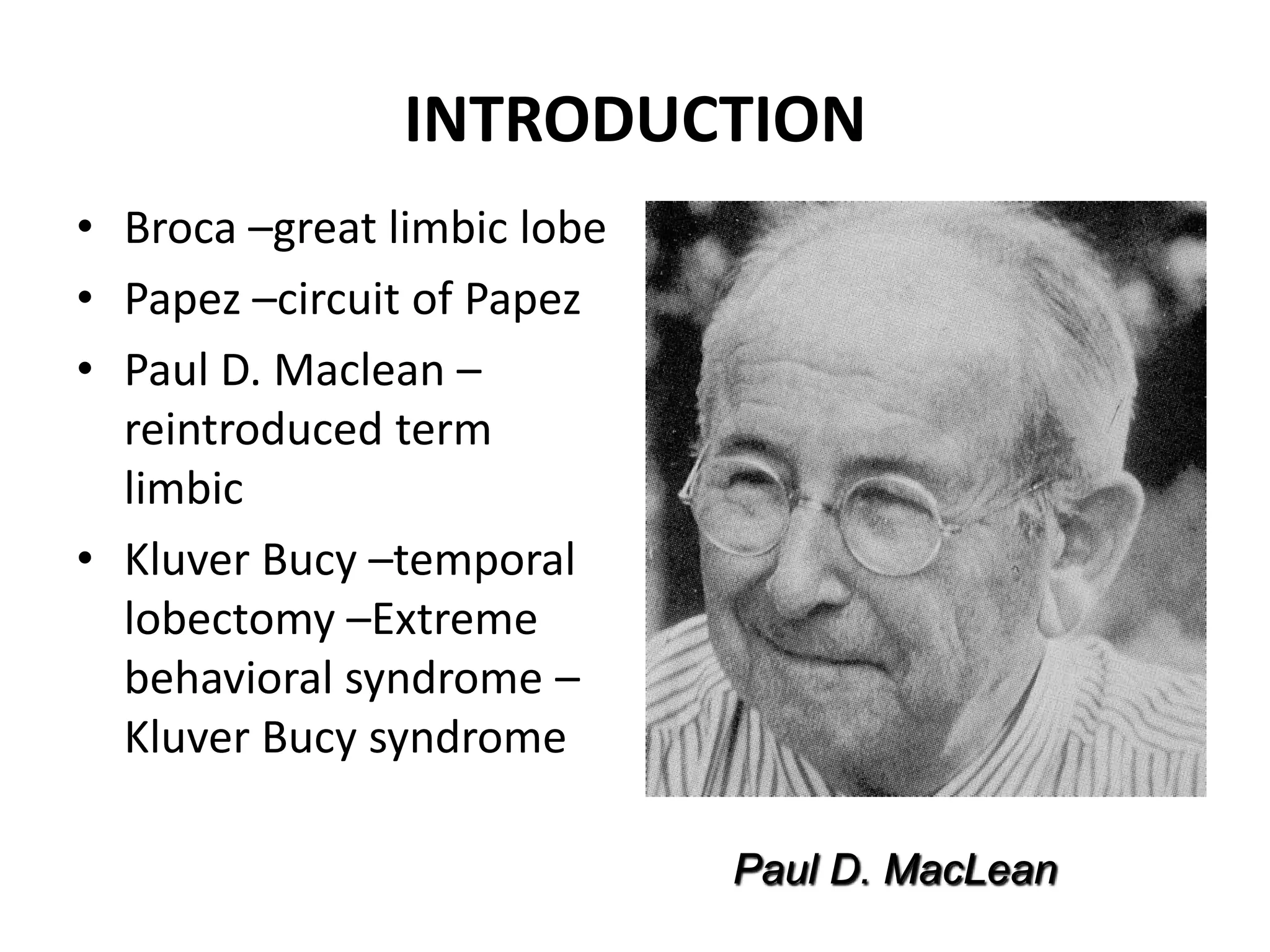
• Broca –great limbic lobe
• Papez –circuit of Papez
• Paul D. Maclean –
  reintroduced term
  limbic
• Kluver Bucy –temporal
  lobectomy –Extreme
  behavioral syndrome –
  Kluver Bucy syndrome

                             Paul D. MacLean
FUNCTIONS OF LIMBIC SYSTEM

• Integration of olfactory, visceral, somatic
  impulses
• Control of activities necessary for survival of
  animal
• Control of activities necessary survival of
  species
• Emotional behaviour
• Retention of recent memory
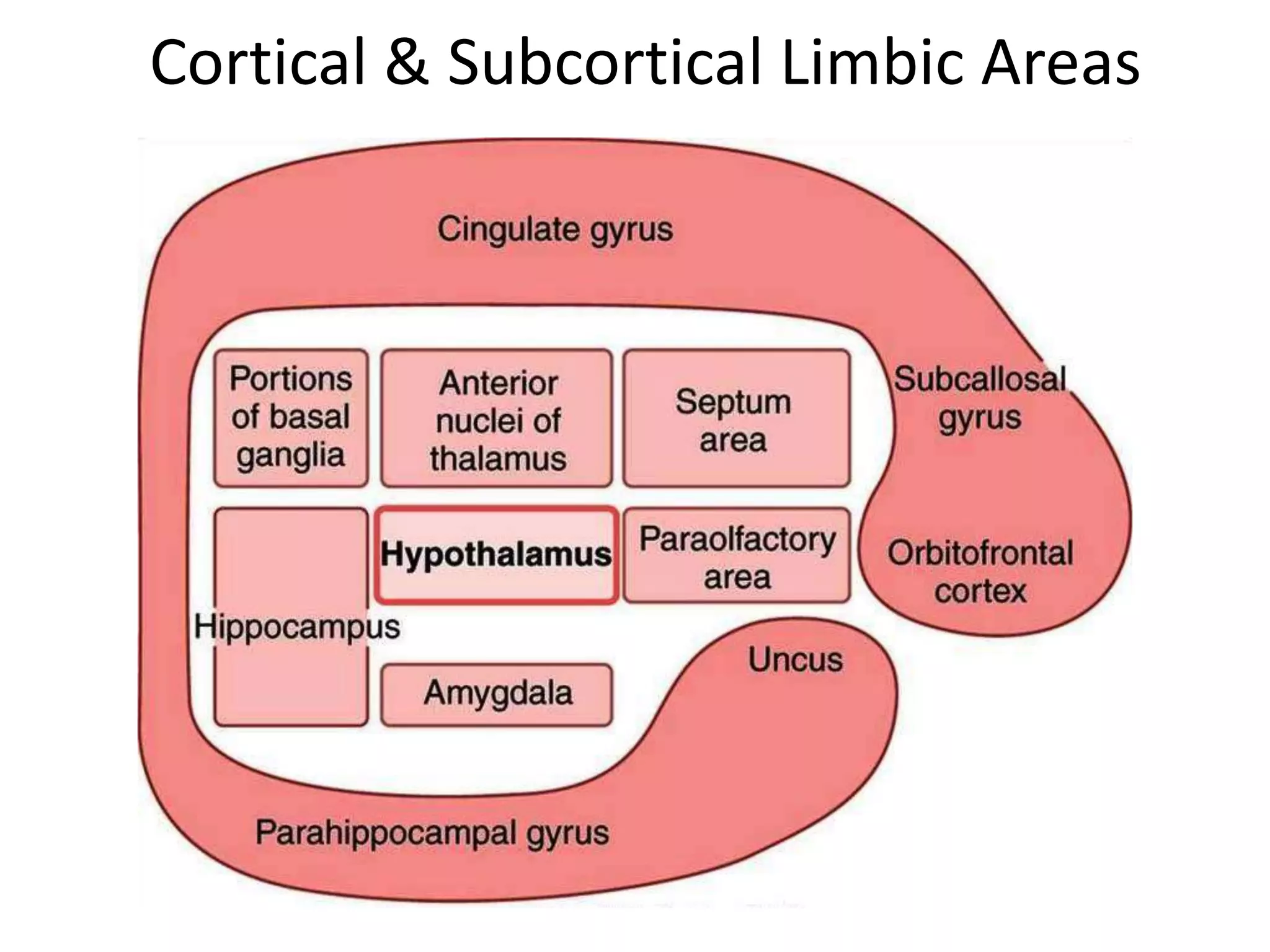
Cortical & Subcortical Limbic Areas
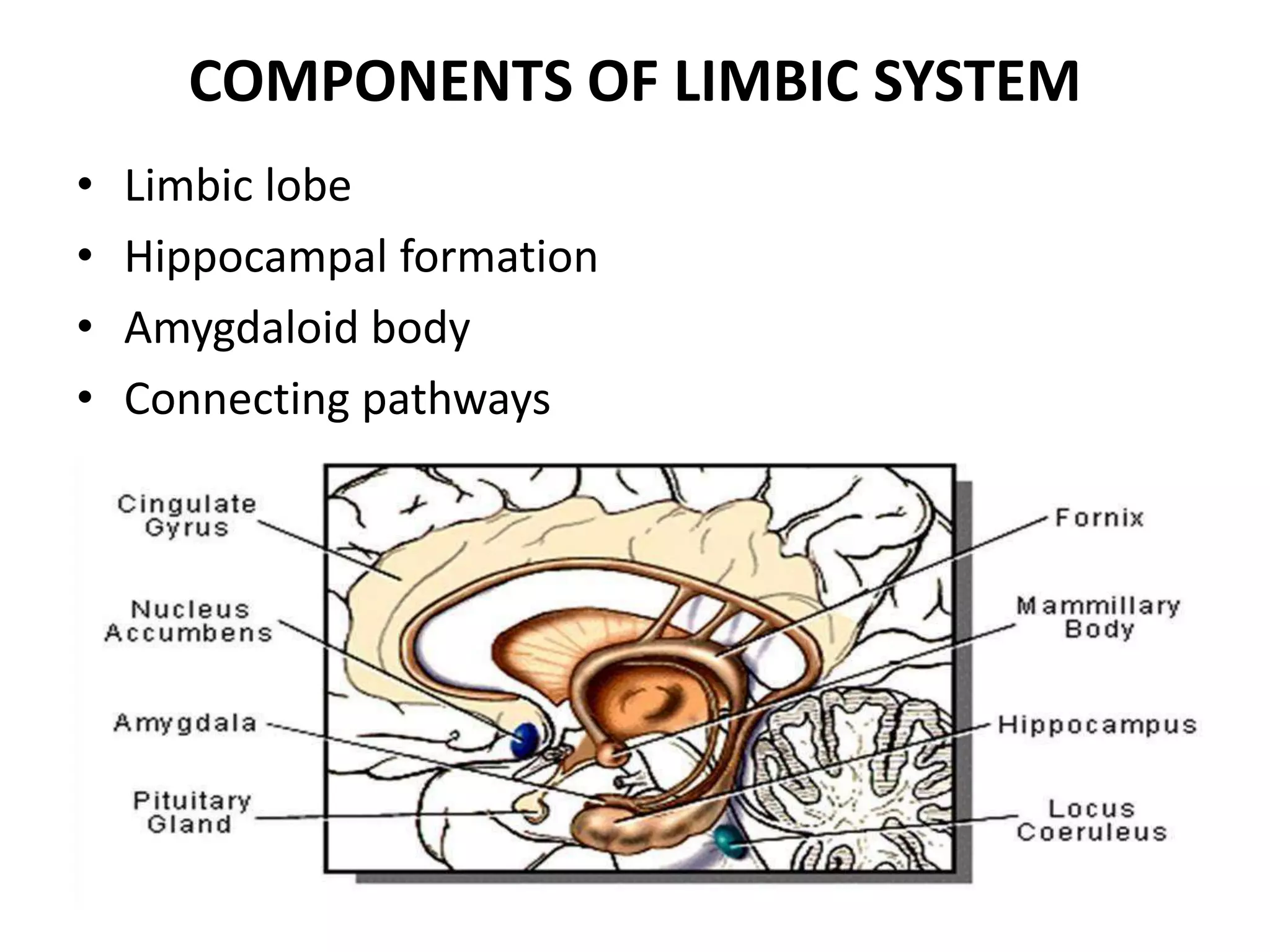
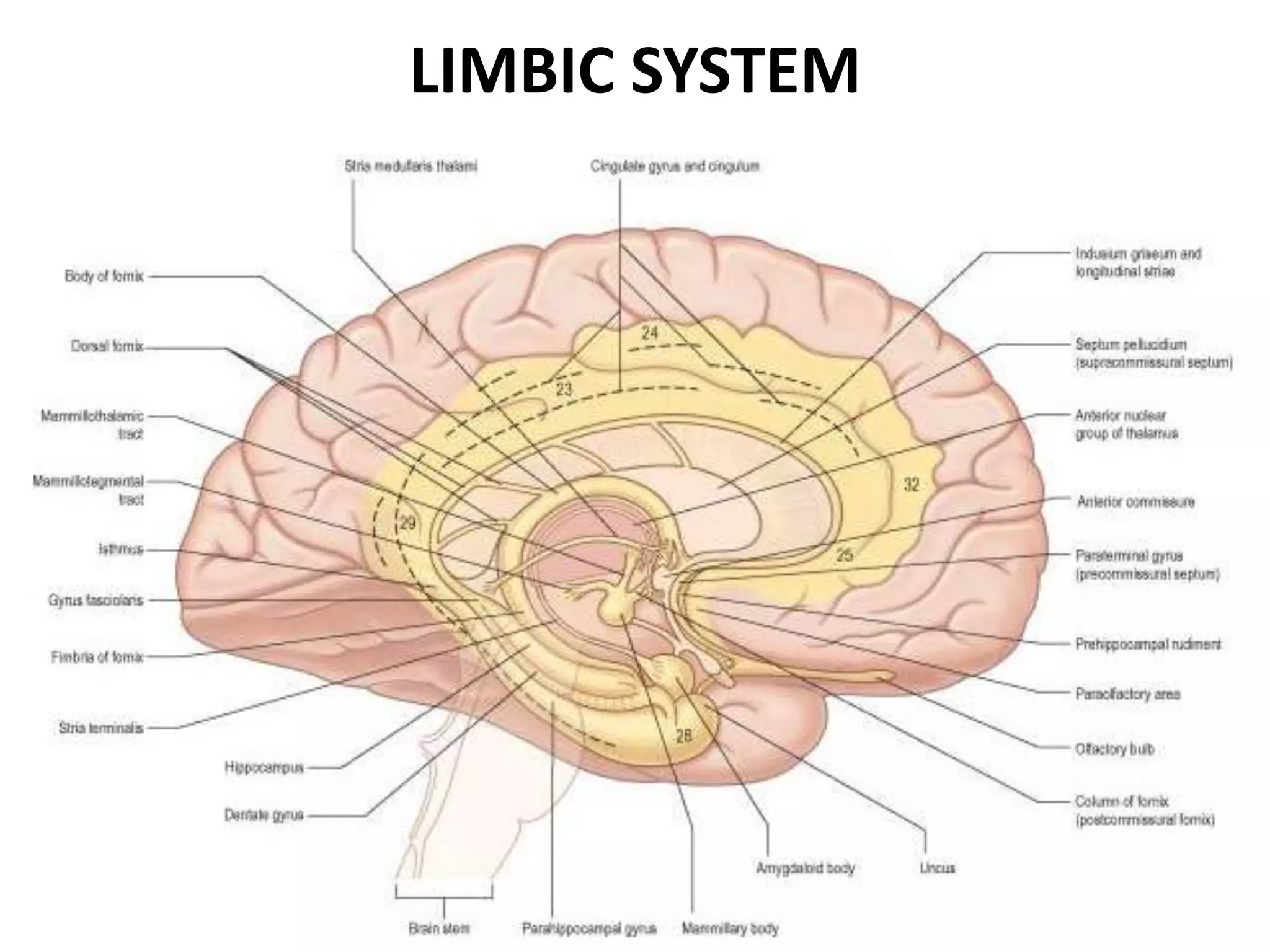
COMPONENTS OF LIMBIC SYSTEM
•   Limbic lobe
•   Hippocampal formation
•   Amygdaloid body
•   Connecting pathways
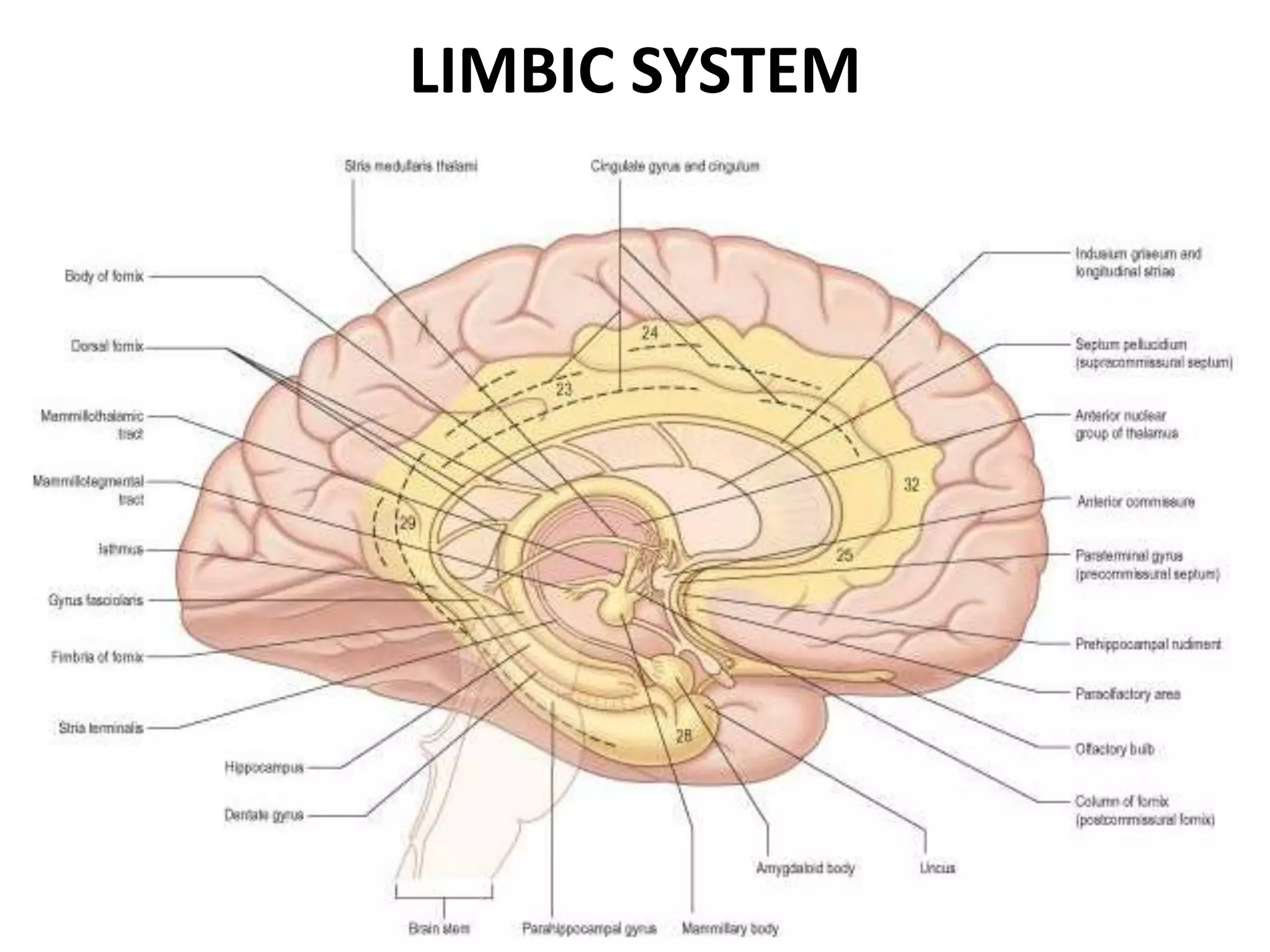
LIMBIC SYSTEM
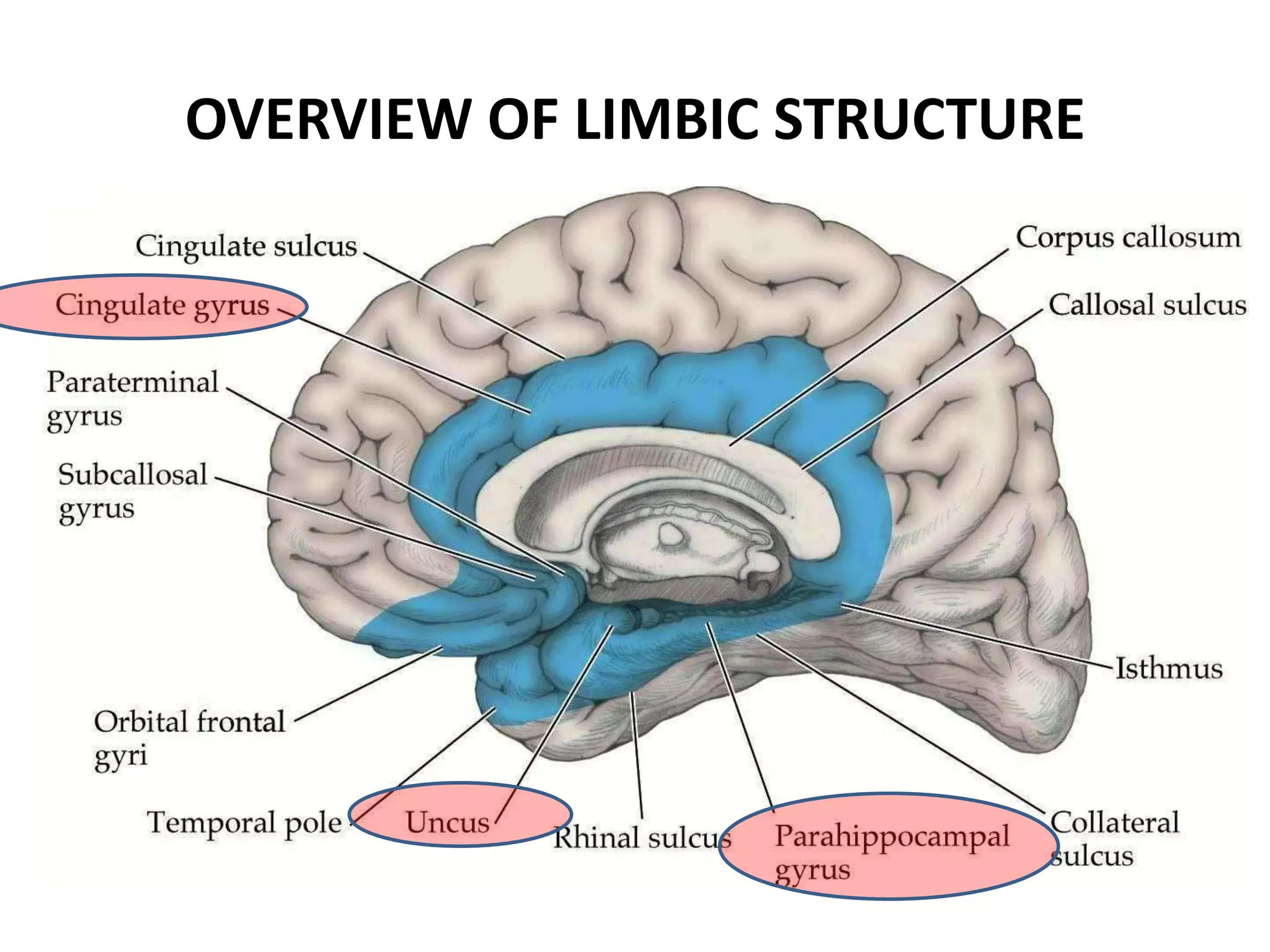
OVERVIEW OF LIMBIC STRUCTURE
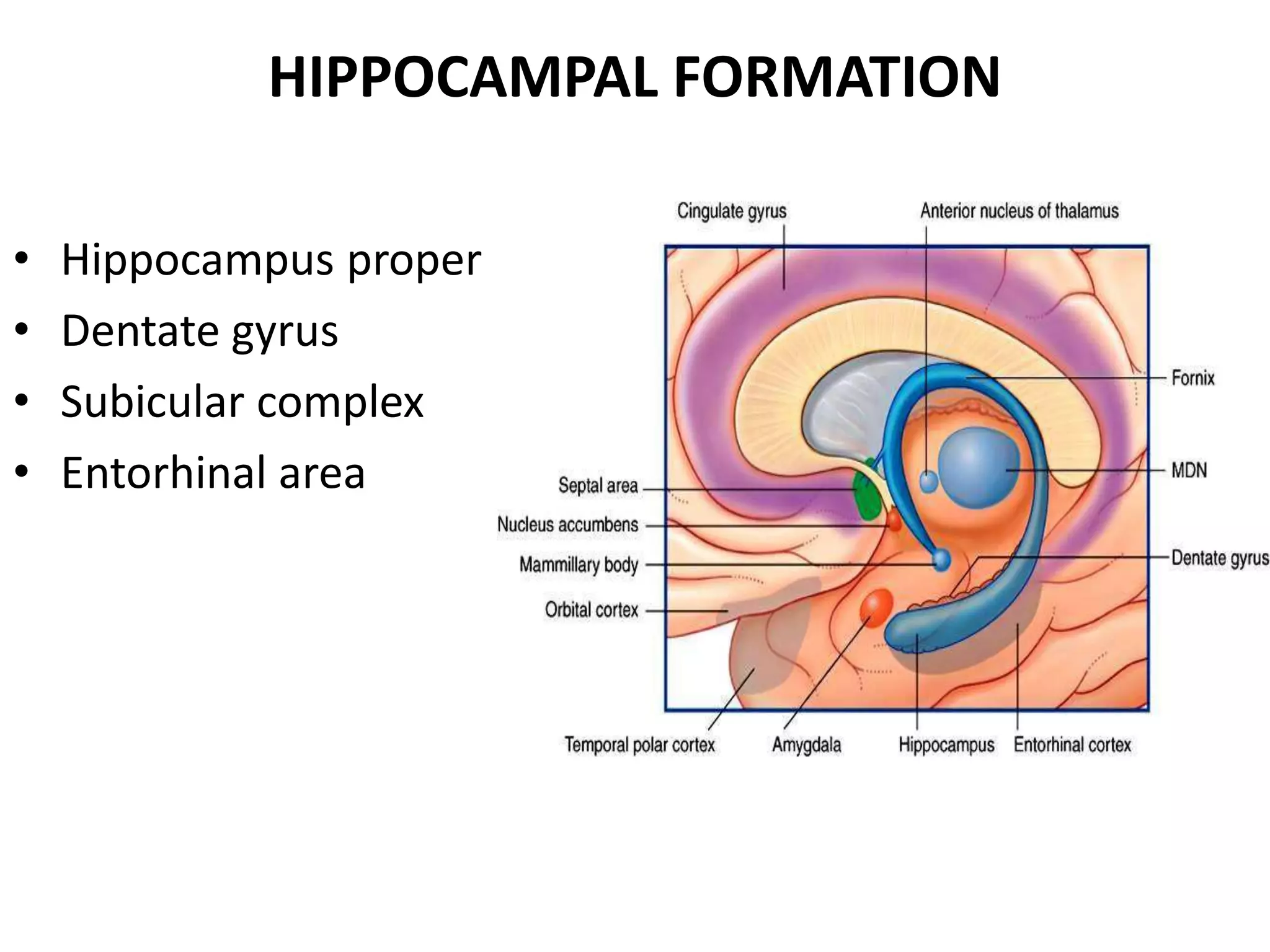
HIPPOCAMPAL FORMATION

•   Hippocampus proper
•   Dentate gyrus
•   Subicular complex
•   Entorhinal area
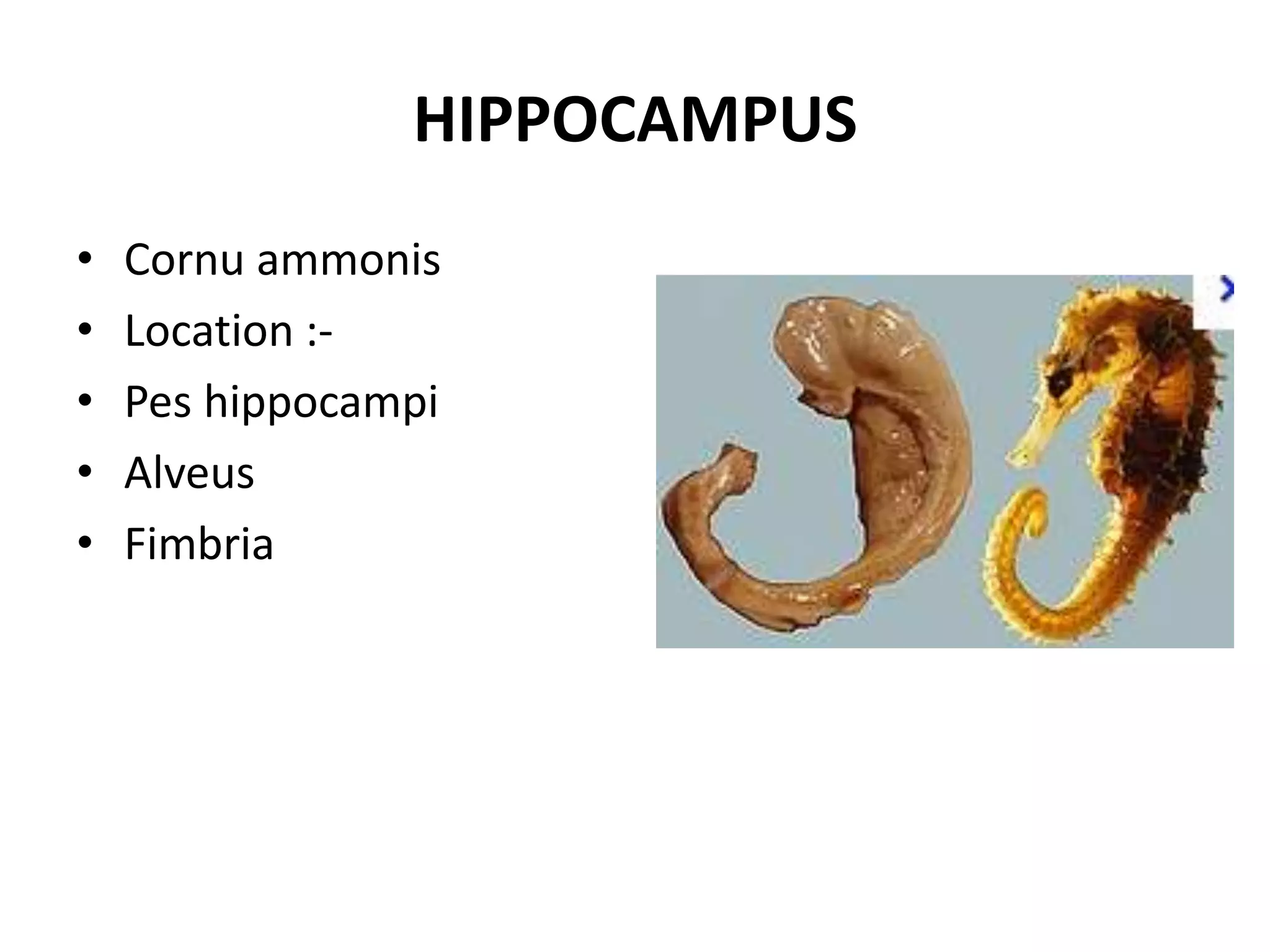
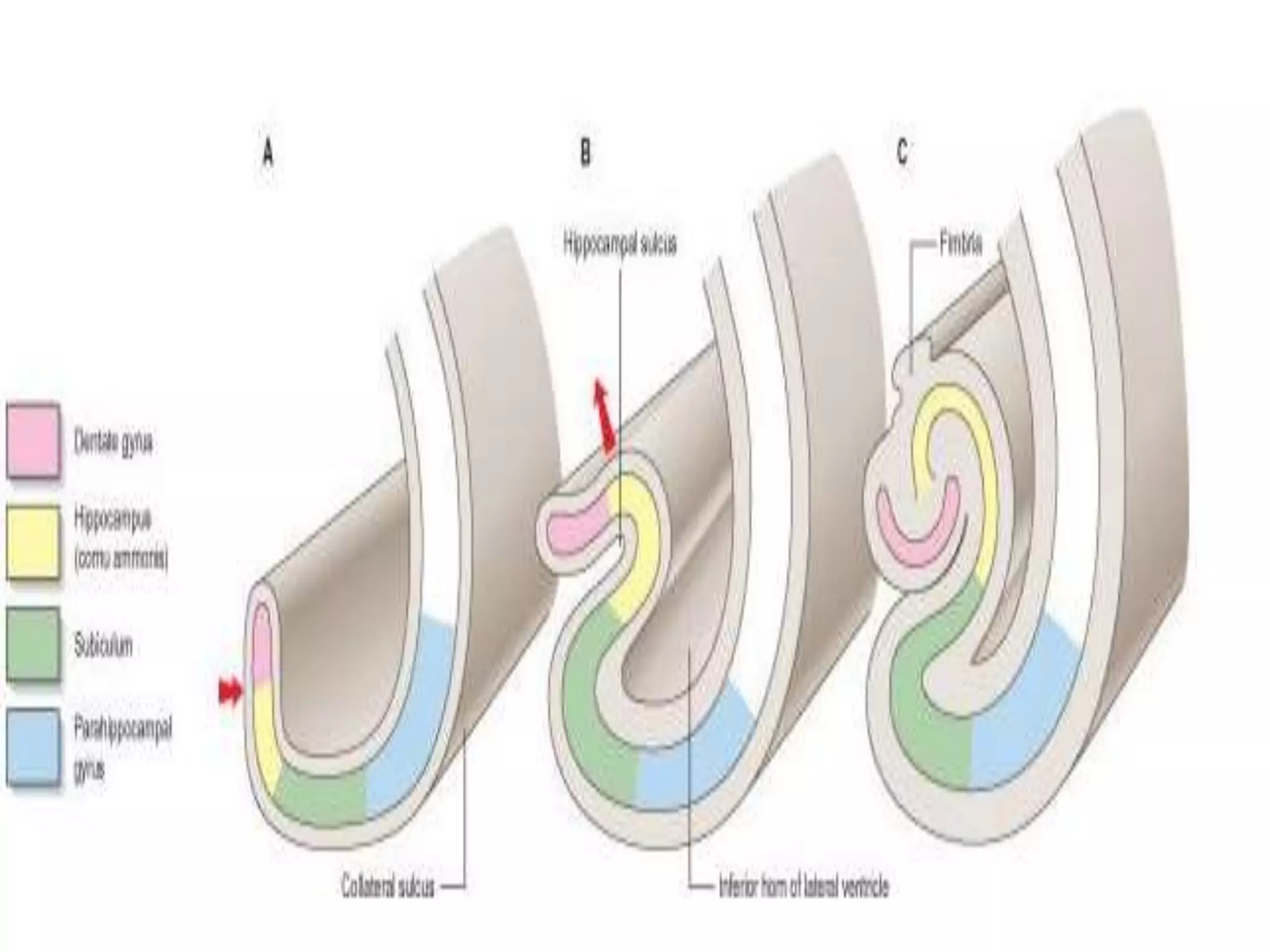
HIPPOCAMPUS
•   Cornu ammonis
•   Location :-
•   Pes hippocampi
•   Alveus
•   Fimbria
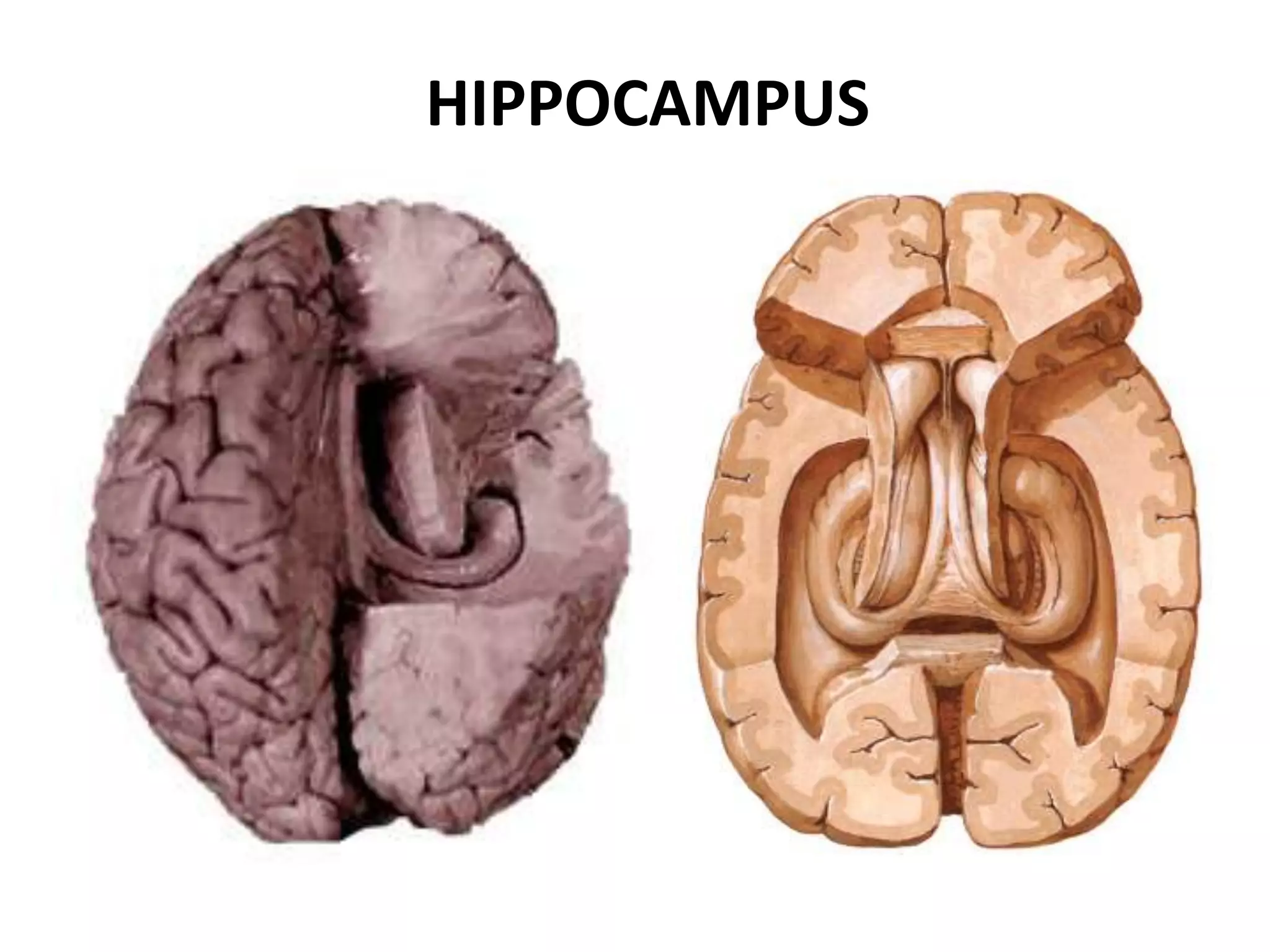
HIPPOCAMPUS
HIPPOCAMPUS
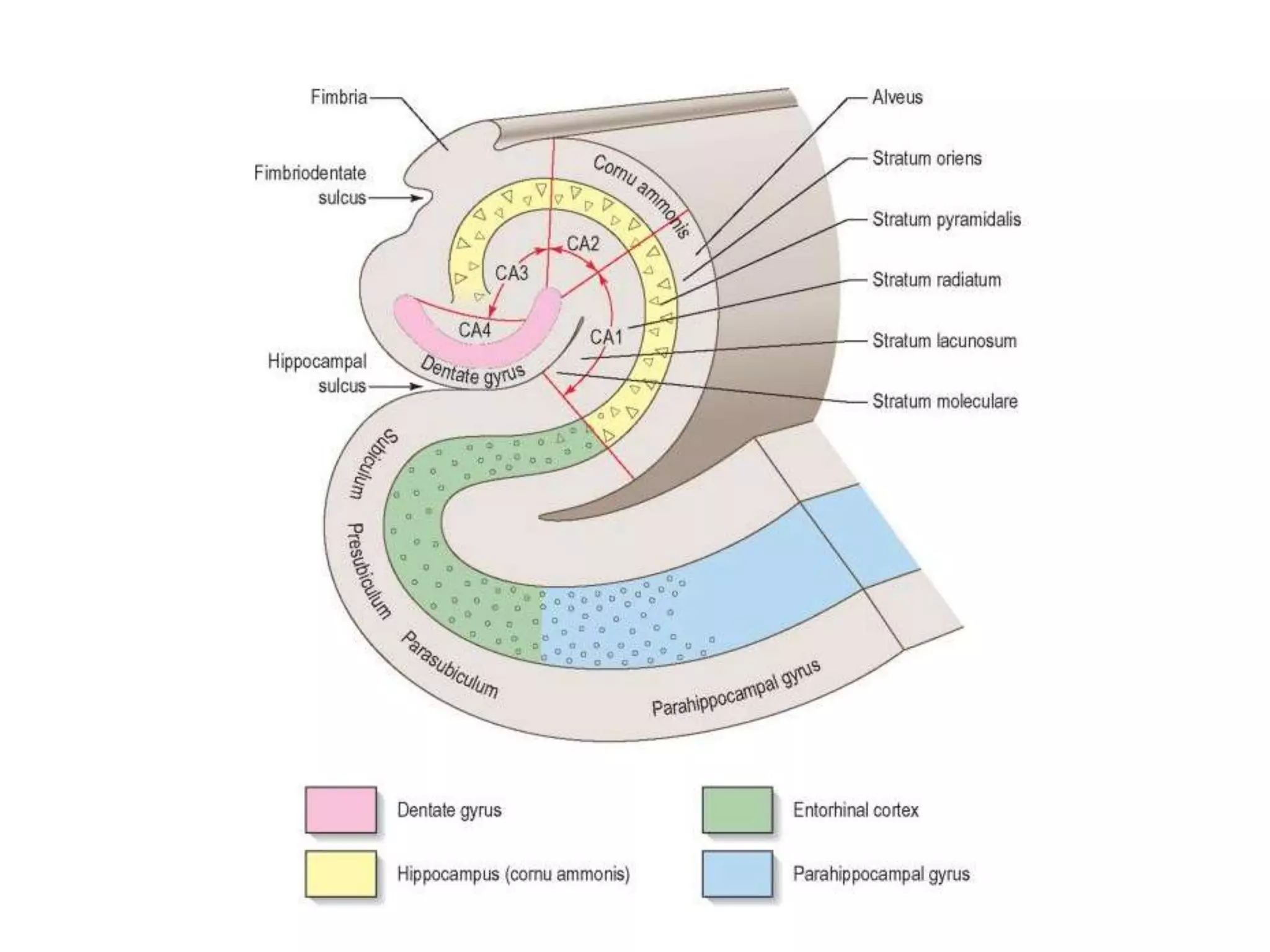
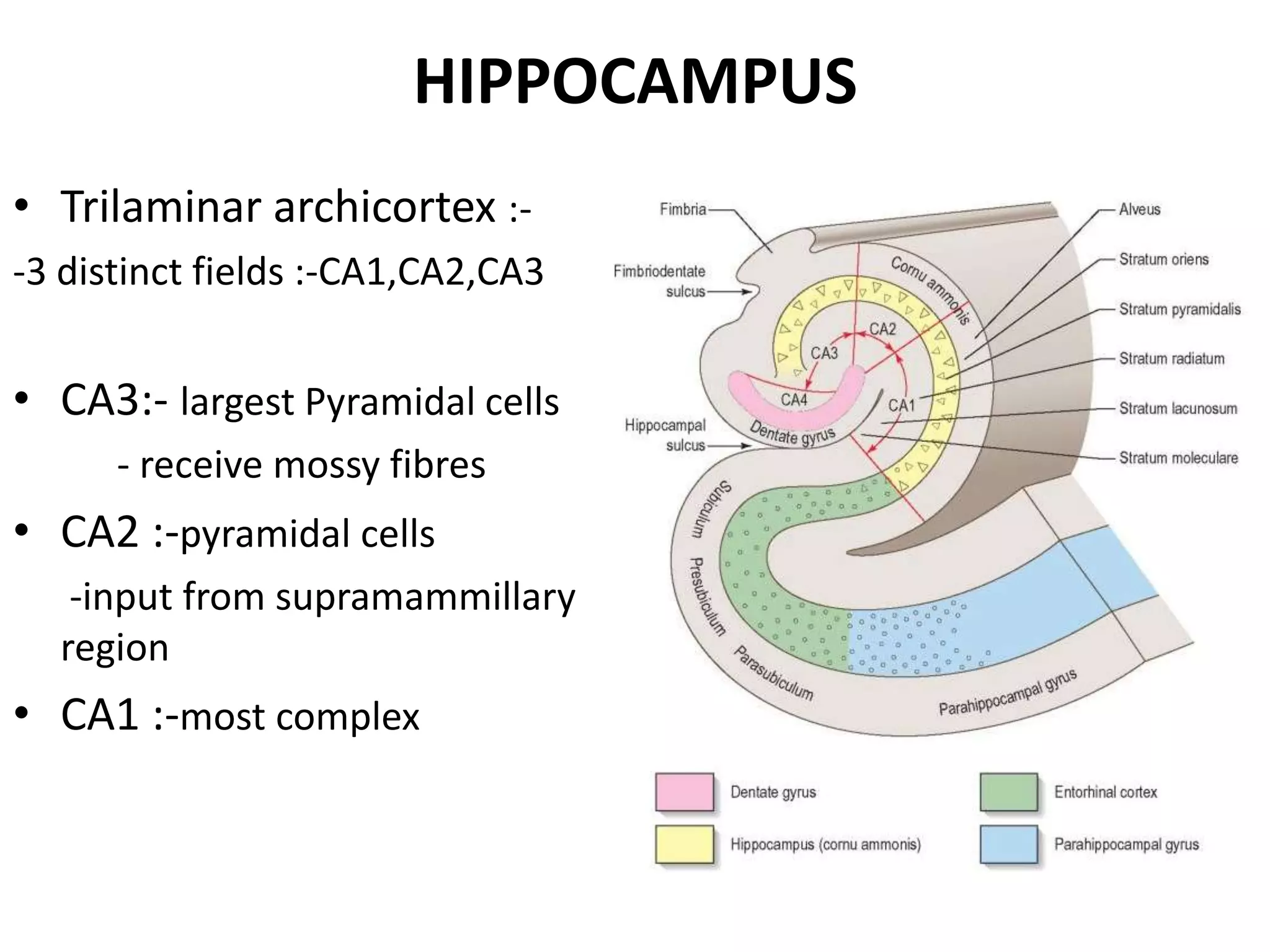
• Trilaminar archicortex :-
-3 distinct fields :-CA1,CA2,CA3


• CA3:- largest Pyramidal cells
      - receive mossy fibres
• CA2 :-pyramidal cells
   -input from supramammillary
  region
• CA1 :-most complex
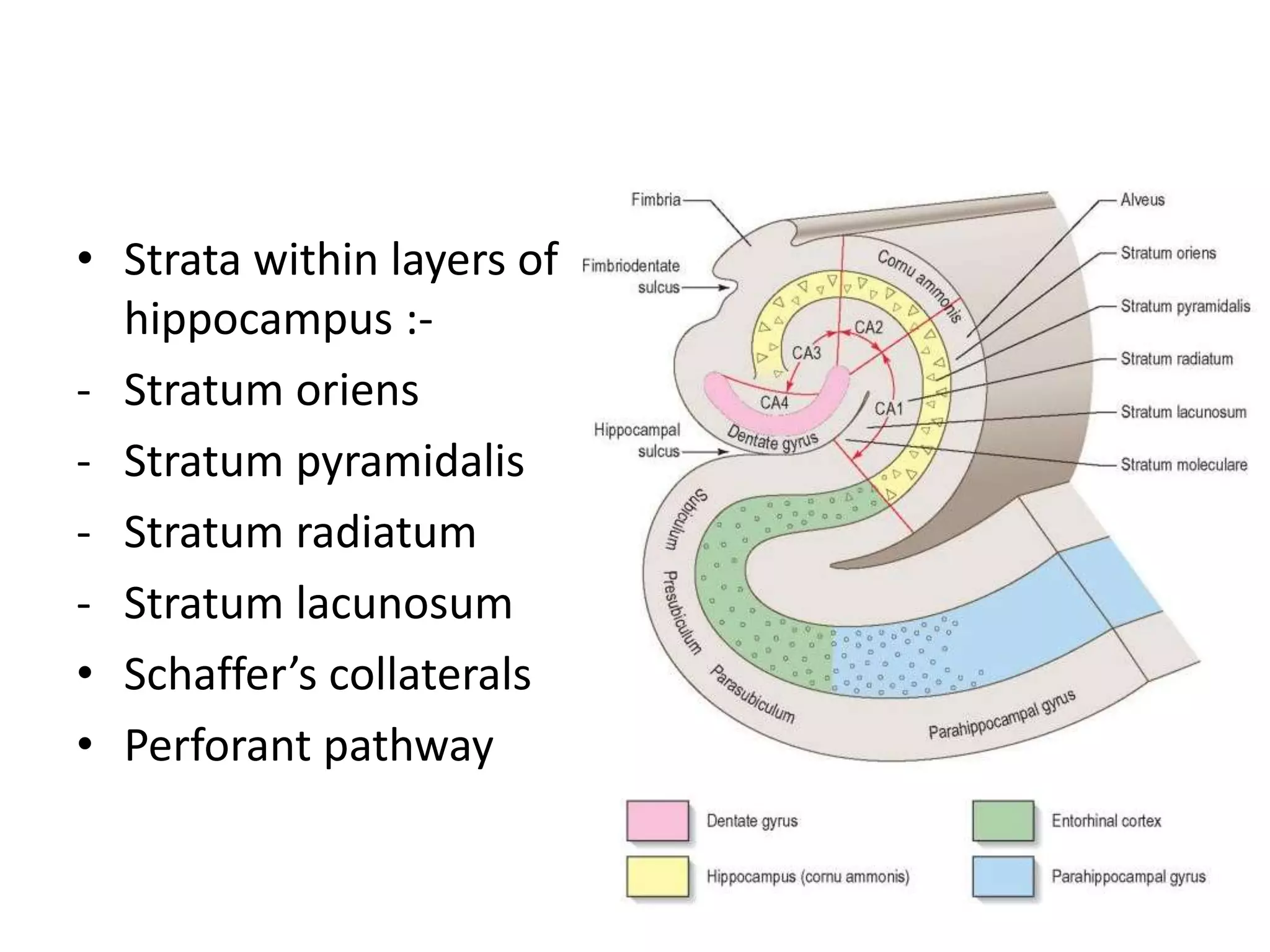
• Strata within layers of
  hippocampus :-
- Stratum oriens
- Stratum pyramidalis
- Stratum radiatum
- Stratum lacunosum
• Schaffer’s collaterals
• Perforant pathway
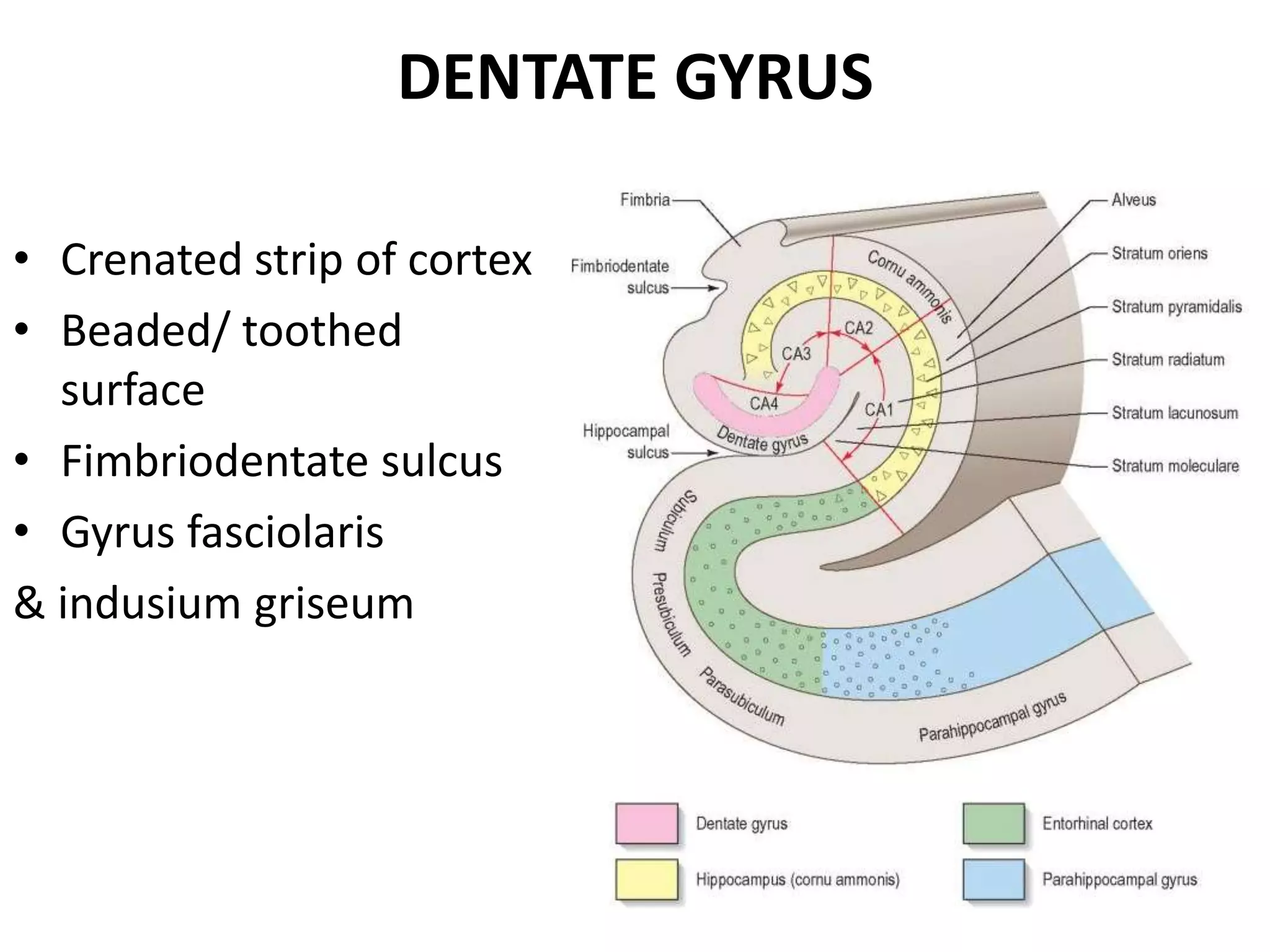
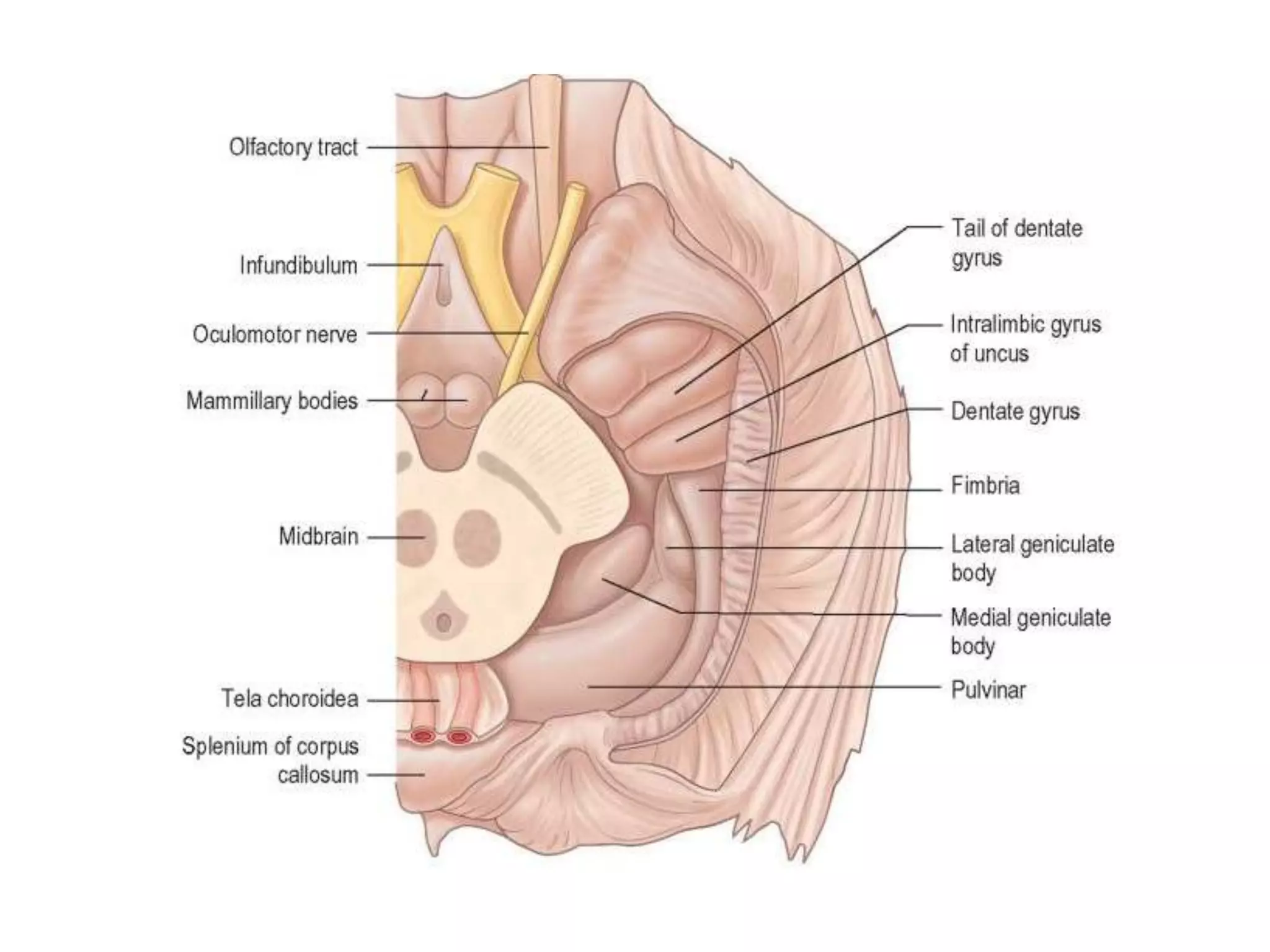
DENTATE GYRUS

• Crenated strip of cortex
• Beaded/ toothed
  surface
• Fimbriodentate sulcus
• Gyrus fasciolaris
& indusium griseum
LIMBIC SYSTEM
[
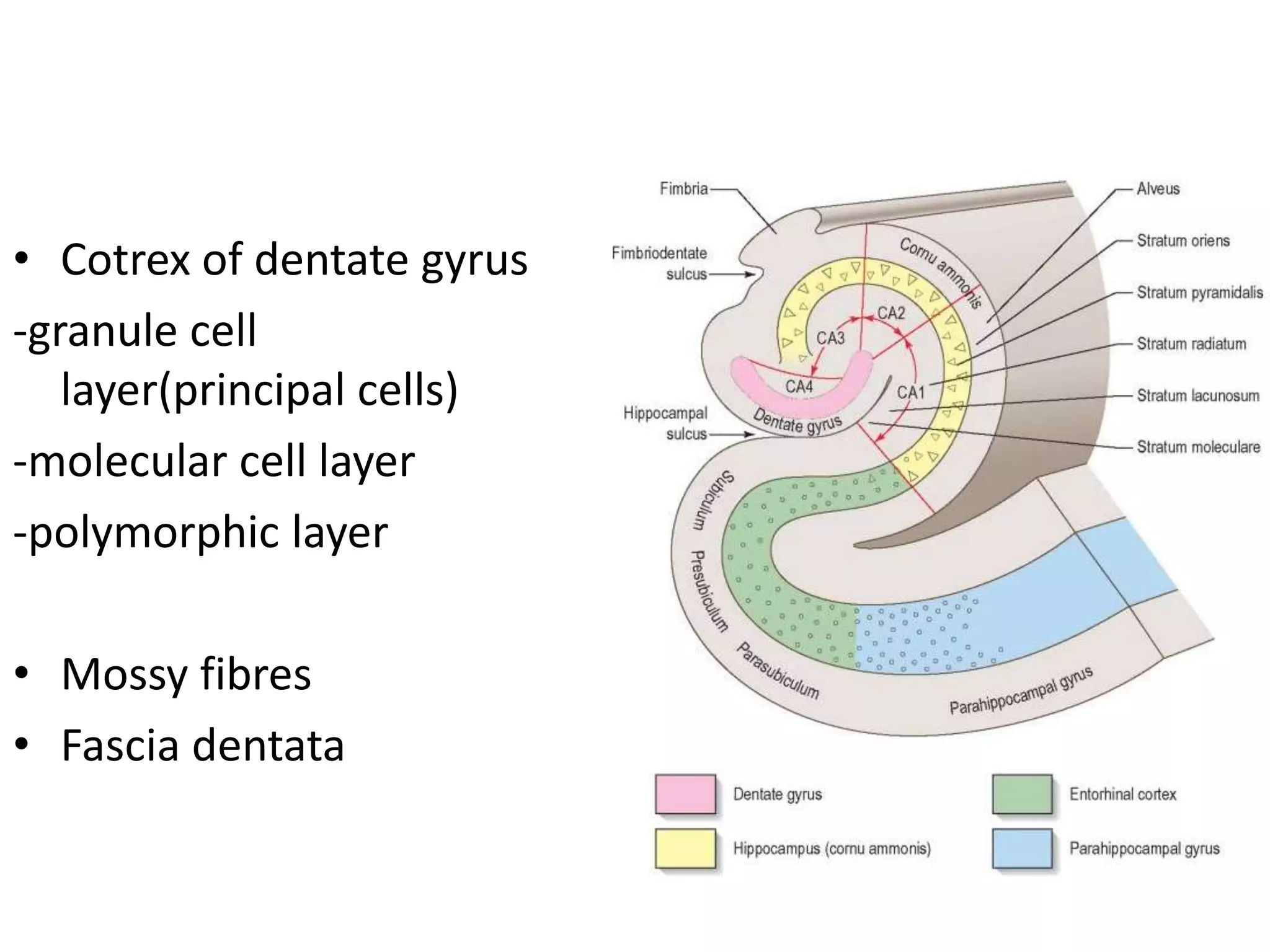
• Cotrex of dentate gyrus
-granule cell
   layer(principal cells)
-molecular cell layer
-polymorphic layer

• Mossy fibres
• Fascia dentata
SUBICULAR COMPLEX
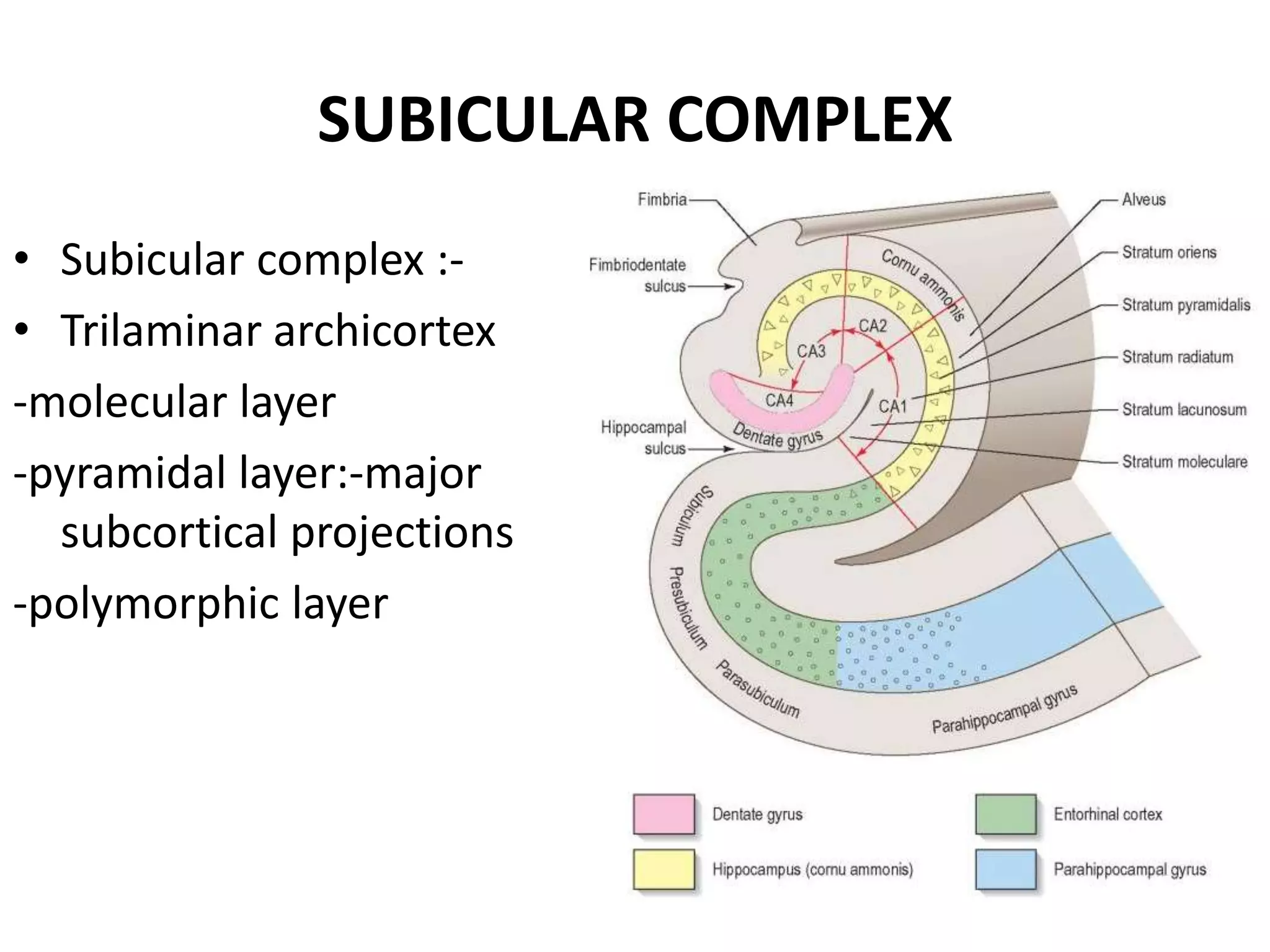
• Subicular complex :-
• Trilaminar archicortex
-molecular layer
-pyramidal layer:-major
  subcortical projections
-polymorphic layer
ENTORHINAL CORTEX
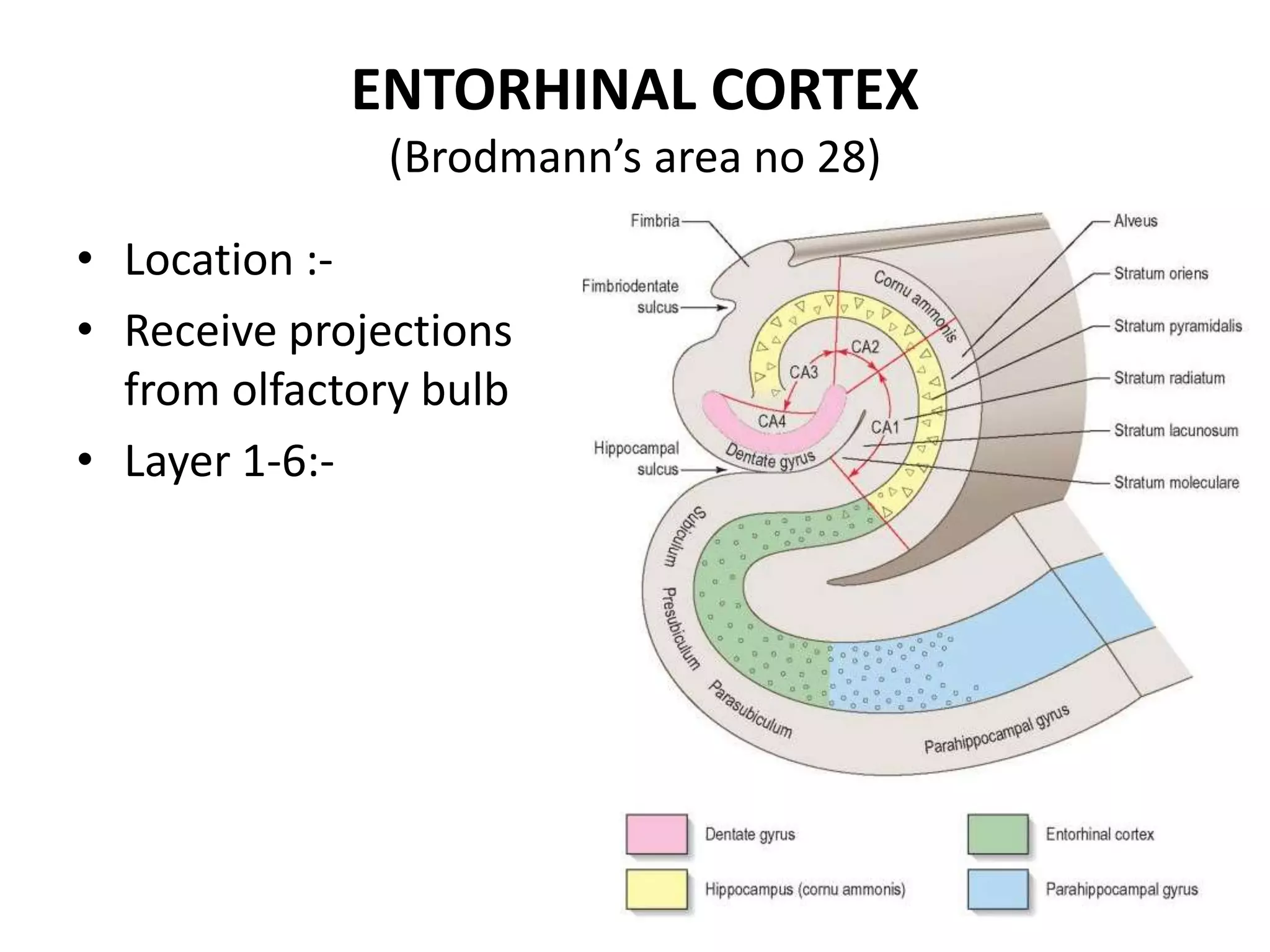
               (Brodmann’s area no 28)

• Location :-
• Receive projections
  from olfactory bulb
• Layer 1-6:-
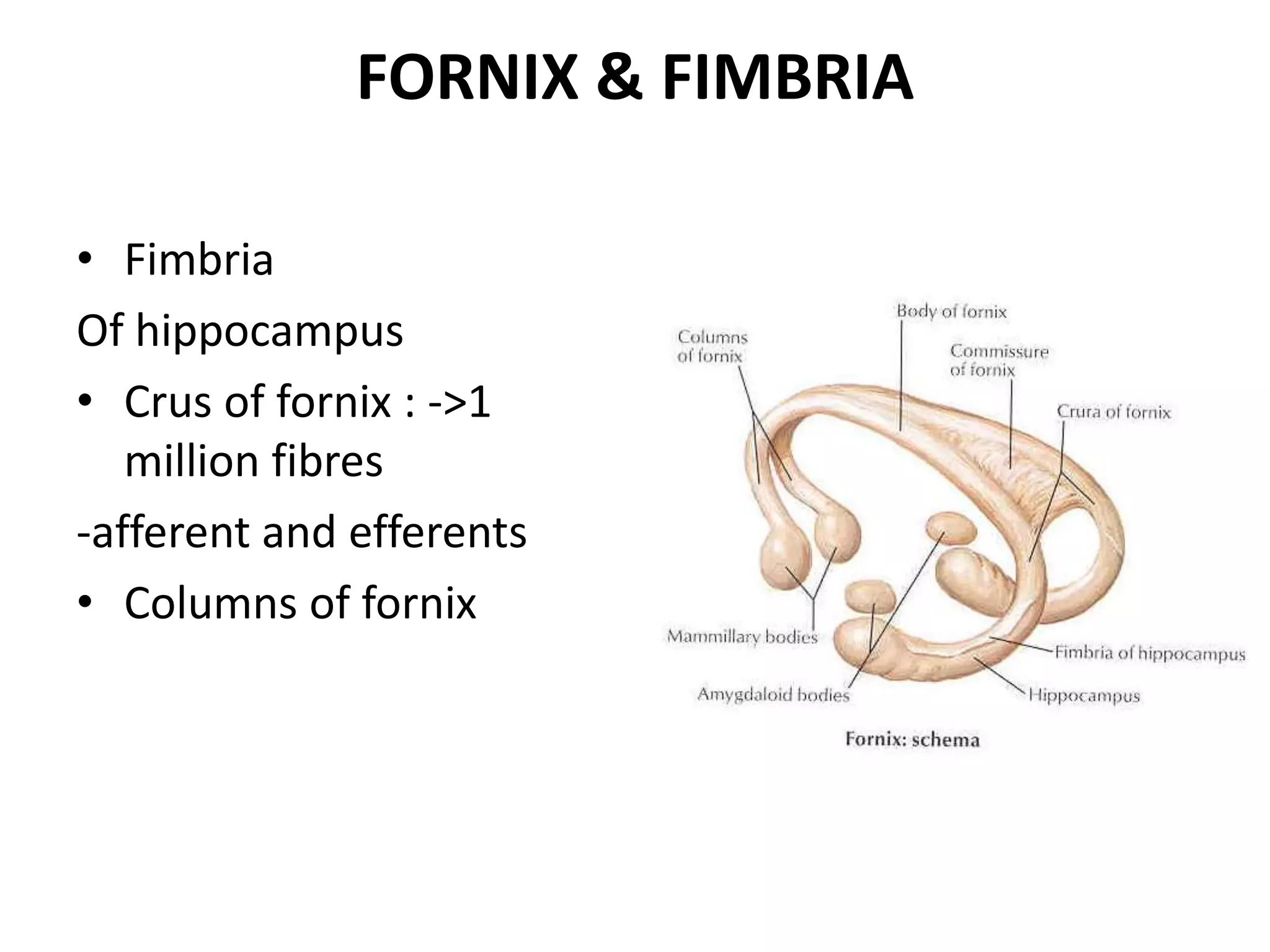
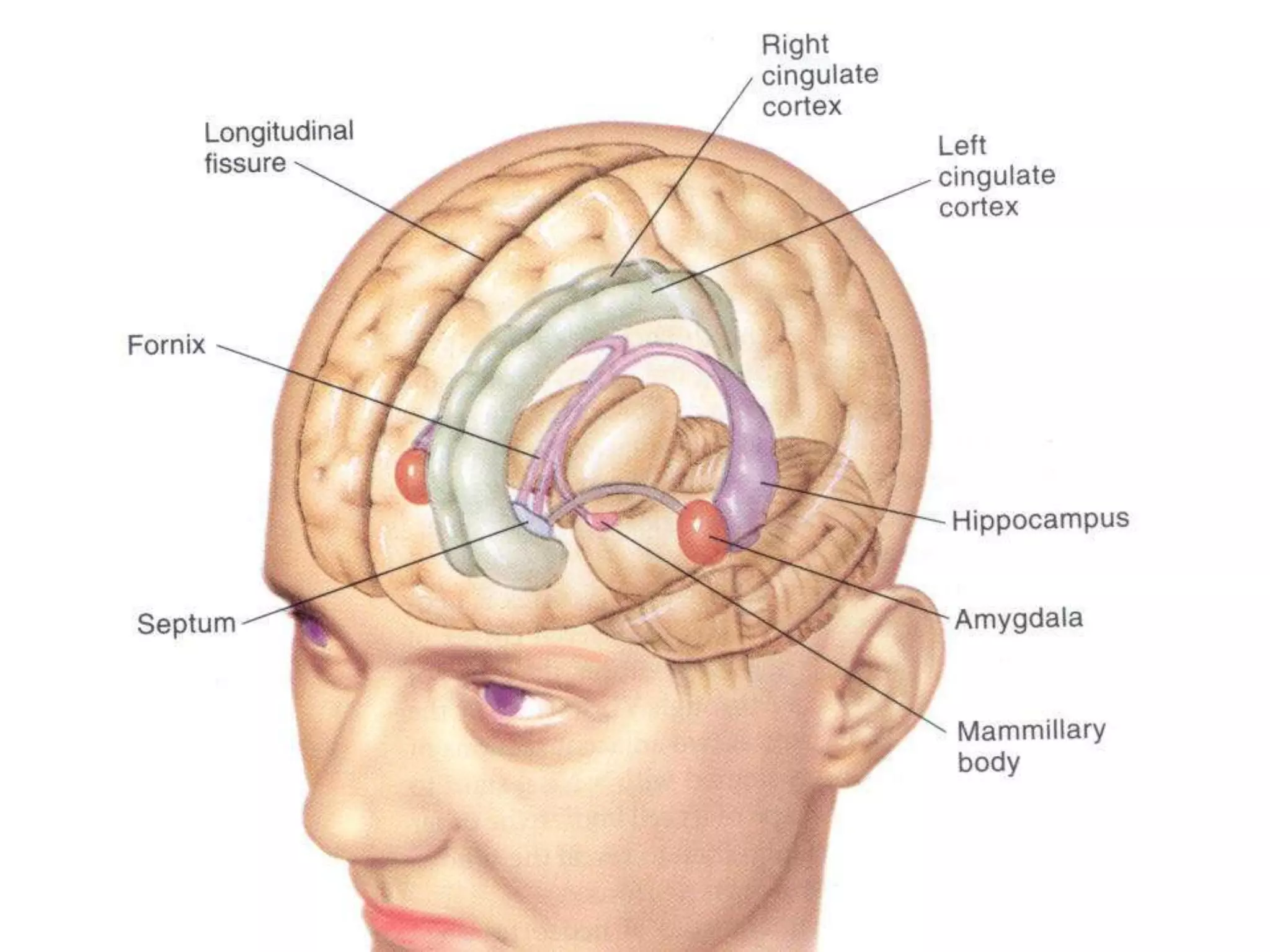
FORNIX & FIMBRIA

• Fimbria
Of hippocampus
• Crus of fornix : ->1
   million fibres
-afferent and efferents
• Columns of fornix
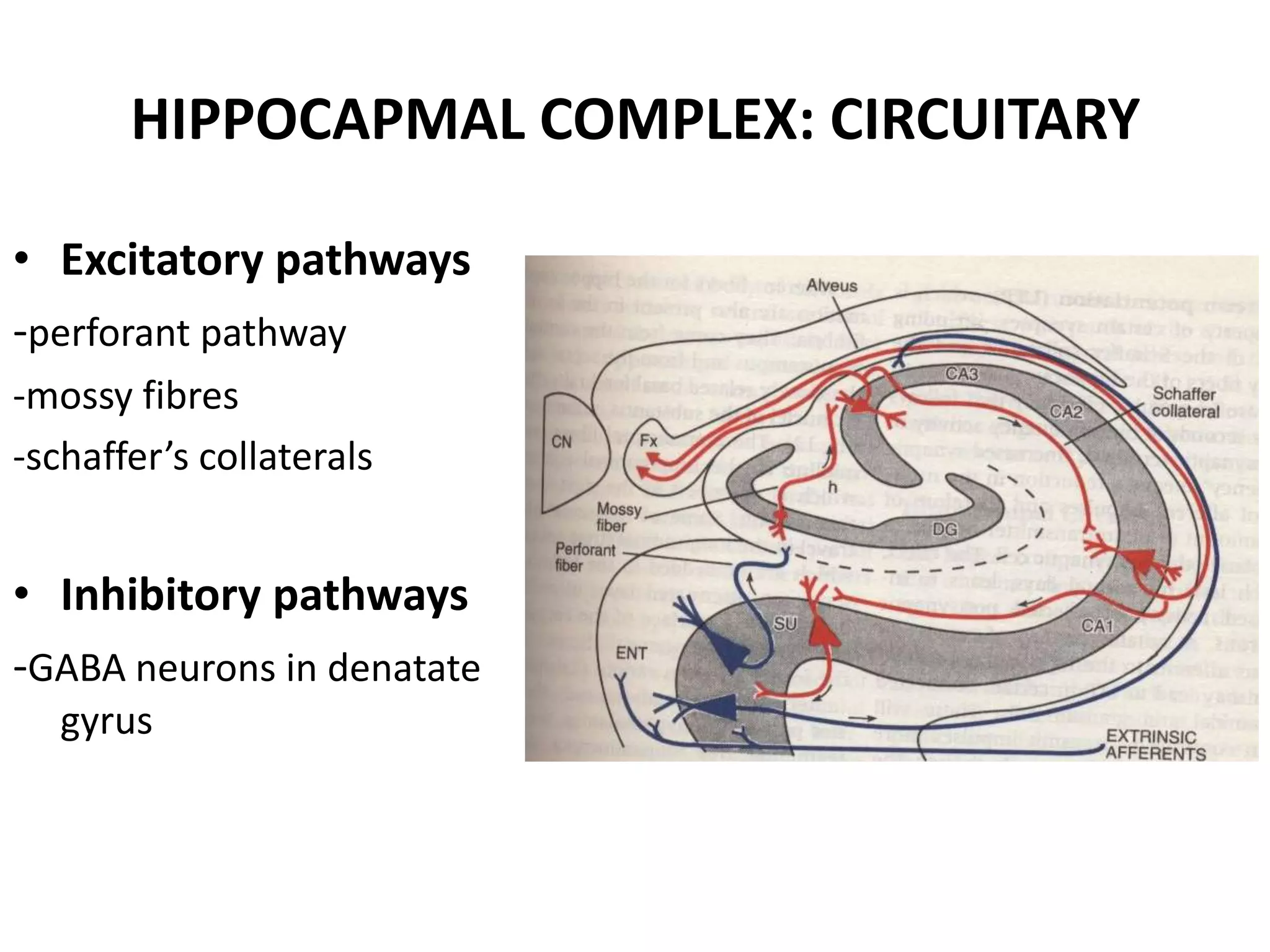
HIPPOCAPMAL COMPLEX: CIRCUITARY

• Excitatory pathways
-perforant pathway
-mossy fibres
-schaffer’s collaterals


• Inhibitory pathways
-GABA neurons in denatate
   gyrus
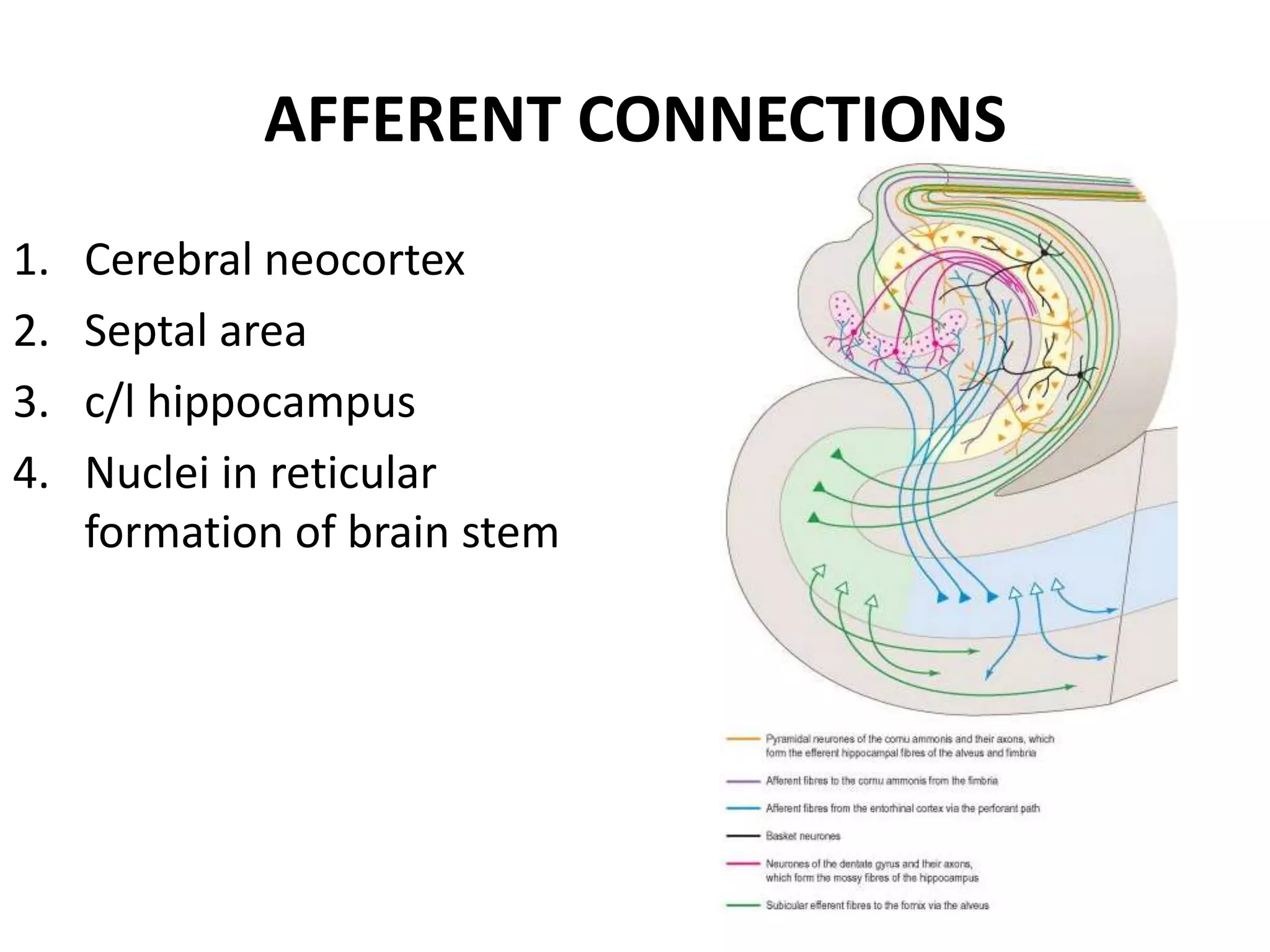
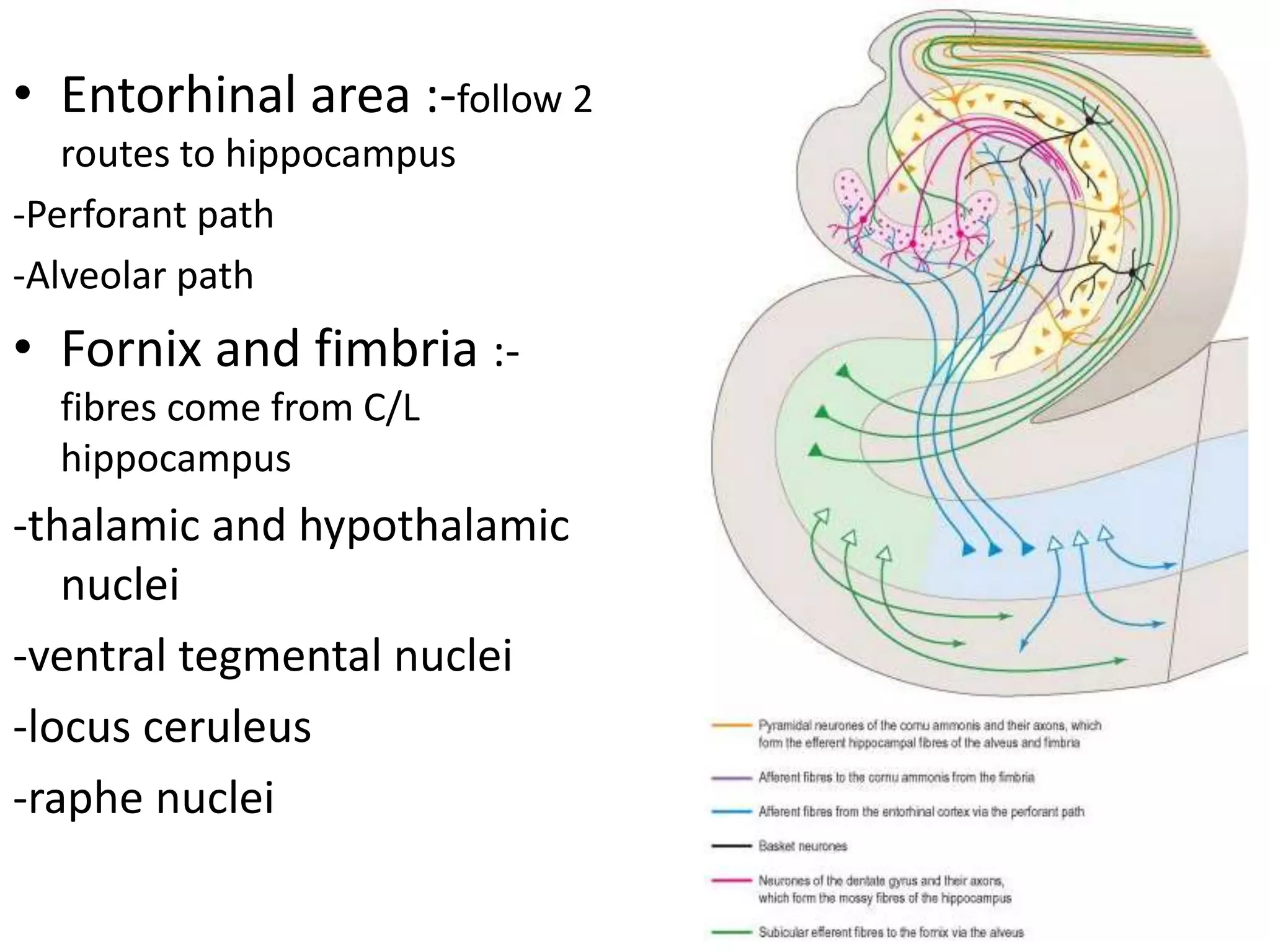
AFFERENT CONNECTIONS
1.   Cerebral neocortex
2.   Septal area
3.   c/l hippocampus
4.   Nuclei in reticular
     formation of brain stem
• Entorhinal area :-follow 2
   routes to hippocampus
-Perforant path
-Alveolar path
• Fornix and fimbria :-
  fibres come from C/L
  hippocampus
-thalamic and hypothalamic
   nuclei
-ventral tegmental nuclei
-locus ceruleus
-raphe nuclei
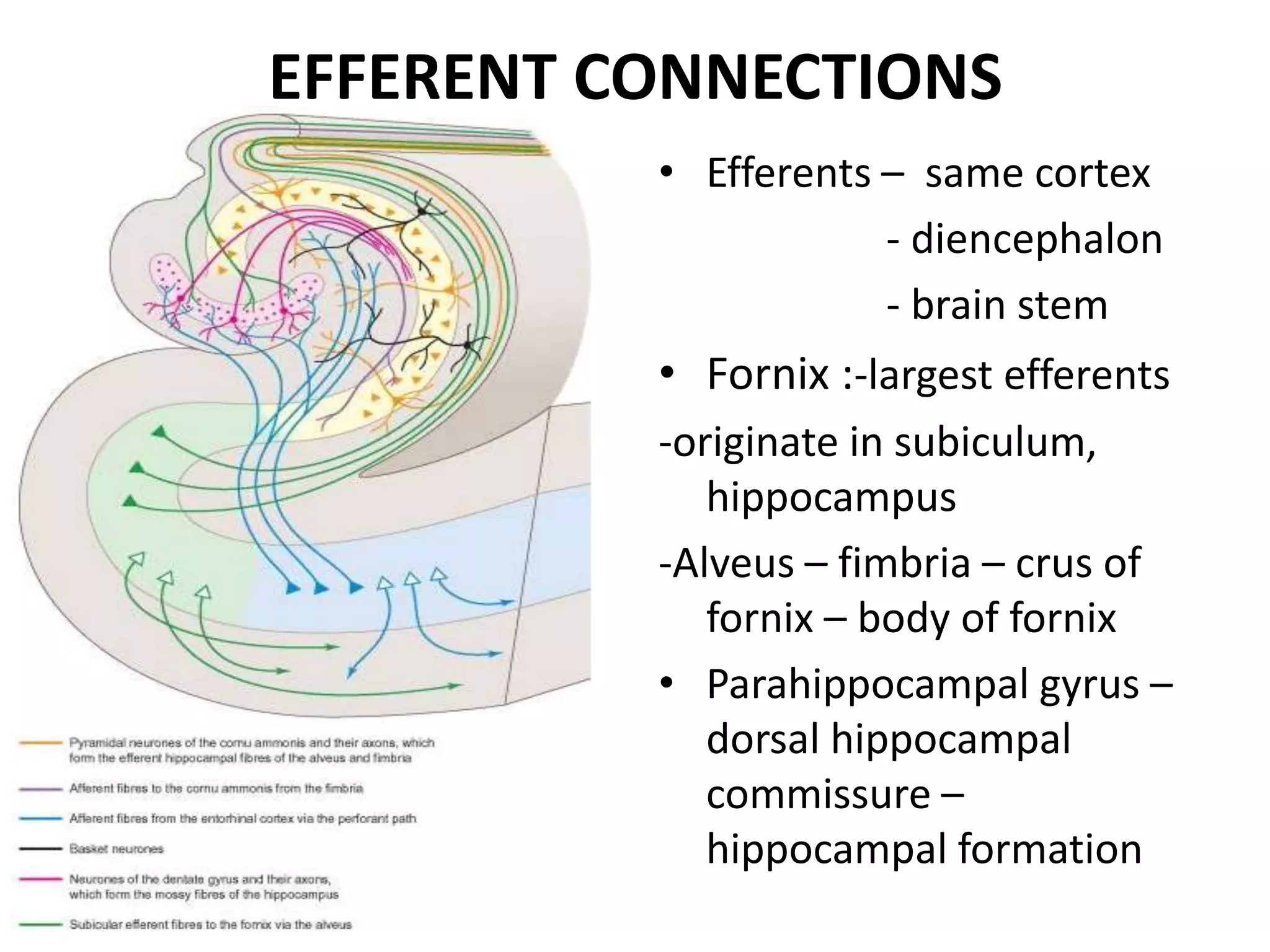
EFFERENT CONNECTIONS
          • Efferents – same cortex
                      - diencephalon
                      - brain stem
          • Fornix :-largest efferents
          -originate in subiculum,
             hippocampus
          -Alveus – fimbria – crus of
             fornix – body of fornix
          • Parahippocampal gyrus –
             dorsal hippocampal
             commissure –
             hippocampal formation
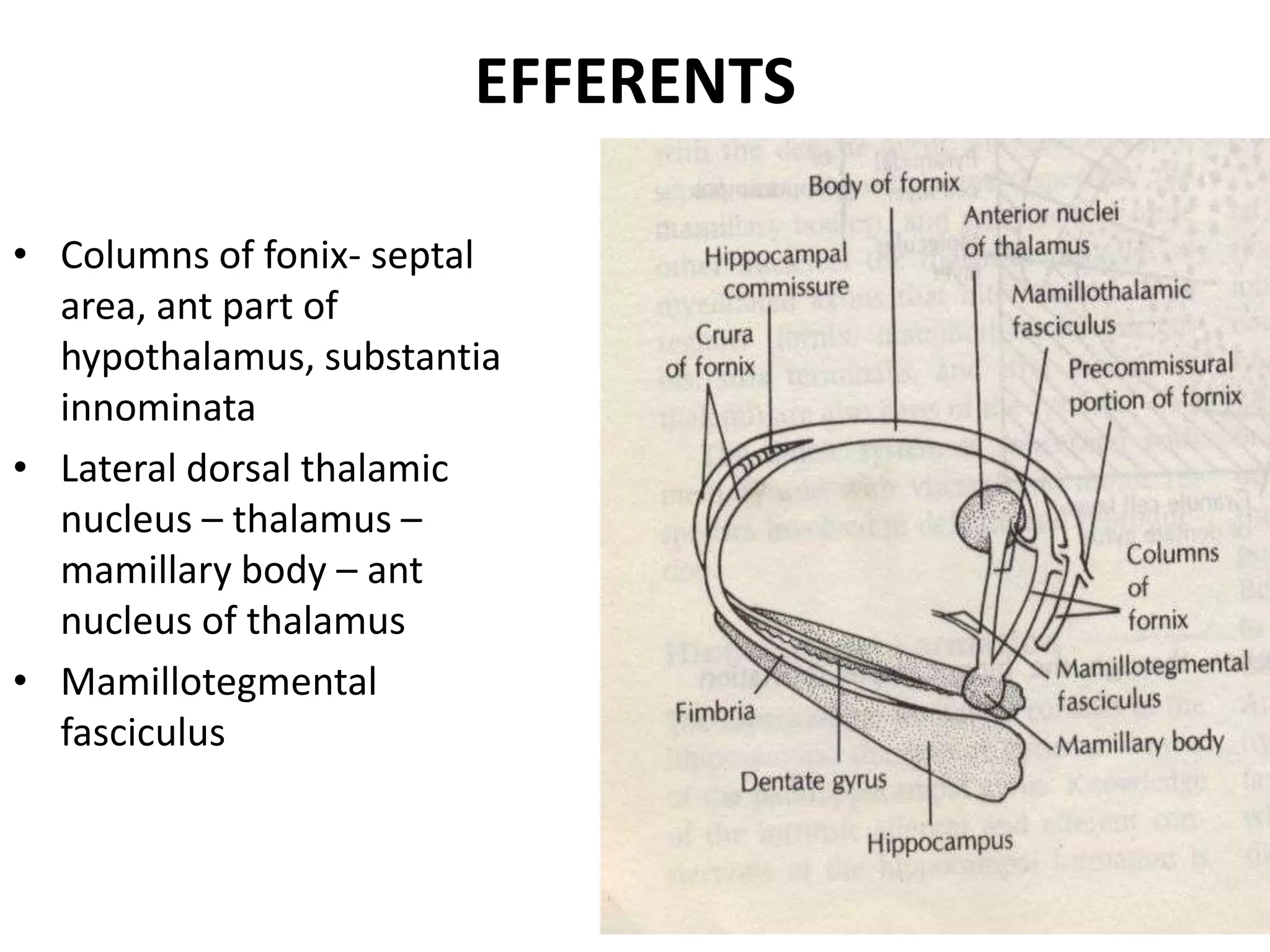
EFFERENTS

• Columns of fonix- septal
  area, ant part of
  hypothalamus, substantia
  innominata
• Lateral dorsal thalamic
  nucleus – thalamus –
  mamillary body – ant
  nucleus of thalamus
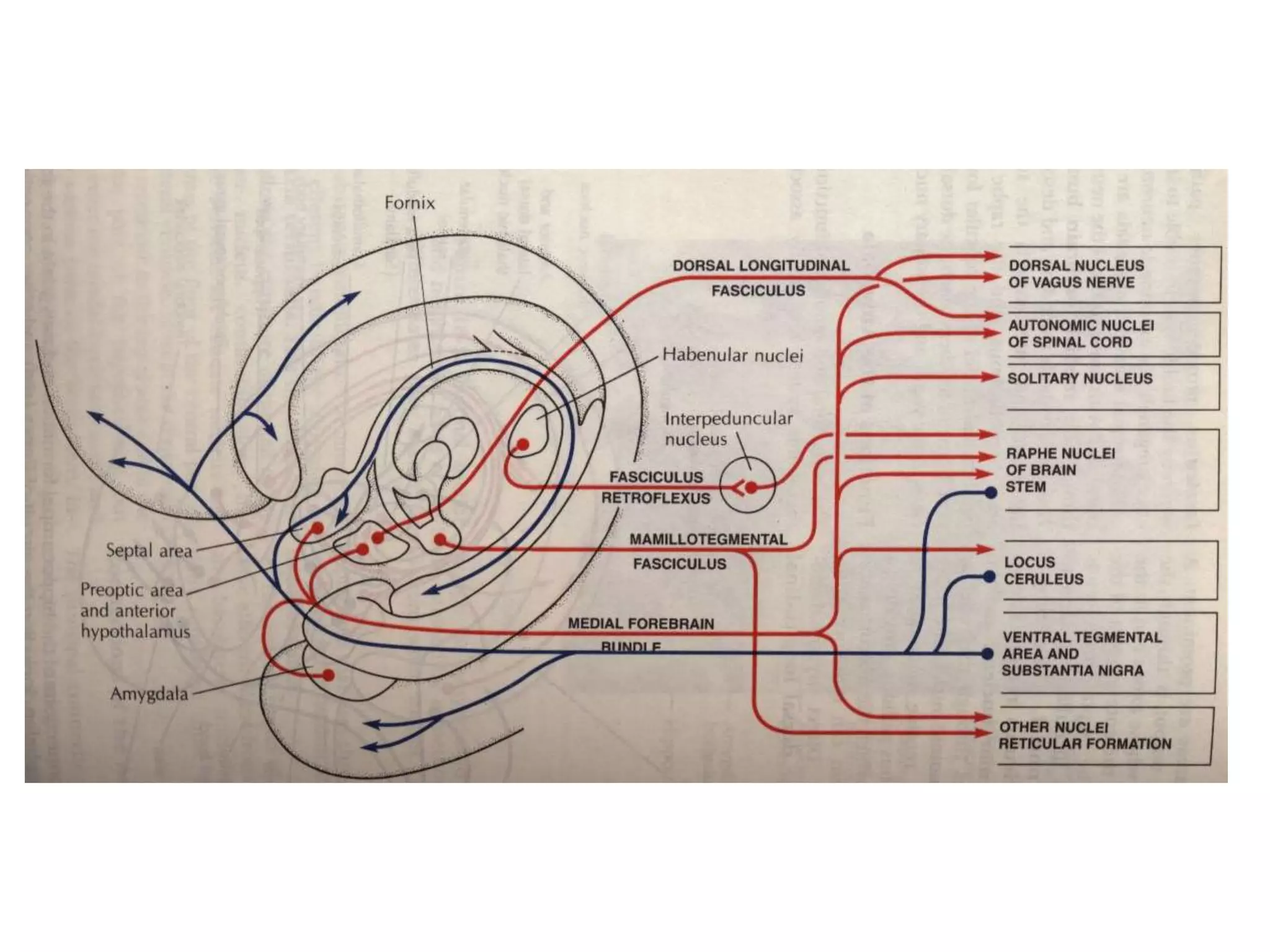
• Mamillotegmental
  fasciculus
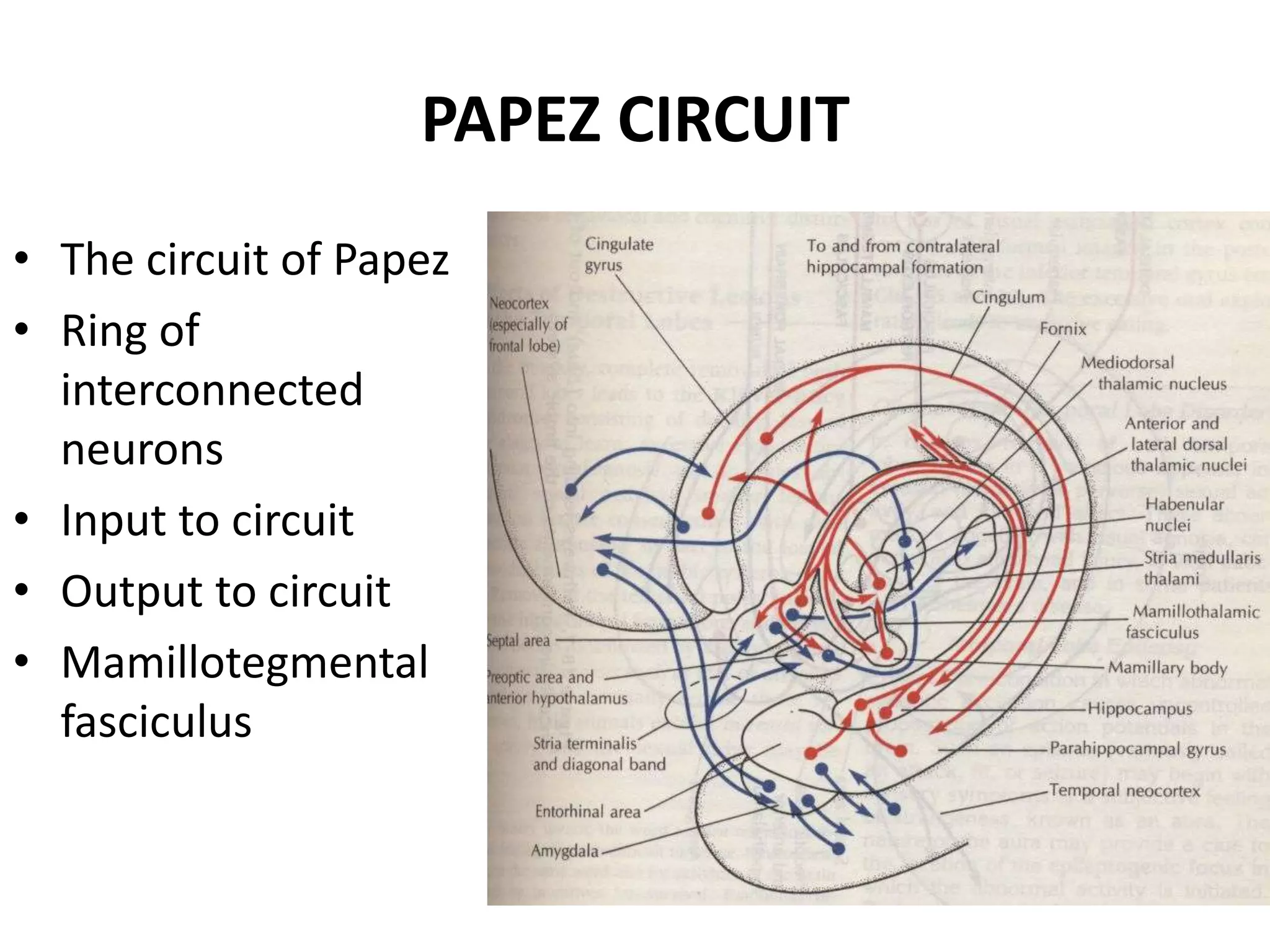
PAPEZ CIRCUIT
• The circuit of Papez
• Ring of
  interconnected
  neurons
• Input to circuit
• Output to circuit
• Mamillotegmental
  fasciculus
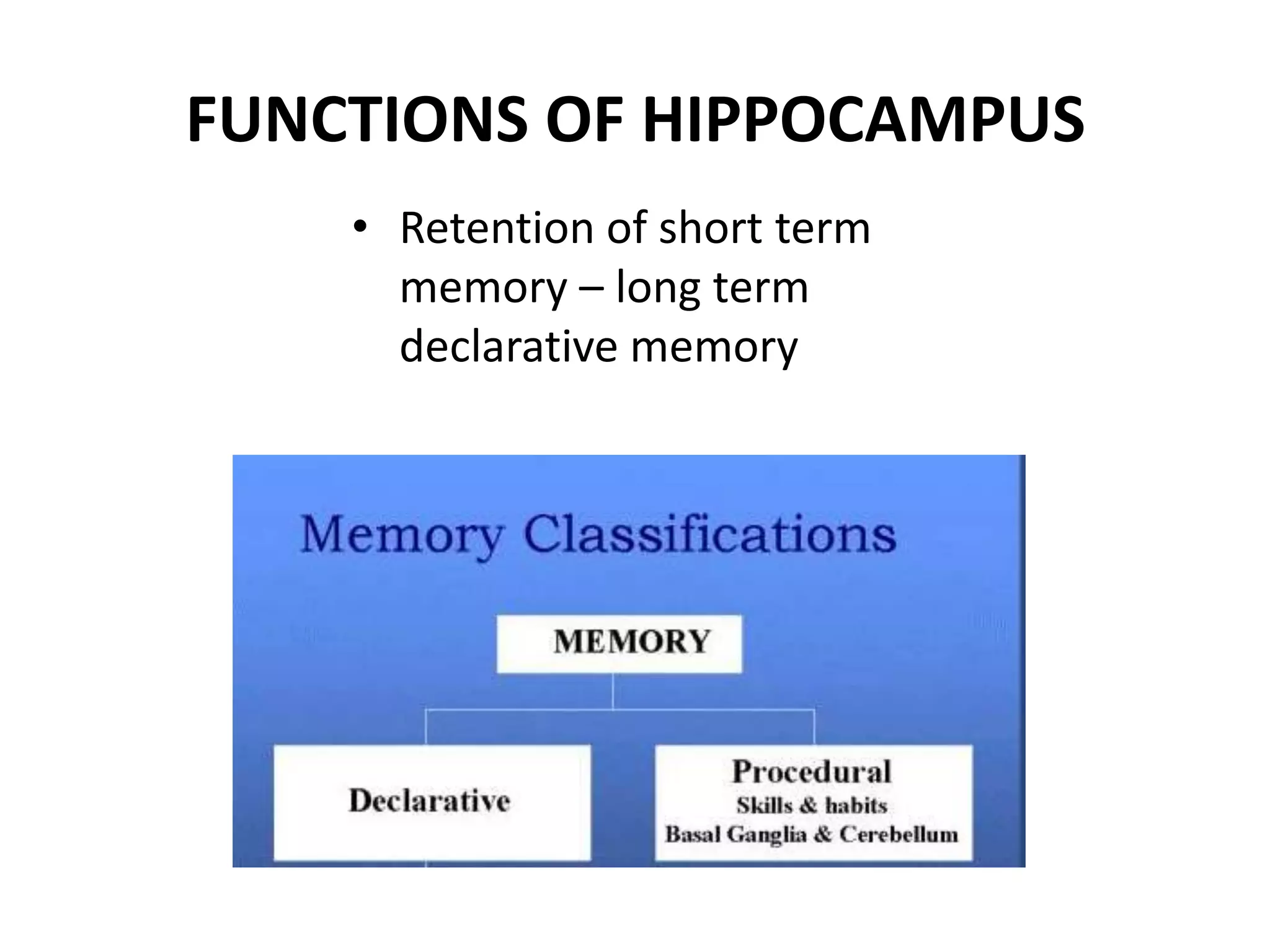
FUNCTIONS OF HIPPOCAMPUS
    • Retention of short term
      memory – long term
      declarative memory
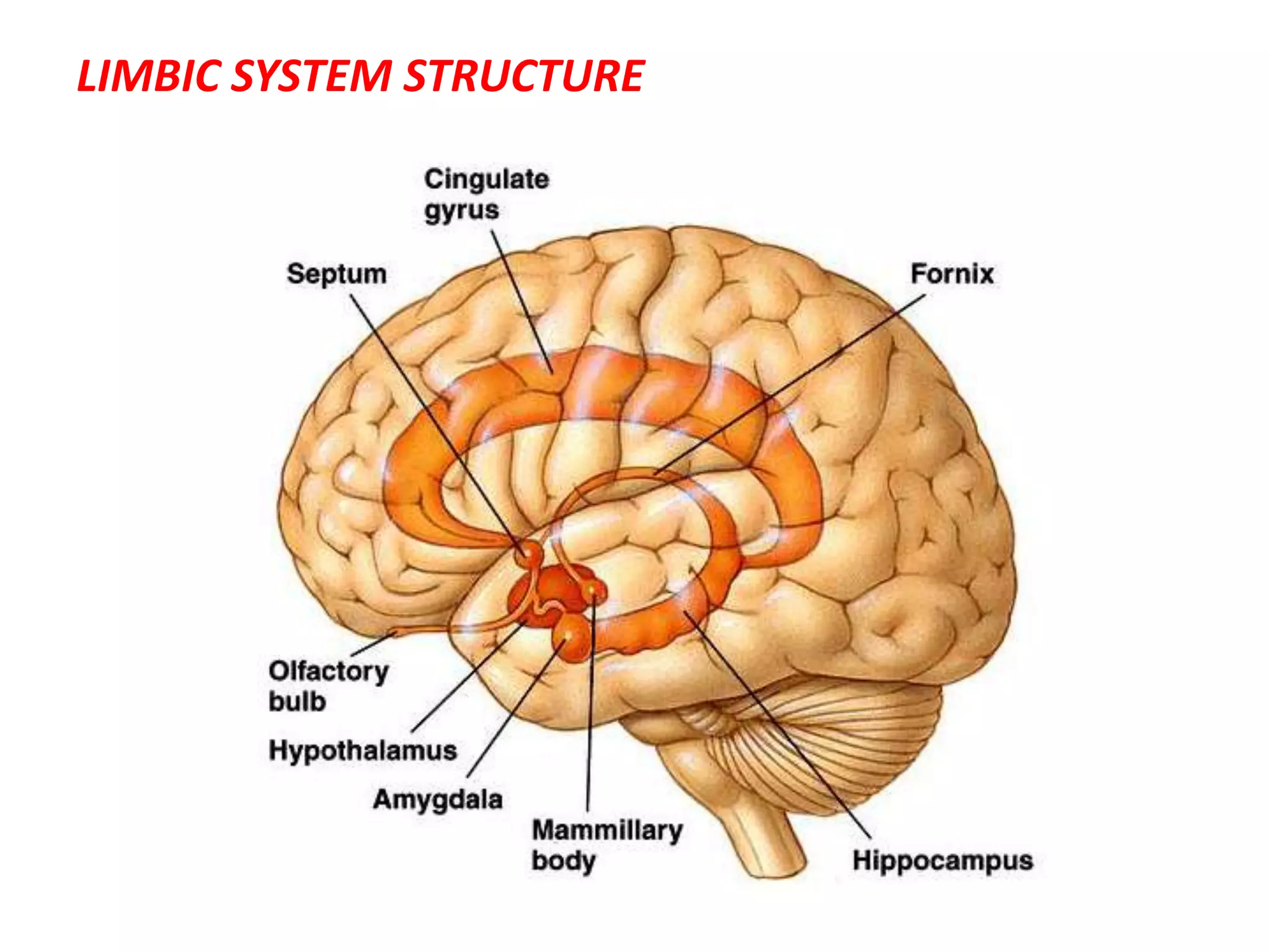
LIMBIC SYSTEM STRUCTURE
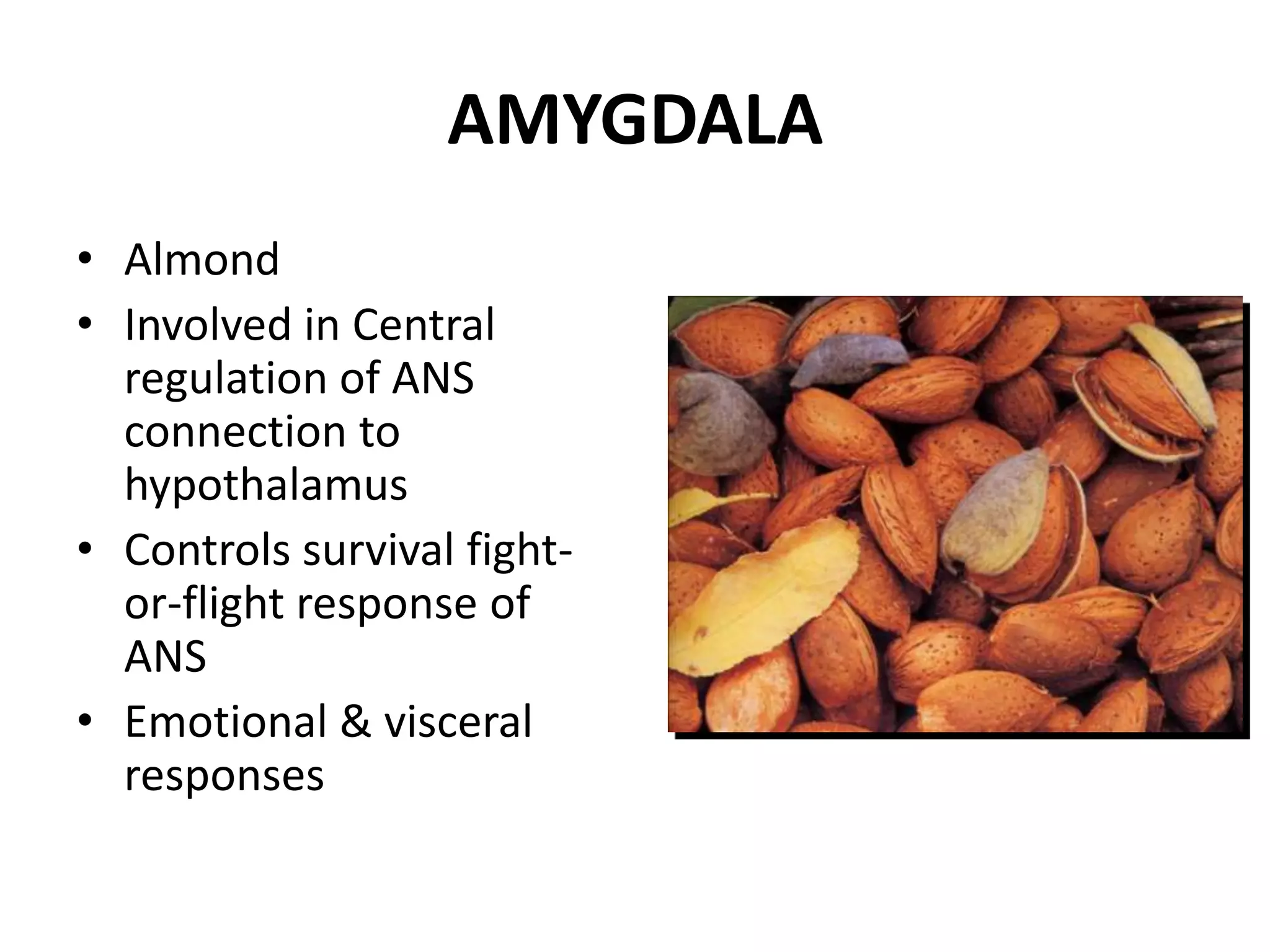
AMYGDALA
• Almond
• Involved in Central
  regulation of ANS
  connection to
  hypothalamus
• Controls survival fight-
  or-flight response of
  ANS
• Emotional & visceral
  responses
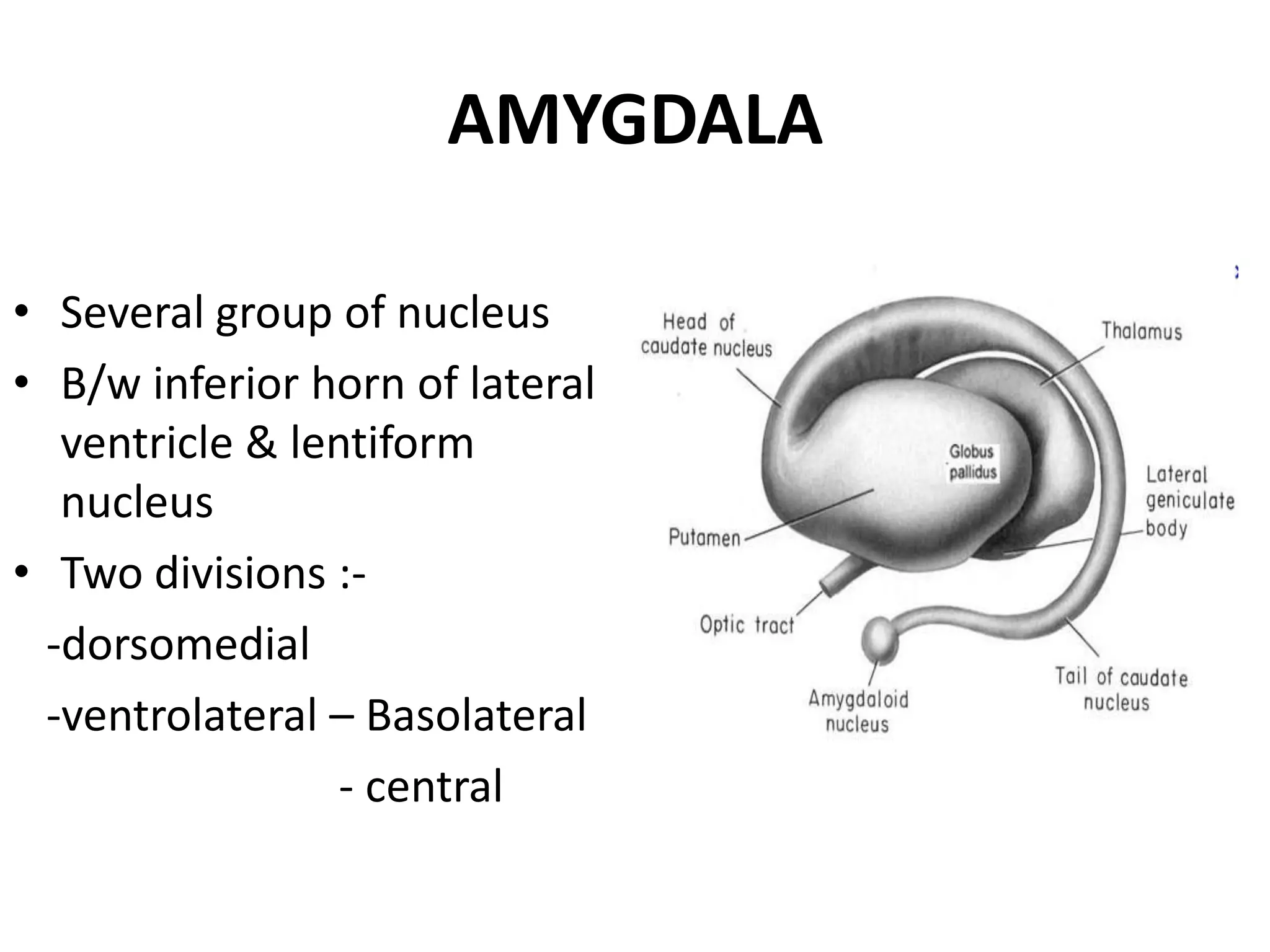
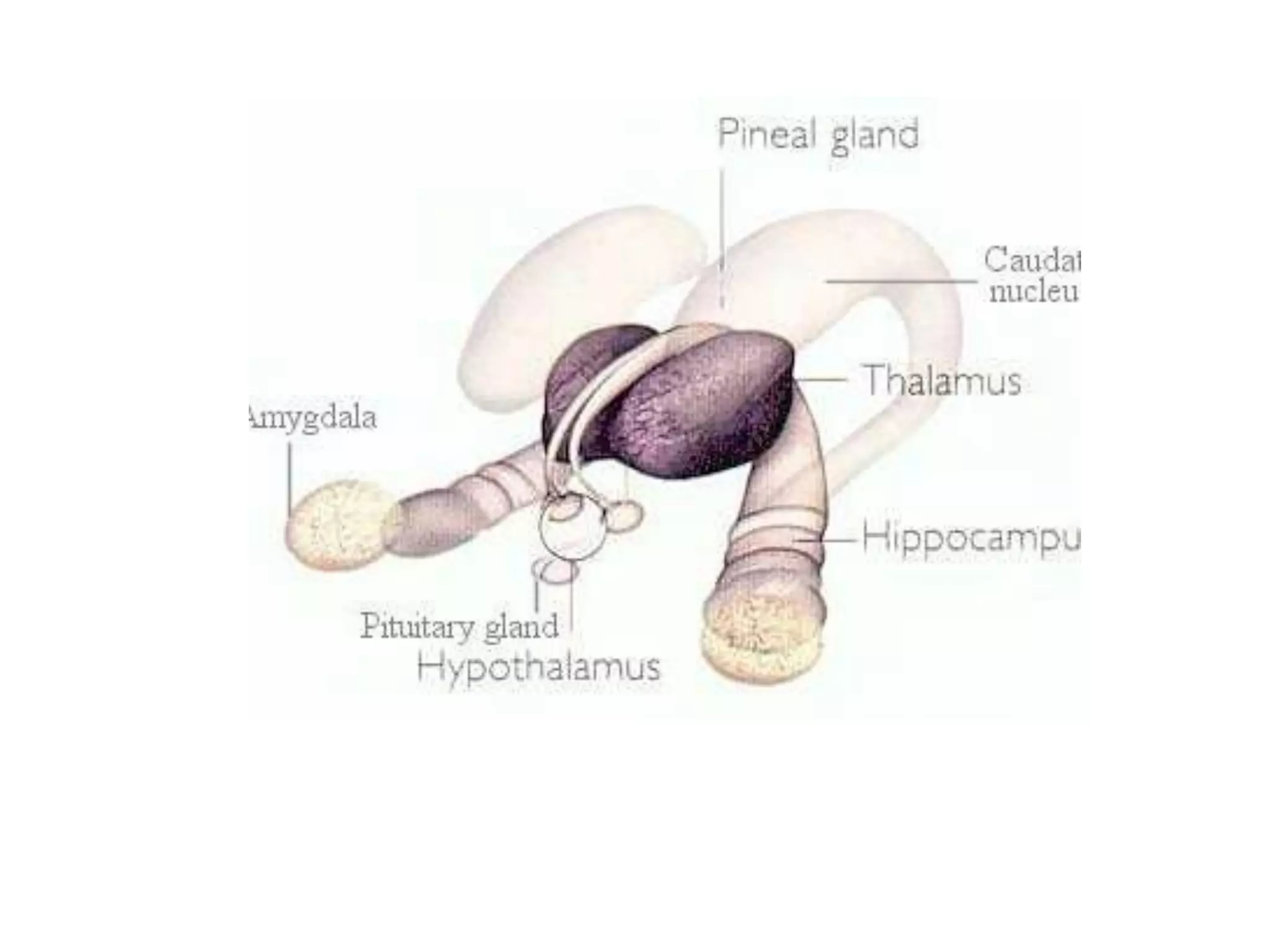
AMYGDALA

• Several group of nucleus
• B/w inferior horn of lateral
   ventricle & lentiform
   nucleus
• Two divisions :-
  -dorsomedial
  -ventrolateral – Basolateral
                  - central
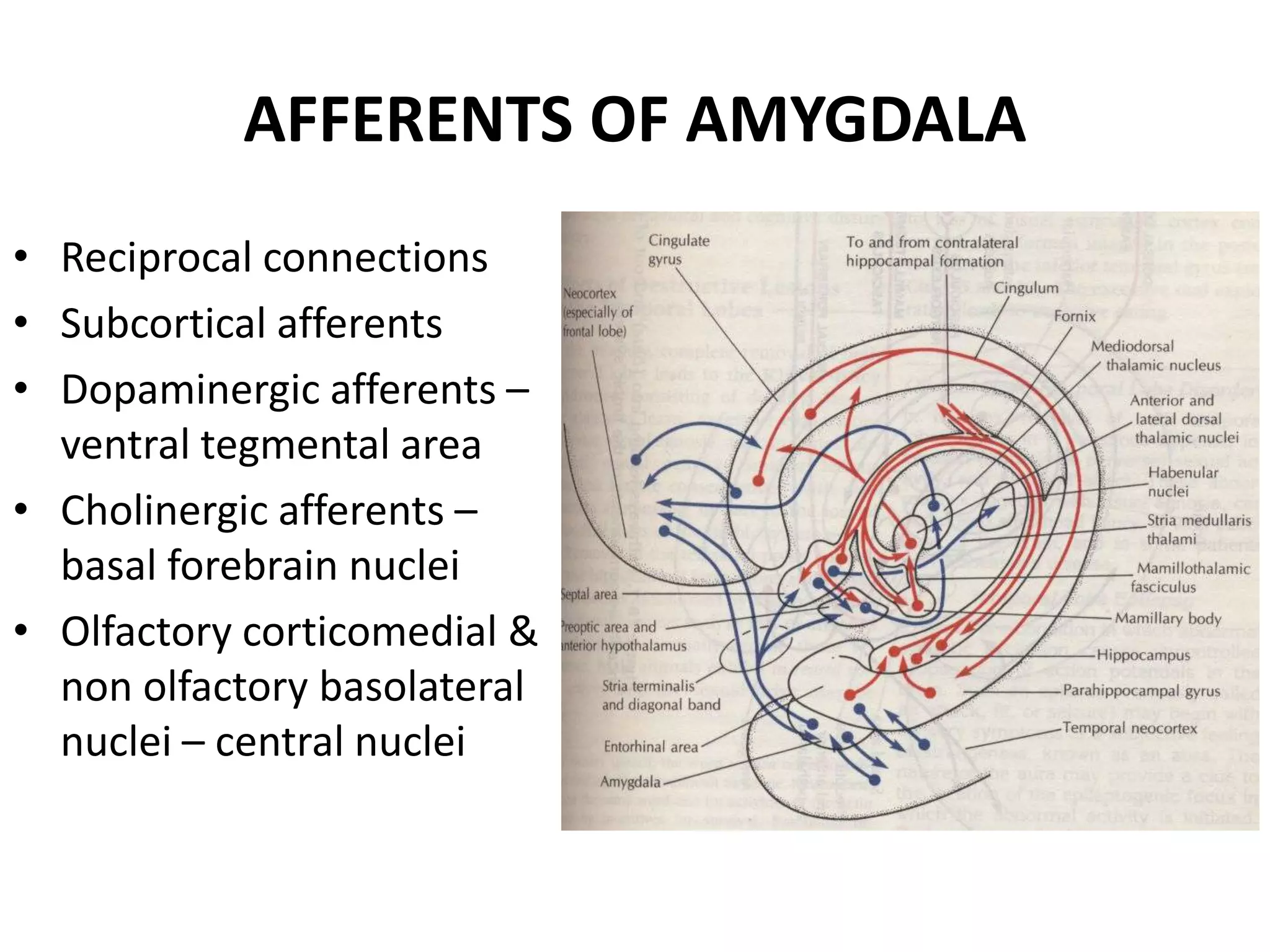
AFFERENTS OF AMYGDALA
• Reciprocal connections
• Subcortical afferents
• Dopaminergic afferents –
  ventral tegmental area
• Cholinergic afferents –
  basal forebrain nuclei
• Olfactory corticomedial &
  non olfactory basolateral
  nuclei – central nuclei
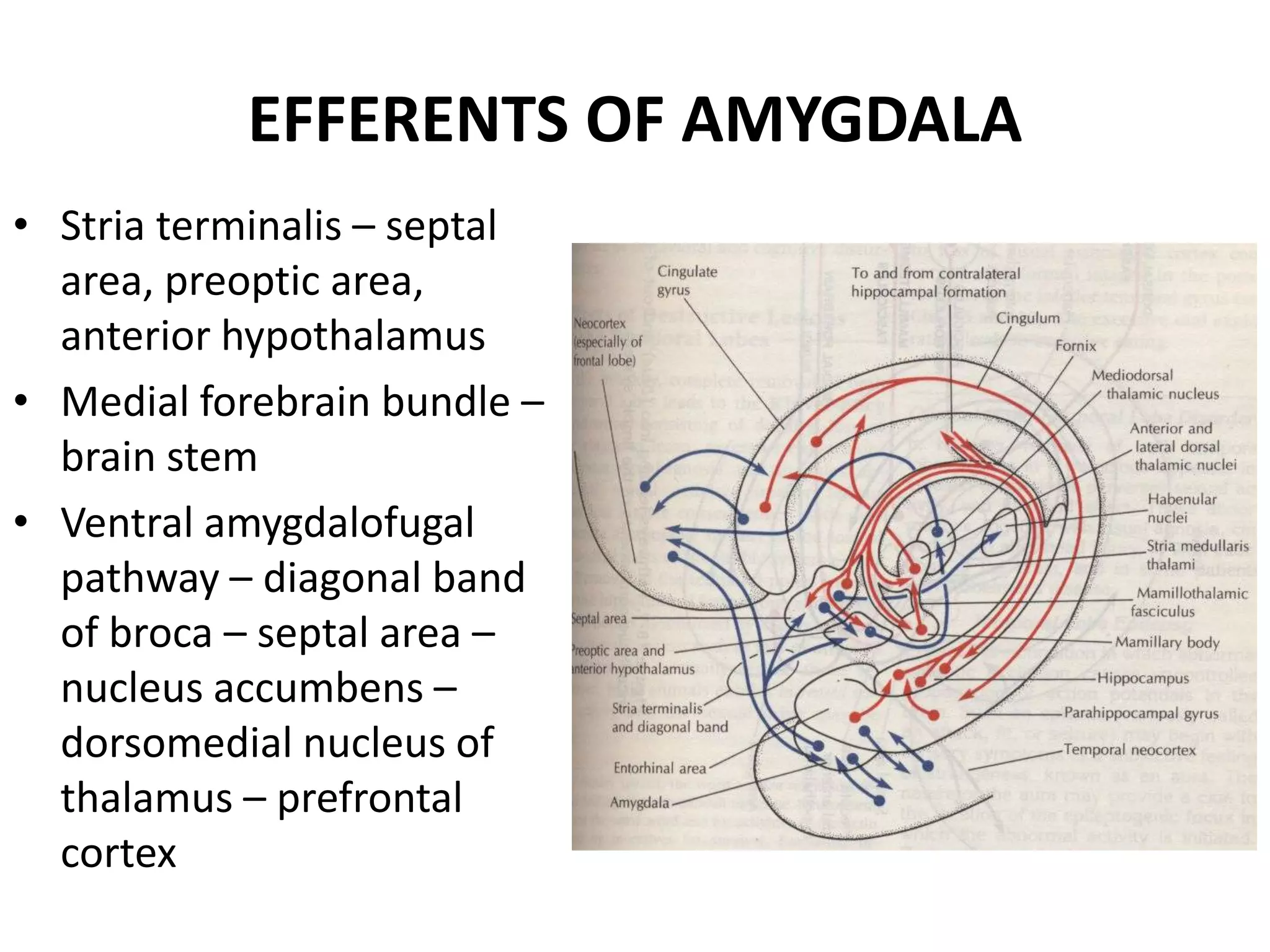
EFFERENTS OF AMYGDALA
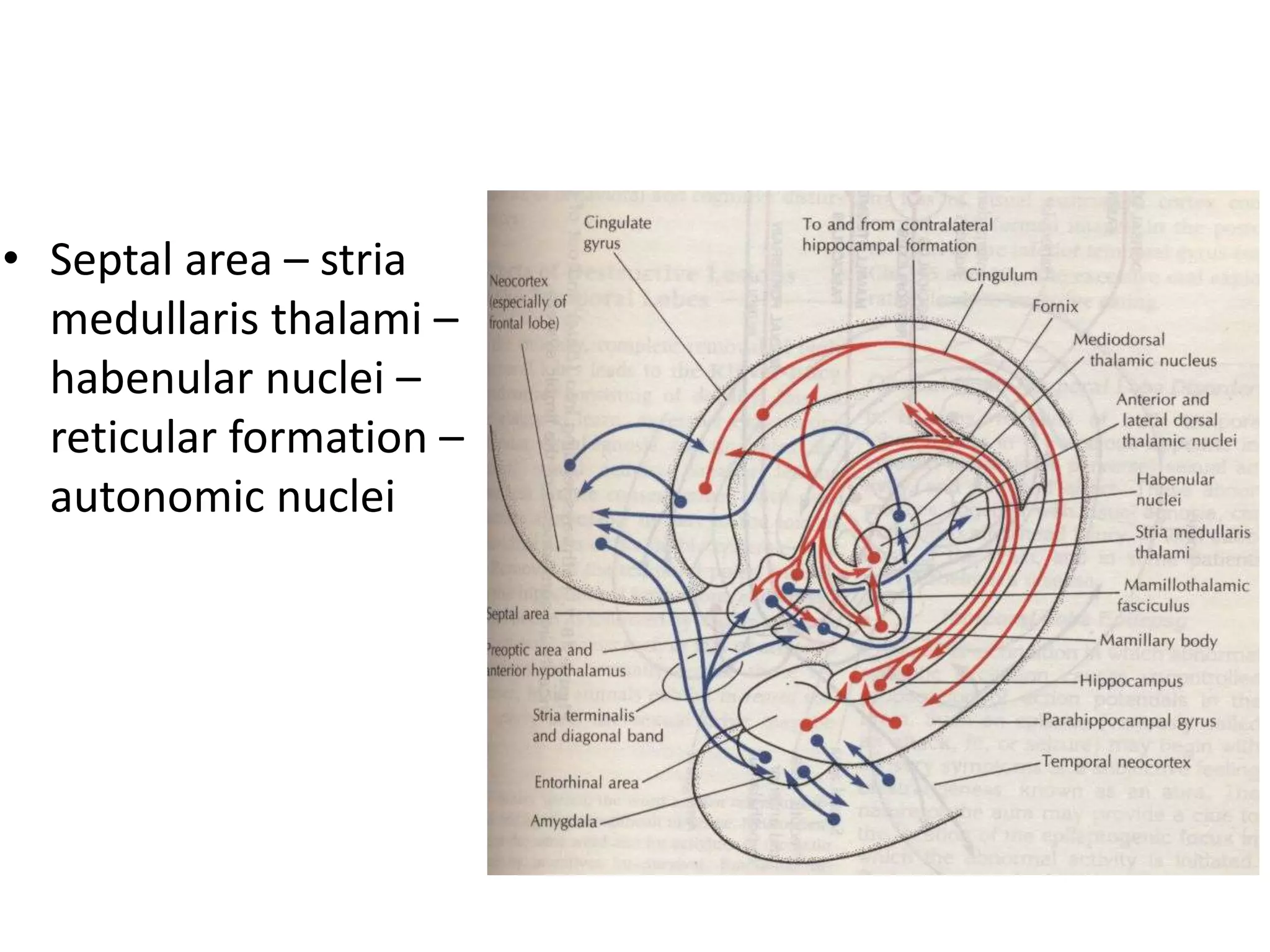
• Stria terminalis – septal
  area, preoptic area,
  anterior hypothalamus
• Medial forebrain bundle –
  brain stem
• Ventral amygdalofugal
  pathway – diagonal band
  of broca – septal area –
  nucleus accumbens –
  dorsomedial nucleus of
  thalamus – prefrontal
  cortex
• Septal area – stria
  medullaris thalami –
  habenular nuclei –
  reticular formation –
  autonomic nuclei
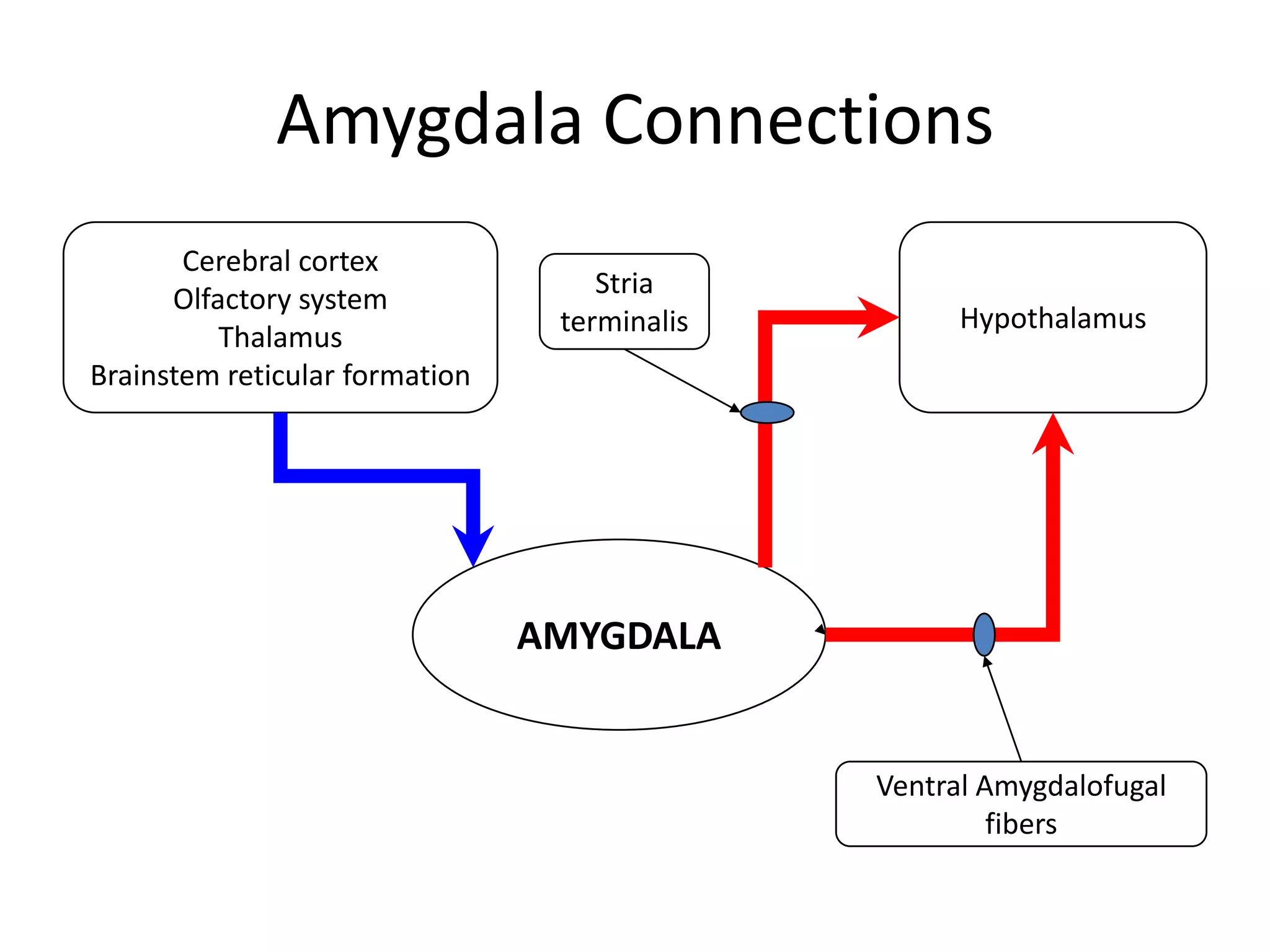
Amygdala Connections
       Cerebral cortex
                                    Stria
      Olfactory system
                                 terminalis         Hypothalamus
          Thalamus
Brainstem reticular formation


                                AMYGDALA


                                              Ventral Amygdalofugal
                                                       fibers
FUNCTIONS OF AMYGDALA
• Central and basolateral nuclei of amygdala –
  behavioral and emotional functions
• Emotional responses
• Electric stimulation – feeling of fear, general
  irritability, anger
• Behavioral and cognitive disturbances
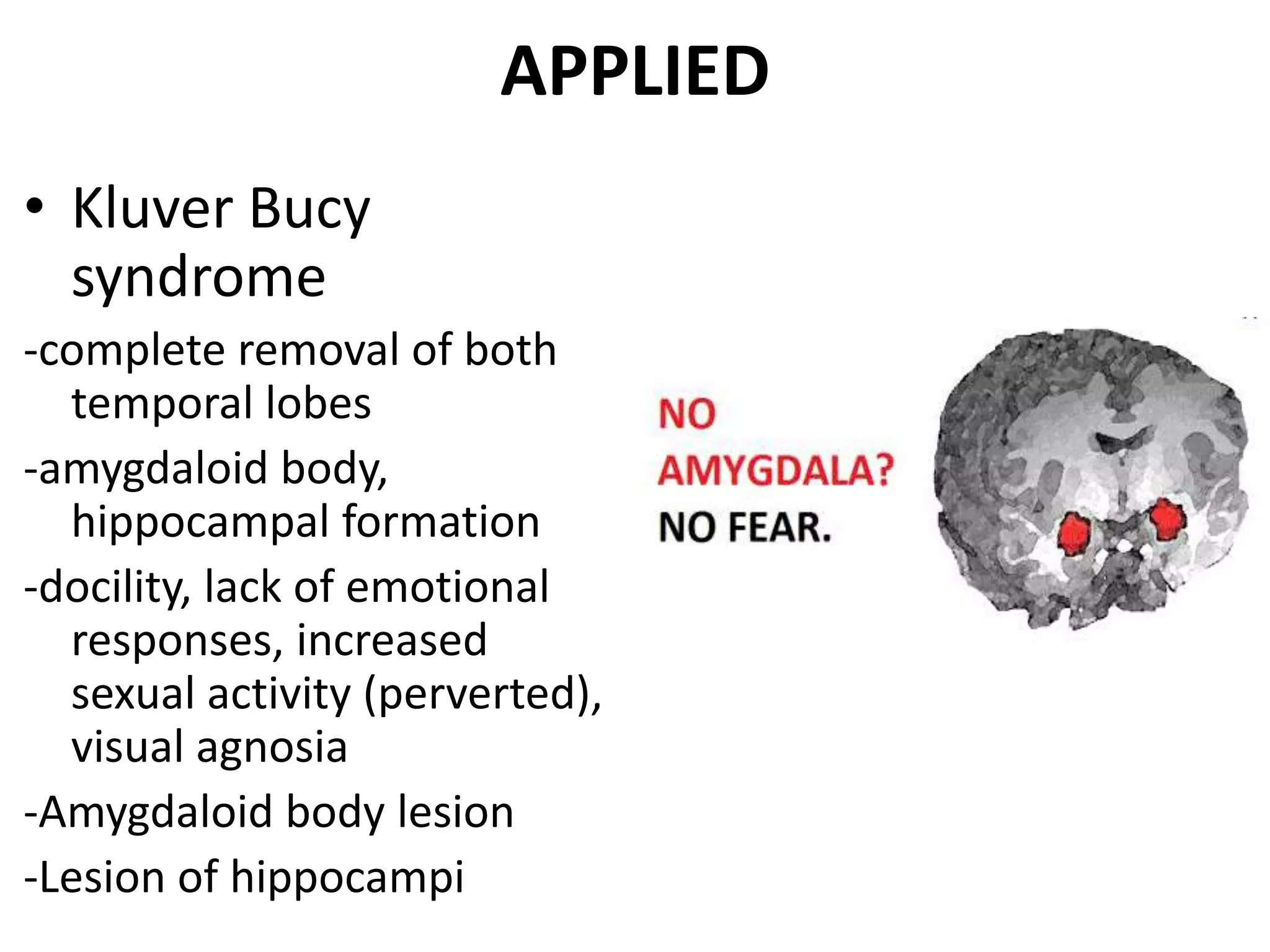
APPLIED
• Kluver Bucy
  syndrome
-complete removal of both
  temporal lobes
-amygdaloid body,
  hippocampal formation
-docility, lack of emotional
  responses, increased
  sexual activity (perverted),
  visual agnosia
-Amygdaloid body lesion
-Lesion of hippocampi
• Anxiety states
-Inappropriate activity of amygdala
-Panic attacks of excessive activity of sympathetic
   nervous system, subjective feeling of worry
-Treatment – anxiolytic drugs
• Schizophrenia
-anatomical measurements reduced in size
-antipsychotics antagonise action of dopamine
-parkinsonism
-tardive dyskinesia
• Memory disorders
-consolidation of new short term memory
-arterial occlusion – infarction – loss of hippocampal
   function
-transient global amnesia
-head injury –damage to hippocampus – hemorrhage –
   anterograde amnesia
- B/l hippocampal lesion – major circuit of hippocampus
- B/l transaction of fornix – severe amnesia

• Alzheimer’s disease –
- loss of cholinergic neurons of substantia innominata
   which project to hippocampus
 -ass. with degenerative changes in entorhinal cortex,
   hippocampus, extensive neocortical atrophy
-amnesia for recently occurred events as mechanism for
   retention of new memory not operating
5 limbic system

5 limbic system

  • 1.
    THE LIMBIC SYSTEM DR.SWATI PATIL
  • 2.
    LIMBIC SYSTEM • Introduction • Anatomical structures • Connecting pathways • Functions • Applied
  • 3.
    INTRODUCTION • Broca –greatlimbic lobe • Papez –circuit of Papez • Paul D. Maclean – reintroduced term limbic • Kluver Bucy –temporal lobectomy –Extreme behavioral syndrome – Kluver Bucy syndrome Paul D. MacLean
  • 4.
    FUNCTIONS OF LIMBICSYSTEM • Integration of olfactory, visceral, somatic impulses • Control of activities necessary for survival of animal • Control of activities necessary survival of species • Emotional behaviour • Retention of recent memory
  • 5.
  • 6.
    COMPONENTS OF LIMBICSYSTEM • Limbic lobe • Hippocampal formation • Amygdaloid body • Connecting pathways
  • 7.
  • 8.
  • 9.
    HIPPOCAMPAL FORMATION • Hippocampus proper • Dentate gyrus • Subicular complex • Entorhinal area
  • 10.
    HIPPOCAMPUS • Cornu ammonis • Location :- • Pes hippocampi • Alveus • Fimbria
  • 12.
  • 13.
    HIPPOCAMPUS • Trilaminar archicortex:- -3 distinct fields :-CA1,CA2,CA3 • CA3:- largest Pyramidal cells - receive mossy fibres • CA2 :-pyramidal cells -input from supramammillary region • CA1 :-most complex
  • 14.
    • Strata withinlayers of hippocampus :- - Stratum oriens - Stratum pyramidalis - Stratum radiatum - Stratum lacunosum • Schaffer’s collaterals • Perforant pathway
  • 15.
    DENTATE GYRUS • Crenatedstrip of cortex • Beaded/ toothed surface • Fimbriodentate sulcus • Gyrus fasciolaris & indusium griseum
  • 16.
  • 17.
  • 18.
    • Cotrex ofdentate gyrus -granule cell layer(principal cells) -molecular cell layer -polymorphic layer • Mossy fibres • Fascia dentata
  • 19.
    SUBICULAR COMPLEX • Subicularcomplex :- • Trilaminar archicortex -molecular layer -pyramidal layer:-major subcortical projections -polymorphic layer
  • 20.
    ENTORHINAL CORTEX (Brodmann’s area no 28) • Location :- • Receive projections from olfactory bulb • Layer 1-6:-
  • 21.
    FORNIX & FIMBRIA •Fimbria Of hippocampus • Crus of fornix : ->1 million fibres -afferent and efferents • Columns of fornix
  • 22.
    HIPPOCAPMAL COMPLEX: CIRCUITARY •Excitatory pathways -perforant pathway -mossy fibres -schaffer’s collaterals • Inhibitory pathways -GABA neurons in denatate gyrus
  • 24.
    AFFERENT CONNECTIONS 1. Cerebral neocortex 2. Septal area 3. c/l hippocampus 4. Nuclei in reticular formation of brain stem
  • 25.
    • Entorhinal area:-follow 2 routes to hippocampus -Perforant path -Alveolar path • Fornix and fimbria :- fibres come from C/L hippocampus -thalamic and hypothalamic nuclei -ventral tegmental nuclei -locus ceruleus -raphe nuclei
  • 26.
    EFFERENT CONNECTIONS • Efferents – same cortex - diencephalon - brain stem • Fornix :-largest efferents -originate in subiculum, hippocampus -Alveus – fimbria – crus of fornix – body of fornix • Parahippocampal gyrus – dorsal hippocampal commissure – hippocampal formation
  • 27.
    EFFERENTS • Columns offonix- septal area, ant part of hypothalamus, substantia innominata • Lateral dorsal thalamic nucleus – thalamus – mamillary body – ant nucleus of thalamus • Mamillotegmental fasciculus
  • 28.
    PAPEZ CIRCUIT • Thecircuit of Papez • Ring of interconnected neurons • Input to circuit • Output to circuit • Mamillotegmental fasciculus
  • 31.
    FUNCTIONS OF HIPPOCAMPUS • Retention of short term memory – long term declarative memory
  • 32.
  • 33.
    AMYGDALA • Almond • Involvedin Central regulation of ANS connection to hypothalamus • Controls survival fight- or-flight response of ANS • Emotional & visceral responses
  • 34.
    AMYGDALA • Several groupof nucleus • B/w inferior horn of lateral ventricle & lentiform nucleus • Two divisions :- -dorsomedial -ventrolateral – Basolateral - central
  • 36.
    AFFERENTS OF AMYGDALA •Reciprocal connections • Subcortical afferents • Dopaminergic afferents – ventral tegmental area • Cholinergic afferents – basal forebrain nuclei • Olfactory corticomedial & non olfactory basolateral nuclei – central nuclei
  • 37.
    EFFERENTS OF AMYGDALA •Stria terminalis – septal area, preoptic area, anterior hypothalamus • Medial forebrain bundle – brain stem • Ventral amygdalofugal pathway – diagonal band of broca – septal area – nucleus accumbens – dorsomedial nucleus of thalamus – prefrontal cortex
  • 38.
    • Septal area– stria medullaris thalami – habenular nuclei – reticular formation – autonomic nuclei
  • 39.
    Amygdala Connections Cerebral cortex Stria Olfactory system terminalis Hypothalamus Thalamus Brainstem reticular formation AMYGDALA Ventral Amygdalofugal fibers
  • 40.
    FUNCTIONS OF AMYGDALA •Central and basolateral nuclei of amygdala – behavioral and emotional functions • Emotional responses • Electric stimulation – feeling of fear, general irritability, anger • Behavioral and cognitive disturbances
  • 41.
    APPLIED • Kluver Bucy syndrome -complete removal of both temporal lobes -amygdaloid body, hippocampal formation -docility, lack of emotional responses, increased sexual activity (perverted), visual agnosia -Amygdaloid body lesion -Lesion of hippocampi
  • 42.
    • Anxiety states -Inappropriateactivity of amygdala -Panic attacks of excessive activity of sympathetic nervous system, subjective feeling of worry -Treatment – anxiolytic drugs
  • 43.
    • Schizophrenia -anatomical measurementsreduced in size -antipsychotics antagonise action of dopamine -parkinsonism -tardive dyskinesia
  • 44.
    • Memory disorders -consolidationof new short term memory -arterial occlusion – infarction – loss of hippocampal function -transient global amnesia -head injury –damage to hippocampus – hemorrhage – anterograde amnesia
  • 45.
    - B/l hippocampallesion – major circuit of hippocampus - B/l transaction of fornix – severe amnesia • Alzheimer’s disease – - loss of cholinergic neurons of substantia innominata which project to hippocampus -ass. with degenerative changes in entorhinal cortex, hippocampus, extensive neocortical atrophy -amnesia for recently occurred events as mechanism for retention of new memory not operating