( Neoclassical
theory of income
distribution.)
Labor Markets
Ways to interpret Economic theoryWays to interpret Economic theory
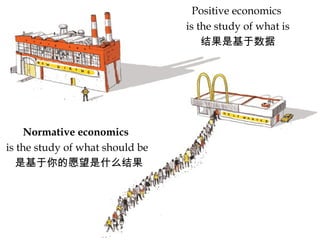
Positive economics
is the study of what is
结果是基于数据
Normative economics
is the study of what should be
是基于你的愿望是什么结果
This model explain
some of the forces that
describe the world in a
positive context.
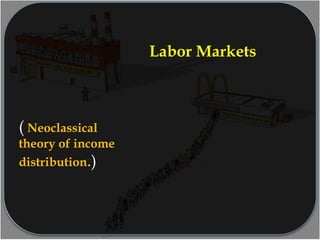
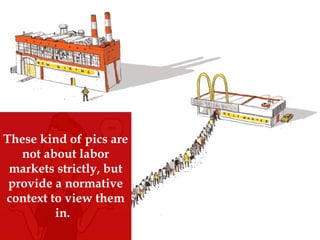
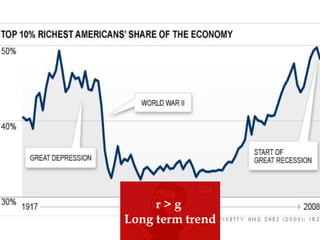
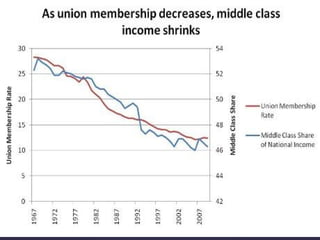
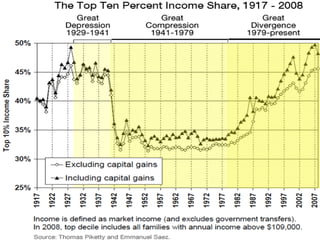
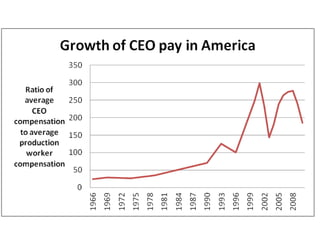
These kind of pics are
not about labor
markets strictly, but
provide a normative
context to view them
in.
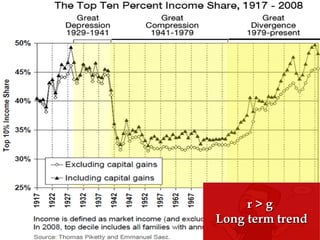
r > g
Long term trend
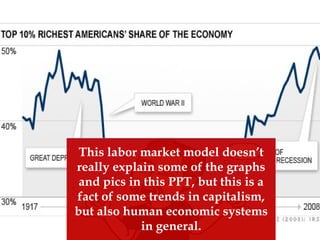
This labor market model doesn’t
really explain some of the graphs
and pics in this PPT, but this is a
fact of some trends in capitalism,
but also human economic systems
in general.
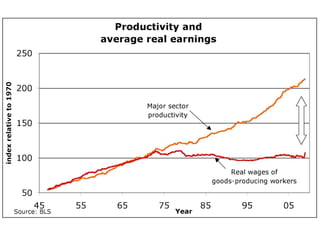
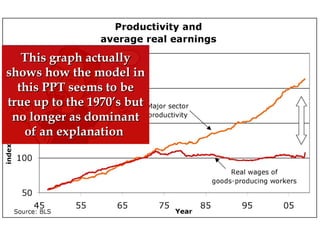
This graph actuallyThis graph actually
shows how the model inshows how the model in
this PPT seems to bethis PPT seems to be
true up to the 1970’s buttrue up to the 1970’s but
no longer as dominantno longer as dominant
of an explanationof an explanation
r > gr > g
Long term trendLong term trend
Positive economics
is the study of what is
结果是基于数据
Normative economics
is the study of what should be
是基于你的愿望是什么结果
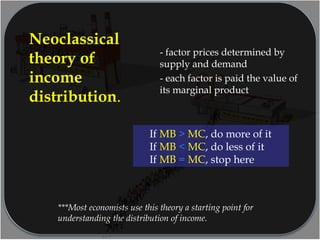
- factor prices determined by
supply and demand
- each factor is paid the value of
its marginal product
Neoclassical
theory of
income
distribution.
***Most economists use this theory a starting point for
understanding the distribution of income.
If MB > MC, do more of it
If MB < MC, do less of it
If MB = MC, stop here
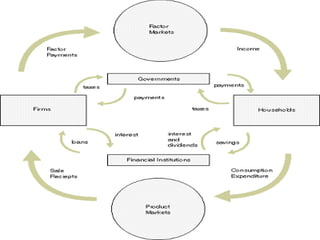
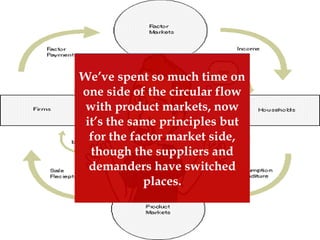
We’ve spent so much time on
one side of the circular flow
with product markets, now
it’s the same principles but
for the factor market side,
though the suppliers and
demanders have switched
places.
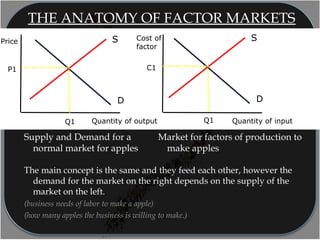
Price
Quantity of output
S
D
Quantity of inputQ1
P1
Supply and Demand for a
normal market for apples
Cost of
factor
Market for factors of production to
make apples
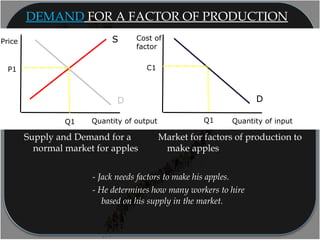
The main concept is the same and they feed each other, however the
demand for the market on the right depends on the supply of the
market on the left.
(business needs of labor to make a apple)
(how many apples the business is willing to make.)
THE ANATOMY OF FACTOR MARKETS
S
D
Q1
C1
Building the Model
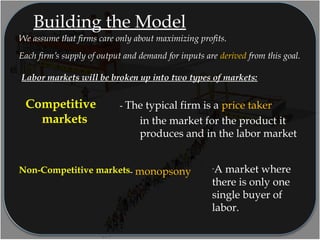
Labor markets will be broken up into two types of markets:
- The typical firm is a price taker
in the market for the product it
produces and in the labor market
- monopsony
Competitive
markets
Non-Competitive markets
We assume that firms care only about maximizing profits.
Each firm’s supply of output and demand for inputs are derived from this goal.
-A market where
there is only one
single buyer of
labor.
Building the Model
- We will look at the supply and demand for labor only.
- Since the other resource markets work in basically the same way, we
only have to look at one and simply apply the same logic and analysis to
the others.
- This does cause confusion with labels.
- This is because books and other sources will either discuss resources and
label it that way or just discuss labor and label it that way, and
sometimes it confusing, but for now at this level of discussion they will
mean the same thing.
- I will try to focus and use the same labels throughout, just beware some
may be used interchangeable.
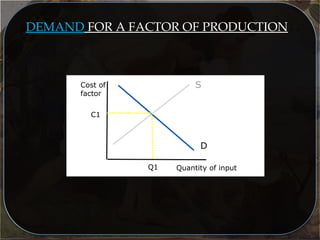
DEMAND FOR A FACTOR OF PRODUCTION
Quantity of input
Cost of
factor
S
D
Q1
C1
1.) Derived Demand
Example:
- Jack owns an apple farm
- He makes a determination about how many apples he can sell in the
market and the prices he can get for them.
- Jack needs factors to make his apples.
- He determines how many workers to hire based on his supply in the
market.
Markets for the factors of production (resources) are like markets
for goods & services, except it depends on two things:
-comes from a firm’s decision to
supply a good in another
market that the factor helped
produce.
DEMAND FOR A FACTOR OF PRODUCTION
Price
Quantity of output
S
D
Quantity of inputQ1
P1
Supply and Demand for a
normal market for apples
Cost of
factor
Market for factors of production to
make apples
D
Q1
C1
- Jack needs factors to make his apples.
- He determines how many workers to hire
based on his supply in the market.
DEMAND FOR A FACTOR OF PRODUCTION
Markets for the factors of production (resources) are like markets
for goods & services, except it depends on two things:
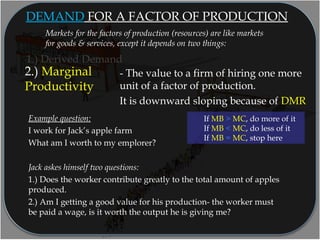
If MB > MC, do more of it
If MB < MC, do less of it
If MB = MC, stop here
- The value to a firm of hiring one more
unit of a factor of production.
It is downward sloping because of DMR
2.) Marginal
Productivity
Example question:
I work for Jack’s apple farm
What am I worth to my emplorer?
Jack askes himself two questions:
1.) Does the worker contribute greatly to the total amount of apples
produced.
2.) Am I getting a good value for his production- the worker must
be paid a wage, is it worth the output he is giving me?
1.) Derived Demand
DEMAND FOR A FACTOR OF PRODUCTION
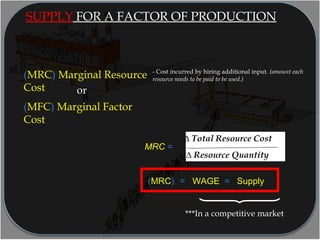
- Cost incurred by hiring additional input. (amount each
resource needs to be paid to be used.)
∆ Total Resource Cost
∆ Resource Quantity
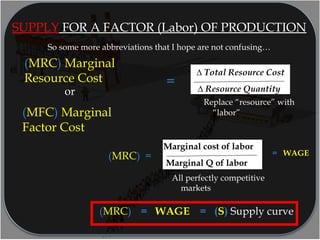
MRC =
(MRC) Marginal Resource
Cost
= WAGE(MRC)
(MFC) Marginal Factor
Cost
or
***In a competitive market
= Supply
SUPPLY FOR A FACTOR OF PRODUCTION
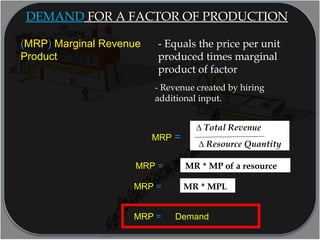
- Equals the price per unit
produced times marginal
product of factor
- Revenue created by hiring
additional input.
∆ Total Revenue
∆ Resource Quantity
MRP =
(MRP) Marginal Revenue
Product
MR * MP of a resource
MR * MPL
MRP =
MRP =
MRP = Demand
DEMAND FOR A FACTOR OF PRODUCTION
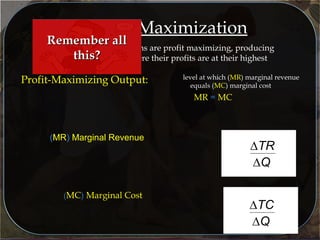
(MR) Marginal Revenue
Profit Maximization
∆TR
∆Q
Profit-Maximizing Output: level at which (MR) marginal revenue
equals (MC) marginal cost
MR = MC
We assume all firms are profit maximizing, producing
at the point where their profits are at their highest
(MC) Marginal Cost
∆TC
∆Q
Remember allRemember all
this?this?
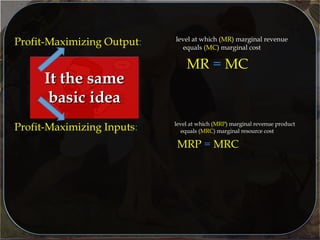
Profit-Maximizing Output: level at which (MR) marginal revenue
equals (MC) marginal cost
MR = MC
Profit-Maximizing Inputs: level at which (MRP) marginal revenue product
equals (MRC) marginal resource cost
MRP = MRC
It the sameIt the same
basic ideabasic idea
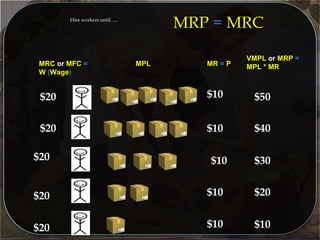
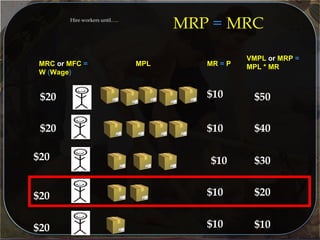
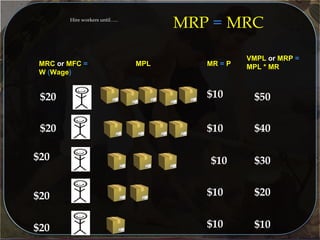
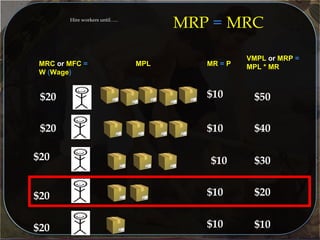
- The price you get for the product vs. the price you pay to make it.
Example:
-Hire one more worker.
-how much more does that worker produce.
-What is the price I sell these extra goods produced.
-Is the price I sell them for higher then the price I
paid for it to be produced.
One more time in simpler English…
$10
$10 $50
$20
$20
$20
$20
$10
$10
$20
$10
$40
$30
$20
$10
MRC or MFC =
W (Wage)
MPL
VMPL or MRP =
MPL * MRMR = P
MRP = MRCHire workers until…..
$10
$10 $50
$20
$20
$20
$20
$10
$10
$20
$10
$40
$30
$20
$10
MRC or MFC =
W (Wage)
MPL
VMPL or MRP =
MPL * MRMR = P
MRP = MRCHire workers until…..
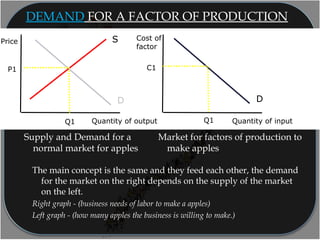
Price
Quantity of output
S
D
Quantity of inputQ1
P1
Supply and Demand for a
normal market for apples
Cost of
factor
Market for factors of production to
make apples
The main concept is the same and they feed each other, the demand
for the market on the right depends on the supply of the market
on the left.
Right graph - (business needs of labor to make a apples)
Left graph - (how many apples the business is willing to make.)
D
Q1
C1
DEMAND FOR A FACTOR OF PRODUCTION
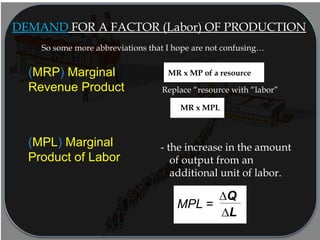
(MRP) Marginal
Revenue Product
So some more abbreviations that I hope are not confusing…
DEMAND FOR A FACTOR (Labor) OF PRODUCTION
Replace “resource with “labor”
(MPL) Marginal
Product of Labor
MR x MP of a resource
- the increase in the amount
of output from an
additional unit of labor.
∆Q
∆L
MPL =
MR x MPL
DEMAND FOR A FACTOR (Labor) OF PRODUCTION
(MPL) Marginal
Product of Labor
- the increase in the amount of output
from an additional unit of labor.
A different book would explain it this way……
DEMAND FOR A FACTOR (Labor) OF PRODUCTION
(MPL) Marginal
Product of Labor
- the increase in the amount of output
from an additional unit of labor.
Problem:
- Cost of hiring another worker (wage) is measured in dollars.
- Benefit of hiring another worker (MPL) is measured in units of
output.
Solution: convert MPL to dollars.
A different book would explain it this way……
DEMAND FOR A FACTOR (Labor) OF PRODUCTION
(MPL) Marginal
Product of Labor
- the increase in the amount of output
from an additional unit of labor.
Problem:
- Cost of hiring another worker (wage) is measured in dollars.
- Benefit of hiring another worker (MPL) is measured in units of
output.
Solution: convert MPL to dollars.
A different book would explain it this way……
(VMPL) Value of the
Marginal Product of
Labor
(MR) Marginal Revenue = P All perfectly competitive markets
- the marginal product of an input
times the price of the output.
P x MPLVMPL =
DEMAND FOR A FACTOR (Labor) OF PRODUCTION
(MRP)
Marginal
Revenue
Product
(VMPL)
Value of the
Marginal
Product of
Labor
MR x MPL
=
- They mean the same thing,
just some sources use one
and some use the other.
This is the simplest equation to use for both =
= (D)
Demand
curve
- They mean the same thing,
just some sources use one and
some use the other.
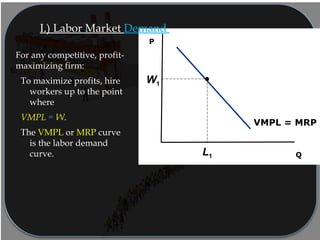
VMPL = MRP
I.) Labor Market Demand
Q
P
For any competitive, profit-
maximizing firm:
To maximize profits, hire
workers up to the point
where
VMPL = W.
The VMPL or MRP curve
is the labor demand
curve.
W1
L1
Farmer Jack has an apple farm
- Cost of hiring another worker:
the wage – the price of labor
- Benefit of hiring another worker:
Jack can produce more apples to sell,
increasing his revenue.
DEMAND FOR LABOR Example:
Farmer Jack has an apple farm
- Cost of hiring another worker:
the wage – the price of labor
- Benefit of hiring another worker:
Jack can produce more apples to sell,
increasing his revenue.
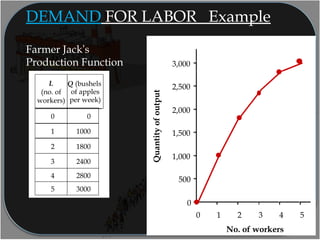
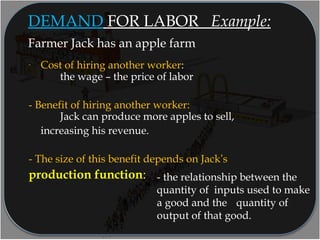
- The size of this benefit depends on Jack’s
production function:
DEMAND FOR LABOR Example:
- the relationship between the
quantity of inputs used to make
a good and the quantity of
output of that good.
0
500
1,000
1,500
2,000
2,500
3,000
0 1 2 3 4 5
No. of workers
Quantityofoutput
Farmer Jack’s
Production Function
30005
28004
24003
18002
10001
00
Q (bushels
of apples
per week)
L
(no. of
workers)
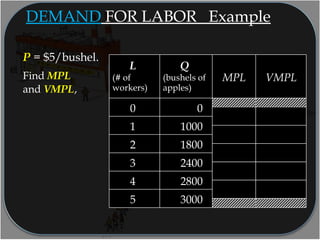
DEMAND FOR LABOR Example
P = $5/bushel.
Find MPL
and VMPL,
30005
28004
24003
18002
10001
00
VMPLMPL
Q
(bushels of
apples)
L
(# of
workers)
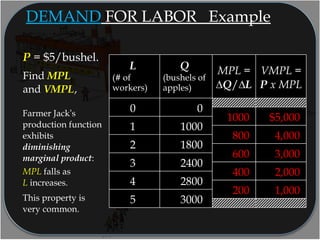
DEMAND FOR LABOR Example
Farmer Jack’s
production function
exhibits
diminishing
marginal product:
MPL falls as
L increases.
This property is
very common.
30005
28004
24003
18002
10001
00
VMPL =
P x MPL
MPL =
∆Q/∆L
Q
(bushels of
apples)
L
(# of
workers)
1,000200
2,000400
3,000600
4,000800
$5,0001000
DEMAND FOR LABOR Example
P = $5/bushel.
Find MPL
and VMPL,
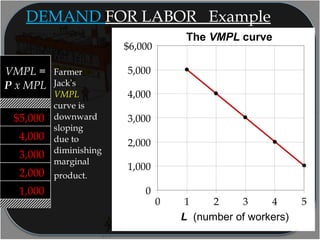
Farmer
Jack’s
VMPL
curve is
downward
sloping
due to
diminishing
marginal
product.
L (number of workers)
The VMPL curve
0
1,000
2,000
3,000
4,000
5,000
$6,000
0 1 2 3 4 5
DEMAND FOR LABOR Example
VMPL =
P x MPL
1,000
2,000
3,000
4,000
$5,000
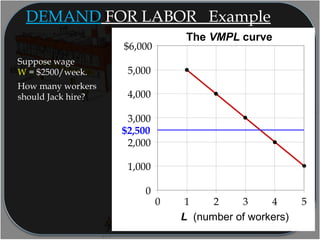
Suppose wage
W = $2500/week.
How many workers
should Jack hire?
L (number of workers)
The VMPL curve
0
1,000
2,000
3,000
4,000
5,000
$6,000
0 1 2 3 4 5
$2,500
DEMAND FOR LABOR Example
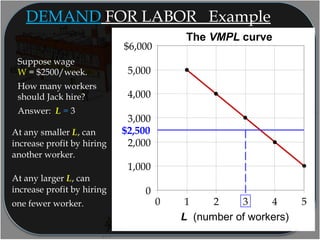
At any larger L, can
increase profit by hiring
one fewer worker.
Suppose wage
W = $2500/week.
How many workers
should Jack hire?
Answer: L = 3
L (number of workers)
The VMPL curve
0
1,000
2,000
3,000
4,000
5,000
$6,000
0 1 2 3 4 5
$2,500At any smaller L, can
increase profit by hiring
another worker.
DEMAND FOR LABOR Example
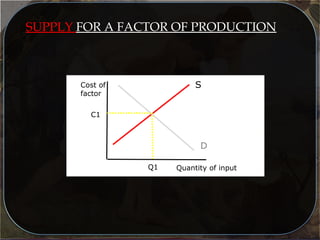
SUPPLY FOR A FACTOR OF PRODUCTION
Quantity of input
Cost of
factor
S
D
Q1
C1
Replace “resource” with
“labor”
(MRC) Marginal
Resource Cost
∆ Total Resource Cost
∆ Resource Quantity
=
SUPPLY FOR A FACTOR (Labor) OF PRODUCTION
= WAGE
So some more abbreviations that I hope are not confusing…
Marginal cost of labor
Marginal Q of labor
=(MRC)
= WAGE(MRC)
All perfectly competitive
markets
= (S) Supply curve
(MFC) Marginal
Factor Cost
or
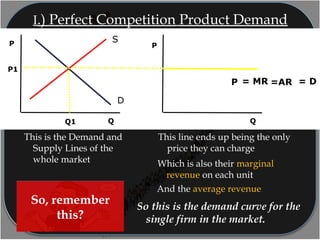
P
Q
P
S
D
QQ1
P1
This is the Demand and
Supply Lines of the
whole market
P
This line ends up being the only
price they can charge
= MR
Which is also their marginal
revenue on each unit
= D=AR
And the average revenue
So this is the demand curve for the
single firm in the market.
I.) Perfect Competition Product Demand
So, remember
this?
P
Q
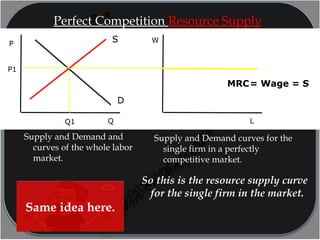
Perfect Competition Resource Supply
S
D
LQ1
P1
Supply and Demand and
curves of the whole labor
market.
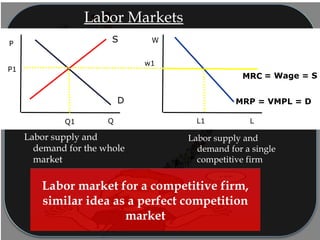
W
Supply and Demand curves for the
single firm in a perfectly
competitive market.
MRC= Wage = S
So this is the resource supply curve
for the single firm in the market.
Same idea here.
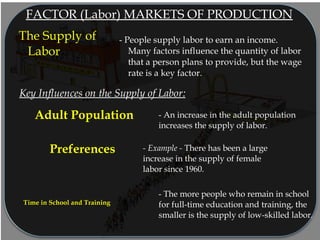
FACTOR (Labor) MARKETS OF PRODUCTION
The Supply of
Labor
- People supply labor to earn an income.
Many factors influence the quantity of labor
that a person plans to provide, but the wage
rate is a key factor.
Key Influences on the Supply of Labor:
- An increase in the adult population
increases the supply of labor.
Adult Population
- Example - There has been a large
increase in the supply of female
labor since 1960.
Preferences
- The more people who remain in school
for full-time education and training, the
smaller is the supply of low-skilled labor.
Time in School and Training
P
Q
Labor Markets
S
D
LQ1
P1
Labor supply and
demand for the whole
market
W
Labor supply and
demand for a single
competitive firm
MRC = Wage = S
MRP = VMPL = D
L1
w1
Labor market for a competitive firm,
similar idea as a perfect competition
market
$10
$10 $50
$20
$20
$20
$20
$10
$10
$20
$10
$40
$30
$20
$10
MRC or MFC =
W (Wage)
MPL
VMPL or MRP =
MPL * MRMR = P
MRP = MRCHire workers until…..
$10
$10 $50
$20
$20
$20
$20
$10
$10
$20
$10
$40
$30
$20
$10
MRC or MFC =
W (Wage)
MPL
VMPL or MRP =
MPL * MRMR = P
MRP = MRCHire workers until…..
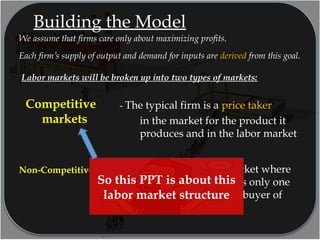
Building the Model
Labor markets will be broken up into two types of markets:
- The typical firm is a price taker
in the market for the product it
produces and in the labor market
- monopsony
Competitive
markets
Non-Competitive markets
We assume that firms care only about maximizing profits.
Each firm’s supply of output and demand for inputs are derived from this goal.
-A market where
there is only one
single buyer of
labor.
So this PPT is about this
labor market structure
Building the Model
Labor markets will be broken up into two types of markets:
- The typical firm is a price taker
in the market for the product it
produces and in the labor market
- monopsony
Competitive
markets
Non-Competitive markets
We assume that firms care only about maximizing profits.
Each firm’s supply of output and demand for inputs are derived from this goal.
-A market where
there is only one
single buyer of
labor.
Next PPT is this one
That’s it for now
Thank you


Labor markets SFLS online

  • 1.
    ( Neoclassical theory ofincome distribution.) Labor Markets
  • 2.
    Ways to interpretEconomic theoryWays to interpret Economic theory Positive economics is the study of what is 结果是基于数据 Normative economics is the study of what should be 是基于你的愿望是什么结果 This model explain some of the forces that describe the world in a positive context.
  • 3.
    These kind ofpics are not about labor markets strictly, but provide a normative context to view them in.
  • 4.
    r > g Longterm trend
  • 5.
    This labor marketmodel doesn’t really explain some of the graphs and pics in this PPT, but this is a fact of some trends in capitalism, but also human economic systems in general.
  • 7.
    This graph actuallyThisgraph actually shows how the model inshows how the model in this PPT seems to bethis PPT seems to be true up to the 1970’s buttrue up to the 1970’s but no longer as dominantno longer as dominant of an explanationof an explanation
  • 10.
    r > gr> g Long term trendLong term trend
  • 12.
    Positive economics is thestudy of what is 结果是基于数据 Normative economics is the study of what should be 是基于你的愿望是什么结果
  • 13.
    - factor pricesdetermined by supply and demand - each factor is paid the value of its marginal product Neoclassical theory of income distribution. ***Most economists use this theory a starting point for understanding the distribution of income. If MB > MC, do more of it If MB < MC, do less of it If MB = MC, stop here
  • 15.
    We’ve spent somuch time on one side of the circular flow with product markets, now it’s the same principles but for the factor market side, though the suppliers and demanders have switched places.
  • 16.
    Price Quantity of output S D Quantityof inputQ1 P1 Supply and Demand for a normal market for apples Cost of factor Market for factors of production to make apples The main concept is the same and they feed each other, however the demand for the market on the right depends on the supply of the market on the left. (business needs of labor to make a apple) (how many apples the business is willing to make.) THE ANATOMY OF FACTOR MARKETS S D Q1 C1
  • 17.
    Building the Model Labormarkets will be broken up into two types of markets: - The typical firm is a price taker in the market for the product it produces and in the labor market - monopsony Competitive markets Non-Competitive markets We assume that firms care only about maximizing profits. Each firm’s supply of output and demand for inputs are derived from this goal. -A market where there is only one single buyer of labor.
  • 18.
    Building the Model -We will look at the supply and demand for labor only. - Since the other resource markets work in basically the same way, we only have to look at one and simply apply the same logic and analysis to the others. - This does cause confusion with labels. - This is because books and other sources will either discuss resources and label it that way or just discuss labor and label it that way, and sometimes it confusing, but for now at this level of discussion they will mean the same thing. - I will try to focus and use the same labels throughout, just beware some may be used interchangeable.
  • 19.
    DEMAND FOR AFACTOR OF PRODUCTION Quantity of input Cost of factor S D Q1 C1
  • 20.
    1.) Derived Demand Example: -Jack owns an apple farm - He makes a determination about how many apples he can sell in the market and the prices he can get for them. - Jack needs factors to make his apples. - He determines how many workers to hire based on his supply in the market. Markets for the factors of production (resources) are like markets for goods & services, except it depends on two things: -comes from a firm’s decision to supply a good in another market that the factor helped produce. DEMAND FOR A FACTOR OF PRODUCTION
  • 21.
    Price Quantity of output S D Quantityof inputQ1 P1 Supply and Demand for a normal market for apples Cost of factor Market for factors of production to make apples D Q1 C1 - Jack needs factors to make his apples. - He determines how many workers to hire based on his supply in the market. DEMAND FOR A FACTOR OF PRODUCTION
  • 22.
    Markets for thefactors of production (resources) are like markets for goods & services, except it depends on two things: If MB > MC, do more of it If MB < MC, do less of it If MB = MC, stop here - The value to a firm of hiring one more unit of a factor of production. It is downward sloping because of DMR 2.) Marginal Productivity Example question: I work for Jack’s apple farm What am I worth to my emplorer? Jack askes himself two questions: 1.) Does the worker contribute greatly to the total amount of apples produced. 2.) Am I getting a good value for his production- the worker must be paid a wage, is it worth the output he is giving me? 1.) Derived Demand DEMAND FOR A FACTOR OF PRODUCTION
  • 23.
    - Cost incurredby hiring additional input. (amount each resource needs to be paid to be used.) ∆ Total Resource Cost ∆ Resource Quantity MRC = (MRC) Marginal Resource Cost = WAGE(MRC) (MFC) Marginal Factor Cost or ***In a competitive market = Supply SUPPLY FOR A FACTOR OF PRODUCTION
  • 24.
    - Equals theprice per unit produced times marginal product of factor - Revenue created by hiring additional input. ∆ Total Revenue ∆ Resource Quantity MRP = (MRP) Marginal Revenue Product MR * MP of a resource MR * MPL MRP = MRP = MRP = Demand DEMAND FOR A FACTOR OF PRODUCTION
  • 25.
    (MR) Marginal Revenue ProfitMaximization ∆TR ∆Q Profit-Maximizing Output: level at which (MR) marginal revenue equals (MC) marginal cost MR = MC We assume all firms are profit maximizing, producing at the point where their profits are at their highest (MC) Marginal Cost ∆TC ∆Q Remember allRemember all this?this?
  • 26.
    Profit-Maximizing Output: levelat which (MR) marginal revenue equals (MC) marginal cost MR = MC Profit-Maximizing Inputs: level at which (MRP) marginal revenue product equals (MRC) marginal resource cost MRP = MRC It the sameIt the same basic ideabasic idea
  • 27.
    - The priceyou get for the product vs. the price you pay to make it. Example: -Hire one more worker. -how much more does that worker produce. -What is the price I sell these extra goods produced. -Is the price I sell them for higher then the price I paid for it to be produced. One more time in simpler English…
  • 28.
    $10 $10 $50 $20 $20 $20 $20 $10 $10 $20 $10 $40 $30 $20 $10 MRC orMFC = W (Wage) MPL VMPL or MRP = MPL * MRMR = P MRP = MRCHire workers until…..
  • 29.
    $10 $10 $50 $20 $20 $20 $20 $10 $10 $20 $10 $40 $30 $20 $10 MRC orMFC = W (Wage) MPL VMPL or MRP = MPL * MRMR = P MRP = MRCHire workers until…..
  • 30.
    Price Quantity of output S D Quantityof inputQ1 P1 Supply and Demand for a normal market for apples Cost of factor Market for factors of production to make apples The main concept is the same and they feed each other, the demand for the market on the right depends on the supply of the market on the left. Right graph - (business needs of labor to make a apples) Left graph - (how many apples the business is willing to make.) D Q1 C1 DEMAND FOR A FACTOR OF PRODUCTION
  • 31.
    (MRP) Marginal Revenue Product Sosome more abbreviations that I hope are not confusing… DEMAND FOR A FACTOR (Labor) OF PRODUCTION Replace “resource with “labor” (MPL) Marginal Product of Labor MR x MP of a resource - the increase in the amount of output from an additional unit of labor. ∆Q ∆L MPL = MR x MPL
  • 32.
    DEMAND FOR AFACTOR (Labor) OF PRODUCTION (MPL) Marginal Product of Labor - the increase in the amount of output from an additional unit of labor. A different book would explain it this way……
  • 33.
    DEMAND FOR AFACTOR (Labor) OF PRODUCTION (MPL) Marginal Product of Labor - the increase in the amount of output from an additional unit of labor. Problem: - Cost of hiring another worker (wage) is measured in dollars. - Benefit of hiring another worker (MPL) is measured in units of output. Solution: convert MPL to dollars. A different book would explain it this way……
  • 34.
    DEMAND FOR AFACTOR (Labor) OF PRODUCTION (MPL) Marginal Product of Labor - the increase in the amount of output from an additional unit of labor. Problem: - Cost of hiring another worker (wage) is measured in dollars. - Benefit of hiring another worker (MPL) is measured in units of output. Solution: convert MPL to dollars. A different book would explain it this way…… (VMPL) Value of the Marginal Product of Labor (MR) Marginal Revenue = P All perfectly competitive markets - the marginal product of an input times the price of the output. P x MPLVMPL =
  • 35.
    DEMAND FOR AFACTOR (Labor) OF PRODUCTION (MRP) Marginal Revenue Product (VMPL) Value of the Marginal Product of Labor MR x MPL = - They mean the same thing, just some sources use one and some use the other. This is the simplest equation to use for both = = (D) Demand curve - They mean the same thing, just some sources use one and some use the other.
  • 36.
    VMPL = MRP I.)Labor Market Demand Q P For any competitive, profit- maximizing firm: To maximize profits, hire workers up to the point where VMPL = W. The VMPL or MRP curve is the labor demand curve. W1 L1
  • 37.
    Farmer Jack hasan apple farm - Cost of hiring another worker: the wage – the price of labor - Benefit of hiring another worker: Jack can produce more apples to sell, increasing his revenue. DEMAND FOR LABOR Example:
  • 38.
    Farmer Jack hasan apple farm - Cost of hiring another worker: the wage – the price of labor - Benefit of hiring another worker: Jack can produce more apples to sell, increasing his revenue. - The size of this benefit depends on Jack’s production function: DEMAND FOR LABOR Example: - the relationship between the quantity of inputs used to make a good and the quantity of output of that good.
  • 39.
    0 500 1,000 1,500 2,000 2,500 3,000 0 1 23 4 5 No. of workers Quantityofoutput Farmer Jack’s Production Function 30005 28004 24003 18002 10001 00 Q (bushels of apples per week) L (no. of workers) DEMAND FOR LABOR Example
  • 40.
    P = $5/bushel. FindMPL and VMPL, 30005 28004 24003 18002 10001 00 VMPLMPL Q (bushels of apples) L (# of workers) DEMAND FOR LABOR Example
  • 41.
    Farmer Jack’s production function exhibits diminishing marginalproduct: MPL falls as L increases. This property is very common. 30005 28004 24003 18002 10001 00 VMPL = P x MPL MPL = ∆Q/∆L Q (bushels of apples) L (# of workers) 1,000200 2,000400 3,000600 4,000800 $5,0001000 DEMAND FOR LABOR Example P = $5/bushel. Find MPL and VMPL,
  • 42.
    Farmer Jack’s VMPL curve is downward sloping due to diminishing marginal product. L(number of workers) The VMPL curve 0 1,000 2,000 3,000 4,000 5,000 $6,000 0 1 2 3 4 5 DEMAND FOR LABOR Example VMPL = P x MPL 1,000 2,000 3,000 4,000 $5,000
  • 43.
    Suppose wage W =$2500/week. How many workers should Jack hire? L (number of workers) The VMPL curve 0 1,000 2,000 3,000 4,000 5,000 $6,000 0 1 2 3 4 5 $2,500 DEMAND FOR LABOR Example
  • 44.
    At any largerL, can increase profit by hiring one fewer worker. Suppose wage W = $2500/week. How many workers should Jack hire? Answer: L = 3 L (number of workers) The VMPL curve 0 1,000 2,000 3,000 4,000 5,000 $6,000 0 1 2 3 4 5 $2,500At any smaller L, can increase profit by hiring another worker. DEMAND FOR LABOR Example
  • 45.
    SUPPLY FOR AFACTOR OF PRODUCTION Quantity of input Cost of factor S D Q1 C1
  • 46.
    Replace “resource” with “labor” (MRC)Marginal Resource Cost ∆ Total Resource Cost ∆ Resource Quantity = SUPPLY FOR A FACTOR (Labor) OF PRODUCTION = WAGE So some more abbreviations that I hope are not confusing… Marginal cost of labor Marginal Q of labor =(MRC) = WAGE(MRC) All perfectly competitive markets = (S) Supply curve (MFC) Marginal Factor Cost or
  • 47.
    P Q P S D QQ1 P1 This is theDemand and Supply Lines of the whole market P This line ends up being the only price they can charge = MR Which is also their marginal revenue on each unit = D=AR And the average revenue So this is the demand curve for the single firm in the market. I.) Perfect Competition Product Demand So, remember this?
  • 48.
    P Q Perfect Competition ResourceSupply S D LQ1 P1 Supply and Demand and curves of the whole labor market. W Supply and Demand curves for the single firm in a perfectly competitive market. MRC= Wage = S So this is the resource supply curve for the single firm in the market. Same idea here.
  • 49.
    FACTOR (Labor) MARKETSOF PRODUCTION The Supply of Labor - People supply labor to earn an income. Many factors influence the quantity of labor that a person plans to provide, but the wage rate is a key factor. Key Influences on the Supply of Labor: - An increase in the adult population increases the supply of labor. Adult Population - Example - There has been a large increase in the supply of female labor since 1960. Preferences - The more people who remain in school for full-time education and training, the smaller is the supply of low-skilled labor. Time in School and Training
  • 50.
    P Q Labor Markets S D LQ1 P1 Labor supplyand demand for the whole market W Labor supply and demand for a single competitive firm MRC = Wage = S MRP = VMPL = D L1 w1 Labor market for a competitive firm, similar idea as a perfect competition market
  • 51.
    $10 $10 $50 $20 $20 $20 $20 $10 $10 $20 $10 $40 $30 $20 $10 MRC orMFC = W (Wage) MPL VMPL or MRP = MPL * MRMR = P MRP = MRCHire workers until…..
  • 52.
    $10 $10 $50 $20 $20 $20 $20 $10 $10 $20 $10 $40 $30 $20 $10 MRC orMFC = W (Wage) MPL VMPL or MRP = MPL * MRMR = P MRP = MRCHire workers until…..
  • 53.
    Building the Model Labormarkets will be broken up into two types of markets: - The typical firm is a price taker in the market for the product it produces and in the labor market - monopsony Competitive markets Non-Competitive markets We assume that firms care only about maximizing profits. Each firm’s supply of output and demand for inputs are derived from this goal. -A market where there is only one single buyer of labor. So this PPT is about this labor market structure
  • 54.
    Building the Model Labormarkets will be broken up into two types of markets: - The typical firm is a price taker in the market for the product it produces and in the labor market - monopsony Competitive markets Non-Competitive markets We assume that firms care only about maximizing profits. Each firm’s supply of output and demand for inputs are derived from this goal. -A market where there is only one single buyer of labor. Next PPT is this one
  • 55.
    That’s it fornow Thank you 

Editor's Notes

  • #41 This exercise should not be difficult. But students are more likely to remember how to compute MPL and VMPL if we make them do it instead of just showing them the results. And students have computed lots of marginal things from preceding chapters, so they should be able to do this exercise using only the definitions of MPL and VMPL from the preceding slides.
  • #43 Some students may not offset the points between the L values, as shown here and in the table on the preceding slide. For our purposes, that’s okay. What matters is they see that VMPL is a downward-sloping curve. They will get the rest from the following slides.
  • #44 A student may wonder why we are measuring the wage in dollars per week rather than dollars per hour. If a student asks this question, before giving the answer, see if another student can explain the answer. The answer is: our task here is to compare the cost and benefit of hiring an extra worker. The benefit, P x MPL, is extra revenue per week from having one more workers (recall, the production function and hence MPL are measured in units per week). So we must compare that to the cost per week of having one more worker. The logic behind the answer L = 3 is the same marginal analysis that students have seen in many other contexts in previous chapters. At any L smaller than L = 3, can increase profit by hiring another worker. For example, suppose Jack has 2 workers. At L = 2, VMPL &amp;gt; W. In other words, the increase in revenue from hiring one more worker exceeds the increase in cost (the wage). So, hiring one more worker would increase profit. At any L larger than L = 3, can increase profit by hiring one fewer worker. For example, suppose Jack has 4 workers. At L = 4, VMPL &amp;lt; W. In other words, the revenue from the 4th worker is less than the cost of that worker, so Jack can increase profit by hiring one fewer worker.
  • #45 A student may wonder why we are measuring the wage in dollars per week rather than dollars per hour. If a student asks this question, before giving the answer, see if another student can explain the answer. The answer is: our task here is to compare the cost and benefit of hiring an extra worker. The benefit, P x MPL, is extra revenue per week from having one more workers (recall, the production function and hence MPL are measured in units per week). So we must compare that to the cost per week of having one more worker. The logic behind the answer L = 3 is the same marginal analysis that students have seen in many other contexts in previous chapters. At any L smaller than L = 3, can increase profit by hiring another worker. For example, suppose Jack has 2 workers. At L = 2, VMPL &amp;gt; W. In other words, the increase in revenue from hiring one more worker exceeds the increase in cost (the wage). So, hiring one more worker would increase profit. At any L larger than L = 3, can increase profit by hiring one fewer worker. For example, suppose Jack has 4 workers. At L = 4, VMPL &amp;lt; W. In other words, the revenue from the 4th worker is less than the cost of that worker, so Jack can increase profit by hiring one fewer worker.